Posted tagged ‘Iranian proxies’

Establishing a Palestinian Islamist State

June 23, 2015

Establishing a Palestinian Islamist State, The Gatestone InstituteBassam Tawil, June 23, 2015

  • The United Nations’ verdict of guilty to Israel, in its “Schabas Report,” issued yesterday, was written even before the trial began.
  • Only the wide-eyed West still does not believe that Mahmoud Abbas is telling the truth when he assures the Palestinians of his intent to destroy Israel.
  • All public opinion polls in the Palestinian Authority (PA) indicate that if elections were held today, Hamas — whose only openly-stated reason for existing is to destroy Israel — would win in a landslide, as in 2006. Gaza has already been lost to Hamas and perhaps soon to ISIS. All evidence reveals that to establish a Palestinian state now would turn it into an Islamist terrorist entity.
  • Abbas thought that forming a Unity Government with Hamas would give the PA a unified front with which to harvest more money and diplomatic concessions from Europe. But last summer, Abbas was informed of a Hamas murder plot against him.

The Middle East is at it again. At the top of the list, no one, it seems, is even thinking of stopping Iran from acquiring nuclear weapons capability — and by extension at least several other countries in the region, including Saudi Arabia, Turkey and Egypt.

First, It is dangerous enough for any openly expansionist regime, theological or not, to have nuclear weapons; Iran has recently shown itself to be nothing if not expansionist. Second, and, if possible, worse, several of the countries around Iran — who correctly feel in its crosshairs, have already announced that they will be building or buying nuclear weapons as well; and have probably already started. The Islamic State (ISIS) is also rumored to be on the market for a nuclear warhead; you too can apparently buy one for around $400 million. So we shall all have uncontrolled and uncontrollable nuclear proliferation to look forward to.

On top of all that, the Americans and Europeans are rumored to be at it again, pressuring the Palestinian Authority (PA) to renew peace negotiations with Israel. The London-based newspaper, Al-Quds Al-Arabi, recently quoted a senior Palestinian who suggested that the PA Chairman, Mahmoud Abbas, meet with Israeli Prime Minister Binyamin Netanyahu to jump-start the stalled negotiations.

New signs of triggering antagonism between the Palestinians and Israel are also reflected in the Vatican’s recognition of the Palestinian Authority as the State of Palestine, despite the vandalizing of the Church of the Nativity in Bethlehem and other acts that led to the mass-exodus of persecuted Christians from the Palestinian territories, and despite the PA having joined with the terrorist group, Hamas, in the so-called Palestinian National Consensus Government [“Unity Government”]. This union enabled Israel to accuse it of responsibility for the war crimes that really only Hamas committed against Israeli civilians during the last war. At the same time, the tottering Palestinian Authority is trying to delegitimize Israel by accusing it of war crimes in the International Criminal Court (ICC). Neither of these attacks bodes well for either Israel or the PA.

The ICC in The Hague also recently announced that it would unilaterally investigate Israel for alleged war crimes committed in the last clash in the Gaza Strip. This project will not end well for the Palestinians, the Israelis or the politicized “Jim Crow” International Criminal Court. Meanwhile, the Unite Nations’ verdict of guilty, in its “Schabas Report,” issued this week, was written even before the trial began.

The Obama Administration has also increased its pressure on Israel with not-so-subtle threats. Susan Rice and other sources within the US administration openly claimed in early March that, in view of Israel’s “refusal” to make peace, and because of its interpretations of statements made by Netanyahu during this Israel’s elections this year, Washington would not veto unilateral European proposals to establish a Palestinian state.

President, Barack Obama, on May 22, tried to reassure the Jewish community to the contrary and said that he was “an honorary member of the [Jewish] tribe,” but his assurances are suspicious. Obama has earned a reputation for not telling the truth, from blaming the 2012 slaughter of Americans at Benghazi, Libya on a YouTube video (even two weeks after he knew the video was not the reason), to welching on his “red line” commitment when Syria’s government used chemical weapons on its own people.

The Israelis regard the American stance as an anti-Israeli vendetta based on Obama’s personal dislike of both Israel and Netanyahu. Although Netanyahu has said that now might not be the best time for a Palestinian state, he has, in fact, never changed his fundamental policy: that a Palestinian state could potentially be in Israel’s best interests.

What Netanyahu did say, with justification — as hard as it is to admit he was right — is that, given the current regional chaos, establishing a Palestinian state at this time would mean establishing a terrorist state in the West Bank. To do so now would simply lead to what is euphemistically called “further regional destabilization” — namely, war. Recognizing a Palestinian state at this time will also encourage terrorist activities by giving extremist Islamic elements — presently operating throughout North Africa, Yemen, Syria, Lebanon and Iraq — even more territory from which to expand their operations.

This new Islamic extremist land-and-power grab would be similar to that of Hamas after it took over the Gaza Strip, after when Israel unilaterally withdrew in 2005; or the ISIS takeover of Syria and Iraq when the US withdrew or failed to act. Currently, Hamas and ISIS in the Gaza Strip menace the security of both Israel and Egypt.

A new Islamic emirate in the West Bank at this time would also be dangerous for Jordan. Even without an Islamic emirate, Jordan has to cope with waves of refugees, among whom are Islamist terrorist operatives infiltrating the kingdom with the goal of overthrowing the Hashemites and turning Jordan into a territory ruled by ISIS or the Muslim Brotherhood. Given Iran’s efforts to exploit the weakness of Sunni Islam in Syria, Iraq, Yemen, Lebanon and Bahrain, there seems no need for another extremist Islamic arena in Jordan.

Considerable pressure is also now being directed at the Palestinian Authority to renew negotiations with Israel. Some of the pressure comes from former President Jimmy Carter’s possibly well-intentioned but totally counterproductive demand that the Palestinians hold elections.

All public opinion polls in the PA indicate that if elections were held today, Hamas, as in 2006, would win in a landslide.

Unfortunately, many decision-makers in both the United States and Europe view the situation through the lens of Western democracy and practices. The overwhelming Hamas victory in the student council elections at Bir Zeit University, near Ramallah, should have been a wake-up call. Unfortunately, it was ignored.

1042Hamas supporters march during a student council election rally at Bir Zeit University, near Ramallah, on April 20, 2015. The overwhelming Hamas victory in the student council elections should have been a wake-up call to the U.S. and Europe.

Mahmoud Abbas has a dilemma. If elections are held in the Palestinian Authority, and Hamas– whose only openly-stated reason for existing is to destroy Israel — wins, the PA will cease to exist and Israel will be able to avoid the peace process for all time.

If, however, elections are not held, Mahmoud Abbas will continue to rule without international or Palestinian legitimacy. Not only did his four-year term expire six years ago, but at this point, he barely represents the Palestinians in the West Bank.

The almost two million Palestinians on the other side of Israel, in Gaza, are represented almost exclusively by Hamas, with continuing attempted inroads by ISIS. Abbas is thus unable to represent “the Palestinian people” in any serious political process. The proposal for elections is therefore an embarrassment for Abbas, and is generally ignored.

Tragically, to shore up its status locally, the Palestinian Authority in the West Bank has taken a series of hasty, contradictory and dangerous steps. Since the PA’s chance at controlling the Gaza Strip has disappeared forever, the PA, to ensure its own continued survival, coordinates security with Israel to prevent further Hamas subversion in the West Bank.

In the meantime, senior figures in the PLO and the PA compete with Hamas in issuing strident, extremist messages to the Palestinian populace, which is consequently being radicalized — to the point now of supporting Hamas and ISIS.

Mahmoud Abbas and his high-ranking associates, nevertheless, continue to hold formal ceremonies to honor terrorists killed during attacks on Israeli targets.[1] Abbas also continues to commemorate “shaheeds” [those who die in the cause of Islam, often called “martyrs”] who killed dozens of Israeli civilians in suicide bombing attacks. Abbas erects monuments, names town squares after them, and holds sports and chess tournaments in their honor.

On this year’s Nakba Day — “the day of catastrophe,” which commemorated the 67th anniversary of the establishment of the State of Israel — during the May 15 ceremonies, Mahmoud Abbas promised the Palestinian masses that the occupied territories and the Palestinian diaspora would soon be restored to the independent state of Palestine. He also swore that the “resistance” — that is, armed violence and terrorism against Israel — would continue until the goal was achieved: destroying the State of Israel and establishing the Palestinian state on its ruins.

These intentions are not a secret to Israelis. They therefore do not trust his sincerity when he claims he wants “peace.” Only the wide-eyed West still does not believe that Mahmoud Abbas is telling the truth when he assures the Palestinians of his intent to destroy Israel.

The deliberate tension crafted by the Palestinian Authority has, as its only objective, bloodshed — both Palestinian and Israeli. This tactic can usually be seen when the level of violence falls below what the PA finds acceptable. It then trots out the old saw, first coined by the anti-Israeli Islamist sheikh Ra’ed Salah (whose right to free speech is protected by Israeli law), “Al-Aqsa mosque is in danger!”

At the beginning of May 2015, Sheikh Yusuf al-Dayis, the PA Minister of Religious Endowments [Waqf], made headlines in the Palestinian daily, Al-Quds, with the incendiary statement that the fate of the entire Muslim nation hung on the 35 acres of the Temple Mount. He even provided a list of what he claimed were Israeli “attacks” on Al-Aqsa mosque. Sadly for him, visitors to the Temple Mount can see every day the exorbitant security measures taken by the Israelis to protect the site. In point of fact, the record shows that every time the Palestinians want to provoke another pointless round of violence and slaughter, they say, “Al-Aqsa mosque is in danger!” It invariably causes hundreds of casualties on both sides and achieves absolutely nothing.

The last time a mosque actually was damaged was recently, in the Gaza Strip, when Hamas’s security forces removed the holy books, then used three bulldozers to raze a Salafist mosque. Hamas claimed it was in retaliation for an alleged Salafist attack on Hamas “jihad fighters” south of Khan Yunis. Sources in Gaza confirmed that seven Salafist-jihadi operatives were arrested in the mosque, and that Hamas had recently arrested 30 Salafist-jihadi Ansar Bayt al-Maqdis members. Having started terrorism in the Gaza Strip, Hamas is now reaping the result: terrorism there is “going viral.”

All evidence reveals that to establish a Palestinian state now would quickly turn it into an Islamist terrorist entity. Each time governments encourage Islamist movements, or ignore them in the hope that they will attack someone else, these movements have boomeranged into their own backyards and then moved on to their neighbors’. This will be the fate of Syria’s Bashar Assad, who let Hamas and other terrorist groups set up shop in Damascus. Former PA Chairman Yasser Arafat let Hamas into the neighborhood, and the Palestinian people are now being repaid by Hamas. Arafat wrongly assumed that letting Hamas in the door would serve him by forcing Israel to make concessions. Mahmoud Abbas thought that forming a Unity Government with Hamas would give the PA a unified front with which to harvest more money and diplomatic concessions from Europe. But last August, Abbas was informed of a Hamas murder plot against him. “We have a national unity government and you are thinking about a coup against me,” he said to Hamas’s leader, Khaled Mashaal.

The Islamist terrorist enclaves are wholly the fruit of the Muslim Brotherhood doctrine freely being spread around the Middle East and the democratic West. The so-far isolated incidents of bloodshed in Europe, Africa and the United States are just at the beginning stages of a long, bloody campaign to engulf the world.

Gaza has already been lost to Hamas and perhaps soon to ISIS. Libya and Lebanon may follow next. If the West pressures Palestinians and Israel to create a Palestinian state now, the West Bank and Jordan will be sure to follow. Enabling an expansionist Iran to have a nuclear threshold capability will also throw the region into war.

We, the Palestinians who live in the Palestinian Authority and within Israel, have not stopped dreaming of a Palestinian state, but we also witness the chaos around us and are relieved that so far the catastrophe has not harmed us or our families.

Some Palestinian politicians have turned to more extreme rhetoric to find favor with Israeli Arabs, but despite the tendency in Palestinian society towards extremism and terrorism, what is certain is that even if the establishment of the Palestinian state is postponed, most Palestinians hope the West will not make the mistake of permitting Iran to go nuclear. A nuclear Iran will create a nightmare that will make the Nakba look like a coming attraction.

____________________

[1] For recent examples, see: “Fatah glorifies arch-terrorist who planned killings of 125,” May 14, 2015; “PA honors 3 terrorists who lynched two Israeli reservists,” May 11, 2015; “PA sports presents terrorist murderers as role models,” May 4, 2015.

The Iran scam worsens — Part III, Human rights and support for terrorism

June 22, 2015

The Iran scam worsens — Part  III, Human rights and support for terrorism, Dan Miller’s Blog, June 22, 2015

(The views expressed in this post are mine and do not necessarily reflect those of Warsclerotic or its other editors. — DM)

It is likely that the P5+1 nuke “deal” with Iran will be approved soon. Military and other nuke sites which Iran has not “disclosed” will not be inspected. Nor will Iran’s nuke ties with North Korea — which P5+1 member China seems to be helping, Iran’s massive support for terrorism and abysmal human rights record be considered because they are also deemed unnecessary for “deal” approval. Sanctions against Iran are moribund and will not be revived regardless of whether there is a “deal.” However, a bronze bust of Obama may soon be displayed prominently in Supreme Leader Khamenei’s office and one of Khamenei may soon be displayed proudly in Dear Leader Obama’s office.

Iran fenced in

Iranian support for terrorism

According to the U.S. State Department, The Islamic Republic of Iran continued its sponsorship of terrorism during 2014. The linked article observes,

Iran has increased its efforts to finance and carry out terrorist activities across the world and remains a top nuclear proliferation threat, according to a new State Department assessment. [Emphasis added.]

Iran is funding and arming leading terrorist groups in the Middle East and elsewhere, according to the State Department’s 2014 Country Reports on Terrorism, which thoroughly documents how Tehran continues to act as a leading sponsor terror groups that pose a direct threat to the United States.

The report comes as Western powers work to finalize a nuclear deal with Iran ahead of a self-imposed June 30 deadline, though it is unclear whether the new findings will come up in negotiations.

It seems clear that the new findings will not be considered.

Among many other terrorist organizations, Iran supports the Taliban.

Afghan and Western officials say Tehran has quietly increased its supply of weapons, ammunition and funding to the Taliban, and is now recruiting and training their fighters, posing a new threat to Afghanistan’s fragile security.

Iran’s strategy in backing the Taliban is twofold, these officials say: countering U.S. influence in the region and providing a counterweight to Islamic State’s move into the Taliban’s territory in Afghanistan. [Emphasis added.]

According to James Clapper, the U.S. Director of National Intelligence, the intelligence community considers Iran to be the “foremost state sponsor of terrorism.”

The assessment came after criticism from the Senate that the information was omitted in a global threat assessment submitted to Congress [in February of this year.] Initially, Iran and Hezbollah were not included as terror threats in the intelligence community’s report to the Senate in February. [Emphasis added.]

Might the Obama administration have been trying to ignore Iran’s continuing support for terrorist activities because of its fixation on getting a “deal” with Iran in the ongoing P5+1 “negotiations?” Probably, but that was then. Now, it is apparently not a problem to report on Iran’s terrorist activities because they are deemed unworthy of consideration by the P5+1 negotiators. It’s terrible, but so what?

Iran is the world’s biggest sponsor of terrorism. Its tentacles have a hold on Syria, Lebanon, Iraq, Afghanistan, Yemen and the Gaza Strip. Its terrorist operations know no border and its proxies partake in mass killings and war crimes. But as it has been demonstrated time and time again, the West appears unperturbed by all that. It views Iran as a potentially constructive state actor, which, as long as it gets its way, could serve to stabilize the region. [Emphasis added.]

Iran could, of course, “stabilize” the region with its own military and its terror proxies in much the same way that Hitler tried to “stabilize” Europe — by gaining military control and forcing his ideology on subjugated residents. At first, there was some resistance but that was shown to be useless as Britain under Chamberlain gave Hitler Czechoslovakia. Eventually, Britain and later her ally, the United States, became sufficiently upset to intervene militarily.

As noted in an article at Asia Times on Line, the “free world” is unwilling to confront Iranian hegemony:

For differing reasons, the powers of the world have elected to legitimize Iran’s dominant position, hoping to delay but not deter its eventual acquisition of nuclear weapons. Except for Israel and the Sunni Arab states, the world has no desire to confront Iran. Short of an American military strike, which is unthinkable for this administration, there may be little that Washington can do to influence the course of events. Its influence has fallen catastrophically in consequence of a chain of policy.

. . . .

President Obama is not British prime minister Neville Chamberlain selling out to Hitler at Munich in 1938: rather, he is Lord Halifax, that is, Halifax if he had been prime minister in 1938. Unlike the unfortunate Chamberlain, who hoped to buy time for Britain to build warplanes, Halifax liked Hitler, as Obama and his camarilla admire Iran. [Emphasis added.]

The bountiful windfall soon to be given to Iran if the P5+1 “deal” is approved, via a “signing bonus” and other Sanctions relief, will help Iran’s terror sponsorship.

[S]hould the “treaty” with Iran be consummated, this sponsor of global terrorism will receive at least $100 billion in sanctions relief. Not only will this money be used for Assad, but it will bankroll Hezbollah and Hamas with a new generation of rockets and weapons.

For Tehran, money buys weapons, and weapons buy power and influence. President Obama is counting on an accommodative Iran that receives foreign assistance. But is there any reason to embrace this hypothesis? And even if someone does, at what point can the International Atomic Energy Agency (IAEA), or any other relevant body, determine the turnabout in Iran’s nuclear program? How do we know when a genuine peace has arrived? [Emphasis added.]

Iranian leaders have made it clear that dreams of a Persian kingdom dance like sugar plums in their imagination. For that to happen, the money pump cannot run dry. There is a need to support their Houthi surrogates in Yemen; resupply Hamas rockets that were destroyed in the last war with Israel; continue to add to the Hezbollah war machine that is poised to attack Israel; and keep Assad afloat, the mechanism by which control of Lebanon is retained. [Emphasis added.]

Iran’s abysmal human rights record is getting worse

Executions in Iran

According to Iranian Human Rights,

[T]he Iranian regime has executed a prisoner every two hours this month.

“So far in 2015, more than 560 have been executed, and we are just in the first half of the year… What we are witnessing today is not so much different from what ISIS is doing. The difference is that the Iranian authorities do it in a more controlled manner, and represent a country which is a full member of the international community with good diplomatic relations with the West.” — Mahmood Amiry-Moghaddam, spokesman for Iran Human Rights. [Emphasis added.]

Now the West, with the possibility of a nuclear deal, stands to increase Iran’s diplomatic standing.

According to officials of the Islamic Republic of Iran,

Iran has “the best human rights record” in the Muslim world;[11] that it is not obliged to follow “the West’s interpretation” of human rights;[12] and that the Islamic Republic is a victim of “biased propaganda of enemies” which is “part of a greater plan against the world of Islam“.[13] According to Iranian officials, those who human rights activists say are peaceful political activists being denied due process rights are actually guilty of offenses against the national security of the country,[14] and those protesters claiming Ahmadinejad stole the 2009 election are actually part of a foreign-backed plot to topple Iran’s leaders.[15] [Emphasis added.]

Conclusions

Iran’s abysmal and already worsening records of human rights violations and support for terrorism will likely get even worse as it gets (or gets to keep) the bomb, along with a reward of massive further sanctions relief. None of that is deemed worthy of consideration by the P5+1 “negotiators,” lest Iran decline to sign a deal or lest its feelings be hurt — as they would be were IAEA inspections of “undisclosed” sites be demanded or if any Iranian demands were not met.

Iran and North Korea share not only nuclear weaponization technology; they also share a common contempt for human rights. Yet the North Korea – Iran nuclear nexus (denied by Iran) appears to be of no concern to the P5+1 “negotiators.”

Obama long ago “opened his heart” to the Muslim world.

“To the Muslim world, we seek a new way forward based on mutual interest and mutual respect,” Obama declared in his first inaugural address. The underlying assumption was that America’s previous relations with Muslims were characterized by dissention and contempt. More significant, though, was the president’s use of the term “Muslim world,” a rough translation of the Arabic ummah. A concept developed by classical Islam, ummah refers to a community of believers that transcends borders, cultures, and nationalities. Obama not only believed that such a community existed but that he could address and accommodate it.

The novelty of this approach was surpassed only by Obama’s claim that he, personally, represented the bridge between this Muslim world and the West.

ALL of My policies are the best ever

ALL of My policies are the best ever

Obama does deserve some credit: His foreign policies are the most foreign in U.S. history to the security of the United States and of what’s left of the free world. Much the same is true of His domestic policies.

Islamic Hate for the Christian Cross

June 22, 2015

Islamic Hate for the Christian Cross, Front Page Magazine, June 22, 2015 (Originally published by PJ Media.)

(Apparently Obama, who appears to favor Islam over all other religions, hopes that when The Islamic Republic of Iran gets or gets to keep the bomb and enjoys lots of sanctions relief its behavior toward non-Muslims will improve. — DM

pc

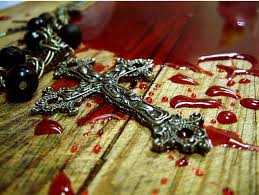
Islamic hostility to the cross is an unwavering fact of life—one that crosses continents and centuries; one that is very much indicative of Islam’s innate hostility to Christianity.

********************

Last May in Italy, a Muslim boy of African origin beat a 12-year-old girl during school because she was wearing a crucifix around her neck. The African schoolboy, who had only started to attend the school approximately three weeks earlier, began to bully the Christian girl—“insulting her and picking on her in other ways all because she was wearing the crucifix”—before he finally “punched the girl violently in the back.”

What is it about the Christian cross that makes some Muslims react this way?

The fact is, Islamic hostility to the cross is an unwavering fact of life—one that crosses continents and centuries; one that is very much indicative of Islam’s innate hostility to Christianity.

Doctrine and History

Because the Christian cross is the quintessential symbol of Christianity—for all denominations, including most forms of otherwise iconoclastic Protestantism—it has been a despised symbol in Islam.

According to the Conditions of Omar—a Medieval text which lays out the many humiliating stipulations conquered Christians must embrace to preserve their lives and which Islamic history attributes to the second “righteous caliph,” Omar al-Khattab—Christians are “Not to display a cross [on churches]… and “Not to produce a cross or [Christian] book in the markets of the Muslims.”

The reason for this animosity is that the cross symbolizes the fundamental disagreement between Christians and Muslims. According to Dr. Sidney Griffith, author of The Church in the Shadow of the Mosque, “The cross and the icons publicly declared those very points of Christian faith which the Koran, in the Muslim view, explicitly denied: that Christ was the Son of God and that he died on the cross.” Thus “the Christian practice of venerating the cross and the icons of Christ and the saints often aroused the disdain of Muslims,” so that there was an ongoing “campaign to erase the public symbols of Christianity, especially the previously ubiquitous sign of the cross.”

Islam’s hostility to the cross, like all of Islam’s hostilities, begins with the Muslim prophet Muhammad. He reportedly “had such a repugnance to the form of the cross that he broke everything brought into his house with its figure upon it.” He once ordered someone wearing a cross to “take off that piece of idolatry” and claimed that at the end times Jesus himself would make it a point to “break the cross”—an assertion the Islamic State regularly makes.

Islamic history following Muhammad is riddled with anecdotes of Muslims cursing and breaking crosses. Prior to the Battle of Yarmuk in 636, which pitted the earliest invading Muslim armies against the Byzantine Empire, Khalid bin al-Walid, the savage “Sword of Allah,” told the Christians that if they wanted peace they must “break the cross” and embrace Islam, or pay jizya and live in subjugation—just as his Islamic State successors are doing today in direct emulation. The Byzantines opted for war.

In Egypt, Saladin (d. 1193)—regularly touted in the West for his “magnanimity”—ordered “the removal of every cross from atop the dome of every church in the provinces of Egypt,” in the words of The History of the Patriarchate of the Egyptian Church.

Europe: Growing Violence against the Cross

Centuries later, not much has changed concerning Islam’s position towards the cross, though much has changed in Western perceptions. In other words, an African boy punching a Christian girl in Italy for her crucifix is part of a long continuum of Islamic hostility for the cross. Perhaps he learned this hatred in mosque—the same European mosques where Islamic State representatives call Muslims to jihad?

After all, earlier this year in Italy, another crucifix was destroyed in close proximity to a populated mosque.  The municipality’s Councilor, Giuseppe Berlin, did not mince words concerning the identity of the culprit(s):

Before we put a show of unity with Muslims, let’s have them begin by respecting our civilization and our culture. We shouldn’t minimize the importance of certain signals; we must wake up now or our children will suffer the consequences of this dangerous and uncontrolled Islamic invasion.

Nor is Italy the only European nation experiencing this phenomenon. In neighboring France, a “young Muslim” committed major acts of vandalism at two churches.  Along with twisting a massive bronze cross, he overturned and broke two altars, the candelabras and lecterns, destroyed statues, tore down a tabernacle, smashed in a sacristy door and even broke some stained-glass windows.  (Click for images.)

And in Germany, a Turkish man who checked himself into a hospital for treatment went into a sudden frenzy because there were “too many crosses on the wall.”  He called the nurse a “bitch” and “fascist” and became physically aggressive.

Of course, other times Europeans willingly capitulate to Islamic hostility for the cross. Real Madrid, a professional football (soccer) team in Spain reportedly stripped the traditional Christian cross from its club crest as part of a deal with the National Bank of Abu Dhabi—“so as not to offend Muslim sensibilities in the United Arab Emirates.” And in the United Kingdom, offensive crucifixes are being removed from prisons in order not to offend Muslim inmates (who are further provided with food baths for Islamic rituals).

Muslim World: Christians Killed for the Cross

If this is how some Muslims react to the Christian cross in Europe—where Muslims are aware of their outnumbered, minority status—how do other Muslims react to the cross in the Islamic world, where vastly outnumbered and ostracized Christian “infidels” are easy prey?

The answer is murderous—literally, Christians are being murdered by Muslims provoked at the sight of the cross:

Last year in Egypt, a young Coptic Christian woman named Mary was mauled to death—simply because her cross identified her as a Christian to Muslim Brotherhood rioters.   According to an eyewitness who discussed the episode, Mary Sameh George was parking her car by the church to deliver medicine to an elderly woman:

Once they [Brotherhood rioters] saw that she was a Christian [because of the cross hanging on her rearview mirror], they jumped on top of the car, to the point that the vehicle was no longer visible. The roof of the car collapsed in.  When they realized that she was starting to die, they pulled her out of the car and started pounding on her and pulling her hair—to the point that portions of her hair and scalp came off.  They kept beating her, kicking her, stabbing her with any object or weapon they could find….  Throughout [her ordeal] she tried to protect her face, giving her back to the attackers, till one of them came and stabbed her right in the back, near the heart, finishing her off.  Then another came and grabbed her by the hair, shaking her head, and with the other hand slit her throat.  Another pulled her pants off, to the point that she was totally naked.

In response, the Coptic Christian Church issued the following statement: “Oh how lucky you are, Mary, you who are beloved of Christ.  They tore your body because of the Cross.  Yet they offered you the greatest service and gave you a name of honor as one who attained the crown of martyrdom.” The statement also quoted Christ’s warning to believers: “Yes, the time is coming that whoever kills you will think that he offers God service” (John 16:2).

In October 2011, seventeen-year-old Ayman Nabil Labib, a Coptic student, was strangled and beaten to death by his Muslim teacher and some fellow students—simply for refusing to obey the teacher’s orders to remove his cross. Student eyewitnesses present during the assault said that while Ayman was in the classroom he was told to cover up his tattooed wrist cross, which many Copts wear. Not only did he refuse, but he defiantly produced the pectoral cross he wore under his shirt, which prompted the enraged Muslim teacher and students to beat the Christian youth to death.

Before that, an off-duty Muslim police officer on a train from Asyut to Cairo shouted “Allahu Akbar!” and opened fire on six Christians, killing a seventy-one-year-old man and critically wounding the rest. Before opening fire he had checked for passengers with the traditional Coptic cross tattooed on their wrists. (Days ago, another Coptic woman was “shot dead by an Egyptian police officer. Although officially an “accident,” the Muslim officer is notorious for hating Christians.)

In Pakistan, when a Muslim man saw Julie Aftab, a Christian woman, wearing a cross around her neck,

The man became abusive, shouting at her that she was living in the gutter and would go to hell for shunning Islam. He left and returned half an hour later, clutching a bottle of battery acid which he savagely chucked over her head. As she ran screaming for the door a second man grabbed her by the hair and forced more of the liquid down her throat, searing her esophagus. Teeth fell from her mouth as she desperately called for help, stumbling down the street. A woman heard her cries and took her to her home, pouring water over her head and taking her to hospital. At first the doctors refused to treat her, because she was a Christian. ‘They all turned against me . . . even the people who took me to the hospital. They told the doctor they were going to set the hospital on fire if they treated me’. . . . 67 percent of her esophagus was burned and she was missing an eye and both eyelids. What remained of her teeth could be seen through a gaping hole where her cheek had been. The doctors predicted she would die any day. Despite the odds she pulled through.

All this because she was wearing a cross.

Even in Muslim nations deemed “moderate,” violence provoked by the cross is not uncommon. In 2012, a 12-year-old boy in Turkey who converted to Christianity and decided to profess his new faith by wearing a silver cross necklace in class was spit on and beat regularly by Muslim classmates and teachers.

In the Maldives, October 2010, authorities had to rescue Geethamma George, a Christian teacher from India, after Muslim “parents threatened to tie and drag her off of the island” for “preaching Christianity.” Her crime was simply to draw a compass in class as part of a geography lesson. The compass was mistaken for the Christian cross.

Christians ‘Killed’ Again for the Cross

If some Muslims kill the wearers of the cross, so do they disturb the slumber of those already dead for having the cross on their tombstones. A few of the many examples follow:

  • Libya, March 2012: A video of a Muslim mob attacking a commonwealth cemetery near Benghazi appeared on the internet. As the Muslims kicked down and destroyed headstones with crosses on them, the man videotaping them urged them to “Break the cross of the dogs!” while he and others cried “Allahu Akbar!” Towards the end of the video, the mob congregated around the huge Cross of Sacrifice, the cemetery’s cenotaph monument, and started to hammer at it, to more cries of “Allahu Akbar.”Other Christian cemeteries in post-“Arab Spring” Libya have suffered similarly.
  • France, April 2015: Christian crosses and gravestones in a cemetery weredamaged and desecrated by a Muslim. After being apprehended, he was described as follows: “The man repeats Muslim prayers over and over, he drools and cannot be communicated with: his condition has been declared incompatible with preliminary detention.” He was hospitalized as “mentally unbalanced.” (See his handiwork.)
  • Malaysia, February 2014: AChristian cemetery was attacked and desecrated in the middle of the night by unknown persons in the Muslim majority nation.  Several crosses were destroyed, including by the use of “a heavy tool to do the damage.”
  • Germany, June 2014: After Muslims were granted their own section at a cemetery in Seligenstadt, and after being allowed to conduct distinctly Islamic ceremonies, these same Muslims begandemanding that Christian symbols and crosses in the cemetery be removed or covered up during Islamic funerals.

—–

One can go on and on with more recent examples of Islam’s hostility to the cross. Last April in “moderate” Malaysia, a Muslim mob rioted against a small Protestant church due to the visible cross atop the building of worship. It was quickly removed.

And in Pakistan, a nation where the mere accusation of offending Islam get Christians burned alive—a Muslim shopkeeper is allowed to sell shoes which depict the Christian cross on their sole: “In Pakistani culture, showing the sole of one’s shoe or foot is offensive because placing anything on the ground is considered to be an insult to the object. Therefore, something on the sole of a shoe is going to be constantly insulted as the person walks.”

From an African School Boy in Italy to ‘ISIS’

In light of the above, it should come as no surprise that the Islamic State—“ISIS”—also exhibits violence to the Christian cross.   In its communiques to the West, hostile reference to the cross is often made: “We will conquer your Rome, break your crosses, and enslave your women, by the permission of Allah…. [We will cast] fear into the hearts of the cross worshippers….”

After carving the heads of Coptic Christians off in Libya, the lead executioner waved his dagger at the camera and said, “Oh people, recently you have seen us on the hills of as-Sham and Dabiq’s plain [Syrian regions], chopping off the heads that have been carrying the cross for a long time.  And today, we are on the south of Rome, on the land of Islam, Libya, sending another message.”  He concluded by declaring: “We will fight you [Christians/Westerners] until Christ descends, breaks the cross and kills the pig” (all eschatological actions ascribed to the Muslim “Christ,” Isa).

Moreover, the Islamic State has committed countless atrocities against and because of the cross: it made and disseminated a video showing its members smashing crosses in and atop churches in territories under its sway; it beheaded and stabbed a man with his own crucifix after it exposed him as a Christian; and it published pictures of its members destroying Christian crosses and tombstones in cemeteries under its jurisdiction — and quoted Islamic scriptures justifying its actions.

Careful readers will note the similar parallels here: destroying crosses in churches and cemeteries and even killing Christian “infidels” for wearing them, as documented above, is not limited to “ISIS” but is happening all around the Muslim world, and even in Europe.

In short, Islam’s age-old hatred for the Christian cross—and what it represents—is not a product of the Islamic State, but of Islam.

The Palestinians’ Real Strategy

June 22, 2015

The Palestinians’ Real Strategy, The Gatestone InstituteKhaled Abu Toameh, June 22, 2015

  • Marzouk’s remarks refute claims by some in the Arab and Western media that Hamas is moving toward pragmatism and moderation, and that it is now willing, for the first time, to recognize Israel’s right to exist. Many in the West often fail to understand Hamas’s true position because they do not follow what Hamas says in Arabic — to its own people. In Arabic, Hamas makes no secret of its call for the destruction of Israel.
  • The current strategy of the Palestinian Authority (PA) is to negotiate with the international community, and not with Israel, about achieving peace in the Middle East. The ultimate goal of the PA is to force Israel to its knees. For the PA, rallying the international community and Europe is about punishing and weakening Israel, not making peace with it.
  • Their strategy is no longer about a two-state solution so much as it is about inflicting pain and suffering on Israel. It is more about seeking revenge on Israel than living in a state next to it.
  • Hamas’s terrorism also helps the PA’s anti-Israel campaign in the international community. Each terrorist attack provides the PA with an opportunity to point out the “urgent” need to force Israel to submit to Palestinian demands as a way of “containing the radicals.”

All signs indicate that the Palestinians are planning to step up their efforts to force Israel to comply with their demands. But as the Palestinians are not united, they are working on two fronts to achieve their goal.

One party, headed by the Palestinian Authority (PA), believes that, with the help of the international community, Israel will be forced to fully withdraw to the pre-1967 lines, including east Jerusalem, and accept the “right of return” for millions of refugees and their descendants to their former homes inside Israel.

The second party, represented by Hamas, Islamic Jihad and several other terror groups, continues to reject any form of compromise, and insists that the only solution lies in the elimination of Israel. Unlike the first party, this one believes that direct or indirect negotiations with the “Zionist enemy” are a waste of time and that terrorism is the only means for the Palestinians to achieve their goal.

The two Palestinian parties, the PA and Hamas, have been at war with each other since 2007, when Hamas seized full control over the Gaza Strip and forced the Palestinian Authority to flee to the West Bank.

But while the two rival parties are fighting each other, they are also working separately to overpower Israel.

On June 19, a Hamas-affiliated group claimed responsibility for the shooting attack that killed Danny Gonen, a 25-year-old man who was visiting the West Bank.

Hamas, Islamic Jihad and other Palestinian groups rushed to “welcome” the killing of the young Israeli man who, by the way, was not a “settler,” but a resident of the Israeli city of Lod, near Ben Gurion Airport.

In separate statements, these terror groups explained that the attack came in the context of Palestinian efforts to “preserve the resistance” against Israel in the West Bank. They said that such attacks were “legitimate means” to achieve Palestinian rights and aspirations.

These groups made it unavoidably clear that their real objective is not to “liberate” the West Bank, but to wipe Israel off the face of the earth. As one of them said, “We will continue to support any resistance action on the land of Palestine until it is liberated, from the (Mediterranean) sea to the (Jordan) river, and cleansed from all Zionist usurpers.”

Hours after the West Bank attack, a senior Hamas leader, Musa Abu Marzouk, repeated that his movement was seeking to replace Israel with an Islamist state: “Hamas wants a state not only in the Gaza Strip, but in all of Palestine; we won’t give up our weapons and will continue to fight in order to liberate our land.”

Marzouk’s remarks refute claims by some Arab and Western media that Hamas has been moving toward pragmatism and moderation, and that it is now willing, for the first time, to recognize Israel’s right to exist. Many in the West often fail to understand Hamas’s true position because they do not follow what Hamas says in Arabic — to its own people. In Arabic, Hamas makes no secret of its call for the destruction of Israel. To Hamas’s credit, this message is often repeated in English and other languages.

While Hamas and its allies work toward destroying Israel through terrorism, the Palestinian Authority seems more determined than ever to step up its worldwide campaign to delegitimize and isolate Israel with the help of various international parties, such as the anti-Israel Boycott, Divestment and Sanctions (BDS) movement.

Some senior Palestinian officials like to describe this campaign as a “diplomatic war” against Israel. They argue that this war has thus far proven to be much more “effective” than rockets and suicide bombings. “When we launch rockets at Israel, we don’t get any sympathy,” explained one official. “But everyone in the international community is now supporting our diplomatic efforts. That’s why we believe that what Hamas is doing right now is harmful to Palestinian interests.”

Shortly before the Israeli man was fatally shot in the West Bank, the chief Palestinian negotiator, Saeb Erekat, revealed his plan to rally the world against Israel so that it would be forced to submit to the Palestinian Authority’s demands, above all a complete withdrawal to the pre-1967 lines.

Erekat’s plan calls for working very closely with EU countries and members of the UN Security Council, to increase pressure on Israel to comply with the Palestinian demands. It also calls for recruiting international support for recognition of a Palestinian state and paving the way for it to join various international organizations and conventions.

In his plan, Erekat warns against endorsing any UN Security Council resolution that would include recognition of Israel as a Jewish state, or offer concessions on the “right of return” for refugees. He also repeats the Palestinian Authority’s rejection of the idea of land swaps between the future Palestinian state and Israel. In addition, Erekat emphasizes his opposition to the idea of creating a demilitarized Palestinian state or giving up any part of Jerusalem.

The Palestinian Authority’s current strategy is to negotiate with the international community, and not with Israel, about achieving peace in the Middle East. The PA knows that it is not going to get from Israel all that it is asking for. That is why the Palestinian leaders have chosen to negotiate with France, Britain, Sweden and the US. The Palestinians are hoping that these countries will give them what Israel cannot and is not prepared to offer at the negotiating table.

Even if Israel wanted to give one hundred percent of what it gained in 1967, the reality on he ground does not allow it. Since 1967, both Jews and Arabs have created irreversible “facts in the ground,” such as the construction of tens of thousands of houses for both Arabs and Jews. A full withdrawal would mean that tens of thousands of Jews and Arabs would lose their homes both in the West Bank and in Jerusalem.

The ultimate goal of the Palestinian Authority is, with the help of the international community, to force Israel to its knees. For the PA, rallying the international community and Europe is about punishing and weakening Israel, not making peace with it. The PA wants to see Israel degraded, isolated and turned into a rogue state. It wants to see Israelis brought before the International Criminal Court and expelled from as many international organizations as possible.

From talking to senior Palestinian Authority officials, one is left with the impression that their true goal is to see Israel in a state of surrender and defeat. Their strategy is no longer about a two-state solution so much as it is about inflicting pain and suffering on Israel. It is more about seeking revenge on Israel than living in a state next to it.

In many ways, the PA’s “diplomatic war” on Israel also helps Hamas. By constantly accusing Israel of “war crimes” and “atrocities,” the PA is helping Hamas justify its terror attacks against Israelis. The PA’s anti-Israel campaign also helps in creating sympathy and understanding for Hamas’s terror attacks.

Meanwhile, Hamas’s terrorism also helps the Palestinian Authority’s anti-Israel campaign in the international community. Each terrorist attack provides the PA with an opportunity to point out the “urgent” need to force Israel to submit to Palestinian demands as a way of “containing the radicals.”

This is how Hamas and the Palestinian Authority, although remaining sworn enemies, complement each other’s role against Israel.

And many in the international community seem to be helping these two Palestinian camps in their effort to undermine and destroy Israel.

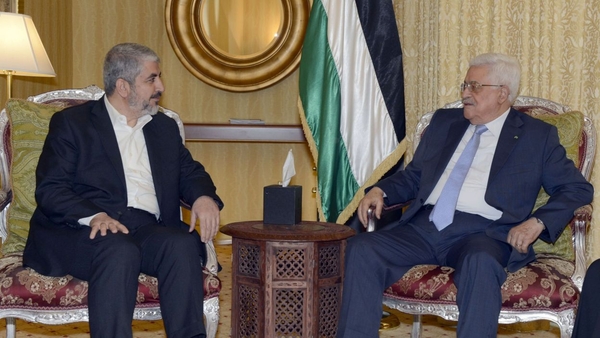
677Palestinian Authority President Mahmoud Abbas (r) meets with the Hamas political bureau chief Khaled Mashaal in Qatar, July 20, 2014. (Image source: Handout from the PA President’s Office/Thaer Ghanem)

Terror will not be defeated with reports

June 22, 2015

Terror will not be defeated with reports, Israel Hayom, Dr. Gabi Avital, June 22, 2015

(Please see also, US: Iran’s Support for Terror Undiminished. — DM)

Iran is led by rational and calculated religious clerics, whose goals are openly declared and well-defined. The rationality one should expect to find in the State Department has dissipated in a haze of illusions, which are exacting a heavy toll. Meanwhile, only the Islamic State stands to outflank Iran, and that is only under the assumption that these two terrorist entities are on completely divergent paths. To be sure, that is quite the baseless assumption.

Yet those who with one hand sound the alarm over an increase in terror, while with the other help the perpetrators of said terror rule the roost by giving it nuclear weapons, must provide convincing explanations. The United States, with its utter foreign policy failures — from Iraq to Yemen to Syria to Egypt and Iran — is not forthcoming with such explanations.

Where is Michael Moore when you need him? The State Department can see what is happening, but Kerry is on his way to a nuclear deal with the world’s leading sponsor of terrorism. Not much could be worse.

********************

Understanding history is a tricky proposition. Its lessons are sometimes hidden to us for long periods; often only subsequent generations can achieve the proper historical perspective, after a series of fateful events has unfolded. Even so, within less than 40 years we have witnessed global events that many political scientists correctly predicted.

The time is the late 1970s. All signs point to an oncoming revolution in Iran. However, U.S. President Jimmy Carter (whom some call the worst president ever), is instead consumed with the wording for a peace deal that undermines pre-existing agreements and international accords. Egypt wins the entire pot in a peace deal with Israel. Iran rises in prominence; the Soviet Union bolsters its standing across the globe, until the arrival of Ronald Reagan, who in an effort to defeat the Soviet Union in the ongoing Cold War, announces his Star Wars program.

We know the ending. Almost every single international relations expert points to that declaration as the beginning of the fall of the Soviet Union. In 1989, Reagan concludes two terms in office, and the Soviet Union falls apart.

Terrorism spreads across the globe. The leading sponsors are Saudi Arabia, Syria and Iran. An extensive report, examining the dangers of mass terrorist attacks on U.S. soil, is being compiled. The conservative-democratic pendulum in the U.S. swings toward the Democratic candidate, Bill Clinton. The egregious disregard of the report, now collecting dust, brings terrorism to its horrific pinnacle on Sept. 11, 2001. All fingerprints lead back to Saudi Arabia. Everything had already been laid out in the dust-covered Pentagon report. What the democratic Pentagon and State Department cooked up, the Republican George W. Bush was forced to eat.

The State Department has now published its annual report on terrorism. The seeds of this report were planted in the Carter era, when peace at all costs was championed without any understanding of the world in general and the Middle East in particular. Iran is led by rational and calculated religious clerics, whose goals are openly declared and well-defined. The rationality one should expect to find in the State Department has dissipated in a haze of illusions, which are exacting a heavy toll. Meanwhile, only the Islamic State stands to outflank Iran, and that is only under the assumption that these two terrorist entities are on completely divergent paths. To be sure, that is quite the baseless assumption.

So what does the report say? There will be a dramatic 35% rise in global terrorist acts. Iran supports terrorist organizations all over the world and in the Middle East especially; it backs the Shiite fighters in Iraq, Hezbollah in Lebanon and in Syria, with arms, training, money and intelligence. And we haven’t even mentioned Syria yet, or Hamas and Islamic Jihad.

Yet those who with one hand sound the alarm over an increase in terror, while with the other help the perpetrators of said terror rule the roost by giving it nuclear weapons, must provide convincing explanations. The United States, with its utter foreign policy failures — from Iraq to Yemen to Syria to Egypt and Iran — is not forthcoming with such explanations. Russia is back on the Cold War track; the Islamic State group is emboldened by the conduct of the U.S. president and his team at the State Department; Iran is envisioning a nuclear bomb in its arsenal; and Saudi Arabia is looking on nervously as the carpet of reciprocity is being pulled out from under it and its oil fields.

Only a week before Secretary of State John Kerry, one of the pillars of this dangerous U.S. foreign policy, takes off to pursue the deal with Iran, Tina Kaidanow, the State Department’s coordinator for counterterrorism, tells us: “We continue to be very, very concerned about [the Islamic Revolutionary Guard Corps] activity as well as proxies that act on behalf of Iran.”

What then, is Kerry really unaware of the findings in the 388-page report? And does he not understand that the deal with Iran, the seeds for which were planted in the Carter era and now being cultivated by Obama, is terrorism itself, and that there is no need for any report to merely sit and collect dust again in the State Department cellar?

Where is Michael Moore when you need him? The State Department can see what is happening, but Kerry is on his way to a nuclear deal with the world’s leading sponsor of terrorism. Not much could be worse.

US: Iran’s Support for Terror Undiminished

June 22, 2015

US: Iran’s Support for Terror Undiminished, The Clarion Project, June 21, 2015

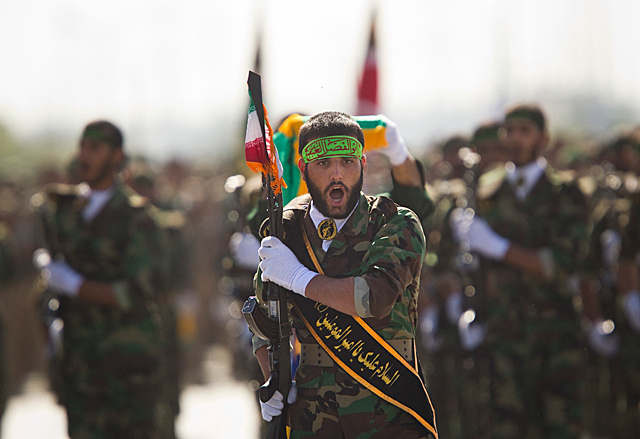
Iran-Basij-March-IP_1The Iranian volunteer Basij militia (Photo: © Reuters)

In an interview with The Atlantic, U.S. President Barack Obamas admitted that some of the money freed up the deal’s proposed sanction relief may up going towards terrorism, although he argued that Iranian government would have to make good on their commitments to improve the country’s economy.

******************

Despite the fact that Iran’s global terror activities were “undiminished” between 2013 and 2014, the U.S. State Department is still entirely committed to pursuing a nuclear deal with Iran.

“We think it’s essential that we pursue those negotiations,” said Tina Kaidanow, the State Department’s coordinator for counterterrorism, as quoted in The Wall Street Journal. “None of that implies that we would be, again, in any way taking our eye off the ball with respect to what Iran is doing as a supporter of terrorism.”

Iran’s support for terror was documented in the State Dept.’s annual report on global terrorism, which was released Friday. The report says “Iran’s state sponsorship of terrorism worldwide remained undiminished,” which makes the State Dept. “very, very concerned,” according to Kaidanow.

While the June 30 deadline for the deal is now fewer than 10 days away, the release of the report shows, “Iran continued to sponsor terrorist groups around the world,” according to Kaidanow.

The report specifically mentions Iran’s continued support for the Shiite terror organization Hezbollah in Lebanon as well as those fighting with embattled Syrian President Bashaar al-Assad.

The Clarion Project reported last week that Iran is supporting more than 100 terrorist organizations in Syria and Iraq alone.

In an interview with The Atlantic, U.S. President Barack Obamas admitted that some of the money freed up the deal’s proposed sanction relief may up going towards terrorism, although he argued that Iranian government would have to make good on their commitments to improve the country’s economy.

“I don’t think …anybody in this administration said that no money will go to the military as a consequence of sanctions relief,” Obama said. “The question is, if Iran has $150 billion parked outside the country, does the IRGC automatically get $150 billion? Does that $150 billion then translate by orders of magnitude into their capacity to project power throughout the region? And that is what we contest …”

The report also showed that between 2013 and 2014, there was a significant rise in global terror attacks, causing an increase in over 80 percent of violent deaths from the previous year (which itself had seen a 43 percent increase from the year before). In addition, the report showed:

  • There was an average of 1,122 attacks per month
  • Kidnappings increased by one-third, with more than with 9,400 people taken hostage
  • The number of global attacks rose by 35 percent
  • 32,727 people were killed worldwide (versus 17,800 in 2013)
  • 34,700 people were injured in attacks in close to 95 countries
  • In Iraq alone,  10,000 people died in 3,360 attacks representing close to a third of all people killed in terror attacks worldwide.

Shaking Hands with Iran

June 19, 2015

Shaking Hands with Iran, The Gatestone InstituteDaniel Mael, June 19, 2015

  • According to the organization Iran Human Rights, the Iranian regime has executed a prisoner every two hours this month.
  • “So far in 2015, more than 560 have been executed, and we are just in the first half of the year… What we are witnessing today is not so much different from what ISIS is doing. The difference is that the Iranian authorities do it in a more controlled manner, and represent a country which is a full member of the international community with good diplomatic relations with the West.” — Mahmood Amiry-Moghaddam, spokesman for Iran Human Rights.
  • Now the West, with the possibility of a nuclear deal, stands to increase Iran’s diplomatic standing.

As negotiations between the P5+1 countries and Iran continue, human rights concerns under the Iranian regime remain on the periphery.

The Obama Administration, over the objections of countless human rights organizations, has made clear that the United States is not seeking to alter the nature of the Iranian regime. Rather, the aim of the direct negotiations is solely to reach an agreeable compromise over the Iran’s continued nuclear enrichment. The current nominal deadline for negotiations is June 30.

The Islamic Republic of Iran is notoriously the world’s largest state sponsor of terrorism. Proxy organizations include Hezbollah in Lebanon, Hamas in the Gaza Strip and Houthi rebels in Yemen. The regime’s support of barbarism is reflected within Iran as well, as Iranian leaders support unspeakable human rights abuses on a daily basis.

With the deadline for negotiations only days away, June 2015 has been no exception.

According to a June 17 press release from the organization Iran Human Rights, which “supports the Iranian people’s struggle for human rights and amplifies their voices on the international stage,” the Iranian regime has executed a prisoner every two hours this month:

“According to reports collected by IHR so far in June at least 206 people have been executed in different Iranian cities. 60 of the executions have been announced by the official sources while IHR has managed to confirm 146 other executions which have not been announced by the authorities.”

“So far in 2015 more than 560 people have been executed in the country and we are just in the first half of the year,” Mahmood Amiry-Moghaddam, the spokesman of IHR, said in an interview. “This is unprecedented in the last 25 years! Unfortunately, people in Iran feel that the international community has closed its eyes on what they are going through.”

The executions are just the tip of the crane. As IHR reported Wednesday morning, Mohammed Moghimi, a defense lawyer for civil activist Atena Faraghadani, was scheduled to be released from prison on June 16, after three days in prison. What, exactly, was his crime?

“Mohammad Moghimi was charged with ‘non-adultery illegitimate relations’ for shaking hands with his female client,” writes IHR. “He had gone to Evin Prison to meet Ms. Faraghadani and to prepare an appeal request for her 12-year prison sentence.” According to IHR sources, the forbidden handshake “happened in the presence of two agents in the room. Atena apologized for this right there… but the agents didn’t let it go and took her back to her prison ward and arrested Mr. Moghimi right there.”

Moghimi release was released on condition that he meet a bail of roughly $60,000.

And why is Faraghadani in prison? For Facebook posts. A Revolutionary Court in Tehran sentenced her to 12 years and 9 months in prison for posts against the government, which constituted “assembly and collusion against national security,” “propaganda against the state,” and “insulting the Supreme Leader, the President, Members of the Parliament, and the IRGC [Revolutionary Guards] Ward 2-A agents, ” according to IHR.

“What we are witnessing in Iran today is not much different from what ISIS is doing,” argues Amiry-Moghaddam. “The difference is that the Iranian authorities do it in a more controlled manner, and represent a country which is a full member of the international community with good diplomatic relations with the West.”

Now the West, with the possibility of a nuclear deal, stands to increase Iran’s diplomatic standing — and with not even a minimal regard for human rights.

While U.S. negotiators shake hands with Iranian diplomats during the next round of talks in Geneva, Iranian citizens cannot shake hands among themselves without fear of years of imprisonment. While officials, both from the West and from Iran, share updates on social media, Iranians at home face jail time for staking out the wrong position in Facebook posts.

1118Does Iran’s foreign minister risk going to jail? Iranian FM Javad Zarif (right) is apparently touching the arm of EU Foreign Affairs representative Federica Mogherini (second from right). Back in Tehran, the lawyer Mohammad Moghimi (inset top) was arrested and charged with “non-adultery illegitimate relations,” for shaking hands with his female client, Atena Faraghadani (inset bottom). Faraghadani was sentenced to 12 years and 9 months in prison, for Facebook posts critical of the regime

If the Iranian regime cannot trust its own citizens’ handshakes, how can the West trust the Iranian regime with uranium centrifuges?

‘Iran Supporting More than 100 Shiite Terror Groups’

June 17, 2015

‘Iran Supporting More than 100 Shiite Terror Groups,’ The Clarion Project, June 17, 2015

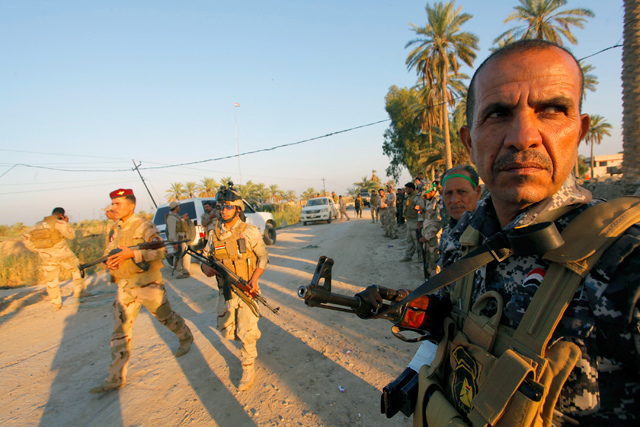
Iraq-Shiite-Militia-Iraqi-Army-IP_0A Shiite militia in Iraq (Photo: © Reuters)

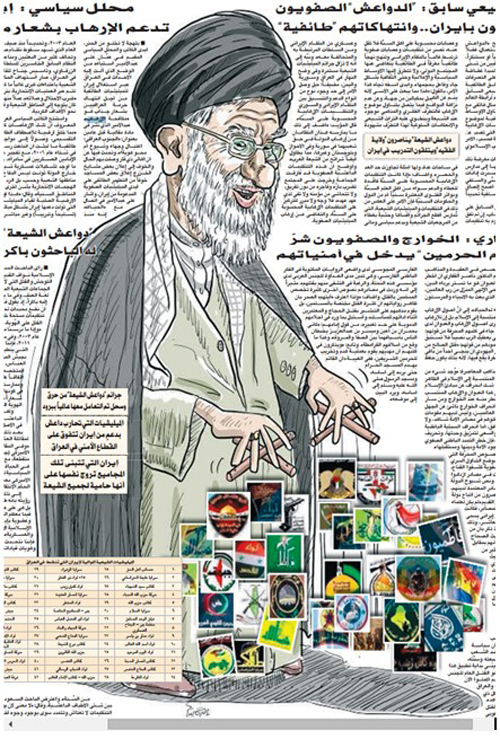
A recent report in Al Hayat, one of the largest and most-respected pan-Arab dailies, charges that Iran is supporting more than 100 Shiite extremist organizations and militias in Syria and Iraq.

The newspaper, which is published in London and funded by Saudi Arabia, says the crimes of these groups are no less horrific than those of the Islamic State.

In Iraq, the Iranian-funded armed militias comprised of Persians have capabilities far beyond those of the Iraqi security forces. The paper quotes academics who commented that the purpose of these militias is to target the Arabs in Iraq, both Sunni and Shiite.

In the Arab world, there is anger that the international media is ignoring the atrocities being committed by these militias. Hussein Al Muayid, an Iraqi religious scholar and advisor to the general secretary of the Muslim World League, pointedly questioned why the media as well as political figures focus only on the activities of the terror activities of Sunni organizations.

Muayid claims such selective reporting serves to makes an implicit statement that the Sunni world is responsible for all the terror in the world.

100-groups

In addition, while governments, experts and clerics issuing fatwasare refusing to give any aid to these Sunni terror organizations, Muayid says Shiite militias, which perpetrate the most horrific acts, enjoy the support of the Iranian ayatollahs, the highest religious authorities in Iran, and the financial and military support of the Islamic republic.

Western researchers and Arab analysts believe that Iran is supporting more than 50 militias in Iraq and another 50 in Syria whose atrocities are not less than those of the Islamic State.

The following is a list of most of the Shiite militias that are loyal to Iran and are active in Iraq:

1.       Gangs of the People of the Truth

2.       Companies of the Churasani Pioneer

3.       Battalions of the Lord of the Martyrs

4.       Noble Movement of Hezbollah

5.       Hezbollah Battalions

6.       Companies of Peace

7.       Corps of the Loyal Promise

8.       Bader Organization – Military Wing

9.       Brigade of Omar ibn Yasser

10.   Brigade of Assad Allah el Raleb

11.   Brigade of the Promised Day

12.   Battalions of the Supporters of Elhaja

13.   Battalions of the Sacred Defense

14.   Brigade of Elkariya

15.   Companies of Alzahra

16.   Brigade of Zu Elfakar

17.   Brigade of the Guarantors of Zainab

18.   Companies of the Supporters of the Belief

19.   Brigade  Al Muntazir

20.   Badar Special Groups

21.   Brigade of Abu Elfader Elabbas

22.   Movement of Al Jihad and al Bina

23.   Companies of the Public Defense

24.   Battalions of the Shiite Brigade

25.   Hezbollah the Rebels

26.   Battalions of the Anger

27.   Brigade of the Youths With Missions

28.   Hezbollah Battalions of the Missing Imam

29.   Battalions With the Direction of the Message

30.   Ashura Companies

31.   Battalions of Malek Elashtar

32.   Elabdar Movement

33.   Battalions of the Imam Ali

34.   Army of the Muktar

35.   Public Draft

36.   Elhamad Brigade

37.   Brigade of the Existing Imam

38.   Eladiat Brigade – Special Guard

39.   Movement of the Loyal Supporters of Allah

40.   Brigade of the 5th Special Guard

41.   Army of Elkarar

42.   Combat Division of Abba

Is there anything the Iranians could do that would upset President Obama?

June 16, 2015

Is there anything the Iranians could do that would upset President Obama? Jerusalem PostEric R. Mandel, June 16, 2015

(Not likely. — DM)

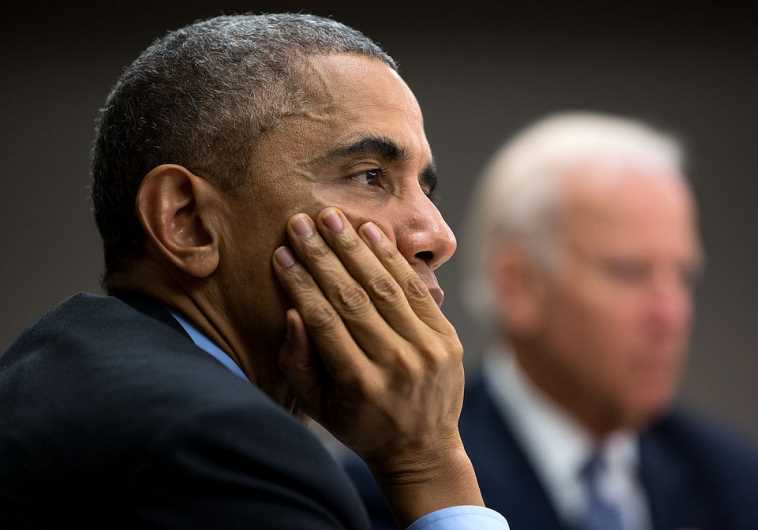
Biden and ObamaUS President Barack Obama (L) and Vice President Joe Biden. (photo credit:OFFICIAL WHITE HOUSE PHOTO BY PETE SOUZA)

The administration’s fear of provoking actions while the nuclear negotiations are ongoing is interpreted by Iran not as pragmatism, but as an invitation to cheat on any future deal.

This schizophrenic foreign policy is not fooling anyone. At best, it is naïve; at worst, it threatens longterm American national security and foreign interests, to say nothing of Israel’s existence.

*****************

It is probably time of us who have strenuously opposed acquiescing in Iran’s development of nuclear weapons to throw in the towel… Mr. Obama’s definition of a satisfactory outcome has evolved… from the complete abandonment… of the Iranian nuclear program to an honor-system reliance on the Iranians.” – Conrad Black, National Review.

What stands out in the following bullets?

• Iran is increasing its financial and military support for the genocidal Syrian ophthalmologist President Bashir Assad.

• The Iranian proxy Hezbollah is helping to prop up the Assad government with its armed forces in Syrian territory.

• US President Barack Obama has stopped supporting Hayya Bina, a “civil society program in Lebanon that seeks to develop alternative Shi’ite political voices to Hezbollah” (The Wall Street Journal).

Reminiscent of the president’s abandonment of the Iranian people during the 2009 Green Revolution, when he sided with the radical mullahs over Iranians seeking a democratic government, the US has decided to leave Lebanese Shi’ites with little choice but the repressive fundamentalist Hezbollah government.

But shouldn’t it be in America’s foreign policy interests to help Iranian and Lebanese Shi’ites break free from the repressive shackles of these anti-Western terrorists and help create the conditions for a peaceful and non-threatening Islam? Anyone paying attention to Iran’s behavior since the Revolution knows that the ayatollah does not reciprocate appeasement. You would have thought after six years of a failed Middle East policy that the president would have learned that unilateral concessions are pocketed, and only encourage more demands and intransigent behavior.

The administration’s fear of provoking actions while the nuclear negotiations are ongoing is interpreted by Iran not as pragmatism, but as an invitation to cheat on any future deal.

The Iranians have been testing the Obama administration with transgressions of the Joint Plan of Action, and their escalating support of the Yemini Houthis, Hezbollah, Hamas, Syria and the Iraqi Shi’ite government. Iran has learned that this American administration would rather bury its head in the sand than act upon almost any transgression.

Iran can be confident that the Obama administration will be the loudest public defender of the deal, knowing it is the president’s foreign policy legacy. Future transgressions will be swept under the table to avoid anything that might unsettle the Iranian regime. Just this week, Iran tested advanced satellite missile launchers, which could be used to deliver nuclear warheads.

Although they contradict current UN Security Council (UNSC) Resolutions, the Obama administration has remained silent, claiming the Iranians are complying with their commitments because the Joint Plan of Action does not address missile systems. The administration conveniently fails to acknowledge is that the JPA does not abrogate the UNSC sanctions.

The president’s outreach to the Iranian-backed Shi’ite Houthis in Yemin, while simultaneously defending the Iranian narrative that it does not support the Shi’ite fighters, fuels the fire that the White House will defend the Iranian narrative after the deal is concluded. Nothing must get in the way of threatening the “success” of the deal.

Even more egregious is the White House’s silence on the blatant violation of a UNSC blacklist. Qassem Suleimani, the head of Iran’s Revolutionary Guard’s elite Quds Force, is barred from traveling to UN member states like Lebanon, Iraq and Syria, yet he travels freely to these nations. For the past eight years, the American government has listed the Quds Force of the Iranian Revolutionary Guard Corps as a terrorist-supporting entity. The Quds Force reports directly to the supreme leader.

The history of the Quds Force’s terrorist activity is well known.

Ahmad Vahidi, who directed the Quds Force at the time, allegedly planned the infamous bombing of the Jewish Center in Buenos Aires in 1994. According to the Obama administration, in 2011 it attempted to assassinate the Saudi ambassador to the US in Washington. No wonder America’s Gulf allies are less than enthusiastic about the US cozying up to the mullahs.

Israel and the Sunni Arab world see the president’s desire to align with Iran as both incomprehensible and inevitable. With little chance of the Senate having the votes to override the president’s almost certain veto this summer, the president is a step closer to his grand plan, in place since his first day in office – to distance America from Israel and the Gulf States, and create a new relationship with the world’s capital for terrorism, Tehran.

The head of the Joint Chiefs of Staff, General Martin Dempsey, went to Israel last week and bluntly told the Israelis that the US expects sanctions relief to increase Iranian support of its proxies, including State Department-designated terrorists Hezbollah and Hamas. The Quds Force can expect a virtual windfall for its overseas terrorist activities. Iran is expected to receive at least $150 billion in sanctions relief, and Dempsey said it would not all be staying in Iran to help its people and economy. Is this administration acting as an indirect supporter of terrorist entities by facilitating their financing? You be the judge.

To deflect charges that the White House is in bed with the Iranians, the administration has allowed the Treasury Department to continue to place some sanctions on Hezbollah members. Like the blacklisting of Quds leader Qassem Suleimani, however, sanctions or blacklisting are one thing, enforcement is another.

This schizophrenic foreign policy is not fooling anyone. At best, it is naïve; at worst, it threatens longterm American national security and foreign interests, to say nothing of Israel’s existence.

Nuclear weapons in the hands of a terrorist state in a decade’s time. That’s a perplexing goal for the leader of the free world.

Iran Backs Taliban With Cash and Arms

June 12, 2015

Iran Backs Taliban With Cash and Arms, Wall Street Journal, Margherita Stancati, June 11, 2015

The White House-supported international nuclear talks with Iran that are scheduled to finish this month face world-wide criticism for potentially setting up a new regional dynamic in which Tehran, unfettered by punitive economic sanctions and flush with new resources, would be able to pursue an activist agenda through its proxies in and around the Middle East. Tehran’s growing ties to the Taliban is another sign of that, these critics say.

U.S. officials declined to comment specifically about closer Iran-Taliban ties, but have said that its diplomacy with Iran doesn’t alter its concerns about Iran’s destabilizing influence in the region. Director of National Intelligence James Clapper said in a recent letter to lawmakers that Iran was the “foremost state sponsor of terrorism.”

**************************

“Iran supplies us with whatever we need,” he said.

Afghan and Western officials say Tehran has quietly increased its supply of weapons, ammunition and funding to the Taliban, and is now recruiting and training their fighters, posing a new threat to Afghanistan’s fragile security.

Iran’s strategy in backing the Taliban is twofold, these officials say: countering U.S. influence in the region and providing a counterweight to Islamic State’s move into the Taliban’s territory in Afghanistan.

The Taliban’s aggressive military push and the new momentum toward peace negotiations between them and Kabul also raises the possibility that some of their members could eventually return to power.

“Iran is betting on the re-emergence of the Taliban,” said a Western diplomat. “They are uncertain about where Afghanistan is heading right now, so they are hedging their bets.”

Iranian officials didn’t respond to requests for comment, but Tehran has repeatedly denied providing financial or military aid to the Taliban in conversations with Afghan and Western officials. “Whenever we discussed it, they would deny it,” a former senior Afghan official said.

The developing Iran-Taliban alliance represents a new complication in Mr. Obama’s plans for both the Middle East and the future of Afghanistan, where the U.S. has been working to curb the Taliban’s role ahead of a planned withdrawal of all but 1,000 U.S. troops at the end of his presidency in 2016. At its peak in 2011 there were 100,000 U.S. troops.

The White House-supported international nuclear talks with Iran that are scheduled to finish this month face world-wide criticism for potentially setting up a new regional dynamic in which Tehran, unfettered by punitive economic sanctions and flush with new resources, would be able to pursue an activist agenda through its proxies in and around the Middle East. Tehran’s growing ties to the Taliban is another sign of that, these critics say.

Rep. Ed Royce (R., Calif.), chairman of the House Foreign Affairs Committee, said Iran’s support to the Taliban could increase if a nuclear deal is signed and Iran wins sanction relief.

“Across the region, Iran is stepping up its support for militants and rebel groups,” Mr. Royce said. “With billions in sanctions relief coming, that support goes into overdrive.”

Sen. John McCain (R., Ariz), chairman of the Armed Services Committee, said Iran’s increased support to the Taliban is a continuation of its aggressive behavior in Yemen, Syria, Iraq and Lebanon. “This is further evidence of the administration’s continued willful disregard for the facts on the ground in light of Iranian aggression in the region,” he said.

U.S. officials declined to comment specifically about closer Iran-Taliban ties, but have said that its diplomacy with Iran doesn’t alter its concerns about Iran’s destabilizing influence in the region. Director of National Intelligence James Clapper said in a recent letter to lawmakers that Iran was the “foremost state sponsor of terrorism.”

The Taliban have long used Pakistani territory as their main recruiting base and headquarters. But Afghan and Western officials say Iran, through its elite Revolutionary Guard Corps, has emerged as an important ally for the Taliban.

What’s more, they say, Tehran is turning to Afghan immigrants within its borders—a tactic it has also used to find new recruits to fight in support of President Bashar al-Assad’s regime in Syria.

Mr. Abdullah is one of those Iranian-backed Taliban fighters. After being detained for working as an illegal laborer in the Iranian port city of Bandar Abbas, Mr. Abdullah said he was approached by an Iranian intelligence officer.

“He asked me how much money I made, and that he would double my salary if I went to work for them in Afghanistan,” he said.

Mr. Abdullah said smugglers hired by Iran ferry supplies across the lawless borderlands where Iran, Afghanistan and Pakistan meet and deliver them to Taliban units in Afghan territory. He said his fighters receive weapons that include 82mm mortars, light machine guns, AK-47 rifles, rocket-propelled grenades and materials for making roadside bombs.

Military and intelligence officials see Iran’s support to the Taliban as an alliance of convenience. Historically, relations between Iran, a Shiite theocracy, and the hard-line Sunni Taliban have been fraught. Iran nearly went to war against the Taliban regime in 1998 after 10 of its diplomats were killed when their consulate in the northern Afghan city of Mazar-e Sharif was overrun.

Iran didn’t oppose the overthrow of the Taliban in 2001, and it has since maintained friendly relations with the Western-backed government in Kabul.

But Iran has long been uneasy with the U.S. military presence on its doorstep, and the Revolutionary Guard Corps have been delivering weapons to the Taliban since at least 2007, according to an October 2014 report by the U.S. Department of Defense.

Iran’s alliance with the Taliban took a new turn in June 2013 when Tehran formally invited a Taliban delegation to participate in a conference on Islam and to meet senior Iranian officials.

By the fall of that year, Afghan security officials said they had clear evidence that Iran was training Taliban fighters within its borders. Tehran now operates at least four Taliban training camps, according to Afghan officials and Mr. Abdullah, the Taliban commander. They are in the Iranian cities of Tehran, Mashhad and Zahedan and in the province of Kerman.

“At the beginning Iran was supporting Taliban financially,” said a senior Afghan official. “But now they are training and equipping them, too.”

The drawdown of U.S. and allied troops has made it easier for Taliban fighters and smugglers to cross the porous border undetected. “In the past, the U.S. had significant surveillance capabilities,” said Sayed Wahid Qattali, an influential politician from the western city Herat, where Iran has long had influence. “But now that the Americans have left, Iran is a lot freer.”

Iran formalized its alliance with the Taliban by allowing the group to open an office in Mashhad, maintaining a presence there since at least the beginning of 2014, a foreign official said. The office has gained so much clout that some foreign officials are now referring to it as the “Mashhad Shura,” a term used to describe the Taliban’s leadership councils.

One of the main points of contact between Tehran and the insurgency is head of the Taliban’s Qatar-based political office, Tayeb Agha, Afghan and foreign officials said. His most recent trip to Iran was in mid-May, the insurgent group said. The Taliban deny they receive support from Iran or any other foreign country, but say they want good relations with Afghanistan’s neighbors.

Iran’s backing of the Taliban has a strategic rationale. Tehran is already battling Islamic State, also known as Daesh, in Syria and Iraq, and it is wary of a new front line emerging close to its eastern border, Afghan officials say.

“Iran seeks to counter Daesh with the Taliban,” said an Afghan security official.

For the Taliban, Islamic State militants represent a threat of a different kind: they are competitors. Since an offshoot of Islamic State announced plans to expand in Afghanistan and Pakistan earlier this year, the new group has been actively recruiting fighters, many of whom are disaffected Taliban, say residents and Afghan officials.

This has pitted the two rival jihadist groups against each other, with clashes erupting between them in provinces including Helmand in the south, Nangarhar in the east and specifically involving Iran-backed Taliban in Farah, near Iran’s border, Afghan officials say.

Iranian funding gives more options to the militant group, support that is beginning to have an impact on the battlefield.

“If it wasn’t for Iran, I don’t think they would’ve been able to push an offensive like they are doing now,” said Antonio Giustozzi, a Taliban expert who has tracked Iran’s involvement in Afghanistan.

In recent months, security in Afghanistan’s west and north deteriorated sharply compared to last year, as Taliban fighters amassed in large numbers, testing the ability of Afghan troops to hold their ground.

It’s unclear, however, how far Iran will go to promote the Taliban.

“They wouldn’t want the Taliban to become too strong,” said a second foreign official. “They just want to make sure that they have some levers in their hands, because if the Taliban would win, God forbid, then they would lose all their leverage.”