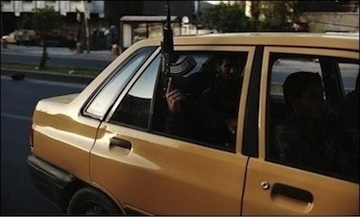
AN ISIS member rides on a rocket launcher in Raqqa in Syria two months ago. (photo credit:REUTERS)
The deal with Iran and the cooperation with Iranian forces against Islamic State, include “Shi’ite militias that are no less criminal.”
*********************
The Arab world perceives the dramatic failure of the small US-trained Syrian rebel force as a further indication that it cannot be a reliable ally against the Iran led Shi’ite axis.
A US defense official, who spoke to Reuters on condition of anonymity, said on Tuesday that at least five Syrian rebels it has trained are believed to have been captured by the Nusra Front.
That followed an attack by the Nusra Front on Friday thought to have killed one member of the so-called “New Syrian Forces,” in what would be their first battlefield casualty.
The incidents underscore the extreme vulnerability of the New Syrian Forces, a still tiny group estimated to number less than 60, who only deployed to the battlefield in recent weeks.
The Pentagon is far behind on its goals to train around 5,000 fighters a year.
Kirk Sowell, principal of Uticensis Risk Services, a Middle East-focused political risk firm, who closely follows Arab media summed it up this way on Twitter: “Pentagon: Arab media are laughing at you.”
Sowell posted a broadcast by pro-opposition Orient News, which expressed astonishment as to why the US would send in a force of only 50 to 60 fighters to help destroy Islamic State.
Aymenn Jawad al-Tamimi, a fellow at the Middle East Forum who closely follows Islamist opposition groups in Syria and Iraq, told The Jerusalem Post that “for many Sunni Arabs and Syrian Sunni Arab rebels in particular, this train-and-equip program has had no credibility from the outset.”
This is because the notion of fighting Islamic State while ignoring regime forces does not make sense for them, said Tamimi.
“US policymakers’ sense of reality on the ground is seriously in question with the apparent failure to anticipate a clash with the Nusra Front, which has a notable presence in the Azaz district into which the force of 50-60 men was inserted,” he continued.
Since the US has targeted Nusra Front in air strikes it is not surprising that the group would view a US backed group as a threat, he said.
Middle East researcher Ali Bakir, who also writes for Arab publications, told the Post on Wednesday that “no one in the Arab world takes this program seriously; I mean you would need around 50 to 60 people to play paintball but definitely not to fight Islamic State.”
“There is a profound general perception in the Arab world that the Obama administration is no less responsible than Iran and Russia in the Syrian crisis,” he said.
The deal with Iran and the cooperation with Iranian forces against Islamic State, include “Shi’ite militias that are no less criminal.”
This situation is increasingly seen in the Arab world as siding with the Shi’ites at the expense of the vast majority of Muslims, he asserted.
The US administration is more concerned about not jeopardizing the Iran deal than helping the Syrian people, Bakir added.
Because crisis management focuses on reducing symptoms rather than eliminating causes, its practitioners typically resort to half measures and token gestures. By demonstrating that the White House is “doing something,” symbolic actions often suffice to alleviate press scrutiny and public pressure for action, at least temporarily. They seldom remedy the problem that they were ostensibly addressing.
Last year, shortly before Barack Obama fired him, Secretary of Defense Chuck Hagel chided America’s President for “lurching from crisis to crisis without direction.” The treatment of foreign policy as an exercise in ad hoc crisis management has characterized Obama’s entire Presidency, as indeed it has every Democratic Presidency of the last half century. Fixated on domestic affairs and reluctant to assert American power overseas, Democrats from Lyndon Johnson to Barack Obama have viewed foreign policy challenges as nuisances to be kept off the front page of the New York Times, rather than problems to be solved through a coherent grand strategy.
Whereas a good strategy drives an active foreign policy, crisis management is inherently reactive. International problems reach the President’s attention mainly when they generate inordinate press coverage or cause a spike in unfavorable polling. Active adversaries, like North Vietnam in 1964 and Russia and ISIS in 2015, have consistently beaten a reactive United States to the punch and dodged the counterpunches.
Because crisis management focuses on reducing symptoms rather than eliminating causes, its practitioners typically resort to half measures and token gestures. By demonstrating that the White House is “doing something,” symbolic actions often suffice to alleviate press scrutiny and public pressure for action, at least temporarily. They seldom remedy the problem that they were ostensibly addressing.
In the case of Syria, Obama rejected recommendations from his cabinet to arm moderate Syrian rebels until 2013, by which time most of the moderate rebels had been killed or co-opted by extremists. He then decided to train and equip rebel forces in such small numbers and with such restrictions on their activities as to render them insignificant. When ISIS advances compelled Obama to restart American training of Iraqi forces, Obama put a ceiling on the number of U.S. trainers that limited throughput to 3,000 trainees per year, too few to make a difference in the war against ISIS or to lessen the influence of the 100,000 Iraqi Shiite militiamen whom the Iranians were training.
In Afghanistan, Obama authorized a troop surge, but began withdrawing troops much earlier than his generals advised, preventing completion of the military’s counterinsurgency campaign and discouraging Afghans from siding with the pro-American government. In Libya, Obama joined a NATO campaign against Muammar Gadhafi after international outrage about Gadhafi’s atrocities reached fever pitch, but his refusal to send American military forces to help secure the peace or protect American interests led to the collapse of central governance and the killing of the U.S. ambassador at Benghazi.
Of the recent additions to the administration’s list of token gestures and half measures, the most flagrant offender is Obama’s nuclear deal with Iran. Less well known is his response to the crisis of Russian expansionism. For more than a year, Eastern European allies and American critics—some of them within the Obama administration—have been calling for tougher American actions to discourage further Russian advances. Obama finally made his token gesture at the end of June, announcing that the United States would send American troops and heavy weaponry to several eastern European countries.
The joy that the initial announcement may have brought the eastern Europeans quickly faded when they saw the fine print, which was issued by U.S. ambassador to NATO Douglas Lute. The United States, Lute explained, was not going to deploy forces to eastern Europe on a permanent basis. “The tanks are empty, the … vehicles are empty, and will be parked, stored and maintained in training areas across the six Eastern most allies for training purposes,” Lute said. “Then the soldiers, on exercise after exercise, will be flown in.” One doubts that the Latvians will feel secure, or the Russians will feel deterred, by empty American vehicles and occasional visits from jet-setting American soldiers.
Many of Obama’s token gestures and half measures are clearly intended to keep simmering crises from boiling over until Obama leaves office. Administration spokesmen have repeatedly said that defeating ISIS will be a “multiyear” effort. The diluted U.S. military presence in Afghanistan is scheduled to last until the end of Obama’s term. Most of the fallout from Obama’s bad Iran deal will not hit ground until someone else occupies the White House. Obama and his proxies will no doubt craft stories explaining how his successor’s errors undid all of his foreign policy masterstrokes.
The President’s tokenism also serves one of the few national security objectives that Obama has pursued with any consistency, the diminution of American military power. The White House ramped up drone strikes in Pakistan and Yemen as a means of diverting the American people’s attention and showing that the United States could still do damage to terrorists without large military forces. While boasting about the number of people killed by drones, Obama quietly forced through drastic reductions in the armed services and withdrew American forces from critical regions. The drone strikes, in actuality, succeeded mainly in killing low-level fighters and antagonizing the Pakistani and Yemeni governments to the point that the United States eventually had to discontinue most strikes.
If one believes that Obama’s foreign policy should be driven by mitigation of immediate crises, particularly those that might detract from perceived domestic achievements such as Obamacare and environmental regulation, then there may be cause for optimism about the next year and a half. If, on the other hand, one believes that Obama’s foreign policy should be driven by protection of America’s enduring national security interests, then there is cause only for worry. Obama’s remaining months in office will give America’s enemies time and space to accumulate strength. The continuance of passivity and tokenism may even invite audacious provocations from enemies seeking to steal more sheep before a more vigilant shepherd comes along.
Iran instructed Hezbollah not to respond to reported Israeli Air Force strikes last week because it wants to focus on finalizing the nuclear deal with world powers, a Saudi newspaper reported on Wednesday.
Tehran does not want an escalation now that could risk the release of funds that will flow in from frozen assets as sanctions relief kicks in as the deal is finalized, sources told Al-Watan.
The unconfirmed report could well be false and part of the ongoing media battle going on between Sunni states such as Saudi Arabia and the Iran Shi’ite axis.
Iran will get access to over $100 billion of assets frozen abroad, US officials say, equivalent to a quarter of its annual output. The inflow may start around the end of this year, after Tehran is certified in compliance with the deal.
The alleged Israel Air Force drone attack last week struck a vehicle on the outskirts of the Druse village of Hader, near the Golan Heights. The UK-based Syrian Observatory for Human Rights said that five people were killed in the attack – two members of Hezbollah and three from the Syrian National Defense Forces, a pro-government militia.
The observatory added that the cell was led and supervised by Kuntar, who was traded by Israel in 2008 in exchange for the bodies of two Israeli reservists killed by Hezbollah in 2006.
A second strike targeted a Lebanese military installation near the Syrian border, wounding six, according to Arab media reports.
Other sources told the Saudi paper that the Shi’ite group aims to cover up its inability to protect its fighters in Syria and particularly from Israeli attacks.
In January, Israel carried out a helicopter attack in Quneitra province that killed a top Iranian Revolutionary Guard general and several Hezbollah members including the son of the group’s late military commander, Jihad Mughniyeh.
Meanwhile, Hezbollah recently arrested a Lebanese engineer who was allegedly an Israeli spy and turned him over to Lebanese authorities, a security force told the Lebanese Daily Star newspaper in a report on Wednesday.
He was recruited and trained in Europe by Israelis, according to the source,
Deputy Foreign Minister Abbas Araqchi speaking in Tehran, Iran, on October 22, 2013. (AFP/Atta Kenare)
Due to the pressure from above, . . . the original report was removed by the national broadcasting service, which stated that the publication of Araqchi’s statements was a “misunderstanding.”
*********************
Iran’s deputy foreign minister and senior nuclear negotiator has called the Islamic Republic’s nuclear program “a big loss” economically, but necessary to defend the country’s honor.
In a leaked off-the-record meeting with journalists Saturday, Abbas Araqchi stressed that “if we want to calculate the expenses of the production materials, we cannot even think about it.” But, he said, “we paid this price so we protect our honor, independence and progress, and do not surrender to others’ bullying.”
Yet, he explained, “If we value our nuclear program based only on the economic calculations, it is a big loss.”
Meeting with the country’s news chiefs under the direction of the Supreme Leader Ali Khamenei, Araqchi said the Iranian Foreign Ministry’s public diplomacy and media relations have so far been unable to sell the agreement to the Iranian people and “the national broadcasting [service] has to help so the people do not feel frustrated with the agreement.”
During the meeting, which was leaked by the Iranian media soon after, the deputy foreign minister suggested that the Iranian parliament should only review the agreement reached in Vienna, and not present it for ratification.
Araqchi stressed that Iran should declare its final position on the deal as soon as possible, “so that should Congress reject the agreement, the burden of rejection and the failure of the talks would fall on the United States.”
The Iranian Parliament (CC-BY Parmida76/Flickr)
“If the [Iranian] National Security Council approves the Vienna nuclear agreement and the leader of the Islamic Republic signs it, then this resolution becomes law,” he added.
With regards to the implications of the agreement on Iranian support for Hezbollah in Lebanon, Araqchi explained that, “we said during the talks that we cannot not provide weapons to Hezbollah, and we are not willing to sacrifice them [Hezbollah] for our nuclear program. Therefore, if you want to keep the weapon sanctions as part of the agreement, we will continue with our efforts. We discussed this matter for a while.”
The Western powers eventually agreed to separate that resolution from the agreement, Araqchi said.
The Iranian minister told journalists that he took seriously previous American threats of a possible military action. “It might be that people do not know the details, however, our IRGC and military friends know that every night in 2007-8 we were concerned that we would wake up in the morning and Iran would be surrounded by all necessary means for an attack against it.”
Iranian military personnel had shown the country’s negotiating team maps of bases where potential foreign attack planes had been identified. “The attack on Iran was a matter of the political will of Mr. Obama,” Araqchi said. “Despite everything, we still continued to object and did not compromise.”
He said that the West tightened the economic sanctions as much as they could and they reached a level where their continuation would lead to a “confrontation.”
“They tried 10 years of economic sanctions and military threats,” he explained, “and it was our strength and capabilities that brought them to the negotiation table.”
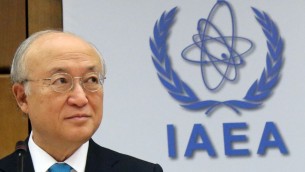
Yukiya Amano, director general of the International Atomic Energy Agency (IAEA) in Vienna, Austria, June 2, 2014. (AP/Ronald Zak)
Araqchi admitted that the regime had made some mistakes, and that those “mistakes in the past, made-up documentations and excuses were turned into claims against us.” He cited the example of International Atomic Energy Agency chief Yukiya Amano, who Araqchi said submitted a 60-paragraph report that included Iran’s use of detonators with multiple timers.
Iran, Araqchi said, has “to be careful with the information that we provide them… It is not that we are dealing only with the IAEA and these spies, but we are dealing with all countries that have nuclear programs. There are formulas and methods that prevent us from providing excess information to the IAEA inspectors. We did not know this in the past and provided information that we should not have done.”
Against national interest and security
The content of this supposedly off the record briefing was published a day later on the website of the Islamic Republic of Iran Broadcasting and picked up almost immediately by various other news sites inside Iran.
Due to the pressure from above, however, the original report was removed by the national broadcasting service, which stated that the publication of Araqchi’s statements was a “misunderstanding.”
Some believe that radical elements within the national broadcasting authority, who oppose the nuclear deal, leaked the briefing in order to undermine the reformist government’s achievements.
Araqchi called the leak “immoral” and “unprofessional,” saying it went “against national interest and security.”
The leak apparently occurred just days after the Iranian Ministry of Culture and Islamic Guidance issued confidential instructions to the media, warning them to avoid publications that could question “the achievements of the nuclear talks,” or would “indicate contradictions among the views of the high-ranking officials.”
On the day of leak, Iranian President Hassan Rouhani said during an interview on live Iranian television that the achievements of the nuclear talks exceeded his initial expectations.
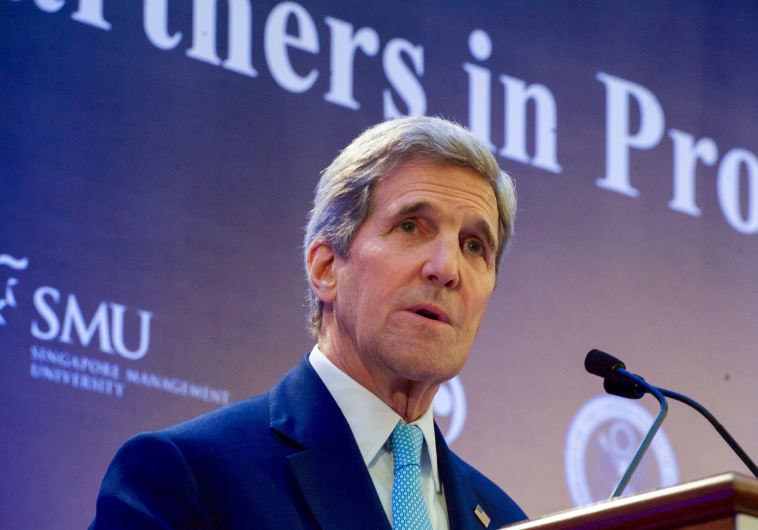
US Secretary of State John Kerry speaks in Singapore. (photo credit:STATE DEPARTMENT)
The secretary rejected Israel’s criticism of the nuclear agreement, saying that the deal “is as pro-Israel” as it gets.
******************
U.S. Secretary of State John Kerry told The Atlantic on Wednesday that if Congress were to shoot down the Iran nuclear agreement, it would be “the ultimate screwing” of Supreme Leader Ayatollah Ali Khamenei.
The secretary rejected Israel’s criticism of the nuclear agreement, saying that the deal “is as pro-Israel” as it gets.
Reneging on the nuclear agreement, which has the support of the major world powers, would constitute a setback for Washington and justify anti-American animus in Iran.
“The ayatollah constantly believed that we are untrustworthy, that you can’t negotiate with us, that we will screw them,” Kerry said. “[Having Congress vote down the nuclear pact] will be the ultimate screwing.”
“The United States Congress will prove the ayatollah’s suspicion, and there’s no way he’s ever coming back. He will not come back to negotiate. Out of dignity, out of a suspicion that you can’t trust America. America is not going to negotiate in good faith. It didn’t negotiate in good faith now, would be his point.”
Kerry also commented on the vociferous opposition to the deal expressed by Israel, which the secretary referred to as “visceral” and “emotional.” He was adamant that the agreement was positive for Israel’s geopolitical standing.
“I’ve gone through this backwards and forwards a hundred times and I’m telling you, this deal is as pro-Israel, as pro-Israel’s security, as it gets,” Kerry said. “And I believe that just saying no to this is, in fact, reckless.”
Kerry said that he was “sensitive” to Israeli concerns over Iran’s long-term aims, but he rejected arguments made by Jerusalem that the Islamic Republic was planning its annihilation.
“I haven’t seen anything that says to me [that Iran will implement its vow of wiping Israel off the map],” the secretary said. “They’ve got 80,000 rockets in Hezbollah pointed at Israel, and any number of choices could have been made. They didn’t make the bomb when they had enough material for 10 to 12. They’ve signed on to an agreement where they say they’ll never try and make one and we have a mechanism in place where we can prove that. So I don’t want to get locked into that debate. I think it’s a waste of time here.”
“I operate on the presumption that Iran is a fundamental danger, that they are engaged in negative activities throughout the region, that they’re destabilizing places, and that they consider Israel a fundamental enemy at this moment in time,” Kerry said. “Everything we have done here [with the nuclear agreement] is not to overlook anything or to diminish any of that; it is to build a bulwark, build an antidote.”
The secretary said that the nuclear deal is even more imperative if Israel’s fears that Iran is plotting its destruction are true, since the agreement neutralizes Tehran’s nuclear program.
(Another interesting question would be, does Obama agree with any of Khamenei’s statements and, if so, which? — DM)
The Khamenei Palestine book is important not in and of itself but because the regime’s obsession with Israel is a key to its foreign policy. . . . But as much as Iran is focused on regional hegemony in which Sunni states would be brought to heel, as Khamenei’s Palestine illustrates, it is the fixation on Israel and Zionism that really animates their expansionism and aid for terror groups.
******************
It turns out President Obama isn’t the only world leader who writes books. His counterpart in Iran – Supreme Leader Grand Ayatollah Ali Khamenei — has also just published a new book. But while it may not be as introspective as Obama’s Dreams From My Father, it does tell us at least as much about the vision of the person in charge in Tehran (as opposed to Hassan Rouhani, the faux moderate who serves as its president) as the president’s best-selling memoir. As Amir Taheri reports in the New York Post,Palestine is a 416-page diatribe against the existence of the state of Israel and a call to arms for it to be destroyed. Supporters of the nuclear deal the president has struck with Khamenei’s regime may dismiss this book as merely one more example of the Supreme Leader’s unfortunate ideology that must be overlooked. But as the New York Times noted last week, the administration’s real goal here isn’t so much in delaying Iran’s march to a nuclear weapon (which is the most that can be claimed for the agreement) as it is fostering détente with it. Seen in that light, the latest evidence of the malevolence of the Islamist regime should be regarded as yet another inarguable reason for Congress to vote the deal down.
In his interview with The Atlantic’s Jeffrey Goldberg on May 21, President Obama was asked directly about the significance of Iran’s anti-Semitism and its commitment to destroying Israel. The president said the anti-Semitism of the Iranian leadership did not mean they weren’t also “interested in survival” or being “rational.” As far as he was concerned, the ideology of the regime was not something that would influence its decisions.
But everything Khamenei says and, even more importantly, everything the regime does, by funding terrorist groups at war with Israel such as Hamas and Hezbollah or by embarking on a ruinously expensive nuclear project that placed it in conflict with the West, speaks to its commitment to policies that Obama may think are irrational but which are completely in synch with what he called its “organizing principle.” Why would a nation so rich in oil need to risk international isolation or war seek nuclear power if not to help Khamenei fulfill his pledge to “liberate” what is now Israel for Muslims?
The president told Goldberg that the American military option would be a sufficient deterrent to ensure that Iran didn’t violate the nuclear pact or behave in an irrational manner. But since the president has ruled out the use of force in a categorical manner, it’s hard to see why the Iranians would fear it once the U.S. and Europe are doing business with them. Even if it was a matter of snapping back sanctions, assuming that such a concept is even possible? Once the restrictions are unraveled, it’s fair to ask why would they work then when the president repeatedly tells us additional sanctions won’t work now and require us to accept the current deal that doesn’t achieve the objectives that the administration set for the negotiations when they began.
The Khamenei Palestine book is important not in and of itself but because the regime’s obsession with Israel is a key to its foreign policy. Iran constitutes a grave threat to Neighboring Arab countries that are at least as angry about the president’s embrace of Tehran as the Israelis since their nuclear status would undermine their security. But as much as Iran is focused on regional hegemony in which Sunni states would be brought to heel, as Khamenei’s Palestine illustrates, it is the fixation on Israel and Zionism that really animates their expansionism and aid for terror groups.
As Taheri notes in his article on the book, Khamenei distinguishes his idée fixe about destroying Israel from European anti-Semitism. Rather, he insists, that his policy derives from “well established Islamic principles.” Chief among them is the idea that any land that was once ruled by Muslims cannot be conceded to non-believers no matter who lives there now. While the Muslim world seems to understand that they’re not getting Spain back, the territory that constitutes the state of Israel is something else. Its central location in the middle of the Muslim and Arab worlds and the fact that Jews, a despised minority people, now rule it makes its existence particularly objectionable to Islamists like Khamenei.
Khamenei’s book shows that not only is he serious about wanting to destroy Israel and uproot its Jewish population, he regards this project as a practical rather than a theoretical idea. The administration ignores this because it wants to believe that Iran is a nation that wants to, as the president put it, “get right with the world.” But what it wants is to do business with the world while pursuing its ideological goals. The nuclear deal is a means to an end for the regime and that end does not involve good relations with the West or cooperation with other states in the region, let alone coexisting peacefully with Israel.
What is curious is that this is the same administration that regarded the announcement of a housing project in Jerusalem by low-level Israeli officials as an “insult” to Vice President Biden. But it chooses to regard the “death to America” chants led by regime functionaries in Iran as well as a book by the country’s leader indicating that Obama’s ideas about its character are fallacious as non-events. The only explanation for this remarkable lack of interest in Iranian behavior is an ideological fixation on détente with Tehran that is every bit as hardcore as any utterances that emanate from the mouth or the pen of the Supreme Leader.
Taken out of the context of a vision of friendship with the Iranian regime, the nuclear deal makes no sense. Yet squaring that vision with Khamenei’s literary effort is impossible. Members of the House and Senate must take note of this conundrum and vote accordingly.
To listen to President Obama and Secretary of State John Kerry defend their nuclear deal in recent weeks, you’d think the issue at stake is a narrow one that solely concerned whether or not the agreement retards Tehran’s quest for a bomb. The assumption from the administration and its apologists that the deal does this even minimally is a dubious one. But one of the subtexts of the misleading way they have been conducting their end of this debate is their effort to distract both Congress and the public from the broader goals of the pact. While critics of the deal have highlighted Obama’s refusal to make the sanctions relief dependent on an end to support for terrorism, ballistic missile production or the nature of Iranian government, the answers from the administration have been consistent. They want to restrict the discussion to purely technical nuclear issues that can be obfuscated by deceptive claims or to the false choice between the agreement and war. But, to its credit, one of the president’s chief media cheerleaders did highlight the real goals of the administration in an article published on Friday. The New York Times feature titled “Deeper Aspirations Seen in Nuclear Deal With Iran” ought to be required reading for all members of the House and Senate. The choice here isn’t one between a flawed nuclear deal and war, but between Iran détente with a tyrannical, anti-Semitic, aggressive Islamist regime and a reboot of the diplomatic process that has been hijacked by appeasers.
As the Times points out, prior to the announcement of the final, lenient terms of the deal that expires in ten years the administration wasn’t so coy about its real objective:
Before his fight for the deal in Congress, Mr. Obama was far more open about his ultimate goals. In an interview in The Atlantic in March 2014, he said that a nuclear agreement with Iran was a good idea, even if the regime remained unchanged. But an agreement could do far more than that, he said:
“If, on the other hand, they are capable of changing; if, in fact, as a consequence of a deal on their nuclear program those voices and trends inside of Iran are strengthened, and their economy becomes more integrated into the international community, and there’s more travel and greater openness, even if that takes a decade or 15 years or 20 years, then that’s very much an outcome we should desire,” he said. …
And in an interview in December, Mr. Obama even seemed to welcome the rise of a powerful Iran. “They have a path to break through that isolation and they should seize it,” he said. “Because if they do, there’s incredible talent and resources and sophistication inside of — inside of Iran, and it would be a very successful regional power.”
The importance of this context for the discussion of the deal cannot be overemphasized.
The deal ought to be defeated on its own merits because it fails to achieve the administration’s stated objectives about stopping Iran’s nuclear ambitions. All it accomplishes, if it can even be said to do that much, is to delay Iran’s march to a bomb for the period of the agreement while permitting to continue research with a large nuclear infrastructure under a loose inspections regime that makes a mockery of its past promises on all these issues.
But the point on which the administration has been most reluctant to comment is the more than $100 billion in frozen assets that will be released to Tehran. Critics rightly believe this money will, one way or another, help subsidize Iran’s terrorist allies and push for regional hegemony that worries neighboring Arab states as well as Israel, whose existence is threatened by Iran becoming a threshold nuclear state with Western approval.
No rational argument can be mustered against this assertion since the money will be Iran’s to use as it likes and any prohibitions on Iranian adventurism are likely to be even less effective in a post-deal environment than they were prior to it. But if, like President Obama, you believe that Iran is in the process of transforming from a revolutionary threat whose goals are mandated by the extreme religious beliefs and Islamist ideology of its rulers into one eager to be friends with the world, the prospect of a stronger Iran doesn’t trouble you.
That’s why President Obama did not predicate these negotiations on any pledges, even ones that were transparently false, of good behavior from Iran. He claims that insisting on an end to Iranian state sponsorship of terror or forcing it to renounce its goal of eliminating Israel would have prevented him from getting a deal on the nuclear question. But that formulation has it backward. The point of the negotiations was never about the nuclear details, something that was made clear by the astonishing series of concessions that the administration made throughout the talks. In October 2012, during his foreign policy debate with Mitt Romney, Obama pledged that any deal would eliminate Iran’s nuclear program. Now he is advocating for one that leaves it in place under Western sponsorship while rewarding Tehran with the lifting of sanctions.
What Obama always wanted was a deal at any price because he thought it was the pathway to a new entente with Iran that would end the conflict with its Islamist leaders. But while a future in which Iran would no longer be a terror sponsor bent on destroying Israel and dominating the Middle East would be a good thing there is no rational reason to imagine this will happen. Indeed, by strengthening its government the president is ensuring that they will never have to choose between their aggressive goals and economic prosperity.
That’s why rather than being sidetracked into debates about the nuclear details, opponents need to focus on the real goal of the deal: détente with a regime that threatens the U.S. and its allies. The deal fails as a nuclear pact. But it is perhaps an even greater disaster when one realizes that its premise is a naive belief that Islamist tyrants are so enraptured with Obama that they are about to abandon their deeply held beliefs and evil intentions.
(The views expressed in this rant — some of which are off-topic — are mine and do not necessarily reflect those of Warsclerotic or its other editors. — DM)
This is a partially updated version of Fixing the Creator’s worst mistakes, published on December 29, 2012. It deals mainly with Islam, Iran, the nuke “deal,” illegal immigration and Obama’s usurpation of power.
Islam and other religions
Obama is “our” Imam in Chief and in that capacity continues to preach that Islam is the religion of peace; there is neither Islamic violence nor any Islamic desire for it. Since the Islamic State is violent it is not Islamic.
Coptic Christians beheaded. So what? They weren’t other Muslims.
In Obama’s apparent view, Palestinians want the true peace of Islam. They abhor violence and want nothing more than to live in peace and harmony in Israel with their Jewish friends and neighbors. Their only obstacles are those senselessly thrown in their path by wicked, apartheid Israel at every turn.
That’s a lie.
The nuke “deal” with Iran
Since the Islamic Republic of Iran is also peaceful, it is Islamic and hence deserves nukes (which it claims neither to have nor to want) along with increased funding to support its hegemonic efforts to bring “stability” to the Middle East with the help of its many proxies.
It’s not MY fault.
Here’s lots more ObamaMoney. Have fun with your virgins!
Obama conceals critical details of His Iran “deal” from members of Congress and from the people, while sending His minions forth to obfuscate and lie about it. Even Iran now claims that the Obama administration has been lying about the “deal.”
“Any time, anywhere” inspections to discover the “possible military dimensions” of Iran’s nuclear program are a farce and have been at least since November of 2013. We were recently advised that under one or more side deals between the International Atomic Energy Agency (IAEA) and Iran, the IAEA will neither inspect sites such as the Parchin military facility nor collect samples there; Iran will collect the samples and provide them (or perhaps samples taken elsewhere) to the IAEA.
Why is Obama doing this? Mr. Fleitz, the interviewee in the above video, suggests that Obama sees Iran as having been too long victimized by the West and in need of freedom from Western oppression.
Illegal immigration
Obama’s fundamental transformation of America in His image continues to accelerate. Illegal immigrants are already overwhelming the country and He demands more of them.
to screw America even more
I am the greatest expert on the Declaration of Dependence
All power to the People Obama
Obama has also accelerated Congress’ partially self-imposed rush to impotence. States’ rights have become a sad joke and the United Nations has become even more powerful, wrongheaded and intrusive. Our military is more focused on climate change and “social justice” than on fighting our worst enemy, which cannot even be named.
Obama confers with His chief military adviser
♥♥♥♥♥♥♥♥♥♥♥♥♥♥♥♥♥♥♥♥♥♥♥♥
By His Supreme Excellency, Barack Humble Hussein Obama
The first paragraph of the Declaration of Dependence refers to “Laws of Nature and of Nature’s God.” However, according to the second paragraph of the Declaration,
We hold these truths to be self-evident, that all men are created equal, that they are endowed by their Creator with certain unalienable Rights, that among these are Life, Liberty and the pursuit of Happiness. (Emphasis added.)
This raises what some may see as an important question: just who is that Creator fella, anyway? Is it Nature, Nature’s God or its earthly manifestation, Government? We need not answer directly due to the partisan overtones of the question. Suffice it to say that fairness and justice dictate that the Government over which I rule — as I had long been destined to do — has an obligation to correct the worst error of judgment and implementation made by that fella, whomever it may be. By correcting that error, I intend no disrespect to it or to anyone else. With few exceptions, everyone makes mistakes and when they are made it is My duty as your President to correct them.
Are all men are created equal?
No they are not, and it is the job of My Government to transform the nation, as I deem appropriate, to make everyone as nearly equal as is feasible consistent with providing the best governance possible. That is a daunting task, but since I won two presidential elections overwhelmingly I have a mandate to do it. I can and shall do it, so help Me — Allah everyone! You have nothing to lose but the chains in which you have long been unfairly bound by unnecessary and unjust freedoms.
Our Black and Brown Brothers and Sisters, whether from My America or from Mexico and elsewhere in Latin America, no less than invaders immigrants from Islamic nations, deserve to come to a truly welcoming America. Travel and resettlement are costly for them and they deserve the very best subsidies I can provide to afford them the leisure they want and hence deserve. That will enable them to evaluate all political candidates and to decide who will best serve My their interests. To that end, My Executive Decree is now being written to require that all promotional materials of a political nature be in Ebonics and Spanish as well as in all languages spoken or written in all Islamic nations unless I decree that it is not necessary for specific candidates whom I favor.
As the nation’s highest constitutional authority and scholar, I am uniquely qualified to interpret and otherwise ignore both the Constitution and the Declaration of Dependence. Both were written and adopted by White Male slaveholders, now despised by all good people.
Clearly, the statement that “all men are created equal” does not mean — as some have mistakenly claimed — equal before the law. Although the most humble of all men, I am so far above the law that I often have difficulty seeing it down below. The same is true in far lesser degree of accredited diplomats and many more. Others, such as those who maliciously oppose My sovereign will, are far beneath the law. No, equality does not mean “equal before the law.” It means equal in every respect except that. At least that’s what it should mean and it is My sworn duty to make it so. There cannot possibility be true equality without vigorous enforcement of My Decrees, to be promulgated now and in the future, mandating equality of both opportunity and result in all things.
Since it is my job to interpret and enforce our laws selectively I must also create those laws. That will be far more efficient.
An Executive Decree is now being drafted for My review, revision and signature. It will set forth the measures that are necessary to achieve our nation’s greatest dream — nay, her manifest destiny — of true equality for all. Very briefly, its directives will include the following:
1. Members of the Congress shall have no higher status or greater legislative authority than the poorest, lowest, most despised and least educated person in My nation — perhaps an illiterate, twelve year old, homeless transsexual drug abuser from Haiti. Hence, My Executive Decree shall declare the Congress in recess until truly representative members have been elected under Federal supervision to replace the elite obstructionists currently there.
In the meantime, I have my phone and veto pen ready.
2. During the congressional recess I shall, as your President, assume with great reluctance all legislative burdens which I have not already assumed. My people shall no longer be subjected to interminable partisan squabbles over such incomprehensible trivia as national debt limits, Federal budgets, tax fairness or anything else. The fruits of peace, love, joy and tranquility shall come to be enjoyed by all throughout My entire land.
3. Due to the peaceful outpourings of racial justice, tranquility, peace, love and joy due to My successful efforts to eliminate the scourge of White racism, there shall no longer be any excuse for privately owned Weapons of Mindless Destruction (WMDs). Hence, all shall be confiscated immediately and disposed of pursuant to Executive Decree.
4. All uniformed personnel of the armed forces shall have the same rank, pay and allowances. Staff Sergeant shall henceforth be the only military rank and all shall henceforth receive pay and allowances commensurate with that rank. The focus of all of My defense efforts will continue to be on social justice and the horrors of Climate Change. Accordingly, military personnel shall be given access to firearms only when called upon to enforce My Climate Change rules.
5. The gross unfairness of wealth maldistribution in the United States is unconscionable and that disgrace to humanity is compounded not only by an incomprehensible Internal Revenue Code but also by lengthy and even more incomprehensible IRS regulations. Accordingly, I shall decree a new and greatly simplified single tax rate of one hundred percent on all property and all earnings from any and all sources, with no deductions or credits. I shall also issue a new Revenue and Property Redistribution Decree granting $25,000 per person per year in cash as well as providing for the fair and just redistribution of all property confiscated in lieu of property tax payments. Since the unreasonably disparaged welfare safety net will no longer be needed it will be abolished.
6. Recognizing that My simplified tax plan may hamper states and other inferior governments in accessing revenues, all states and their subdivisions shall be abolished and the United States shall be divided into ten Federal Districts, to be governed by My appointed District Governors.
Conclusions
My simple, eminently fair and absolutely just decrees will transform My entire nation into a far better place for all of My people.
Islam absolutely must be recognized as the world’s preeminently peaceful religion; Christians, Jews and others must recognize this and accept the true enlightenment provided by the Holy Koran. If a few Jews or Christians are killed by Muslims who are ignorant of true Islamic teachings, that is far, far less hurtful to My people than the ravages of Climate Change. I believe that Pope Francis agrees with Me on this point.
As the monumental successes of My initiatives become clear throughout the world, I am confident that the United Nations will issue similar decrees for all nations, perhaps uniting some in UN protectorates to be governed in the fair and just ways of which the UN has over the years shown itself to be uniquely capable. The UN bows to no legitimate state or even to illegitimate states such as as Israel. Indeed, I am so confident that these wonders will come to pass that I have today notified the Secretary General that, when My work here is done, I shall give My service as his replacement higher priority than even My obligations to My own dear family.
Permit Me to commend those brave young people for their courage and superb intelligence in standing up for the highest, the best and brightest in our nation.
In closing, here’s another of my favorite songs. I hope you will enjoy it too:
Ayatollah Ali Khameni has published his version of Mein Kampf, a 416 page book outlining his strategy to eliminate Israel, which he describes as “a cancerous tumor.” Although it is currently available only in Iran, an Arabic translation is underway, and sooner or later it will achieve wide readership in the Muslim world. The Obama administration is no doubt hoping it will achieve no notice in the United States until after the Iran deal is voted upon, because the plan advocated will be immensely aided by its implementation.
Amir Taheri of the New York Post obtained a copy from Iran:
Khamenei makes his position clear from the start: Israel has no right to exist as a state.
He uses three words. One is “nabudi” which means “annihilation.” The other is “imha” which means “fading out,” and, finally, there is “zaval” meaning “effacement.”
Khameni does not call for wiping out Israel with a nuclear bomb. He states that one of his fondest desires is to pray in Jerusalem. Instead, his plan is one of terrorism and pressure, keeping Israel from fighting back against Iran, the sponsor of terror, with the implicit threat of nuclear retaliation.
What he recommends is a long period of low-intensity warfare designed to make life unpleasant if not impossible for a majority of Israeli Jews so that they leave the country.
His calculation is based on the assumption that large numbers of Israelis have double-nationality and would prefer emigration to the United States and Europe to daily threats of death.
Iran has many allies in this effort, including the BDS movement in the United States. Cripple Israel economically, and her economically productive people will leave. Make the political cost of supporting Israel high. That will pave the way for an internationally-sponsored plebiscite engineered to produce a Muslim state:
Under Khamenei’s scheme, Israel, plus the West Bank and Gaza, would revert to a United Nations mandate for a brief period during which a referendum is held to create the new state of Palestine.
All Palestinians and their descendants, wherever they are, would be able to vote, while Jews “who have come from other places” would be excluded.
Double standards are inherent in Islamic thinking. Any land that once fell under Muslim control belongs to Muslims by right. So Israelis who only boast a few generations in Israel are excluded, while Arabs whose families once lived in Israel generations ago are automatically qualified.
Khamenei does not mention any figures for possible voters in his dream referendum. But studies by the Islamic Foreign Ministry in Tehran suggest that at least eight million Palestinians across the globe would be able to vote against 2.2 million Jews “acceptable” as future second-class citizens of new Palestine. Thus, the “Supreme Guide” is certain of the results of his proposed referendum.
With a $150 billion war chest, thanks to the Obama deal, and the prospect of oil exploration and other business expansion in Iran, there will be plenty of money available to subsidize Hezb’allah, Hamas, and other terror attacks against Israelis and Jews (such as the attack on the Jewish Community Center in Buenos Aires).
Khamenei boasts about the success of his plans to make life impossible for Israelis through terror attacks from Lebanon and Gaza. His latest scheme is to recruit “fighters” in the West Bank to set up Hezbollah-style units.
“We have intervened in anti-Israel matters, and it brought victory in the 33-day war by Hezbollah against Israel in 2006 and in the 22-day war between Hamas and Israel in the Gaza Strip,” he boasts.
Far from a spittle-flecked madman, Khameni is coldly calculating, and explains a plan that is already underway with considerable success. And he has many allies in this country, some of them in high places.
Close observation of the militias, their activities, and their links to Tehran is invaluable in understanding what is likely to happen in the Middle East following the conclusion of the nuclear agreement between the P5 + 1 powers and Tehran.
The genius of the Iranian method is that it is not possible to locate a precise point where the Iranian influence ends and the “government” begins. Everything is entwined. This pro-Iranian military and political activity depends at ground level on the successful employment and manipulation of religious fervor. This is what makes the Hashed fighters able to stand against the rival jihadis of ISIS.
The deal itself proves that Iran can continue to push down this road while paying only a minor price, so why change? Expect further manifestations of the Tehran formula in the Middle East in the period ahead.
****************
In late June, I traveled to Iraq with the purpose of investigating the role being played by the Iranian-supported Shia militias in that country.
Close observation of the militias, their activities, and their links to Tehran is invaluable in understanding what is likely to happen in the Middle East following the conclusion of the nuclear agreement between the P5 + 1 powers and Tehran.
An Iranian stealth takeover of Iraq is currently under way. Tehran’s actions in Iraq lay bare the nature of Iranian regional strategy. They show that Iran has no peers at present in the promotion of a very 21st century way of war, which combines the recruitment and manipulation of sectarian loyalties; the establishment and patient sponsoring of political and paramilitary front groups; and the engagement of these groups in irregular and clandestine warfare, all in tune with an Iran-led agenda.
With the conclusion of the nuclear deal, and thanks to the cash about to flow into Iranian coffers, the stage is now set for an exponential increase in the scale and effect of these activities across the region.
So what is going on in Iraq, and what may be learned from it?
Power in Baghdad today is effectively held by a gathering of Shia militias known as the Hashed al-Shaabi (Popular Mobilization). This initiative brings together tens of armed groups, including some very small and newly formed ones. However, its main components ought to be familiar to Americans who remember the Iraqi Shia insurgency against the U.S. in the middle of the last decade. They are: the Badr Organization, the Asaib Ahl al-Haq, the Kataeb Hizballah, and the Sarayat al-Salam (which is the new name for the Mahdi Army of Muqtada al-Sadr).
All of these are militias of long-standing. All of them are openly pro-Iranian in nature. All of them have their own well-documented links to the Iranian government and to the Revolutionary Guards Corps.
Shia militiamen are becoming a fixture of daily life in the Iraqi capital.
The Hashed al-Shaabi was founded on June 15, 2014, following a fatwa by venerated Iraqi Shia cleric Ali al-Sistani a day earlier. Sistani called for a limited jihad at a time when the forces of ISIS were juggernauting toward Baghdad. The militias came together, under the auspices of Quds Force kingpin Qassem Suleimani and his Iraqi right-hand man Abu Mahdi al-Muhandis.
Because of the parlous performance of the Iraqi Army, the Shia militias have become in effect the sole force standing between ISIS and the Iraqi capital.
Therein lies the source of their strength. Political power grows, as another master strategist of irregular warfare taught, from the barrel of a gun. In the case of Iraq, no instrument exists in the hands of the elected government to oppose the will of the militias. The militias, meanwhile, in their political iteration, are also part of the government.
In the course of my visit, I travelled deep into Anbar Province with fighters of the Kataeb Hizballah, reaching just eight miles from Ramadi City. I also went to Baiji, the key front to the capital’s north, accompanying fighters from the Badr Corps.
Asaib Ahl al-Haq fighters operating in Baiji in June
In all areas, I observed close cooperation between the militias, the army, and the federal police. The latter are essentially under the control of the militias. Mohammed Ghabban, of Badr, is the interior minister. The Interior Ministry controls the police. Badr’s leader, Hadi al-Ameri, serves as the transport minister.
In theory, the Hashd al-Shaabi committee answers to Iraqi Prime Minister Haider al Abadi. In practice, no one views the committee as playing anything other than a liaison role. The real decision-making structure for the militias’ alliance goes through Abu Mahdi al Muhandis and Hadi al-Ameri, to Qassem Suleimani, and directly on to Supreme Leader Ali Khamenei.
No one in Iraq imagines that any of these men are taking orders from Abadi, who has no armed force of his own, whose political party (Dawa) remains dominated by former Prime Minister Nouri al-Maliki and his associates, and whose government is dependent on the military protection of the Shia militias and their political support. When I interviewed al-Muhandis in Baiji, he was quite open regarding the source of the militias’ strength: “We rely on capacity and capabilities provided by the Islamic Republic of Iran.”
Iraqi militia leader Abu Mahdi al-Muhandis (right) with Iranian Quds Force commander Qassem Suleimani
The genius of the Iranian method is that it is not possible to locate a precise point where the Iranian influence ends and the “government” begins. Everything is entwined. This pro-Iranian military and political activity depends at ground level on the successful employment and manipulation of religious fervor. This is what makes the Hashed fighters able to stand against the rival jihadis of ISIS. Says Major General Juma’a Enad, operational commander in Salah al-Din Province: “The Hashed strong point is the spiritual side, the jihad fatwa. Like ISIS.”
So this is Tehran’s formula. The possession of a powerful state body (the IRGC’s Quds Force) whose sole raison d’etre is the creation and sponsorship of local political-military organizations to serve the Iranian interest. The existence of a population in a given country available for indoctrination and mobilization. The creation of proxy bodies and the subsequent shepherding of them to both political and military influence, with each element complementing the other. And finally, the reaping of the benefit of all this in terms of power and influence.
This formula has at the present time brought Iran domination of Lebanon and large parts of Syria, Iraq, and Yemen. Current events in Iraq form a perfect study of the application of this method, and the results it can bring. Is Iran likely to change this winning formula as a result of the sudden provision of increased monies resulting from the nuclear deal? This is certainly the hope of the authors of the agreement. It is hard to see on what it is based.
The deal itself proves that Iran can continue to push down this road while paying only a minor price, so why change? Expect further manifestations of the Tehran formula in the Middle East in the period ahead.
 AN ISIS member rides on a rocket launcher in Raqqa in Syria two months ago. (photo credit:REUTERS)










 anneinpt
 artaxes
 danmillerinpanama
 davidking1530
 Peter Hofman
 Joseph Wouk
 Peter
Peter Louisiana Steve
 WarSclerotic
Recent Comments