Posted tagged ‘Iranian proxies’

Iran-US Talks Limited to Nuclear Issue: MPs

October 31, 2015

Iran-US Talks Limited to Nuclear Issue: MPs, Tasnim News Agency (Iranian), October 31, 2015

(Please see also, Russia Invites Iran to Join Talks on Syria, with US Approval. — DM)

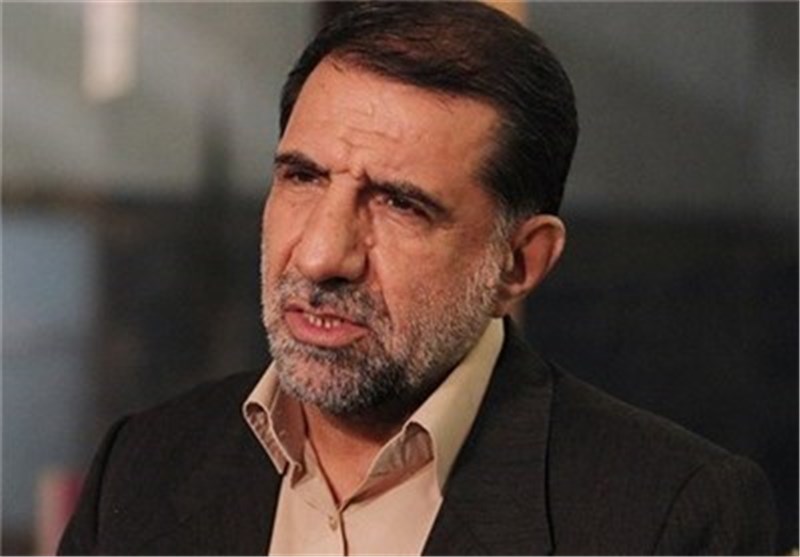
Iranian guy(1)

TEHRAN (Tasnim) – A senior Iranian lawmaker dismissed claims about Iran’s bilateral talks with the US over the ongoing crisis in Syria, saying Tehran does not at all negotiate with Washington on any non-nuclear issue.

Esmaeil Kosari, the chairman of the Iranian parliament’s defense commission, rejected media speculations about Iran’s direct talks with the US over the Syrian crisis, saying the country would never negotiate with the US over any topic other than the nuclear issue.

The Iranian negotiating team does not at all hold any direct negotiations with the US outside the nuclear issue, he told the Tasnim News Agency.

Another Iranian lawmaker, Baqer Hosseini, who is a member of the parliament’s National Security and Foreign Policy Commission, also told Tasnim that the foreign ministry officials have no permission to have non-nuclear talks with the US, and that it should not happen.

Given the guidelines of the Supreme Leader of the Islamic Revolution Ayatollah Seyed Ali Khamenei, and considering the previous experiences with Americans, Iran is not supposed to hold talks with the US on any topic other than the nuclear issue, he added.

The remarks came after certain media alleged that Tehran and Washington have conferred on the issue of Syria in their Thursday bilateral talks, previously announced to be focused on the implementation of a recent nuclear deal between Iran and world powers known as Joint Comprehensive Plan of Action (JCPOA).

In a similar reaction to the claim, US State Department Spokesman John Kirby stressed that “the discussions with Iran over Syria and what’s going on in Syria took place inside the multilateral setting.

“The meetings bilaterally were primarily about JCPOA implementation,” he added.

Earlier on October 7, Ayatollah Khamenei categorically rejected the idea of talks between Tehran and Washington in areas other than the nuclear issue.

Negotiating with the US is forbidden because it would bear no fruits, but would do countless harms, Imam Khamenei stressed at the time.

Reports: IAF targets Hezbollah assets in Syria

October 31, 2015

Reports: IAF targets Hezbollah assets in Syria, Times of Israel, October 31, 2015

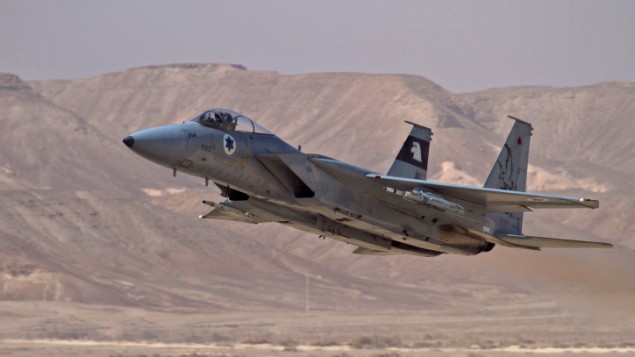
Israeli jet fighterAn Israeli fighter jet takes off during a training sortie in February 2010. (photo credit: Ofer Zidon/Flash90)

The Lebanese and Syrian media said Saturday that Israel Air Force warplanes have attacked targets in Syria linked to the Lebanon-based militant group Hezbollah. Reports varied, however, on the exact targets and location of the strikes.

According to a report on the Lebanese Debate website, six IAF jets carried out the strike over the Qalamoun Mountains region of western Syria, and targeted weapons that were headed for Hezbollah, Channel 10 said.

Syrian opposition groups, for their part, claimed Israeli planes had attacked targets in the Damascus area, in two strikes in areas where Hezbollah and pro-Assad forces were centered.

Syrian media, however, said that Israeli warplanes hit several Hezbollah targets in southern Syria.

Israel’s defense establishment declined to comment on the reports of the strikes, which would be the first since Russia boosted its involvement in the Syrian civil war.

Syrian and Iranian media reported Friday that Russia was carrying out air strikes against anti-Assad rebel forces on the Syrian side of the Golan Heights border with Israel.

The Jewish state has reportedly carried out several strikes on Syrian arms convoys destined for Hezbollah, although it routinely refuses to confirm such operations. It has, however, warned that it will not permit the Lebanon-based group to obtain what it calls “game-changing” advanced weaponry.

Prime Minister Benjamin Netanyahu said last month after meeting with Russian President Vladimir Putin in Moscow that Israel and Russia have agreed on a mechanism to avoid military confrontations between the two countries in Syria.

Russia, a key ally of Syrian President Bashar Assad, is in the midst of a military operation in the war-torn country, ostensibly to fight Islamic State militants who have seized huge swathes of territory. Critics however, claim that Russian airstrikes are targeting not only the fundamentalist group, but also Western-backed opposition groups who are seeking Assad’s ouster.

“My goal was to prevent misunderstandings between IDF forces and Russian forces. We have established a mechanism to prevent such misunderstandings. This is very important for Israel’s security,” Netanyahu told Israeli reporters during a telephone briefing from the Russian capital.

“Our conversation was dedicated to the complex security situation on the northern border,” the prime minister said. “I explained our policies in different ways to try to thwart the deadly weapons transfers from the Syrian army to Hezbollah — action actually undertaken under the supervision of Iran.”

Netanyahu said that he told Putin in “no uncertain terms” that Israel will not tolerate Tehran’s efforts to arm Israel’s enemies in the region, and that Jerusalem has taken and will continue to take action against any such attempts. “This is our right and also our duty. There were no objections to our rights and to what I said. On the contrary: there was readiness to make sure that whatever Russia’s intentions for Syria, Russia will not be a partner in extreme actions by Iran against us.”

Ahead of their meeting, as they made statements to the press, Netanyahu told Putin that Iran and Syria have been arming Hezbollah with advanced weapons, thousands of which are directed at Israeli cities. He also told his Russian host that Israel’s policy is to prevent these weapons transfers “and to prevent the creation of a terrorist front and attacks on us from the Golan Heights.”

In April, Defense Minister Moshe Ya’alon also warned that Israel would not let Iran equip Hezbollah with advanced weapons — a day after an alleged Israeli airstrike hit weapons depots in Syria.

Although Ya’alon did not discuss the airstrike that reportedly hit surface-to-surface missile depots, he declared that Israel would not allow Iran to supply arms to the terror group, which has a strong military presence in Lebanon as well as in Syria, the two countries lying on Israel’s northern borders.

Hizbullah Sec.-Gen. Nasrallah: The U.S. Supports ISIS, Runs the Entire War in Our Region

October 30, 2015

Hizbullah Sec.-Gen. Nasrallah: The U.S. Supports ISIS, Runs the Entire War in Our Region,Middle East Media Research Institute TV via You Tube, October 29, 2015

(Oh well. — DM)


According to the blurb following the video,

In an October 23 speech at a ceremony marking the ‘Ashura holiday in Beirut, Hizbullah Secretary-General Hassan Nasrallah said that the U.S. “provided ISIS with money, weapons, and aid,” and that “the war raging in our region is actually being led by the US.” The speech aired on the Iranian Al-Alam TV channel.

Hizballah is creeping up on Israel’s Golan border, relying on Russian military cover

October 23, 2015

Hizballah is creeping up on Israel’s Golan border, relying on Russian military cover, DEBKAfile, October 23, 2015

nasrallah-putin_10.15Hassan Nasrallah believes he has Putin behind him.

Wholly preoccupied with the ferocious Palestinian terror campaign washing over their country, Israelis have scarcely noticed that Hizballah forces, believing they are protected by the Russian military presence in Syria, are creeping toward Israel’s northeastern Golan border. DEBKAfile reports: The Lebanese group thinks it is a step away from changing the military balance on the Golan to Israel’s detriment and gaining its first Syrian jumping-off base against the Jewish state – depending on the Syrian-Hizballah forces winning the fierce battle now raging around Quneitra opposite Israel’s military positions.

For two years, Hizballah, egged on intensely by Iran, has made every effort to plant its forces along the Syrian border with Israel. For Tehran, this objective remains important enough to bring Al Qods Brigades chief, Gen. Qassem Soleiman, on a visit last week to the Syrian army’s 90th Brigade Quneitra base, which is the command post of the battle waged against Syrian rebel forces.

Soleimani, who is commander-in-chief of Iran’s military operations across the Middle East, is acting as military liaison in Syria between Tehran and Moscow.

DEBKAfile’s military sources report that the Iranian general inspected the Quneitra battle lines no more than 1.5-2 km from the Israeli Golan border. He arrived a few days after Revolutionary Guards Col. Nader Hamid, commander of Iranian and Hizballah forces in the region, died there fighting against Syrian rebels.

His death betrayed the fact that not only are Hizballah forces gaining a foothold on the strategic Golan enclave, but with them are Iranian servicemen, officers and troops.

While in Quneitra, the Iranian general also sought to find out whether Col. Hamid really did die in battle or was targeted for assassination by Israel to distance Iranian commanders from its border.

Just 10 months ago, on Jan. 18, Israel drones struck a group of Iranian and Hizballah officers who were secretly scouting the Quneitra region for a new base. Iranian Gen. Ali Mohamad Ali Allah Dadi died in that attack.

But Tehran and Hizballah are again trying their luck. During his visit to Quneitra, Soleimani called up reinforcements to boost the 500 Hizballah fighters in the sector.

Seen from Israel, the Syrian conflict is again bringing enemy forces into dangerous proximity to its border.

The Iranian general and Russian Air Force commanders agree that the drawn-out battle for Quneitra will not be won without Russian air strikes against the rebels holding out there. A decision to extend Russia’s aerial campaign from northern and central Syria to the south would be momentous enough to require President Vladimir Putin’s personal approval.

This decision would, however, cross a strong red line Israel laid down when Binyamin Netanyahu met Putin on Sept. 21 in Moscow and when, last week, a delegation of Russian generals visited Tel Aviv to set up a hot line for coordinating Israeli and Russian air operations over Syria.

Israeli officials made it very clear that Iranian and Hizballah forces would not be permitted to establish a presence opposite the Israeli Golan border and that any Russian air activity over southern Syria and areas close to its borders was unacceptable.

The possibility of Israeli fighter jets being scrambled against Russian aerial intervention in the Quneitra battle was not ruled out.

This state of affairs was fully clarified to Gen. Joseph Dunford, Chairman of the Joint US Chiefs of Staff, when he was taken on a trip this week to the southern Golan under the escort of IDF Chief of Staff Gen. Gady Eisenkot and OC Northern Command Gen. Avivi Kochavi. He visited the command post of Brig. Yaniv Azor, commander of the Bashan Division, which will be called upon for action if the hazard to Israel’s security emanating the Quneitra standoff takes a dangerous turn.

US praises role of Iranian-backed Shiite militias in Baiji operation

October 22, 2015

US praises role of Iranian-backed Shiite militias in Baiji operation, Long War Journal, October 22, 2015

Over the past several days, US officials have celebrated the capture of Baiji from the Islamic State. While doing so, they have praised the role that Iranian-supported Shiite militias have played in capturing the strategic central Iraqi city. These are the same militias that are responsible for killing hundreds of US soldiers just a few years ago, and many of these militia leaders are listed as Specially Designated Global Terrorists. Additionally, the US is continuing to provide air support to aid these groups.

Both the US military and the Obama administration’s Deputy Special Presidential Envoy to the Global Coalition to Counter ISIL (the outdated acronym for the Islamic State) issued statements that praised the role the Shiite militias played in recapturing Baiji.

Brett McGurk, the Deputy Special Presidential Envoy for the Global Coalition to Counter ISIL [another acronym for the Islamic State], tweeted that the “US commends progress by Iraqi Security Forces and popular mobilization forces [emphasis ours] against ISIL terrorists in Baiji.” He also confirmed that the US has launched around 130 airstrikes in support of these groups since August.

McGurk’s plaudits for the role that the “popular mobilization forces” have played in Baiji was echoed by the US military, which called these units “Shiia [sic] security forces.”

Army Major Mike Filanowski, an officer in the Combined Joint Task Force-Operation Inherent Resolve (CJTF-OIR), said that “The people who did the heavy lifting [in Baiji] were the Iraqi special forces.” He continued by saying, “they not only secured the [Baiji] oil refinery, but also the power plant to the north all the way up to the al-Fatah Bridge.” While the Iraqi special forces did help capture the refinery, they were not the only forces doing the “heavy lifting.”

The Department of Defense press release that quoted Filanowski admitted that the Popular Mobilization Committee (also called Popular Mobilization Units or Popular Mobilization Forces), was conducting operations.

“In the last three days, a special operations team from the elite Counterterrorism Service spearheaded the attack,” the DoD statement said. “The team worked with Iraqi army soldiers, Popular Mobilization Front forces — essentially Shiia security forces — and federal police” [emphasis ours].

So while the US commends the Iraqi Security Forces and the Popular Mobilization Committee, it is also lauding designated terrorists and a Foreign Terrorist Organization. The Popular Mobilization Committee is led by Abu Mahdi al Muhandis, a former commander in the Badr Organization who was listed by the US government as a Specially Designated Global Terrorist in July 2009. The US government described Muhandis, whose real name is Jamal Jaafar Mohammed, as “an advisor to Qassem Soleimani,” the commander of the Qods Force, the external operations wing of the Iranian Revolutionary Guards Corps (IRGC).

The Iranian-backed Shiite militias that played a prominent role in the assault on Baiji include: Asa’ib al Haq (League of the Righteous), whose leader Qais al Khazali is thought to be involved in the murder of five US soldiers in Karbala in 2007; Hezbollah Brigades, which is listed as a Foreign Terrorist Organization by the US government; Harakat al Nujaba, which recently called for the expulsion of US troops from Iraq; Harakat al Nujaba, which is led by Akram Abbas al Kaabi, a Specially Designated Global Terrorist; Kata’ib Imam Ali, led by Shebl al Zaydi, who is close to Qods Force commander Qassem Soleimani; Kata’ib Sayyid al Shuhada, which is commanded by Mustafa al Sheibani, who is also a Specially Designated Global Terrorist; and Badr Corps, another large militia supported by Iran. For more information the role these militias played in the retaking of Baiji, including photographs and video of Iraqi forces operating alongside these militias, see LWJ report, Iraqi Army, Shiite militias report success in Baiji.

Sadly, this behavior by US officials is nothing new. Earlier this year, General (retired) John Allen, the former Special Presidential Envoy for the Global Coalition to Counter ISIL, claimed that the US is only supporting so-called moderate Shiite militas, and not the “extremist elements.” Allen’s statement is below:

With regard to militias, it’s really important to understand that the militias are not just a single monolithic entity. There are the militias that you and I are used to hearing that have close alignments with Iran. Those are the extremist elements, and we don’t have anything to do with that. But there are elements of the Shia militias that volunteered last year to try to defend Iraq from the onslaught of Daesh [Islamic State] who were called to arms by Grand Ayatollah Sistani, and those elements, or the Popular Mobilization Force, as they are known, have been subordinated to the Iraqi higher military campaign or command. And they will provide maneuver capacity and additional firepower to the Iraqi Security Forces as we continue to build them out, as we continue to build the professionalization of the Iraqi forces.

So the fact that militias are involved and tribes are involved in this part of the campaign, this part of the implementation of supporting Iraq ultimately to recover the country, should not alarm us. We just need to ensure that we manage the outcome of this. Prime Minister Abadi’s been clear that these organizations within the Popular Mobilization Force, the Shia volunteers, will eventually either transition into the security forces themselves or go home. That’s the solution that he intends and I think that that’s a supportable outcome. So for now – this goes back to the point that you made about urgency – urgency is an important factor here in helping us to focus on supporting the Iraqis, the tribes, and the Popular Mobilization Force to take those actions necessary to defeat Daesh locally.

Allen said that the fact that the US is supporting the Popular Mobilization Committee “should not alarm us.” Except it should alarm us. Because as we detailed, the organization’s operational leader is a Specially Designated Terrorist, and its most effective militias are Iranian pawns that are responsible for killing hundreds of US soldiers and remain openly hostile to the US.

Leader Outlines Major Observations in JCPOA Implementation

October 21, 2015

Leader Outlines Major Observations in JCPOA Implementation, Tasnim News Agency (Iran), October 21, 2015

139406041520538615968453

[T]hroughout the 8-year period of implementing the JCPOA, imposing any sanctions, at any level and under any pretext –such as the “recurring and fabricated allegations of terrorism and human rights violation – by any of the parties to the talks”, will be tantamount to breach of the JCPOA and the administration will be obligated to take the necessary measures under the Clause 3 of the Iranian Parliament’s plan and cease the JCPOA activities.

*********************

TEHRAN (Tasnim) – Supreme Leader of the Islamic Revolution Ayatollah Seyed Ali Khamenei in a letter to President Hassan Rouhani highlighted nine main points that the administration will need to take note of regarding the course of implementing a final nuclear deal with six world powers.

In the letter, Ayatollah Khamenei appreciated the efforts made by the country’s different bodies involved in the course of nuclear negotiations with the Group 5+1 (Russia, China, the US, Britain, France and Germany) and the consequent efforts to evaluate the deal.

The Leader, however, noted that the nuclear agreement, dubbed the Joint Comprehensive Plan of Action (JCPOA), contains “ambiguities, structural weak points and multiple points that could inflict heavy losses on the country” at present and in the future in case of lack of strict and constant vigilance.

Ayatollah Khamenei then explicated the observations that the administration should make about the JCPOA and its implementation.

The first point in the Leader’s letter was the necessity for the full termination of the anti-Iran sanctions under the JCPOA.

Since the purpose of Iran’s approval to the nuclear negotiations was the removal of “cruel economic and financial sanctions”, and given the fact that the termination of the sanctions has been subjected to completion of Iran’s undertakings, there needs to be “firm and sufficient guarantees” to avert the other side’s breach, Ayatollah Khamenei underlined.

The US president and the European Union must declare that the anti-Iran sanctions have been “fully lifted”, the Leader noted.

The second observation in the letter was the categorical rejection of imposition of any new sanctions against Iran, which the Leader described as a breach of the JCPOA in which case the Iranian administration would be obligated to stop implementing the deal.

Third, the Leader further said, throughout the 8-year period of implementing the JCPOA, imposing any sanctions, at any level and under any pretext –such as the “recurring and fabricated allegations of terrorism and human rights violation – by any of the parties to the talks”, will be tantamount to breach of the JCPOA and the administration will be obligated to take the necessary measures under the Clause 3 of the Iranian Parliament’s plan and cease the JCPOA activities.

The rest of the observations are as follows:

4. Measures to renovate the Arak plant, which should keep its heavy (water) nature, will begin only after signing a definite and safe contract on an alternative plan and sufficient guarantee for its implementation.

5. The trade of the available enriched uranium with the yellowcake (a type of uranium concentrate powder) with a foreign government will take place when a secure contract with sufficient guarantees is signed. The mentioned trade and exchange (of materials) should occur gradually and in multiple times.

6. In accordance with the bill passed by the Majlis (parliament), a necessary plan should be devised and meticulously discussed by the Supreme National Security Council (SNSC) for mid-term development of (the country’s) nuclear energy industry, including ways to make progress in the next 15 years, leading to the production of 190,000 SWUs (Separative Work Units).

7. The Atomic Energy Agency of Iran (AEOI) should organize research and development in different aspects in such a way that at the end of the 8-year period, there will be no technological shortages for achieving the level of enrichment as accepted in the JCPOA.

8. As for ambiguities in the JCPOA, it should be stressed that the other side’s interpretation is not accepted, and that the reference (for interpretation) is the text of the negotiations.

9. The existence of complexities and ambiguities in the JCPOA and the possibility of breach of commitments and deception on the part of the other side, especially the US, necessitate that a strong, observant and smart committee be formed to monitor the progress of works, fulfilment of the other side’s commitments and  realization of the observations mentioned above. The committee’s arrangement and responsibilities should be formulated and approved by the SNSC.

European Influx of Militiamen Loyal To Iran Could Pose Problems

October 20, 2015

European Influx of Militiamen Loyal To Iran Could Pose Problems, Investigative Project on Terrorism, John Rossomando, October 19, 2015

1249

Evidence uncovered on social media indicates that members of Iranian-trained Shiite militias may be entering Europe as refugees, a London-based Iraqi émigré group says. The Foreign Relations Bureau – Iraq (FRBI) identified images of 48 men on Facebook and Twitter who it says fought with Iranian-trained Shiite militias in Iraq and now are in Europe.

FRBI came into existence in 2014 and promotes women’s rights, equality, Iraqi independence from foreign control, and a non-sectarian approach to governance.

FRBI’s list shows pictures of militiamen in uniform and carrying weapons. Alongside those images are pictures showing the same people wearing Western street clothes and standing in places such as Germany, Sweden, Belgium, Greece and Finland. This same list also includes 16 people belonging to Iraq’s security services who similarly made their way to Europe and who FBRI accuses of crimes against the Iraqi people.

These militias engaged in serious human-rights abuses in places like Tikrit after they ousted the Islamic State, and Iraqi security forces similarly engaged in unlawful killings, according to Human Rights Watch (HRW). FRBI refers to HRW’s research about human-rights abuses in Iraq as a reason why these men should not have been allowed into the E.U.

Images of these fighters began surfacing on social media in August and early September, said FRBI spokesman A. Al-Mahmoud.

“Our lists are compiled with the efforts of some of our affiliate analysts who follow social media of all sorts mainly militia related pages whom suddenly started posting images from within the EU as the refugee situation escalated,” Al-Mahmoud said in an email to the Investigative Project on Terrorism (IPT). “A public page was then set up on our website to document what can be from these accounts in hope that media would find it easier to have what they need all in one page.”

Thus far, FRBI has no evidence that the influx of Shiite militiamen into Europe has been organized or orchestrated by Iran or any organized crime syndicate in Europe, but the scale of the militiamen’s migration is unprecedented, Al-Mahmoud said.

They may have varying motivations, he said. Some may fear war crimes prosecutions and are trying to remake themselves into refugees. Others may no longer care about their government’s or clergy’s goals.

The men regularly posted images of themselves on the battlefield, Al-Mahmoud said, then suddenly began posting images showing them in Europe, which led FBRI to believe they had infiltrated the wave of refugees.

No matter the reasons for their move, FRBI fears these men are on a collision course with European values and trapped by a vicious sectarian ideology that makes them a potential threat to their host countries. It alleges that some of these men may have participated in war crimes in Iraq.

“[M]ost of the people who did join the militias do have sectarian leanings and they will export their irrational thought of non co-existence outside Iraq, which will collide with other open and liberal societies, so they will bring their problems with them,” Al-Mahmoud said. “Finally, the background they are from is very low and poor with minimal education; unskilled and foreign, they will quickly find it easy to get into the criminal/theft and drug world adding more problems to the European Union immigrant communities already suffering from stereotyping and media pressure.

“They were paid members of organizations that were trained to kill under religious banners; this is the first time they have come out of Iraq in such large numbers.”

The men belonged to deadly militias such as Al-Hashid al-Shaabi and its subsidiaries such as: Kataib Hizballah (aka Hizballah Iraq), Kataib Imam Ali militia, Saraya al-Salam militia (Iraqi cleric Moqtada al-Sadr’s Peace Brigades) – all of which are trained and strongly influenced by the Iranian Revolutionary Guard Qods Force under the command of Gen. Qasem Soleimani. He emerged as a controversial figure in the discussions of the Iranian nuclear deal.

Kataib Imam Ali militia formed from splinter elements of al-Sadr’s militia that fought American forces during the Iraq War and remain “extremely anti-American,” said Phillip Smyth, an adjunct fellow at the Washington Institute and an expert on Shiite militias in Iraq and Syria. Kataib Imam Ali militiamen have been implicated in human-rights abuses similar to those carried out by the Islamic State (ISIS), he said. In one case, a video showed a militiaman dismembering the burned corpse of a Islamic State fighter as if he were “shwarma,” which sparked a reprisal video by the Islamic State in which two Shiite fighters were burned to death.

An IPT review of the information provided by FRBI lends credence to its contention that Shiite fighters have entered Europe among groups of refugees.

For example, the Facebook page of Al-Hashid al-Shaabi militia member Ali Spaaki shows a clear progression from being on the battlefield in Iraq in June to making his way across Europe throughout September and on to Helsinki, Finland on Oct. 4. Spaaki’s Facebook page shows him getting off a ferry along with a crowd of people in a picture posted to his timeline on Sept. 20 in front of a Greek-flagged ferry and a large crowd. A related photo, also taken Sept. 20, shows him standing in front of a boat that reads “Bodrum” [Turkey] on its stern as its homeport, suggesting the ferry may have departed from that Turkish town. Bodrum has become a “magnet” for refugees, and large numbers of refugees have left the town hoping to make it to Greece since the summer, according to news reports. Spaaki’s departure date came weeks after the body of Aylan Kurdi, a toddler refugee, washed up onshore near Bodrum.

A similar story can be told by examining the Facebook page belonging to Al-Hashid Al-Shaabi fighter Mustafa Al-Azawi. There, he explicitly discusses his effort to enter Greece on the island of Lesbos on Sept. 17 via Izmir, Turkey, which news reports say is a common point of departure for refugees. Pictures on Al-Azawi’s timeline of himself posing on the shore of the island and of inner tubes and a crowd of likely refugees happened the same day a Getty Images photographer captured an image of migrants arriving on Lesbos. Days earlier, on Sept. 10, Al-Azawi posted Google Maps images of routes to Lesbos on Facebook, suggesting he planned his route to the island. Like Spaaki, Al-Azawi’s Facebook page shows his travel across Europe before making his to his final destination in Oulu, Finland on Oct. 3.

Al-Mahmoud also worries these militiamen could become entangled in organized crime and become involved in Iranian-controlled social organizations across Europe, and they will be used for Iran’s political ends.

“A lot of them believe in … Iran’s guiding ideology, and that political and social matters are presided over by Ayatollah Khamenei … so they follow what he says,” Smyth said. “They (Iraqi Shiite militiamen in Europe) do pose a risk.

“These groups believe that both America and the State of Israel are their existential foes.”

In the past, Hizballah supporters living in Europe, Canada or the United States have engaged in criminal activities. This includes cigarette smuggling in the U.S. and accusations of organized crime in Canada and in the E.U. Hizballah supporters also plotted and carried out terrorist attacks in Argentina and Bulgaria. Although these Iraqi militias are not part of Hizballah, they are branches on the same Iranian Qods Force tree – first cousins in effect.

Shiites who support Hizballah and Iran in places like Sweden already have been recruited as foreign fighters by Iranian proxies to fight in Iraq, said Smyth, who traveled to Scandinavia last year on a related research trip. Having a passport from someplace like Sweden means a foreign fighter can come and go from hot zones like Iraq or Syria without the same hassles someone traveling on a Lebanese, Syrian or Iraqi passport.

While most attention has been given to Sunni foreign fighters traveling to Syria and Iraq to fight for the Islamic State and other Sunni jihadist groups, Smyth said, not enough attention has been given to Shiite fighters with ties to Iran.

“You now have a new transnational threat that is loyal to the Iranians, that is anti-American, is anti-Western, is anti-Israel,” Smyth said. “There is a direct threat that’s there.”

It is hard to tell how many people on the FRBI list actually are refugees or if they are in the E.U. vacationing or are there for some other reason. But Smyth sees them as a national-security threat either way.

“Here are examples of these guys when they are out of uniform, when they are possibly still militiamen, and they are traveling to Europe, which says something. How did they get there with a visa? Why, after all of this has been publicized, are they all still going?” Smyth asked in a phone interview with the IPT. “There are already examples of Shia militiamen, Hizballah for instance, who have used Western passports to go different places and to engage in bad deeds.”

This also has U.S. Customs officials concerned. The ease in which these Shia militiamen have entered Europe raises fears that they will be able to travel to the U.S. on E.U. passports, said one Immigration and Customs Enforcement (ICE) agent who spoke under the condition of not being named. Anyone with a passport from places like Germany, Sweden can easily get on a flight to the U.S. without the sorts of hassles they might experience traveling on an Iraqi or a Syrian passport.

A spokeswoman for Europe’s top law enforcement agency, EUROPOL, told the IPT her agency was unaware of any organized effort by terrorist organizations to infiltrate the E.U. However, none of the Shia militia groups whose members have made their way to Europe are listed as terror groups by the E.U.

“There are however concerns about the use of the Mediterranean routes. While the majority of irregular migrants and refugees are in search of safety, other groups such as returning foreign fighters and other individuals linked to IS (Islamic State), might make use of the services provided by the organized crime groups,” EUROPOL spokeswoman Agnieszka Biegaj wrote in an e-mailed statement. “Given the hazardous nature of the illegal migratory routes, from a terrorists’ perspective, it makes more sense to use regular travel methods and other resources such as false or genuine travel documents.”

World view: Politics may force Obama to ‘over-react’ militarily in Syria

October 11, 2015

World view: Politics may force Obama to ‘over-react’ militarily in Syria, BreitbartJohn J. Xenakis, October 11, 2015

(Fine. But what advice will he take from whom before he does something? Perhaps his favorite military political adviser?

PJ boy and Obama

— DM)


obamaz-640x480

Palestinian-Israeli violence continues in Gaza and West Bank

g151009bPalestinian protesters in Gaza on Friday (AP)

Six Palestinians were killed and hundreds of Palestinians and Israeli were wounded on Friday as several weeks of violence continued. ( “9-Oct-15 World View — Israeli-Palestinian violence spreads across West Bank as anger grows”)

Ismail Haniyeh, the leader of Hamas, which governs Gaza, applauded the recent Palestinian knife attacks on Israelis, and called for a “third intifada.” By contrast, Israeli Prime Minister Benjamin Netanyahu “strongly condemned the harming of innocent Arabs.” Both Israeli and Palestinian security forces are on high alert, with more violence expected. Fox News/AP

Obama administration announces an abrupt change of policy in Syria

The Obama administration’s widely ridiculed $500 million program to train and equip Syrian rebels to fight the so-called Islamic State (IS or ISIS or ISIL or Daesh) was “paused” on Friday as a publicly admitted failure. The program was supposed to train thousands of rebels, but the public was shocked several weeks ago when the administration admitted that only “four or five” had been trained, despite the program’s huge price tag.

As Foreign Policy magazine put it: “On Capitol Hill, it’s been called “a joke,” a “total failure,” and “a bigger disaster than I could have ever imagined.” And now we have another name for it: dead.”

A new program has been announced. The new program will provide air support and basic equipment and training to vetted opposition group leaders who are already fighting ISIS and who are committed to fighting ONLY ISIS, and not the regime of Syria’s president Bashar al-Assad.

Brett McGurk, whose title is “White House deputy envoy to the Global Coalition to Counter Islamic State,” described the new program as follows:

“Is it best to take those guys out and put them through training programs for many weeks, or to keep them on the line fighting and to give them additional enablers and support? I think the latter is the right answer, and that’s what we’re going to be doing.”

According to Secretary of Defense Ash Carter: “I remain convinced that a lasting defeat of ISIL in Syria will depend in part on the success of local, motivated and capable ground forces. I believe the changes we are instituting today will, over time, increase the combat power of counter-ISIL forces in Syria and ultimately help our campaign achieve a lasting defeat of ISIL.”

The old policy was criticized and mocked from the day it was announced last year. The new policy is receiving similar treatment. A NY Times editorial titled “An Incoherent Syria War Strategy” points out that the strategy of finding and arming rebel groups that want to fight ISIS but who are going to be forbidden from fighting the al-Assad regime makes no sense:

“The initial plan was dubious. The new one is hallucinatory, and it is being rolled out as the war enters a more perilous phase now that Russia has significantly stepped up its military support of Mr. Assad’s forces.

There is no reason to believe that the United States will suddenly be successful in finding rebel groups that share its narrow goal of weakening the Islamic State, also known as ISIS or ISIL, but not joining the effort to topple Mr. Assad. Washington’s experience in Syria and other recent wars shows that proxy fighters are usually fickle and that weapons thrust into a war with no real oversight often end up having disastrous effects.”

This harsh criticism from a newspaper that regularly slobbers over President Obama symbolizes how much even the left-wing mainstream media, not to mention foreign media throughout the Mideast, now views the Obama administration as weak and rudderless, lurching from one policy to the next. (As another example, it had been widely expected that Secretary of State John Kerry would win this year’s Nobel Peace Prize for the Iran nuclear deal, but even the loony Norwegians have lost faith.) VOA and NY Times

Obama administration may be forced into greater military role

I’ve written many times about the Harry Truman’s Truman Doctrine of 1947, which made America policeman of the world. The justification is that it’s better to have a small military action to stop an ongoing crime than to let it slide and end up having an enormous conflict like World War II. Every president since WW II has followed the Truman Doctrine, up to and including George Bush. Barack Obama is the first president to repudiate the Truman Doctrine, essentially leaving the world without a policeman.

Call it Kismet or Karma or God’s Will (or call it an unstoppable generational trend), but America does have an exceptional role in the world, and repudiating that role does not end it. Obama’s policy of apologizing for America has held sway for over six years, but now powerful political pressures are growing to force a change. Those forces are being driven by massive shifts in public attitudes towards Obama, both in the US and abroad, as reflected in worldwide criticism of him in the media as a weak president.

According to the left-leaning Washington Post:

“Russia’s military moves in Syria are fundamentally changing the face of the country’s civil war, putting President Bashar al-Assad back on his feet, and may complicate the Obama administration’s plans to expand its air operations against the Islamic State. …

But others within the administration, and many outside experts, are increasingly worried that if President Obama does not take decisive action — such as quickly moving to claim the airspace over northwestern Syria and the Turkish border, where Russian jets are already operating — it is the United States that will suffer significant damage to both its reputation and its foreign policy and counterterrorism goals. …

The current internal administration debate is largely the same one that has kept the administration out of significant intervention in Syria’s civil war for the past four years. On one side, Russia’s involvement has strengthened the winning argument that the United States should avoid direct involvement in yet another Middle East conflict and should continue directing its resources toward countering forces such as the Islamic State that pose a direct threat to U.S. national security.

On the other side, the argument is that it makes no strategic sense for the United States to concede Russian dominance of the situation: If Russia succeeds in keeping Assad in power, the problems in the West caused by both the Syrian war and militant expansion will only get worse.”

The article describes two sides of the debate whether to intervene in Syria, but does not draw the obvious conclusion that the weight of political opinion is moving sharply towards the side of some kind of intervention — although those that say that “it makes no strategic sense … to concede Russian dominance” do not agree on what steps should be taken to avoid conceding.

The left-leaning Brookings Institution makes the claim that intervention in Syria is costing Russia enormously, and so “For the United States, avoiding the temptation to over-react is still the key guideline.”

But the article then goes on to describe problems with doing nothing, and even conclude:

“Finally, the United States and its allies could deliver a series of airstrikes on the Hezbollah bands around Damascus. That would be less confrontational vis-à-vis Russia than hitting Assad’s forces. Hezbollah has already suffered losses in the Syrian war and is not particularly motivated to stand with Assad to the bitter end, away from own home-ground in Lebanon. (Israel would appreciate such punishment, too.)”

I almost can’t believe my eyes reading this recommendation. American warplanes around Damascus would almost certainly come into contact with Russian warplanes, and even if they didn’t, bombing al-Assad’s close ally Hezbollah could be the trigger that sets off a wider war in this generational Crisis era.

Policy can sometimes act like a rubber band that be stretched in one direction so far that when it’s released, it snaps back in the other direction violently. After six years of constantly apologizing for America, the pressure is on President Obama to do something different. Brookings advises Obama about “avoiding the temptation to over-react,” but Obama may be politically forced to decide that with his previous policies so widely criticized and mocked, he has to take some step to prove to the world that he’s a tough leader after all, and he may have to over-react, because no half-measure will provide the proof he needs. Washington Post and Brookings Institution.

Op-Ed: Chaos and 2nd Cold War, Part II: Israel’s Nuclear Strategy

October 11, 2015

Op-Ed: Chaos and 2nd Cold War, Part II: Israel’s Nuclear Strategy, Israel National News, Prof. Louis René Beres, October 11, 2015

(Part I is available here. — DM)

Israel should now be calculating the exact extent or subtlety with which it should consider communicating key portions of its nuclear posture and positions. Naturally, Israel should never reveal any too-specific information about its nuclear strategy, its nuclear hardening, or even its nuclear yield-related capabilities. Still, sometimes, the duty of finely-honed intelligence services should not be to maximize strategic secrecy, but rather, to carefully “share” certain bits of pertinent information.

**********************************

How will Russia respond to any ramped up American uses of force in the Middle East, and, more plausibly, vice-versa?  One must assume that Jerusalem is already asking these key questions, and even wondering whether, in part, greater mutualities of interest could sometime exist with Moscow than with Washington.

To wit, Prime Minister Benjamin Netanyahu met with Russia’s President Vladimir Putin in September 2015. Among other things, the Israeli leader must  be calculating: 1)Will the Obama Administration’s incoherent retreat from most of the Middle East point toward a more permanent United States detachment from the region; and 2) If it does, what other major powers are apt to fill the resultant vacuum? Just as importantly, and as an obvious corollary to (2), above, the prime minister should be inquiring: “How will the still-emerging Cold War II axis of conflict impact America’s pertinent foreign policy decisions?”

There are some additional ironies yet to be noted. Almost certainly, ISIS, unless it is first crushed by U.S. and/or Russian-assisted counter-measures, will plan to march westward across Jordan, ultimately winding up at the borders of West Bank (Judea/Samaria). There, ISIS Jihadists could likely make fast work of any still-posted Hamas and Fatah forces, in effect, taking over what might once have become “Palestine.” In this now fully imaginable scenario, the most serious impediment to Palestinian statehood is not Israel, but rather a murderous band of Sunni Arab terrorists.[16]

What about the larger picture of “Cold War II?” Israeli defense planners will need to factor into their suitably nuanced calculations the dramatically changing relationship between Washington and Moscow. During “Cold War I,” much of America’s support for the Jewish State had its most fundamental origins in a perceived need to compete successfully in the Middle East with the then Soviet Union. In the progressive development of “Cold War II,” Jerusalem will need to carefully re-calculate whether a similar “bipolar” dynamic is once again underway, and whether the Russian Federation might, this time around, identify certain strategic benefits to favoring Israel in regional geo-politics.

In all such strategic matters, once Israel had systematically sorted through the probable impact of emerging “superpower” involvements in the Middle East, Jerusalem would need to reassess its historic “bomb in the basement.” Conventional wisdom, of course, has routinely pointed in a fundamentally different policy direction. Still, this “wisdom” assumes that credible nuclear deterrence is simply an automatic result of  physically holding nuclear weapons. By the logic of this too-simplistic argument, removing Israel’s nuclear bomb from the “basement” would only elicit new waves of global condemnation, and would likely do so without returning any commensurate security benefits to Jerusalem.

Scholars know, for good reason, that the conventional wisdom is often unwise. Looking ahead, the strategic issues facing Israel are not at all uncomplicated or straightforward.  Moreover, in the immutably arcane world of Israeli nuclear deterrence, it can never really be adequate that enemy states merely acknowledge the Jewish State’s nuclear status. Rather, it is also important that these states should be able to believe that Israel holds usable nuclear weapons, and that Jerusalem/Tel-Aviv would be willing to employ these usable weapons in certain clear, and situationally recognizable, circumstances.

Current instabilities in the Middle East will underscore several good reasons to doubt that Israel could ever benefit from any stubborn continuance of deliberate nuclear ambiguity. It would seem, too, from certain apparent developments already taking place within Mr. Netanyahu’s “inner cabinet,” that portions of Israel’s delegated leadership must now more fully understand the bases of any such informed skepticism.

In essence, Israel is imperiled by compounding and inter-related existential threats that justify its fundamental nuclear posture, and that require a correspondingly purposeful strategic doctrine. This basic need exists well beyond any reasonable doubt. Without such weapons and doctrine, Israel could not expectedly survive over time, especially if certain neighboring regimes, amid expanding chaos,  should soon become more adversarial, more Jihadist, and/or less risk-averse.

Incontestably, a purposeful nuclear doctrine could prove increasingly vital to coping with various more-or-less predictable strategic scenarios for Israel, that is, those believable narratives requiring preemptive action, and/or an appropriate retaliation.

Typically, military doctrine carefully describes how national forces should fight in various combat operations. The literal definition of “doctrine” derives from Middle English, from the Latin doctrina, meaning teaching, learning, andinstruction. Though generally unrecognized, the full importance of doctrine lies not only in the several ways that it can animate and unify military forces, but also in the uniquely particular fashion that it can transmit certain desired “messages.”

In other words, doctrine can serve an increasingly imperiled  state as a critical form of communication, one directed to its friends, and also to its foes.

Israel can benefit from just such broadened understandings of doctrine. The principal security risks now facing Israel are really more specific than general or generic. This is because Israel’s extant adversaries in the region will likely be joined, at some point, by: (1) a new Arab state of “Palestine;” and/or by (2) a newly-nuclear Iran. It is also because of the evidently rekindled global spark of “bipolar” or “superpower” adversity, and the somewhat corollary insertion of additional American military forces to combat certain new configurations of Jihadi terror.

For Israel, merely having nuclear weapons, even when fully recognized in broad outline by enemy states, can never automatically ensure successful deterrence. In this connection, although starkly counter-intuitive, an appropriately selective and thoughtful end to deliberate ambiguity could improve the overall credibility of Israel’s nuclear deterrent.  With this point in mind, the potential of assorted enemy attack prospects in the future could be reduced by making available certain selected information concerning the safety of  Israel’s nuclear weapon response capabilities.

This crucial information, carefully limited, yet more helpfully explicit, would center on the distinctly major and inter-penetrating issues of Israeli nuclear capability and decisional willingness.

Skeptics, no doubt, will disagree. It is, after all, seemingly sensible to assert that nuclear ambiguity has “worked” thus farWhile Israel’s current nuclear policy has done little to deter multiple conventional terrorist attacks, it has succeeded in keeping the country’s enemies, singly or in collaboration, from mounting any authentically existential aggressions. This conclusion is not readily subject to any reasonable disagreement.

But, as the nineteenth-century Prussian strategic theorist, Karl von Clausewitz, observed, in his classic essay, On War, there may come a military tipping point when “mass counts.” Israel is already coming very close to this foreseeable point of no return. Israel is very small.  Its enemies have always had an  undeniable advantage in “mass.”

More than any other imperiled state on earth, Israel needs to steer clear of such a tipping point.

This, too, is not subject to any reasonable disagreement.

Excluding non-Arab Pakistan, which is itself increasingly coup-vulnerable, none of Israel’s extant Jihadi foes has “The Bomb.”  However, acting together, and in a determined collaboration, they could still carry out potentially lethal assaults upon the Jewish State. Until now, this capability had not been possible, largely because of insistent and  persistently overriding fragmentations within the Islamic world. Looking ahead, however, these same fragmentations could sometime become a source of special danger to Israel, rather than remain a continuing source of  national safety and reassurance.

An integral part of Israel’s multi-layered security system lies in the country’s ballistic missile defenses, primarily, the Arrow or “Hetz.” Yet, even the well-regarded and successfully-tested Arrow, now augmented by the newer and shorter-range iterations of “Iron Dome,” could never achieve a sufficiently high probability of intercept to meaningfully protect Israeli civilians.[17] No system of missile defense can ever be “leak proof,” and even a single incoming nuclear missile that somehow managed to penetrate Arrow or corollary defenses could conceivably kill tens or perhaps hundreds of thousands of Israelis.[18]

In principle, at least, this fearsome reality could be rendered less prospectively catastrophic if Israel’s traditional reliance on deliberate ambiguity were suitably altered.

Why alter? The current Israeli policy of an undeclared nuclear capacity is unlikely to work indefinitely. Leaving aside a Jihadi takeover of already-nuclear Pakistan, the most obviously unacceptable “leakage” threat would come from a nuclear Iran. To be effectively deterred, a newly-nuclear Iran would require convincing assurance that Israel’s atomic weapons were both (1) invulnerable, and (2) penetration-capable.

Any Iranian judgments about Israel’s capability and willingness to retaliate with nuclear weapons would then depend largely upon some prior Iranian knowledge of these weapons, including their expected degree of protection from surprise attack, as well as Israel’s expected capacity to “punch-through” all pertinent Iranian active and passive defenses.

Jurisprudentially, at least, following JCPOA in Vienna, a  nuclear weapons-capable Iran is a fait accompli. For whatever reasons, neither the “international community” in general, nor Israel in particular, had ever managed to create sufficient credibility concerning a once-timely preemptive action. Such a critical defensive action would have required very complex operational capabilities, and could have generated Iranian/Hezbollah counter actions that might have a  very significant impact on the entire Middle East. Nevertheless, from a purely legal standpoint, such preemptive postures could still have been justified, under the authoritative criteria of anticipatory self-defense, as permitted under customary international law.

It is likely that Israel has undertaken some very impressive and original steps in cyber-defense and cyber-war, but even the most remarkable efforts in this direction will not be enough to stop Iran altogether. Earlier, the “sanctions” sequentially leveled at Tehran – although certainly better than nothing – could have had no tangible impact on effectively halting Iranian nuclearization.

Strategic assessments can sometimes borrow from a Buddhist mantra. What is, is. Ultimately, a nuclear Iran could decide to share some of its nuclear components and materials with Hezbollah, or with another kindred terrorist group. Ultimately, amid growing regional chaos, such injurious assets could find their way to such specifically U.S- targeted groups as ISIS.

Where relevant, Israeli nuclear ambiguity could be loosened by releasing certain very general information regarding the availability and survivability of appropriately destructive  nuclear weapons.

Israel should now be calculating the exact extent or subtlety with which it should consider communicating key portions of its nuclear posture and positions. Naturally, Israel should never reveal any too-specific information about its nuclear strategy, its nuclear hardening, or even its nuclear yield-related capabilities. Still, sometimes, the duty of finely-honed intelligence services should not be to maximize strategic secrecy, but rather, to carefully “share” certain bits of pertinent information.

What about irrational enemies? An Israeli move from ambiguity to disclosure would not likely help in the case of an irrational nuclear enemy. It is even possible, in this regard, that particular elements of Iranian leadership might meaningfully subscribe to certain end-times visions of a Shiite apocalypse. By definition, any such enemy would not necessarily value its own continued national survival more highly than any other national preference, or combination of preferences. By definition, any such enemy would present a genuinely unprecedented strategic challenge.

Were its leaders to become authentically irrational, or to turn in expressly non-rational directions, Iran could then effectively become a nuclear suicide-bomber in macrocosm.  Such a profoundly destabilizing strategic prospect is improbable, but it is also not inconceivable. A similarly serious prospect exists in already-nuclear Pakistan.

To protect itself against military strikes from irrational enemies, especially those attacks that could carry existential costs, Israel will need to reconsider virtually every aspect and function of its nuclear arsenal and doctrine. This is a strategic reconsideration that must be based upon a number of bewilderingly complex intellectual calculations, and not merely on ad hoc, and more-or-less presumptively expedient political judgments.

Removing the bomb from Israel’s basement could enhance Israel’s strategic deterrence to the extent that it would heighten enemy perceptions of the severe and likely risks involved. This would also bring to mind the so-called Samson Option, which, if suitably acknowledged, could allow various enemy decision-makers to note and underscore a core assumption. This is that Israel is prepared to do whatever is needed to survive. Interestingly, such preparation could be entirely permissible under governing international law, including the 1996 Advisory Opinion of the International Court of Justice.[19]

Irrespective of  its preferred level of ambiguity, Israel’s nuclear strategy must always remain oriented toward deterrence, not to actual war-fighting.[20] The Samson Option refers to a policy that would be based in part upon a more-or-less implicit threat of massive nuclear retaliation for certain anticipated enemy aggressions.  Israel’s small size means, inter alia, that any nuclear attack would threaten Israel’s very existence, and could not be tolerated. Israel’s small size also suggests a compelling need for sea-basing (submarines) at least a recognizably critical portion of its core nuclear assets,

From a credibility standpoint, a Samson Option could make sense only in “last-resort,” or “near last-resort,” circumstances. If the Samson Option is to be part of a convincing deterrent, as it should, an incremental end to Israel’s deliberate ambiguity is essential. The really tough part of this transformational process will lie in determining the proper timing for such action vis-a-vis Israel’s security requirements, and in calculating authoritative expectations (reasonable or unreasonable) of the “international community.”

The Samson Option should never be confused with Israel’s overriding security objective: To seek stable deterrence at the lowest possible levels of military conflict. As a last resort, it basically states the following warning to all potential nuclear attackers:  “We (Israel) may have to `die,` but (this time) we won’t die alone.”

There is a related observation. In our often counter-intuitive strategic world, it can sometimes be rational to pretend irrationality. The nuclear deterrence benefits of any such pretended irrationality would depend, at least in part, upon an enemy state’s awareness of Israel’s intention to apply counter-value targeting when responding to a nuclear attack. But, once again, Israeli decision-makers would need to be aptly wary of ever releasing too-great a level of specific operational information.

In the end, there are specific and valuable critical security benefits that would likely accrue to Israel as the result of a purposefully selective and incremental end to its historic policy of deliberate nuclear ambiguity.   The right time to begin such an “end”  has not yet arrived. But, at the precise moment that Iran verifiably crosses the nuclear threshold, or arguably just before this portentous moment, Israel should  promptly remove The Bomb from its “basement.”

When this critical moment arrives, Israel should already have configured (1) its presumptively optimal allocation of nuclear assets; and (2) the extent to which this preferred configuration should now be disclosed. Such strategic preparation could then enhance the credibility of Israel’s indispensable nuclear deterrence posture.

When it is time for Israel to selectively ease its nuclear ambiguity, a second-strike nuclear force should be revealed in broad outline. This robust strategic force – hardened, multiplied, and dispersed – would need to be fashioned so as to recognizably inflict a decisive retaliatory blow against major enemy cities. Iran, it follows, so long as it is led by rational decision-makers, should be made to understand that the actual costs of  any planned aggressions against Israel would always exceed any expected gains.

In the final analysis, whether or not a shift from deliberate ambiguity to some selected level of nuclear disclosure would actually succeed in enhancing Israeli nuclear deterrence would depend upon several complex and intersecting factors. These include, inter alia, the specific types of nuclear weapons involved; reciprocal assessments and calculations of pertinent enemy leaders; effects on rational decision-making processes by these enemy leaders; and effects on both Israeli and adversarial command/control/communications operations. If  bringing Israel’s bomb out of the “basement” were to result in certain new enemy pre-delegations of nuclear launch authority, and/or in new and simultaneously less stable launch-on-warning procedures, the likelihood of unauthorized and/or accidental nuclear war could then be substantially increased.

Not all adversaries may be entirely rational. To comprehensively protect itself against potentially irrational nuclear adversaries, Israel has no logical alternative to developing an always problematic conventional preemption option, and to fashion this together with a suitable plan for subsequent “escalation dominance.” Operationally, especially at this very late date, there could be no reasonable assurances of success against many multiple hardened and dispersed targets. Regarding deterrence, however, it is noteworthy that “irrational” is not the same as “crazy,” or “mad,” and that even an expectedly irrational Iranian leadership could still maintain susceptible preference orderings that are both consistent and transitive.

Even an irrational Iranian leadership could be subject to threats of deterrence that credibly threaten certain deeply held religious as well as civic values. The relevant difficulty here for Israel is to ascertain the precise nature of these core enemy values. Should it be determined that an Iranian leadership were genuinely “crazy” or “mad,” that is, without any decipherable or predictable ordering of preferences, all deterrence bets could then have to give way to preemption, and possibly even to certain plainly unwanted forms of war fighting.

Such determinations, of course, are broadly strategic, not narrowly jurisprudential. From the discrete standpoint of international law, especially in view of Iran’s expressly genocidal threats against Israel, a preemption option could still represent a permissible expression of anticipatory self-defense. Again, however, this purely legal judgment would be entirely separate from any parallel or coincident assessments of operational success. There would be no point for Israel to champion any strategy of preemption on solely legal grounds if that same strategy were not also expected to succeed in specifically military terms.

Growing chaotic instability in the Middle East plainly heightens the potential for expansive and unpredictable conflicts.[21] While lacking any obviously direct connection to Middle East chaos, Israel’s nuclear strategy must now be purposefully adapted to this perilous potential. Moreover, in making this adaptation, Jerusalem could also have to pay special attention not only to the aforementioned revival of  major “bipolar” animosities, but also, more specifically and particularly, to Russia’s own now-expanding nuclear forces.

This cautionary warning arises not because augmented and modernized Russian nuclear forces would necessarily pose any enlarged military threat to Israel directly, but rather because these strategic forces could determine much of the way in which “Cold-War II” actually evolves and takes shape. Vladimir Putin has already warned Washington of assorted “nuclear countermeasures,” and recently test launched an intercontinental nuclear missile.[22] One such exercise involved a new submarine-launched Bulava missile, a weapon that could deliver a nuclear strike with up to 100 times the force of the 1945 Hiroshima blast.

Current adversarial Russian nuclear posturing vis-à-vis the United States remains oriented toward the Ukraine, not the Middle East.[23] Nevertheless, whatever happens to U.S.-Russian relations in any one part of the world could carry over to certain other parts, either incrementally, or as distinctly sudden interventions or escalations. For Jerusalem, this means, among other things, an unceasing obligation to fashion its own developing nuclear strategy and posture with an informed view to fully worldwide power problems and configurations.

Whether looking toward Gaza, West Bank (Judea/Samaria), Iran, Lebanon, Iraq, Jordan, Egypt, or Syria, Israel will need to systematically prioritize existential threats, and, thereafter, stay carefully focused on critically intersecting and overriding factors of global and regional security. In all such meticulously careful considerations, both chaos and Cold War II should be entitled to occupy a conspicuous pride of place.

Sources:

[16] A further irony here concerns Palestinian “demilitarization,” a pre-independence condition of statehood called for by Israeli Prime Minister Benjamin Netanyahu. Should Palestinian forces (PA plus Hamas) ever actually choose to abide by any such formal legal expectation, it could makes these forces less capable of withstanding any foreseeable ISIS attacks. Realistically, however, any such antecedent compliance would be highly improbable. See, for earlier legal assessments of Palestinian demilitarization, Louis René Beres and (Ambassador) Zalman Shoval, “Why a Demilitarized Palestinian State Would Not Remain Demilitarized: A View Under International Law,” Temple International and Comparative Law Journal, Winter 1998, pp. 347-363; and Louis René Beres and Zalman Shoval, “On Demilitarizing a Palestinian `Entity’ and the Golan Heights: An International Law Perspective,” Vanderbilt Journal of Transnational Law, Vol. 28, No. 5, November 1995, pp. 959-972.

[17] There is another notable and more generic (pre-nuclear age) risk of placing too-great a reliance on defense. This is the risk that a corollary of any such reliance will be a prospectively lethal tendency to avoid taking otherwise advantageous offensive actions. Recall, in this connection, Carol von Clausewitz On War:  “Defensive warfare…does not consist of waiting idly for things to happen. We must wait only if it brings us visible and decisive advantages. That calm before the storm, when the aggressor is gathering new forces for a great blow, is most dangerous for the defender.” See: Carl von Clausewitz, Principles of War, Hans W. Gatzke, tr., New York: Dover Publications, 2003, p. 54.

[18] For early authoritative accounts, by the author, of expected consequences of a nuclear attack, see: Louis René Beres, Apocalypse: Nuclear Catastrophe in World Politics (Chicago: University of Chicago Press, 1980); Louis René Beres, Mimicking Sisyphus: America’s Countervailing Nuclear Strategy (Lexington, Mass., Lexington Books, 1983); Louis René Beres, Reason and Realpolitik: U.S. Foreign Policy and World Order (Lexington, Mass., Lexington Books, 1984); and Louis René Beres, Security or Armageddon: Israel’s Nuclear Strategy (Lexington, Mass., Lexington Books, 1986).

[19] See: “Summary of the Legality of the Threat or Use of Nuclear Weapons,” Advisory Opinion, 1996, I.C.J., 226 (Opinion of 8 July 1996). The key conclusion of this Opinion is as follows: “…in view of the current state of international law, and of the elements of fact at its disposal, the Court cannot conclude definitively whether the threat or use of nuclear weapons would be lawful or unlawful in an extreme circumstance of self-defense, in which the very survival of a State would be at stake.”

[20] This advice was a central recommendation of the Project Daniel Group’s final report,  Israel’s Strategic Future (ACPR, Israel, May 2004: “The overriding priority of Israel’s nuclear deterrent force must always be that it preserves the country’s security without ever having to be fired against any target. The primary point of Israel’s nuclear forces must always be deterrence ex ante, not revenge ex post.” (p. 11). Conceptually, the core argument of optimizing military force by not resorting to any actual use pre-dates the nuclear age. To wit, Sun-Tzu, in his ancient classic, The Art of War, counseled: “Supreme excellence consists of breaking the enemy’s resistance without fighting.”

[21] Once again, Prussian military thinker, Carl von Clausewitz, had already highlighted the generic (pre-nuclear age) dangers of unpredictability, summarizing these core hazards as matters of “friction.”

[22] ICBM test launches are legal and permissible under the terms of New START, It does appear, however,  that Russia has already developed and tested a nuclear-capable cruise missile with a range of 500-5500 KM, which would be in express violation of the Intermediate Nuclear Forces Treaty (INF). At the same time, current research into the U.S. Conventional Prompt Global Strike Program seeks to circle around INF Treaty limitations, by employing a delivery vehicle trajectory that is technically neither ballistic nor cruise.

[23] Russia, of course, is operating much more openly and substantially in Syria, but here, in the Middle East theatre, at least, Moscow’s public tone toward Washington is somewhat less confrontational or adversarial.
 

Op-Ed: Chaos and 2nd Cold War, Part I: Israel’s Nuclear Strategy

October 11, 2015

Op-Ed: Chaos and 2nd Cold War, Part I: Israel’s Nuclear Strategy, Israel National News,Prof. Louis René Beres, October 9, 2015

To fashion a functional nuclear strategy would be difficult for any state in world politics, but it could be especially challenging for one that keeps its bomb more-or-less securely “in the basement.” Now, as the Middle East descends into an ever more palpable chaos,[1] Israel will have to make certain far-reaching decisions on this very complex task.

Among other nuanced and widely intersecting concerns, Jerusalem’s decisions will need to account for a steadily hardening polarity between Russia and the United States.

Here, almost by definition, there will be no readily available guidebook to help lead the way. For the most part, Israel will need to be directed by an unprecedented fusion of historical and intellectual considerations. In the end, any resultant nuclear strategy will have to represent the prospective triumph of mind over mind, not merely of mind over matter.[2]

Conceivably, at least for the Jewish State that is smaller than America’s Lake Michigan, an emergent “Cold War II” could prove to be as determinative in shaping its national nuclear posture as coinciding regional disintegration. Still, a new Cold War need not necessarily prove disastrous or disadvantageous for Israel. It is also possible, perhaps even plausible, that Jerusalem could sometime discern an even greater commonality of strategic interest with Moscow, than with Washington.

To be sure, any such stark shift of allegiance in Israeli geo-political loyalties ought not to be intentionally sought, or in any way cultivated for its own sake. Moreover, on its face, it would currently be hard to imagine in Jerusalem that a superpower mentor of both Syria and Iran could somehow also find strategic common ground with Israel. Yet, in these relentlessly tumultuous times, any normally counter-intuitive judgments could, at least on rare occasions, prove surprisingly correct.

Credo quia absurdum. “I believe because it is absurd.” In these tumultuous times, certain once preposterous counter-intuitive judgments should no longer be dismissed out of hand. Moreover, in seeking to best understand the Israel-relevant dynamics of any renewed Washington-Moscow bipolar axis of conflict, Jerusalem will need to consider the prospects for a conceivably “looser” form of enmity.

In other words, looking ahead, it would seem realistic that a now “restored” superpower axis might nonetheless reveal greater opportunities for cooperation between the dominant “players.” Understood in the traditional language of international relations theory, this points toward a relationship that could become substantially less “zero-sum.”[3]

By definition, regarding zero-sum relationships in world politics, any one state’s gain is necessarily another state’s loss. But in Cold War II, it is reasonable to expect that the still-emerging axis of conflict will be “softer.” Here, for both major players, choosing a cooperative strategy could sometimes turn out to be judged optimal.[4]

Recognizing this core difference in superpower incentives from the original Cold War, and to accomplish such recognition in a timely fashion,  could prove vitally important for Israel. In essence, it could become a key factor in figuring out what should or should not be done by Jerusalem about any expected further increments of regional nuclear proliferation, and about Iran.

Iranian nuclearization remains the single most potentially daunting peril for Jerusalem. In this regard, virtually nothing has changed because of the recent Iran Nuclear Agreement (Joint Comprehensive Plan of Action, Vienna, 14 July, 2015).[5] To the contrary, in a situation fraught with considerable irony, Iran’s overall strategic latitude will actually have been expanded and improved by the terms of this concessionary pact.[6] Most plainly, these Iranian enhancements are the permissible result of a now no-holds-barred opportunity for transfer of multiple high-technology weapons systems, from Moscow to Tehran.

For the foreseeable future, the nuclear threat from Iran will continue to dwarf all other recognizable security threats.[7] At the same time, this enlarging peril could be impacted by certain multi-sided and hard to measure developments on the terrorism front.  In more precisely military terminology, these intersecting terror threats could function “synergistically,” or as so-called “force multipliers.”

The “whole” of the strategic danger now facing Israel is substantially greater than the simple arithmetic sum of its parts.[8] This true combination could include a persistently shifting regional “correlation of forces,”[9] one that would continue to oscillate menacingly, and also to the  observable benefit of Israel’s mortal enemies, both state and sub-state.

In Jerusalem and Tel-Aviv, serious derivative questions should now be addressed. What does this changing set of adversarial developments mean for Israel in very specifically operational and policy terms? Above all, this configuration of enmity should warn that a steady refinement and improvement of Israel’s nuclear strategy must be brought front and center. For Israel, there can be no other reasonable conclusion, not only because of ominous developments in Iran, but also because of the growing prospect of additional nuclear weapon states in the region, including perhaps Egypt, and/or Saudi Arabia.

Despite U.S. President Barack Obama’s continuing support for a “world free of nuclear weapons,” all of the world’s existing nuclear weapon states are already expanding and modernizing their nuclear arsenals. As of the end of September 2015, the world’s total inventory of nuclear warheads was reliably estimated as 17,000.[10] What Israel must also bear in mind is that this American president’s notion that nuclear weapons are intrinsically destabilizing, or even evil, makes no defensible intellectual sense.

It is plausible, rather, that only the perceived presence of nuclear weapons in the arsenals of both original superpowers prevented World War III. Equally convincing, Israel, without its atomic arsenal – whether ambiguous, or declared – could never survive, especially in a region that may soon combine further nuclear spread with steadily undiminished chaos.

Israel will have to decide, in prompt and sometimes inter-related increments, upon the precise extent to which the nation needs to optimize its composite national security policies on preemption, targeting, deterrence, war fighting, and active defense. A corollary imperative here must be to deal more purposefully with the complicated and politically stubborn issues of “deliberate ambiguity.” Going forward, it will not serve Israel’s best interests to remain ambiguous about ambiguity.

To date, at least, it seems that this longstanding policy of “opacity” (as it is also sometimes called) has made perfectly good sense. After all, one can clearly assume that both friends and enemies of Israel already acknowledge that the Jewish State holds persuasive military nuclear capabilities that are (1) survivable; and (2) capable of penetrating any determined enemy’s active defenses. Concerning projections of nuclear weapon survivability, Israel has made plain, too, its steady and possibly expanding deployment of advanced sea-basing (submarines).

Thus far, “radio silence” on this particular “triad” component has likely not been injurious to Israel. This could change, however, and rather quickly. Here, again, there is no room for error. Already, in delivering his famousFuneral Speech, with its conspicuously high praise of Athenian military power, Pericles had warned: “What I fear more than the strategies of our enemies, is our own mistakes.”[11]

Thus far, there have been no expressed indications that Israel’s slowly growing force of Dolphin-class diesel submarines has anything at all to do with reducing the vulnerability of its second-strike nuclear forces, but any such policy extrapolations about Israeli nuclear retaliatory forces would also be problematic to dismiss.[12]

Also significant for Israel’s overall security considerations is the refractory issue  of “Palestine.” A Palestinian state, any Palestinian state, could pose a serious survival threat to Israel, in part, as a major base of operations for launching increasingly lethal terrorist attacks against Israeli citizens. A possibly more important “Palestine” security issue for Israel lies in an even larger generalized potential for creating a steadily deteriorating correlation of regional forces. More specifically, any such deterioration could include various destabilizing “synergies,” that is, tangible interactive effects resulting from instabilities already evident  in Iraq and Syria, and from a manifestly concomitant Iranian nuclearization.

Leaving aside the various possibilities of any direct nuclear transfer to terrorists, a Palestinian state would  itself remain  non-nuclear. But, when viewed together with Israel’s other regional foes, this new and 23rd Arab state could still have the stunningly consequential effect of becoming a “force multiplier,” thereby impairing Israel’s already-minimal strategic depth, and  further rendering the Jewish State vulnerable to a thoroughly diverse panoply of both conventional and unconventional attacks. Here, for a variety of easily determinable reasons, a “merely” non-nuclear adversary could still heighten the chances of involving Israel in assorted nuclear weapons engagements,[13] including, in the future, a genuine nuclear war.[14]

What, then, should Israel do next about its core nuclear posture, and about its associated “order of  battle?”  How, exactly, should its traditionally ambiguous nuclear stance be adapted to the increasingly convergent and inter-penetrating threats of Middle Eastern chaos, Iranian nuclearization, and “Palestine?” In answering these difficult questions, Jerusalem will have to probe very carefully into the alleged American commitment to “degrade” and “destroy” ISIS(IS).  However well-intentioned, this pledge, especially if actually carried out effectively, could simultaneously aid both Syria’s President Assad, and the surrogate Shiite militia, Hezbollah.[15]

___________________________

[1] Although composed in the seventeenth century, Thomas Hobbes’Leviathan still offers an illuminating and enduring vision of chaos in world politics. Says the English philosopher in Chapter XIII, “Of the Naturall Condition of Mankind, as concerning their Felicity, and Misery:”  during chaos, a condition which Hobbes identifies as a “time of Warre,”  it is a time “…where every man is Enemy to every man… and where the life of man is solitary, poore, nasty, brutish, and short.” At the time of writing, Hobbes believed that the condition of “nature” in world politics was less chaotic than that same condition existing among individual human beings -because of what he called the “dreadful equality” of individual men in nature being able to kill others – but this once-relevant differentiation has effectively disappeared with the global spread of nuclear weapons.

[2] The core importance of literally thoughtful military doctrine – of attention to the complex intellectual antecedents of any actual battle – had already been recognized by early Greek and Macedonian armies. See, on this still-vital recognition, F.E. Adcock, The Greek and Macedonian Art of War (Berkeley, CA: University of California Press, 1962), especially Chapter IV.

[3] For much earlier, but still useful, scholarly assessments of polarity in world politics, by this author, See: Louis René Beres, “Bipolarity, Multipolarity, and the Reliability of Alliance Commitments,” Western Political Quarterly, Vol. 25, No. 4, December 1972, pp. 702-710; Louis René Beres, “Bipolarity, Multipolarity, and the Tragedy of the Commons,” Western Political Quarterly, Vol. 26, No. 4, December 1973, pp. 649-658; and Louis René Beres, “Guerillas, Terrorists, and Polarity: New Structural Models of World Politics,”Western Political Quarterly, Vol. 27, No.4., December 1974, pp. 624-636.

[4] Of course, in the context of any non-zero-sum game, ensuring enforceable agreements between the players (here, the United States and Russia) could still prove more-or-less decisively problematic.

[5]  See Louis René Beres, “After the Vienna Agreement: Could Israel and a Nuclear Iran Coexist?”  IPS Publications, IDC Herzliya, Institute for Policy and Strategy, Israel, September 2015.

[6] Significantly, this agreement also violates two major treaties, the 1968Non-Proliferation Treaty (NPT), and the 1948 Genocide Convention. The first violation has to do with subverting the NPT expectation that all non-nuclear state signatories must remain non-nuclear for a period of “indefinite duration.” The second violation centers on codified U.S. indifference to Genocide Convention obligations concerning responsibility to enforce the prohibition against “incitement to genocide.” In both cases, moreover, per article 6 of theU.S. Constitution – the “Supremacy Clause” – these violations are ipso factoalso violations of U.S. domestic law.

[7] See Louis René Beres, “Like Two Scorpions in a Bottle: Could Israel and a Nuclear Iran Coexist in the Middle East?” The Israel Journal of Foreign Affairs, Vol. 8., No. 1., 2014, pp. 23-32. See, also: Louis René Beres and (General/USAF/ret.) John T. Chain, “Living With Iran: Israel’s Strategic Imperative,” BESA Perspectives Paper No. 249, May 28, 2014, BESA Center for Strategic Studies, Israel. General Chain was Commander-in-Chief, U.S. Strategic Air Command.

[8] See Louis René Beres, “Core Synergies in Israel’s Strategic Planning: When the Adversarial Whole is Greater than the Sum of its Parts,” Harvard National Security Journal, Harvard Law School, June 2, 2015.

[9] See Louis René Beres, “Understanding the Correlation of Forces in the Middle East: Israel’s Urgent Strategic Imperative,” The Israel Journal of Foreign Affairs, Vol. IV, No. 1 (2010). Russia’s Putin, of course, is accustomed to thinking in such strategic terms; in the Soviet days, “correlation of forces” was already a tested yardstick for measuring Moscow’s presumptive military obligations.

[10] Se: Hans M. Kristensen, “Nuclear Weapons Modernization: A Threat to the NPT?”  Arms Control Today, Arms Control Association, September 2015, 11 pp.

[11] From the Funeral Speech of 431 BCE, near the outbreak of the Peloponnesian War, when Sparta first invaded Attica. For greater detail, see:Thucydides, The Speeches of Pericles, H.G. Edinger, tr., New York: Frederick Ungar Publishing Co., 1979), 68 pp.

[12] On nuclear sea-basing by Israel (submarines) see: Louis René Beres and (Admiral/USN/ret.) Leon “Bud” Edney, “Israel’s Nuclear Strategy: A Larger Role for Submarine Basing,” The Jerusalem Post, August 17, 2014; and Professor Beres and Admiral Edney, “A Sea-Based Nuclear Deterrent for Israel,” Washington Times, September 5, 2014. Admiral Edney was NATO Supreme Allied Commander, Atlantic.

[13] Such engagements could include assorted enemy attacks on Israel’sDimona nuclear reactor. Already, in both 1991 and 2014, this small reactor came under combined missile and rocket attack from Iraq and Hamas aggressions, respectively. For fully authoritative assessments of these attacks, and related risks, see: Bennett Ramberg, “Should Israel Close Dimona? The Radiological Consequences of a Military Strike on Israel’s Plutonium-Production Reactor,” Arms Control Today, Arms Control Association, May 2008, pp. 6-13.

[14] Naturally, the risks of a nuclear war would be expected to increase together with any further regional spread of nuclear weapons. In this connection, returning to the prophetic insights of Thomas Hobbes, back in the seventeenth century (see Note #1, above), Leviathan makes clear that the chaotic condition of nature is substantially worse among individual human beings, than among states. This is because, opines Hobbes, also in Chapter XIII, within this particular variant of chaos, “…the weakest has strength enough to kill the strongest….” Now, however, with the spread of nuclear weapons, the “dreadful equality” of Hobbesian man could be replicated, more or less, in the much larger and more consequential arena of world politics.

[15] “Everything is very simple in war,” advises Clausewitz, “but the simplest thing is also very difficult.” See: Carl von Clausewitz, On War.