The Jewish Press, March 2, 2015
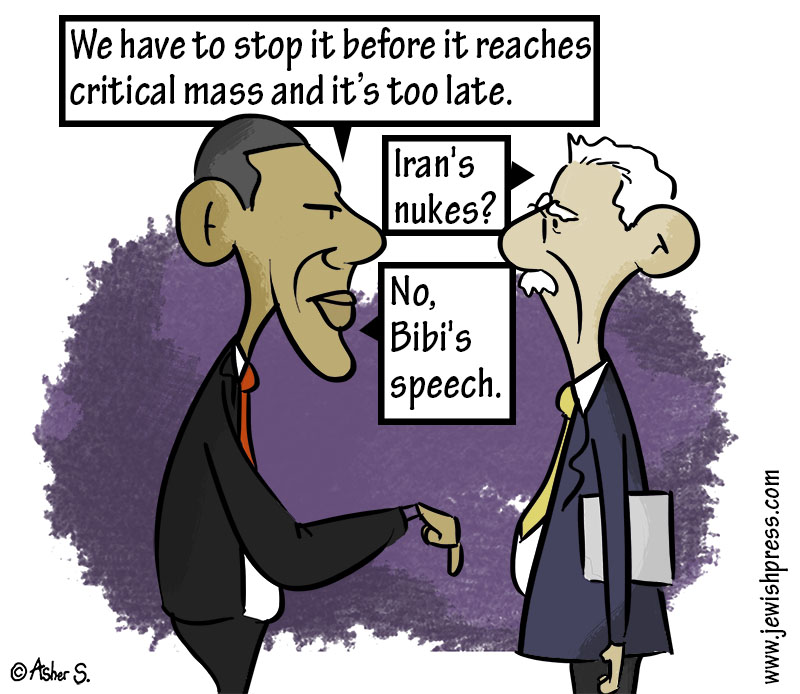
The strategic genius of Iran’s supreme leader, The Washington Post, Ray Takeyh, March 1, 2015
(Please see also Adolph Hitler. However, a genius at strategy was not needed to best Obama. The words “thirty pieces of silver” keep going through my head. I wonder why.– DM)
As Khamenei held firm . . . the great powers grew wobbly. With the advent of the Joint Plan of Action in November 2013, Iran’s fortunes began to change.
As Khamenei presses toward an accord that will place him in an enviable nuclear position, he can also be assured that technical violations of his commitments would not be firmly opposed. Once a deal is transacted, the most essential sanctions against Iran will evaporate. It is unlikely that Europeans, much less China or Russia, would agree to their reconstitution should Iran be caught cheating. And as far as the use of force is concerned, the United States has negotiated arms-control compacts for at least five decades and has never used force to punish a state that has incrementally violated its treaty obligations. As the reaction to North Korea’s atomic provocations shows, the international community typically deals with such infractions through endless mediation. Once an agreement is signed, too many nations become invested in its perpetuation to risk a rupture.
*********************
On the surface, there is not much that commends Iran’s Supreme Leader Ayatollah Ali Khamenei. An anti-Semite, he has frequently questioned the Holocaust and defamed Israel in despicable terms. As a conspiracy theorist, he endlessly weaves strange tales about the United States and its intentions. As a national leader, he has ruthlessly repressed Iran’s once-vibrant civil society while impoverishing its economy. And yet Khamenei is also a first-rate strategic genius who is patiently negotiating his way to a bomb.
After years of defiance, Khamenei seems to appreciate that his most advantageous path to nuclear arms is through an agreement. To continue to build up his atomic infrastructure without the protective umbrella of an agreement exposes Iran to economic sanctions and the possibility of military retribution. While in the past Khamenei may have been willing to cross successive U.S. “red lines,” the price of such truculence was financial stress that he feared could provoke unrest. Unlike many of his Western interlocutors, Khamenei appreciates that his regime rests on shaky foundations and that the legitimacy of the Islamic revolution has long been forfeited. The task at hand was to find a way to forge ahead with a nuclear program while safeguarding the regime and its ideological verities.
In many ways, a nuclear agreement is the answer to Khamenei’s multiplicity of dilemmas. A good agreement for the supreme leader, however, has to be technologically permissive and of a limited duration. Since the exposure of Iran’s illicit nuclear program in 2002, its disciplined diplomats have insisted that any accord must be predicated on the Nuclear Non-Proliferation Treaty (NPT), which, in their telling, grants Iran the right to construct a vast nuclear infrastructure. In exchange for such a “right,” they would be willing to concede to an inspection regime within the leaky confines of the NPT. And for much of that time, the great powers rebuffed such presumptions from a state that has been censured by numerous U.N. Security Council resolutions and denies the International Atomic Energy Agency reliable access to its facilities and scientists.
As Khamenei held firm, however, the great powers grew wobbly. With the advent of the Joint Plan of Action in November 2013, Iran’s fortunes began to change. Washington conceded to Iran’s enrichment at home and agreed that eventually that enrichment capacity could be industrialized. The marathon negotiations since have seen Iran attempt to whittle down the remaining restrictions, while the United States tries to reclaim its battered red lines. For Khamenei, the most important concession that his negotiators have won is the idea of a sunset clause. Upon the expiration of that clause, there would be no legal limits on Iran’s nuclear ambitions. If the Islamic Republic wants to construct hundreds of thousands of sophisticated centrifuges, build numerous heavy-water reactors and sprinkle its mountains with enrichment installations, the Western powers will have no recourse. And once Iran achieves that threshold nuclear status, there is no verification regime that is guaranteed to detect a sprint to a bomb. An industrial-size nuclear state has too many atomic resources, too many plants and too many scientists to be reliably restrained.
As Khamenei presses toward an accord that will place him in an enviable nuclear position, he can also be assured that technical violations of his commitments would not be firmly opposed. Once a deal is transacted, the most essential sanctions against Iran will evaporate. It is unlikely that Europeans, much less China or Russia, would agree to their reconstitution should Iran be caught cheating. And as far as the use of force is concerned, the United States has negotiated arms-control compacts for at least five decades and has never used force to punish a state that has incrementally violated its treaty obligations. As the reaction to North Korea’s atomic provocations shows, the international community typically deals with such infractions through endless mediation. Once an agreement is signed, too many nations become invested in its perpetuation to risk a rupture.
Iran’s achievements today are a tribute to the genius of an unassuming midlevel cleric. In a region where many dictatorial regimes have collapsed, the Islamic Republic goes on. Khamenei is in command of the most consequential state from the Persian Gulf to the banks of the Mediterranean. He has routinely entered negotiations with the weakest hand and emerged in the strongest position. God is indeed great.
Netanyahu, Not Obama, Speaks for Us, National Review On Line, Quin Hilleyer, March 2, 2015
Benjamin Netanyahu of course speaks first for Israel, but he speaks also for you and for me, for decency and humaneness, and for vigilance and strength against truly evil adversaries. Congress, by inviting him, is wise. Obama, by opposing him, is horribly wrong. And the civilized world, if it ignores him, will be well-nigh suicidal.
************************
While under fierce attack from President Obama, the Israeli prime minister defends Western values and speaks the truth about Iran.
The leader of the free world will be addressing Congress on Tuesday. The American president is doing everything possible to undermine him.
Israeli prime minister Benjamin Netanyahu leads a nation surrounded by enemies, a nation so small that it narrows at one point to just 9.3 miles. Yet, in a world where the Oval Office is manned by someone openly apologetic for most American exercises of power; and where Western Europe’s economy is enervated, its people largely faithless, and its leadership feckless; and where Freedom House has found “an overall drop in [global] freedom for the ninth consecutive year,” the safeguarding of our civilization might rely more on leaders who possess uncommon moral courage than on those who possess the most nukes or biggest armies.
Right now, nobody on the world stage speaks for civilization the way Netanyahu does. While Barack Obama babbles about the supposedly “legitimate grievances” of those who turn to jihad, Netanyahu talks like this (from his speech to the United Nations on September 27, 2012):
The clash between modernity and medievalism need not be a clash between progress and tradition. The traditions of the Jewish people go back thousands of years. They are the source of our collective values and the foundation of our national strength.
At the same time, the Jewish people have always looked towards the future. Throughout history, we have been at the forefront of efforts to expand liberty, promote equality, and advance human rights. We champion these principles not despite of our traditions but because of them.
We heed the words of the Jewish prophets Isaiah, Amos, and Jeremiah to treat all with dignity and compassion, to pursue justice and cherish life and to pray and strive for peace. These are the timeless values of my people and these are the Jewish people’s greatest gift to mankind.
Let us commit ourselves today to defend these values so that we can defend our freedom and protect our common civilization.
When Hamas fired thousands of rockets into Israel last year, Netanyahu, in his necessary military response, did something almost unprecedented in the history of warfare. As he accurately described in his U.N. speech last year, on September 29:
Israel was doing everything to minimize Palestinian civilian casualties. Hamas was doing everything to maximize Israeli civilian casualties and Palestinian civilian casualties. Israel dropped flyers, made phone calls, sent text messages, broadcast warnings in Arabic on Palestinian television, always to enable Palestinian civilians to evacuate targeted areas.
No other country and no other army in history have gone to greater lengths to avoid casualties among the civilian population of their enemies.
As Barack Obama complains (with scant grasp of the historical context) about how Christians were such gosh-darn meanies a thousand years ago in the Crusades, Netanyahu protects the ability of Muslims today to have free access to the Old City of Jerusalem, even as Jews and Christians are prohibited from visiting the Temple Mount. At the beginning of his first term, in his first trip overseas as president, Obama delivered a speech to Turkey’s parliament, under the thumb of the repressive Tayyip Erdogan. “The United States is still working through some of our own darker periods in our history,” he confessed, sounding like America’s therapist-in-chief. “Our country still struggles with the legacies of slavery and segregation, the past treatment of Native Americans.”
Netanyahu, in contrast, in a 2011 Meet the Press interview, offered unabashed words of praise for the United States: “Israel is the one country in which everyone is pro-American, opposition and coalition alike. And I represent the entire people of Israel who say, ‘Thank you, America.’ And we’re friends of America, and we’re the only reliable allies of America in the Middle East.” (Netanyahu was accurate in his description of how much Israelis appreciate Americans, as I saw last summer during a visit to the country.)
In thanking America, Netanyahu was not posturing for political advantage. Netanyahu — who spent far more of his formative years on the American mainland than Obama did, and who took enemy fire at the age when Obama was openly pushing Marxist theory, and who learned and practiced free enterprise at the same age when Obama was practicing and teaching Alinskyism — has spoken eloquently for decades in praise of the Western heritage of freedom and human rights. He also speaks and acts, quite obviously, to preserve security — for Israel, of course, but more broadly for the civilized world. On Tuesday, as he has done for more than 30 years, Netanyahu will talk about the threat to humanity posed by Iran.
It’s mind-boggling to imagine that any national leader in the free world would fail to understand the danger. The ayatollahs have never backed down from their stated aim of destroying Christendom. They have never wavered from their depiction of the United States as the “Great Satan.” Just last week, Iran bragged about its recent test-firing of “new strategic weapons” that it says will “play a key role” in any future battle against the “Great Satan U.S.”
Iran also continues developing, while trying to keep them secret, new missiles and launch sites with devastatingly long-range capability. It continues to enrich uranium, including an allegedly secret program, to a level that’s a short jump-step from bomb strength. It has a lengthy record of lying and cheating about its military activities, its compliance with U.N. mandates (not that the U.N. is worth much anyway), and its protections of even the limited human rights it actually recognizes as such.
About the only thing Iran never lies about is its absolute, unyielding determination to wipe Israel off the face of the earth. It was only a few months ago, for example, that the “revolutionary” regime’s “Supreme Leader,” the Ayatollah Ali Khamenei, released a nine-point plan for how to “annihilate” the Jewish state.
Yet Obama not only begrudges the Israeli prime minister the opportunity to make his case against this existential threat to his nation, but he conducts a diplomatic and political assault against Netanyahu of a ferocity rarely seen in the annals of American foreign policy. Obama’s actions aren’t just wrongheaded; they are malignant. They pervert American tradition and American interests, and they attempt to deprive the entire free world of its single most clarion voice for enlightenment values.
Benjamin Netanyahu of course speaks first for Israel, but he speaks also for you and for me, for decency and humaneness, and for vigilance and strength against truly evil adversaries. Congress, by inviting him, is wise. Obama, by opposing him, is horribly wrong. And the civilized world, if it ignores him, will be well-nigh suicidal.
U.N. nuclear watchdog says Iran still withholding key information, Reuters, March 2, 2015
(In other breaking news, the National Oceanic and Atmospheric Administration has revealed that the oceans are still wet and that the Sun remains hot. But wait! There’s more: the P5+1 negotiations with Iran will continue and a deal will be reached because Obama needs a legacy.– DM)
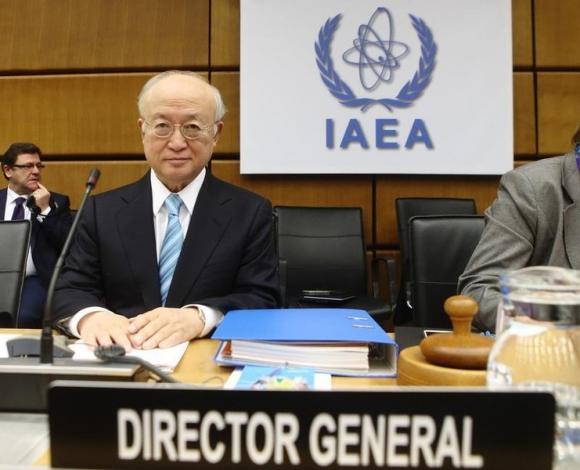 International Atomic Energy Agency (IAEA) Director General Yukiya Amano waits for the start of a board of governors meeting at the IAEA headquarters in Vienna March 2, 2015. CREDIT: REUTERS/HEINZ-PETER BADER
(Reuters) – The head of the United Nations‘ nuclear watchdog said on Monday Iran had still not handed over key information to his staff, and his body’s investigation into Tehran’s atomic program could not continue indefinitely.
“Iran has yet to provide explanations that enable the agency to clarify two outstanding practical measures,” chief Yukiya Amano told the body’s Board of Governors in Vienna, echoing a report seen by Reuters last month.
The two measures relating to alleged explosives tests and other measures that might have been used for bomb research should have been addressed by Iran by last August.
“The Agency is not in a position to provide credible assurance about the absence of undeclared nuclear material and activities in Iran, and therefore to conclude that all nuclear material in Iran is in peaceful activities,” Amano said.
The West fears Iran wants to develop an atomic bomb. Tehran says its nuclear program is entirely peaceful.
The Agency remains ready to accelerate the resolution of all outstanding issues, he added, but “this process cannot continue indefinitely”.
The United States and five other powers are seeking to negotiate an agreement with Iran to curb its nuclear program in exchange for relief from economic sanctions.
They have set a March deadline for a framework deal and a June deadline for a final one.
The IAEA is likely to monitor any possible deal between Iran and the six powers in addition to its own investigation into Iran’s nuclear program. Amano said he proposed a 1.8-percent increase to the body’s 344-million-euro ($386 million) budget given increased demand for its services.
Amano added that he remained seriously concerned about the nuclear activities of North Korea which quit the nuclear Non-Proliferation Treaty in 1993. The IAEA has not had inspectors on the ground there since they were expelled by North Korea in 2009.
Netanyahu, Churchill and Congress, The Gatestone Institute, Richard Kemp, March 1, 2015
There are striking similarities between the objectives of Churchill’s speech nearly 75 years ago and Netanyahu’s today; both with no less purpose than to avert global conflagration. And, like Churchill’s in the 1930s, Netanyahu’s is the lone voice among world leaders today.
There is no doubt abut Iran’s intent. It has been described as a nuclear Auschwitz. Israel is not the only target of Iranian violence. Iran has long been making good on its promises to mobilize Islamic forces against the US, as well as the UK and other American allies. Attacks directed and supported by Iran have killed an estimated 1,100 American troops in Iraq in recent years. Iran provided direct support to Al Qaeda in the 9/11 attacks.
Between 2010 and 2013, Iran either ordered or allowed at least three major terrorist plots against the US and Europe to be planned from its soil. Fortunately, all were foiled.
Iran’s ballistic missile program, inexplicably outside the scope of current P5+1 negotiations, brings Europe into Iran’s range, and future development will extend Tehran’s reach to the US.
It is not yet too late to prevent Iran from arming itself with nuclear weapons. In his 1941 speech to Congress, Churchill reminded the American people that five or six years previously it would have been easy to prevent Germany from rearming without bloodshed. But by then it was too late.
This vengeful and volatile regime must not in any circumstances be allowed to gain a nuclear weapons capability, whatever the P5+1 states might consider the short-term economic, political or strategic benefits to themselves of a deal with Tehran.
In a few days, Israeli Prime Minister Benjamin Netanyahu will address the US Congress for the third time. The only other foreign leader to have had that privilege was Winston Churchill. Like Churchill when he first spoke to Congress in December 1941, Netanyahu is taking a risk.
For Churchill the risk was to his life — he had to make a hazardous transatlantic voyage aboard the battleship HMS Duke of York through stormy, U-boat infested waters. For Netanyahu the risk is to his own political life and to his country’s relationship with the United States, given the intense presidential opposition to his speech.
But like Churchill was, Netanyahu is a fighting soldier and, like Churchill, a tough political leader, unafraid to shoulder such risks when so much is at stake. And in both cases, the stakes could not be higher, greater than their own lives, political fortunes or rivalries and affecting not just their own countries and the United States, but the whole of the world.
 Israel’s Prime Minister Benjamin Netanyahu addresses a joint session of U.S. Congress on May 24, 2011. (Image source: PBS video screenshot)
There are striking similarities between the objectives of Churchill’s speech nearly 75 years ago and Netanyahu’s today: both with no less a purpose than to avert global conflagration.
Speaking days after the Japanese attack on Pearl Harbor, Churchill summarized the course of the war thus far but then concluded with a dramatic appeal to the American people for Anglo-American unity to prevent conflict in the future, reminding them that “twice in a single generation, the catastrophe of world war has fallen upon us.”
“Do we not owe it to ourselves, to our children, and to mankind,” he asked, “to make sure that these catastrophes do not engulf us for the third time?”
No less profound, and no less far-reaching, will be Netanyahu’s appeal for American-Israeli unity in the face of a new danger. A danger perhaps even greater than Churchill was able to comprehend in pre-nuclear 1941. Whereas Churchill spoke of a future, as yet unknown peril, Netanyahu will focus on the clear and present threat to world peace if Iran is allowed to produce nuclear weapons.
And like Churchill in the 1930s, Netanyahu’s is a lone voice among world leaders today.
In pursuit of both uranium and plutonium tracks to a bomb, as well as the development of long-range ballistic missiles, there is no doubt about Iran’s intent. It has been described as a nuclear Auschwitz.
It is Netanyahu’s duty to sound the alarm against such a prospect. It is Israel’s survival that is at stake. It is Israel that will have to conduct military intervention if the US will not. And it is Israelis who will die in any subsequent regional conflagration.
But this is not only an existential threat to Israel — it is a danger to other states in the Middle East and to us all. Doubtful of Western resolve, Saudi Arabia, Egypt and Turkey are already investigating the development of their own nuclear capabilities.
An agreement that leaves Iran with the potential to achieve nuclear breakout will trigger a Middle East arms race that will exponentially increase the risks of global nuclear war, a risk multiplied by the vulnerability of regional governments to overthrow by extremists.
Iran’s ballistic missile program, inexplicably outside the scope of current P5+1 negotiations, brings Europe into Iran’s range, and future development will extend Tehran’s nuclear reach to the US. The world’s number one sponsor of terrorism, the regime of the ayatollahs would have no qualms about supplying their terrorist proxies with nuclear weapons.
This is the greatest threat the world faces today. Yet all the signals suggest that the P5+1, driven by President Obama’s apparent desperation for détente with Tehran, is already set on a path towards 1930s-style appeasement that will end with Iran’s acquisition of nuclear weapons.
The view that Cold War style containment and mutual deterrence could prevent this apocalyptic, fanatical regime from using its nuclear weapons is dangerously naïve. Yet the Western leaders who seem to be on the verge of reaching an agreement are not naïve. Lacking the moral strength to face down Iran, they see deception and appeasement as the only way out of their dilemma.
To gauge their intentions, we do not need to rely just on frequent Iranian threats, such as those of General Hossein Salami, who said recently, with negotiations still under way: “As long as the US continue to use the Islamic world as the scene for their regional policies, all the forces of the Islamic world will undoubtedly be mobilized against them.” In the same interview, he threatened Israel too: “The very existence of the Zionist entity and its collapse are of crucial importance.”
Iran’s determination to bring about the violent collapse of the “Zionist entity” is continuously manifested in its directing and funding of armed attacks against Israeli soldiers and civilians at home and overseas, by proxies including Hizballah, Hamas and Palestinian Islamic Jihad. The Gaza conflict last summer, for example, owed much to Iranian funding and weaponry.
Just a few weeks ago, Islamic Revolutionary Guard Corps General Mohammad Allahadi was operating with senior Hizballah commanders to set up a new front on Syrian territory in the Golan, from which to launch attacks against Israel. He was killed by an Israeli air strike while visiting his planned area of operations.
Israel is not the only target of Iranian violence. Iran has long been making good on its promises to mobilize Islamic forces against the US, as well as the UK and other American allies. Attacks directed and supplied from Tehran killed an estimated 1,100 American troops in Iraq in recent years. Strikes have been facilitated in Afghanistan, killing US, British and other Coalition soldiers.
Iran provided direct support to Al Qaeda in the 9/11 attacks and continues to harbor Al Qaeda terrorists. Between 2010 and 2013, Tehran either ordered or allowed at least three major terrorist plots against the US and Europe to be planned from its soil. Fortunately, all were foiled. Direction, support and facilitation to both Sunni and Shia terrorist groups in planning attacks against the US and its allies continues today.
This vengeful and volatile regime must not in any circumstances be allowed to gain a nuclear weapons capability, whatever the P5+1 states might consider the short-term economic, political or strategic benefits to themselves of a deal with Tehran.
Even before the world’s first experience of nuclear bombing in August 1945, Churchill and Roosevelt both understood the dangers of allowing their enemies and potential enemies to acquire such capability. When Allied intelligence identified a Nazi uranium production plant in Oranienburg in eastern Germany, 612 bombers destroyed it in a single raid in March 1945 with 1,506 tons of high explosives and 178 tons of incendiary bombs, to prevent it falling into the hands of advancing Russian troops.
Only a strong stand by the West, and rejection of an agreement that allows development of nuclear weapons, will ensure that such action does not in the future become necessary against Iran. In his 1941 speech to Congress, Churchill reminded the American people that five or six years previously it would have been easy to prevent Germany from rearming without bloodshed. But by then it was too late, and the world was engulfed in unprecedented violence.
It is not yet too late to prevent Iran from arming itself with nuclear weapons. The American people, the American government and the West as a whole must heed Netanyahu’s clear warning not to reach a deal that will allow the mendacious and malevolent Iranian regime to acquire nuclear weapons. Instead, sanctions that stand a chance of compelling Tehran to abandon its world-threatening ambitions must be maintained, and if necessary, increased.
Obama Must Explain Why the Iran Deal Isn’t North Korea Redux, Commentary Magazine, Michael Rubin, March 1, 2015
(There are additional parallels. North Korea and Iran have comparable views of human rights, both make loud and frequent noises about obliterating their perceived enemies and both have allies willing if not anxious to sneak around sanctions. There are also differences. Iran is far more powerful than North Korea was or is and Iran’s intention to dominate the Middle East transcends North Korea’s desire to “unify” with South Korea on North Korea’s terms. Iranian governance is based on Islam, an unfortunately powerful world religion seeking world domination. North Korean governance is based on the “religion of Kim,” supreme internally but otherwise of little significance elsewhere. Iran also presents a greater danger to the U.S. than North Korea did. However, Obama won’t explain why the Iran deal isn’t “North Korea redux” because he quite likely neither knows nor cares and because it is. — DM)
The State Department has never conducted a lessons learned exercise about what went wrong with the North Korea deal. Perhaps it’s time. Diplomatic responsibility and national security demand it.
**********************
As the Obama administration rushes into a nuclear deal with Iran, it pays to remember the last time the United States struck a deal with a rogue regime in order to constrain that state’s nuclear program and the aftermath of that supposed success.
Bill Clinton had been president barely a month when North Korea announced that it would no longer allow International Atomic Energy Agency (IAEA) inspections, followed shortly thereafter by an announcement that it would withdraw from the NPT altogether within a matter of months. If Kim Il-sung expected Washington to flinch, he was right. The State Department aimed to keep North Korea within the NPT at almost any price. Chief U.S. negotiator Robert Gallucci and his aides explained in their book Going Critical, “If North Korea could walk away from the treaty’s obligations with impunity at the very moment its nuclear program appeared poised for weapons production, it would have dealt a devastating blow from which the treaty might never recover.” Unwilling to take any path that could lead to military action, Clinton’s team sought to talk Pyongyang away from nuclear defiance, no matter that talking and the inevitable concessions that followed legitimized Pyongyang’s brinkmanship.
As with President Obama relieving Iran of the burden of six United Nations Security Council resolutions which demanded a complete cessation of enrichment, Clinton’s willingness to negotiate North Korea’s nuclear compliance was itself a concession. After all, the 1953 Armistice required Pyongyang to reveal all military facilities and, in case of dispute, enable the Military Armistice Commission to determine the purpose of suspect facilities. By making weaker frameworks the new baseline, Clinton let North Korea off the hook before talks even began.
Just as Israeli (and Saudi and Emirati and Egyptian and Kuwaiti and Bahraini) leaders express frustration with the Obama administration regarding its naiveté and unwillingness to consult, so too did South Korea at the time chafe at Clinton’s arrogance. South Korean President Kim Young Sam complained to journalists that North Korea was leading America on and manipulating negotiators “to buy time.” And in a pattern that repeats today with regard to Iran, the IAEA held firmer to the demand that North Korea submit to real inspections than did Washington. The issue came to a head in September 1993 after the State Department pressured the IAEA to compromise on limited inspections.
In the face of Pyongyang’s defiance, Clinton was also wary that coercion could be a slippery slope to war. Just as President Obama and Secretary of Defense Chuck Hagel instructed U.S. forces in the Persian Gulf not to stand firm but rather to retreat if probed or pushed by Iran, Clinton sought to mollify Pyongyang, for example cancelling the joint U.S.–South Korea military exercise in 1994. Adding insult to injury, the Clinton administration criticized the South Korean government for being unwilling to compromise. Indeed, everything the Obama administration has done with regard to Israel over the past year—with the exception, perhaps, of the classless chickensh-t comment—was ripped right from the Clinton playbook two decades before when the White House sought to silence Seoul.
There followed months of baseless optimism in Washington, followed by disappointment quickly supplanted by denial. At one point, when it looked like Kim Il-sung’s intransigence might actually lead to war, former President Jimmy Carter visited Pyongyang and, whether cleared to or not, made concessions which diffused the situation. It was the diplomatic equivalent of Obama’s voided redlines. Nightlinehost Ted Koppel observed on May 18, 1994, “this administration is becoming notorious … for making threats and then backing down.”
On July 8, 1994, a heart attack felled Kim Il-sung. Kim Jong-il, his eldest son, took over. Negotiations progressed quickly. Gallucci and his team promised an escalating series of incentives—reactors, fuel oil, and other economic assistance. They kicked inspections of North Korea’s suspect plutonium sites years down the line.
What had begun as North Korean intransigence had netted Pyongyang billions of dollars in aid; it would go down in history as the largest reward for cheating and reneging on agreements until Obama granted Iran $11 billion in sanctions relief just for coming to the table. Columnist William Safire traced the steps of concessions on North Korea. “Mr. Clinton’s opening position was that untrustworthy North Korea must not be allowed to become a nuclear power,” he observed, but Clinton “soon trimmed that to say it must not possess nuclear bombs, and stoutly threatened sanctions if North Korea did not permit inspections of nuclear facilities at Yongbyon, where the CIA and KGB agree nuclear devices have been developed. But as a result of Clinton’s Very Good Deal Indeed, IAEA inspectors are denied entry to those plants for five years.” And Sen. John McCain, for his part, lamented that Clinton “has extended carrot after carrot, concession after concession, and pursued a policy of appeasement based … on the ill-founded belief that North Koreans really just wanted to be part of the community of nations.” Again, the parallels between Clinton’s and Obama’s assumptions about the desire of enemies to reform were consistent.
Clinton wasn’t going to broker any criticism of what he believed was a legacy-defining diplomatic triumph, all the more so when the criticism came from abroad. On October 7, 1994, South Korean President Kim Young Sam blasted Clinton’s deal with the North, saying, “If the United States wants to settle with a half-baked compromise and the media wants to describe it as a good agreement, they can. But I think it would bring more danger and peril.” There was nothing wrong with trying to resolve the problem through dialogue, he acknowledged, but the South Koreans knew very well how the North operated. “We have spoken with North Korea more than 400 times. It didn’t get us anywhere. They are not sincere,” Kim said. His outburst drew Clinton’s ire. He became the Netanyahu of his day. Meanwhile, the U.S. and North Korea signed the Agreed Framework. Gallucci and his team were “exhilarated.” They later bragged they “had overcome numerous obstacles in the negotiations with the North; survived the intense, sometimes strained collaboration with Seoul and the International Atomic Energy Agency; and marshaled and sustained an often unwieldy international coalition in opposition to the nuclear challenge, all under close and often critical scrutiny at home.”
Today, by some estimates, North Korea is well on its way to having 100 nuclear weapons and is steadily developing the ballistic capability to deliver them. Iran’s nuclear negotiators have cited North Korea’s negotiating strategy as a model to emulate rather than an example to condemn. Meanwhile, Obama has relied on many of the same negotiators to advance his deal with Iran.
The State Department has never conducted a lessons learned exercise about what went wrong with the North Korea deal. Perhaps it’s time. Diplomatic responsibility and national security demand it.
Obama to preempt all programming to address Climate change: March 3, Dan Miller’s Blog, The Most Reverend Mohamed Allah-scimitar, February 28, 2015
(The views expressed in this article are mine and those of my (imaginary) guest author, the Most Reverend Mohamed Allah-Scimitar. They do not necessarily reflect the views of Warsclerotic or any of its other editors.– DM)
This is a guest post by my (imaginary) guest author, the Most Reverend Mohamed Allah-scimitar, President Obama’s chief adviser on Islamic relations with Christians and Jews.

The Most Revereddd Mohamed Allah-scimitar
**********************
The worst crisis ever to face The Obama Nation — man-caused global warming climate change — continues to immobilize the country. It does so contemptuously despite the decades-long warming trend recognized by all reputable scientists. Therefore, President Obama will use the emergency broadcast system to preempt all other programming, including the internet, to address the nation on March 3.

Hell Niagara Falls freezes over

Violent right-wing Christian and Jewish extremist Islamophobes have contended that, by virtue of its timing, President Obama’s address is intended to preempt media coverage of Israeli Prime Minister Netanyahu’s remarks to the Congress on the alleged “existential threat” of a nuclear deal with Iran.
However, White House press secretary Josh Earnest vigorously denied their racist and therefore specious claims. He pointed out that Obama is extraordinarily busy fulfilling His duties as the President of all of His people. He has, therefore, made — and continues to make — historic efforts to help potential non-Islamic Islamic State recruits find jobs and hence to feel good about themselves. Do we want more of this non-Islamic violence? No? Then you should not watch Netanyahu’s address, even if you could.

President Obama also owes it to His people to continue His Herculean efforts to prevent the Republican Congress from destroying His country by passing legislation which He has to waste time vetoing, thereby attempting to impede His noble efforts to give His people — American citizens and American citizens in waiting — everything they need and want by executive decree action.
Unfortunately, the only time He has available coincides, unexpectedly, with PM Netanyahu’s frivolous speech — which nobody in his right mind would watch anyway because Netanyahu is an untrustworthy nattering nabob of negativism and a war criminal to boot.

Moreover, as explained by Robert Kagan in a February 27th Washington Post article, there is no need for anyone to hear Netanyahu’s meddlesome nonsense:
Do we really need the Israeli prime minister to appear before Congress to explain the dangers and pitfalls of certain prospective deals on Iran’s nuclear weapons programs? Would we not know otherwise? Have the U.S. critics of those prospective deals lost their voice? Are they shy about expressing their concerns? Are they inarticulate or incompetent? Do they lack the wherewithal to get their message out?
Not exactly. Every day a new report or analysis warns of the consequences of various concessions that the Obama administration may or may not be making. Some think tanks in Washington devote themselves almost entirely to the subject of Iran’s nuclear program. Congress has held numerous hearings on the subject. Every week, perhaps every day, high-ranking members of the House and Senate, from both parties, lay out the dangers they see. The Post, the New York Times, the Wall Street Journal and others publish countless stories on the talks in which experts weigh in to express their doubts. If all the articles, statements and analyses produced in the United States on this subject could be traded for centrifuges, the Iranian nuclear program would be eliminated in a week.
. . . .
Given all this, can it really be the case that the American people will not know what to think about any prospective Iran deal until one man, and only one man, gets up to speak in one venue, and only one venue, and does so in the first week of March, and only in that week? That is what those who insist it is vital that Israeli Prime Minister Benjamin Netanyahu speak before a joint meeting of Congress next week would have us believe. [Emphasis added.]
President Obama is greatly, and perfectly understandably, distressed that Netanyahu will offer nothing new in support of His legacy achievement of world peace in His time and that his address will therefore force Him to create insuperable problems for Israel. Indeed, He has already asked Iran, under the auspices of the United Nations, to mediate a binding peace agreement among Israel, the Palestinian Authority and Hamas. President Obama did not want to do it, because He loves Israel just as He would His only begotten son if He had one. However, in the circumstances Netanyahu has created, He has has no alternative. Only a vile Islamophobic Jew-hater like Netanyahu would destroy his own country by opposing President Obama’s grand plan for world peace.
As the world’s second greatest authority — second only to Obama — on Islam and its profoundly helpful relations with Jews and Christians everywhere, I call upon everyone in Israel and elsewhere to ignore whatever nonsense the soon-to-be-former Prime Minister of that insignificant beautiful little country may try to spew.
*************
Editor’s comment:
All citizens of the World with half a brain — and even less — should pay heed to The Most Reverend Mohamed Allah-scimitar’s profound words and trust only Dear Leader Obama. He, and only He, can and will do all that needs to be done to keep them warm, safe and content. Should they place unwarranted trust elsewhere, their Dear Leader may well be unable to achieve world peace whirled peas in His time.

On moral blindness, Israel Hayom, Dror Eydar, February 27, 2015
1. Scholars who study our civilization a hundred years in the future will be able to point out the key geopolitical shifts in the Middle East, the collapse of the geographical nations and the return to the ancient social borders, and the rise of radical Islam. They will describe how the Islamic Republic of Iran took over countries like Yemen, Iraq, Syria and Lebanon, its tentacles of terrorism reaching every corner, including Gaza, Judea and Samaria.
They will study the Iranian nuclear issue and be able to quote hundreds of instances in which Iranian leaders vowed to destroy the Jewish state. But when they begin studying the Israeli society of our time, they will encounter a failure of logic. Amid a virtual consensus on preventing an Iranian nuclear bomb, they will not be able to understand the Israeli focus on bottles recycled by the prime minister’s wife, the electrician the prime minister hired and the frivolous reports that grabbed massive headlines while world powers were busy leaving Iran with the ability to manufacture a bomb. They will have trouble understanding what the Jews were arguing about while facing such an obvious threat.
In an effort to solve this mystery, the scholars will turn to historians who studied the 1930s in Europe: Western leaders’ willful blindness to Hitler’s explicit threats; Europe’s desperate longing for reconciliation with the fuhrer. They will review the history of France, which was warned in those years but failed to prepare an army. They will review Neville Chamberlain’s declaration of “peace for our time” while waving a worthless piece of paper. They will examine the history of European Jewry, which failed to accurately read the political map. Among other things, they will look at U.S. Jewry in the 1940s. They may read the memoirs of Rebecca Kook, the daughter of Hillel Kook, a prominent member of the Irgun.
2. In 1940, the members of the Irgun arrived in the U.S. at the behest of Ze’ev Jabotinsky, to recruit a Hebrew army to fight the Nazis alongside the allied forces. In 1942, when the extermination of Europe’s Jewry began to emerge, the delegation changed course and devoted themselves to saving Jewish lives. They had the nerve to challenge the official stance adopted by the Roosevelt administration — accepted with little opposition by the Jewish leaders of the United States — that the only way to save the Jews was to win the war.
The Irgun members pressured the leaders of the free world to make saving Jewish lives a goal of equal importance to winning the war, and to dedicate special resources to making it happen. They focused their efforts on campaigning in the media, among intellectuals, in the U.S. Congress and to the administration. They convinced then-President Franklin D. Roosevelt to establish the War Refugee Board — an executive agency created to save Jews. It is estimated that the board was responsible for saving 200,000 Jewish lives.
The future scholars will delve deep into the battle waged by the Jewish leadership in America against the Irgun’s delegation. The mudslinging campaign against them was not led by the administration. It was spearheaded by House Foreign Affairs Committee Chairman Sol Bloom — a New York Jew, Rabbi Stephen Samuel Wise and Nahum Goldmann of the American Jewish Congress and other Jewish leaders.
Every effort made by the Irgun delegation was met with criticism and active sabotage efforts. They claimed that their activity was too political, too vocal, too aggressive, and that in fact they did not represent anyone. Hundreds of letters were sent to senators and representatives and Jewish leaders. The letters said that the Irgun members were part of a fascist terrorist outfit from Palestine. Jewish activists handed out pamphlets warning that the delegation would bring catastrophe and destruction on the Jewish people.
Several explanations were provided for this hostile behavior. The main explanation was that Jewish leadership’s fear of tarnishing the image of the Jewish community. In a secret British Foreign Office document, Nahum Goldmann was quoted as saying that just as Hitler brought anti-Semitism to Europe, Hillel Kook would bring anti-Semitism to the U.S.
At the end of the 19th century, Germany’s Jews were also fearful of Zionism. It made them susceptible to accusations of dual loyalty, and labeled them as belonging in Palestine. That is why they resisted the Zionist movement and made extra efforts to be even more German than the rest of the Germans.
3. For the last 20 years, Prime Minister Benjamin Netanyahu has been warning anyone who would listen of Iran’s perilous ambitions. Much like Nazi Germany, Iran and radical Islam do not threaten only Israel but the entire free world. But the left-wing liberal mindset, inspired by U.S. President Barack Obama, complacently dismisses these warnings, often with a side of disrespect.
Over the last month, the White House and a long line of cultural figures and politicians have been confronting a far greater threat: Netanyahu’s upcoming speech at the U.S. Congress. The future historians will note the American Jews who disrespected the Israeli prime minister for fighting for the safety of his people. They will add to that list a number of Israelis who took pains to undermine Netanyahu’s legitimacy and sabotage his address.
One of these critics, Peter Beinart, recently slammed Nobel Peace Prize laureate Elie Wiesel for urging Obama to join him at Netanyahu’s address.
“Wiesel is acutely, and understandably, sensitive to the harm Jews suffer. Yet he is largely blind to the harm Jews cause,” Beinart wrote. Cause to whom? To the Palestinians, of course. The American Left is stuck in its 1980s elitist morality that refused to see that the reality has changed.
There is no occupation anymore, Mr. Beinart. Certainly not in the way that you and your friends make it out. The Arabs of Judea and Samaria enjoy expanded autonomy — a de facto state with a national anthem, a flag, a government and enormous budgets. It is true that the IDF is present on the outskirts, because we do not trust our neighbors. But incidentally, they, too, do not trust themselves to ward off Hamas and the radical Islamists. Israel in fact protects the lives of the Palestinian leadership and population from the perils of the Islamic caliphate, which has the ability to turn the lives of these Arabs into a hell devoid of human rights, and heads.
4. This blindness is not just geopolitical, but it is also moral. We are students of the great teacher Rabbi Akiva, who in the second century classified the commandment to “love your neighbor as you love yourself” (Leviticus 19:18) as a great principle of the Torah (Genesis Rabbah 24:7). In this he built on the work of Hillel the Elder who in the first century B.C.E. placed the entire Torah upon the foundation of this dictum (Babylonian Talmud: Tractate Shabbat 31a).
But the same Rabbi Akiva taught us that in the event of a conflict between your life and your neighbor’s life, “your brother shall live with you.” Namely, your own life comes first (Babylonian Talmud: Tractate Baba Mezi’a, 62a). That is the proper way to approach altruistic love. If you do not love your own life, or the lives of your own people, more than the lives of others, especially those who are hostile toward you, then you do not truly possess a moral understanding, but rather a nihilistic intellectualism that plays pretend in living rooms across the east and west coasts of the U.S.
Next Tuesday, truth seekers will be called upon to support Netanyahu when he addresses a joint session of Congress. The State of Israel needs your courageous support.
Obama, Iran and the Late William Buckley, Huffington Post, Sheldon Filger, February 15, 2015
(This is from left-“leaning” Huffington Post. William Buckley, the CIA agent mentioned in the article, was not National Review’s William F. Buckley, Jr. The comments following the article are interesting.– DM)
President Obama seems determined to move forward on a nuclear agreement with the regime that tortured and murdered William Buckley. He should reflect on how this dedicated CIA agent must have felt, abandoned by his government and alone with his Iranian torturers, enduring a hellish nightmare in the basement of the Iranian foreign ministry. Is the nation William Buckley died for now about to be abandoned, for the sake of a presidential legacy?
***************
There are growing indications that the Obama administration will sign a nuclear agreement with Iran that will allow Tehran to become a nuclear-threshold state. It seems the only issue being contested at present is the extent of the cosmetic and temporary concessions the Iranians will grant so that Iran does not fully emerge as a nuclear weapons state until after the expiration of the Obama presidency. The disarming body language and genuine warmth that characterizes the public interaction between U.S. Secretary of State John Kerry and Iran’s Minster of Foreign Affairs Mohammad Javad Zarif seems to point in that direction, belying the fact that these two nations have not had diplomatic relations for 35 years because the government of one of those states ordered its armed thugs to attack and seize the embassy of the other nation, in the most flagrant violation of international law, holding its diplomats hostage for 444 days.
Of course, Barack Obama has promised on more than one occasion that he would never permit Iran to become a nuclear armed state. Then again, this is the same President Obama who warned Syria’s president not to use poison gas on his own people, or there would be consequences for crossing that red line. And let us not forget the President’s assurances that the war in Iraq was over and it was safe to withdraw all U.S. forces, or that the emerging Islamic State was nothing more than a “jayvee team” or that Yemen was a great success story for America’s anti-terrorism strategy — the same Yemen where Washington was recently forced to close its embassy after a coup in that country staged by anti-American rebels loyal to Iran.
The consequences involved in permitting Iran to become a nuclear weapons state are, obviously, far more consequential. Barack Obama is not the first president confronting a rogue regime about to acquire nuclear weapons capability. In the early 1990s, evidence mounted that North Korea was embarking on a nuclear weapons program. As with President Obama, then President Clinton pledged to the American people that the North Korean regime would never be permitted to obtain nuclear weapons. Then former President Jimmy Carter came to the rescue. He flew to North Korea, met with the reigning dictator and laid the groundwork for what became the 1994 Agreed Framework treaty, which supposedly froze North Korea’s attempt to develop atomic weapons through plutonium production in exchange for U.S. economic aid. However, the treaty collapsed after Clinton left office when U.S. intelligence learned that North Korea had cheated on the agreement by secretly developing a uranium enrichment program as an alternative path towards developing nuclear bombs. In 2006, North Korea conducted its first test detonation of a nuclear bomb.
It appears that the Obama administration is following in the path originally set by President Clinton. In addition to tolerating a vast nuclear enrichment facility, much of it underground, that can only have been established for the eventual mass production of nuclear bombs to mate with Tehran’s increasingly powerful and longer-range ballistic missiles, the current administration has been passive in the face of Iran’s growing hegemony in the Middle East, as witnessed by Tehran’s virtual occupation of Lebanon through its proxy militia, its massive intervention in the Syrian civil war on the side of Basher Assad, and increasing military involvement and control in Iraq and the recent pro-Iranian coup in Yemen. This passivity is inexplicable, considering the potential and dire strategic and economic consequences for the United States.
What about the character of the regime that President Obama and his national security team seem about to trust with the most destructive weapons on earth? Amid the long list of Iranian terrorist attacks against the U.S. and its interests aboard unleashed by Tehran since 1979, there is one which, more than any other, defines the essence of the regime of the Ayatollahs and its contempt for the United States.
In 1984, the CIA station chief in Beirut, William Buckley, was kidnapped by the Iranian controlled Hezbollah militia. The fate of William Buckley was disclosed byWashington Post columnist Jack Anderson in an article published the following year. According to Anderson, who based his account on confidential sources within the U.S. intelligence community, Buckley was smuggled into Iran, and subjected to numerous bouts of brutal interrogation under barbaric torture in the basement of the Iranian foreign ministry, the same building being presided over today by John Kerry’s Iranian counterpart, Zarif. The barbarous torture eventually induced a heart attack, leading to the death of Buckley. As Jack Anderson stated in his article, Iran was responsible for the horrific murder under torture of an American patriot.
President Obama seems determined to move forward on a nuclear agreement with the regime that tortured and murdered William Buckley. He should reflect on how this dedicated CIA agent must have felt, abandoned by his government and alone with his Iranian torturers, enduring a hellish nightmare in the basement of the Iranian foreign ministry. Is the nation William Buckley died for now about to be abandoned, for the sake of a presidential legacy?
Missiles and menaces in an Iran-Russia-North Korea alliance, The Hill, Michael Ledeen, February 13, 2015
Iranian scientists are often very good, and their missiles are excellent, but the satellite was not a product of Persian technology. According to well-informed Iranians, 70 percent of the package is Russian, 20 percent is “Asian,” (i.e., North Korean), and the rest comes from Europe. The Iranian input was gluing it together.
It’s no coincidence. Russia, Iran and North Korea are in active cahoots. They are pooling resources, including banking systems (the better to bust sanctions), intelligence and military technology, as part of an ongoing war against the West, of which the most melodramatic battlefields are in Syria/Iraq and Ukraine.
******************
At the beginning of February, Iran sent a spy satellite into orbit, the first time it had done so in three years. As you’d expect, they bragged about it, proclaiming it a triumph of national scientific know-how according to Agence France-Presse:
The satellite was locally made, said the official IRNA news agency, as was its launcher, according to [Iranian President Hassan] Rouhani, who noted that Iran’s aim is to have no reliance on foreign space technology.
“Our scientists have entered a new phase for conquering space. We will continue on this path,” Rouhani said in a short statement on state television.
Iranian scientists are often very good, and their missiles are excellent, but the satellite was not a product of Persian technology. According to well-informed Iranians, 70 percent of the package is Russian, 20 percent is “Asian,” (i.e., North Korean), and the rest comes from Europe. The Iranian input was gluing it together.
The composition of the satellite is significant, as it neatly provides us with the proper context in which to think about the world. It shows us that Tehran is part of a global alliance that stretches from Pyongyang, North Korea through Moscow, across the Middle East and into our own hemisphere, notably Havana, Cuba and Caracas, Venezuela.
I believe that the Iranians, Russians and North Koreans want us to recognize their alliance. Indeed, at the same time the Iranians were launching “their” satellite into orbit, the North Koreans were testing an anti-ship missile with Russian fingerprints all over it. In all likelihood, it’s a Russian cruise missile.
It’s no coincidence. Russia, Iran and North Korea are in active cahoots. They are pooling resources, including banking systems (the better to bust sanctions), intelligence and military technology, as part of an ongoing war against the West, of which the most melodramatic battlefields are in Syria/Iraq and Ukraine.
To judge by their language, the leaders of the three countries think the tide of world events is flowing in their favor. Iranian Supreme Leader Ali Khamenei delivered an ultimatum to the West, saying that Iran’s war against “evil” would only end with the removal of America. Russian President Vladimir Putin marches on in Ukraine, blaming the West for all the trouble, and the North Koreans are similarly bellicose.
They are singing from the same hymnal. And they aim to do us in.
Still, not all is well with our enemies. You wouldn’t expect a brutal regime to have trouble carrying out punishment against convicted criminals, but there are several documented cases in which that has occurred. Iran applies the Law of Talion — “an eye for an eye” — so that if someone is convicted for blinding another person, the punishment is to be blinded himself. Yet Iranian doctors frequently refuse to do it, insisting that it violates their oath to “do no harm,” and they have stuck to their principles, leaving the guilty parties in jail as the authorities search for a willing doctor.
This is, to be sure, an unusual form of civil disobedience, but I haven’t seen any reports of those doctors being punished for it. Which is not to suggest that human rights are improving in Iran, any more than they are in Russia or North Korea. Quite the contrary, in fact. Human Rights Watch, which is not notoriously tough on the Islamic Republic, recently published a grim analysis of the worsening treatment of the Iranian people.
Perhaps the doctors’ disobedience will carry over to broader segments of the society.




 anneinpt
 artaxes
 danmillerinpanama
 davidking1530
 Peter Hofman
 Joseph Wouk
 Peter
Peter Louisiana Steve
 WarSclerotic
Recent Comments