Posted tagged ‘Iranian nukes’

Op-Ed: Obama’s Faith in anti-Semites and the Cost

June 20, 2015

Op-Ed: Obama’s Faith in anti-Semites and the Cost, Israel National News, Steve Apfel, June 18, 2015

(Please see also, State Department Report Minimizes Palestinian Incitement to Violence.– DM)

Perhaps it’s more self-deception than ignorance. But it’s atrocious for a leader with the balance of human survival on his shoulders to deal a joker like this: “…The fact that (Iran’s leaders) are anti-Semitic doesn’t mean that this overrides all their other considerations.”

***************************

It is one thing to hate Greeks or Turks, for want of example, and quite a different thing to hate Jews. Likewise, to hate this country or that one is not akin to hating Israel. The faultless logic of a felon explains all. Asked why he robbed banks Willie Sutton explained, “That’s where the money is.” Well, Israel is where six million Jews are, and Iran is not the only power that, day and night, aches to wipe them off the face of the earth.

Clearly there’s more to hating Israel than meets the eye. By ”more” I mean a human condition – the raising of blind hatred to such a power that incendiary rhetoric is not enough to contain an imperative for violence. And right at this point the leader of the free world commits a cardinal error. By papering over this special hatred, American President Obama tilts the globe towards an ultimate catastrophe.

Calculated or innocent, the error is mighty convenient for that do or die Iran deal. To get the piece of paper signed it helps Obama to make light of the risk posed by Jew-mad fanatics. It’s not enough to decouple Tehran’s world-wide web of terrorism from the nuclear talks. To placate mullahs and ayatollahs he must downplay the rabid anti-Semitism from that quarter, already guilty of two heinous attacks on Jewish targets, in Borges and Buenos Aries. Now there’s talk of US complicity. Diplomatic sources told World Tribune that the US pressed Argentina to end, or at least fudge the investigation of Iran’s involvement.

Pacts with the devil come at a price. That  was Tehran’s price, and at the wink of an eye Washington paid it. Lately Obama declared himself an honorary member of the ‘tribe.’ And he has always had “Israel’s back” should Iran’s bite prove to be worse than its bark. A President for whom Democrat Jews voted for twice is duty-bound to give assurances of the kind. Certainly he can’t afford to be seen making a Chamberlain look-alike pact with a bunch of Fuhrers.

To drive his message home, Obama gave The Atlantic’s Jeffrey Goldberg a morale booster to pass onto American Jewry: they needn’t be overly concerned. “There are deep strains of anti-Semitism in the core regime,” Goldberg’s ‘Pres’ conceded, “but they also are interested in maintaining power.”

Even Goldberg was left wide-eyed. “It’s my belief,” he told the President, “that it is difficult to negotiate with parties that are captive to a conspiratorial anti-Semitic worldview; not because they hold offensive views, but because they hold ridiculous views… I don’t believe that the regime can be counted on to be entirely rational.”

The truth is somewhat more profound. True, there’s nothing calculated in verbal attacks of the kind that Iran makes. Like a volcano they seem to emanate from a deep-down superheated disturbance. But when anti-Semites spew vitriol at Israel they do more than distort facts or recite a miscellany of canards. Seldom do anti-Semites react to provocation, to something that Jews did. When a core figure warns that Iran needs only 24 hours and an excuse to wipe Israel off the map, he’s not mad at Israel’s deeds. No, he is passionately in love with hating Jews.

Anti-Semites are not, as the phrase goes, in their right minds. In a real sense they are out of their minds. A passion can do that. And the passion that collects around Israel is like no other. It consumes whole countries. It sweeps up domestic and international affairs in a maelstrom. It distorts trade. Quite sane leaders when it comes to Israel lose their minds. According to Walter Russell Mead, “nations and political establishments warped by this hatred tend to make one dumb decision after another — starting at shadows, warding off imaginary dangers, misunderstanding the nature of problems they face.”

It’s what Goldberg was getting at, and also what left him nonplussed that his revered leader did not get it. Debriefing Foreign Policy Journalafterwards he bemoaned the great man’s obtuseness. “Obama doesn’t seem to fully understand that anti-Semites actually believe the dangerous and idiotic things they say.” Had he not been a died-in-the-wool Democrat, perhaps Goldberg would have paid closer attention to the President’s own ‘take’ on the subject. Had he done so Obama would not have slipped that cardinal error past him. Here it comes.

“The fact that you are anti-Semitic, or racist, doesn’t preclude you from being interested in survival. It doesn’t preclude you from being rational about the need to keep your economy afloat; it doesn’t preclude you from making strategic decisions about how you stay in power; and so the fact that (Iran’s) supreme leader is anti-Semitic doesn’t mean that this overrides all of his other considerations.”

The dead give-away lurks where? We hit on it here, there and everywhere in that snatch from an Obama lecture.  It makes us want to interject with, ‘How about the Third Reich!’ For how can the President be that ignorant about the last word in Jew-mad regimes? No one taught Obama that the extermination of Jews was not a means to an end but an end in itself? He doesn’t know that the Final Solution was not a part of the war effort, it was fully equal to the whole war effort? He’s not aware that resources needed for winning the war were diverted to the higher priority of putting Jews to death? He never read about the failure of Operation Barbarossa, a turning point in the fortunes of the Third Reich, in no small measure caused by the diversion of trains for Hitler’s genocide project? Hitler condemned his own troops to the pitiless Russian winter so that trains to death camps would continue to run and oven chimneys would continue to smoke.

Perhaps it’s more self-deception than ignorance. But it’s atrocious for a leader with the balance of human survival on his shoulders to deal a joker like this: “…The fact that (Iran’s leaders) are anti-Semitic doesn’t mean that this overrides all their other considerations.”

For the good of the world so fatuous a notion ought not to pass muster. Yet Obama-voting Jews passed it. Tehran warns that it will not abide the “Zionist tumor.” The White House says, don’t worry, the mullahs and ayatollahs will keep cool heads. Tehran declares that destruction of Israel is non-negotiable. Obama says ignore it. Maybe Tehran will play ball. Maybe it will behave so as not to ruin the American leader’s pet project.

Iran of course is not Obama’s only pet project. If it’s learning he’s in want of, there’s a textbook case of Jew-hatred and its cost near the top of Washington’s foreign agenda. Everyone knows how desperately Obama wants to secure a state for Palestinians. Hark to the appeal from the President’s very Jewish heart. If your age-old values still mean anything to you, Oh Israel, set the oppressed Palestinians free.

Now here’s the thing. If Jordan was still occupying the “West Bank” and Egypt was still occupying Gaza, the Palestinians would not be pleading to be set free. They’d be as happy as the day was long under the occupying powers. We know, because for nineteen long years, ending in 1967, Palestinians told the world they were happy not to have a state to call their own. They were more than happy; Arafat and his cronies inscribed it in the founding PLO Charter. We like what we have. Life under Egypt is fine; we accept the King of Jordan as our sovereign ruler. As for the Arab world, it would be wrong to say it was happy.

The wants and wishes of subjugated people in Gaza and “West Bank” never entered the mind of the Arab world. No Arab leader offered hisbrothers living on Israel’s doorsteps a home to call their own. Only Jewish leaders did that – a couple of times after 1967. Even then Arafat said ‘Nein! and with his Intifadas bit the Jewish hand that proffered the prize. Abbas said ‘Nein! after Arafat – a few times.

And here are the Palestinians, half a century on, wallowing in self-pity even as they insist they’ll not live with a Jewish state for a neighbour. If that is not a self-inflicted wound from hating the Jew then pigs can fly.

Shaking Hands with Iran

June 19, 2015

Shaking Hands with Iran, The Gatestone InstituteDaniel Mael, June 19, 2015

  • According to the organization Iran Human Rights, the Iranian regime has executed a prisoner every two hours this month.
  • “So far in 2015, more than 560 have been executed, and we are just in the first half of the year… What we are witnessing today is not so much different from what ISIS is doing. The difference is that the Iranian authorities do it in a more controlled manner, and represent a country which is a full member of the international community with good diplomatic relations with the West.” — Mahmood Amiry-Moghaddam, spokesman for Iran Human Rights.
  • Now the West, with the possibility of a nuclear deal, stands to increase Iran’s diplomatic standing.

As negotiations between the P5+1 countries and Iran continue, human rights concerns under the Iranian regime remain on the periphery.

The Obama Administration, over the objections of countless human rights organizations, has made clear that the United States is not seeking to alter the nature of the Iranian regime. Rather, the aim of the direct negotiations is solely to reach an agreeable compromise over the Iran’s continued nuclear enrichment. The current nominal deadline for negotiations is June 30.

The Islamic Republic of Iran is notoriously the world’s largest state sponsor of terrorism. Proxy organizations include Hezbollah in Lebanon, Hamas in the Gaza Strip and Houthi rebels in Yemen. The regime’s support of barbarism is reflected within Iran as well, as Iranian leaders support unspeakable human rights abuses on a daily basis.

With the deadline for negotiations only days away, June 2015 has been no exception.

According to a June 17 press release from the organization Iran Human Rights, which “supports the Iranian people’s struggle for human rights and amplifies their voices on the international stage,” the Iranian regime has executed a prisoner every two hours this month:

“According to reports collected by IHR so far in June at least 206 people have been executed in different Iranian cities. 60 of the executions have been announced by the official sources while IHR has managed to confirm 146 other executions which have not been announced by the authorities.”

“So far in 2015 more than 560 people have been executed in the country and we are just in the first half of the year,” Mahmood Amiry-Moghaddam, the spokesman of IHR, said in an interview. “This is unprecedented in the last 25 years! Unfortunately, people in Iran feel that the international community has closed its eyes on what they are going through.”

The executions are just the tip of the crane. As IHR reported Wednesday morning, Mohammed Moghimi, a defense lawyer for civil activist Atena Faraghadani, was scheduled to be released from prison on June 16, after three days in prison. What, exactly, was his crime?

“Mohammad Moghimi was charged with ‘non-adultery illegitimate relations’ for shaking hands with his female client,” writes IHR. “He had gone to Evin Prison to meet Ms. Faraghadani and to prepare an appeal request for her 12-year prison sentence.” According to IHR sources, the forbidden handshake “happened in the presence of two agents in the room. Atena apologized for this right there… but the agents didn’t let it go and took her back to her prison ward and arrested Mr. Moghimi right there.”

Moghimi release was released on condition that he meet a bail of roughly $60,000.

And why is Faraghadani in prison? For Facebook posts. A Revolutionary Court in Tehran sentenced her to 12 years and 9 months in prison for posts against the government, which constituted “assembly and collusion against national security,” “propaganda against the state,” and “insulting the Supreme Leader, the President, Members of the Parliament, and the IRGC [Revolutionary Guards] Ward 2-A agents, ” according to IHR.

“What we are witnessing in Iran today is not much different from what ISIS is doing,” argues Amiry-Moghaddam. “The difference is that the Iranian authorities do it in a more controlled manner, and represent a country which is a full member of the international community with good diplomatic relations with the West.”

Now the West, with the possibility of a nuclear deal, stands to increase Iran’s diplomatic standing — and with not even a minimal regard for human rights.

While U.S. negotiators shake hands with Iranian diplomats during the next round of talks in Geneva, Iranian citizens cannot shake hands among themselves without fear of years of imprisonment. While officials, both from the West and from Iran, share updates on social media, Iranians at home face jail time for staking out the wrong position in Facebook posts.

1118Does Iran’s foreign minister risk going to jail? Iranian FM Javad Zarif (right) is apparently touching the arm of EU Foreign Affairs representative Federica Mogherini (second from right). Back in Tehran, the lawyer Mohammad Moghimi (inset top) was arrested and charged with “non-adultery illegitimate relations,” for shaking hands with his female client, Atena Faraghadani (inset bottom). Faraghadani was sentenced to 12 years and 9 months in prison, for Facebook posts critical of the regime

If the Iranian regime cannot trust its own citizens’ handshakes, how can the West trust the Iranian regime with uranium centrifuges?

Kerry’s refusal to be “fixated” on Iran’s former nuclear misdeeds fits the US pattern of indulging Tehran

June 17, 2015

Kerry’s refusal to be “fixated” on Iran’s former nuclear misdeeds fits the US pattern of indulging Tehran, DEBKAfile, June 17, 2015

(The Obama administration’s “fixation” is on getting any “deal” acceptable to Iran. Please see also, Kerry’s absolute idiocy. — DM)

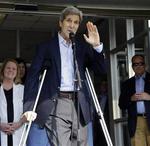
Kerry_Massachusetts_General_Hospital_12.6.15John Kerry returns to the Iran nuclear table

US Secretary of State John Kerry remarked Wednesday that the “US and its negotiating partners are not fixated on the issue of so-called possible military dimensions [of the Iranian nuclear program] because they already have a complete picture of Iran’s past activities.”

This comment was a compendium of contradictions and untruths.

DEBKAfile lists five instances to demonstrate the US has been in the dark over Iranian nuclear activities – past and present:

1. Iran’s military complex at Parchin remains a closed book despite repeated international demands to check on the nuclear detonation tests reported to have been conducted there. The US and Israel are left with suspicions, no facts, although Kerry declared: “We know what they did.”

2. At the Fordo underground site, all that is known for sure is that the Iranians are enriching uranium with advanced centrifuges – which they admitted after they were found out. But nothing is known about activities in other parts of the subterranean facility.

3.  Iran is known to be operating secret sites. Once again, strong suspicions are not supported by solid evidence which remains out of reach.

4.  US intelligence has not gained a full picture of Iran’s nuclear collaboration with North Korea or their shared plans for the development of ballistic missiles. Every now and then, delegations of nuclear scientists pay reciprocal visits to each other’s facilities, but no one has got to the bottom of the secret transactions between them. The question is why does this collaboration continue if Iran is not developing a nuclear weapon? And how far as it got? There are no answers to either of these questions.

5. Neither the US nor the international inspectors have gained direct access to the Iranian scientists employed on military nuclear projects, aside from the information reaching the US and Israel from Iranian defectors. All applications to interview these scientists were either turned away or ignored by Tehran.

So when Kerry claims that the negotiators “already have a complete picture of Iran’s past activities,” he is in fact letting Iran off the hook for providing information or even opening up its suspect facilities to international monitors, least of all the “intrusive inspections” promised by President Barack Obama.

For the sacred goal of getting a final nuclear deal signed with Iran by the June 30 deadline, it is permissible to brush these embarrassing “details” under the carpet and ignore troubling questions.

On June 15, Republican Sen. Bob Corker, head of the Foreign Affairs Committee, sent a letter to President Obama saying: “It is breathtaking to see how far from your original goals and statements the P5+1 have come during negotiations with Iran.” He went on to say that negotiators “have moved” from trying to strike a 20-year agreement to a 10-year one and “seem ready to let Tehran continue to develop its ballistic missile effort and maintain research and development for advanced nuclear centrifuges.”

Senator Cork concludes: “The stakes here are incredibly high and the security implications of these negotiations are difficult to overstate.”

However, the Obama administration’s concessions to buy a deal do not stop there. They go still further. DEBKAfile’ sources reveal that Washington is preparing to give way on the snap inspections mandated by the Additional Protocol, and agree to limit inspections to facilities unilaterally designated “nuclear” by Tehran and only after two weeks’ notice.

But President Obama has made his most substantial concession yet, by accepting Tehran’s demand to divide the final accord into two parts. The first would be made public and the second, carrying the technical protocols, would be confidential. The senior US negotiator Undersecretary Wendy Sherman fought hard to have both parts of the accord released, explaining that the president could not otherwise get it through Congress. But she was overruled.

The US president has employed the same stratagem on the issue of sanctions. While declaring that they will not be lifted until Iran complies with its commitments, he has allowed American companies to enter into business negotiations with Iranian firms.

The 50 pages of the nuclear accord’s practical annexes embody the adage that the devil is in the detail. But president Obama has chosen to keep it secret from Congress, the American public and US allies, while Iran is given free rein to pursue its objectives.

Kerry’s absolute idiocy

June 17, 2015

Kerry’s absolute idiocy, Power LineScott Johnson, June 16, 2015

The administration told Congress to hold off pressuring Iran by declaring they were going to bring home a deal in which the Iranians capitulated on PMDs. They failed. Now they’re claiming it never mattered anyway.

********************

The Obama administration’s rush to sell us out to Iran presents a spectacle of deception, prevarication, and idiocy the likes of which we have never seen. It is as though Henry Wallace had been given the keys to the kingdom in 1945 instead of Harry Truman and made Alger Hiss Secretary of State instead of Dean Acheson.

Among the “parameters” of a final agreement set forth by the White House and supposedly agreed to by Iran is this one: “Iran will implement an agreed set of measures to address the IAEA’s concerns regarding the Possible Military Dimensions (PMD) of its program.” Sounds a little vague on a key measure that is necessary to provide a baseline against which future activities can be measured, but it was touted as a substantial requirement. In today’s news we have this development, summarized by Omri Ceren in an email this afternoon (including his footnotes):

Earlier today Secretary Kerry addressed the State Department press corps by teleconference. Here’s the quote, in response to a question from the NYT’s Michael Gordon on whether concerns over atomic work by Iran’s military would “need to be fully resolved before sanctions are eased or released or removed or suspended on Iran as part of that agreement.” The term of art for that work – which ranges from mines controlled by the IRGC to full-blown weaponization work – is “possible military dimensions” (PMDs):

Michael, the possible military dimensions, frankly, gets distorted a little bit in some of the discussion, in that we’re not fixated on Iran specifically accounting for what they did at one point in time or another. We know what they did. We have no doubt. We have absolute knowledge with respect to the certain military activities they were engaged in. What we’re concerned about is going forward. It’s critical to us to know that going forward, those activities have been stopped, and that we can account for that in a legitimate way. That clearly is one of the requirements in our judgment for what has to be achieved in order to have a legitimate agreement. And in order to have an agreement to trigger any kind of material significant sanctions relief, we would have to have those answers [1].

This is new. I don’t think the administration has ever tried to spin up reporters on the claim that the US “has absolute knowledge” of Iran’s military nuclear work. Certainly it’s never been a top message. But administration officials have no choice: the Associated Press confirmed last week that the P5+1 has collapsed on the demand that Iran come clean about its past atomic work, which would gut the verification regime that the White House has made the key criterion of any deal [2]. Without knowing what the Iranians did in the past there’s no way confirming they’ve stopped doing those things, which means there’s no way that Kerry’s other line about confirming that prohibited “activities have stopped” could ever be true. So the new argument is – as it sort of has to be – that Washington doesn’t need the Iranians to reveal anything because American officials already know everything.

Couple things to note about the claim:

(1) It’s false – Here is IAEA Director General Amano 3 months ago: “what we don’t know [is] whether they have undeclared activities or something else. We don’t know what they did in the past. So, we know a part of their activities, but we cannot tell we know all their activities. And that is why we cannot say that all the activities in Iran is in peaceful purposes” [3]. And here he is again a few weeks ago: “the Agency is not in a position to provide credible assurance about the absence of undeclared nuclear material and activities in Iran, and therefore to conclude that all nuclear material in Iran is in peaceful activities” [4].

And here is a partial list of things the West doesn’t know about Iran’s past atomic work (the first few are from current and former IAEA inspectors): how far Iran got on testing nuclear detonators [5], whether Iran maintains the infrastructure to do further tests and build on that work [6], whether Iran diverted nuclear material, including enriched material, for past or future clandestine purposes [7], what nuclear assets and knowledge Iran acquired from North Korea and is keeping on the shelf [8], same about nuclear assets and knowledge acquired from Russia [9], how Iran skirted inspectors in the past and whether they could repeat those tricks in the future [10], what the Iranians managed to destroy when it literally paved over the Parchin site where it did nuclear work [11].

(2) It’s a collapse the administration’s core promise to lawmakers on any deal – Every time the administration needed to defend negotiations they asked Congress and the public for breathing room by promising they’d force the Iranians to meet their PMD obligations. Lead negotiator Wendy Sherman sold the interim JPOA to Congress in December 2013 by telling Senate Banking that under the interim agreement Iran had agreed to “address past and present practices, which is the IAEA terminology for possible military dimensions” and that “we intend to support the IAEA in its efforts to deal with possible military dimensions” [12]. A few months later she told SFRC that “in the Joint Plan of Action we have required that Iran come clean” [13]. The same month she told AIPAC attendees to “create space” for talks because “the possible military dimensions of the Iranian nuclear program will have to be addressed” [14]. Kerry told PBS in April, in the immediate aftermath of Lausanne, that on PMDs the Iranians will “have to do it. It will be done” [15].

The administration told Congress to hold off pressuring Iran by declaring they were going to bring home a deal in which the Iranians capitulated on PMDs. They failed. Now they’re claiming it never mattered anyway.

[1] http://www.state.gov/secretary/remarks/2015/06/243892.htm
[2] http://hosted2.ap.org/APDEFAULT/89ae8247abe8493fae24405546e9a1aa/Article_2015-06-11-US–Iran-Nuclear%20Talks/id-bf93656644504b9386eb34a86065721d
[3] http://www.pbs.org/newshour/bb/iaea-monitoring-irans-nuclear-program/
[4] https://www.iaea.org/newscenter/statements/introductory-statement-board-governors-63
[5] http://www.isisnucleariran.org/assets/pdf/ISIS_Analysis_IAEA_Report_May_29_2015_Final.pdf
[6] http://isis-online.org/uploads/isis-reports/documents/PMD_Resolution_November_5_2014.pdf
[7] http://www.algemeiner.com/2014/10/21/iaea-chief-unsure-that-all-iranian-nuclear-material-is-peaceful/
[8] http://www.washingtonpost.com/opinions/what-else-is-iran-hiding/2015/03/29/0c231790-d4b9-11e4-8fce-3941fc548f1c_story.html
[9] http://www.timesonline.co.uk/tol/news/world/middle_east/article6860161.ece
[10] http://nationalinterest.org/feature/atomic-amnesia-the-forgotten-military-aspects-iran%E2%80%99s-nuclear-10585
[11] http://www.foxnews.com/world/2013/08/22/iran-may-have-covered-up-nuclear-site-with-asphalt-us-institute-says/
[12] http://www.nti.org/gsn/article/iran-iaea-discuss-atomic-probes-step-two/
[13] http://www.shearman.com/~/media/Files/Services/Iran-Sanctions/US-Resources/Joint-Plan-of-Action/4-Feb-2014–Transcript-of-Senate-Foreign-Relations-Committee-Hearing-on-the-Iran-Nuclear-Negotiations-Panel-1.pdf
[14] http://www.i24news.tv/en/news/international/middle-east/140222-sherman-aipac-should-give-iran-talks-a-chance
[15] http://www.pbs.org/newshour/bb/iran-must-disclose-past-nuclear-military-activities-final-deal-says-kerry/

Is there anything the Iranians could do that would upset President Obama?

June 16, 2015

Is there anything the Iranians could do that would upset President Obama? Jerusalem PostEric R. Mandel, June 16, 2015

(Not likely. — DM)

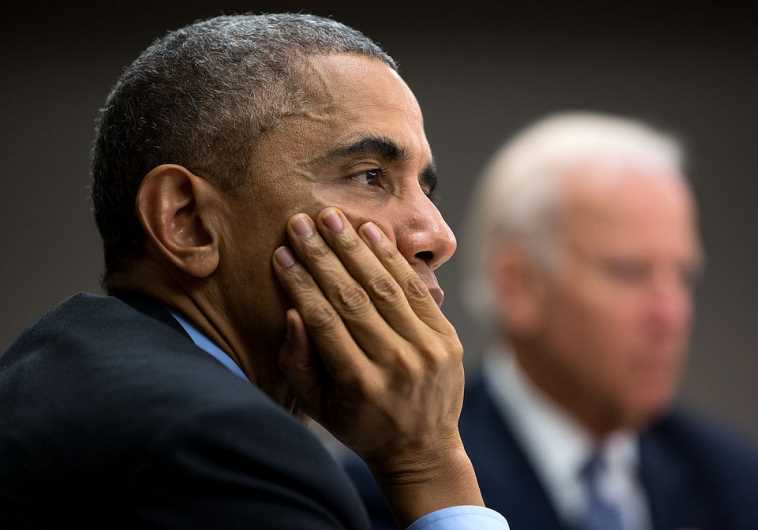
Biden and ObamaUS President Barack Obama (L) and Vice President Joe Biden. (photo credit:OFFICIAL WHITE HOUSE PHOTO BY PETE SOUZA)

The administration’s fear of provoking actions while the nuclear negotiations are ongoing is interpreted by Iran not as pragmatism, but as an invitation to cheat on any future deal.

This schizophrenic foreign policy is not fooling anyone. At best, it is naïve; at worst, it threatens longterm American national security and foreign interests, to say nothing of Israel’s existence.

*****************

It is probably time of us who have strenuously opposed acquiescing in Iran’s development of nuclear weapons to throw in the towel… Mr. Obama’s definition of a satisfactory outcome has evolved… from the complete abandonment… of the Iranian nuclear program to an honor-system reliance on the Iranians.” – Conrad Black, National Review.

What stands out in the following bullets?

• Iran is increasing its financial and military support for the genocidal Syrian ophthalmologist President Bashir Assad.

• The Iranian proxy Hezbollah is helping to prop up the Assad government with its armed forces in Syrian territory.

• US President Barack Obama has stopped supporting Hayya Bina, a “civil society program in Lebanon that seeks to develop alternative Shi’ite political voices to Hezbollah” (The Wall Street Journal).

Reminiscent of the president’s abandonment of the Iranian people during the 2009 Green Revolution, when he sided with the radical mullahs over Iranians seeking a democratic government, the US has decided to leave Lebanese Shi’ites with little choice but the repressive fundamentalist Hezbollah government.

But shouldn’t it be in America’s foreign policy interests to help Iranian and Lebanese Shi’ites break free from the repressive shackles of these anti-Western terrorists and help create the conditions for a peaceful and non-threatening Islam? Anyone paying attention to Iran’s behavior since the Revolution knows that the ayatollah does not reciprocate appeasement. You would have thought after six years of a failed Middle East policy that the president would have learned that unilateral concessions are pocketed, and only encourage more demands and intransigent behavior.

The administration’s fear of provoking actions while the nuclear negotiations are ongoing is interpreted by Iran not as pragmatism, but as an invitation to cheat on any future deal.

The Iranians have been testing the Obama administration with transgressions of the Joint Plan of Action, and their escalating support of the Yemini Houthis, Hezbollah, Hamas, Syria and the Iraqi Shi’ite government. Iran has learned that this American administration would rather bury its head in the sand than act upon almost any transgression.

Iran can be confident that the Obama administration will be the loudest public defender of the deal, knowing it is the president’s foreign policy legacy. Future transgressions will be swept under the table to avoid anything that might unsettle the Iranian regime. Just this week, Iran tested advanced satellite missile launchers, which could be used to deliver nuclear warheads.

Although they contradict current UN Security Council (UNSC) Resolutions, the Obama administration has remained silent, claiming the Iranians are complying with their commitments because the Joint Plan of Action does not address missile systems. The administration conveniently fails to acknowledge is that the JPA does not abrogate the UNSC sanctions.

The president’s outreach to the Iranian-backed Shi’ite Houthis in Yemin, while simultaneously defending the Iranian narrative that it does not support the Shi’ite fighters, fuels the fire that the White House will defend the Iranian narrative after the deal is concluded. Nothing must get in the way of threatening the “success” of the deal.

Even more egregious is the White House’s silence on the blatant violation of a UNSC blacklist. Qassem Suleimani, the head of Iran’s Revolutionary Guard’s elite Quds Force, is barred from traveling to UN member states like Lebanon, Iraq and Syria, yet he travels freely to these nations. For the past eight years, the American government has listed the Quds Force of the Iranian Revolutionary Guard Corps as a terrorist-supporting entity. The Quds Force reports directly to the supreme leader.

The history of the Quds Force’s terrorist activity is well known.

Ahmad Vahidi, who directed the Quds Force at the time, allegedly planned the infamous bombing of the Jewish Center in Buenos Aires in 1994. According to the Obama administration, in 2011 it attempted to assassinate the Saudi ambassador to the US in Washington. No wonder America’s Gulf allies are less than enthusiastic about the US cozying up to the mullahs.

Israel and the Sunni Arab world see the president’s desire to align with Iran as both incomprehensible and inevitable. With little chance of the Senate having the votes to override the president’s almost certain veto this summer, the president is a step closer to his grand plan, in place since his first day in office – to distance America from Israel and the Gulf States, and create a new relationship with the world’s capital for terrorism, Tehran.

The head of the Joint Chiefs of Staff, General Martin Dempsey, went to Israel last week and bluntly told the Israelis that the US expects sanctions relief to increase Iranian support of its proxies, including State Department-designated terrorists Hezbollah and Hamas. The Quds Force can expect a virtual windfall for its overseas terrorist activities. Iran is expected to receive at least $150 billion in sanctions relief, and Dempsey said it would not all be staying in Iran to help its people and economy. Is this administration acting as an indirect supporter of terrorist entities by facilitating their financing? You be the judge.

To deflect charges that the White House is in bed with the Iranians, the administration has allowed the Treasury Department to continue to place some sanctions on Hezbollah members. Like the blacklisting of Quds leader Qassem Suleimani, however, sanctions or blacklisting are one thing, enforcement is another.

This schizophrenic foreign policy is not fooling anyone. At best, it is naïve; at worst, it threatens longterm American national security and foreign interests, to say nothing of Israel’s existence.

Nuclear weapons in the hands of a terrorist state in a decade’s time. That’s a perplexing goal for the leader of the free world.

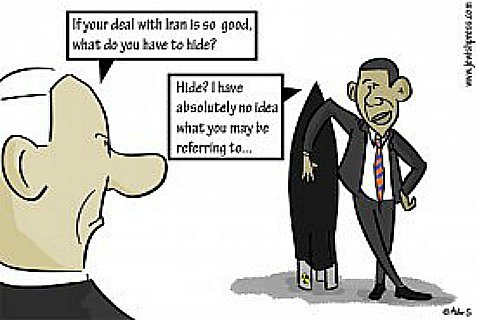
Cartoon of the day

June 16, 2015

H/t The Jewish Press

Obama nukes


The Iran scam grows even worse – Part I, Nuke site inspections

June 15, 2015

Dan Miller’s Blog, May 15, 2015

(The views expressed in this article are mine and do not necessarily reflect those of Warsclerotic or its other editors. — DM

It is likely that the P5+1 nuke deal with Iran will be approved soon. Military and other nuke sites which Iran has not “disclosed” will not be inspected. Nor will Iran’s nuke ties with North Korea — which P5+1 member China seems to be helping, Iran’s massive support for terrorism and abysmal human rights record be considered because they are also deemed unnecessary for deal approval. Sanctions against Iran are moribund and will not be revived regardless of whether there is a “deal.” However, a bronze bust of Obama may soon be displayed prominently in Supreme Leader Khamenei’s office and one of Khamenei may soon be displayed proudly in Dear Leader Obama’s office.

Iran fenced in

Part I — Nuke site inspections

According to a June 11, 2015 article by the Middle East Research Institute (MEMRI), Iran’s Supreme Leader has said there will not even be “token” IAEA inspections.

This past week, members of Iran’s nuclear negotiating team revealed details about the Iran-U.S. nuclear negotiations. The negotiations were dealt a blow when Iranian Supreme Leader Ali Khamenei rejected an agreement reached by the two sides concerning a token inspection of military facilities and questioning of several nuclear scientists and “military personnel”; these were to be the response to the IAEA’s open dossier on possible military dimensions (PMD) of Iran’s nuclear program to which Iran has so far refused to respond.

Iranian reports on these developments show that in order to arrive at a comprehensive agreement, the U.S. is willing to forgo actual inspection of Iranian military facilities and to settle for inspection of declared nuclear facilities only, as set forth under the Additional Protocol, while the ongoing monitoring of Iran’s nuclear program will be left to intelligence elements. [Emphasis added.]

Also on June 11th, it was reported that

CIA Director John Brennan likely came to Israel last week to tell Israeli officials that a final nuclear deal with Iran does not have to include a commitment by Tehran to provide access to military bases, or Iranian consent to interview its scientists, a new report by the Middle East Media Research Institute (MEMRI) said. [Emphasis added.]

On June 12th, Iranian President Rouhani reiterated that

the country will never allow its secrets to be exposed under the Additional Protocol of the Nuclear Non-Proliferation Treaty (NPT) or any other treaty.

“Certainly, Iran will not allow its secrets to be obtained by others under the pretext of implementing the (Additional) Protocol or any other treaty,” President Rouhani said at a press conference in Tehran.

He reaffirmed that foreigners will be denied access not only to Iran’s military secrets but also to secret information in other technological fields.

Here’s a video with comments by Former DIA Director Lt. General Michael Flynn and Ambassador Robert Joseph on Iran’s ballistic missile program and other aspects of the “deal:”

Here’s the Obama administration’s most recent waffle on inspections of Iran’s nuclear sites and sanctions relief:

Although the State Department spokesman waffled, his comments were, unfortunately, at least generally consistent with the January 14, 2014 White House Summary of the framework for subsequent P5+1 negotiations. As I noted here in January of 2014, that summary failed even to mention such military sites as Parchin — even though the IAEA “had reason to think that there had been implosion testing in 2011 but was refused access to inspect” it, Iran’s development and testing of rocketry capable of delivering nuclear warheads and its development and testing of nuclear warheads.

It had been reported on November 27, 2013 that

Despite Tehran’s protestations that it has no intention of ever creating a nuclear weapon, Iran, in fact, has been developing a warhead for some 15 years. That design is now near perfect. [Emphasis added.]

It had been reported on November 28, 2013 that

A top Iranian military leader announced late Tuesday that Iran has developed “indigenous” ballistic missile technology, which could eventually allow it to fire a nuclear payload over great distances. [Emphasis added.]

Why does the White House Summary fail to mention such things? Probably because they are not within the parameters of the November 24, 2013 Joint Plan of Action.

The Joint Plan of Action, — on which the White House Summary seems to have been based — states, in a superficially comforting preamble,

The goal for these negotiations is to reach a mutually-agreed long-term comprehensive solution that would ensure Iran’s nuclear programme will be exclusively peaceful. Iran reaffirms that under no circumstances will Iran ever seek or develop any nuclear weapons. This comprehensive solution would build on these initial measures and result in a final step for a period to be agreed upon and the resolution of concerns. This comprehensive solution would enable Iran to fully enjoy its right to nuclear energy for peaceful purposes under the relevant articles of the NPT in conformity with its obligations therein. This comprehensive solution would involve a mutually defined enrichment programme with practical limits and transparency measures to ensure the peaceful nature of the programme. This comprehensive solution would constitute an integrated whole where nothing is agreed until everything is agreed. This comprehensive solution would involve a reciprocal, step-bystep process, and would produce the comprehensive lifting of all UN Security Council sanctions, as well as multilateral and national sanctions related to Iran’s nuclear programme. [Emphasis added.]

There would be additional steps in between the initial measures and the final step, including, among other things, addressing the UN Security Council resolutions, with a view toward bringing to a satisfactory conclusion the UN Security Council’s consideration of this matter. The E3+3 and Iran will be responsible for conclusion and implementation of mutual near-term measures and the comprehensive solution in good faith. A Joint Commission of E3/EU+3 and Iran will be established to monitor the implementation of the near-term measures and address issues that may arise, with the IAEA responsible for verification of nuclear-related measures. The Joint Commission will work with the IAEA to facilitate resolution of past and present issues of concern.

However, while the Joint Plan of Action calls for “enhanced monitoring” of Iran’s facilities, its focus is on nuclear enrichment, not Iran’s militarization of nukes.

Enhanced monitoring:

Provision of specified information to the IAEA, including information on Iran’s plans for nuclear facilities, a description of each building on each nuclear site, a description of the scale of operations for each location engaged in specified nuclear activities, information on uranium mines and mills, and information on source material. This information would be provided within three months of the adoption of these measures.

Submission of an updated DIQ for the reactor at Arak, designated by the IAEA as the IR-40, to the IAEA.  Steps to agree with the IAEA on conclusion of the Safeguards Approach for the reactor at Arak, designated by the IAEA as the IR-40.

Daily IAEA inspector access when inspectors are not present for the purpose of Design Information Verification, Interim Inventory Verification, Physical Inventory Verification, and unannounced inspections, for the purpose of access to offline surveillance records, at Fordow and Natanz.

IAEA inspector managed access to: centrifuge assembly workshops; centrifuge rotor production workshops and storage facilities; and, uranium mines and mills.

Despite Obama’s claims, Iran appears to have increased, not rolled-back, its nuclear enrichment program. According to the New York Times on June 1st,

With only one month left before a deadline to complete a nuclear deal with Iran, international inspectors have reported that Tehran’s stockpile of nuclear fuel increased about 20 percent over the last 18 months of negotiations, partially undercutting the Obama administration’s contention that the Iranian program had been “frozen” during that period.

But Western officials and experts cannot quite figure out why. One possibility is that Iran has run into technical problems that have kept it from converting some of its enriched uranium into fuel rods for reactors, which would make the material essentially unusable for weapons. Another is that it is increasing its stockpile to give it an edge if the negotiations fail.

Here’s an “explanation” by Marie Harf, the “the Senior Advisor for Strategic Communications to U.S. Secretary of State John Kerry at the U.S. State Department. . . .”

Iran will not budge on inspection of its military and other sites it has not disclosed and which are claimed by the IAEA to be places where Iran’s weaponization of nukes is likely. The Obama Administration will not budge on permitting Iran to get away with it.

Although Israel has been the only free and democratic nation consistently to oppose the P5+1 “negotiations” and the framework on which they are based from the beginning, France has sometimes opposed Obama’s pursuit of a bad “deal.” Recently, France even demanded the inspection of Iran’s sites as sought by the IAEA and stated that it would not consent to a P5+1 “deal” without them.

However, “the French position creates a problem for President Obama because the deal has to be agreed on by the P5+1, not the ‘P4+1-with-one-vote-in-opposition’.” Of the P5+1 members (China, France, Russia, the United Kingdom, and the United States, plus Germany), France appeared to stand alone on this point. However, the linked article suggests that Obama may be trying to use France’s support for a Palestinian state within Israel to convince her to agree that such inspections are unnecessary.

The first story is about France, a member of the P5+1 negotiating a deal with Iran on nuclear capabilities. The French government has expressed increasing concern that the emerging deal is flawed — perhaps fatally.

The other story is that Obama’s

expressed skepticism about the achievability of an Israeli-Palestinian agreement appears to have given way to the French notion that “all other ways have been explored,” and that it is time to let the UN determine parameters for a “big overarching deal.” And, as it happens, the French draft corresponds with the President Obama’s own — strongly held — belief that Israel has to ascribe to the President’s view, despite having just elected a Prime Minister who disagrees.

. . . .

Smash the two stories together, you get an American president supporting France in its efforts to be a major player in the Middle East in exchange for French support of the P5+1 deal with Iran.

In both cases, guess who pays the price: Israel.

The rest of the “free world,” such as it has become, will also pay a hefty price for such a “deal” with Iran.

On a similar note, it was reported on June 9th that

A senior Western diplomat told Ma’ariv in a report published Tuesday that “a diplomatic attack against Israel is expected soon that will surprise even the pessimists in Jerusalem.”  [Emphasis added.]

“In the (UN) Security Council, in western capitals and at EU headquarters, they are just waiting for the Iran deal to be signed and for it to be approved by the American Congress,” warned the diplomatic source.

It appears that the waiting period will likely expire in September, at which time a UN General Assembly will open in tandem with the first shots of the diplomatic barrage against Israel.

Diplomatic sources familiar with Western European positions vis-a-vis Israel said the EU already has a list ready, itemizing sanctions against Israel in the fields of trade, agriculture, science and culture. [Emphasis added.]

That list is to be translated into an economic assault – unless Israel presents a new set of concessions it is willing to make for a new round of peace talks, after the last set of talks was torpedoed by the PA signing a unity deal with the Hamas terrorist organization.

“S‭enior officials in Jerusalem are aware of the existence of sanctions documents at EU headquarters, some of which have even fallen into their hands,” one diplomatic source revealed to Ma’ariv.

Were Israeli Prime Minister Netanyahu to have agreed with Obama on the Iran nuke “negotiations,” Israel’s punishment by imposing economic sanctions on her as those on Iran cease would now be unlikely.

Obama seems to be happy with any “deal” that Iran is willing to sign, despite Iran’s ongoing nuke militarization, the Iran-North Korea-China connection, Iran’s continued massive support for terrorism and its abysmal human rights record. With such a “deal,” Iran will be able to pursue such goals essentially unimpeded, at least until a different administration takes over in Washington.

gary_varvel_gary_varvel_for_04272014_5_-500x367 (H/t Freedom is just another word.)

Parts II through ?? of this series will be posted over the next several days.

State Dept Struggles to Explain Massive Nuke Concessions To Iran

June 13, 2015

State Dept Struggles to Explain Massive Nuke Concessions To Iran, Washington Free Beacon via You Tube, June 12, 2015


General Michael Flynn and Ambassador Robert Joseph on Iran’s Missile Program and a Nuclear Deal

June 11, 2015

General Michael Flynn and Ambassador Robert Joseph on Iran’s Missile Program and a Nuclear Deal, Secure Freedom.Org. via You Tube, June 11, 2015

Former DIA Director Lt. General Michael Flynn and Ambassador Robert Joseph discuss their concerns about the exclusion of Iran’s ballistic missile program from the nuclear agreement currently being negotiated with Tehran and their belief that this deal will not stop or slow Iran’s pursuit of nuclear weapons.


Nuclear Negotiations At An Impasse

June 11, 2015

Nuclear Negotiations At An Impasse, MEMRI, A. Savyon and Y. Carmon, June 11, 2015

Leader Khamenei Rejects Agreement Reached On Token Inspection Of Military Sites And Questioning Of Scientists; U.S. Willing To Close IAEA Dossier On Iranian PMD, To Settle For Inspecting Declared Nuclear Sites Only, And To Rely On Intelligence; EU Objects.

Introduction

This past week, members of Iran’s nuclear negotiating team revealed details about the Iran-U.S. nuclear negotiations. The negotiations were dealt a blow when Iranian Supreme Leader Ali Khamenei rejected an agreement reached by the two sides concerning a token inspection of military facilities and questioning of several nuclear scientists and “military personnel”; these were to be the response to the IAEA’s open dossier on possible military dimensions (PMD) of Iran’s nuclear program to which Iran has so far refused to respond.

Iranian reports on these developments show that in order to arrive at a comprehensive agreement, the U.S. is willing to forgo actual inspection of Iranian military facilities and to settle for inspection of declared nuclear facilities only, as set forth under the Additional Protocol, while the ongoing monitoring of Iran’s nuclear program will be left to intelligence elements.[1]

Thus, at this stage, there is a deadlock: Iran is refusing both to respond to the IAEA dossier on its PMD, and to allow actual inspection of facilities that are not declared nuclear facilities.

Furthermore, the EU has announced its objections to a comprehensive agreement with Iran in the absence of satisfactory answers from it regarding the IAEA dossier on its PMD. It said that the IAEA investigation of the PMD “will be essential” to a nuclear deal.[2] IAEA Director-General Yukio Amano has also linked the investigation of Iranian PMD to the attainment of such an agreement.

The Issue: Inspection Of Iranian Military Sites, Questioning Of Iranian Scientists

On May 25, 2015, in an Iranian television interview, Iranian Deputy Foreign Minister and head negotiator Abbas Araghchi disclosed that this issue had been agreed upon, but that when the Iranian team returned to Tehran for Khamenei’s approval, Khamenei had rejected this agreed solution out of hand (see MEMRI TV Clip No. 4928, Top Iranian Nuclear Negotiator Abbas Aragchi: We Reached Solution with P5+1 on Site Inspection, But Khamenei Rejected It, May 25, 2015 and Appendix I).[3]

It was evident also from Aragchi’s statements that after Khamenei rejected the agreed solution, Iran even reneged from what had been agreed as part of the Additional Protocol, and is now insisting that limitations and restrictions that are part of the Protocol be implemented in a way that will make future inspections difficult. As part of Iran’s backpedaling, Araghchi repeatedly emphasized that “so far, nothing has been concluded” regarding the issue of the inspections.[4]

U.S. Willingness To Disregard IAEA PMD Dossier

Statements by negotiating team member Hamid Baidinejad show that in return for willingness on Iran’s part to sign a comprehensive agreement, the U.S. was willing to forgo actual investigation of the IAEA’s open PMD dossier on Iran and instead to conduct a token inspection of military sites and questioning of Iranian nuclear scientists and military personnel. The U.S. asked Iran to carry out a number of specific steps, thereby paving the way to a comprehensive solution for this issue. These steps included inspections at several points in Iran, including two military facilities, and questioning several senior military officials and scientists (see Appendix II).

Iranian Negotiators’ Two Versions Of Events

An analysis of these statements by the Iranian negotiators shows that there are two different versions of what took place in the negotiations. According to Araghchi, the Iranian team agreed to the U.S.’s demand for a token inspection, but when the team returned to Tehran, Khamenei completely rejected this token inspection. Aragchi’s disclosure that the Iranian negotiators had arrived at an agreement with the Americans that was subsequently rejected by Khamenei caused an uproar in the Iranian political system, triggering harsh criticism against both the negotiators and the leaders of the pragmatic camp, and even leading to a public confrontation between Khamenei and pragmatic camp leader Hashemi Rafsanjani.[5]

The second version of events emerged after the uproar sparked by Aragchi’s revelations. Another negotiator, Baidinejad, in an attempt to correct Araghchi’s claim, stated that the Iranian negotiators had rejected the U.S. demands, even the demand for token inspection, but that the Americans had pressed them to present the demand to Khamenei anyway; when they did so, at the Americans’ urging, Khamenei rejected it outright.

Conclusion

Iran’s reneging on its consent to the U.S. demand for token inspections of its military facilities and questioning of some of its scientists and military personnel in exchange for the closing of the IAEA’s PMD dossier on it places President Obama in a difficult situation, and brings the negotiations to an impasse. This is because along with Khamenei’s rejection, the EU and the IAEA director-general both oppose closing Iran’s dossier in order to arrive at a comprehensive agreement.

It was apparently under these circumstances that CIA director John Brennan was secretly dispatched in early June to Israel, in order to persuade Israel, and, via Israel, the EU, that intelligence monitoring of any Iranian PMD was a satisfactory solution and that actual investigation of the PMD, which Khamenei rejected, could be waived. To this end, Brennan also underlined,on May 31, 2015 on CBS’s Face the Nation, the close U.S.-Israel security cooperation.[6]

In light of this situation, Iranian Foreign Minister Javad Zarif said on May 31, 2015 that with regard to inspection, “other solutions must be discussed.”[7]

Appendix I: Aragchi’s Version Of Events

In an interview that aired May 25, 2015 on Iran’s Channel 2 TV,Araqchi said [8]: “[Our] red lines may change under certain circumstances. This is another issue. We may change some of our red lines for a certain period of time. This is not a problem. The [leader] will give us new instructions, and the team will act accordingly. We have acted within this framework, and we will do so in the future. We will not let ourselves go beyond this framework…

“The Additional Protocol, which is the internationally accepted [control] regime, was not a red line for us. As I said before, our [negotiating] team does not determine those red lines. From the very beginning – and given that the Additional Protocol is [internationally] accepted – we were given permission to accept it during the negotiations. So far, it has not been accepted – we do not have an agreement yet – but it is one of the issues that the negotiating team has been given instructions to accept. As I said, the red lines may or may not be changed in due course, and the Additional Protocol may or may not be accepted at some point, but so far, this has not happened, and our instructions have not changed…

“If the military officials, the relevant officials, the Iranian parliament or the council appointed by Khamenei reach the conclusion that the access provided for in the Additional Protocol comes under the same category as the inspections that Khamenei banned, we will obey and will categorically not allow ‘managed access…’

“The ‘Possible Military Dimension’ [PMD] has always been a strong pretext for the [West]. We have to take this pretext away from them. We have created conditions that will enable us, within the framework of reaching the final nuclear agreement, to resolve the issue of PMD. This is possible now. In the negotiations, we discussed and reached several possible solutions, but these were not accepted in Tehran. These include [allowing the IAEA] to interview several [nuclear scientists], and allowing access to several facilities. They gave us a list and said: ‘If you let us have access to these people and these facilities, we will end the issue of PMD.’ This, however, was not accepted by Tehran, and Khamenei decisively and courageously rejected it..”

Appendix II: Baidinejad’s Version Of Events

In June 1, 2015 statements on his Instagram account that were quoted by the Iranian news agency Fars, negotiating team member Hamid Baidinejad said:[9] “One of the first principles agreed upon, already at the start of the Iran-P5+1 negotiations, was that in a future nuclear agreement, Iran would implement the Additional Protocol on a temporary and voluntary basis until the Majlis decides whether to ratify it and takes into account the other side’s implementation of its obligations…

“It is natural that after a comprehensive nuclear agreement is signed, Iran would be expected to revert to its previous decision – that is, temporarily and voluntarily implementing the Additional Protocol… Without the implementation of the Additional Protocol, even if it is on a temporary basis, the IAEA will not be able to confirm that Iran’s nuclear program is civilian, and that would mean that the process for resolving the nuclear issue will have failed…

“In no way does the Additional Protocol include a clause regarding an obligation on the part of the member states to agree to inspection of their military facilities or investigation of their nuclear scientists. The only thing that the Additional Protocol does make possible is controlled access to non-nuclear facilities, for taking [soil] samples for proving that there is no nuclear activity at facilities that are not declared [to be nuclear sites]…

“Should there be evidence of nuclear material at undeclared sites, whether they are military or civilian, the IAEA will be able to demand controlled access to them [but] only by means of a specific procedure already set out, so that an [Additional Protocol] member state will agree to the sampling in order to prove that it is not conducting nuclear activity in undeclared facilities…

“The Additional Protocol is not a special agreement between the international community and Iran; it is an important international document. Over 120 states are currently members of this protocol, and some have signed it and implemented it temporarily. Therefore, the attempt to interpret it in a way that will include an obligation on the part of [member]states to undergo inspection at [their] military facilities or to allow investigation of [their] nuclear scientists is completely mistaken…

“The discussion on the issue of [Iran’s] PMD, [that is,] Western countries’ claim that Iran has a military nuclear program for producing nuclear weapons, is historically rooted in the years prior to 2003. In recent years, U.S. and Western intelligence services have said that before 2003, Iran’s military wing – commanded by specific commanders in the country – engaged in an extensive clandestine project for producing nuclear weapons. To prove their mistaken claim, [the West] presented intelligence based on their intelligence agencies; however, Iran considers all this intelligence [data] to be faked… There is no doubt that these false accusations against Iran can only be resolved with a political agreement. Discussion of this issue, no matter how lengthy, will not remove these accusations…

“[That is why] the Iranian negotiating team proposed during the talks that Iran and the P5+1 resolve this issue, because they [i.e. the P5+1] would like, along with reaching an agreement, that the issue of the accusations [that Iran] attempted to obtain nuclear weapons will be resolved. They proposed that Iran take several specific steps and thus pave the way to a comprehensive solution to the issue… Iran announced that it considers this dossier faked… But an agreement on it depends on what steps Iran will be asked to take [in order to close the dossier]. They announced that they will discuss the issue on level of the P5+1 [alone] because of its special sensitivity, and will submit their final opinion to Iran at the appropriate time.

“In the round [of talks] that preceded the [April 2015] press release in Lausanne, the P5+1 countries presented Iran with a program that includes inspection at a few points, including two military facilities, and questioning of several senior military officials and nuclear experts whose names were noted in the IAEA reports both directly and indirectly. They claimed that [if they] were allowed access to these sites, and the IAEA was permitted to question these people, that would be the end of the matter of the [PMD] accusations against Iran. As soon as this insulting proposal was raised, Iran rejected it unequivocally… At the same time, the P5+1 asked the Iranian representatives to present the P5+1’s opinion to officials in Iran, despite their express opposition, [for the officials’ approval].

“Leader [Khamenei’s] harsh response rejecting the demand by these countries to inspect military facilities and question nuclear scientists was a completely correct and accurate response. The nuclear negotiations team is proud of having expressed the exact same position [as Khamenei] three months ago, thanks to its complete grasp of the position of the regime and of the leader… Unfortunately, there were some in Iran who were not updated on the details of this issue… and instead of praising the Iranian negotiating team, took the opportunity, while being unaware of the process by which the issue was brought up for discussion – which was reported in full to top regime officials – to launch extremely harsh attacks on the Iranian negotiating team, to plan protests, and to demand a halt to the negotiations…

“These objections and accusations will not last long, but airing these concerns to public opinion can cast doubt on the regime’s main institutions. Everyone is expected to understand Iran’s critical circumstances, and, in this Year of Empathy Between the Government and the People they must join hands in defending Iran’s basic principles and rights and must unite with senior officials in order to efficiently promote the sensitive stage of the nuclear negotiations under the guidance of top senior officials in the regime of the Islamic Republic – and especially by Leader [Khamenei] who is very closely overseeing the negotiations. This way, if an agreement is reached, it will guarantee the preservation of the great Iranian nation’s basic principles.”

Endnotes:

[1] Under the Additional Protocol, the clarification of PMDs at facilities that are not declared nuclear facilities is subject to the consent of the member state under investigation; thus, such sites in fact cannot be inspected.

[2] AP, June 8 2015.

[3] In the interview, Aragchi said that the NPT’s Additional Protocol was not a red line for the Iranian team, and that the team had in fact beeninstructed to accept it. He explained that Iran could always harden its position on these issues. See MEMRI TV Clip No. 4928, “Top Iranian Nuclear Negotiator Abbas Araqchi: We Reached Solution with P5+1 on Site Inspection, But Khamenei Rejected It,” May 25, 2015. It should be mentioned that under former Iranian president Mahmoud Ahmadinejad, IAEA questioning of Iranian scientists was permitted, and two visits to theParchin military facility were allowed. The Iranian team’s acceptance of this demand by the international community was presumably based on this precedent.

[4] Irib (Iran), June 4, 2014.

[5] Senior figures in Iran’s ideological camp hastened to obscure Araghchi’s statements, and to correct them. Majlis speaker for national security affairs Alaa Al-Boroujerdi stated that Aragchi’s words were untrue, and added: “Aragchi only discussed the major issues, and did not say that Iran had consented to inspection of military facilities… Khamenei announced that we will not allow any talks with Iranian scientists, after he noticed that we were under threat by terrorists. The arrest of several who murdered our nuclear scientists revealed that these [perpetrators] were linked to the Mossad. We have red lines, and we will implement them. ISNA, Iran, May 25, 2015. The Javandaily, which is affiliated with Iran’s Islamic Revolutionary Guards Corps (IRGC), also denied Aragchi’s statements regarding the red lines: “In a television interview, top Iranian negotiation [Aragchi] referred to a particular point, and this issue should be addressed. He said: ‘…Perhaps under certain conditions our red lines will change, and the work [of the negotiations] will proceed according to instructions.’ This declaration regarding the possibility of changes to the red lines under certain circumstances is mistaken, for several reasons… As is evident from their names, the red lines are borders that define the basic framework of the negotiations, and without them the negotiations will reach undesirable and unexpected results.” Javanalso warned the Iranian negotiating team about deviating from the red lines: “The Iranian nation supports its negotiating team as long as it operates to realize its rights in the framework of the national interests and preserves national honor. Any withdrawal from this basis, and acceptance of being forced into humiliation by the enemy side, will be met with a popular response from the nation, and will undoubtedly go down in history as a dark and negative point.” Javan, Iran, May 26, 2015. A new website affiliated with the extremist ideological camp called on May 26, 2015 on Khamenei to fire Foreign Minister Zarif and his negotiating team for their “American tendencies.” Amanpress.ir, May 26, 2015.

[6] Haaretz (Israel), June 9, 2015.

[7] Mehr (Iran), May 31, 2015.

[8] See MEMRI TV Clip No. 4928, Top Iranian Nuclear Negotiator Abbas Aragchi: We Reached Solution with P5+1 on Site Inspection, But Khamenei Rejected It, May 25, 2015.

[9] Fars (Iran), June 1, 2015.