Posted tagged ‘Iranian nukes’

Iran Threatens to Walk Away from Nuke Deal

November 13, 2015

Iran Threatens to Walk Away from Nuke Deal Rouhani: Any new sanctions are a deal breaker

BY:
November 12, 2015 3:05 pm

Source: Iran Threatens to Walk Away from Nuke Deal – Washington Free Beacon

Iran has threatened to walk away from the recently inked nuclear deal and stop rolling back its nuclear enrichment program, according to recent comments by Hassan Rouhani, the Islamic Republic’s president.

Rouhani, in comments on Thursday, threatened to break the deal if the United States imposes any new sanctions on Iran, even ones concerning the country’s human rights abuses and its ballistic missile program.

The comments are a direct response to promises by the Obama administration to continue pursuing economic sanctions targeted at Iran’s terrorist proxies and efforts to foment unrest across the globe.

The warning from the Iranian president was delivered amid bipartisan calls in Congress to increase pressure on Iran in response to its recent arrest of two Americans, one a dual citizen and one a D.C.-based permanent resident.

Iran “will not fulfill agreements” aimed at curbing its nuclear program if any new sanctions are considered, Rouhani said, according to reports carried by the country’s state-controlled media.

“The obligations are the following: the group of six [global powers] will not impose new sanctions, and we should fulfill the agreements,” Rouhani said. “In case the Unites States or other countries fail to comply with their obligations, we will be forced to do the same.”

Rouhani’s made these comments just days after reports emerged indicating that Iran has stopped dismantling its nuclear centrifuges, a key requirement of the agreement.

Major differences between the United States and Iran have arisen on the issue of sanctions. While Iran maintains that all U.S. sanctions must be terminated, the Obama administration says it is only required to suspend nuclear-related sanctions.

This leaves open the possibility that the United States could reintroduce sanctions if Iran violates the deal and could level new sanctions unrelated to the country’s nuclear program.

Rouhani acknowledged that this has caused tension between the two nations, stating in his remarks, “a U.S. decision to withdraw only nuclear-related sanctions on Tehran but keeping other restrictions in place has led to continuous disagreement between Iran and the United States.”

The Iranian president also demanded in his remarks that the United States “apologize” for its past actions against Iran.

“If they [the U.S.] modify their policies, correct errors committed in these 37 years and apologize to the Iranian people, the situation will change and good things can happen,” Rouhani said.

Sen. Ted Cruz (R., Texas), a vocal opponent of the nuclear deal, told the Washington Free Beacon that the administration is intentionally ignoring Iran’s bad behavior in order to preserve the accord.

“The Obama administration may insist that the nuclear deal is somehow isolated from other bad behavior on the part of the Islamic Republic, but the fact is that this is all part of the same ugly pattern,” Cruz said. “Tehran understands perfectly well that the terrorist activities of the Revolutionary Guard, including the detention last month of American citizen Siamek Namazi and American resident Nizar Zakka, are part of the same anti-American hostility that also fuels their nuclear program.”

“Trying to separate out their activities is a fool’s errand,” Cruz said. “There can be no good-faith deal with a regime that is the world’s leading state sponsor of terrorism and that has been targeting America and our allies for 36 years.”

The Obama administration has reserved the right to pursue new sanctions.

The State Department explained to the Free Beacon earlier this week that it will not remove sanctions relating to certain elements of Iran’s Revolutionary Guard Corps, an organization responsible for waging terror attacks. Other sanctions aimed at curbing Iranian human rights abuses also remain in place.

However, the State Department has declined to go further with its sanctions against the corps, telling the Free Beacon that it is not considering designating the military group as a foreign terrorist organization, which could severely restrict its activities.

“We believe the sanctions we have in place remain the most appropriate and effective tools for targeting the IRGC, and we are making full use of such authorities with respect to the IRGC,” a State Department official told the Free Beacon this week. “In addition to Iran’s designation as a State Sponsor of Terrorism, we have a substantial set of sanctions already in place against the IRGC.”

Questions still remain about whether the United States will respond to the recent arrests of two American citizens in Iran. While members of Congress have called for sanctions as a result of the arrests, the administration has balked.

Sen. Mark Kirk (R., Ill.), among other lawmakers, has demanded that the Obama administration work with lawmakers to strengthen sanctions.

“Iran’s threatening behavior will worsen if the administration does not work with Congress to enact stronger measures to push back, including renewal of the expiring Iran Sanctions Act of 1996 and targeted sanctions against Iran’s Revolutionary Guard and against any Iranian official found to have participated in the unjust detainment of American citizens,” Kirk said in a statement.

“It should come as no surprise that Iranian leaders are trying to blackmail the administration into ignoring Iran’s terrorism, human rights abuses, tests of missiles that can strike Israel, and detention of American citizens,” Kirk told the Free Beacon. While Congress has red lines that Iran passed long ago, the question is whether the administration has any red lines.”

Iran is pursuing a policy aimed a tying the White House’s hands, analysts said.

“Under the deal Iran always has a gun to America’s head,” said Omri Ceren, managing director for press at The Israel Project, a D.C.-based organization that has been critical of the final terms of the deal. “Any time the Iranians don’t like anything the U.S. is doing, they can blackmail Washington by threatening to walk away from the deal. “

“This time they’re telling Congress that lawmakers are prohibited from responding to the arrest of American citizens,” Ceren said. “Who knows what they’ll ban the U.S. from doing next time?”

Other analysts agreed.

Michael Rubin, a former Pentagon adviser and expert on rogue regimes, said that these types of threats by Iran are a hallmark of the hardline administration.

“It’s the traditional Tehran two-step: One step forward and two back,” Rubin said.

Iran is comfortable issuing threats because it has already begun to receive sanctions relief granted under the nuclear accord. Tehran also has leverage over the Obama administration because of the way the deal is structured, according to Rubin.

“Kerry’s team played into Iran’s hands by front-loading Iran’s rewards and removing any incentive for Tehran to adhere to commitments,” Rubin said. “Who besides Obama and Kerry would give a rogue regime and the world’s largest state sponsor of terrorism a free pass against consequence for any of their actions?”

“Kerry essentially handed Iran a get out of jail free card, and the Iranian leadership will respond by seeing how far they can push,” Rubin explained. “Obama stays quiet on the arrest of reporters or businessman? Well, why not execute one or two and see what happens then? Obama ignores Iranian shipment of missiles to Hezbollah? Why not launch a few?”

Ahead of Europe trip, Rouhani won’t disavow desire to destroy Israel

November 12, 2015

Ahead of Europe trip, Rouhani won’t disavow desire to destroy Israel Iran leader tells French TV Tehran eschews ties with ‘illegitimate’ Israel, refuses to say if he agrees with hard-line statements of predecessor

By Times of Israel staff

November 12, 2015, 11:52 am

Source: Ahead of Europe trip, Rouhani won’t disavow desire to destroy Israel | The Times of Israel

The EU has more labeling to do, but do not hold your breath

Iranian president in a televised interview to France 2 posted online on November 11 2015. (Screen capture France 2)

Iranian president in a televised interview to France 2 posted online on November 11 2015. (Screen capture France 2)

Iranian president Hassan Rouhani refused to say whether he agreed that Israel should be wiped off a map, but called for a one-state end to the conflict with the Palestinians, in two interviews published Thursday.

Speaking to French TV ahead of his first trip to Europe, Rouhani also denied that Iran ever sought nuclear weapons.

Asked by France 2 whether he shared his hard-line predecessor Mahmoud Ahmedinejad’s view that Israel “has no place on the map of the Middle East,” Rouhani answered: “How come this question destined for my predecessor returns now to me?”

He then added that Iran does not believe in a two-state solution.

“We are not speaking of two states but a single one. We say that all the people who originated in Palestine as it was in the borders before 1948 and as it was then as a country should reunite and vote, and whichever [political] system they choose, we will be in agreement with that.”

Iranian President Hassan Rouhani (left, seen from the back) interviewed by France 2 ahead of his visit to France, scheduled for 16-17 November 2015. (Screen capture France 2)

Iranian President Hassan Rouhani (left, seen from the back) interviewed by France 2 ahead of his visit to France, scheduled for 16-17 November 2015. (Screen capture France 2)

“Israel in its current form is not legitimate; this is why we don’t have any relations with it, because we do not consider it legitimate,” said Rouhani, according to a France 2 translation.

Speaking to Italian paper Corriere della Sera, Rouhani was asked when the time will come when “Death to Israel” and similar slogans will no longer be part of Friday prayers.

“We respect all monotheistic religions,” he said, including the Hebrew and Christian ones. “The Jewish people have always lived peacefully in Iran […] they have representatives in the Iranian parliament and they can practice their religion freely. But this is different from Zionism’s policies, which is different from Judaism,” the Iranian president said.

“We condemn the persecutions by the Zionist regime in the region, including the killing of Palestinians, and we condemn American policies of unilaterally supporting this regime. What I am trying to say is that the Iranian people can detest Israel and Zionist policies but at the same time love Judaism, the prophets and the book [the Bible].”

Rouhani’s trip next week — the first by an Iranian leader in over a decade — will see him travel to France, Italy and the Vatican, highlighting warming ties with the Continent in the wake of the July nuclear deal.

The visit will largely be devoted to inking new trade agreements. He said there have been discussions regarding future possible collaboration with French companies on several economic ventures.

Ties with the US have remained cold, but he told Corriere della Sera that he could envision a day when the relationship with Washington, accused in Iran of propping up the unpopular Pahlavi regime overthrown in 1979, is restored.

“One day these embassies will reopen, but what matters is the behavior and those who hold the key to this are the Americans. If they change their policies, correct the mistakes they committed during 37 years and apologize to the Iranian people, the situation will change and good things can happen,” he said.

He told the French station that Iran’s nuclear ambitions have never included military use, repeating Tehran’s official line which stands in contrast to Western fears that the country does seek a nuclear weapon.

Asking whether Iran renounces the pursuit of a nuclear bomb, a France 2 interviewer said “for the French there is still a doubt” on this issue. During P+5 negotiations, Paris was seen as the most suspect of Iranian ambitions.

Rouhani said Tehran has “always sought this research uniquely in the domain of civil nuclear power and this continues today.”

Iran has “never wished, at any moment, not yesterday nor today, to manufacture an atomic bomb,” he said.

He added that Iran has long been a signatory of the Nuclear Non-Proliferation Treaty and has cooperated with the UN’s International Atomic Energy Agency.

“Our country has always collaborated with the IAEA. All the reports of this agency show that Iran has collaborated well. Today, we are willing to take on all the obligations [of the nuclear agreement] on the condition that the permanent members of the UN Security Council plus Germany take on theirs,” he said.

Before the nuclear deal, the IAEA had long complained that Iran restricted access to suspected nuclear sites. The watchdog recently said Iran was complying with a new inspections regime put in place as part of the nuclear pact.

Iran has stopped dismantling nuclear centrifuges: senior official

November 11, 2015

Iran has stopped dismantling nuclear centrifuges: senior official

DUBAI

Tue Nov 10, 2015 2:37pm EST

Source: Iran has stopped dismantling nuclear centrifuges: senior official | Reuters

Iran has stopped dismantling centrifuges in two uranium enrichment plants, state media reported on Tuesday, days after conservative lawmakers complained to President Hassan Rouhani that the process was too rushed.

Last week, Iran announced it had begun shutting down inactive centrifuges at the Natanz and Fordow plants under the terms of a deal struck with world powers in July that limits its nuclear program in exchange for easing sanctions.

Iran’s hardliners continue to resist and undermine the nuclear deal, which was forged by moderates they oppose and which they see as a capitulation to the West.

“The (dismantling) process stopped with a warning,” Ali Shamkhani, Secretary of the National Security Council, was quoted as saying by the ISNA student news agency.

Only decommissioned centrifuges were being dismantled to begin with, of which there were about 10,000 at Natanz and Fordow, the Atomic Energy Organisation of Iran has said.

Shamkhani did not specify what he meant by “warning”, but the head of parliament’s nuclear deal commission, Alireza Zakani, told Mehr news agency that the dismantling had stopped in Fordow because of the lawmakers’ letter to Rouhani.

Zakani, who was not one of the signatories of the letter, did not mention activities at Natanz.

A group of 20 hardline parliamentarians wrote to the president last week complaining that the deactivation of centrifuges contradicted the directives of Supreme Leader Ayatollah Ali Khamenei.

Khamenei has said that the deal should only be implemented once allegations of past military dimensions (PMD) of Iran’s nuclear program had been settled.

The International Atomic Energy Agency is expected to announce its conclusions on PMD by Dec. 15.

Centrifuges spin at supersonic speed to increase the ratio of the fissile isotope in uranium. Low-enriched uranium is used to fuel nuclear power plants, Iran’s stated goal, but can also provide material for bombs if refined much further.

Iran denied Western suspicions it was aiming to build a nuclear bomb.

(Reporting by Bozorgmehr Sharafedin; Editing by Yara Bayoumy and Raissa Kasolowsky)


Cartoon of the day

November 11, 2015

H/t Hope n’ Change

slings-and-narrows-1

Iran ‘Rocket Kitten’ cyber group hit in European raids after targeting Israeli scientists

November 9, 2015

Iran ‘Rocket Kitten’ cyber group hit in European raids after targeting Israeli scientists

Source: Iran ‘Rocket Kitten’ cyber group hit in European raids after targeting Israeli scientists – Middle East – Jerusalem Post

FRANKFURT – European authorities have taken action to shut down a cyber espionage operation linked to Iran’s powerful Revolutionary Guard in the first operation of its kind since Tehran signed a nuclear treaty, according to security researchers who located computers used to launch attacks.

The hacker group – dubbed “Rocket Kitten” by security experts who have been hunting the hacker group since early 2014 – has mounted cyber attacks on high-profile political and defense figures globally since that time.

The action is likely to hamper Tehran’s efforts to gather sensitive intelligence from rivals including Saudi Arabia, Israel, Turkey, the United States and Venezuela, which were among the nations targeted.

Researchers from US-Israeli security firm Check Point Software said the 1,600 high-profile targets include members of the Saudi royal family, Israeli nuclear scientists, NATO officials and Iranian dissidents and even the wives of high-ranking generals from unnamed countries.

The company said it had informed national computer security response teams in Britain, Germany and the Netherlands, who in turn alerted police in those countries to the locations of “command and control” servers used to mount attacks controlled from Iran.

Europol, the FBI and Israel’s internal security service Shin Bet declined immediate comment.

The actions come as US President Barack Obama and Israel’s Prime Minister Benjamin Netanyahu prepare to meet on Monday for the first time since the Israeli leader lost his battle against the Iran nuclear deal and security issues top the agenda.

Check Point plans to issue a report later on Monday. According to an advance copy obtained by Reuters, the report details how its experts burrowed inside the hacker group’s database, giving them a map of malicious software tools and remote-controlled computers used by the group.

Russian weapons chief: S-300 deal with Iran has been signed

November 9, 2015

Russian weapons chief: S-300 deal with Iran has been signed Final contract would allow Moscow to begin delivery of advanced surface-to-air missile system to Tehran

By Raoul Wootliff

November 9, 2015, 12:32 pm

Source: Russian weapons chief: S-300 deal with Iran has been signed | The Times of Israel

Undated photo of a Russian S-300 anti-aircraft missile system on display in an undisclosed location in Russia (photo credit: AP, File)

Undated photo of a Russian S-300 anti-aircraft missile system on display in an undisclosed location in Russia (photo credit: AP, File)

Russia and Iran have signed a contract on Moscow’s delivery of the advanced S-300 missile defense system to the Islamic Republic, Sergei Chemezov, chief executive of Russian state-owned defense conglomerate Rostec, said Monday.

“The contract on delivery of S-300 to Iran has not only been signed by the sides but has already entered into force,” Chemezov said at the Dubai Airshow-2015, according to Russian media.

One of the most sophisticated anti-aircraft weapons in the world, the S-300 is capable of tracking multiple planes at once, and some versions have an interception range of up to 200 kilometers.

Israel has long sought to block the sale to Iran of the S-300 system, which analysts say could impede a potential Israeli strike on Tehran’s nuclear facilities. Other officials have expressed concern that the systems could reach Syria and Hezbollah, diluting Israel’s regional air supremacy.

The agreement would allow the delivery of five systems to Iran following a nine-year delay in the $800 million deal. Russia initially agreed to sell the system to Iran in 2007 but then balked, saying at the time it was complying with a United Nations arms embargo on the Islamic Republic.

In April, shortly after the announcement of the Lausanne outline for the nuclear deal between world powers and Iran, Russia announced it was lifting the ban on selling the advanced missile defense system to Iran, over American and Israeli objections.

In August, Iran and Russia announced that the system would be delivered by the end of the year, with Russian Deputy Foreign Minister Mikhail Bogdanov saying at the time that “just technical details” remained to be agreed upon.

Monday’s statements suggesting the final deal has been signed came as Prime Minister Benjamin Netanyahu was set to meet with US President Barack Obama in Washington to discuss US military assistance to Israel for the coming decade. Some of the weapons said to be under discussion reflect the prominence of Iran in US and Israeli military thinking.

Prime Minister Benjamin Netanyahu prepares to board a plane headed to the US, November 8, 2015 (PMO)

The two leaders are expected to discuss commitments that could see Israel get more than the 33 high-tech F-35 jets already ordered, along with precision munitions and a chance to buy V-22 Ospreys and other weapons systems designed to ensure a qualitative Israeli military edge.

The F-35 is the only aircraft able to counter the S-300 surface-to-air missile system. Officials said Israel may also seek to ensure that other US allies in the region do not get the F-35.

The White House has so far rebuffed Arab Gulf states’ requests to buy the planes.

Obama Deepening Syria War as Prelude to More War, Based on Lies

November 6, 2015

Obama Deepening Syria War as Prelude to More War, Based on Lies

Friday, 06 November 2015

Written by 

Source: Obama Deepening Syria War as Prelude to More War, Based on Lies

Obama Deepening Syria War as Prelude to More War, Based on Lies

Photo of President Obama: AP Images

Outrage and criticism are growing across the political spectrum after Obama, contradicting his repeated past pledges not to put U.S. troops in Syria, decided without congressional or constitutional authority to deploy some 50 Special Forces operatives to aid Syrian jihadists. At least one U.S. soldier has already been killed, dying last month in what Obama officials claimed was a raid to free prisoners held by the Islamic State (ISIS). More deaths are likely, as are more troop deployments, according to lawmakers and analysts, potentially setting up a broader war in which the United States could become further ensnared in Syria and beyond. Thanks in large part to the administration’s deceit and machinations in recent years, the whole region is likely to end up in flames — a kind of post-Obama Libya on a much larger scale. And Obama’s Republican and Democrat enablers in Congress, despite voicing some complaints and concerns, have done practically nothing to stop it.

The official excuse for sending American forces to Syria is to help various jihadist “rebels” battle ISIS. Yet, based on the statements of Obama’s own top officials, including Vice President Joe Biden and Chairman of the U.S. Joint Chiefs of Staff Martin Dempsey, members of Obama’s “anti-ISIS” coalition have been arming, funding, and training ISIS from the start. In fact, in a public speech at Harvard, Biden said the anti-ISIS coalition had essentially created ISIS in the first place — on purpose. Official U.S. intelligence documents later confirmed that. The notion that Obama is sending U.S. troops to battle the Frankenstein creation of its own “anti-ISIS” coalition, then, sounds far-fetched at best. Far more likely is that the real agenda is not being publicly discussed, with ISIS merely serving as the excuse du jour to wage more illegal war.

The administration, of course, also claims that the U.S. military deployment will remain small, supposedly in a mostly advisory capacity along the lines of what got the U.S. government embroiled in Vietnam. Chief White House mouthpiece Josh Earnest even claimed Obama would “not allow the U.S. to be drawn into a sectarian quagmire in Syria.” As he was speaking, though, Obama was in the process of sinking America deeper into the sectarian quagmire that Obama himself helped create and fuel in Syria. “The president believes that by committing a relatively small number of forces, fewer than 50, that they can serve as a force multiplier and further enhance the efforts of these local forces on the ground,” Earnest continued. The “force” that would be “multiplied” by U.S. forces, of course, is a jihadist force, as Obama’s own top officials have already acknowledged publicly and as U.S. military documents show conclusively.

Either way, there is no reason to believe anything Earnest or anyone else in the administration has to say about the deployment, the purpose of it, or anything else, really — and there are plenty of reasons not to believe it. As The New American reported this week, Obama decided to lawlessly commit U.S. troops into Syria’s civil war after years of repeated promises to not deploy U.S. troops in Syria. Indeed, reporter C. Mitchell Shaw compiled a list of 18 separate instances in which the Obama administration publicly pledged not to deploy U.S. troops in Syria. Instead of keeping its promise and U.S. boots off the ground in Syria, though, the administration announced last week that a contingent of American Special Forces personnel were on the way to help various jihadist groups battle other jihadist groups.

It appears, however, that the administration and its war-mongering allies are having trouble keeping their lies straight on all fronts. For instance, the White House claims it has the authority to deploy U.S. forces in Syria based on an “Authorization for Use of Military Force” (AUMF) passed by Congress in 2001 authorizing military strikes on “al Qaeda and associated forces.” Yet, the Obama administration and various warmongers demanding military action in Syria also claim that al-Qaeda and ISIS are at odds with each other. Indeed, disgraced former General David Petraeus, who oversaw the U.S. wars in Iraq and Afghanistan, even called for a U.S. government alliance with al-Qaeda to fight ISIS. Seriously. Official U.S. documents also show that Washington, D.C., has known from the beginning that the Syrian “opposition” was being led by al-Qaeda, the Muslim Brotherhood, and other Islamist organizations.

Meanwhile, Obama’s unconstitutional “regime-change” plot against Libya also discredits the administration’s false claim that the AUMF against al-Qaeda authorizes U.S. government support for jihad in Syria. In Libya, retired U.S. military generals and others even concluded that Obama had “switched sides” in the terror war when he backed self-declared al-Qaeda leaders against former U.S. terror-war ally Moammar Gadhafi. In that war, which turned what remains of war-torn Libya into a jihadist paradise mired in ongoing civil war, Obama did not cite the AUMF, instead pointing to an illegitimate United Nations Security Council “resolution” as the source of authority. Then-Secretary of State Hillary Clinton even promised to ignore Congress if it tried to stop the illegal war. The U.S. Constitution, of course, requires a declaration of war before the president is authorized to wage war.

Even some congressional Democrats, though, are speaking out against Obama. “It’s hard not to be concerned when the president very clearly ruled out putting troops on the ground in Syria and now they’re on their way into the battle,” explained U.S. Senator Chris Murphy (D-Conn.), adding that he expected Obama to deploy even more U.S. troops in Syria going forward. “We’ve crossed a line here that’s hard to understand.” Another Senate Democrat, Tim Kaine of Virginia, echoed those concerns, saying lawmakers were not convinced. The White House’s efforts “to say, ‘Don’t worry, this is not ground troops,’ people don’t think that’s credible,” he said. Various Republicans have also slammed Obama’s decision. The public, too, is catching on, with a recent Associated Press poll showing that more than 6 in 10 Americans reject Obama’s “anti-ISIS” machinations in Syria.

Unsurprisingly, the warmongering Republican neoconservatives in Congress who supported the disastrous U.S. government invasion, “regime change,” and occupation of Iraq were standing fully behind Obama. Some even demanded that Obama deepen his involvement in Syria’s civil war even further. “Democrats and a few Republicans have absolutely no clue as to the threat we face,” complained Senator Lindsey Graham (R-S.C.), who supports sending even more U.S. troops to the region. “We’re going to get attacked from Syria. That is where the next 9/11 is coming from.” He may be right.

What Graham and his fellow warmongers in Congress failed to mention, though, is that creating a fundamentalist Islamist principality in Syria — known today as ISIS — was official U.S. government policy as far back as 2012, according to a U.S. Defense Intelligence Agency (DIA) report. Top U.S. officials said they warned against such an absurd and deadly policy, but were overruled by Obama and his cohorts desperate for more war. Graham and his neocon sidekick Senator John McCain (R-Ariz.), though, have been cheerleading for Obama’s military support to Middle Eastern jihadists for years. McCain even posed for pictures with them. So if it is true that the next terror attack on U.S. soil comes from Syria, the Republican neocon enablers in Congress and the Obama administration will bear a major part of the blame.

But what is the real purpose of Obama’s latest scheming in Syria? According to Kremlin-backed media voices, it is about using U.S. troops as “human shields” to protect Obama’s anti-government jihadist “rebels” from Vladimir Putin’s air power. “The troop dispatch signals that the U.S. [is] trying to forestall Russian successes in wiping out Washington’s regime-change assets in Syria,” wrote analyst Finian Cunningham in a piece published by the Moscow-controlled RT. “In short, the US Special Forces are being used as ‘human shields’ to curb Russian air strikes against anti-government mercenaries, many of whom are instrumental in Washington’s regime-change objective in Syria.”

Despite Moscow’s ostensible support for Assad, however, it appears that the globalist goals in Syria still include deposing the autocratic dictator, eventually — but not before the nation is reduced to rubble, Libya-style, and the genocide of Syria’s ancient Christian communities by Western-backed jihadist “rebels” is complete. Also apparently on the globalist agenda: exploiting the Syrian war to flood the West with millions of refugees, empowering the UN and its kangaroo “court,” and imposing a European Union-style “Middle-East Union” pushed by the global-government-promoting Council on Foreign Relations.

Hundreds of thousands of innocents are now dead. More are dying every single day. Christians are  where they have lived continuously for almost 2000 years. Millions of Syrians have been forced to flee their homes. And much of the responsibility for the tragedy can be traced straight back to the deadly machinations of Obama and his allies.

Congress must take immediate action to rein in the White House, or the growing rivers of blood drenching the Middle East will be on their hands, too.

Dear Fellow Americans: Do You Have Any Idea What’s Being Done In Your Name In Syria?

November 6, 2015

Dear Fellow Americans: Do You Have Any Idea What’s Being Done In Your Name In Syria?

Posted on November 5, 2015

by WashingtonsBlog

Source: Dear Fellow Americans: Do You Have Any Idea What’s Being Done In Your Name In Syria? Washington’s Blog

Americans have some vague understanding that the U.S. wants Syria’s Assad to go, while Russia wants him to stay.

And Americans know that the U.S. “war against ISIS” hasn’t done much, while the Russians have been pounding Syrian targets with jets.

But Americans have no idea that the U.S. is deploying fighter jets designed solely to engage in plane-to-plane dogfighting … in order to counter the Russians.

And we don’t understand that the U.S. is arming the Syrian “rebels” with should-fired anti-aircraft weapons. As the Wall Street Journal  reports:

The U.S. and its regional allies agreed to increase shipments of weapons and other supplies to help moderate Syrian rebels hold their ground and challenge the intervention of Russia and Iran on behalf of Syrian President Bashar al-Assad, U.S. officials and their counterparts in the region said.

The deliveries from the Central Intelligence Agency, Saudi Arabia and other allied spy services deepen the fight between the forces battling in Syria, despite President Barack Obama’s public pledge to not let the conflict become a U.S.-Russia proxy war.

Saudi officials not only pushed for the White House to keep the arms pipeline open, but also warned the administration against backing away from a longstanding demand that Mr. Assad must leave office.

In the past month of intensifying Russian airstrikes, the CIA and its partners have increased the flow of military supplies to rebels in northern Syria, including of U.S.-made TOW antitank missiles, these officials said. Those supplies will continue to increase in coming weeks, replenishing stocks depleted by the regime’s expanded military offensive.

An Obama administration official said the military pressure is needed to push Mr. Assad from power. 

“Assad is not going to feel any pressure to make concessions if there is no viable opposition that has the capacity, through the support of its partners, to put pressure on his regime,” the official said.

In addition to the arms the U.S. has agreed to provide, Saudi and Turkish officials have renewed talks with their American counterparts about allowing limited supplies of shoulder-fire man-portable air-defense systems, or Manpads, to select rebels. Those weapons could help target regime aircraft, in particular those responsible for dropping barrel bombs, and could also help keep Russian air power at bay, the officials said.

Mr. Obama has long rebuffed such proposals, citing the risk to civilian aircraft and fears they could end up in the hands of terrorists. To reduce those dangers, U.S. allies have proposed retrofitting the equipment to add so-called kill switches and specialized software that would prevent the operator from using the weapon outside a designated area, said officials in the region briefed on the option.

U.S. intelligence agencies are concerned that a few older Manpads may already have been smuggled into Syria through supply channels the CIA doesn’t control.

(This comes a week after ISIS may have used a Manpad to shoot down a Russian civilian airliner.)

Americans don’t know that sending Manpads into Syria and trying to establish a no-fly zone is what Al Qaeda leaders have been hoping for, and that ISIS and Al Qaeda will end up with all of the weapons which the U.S. sends to Syria.

Americans don’t know the history of American regime change in Syria:

Americans don’t know that it was the “rebels” – not the Syrian government – who carried out the chemical weapons massacre in Syria.

Americans don’t know that U.S. backed rebels told Christians, “Either you convert to Islam or you will be beheaded.”   Syrian rebels slit the throat of a Christian man who refused to convert to Islam, taunting his fiance by yelling: “Jesus didn’t come to save him!”  A former Syrian Jihadi says the rebels have a “9/11 ideology”.  Indeed, they’re literally singing Bin Laden’s praises and celebrating the 9/11 attack.

Americans don’t know that the U.S. and its allies are largely responsible for creating ISIS, that U.S., Turkey and Israel have all been acting as ISIS’ air force, and that influential American figures are calling for openly arming Al Qaeda … and perhaps even ISIS.

Americans don’t know that Russia and China are catching up to the U.S. military, and that this isn’t a mere proxy war … but is “one step closer” to all out war between the U.S. and Russia.

And Americans don’t know that  history shows that empires collapse when they overextend themselves militarily … and fight one too many wars.

Postscript.  Americans also don’t know how close we’ve come to the worst-case scenario:

  • We came very close to nuclear war with Russia numerous times in the past … and only the courage of a handful of men to disobey the commands of their superiors saved the world
  • In 1962, the head of the U.S. Air Force – General Curtis LeMay – pushed president Kennedy to use the “opportunity” to launch a nuclear war against Russia, and was bitterly disappointed that Kennedy instead opted for peace.  As highly-regarded reporter David Talbot said recently:

The military in this country and the CIA thought that we could take, you know, Castro out. During the Cuban missile crisis, they were prepared to go to a nuclear war to do that. President Kennedy thought people like Curtis LeMay, who was head of the Air Force, General Curtis LeMay, was half-mad. He said, “I don’t even see this man in my—you know, in my sight,” because he was pushing for a nuclear confrontation with the Soviet Union. And even years later, Curtis LeMay, after years after Kennedy is dead, in an interview that I quote from in the book, bitterly complains that Kennedy didn’t take this opportunity to go nuclear over Cuba. So, President Kennedy basically, I think, saved my life—I was 12 years old at the time—saved a lot of our lives, because he did stand his ground. He took a hard line against the national security people and said, “No, we’re going to peacefully resolve the Cuban missile crisis.”

  • One of the world’s leading physicists (Michio Kaku) revealed declassified plans for the U.S. to launch a first-strike nuclear war against Russia in the 1987 book To Win a Nuclear War: The Pentagon’s Secret War Plans.  The forward was written by the former Attorney General of the United States, Ramsey Clarke
  • American, Russian and other experts warn that U.S. and Russian conflicts elsewhere could lead to nuclear war

Obama rules out Israeli-Palestinian peace deal before leaving office

November 6, 2015

Obama rules out Israeli-Palestinian peace deal before leaving office US officials say president has made ‘realistic assessment’; will discuss steps to prevent further violence with Netanyahu on Monday

By AP, Times of Israel staff and AFP

November 6, 2015, 2:17 am

Source: Obama rules out Israeli-Palestinian peace deal before leaving office | The Times of Israel


From left: Prime Minister Benjamin Netanyahu, US President Barack Obama and PA President Mahmoud Abbas during a trilateral meeting in New York, Sept. 22, 2009 (photo credit: Avi Ohayon/GPO/Flash90)

From left: Prime Minister Benjamin Netanyahu, US President Barack Obama and PA President Mahmoud Abbas during a trilateral meeting in New York, Sept. 22, 2009 (photo credit: Avi Ohayon/GPO/Flash90)

US officials said Thursday that President Barack Obama has made a “realistic assessment” that a peace deal between Israelis and Palestinians is not possible during his final months in office.

The stark assessment comes ahead of Israeli Prime Minister Benjamin Netanyahu’s visit to the White House on Monday — the first meeting between the two leaders in more than a year. Preparation for that meeting has been overshadowed by Netanyahu’s appointment of a new media chief, Ran Baratz, who has previously branded Obama an anti-Semite and mocked Secretary of State John Kerry. Netanyahu was Thursday night said to have told Kerry that he was reviewing the appointment.

Officials said the two leaders will discuss steps to prevent a confrontation between the parties in the absence of a two-state solution. They said that while Obama remains committed to a two-state solution between Israelis and Palestinians, he does not believe it’s possible before he leaves office in January 2017, barring a major shift.

White House deputy national security adviser Ben Rhodes told Israeli reporters that the president would want to hear from Netanyahu on Monday ways in which the prime minister will seek to keep a two-state solution viable even in the absence of direct negotiations. Rhodes said Obama regards a two-state solution as urgent, and reiterated the US stance that settlement building undermines faith in the diplomatic process and delays such a solution.

“The main thing the president would want to hear from Netanyahu is that, without peace talks, how does he want to move forward to prevent a one-state solution, stabilize the situation on the ground and to signal he is committed to the two-state solution,” said Rob Malley, the president’s senior adviser on the Middle East, according to Haaretz.

The president expects that Netanyahu will take trust-building steps that “leave the door open for a two-state solution,” Malley said, without elaborating. “We said for some time that we expect from both parties to show that they are committed to a two-state solution. We would expect they take steps that are consistent with that,” Malley said.

A wave of Israeli-Palestinian violence, marked by dozens of Palestinian stabbing attacks on Israelis, broke out two months ago; clashes at Jerusalem’s contested Temple Mount have been followed by Palestinian terror attacks across Israel and into the West Bank, and Palestinian-Israeli clashes in the West Bank and at the border with the Gaza Strip.

At a press conference last month, Obama reiterated his long-held conviction that the only way Israel would be secure, and the Palestinians would meet their aspirations, was via a two-state solution. He indicated then, but did not spell out, that the US was not about to start a new peace effort, saying “it’s going to be up to the parties” to do that, “and we stand ready to assist.”

Kerry sought to be broker an accord in 2013-2014, but the effort collapsed amid a stream of bitter accusations and recriminations between the sides.

With no realistic prospect of substantial negotiated progress, the Obama administration is said to remain determined to keep the idea of a two-state solution viable, and it is understood the president and the prime minister will discuss possible steps in that direction.

The two leaders will likely discuss means to prevent a further deterioration on the ground, including how to thwart further terrorism; tackle incitement more effectively; deal with the strained Palestinian Authority; and safeguard Israeli-Jordanian relations.

No meeting is known to be scheduled for the near future between Obama and PA President Mahmoud Abbas.

The two leaders are also expected to announce that their allied countries are at work on a new long-term agreement for US defense assistance to Israel. The current 10-year framework, which provided for over $30 billion in US military aid, expires in 2018, and there has been talk of a new 10-year framework valued at $40-50 billion in total.

Obama and Netanyahu are expected to discuss commitments that could see Israel get more than the 33 hi-tech F-35 jets already ordered, precision munitions and a chance to buy V-22 Ospreys and other weapons systems designed to ensure Israel’s military edge over its neighbors.

The weapons said to be under discussion reflect the prominence of Iran in US and Israeli military thinking.

The F-35 is the only aircraft able to counter the S-300 surface-to-air missile system that Russia has suggested it may sell to Tehran.

Officials said Israel may also seek to ensure that other US allies in the region do not get the F-35.

The White House has so far rebuffed Arab Gulf states’ requests to buy the planes.

But while Israel has been offered some bunker-busting bombs, divisions over how to handle Tehran may put the sale of 30,000 pound “Massive Ordnance Penetrators” that could be used to target Iranian nuclear sites off the table.

“This is not something that has been raised in the context of the MoU discussions,” said senior Obama national security aide Ben Rhodes referring to the deal, known formally as a memorandum of understanding.

Military experts say Israel’s lack of bunker busting capability has limited Netanyahu’s ability to launch a unilateral strike against Iran, effectively giving Washington a veto over military action.

The visit, Rhodes said, “would be an opportunity to discuss and hear from Israel its assessment of its security challenges and the related security needs it has… whether it is something like the F-35 or a variety of others.”

Obama and Netanyahu will be meeting face-to-face for the first time since the US and its partners reached a nuclear accord with Iran. Netanyahu has been a chief critic of the deal.

On that vexed issue, the meeting could mark the day when Netanyahu finally engages with the administration on the practical implications of the deal, enabling the two sides to get down to work coordinating their positions on countering the threats posed by an emboldened and soon-to-be wealthier Iran, and on the appropriate responses to possible Iranian violations of the deal.

Cartoon added by JK

Two-Office Solution

Photo Credit: Asher Schwartz

Iranian Supreme Leader Khamenei’s Letter Of Guidelines To President Rohani On JCPOA Sets Nine Conditions Nullifying Original Agreement Announced July 14, 2015

October 23, 2015

Iranian Supreme Leader Khamenei’s Letter Of Guidelines To President Rohani On JCPOA Sets Nine Conditions Nullifying Original Agreement Announced July 14, 2015, Middle East Media Research Foundation, Y. Carmon and A. Savyon, October 22, 2015

(Please pay particular attention to Conditions 1 – 6 and their implications as noted by MEMRI. The conditions appear to be quite substantial. Additional material, including Twitter and Facebook messages, is also provided in appendices at the end of the article. I have not reproduced that material here.– DM)

On October 21, 2015, Iranian Supreme Leader Ali Khamenei published a letter of guidelines to Iranian President Hassan Rohani on the execution of the Joint Comprehensive Plan of Action (JCPOA). The letter’s publication coincides with the days of the Ashura that are of vital religious and national significance in Iran and symbolize steadfastness against the forces of evil. Intended as an historical document aimed at assuring Iran’s future, the letter was posted on Khamenei’s website in Persian and tweeted from his Twitter account and posted on his Facebook page in English (see Appendices), and published in English by the official Islamic Republic of Iran Broadcasting authority IRIB (see below). The letter is now a founding document in all things concerning theJCPOA and the conditions under which Iran will be willing to execute it.

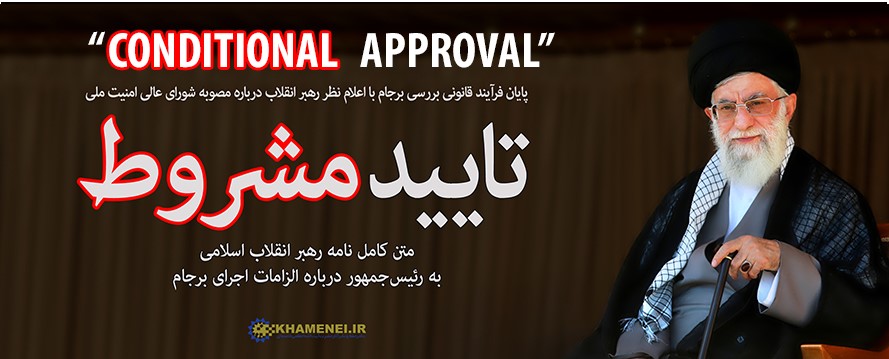
The letter, defined by Khamenei on his website as “conditional approval” of the JCPOA, sets several new conditions for Iran’s execution of the agreement. These conditions constitute late and unilateral additions to the agreement concluded three months previously that fundamentally change it. Khamenei stresses that the agreement awaits his opinion following what he calls “precise and responsible examination” in the Majlis and “clearance of this agreement through legal channels” in Iran’s Supreme National Security Council.  

25366

It should be further noted that in his introduction to the new conditions, Khamenei attacks the U.S. and President Obama with great hostility, and calls for Obama to be prosecuted by international judiciary institutions. He states that Obama had sent him two letters declaring that he has no intention of subverting the regime of the Islamic Republic of Iran, but adds that the U.S.’s support for fitna in Iran (i.e. the popular post-election unrest in 2009), its monetary aid to opponents of the Republic, and its explicit threats to attack Iran have proven the opposite and have exposed the real intent of America’s leaders, whose enmity towards Iran will not end. He wrote that the Americans’ behavior in the nuclear talks is another link in the chain of its enmity towards Iran, that America entered into the talks with the aim of “deception,” and that therefore Iran must remain alert in light of America’s hostile intentions.

The set of conditions laid out by Khamenei creates a situation in which not only does the Iranian side refrain from approving the JCPOA,[1] but, with nearly every point, creates a separate obstacle, such that executing the agreement is not possible.

The following are Khamenei’s nine conditions, and their implications:

Khamenei’s Conditions For Iranian Execution Of The JCPOA

First condition: Khamenei demands that the U.S. and Europe lift the sanctions, not suspend them, and in addition demands “solid and sufficient” guarantees in advance that this will be done, before Iran takes its own steps and meets its own obligations under the agreement. These guarantees, insists Khamenei, must include, inter alia, an official letter from the U.S. president and from the EU undertaking to fully lift the sanctions. Furthermore, he demands that this letter will state that any declaration by the West that the “structure of the sanctions will remain in force” (i.e. allowing snapback) will be considered “non-compliance with the JCPOA” on the part of the West.

Implications: These conditions constitute a total change of the JCPOA. Khamenei is not allowing any execution of the JCPOA by Iran until this is accepted in writing by the other side, and thus he is nullifying the JCPOA as agreed upon on July 14, 2015.

Second condition: Any sanctions against Iran “at every level and on every pretext,” including terrorism and human rights violations, by any one of the countries participating in the negotiations will “constitute a violation of the JCPOA,” and a reason for Iran to stop executing the agreement.

Implications: This demand, that links the JCPOA to other issues and prohibits any punishment of Iran on any issue and for any reason, serves as an excuse for Iran to cancel the agreement.

Third condition: Under the JCPOA, Iran is obligated, following the JCPOA’s Adoption Day, to carry out its obligations concerning changing the function of the nuclear reactor at Arak and shipping out most of its stockpile of enriched uranium. Contrary to this, Khamenei is changing the timetable of the JCPOA, stating that Iran will not carry out these actions until after the International Atomic Energy Agency (IAEA) declares that it is closing its dossier on Iran’s “past and future issues (including the so-called Possible Military Dimensions or PMD of Iran’s nuclear program).”

Implications: This demand to change the timetable creates a situation in which Iran will not take action as stipulated in the JCPOA, and will not meet its obligations, before the sanctions are eased, also according to the JCPOA, but instead dictates that the sanctions must first be lifted completely and states that only then will Iran meet its obligations. Khamenei here is creating a situation in which the IAEA will not be able to report on Iran’s meeting of its obligations regarding the Arak reactor and regarding the shipping out of its enriched uranium by the target date of December 15, 2015, because Iran is not going to do so by then – thus the execution of the agreement is thwarted from the beginning.

Fourth condition: Iran will meet its obligations to “renovate” and change the purpose of the Arak reactor only after there is a signed agreement on an “alternative plan” for changes to the reactor, and after there is “sufficient guarantee” that this alternative plan will be implemented.

Implications: Iran’s fulfillment of its obligations regarding the Arak reactor, as stipulated by the JCPOA, will be postponed until some unknown future date.

Fifth condition: Iran will carry out its obligation to ship out its enriched uranium to another country in exchange for yellowcake “on a gradual basis and on numerous occasions,” and only after “a secure agreement has been clinched to that effect, along with sufficient guarantees” that this exchange will be implemented.

Implications: The date for Iran to ship out its enriched uranium as stipulated by the JCPOA is postponed until some unknown future date. Khamenei is demanding that Iran receive in exchange for the enriched uranium not raw uranium as per the JCPOA, but instead uranium that has been enriched, albeit to a lower level than the uranium it ships out. This is yet another change to the JCPOA as concluded on July 14, 2015.

Sixth condition: Khamenei instructs President Rohani to begin, along with reducing Iran’s ability to enrich uranium under the JCPOA, immediately to expand Iran’s ability to enrich uranium with a 15-year long-term plan for 190,000 centrifuge SWU (Separative Work Units). “This plan,” he says, “must allay any concern stemming from some points entailed in the JCPOA appendices.”

Implications: This article nullifies the declared goal of the JCPOA, which is to reduce Iran’s nuclear enrichment capabilities.

Seventh condition: The Iranian Atomic Energy Organization must ensure continued nuclear research and development, in its various dimensions, such that in eight years’ time, Iran will not be lacking in enrichment technology. This, he says, is all in accordance with the JCPOA.

Eighth condition: In the event of doubt or ambiguity regarding the content of the JCPOA, the source of authority for removing this doubt or ambiguity will be the content of the talks – i.e. it will also include the statements by the Iranian side, not just the “interpretation provided by the opposite party,” that is, the P5+1.

Implications: Any doubt or ambiguity regarding the content of the JCPOA will become the source of unending dispute and will paralyze any possibility of executing the agreement.

Ninth condition: Due to apprehensions that the other side, particularly the U.S., will break its promises or cheat, President Rohani must establish a “well-informed and smart panel” to monitor the execution of the agreement.

Implications: Khamenei is creating an administrative framework for perpetual delays in the execution of the agreement.

Khamenei adds also a 10th condition, directed at Iran, not the P5+1, demanding that Rohani take seriously his instructions in the matter of the “resistance economy,” the main thrust of which is self-reliance instead of basing Iran’s economy on external sources. He also demands that after the sanctions are lifted, there will be no “unbridled imports,” and no imports whatsoever from the U.S.

Political Ramifications In Iran

In February 2016, elections for the Majlis and the Assembly of Experts are set to take place in Iran. The pragmatic camp, headed by Hashemi Rafsanjani and President Rohani, had hoped that a quick execution of the agreement would allow the sanctions to be eased and funds to be released immediately, which in turn would allow the pragmatic camp to present these achievements and triumph in the elections. By setting these conditions, however, Khamenei has thwarted any speedy execution of the agreement, and thus has thwarted the pragmatic camp’s hope for electoral success.

IRIB Translation

The following is the official English translation of Khamenei’s letter, as published by IRIB.[2] This translation was tweeted by Khamenei and also posted on his Facebook page (see Appendix I and II).

“Wednesday, 21 October 2015 17:41
“Ayatollah Khamenei sends a letter to President Hassan Rouhani about the JCPOA

25367

“Ayatollah Seyyed Ali Khamenei, the Leader of the Islamic Revolution, in a letter to President Hassan Rouhani, who also heads the Supreme National Security Council (SNSC), referred to the precise and responsible examination of the Joint Comprehensive Plan of Action (JCPOA) in the Islamic Consultative Assembly (parliament) and also the SNSC, and the clearance of this agreement through legal channels, and issued important instructions regarding the observation of and safeguarding the country’s national interests. Enumerating nine-point requirements for the implementation of the JCPOA, Ayatollah Ali Khamenei endorsed SNSC Resolution 634, dated August 10, 2015, provided that the following provisions and requirements are observed.

“The full text of Ayatollah Khamenei’s letter follows on:

In the Name of Allah, the Most Compassionate, the Most Merciful

“Your Excellency,  Mr Rouhani,
“President of the Islamic Republic of Iran and Head of the Supreme National Security Council
“May God bestow success upon you.
“Greetings to You

“The agreement known as the Joint Comprehensive Plan of Action (JCPOA) has already been cleared through legal channels following precise and responsible examinations in the Islamic Consultative Assembly, [parliamentary] ad hoc committees and other committees as well as the Supreme National Security Council. Since the agreement is waiting for my view, I deem it necessary to remind several points so that Your Excellency and other officials directly or indirectly involved in the issue would have enough time to comply with and safeguard national interests and the country’s best interests.

“1. Before anything else, I deem it necessary to extend my gratitude to all those involved in this challenging procedure throughout all its periods, including the recent nuclear negotiating team whose members tried their best in explaining the positive points and incorporating all those points [into the agreement], critics who reminded all of us of weak points through their appreciable meticulousness, and particularly the chairman and members of the Majlis ad hoc committee [set up to review the JCPOA] as well as the senior members of the SNSC who covered some voids by including their important considerations, and finally the Speaker of Majlis and Members of Parliament who adopted a cautious bill to show the right way of implementation [of the agreement] to the administration, and also national media and the country’s journalists who despite all their differences of view presented a complete image of this agreement to public opinion. This voluminous collection of activity and endeavors and thoughts [spent] on an issue which is thought to be among the unforgettable and instructive issues of the Islamic Republic, deserves appreciation and is a source of satisfaction. Therefore, one can say with certainty that the divine reward for these responsible contributions will, God willing, include assistance and mercy and guidance by Almighty God because the divine promises of assistance in exchange for assisting His religion are unbreakable.

“2. Enjoying decades-long background of presence in the very details of the affairs of the Islamic Republic of Iran, you must have naturally realized that the government of the United States of America, neither in the nuclear issue nor in any other issue, had been pursuing no other approach but hostility and disturbance, and is unlikely to do otherwise in the future either. The remarks by the US President [Barack Obama] in two letters addressed to me on the point that [Washington] has no intention of subverting the Islamic Republic of Iran turned out to be unreal and his open threats of military and even nuclear strike, which can result in a lengthy indictment against him in international courts, laid bare the real intentions of US leaders. Political pundits and public opinion of many nations clearly understand that the case of his never-ending hostility is the nature and identity of the Islamic Republic of Iran, which is born out of the Islamic Revolution. Insistence on rightful Islamic stances and opposition to the hegemonic and arrogant system, perseverance against excessive demands and encroachment upon oppressed nations, revelations on the US support for medieval dictators and suppression of independent nations, incessant defense for the Palestinian nation and patriotic resistance groups, rational and globally popular yelling at the usurping Zionist regime constitute the main items which make the US regime’s enmity against the Islamic Republic inevitable, and this enmity will continue as long as the Islamic Republic [continues to] disappoint them with its internal and sustainable strength.

“The behavior and words of the US government in the nuclear issue and its prolonged and boring negotiations showed that this (nuclear issue) was also another link in their chain of hostile enmity with the Islamic Republic. Their deception through flip-flopping between their initial remarks that came after Iran accepted to hold direct talks with them and their constant non-compliance with their pledges throughout two-year-long negotiations and their alignment with the demands of the Zionist regime and their bullying diplomacy regarding relations with European governments and bodies involved in the negotiations are all indicative of the fact that the US’s deceitful involvement in the nuclear negotiations has been done not with the intention of a fair settlement [of the case], but with the ill intention of pushing ahead with its hostile objectives about the Islamic Republic.

“Doubtlessly, vigilance vis-à-vis the hostile intentions of the US government and instances of resistance on the part of the officials of the Islamic Republic of Iran throughout the negotiations managed, in numerous cases, to prevent heavy damage from being inflicted [upon Iran].

“However, the outcome of the negotiations, which is enshrined in the JCPOA, has numerous ambiguities and structural weaknesses that could inflict big damage on the present and the future of the country in the absence of meticulous and constant monitoring.

“3. The nine-point provisions entailed in the recent bill adopted by the Majlis and the 10-point instructions outlined in the resolution of the Supreme National Security Council carry helpful and effective points which must be taken into consideration. Meantime, there are some other necessary points which are announced here while some of the points mentioned in the two documents are highlighted.

“First, since Iran has accepted to negotiate basically for the objective of removal of unjust economic and financial sanctions and its enforcement (the lifting of sanctions) is tied to Iran’s future actions under the JCPOA, it is necessary that solid and sufficient guarantees be arranged to avoid any infraction by the opposite parties. Written declaration by the US president and the European Union for the lifting of the sanctions is among them. In the statements of the EU and the US president, it must be reiterated that these sanctions will be fully lifted. Any declaration that the structure of the sanctions will remain in force shall imply non-compliance with the JCPOA.

“Second, throughout the eight-year period, any imposition of sanctions at any level and under any pretext (including repetitive and fabricated pretexts of terrorism and human rights) on the part of any of the countries involved in the negotiations will constitute a violation of the JCPOA and the [Iranian] government would be obligated to take the necessary action as per Clause 3 of the Majlis bill and stop its activities committed under the JCPOA .

“Third, the measures related to what is mentioned in the next two clauses will start only after the International Atomic Energy Agency (IAEA) announces [the conclusion of] the past and future issues (including the so-called Possible Military Dimensions or PMD of Iran’s nuclear program).

“Fourth, measures to renovate the Arak plant by preserving its heavy [water] nature will start only after a firm and secure agreement has been signed on an alternative plan, along with sufficient guarantees for its implementation.

“Fifth, the deal with a foreign government for swapping enriched uranium with yellow cake will start only after a secure agreement has been clinched to that effect, along with sufficient guarantees [for its implementation]. The aforesaid deal and exchange must be done on a gradual basis and on numerous occasions.

“Sixth, by virtue of the Majlis bill, the plan and the necessary preparations for mid-term development of the atomic energy industry, which includes the method of advancement in different periods of time for 15 years for the final objective of 190,000 SWU, must be drawn up and carefully reviewed by the Supreme National Security Council. This plan must allay any concern stemming from some points entailed in the JCPOA appendices.

“Seventh, the Atomic Energy Organization of Iran must organize research and development in different aspects such that after the end of the eight-year period, there would be no shortage of technology for the level of [uranium] enrichment entailed in the JCPOA.

“Eighth, it must be noted that on the ambiguous points in the JCPOA document, the interpretation provided by the opposite party is not acceptable and the reference would be the text of the negotiations.

“Ninth, the existence of complications and ambiguities in the text of the JCPOA and the suspicion of breach of promise, infractions and deception by the opposite party, particularly the US, require that a well-informed and smart panel be established to monitor the progress of affairs and [gauge] the opposite party’s commitment and realization of what was mentioned above. The composition and the tasks of this would-be panel should be determined and approved by the Supreme National Security Council.

“In witness whereof, Resolution 634, dated August 10, 2015, of the Supreme National Security Council, is endorsed pending the observation of the aforementioned points.

“In conclusion, as it has been notified in numerous meetings to you and other government officials and also to our dear people in public gatherings, although the lifting of sanctions is a necessary job in order to remove injustice [imposed on people] and regain the rights of the Iranian nation, economic overture and better livelihood and surmounting the current challenges will not be easy unless the Economy of Resistance is taken seriously and followed up on entirely. It is hoped that this objective will be pursued with full seriousness and special attention would be paid to enhancing national production. You should also watch out so that unbridled imports would not follow the lifting of sanctions, and particularly importing any consumer materials from the US must be seriously avoided.

“I pray to Almighty God for your and other contributors’ success.
“Source: www. leader. ir”

__________________

Endnotes:

[2] English.irib.ir/news/leader/item/217470-ayatollah-khamenei-sends-a-letter-to-president-hassan-rouhani-about-the-jcpoa, October 21, 2015.

[3] Twitter.com/khamenei_ir, October 21, 2015.

[4] Facebook.com/www.Khamenei.ir/posts/943612332378368:0, posted October 21, 2015.