Posted tagged ‘Iranian missiles’

Khamenei Smashes Terms of Nuclear Agreement

April 12, 2015

Khamenei Smashes Terms of Nuclear Agreement, Clarion ProjectRyan Mauro, April 12, 2015

(Obama demands, don’t mention Iran’s mumblings about his once in a lifetime deal. Partisan wrangling must stop!– DM)
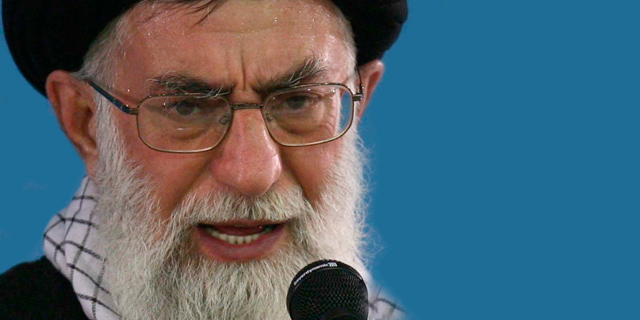
Iran-Ayatollah-Khamenei-HP_3Iranian Supreme Leader Ayatollah Kamenei (Photo: © Reuters)

Khamenei’s accusations make Saudi Arabia a legitimate target under any understanding of jihad. He even went so far as to say the Saudis’ actions are equivalent to Israel’s so-called “genocide” in Gaza. This implies that a violent jihad against Saudi Arabia is as justifiable as one against Israel.

Iran believes that these end times prophesies correlate to the death of Saudi King Abdullah, the Houthis’ overthrow of the Yemeni government, the civil war in Syria, Saudi military action and the fierce fighting in Iraq. The regime sees the confluence of all these crises as beyond the realm of coincidence and signaling the imminent arrival of the “Hidden Imam” which will herald military victory for Iran.

Before the “Hidden Imam” can arrive, two other condition must be fulfilled: instability in Saudi Arabia and the march of a prophetic figure titled “Yamani” who will lead Shiite forces from Yemen into Mecca. The Houthis recently pledged to invade Saudi territory, capture Mecca and overthrow the royal family in Riyadh. They were likely referring to this prophecy.

“We’re not going to respond to every public statement made by Iranian officials or negotiate in public,” said State Department spokesman Jeff Rathke during a daily press briefing.

********************

Iranian Supreme Leader Ayatollah Khamenei ended his eerie silence since the nuclear framework agreement was announced with a fiery speech accompanied with “Death to America” chants. Khamenei essentially smashed the viability of the nuclear framework to pieces, signalled a major escalations in the war in Yemen and essentially endorsed a violent jihad against the Saudi royal family.

Wishful thinkers can’t dismiss the speech as theater for a domestic audience. Khamenei tweeted highlights in English to make sure the world, especially Americans, saw them. The threats and demands are so unequivocal that failing to follow through would sacrifice his entire credibility and prestige.

The Iranian Supreme Leader is unsatisfied with the nuclear framework agreement even though it generously permits Iran to retain the ability to produce nuclear weapons while getting major sanctions relief.

First, he said that the fact sheet published by the U.S. contains lies and does not reflect what Iran agreed to. The statement obliges the regime to seek significant revisions shortly after it gave President Obama the go ahead to make a high-profile victory lap.

Khamenei’s demands are inescapably incompatible with America’s requirements for a deal.

First, Iran is demanding that all sanctions be lifted on the first day that a final deal is signed. The framework only agrees to lift sanctions in phases and only those related to nuclear activity, not terrorism or human rights. Doing so would unfreeze the assets of individuals and entities involved in terrorism around the world, sparking a massive growth in Iran’s terrorist apparatus and proxy warfare.

The inherently flawed hope by the West that “moderate” President Rouhani and other Iranian figures can reign in Khamenei can be immediately ruled out, since Rouhani said the same exact thing.

Iran-Khamenei-Nuke-Tweets

Second, Iran is insisting that there will be no “unconventional,” “special” or “foreign” inspections or monitoring. In other words, Iran will not be subject to exceptionally intrusive inspections. Khamenei’s tweets do not specify Iran’s standards, but it is clear that Iran does not intend to give the IAEA unlimited access.
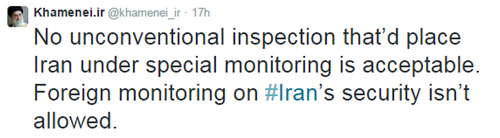
Iran-Khamenei-Rejects-Inspections-Tweets

This is almost definitely a reference to military sites, to which Iran consistently says it has the option of denying access. Iran wants the ability to deny access to any location by declaring it a military institution.

This is how Iran denies access to the critical Parchin site, where damning evidence may exist to prove that Iran conducted major nuclear weapons research until at least 2003. An Iranian opposition group identified an alleged nuclear site in February that is within a military compound. It is claimed that the facility is used for uranium enrichment and the production of advanced centrifuges.

Notice the language of the tweets, which was reported to be equally non-compromising in Farsi. There is no wiggle room. Khamenei would have left some ambiguity if he was willing to budge. If you believe this is just talk, then you must believe that Khamenei made the calculated decision to cause an easily avoidable self-inflicted wound for no reason.

Another flurry of tweets related to the war in Yemen, where Iran is backing the Shiite Houthi rebels who have overthrown the government.

A U.S.-supported coalition of Sunni countries intervened militarily to support President Hadi and stop Iran from threatening the strategic Bab al-Mandeb Strait. This alliance includes Saudi Arabia, Egypt, Bahrain, Qatar, Kuwait, the United Arab Emirates, Jordan, Morocco, Turkey, Pakistan and Sudan. The last two are especially significant because of their close ties to Iran. Separately, Al-Qaeda is gaining ground in Yemen and the Islamic State (ISIS) is rising up as a competitor.

Interestingly, the tweets only threatened Saudi Arabia and did not mention any of these other participants by name. Khamenei stopped just short of a formal declaration of jihad, instead laying out the justification for it.
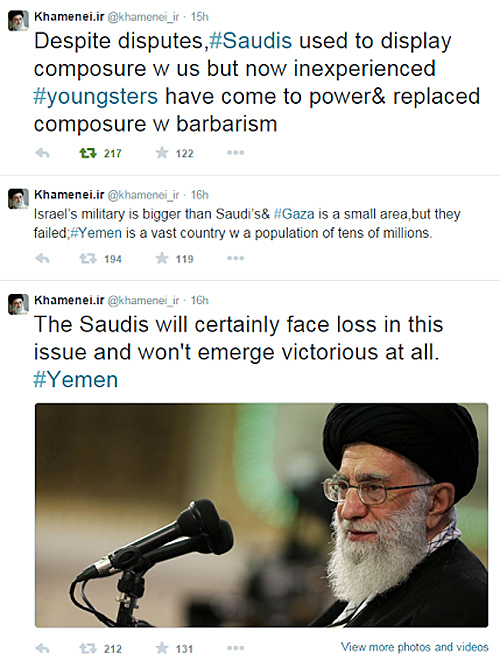
Iran-Khamenei-Yemen-1-Tweets
Iran-Khamenei-Yemen-2-Tweets

Khamenei’s accusations make Saudi Arabia a legitimate target under any understanding of jihad. He even went so far as to say the Saudis’ actions are equivalent to Israel’s so-called “genocide” in Gaza. This implies that a violent jihad against Saudi Arabia is as justifiable as one against Israel.

Don’t be comforted by Khamenei’s mentioning of prosecuting Saudi leaders in international courts. This is not meant to substitute jihad. Khamenei is making a point about how blatant the Saudi crimes are. He’s not even saying that this is Iran’s chosen course of action.

This comes as Iran dispatches two ships to the front in Yemen, including a destroyer to “safeguard naval routes” — meaning it will challenge the challenge the Saudi-Egyptian naval blockade.

Iran sent a flotilla to Bahrain in 2011 after Saudi and Emirati forces intervened to stomp out a revolution against the Sunni monarchy. The regime blinked at the last moment when the Arabs made it clear they would use force to stop it. However, the Yemen conflict has significant differences that Khamenei’s tweets help explain.

Khamenei is signaling that unprecedented hostilities with Saudi Arabia will now commence. The previous Saudi leaders, he says, could be dealt with. The new Saudi King and his circle must be handled more toughly.

However, Iran orchestrated massive terrorist attacks on Saudi interests even under the previous “composed” leaders, a campaign that put the U.S. economy and homeland at risk.

For example, in 2011, the U.S. prevented an Iranian Revolutionary Guards’ plot to assassinate the Saudi ambassador in Washington, D.C. by blowing up a restaurant, which inevitably would have taken the lives of American citizens as well. The scheme involved hiring a Mexican drug cartel to perpetrate the attack, along with bombings of the Israeli embassy in D.C. and the Israeli and Saudi embassies in Argentina.

In 2012, Iran launched a cyber attack on the Saudi Aramco oil company in response to the country’s policies in Bahrain and Syria. Aramco said the hackers tried to take down the country’s oil and gas production (which failed), but they did erase the data on 30,000 computers, three-fourths of the corporate computers.

Khamenei says that the new Saudi leadership is committing far worse crimes, so we should expect a far worse response.

We must also remember the prophecies cited by the Iranian regime.  Iran believes that these end times prophesies correlate to the death of Saudi King Abdullah, the Houthis’ overthrow of the Yemeni government, the civil war in Syria, Saudi military action and the fierce fighting in Iraq. The regime sees the confluence of all these crises as beyond the realm of coincidence and signaling the imminent arrival of the “Hidden Imam” which will herald military victory for Iran.

Before the “Hidden Imam” can arrive, two other condition must be fulfilled: instability in Saudi Arabia and the march of a prophetic figure titled “Yamani” who will lead Shiite forces from Yemen into Mecca. The Houthis recently pledged to invade Saudi territory, capture Mecca and overthrow the royal family in Riyadh. They were likely referring to this prophecy.

Khamenei’s speech wasn’t the typical bluster we are used to hearing from Islamist radicals and dictators. The timing, language and high-profile nature makes it very significant.

Even though the U.S. State Dept. responded by saying that sanctions against Iran would be removed gradually based on verification that Iran had kept its commitments, its response lacked conviction:

“We’re not going to respond to every public statement made by Iranian officials or negotiate in public,” said State Department spokesman Jeff Rathke during a daily press briefing.
Obama still believes in a nuclear deal, although Iran is skittish – even against a military option

April 12, 2015

Obama still believes in a nuclear deal, although Iran is skittish – even against a military option, DEBKAfile, April 12, 2015

Ashton_Carter_4.15US Defense Secretary Ashton Carter:The nuclear option is on the table

In the last two days, the Obama administration has swung between conflicting signals on the Iranian nuclear deal. Unable to wave away the tough conditions laid down by Tehran, the US president was nonetheless optimistic about a final deal to curb Iran’s nuclear program in comments he made at the Americas summit in Panama Sunday, April 12. Obama said he was not surprised at the way supreme leader Ali Khamenei had characterized the framework agreement, because “Iran has it own politics and hardliners who need to be satisfied, but there may be ways to structure the final nuclear deal that achieve core objectives while satisfying Iran’s pride.”

Just Saturday, US Defense Secretary Ashton Carter said: “We have the capability to shut down, set back and destroy the Iranian nuclear program.” He referred to the Massive Ordinance Penetrator-MOP, aka the “bunker buster” which is capable of penetrating fortified facilities up to 200 feet underground. “My job is among other things to make sure that the so-called military option is on the table,” he said.

Iranian media headlines screamed: “US Secretary of Defense Ashton Carter has threatened Tehran with war.”

This is exactly what Khamenei was aiming for when on April 9, he laid down two implacable terms for a deal: the removal of sanctions on the day a final deal is signed and a firm refusal to allow international inspections of Iran’s military sites.

Both of these provisions contradicted Washington’s presentation of its core conditions for a comprehensive accord as being gradual sanctions relief and intrusive inspections.

One of Khamenei’s objects was indeed to remove all suspicion on his home front that Iran’s negotiators had given ground to the world powers either in the overt agreement or in any secret annexes.

The Iranian media headlines achieved this purpose.

But underlying the vocal exchanges between the two capitals is Iran’s confidence that President Obama has discarded the option of military force against its nuclear sites. This confidence gave Tehran the edge in round after round of diplomacy with the US and the world powers.

Senior negotiator Foreign Minister Javad Zarif boasted on April 7, that Iran was “capable of producing an atomic bomb at any given moment,” and was contained solely by “religious Islamic injunctions.”

His boast was amply illustrated by the 20,000 centrifuges Iran had built up during the years of negotiations, plus thousands of advanced machines standing by to further accelerate uranium enrichment – even though its stockpile of 3.6 percent had soared to 10 tons – enough to build 4-6 nuclear bombs.

This edge further enabled the Iranians to bring the Arak heavy water plant capable of producing plutonium to its final stages of construction, without encountering a prohibition in Lausanne, any more than the Fordo enrichment site, stealthily installed some years ago, or its ballistic missile program were sentenced to be dismantled.

That Iran would continue to get away with its tactic of talking while enriching was borne out by Obama assurance Sunday that ways would be found “to structure the final nuclear deal that achieve core objectives while satisfying Iran’s pride.”

The negotiating tactics pursued by Secretary of State John Kerry in Lausanne and in the previous round in Geneva not only diluted America’s military option but virtually took it off the table – not only for America but for everyone else, including Israel. To put it back, much more is needed than Ashton Carter’s reference to the bunker-buster. To make it credible, the United States must rebuild its military presence in the Gulf and the Middle East – bringing back two aircraft carriers to reinforce the lone USS Carl Vinson, for starters.

This, however, would contradict the doctrine Obama expounded on April 2 when he said: “When you hear the inevitable critics of the deal sound off, ask them a simple question: Do you really think that this verifiable deal, if fully implemented and backed by the world’s powers, is a worse option than the risk of another war in the Middle East?”

But he failed to explain the multiple versions of the Lausanne deal published in Washington, Tehran and latterly Paris, whose discrepancies can no longer be glossed over.

Speaking after his historic meeting with Cuba’s Raul Castro Sunday, Obama rebuked Republican senators for pointing this out, accusing them of “partisanship which has crossed all boundaries.”

Sen. John McCain shot back that discrepancies between US and Iranian versions of the deal extended to inspections, sanctions relief, and other key issues. ‘‘It is undeniable that the version of the nuclear agreement outlined by the Obama administration is far different from the one described by Iran’s supreme leader,’’ he said.

This exchange took place two days before members of the Senate Foreign Relations Committee plan to vote on Senator Bob Corker’s bipartisan Iran nuclear agreement review act. This would give members of Congress 60 days after a nuclear deal is reached to decide if they want to waive sanctions against Iran.

But most of all it calls into question the Obama administration’s presentation of a tentative set of disputed concepts reached in Lausanne as a finalized framework, which left just a few loose ends for resolving by the next deadline of June 30. The very real gaps have been highlighted and exploited by Tehran.

US tactics don’t work well in the Persian bazaar, where the carpet seller pretends to be unwilling to sell his merchandise to an interested customer, while putting the price up in round after round of haggling.

Khamenei falls naturally into the role of the reluctant carpet seller when he is confronted with an especially keen American customer.

Ayatollah Khamenei Outlines Requirements of Final Iran Nuclear Deal

April 9, 2015

Ayatollah Khamenei Outlines Requirements of Final Iran Nuclear Deal, Tasnim News Agency (Iranian), April 9, 2015

(All bold face print is from the original. — DM)

139401201524404185070453

TEHRAN (Tasnim) – Supreme Leader of the Islamic Revolution Ayatollah Seyed Ali Khamenei on Thursday defined the main points that a final nuclear deal between Iran and world powers should involve, but refused to adopt a stance on the Lausanne statement that entails no binding commitment.

Addressing a gathering in Tehran on Thursday, Ayatollah Khamenei said he has not taken a position on a statement released by Iran and the Group 5+1 (Russia, China, the US, Britain, France and Germany) after the most recent round of nuclear talks in the Swiss city of Lausanne, because nothing has been still agreed upon, nor have the parties reached any binding agreement.

“What has happened so far does not guarantee either the principle of an agreement, or the negotiations that lead to an agreement or even the content of an agreement, and it does not even guarantee that these talks would result in a deal, so congratulation has no meaning,” the Leader said.

The comments came after Iran and the six powers on April 2 reached a framework nuclear agreement after more than a week of intensive negotiations in Lausanne, Switzerland, with both sides committed to push for a final, comprehensive accord until the end of June.

Ayatollah Khamenei then reaffirmed strong support for a deal that respects the Iranian nation’s dignity, and rejected as “untrue” the reports on his opposition to any agreement.

The Leader, however, underlined that “no deal is better than a bad deal.”

Imam Khamenei then explained that he has only outlined the “general issues, the main guidelines, frameworks and red lines” regarding the nuclear talks and has not specified the details.

“I am not indifferent to the negotiations, but have not interfered in the details of the talks so far, and will not interfere in future either,” the Leader stressed.

The Supreme Leader then pointed to the unreliable nature of the US, an obvious sign of which he said was a biased fact sheet that Washington issued only two hours after the Lausanne statement was declared.

“Drafting such a statement (fact sheet) within two hours is not possible, so they (Americans) had been busy preparing a flawed and wrong statement contrary to the content of the talks at the same time that they were negotiating with us.”

The Leader further called on the country’s negotiators to hold consultations with the critics of the Lausanne statement to better deal with the talks, something known as “rapport” among Iranians.

Imam Khamenei once again made it clear that the talks with the US revolve only around the nuclear issue and nothing else, but at the same time noted that such nuclear negotiations provide an experience to test the possibility of talking on other subjects if Washington puts aside objections.

But, the Leader added, if the US keeps raising objections, Iran’s experience of mistrust of the US will be corroborated.

Commenting on the main points that have to be stipulated in a possible final nuclear deal, Ayatollah Khamenei pointed to the removal of anti-Iran sanctions all at once, adding, “This issue is very important and the sanctions should be completely terminated at the very day of the agreement.”

“If the removal of sanctions is to be conditioned by a new process, the fundamental of negotiations will be nonsense, because the purpose of the talks is lifting of the sanctions,” the Leader said.

The Supreme Leader also categorically rejected foreign access to the country’s “security and defensive” sectors under the pretext of nuclear monitoring.

Imam Khamenei said Iran’s military capabilities must be upheld and strengthened day by day, stressing that Iran’s backing for its “brothers” in the resistance front in different regions should never be diminished.

Moreover, the Leader voiced opposition to any deal that subjects Iran to “unconventional” monitoring and would make it a special case in the world, underlining that monitoring of Iran’s peaceful nuclear program should be conventional, like the other countries.

Iran’s “scientific and technical developments in different dimensions” was another requirement that the Leader emphasized a deal must include.

Ayatollah Khamenei finally said the responsibility lies with the country’s negotiators to fulfill those necessary demands in the talks, calling on them to “find the correct ways of negotiations” by using the view points of the informed and reliable individuals and listening to the critics.

Take Them At Their Word: Iran Might Destroy Us | Bill Whittle

April 9, 2015

Take Them At Their Word: Iran Might Destroy Us | Bill Whittle via You Tube, April 9, 2015


Humor?| Obama to Israel: I have your back

April 8, 2015

(The views expressed in this article are either mine or those of my guest author. They do not necessarily reflect those of Warsclerotic or its other editors. — DM)

The Most Revereddd Mohamed Allah-scimitar

The Most Revereddd Mohamed Allah-scimitar

This is a post by my (imaginary) guest author, the Most Reverend Mohamed Allah-scimitar, President Obama’s chief foreign policy adviser on Islamic relations with Christians and Jews. But first, some related observations:

Iran continues to reject as lies Obama’s statements about the April 2nd P5+1 nuke “deal,” and states that it “could build bomb today” but won’t because of Ayatollah Khamenei’s (non-existent) fatwa. Understandably, Israel is becoming increasingly concerned about her future existence. Obama’s claims that He has her back and that she therefore need not worry about anyone (else) who tries to “mess with Israel.” His assurances have provided scant comfort.

Cartoon_Israel_BB_KnifeInBack

Here’s are the comforting(?) words of the Most Reverend Mohamed Allah-scimitar.

***********************

Lord Obama has Israel’s back almost to the same extent that He has the Obama Nation’s back and will protect her if necessary. For Israel to maintain, and even improve, her weapons minimizing destruction (WMDs) is an unacceptable insult to Him and to all for which He stands.

ObamaWillStandWithMuslims (2)

Obama salute

During Israel’s “Protective Edge” war against peaceful Palestinians in Gaza, Israel shamelessly shifted the odds disproportionately in her own favor by using the Iron Dome to thwart efforts to destroy her major cities. She provided not even one Iron Dome to the Palestinians! Since that time, she has improved the Iron Dome and developed other WMDs less dependent upon lengthy trajectory tracking of missiles and perhaps even mortar rounds. Racist to the core, she has no regard for social justice, equality and the sad plight she has imposed on the Palestinians. Indeed, they are forced to rely on funds (“tens of millions of dollars”) from Iran to help rebuild Tunnels for Peace (TFP) and resupply their stocks of Missiles for Peace (MFP).

Now that Israel claims that peaceful Iranian nuclear weapons are an existential threat, she is doubtless looking for — and probably finding — ways to escape their consequences as well. Doing so is risible because Lord Obama has explained patiently — even as He would to a backward child — that it is unnecessary. He has her back, as He always had and always will.

Nobody except Obama had dare mess with Israel! Not even Netanyahu! Hence, there is no need for Iran to recognize Israel’s speciously claimed right to continue to exist, which would require fundamental changes in Iran. For Israel to insist on it is a fundamental misjudgment.

Lord Obama is able and willing to act, if necessary, to demonstrate the firmness of His resolve. Indeed, it has already been rumored that He may dispatch His own beloved mother in law from her happy home in the White House to live with Prime Minister Netanyahu in Occupied Palestine. If so, she will be accompanied by a suitable contingent of unarmed Organizing for Action volunteers. Recognizing, however, that more may be required, Lord Obama has been negotiating with Iran to provide the unjustly impoverished Palestinians not only free electrical power but also medically useful radioactive isotopes as well as others for other peaceful purposes. Despite the petty squabbles between the Palestinian Authority and Hamas, Iran will treat them equally.

Israel should and will cease to exist but, with Lord Obama in the picture, Iran should not be a concern.

**************************

There is no P5+1 “deal” and it seems unlikely that there ever will be, no matter how many contortions Obama and Kerry attempt. A deal like the one described in Obama’s talking points would be bad enough. However, Iran has rejected His talking points, has stated that it could build nukes now if it so desired and that the only impediment is a (non-existent) fatwa issued by the Supreme Leader. The Iranian foreign minister has been quoted as saying that

Iran will begin using its latest generation IR-8 centrifuges as soon as its nuclear deal with the world powers goes into effect, Iran’s foreign minister and nuclear chief told members of parliament on Tuesday, according to Iran’s semi-official FARS news agency. [Emphasis added.]

If accurate, the report makes a mockery of the world powers’ much-hailed framework agreement with Iran, since such a move clearly breaches the US-published terms of the deal, and would dramatically accelerate Iran’s potential progress to the bomb.

Iran’s military sites are, of course, off limits to inspections according to Iran’s Defense Minister. Meanwhile, the Supreme Leader continues to lead “death to America” chants and Iranian television continues to entertain its viewers with simulations of nuclear attacks on Israel.


More recently,

[T]he Islamic Republic has announced a new documentary film which will celebrate the life of Qods Force Commander Qassem Soleimani. It’s bad enough lionizing a master terrorist responsible for the deaths of hundreds of Americans in Iraq and Afghanistan. But the description of the film is even more telling: The film Commander will depict Iran’s and Soleimani’s strategic approach to destroy not only the Islamic State but also “the Zionist regime.” Importantly, the article describing the film was published after agreement on a nuclear framework between the P5+1 and Iran. [Emphasis added.]

Can and should Israel destroy Iran’s nuclear facilities?

April 5, 2015

Can and should Israel destroy Iran’s nuclear facilities? Dan Miller’s Blog, April 5, 2015

(The views expressed in this article are mine and do not necessarily reflect those of Warsclerotic or any of its other editors. — DM)

It has been suggested that Israel should seriously consider destroying Iranian nuclear facilities, but Israeli officials obviously haven’t said, and won’t say, if, how or when she might.

Iran fenced in

Speaking to Arutz Sheva Friday, Professor Efraim Inbar, who heads the Begin-Sadat Center for Strategic Studies, said the deal had realized Israel’s worst fears by leaving Iran’s nuclear program essentially intact.

The Islamic Republic’s nuclear program has been granted “legitimacy” by the agreement, which still allowed it to continue enriching uranium and to maintain a reactor capable of producing enriched plutonium, he said. “And that’s what worries Israel, that they (Iran) will be able within a short time frame to reach a nuclear bomb.”

“I hold the view that the only way to stop Iran in its journey to a nuclear bomb is through military means,” Inbar maintained, suggesting that “Israel needs to seriously consider striking a number of important nuclear facilities” to head off the threat.

On March 28, former U.S. Ambassador Bolton said that it should be done.

The P5+1 nuclear “deal,” proudly announced by President Obama on April 2nd, is a sham. There is no “deal,” and public announcements by Iran and Obama cast it in very different lights. According to Iran, all sanctions will be lifted immediately when an agreement is reached on or before June 30th. According to Obama, sanctions relief will be gradual and based on Iran’s compliance with invasive inspections and other conditions. Even National Public Radio (NPR) has pointed out differences. NPR observed that, according to Iran,

all sanctions relief – U.N., EU and U.S. – would be immediate. It was unequivocal. It stated that Iran under the deal was free to pursue industrial scale enrichment to fuel its own reactors – unequivocal. It stated that Iran was unhindered in its ability to conduct centrifuge R&D.

Iran has also emphasized that its intention to destroy Israel is non-negotiable, and the Obama Administration has rejected any efforts to make Iran recognize Israel’s right to exist, on the ground that

“This is an agreement that is only about the nuclear issue,” State Department spokeswoman Marie Harf told reporters on Friday night, according to Fox News. “This is an agreement that doesn’t deal with any other issues, nor should it.” [Emphasis added.]

Israeli Prime Minister Netanyahu has said that Israel’s right to exist is non-negotiable.

Iran is very unlikely to retreat from its perception of the “deal,” Obama is very likely to retreat in Iran’s favor, and Israel is very unlikely to retreat from its perceptions about Iran, the “deal” or Israel’s right to exist.

What should Israel do?

In Martin Archer’s novel Islamic War, which I reviewed here, Israel dispatched elderly, large and substantially refurbished remove controlled aircraft, full of high explosives, from Somalia to half dozen nuclear facilities operated by hostile nations. They flew circuitous routes at varying altitudes to avoid detection until it was too late to stop them. Over a period of weeks, they crashed into and destroyed their targets, amid speculation about who had done it and why. Israel was not suspected. Would that have been possible then? Now? I don’t know.

It has been reported that Saudi Arabia has given Israel clearance to use her airspace for an attack on Iran’s nuclear facilities.

Fox News reports that US Defense sources claim the Saudis are conducting tests on their air defense systems after giving Israel permission to to enter a narrow corridor to shorten the distance to attack Iran.

The testing would make sure that Saudi jets don’t get scrambled when Israel entered Saudi airspace. Once the IAF planes complete their mission and exit Saudi airspace, Saudi defenses would go back online again. [Emphasis added.]

Might Saudi Arabia, Egypt and perhaps other Gulf States go beyond not interfering with an Israeli attack to provide air support and other help? They seem to be as displeased with the “deal” as Israel is.

Assuming that Israel is not overly concerned about being identified as the attacker and is willing to act alone, she might:

Detonate one or more high-altitude atomic bombs to emit sufficient electromagnetic pulses (EMP) to fry all above-ground Iranian electronics. That would substantially disable Iranian above-ground command and control facilities as well as other communications, hence diminishing (but not eliminating) the possibility of counter-strikes by Iran and/or its proxies. Perhaps she has other, non-nuclear, means of generating EMPs; she hasn’t said.

Immediately thereafter, drop whatever suitable bombs she may have on all Iranian military and nuclear facilities. Does Israel have bunker-buster bombs? Probably not of U.S. manufacture, but that does not mean that she has not developed her own. It would be surprising if she had not.

Obama and other “leaders of the free world” would complain and the U.N. would emit fits of angry censures. However, that happens with great frequency in any event, and would be an insufficient reason for Israel to commit national suicide through inaction against Iran.

I am no “military expert” and would appreciate any comments on the suggestions I have made as well as any other suggestions anyone might care to offer.

The Tricks Obama Is Trying to Play with the Iran Announcement

April 2, 2015

The Tricks Obama Is Trying to Play with the Iran Announcement, Commentary Magazine, April 2, 2015

(When will Iran say what and to whom about Obama’s new “framework?” Will Iran cloud the results of the negotiations as cleverly as did Obama? — DM)

If you look at what happened today between the U.S. and Iran through the lens of domestic American politics, Barack Obama has made a very clever play here—because what might be called “the agreement of the framework of the possibility of a potential deal” gives him new leverage in his ongoing battle with the Senate to limit its ability to play a role in the most critical foreign-policy matter of the decade.

The “framework” codifies the Obama administration’s cave-ins but casts them as thrilling reductions in Iran’s capacities rather than what they are—a pie-in-the-sky effort to use inspections as the means by which the West can “manage” the speed with which Iran becomes a nuclear power.

Obama’s tone of triumph this afternoon was mixed with sharp reminders that the deal is actually not yet done—and that is entirely the point of this exercise from a domestic standpoint. the triumph signals his troops and apologists that the time has come for them to stand with him, praise the deal sheet and pretend it’s a deal, declare it historic, and generally act as though the world has been delivered from a dreadful confrontation by Obama and Kerry.

But since the deal is not yet done, it could still be derailed. And that is where Obama’s truly Machiavellian play here comes in: He may have found a way to put the Senate in a box and keep Democrats from melting away from him on Iran and voting not only for legislation he doesn’t want but also to override the veto he has promised.

The Senate has two provisions at the ready with which it could go ahead any time. One, called Kirk-Menendez, imposes new sanctions on Iran. Obama promised a veto of this bill should it pass, and after today, one ought to presume that it’s dead.

The other, Corker-Menendez, requires the administration to submit any deal to the Senate within 60 days of its signing. This is a key provision because, of course, what the Iranians want—and what they said today they got—was the lifting of all sanctions. The president, in his statement, vowed to lift the “nuclear” sanctions (there are others involving human rights) if the Iranians comply by the terms of the deal.

Existing sanctions legislation features waivers the president can arguably use to do that. But those sanctions were put into place specifically to make it incredibly painful for Iran to retain any nuclear-weapons capability—not as a means of acceding to Iran’s retention of a nuclear capability.

For this reason, and for the reason that the president is essentially negotiating an arms-control treaty with Iran, the Senate should approve any final deal. Obama disagrees and claims this is merely a nuclear-agreement, not a treaty, and therefore Congress has no role.

That’s a very nervy argument. It is not only disrespectful of the Senate but it misrepresents the nature of what’s being negotiated. And that’s why it’s an argument it appeared the president would lose—that senators would not only vote for Corker-Menendez but would override his veto of it.

Which is why the deal-that’s-not-yet-a-deal works in his favor. Talks are now to continue until the end of June. Obama can and will argue to Democrats that they owe it to him, to their base, and to their governing ideology to give him all the room he needs to get to June 30.

Of course, if the legislation does not pass by June 30 and Obama signs a final deal, the game is up; the Senate can’t retroactively insist in July he bring it to them for a vote.

Will there be a deal by June 30? Maybe, maybe not; maybe they’ll finish, maybe they won’t; maybe the Iranians will say they didn’t agree to this or that and blow up the whole thing; who knows. Probably the total collapse, after all this, would bring the Kirk-Menendez sanctions back to life. Which is why there will never be a total collapse—because these talks can simply go on….

Humor? Obama abducted by aliens

April 1, 2015

Obama abducted by aliens, Dan Miller’s Blog, April 1, 2015

(The views expressed in this article are not necessarily mine or those of Warsclerotic or its other editors. — DM)

Today, April fool’s day first, Obama was abducted by aliens from Venus who were concerned about His warlike stance toward the peaceful Islamic Republic of Iran.

Venus

Organizing for Action logo 1

Mars is the god of war, Venus is the goddess of peace. Aliens from Mars had been slightly disturbed that Obama’s efforts to give Iran nuclear weapons might fail, but had seen that her status as a nuclear power was inevitable and hence did nothing. Aliens from Venus were equally pleased with the prospects of Iranian nuclear weapons but were very concerned that Obama, by failing adequately to praise Iranian attempts to extend its hegemony over the entire Middle East and beyond, had retarded those praiseworthy efforts on behalf of true Islamic peace. Hence, they secretly abducted Him this morning as He deplaned from Air Force One following an off-the-books trip to His spiritual birth place in Manchuria.

Since Obama’s abduction and remedial training required only a few minutes He was not missed, even by His dear soul mate, Valerie Jarrett. Ms. Jarrett was, therefore, pleasantly surprised when Obama called a press conference in the Rose Garden to make an announcement, following a splendid rendition of Hail to the Chief:


Fellow world citizens, I have finally awakened from my slumbers to realize that Iran is the only country in the world capable of bringing true peace through submission in accord with the word of Allah, may His Holy name be forever praised by all. Israel claims to desire peace, but only through war. Saudi Arabia, Egypt, Jordan and other misbegotten specs of excrement on the face of our dear planet — now in peril of imminent death due to climate change to which their vile oil has contributed massively — have dared even to challenge Iran’s peaceful pursuits of peace throughout the Middle East in Iraq, Syria, Yemen and elsewhere.

Henceforth, it will be My supreme duty as your Commander in Chief to promote and otherwise to assist Iran in her glorious efforts for peace. I know in my heart that that’s the principal reason that you, My people, elected Me as your very own Supreme Leader. Accordingly, I pledge that My efforts will be unstintingly directed to the end that you desire.

May Allah bless Iran, Damn America, Israel and all other enemies of true peace, and give a blessed day to you all, inshallah.

Iran’s leaders, due to their extensive relations with the aliens who had abducted Obama, were not at all surprised but pretended that they were. Supreme Leader Khamenei personally accepted Supreme Leader Obama’s gracious words by saying that Obama had finally managed to tame the Great Satan and promised to do everything within his power to help, inshallah. He also commented favorably on Secretary Kerry’s use of “inshallah” in rebutting suggestions by defeatists that the P5+1 negotiations would collapse without giving Iran nuclear weapons.

Kerry34

Even those who had previously viewed Obama as weak and indecisive will now be forced to see Him as He truly is, a towering beacon of strength and light to a world beset with tribulation, turmoil and darkness.  His legacy as the Greatest Peace Maker, Ever, is assured, inshallah.

Smoking pot is lots better than making war!

Smoke ganja. War is for sissies!

Let’s hope it’s just April Fool’s Day nonsense.

Satrapy fishing in the Yemen

April 1, 2015

Satrapy fishing in the Yemen, Israel Hayom, Clifford D. May, April 1, 2015

Bab_el-Mandeb_strait_31.3.15

Three years ago, film-goers were treated to “Salmon Fishing in the Yemen,” which critic Kenneth Turan called a “pleasant fantasy” about the Middle East. Today, of course, Yemen is the hub of a bloody conflict, one which U.S. President Barack Obama persists in viewing with equal unreality.

Most obviously: Yemen is not, as the administration has touted, a “success” brought about by its “smart diplomacy.” Most importantly: Iran has a plan. Yemen is a vital component.

Prime Minister Benjamin Netanyahu sees that. So does Saudi King Salman (and no, I will not dwell on the pun). His foreign minister, Saud al-Faisal, last week called Iran “an aggressive state that is intervening and operating forces in the Arab world.” Iran’s nuclear weapons program, he added, represents “a threat to the Gulf and the entire world.”

A quick tour of the neighborhood: Much of Syria is already an Iranian satrapy. Hezbollah, Iran’s terrorist foreign legion, is the most powerful force in Lebanon. Iranian military advisors and Iranian-backed Shia militias increasingly call the shots in Iraq. And now Iran is aggressively supporting the Houthi rebels in Yemen.

Over the weekend, a Houthi spokesman directly threatened the Saudis. “When we decide to invade,” he said, “we won’t stop in the city of Mecca, but will continue on to Riyadh to topple the government institutions.” While that invasion may not be imminent, Iran’s strategy and objectives are now apparent.

Iran has begun what Netanyahu called a “pincer movement.” To the east of Saudi Arabia is the Persian Gulf, in and around which is the world’s largest repository of known oil and gas reserves — vital to the international economy. The Gulf’s only outlet to open waters is the 24-mile-wide Strait of Hormuz. More than a third of the petroleum traded by sea passes through this strait which Iran’s rulers have for years referred to as their “territorial waters.” On a number of occasions, U.S. ships in the strait have been harassed by Iranian vessels.

To the west of Saudi Arabia is the Red Sea. Iranian domination of Yemen would mean control of Bab-el-Mandeb, the “Gateway of Tears.” This 20-mile-wide strait separates Yemen and the Arabian Peninsula from Djibouti and Africa. Whoever controls Bab-el-Mandeb also controls marine traffic in and out of the Red Sea which has, at its northern end, Egypt’s Suez Canal.

Control of these two waterways would give Iran an economic choke hold on Europe and Asia. With Iraq, Syria, Lebanon and Yemen already under Iranian domination, other Arab nations would soon come under severe pressure to accept the suzerainty — and perhaps the hegemony — of what could legitimately be called a new Persian empire.

What about al-Qaida and the Islamic State group? The Arab nations might decide their interests are best served by supporting them (beyond the clandestine support that may have been provided in the past) so long as they continue to fight against, rather than collaborate with, Iranian imperialism. Even so, Iran’s rulers are doubtless confident that, over time, they will defeat their Sunni jihadi rivals — with Americans continuing to assist the effort.

It’s an ambitious plan. Nothing would do more to bolster it than for America and Europe to lift economic sanctions and end their opposition to Iran’s nuclear weapons program. That appears to be where the delayed and drawn-out talks are heading.

Consider: On November 24, 2013, when negotiations with Iran produced a Joint Plan of Action, Obama announced: “We have halted the progress of the Iranian nuclear program.” The interim agreement, Secretary of State John Kerry added, will ensure that Iran “cannot build a nuclear weapon.”

Last week, however, Kerry implicitly acknowledged how wrong that earlier appraisal has been. “So this is not a choice, as some think it is, between the Iran of long ago and the Iran of today,” he said. “It’s not a choice between this moment and getting them to give up their entire nuclear program, as some think. It’s not going to happen.”

Over the weekend, Amir Hossein Motaghi, an Iranian public relations aide, defected to the West. According to the Telegraph (U.K.), he revealed that American diplomats have been carrying Iran’s water. “The U.S. negotiating team are mainly there to speak on Iran’s behalf with other members of the 5+1 countries and convince them of a deal,” he said in an interview.

Summing up the current state of affairs, Lt. Gen. Michael Flynn, former chief of the Defense Intelligence Agency — a position from which he was forced to resign in 2014 because his analyses contradicted the Obama administration’s rosy narratives — told Fox’s Chris Wallace that “Iran is clearly on the march,” in response to which the White House has adopted a policy of “willful ignorance,” and that the only way to limit the damage now is to “stop all engines on this nuclear deal.”

It is unlikely that Obama and his envoys will give up their pleasant fantasies about the Islamic Republic of Iran. On the contrary, “smart diplomacy” may soon include awarding both economic and nuclear weapons to jihadi revolutionaries vowing to annihilate America’s allies and, in time, bring “Death to America!” as well. So if Iran’s supreme leader does become a 21st century emperor, he’ll have the United States to thank — and may do so in creative ways.

Those members of Congress who see this situation clearly need to speak out loudly and push back powerfully. That’s harder for Democrats than for Republicans — I get that. But if they can’t do their jobs now, they might just as well go fishing.

Iran, North Korea, nukes and Obama

March 30, 2015

Iran, North Korea, nukes and Obama, Dan Miller’s Blog, March 30, 2015

(The views expressed in this article are mine and do not necessarily reflect those of Warsclerotic or its other editors. — DM)

North Korea has ample nukes and wants money. Iran wants (and may already have) nukes, has money and will have more as sanctions are ended. The two rogue nations have long had a symbiotic relationship and it has not diminished. Yet “our” P5+1 negotiators, under the leadership of Obama’s minions, ignore that inconvenient problem as well as Iran’s missile development, “possible” nuclear weaponization and increasing regional hegemony.

I wrote about the Iran – North Korea connection back in 2013 in articles titled China, Iran and North Korea — a radioactive stew,  Iran, North Korea and Nuke Negotiations and elsewhere. As I noted in the radioactive stew article,

The main thing that puzzles me is why we continue to focus on Iran’s uranium enrichment. Is Iran (again) playing us for suckers? North Korea is fully capable of enriching uranium for Iran (or for anyone else) and would doubtless be happy to enrich as much as may be desired in exchange for the hard currency freely available to Iran if it were only to cease its own enrichment. North Korea needs the money and is not likely very particular about its sources. Just as our sanctions have not impacted Iran’s enrichment capabilities significantly, neither have they impacted those of North Korea. Perhaps we may awaken before it’s too late and notice Iran playing its Korean hole card in our high-stakes poker game.

We have not awakened and the problem has worsened since 2013.

Soure: American in North Korea

Soure: American in North Korea

In 2014, I summarized several earlier articles in one titled The Iran scam continues. There, I pointed out that the English language version of the interim P5+1 deal and the White House summary generally ignore “undisclosed” — but known — Iranian sites for missile and warhead development and the work done there– despite warnings from the International Atomic Energy Agency. I also noted the Iran – North Korea nexus. Again, the situation has become worse since then. As the magic date of March  31, 2015 arrives, Iran is still demanding – and likely will get — more and more concessions.

“The Iranians are again outplaying the Americans,” said one source in Europe familiar with the negotiations. “They know they’ll have to give up certain things eventually. So they’re digging in their heels on issues that mean everything and preparing to give ground on relatively minor issues—but not yet, and not until they see how much more the Americans are willing to give.” [Emphasis added.]

. . . .

“Iran has successfully dragged the administration toward their positions to attain massive concessions, and, sensing that kind of weakness, they are seeking to press their advantage to gain further ground on critical points,” according to the source, who added that on the sanctions relief front, Iran is seeking a rollback “without dismantling anything.” [Emphasis added.]

a1  Obama and Kahameni -building a toaster

What might Iran be willing to give up in order to get additional important concessions? How about stuff that North Korea will be pleased to do in exchange for a share of the extra funds Iran will have as sanctions are eliminated?

Occasionally but not often, news media raise the Iran – North Korea connection. For example, a March 29th article at the Washington Post by Ali Alfoneh and Reuel Marc Gerecht is titled What else is Iran hiding? Another article at the Daily Beast by Gordon G. Chang is titled Does Iran Have Secret Nukes in North Korea?

As noted in the Washington Post article,

The unfinished North Korean-designed reactor that was destroyed by Israeli planes on Sept. 6, 2007, at Deir al-Zour in Syria was in all likelihood an Iranian project, perhaps one meant to serve as a backup site for Iran’s own nuclear plants. We draw this conclusion because of the timing and the close connection between the two regimes: Deir al-Zour was started around the time Iran’s nuclear facilities were disclosed by an Iranian opposition group in 2002, and the relationship between Shiite-ruled Syria and Shiite Iran has been exceptionally tight since Bashar al-Assad came to power in 2000. We also know — because Ali Akbar Hashemi Rafsanjani, the former Iranian president and majordomo of the political clergy, proudly tells us in his multivolume autobiography — that sensitive Iranian-North Korean military cooperation began in 1989. Rafsanjani’s commentary leaves little doubt that the Iranian-North Korean nexus revolved around two items: ballistic missiles and nuclear-weapons technology. [Emphasis added.]

. . . .

The Iranian-North Korean contacts intensify in 1992, the year that Rafsanjani, with Rouhani at his side, launches a policy of commercial engagement with the Europeans. On Jan. 30, Rafsanjani receives intelligence minister Ali Fallahian and Mostafa Pourmohammadi, the ministry’s director of foreign espionage, to discuss “procurement channels for sensitive commodities.” On Feb. 8, Rafsanjani writes, “The North Koreans want oil, but have nothing to give in return but the special commodity. We, too, are inclined to solve their problem.” Rafsanjani orders defense minister Akbar Torkan to organize a task force to analyze the risks and benefits of receiving the “special commodity.” This task force recommends that the president accept the “risk of procuring the commodities in question.” Rafsanjani adds that “I discussed [this] with the Leader [Ayatollah Ali Khamenei] in more general terms and it was decided to take action based on the [task force’s] review.” [Emphasis added.]

It’s most unlikely that the “special commodity” and the technical know-how surrounding it have anything to do with ballistic missiles; Rafsanjani expresses anxiety that the “special commodity” could be intercepted by the United States, but doesn’t share this worry about missile procurement. In a March 9, 1992, journal entry, the cleric gloats about the U.S. Navy having tracked a North Korean ship bound for Syria but not two ships destined for Iran. Two days later, when the “special commodity” is unloaded, he writes: “The Americans were really embarrassed.” [Emphasis added.]

. . . .

Odds are good that North Korea helped to jump-start Iran’s nuclear-weapons program. If so, how long did this nefarious partnership continue?

Rouhani was Rafsanjani’s alter ego. He’s undoubtedly the right man to answer all of the PMD questions that the IAEA keeps asking and the Obama administration keeps avoiding. [Emphasis added.]

As noted at the Daily Beast article,

In October 2012, Iran began stationing personnel at a military base in North Korea, in a mountainous area close to the Chinese border. The Iranians, from the Ministry of Defense and associated firms, reportedly are working on both missiles and nuclear weapons. Ahmed Vahidi, Tehran’s minister of defense at the time, denied sending people to the North, but the unconfirmed dispatches make sense in light of the two states announcing a technical cooperation pact the preceding month.

. . . .

[N]o inspections of Iranian sites will solve a fundamental issue: As can be seen from the North Korean base housing Tehran’s weapons specialists, Iran is only one part of a nuclear weapons effort spanning the Asian continent. North Korea, now the world’s proliferation superstar, is a participant. China, once the mastermind, may still be a co-conspirator. Inspections inside the borders of Iran, therefore, will not give the international community the assurance it needs.

The cross-border nuclear trade is substantial enough to be called a “program.” Larry Niksch of the Center for Strategic and International Studies in Washington, D.C., estimates that the North’s proceeds from this trade with Iran are “between $1.5 billion and $2.0 billion annually.” A portion of this amount is related to missiles and miscellaneous items, the rest derived from building Tehran’s nuclear capabilities. [Emphasis added.]

Iran has bought a lot with its money. Mohsen Fakhrizadeh, thought to be Tehran’s chief nuclear scientist, was almost certainly in North Korea at Punggye-ri in February 2013 to witness Pyongyang’s third atomic test. Reports put Iranian technicians on hand at the site for the first two detonations as well.

The North Koreans have also sold Iran material for bomb cores, perhaps even weapons-grade uranium. The Telegraph reported that in 2002 a barrel of North Korean uranium cracked open and contaminated the tarmac of the new Tehran airport.

. . . .

Even if Iran today were to agree to adhere to the Additional Protocol, it could still continue developing its bomb in North Korea, conducting research there or buying North Korean technology and plans. And as North Korean centrifuges spin in both known and hidden locations, the Kim regime will have a bigger stock of uranium to sell to the Iranians for their warheads. With the removal of sanctions, as the P5+1 is contemplating, Iran will have the cash to accelerate the building of its nuclear arsenal.

So while the international community inspects Iranian facilities pursuant to a framework deal, the Iranians could be busy assembling the components for a bomb elsewhere. In other words, they will be one day away from a bomb—the flight time from Pyongyang to Tehran—not one year as American and other policymakers hope. [Emphasis added.]

Why does the Obama administration persistently avoid raising the Iran – North Korea nexus? Perhaps doing so would scuttle the “negotiations” and thereby Obama’s dreams about His legacy. Perhaps Obama is keen for Iran to have, and be in a position to use, nukes to enhance its hegemony over the Middle East and to displace Israel as well as regional Arab allies in the Gulf states. Since Israel is unwilling to commit suicide in present circumstances by agreeing to a two state solution with Palestinians — intent upon and capable of causing her destruction — that may well be His only way to bring to fruition His desire for Middle east “peace” through submission and “social justice.”

to follow the Constitution.  It's to old and too slow.

to transform the Middle East with social justice

Conclusions

The Iran – North Korea nexus, regardless of its importance, was not considered (or was considered but deemed too intractable to approach) when the framework for the P5+1 negotiations was decided and it will not be considered now. That’s bad and dangerous. If a deal with Iran evolves from the current mess, Obama will gloat about His legacy and the Mad Mullahs will gloat about having put one over on the weak and declining free world. That’s frustrating but otherwise of little consequence.

Because of the Iran – North Korea nexus, Iran would need little time to repair any damage Israel and/or her Arab allies might do to Iran’s existing or future nuclear infrastructure. What can and should be done? I wish I knew. Perhaps Iran’s borders could be sealed adequately to keep North Korean stuff out, but that would require an expensive long term commitment. Perhaps others will think of something better. I hope so.


