Posted tagged ‘Iranian economy’

Iran Bolsters Itself with UN Resolution Condemning Sanctions

September 27, 2015

Iran Bolsters Itself with UN Resolution Condemning Sanctions, Legal Insurrection, September 26, 2015

(Please see also, Iran Openly Declares That It Intends To Violate UNSCR 2231 That Endorses The JCPOA — DM)

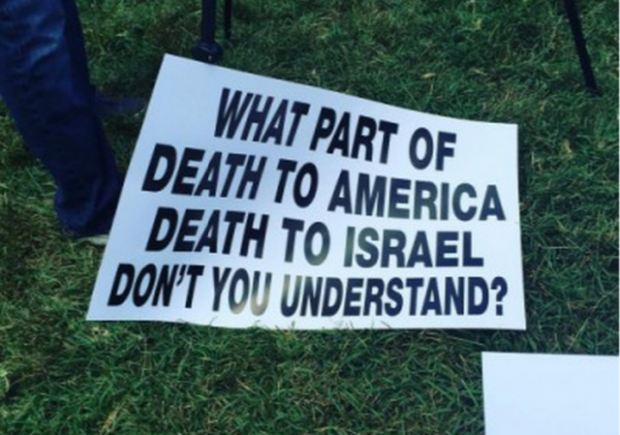
Protest-Sign-Against-Iran-Nuclear-Deal-Death-to-America-e1441978760141-620x435


I think we all know what Iran means when it speaks of political free will. In the wake of the adoption of the Iran nuclear deal, conversations about nightmare “what if” scenarios focused on America’s ability to “snap” sanctions against Iran back into place; now, Iran is trying to reframe the conversation about the use of sanctions by arguing that the use of sanctions at all will constitute a greater violation than what the sanctions are meant to punish.

***************************

This week, Iran used its considerable muscle to launch an attack on US efforts to tamper its nuclear program and otherwise belligerent conduct in the Middle East. These efforts took the form of a proposed resolution in the United Nations Human Rights Council (UNHRC) that condemns the use of sanctions against misbehaving nations as a violation of international law and fundamental human rights.

You won’t see the word “sanctions” more than three times in the resolution; instead, the drafters used the phrase “unilateral coercive measures.” From the proposed resolution:

Recognizing the universal, indivisible, interdependent and interrelated character of all human rights and, in this regard, reaffirming the right to development as a universal and inalienable right and an integral part of all human rights,

Expressing its grave concern at the negative impact of unilateral coercive measures on human rights, development, international relations, trade, investment and cooperation,

Reaffirming that no State may use or encourage the use of any type of measure, including but not limited to economic or political measures, to coerce another State in order to obtain from it the subordination of the exercise of its sovereign rights and to secure from it advantages of any kind,

Recognizing that unilateral coercive measures in the form of economic sanctions have far-reaching implications for the human rights of the general population of targeted States, disproportionately affecting the poor and the most vulnerable classes,

Recalling also article 1, paragraph 2, common to the International Covenant on Civil and Political Rights and the International Covenant on Economic, Social and Cultural Rights, which provides that, inter alia, in no case may a people be deprived of its own means of subsistence,

1. Calls upon all States to stop adopting, maintaining or implementing unilateral coercive measures not in accordance with international law, international humanitarian law, the Charter of the United Nations and the norms and principles governing peaceful relations among States, in particular those of a coercive nature with extraterritorial effects, which create obstacles to trade relations among States, thus impeding the full realization of the rights set forth in the Universal Declaration of Human Rights and other international human rights instruments, in particular the right of individuals and peoples to development;

The writing goes on to demand that member states ignore calls for sanctions, and condemns the use of such “as tools of political or economic pressure against any country, particularly against developing countries, with a view to preventing these countries from exercising their right to decide, of their own free will, their own political, economic and social systems.”

I think we all know what Iran means when it speaks of political free will. In the wake of the adoption of the Iran nuclear deal, conversations about nightmare “what if” scenarios focused on America’s ability to “snap” sanctions against Iran back into place; now, Iran is trying to reframe the conversation about the use of sanctions by arguing that the use of sanctions at all will constitute a greater violation than what the sanctions are meant to punish.

This isn’t a one-off finger-in-the-air from Iran to the US. The UNHRC is a dysfunctional land of multilingual politicking, and now the most dangerous players are using their influence with the greater UN body to bolster the worst violators at the expense of what should be common sense.

More from UN Watch [emphasis mine]:

Earlier this year, the UNHRC’s infamous Consultative Group, with Saudi Arabia’s Faisal Trad then serving merely as Vice-President, successfully picked Algerian hardliner Idriss Jazairy — famous for his efforts as a former diplomat to enact a UNHRC “code of conduct” to intimidate independent human rights experts — as the new “Special Rapporteur on the negative impact of the unilateral coercive measures.”

Jazairy has already accused the U.S. and Europe of being leading human rights violators due to their use of sanctions against countries like Iran and Zimbabwe.

Indeed, many of the resolutions adopted at each session of the UNHRC are sponsored by Cuba, Iran, Pakistan, Algeria, and other non-democracies, and are designed to demonize the West, free market economies, individual rights, or Israel, as part of a strategy to deflect attention from council members who are guilty of subjugating women, trampling religious freedom, persecuting gays, oppressing ethnic minorities and promoting relgious extremism.

This is clever, and part of a bigger strategy meant to counter American and Israeli efforts to speak out against the Iran nuclear deal. Even in the US, the media’s narrative has taken a subtle shift, away from the back and forth in Congress and toward an optic that frames the deal in terms of what it can do to encourage the advent of greater global cooperation. WaPo on Friday published an article needling the Republican Congress’ apparent rejection of “multilateralism”; meanwhile, the NYT editorial board executed a hard pivot away from the political theatre of the moment and toward What We Really Need to be Talking About© in terms of America’s participation in Gulf state politics.

The United Nations itself isn’t necessarily an important player in the American political conversation; international law is obscure, and multilateral relationships are [a] complication and confusing at best. However, if this resolution is adopted (and even if it isn’t) I can just about guarantee that the pro-Iran Deal crowd will use it as a weapon against anti-Deal candidates (primary season doesn’t go away just because we’re dealing with something happening in Geneva) currently warning their colleagues against the folly of attempting to deal with a nation that has proven itself more than adept at sidestepping the rules.

In this case, they’ve taken it upon themselves to rewrite them.

You can read the full proposed resolution here.

Iran wants to renegotiate parts of the nuke “deal.” That may be good.

September 22, 2015

Iran wants to renegotiate parts of the nuke “deal.” That may be good. Dan Miller’s Blog, September 22, 2015

(The views expressed in this article are mine and do not necessarily reflect those of Warsclerotic or those of its other editors. — DM)


Iran wants sanctions relief to be lifted, immediately, and not merely suspended. Iran should not get that. If it doesn’t, it may well terminate the “deal” unilaterally. If Iran gets what it wants, the Senate should review the “deal” as a treaty and reject it. Either outcome would be a substantial improvement over the current “deal” and the morass in which it is embedded.

This post is based on a September 21st article at Middle East Media Research Institute (MEMRI) titled “Expected September 28 NY Meeting Between P5+1 Foreign Ministers And Iran Could Signify Reopening Of Nuclear Negotiations To Address Khamenei’s September 3 Threat That If Sanctions Are Not Lifted, But Merely Suspended, There Will Be No Agreement.”

The MEMRI article cites statements by Supreme Leader Khamenei and one of his senior advisers, Ali Akbar Velayat. The latter said, on September 19th,  “the nuclear negotiations are not over yet.” Khamenei has said much the same thing.

Khamenei said, in a September 3, 2015 speech to the Assembly of Experts, that he did not accept the terms of the agreement and demanded that the sanctions be immediately lifted rather than merely suspended; otherwise, he said, there would either be no agreement, or Iran too would merely suspend its execution of its obligations under the JCPOA.

. . . .

“Freezing or suspension [of the sanctions] is unacceptable to me… If they suspend [the sanctions], we too will suspend [what is incumbent upon us]. If we are to implement what [is required of us], the sanctions must be [actually] cancelled.

Iran has thus made clear that it will not abide by the nuke “deal” as written; unless it gets the changes it now demands, it will either terminate the deal or violate it. If, as seems likely for the reasons cited in the MEMRI article, the September 28th meeting involves discussion of the deal, it will either be renegotiated or it won’t be.

If the “deal” is not renegotiated, or is renegotiated and Iran does not get what it demands, it may very well terminate the deal. Iran has already received substantial sanctions relief, is already open for business and is already doing lots of it with many more nations than previously. Termination would be a rebuff to the “Great Satan,” would not damage Iran much economically and it could proceed with its “peaceful” nuke program without even farcical nuke self-inspections.

If The Obama administration and others cave and Iran gets what it demands or enough to satisfy it, the “deal” will be very different from what was previously presented to the Congress under the Corker legislation. That legislation purported to eliminate the constitutional requirement of approval of the “deal” by a two-thirds Senate majority before going into effect and permitted it to go into effect unless rejected by half of the membership of both houses; Obama promised to veto such a rejection and put the “deal” into effect. The House has disapproved the “deal” but the Senate has not acted because of Democrat fillibusters, urged by the White House. Under the new “deal,” the ability of the United States to “snap back” sanctions would be vitiated; a possible but very difficult if not impossible to accomplish, “snap back” had been among the reasons cited by many of those who favored the “deal” (often despite its many other flaws) for supporting it.

If a deal eliminating the “snap back” is struck, Obama, et al, may well claim that it’s none of the business of the Congress since, by virtue of the Corker legislation, it has already eliminated its constitutional authority to deal with the JCPOA as a treaty, regardless of any “minor” change.

I hope, but am less than confident, that both houses of the Congress will reject this contention vigorously and repeal the Corker legislation. Whatever benefits or other legitimacy the Corker legislation may once have been thought to have it no longer has. Repeal will probably require use of the “nuclear option” to invoke cloture to end a Democrat filibuster in the Senate. If — as seems likely — Obama vetoes the rejection, the Congress should state that it no longer considers itself bound by the Corker legislation. Next, the Senate should treat the renegotiated “deal” as a treaty, regardless of whether Obama agrees to send it to the Senate, and reject it. It should do so even if, as also seems likely, that requires use of the “nuclear option” to invoke cloture.

Obama has precipitated what may well become a constitutional crisis. If the Congress does its job, Obama will be the loser and America will be the winner — even if it becomes necessary to take out Iran’s nukes militarily.

Evidence mounts that soon-to-be flush Iran already spurring new attacks on Israel

August 28, 2015

Evidence mounts that soon-to-be flush Iran already spurring new attacks on Israel, Fox News, August 27, 2015

An unsettling surge in terrorism by Iranian proxies has many Israelis convinced the release to Tehran of tens of billions of dollars in frozen funds is already putting the Jewish state in danger.

In recent days, rockets have rained down on Israel from Gaza in the south and the Golan Heights to the north, Israeli forces foiled a bomb plot at the tomb of biblical patriarch Joseph, and Gaza-based terrorist groups that also have a presence in the West Bank have openly appealed for aid on Iranian television. Israeli officials fear the terrorist activity is spiking as groups audition for funding from Tehran, which is set to receive the long-frozen funds as part of its deal to allow limited nuclear inspections. They say the international focus on Iran’s nuclear ambitions has left its more conventional methods of attacking regional adversaries unaddressed.

“The nuclear context is just one aspect of the negative Iranian activities in the region,” Emmanuel Nahshon, senior Israeli Foreign Ministry spokesman, told FoxNews.com. “We can see the demonstration of this on a daily basis in Syria, in Yemen, and in Iraq. We see it also when we see the [Iranian] support of Hezbollah and other groups who operate against Israel.”

Last month, National Security Adviser Susan Rice admitted that some of the money due to be released as part of the deal negotiated by the U.S. led P5+1 “would go to the Iranian military and could potentially be used for the kinds of bad behavior that we have seen in the region.”

Aside from the soon-to-be-released billions, Iran’s finances will also be strengthened by the easing of trade embargoes that have seen a horde of major international business – many from P5+1 countries – rushing to sign lucrative deals with the ayatollahs. Earlier this week, British Foreign Minister Philip Hammond scoffed at the fears of Israel and many Arab countries in the Middle East, saying the deal would “slowly rebuild their sense that Iran is not a threat to them.” Less than 24 hours later, the spokesman for Iran’s top parliament member said, “Our positions against [Israel] have not changed at all; Israel should be annihilated.”

If that remains Iran’s intention, terror groups Hezbollah, Hamas, and Palestinian Islamic Jihad are showing a renewed eagerness to continue as its proxies. Four rockets apparently fired by the PIJ from Syria into northern Israel last week – two into the Golan Heights and two more into the Upper Galilee – were the first such attacks since the start of Syria’s bloody civil war more than four years ago. Israel responded with targeted missile strikes, including one which hit a car killing “five or six PIJ terrorists.”

On Aug. 18, Iranian state TV broadcast images of a new, 2.5-mile tunnel leading from Gaza into Israel. Dug by the Fatah-linked terror group the Al Aqsa Martyrs Brigade, and seemingly competing with arch-rivals Hamas for a share of the imminently unfrozen Iranian funds, the terrorists made an unabashed appeal for more cash. In a segment translated by Palestinian Media Watch, the terror group’s representatives said, “This is why we are asking [for money]… especially [from] Iran, which is a known long-time supporter of the resistance and the Palestinian cause.”

On Tuesday, Israeli officials revealed that a joint Israeli internal security and military operation thwarted a potentially lethal bomb attack planned by the Islamic Jihad on visitors to Joseph’s Tomb in Shechem in the Palestinian-controlled West Bank, the resting place of the biblical figure revered by Jews, Christians and Muslims alike.

The pace of attacks, as well as the diversity of their perpetrators, has prompted speculation that terrorist groups are competing for Iranian funding, and trying to show they are capable of giving Tehran bang for its buck. The terrorist groups however operate on budgets that are tiny given the scale of Iran’s financing capability.

“The amount that Iran gives Hezbollah is not very much – around $200 million – not even 1 percent of Iran’s budget last year,” Meir Javedanfar, an Iranian-born Israeli expert on the region who writes at www.middleastanalyst.com, told FoxNews.com. “If you want to stop Iranian support of Hezbollah you would need to have inspectors on the ground in Syria and Lebanon, the most dangerous of places, checking Hezbollah’s arsenal, bank accounts, bases, and Syrian bases which Hezbollah uses. I don’t see any UN force, or anyone else volunteering to do that.”

Iran: Nuclear Deal Will Enable Support for Terrorism

August 26, 2015

Iran: Nuclear Deal Will Enable Support for Terrorism, Washington Free Beacon, August 25, 2015

Iranian Foreign Minister Mohammad Javad Zarif speaks at the New York University (NYU) Center on International Cooperation in New York April 29, 2015. REUTERS/Lucas Jackson Iranian Foreign Minister Mohammad Javad Zarif speaks at the New York University (NYU) Center on International Cooperation in New York April 29, 2015. REUTERS/Lucas Jackson

Multiple senior officials in recent days have said that the Iranian nuclear deal will help the Islamic Republic fund its global terrorist operations, including the financial backing of Hamas and other regional groups, according to a briefing by an Israeli intelligence group.

Iranian officials, speaking at multiple forums in recent days, stressed that the nuclear deal will embolden Iran’s support for its “regional allies” and that weapons and military support would continue to be delivered on the “resistance front,” according to a recent brief by the Meir Amit Intelligence and Terrorism Information Center.

The officials outlined Iran’s plan to bolster its global terrorism operation and stated that the recent nuclear deal between Tehran and global powers will do nothing to deter Iran’s pursuit of regional dominance.

Ali-Akbar Velayati, Supreme Leader Ali Khamenei’s adviser for international affairs, stated at a recent conference in Tehran that support for the “resistance front” is a top foreign policy objective.

The nuclear agreement, Velayati said, “would make it possible to increase Iran’s support for its regional allies,” according to recent comments noted in the brief. The official went on to say that “the situation of the resistance front had improved.”

Other senior Iranian officials have echoed these remarks.

Foreign Minister Javad Zarif, who led nuclear negotiations with the United States, recently travelled to Syria and Lebanon to announce Iran’s renewed support for Hezbollah and the embattled regime of President Bashar al-Assad in Syria, according to the brief.

Iran will “continue providing weapons to support the Middle Eastern countries fighting terrorism,” Zarif is quoted as saying by Iran’s state-controlled press.

In light of the nuclear deal, Iran will “preserve its defensive capabilities and send weapons to its regional allies,” according to Zarif, who stressed that “without Iran and the weapons it provided to the countries fighting terrorism, the capital cities of the Middle East would have been occupied by” the Islamic State (IS, also known as ISIS or ISIL).

Iran also intends to boost its support for fighters in Yemen and Palestinian terrorist groups.

More than 70 members of the Iranian parliament, for instance, recently petitioned President Hassan Rouhani to increase “Iranian support for the regional resistance front after the nuclear agreement,” according to the report.

“They called on the president to use the ministries of defense and foreign affairs to send aid to the Palestinians in accordance with instructions from the Supreme Leader to arm the Palestinians in the West Bank,” the report notes.

Another senior Iranian national security official, Javad Karimi Qoddousi, demanded this month that “all the senior Iranian officials … support aid for the Palestinian people and the resistance front so that the nuclear agreement [is not] exploited to strengthen Israel’s security,” according to the brief.

These remarks have been accompanied by aggressive military moves by Iran, which has conducted multiple war drills in recent weeks and announced the upcoming launch of missiles, a move that could violate current United Nations Security Council resolutions barring such activity.

Iran appears to be attempting “to impress its allies with its commitment to continue supporting them even after the nuclear agreement with the West,” the Meir Amit center concluded in its brief. “The speeches of senior officials also reflected Iran’s approach to the rise and strengthening of ISIS and radical Sunni Islam.”

Iran also has committed itself to preventing the United States from gaining a foothold in the Middle East.

Iran will “not allow the United States to again extend its political influence in the region,” Velayati said in another recent interview. “Middle Eastern countries and people, led by Iran, had awakened and were standing firm” against America.

Senior Hamas officials have also disclosed in recent days that a delegation would soon be visiting Tehran.

Since the nuclear deal was secured, “relations between Hamas and Iran [have been] good,” according to these officials.

Senators: Obama Admin Hiding Secret Iran Deal Letters

August 20, 2015

Senators: Obama Admin Hiding Secret Iran Deal Letters, Washington  Free Beacon, August 19, 2015

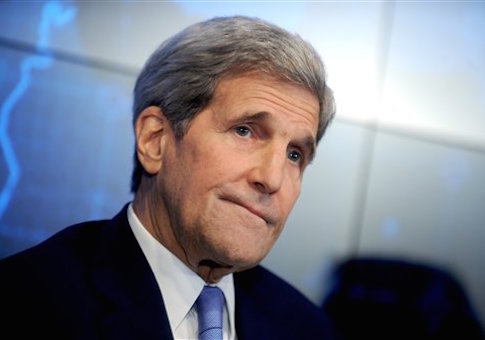
Photo by: Dennis Van Tine/STAR MAX/IPx 8/11/15 John Kerry participates at a discussion on Iran. (NYC)

Photo by: Dennis Van Tine/STAR MAX/IPx
8/11/15  John Kerry participates at a discussion on Iran.(NYC)

Two leading U.S. senators are calling on the Obama administration to release secret letters to foreign governments assuring them that they will not be legally penalized for doing business with the Iranian government, according to a copy of a letter sent Wednesday to the State Department and obtained by the Washington Free Beacon.

Sens. Mark Kirk (R., Ill.) and Marco Rubio (R., Fla.) disclosed in the letter to the State Department that U.S. lawmakers have been shown copies of several letters sent by the Obama administration to the Chinese, German, French, and British governments assuring them that companies doing business with Iran will not come under penalty.

The Obama administration is purportedly promising the foreign governments that if Iran violates the parameters of a recently inked nuclear accord, European companies will not be penalized, according to the secret letters.

Congress became aware of these promises during closed-door briefings with the Obama administration and through documents filed by the administration under a law requiring full disclosure of all information pertaining to the accord.

The issue of sanctions on Iran has become a major issue on Capitol Hill in the weeks since the Obama administration agreed to a deal that permits Iran to enter the international community in exchange for temporarily constraining its nuclear program.

Iran will receive more than $150 billion in sanctions relief as part of the deal and many of its military branches will be removed from international sanctions designations.

“The documents submitted by the Administration to Congress include non-public letters that you sent to the French, British, German, and Chinese governments on the consequences of sanctions snap-back,” Kirk and Rubio wrote to Secretary of State John Kerry.

“These letters appear to reassure these foreign governments that their companies may not be impacted if sanctions are re-imposed in response to Iranian violations of the agreement,” they claim. “While Administration officials have claimed that this is not the case, we think it is important for the American public to be able to read your assurances to foreign governments for themselves as their elected representatives review this deal in the coming weeks.”

Kirk and Rubio are demanding that the Obama administration release these letters to the public so that the full nature of the White House’s backroom dealings are made known.

“We therefore request the Administration to publicly release these letters, which are not classified, so that the full extent of the Administration’s non-public assurances to European and Chinese governments can be discussed openly by Congress and analyzed by impartial outside experts,” they write.

“Given the conflicting interpretations hinted at by the deal’s various stakeholders, it would also ease congressional review of the deal if you were to receive assurances from the other members of the P5+1 about the guidance they will provide to companies about the inherent risks of investing in Iran due to Iran’s ongoing support for terrorism and use of its financial system for illicit activities and the potential for sanctions to snap back if Iran violates the nuclear agreement,” the letter states.

As Iranian companies and government entities are removed from sanctions lists, they will be permitted to do business on the open market. A number of governments, including the Russia and Italy, have already expressed interest in partnering with Iran.

U.S. lawmakers remain concerned that if Iran violates the nuclear accord, sanctions will not be reimposed in a meaningful way.

“The conditions under which foreign investment in Iran would proceed under the nuclear agreement remain unclear,” Kirk and Rubio wrote. “On July 23, 2015, Secretary of the Treasury Jack Lew told the Senate Foreign Relations Committee that companies that have invested in Iran would ‘not be able to continue doing things that are in violation of the sanctions’ if sanctions snap back.”

“Foreign investment in Iran will involve long-term contracts in many cases, however, and some interpretations of the Iran agreement indicate these contracts might be protected from the snap-back of sanctions by a so-called ‘grandfather clause,’” they write.

Under the terms of the agreement, sanctions on Iran’s Revolutionary Guard Corps (IRGC), a paramilitary force known to commit acts of terrorism across the globe, will be lifted.

A multi-billion dollars financial empire belonging to Iranian Supreme Leader Ali Khamenei also will be removed from sanctions lists, according to the parameters of the deal.

Menendez opposes Iran deal: ‘If Iran is to acquire a nuclear bomb, it will not have my name on it’

August 18, 2015

Menendez opposes Iran deal: ‘If Iran is to acquire a nuclear bomb, it will not have my name on it’, Washington Free Beacon via You Tube, August 18, 2015

(Sen. Mendndez also reiterated his pledge to vote to override an Obama veto. — DM)


A new era of impeachments in Iran?

August 14, 2015

A new era of impeachments in Iran? Al-MonitorArash Karami, August 13, 2015

(What would happen to the Iran “deal” if Rouhani’s “moderates” were impeached? — DM)

Iranian President Hassan Rouhani smiles during a meeting with German Economy and Energy Minister Sigmar Gabriel (unseen) in Tehran on July 20, 2015. Gabriel flew to Iran, becoming the first top Western official to visit the country since world powers and Tehran reached a historic nuclear deal. AFP PHOTO / ATTA KENARE (Photo credit should read ATTA KENARE/AFP/Getty Images)Iranian President Hassan Rouhani smiles during a meeting with German Economy and Energy Minister Sigmar Gabriel (not pictured) in Tehran, July 20, 2015. (photo by Getty Images/Atta Kenare)

The Hassan Rouhani administration took office two years ago and has undoubtedly primarily focused its energy and political clout on the nuclear talks with the five permanent members of the UN Security Council. But domestically, Iran’s conservative-dominated parliament has been more active than ever in pushing back the administration and targeting its ministers through summoning them to parliament, issuing yellow warning cards and using threats of impeachment.

The front pages of two Iranian newspapers, Ebtekar and Aftab-e Yazd, wrote Aug. 13 about this active parliament in targeting Rouhani’s ministers.

Ebtekar published an article titled “A new season of political impeachments,” which read, “The Rouhani administration has reached the halfway point and already the record for most questions by members of parliament put to ministers has been broken. [Parliament] has asked approximately 2,000 questions of the Cabinet.”

The article said that while questioning ministers is part of the parliament’s function, “many believe that in the last two years another goal was used for this function.” The article states that with the exception of a handful of ministers, ministers “have felt the shadow of impeachment above their heads.” The article’s reasons for record number of summons and questions range from personal issues to having an eye on the 2016 parliamentary elections.

Arash Bahmani has written for Al-Monitor about the troubles facing Minister of Culture and Islamic Guidance Ali Jannati, who Supreme Leader Ayatollah Ali Khamenei has reportedly reprimanded. As Alireza Ramezani wrote in Al-Monitor, “As the parliamentary elections approach, conservatives will try to find alternative solutions to drive the administration back and compensate for their loss in the battle over the nuclear deal.”

The newest target has been Alireza Teyebnia, Iran’s minister of economics and finance, who received his third yellow card from parliament Aug. 9, setting into motion the process for his impeachment. The minister, who received the highest number of approval votes during his hearing in August 2013, was summoned to parliament by conservative Iranian member of parliament Mehrdad Bazrpash to answer questions about the increase on taxes of guilds and legislation involving opening lines of credit to Iranian banks.

According to Eghtesad online, the two questions that Teyebnia was summoned for had little to do with his office. Taxes on guilds are set by parliament and Teyebnia’s position only gives him discretion to implement legislation passed by parliament, something Teyebnia explained during the parliament session. Also, the issue of a line of credit to banks has more to do with the Central Bank than the Ministry of Economics and Finance.

Aftab-e Yazd, in an article titled “Teyebnia deserves praise, not the injustice of MPs,” interviewed Ebrahim Nekoo, a member of parliament’s economic committee. While Nekoo defended the right of parliament members to summon ministers, he called Teyebnia’s treatment by parliament members as “unfair.” When asked about the possible impeachment of Teyebnia, Nekoo said, “This type of impeachment is not even logical.” He added, “Given the upcoming parliamentary elections, the possibility of finding a new minister with a better performance than Teyebnia is weak.”

Teyebnia added that given the post-sanctions environment and expectations that the lifting of sanctions will improve Iran’s economic situation, the administration’s economic team is in a sensitive position and must manage this transition. He said, “No one is more proficient in the affairs of the Economics Ministry than Teyebnia.”


Europeans Rush to Profit from Iran Deal

August 13, 2015

Europeans Rush to Profit from Iran Deal, The Gatestone InstituteSoeren Kern, August 13, 2015

(Sanctions “snap back?” That’s like “anytime, anywhere inspections.” Both are fiction.– DM)

  • Middle East expert Ilan Berman points out that for Iran, trading with Europe is actually the perfect self-defense, a virtual guarantee that it will not face military attack if it cheats on its obligations under the nuclear deal.
  • Sanctions will also be lifted on Supreme Leader Ali Khamenei’s $95 billion business empire, as well as on Iran’s Islamic Revolutionary Guard Corps, which operates a vast network of companies and industries. No wonder European media outlets are referring to Iran as the “new El Dorado,” the “chance of a century,” and the “last untapped market.”
  • “Conducting business with the Iranian regime means to finance the nuclear program, the annihilation threats against Israel, Holocaust denial, the export of Islamist terror and the oppression of the Iranian population.” — Stop the Bomb, Austria.
  • “Everyone is looking at Iran with greed.” — Senior French official.

European politicians and business leaders, resembling the running of the bulls in Spain, are falling over themselves in a rush to secure the “first-mover” advantage in Iran’s $400 billion economy.

Under the nuclear deal reached in Vienna on July 14, international sanctions will be removed on Iran’s banking, energy and trade sectors if Tehran agrees to certain curbs on its nuclear program.

The lifting of sanctions on Iran, a market of 80 million consumers (the second-largest market in the Middle East after Turkey in terms of GDP) creates the potential for staggering business opportunities.

Iranian officials say that investments of $185 billion are required in the oil and gas sector alone during the next five years. The mining sector requires $29 billion between now and 2025. Iran hopes to triple the number of cars manufactured in the country to three million a year by 2025.

Sanctions will also be lifted on Supreme Leader Ali Khamenei’s $95 billion business empire, as well as on Iran’s Islamic Revolutionary Guard Corps, which operates a vast network of companies and industries.

No wonder that European media outlets are referring to Iran as the “new El Dorado,” the “chance of a century,” and the “last untapped market.”

Although the United States Congress will not vote on the accord until September, Europeans appear to be operating on the premise that Iran is now open for business.

Within days of the agreement’s signing, the European Union approved the deal, and senior officials from Germany, France, Italy and the European Union rushed to Tehran to pursue business deals; leaders from Austria, Spain and Sweden are planning to lead trade missions to Iran in September and October.

On August 12, Switzerland — a neutral country that is not a member of the European Union — announced it would unilaterally lift sanctions on Iran effective immediately, presumably providing Tehran with access to technology and the Swiss banking system.

Analysts say the flurry of European activity implies that international sanctions on Iran are crumbling, and if Tehran violates its commitments under the nuclear deal, efforts to re-impose them are unlikely to succeed.

Saeed Ghasseminejad, an Iran analyst with the Washington-based Foundation for the Defense of Democracies, said:

“President Obama’s promise about the snapback sanction has no truth in it. When international companies go to Iran and commit themselves and their shareholders to long-term multi-billion dollar investments, there will be no snapback sanction mechanism.

“It took the U.S. almost a decade to convince Europeans to leave Iran’s market, as the European companies were deeply invested in the country. Those who promise an immediate return of sanctions in future are either naïve or they are not telling the truth.”

In an interview with the New York Times, Philip Gordon, the Obama Administration’s former coordinator for the Middle East who is now with the Council on Foreign Relations, admitted that American negotiators had deliberately left vague the procedures over sanctions snap-back, which means that if Iran fails to comply with the agreement, not all sanctions will necessarily be reapplied.

According to the Times, “The accord stipulates, for instance, that renewed sanctions ‘would not apply with retroactive effect’ to contracts signed before a potential violation is flagged. European companies and governments could argue that contracts signed now would be excluded from any future sanctions.”

Addressing a meeting at Iran’s Strategic Council on Foreign Relations on August 3, Iranian Foreign Minister Javad Zarif bragged that the international sanctions regime against the country has collapsed and will never again be re-imposed. He said:

“The structure of the sanctions that the US had built based on the UN Security Council’s resolutions was destroyed and like the 1990s when no other country complied with the US sanctions against Iran, no one will accept the return of the sanctions in the future.”

In an essay for Politico Europe, Middle East expert Ilan Berman pointed out that for Tehran, trading with Europe is actually the perfect self-defense, a virtual guarantee that it will not face military attack if it cheats on its obligations under the nuclear deal.

“The end result is a situation in which Europe’s growing political and economic stake in the Islamic Republic virtually guarantees that Iran won’t return to its old status as an international pariah, whether or not it ends up abiding by the terms of the JCPOA,” Berman wrote. “The lesson, it seems, is that trading with Europe means never having to say you’re sorry.”

Following is a brief country-by-country round-up of key European trade delegations seeking to open business opportunities with Iran.

Germany. German Vice Chancellor Sigmar Gabriel was the first senior European official to visit Iran after the signing of the Vienna agreement. On July 19, Gabriel, who also serves as Economy Minister, led a delegation of high-ranking German business leaders to Iran to build bilateral trade relations. He said there was “great interest on the part of German industry in normalizing and strengthening economic relations with Iran.”

The German Federation of Industries (Bundesverband der Deutschen Industrie, BDI) believesexports to Iran could rise to more than 10 billion euros ($10.9 billion) within three to four years, up from 2.4 billion euros in 2014.

Gabriel insisted that Iran must improve relations with Israel if it wants closer economic ties with Germany. “For Germany this much is clear: Anyone who wants sustainable relations with us cannot question Israel’s right to exist,” Gabriel said.

But Iranian officials flatly rejected Gabriel’s plea. “We have totally different views from Germany on certain regional issues in the Middle East, and we have explicitly expressed our viewpoints in different negotiations,” a foreign ministry spokesperson said.

France. Foreign Minister Laurent Fabius was the second senior European official to visit Iran after the nuclear deal was signed. Arriving in Tehran on July 29, Fabius proclaimed: “We are two great independent countries, two great civilizations. It is true that in recent years, for reasons that everyone knows, links have loosened, but now thanks to the nuclear deal, things are going to change.”

Imports from Iran to France fell to just 62 million euros in 2013 from 1.77 billion in 2011. French exports to Iran in 2013 fell to 494 million euros from 1.66 billion euros in 2011, according to French foreign ministry estimates.

Fabius, who denied accusations that France’s primary motivation in signing the Iran deal was to create business opportunities for French companies, also conveyed an invitation from French President François Hollande to Iranian President Hassan Rouhani to visit France in November.

Fabius’ visit was marred by Iranian hardliners, who blame him for the spread of AIDS in the country. Some 300 Iranians were infected with tainted blood supplies that were exported to Iran in the mid-1980s, when Fabius was the Socialist prime minister, and when France’s national blood transfusion center knowingly distributed HIV-contaminated blood products. Fabius was charged with manslaughter in 1999 but was later acquitted. Iranian protesters greeted Fabius with flyers depicting him with blood on his hands and the pledge: “We will not forgive or forget.”

Representatives from France’s largest employer federation, MEDEF, are due to visit Iran on September 27-29 to explore investment opportunities and re-establish commercial ties.

In February 2014, more than 100 French business leaders — with representatives from companies including Airbus, Alstom, Citroën, GDF Suez, Lafarge, Peugeot, Renault and Total — visited Iran “in an exploratory capacity.” It was the largest of trade delegation of its kind from Europe since Iran signed an interim agreement in November 2013 promising to limit its nuclear program.

At the time, French Finance Minister Pierre Moscovici said the visit was intended to “convey the message that, if the situation improves, there will be significant commercial opportunities for France in Iran.”

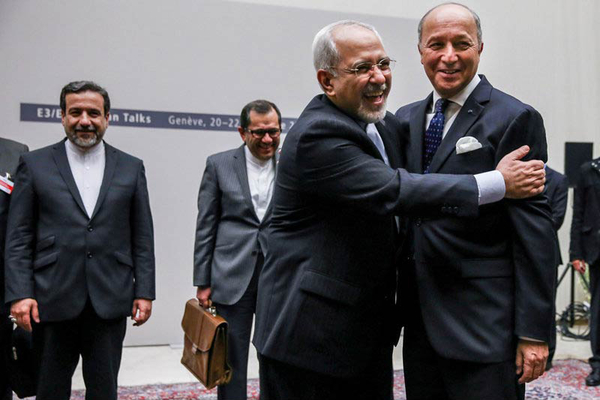
984Foreign Minister Laurent Fabius says: “Trade is very important. It fosters growth. It’s important for the Iranians, it’s important for us,” adding that regarding the current nuclear deal with Iran, “we did not take it for commercial reasons, but for strategic reasons…” Above, Iranian Foreign Minister Javad Zarif hugs Fabius at the close of nuclear talks in Geneva, Nov. 23, 2014. (Image source: ISNA)

Italy. Italian Foreign Minister Paolo Gentiloni and Economic Development Minister Federica Guidi led a high-level trade mission to Iran on August 4-6, aimed at opening export opportunities for Italian companies. According to forecasts by SACE, the Italian export credit company, Italian exports to Iran are expected to grow to €3.8 billion ($4.1 billion) in 2018, up from €1.2 billion currently.

Companies in the oil and gas industry and the machine tool industry, the two sectors most adversely affected by sanctions, are hoping to recapture market share lost due to the trade embargo. Companies active in the machine tools sector (which accounts for nearly 60% of current Italian exports to Iran) have seen their exports drop to €700 million from €1.3 billion during the past five years, according to SACE.

Gentiloni and Guidi met with Iranian Oil Minister Bijan Namdar Zanganeh on August 6. After the meeting, Zanganeh said that Iran had invited the Italian oil and gas giant Eni, as well as other Italian companies, to participate in projects in the Iranian oil industry.

On August 4, SACE, together with the Italian Ministry of Economic Development and Mediobanca, the leading investment bank in Italy, announced the finalization of a Memorandum of Understanding with the Iranian Ministry of Economy and Finance and the Central Bank of Iran, aimed at facilitating the development of future economic and trade relations between the two countries.

Under the agreement, “the parties will collaborate to evaluate short and medium-long term projects of mutual interest implying Italian export and investments and to identify local financial institutions that could benefit from credit lines provided by Mediobanca, and guaranteed by SACE and the Ministry of Economy and Finance of Iran, to support the financing and payment of such transactions.”

Also on August 4, Finmeccanica, Italy’s main industrial group, announced that it had signed a €500 million ($543 million) contract with Iran’s Ghadir Investment Company to build a power plant in the country. Ghadir is 80% owned by the Islamic Revolutionary Guards’ Corps (IGRC). The IRGC, through its elite Quds Force, is responsible for the deaths of at least 1,000 American troops in Iraq.

Austria. Austrian President Heinz Fischer is set to become the first European head of state to visit Iran since 2004 when he travels to Tehran on September 7-9. Fischer will be accompanied by Vice Chancellor and Economy Minister Reinhold Mitterlehner, Foreign Minister Sebastian Kurz, as well as a delegation of high-ranking Austrian business leaders. Mitterlehner said he hopes that Austrian exports to Iran will reach one billion euros per year by 2020, up from 232 million euros today.

On July 23-24, the Austrian Economic Chamber (Wirtschaftskammer Österreich, WKÖ)organized a major EU-Iran trade conference that was attended by nearly 400 Austrian and Iranian business leaders, including Iranian Industry Minister Mohammad Reza Nematzadeh.

According to Nematzadeh: “We are no longer interested in unidirectional importation of goods and machinery from Europe. We are looking for two-way trade, as well as cooperation in development, design, engineering and joint investment for production and export.”

Not all Austrians are happy about the government’s rush to embrace Iran. The Austrian branch of the activist group “Stop the Bomb” organized a protest outside the WKÖ’s headquarters on July 23. In a statement, the group said:

“While the implementation of the nuclear deal with the Iranian has not even started and the sanctions on Iran are still in place, Iran trade lobbyists are set to host the ‘EU-Iran-Conference’ at the Austrian Economic Chamber WKO in Vienna. Among the participants are WKO-President Christoph Leitl and the Iranian Industry & Trade Minister Mohammad Reza Nematzadeh. 70 years after the Shoah, Austrian and German companies are in the first row to boost business ties with the anti-Semitic Iranian regime.

“This conference shows that billions of Euros are going to flow to the Iranian mullahs as a result of the Vienna agreement. This will enable the regime to sponsor its terror proxies like Hamas and Hezbollah and to enforce its aggressive expansion in the region in unprecedented ways. The terror against the Iranian population will not decrease, but increase. Already now more people have been executed under supposedly ‘moderate’ President Rouhani than under his predecessor Ahmadinejad.

“Conducting business with the Iranian regime means to finance the nuclear program, the annihilation threats against Israel, Holocaust denial, the export of Islamist terror and the oppression of the Iranian population.”

Spain. Foreign Minister José Manuel García-Margallo, Industry, Energy and Tourism Minister José Manuel Soria and Development Minister Ana Pastor will lead a high-level trade delegation to Iran in early September. The objective is to open doors for Spanish companies in the energy, telecommunications and infrastructure sectors.

After the sanctions are lifted, Spain hopes to double its exports to Iran to 600 million euros, up from 300 million euros today, according to the Chamber of Commerce. The key sectors of interest for Spanish companies are petroleum, petro-chemical, mining, automobile, infrastructure and rail transport.

Despite the embargo, more than 350 mostly small- and medium-sized Spanish companies are currently active in Iran. On July 19, the newspaper El Mundo reported that more than a dozen Spanish companies sold so-called dual-use materials that could have been used to help Iran build weapons of mass destruction.

Since 2011, Spanish authorities have carried out nearly a dozen police operations aimed at disrupting illegal weapons sales to Iran. One such operation blew the lid off a scheme to sell nine helicopters to Iran. Another operation discovered that a company ostensibly dedicated to importing Persian rugs was trying to sell missile casings to the Iranian military.

A report published by Gatestone Institute in April 2014 found that in addition to Spain, companies or individuals in more than a dozen European countries — including Belgium, Britain, Finland, France, Germany, Hungary, Ireland, Italy, the Netherlands, Norway, Slovenia, Sweden and Switzerland — have been involved in illegal dual-use exports to Iran.

A senior French official interviewed by the Reuters news agency summed it up this way: “Everyone is looking at Iran with greed.”
No Trust, No Verification, No Sanctions: Obama’s Humiliating Capitulation to the Mullahs

August 8, 2015

No Trust, No Verification, No Sanctions: Obama’s Humiliating Capitulation to the Mullahs, National Review, Andrew C. McCarthy, August 8, 2015

(I have been beating this drum for quite a while. So have others. The Obama administration’s position still makes no sense whatever, unless unfortunate motives are attributed to the Commander in Chief. — DM)

The sanctions regime President Obama and Secretary of State Kerry vowed to step up has already collapsed. The mullahs are already scooping up billions in unfrozen assets and new commerce, and they haven’t even gotten the big payday yet. Obama’s promises of “anytime, anywhere” inspections have melted away as Tehran denies access and the president accepts their comical offer to provide their own nuclear-site samples for examination. Senator John Barasso (R., Wyo.), a medical doctor, drew the apt analogy: It’s like letting a suspect NFL player what he says is his own urine sample and then pronouncing him PED-free.#

And now even the Potemkin verification system has become an embarrassing sham, with Iran first refusing to allow physical investigations, then declining perusal of documentation describing past nuclear work, and now rejecting interviews of relevant witnesses.

Recall that administration officials indignantly assured skeptics that there would be no agreement in the absence of Iran’s Iran’s coming clean on the “past military dimensions” of its nuclear work. As Kerry put it, “They have to do it. It will be done. If there’s going to be a deal; it will be done.”

The reason it had to be done is obvious. According to Obama, his Iran deal is built on verification, not trust — at least when the president is not trusting Ayatollah Khamenei’s phantom anti-nuke fatwa. Plainly, it would be impossible to verify whether Iran was advancing toward the weaponization of nuclear energy — whether it had shortened the “breakout time” the elongation of which, Obama claims, is the principal objective of his deal — unless one knew how far the mullahs had advanced in the first place

But now, in open mockery of an American president they know is so desperate to close this deal he will never call their bluff, the mullahs have told the International Atomic Energy Agency to pound sand — although not sand in Iran, where the IAEA is not permitted to snoop around. Tehran is steadfastly refusing to open its books, and the IAEA sheepishly admits that it cannot answer basic questions about Iran’s programs and progress.

So what does Team Obama do? Do they, as they promised, walk away from an unverifiable and thus utterly indefensible deal that lends aid and comfort to our enemies? Of course not. Now they’re out there telling Americans, “We don’t need this IAEA program to discover whether or not Iran was pursuing a nuclear weapon — they were,” as Senator Chris Murphy, a Connecticut Obamabot, told the Wall Street Journal.

Well good for you, Sherlock; Obama, Kerry, and Hillary Clinton may still be hanging on that fatwa, but you hit the bull’s-eye.

Here’s the thing, though, Senator Murphy: Yes, all of us know the Iranians, as you cheerily put it, “were” pursuing a nuclear weapon — especially all of us who oppose Obama’s Iran deal and who recognize that the jihadist regime has waged war against us since 1979, killing thousands of Americans. But you “let’s make a deal” guys told us your objective was to uncover how far along they “were” and to roll back their progress. (Actually, you used to tell us your objective was to prevent them from getting nuclear weapons, period — as in “if you like your health-care plan, you can keep your health-care plan, period.”)

If you don’t have a baseline from which to begin verification, you can’t verify the time of day, much less the progress of nuclear research, development, procurement, and experimentation. Iran is saying we don’t get the baseline without which the Obama administration guaranteed there would be no agreement.

So in the grand deal our president describes as subjecting the mullahs to historically rigorous inspection, disclosure, and verification requirements, there is no inspection, no disclosure, and no verification.

And did I mention no sanctions?

On July 29, Kerry assured lawmakers that Iranian Quds Force commander “Qassem Soleimani will never be relieved of any sanctions.” Soleimani orchestrates the regime’s terrorist operations and, according to the Pentagon, is responsible for killing at least 500 American soldiers in Iraq.

Yet, only five days before Kerry gave that testimony, Soleimani traveled to Russia for meetings with Putin’s government — notwithstanding the vaunted sanctions that, Kerry would have us believe, confine him to Iran.

Russia, of course, is a member of the U.N. Security Council, from which Obama sought and obtained endorsement of his Iran deal before seeking congressional review. Not only has Russia rendered the current sanctions a joke; it has made Obama’s implausible promise of future “snapback” sanctions against Iran even more laughable. Russia, by the way, has also agreed to build yet another nuclear reactor for the mullahs in Busheir — which Obama’s deal obligates the United States to protect against sabotage. And Putin has also just agreed to supply the terrorist regime in Tehran with $800 million worth of S-300 anti-aircraft missiles that can be used against the U.S. Air Force and have enough range to strike planes in northern Israel.

What a deal, Mr. President!

Actually, we really don’t know quite what a deal it is because key provisions remain secret. After its bold verification promises, the Obama administration was too embarrassed to reveal exactly how pathetic the agreement’s inspections provisions are. So, as I outlined in a recent column, Obama and Kerry tucked them into a secret side deal between Iran and the IAEA. It then twaddled that the details — i.e., the heart of the deal from the American perspective — are, conveniently, between Iran and the IAEA. None of our business, you see.

This message was reiterated on Capitol Hill this week by the IAEA. Understand: The IAEA could not function (to the limited extend it does function) without the United States Congress’s underwriting of 25 percent of its budget — the American taxpayer contribution dwarfs that of every other country, including Iran’s, which is tiny. Yet, the IAEA chief told lawmakers that he could not reveal the agreement between his agency and Tehran because that is “confidential” information, disclosure of which would compromise the IAEA’s “independence.” The only things the IAEA would confirm are that (a) there are verification provisions and (b) Iran is not cooperating with them.

Feel better?

Well, to further improve your mood, let’s talk the Corker bill. Remember, that’s the legislation by which the GOP-controlled Congress reversed the constitutional presumption against international agreements and virtually assured that Obama’s Iran deal — no matter how appalling it may be, no matter how much aid and comfort if provides to the enemy — will become law.

Why on earth would Beltway Republicans agree to anything so catastrophic for the national security that the Constitution’s Treaty Clause is designed to protect? Because, they proclaimed, by making this devil’s bargain, they would ensure that Congress and the American people got full disclosure of the Iran deal that Obama would otherwise shroud in secrecy.

But as I asked at the time, what possessed them to think Obama would not shroud the agreement in secrecy just because there would now be a law forbidding that?

Supporters are telling themselves that the Corker bill’s benefits [include that] the president will have to produce the agreement. . . . But this is a mirage. . . . The president is notoriously lawless, and thus Republicans can have no confidence that the agreement he produces to Congress will, in fact, be the final deal he signs off on with Iran and, significantly, submits to the U.N. Security Council for an endorsing resolution.

And so it has come to pass: Republicans forfeited their constitutional power for an unenforceable promise of transparency from an infamously duplicitous backroom dealer. Now they have no power and no idea what they’ve enabled.

The president had it backwards Wednesday when, in his repulsively demagogic speech on the Iran deal, he said that Republicans are aligned with the Iranian chanting ‘Death to America.’” It is Obama who is aiding and abetting the hardliners. Republicans have merely aided and abetted Obama.

Iran’s Supreme Leader Khameni publishes book on how to eliminate Israel

August 2, 2015

Iran’s Supreme Leader Khameni publishes book on how to eliminate Israel, American ThinkerThomas Lifson, August 2, 2015

Ayatollah Ali Khameni has published his version of Mein Kampf, a 416 page book outlining his strategy to eliminate Israel, which he describes as  “a cancerous tumor.” Although it is currently available only in Iran, an Arabic translation is underway, and sooner or later it will achieve wide readership in the Muslim world. The Obama administration is no doubt hoping it will achieve no notice in the United States until after the Iran deal is voted upon, because the plan advocated will be immensely aided by its implementation.

Amir Taheri of the New York Post obtained a copy from Iran:

Khamenei makes his position clear from the start: Israel has no right to exist as a state.

He uses three words. One is “nabudi” which means “annihilation.” The other is “imha” which means “fading out,” and, finally, there is “zaval” meaning “effacement.”

Khameni does not call for wiping out Israel with a nuclear bomb. He states that one of his fondest desires is to pray in Jerusalem. Instead, his plan is one of terrorism and pressure, keeping Israel from fighting back against Iran, the sponsor of terror, with the implicit threat of nuclear retaliation.

 What he recommends is a long period of low-intensity warfare designed to make life unpleasant if not impossible for a majority of Israeli Jews so that they leave the country.

His calculation is based on the assumption that large numbers of Israelis have double-nationality and would prefer emigration to the United States and Europe to daily threats of death.

Iran has many allies in this effort, including the BDS movement in the United States. Cripple Israel economically, and her economically productive people will leave. Make the political cost of supporting Israel high. That will pave the way for an internationally-sponsored plebiscite engineered to produce a Muslim state:

Under Khamenei’s scheme, Israel, plus the West Bank and Gaza, would revert to a United Nations mandate for a brief period during which a referendum is held to create the new state of Palestine.

All Palestinians and their descendants, wherever they are, would be able to vote, while Jews “who have come from other places” would be excluded.

Double standards are inherent in Islamic thinking. Any land that once fell under Muslim control belongs to Muslims by right. So Israelis who only boast a few generations in Israel are excluded, while Arabs whose families once lived in Israel generations ago are automatically qualified.

Khamenei does not mention any figures for possible voters in his dream referendum. But studies by the Islamic Foreign Ministry in Tehran suggest that at least eight million Palestinians across the globe would be able to vote against 2.2 million Jews “acceptable” as future second-class citizens of new Palestine. Thus, the “Supreme Guide” is certain of the results of his proposed referendum.

With a $150 billion war chest, thanks to the Obama deal, and the prospect of oil exploration and other business expansion in Iran, there will be plenty of money available to subsidize Hezb’allah, Hamas, and other terror attacks against Israelis and Jews (such as the attack on the Jewish Community Center in Buenos Aires).

Khamenei boasts about the success of his plans to make life impossible for Israelis through terror attacks from Lebanon and Gaza. His latest scheme is to recruit “fighters” in the West Bank to set up Hezbollah-style units.

“We have intervened in anti-Israel matters, and it brought victory in the 33-day war by Hezbollah against Israel in 2006 and in the 22-day war between Hamas and Israel in the Gaza Strip,” he boasts.

Far from a spittle-flecked madman, Khameni is coldly calculating, and explains a plan that is already underway with considerable success. And he has many allies in this country, some of them in high places.