Posted tagged ‘Iran’

Iran Sues U.S. to Take $2 B Away From American Terror Victims

June 17, 2016

Iran Sues U.S. to Take $2 Billion Payout Away From American Terror Victims

BY:
June 16, 2016 12:06 pm

Source: Iran Sues U.S. to Take $2 B Away From American Terror Victims

Iran has filed suit against the United States in the International Court of Justice, seeking some $2 billion in assets recently frozen by U.S. courts and awarded to American victims of terror attacks sponsored by the Islamic Republic, according to Iranian leaders.

Iranian President Hassan Rouhani announced late Wednesday that Iran has sued the United States over the Supreme Court’s recent decision to award some $2 billion in Iranian assets to victims of the 1983 Beirut bombings, which was organized by the Islamic Republic.

Rouhani vowed to pursue the case until Iran retrieves the money set aside for these terror victims, according to comments published in the country’s state-controlled press.

“We shouldn’t remain silent vis a vis this event and we officially filed a lawsuit at the International Court of Justice yesterday [Tuesday] and will pursue the case until attaining results,” Rouhani was quoted as saying on Wednesday.

“The U.S. courts have issued illegal rulings and said that the properties should be provided to the Americans and the families of those people killed in Lebanon and it is not clear what the Americans did in Lebanon (at the time) and how the issue is related to Iran,” Rouhani was quoted as saying.

Iranian Foreign Minister Javad Zarif, who has emerged as a close ally of Secretary of State John Kerry, also took aim at the Supreme Court ruling, saying in a recent press conference that Iran does not recognize U.S. court decisions.

“The U.S. has long been taking decisions against Iran which contradict the international laws and the Americans have filed different lawsuits against Iran during the past years; [but] we don’t recognize the U.S. courts’ rulings,” Zarif was quoted as saying in May.

IDF Intelligence Chief: If our Enemies Knew What We Can Do They’d Give Up

June 15, 2016

IDF Intelligence Chief: If our Enemies Knew What We Can Do They’d Give Up

By: JNi.Media

Published: June 15th, 2016

Source: The Jewish Press » » IDF Intelligence Chief: If our Enemies Knew What We Can Do They’d Give Up

Major General Herzl Halevi, head of Military Intelligence
Photo Credit: FIDF YouTube screenshot / https://www.youtube.com/watch?v=VkvP3ljrPoc

At a session headlined “Israel in a Turbulent Middle East: Strategic Review & Intelligence Assessment” held Wednesday at the 2016 Herzliya Conference, Maj. Gen. Herzl (Herzi) Halevi, Chief of the IDF Military Intelligence Directorate warned Israel’s opponents against initiating a conflict, saying, “I am sure that had Nasrallah or any of our enemies known our military capabilities they wouldn’t risk additional conflict.”

Halevi discussed Israel’s challenges and opportunities in today’s middle east, saying “there are a lot of people who live in the Middle East with no electricity. Looking at the GDP per capita or unemployment rates it is noticeable that very big gaps have formed between us and our neighbors. It should not make us happy – A poor Middle East is a hotbed for terrorist organizations.”

“The Game board in the Middle East has changed,” he added. “Instead of few states, there are now many players. The transition from nation states to organizations is very significant. There are no good and bad guys, and players on the field change their identities.”

Halevi continued to discuss the new ways in which conflicts and wars are formed in the Middle East, in what he calls Dynamics of Escalation’. “We live in an era in which it is most likely for wars to begin even though neither side is interested in it,” he explained.

Regarding Iran, Halevi said: “The nuclear agreement was a great achievement for Iran, allowing them to be accepted among the world’s nations and we believe they will honor [the nuclear deal] for the first few years. At the same time, Iran is investing great efforts against Israel. Iran is supporting the three main threats Israel faces: Hamas, Hezbollah, and Islamic Jihad – in fact, they support 60% of [the threat]. It is [a case of] a Shiite nation giving money to Sunni organizations – they would do that to hurt Israel.”

Regarding Lebanon & Hezbollah, Halevi said, “We have no offensive intentions in Lebanon. We do not want a war but we’re ready for one more than ever. No army has had more intelligence on their enemies as we do about Hezbollah today.”

“The next conflict will not be easy. Hezbollah is suffering heavy casualties in Syria but also experiences significant achievements, and in this process they learn a lot and gain access to new means of combat.”, said Halevi. “Iran is sending weaponry to Hezbollah – some of it gets so Syria, but some of it stays in Lebanon. Syrian industries have resumed the production of weaponry for Hezbollah, and neither the world or Israel should accept it – it could escalate the next conflict.”

The Iran Threat to America

June 12, 2016

The Watchman – Episode 4: The Iran Threat to America

The Watchman

Congress to Compel Disclosure of $1.7B ‘Ransom Payment’ to Iran

June 1, 2016

Congress to Compel Obama Disclosure of $1.7 Billion ‘Ransom Payment’ to Iran Bill requires White House to reveal details about Iranian capture of U.S. sailors

BY:
June 1, 2016 4:58 am

Source: Congress to Compel Disclosure of $1.7B ‘Ransom Payment’ to Iran

Credit: Iranian state media

New legislation could force the Obama administration to disclose if it paid Iran $1.7 billion in taxpayer funds as part of a “ransom payment” earlier this year to secure the release of 10 U.S. sailors who were abducted at gunpoint by the Iranian military, according to a copy of the legislation and conversations with lawmakers.

The bill, jointly filed by Rep. Mike Pompeo (R., Kan.) and Sen. John Cornyn (R., Texas), comes on the heels of a Washington Free Beacon report disclosing that the Obama administration has been suppressing potentially “shocking” details related to the January abduction of the sailors, who were held at gunpoint by Iranian soldiers and forced to apologize on camera.

The legislation, dubbed the No Impunity for Iranian Aggression at Sea Act, would compel the Obama administration to issue a report to Congress detailing whether it paid Iran a $1.7 billion settlement as part of the hostage release. It also would level sanctions against Iran for possible breach of Geneva Convention rules governing legal military detainment.

Lawmakers and others have suspected for months that taxpayer money was partly used to secure the release of the sailors and other imprisoned Americans, though the administration has been adamant the issues are not linked.

The new legislation would require the White House to certify whether any federal funds, including January’s $1.7 billion payment, were doled out to Iran as part of a “ransom” to secure the release of these sailors and citizens imprisoned in Iran.

The legislation noted that the administration released the money to Iran just a day after it freed several U.S. citizens from prison.

The bill would further require the White House to determine if Iran’s treatment of the sailors—which included filming them crying—constitutes a violation of the Geneva Conventions or international laws governing innocent passage in international seas, according to the bill.

If it is determined that Iran violated either of these accords, the legislation would force the White House to list and sanction every Iranian complicit in the detainment.

Pompeo, a member of the House’s intelligence committee, told the Free Beacon on Tuesday that the White House continues to stonewall efforts to determine precisely what happened to the sailors.

“After the Iranians captured ten U.S. Navy sailors, President Obama mentioned these brave men and women only in passing in his last State of the Union address,” Pompeo told the Free Beacon. “Since then, instead of investigating whether the Iranians violated the Geneva Convention and the right of innocent passage, the Obama administration has only offered apologies and then fired an American Naval officer. There has been no criticism of the Iranians, no public explanation of why these Americans were forced on their knees, hands on their heads, or why they were forced to confess—nothing from President Obama that would send a signal that this is an unacceptable way to treat American sailors.”

Pompeo said that he and Cornyn are seeking to ensure there are “consequences on the Iranians responsible.”

“The Obama administration cannot just focus on its inherently flawed nuclear deal and hope inflammatory incidents like this blow over,” he said.” The implications for the safety of Americans and the U.S. military are too great.”

Rep. Randy Forbes (R., Va.) disclosed to the Free Beacon earlier this month that classified details surrounding the incident are being withheld by the administration. It could be more than a year before this information becomes public, Forbes said.

“I think that when the details actually come out, most Americans are going to be kind of taken aback by the entire incident, both how Iran handled it and how we handled it,” Forbes said. “I think that’s going to be huge cause for concern for most Americans. That’s why I’ve encouraged members of Congress to get that briefing so they do know exactly what did take place.”

Is Obama’s Iran Deal a ‘Dhimmi’ Contract?

June 1, 2016

Is Obama’s Iran Deal a ‘Dhimmi’ Contract?, PJ Media, A.J. Caschetta, May 31, 2016

iran-nuclear-deal.sized-770x415xc

IRGC Commander Ali Fadavi’s recent threat to “drown American vessels” in the Persian Gulf is only the latest indication that America’s relationship with Iran resembles a dhimma contract more than a traditional foreign policy.

Since the seventh century, anyone defeated by Islamic conquest was given three choices: conversion, death, or a dhimma contract, which Bat Ye’or calls the “treaty of submission for people conquered by jihad.” By accepting the third choice, they became dhimmis: members of a “protected” class whose failure to submit to Allah was replaced by a compulsory submission to Muslims.

Isolated, disarmed, insulted at every turn, and coerced into acknowledging their inferiority with regular self-abasement, dhimmis are expected to show humility and gratitude to their conquerors.

President Obama’s approach to the Muslim world in general has been replete with gratitude, flattery, and apologies – even, and especially, for violence perpetrated by Christians one thousand years ago. Obama refuses to utter the words “Islamist terrorism.” He wildly exaggerates Islam’s role in “saving” Western culture. At the United Nations, Obama demanded that “the future must not belong to those who slander the prophet of Islam.” He even put one filmmaker in jail for doing so.

Above all, throughout his presidency Obama has reached out to Iran both publicly and via private letters.

Obama’s overtures may not be consciously designed to follow a dhimmi’s accommodation of his master. However, Ali Khamenei certainly treats Obama as if a dhimmi contract is in effect, offering only contempt in return for the president’s obsequious deference.

Khamenei leads cheers of “Death to America”? Obama makes excuses for it.

Obama insists that Iran’s path forward lies at the UN with the P5+1 partners. Khamenei answers:

[T]hose who say the future is in negotiations, not in missiles, are … ignorant.

Within Iran and elsewhere, each Iranian provocation that goes unanswered by Obama reinforces the appearance of his dhimmi status: Obama pays his tribute and endures his proscribed submission with gestures of obeisance.

Under Obama’s administration, Iran has attempted an assassination in Washington, D.C., shipped arms to Palestinian terrorists in Gaza and Houthi rebels in Yemen, and attempted to hack a dam in New York and the electrical grid in California.

Obama’s administration has responded with self-effacing conciliation.

Even video of captured American sailors being humiliated by the IRGC didn’t rouse the president from his supine repose. John Kerry actually thanked “the Iranian authorities for their cooperation.”

Iran’s violations of sanction have grown more flagrant with each passing year — with zero consequences. As the supposed weaker side, Iran should be expected to deny it had conducted missile tests, or to claim its ICBM program is just a space program. Instead, Iran has boasted of the tests. An emboldened, confident Iran has acted as though it possesses the upper hand.

Among the humiliations dhimmis are forced to endure at the hands of Muslims is a tax called the jizya. This originates in the Koran:

Fight those who believe not in Allah … until they pay the Jizya with willing submission, and feel themselves subdued (9:29).

As they present their payment, dhimmis are often required to prostrate themselves and accept slaps to the head and neck, symbolic of the fate they avoided with the treaty. In 1799, British historian William Eton referred to the jizya as a “capitation tax” — permitting dhimmis to “wear their heads” for another year.

The $100 to $150 billion Iran receives under the U.S.-brokered Joint Comprehensive Plan of Action (JCPOA) is, surely, the largest jizya payment in history.

Last July as the White House celebrated the JCPOA, Khamenei tweeted an image of Obama holding a gun to his own head.

Six months later, the IRGC fired missiles dangerously close to the USS Harry S. Truman.

Despite Iran’s defiant and aggressive behavior, the president continues to grant concessions. Obama has pushed for Iran to gain access to the U.S. monetary system. Obama has even purchased Iranian nuclear waste.

Meanwhile, Iran threatened to close the Strait of Hormuz and to kill Americans found there.

Shortly after the American Revolution, the Barbary Pirates of Morocco, Tunis, Algiers, and Tripoli began seizing U.S. merchant vessels and demanding ransom. These Islamic pirates — from whence the English term “barbarians” arose — explained that the Koran simply gave them the “right and duty to make war” on non-Muslims.

George Washington did not pay tribute to the sheikhs. Instead, George Washington ordered the creation of the U.S. Navy.

They were send to fight what Washington termed the “nests of banditti.” In 1815, James Madison used that Navy to defeat the Barbary sheikhs at sea, and on “the shores of Tripoli.”

Two hundred years later, the Obama administration is accommodating the “banditti” in Tehran — and lying to the American people about it.

President Obama has assumed the role of a meek and humbled dhimmi paying tribute to his Muslim protector while enduring his insults. Washington and Madison would be disgusted.

Iran supplying weapons, cash and training to Taliban

May 27, 2016

Iran supplying weapons, cash and training to Taliban, Jihad Watch

Sunnis and Shi’ites hate each other, but not as much as they hate the Infidel. Hence Iran’s support for the Taliban, as well as Hamas and Islamic Jihad: Sunnis who are waging jihad against Infidels are allies of Iran, as far as the mullahs are concerned. Such support also strengthens Iran’s ongoing maneuvering to be the leader of the Islamic world.

Taliban89
“Death of Mullah Mansoor highlights Taliban’s links with Iran,” by Jon Boone and Saeed Kamali Dehghan, Guardian, May 23, 2016:The killing of the Taliban chief on the main highway leading from the Iranian border shines new light on the movement’s complicated relationship with Tehran.Although it is Pakistan that has traditionally been condemned for secretly supporting Afghan insurgents, analysts say Iran also provides weapons, cash and sanctuary to the Taliban. Despite the deep ideological antipathy between a hardline Sunni group and cleric-run Shia state the two sides have proved themselves quite willing to cooperate where necessary against mutual enemies and in the pursuit of shared interests.

Mullah Mansoor first entered Iran almost two months ago, according to immigration stamps in a Pakistani passport found in a bag near the wreckage of the taxi he was travelling in when he was killed by a US drone strike.

The passport, in the name of Wali Muhammad, also showed he had only just returned to Pakistan from the border crossing of Taftan, some 280 miles (450km) away from the site where he was killed, an area called Ahmed Wal, where he had stopped for lunch.

On Monday, the Iranian foreign ministry denied that “such a person had entered Pakistan from the Iranian border”.

“Iran welcomes any efforts made in bringing stability and peace to Afghanistan,” said spokesman Hossein Jaberi-Ansari.

It is not known where Mansoor went inside Iran, whether his trip was secretly facilitated by the Iranian Revolutionary Guard or whether he stayed among the large populations of Afghans living in eastern Iran, especially in the cities of Mashhad and Zahedan.

The Taliban also have ties to Sunni extremist groups operating in the Iranian province of Sistan and Balochistan.

A Pakistani official from Dalbandin, a district bordering Iran, said he did not think Iran would back foreign insurgents with links to such groups.

“All Afghan militants hold Pakistani nationality, it is not written on their forehead whether he is a militant or not,” said the official, who did not wish to be identified.

Nonetheless police and intelligence officials in western Afghanistan often complain the local insurgency is being managed and supplied with weapons and training from Iran….

8 Iranian missile launches since nuke deal signed, expert tells US Congress

May 26, 2016

8 Iranian missile launches since nuke deal signed, expert tells US Congress Islamic Republic increases ballistic missile tests, strives to improve accuracy, despite American opposition

By Judah Ari Gross

May 26, 2016, 4:29 pm

Source: 8 Iranian missile launches since nuke deal signed, expert tells US Congress | The Times of Israel

But the US state department has more concerns about Liberman than Iranian rockets

An Iranian Shahab-3 missile launched during military exercises outside the city of Qom, Iran, in June 2011. (AP/ISNA/Ruhollah Vahdati)

In the 10 months since the Iran nuclear agreement was signed, the Islamic Republic has increased the frequency of its ballistic missile testing, according to researcher Michael Elleman, who testified before a US senatorial committee this week.

Iran is primarily focused on increasing the accuracy, not the range, of its missiles, Elleman said.

 Elleman, a senior fellow at the International Institute for Strategic Studies (IISS) think tank, was called to speak Tuesday before the US Senate Committee on Banking, Housing, and Urban Affairs, which is investigating the effects of the Joint Comprehensive Plan of Action (JCPOA), the official name for the Iran nuclear deal signed in July 2015.

Since then, Iran’s ballistic missile program has become a central issue in the debate surrounding the nuclear deal, with opponents of the agreement saying test launches violate the terms of the JCPOA, while proponents argue missile tests are “inconsistent” with United Nations resolutions but not necessarily illegal.

According to the UN decision, “Iran is called upon not to undertake any activity related to ballistic missiles designed to be capable of delivering nuclear weapons, including launches using such ballistic missile technology,” until October 2023.

As they’re only “called upon not to” test missiles, but not expressly forbidden from doing so, Iran has used that loophole to increase its testing with impunity.

“[The US has] engaged in a lot of hue and cry over Iran’s missile capabilities, but they should know that this ballyhoo does not have any influence and they cannot do a damn thing,” Iranian supreme leader Ali Khamenei said this week.

A Khalij Fars ballistic missile on a transporter during a military parade in Iran. (Iranian military/CC BY-SA 3.0/WikiMedia)

A Khalij Fars ballistic missile on a transporter during a military parade in Iran. (Iranian military/CC BY-SA 3.0/WikiMedia)

According to Elleman, in the almost year following the signing of the agreement and the removal of sanctions, Iran has performed at least eight missile tests — three in 2015 and five thus far in 2016.

In 2005, 2013 and 2014, however, when negotiations for the deal were in full swing, Iran did not perform a single test of a “nuclear-capable missile,” the IISS fellow testified.

After talks fell through in 2005 and before they resumed in 2013, the Islamic Republic “averaged roughly five test launches per year,” according to Elleman.

A missile launched from the Alborz mountains in Iran on March 9, 2016, reportedly inscribed in Hebrew, 'Israel must be wiped out.' (Fars News)

A missile launched from the Alborz mountains in Iran on March 9, 2016, reportedly inscribed in Hebrew, ‘Israel must be wiped out.’ (Fars News)

Though the increase from an average of five to eight missile tests a year seems dramatic — it’s a 60 percent increase, after all — Elleman offered perspective by comparing that to the US and Soviet missile testing programs during the Cold War, which averaged “about one test a week,” or nearly 10 times as many tests per year.

Tactically speaking, ballistic missiles have little value other than as a means of delivering a nuclear warhead, Elleman pointed out.

In May, an Iranian official claimed the country had tested a missile capable of reaching Israel, which had almost unheard-of accuracy for Iran.

“We test-fired a missile with a range of 2,000 kilometers and a margin of error of eight meters,” Brigadier General Ali Abdollahi was quoted as saying at a Tehran science conference.

However, this was swiftly denied by the Iranian defense minister on the same day.

“We’re still trying to get to the bottom of what exactly transpired,” White House spokesman Josh Earnest said at a press briefing.

“We are aware of Iranian claims of an additional ballistic missile launch. We’re also aware of statements from the defense minister indicating that such a launch did not take place,” he said.

Accuracy over range

Whether or not the test took place, the emphasis on the rocket’s margin of error points to a renewed focus on the accuracy of Iran’s existing arsenal of missiles, rather than on the development of farther-reaching projectiles.

“Iran seeks to improve the accuracy of its missiles, a priority that supersedes the need to develop longer-range missiles,” Elleman told the Senate committee on Tuesday. “Iran has repeated said that it does not need missiles with a range of greater than 2,000 kilometers, or 1,200 miles.”

At that range, Iran could easily reach any target within Israel, which is just under 1,000 miles away.

A military exhibition displays the Shahab-3 missile under a picture of the Iranian supreme leader Ayatollah Ali Khamenei, in Tehran, in 2008 (photo credit: AP/Hasan Sarbakhshian)

A military exhibition displays the Shahab-3 missile under a picture of the Iranian Supreme Leader Ayatollah Ali Khamenei, in Tehran, in 2008. (AP/Hasan Sarbakhshian)

At this point in time, however, Iran’s missile technology is far from accurate enough to reliably hit a predetermined target, and changing that will not be easy or quick, Elleman said.

“Substantial improvements in missile accuracy will take years, if not a decade, to materialize,” he said.

As with so many things, he most important aspects of a military attack are location, location, location. A missile — even a nuclear-tipped missile — landing in the Arava desert would have an incomparably lesser effect than a missile landing on, say, Dizengoff Center in Tel Aviv.

“Iran’s ballistic missiles have poor accuracy. The successful destruction of a single fixed military target, for example, would probably require Iran to use a significant percentage of its missile inventory,” Elleman told the Senate committee.

Illustrative photo of a Fateh-110 ballistic missile, taken at an Iranian armed forces parade in 2012. (military.ir/Wikimedia Commons)

Illustrative photo of a Fateh-110 ballistic missile, taken at an Iranian armed forces parade in 2012. (military.ir/Wikimedia Commons)

That inventory consists of over 300 missiles considered “nuclear-capable,” according to the international Missile Technology Control Regime monitoring association, which defines it as any missile capable of delivering a 1,100 pound (500 kg) warhead a distance of 186 miles (300 km), Elleman said.

Slow progress on ICBM technology

In terms of increasing the range of its ballistic missiles, the senior researcher said Iran has not made great strides in that effort.

“I have seen no evidence to suggest that Iran is actively developing an intermediate- or intercontinental-range ballistic missile (IRBM or ICBM, respectively),” Elleman said, but he added, “I cannot speak to a covert program.”

The most recent test that could be related to ICBMs appears to have been the launch of the Simorgh rocket, which is believed to have been conducted last month. US and Iranian officials have not publicly acknowledged the test, though Russian revealed that the launch popped up on one of their radar stations.

Iranians take photos of the Simorgh satellite rocket during celebrations to mark the 37th anniversary of the Islamic Revolution, in Teheran, February 11, 2016. (AFP/Atta Kenare)

Iranians take photos of the Simorgh satellite rocket during celebrations to mark the 37th anniversary of the Islamic Revolution, in Teheran, February 11, 2016. (AFP/Atta Kenare)

The Simorgh rocket is designed to launch satellites into space. However, Elleman told the Senate committee, “Without question, rockets designed to boost a satellite into orbit and long-range ballistic missiles employ many of the same technologies, key components, and operational features.”

But it’s not likely that the Simorgh itself would be used as a weapon because of the considerable effort that would be required to convert it into a reliable ICBM. Rather, the information gleaned from the space rocket would be applied to create a new type of missile, Elleman said.

“Iran’s ambitious space program provides engineers with critical experience developing powerful booster rockets and other skills that could be used in developing longer-range missiles, including ICBMs,” he said.

The production of those long-range missiles, which would be capable of striking the United States, is still years away, assuming Iran continues on its current course.

According to Admiral William Gortney of the North American Aerospace Defense Command, Iran is anticipated to have an operational intercontinental ballistic missile by the year 2020.

Michael Elleman, a senior fellow at the International Institute for Strategic Studies think-tank. (Screen capture: C-Span)

Michael Elleman, a senior fellow at the International Institute for Strategic Studies think tank. (Screen capture: C-Span)

Meanwhile, Elleman, who has interviewed Russian and Ukrainian scientists who worked in the Iranian missile program, estimated the Islamic Republic would not be able to produce an operational ICBM until “2022, at the earliest.”

In his testimony, the senior IISS researcher also discussed an interesting piece of modern history, namely that Israel is partially responsbile for the Iranian missile defense program, which was created before the 1979 revolution when the two countries were still allies.

“Ironically, the shah teamed with Israel to develop a short-range system after Washington denied his request for Lance missiles,” Elleman said.

“Known as Project Flower, Iran supplied the funds and Israel provided the technology. The monarchy also pursued nuclear technologies, suggesting an interest in a delivery system for nuclear weapons,” he said.

Canada Home to Islamic Radicals

May 25, 2016

Canada Home to Islamic RadicalsThe Toronto Sun via Middle East Forum, Tarek Fatah, May 24, 2016

2683

In November 2014, while testifying before the Senate Committee on National Security and Defence, I raised the issue of Islamic clerics using mosque sermons to attack the foundational principles of Western civilization and liberal secular democracy.

Liberal Senator Grant Mitchell was outraged by my testimony that at most Canadian mosques, the Friday congregation includes a ritual prayer asking, “Allah to give victory to Muslims over the ‘Kufaar’ (non-Muslims).” In a heated exchange with me, the senator suggested I wasn’t telling the truth, implying I was motivated by Islamophobia. Sadly, Sen. Mitchell is not alone in such views.

But neither is there any let-up in the attacks on Canadian values emanating from many mosque pulpits and Islamic conferences hosted by radical Islamist groups.

For example, in a sermon on Friday, May 6, delivered at a mosque in Edmonton, an imam invoked the memory of Prophet Muhammad to whip up hatred against Israel. He declared peace accords with Israel are “useless garbage” and vowed that Jerusalem will be conquered “through blood.”

In February, the same cleric predicted Islam would soon conquer Rome, “the heart of the Christian state.”

The Edmonton mosque diatribe was not isolated.

On May 13, just north of Toronto, an Islamic society hosted a celebration of Iranian mass murderer, Ayatollah Khomeini. The poster promoting the event described Khomeini as a, “Liberator and Reformer of the Masses.”

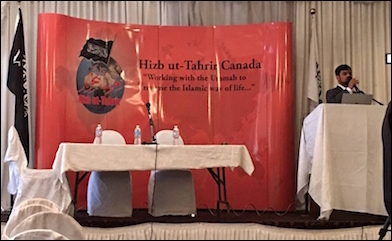
On Saturday, the Islamist group Hizb-ut-Tahrir, banned in some countries, hosted a conference to discuss the re-establishment of a global Islamic caliphate.

Pakistan-Canadian writer Tahir Gora went to cover the event, but was barred from entering the hall. “They said this was a closed door, in-camera meeting for our supporters,” Gora told me after he was asked to leave.

2684A speaker addresses the Hizb-ut-Tahrir conference in Mississauga, Ontario, on May 21.

Fortunately, one Palestinian-Canadian woman was able to enter the event.

She shared with me some of the proceedings from inside the gathering. “I walked into the banquet hall with approximately 100 attendees who were gender segregated. I sat next to a woman who said she had been in Canada for 40 years.” When I asked her if she felt any disconnect between enjoying 40 years of democracy, yet supporting the Hizb-ut-Tahrir who wanted to end it, she explained that democracy has done nothing good to people, so she and other believers follow Allah’s rule.

“The first speaker reminded Muslims that they are obligated to implement Allah’s orders that fulfil the Islamic State. It is “not permissible for us to choose’ he said, citing the Quran. However, he said it was necessary to win the public’s hearts and minds; and to partner with people of power, citing examples from the life of the Prophet.”

“At the end, a three-minute video was presented to demonstrate the collective oil and natural gas production capabilities of the Muslim world, the human capital needed to mine and process these resources … the military power required to protect them and the types of weapons needed to make such a military effective.”

While this was unfolding we received news that the Trudeau government, as part of its infrastructure development program, had authorised a $200,000 grant to a southern Ontario mosque with links to the Muslim Brotherhood.

Which begs the question: Who’s minding the store?

Soros-Backed J Street Received Over $500,000 To Push Iran Nuclear Deal To Pro-Israel Community

May 24, 2016

Soros-Backed J Street Received Over $500,000 To Push Iran Nuclear Deal To Pro-Israel Community
by Aaron Klein

23 May 2016

Source: Soros-Backed J Street Received Over $500,000 To Push Iran Nuclear Deal To Pro-Israel Community – Breitbart

BRENDAN SMIALOWSKI/AFP/Getty Images

TEL AVIV – The pro-Palestinian lobby group J Street stated that it was “proud” of its role in pushing the controversial Iran nuclear agreement amid reports that it received $576,500 to promote the deal from a group tied to White House efforts to sell the agreement to the public.

“J Street worked to advance the nuclear agreement with Iran out of the belief that this is an important agreement which contributes mightily to Israel’s security,” J Street said, without denying that it received the funds.

“This is a belief that is shared with many officials in both the Obama administration as well as the Israeli defense establishment and among many in the American Jewish community, most of which supports the agreement,” the organization said.

“The nuclear agreement with Iran blocked Iran’s pathways to a nuclear weapon for years to come,” J Street added. “As of now, Iran has abided by the terms of the deal.”

J Street’s financing to advocate for the deal came from the Ploughshares Fund, a group that advocates a nuclear-free world and was identified earlier this month by the White House as central in helping to market the Iran nuclear deal to the news media.

On Friday, the Associated Press reported that Ploughshares has also funded National Public Radio since 2005, and has provided financing to U.S.-based foreign policy think tanks.

Unmentioned by the AP is that the Ploughshares Fund is financed by billionaire George Soros’ Open Society Institute. Soros is also a top donor to J Street.

The Jerusalem Post summarized the extent of the Ploughshares funding to J Street, reportedly to lobby for the deal within the pro-Israel community.

J Street was the single largest beneficiary last year of the Ploughshares Fund, a group that seeks to eliminate the world’s nuclear stockpiles, with over $575,000 in grants that funded advocacy for the Iran nuclear deal.

Ploughshares’ annual report, first reported last week by the Associated Press, emphasizes the foundation’s role in helping to bring about support for sanctions relief for the nuclear rollback deal last year. …

The amount of funding for J Street underscores the significance deal proponents attached to garnering American Jewish support for the deal. J Street and J Street Education Fund received a total of $576,500, making it by far the largest recipient of funds. One goal of the funding was “to mobilize Jewish support for a final deal.”

The involvement of Ploughshares in selling the Iran agreement to the public was revealed in an extensive New York Times Magazine profile of Obama’s Deputy National Security Adviser Ben Rhodes titled, “The Aspiring Novelist Who Became Obama’s Foreign-Policy Guru.” The article contains interviews with Rhodes and scores of top Obama administration officials.

Robert Malley, senior director at the National Security Council, explained the genesis and execution of the marketing plan to sell the Iran deal.

Malley said “experts” were utilized to create an “echo chamber” that disseminated administration claims about Iran to “hundreds of often-clueless reporters” in the news media.

In the spring of last year, legions of arms-control experts began popping up at think tanks and on social media, and then became key sources for hundreds of often-clueless reporters. “We created an echo chamber,” he admitted, when I asked him to explain the onslaught of freshly minted experts cheerleading for the deal. “They were saying things that validated what we had given them to say.”

Rhodes told Times reporter David Samuels that the marketing strategy took advantage of the “absence of rational discourse” and utilized outside groups, including Ploughshares.

When I suggested that all this dark metafictional play seemed a bit removed from rational debate over America’s future role in the world, Rhodes nodded. “In the absence of rational discourse, we are going to discourse the [expletive] out of this,” he said. “We had test drives to know who was going to be able to carry our message effectively, and how to use outside groups like Ploughshares, the Iran Project, and whomever else. So we knew the tactics that worked.” He is proud of the way he sold the Iran deal. “We drove them crazy,” he said of the deal’s opponents.

Now the AP has revealed the extent of Ploughshares funding to NPR and to influential foreign policy U.S. think tanks.

Besides $100,000 to NPR last year, the AP reports:

Ploughshares has funded NPR’s coverage of national security since 2005, the radio network said. Ploughshares reports show at least $700,000 in funding over that time. All grant descriptions since 2010 specifically mention Iran.

“It’s a valued partnership, without any conditions from Ploughshares on our specific reporting, beyond the broad issues of national and nuclear security, nuclear policy, and nonproliferation,” NPR said in an emailed statement. “As with all support received, we have a rigorous editorial firewall process in place to ensure our coverage is independent and is not influenced by funders or special interests.”

Ploughshare’s president was interviewed on NPR, the AP reports:

Another who appeared on NPR is Joseph Cirincione, Ploughshares’ president. He spoke about the negotiations on air at least twice last year. The station identified Ploughshares as an NPR funder one of those times; the other time, it didn’t.

Cirincione was an adviser on nuclear issues to Obama’s 2008 presidential campaign.

Ploughshares documents show funding last year to other groups to “advance its nonproliferation agenda,” according to the AP.

The Arms Control Association got $282,500; the Brookings Institution, $225,000; and the Atlantic Council, $182,500. They received money for Iran-related analysis, briefings, and media outreach, and non-Iran nuclear work.

Other groups, less directly defined by their independent nuclear expertise, also secured grants.

J Street, the liberal Jewish political action group, received $576,500 to advocate for the deal. More than $281,000 went to the National Iranian American Council.

Princeton University got $70,000 to support former Iranian ambassador and nuclear spokesman Seyed Hossein Mousavian’s “analysis, publications, and policymaker engagement on the range of elements involved with the negotiated settlement of Iran’s nuclear program.”

Ploughshares says it has awarded hundreds of grants “whose aggregate value exceeded $60 million.”

A previous investigation by this reporter showed Ploughshares has partnered with a who’s who of the radical left, including Code Pink, the pro-Palestinian J Street, United for Peace & Justice, the U.S. Campaign to End the Israeli Occupation, and Demo, a progressive economic advisory group where President Obama’s controversial former green jobs czar, Van Jones, has served on the board.

The group says its mission is to support the “smartest minds and most effective organizations to reduce nuclear stockpiles, prevent new nuclear states, and increase global security.”

Ploughshares is in turn financed by Soros’ Open Society Institute, the Buffett Foundation, the Carnegie Corporation of New York, the Ford Foundation, the Rockefeller Brothers Fund, and the Rockefeller Foundation.

Another Ploughshares donor is the Tides Foundation, which is one of the largest funders of the radical left. Tides is funded by Soros.

Ploughshares has donated to the Institute for Policy Studies, which calls for massive slashes in the U.S. defense budget.

It has also financed the International Crisis Group, a small organization that boasts Soros on its board.

Aaron Klein is Breitbart’s Jerusalem bureau chief and senior investigative reporter. He is a New York Times bestselling author and hosts the popular weekend talk radio program, “Aaron Klein Investigative Radio.” Follow him on Twitter @AaronKleinShow. Follow him on Facebook.

Iranian commander: We can destroy Israel ‘in under 8 minutes’

May 23, 2016

Iranian commander: We can destroy Israel ‘in under 8 minutes’ If supreme leader gives order, Revolutionary Guards ‘will raze the Zionist regime’ quickly, says senior adviser of elite al-Quds unit

By Times of Israel staff May 22, 2016, 4:14 pm

Source: Iranian commander: We can destroy Israel ‘in under 8 minutes’ | The Times of Israel

A missile launched from the Alborz mountains in Iran on March 9, 2016, reportedly inscribed in Hebrew, ‘Israel must be wiped out.’ (Fars News)

A senior Iranian military commander boasted that the Islamic Republic could “raze the Zionist regime in less than eight minutes.”

Ahmad Karimpour, a senior adviser to the Iranian Revolutionary Guards’ elite unit al-Quds Force, said if Supreme Leader Ali Khamenei gave the order to destroy Israel, the Iranian military had the capacity to do so quickly.

 “If the Supreme Leader’s orders [are] to be executed, with the abilities and the equipment at our disposal, we will raze the Zionist regime in less than eight minutes,” Karimpour said Thursday, according to the semi-official Fars News Agency.

A senior Iranian general on May 9 announced that the country’s armed forces successfully tested a precision-guided, medium-range ballistic missile two weeks earlier that could reach Israel, the state-run Tasnim agency reported.

Iranian Supreme Leader Ali Khamenei meets the Iranian Revolutionary Guards Corps (IRGC) Navy unit that detained US sailors earlier in January, in a photo released by Iran on January 24, 2016.

Iranian Supreme Leader Ali Khamenei meets the Iranian Revolutionary Guards Corps (IRGC) Navy unit that detained US sailors earlier in January, in a photo released by Iran on January 24, 2016.

“We test-fired a missile with a range of 2,000 kilometers and a margin of error of eight meters,” Brigadier General Ali Abdollahi was quoted as saying at a Tehran science conference. The eight-meter margin means the “missile enjoys zero error,” he told conference participants.

Iran in March tested ballistic missiles, including two with the words “Israel must be wiped off the earth” emblazoned on them, according to the US and other Western powers.

Under a nuclear deal signed last year between world powers and Iran, ballistic missile tests are not forbidden outright but are “not consistent” with a United Nations Security Council resolution from July 2015, US officials say.

According to the UN decision, “Iran is called upon not to undertake any activity related to ballistic missiles designed to be capable of delivering nuclear weapons, including launches using such ballistic missile technology,” until October 2023.

Khamenei has repeatedly threatened to annihilate the Jewish state, and in September 2015 suggested Israel would not be around in 25 years. In a quote posted to Twitter by Khamenei’s official account on September 9, 2015, Khamenei addressed Israel, saying, “You will not see next 25 years,” and added that the Jewish state will be hounded until it is destroyed.

“After negotiations, in Zionist regime they said they had no more concern about Iran for next 25 years; I’d say: Firstly, you will not see next 25 years; God willing, there will be nothing as Zionist regime by next 25 years. Secondly, until then, struggling, heroic and jihadi morale will leave no moment of serenity for Zionists,” the quote from Iran’s top leader reads in broken English.

In November 2014, Khamenei stated that the “barbaric” Jewish state “has no cure but to be annihilated.” A plan titled “9 key questions about the elimination of Israel” was posted on his Twitter account, using the hashtag #handsoffalaqsa, in reference to the tensions on the Temple Mount. The sometimes grammatically awkward list explained the how and why of Khomeini’s vision for replacing Israel with a Palestinian state.

The first point stated that “the fake Zionist regime has tried to realize its goals by means of infanticide, homicide, violence & iron fist while boasts about it blatantly.” Due to the above, Khomeini argued, “the only means of bringing Israeli crimes to an end is the elimination of this regime.”