Posted tagged ‘Iran Scam’

Commander: Most IRGC Missiles Can Reach Israel

March 8, 2016

Commander: Most IRGC Missiles Can Reach Israel, TASNIM News Agency, March 8, 2016

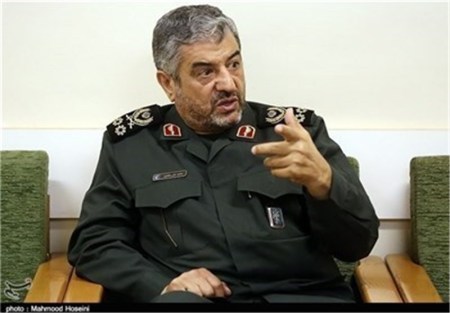
IRG leader

TEHRAN (Tasnim) – The occupying Zionist regime of Israel is within the range of most of the missiles in IRGC’s possession, Commander of the Islamic Revolution Guards Corps Major General Mohammad Ali Jafari said Tuesday.

Whoever feels more hostility towards Iran will be naturally more fearful of the country’s military capabilities and achievements, the top general told reporters on Tuesday on the sidelines of an ongoing missile drill staged by the IRGC, codenamed ‘Might of Velayat’.

Since most of the IRGC missiles have the enough range to reach the lands occupied by the Zionist regime of Israel, the Tel Aviv regime has the most degree of concerns, he added.

“Enemies of the Islamic Revolution and security in the region should be in panic about the roar of the IRGC missiles,” Jafari stated.

The commander noted that the launch of various types of missiles in the drill was only a slight indication that the IRGC’s missile silos, scattered all over the country, are fully operational.

He underscored that the country’s missile capabilities have been achieved under sanctions imposed by the foreigners, stressing that Iran’s missiles are fully indigenous.

The message of the missile drills is security for Iran and the neighboring countries, Major General Jafari underlined.

The missile drill has been in progress for a couple of days, but its final stage kicked off on Tuesday in different parts of the country.

According to the IRGC, the exercise is meant to demonstrate Iran’s might and sustainable security in light of unity, convergence, empathy and harmony.

Iranian officials have already made it clear that the country’s military program, including the routine exercises and test of new missiles, will not be hampered by anything, including a recent nuclear deal with the Group 5+1 (Russia, China, the US, Britain, France and Germany), which took effect on January 16.

Iran Threatens to Walk Away From Nuke Deal After New Missile Test

March 8, 2016

Iran Threatens to Walk Away From Nuke Deal After New Missile Test, Washington Free Beacon, March 8, 2016

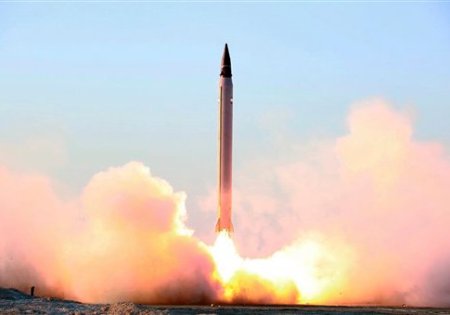
FILE - This file picture released by the official website of the Iranian Defense Ministry on Sunday, Oct. 11, 2015, claims to show the launching of an Emad long-range ballistic surface-to-surface missile in an undisclosed location. Iran tested a ballistic missile again in November 2015, a U.S. official said Dec. 8, describing the second such test since this summerís nuclear agreement. The State Department said only that it was conducting a "serious review" of such reports. The test occurred on Nov. 21, according to the official, coming on top of an Oct. 10 test Iran confirmed at the time. The official said other undeclared tests occurred earlier than that, but declined to elaborate. The official wasnít authorized to speak on the matter and demanded anonymity. (Iranian Defense Ministry via AP)

FILE – This file picture released by the official website of the Iranian Defense Ministry on Sunday, Oct. 11, 2015, claims to show the launching of an Emad long-range ballistic surface-to-surface missile in an undisclosed location. Iran tested a ballistic missile again in November 2015, a U.S. official said Dec. 8, describing the second such test since this summerís nuclear agreement. The State Department said only that it was conducting a “serious review” of such reports. The test occurred on Nov. 21, according to the official, coming on top of an Oct. 10 test Iran confirmed at the time. The official said other undeclared tests occurred earlier than that, but declined to elaborate. The official wasnít authorized to speak on the matter and demanded anonymity. (Iranian Defense Ministry via AP)

Iranian leaders now say that they are poised to walk away from the deal if the United States and other global powers fail to advance the Islamic Republic’s “national interests.”

*************************

Iran on Tuesday again threatened to walk away from the nuclear agreement reached last year with global powers, hours after the country breached international agreements by test-firing ballistic missiles.

Iran’s most recent ballistic missile test, which violates current U.N. Security Council resolutions, comes a day after the international community’s nuclear watchdog organization disclosed that it is prohibited by the nuclear agreement from publicly reporting on potential violations by Iran.

Iranian leaders now say that they are poised to walk away from the deal if the United States and other global powers fail to advance the Islamic Republic’s “national interests.”

“If our interests are not met under the nuclear deal, there will be no reason for us to continue,” Abbas Araqchi, Iran’s deputy foreign minister, warned during remarks delivered to a group of Iranian officials in Tehran.

“If other parties decide, they could easily violate the deal,” Araqchi was quoted as saying by Iran’s state-controlled media. “However, they know this will come with costs.”

Araqchi appeared to allude to the United States possibly leveling new economic sanctions as a result of the missile test. The Obama administration moved forward with new sanctions earlier this year as a result of the country’s previous missile tests.

Iran’s latest missile test drew outrage from longtime regime critics on Capitol Hill.

“The administration’s response to Iran’s new salvo of threatening missile tests in violation of international law cannot once again be, it’s ‘not supposed to be doing that,’” Sen. Mark Kirk (R., Ill.) said in a statement. “Now is the time for new crippling sanctions against Iran’s Islamic Revolutionary Guard Corps, Ministry of Defense, Aerospace Industries Organization, and other related entities driving the Iranian ballistic missile program.”

House Majority Leader Kevin McCarthy (R., Calif.) warned that the nuclear agreement has done little to moderate Iran’s rogue behavior.

“Far from pushing Iran to a more moderate engagement with its neighbors, this nuclear deal is enabling Iran’s aggression and terrorist activities,” McCarthy said in a statement. “Sanctions relief is fueling Iran’s proxies from Yemen to Iraq to Syria to Lebanon. Meanwhile, Khamenei and the Iranian regime are acting with impunity because they know President Obama will not hold them accountable and risk the public destruction of his nuclear deal, the cornerstone of the president’s foreign policy legacy.”

McCarthy went on to demand that the Obama administration step forward with new sanctions as punishment for the missile test.

Meanwhile, the U.S. State Department had difficulty Monday explaining why the nuclear agreement limits public reporting by the International Atomic Energy Agency, or IAEA, on potential deal violations by Iran.

Yukiya Amano, the IAEA’s chief, disclosed on Monday that his agency is no longer permitted to release details about Iran’s nuclear program and compliance with the deal. The limited public reporting is a byproduct of the nuclear agreement, according to Amano.

When asked about these comments again Tuesday, a State Department official told the Free Beacon that the IAEA’s reports would continue to provide a complete picture of Iran’s nuclear program, though it remains unclear if this information will be made publicly available.

“There isn’t less stringent monitoring or reporting on Iran’s nuclear program,” the official said. “The IAEA’s access to Iran’s nuclear program and its authorization to report on it has actually expanded. It’s a distortion to say that if there is less detail in the first and only post-Implementation Day IAEA report then that somehow implies less stringent monitoring or less insight into Iran’s nuclear program.”

While the IAEA “needs to report on different issues” under the final version of the nuclear agreement, the agency continues to provide “a tremendous amount of information about Iran’s current, much smaller nuclear program,” the source maintained.

The IAEA’s most recent February report—which was viewed by nuclear experts as incomplete and short on detail—“accurately portrays the status of Iran’s nuclear program,” including its efforts to uphold the nuclear deal, the official added.

“We expect this professional level of reporting to continue in the future,” the official said.

Off Topic | Deserve Hillary? Then vote for her

March 3, 2016

Deserve Hillary? Then vote for her, Dan Miller’s Blog, March 3, 2016

(The views expressed in this post are mine and do not necessarily reflect those of Warsclerotic or its other editors. — DM)

Democrats have done a bang up job for their people for the last fifty years. Want more of the same? Vote for Hillary.


How about Mit Romney? Surely, he must be right. After all, the proud godfather of ObamaCare did so well in 2012. His part of the video starts at 23:00.


So, all of you RINOs who prefer Hillary to Trump, have at it. Heck, with the RINOs and the Dems in charge, the country will stay in the very best of hands.


No new dawn in Iran

March 1, 2016

No new dawn in Iran, Israel Hayom, Ruthie Blum, March 1, 2016

For the past three years, the West has been tricking itself into seeing the Islamic Republic of Iran as a country undergoing a gradual process of reform. The outcome of Friday’s two elections — one for the Majlis (parliament) and the other for the Assembly of Experts — is serving as the latest mirage in the delusion.

In 2013, when Hassan Rouhani replaced Mahmoud Ahmadinejad as president of Iran, the United States and Europe took it as a sign of a new dawn. Even Supreme Leader Ali Khamenei, the chief mullah controlling Iran’s “elected” leader, came to understand that Rouhani was preferable to the volatile and fanatic Ahmadinejad, whose repeated pronouncements about wiping Israel off the map before attending to America were not serving Tehran in good stead.

Rouhani’s appearance on the international stage provided particular fantasy-fodder for supporters of a diplomatic solution to the problem of Iran’s race to obtain nuclear weapons and to guarantee its regional, and eventually global, hegemony.

Those people today feel vindicated for two reasons. The first is that world powers finally did reach a nuclear deal with Iran. The second is that Rouhani’s “pro-deal” camp emerged victorious in the latest parliamentary election, and two of the most hard-line ayatollahs were voted out of the Assembly of Experts, the body charged with appointing the supreme leader. And considering Khamenei’s advancing age and questionable health, this clerical assembly, which sits for eight years, is likely to end up selecting his successor.

To understand why the above is no cause for celebration, two crucial things need to be kept in mind: the only thing the nuclear deal accomplished was to enable Iran to step up its nuclear program, but with lots more money at its disposal; and Rouhani is no moderate.

Indeed, Iran continues to assert its right to nuclear power, while flexing its military muscles nearly daily by testing missiles and threatening the West not to intervene. In addition, celebrations less than three weeks ago marking the anniversary of the 1979 revolution that turned Iran into an Islamic state included chants of “death to America,” “death to Israel” and a reenactment of the Iranian Revolutionary Guard Corps Navy’s humiliation of U.S. sailors who had strayed into Tehran’s territorial waters.

A review of Rouhani’s record also leaves little room for optimism. Though the Shiite cleric was not Khamenei’s preferred choice, he would never have been approved as a candidate in the first place if his revolutionary credentials had not been impeccable. And they certainly were.

Rouhani was a long-time Ayatollah Ruhollah Khomeini loyalist, who has always backed and spearheaded the quelling of any popular protests, employing any bloody means to nip them in the bud. The only real difference between him and his predecessor is in his strategic understanding of how to accomplish Iran’s goals by presenting himself as more palatable to the West.

In 1992, his eldest son committed suicide, leaving a note to this very effect, saying, “I hate your government, your lies, your corruption, your religion, your double-dealing and your hypocrisy. I am ashamed to live in an environment in which I am forced to lie to my friends every day and tell them that my father is not part of all this — to tell them that my father loves the nation and to know that the reality is far from this. I get nauseated when I see you, father, kissing Khamenei’s hand.”

But it was his resume that made Rouhani such an appropriate nuclear negotiator, a role he fulfilled for years. Addressing Iran’s Supreme Cultural Revolution Council in September 2005, he explained the purpose of being a wolf in sheep’s clothing: “While we were talking with the Europeans in Tehran, we were installing equipment in parts of the Isfahan facility,” he said. “By creating a calm environment, we were able to complete the work.”

It is this tactic that puts Rouhani in the “pragmatist” camp.

In July, after the completion of the nuclear deal was first announced — and then disputed as to its contents, perceived differently in Washington and Tehran — Rouhani made a speech to the Iranian public.

“Peace and blessings upon the pure souls of the prophets and the holy men, the great Prophet of Islam [Muhammad], the imams, the imam of the martyrs [Khomeini], and the exalted martyrs, especially the nuclear [scientists], and peace and blessings upon the Hidden Imam,” he began.

“We aspired to achieve four goals: The first was to continue the nuclear capabilities, the nuclear technology, and even the nuclear activity. The second was to remove the mistaken, oppressive, and inhuman sanctions. The third was to remove the Security Council resolutions that we see as illegitimate. The fourth was to remove the nuclear dossier from Chapter VII of the U.N. Charter and the Security Council in general. All four goals have been achieved today.”

He later referred to Israel’s warnings about the deal. “The people in Gaza, the West Bank, Jerusalem and Lebanon are happy, too, because the hollow efforts of the oppressive Zionist regime to thwart the negotiations during the past 23 months have failed,” he said, ending with a message to the Arab countries of the region.

“Do not be misled by the propaganda of the Zionist regime and the evil-mongers of this [Iranian] nation,” he cautioned. “Iran and its might are always your might. We see the security of the region as our security, and the stability of the region as our stability.”

Let us not kid ourselves. Rouhani’s showing in the elections does not signify a new era of freedom for the Iranian people. Nor does it indicate a shift away from the regime’s sponsorship of global terrorism. On the contrary, if anything, it could provide American voters with a false sense of national — and international — security that is utterly unwarranted.

The Moral Cost of Appeasing Iran

February 24, 2016

The Moral Cost of Appeasing Iran, Gatestone InstituteMohshin Habib, February 24, 2016

♦ The leaders of both France and Italy set aside their values to appease the president of Iran.

♦ In France, protesters demanded that President François Hollande challenge the Iranian president about his country’s human rights abuses. France’s leadership, however, raised no questions of that sort. Instead, Mr. Rouhani was welcomed as a superstar.

♦ According to a 659-page report by Human Rights Watch, Iran’s human rights violations under Mr. Rouhani’s governance have been increasing. Social media users, artists and journalists face harsh sentences on dubious security charges.

♦ In November, the Iranian Supreme Court upheld a criminal court ruling sentencing Soheil Arabi to death for Facebook posts “insulting the Prophet” and “corruption on earth.”

Right after signing the Iran nuclear deal with itself — Iran still has not signed it, and even if it did, the deal would not be legally binding — members of the P5+1 (the five permanent members of the UN Security Council plus Germany) have been showing their eagerness to establish improved relations with their imaginary partner.

Last month, after the lifting of international sanctions, Iran’s president, Hassan Rouhani, went on a five-day trip to Italy and France.

Officials from the host countries were so enthusiastic to welcome the Iranian president, it was as if they were unaware of Iran’s multiple violations of The Treaty on the Non-Proliferation of Nuclear Weapons (NPT) — which Iran did sign in 1968. They also seemed unaware of Iran’s expansion into Syria, Lebanon and Yemen, as well as Iran’s continuing role in sponsoring global terrorism.

Although both the leaders of France and Italy seemed eager to appease the president of Iran, in Paris, thousands of demonstrators gathered on the streets to protest Mr. Rouhani’s visit, and staged mock executions to highlight Iran’s dire human rights violations. In 2014, for instance, at least nine people were executed on the charge of moharebeh (“enmity against God”).

Even today, dozens of child offenders remain on death row in Iran. According to Iranian law, girls who reach the age of 9 and boys who reach the age of 15 can be sentenced to capital punishment. A recent report by Amnesty International called Iran one of the world’s leading offenders in executing juveniles. Despite the country’s ratification of the Convention on the Rights of the Child — which abolishes the use of the death penalty against offenders under the age of 18 — the UN estimates that 160 minors remain on death row.

The Iranian delegation, according to The New York Times, had asked Italian officials to hide all statues leading to the grand hall of the Capitoline Museums — where a news conference between Prime Minister Matteo Renzi and the Iranian president took place — to avoid any “embarrassment” for Rouhani, who casts himself as a moderate and reform-seeker. So on the first stop of Mr. Rouhani’s European visit, statues were encased in tall white boxes. In addition, “The lectern, was placed to the side — not the front — of an equestrian statue of the emperor Marcus Aurelius, apparently to avoid having images of the horse’s genitals appear in news photographs.”

As any kind of image is haram (forbidden) in Islam, any form of statue is considered idolatry.

Many Italians expressed their outrage over the decision to censor the statues. They accused the government of betraying Italian history and culture for the sake of economic interests.

An Iranian women’s rights organization, My Stealthy Freedom, condemned the Italian government’s decision. In a post on their Facebook page, the group wrote:

“Italian female politicians, you are not statues, speak out. Rome covers nude statues out of respect for Iran’s president in Italy and Islamic Republic of Iran covers Italian female politicians in Iran. Dear Italy. Apparently, you respect the values of the Islamic Republic, but the problem is the Islamic Republic of Iran does not respect our values or our freedom of choice. They even force non-Muslim women to cover up in Iran…”

In France, protesters demanded that President François Hollande challenge the Iranian president about his country’s human rights abuses. France’s leadership, however, raised no questions of that sort. Instead, Mr. Rouhani was welcomed as a superstar.

Big business deals were signed. France’s car-maker Peugeot and Iran’s leading vehicle manufacturer, Khodro, are engaged in a €400 million partnership. France’s energy giant, Total, signed a Memorandum of Understanding to buy crude oil from Iran. Total will reportedly begin importing 160,000 barrels of oil per day starting on February 16. Twelve days after the West lifted economic sanctions, Airbus announced that Iran Air had agreed to purchase 118 new planes. The deal is estimated at $25 billion.

Prime Minister of France Manual Valls hailed his country’s trade agreements with Iran. “France is available for Iran,” he said.

During a recent visit to Tehran, Germany’s Foreign Minister, Frank Walter Steinmeier, asked the Iranian president to keep Germany in mind as a future stop on his next trip to Europe.

Meanwhile, according to a US State Department report, Iran has pledged to continue its assistance to Shiite militias in Iraq. Many of these militias have poured into Syria and are now fighting alongside the Assad regime. Rouhani’s government also continues to support its Lebanese proxy Hezbollah, and Palestinian militants in Gaza.

For many years, the Iranian president has kept up close ties with leaders of Hezbollah, including Abbas Moussavi (the former leader of Hezbollah who was killed in 1992) and Hassan Nasrallah. In March 2014, Mr. Rouhani publicly pledged support for Hezbollah.

Rouhani’s Defense Minister is a former Islamic Revolutionary Guards Corps (IRGC) officer, Brig. Gen. Hossein Dehghan. He commanded IRGC forces in Lebanon is Syria during Hezbollah’s founding years from 1982-1984.

Last September, Dehghan said that Tehran will continue arming Hezbollah, Hamas and any group that is part of the “resistance” against the U.S. and Israel. Iran, he explained, considers America to be the Great Satan.

“Hizbullah,” Dehghan stated, “does not need us to supply them with rockets and arms. Israel and the U.S. need to know this. Today, Hamas, the Islamic Jihad, and Hizbullah have the capability of producing their own resources and weapons themselves. Nevertheless, we shall not refrain from supporting them.”

As well as Dehghan, almost all of Rouhani’s appointments are either former members of the IRGC or other revolutionary institutions, such as Iran’s Judiciary and Intelligence Ministries.

Iran’s human rights violations under Rouhani’s governance have been increasing. A 659-page report published by Human Rights Watch concludes that Iranian authorities have repeatedly clamped down on free speech and dissent. “In a sharp increase from previous years, Iran also executed more than 830 prisoners.”

806Since Hassan Rouhani (right) became the president of Iran, the surge in executions has given Iran the world’s highest death penalty rate per capita.

Social media users, artists and journalists face harsh sentences on dubious “security” charges. In May 2014, four young men and three unveiled women were arrested after a video showing them dancing to the popular song “Happy” went viral on YouTube. They were sentenced to up to a year in prison and 91 lashes on several charges, including “illicit relations.”

In November, the Iranian Supreme Court upheld a criminal court ruling sentencing Soheil Arabi to death for Facebook posts “insulting the Prophet” and “corruption on earth.”

What to Expect in Iran

February 22, 2016

What to Expect in Iran, Gatestone InstituteJagdish N. Singh, February 22, 2016

♦ “The destruction of Israel is non-negotiable.” — Mohammad Neza Naghdi, Commander of Iran’s Basij paramilitary force.

♦ Sanctions relief will mainly benefit Ayatollah Khamenei and members of the Revolutionary Guards: they control up to one-third of Iran’s economy.

♦ Part of the Iranian regime’s grand strategy is to inflict “death to America” and replace it with its own radical version of Islamic governance. Ayatollah Khamenei himself called for America’s destruction amid nuclear negotiations.

♦ Officials also believe Iran is indirectly funding the Islamic State (IS) in the Sinai. “Suitcases of cash” are sent directly to Hamas officials in the Gaza Strip; part of the money is then transferred to IS.

♦ Iran now poses an even greater threat. If democracies today continue their present policies towards Iran, it will only embolden Iran’s regime to continue its quest to obtain nuclear weapons as well as its terrorism and human rights violations.

Humanity seldom seems to learn its lessons. The governments of the world’s leading democracies appear to be suffering from this predicament in their nuclear dealings with the Islamic Republic of Iran. To avoid catastrophe, democracies need quickly to correct their course.

One of the fatal blunders of Western democracies is their repeated commitment to appeasing and delaying action against aggressive regimes. Between the two World Wars, despite plenty of evidence of the widely-declared global racist agenda of Germany’s Adolf Hitler, democratic powers waited to take action until it was too late. Hitler was able to carry out a genocide that continues to haunt many nations.

Today, Western democratic governments, with their Eastern counterparts such as India, seem on a similar course in dealing with the Islamic Republic of Iran.

The domestic and international agenda of the Khomeinist government is publicly documented. Since the Iranian Revolution of 1979, part of the regime’s open grand strategy is to inflict “death to America,” the leader of the free world, and replace it with its own radical version of Islamic governance. Under the current Supreme Leader Ayatollah Ali Khamenei and his Islamic Revolutionary Guards Corps (IRGC), Iran has been gaining influence across the Middle East, Latin America, the Caribbean and South Asia. Despite nuclear talks with the West, Iran’s goal of “death to America” remains. The Ayatollah himself even called for America’s destruction amid nuclear negotiations.

Currently, Iran is a major player in aiding the autocratic regime of Basher al-Assad in Syria, the Houthis in Yemen, Hezbollah in Lebanon, Palestinian Islamic Jihad and Hamas in the West Bank and Gaza and the Islamic State (IS) in Egypt’s Sinai Peninsula.

To advance its imperial agenda, Iran has proceeded to develop its conventional and nuclear ballistic missile program. According to Director of National Intelligence James Clapper, Iran has “one of the largest inventories of ballistic missiles in the Middle East.”

In line with Iran’s missile development program, Iran’s Revolutionary Guard Navy Rear Commander, Ali Fadavi, announced: “Based on the fifth five-year plan, we should materialize our objective of mass-producing military speedboats with the speed of 80 knots per hour… and are equipped with missiles with a range of 100km; the vessels no one can catch.”

Aside from its military aspirations, since the fall of the Shah in 1979, successive Iranian governments have voiced their plans to annihilate the State of Israel, the only pluralist democracy in the Middle East, and an effective military deterrent to Iran’s designs in the region.

Hostile messages have been pouring forth from Iran. Mohammad Neza Naghdi, Commander of the Basij paramilitary force, stated in clear terms in April 2015, that, “The destruction of Israel is non-negotiable.”

Major General Yahya Rahim Safavi, a former IRGC commander and a top military aide to Khamenei, warned in May 2015, that “More than 80,000 missiles are ready to rain down on Tel Aviv and Haifa.”

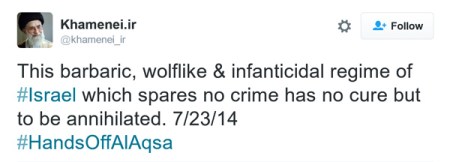
As late as November, Iran’s Supreme Leader Khamenei himself tweeted, “This barbaric, wolflike & infanticidal regime of #Israel which spares no crime has no cure but to be annihilated.”
1477

Bewilderingly, Western democracies have chosen to overlook Iran’s speeches and actions. They chose instead to appease the regime. Last July, despite genuinely serious reservations expressed by international strategic and military experts (including retired American military officers), the United States, United Kingdom, France and Germany – the four democracies in the P5+1 — concluded a nuclear deal with themselves that they proposed to Iran. Iran so far has not signed the deal, and apparently even if it did, according to the U.S. Department of State, the deal would not be legally binding.

Tehran will greatly benefit financially from the terms of the nuclear agreement in the months to come. Under the administration of President Barack Obama, nuclear sanctions against Iran have been lifted. To advance the deal and make it more appealing to Iran, the president has also agreed to pay Iran a $1.7 billion settlement for $400 million in “frozen” assets held in the United States since 1981.

The Society for Worldwide Interbank Financial Telecommunication (SWIFT), “the electronic bloodstream of the global financial system,” had disconnected 15 Iranian banks from its system in 2012. after coming under pressure from both the United States and the European Union at the height of efforts to curb Iran’s nuclear ambitions. Today, SWIFT is ready to let those banned banks, including the Central Bank of Iran, use its system once again. Iran now has an even greater ability to fund its terrorist proxies around the world.

European political and business leaders have been rushing to Tehran to sign new agreements. On January 28, in Paris, Iran’s President Hassan Rouhani and France’s President Francois Hollande signed major business deals, including a joint venture between car-makers PSA Peugeot Citroen and Iran’s Khodro. Iran is in the process of buying 118 Airbus passenger planes to update its aging fleet. The construction group Bouygues and the French airport operator ADP are now set to build an extension for Tehran’s airport, while Vinci, another construction firm, has been commissioned to design, build and operate new terminals for the Mashhad and Isfahan airports. The French oil company Total has agreed to buy Iranian crude oil, and agreements in shipping, health, agriculture and water provision have also been signed.

Democratic India is also cultivating relations with Iran. In a meeting in May, India’s Minister of Road Transport and Highways, Nitin Gadkari, and Iranian Transport and Urban Development Minister, Abbas Ahmad Akhoundi signed a Memorandum of Understanding on India’s participation in the development of the Chabahar Port in Iran.

The Chabahar project will impart strategic leverage to India and its access to Afghanistan and energy-rich Central Asia by bypassing Pakistan. The distance between the Chabahar Port and Gujarat – India’s westernmost state, located near the Persian Gulf, is less than the distance between Delhi and Mumbai. Transit times are estimated to be reduced by a third. Indian firms have already agreed to lease two existing berths at the port and operate them as container and multi-purpose cargo terminals.

The Chabahar project, New Delhi calculates, will be highly beneficial. As India has invested over $2 billion in Afghanistan, the Indian government plans to link the Chabahar port with the Zaranj-Delaram road it built in Afghanistan, thereby opening alternative routes to Afghanistan and enhancing access to regional and global markets.

Russia and China, permanent members of the UN Security Council, are also strengthening their cooperation with Iran. Both Russia and China adopted a policy of ambivalence towards Iran and saw to it that sanctions imposed by the West were not too tough. They also repeatedly blocked attempts at sanctioning Iran’s ally, the current Syrian regime, out of concern over financial ties in the region.

China is also capitalizing on the lifting of sanctions against Iran. Chinese President Xi Jinping rushed to Iran after the so-called nuclear agreement to discuss a 25-year strategic cooperation plan. In a landmark deal worth up to $600 billion, Xi committed to increase trade between the two nations during the next decade. Beijing and Tehran also agreed to enhance security cooperation through intelligence-sharing, counter-terror measures, military exchanges and coordination. Incidentally, despite international sanctions, China-Iran trade increased from $3 billion in 2001 to more than $50 billion in 2014.

Given its fanatical and sectarian ideological agenda, Iran is likely to use the new funds to boost its armament program and ongoing clandestine terror acts. Sanctions relief will mainly benefit Khamenei and members of the IRGC: they control up to one-third of Iran’s economy.

Iran now poses an even greater threat to the entire civilized world. The pattern of Tehran’s behavior shows the government can never be trusted on any promises it makes not to advance its nuclear weapons program. Khamenei has made an open declaration that Tehran will not allow effective inspections of its military sites or interviews with its nuclear scientists.

The links of the IRGC’s Qods Force with Hezbollah, Hamas, Palestinian Islamic Jihad, the Houthis and other terror militias pose a major threat to peace and stability in the Middle East.

Hezbollah’s networks have expanded over the years, infiltrating Latin America and the Caribbean through Shiite cultural centers in the region. According to an official Argentine report, Tehran has established its terrorist, intelligence and operational networks throughout Latin America as far back as the 1980s. Iran’s intelligence activities in the region are being conducted directly by Iranian officials or through its proxy, Hezbollah. Criminal activity may already be underway in Brazil, Colombia, Chile, Paraguay, Uruguay, Suriname and Trinidad and Tobago. Iran’s involvement in the cocaine trade has bolstered the regimes regional access and strengthened ties with its allies in Venezuela, Ecuador, Bolivia and elsewhere.

According to senior Western intelligence officials, the IRGC has transferred tens of millions of dollars to Hamas to be used for weapons, military equipment and training, and that Iran also delivers arms and funds to Hamas through the Red Sea and the Sinai. Officials also believe Iran is indirectly funding the Islamic State (IS) in the Sinai. “Suitcases of cash” are sent directly to Hamas officials in the Gaza Strip; part of the money is then transferred to IS.

Tehran’s links with Hamas and IS are part of a grander strategy of using proxy forces to gain hegemony over the Middle East and undermining American allies such as Egypt and Israel. In Lebanon, Iraq and Syria, Iran seeks to preserve its influence. By fighting IS, Iran strengthens existing pro-Iran regimes and maintains its relevance in the region.

While Iran does support IS indirectly in the Sinai, the government’s goal is to weaken the current Egyptian regime and the Sunni Arab alliance between Egypt, Saudi Arabia and Jordan. It has no problem with IS gaining strength in the Sinai right now. If IS does gain more power in the Sinai, Iran can use it to impose its own agenda in the future. Tehran evidently wants to use IS victories against Sunni states as an opportunity to take over.

Iran also supports the Gaza-based terror group al-Sabireen [“The Patient Ones”], established in the wake of previous tensions between Iran, Hamas and Islamic Jihad. The group has about 400 followers and its emblem is identical to that of Hezbollah. Each member receives a monthly salary of $250-$300, while senior members receive at least $700. Annually, the terror group receives a budget of $10 million from Iran, smuggled in suitcases through tunnels along the border with Egypt. Potential members are wooed by al-Sabireen through familiar channels of philanthropy and education. The group’s publications refer to the United States as “the source of superpower terrorism,” and its slogan is, “The road to the liberation of Palestinian goes through Karbala” — a Shiite holy city in Iraq.

Al-Sabireen has extended its operations from the Gaza Strip to the West Bank and Jerusalem with Iran’s backing. Hisham Salim, the founder of al-Sabireen, admitted that his group is directly financed by Iran. “We have an armed branch whose goal is to wage war on the Israeli occupation everywhere,” Salim said. “Within this framework we have members in the West Bank and Jerusalem.”

The Obama administration has forged ahead with its Iran policies despite knowing the regime’s support of global terrorism. U.S. President Barack Obama himself spoke about Iran’s terror activities in a press conference last year. “Now, we’ll still have problems with Iran’s sponsorship of terrorism; its funding of proxies like Hezbollah that threaten Israel and threaten the region; the destabilizing activities that they’re engaging in, including place like Yemen,” he said, adding that the nuclear “deal is not contingent on Iran changing its behavior. Its not contingent on Iran suddenly operating like a liberal democracy.”

History urges those living in democracies today to rein in their governments and correct their fatal Iran policies. The world cannot afford to overlook the damage of these governments. If democracies today continue their present policies towards Iran, it will only embolden Iran’s regime to continue its quest to obtain nuclear weapons as well as its terrorism and human rights violations.
‘Turkey going crazy, jumps in to save & help terrorists tools’ – Assad’s adviser to RT

February 19, 2016

Turkey going crazy, jumps in to save & help terrorists tools’ – Assad’s adviser to RT

Published time: 19 Feb, 2016 01:41

Source: ‘Turkey going crazy, jumps in to save & help terrorists tools’ – Assad’s adviser to RT — RT News

Ankara is going “crazy” over Kurdish and Syrian army advances, which is why it ramped up its support of the so-called “moderate terrorists” and direct violations of Syria’s sovereignty, Assad’s political adviser Bouthaina Shaaban told RT.


Rejecting the avalanche of claims that Damascus and Russian air forces were involved in the bombing of schools and hospitals in Idlib and Alleppo provinces, that according to reports left dozens of civilians dead, Shaaban told RT that the media and politicians are basing their accusations on “unfounded claims…about what the Russians and the Syrian army are doing.”

“What the Syrian army in cooperation with Russian aircraft are doing is fighting terrorism in Syria… And what we are hopeful for is that other countries [will] join, because this terrorism is a threat to the entire[ty of] humanity,” Shaaban stressed.

Read more

Foreign Ministry Spokesperson Maria Zakharova © Valeriy Melnikov

The success of the anti-terror campaign on the ground, especially along the Turkish border, is making other regional players such as Ankara and Saudi Arabia “go crazy” in their statements and reactions, because they are the ones who are invested so much in “supporting terrorism in Syria,” Shaaban said.

Shaaban accused Ankara of leading the war against Syria by taking advantage of the shared border to allow the infiltration of jihadists “from all over the world” into the Arab Republic.

At a time when the Syrian army and Kurdish forces are making gains on the ground, Turkey is “attacking our cities and villages directly” in order to “save” their investments in the jihadist force they sent into Syria, the adviser said.

“Once Turkey saw that these terrorists are failing or they are being defeated, Turkey jumped in to save them and to help them,” Shaaban said.

READ MORE: Dozens of Turkish military vehicles cross Syria border, dig trenches – report

The UNSC is yet to respond with an official reaction to a letter from Damascus which requested the world body to “stop” Turkish shelling of the Syrian border towns, the adviser noted, adding that in total Syria has sent “over 300 letters” from the beginning of the crisis outlining Turkish violations.

While violating Syrian sovereignty at the same Ankara is “accusing the Kurds of the things that they are not doing,” Shaaban added.

READ MORE: Turkey launched 100+ artillery strikes on Syrian towns in Aleppo – Russian military

Turkey leadership’s ambitions, according to Assad’s adviser, go as far as to resurrect the Ottoman Empire and they are using every means possible, including the refugee crisis, to achieve their agenda.

“It is Turkey who started the refugee crisis four years ago. It was Turkey who put tanks on the borders well before any Syrian refugee was at any border,” she said. The only way out of the refugee crisis is for “Europe and Syria to speak together.”

Read more

Turkish President Tayyip Erdogan. © Umit Bektas

“Turkey dismantled our factories, stole our heritage; has ambitions to recreate the Ottoman Empire in the Arab world…plus Erdogan government is a Muslim Brotherhood government and that is why they are launching this war with all the terrorist tools,” Shaaban added.

The Damascus spokesperson also once again stressed that there is no such a thing as “moderate” terrorism.

“Anyone who carries arms against civilians, against government, against institutions is a terrorist. Political opposition should be dealing with politics, should be in opposition against the government but by political means, without using arms, without killing people, without beheading people,” she said.

“Can terrorism be moderate?,” Shaaban asked rhetorically, noting that the gruesome 2013 footage showing a Syrian rebel commander who cut out the heart of a fallen enemy soldier before eating it, was a fighter with the Free Syrian Army, which the US and their coalition consider to be part of the “moderate” force.

The adviser did not deny that the conflict results in unfortunate collateral damage and accidental civilian deaths, but insisted that the only way to stop innocent people from dying is to “put an end to terrorism” and to stop arming and funding the extremists by strictly following the United Nations security council resolution that forbids countries supporting jihadist groups in Syria.

There are all the means available if there is a real will to put an end to terrorism. There is the Security Council resolution 2235, which should force countries to stop financing, arming, facilitating and sending mercenaries and terrorist into Syria,” Shaaban told RT.

“I hope that the Western world would stop looking at Erdogan’s government as the means to help them whether in fighting terrorism or stopping the refugee crisis,” Shaaban said. “We would wish that Russia and America and all countries in the world would join forces in fighting terrorism…instead of exchanging accusations which lead nowhere.

Sean Hannity Full One-on-One Interview with Donald Trump (2/18/2016)

February 19, 2016

Sean Hannity Full One-on-One Interview with Donald Trump (2/18/2016), Fox News via You Tube, February 18, 2016

(Trump discusses the Israel – “Palestine” situation and the mess Obama has made beginning at 11:05 during the interview. The rest is very good too. — DM)

Syrian army advances into Raqqa in major anti-ISIS assault

February 15, 2016

Syrian army advances into Raqqa in major anti-ISIS assault

Published time: 15 Feb, 2016 08:22 Edited time: 15 Feb, 2016 12:58

Source: Syrian army advances into Raqqa in major anti-ISIS assault — RT News

© Valeriy Melnikov
Syrian army units and paramilitary forces are reportedly moving into Raqqa province, seizing strategically important areas along the Salamiyah-Raqqa road which leads directly into the Islamic State stronghold.

On Sunday, Syrian government forces and Palestinian armed militia captured the strategically important Tal Masbah hilltop, the last entrenched Islamic State (IS, previously ISIS/ISIL) position.

Read more

A multifunctional fighter-bomber Su-34 of the Russian Aerospace Forces lands at Hemeimeem air base in Syria. © Dmitriy Vinogradov

The fortified position guarded approaches to the Salamiyah-Raqqa highway, leading to the terror group’s stronghold in the city of Raqqa, Al-Masdar news outlet reported, citing a military source.

Later that day, the Syrian government army launched a massive assault on the village of Zakiyah and seized an important crossroads near the village, cutting IS’s major supply route from Raqqa to nearby Hama province.

The Syrian government army’s 555th Brigade, 4th Mechanized Division, “Desert Hawks” brigade and Golani regiment, as well as the pro-government Palestinian Liwaa Al-Quds militia (Jerusalem brigade) took part in both ground offensives.

A source in the 555th brigade told Al-Masdar that IS militants entrenched at Tal Masbah hilltop were forced to flee northeast towards the desert on the Raqqa-Hama border, where an intense battle between the terror group and government forces is taking place.

© Google  Maps

The Syrian government army is also set to retake the key Tabaqah military airbase in southwest Raqqa province, which was captured by IS in August 2014.

“This is an indication of the direction of coming operations toward Raqqa,” a military source briefed on the battle told Reuters. “In general, the Raqqa front is open … starting in the direction of the Tabqa area.”

The advance into IS-held Raqqa province would allow Damascus to regain control over a region where Syrian government forces have had no presence since 2014. It would also complicate any move by Saudi Arabia to deploy forces to the area.

Previous media reports indicate that Saudi Arabia is considering a full-scale ground invasion into war-torn Syria, where they are backing anti-government rebels battling Syrian President Bashar Assad.

Riyadh has also been threatening that Assad will be toppled if he does not leave during a period of political transition. “Bashar al-Assad will leave – have no doubt about it. He will either leave by a political process or he will be removed by force,” Saudi Arabian Foreign Minister Adel al-Jubeir told CNN.

The possible Saudi intervention as well as recent Turkish artillery shelling of Kurdish and Syrian army positions came amid a successful anti-IS offensive by government forces in Aleppo, another important region.

Iran Mocks Capture Of U.S. Sailors In Tehran Revolution Day Parade – Outnumbered

February 12, 2016

Iran Mocks Capture Of U.S. Sailors In Tehran Revolution Day Parade – Outnumbered, Fox News via You Tube, February 11, 2016


