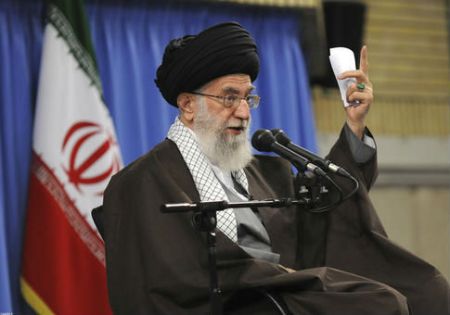
Posted tagged ‘Iran Scam’

IRGC Aerospace And Missile Force Commander: The Americans Are Telling Us ‘Don’t Talk About Missile Affairs, And If You Conduct A Test… Don’t Mention It’

May 16, 2016

IRGC Aerospace And Missile Force Commander: The Americans Are Telling Us ‘Don’t Talk About Missile Affairs, And If You Conduct A Test… Don’t Mention It’, MEMRI, May 15, 2016

Amir Ali Hajizadeh, commander of the Aerospace and Missile Force of Iran’s Islamic Revolutionary Guard Corps (IRGC), said at a conference of religious students in Qom on May 14, 2016:

28028Hajidazeh. Source: Farsnews.com.

“The arrogance [i.e. the U.S.] is trying to create [among us] the belief that Iran is at a crossroads, and that it has no choice but to compromise with America or be eternally subjected to American pressure and the problems that stem from that… At the same time, within Iran the belief has taken root that it is not possible to solve [Iran’s] problems without America…

“If we stand fast against this move by the Americans, who have stolen the funds of the [Iranian] nation, they will abandon this habit [of thievery]. But if we compromise with them, the[ir] thievery will end up [taking] $40-$50 billion of Iran’s assets and its blocked funds. The Americans understand only the language of force; they do not understand the language of reason. They cannot be trusted. We must face them down firmly, and we must act. If we do not, we will witness daily their exaggerated and evil demands.

“At this time, the Americans are telling [us]: ‘Don’t talk about missile affairs, and if you conduct a test or maneuver, don’t mention it.’ If we agree to this, they will advance another step, and say: ‘Don’t conduct [a missile test] at this time, and also don’t do it in the Persian Gulf region.’ After that, they will tell us: ‘Why do you need your missiles to have a range of 2,000km [anyway?]?’

“After that, they will tell [us]: ‘Next, we will check whether your missiles can really carry nuclear weapons. Bring us the details [of the missiles].’ After that, they will say: ‘We need to set up cameras.’ And, finally, they will say: ‘Either saw [the missiles up into pieces] or, like [Libyan dictator Mu’ammar] Gadhafi, load them onto a ship and hand [them] over to us.’

“They are clearly deluding themselves. Nothing like this will ever happen.”[1]


Endnote:


[1] Tasnimnews.com, Iran, May 14, 2015.

Inside the Pro-Iran ‘Echo Chamber’

May 16, 2016

Inside the Pro-Iran ‘Echo Chamber’ Washington Free Beacon, May 16, 2016

ayatollah

A White House-allied group funded a private email listserv that pushed out pro-Iran talking points and anti-Israel conspiracy theories to hundreds of influential policy experts, government officials, and journalists during the Iran nuclear debate.

The contents of the invite-only listserv, obtained by the Washington Free Beacon, could give a glimpse inside the “echo chamber” used by White House aide Ben Rhodes and allied lobbying groups to promote the administration’s nuclear deal with Iran.

Members of the list included an Obama White House adviser, senior officials at the State Department, journalists for the New York Times and the Washington Post, and fellows at prominent think tanks.

The email forum, known as “Gulf/2000,” was originally created by Columbia University professor and former Jimmy Carter aide Gary Sick in 1993.

Since 2010, Gulf/2000’s operations have been funded by the Ploughshares Fund, a group that worked closely with the White House to promote the Iran nuclear deal.

In a New York Times article earlier this month, President Obama’s foreign policy advisor Ben Rhodes said the Ploughshares Fund was part of the administration’s spin operation to sell the public on the agreement.

“We had test drives to know who was going to be able to carry our message effectively, and how to use outside groups like Ploughshares, the Iran Project and whomever else,” Rhodes said. “So we knew the tactics that worked.”

Gulf/2000 is still run out of Columbia University, where it is curated by Sick. Over the last two decades, Sick built the group into the predominant email list for Gulf State policy experts across the ideological spectrum.

The vast majority of posts on the forum are news articles, but occasionally members weigh in with their own comments. Posts are pre-approved by Sick or his assistants, and insiders say the forum is “dominated” by pro-Iran talking points.

One former member, who left Gulf/2000 several years ago because “90 percent of the traffic was either useless or promoting the official lines,” said the comments that were approved for posting seemed to follow an ideological slant.

“Gary [Sick] was the moderator, and the moderator is supposed to moderate,” said the former member. “And I learned after awhile, it was quite obvious, that Gary was filtering and navigating more toward his views of the world on all these issues.”

Sick said he was unable to discuss Gulf/2000 because he was traveling for the next few weeks. He declined to answer questions by email.

Joe Cirincione, the president of the Ploughshares Fund, did not respond to a request for comment. In a column last week, Cirincione disputed allegations that the Ploughshares Fund took orders from the White House about how to sell the Iran deal.

Gulf/2000 members said the forum posts, which are supposed to focus on Gulf State policy issues, often veer into defenses of the Iranian regime or conspiracy theories about Israel. Another member, speaking on background to theWashington Free Beacon, compared the group to a pro-Iran “info-op”—military jargon for a campaign to influence policy decisions.

“The most significant forum for scholars of Iranian studies to exchange ideas and views was dominated by apologists for the Iranian regime and was dominated by people who would reflexively push back on any argument that the Iranian regime was involved in what we would call ‘malign activities’ or ‘illicit activities,’” said the member, who added that the majority of his colleagues who work on Gulf issues belong to the forum.

The Ploughshares Fund said it finances Gulf/2000 in order to “inform the debate over Iran’s nuclear program in the media and among policymakers by assessing and reporting on events, generating viable solutions and refuting false stories,” according to its annual reports. The foundation has given the email list $75,000 a year since 2010.

Gulf/2000 is linked to a larger messaging effort on the Iran deal that has been reported on by the Free Beacon and other outlets.

In October 2014, the Free Beacon published audio recordings from a since-discontinued strategy meeting between the White House and activist groups lobbying for the nuclear deal. During the session, Rhodes stressed that the agreement was “the biggest thing President Obama will do in his second term on foreign policy.”

Last summer, the Free Beacon posted tapes from a private conference call with progressive groups organized by the Ploughshares Fund that discussed how to sell the Iran deal to congressional Democrats.

Republicans on the House Oversight Committee are calling on Rhodes to testify about his comments to the Times, which seemed to suggest the administration misled the public and created an “echo chamber” in order to get the deal through.

Members of Gulf/2000 include activists and writers who worked closely with the Obama administration on Iran issues. One is Trita Parsi, head of the National Iranian American Council, a lobbying group working to repeal Iran sanctions. Another is Al-Monitor reporter Laura Rozen, who a White House aide described as her “RSS feed” on Iran in the Timesarticle. Cirincione is also on the list.

Other members have included Puneet Talwar, a senior State Department official and former advisor to Joe Biden in the Senate and White House; John Limbert, Obama’s former deputy assistant secretary of state for Iran; and Tamara Cofman Wittes, Obama’s former deputy assistant secretary of state for Near Eastern affairs.

Many of the email list’s regular contributors are bloggers and academics: Jim Lobe and Marsha Cohen, writers for the anti-Israel website LobeLog; Flynt and Hillary Leverett, authors of the book “Going to Tehran: Why the United States Must Come to Terms with the Islamic Republic of Iran”; Truthout writer Gareth Porter; and Cyrus Safdari, a commentator at Iran Review. Gulf/2000 also includes a number of current and former Iranian scholars who work at state-controlled universities or think tanks.

The Free Beacon reviewed hundreds of posts sent to the listserv between 2010 and 2015. Many contain theories about the “Israel Lobby’s” destructive influence over U.S. foreign policy and politicians, defenses of the Iranian government, and comments downplaying news stories that cast the regime in a negative light.

Although some Gulf/2000 members are strong critics of the Iranian government, particularly on human rights, many of the most active posters are vocal defenders of the regime.

“Perhaps above all, one of the greatest benefits of this [Iran] deal has been to put some limits, at least for the time being, on the Israeli Lobby and their rightwing supporters in the Congress,” wrote Farhang Jahanpour, a former dean at a state-run Iranian university, in 2013.

Other posts talked about the necessity of “breaking the power of the domestic Israel lobby” and the “neo-con cabal” that were allegedly the main threats to the Iran deal.

“The Neo-Cons have convinced themselves that no costs of human life outweigh the moral benefits they see of ridding Israel of any perceived military threat by pre-active lethal military force,” wrote David Long in January 2013.

The forum is also littered with conspiracy theories about the Israeli government and foreign affairs. In one post, retired journalist Richard Sale claimed the CIA told him that pro-Israel Christian groups were “secretly funded by Mossad.” In another, Soraya Sepahpour-Ulrich speculated that the Iranian-backed bombing of the 1994 AMIA Jewish community center was actually a false flag operation by the Argentine government to cover up its complicity with the Nazis.

Although Gulf/2000 is ostensibly a forum to discuss Gulf policy issues, the listserv’s fixation with “neocons” and the “Israel lobby” is not new. In 2003, a Lebanese columnist named Jihad Al Khazen published a series of lengthy posts on Gulf/2000 that purported to tell the “Biographies of the Neo-Cons.” His subjects included Bill Kristol, Douglas Feith, Michael Ledeen, and Robert Kagan.

At the time, members also debated the correlation between “neo-cons” and Jews.

“It is certainly true that not every supporter of the [Iraq] war is Jewish, but it is definitely true that every supporter of the war with Iraq is a supporter of the most extreme Israeli right-wing. The coincidence is hard to ignore,” noted William Beeman.

Occasionally a contributor would push back on the forum’s general consensus.

“I am puzzled by the consistent tone of dismissal of any allegations of wrongdoing on the part of Iran by members of this list,” wrote one poster in 2003. “These charges are lumped together as either the baseless allegations of the US government, or worse, the product of a secret Jewish-neocon plot to discredit an Iran which would never, ever participate in terrorism.”

But a former forum member said Sick would often cut off conversations as “off-topic” when commenters tried to defend Israel against charges.

“There were clearly cases where there were things that were said about Israel, or written, posted about Israel, that were false, defamatory, absurd,” said the former member.

On March 5, 2014, the day the Israeli military announced it had intercepted an Iranian shipment of advanced rockets to Gaza, the news was greeted with typical suspicion in the forum.

“Call me a cynic, but it does seem like amazingly fortuitous timing: just when the IAEA have resisted Israel’s call to publish the claims (probably) Israel leaked, and while Bibi is tub-thumping to AIPAC in Washington ,” wrote James Spencer, a blogger for LobeLog.

“[S]omething did not jibe with this story. It is just a little bit too convenient,” agreed another poster.

“I can’t take that narrative at face value,” added Thomas Lippman, former Middle East bureau chief of the Washington Post.

“As James Spencer and Walter Posch noted the timing is suspicious, occurring as the AIPAC conference convened with Netanyahu in Washington,” wrote Charles Smith, a professor at the University of Arizona.

When the Iranian government weighed in on the arms seizure the day after the story broke, its response was similar.

“An Iranian ship carrying arms for Gaza. Captured just in time for annual AIPAC anti Iran campaign. Amazing Coincidence! Or same failed lies,” wrote Iranian Foreign Minister Javad Zarif on Twitter.

Another common refrain in posts is that there is no evidence Iran is pursuing nuclear weapons.

“Like other counter-factual mythologies (President Obama’s birthplace, the identity of the Kennedy assassin, Jimmy Hoffa’s killer), this one seemingly will never die–at least as long as the neo-cons are alive to fan the last of its faint sparks,” wrote William O. Beeman, an anthropology professor at the University of Minnesota.

An official at an Iranian university, whose name was withheld, claimed the notion that Iran was seeking a bomb was driven by “Iranophobia.”

“Iran repeatedly has said that it doesn’t pursue the way of reaching to Atomic bomb,” said the poster. “What makes the US doesn’t believe this is exactly rooted to what Mr. Aboutalebi described it in his interview as Iranophobia.”

Posts also defend Iran against allegations of human rights violations by suggesting the claims are intended to undermine moderates or denying the charges altogether.

“[A]s the nuclear issue has become effectively – for now – insulated due to the support of Khamenei, critics are seeking to undermine Rouhani through other issues,” wrote Parsi in March 2014. “Human rights – due to the impact it has on Rouhani’s external image and the impact that can have on negotiations – appears to be one such issue.”

Other commenters were less subtle than Parsi.

“The Leveretts said it best: Ahmadinejad won those elections; get over it already,” argued blogger Safdari in December 2013.

One former member expressed concern that the influential listserv was being used to whitewash the Iranian government.

“If the Iranian regime wanted to push back on any assertion against it … it could not do a better job itself than the American academics and pundits who do it on Gulf/2000,” he said.
Obama’s Animus toward Israel May Lead to War

May 15, 2016

Obama’s Animus toward Israel May Lead to War, American ThinkerVictor Sharpe and Robert Vincent, May 15, 2016

Will the looming conclusion of the Obama presidency lead him to engineer an all-out war by Iran’s terror surrogates, Hamas and Hezbollah, against the embattled Jewish state?  Will that war conveniently occur in December 2016, as Obama serves out the final days of his presidency?

Is it conceivable that the pro-Muslim president of the United States will use such a conflict to predictably and mendaciously blame Israel as a means to permanently fracture the U.S.-Israeli alliance in a manner that would be difficult for any successor to repair?  As extreme as this may sound, it is entirely possible in view of Obama’s past acts of blatant hatred toward America’s one and only true democracy and ally in the Middle East.

As should be obvious by now, Obama believes that Islam has suffered from British and European Christian colonization and oppression.  After being thoroughly prepared to be receptive to this message by his stridently anti-Western mother and maternal grandparents, such was the indoctrination Obama received from Khaled al-Mansour – a Muslim high-level adviser to Saudi Prince Al-Waleed bin Talal and anti-Jewish hate-monger – during his formative years.

It was al-Mansour who helped Obama gain admittance to the Harvard Law School.  Edward Said, an outspoken anti-Israel professor of Obama’s at Columbia University, and Rashid Khalidi, a former press agent for Yasser Arafat’s PLO, served as Obama’s mentor in the former case and friend in the latter.

These figures, whose entire professional adult lives had been essentially dedicated to eliminating Israel, focused on influencing Obama to support the Arabs who call themselves Palestinians – along with their thugocracy known as the Palestinian Authority.  These overwhelmingly Muslim terrorists amount to little more than cannon fodder in the ongoing Islamist quest to effectively perpetrate yet another Holocaust.

Thus, while Obama weakens America and disparages Western values and the tenets of Judeo-Christian civilization, he always chooses to suppress the reality of Islamic triumphalism and its appalling and inhumane history of slavery, hatred of non-Muslims, brutal Muslim conquests, and slaughter dating back to its 7th-century origins in Arabia.

This is why no one should be surprised that he would bow to a Saudi king and venerate the Islamic call of the muezzin.

Given his background, it is no wonder that Obama fell for the monumental lie that the Jewish state is also a modern colonizer, just as the European powers were.  After all, Obama’s other confidants included, as the principled and worthy Victor David Hanson recently pointed out, “the obscene Reverend Wright and reprobates like Bill Ayers and Father Michael Pfleger.”

But unlike the European colonizers who had no ancestral roots in the Middle Eastern territories they occupied, Israel is the biblical and post-biblical homeland of the Jewish people, and as the native people of its ancestral homeland, the Jews predate the Muslim invasion of Israel by millennia, as is clearly evident in the Bible, which could not have been written when and where it was otherwise.

Even though sovereignty was lost to them after the Roman destruction of the Jewish state, Jews have always lived in their native land in whatever numbers they could sustain under a succession of alien occupiers.

Despite these clearly established historical facts, modern reborn Israel and her democratically elected leader, Prime Minister Netanyahu, have been treated with unprecedented contempt by Obama and his sycophants.

This was evident early on with Obama’s support of and friendship to the Islamist Erdoğan in Turkey, who has reduced once secular Turkey to a growing totalitarian Islamic state that has openly supported terrorism against Israel, as demonstrated by the Gaza flotilla incident of 2010.

Erdoğan’s perfidy – which has included all but open support for ISIS – has in no way dampened Obama’s preferential treatment of this dictator, in contrast to his appalling treatment of Israel’s Prime Minister Netanyahu.

Routinely, the State Department promotes the hypocrisy of the Obama administration by ignoring the aggression and terror of the Palestinian Authority, led by the Holocaust-denying Mahmoud Abbas and the Hamas and Islamic Jihad thugs who rule over the Gaza Strip.

In deplorable contrast, the State Department routinely attacks Israel for building homes in Jerusalem for young couples, or chiding Israel to exercise “restraint” when Israel is forced to defend itself from relentless Palestinian brutality and murder of Israeli civilians.  Was France or Belgium similarly asked to exercise “restraint” in the face of recent Muslim terrorist attacks in those countries?

This spitefulness was exhibited when the U.S., at the behest of a high-level individual in the Obama administration (wonder who!), denied visas to Israelis during Israel’s defensive Gaza war in 2014 against Hamas aggression.

Even as the barrage of thousands of rockets aimed at Israeli villages and towns from Gaza continued, this outrage was compounded when President Obama banned the much needed resupply of armaments to Israel at the height of the Hamas terror blitz and temporarily banned U.S. airlines from flying to Israel on the flimsiest of pretexts (23 international carriers – including British Airways – continued flights to Israel in spite of this ban).

Obama has also treated America’s other traditional allies with insolent disdain and cozied up to the worst enemy of freedom and liberty – namely, the Islamo-Nazi regime of Iran.

Iran’s ongoing implicit threats of nuclear warfare – against the U.S. as well as Israel – including its aggressive development of potentially nuclear-armed ICBMs, which can eventually reach the U.S., does not faze this incumbent in the White House.

The fact that this supposed nuclear “agreement” with Iran was reached, even as his very own State Department admits that Iran has yet to actually sign the agreement and even as Iranian mobs continue to chant “Death to America” to the approving nods of the Iranian mullahs, also fits into Barack Hussein Obama’s distorted world view – a deliberate policy of lies, deception, and dissimilitude.

This was admitted to by one of his closest advisers, Ben Rhodes, who recently disclosed that the Obama administration had deliberately deceived Congress and the American public about the Iran deal – as if this was something to be proud of.

Perhaps one of the most blatant examples of Obama’s anti-Western, anti-American, and anti-Israeli ideology was his support for the Muslim Brotherhood in Egypt and his reluctance to sell arms to President El-Sisi, who overthrew the Brotherhood’s Mohammed Morsi and his vicious anti-Christian regime after it had been in power for only two years and had wrought havoc on that country.

Obama’s support for Morsi should have come as no surprise, given the endless flow of Muslim Brotherhood activists visiting Obama’s White House and the filling of senior positions within the administration, as documented by former CIA analyst Clare Lopez.

Even today, El-Sisi fights al-Qaeda terrorism in the Sinai and the Hamas terrorists in Gaza without any apparent support or approval from Obama.

These examples of the president’s bias, his pro-Islamic sympathies, and his agenda point to a seminal hatred of not only America itself, but most pointedly of the Jewish state – this hatred may override all other practical considerations in the remaining few months of his term in office.

His parting shot at Israel may well be to force her expulsion from the United Nations and turn the Jewish state into another Taiwan.

As suggested at the beginning of this article, he might well encourage both Iranian terror proxies, Hamas in Gaza and Hezb’allah in Lebanon, to attack Israel with a massive missile bombardment sometime this coming December.

Hamas, for its own part, has thousands of lethal rockets and mortars and is feverishly building tunnels into Israeli territory in the hope of sending its terrorist hordes into Israeli villages and towns and slaughtering as many civilians as possible.  Hezb’allah, on the other hand, is estimated to have more than 150 thousand missiles and rockets aimed at all of Israel, hidden in Lebanese schools, hospitals, and apartments.

Even as the deliberate use of civilians as human shields is explicitly spelled out by the Geneva Conventions as a crime against humanity, and though Israel would have no choice but to inflict substantial civilian casualties in her own defense, this circumstance would naturally be used as a pretext by the U.N. to punish Israel in an unprecedented manner.

They would do so knowing that for the first time, an American president would likely stand by and approve whatever the U.N. anti-Israel “lynch mob” might concoct in order to further isolate and delegitimize the Jewish state.  This might include severe economic sanctions or embargoes or might even involve expulsion of Israel from the U.N. entirely.

It should be emphasized here that once the American national election is over, there will be nothing to stop Obama from doing this.  Obama’s entire foreign policy has revolved around undermining Israel.  Such an action on his part in the closing weeks of his administration can be seen as not only possible, but likely, given the pattern of his behavior toward Israel for the whole of his presidency.

This latter punishment would suit Israel’s enemies very well, even though it would change nothing on the ground.  An Israel reduced to a Taiwan-like status – i.e., a de facto sovereign state not officially recognized as such by the U.N. – would obviate the need for Gulf Arabs (who are covertly making common cause with Israel against Iran) to establish any formal diplomatic relations with her.

The “Zionist entity,” as their official propaganda impudently puts it, would remain just that.  This might even, in rhetorical terms, satisfy the requirement of Iran’s mullahs to “wipe Israel from the map.”  What is more, once Israel is expelled from the U.N., it would be very difficult for any future U.S. president, no matter how pro-Israel, to successfully support Israel’s re-admittance into the U.N.

As is the case with Taiwan, the U.S. may maintain a commitment to supplying Israel with arms and supporting her efforts at self-defense, but in practical terms, that may be the extent of the relationship, even in the best-case scenario surrounding Israel’s expulsion from the U.N. under Obama during his final days in office.

While such a turn of events may sound far-fetched to even some of those most critical of Obama, it is entirely possible in view of Obama’s past acts of blatant hatred toward America’s one and only true ally and democracy in the Middle East.


UNESCO’s Collapse of Credibility

May 13, 2016

UNESCO’s Collapse of Credibility, American ThinkerMichael Curtis, May 13, 2016

Lying and spinning history are becoming an international disease.  On May 3, 2016, the world learned that the White House had deliberately falsified information about Obama administration’s relations with Iran.  A month earlier, the spinning and falsification of history had been demonstrated at the headquarters in Paris of UNESCO, the United Nations Educational, Scientific, and Cultural Organization.  

Yet the difference between the two is meaningful.  Whatever one’s views of the correctness of U.S. policy on Iran, the White House acted for political reasons, though falsely, to score a policy success.  UNESCO was created in 1945 after World War II not as a political body, but to contribute to peace that would be established on the basis of humanity’s moral and intellectual solidarity.

UNESCO betrayed its own principles and ethos by the resolution, passed by the Executive Board on April 16, 2016.  Not only inaccurate historically and factually, the resolution was one partly of self-protection for reasons of security, but mainly based on hatred and animosity toward the State of Israel and, on the part of some countries, of anti-Semitism.

The resolution, submitted by seven Arab countries including Egypt, passed by 33 in favor, 6 against, and 17 abstentions.  France, Spain, Russia, and Sweden voted in favor; the U.S, the U.K., and Germany voted against.  The vote of France, which has experienced terrorist massacres in Paris, was particularly surprising and disappointing.  UNESCO director-general Irina Bokova dissociated herself from the resolution, saying it was a political decision by the economic council and the management council of UNESCO and that she herself was opposed to it.

UNESCO does not have a good record regarding Israel and Jewish holy places.  In 2010, and again in October 2015, resolutions proclaimed that Rachel’s tomb near Bethlehem and the Cave with the tombs of the Jewish patriarchs in Hebron (Ma’arat HaMachpela), which are mentioned in Genesis, are Islamic holy sites.  The new 2016 resolution reaffirms that the two sites are an integral part of “Palestine” and calls on Israel to end its illegal archeological excavations there.

The resolution in strong terms condemned Israeli actions in east Jerusalem, the West Bank, and Gaza Strip, but most pointedly it concentrated on supposed Israeli actions on the Temple Mount in Jerusalem and the Plaza of the Western Wall in the Old City.  The resolution referred to the area of the Temple as al-Aqsa Mosque/al-Ha-ram al Sharif, and to the Western Wall as al-Buraq Plaza, implying they are regarded as Muslim areas.  UNESCO thus refused to recognize the 3,000-year historic and religious connection between the Jewish people and those holy sites in Jerusalem and in Israel.

For some years the Palestinian Authority and Hamas have used spin and false rumors that Israel intended to change the status quo on the Mount.  The UNESCO majority accepted the spin and charged that Israel does not respect the integrity, authenticity, and cultural heritage of the mosque as a holy site of worship.  The resolution requires Israel to restore the status of the Mount to what it was before 1967.

This in itself is the height of hypocrisy as well as the rewriting of history.  Two things are pertinent.  One is that since 1967 and Israeli control of Jerusalem, all faiths have had access to the holy places in the city.  By comparison, in the period, 1948 to 1967, when the area of Jerusalem and the West Bank were under Jordanian control, the city was physically divided, Jewish civilians were attacked, and 57 synagogues were destroyed.

The second factor is that conditions in the disputed area changed in September 2000, when Arafat deliberately started the Second Intifada and falsely declared that Israel was about to change access to the Mount.  In fact, at that time, the Jordan Wakf had full control of the area, including access to it.  Today, the site is under the authority, but not the control, of the Wakf.  It was the very Palestinian riots provoked by Arafat that led to Israeli control of access to the site for security reasons.

Today, only Muslims are allowed to pray on the Mount.  Jewish worship has been forbidden there since 1967.  The resolution calls on Israel not to restrict Muslim worshippers from access to the mosque, but Israel has never had any intention to do so.

Not surprisingly, the UNESCO majority accepted the Palestinian Narrative of Victimhood and saw Israel as the repressive occupying power.  But it is morally reprehensible that it agreed to the Palestinian attempt to erase the historic connection between the Jewish people and its holy sites.  In addition, the majority forgot that the Palestinian Authority has laid claim not simply to Jewish sites, but also to the Christian Church of the Holy Sepulcher.

The one-sided resolution continued its misleading and false charges.  It condemned Israeli plans to build a prayer space for women at the Western Wall.  It charged that Israel had placed Jewish fake graves in spaces in Muslim cemeteries on Wafk property near the Temple.  It condemned the “new cycle of violence” since October 2015 but laid the blame on the victims of terrorism in Israel.  It accused Israel of the continued conversion of many Islamic and Byzantine remains into the “so-called” Jewish ritual baths or Jewish prayer places.

Again not surprisingly, without mentioning the continuing rocket attacks by Hamas on Israel and the projected use of tunnels in order to attack Israel civilians, UNESCO deplored the continuous Israeli blockade of the Gaza Strip and the intolerable number of casualties among Palestinian children.  UNESCO appears ignorant of the reports including the important one by Amnesty International that indicates the use of children by Hamas for military purposes and stresses the war crimes committed by Hamas.

It is shameful that UNESCO, set up for peaceful purposes to promote intercultural dialogue, has been misused for political purposes.  Its one-sided resolutions against Israel and its citizens demonstrate that it has become a vehicle for hatred, not peace.


Rosen: Obama Administration Extensively Deceived Public, Media to Sell Iran Nuclear Deal

May 10, 2016

Rosen: Obama Administration Extensively Deceived Public, Media to Sell Iran Nuclear Deal, Fox News via YouTube, May 9, 2016

(The video is about the secret bilateral negotiations between the Obama administration and Iranian officials. Please see also, Obama, the Iran Scam, Ben Rhodes and Public Credulity. — DM)

Why Middle Eastern Leaders Are Talking to Putin, Not Obama

May 9, 2016

Why Middle Eastern Leaders Are Talking to Putin, Not Obama, Politico, Dennis Ross, May 8, 2016

John Hinderaker at Power Line writes,

Dennis Ross is a respected, if thoroughly conventional, expert on the Middle East. A Democrat, he has served in both Republican and Democratic administrations as an adviser and envoy. Ross served in the State Department as Hillary Clinton’s Special Advisor for the Persian Gulf and Southwest Asia. Subsequently, he joined President Obama’s National Security Council staff as a Special Assistant to the President and Senior Director for the Central Region, which includes the Middle East, the Persian Gulf, Afghanistan, Pakistan and South Asia. So when Ross writes, in Politico, that Obama’s foreign policy weakness is hurting American interests, we should take notice.

— DM)

Putin and Middle Eastern leaders understand the logic of coercion. It is time for us to reapply it.

*****************************

The United States has significantly more military capability in the Middle East today than Russia—America has 35,000 troops and hundreds of aircraft; the Russians roughly 2,000 troops and, perhaps, 50 aircraft—and yet Middle Eastern leaders are making pilgrimages to Moscow to see Vladimir Putin these days, not rushing to Washington. Two weeks ago, Israeli Prime Minister Benjamin Netanyahu traveled to see the Russian president, his second trip to Russia since last fall, and King Salman of Saudi Arabia is planning a trip soon. Egypt’s president and other Middle Eastern leaders have also made the trek to see Putin.

Why is this happening, and why on my trips to the region am I hearing that Arabs and Israelis have pretty much given up on President Barack Obama? Because perceptions matter more than mere power: The Russians are seen as willing to use power to affect the balance of power in the region, and we are not.

Putin’s decision to intervene militarily in Syria has secured President Bashar Assad’s position and dramatically reduced the isolation imposed on Russia after the seizure of Crimea and its continuing manipulation of the fighting in Ukraine. And Putin’s worldview is completely at odds with Obama’s. Obama believes in the use of force only in circumstances where our security and homeland might be directly threatened. His mindset justifies pre-emptive action against terrorists and doing more to fight the Islamic State. But it frames U.S. interests and the use of force to support them in very narrow terms. It reflects the president’s reading of the lessons of Iraq and Afghanistan, and helps to explain why he has been so reluctant to do more in Syria at a time when the war has produced a humanitarian catastrophe, a refugee crisis that threatens the underpinnings of the European Union, and helped to give rise to Islamic State. And, it also explains why he thinks that Putin cannot gain—and is losing—as a result of his military intervention in Syria.

But in the Middle East it is Putin’s views on the uses of coercion, including force to achieve political objectives, that appears to be the norm, not the exception—and that is true for our friends as well as adversaries. The Saudis acted in Yemen in no small part because they feared the United States would impose no limits on Iranian expansion in the area, and they felt the need to draw their own lines. In the aftermath of the nuclear deal, Iran’s behavior in the region has been more aggressive, not less so, with regular Iranian forces joining the Revolutionary Guard now deployed to Syria, wider use of Shiite militias, arms smuggling into Bahrain and the eastern province of Saudi Arabia, and ballistic missile tests.

Russia’s presence has not helped. The Russian military intervention turned the tide in Syria and, contrary to Obama’s view, has put the Russians in a stronger position without imposing any meaningful costs on them. Not only are they not being penalized for their Syrian intervention, but the president himself is now calling Vladimir Putin and seeking his help to pressure Assad—effectively recognizing who has leverage. Middle Eastern leaders recognize it as well and realize they need to be talking to the Russians if they are to safeguard their interests. No doubt, it would be better if the rest of the world defined the nature of power the way Obama does. It would be better if, internationally, Putin were seen to be losing. But he is not.

This does not mean that we are weak and Russia is strong. Objectively, Russia is declining economically and low oil prices spell increasing financial troubles—a fact that may explain, at least in part, Putin’s desire to play up Russia’s role on the world stage and his exercise of power in the Middle East. But Obama’s recent trip to Saudi Arabia did not alter the perception of American weakness and our reluctance to affect the balance of power in the region. The Arab Gulf states fear growing Iranian strength more than they fear the Islamic State—and they are convinced that the administration is ready to acquiesce in Iran’s pursuit of regional hegemony. Immediately after the president’s meeting at the Gulf Cooperation Council summit, Abdulrahman al-Rashed, a journalist very well connected to Saudi leaders, wrote: “Washington cannot open up doors to Iran allowing it to threaten regional countries … while asking the afflicted countries to settle silently.”

As I hear on my visits to the region, Arabs and Israelis alike are looking to the next administration. They know the Russians are not a force for stability; they count on the United States to play that role. Ironically, because Obama has conveyed a reluctance to exercise American power in the region, many of our traditional partners in the area realize they may have to do more themselves. That’s not necessarily a bad thing unless it drives them to act in ways that might be counterproductive. For example, had the Saudis been more confident about our readiness to counter the Iranian-backed threats in the region, would they have chosen to go to war in Yemen—a costly war that not surprisingly is very difficult to win and that has imposed a terrible price? Obama has been right to believe that the regional parties must play a larger role in fighting the Islamic State. He has, unfortunately, been wrong to believe they would do so if they thought we failed to see the bigger threat they saw and they doubted our credibility.

Indeed, so long as they question American reliability, there will be limits to how much they will expose themselves—whether in fighting the Islamic State, not responding to Russian entreaties, or even thinking about assuming a role of greater responsibility for Palestinian compromises on making peace with Israel. To take advantage of their recognition that they may need to run more risks and assume more responsibility in the region, they will want to know that America’s word is good and there will be no more “red lines” declared but unfulfilled; that we see the same threats they do; and that U.S. leaders understand that power affects the landscape in the region and will not hesitate to reassert it.

Several steps would help convey such an impression:

⧫ Toughen our declaratory policy toward Iran about the consequences of cheating on the Joint Comprehensive Plan of Action to include blunt, explicit language on employing force, not sanctions, should the Iranians violate their commitment not to pursue or acquire a nuclear weapon;

⧫ Launch contingency planning with GCC states and Israel—who themselves are now talking—to generate specific options for countering Iran’s growing use of Shiite militias to undermine regimes in the region. (A readiness to host quiet three-way discussions with Arab and Israeli military planners would signal we recognize the shared threat perceptions, the new strategic realities, and the potentially new means to counter both radical Shiite and Sunni threats.)

⧫ Be prepared to arm the Sunni tribes in Iraq if Prime Minister Haider al-Abadi continues to be blocked from doing so by the Iranians and the leading militias;

⧫ In Syria, make clear that if the Russians continue to back Assad and do not force him to accept the Vienna principles (a cease-fire, opening humanitarian corridors, negotiations and a political transition), they will leave us no choice but to work with our partners to develop safe havens with no-fly zones.

Putin and Middle Eastern leaders understand the logic of coercion. It is time for us to reapply it.


Iran’s Plans to Control a Palestinian State

May 9, 2016

Iran’s Plans to Control a Palestinian State, Gatestone Institute, Khaled Abu Toameh, May 9, 2016

(Please see also, Op-Ed: Trump’s “peace through strength”  for  USA also applies to Israel. — DM)

♦ The Iran nuclear deal, marking its first anniversary, does not appear to have had a calming effect on the Middle East.

♦ Iran funnels money to Hamas and Islamic Jihad because they share its desire to eliminate Israel and replace it with an Islamic empire. The Iranian leaders want to see Hamas killing Jews every day, with no break. Ironically, Hamas has become too “moderate” for the Iranian leadership because it is not doing enough to drive Jews out of the region.

♦ More Palestinian terror group leaders may soon perform the “pilgrimage” to their masters in Tehran. If this keeps up, the Iranians themselves will puppeteer any Palestinian state that is created in the region.

The Iran nuclear deal, marking its first anniversary, does not appear to have had a calming effect on the Middle East. The Iranians seem to be deepening their intervention in the Israeli-Palestinian conflict in general and in internal Palestinian affairs in particular.

This intervention is an extension of Iran’s ongoing efforts to expand its influence in Arab and Islamic countries, including Iraq, Yemen, Syria and Lebanon and some Gulf states. The nuclear deal between Tehran and the world powers has not stopped the Iranians from proceeding with their global plan to export their “Islamic Revolution.” On the contrary, the general sense among Arabs and Muslims is that in the wake of the nuclear deal, Iran has accelerated its efforts to spread its influence.

Iran’s direct and indirect presence in Iraq, Syria, Yemen and Lebanon has garnered some international attention, yet its actions in the Palestinian arena are still ignored by the world.

That Iran provides financial and military aid to Palestinian groups such as Hamas and Islamic Jihad has never been a secret. In fact, both the Iranians and the Palestinian radical groups have been boasting about their relations.

Iran funnels money to these groups because they share its desire to eliminate Israel and replace it with an Islamic empire. Like Hezbollah in Lebanon and the Houthis in Yemen, Hamas and Islamic Jihad agreed to play the role of Tehran’s proxies and enablers in the Israeli-Palestinian conflict.

1162 (1)Iran used to funnel money to Hamas and Islamic Jihad because they share its desire to eliminate Israel and replace it with an Islamic empire. Relations between Iran and Hamas foundered a few years back, when Hamas leaders refused to support the Iranian-backed Syrian dictator, Bashar Assad. Pictured above: Hamas leader Khaled Mashaal (left) confers with Iranian “Supreme Leader” Ali Khamenei, in 2010. (Image source: Office of the Supreme Leader)

But puppets must remain puppets. Iran gets nasty when its dummies do not play according to its rules. This is precisely what happened with Hamas and Islamic Jihad.

Relations between Iran and Hamas foundered a few years back over the crisis in Syria. Defying their masters in Tehran, Hamas leaders refused to declare support for the Iranian-backed Syrian dictator, Bashar Assad. Things between Iran and Hamas have been pretty bad ever since.

First, the Assad government closed down Hamas offices in Damascus. Second, Assad expelled the Hamas leadership from Syria. Third, Iran suspended financial and military aid to Hamas, further aggravating the financial crisis that the Gaza-based Islamist movement had already been facing.

Islamic Jihad got it next. Iranian mullahs woke up one morning to realize that Islamic Jihad leaders have been a bit unfaithful. Some of the Islamic Jihad leaders were caught flirting with Iran’s Sunni rivals in Saudi Arabia and other Gulf countries. Even worse, the Iranians discovered that Islamic Jihad was still working closely with their erstwhile allies in the Gaza Strip, Hamas.

Iran had had high hopes for Islamic Jihad replacing Hamas as Tehran’s darling, and major proxy in the Palestinian arena. But here were Islamic Jihad leaders and activists working with their cohorts in Hamas, in apparent disregard of Papa Iran.

The mullahs did not lose much time. Outraged by Islamic Jihad’s apparent disloyalty, Iran launched its own terror group inside the Gaza Strip: Al-Sabireen (The Patient Ones). This group, which currently consists of several hundred disgruntled ex-Hamas and ex-Islamic Jihad members, was meant to replace Islamic Jihad the same way Islamic Jihad was supposed to replace Hamas in the Gaza Strip — in accordance with Iran’s scheme.

Lo and behold: it is hard to get things right with Iran. Al-Sabireen has also failed to please its masters in Tehran and is not “delivering.” Palestinian sources in the Gaza Strip say that Iran has realized that the investment in Al-Sabireen has not been worthwhile because the group has not been able to do anything “dramatic” in the past two years. By “dramatic,” the sources mean that Al-Sabireen has neither emerged as a serious challenger to Islamic Jihad or Hamas, and has not succeeded in killing enough Israelis.

So Iran has gone running back to its former bedfellow, Islamic Jihad.

For now, Iran is not prepared fully to bring Hamas back under its wings. Hamas, for the Iranians, is a “treacherous” movement, thanks to its periodic temporary ceasefires with Israel. The Iranian leaders want to see Hamas killing Jews every day, with no break. Ironically, Hamas has become too “moderate” for the Iranian leadership because it is not doing enough to drive Jews out of the region.

That leaves Iran with the Islamic Jihad.

In a surprise move, the Iranians this week hosted Islamic Jihad leader Ramadan Shalah and senior officials from his organization, in a renewed bid to revive Islamic Jihad’s role as the major puppet of Tehran in the Gaza Strip. Islamic Jihad officials said that the visit has resulted in the resumption of Iranian financial aid to their cash-strapped organization. As a result of the rift between Islamic Jihad and Iran, the Iranians are said to have cut off nearly 90% of their financial aid to the Palestinian terror organization.

Some Palestinians, such as political analyst Hamadeh Fara’neh, see the rapprochement between Iran and Islamic Jihad as a response to the warming of relations between Hamas and Turkey. The Iranians, he argues, are unhappy with recent reports that suggested that Turkey was acting as a mediator between Hamas and Israel.

Other Palestinians believe that Iran’s real goal is to unite Islamic Jihad and Al-Sabireen so that they would become a real and realistic alternative to Hamas in the Gaza Strip.

Whatever Iran’s intentions may be, one thing is clear: The Iranians are taking advantage of the nuclear deal to move forward with their efforts to increase their influence over some Arab and Islamic countries. Iran is also showing that it remains very keen on playing a role in the Israeli-Palestinian conflict — one that emboldens radical groups that are bent on the destruction of Israel and that share the same values as the Islamic State terror group.

Iran’s latest courtship of Islamic Jihad is yet another attempt by the mullahs to deepen their infiltration of the Palestinian arena by supporting and arming any terror group that strives to smash Israel. For now, it seems that Hamas’s scheme is working, largely thanks to the apathy of the international community, where many believe that Iran has been declawed by the nuclear deal.

But more Palestinian terror group leaders may soon perform the “pilgrimage” to their masters in Tehran. If this keeps up, the Iranians themselves will puppeteer any Palestinian state that is created in the region. Their ultimate task, after all, is to use this state as a launching pad to destroy Israel. And the Iranians are prepared to fund and arm any Palestinian group that is willing to help achieve this goal.

Ralph Peters on Ben Rhodes: Stalin Could Have Used This Guy

May 9, 2016

Ralph Peters Rips Obama’s ‘Chief Propagandist’ Ben Rhodes: Stalin Could Have Used This Guy

BY:
May 9, 2016 10:35 am

Source: Ralph Peters on Ben Rhodes: Stalin Could Have Used This Guy

Lt. Col. Ralph Peters blasted White House aide Ben Rhodes Monday, insisting that dictator Joseph Stalin could have used a “chief propagandist” like him when he was in power.

Peters was responding to a New York Times profile where, among other revelations, Rhodes boasted about using reporters and creating an “echo chamber” of Obama-friendly experts to sell the Iran nuclear deal.

Fox Business host Stuart Varney read out Rhodes’ Medium column posted Sunday where the Obama flack reversed course and said there was “no shortage of good reporting and analysis.” However, Varney pointed out, Rhodes “still misled” these people.

He asked Peters, a fierce critic of the Obama administration’s foreign policy, for his take.

“Well, let’s start with Ben Rhodes’ title,” Peters said. “It’s Deputy National Security Adviser for Strategic Communications. In other words, Chief Propagandist. And as a propagandist, he’s been very, very good. I mean, Joseph Stalin could have used this guy. But, really, if you look at what he said, he not only insulted journalists, just trashed them, he insulted the foreign policy community, the military, virtually everyone.

“Ben Rhodes was gleeful, gleeful in this brilliantly done article about how they put one over on the American people through manipulating journalists through this myth that they were only negotiating now with the Iranians because suddenly there were moderates in place when they’d been negotiating with the hard-liners for years before that. Then Ben Rhodes throws out the trope that, ‘Well, you know, if you don’t like this nuke deal, the only alternative is war.’ And that was nonsense.”

Peters later referred to Rhodes as being “just a wordsmith.”

Khamenei’s Anti-Americanism

May 9, 2016

Khamenei’s Anti-Americanism, Gatestone InstituteMajid Rafizadeh, May 8, 2016

(Please see also, Dangerous illusions about Iran. — DM)

♦ Khamenei is sending a strong signal to Washington that Iran’s reintegration in global financial system does not mean that the Iranian regime will change its hostility towards the U.S. and Israel.

♦ “The Persian Gulf is the Iranian nation’s home and the Persian Gulf and a large section of the Sea of Oman belong to this powerful nation. Therefore, we be present in the region, hold war games and display our power.” – Iranian Supreme Leader Ali Khamenei

♦ In addition, Khamenei is sending a message to the Iranian people that the current process of implementing the nuclear agreement, lifting sanctions, and partial economic liberalization does not mean that Iran is going to liberalize its politics and allow freedom of speech, freedom of the press, and more political participation.

Some politicians and policy analysts argue that Iran’s sanctions relief and the continuing implementation of its nuclear program would push Iran towards moderation in dealing with the United States and Israel, as well as scaling down Iran’s expansionist and hegemonic ambitions. The realities on the ground suggest otherwise.

As Tehran’s revenues are rising, anti-American and anti-Semitic rhetoric by Iran’s Supreme Leader, Ayatollah Ali Khamenei, are escalating.

The Iranian regime continues to view the U.S. and Israel as their top geopolitical, strategic and ideological enemies. According to Iran’s Mehr News Agency, on May 1, Khamenei welcomed the Secretary General of Palestinian Islamic Jihad, Ramadan Abdullah Shalah, and his accompanying delegation in Tehran:

“Ayatollah Khamenei reaffirmed that with this perspective in regional issues, Iran sees the United States as the main enemy with the Zionist regime standing behind it. He pointed to extensive, unprecedented sanctions of the U.S. and its followers against the Islamic establishment in recent years and dubbed the objective of them as discouraging Iran from continuing its path; ‘but they failed to achieve their goals and will fail in future as well.’ “

Khamenei is sending a strong signal to Washington that Iran’s reintegration in the global financial system does not mean that the Iranian regime will change its hostility towards the U.S. and Israel.

In addition, Khamenei is sending a message to the Iranian people that the current process of implementing the nuclear agreement, lifting sanctions, and partial economic liberalization does not mean that Iran is going to liberalize its politics and allow freedom of speech, freedom of the press, and more political participation.

Khamenei is also making it clear that Iran is not going to fundamentally change its foreign policy objectives in the region.

Regarding Iran’s role in the Gulf, Iran’s Supreme Leader pointed out on May 2 that

“The Persian Gulf is the Iranian nation’s home and the Persian Gulf and a large section of the Sea of Oman belong to this powerful nation. Therefore, we should be present in the region, hold war games and display our power.”

When it comes to Syria, Iran’s Islamic Revolutionary Guard Corps (IRGC) has become more emboldened and empowered in supporting the Syrian regime financially, militarily, and in intelligence and advisory capacities. Even during the current peace talks, Iran is ramping up its presence in Syria to increase Bashar Assad’s leverage in the negotiations.

In Iraq, Iran’s sectarian agenda and support for Shiite militias continues to cause political instability. This week, hundreds of followers of the Iraqi Shia leader, Muqtada al-Sadr, stormed into the Iraqi parliament building, demanding its speaker halt the session. Prime Minister Haider al-Abadi warned that these protests could lead to the Iraqi state’s failure. After the protests, al-Sadr — who spent several years studying in Qom (Iran’s center of Islamic studies) — travelled to Iran.

Currently, some of the powerful Iraqi Shiite militias with which Iran has close connections, and in which it is investing its resources, are: Sadr’s Promised Day Brigade, the successor to the Mahdi Army; the Badr Organization, Asa’ib Ahl al Haqq (League of the Righteous) and Kata’ib Hezbollah (Battalions of Hezbollah).

In Yemen and Bahrain, Iran’s support for the Houthi rebels and Shiite groups continues to fuel the sectarian conflicts there.

Khamenei has also unleashed a series of anti-U.S. and anti-Israel tweets, including:

“Lebanon’s Hezbollah is strong enough not to be hurt by some pressures; today, no doubt Zionist regime is scared of Hezbollah more than past.” (1 May 2016)

“Shia-Sunni clash is colonialist, US plot. Top issue is to realize 2 sides of the extensive war & one’s stance to avoid being against Islam.” (1 May 2016)

Iran’s foreign policy is anchored in three areas: ideological principles (anti-Americanism and anti-Semitism), national interests (mainly economic gains), and nationalism.

Although Khamenei needed to emphasize Iran’s national and economic interests, there is no evidence that he is giving up on the revolutionary ideological norms. Khamenei is relying on the so-called moderates — President Hassan Rouhani and his U.S.-educated foreign minister, Javad Zarif — to continue the process of implementing the nuclear deal in order to benefit Iran economically and ensure the regime’s hold on power.

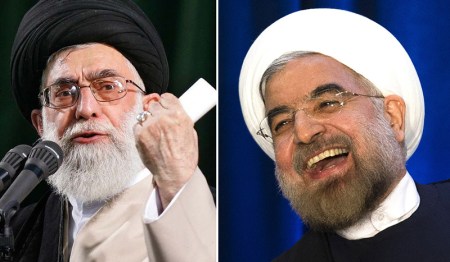
1590Iran’s Supreme Leader, Ayatollah Khamenei (left), is not giving up on the revolutionary ideological norms. He is relying on the so-called moderates, such as President Hassan Rouhani (right), to continue the process of implementing the nuclear deal in order to benefit Iran economically and ensure the regime’s hold on power.

Nevertheless, at the end of day, the key decision makers in Iran’s political establishments are Khamenei and the senior cadre of the IRGC, who prioritize Iran’s ideological and revolutionary principles. It is from them that Khamenei draws his legitimacy.

As long as the Supreme Leader is alive, one should not expect that Iran’s reintegration into the global economy to move the country to the moderate end of the spectrum, or that its anti-American, anti-Semitic sentiments and fundamentals of Tehran’s foreign policies will change.

Obama, the Iran Scam, Ben Rhodes and Public Credulity

May 8, 2016

(The views expressed in this article are mine and do not necessarily reflect those of Warsclerotic or any of its other editors. — DM)

A recent article by David Samuels at the New York Times Magazine, based on an interview with Obama’s foreign policy guru Ben Rhodes, purported to explain how, and about what, the Obama administration lied to get public support for the Iran Scam. According to the article, the principal Obama lie involved who was the Iranian president when the negotiations with Iran began. It’s much deeper and worse than that. As Paul Harvey would say, “Here’s “the rest of the story.” 

Iranian President Rouhani was elected on June 15, 2013 and assumed office on August 3d. According to Rhodes,

negotiations started when the ostensibly moderate Hassan Rouhani was elected president, providing an opening for the administration to reach out in friendship. In reality, as Samuels gets administration officials to admit, negotiations began when “hardliner” Mahmoud Ahmadinejad was still president. [Emphasis added.]

There is no necessary inconsistency — about a month and a half elapsed between Rouhani’s election and becoming the Iranian president. However, that is of little if any consequences.

Mr. Rosen, interviewed in the above video, touches, very briefly, on other problems with the Iran scam. Back in the world of reality, “we” had been negotiating with Iran during Ahmadinejad’s presidency for a couple of years, during which “we” gave Iran everything it requested. This article is intended to provide substantially more information and analysis of what happened and why during “our” secret bilateral negotiations with Iran.

The Negotiations

According to interviews with Iranian vice president and Atomic Energy Organization head Ali Akbar Salehi, translated and published by the Middle East Media Research Institute (MEMRI) on August 17, 2015, secret bilateral negotiations between the Obama and Iranian regimes had begun much earlier and included Obama’s Assistant Secretary of State, William Burns. During those negotiations, the U.S. conceded that Iran’s right to Uranium enrichment would be respected, that Iran’s missile programs would be left out of any deal and that its efforts to develop nuclear warheads and other devices would be ignored. Obama had essentially caved in to Iran’s demands even before the existence of negotiations was acknowledged.

In an interview published in the daily Iran on August 4, 2015 under the title “The Black Box of the Secret Negotiations between Iran and America,” Iranian vice president and Atomic Energy Organization head Ali Akbar Salehi, who is a senior member of Iran’s negotiation team and was foreign minister under president Ahmadinejad, revealed new details on the secret bilateral talks between Iran and the U.S. that started during Ahmadinejad’s second presidential term. According to Salehi, U.S. Secretary of Energy Dr. Ernest Moniz, whom Salehi knew from his period as a doctoral student at MIT, was appointed to the American negotiation team at Salehi’s request, a request which the Americans met within hours. [Emphasis added.]

Salehi added that Khamenei agreed to open a direct channel of negotiations between Iran and the U.S. on the condition that the talks would yield results from the start and would not deal with any other issue, especially not with U.S.-Iran relations. Following this, Salehi demanded, via the Omani mediator Sultan Qaboos, that the U.S. recognize Iran’s right to enrich uranium, and received a letter from Qaboos expressing such American recognition, which he relayed to Ahmadinejad.  [Emphasis added.]

The secret bilateral Iran-US negotiations had begun with a letter for Iran delivered to an Omani official. Salehi told an Omani intermediary.

‘I am not sure how serious the Americans are, but I will give you a note. Tell them that these are our demands. Deliver it on your next visit to Oman.’ I wrote down four clear issues, one of which was official recognition of rights to [uranium] enrichment. I figured that if the Americans were sincere in their offer, then they must agree to these four demands. Mr. Suri gave this short letter to the mediator, and stressed that these were Iran’s demands. [He added that]if the Americans wished to solve this issue, they were welcome to, otherwise dealing with White House proposals would be useless and unwarranted…

“All the demands in the letter were related to the nuclear challenge. These were issues we have always come against, such as closing the nuclear dossier [in the Security Council], official recognition of [Iran’s] right to enrich [uranium], and resolving the issue of Iran’s actions under the PMD [Possible Military Dimensions]. After receiving the letter, the Americans said: ‘We are certainly willing and able to easily solve the issues Iran has brought up.’ [Emphasis added.]

The first meeting between the Iranian and American negotiating teams began following eight months of coordination. Iran

sent a team to Oman that included the deputy foreign minister for European and American affairs, Mr. [Ali Asghar] Khaji, as well as several CEOs. The Americans were surprised in the first meeting and said, ‘We cannot believe this is happening. We thought Oman was joking. We aren’t even prepared for these talks with you.’

Q: What was the level of the team that the Americans dispatched?

A: It included Assistant Secretary of State William Burns. They said: ‘We only came to see if Iran was truly willing to negotiate.’ Our representative gave them the required response and eventually there were talks on this issue. The initial result was achieved and the ground was prepared for further coordination. [Emphasis added.]

Q: How were the Americans convinced that the Iranian diplomats who were dispatched had the necessary authority?

A: [Until] that phase, Iran and America had not been allowed to sit opposite each other at the negotiating table. The fact that Iran had sent a deputy foreign minister to the talks indicated its seriousness. The Americans also noticed how seriously [Iran was taking] the issue. At that meeting, Khaji pressed the Americans to set up a roadmap for the negotiations, and eventually the talks of a roadmap were postponed to the second meeting. At the second meeting, Khaji warned the Americans: ‘We did not come here for lengthy negotiations. If you are serious, you must officially recognize enrichment, otherwise we cannot enter into bilateral talks. But if you officially recognize enrichment, then we too are serious and willing to meet your concerns on the nuclear matter as part of international regulations.

International regulations were later agreed upon by the P5+1 negotiators, in the form of the Iran – IAEA secret deals concerning nuke inspections and a UN resolution dealing with Iranian missiles. Neither was included in the Joint Cooperative Plan of Action.

“Of course, at that time we were [still] exchanging various information with the Americans via the [Omani] mediation, and this is documented at the Foreign Ministry. We did not do it in the form of official letters, but rather unofficially and not on paper. The Omani mediator later came to Iran, held talks with us, and then later spoke to the Americans and told them our positions, so that the ties were not severed. But there was no possibility for direct talks.

Thus, a real opportunity was squandered because, at the time, the Americans were genuinely prepared to make real concessions to Iran. Perhaps it was God’s will that the process progressed like that and the results were [eventually] in our favor. In any case, several months passed and Obama was reelected in America [in November 2012]. I thought that, unlike the first time, we must not waste time in coordinating [within regime bodies], so with the leader’s backing and according to my personal decision, I dispatched our representatives to negotiate with the Americans in Oman. [Emphasis added.]

Q: Didn’t you have another meeting with the leader about the process and content of the talks?

A: No. Obviously during the process I wrote a letter to the leader detailing the problems. He said ‘try to solve them.’ He was always supportive but told me to ‘act in a manner that includes necessary coordination [within the regime]. In this situation, I dispatched Khaji to the second meeting in Oman (around March 2013) and it was a positive meeting. Both sides stayed in Oman for two or three days and the result was that the Omani ruler sent a letter to Ahmadinejad saying that the American representative had announced official recognition of Iran’s enrichment rights. Sultan Qaboos sent the same letter to the American president. When Ahmadinejad received the letter, several friends said that this move would be fruitless and that the Americans do not keep [their]  commitments. [But] we had advanced to this stage. [Emphasis added.]

. . . . We [then ] prepared ourselves for the third meeting with the Americans in order to set up the roadmap and detail the mutual commitments. All this happened while Iran was nearing the presidential elections [in June 2013]. At that time, the leader’s office told me that I had to cease negotiations and let the next government handle the talks after the results of the elections were known.

. . . .

Q: What was the Americans’ position in the first meetings between Iran and the P5+1 held during the Rohani government [era]?

A:After the Rohani government began to operate – along with the second term of President Obama – the new negotiations between Iran and the P5+1 were started. By then, Kerry was no longer an American senator but had been appointed secretary of state. As a senator, Kerry had been appointed by Obama to be in charge of handling the nuclear dossier, and then [in December 2012] he was appointed secretary of state. [Emphasis added.]

“Before that, the Omani mediator, who had close relations with Kerry, told us that Kerry would soon be appointed [U.S.] secretary of state. During the period when the secret negotiations with the Americans were underway in Oman, there was a situation in which it was easier to obtain concessions from the Americans. After the Rohani government and the American administration [of Obama’s second term] took power, and Kerry become secretary of state, the Americans spoke from a more assertive position. They no longer showed the same degree of eagerness to advance the negotiations. Their position became harder, and the threshold of their demands rose. At the same time, on the Iranian side, the situation [also] changed, and a most professional negotiating team took responsibility for negotiating with the P5+1. [Emphasis added.]

As to the reluctance of the American side to make concessions after Kerry had replaced Clinton as the Secretary of State, it must be remembered that “we” had already made all or most of the concessions Iran sought.

Another positive point was that [President] Rohani oversaw the dossier, knew its limits, and as a result succeeded in producing a good strategy to advance the nuclear dossier. At the same time, Rohani took responsibility for everything. Many may have reservations and ask why we were putting ourselves in danger, but Rohani’s willingness to take responsibility was very high. There are those who say, from a political standpoint, that he was willing to take a very great risk, because, had the negotiations not achieved certain results, and had the best results not been achieved, he would have faced waves of criticism. But he took upon himself the risk of [such] criticism. In any event, he agreed to take this responsibility, and, God be praised, even God helped him, and he emerged [from the negotiations] with his head held high.” [Emphasis added.]

At some point, the negotiations broke down over “technical issues.” Salehi, a technical expert as well as a diplomat, found a way to resolve those issues.

A . . .  condition was that American experts would come to Iran and talk to me. I said that as vice president I would not enter into a discussion with their experts, because as far as the protocol was concerned, this would create a bad situation and they would say that Iran would capitulate in any situation. This was not good for Iran, but I was willing to quit and to come to the talks not as vice president but as the foreign minister’s scientific advisor. Larijani said ‘he’s right.’ The next day, Fereydoun asked me to come to his office and asked me who my [American] counterpart was. I said, the [U.S.] Department of Energy. Fereydoun called Araghchi and said, ‘Tell [U.S. Under Secretary of State for Political Affairs] Ms. [Wendy] Sherman that Salehi is joining the negotiations provided that the American secretary of energy also joins the negotiators.‘ Araghchi and Sherman were the liaison between Iran and America. Araghchi said in this conversation with Fereydoun that on such short notice it was unlikely that they [i.e. the Americans] would send their secretary of energy. I heard [Fereydoun’s conversation with Araghchi]. In short, Fereydoun asked and Araghchi contacted Sherman and a few hours later a report that they welcomed Iran’s proposal arrived. [Emphasis added.]

Q: How many hours did it take before they [the Americans] said yes?

A: It didn’t take long. I went to see Fereydoun in the evening and the next day they responded. This was because of the time difference [between Tehran and Washington].

Q: The general perception was that because Moniz was brought into the negotiating team, you were brought into the Iranian team?

A: [On the contrary,] Moniz came because of me. In any case, in February [2015] I joined [the negotiations], and praise God, matters moved forward with Moniz.

Q: Did you and Moniz study together?

A: Moniz knew me more than I knew him. I saw him at the annual IAEA meeting. When I was a doctoral student at MIT, he had just been accepted as a staff member. He is five years older than me.

Q: Did you take one of his classes?

A: No. He knew me because my doctoral studies advisor was his close friend and right hand man in scientific fields. Even now he is an advisor on many of Moniz’s scientific programs. Many of my fellow students are now experts for Moniz. One of them was Mujid Kazimi, who is of Palestinian origin. He recently died. He was two years older than me but we were friends in college. After graduating, he became the head of the MIT Department of Nuclear Science and was a prominent figure who carried out many programs with Moniz.

Q: How did Moniz treat you initially?

A: In light of our prior acquaintance, he was excited. We’ve known each other for years and he treated [me] very well. Our first meeting was in public.

Q: How did you feel when you heard Moniz was coming [to the talks]?

A: I was very happy. I was assured. I said that the prestige of the Islamic Republic remained intact [because] an Iranian official would not speak to an American expert but rather would negotiate with a high-ranking American official. This was very important. Second, as I said before, he could make a decision [while] an expert could not. We had a very interesting group meeting. The American experts were same ones who had dealt with disarmament vis-à-vis the Soviet Union.

“I said [to Moniz]: ‘I cannot accept your offer for various reasons.’ One American expert said, ‘We do not accept the basic assumption of your calculations.’ I said, ‘Tell us what is the basic assumption of [your] calculations so we can work from there.’ He said ‘we can’t do that.’ I said to them, ‘If you don’t accept our estimation, then tell us [yours]. You say that you cannot because this [exposes] your process. If we show [our] calculation, you will know our working secrets.’ So then I said ‘ok, what do we do now?’ The meeting stagnated.

“Later I thought about it… and said ‘Mr. Moniz, I am here with full authority from my country. Anything I sign will be acceptable to my country. Do you have full authority as well, or does any result achieved here need to be asked and clarified with officials from other countries?’ He said ‘no, I have full authority.’

Q: Did you have full authority?

A: Yes. In the scientific discussions, I knew the level of [Iran’s] demands. I said, ‘Mr. Moniz, you made an offer to Iran, and Iran rejects it. I want to ask you a question. If you can answer it [then] I will have no problem with your offer.’ I continued and said: ‘Show me one place on earth where enrichment is taking place using the method you are demanding of us. If you can give me even a single example then I will sign on the spot and we will become the second country to enrich in this method.’ He looked [at me] and then announced that the meeting was over, and we spoke. We had the first private meeting that lasted two or three hours. He said: ‘Mr. Salehi, when I was called [out of the negotiating room, it was because] Obama wanted to speak to me. Now I am free [to continue]. What you said is acceptable [but] there are practical problems with your offer.’ I said, ‘Do you agree? Then I relinquish that proposal.’ Eventually. we reached mutual understandings on this issue. I said ‘let’s start from the top.’ This diplomatic challenge should be published in a memoir so that everyone can understand how we reached 6,000 centrifuges. It is a very nice story… [Emphasis added.]

The Aftermath

Ultimately, Iran’s right to enrich Uranium was fully recognized in the Joint Plan of Action (JPOA) and in the subsequent Joint Cooperative Plan of Action (JCPOA). As to the missile aspects of the  “possible military dimensions” of Iran’s nuclear program, neither document dealt with Iranian missiles. That was left up to the United Nations Security Council to deal with in its resolution approving the nuke “deal.” In light of Russia’s warm relations with Iran, Russia would most likely veto any proposed Security Council resolution finding Iran in violation of its missile provisions.

The “verification” mechanism was included only in separate and secret “side deal(s)” solely between Iran and the IAEA which members of the U.S. Congress were not permitted to see during the pseudo-approval process. According to Kerry, he was not permitted to see them either, but the details were “fully explained” to him.

Here’s a video of Secretary Kerry under questioning about the side deals:

Questions might have been better directed to this Kerry clone; more candid answers might have been provided.

As I wrote earlier, the Iranian nuke inspections are a sick joke.

Any pretense that the IAEA will have “any time, anywhere” access to Iran’s military sites was mere rhetoric, as acknowledged by US Under Secretary of State Wendy Sherman on July 16th

“I think this is one of those circumstances where we have all been rhetorical from time to time,” Sherman said in a conference call with Israeli diplomatic reporters. “That phrase, anytime, anywhere, is something that became popular rhetoric, but I think people understood that if the IAEA felt it had to have access, and had a justification for that access, that it would be guaranteed, and that is what happened.” [Emphasis added.]

Ms. Sherman was right about the rhetorical nature of administration assertions, but wrong about IAEA access, of which there will apparently be little or none pursuant to the secret deals between Iran and the IAEA.

As I observed on August 4, 2015,

In an interview on Al Jazeera TV last week Ali Akbar Velayati, Security Adviser to Iran’s Supreme Leader, stated that

United Nations nuclear inspectors from the International Atomic Energy Agency would not be given access to Tehran’s sensitive military nuclear sites.

. . . .

“First, allow me to emphasize that the issue of the missiles and of Iran’s defensive capabilities were not part of the negotiations to begin with,” Velayati said. [Emphasis added.]

“No matter what pressure is exerted, Iran never has negotiated and never will negotiate with others – America, Europe, or any other country – about the nature and quality of missiles it should manufacture or possess, or about the defensive military equipment that it needs. This is out of the question.” [Emphasis added.]

. . . .

Reza Najafi, Iran’s ambassador and permanent envoy to the IAEA, stated over the weekend that “no country is permitted to know the details of future inspections conducted by the IAEA.” [Emphasis added.]

Najafi’s statement could mean (a) that no details about inspection methodology will be disclosed, (b) that no details about inspection results will be disclosed or (c) both. If inspection methodologies — who did the inspections as well as when, where and how, are not disclosed, what useful purpose will they serve, other than for Iran? If details of the results of inspections are not disclosed, that will also be the case. How, in either or both cases, will the members of the P5+1 negotiating teams have sufficient information to decide whether to “snap back” sanctions — if doing so is now even possible — or anything else? [Emphasis added.]

Conclusions

One can only hope that our next president will dispose of the Iranian “deal” as a treaty which Obama refused to submit to the Congress as the Constitution requires or at least ostentatiously ignore it and grant no more concessions.

Otherwise, be not afraid; Obama the Great One — the smartest person in any room and the best President ever — has made us safe. How can one possibly be safer alive than dead?