Posted tagged ‘Iran – regime change’

In Iran, A Nationwide Teachers’ Demonstration

March 13, 2017

In Iran, A Nationwide Teachers’ Demonstration, American ThinkerHassan Mahmoudi, March 13, 2017

Amid ballistic missile tests by Iran’s Revolutionary Guard and continued economic and political isolation, Iran’s domestic unrest is escalating.

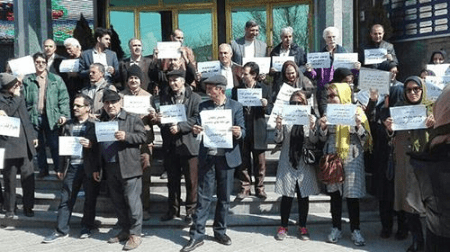
Simultaneous protests of thousands of angry teachers in more than 22 cities broke out in Iran on Thursday, March 9. The nationwide teachers’ demonstration took place in Tehran, Mashhad, Bojnourd, Ferdows, Torbat-heidaria, Mazandaran, Sanandaj, Saqqez, Marivan, Qorveh, Tabriz, Ardebil, Zanjan, Shiraz, Bushehr, Isfahan, Kermanshah, Kangan, Dehgolan, Lordegan, Ahwaz and Aligudarz.

The demonstrators held a sit-in in front of the local branch of the ministry of education buildings, calling for their demands to be met. They chanted slogans against suppression, repression and plundering policies of the ruling mullahs in Iran. They were holding placards that read:  ‘Detained Teachers Must be Freed,’  ‘NO to Prison,’ ‘Teachers’ future must be secured.’ See the photo at right.

According to Iranian Opposition (MEK) report, in Tehran, more than 1,000 teachers, as well as the families of political prisoners, and staff from the Ministry of Education demonstrated in front of the Iranian regime’s parliament, demanding proper jobs and security.  In today’s teachers gathering, one of the security force members of parliament tried to confiscate the smartphone of one of the protestors in a provocative manner, but he was pushed back by the protestors.

In what was an act of bravery for the teachers in Esfahan, they chanted: ‘Teachers are ready to die but wouldn’t be bullied by the government.’ The photo is below.

In Shiraz, the protesting teachers sat at a table with no food on it, in a symbol of their poor economic condition. The problem is so bad many are severely suffering from food insecurity. They said they are unable to feed themselves or their children with the meager wages and salaries they are getting. They had placards that read: ‘Teachers must rise to end the discrimination and a petty monthly salary.’

In some cities, the special anti-riot guards had surrounded the protesting teachers, but the protestors ignored the intimidation and continued with their protest for hours. Passersby hailed the protestors and paid sympathy and tributes to them as they signaled their hatred of the regime.

The security forces prevented any passerby from stopping in the street. The protestors were holding placards that read: ‘We will not rest until we get our rights.’

Teachers in Sanandaj demanded an end to the rising instances of torture and the high number of executions of the mullahs’ government.

In Kermanshah, in southwestern Iran, the presence of female teachers was remarkable in the streets of that city. The suppressive security forces were trying to prevent the demonstration but failed miserably. The protestors continued to protest there and had placards that read: ‘Discrimination and inequality must end.’ ‘We are crying out of poverty and frustrated of discrimination’,

In their final statement, the protestors condemned the exiles and expulsions of teachers for teaching and speaking out, and demanded the freedom of teachers, especially the freedom of Mr. Baghani who is a known teacher in Kermanshah.

In Ardebil, northwestern Iran, the protesting teachers were chanting: ‘Teachers are willing to die but not to submit to discrimination.’ They demanded unpaid wages and benefits.

According to the National Council of Resistance of Iran (NCRI) roundup report of February 2017 on the teachers’ protests, there were 13 protests classified as cultural. Statistics for the month showed a slight increase from January.

Protests were over the lack of salary increases, lack of equalization of retirement wages and lack of formal employment. Also, a group of teachers published a text about the prosecution of Jafar Azim Zadeh. Teachers who retired in 2016 gathered in front of parliament to demand their 30-year employment bonus.

Maryam Rajavi, President-elect of the Iranian Resistance, in her last statement regarding the teachers’ protest “hailed the noble teachers who have staged protest gatherings in various parts of the country to attain their lawful rights and to protest the oppressive and criminal measures by the mullahs’ regime. She called on the nation, especially the students and their parents and the youth throughout the country to support and express solidarity with teachers.

Rajavi said: In circumstances where the clerical regime spends most of the Iranian people’s wealth on suppression, export of terrorism, the massacre of peoples in Syria, Iraq, Yemen and Lebanon, the bottomless and anti-patriotic nuclear projects, or which funnels this wealth to the bank accounts of regime’s leaders and their families, the hard-working and noble teachers of the country that play the greatest role in building the future of Iran are living in poverty and face the most hardship in their lives.”


Tehran Relies on Propaganda to Make up For Misallocation of Funds to Foreign Conflicts

March 10, 2017

Tehran Relies on Propaganda to Make up For Misallocation of Funds to Foreign Conflicts, Iran News Update, March 10, 2017

(Please see also, Time to Call Iran’s Revolutionary Guards What They Are: Terrorists. — DM)

[R]ecently released intelligence strongly suggests that the supreme leader and hardline authorities like the Islamic Revolutionary Guard Corps bear a great deal of responsibility for the economic struggles of Iranian citizens, as a result of the systematic misappropriation both of budgetary funds and financial resources earned through Iran’s private sector. On Wednesday, the National Council of Resistance of Iran held a panel discussion coinciding with the release of an e-book titled, The Rise of the Revolutionary Guards’ Financial Empire.

In both the discussion and the document, the leading Iranian opposition group explained that a recent push toward widespread privatization of the Iranian economy has actually resulted in the private acquisition of more than half of the country’s gross domestic product by front companies and other affiliates of the IRGC and the supreme leader himself.

********************

On Friday, Reuters picked up on reporting in Iranian state media which noted that Supreme Leader Ali Khamenei had once again voiced criticism of President Hassan Rouhani’s handling of the nation’s economy following the nuclear agreement that went into effect at the beginning of last year. The supreme leader’s remarks appeared to specifically highlight the ongoing struggles of the Iranian people, who are experiencing poverty at a rate of at least nine percent and likely much higher.

“Of course the government has taken remarkable steps but if the resistance economy had been implemented fully and widely, we could witness a tangible difference in people’s lives,” Khamenei was quoted as saying. In previous months, he had already called for the renewal of his own “resistance economy” plan, which involves domestic development aimed at making the nation more capable of weather the storm of international economic sanctions, as distinguished from Rouhani’s plan of reaching out to Western powers in order to alleviate those sanctions.

Khamenei’s recommendations thus serve a dual purpose. In the first place, they further undermine the prospects for further rapprochement between the Islamic Republic and the West. And secondly, they defray blame for economic woes away from the supreme leader’s office and its hardline affiliates, putting it instead onto the Rouhani administration, which faces a contentious reelection bid in May.

But recently released intelligence strongly suggests that the supreme leader and hardline authorities like the Islamic Revolutionary Guard Corps bear a great deal of responsibility for the economic struggles of Iranian citizens, as a result of the systematic misappropriation both of budgetary funds and financial resources earned through Iran’s private sector. On Wednesday, the National Council of Resistance of Iran held a panel discussion coinciding with the release of an e-book titled, The Rise of the Revolutionary Guards’ Financial Empire.

In both the discussion and the document, the leading Iranian opposition group explained that a recent push toward widespread privatization of the Iranian economy has actually resulted in the private acquisition of more than half of the country’s gross domestic product by front companies and other affiliates of the IRGC and the supreme leader himself.

The Washington Times reported upon some of the findings presented in that document, emphasizing the fact that the regime is using these privately acquired assets to channel billions of dollars into regional terrorism, paramilitary activities, and weapons development. The article notes that the intelligence gathered by the People’s Mojahedin Organization of Iran found that approximately 100 billion dollars was being spent annually just on salaries for militant fighters in the Syrian Civil War.

The Washington Times credits the NCRI with presenting a clear warning to Western businesses and policymakers. And the document itself says, “Foreign investors cannot in practical terms avoid entanglement by affiliation in the Iranian regime’s behavior, including its support for terrorism, continued aggressive policies towards regional countries, manufacture and testing of ballistic missiles, and systematic egregious human rights violations inside Iran.”

To critics of Iran’s clerical regime, this entanglement is worrying in its own right because of Tehran’s traditional behavior. And it is made more worrying by the fact that the above-mentioned ballistic missile program is being used alongside other types of weapons as a tool of explicit anti-Western propaganda.

This fact was highlighted once again on Friday when the Associated Press reported that General Amir Ali Hajizadeh, the head of the IRGC’s aerospace division, had boasted of the successful testing of another ballistic missile. The launch was aimed at naval targets and took place amidst three days of large-scale training exercises by the Iranian Navy, which is separate from the naval forces of the IRGC.

The IRGC conducted its own naval operations the previous week, and both demonstrations were accompanied by boastful rhetoric about readiness for war with proclaimed enemies including the United States. In a separate example of the same propaganda trends, Iran also premiered an animated film depicting a military officer modeled after IRGC Quds Force commander Qassem Suleimani leading a small number of Iranian vessels in destroying a much larger American fleet.

In January, the IRGC conducted the test launch of a nuclear-capable ballistic missile barely a week after the inauguration of US President Donald Trump. Such tests take place in defiance of a UN Security Council resolution calling on Iran to refrain from work on weapons that could carry a nuclear warhead, but a half dozen other such launches had been carried out before Trump was inaugurated but after the conclusion of nuclear negotiations between Iran and the five permanent members of the Security Council plus Germany.

The January incident was apparently the immediate impetus for a statement by the Trump administration putting Iran on notice over its provocative behavior. But various observers including US Navy officers have declared that that behavior remains unchanged, and that the IRGC continues to act unprofessionally and confrontationally in the region. Last weekend, for instance, several fast-attack vessels belonging to the IRGC positioned themselves about 600 yards away from a US Navy surveillance ship and three British vessels, compelling them to change course.

The AP reported on Friday that Iranian officials had since made exactly the opposite claim about the incident: that the American and British vessels had changed course specifically to approach the Iranian boats. But considering that this is at odds with the accounts of various other Iranian-initiated close-encounters, it seems to suggest an effort on Tehran’s part to justify its missile tests and defiant rhetoric, by suggesting that the US is the more aggressive party.

Assuming that this particular Iranian claim is indeed a deceptive one, it is certainly not the only one of its kind. The ongoing propaganda campaign also appears to involve an effort to present Iran as being much better positioned than it is for global conflict. This is suggested by the aforementioned film and the statements accompanying military demonstrations and missile tests. But the tendency is perhaps much more clearly on display in allegedly false Iranian claims of advanced weapons development.

The National Interest recently pointed to this phenomenon as it concerns the Qaher F-313 fighter jet, which is supposedly equivalent to an American F-35 stealth fighter, and which Iranian Defense Minister Hossein Dehqan claimed was ready for operational testing. In fact, independent analyses of photographs of the craft are broadly in agreement that it is merely a non-functional mockup, and a poorly structured one, at that.

Similar claims have been made about other Iranian weapons and equipment, including drones supposedly cloned from captured American technology. Other military hardware unveiled by the Iranian Army and the Revolutionary Guards has been shown to be little more than outmoded technology affixed with purely cosmetic upgrades. But to the extent that the regime is able to use its tightly controlled state media to present these so-called developments to a domestic audience, it may evoke a more war-ready image of Iran than is defensible in reality.

What’s more, this messaging dovetails with Supreme Leader Khamenei’s statements on the Iranian economy, insofar as it suggests Iran is capable of greater-than-expected domestic military development, while also concealing the fact that much of the country’s military allotment is being spent in foreign territory like Syria and Yemen instead of on advanced domestic development, whether military or civilian.


Time to Call Iran’s Revolutionary Guards What They Are: Terrorists

March 10, 2017

Time to Call Iran’s Revolutionary Guards What They Are: Terrorists, American ThinkerReza Shafiee, March 10, 2017

What is missing in all the talks and arguments made in Washington as to what is an effective remedy to counter the mullahs in Iran is the role of Iranian people. Iran is boiling with popular discontent, now. According to Brigadier General Hossein Ashtari, the Iranian regime’s chief of police: “On average 20 to 30 protest gatherings take place around the country by citizens who have lost their life savings to the banks,” These citizens are mainly retired with very limited savings and were scammed out of their lifetime savings by various government-owned financial institutions.  Such protests are but a drop in the ocean when we add the teachers, nurses, factory workers, and an army of college graduates with no prospects of finding decent jobs to the discontent. This amounts to tens of thousands of people, in large numbers of gatherings each year. According to a BBC report, more than 11 million or Iran’s 83 million people are unemployed in the country.

*********************************

Ever since signs emerged that Trump administration is considering a long-overdue classification of Iran’s Islamic Revolutionary Guard Corps (IRGC) as a terrorist organization, the ruling mullahs have gone to work. They put into place a well-known strategy of intimidation and deception aboard, coupled with an absolute iron fist at home. They do this because they know the value of controlling a terrorist organization. The problem is in the harm it means for everyone else.

In the past, the Supreme Leader, Ayatollah Ali Khomeini, would brandish the former by reminding Western governments that if they chose to cross Tehran then they must be prepared to pay dearly. But that was decades ago. One fact is undisputable now: The Iranian regime has long passed its prime revolutionary and glory days when Khomeini rode in on the tides of millions who were sadly unaware of what was to come. In those days, people tasted a short-lived period of high expectations, at the time wildly called “spring of freedom.”

At the same time, hostage-taking by IRGC’s protégés, such as nascent Lebanese Hezbollah, of foreign nationals, preferably Americans, was routine. The ayatollahs were behind it even though it often took place in Lebanon. After each kidnapping, IRGC’s proteges then engaged hostages’ governments in a lengthy and humiliating process of hostage negotiations and sometimes hostage swaps in the 1980s.

Today the IRGC has made it much more convenient to reach the same ends by taking the hostages among dual citizens who take the risk of traveling to Iran. Case in point was hostages released just after Iranian regime struck the nuclear deal with the U.S. and five other world powers. IRGC’s deputy chief, Brigadier General Hossein Nejat, in a speech in Bushehr (south of Iran), said: “The Iranian-American journalist of the Washington Post, Jason Rezaian, who had formed an espionage network was identified and arrested by the IRGC.”

Hossein Nejat stated: “The former Secretary of State, John Kerry with his intelligence forces urged the Iranian Foreign Minister, Mohammad Javad Zarif to release Jason Rezaian. Consequently, the U.S. government in return paid 1 billion and 400 million dollars ransom to Iran for the release of Jason Rezaian.”

Other IRGC officials, on different occasions after the hostages were released, have bragged that the Obama administration released Iranian prisoners in the United States and on top of that paid a hefty sum as ransom money.

In past few weeks, despite attempts by regime officials, such as Zarif, to keep a low profile while anxiously monitoring Donald Trump’s every move, IRGC is actively scheming. It raised the prize on Salman Rushdie’s head, showcased and glorified old terrorists such as Anis-Alnaghash on state-run television and openly threatened the U.S.

CNC News revealed on Feb. 28 that an IRGC strategist, Hassan Abbasi renewed threats that the force has planned to unleash terror cells on U.S. soil. He has elaborated plans to sabotage nuclear plants in the United States among other things. Ironically, at the same time, IRGC has claimed that it is fighting terrorism in neighboring countries.

Javad Zarif has recently said: “the world at large agrees that the IRGC has extended the utmost support for neighboring countries in their fight against terrorism.”

Zarif seemingly refers to IRGC’s destructive and brutal role in Syria and is trying to sell it as constrictive. According to IRGC’s own figures, more than 1,000 members of its rank and file have been killed in cities around the war-torn country.  Many were veteran IRGC officers. The Iranian regime claims that it has only an advisory role in Syria, however it has recruited and dispatched thousands of Afghani and Pakistani nationals to Syrian fronts. Not one has fought ISIS.

On March 2, Brigadier General Ismail Ghaani, who is deputy Quds Force commander, speaking in the northeastern city of Mashhad, told a group from the Fatemiyoun Division, an offshoot of the force fighting in Syria: “Fatemiyoun proved that it is a capable force ready to operate not only in Syria but anywhere else on the planet when Islam requires it.” Fatemiyoun was formed of Afghani recruits, along with its sibling organization Zenabiyoun Division of Pakistanis.

The Iranian regime today makes it no secret that it is heavily involved in Syria and Iraq. It sugarcoats its involvement with the illusion that IRGC and its armed wing, the Quds Force, are fighting ISIS. But it’s not true. After almost six years of involvement in the bloody civil war in Syria, it is out in the open that the regime has no quarrel with ISIS. Former Secretary of State John Kerry said in an interview with Fox News: “Assad facilitated the release of 1,500 prisoners, parallel to 1,000 by Maliki in Iraq, leading to the foundation of ISIS.”  Former U.S. ambassador to Iraq, James Jeffrey, said that Americans knew what Prime Minister Maliki was up to, but chose not to take any action.

It is also a hard fact that Maliki was in every way a puppet of the Iranian regime. He was trained by the IRGC and fought alongside its forces during the 1980-1988 Iran-Iraq war.

What is missing in all the talks and arguments made in Washington as to what is an effective remedy to counter the mullahs in Iran is the role of Iranian people. Iran is boiling with popular discontent, now. According to Brigadier General Hossein Ashtari, the Iranian regime’s chief of police: “On average 20 to 30 protest gatherings take place around the country by citizens who have lost their life savings to the banks,” These citizens are mainly retired with very limited savings and were scammed out of their lifetime savings by various government-owned financial institutions.  Such protests are but a drop in the ocean when we add the teachers, nurses, factory workers, and an army of college graduates with no prospects of finding decent jobs to the discontent. This amounts to tens of thousands of people, in large numbers of gatherings each year. According to a BBC report, more than 11 million or Iran’s 83 million people are unemployed in the country.

When it comes to Iran, the decision-makers in Washington have two options: One is to follow the status quo and tolerate a regime which is the number one state sponsor of terrorism in the world, a stirrer of sectarian violence in the region, and engaged in two wars in Iraq and Syria. It’s a nation that secretly supplies weapons to Yemen’s Houthis which has also cost American servicemen’s lives. If the Trump administration chooses this option, it will make the same mistakes the Obama administration made.

The other, and better, option is to stand with Iranian people and their resistance, to let them shape their own future. All they asked of U.S. in 2009 was for the U.S. to stand with them. At the time, they chanted: “Obama are you with us or with them.” They clearly hoped the U.S. would not placate mullahs with concessions, nor turn a blind eye to regime’s terrorism.

One such good signal in the right direction would be to designate IRGC as a terrorist organization.  In light of all it has done and its growing strength, in designating the IRGC as a terrorist group, we are doing ourselves a favor.

Reza Shafiee is a member of Foreign Affairs Committee of the National Council of Resistance of Iran (NCRI) 

Iran in Crisis

March 5, 2017

Iran in Crisis, American ThinkerHeshmat Alavi, March 5, 2017

(Please see also, Mullahs’ Nightmare: Huge Demonstration Breaks Out In Tehran. — DM)

Forecasting what lies ahead is truly impossible, making Khamenei and his entire regime extremely concerned, trekking this path very carefully and with a low profile. As we witnessed with the inauguration of Ronald Reagan, Iran immediately released the 52 hostages held for 444 days.

This regime understands the language of force very carefully. And yet, there is no need to use military force to inflict a significant blow and make Tehran understand the international community means business. Blacklisting Iran’s IRGC as a terrorist organization by the U.S. at this timing would be the nail in the coffin for the mullahs.

********************************

The recent dust storms that wreaked havoc in southwest Iran signaled only one of the many crises the mullahs are facing less than three months before critical elections. Tehran has been hit with severe blows during the Munich Security Conference, contrasting interests with Russia, the recent escalating row with Turkey, and most importantly, a new U.S. administration in Washington.

These crises have crippling effects on the mullahs’ apparatus, especially at a time when Iranian Supreme Leader Ali Khamenei sees his regime facing a changing balance of power in the international community, and is faced with a major decision of selecting the regime’s so-called president.

Iran and Ahvaz

The dust storms crisis in Ahwaz, resulting from the mullahs’ own destructive desertification policies, caused severe disruptions in water and power services and people pouring into the streets in major protests.

The regime, and especially the Revolutionary Guards (IRGC), has for decades pursued a desertification policy of constructing dams, drying lagoons, digging deep oil wells beneath underground water sources with resulting catastrophic environmental disasters. Various estimates indicate the continuation of such a trend will literally transform two-thirds of Iran into desert lands in the next decade. This will place 14 to 15 million people at the mercy not only dust storms but also salt storms.

Iran and the Munich Security Conference

Iranian Foreign Minister Mohammad Javad Zarif attended this conference with a series of objectives in mind, only to face a completely unexpected scene. U.S. Vice President Mike Pence described Iran as the world’s leading state sponsor of terrorism. Saudi Arabia Foreign Minister Adel al-Jubeir said the mullahs are the source of threats and instability throughout the Middle East. Turkey went one step further and said Tehran is the heart of sectarianism and spreads such plots across the region, and all traces in Syria lead to Iran’s terrorism and sectarian measures.

This resembles a vast international coalition against Tehran, inflicting yet another blow to the mullahs following a new administration taking control of the White House. These developments are very costly for Khamenei and the entire regime.

In comparison to the early 2000s when the U.S. launched wars against Afghanistan and Iraq, Iran was the main benefactor. The current balance of power now is quite different, as seen in Munich. While there is talk of an Arab NATO, any coalition formed now in the Middle East will be completely against Iran’s interests.

Iran and Russia

Following a disastrous joint campaign in Syria, for the first time Russia is reportedly supporting a safe zone in Syria. Russian Deputy Foreign Minister Mikhail Bogdanov said contacts have been made with the Syrian regime to establish safe zones in Syria. These are the first remarks made by any Russian official on the issue of safe zones in Syria.

Moscow’s increasing contrast in interest with Iran over Syria has the potential of playing a major role in regional relations. Russia certainly doesn’t consider Bashar Assad remaining in power as a red line, a viewpoint far different from that of Iran. Moscow is also ready to sacrifice its interests in Syria in a larger and more suitable bargain with the Trump administration over far more important global interests.

Iran and Turkey

Yes, Ankara and Tehran enjoy a vast economic partnership. However, recent shifts in geopolitical realities have led to significant tensions. Turkish President Recep Tayyip Erdogan accused the mullahs of resorting to “Persian nationalism” in an effort to split Iraq and Syria.

Turkish Foreign Minister Mevlut Cavusoglu accused Iran of seeking to undermine Bahrain and Saudi Arabia as part of Tehran’s “sectarian policy.” Cavusoglu used his speech in Munich to say, “Iran is trying to create two Shia states in Syria and Iraq. This is very dangerous. It must be stopped.”

Tehran considers Ankara’s soldiers in Iraq and Syria as a major obstacle in its effort to expand its regional influence.

U.S. president Donald Trump’s strong approach vis-à-vis Iran and the possibility of him supporting the establishment of a Turkish-administered northern Syria safe zone may have also played a major part in fuming bilateral tensions between these two Middle East powers.

Erdogan has obviously realized completely the new White House in Washington intends to adopt a much more aggressive stance against Tehran. This is another sign of changing tides brewing troubles for Iran’s mullahs.

Iran and Presidential Elections

With new reports about his ailing health, Khamenei is extremely concerned about his predecessor. One such signal is the candidacy of Ibrahim Reisi, current head of the colossal Astan Quds Razavi political empire and a staunch loyalist to Khamenei’s faction, for the presidency. With former Iranian president Ali Akbar Hashemi Rafsanjani out of the picture, Khamenei may seek to seal his legacy by placing Reisi against Iranian president Hassan Rouhani in the upcoming May elections.

This is literally Khamenei playing with fire, as Reisi is considered a hardline figure and such an appointment may spark 2009-like protests across the country, as the country has become a scene of massive social challenges. Rouhani himself doesn’t enjoy any social base support, especially after four years of lies and nearly 3,000 executions.

Final Thoughts

This places the entire regime in a very fragile situation. From the internal crises of Ahwaz, the upcoming elections and the formation of a significant international front threatening the Iranian regime’s strategic interests.

Forecasting what lies ahead is truly impossible, making Khamenei and his entire regime extremely concerned, trekking this path very carefully and with a low profile. As we witnessed with the inauguration of Ronald Reagan, Iran immediately released the 52 hostages held for 444 days.

This regime understands the language of force very carefully. And yet, there is no need to use military force to inflict a significant blow and make Tehran understand the international community means business. Blacklisting Iran’s IRGC as a terrorist organization by the U.S. at this timing would be the nail in the coffin for the mullahs.


Iranian Regime gets desperate; holds 300 exhibitions against MEK

February 13, 2017

Iranian Regime gets desperate; holds 300 exhibitions against MEK, Iran Focus, February 13, 2017

(Will President Trump work with the MEK for regime change in Iran? Should he? — DM)

mek-750

London, 13 Feb – The Iranian Regime held 300 exhibitions against the resistance group, MEK, in an increasingly desperate attempt to smear the Iranian Opposition.

This is believed to be in response to a report by the Regime’s Ministry of Intelligence which detailed the power of the People’s Mojahedin Organization of Iran (PMOI or MEK) and the progress they have made.

The report noted that young people are far more likely to side with the Resistance and that the Iranian Resistance is highly respected both at home and abroad.

Hashemi Nejad the director general of the state-funded foundation, Habilian, said: “We have held 300 exhibitions against MEK in Iran up to now. These days, MEK is getting recognised as a leading institute in Human Rights, our duty is to discuss Human Rights issues against MEK since Iranian youths are the target of MEK.”

The report noted that the MEK favoured regime change and the removal of the Iranian mullahs, but the MEK have never made a secret of that.

It also highlighted that the MEK had assisted the West by revealing Iran’s secret nuclear missiles programme.

They noted that in order to stop the youth from joining the MEK, the Regime would have to present a totally warped view of the Resistance Forces, which is what they have attempted to do with the exhibitions.

The National Council of Resistance of Iran (NCRI) noted in their recap of the report, that it was weird to hear the Regime admit that they had been trounced by the Resistance in terms of support from the Iranian people.

They wrote: “The truth is that after the regime was unable to destroy the MEK by inhumane siege and missile attacks and Mojahedin were able to maintain the integrity of their organisation and transfer themselves to a safe place, the regime is frightened now. That is why the mullahs regularly yowl and whimper about the danger of Mojahedin.”

They continued: “This fear and sense of danger is particularly due to the fact that the power and cohesion of the People’s Mojahedin Organization of Iran has coincided on the one hand with the weakness and ultimate decay of the Velayat-e faqih regime and the crises engulfing the regime, and on the other hand by the fact that Iran’s society is on the verge of explosion and ready for uprising and revolution and is only waiting for a spark.”

More about the People’s Mojahdin Organization of Iran (PMOI/ MEK)

The People’s Mojahedin Organization of Iran (Also known as MEK, or Mujahedin-e-Khalq / Mujahedeen-e-Khalq), was founded on September 6, 1965, by Mohammad Hanifnejad, Saeed Mohsen, and Ali-Asghar Badizadgan. All engineers, they had earlier been members of the Freedom Movement (also known as the Liberation Movement), created by Medhi Bazargan in May 1961.1

The MEK’s quest culminated in a true interpretation of Islam, which is inherently tolerant and democratic, and fully compatible with the values of modern-day civilization. It took six years for the MEK to formulate its view of Islam and develop a strategy to replace Iran’s dictatorial monarchy with a democratic government.

MEK’s interpretation of Islam

The theocratic mullah regime in Iran believe interpreting Islam is their exclusive domain. The MEK reject this view and the cleric’s reactionary vision of Islam. The MEK’s comprehensive interpretation of Islam proved to be more persuasive and appealing to the Iranian youth.

MEK’s founders and new members studied the various schools of thought, the Iranian history and those of other countries, enabling them to analyze other philosophies and ideologies with considerable knowledge and to present their own ideology, based on Islam, as the answer to Iran’s problems.

MEK’s leadership’s arrest during the 70s.

The Shah’s notorious secret police, SAVAK, arrested all MEK leaders and most of its member’s in1971. On May 1972, the founders of the MEK, Mohammad Hanifnejad , Saeed Mohsen and Ali Asghar Badizadegan, along with two members of the MEK leadership, Mahmoud Askarizadeh and Rasoul Meshkinfam, were put before death squads and were executed after long months of imprisonment and torture. They were the true vanguards, who stood against the dictatorial regime of Shah. However, they are also recognized for their opposition to what is today known as Islamic fundamentalism.

The death sentence of Massoud Rajavi, a member of MEK’s central committee, was commuted to life imprisonment as a result of an international campaign by his Geneva based brother, Dr. Kazem Rajavi (assassinated in April 1990 in Geneva by mullahs’ agents) and the personal intervention of the French President Georges Pompidou and Francois Mitterrand. He was the only survivor of the MEK original leadership.

Massoud Rajavi’s critical role in characterizing religious extremism

From 1975 to 1979, while incarcerated in different prisons, Massoud Rajavi led the MEK’s struggle while constantly under torture for his leading position.

Massoud Rajavi stressed the need to continue the struggle against the shah’s dictatorship. At the same time, he characterized religious fanaticism as the primary internal threat to the popular opposition, and warned against the emergence and growth of religious fanaticism and autocracy. He also played a crucial role when some splinter used the vacuum in the MEK leadership who were all executed or imprisoned at the time, to claim a change of ideology and policy. Massoud Rajavi as the MEK leader condemn these individual’s misuse of MEK’s name while continuing to stress the struggle against dictatorship. His efforts while still in prison forced these individuals to no longer operating under the name of MEK and adopting a different name for their group. These positions remained the MEK’s manifesto until the overthrow of the shah’s regime.

Release of Political Prisoners on the last days of the Shah

A month before the 1979 revolution in Iran, the Shah was forced to flee Iran, never to return. All democratic opposition leaders had by then either been executed by the Shah’s SAVAK or imprisoned, and could exert little influence on the trend of events. Khomeini and his network of mullahs across the country, who had by and large been spared the wrath of SAVAK, were the only force that remained unharmed and could take advantage of the political vacuum. In France, Khomeini received maximum exposure to the world media. With the aid of his clerical followers, he hijacked a revolution that began with calls for democracy and freedom and diverted it towards his fundamentalist goals. Through an exceptional combination of historical events, Shiite clerics assumed power in Iran.

Khomeini’s gradual crackdown on MEK in fear of their popular support

In internal discourses, Rajavi the remaining leader of the MEK, argued that Khomeini represented the reactionary sector of society and preached religious fascism. Later, in the early days after the 1979 revolution, the mullahs, specifically Rafsanjani, pointed to these statements in inciting the hezbollahi club-wielders to attack the MEK.

Following the revolution, the MEK became Iran’s largest organized political party. It had hundreds of thousands of members who operated from MEK offices all over the country. MEK publication, ‘Mojahed’ was circulated in 500,000 copies.

Khomeini set up an Assembly of Experts comprised of sixty of his closest mullahs and loyalists to ratify the principle of velayat-e faqih (absolute supremacy of clerical rule) as a pillar of the Constitution. The MEK launched a nationwide campaign in opposition to this move, which enjoyed enormous popular support. Subsequently, the MEK refused to approve the new constitution based on the concept of velayat-e faqih, while stressing its observance of the law of the country to deny the mullahs any excuse for further suppression of MEK supporters who were regularly targeted by the regime’s official and unofficial thugs.

Khomeini sanctioned the occupation of the United States embassy in 1979 in order to create an anti-American frenzy, which facilitated the holding of a referendum to approve his Constitution, which the MEK rejected.

MEK’s endeavors to participate in the political process avoiding an unwanted conflict with government repressive forces

The MEK actively participated in the political process, fielding candidates for the parliamentary and presidential elections. The MEK also entered avidly into the national debate on the structure of the new Islamic regime, though was unsuccessful in seeking an elected constituent assembly to draft a constitution.

The MEK similarly made an attempt at political participation when [then] Massoud Rajavi ran for the presidency in January 1980. MEK’s leader was forced to withdraw when Khomeini ruled that only candidates who had supported the constitution in the December referendum – which the MEK had boycotted- were eligible. Rajavi’s withdrawal statement emphasized the MEK’s efforts to conform to election regulations and reiterated the MEK’s intention to advance its political aims within the new legal system”. (Unclassified report on the People’s Mojahedin Organization of Iran(PMOI/ MEK) by the Department of State to the United States House of Representatives, December 1984.)
However, the MEK soon found itself in a direct struggle against the forces of the regime’s Supreme leader. The MEK’s differences with Khomeini dated back to the 1970s, and stem from its opposition to what is known today as Islamic extremism. Angry at the position taken by the MEK against his regime and worried about the MEK’s growing popularity, Khomeini ordered a brutal crackdown against the MEK and its supporters. Between 1979 and 1981, some 70 MEK members and sympathizers were killed and several thousand more were imprisoned by the Iranian regime.

June 20, 1981- Khomeini’s order to open fire on peaceful demonstration of half-a-million supporters of MEK

The turning point came on 20th June 1981, when the MEK called a demonstration to protest at the regime’s crackdown, and to call for political freedom which half-a-million supporters participated at. Khomeini ordered the Revolutionary Guards to open fire on the swelling crowd, fearing that without absolute repression the democratic opposition (MEK) would force him to engage in serious reforms – an anathema as far as he was concerned; he ordered the mass and summary executions of those arrested.

Since then, MEK activists have been the prime victims of human rights violations in Iran. Over 120,000 of its members and supporters have been executed by the Iranian regime, 30,000 of which, were executed in a few months in the summer of 1988, on a direct fatwa by Khomeini, which stated any prisoners who remain loyal to the MEK must be executed.

Having been denied its fundamental rights and having come under extensive attack at the time that millions of its members, supporters and sympathizers had no protection against the brutal onslaught of the Iranian regime, the MEK had no choice but to resist against the mullahs’ reign of terror.

“Towards the end of 1981, many of the members of the MEK and supporters went into exile. Their principal refuge was in France. But in 1986, after negotiations between the French and the Iranian authorities, the French government effectively treated them as undesirable aliens, and the leadership of the MEK with several thousand followers relocated to Iraq.” (Judgment of the Proscribed Organizations Appeal Commission, November 30, 2007.)

MEK Today

The MEK today is the oldest and largest anti-fundamentalist Muslim group in the Middle East. It has been active for more than a half century, battling two dictatorships and a wide range of issues. The MEK supports:

• Universal suffrage as the sole criterion for legitimacy

• Pluralistic system of governance

• Respect for individual freedoms

• Ban on the death penalty

• Separation of religion and state

• Full gender equality

• Equal participation of women in political leadership. MEK is actually led by its central committee consist of 1000 women.

• Modern judicial system that emphasizes the principle of innocence, a right to a defense, and due process

• Free markets

• Relations with all countries in the world

• Commitment to a non-nuclear Iran

The MEK remains a strong and cohesive organization, with a broad reach both worldwide and deep within Iran. MEK is the leading voice for democracy in Iran, supported by its interpretation of Islam that discredits the fundamentalist mullahs’ regime.
After Trump Inauguration, Netanyahu Wastes No Time Putting Iran Back on Agenda

January 21, 2017

After Trump Inauguration, Netanyahu Wastes No Time Putting Iran Back on Agenda, Jerusalem PostHerb Keinon, January 21, 2017

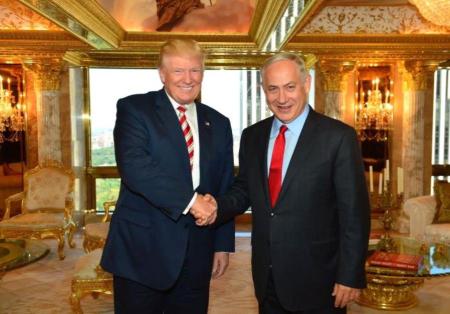
bibiandtrumpDonald Trump and Benjamin Netanyahu meet at the Trump tower. (photo credit:KOBI GIDON / GPO)

“This ruthless regime continues to deny you your freedom,” Netanyahu said in the English video, accompanied by Farsi subtitles.  “It prevents thousands of candidates from competing in elections, it steals money from your poor to fund a mass murderer like [Syrian President Bashar] Assad. By calling daily for Israel’s destruction, the regime hopes to instill hostility between us. This is wrong. We are your friend, not your enemy.”

***************************

Just 24 hours after US President Donald Trump spoke in his inaugural address about the need to eradicate radical Islamic terrorism, Prime Minister Benjamin Netanyahu put a brief video clip on social media aimed at placing the Iranian threat squarely back on the international agenda.

“I plan to speak soon with President Trump about how to counter the threat of the Iranian regime, which calls for Israel’s destruction,” Netanyahu said in the two-and-a-half minute video addressed directly to the Iranian people.

“This ruthless regime continues to deny you your freedom,” Netanyahu said in the English video, accompanied by Farsi subtitles.  “It prevents thousands of candidates from competing in elections, it steals money from your poor to fund a mass murderer like [Syrian President Bashar] Assad. By calling daily for Israel’s destruction, the regime hopes to instill hostility between us. This is wrong. We are your friend, not your enemy.”

This was the first video of this sort Netanyahu has put out in months, after putting out several in the spring and summer that addressed issues such as Palestinian incitement and the settlements. It is also the first time in a while that he has exclusively addressed the Iranian issue, other than in a  couple of sentences in public appearances here and there.

The release of the video now, just 24-hours after Trump took over from Barack Obama, is an obvious effort to get the world’s leaders – first and foremost Trump – to one again focus on the Iranian regime.

Trump has come out squarely against the Iranian nuclear deal.  The sense among sources close to Netanyahu is that when dealing with the new administration, Netanyahu will not only have a more receptive ear regarding the dangers that the Iranians pose, but also find an administration more willing to shine the light on Iran’s part in the spread of radical Islamic terrorism, and more vigilant in ensuring that Tehran lives up to its commitments under the nuclear deal.

“We’ve always distinguished between the Iranian people and the Iranian regime,” Netanyahu said in the video.

“The regime is cruel, the people are not; the regime is aggressive, the people are warm. I yearn for the day when Israelis and Iranians can once against visit each other freely – in Tehran and Isfahan, in Jerusalem and Tel Aviv,” he said. “The fanatics must not win, their cruelty must not conquer our compassion. Our two peoples can work together for a more peaceful and hopeful future for both of us. We must defeat terror and tyranny, and we must ensure that freedom and friendship win the day.”

Netanyahu referenced the Iranian student protests of 2009, which some say was a golden opportunity for change in Iran which was squandered by a lack of unequivocal moral and material support by Obama in the early days of his presidency.

“I will never forget the images of brave young students , hungry for change, gunned down in the streets of Tehran in 2009,” Netanyahu said. “And I will never forget beautiful Neda Soltan – gasping for her last breath on that sidewalk.”

This was a reference to Iranian student Neda Agha-Soltan, whose shooting-death during the protests was caught on video and went viral.

“You have a proud history, you have a rich culture,” Netanyahu said. “Tragically, you are shackled by a technocratic tyranny. In a free Iran you will once again be able to flourish without limit , but today a cruel regime is trying to keep you down.”

While Netanyahu said he will speak to Trump about Iran soon, no announcement has yet been made about when their first meeting will be held, though there have been recent reports it could be as early as the first week in February. Government officials said that the issue will be determined in the coming days.

Netanyahu congratulated Trump on his inauguration in a tweet Friday afternoon: “Congratulations to my friend President Trump,” he wrote. “I look forward to working closely with you to make the alliance between Israel and America stronger than ever. Shabbat Shalom.”

Obama’s Enabling of Palestinian Terror

January 11, 2017

Obama’s Enabling of Palestinian Terror, Front Page MagazineJoseph Puder, January 11, 2017

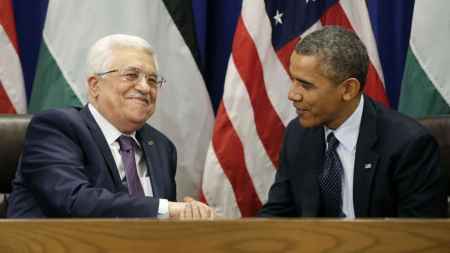
abbasobama

When we consider last month’s United Nations Security Council resolution (UNSC) 2334 that passed with deliberate U.S. abstention and later, justified in a speech by U.S. Secretary of State John Kerry, it makes the adage below come to mind. The Midrash (commentary on part of the Hebrew Scriptures) tells us, “He who becomes compassionate to the cruel will ultimately become cruel to the compassionate.”  Maimonides wrote in The Guide of the Perplexed that “the wicked and calculating person who killed intentionally and was sentenced to death – if he seeks sanctuary among us, we must not provide him with asylum, and not have mercy upon him, because compassion toward the wicked is cruelty to all beings.

In supporting the Palestinian regime that seeks the destruction of the Jewish State as its ultimate goal, the Obama administration is being compassionate toward the wrong party.  The Obama administration is knowingly and deliberately supporting the creation of another unstable Arab authoritarian regime that has failed its people.  Mahmoud Abbas, like Arafat before him, albeit more subtle, seeks the same goal: undermining the Jewish state, and replacing it with an undemocratic Palestinian state.  Abbas wouldn’t return to the negotiating table unless he is heavily bribed, and like Arafat, at the crucial moment when all reasonable concessions had been made, he walked out.

At their September 16, 2008 meeting in Jerusalem, Israeli Prime Minister Olmert agreed to forgo sovereignty over the Temple Mount in Jerusalem, Judaism’s holiest site, and proposed that in the framework of the peace agreement, the area containing the religious sites in Jerusalem would be managed by a special committee consisting of representatives from five nations: Saudi Arabia, Jordan, Palestinians, the U.S. and Israel.  The advisors and Fatah officials heard that Olmert laid out for Abbas not only the details of the agreement but also a large map upon which he outlined the borders of the future Palestinian state.  Abbas, like Arafat in July, 2000, walked out.

Considering Palestinian terrorism incited by Hamas and the Palestinian Authority against Jewish civilians and soldiers alike, it becomes clear that the Obama administration has shown compassion toward Palestinian aspirations and contempt for Jews aspiring to settle in their ancestral regions of Judea and Samaria.  The Administration would be quite content on a “judenrein” West Bank.   In fact, the U.S. and its European allies support the PA with huge grants, portions of which goes to pay salaries to Palestinian terrorists with blood on their hands and their families.  They have likewise funded Palestinian-Arab construction projects, built illegally throughout the West Bank and Jerusalem.

The Obama administration has also shown compassion for the Iranian regime by ending the economic sanctions against the radical Islamic Iranian regime, which hangs gays and lesbians as well as juveniles.  Amnesty International reported on January 26, 2016, that “Iran remains the leading executioner of juvenile offenders.”  The New York Post reported on August 3, 2016 that “The Obama administration quietly shipped $400 million stacked on wooden pallets in an unmarked plane to Iran in January – just as Tehran was releasing four Americans who had been detained there.”  This was done to appease the Islamic Republic, which is the leading state sponsor of terror around the world, and that has taken Americans in Iran as hostages.

U.S. Mideast mediator Dennis Ross pointed out that the Obama administration was so enamored with the so-called “moderate” Iranian President Rouhani, that it “showed readiness to accept an industrial-scale Iranian nuclear program and not to roll it back.”  The Obama administration was willing to bend its principles in order to foster a relationship and perhaps an alliance of sorts (against the Islamic State in Iraq) with the Ayatollahs regime that promised “to wipe Israel off the map.”

In the summer of 2009, the Iranian people voted for freedom and against the choices of the theocratic regime that oppressed them. They demonstrated in the millions with signs that read “Obama, are you with them or with us.”  Obama did not respond. He proved to have little compassion for the oppressed.

In Syria, the Shiite-Iranian Revolutionary Guards and their supported Iraqi-Shiite militias, as well as the Lebanese-Shiite terrorist group Hezbollah, are murdering hundreds of thousands of innocent Syrian Sunni Muslims, Christians, and others civilians with impunity.  They are bolstering the dictatorship of the Alawi (offshoot of Shiite Islam) minority ruler Bashar Assad.  The Russians have also joined in the killing of Syrian civilians in the name of combatting so-called “terrorists.”

The Palestinians of Hamas and the PA raise their children on hate and expound on the destruction of the Jewish state in schools, mosques, in the media, and in their policy directives.  The Palestinian intolerance towards Jews and Christians is deeply embedded, but due to political correctness, it has never been sufficiently reported in the western media, or by western governments.  Under the Palestinian regime, Christian Arabs have been victims of frequent human rights abuse by Muslims. There are many examples of intimidation, beatings, land theft, firebombing of churches and other Christian institutions, denial of employment, economic boycotts, torture, kidnapping, forced marriage, sexual harassment, and extortion. Palestinian Authority (PA) officials are directly responsible for many of the human rights violations. Muslims who have converted to Christianity are in the greatest danger. They are often left defenseless against cruelty by Muslim fundamentalists. Some have been murdered.

There is a clear dichotomy in determining who the compassionate side is, and who is the cruel. It comes together perfectly clear in the Syrian civil war arena.  Thousands of Palestinians are fighting on behalf of the Syrian dictator, and help in slaughtering the Syrian people who are fighting for their freedom.  The Palestinian radical group, the Popular Front for the Liberation of Palestine-General Command (PFLP-GC) led by Ahmed Jibril, provided the Assad war machine with intelligence and ground support, when he laid siege to the Palestinian populated Yarmouk refugee camp.  The PFLP-GC, once a member of the Palestinian Liberation Organization (PLO) joined the Assad troops in killing fellow Palestinians.

Conversely, Israel has opened its hospital gates to wounded Syrians, both civilians and soldiers.  Prime Minister Netanyahu announced last month “We are prepared to take in wounded women and children, and also men if they are not combatants. Bring them to Israel, we will take care of them in our hospitals as we have done with thousands of Syrian civilians. We are looking into ways of doing this. It is being explored as we speak.”  Netanyahu added, “The suffering is great, and the one initiative we took is to help – as I said – thousands of Syrians who are sometimes mutilated beyond belief. We help them. I offered to do more today. I don’t know if we can resolve [the crisis in] Syria, but we can help mitigate some of the suffering. That is the best that Israel can do.”

Being compassionate toward the Palestinian’s aspirations to destroy the Jewish state in stages by forming a terrorist supporting state, the Obama administration is being cruel toward the Jewish state, which seeks to defend its people from the ongoing Palestinian terror.

Is real change coming to Iran? Get ready for March 15, 2017

December 26, 2016

Is real change coming to Iran? Get ready for March 15, 2017, Israel National News, Dr. Mordechai Kedar, December 25, 2016

I do not recommend holding one’s breath in anticipation of the success of Iranian Zoroastrians, because it is not entirely clear that they are seriously planning action against the hated government – and even if they do go out to the streets, it is not at all sure they will succeed in getting the Ayatollahs to board those waiting planes out of the country. Success depends on a great many factors whose actions on that fateful day are hard to predict..

Still, taking into account the determination of the organizers, I have a reasonable basis for expecting them to carry out their plans in and around the middle of March. I send them my wishes for success from this podium. Israel will be only too pleased to return to the days of its good relations with Iran – the days before the Islamist revolution destroyed the Shah’s regime towards the end of 1978.

*********************************

The social makeup of Iran’s population is very complex, because there is actually no such thing as an Iranian people. There are, instead, Iranian citizens divided into many ethnic groups: Persians make up about 60% of the population, while the rest are Azars, Kurds, Blouchis, Arabs, Turkmen and tens of smaller ethnic groups.

The main religion in Iran is Shia Islam, adhered to by 90% of the country’s people, while Sunnis – mainly Kurds and Blouchis – make up about 10%. The country recognizes Judaism, Christianity and Zoroastrianism and reserves a parliamentary seat for each religion.

Zoroastrianism is based on the belief in two gods, a good one and an evil one.The world is the arena in which they battle one another. Daytime is when the good god wins and nighttime is the time the evil god has the upper hand. Good occurrences are arranged by the good god, bad ones are the fruit of the evil god’s labors.

Zoroastrianism was the official religion of the Sassanid Persian Empire, vanquished and destroyed in the 7th century Islamic-Arab conquest. The Arabs forced most of the Zoroastrian believers to accept Islam, and punished whoever stayed loyal to his original religion by death. Despite that persecution, or because of it, many of today’s Iranians are Zoroastrians who pretend to be Muslims. No one has any idea who is a secret Zoroastrian and who is an authentic Muslim, because everyone identifies himself as Muslim, knows how to pray and is familiar with the laws and customs of Islam.

During my academic career, I met many Iranian expatriates. Some of them told me that the number of people in Iran who are loyal to the Zoroastrian religion is in the millions and in fact numbers many millions, but that all of them succeed in passing as Muslims and even in having a significant presence in the Ayatollah regime. Many of them serve in the Iranian Army and in the Iranian Revolutionary Guards, a good number of them having reached the upper echelons of the Revolutionary Guards.

Every once in a while they burst out to demonstrate, the last time being in 2009 after the Iranian presidential elections were faked, allowing power to be snatched by Mahmoud Ahmadinejad. The country was filled with demonstrators, which could have ended with the Ayatollahs fleeing in planes that stood fueled, ready and waiting in the Tehran airport – had the protests continued. The brutal suppression of the demonstrations brought about their end – till next time.

President Obama did not support the protestors at that time, probably because of the empathy he had – and still has – for the Ayatollah regime, an empathy that brought him five years later to grant that dark regime the possibility of continuing its satanic plans to acquire nuclear power in another decade.

On Wednesday, March 15, 2017, the Zoroastrian holiday of Chahar Shanbeh Soori will occur.  Zoroastrians all over Iran are planning a “Freedom Holiday” for that date, intending to burst out into the streets in an attempt to overthrow the Ayatollah regime  If they are able to get rid of their Muslim rulers, they intend to bring the Shah’s son, at present in exile in Europe, back to Iran to assume the leadership of the country like his father, who was deposed at the end of 1978.

The Zoroastrians are using social media to organize the protests as well as passing information from one person to another among those whom they consider to be trustworthy. They estimate that there is enough time until mid-March to bring the message to the ears of every Zoroastrian in the country and to prepare them physically and psychologically for the “Freedom Holiday.”

Can this plan being an end to the Ayatollah regime? It most certainly can, if the Zoroastrians actually all go out to the streets and cause other “outsider” groups, who suffer economically and socially from the unbearable corruption that has taken over government officials, to join them.

If the many hidden Zoroastrians who serve in the armed forces turn their weapons on their Muslim colleagues, the army will be paralyzed, and so will the Revolutionary Guard, the Basij militia forces and the branches of Army Intelligence.  This will allow the Zoroastrians out in the street to take over the public sphere and force their own agenda upon it.

The Zoroastrians-in-exile, who encourage and advertise the “Freedom Holiday” are hopeful that this attempt will succeed, especially because the new US president Donald Trump is not exactly pro-Islam and certainly not in favor of the Ayatollahs ruling Iran. He, as opposed to Obama, might actually support the rebels and take concrete steps against the Iranian government if it comes down heavily against the protestors, as it did in 2009.

I do not recommend holding one’s breath in anticipation of the success of Iranian Zoroastrians, because it is not entirely clear that they are seriously planning action against the hated government – and even if they do go out to the streets, it is not at all sure they will succeed in getting the Ayatollahs to board those waiting planes out of the country. Success depends on a great many factors whose actions on that fateful day are hard to predict..

Still, taking into account the determination of the organizers, I have a reasonable basis for expecting them to carry out their plans in and around the middle of March. I send them my wishes for success from this podium. Israel will be only too pleased to return to the days of its good relations with Iran – the days before the Islamist revolution destroyed the Shah’s regime towards the end of 1978.

Giuliani’s Ties to Iranian Resistance Group MEK Should be Viewed as a Valuable Contribution

November 29, 2016

Giuliani’s Ties to Iranian Resistance Group MEK Should be Viewed as a Valuable Contribution, Iran Focus, November 29, 2016

(The objected-to Politico article was written by Daniel Benjamin, often referred to below but not identified as author of that article. — DM)

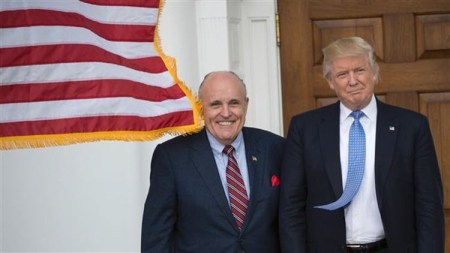
trumpandgu

London, 29 Nov – On November 28, in an article for Politico Magazine, Robert G. Torricelli, former U. S. Senator from New Jersey, and a former member of the U.S. House of Representatives, wrote about the Iranian Resistance Group, Mujahidin e-Khalq (MEK).  His article was written  in response to an article published in Politico last week, criticizing the MEK and the U.S. politicians who support them, particularly former New York Mayor Rudy Giuliani.

Torricelli, a former Democratic member of the Senate Foreign Relations Committee, who is familiar with the MEK and with Giuliani’s work on behalf of the organization says, “I can say unequivocally that Benjamin’s assertions are outrageous—so outrageous that I must respond.” 

A large bipartisan coalition supports the MEK in its campaign for regime change in Iran, including two former chairmen of the joint chiefs, two former CIA directors, a former attorney general and the former chairs of both political parties. People with such varied political ideals, such as Howard Dean and Patrick Kennedy to Newt Gingrich and John Bolton support the MEK. Torricelli says, “From this perspective, the outlier isn’t Rudy Giuliani; it’s Daniel Benjamin.” 

The history of the MEK began when it was part of the coalition opposing the shah of Iran in the late 1970s. The shah’s secret police executed and imprisoned most of their leadership. That vacuum was briefly filled by a Marxist group who were rejected by the incarcerated MEK leaders. Most of the Marxist leaders were killed by the shah or by the mullahs after their ascent to power in 1979. The MEK eventually regained its original leadership, and the MEK became an opposition group to the theocratic regime, and fled into exile in Paris and Iraq.

Torricelli writes, “Throughout this time, the MEK did take part in legitimate political and military action against the Iranian regime, but I have seen no evidence to support the assertion Benjamin makes that it took part in terrorist activities against Iranians or Americans.”

In Iraq in the 1980s, the refugee camps of the MEK were under the protection of the government of Iraq. MEK fighters were aligned with Iraqi Army during Iran/Iraq War. “But Benjamin’s claims that they assisted in Saddam Hussein’s repression of the Kurds have been denied by both MEK and U.S. Army leaders in Iraq. Upon the arrival of U.S. forces in 2003, the MEK willingly handed over its weapons, accepted U.S. protection and actively exposed the Iranian regime and its proxies’ terrorist activities. This included saving American lives by identifying IED locations. This, more than anything, explains the group’s support by former U.S. military personnel, including the former army anti-terror officer and the U.S. military police general assigned to the camp,” writes Torricelli.

The MEK provided invaluable intelligence regarding the Iranian nuclear program that helped counter Tehran’s efforts to develop atomic weapons. Maryam Rajavi, leader of the movement, committed herself publicly to a democratic, non-nuclear, secular Iran at peace with its neighbors with gender equality and a ban on capital punishment. The MEK organized thousands in the Iranian diaspora and built political support in Congress and parliaments across Europe. It is now the most organized and disciplined of the Iranian opposition groups.

“Some current and former State Department employees, including Mr. Benjamin, have a different concept. They remain committed to the idea that the MEK was a terrorist organization—a notion, I believe, which stems from an illusion of American reconciliation with the mullahs. In 1997, a group at State succeeded in convincing President Bill Clinton to place the MEK on the State Department list of terrorist organizations. Some claimed at the time that this decision was mainly intended as a goodwill gesture to Iran. The State Department gave as its reasons the MEK’s long record of violence, but I can tell you that as a member of the Foreign Relation Committee, I reviewed the State Department file on the MEK and found no evidence, no testimony and no reason for the designation except placating Tehran,” Torricelli writes, adding, “Thousands of Iranian-Americans and literally hundreds of members of Congress protested. In 2011, as a private attorney, I led a team of lawyers in a State Department inquiry to resolve the issue. After four hours of testimony, we yielded to the State Department to present their contradictory evidence. They had nothing.”

Without evidence, an order by the U.S. District Court was issued.  The MEK was removed from the State Department list of terrorist organizations by Secretary Hillary Clinton in 2012.

Torricelli continues, “Defeat came hard for the Iran apologists within the department. Mr. Benjamin isn’t the first to argue that the broad coalition of former U.S. intelligence, military, diplomatic and congressional leaders can’t be believed because some accepted speaking fees to attend MEK meetings around the world. The fact that these people faced combat for or dedicated their entire careers to our country, and are among our most respected leaders seems to be of no consequence. It’s an argument that requires no rebuttal except to note that by this standard the views of Thomas Paine, Elie Wiesel and Winston Churchill—all of whom accepted speaking fees from various international organizations—would have been silenced as well.”

Rudy Giuliani was one of the most outspoken supporters. The 3,000 MEK refugees settled along the Iran/Iraq border were under imminent threat in 2012. Iraqi relations with the United States were tense. Torricelli writes,  “Secretary Clinton requested that I assemble a persuasive group of distinguished Americans to travel to Europe and persuade Mrs. Rajavi to relocate the refugees to a former U.S. military base near Baghdad. I appealed to Louis Freeh, Ed Rendell, Michael Mukasey and Rudy Giuliani. Each accepted, canceled commitments, paid his own transportation to Paris and argued persuasively that the MEK assist the United States by relocating.”

Such a broad coalition of diverse Americans has varied perspectives. Torricelli says that, “Some believe that in the political vacuum following an economic or political collapse in Tehran, a determined and well-funded political opposition like the MEK could seize power. Others believe that the MEK might simply be part of a broader coalition, a simple pressure point or just a source of continuing intelligence.” Although rationales for support might differ, this group of Americans is united by the beliefs that the MEK is a genuine democratic force, and that regime change in Tehran is the best option to keep the peace, avoid a nuclear Iran, and benefit American interests.

Going back to Mr. Benjamin’s argument that Rudy Giuliani’s participation in this coalition should disqualify him for consideration as secretary of state, Torricelli has this to say, “Experience and participation in public policy issues was once a condition for high government service. It’s now a complication, because a record of advocacy creates controversy. But the selection of secretary of state needs to be different. Among the most likely crises facing the new president is an escalation in the struggle with the fundamentalist Islamic Republic of Iran. Rudy Giuliani has lived that struggle for a decade. Mr. Benjamin may quarrel with his efforts but it’s important to note that voices in the American foreign policy establishment as diverse as Senator McCain, Secretary Clinton, Deputy Secretary Blinken and John Kerry’s own personal representative on the MEK, Jonathan Weiner disagree. Each has thanked Rudy Giuliani and the other Americans involved in these efforts.”

Whether or not the president-elect chooses Mr. Giuliani as secretary of state, countering Tehran and assisting our country should not be seen as anything other than a valuable contribution to his consideration.