Obama’s public rejection of every ally, from Israel to Egypt to Saudi Arabia, has finally created the Post-American Middle East that his “Blame America” doctrine sought. The Post-American Middle East is a hive of terrorist groups and a region of nuclear arms races where murderous despots with vast armies dream of resurrecting the Ottoman Empire, the Persian Empire and the Abbasid Caliphate.
*********************
Obama’s Middle East policy was doomed to fail because it was based on the myth that everything wrong with the region was America’s fault.
Senator Obama had argued that Iraq would fix itself once we pulled out. Without America, the Iraqis would create a “political solution”. Instead the Shiites used the withdrawal to take over the government and Al Qaeda rebounded to dominate the Sunnis. After years of denying what was going on, he was forced back into Iraq after genocide and beheadings filled every television screen.
From the White House, he deployed the “Iraq Solution” across the Middle East by withdrawing support from American allies and backing terrorist groups like the Muslim Brotherhood. The chaos tore apart the region and turned over entire cities and countries to terrorists.
Egypt went through multiple coups. Street violence in Tunisia wrecked the country and supplied thousands of fighters to ISIS. His regime change war in Libya led to terrorist takeovers of its capital. Al Qaeda nearly took over Mali. Houthi Jihadists backed by Iran took over Yemen’s capital. The Saudis are bombing Yemen. The Egyptians are bombing Libya. The French are still fighting in Mali.
Iran and Al Qaeda have divided up Iraq, Syria and Yemen between themselves.
Withdrawing American power and influence didn’t work because we were never the problem. American soldiers weren’t causing the Sunnis and Shiites to fight each other. They were the only thing preventing it. American power and influence across the Middle East wasn’t holding back freedom and human rights, it was the only thing keeping a modicum of freedom alive in places like Egypt and Tunisia that quickly fell to Islamist rule in the Arab Spring, resulting in street violence, torture, terrorism and military coups.
The left had been fundamentally wrong about the cause of the problems in the Middle East. Obama trashed the region by following its wrongheaded doctrines.
Once the “Blame America” foreign policy has been implemented and the region went to hell, he had no idea what to do next. Intervening in Libya made sense according to the “Blame America” doctrine because Gaddafi had recently cut a deal with the United States and was obstructing the Jihadists who were implementing the local version of the Arab Spring in coordination with the Muslim Brotherhood.
But intervening in Syria didn’t. Assad wasn’t an American ally. Therefore the “Blame America” doctrine said that he should be left alone. But he was obstructing the Arab Spring. Overthrowing him would let the Muslim Brotherhood claim another country, but would alienate Iran and spoil any reconciliation.
Unable to make a final decision, Obama veered back and forth between Iran and the Muslim Brotherhood. Some days he seemed on the verge of bombing Syria and other days he was against even providing the promised weapons to the Sunni rebels. Even his supporters accused him of having no plan.
Syria’s real red line was the one that it had drawn through his foreign policy. Instead of making the Middle East better, his withdrawals had made it worse. And the beneficiaries of his foreign policy, especially the Muslim Brotherhood, were clamoring for more American military intervention.
Even Iraq’s Shiite government, backed by Iran, wanted American intervention.
Obama’s foreign policy had created a new set of untrustworthy client states which had to be kept alive by American intervention. The great joke of his foreign policy was that his new terrorist states acted just like the old dictators they were supposed to replace. They wanted American weapons and soldiers. Their own people hated them and hated America by extension. The climax of the Arab Spring came with crowds in Tahrir Square denouncing Obama and the Muslim Brotherhood for acting as his client state.
The “Blame America” foreign policy had led to even more blame of America. The new “democratic” Islamist governments that he helped bring to power to appease the Arab Street and atone for the sins of supporting the old secular-ish dictators backfired by making the Arab Street hate us more than ever.
Iran saved Obama’s foreign policy. Just as he was stumbling around Syria and weeping at being stuck back in Iraq, the agents of the Iran Lobby suggested that the whole mess could be put back together again. Iran and the US would fight on the same side against ISIS in Syria and Iraq. And this cooperation could be used to hammer out a nuclear accord that would retroactively justify Obama’s Nobel Prize.
The only problem was that everyone else in the region was completely against the idea.
The Iran Lobby threw Obama’s failed foreign policy a lifeline and he grabbed it. The bombing of Syria was off. Assad turned over some WMDs, but went on using others. The US began acting as the air force for Iran’s Shiite militias in Iraq while the Kurds and the Sunni Sheikhs of the Awakening were shut out.
When the Houthis took over Yemen, Obama shrugged. When the Saudis began bombing Yemen, they didn’t tell him because they were afraid the news would leak to Iran. And the administration covertly began pressuring them to stop, confirming that it now took its marching orders from Tehran, not Riyadh.
Obama ignored the vocal opposition, particularly from Israel’s Netanyahu, because the Iran deal was the only thing holding his foreign policy together. It made it seem as if he knew what he was doing. Take away the Iran deal and there was no longer a strategy, just a series of incoherent panicked responses.
That is why he continues to cling to the Iran deal. Without it, the Emperor’s foreign policy is naked.
The Iran deal salvaged the “Blame America” foreign policy by reorienting it away from the Muslim Brotherhood to deal with our great enemy in the region. By acceding to Iran’s nuclear program, Obama could finally fix everything by atoning for America’s biggest foreign policy sin in the region.
Despite his Muslim family background, Obama never understood the Middle East. Instead he looked at the region through a left-wing lens and saw only America’s crimes.
The Sunnis and Shiites, the Arabs, Kurds, Persians and Turkmen, weren’t fighting because of America. They were fighting over differences in religion, ethnicity and clan. The left has always thought that the way to fix the Middle East was to withdraw American influence. Instead doing that destabilized the region and created a power vacuum that Russia and Iran have been more than happy to fill.
Obama’s final foreign policy act was to fall directly into Iran and Al Qaeda’s trap.
Iran and the various Al Qaeda groups had effectively split parts of the region among themselves. By embracing Iran, Obama alienated the Sunni Middle East and shoved entire populations into Al Qaeda’s waiting embrace. He completed the polarizing process that he began with the Arab Spring by selling out the moderates to the extremists and waiting for everyone in the region to love America again.
But the Muslim Brotherhood lost out to its edgier Al Qaeda children. Egypt and the Saudis are scrambling to hold together some sort of Sunni center without the United States and against its wishes. Obama’s alignment with Iran, his rejection of Egypt’s new government and his failure to back the Saudis in Yemen has sent the message that the only legitimate alternative to Al Qaeda is Iran.
That’s not an alternative that most Sunnis can accept. Many would rather stand with Al Qaeda than Iran.
Obama’s public rejection of every ally, from Israel to Egypt to Saudi Arabia, has finally created the Post-American Middle East that his “Blame America” doctrine sought. The Post-American Middle East is a hive of terrorist groups and a region of nuclear arms races where murderous despots with vast armies dream of resurrecting the Ottoman Empire, the Persian Empire and the Abbasid Caliphate.
While genocide goes on, sex slaves are raped under the rule of a Caliph and black flags are unfurled and nuclear weapons are developed to fulfill apocalyptic Islamic prophecies, Obama smiles for the camera and waits for his second Nobel Prize.
It had been America’s fault all along. Now that Iran and Al Qaeda are in charge, everything will be okay.
[I]f the Obama administration were, in fact, to “tolerate” this disruption of the free flow of shipping it would send a dangerous signal, or to be more accurate, to reinforce a signal already sent: The U.S. lacks the will to stand up to predators in the international system, and in particular to Iran.
*****************
Every day, everywhere around the world, a silent referendum is going on about the state of American power. President Obama has consistently failed that test. By demanding that Bashar Assad leave power and then letting him stay; by letting Assad cross a “red line” on chemical weapons with impunity; by talking big about ISIS (“degrade and destroy”) and doing little; by standing by as Iran expanded its power into Iraq, Syria, and Yemen, as Russia seized chunks of Ukrainian territory, and as China intimidated its neighbors to claim sovereignty over disputed island, the president has dissipated the most precious commodity in the world—American credibility.
Today comes yet another test of American resolve. Details remain in dispute, but it appears that Iranian Revolutionary Guard gunboats seized the Maersk Tigris, a container ship traversing the Persian Gulf either through international waters or through a small section of Iranian waters that it would be allowed to traverse under the international legal doctrine of “innocent passage.” Instead of allowing the ship to go on its way, the IRGC fired a shot across its bow and detained the ship along with its crew. This is a vessel flagged in the Marshall Islands, a U.S. protectorate, owned by the Maersk line (a company with substantial American operations that is headquartered in Denmark, a NATO ally), and chartered by Rickers Ship Management, the Singapore-based subsidiary of a German company (two more U.S. allies).
The Iranian action may well be an indirect response to the U.S. decision to deploy an aircraft carrier strike group in order to intimidate Iran into turning back a cargo of supply ships reportedly bringing weapons to Iranian-backed Houthi fighters in Yemen. But whatever caused the Iranian action, it is a direct threat to freedom of navigation, which the U.S. Navy has defended around the world for centuries.
In the Persian Gulf, the U.S. commitment to that doctrine led President Reagan to order U.S. Navy ships to escort tankers and protect them from Iranian attacks, precipitating a short and sharp conflict (the Tanker War of 1987-88) between the U.S. and Iran. This was the last time, incidentally, that the U.S. used force to respond to Iranian attacks and it was an unqualified success—the Iranians lost some oil platforms and boats that they had been using to harass shipping. Finally the accidental shootdown of an Iranian airliner in 1988 by the USS Vincennes (an unintended and unfortunate consequence of these operations) helped convince the Iranian leadership to end their war with Iraq.
Today the U.S. still remains committed, at least on paper, to protecting freedom of navigation in the Persian Gulf. In 2011, a 5th Fleet spokesman put it well: “The free flow of goods and services through the Strait of Hormuz is vital to regional and global prosperity. Anyone who threatens to disrupt freedom of navigation in an international strait is clearly outside the community of nations; any disruption will not be tolerated.”
Thus if the Obama administration were, in fact, to “tolerate” this disruption of the free flow of shipping it would send a dangerous signal, or to be more accurate, to reinforce a signal already sent: The U.S. lacks the will to stand up to predators in the international system, and in particular to Iran. Put another way, it would signal to the entire region that the president is so invested in reaching a deal with Iran that no Iranian misconduct—not the dropping of barrel bombs on Syrian civilians, not the takeover of Yemen, not the ethnic cleansing of Sunni communities in Iraq, and now not the seizure of a Western cargo ship—will be allowed to interfere with his objective.
The fate of the Maersk Tigris does not matter much in and of itself, but it will say much about this administration’s commitment to maintaining America’s traditional security responsibilities.
Obama’s foreign policy legacy will be to have tied America’s fortunes to an imperial and nuclear Iran governed by an ambitious and ruthless anti-American regime.
*****************
Last week, the Obama administration urged Saudi Arabia to halt its air campaign against the Iranian-backed Houthi rebels who have wrested control of the Yemeni capital Sanaa. The White House’s professed concern was that Riyadh’s Operation Decisive Storm was killing too many civilians. Unfortunately, that’s hardly surprising since Iranian proxies, like Hezbollah and Hamas, typically stash their missiles and rockets in civilian areas. Presumably, the Houthis have read from the same playbook. The effect of the administration’s diplomatic efforts, then, was to protect Iranian arms in Yemen. And this, in turn, the administration no doubt believes, protects Obama’s nuclear agreement with Iran.
Houthis rally against Saudi Arabia, April 1. Newscom
In public, Obama is eager to show that the United States still stands by its traditional allies, like Riyadh. But behind the scenes, it’s clear that the White House’s real priority is partnering with Iran. Sure, the White House dispatched an aircraft carrier to the Arabian Sea, but this was not to stop Iran from shipping arms to the Houthis. As Obama himself explained, America’s blue-water Navy was present to ensure freedom of navigation in the Persian Gulf. The notion that the White House really intended to interdict Iranian arms shipments beggars belief. For more than four years Obama has done nothing to stop Bashar al-Assad from killing nearly a quarter of a million people in Syria, lest he endanger his nuclear agreement with Iran. With a deal so close, Obama is certainly not going to risk what he sees as the capstone of his foreign policy legacy by disarming Iranian allies in Yemen.
The problem is that by protecting his nuclear agreement with Iran, the president has protected and empowered the Islamic Republic. Tehran may boast of controlling four Arab capitals, but the reality is that its regional position is a house of cards. Pull out one of those Arab capitals, or the nuclear program, and Iran’s burgeoning empire quickly collapses. It’s Obama who is propping it up.
It’s interesting to imagine how these last six years might have gone for the Islamic Republic had the White House not been so determined to have a nuclear deal. Perhaps the Tehran regime would have been toppled when the Green Movement took to the streets in June 2009 to protest a fraudulent election if the American government had decided to back the opposition early, openly, and resourcefully. Perhaps another administration would at least have seen that uprising as an opportunity to gain leverage over the Iranian regime. Not Obama. He wanted a nuclear deal with the existing regime.
Another White House might have backed the Syrian rebels in order to bring down Assad. Indeed, a good portion of Obama’s cabinet counseled as much. To topple Tehran’s key Arab ally would have been the biggest strategic setback to Iran in 20 years, said Gen. James Mattis. Obama chose to leave Assad alone, and even ignored his own red line against the use of chemical weapons. Instead of the airstrikes he threatened on Syrian regime targets, Obama made a deal to ostensibly remove the chemical weapons that Assad is still employing.
As Assad’s position became weaker, Hezbollah entered the Syrian war to prop him up. The Iranian-backed militia was stretched thin between Syria and Lebanon, but the Obama administration helped the terrorist organization cover its flank by sharing intelligence to keep Sunni car bombs out of Hezbollah strongholds in Beirut. Another administration might have understood this as an opportunity to weaken Iran’s position in Damascus and Beirut, but not Obama. He had his eyes on the prize.
In sum, over the last six years, almost all of Iran’s advances in the region, including its move into Iraq to fill the vacuum in Baghdad after the American withdrawal from that country, has taken place with either the overt or tacit assistance of Obama. The White House brags about it. Israel might have attacked Iranian nuclear facilities, as one administration official told the press, but we deterred Prime Minister Benjamin Netanyahu from striking. If the Iranians strut with confidence these days, that’s because they understand who has their back.
The nuclear deal, as the president has explained, means that within a little more than a decade, Iran’s breakout time will be down to zero—which is a nice way of saying the clerical regime will have the bomb. The likely result is that the agreement will ensure Iran’s regional position long after Obama’s presidency is around to safeguard it. It will strengthen the hand of the hardliners. It is not Rouhani or Zarif or other so-called moderates who hold the nuclear file, but Khamenei and the Revolutionary Guard Corps. And in the future, American policymakers will have a vital interest in ensuring there are no internal regime fights over who controls the bomb.
In other words, Obama’s foreign policy legacy will be to have tied America’s fortunes to an imperial and nuclear Iran governed by an ambitious and ruthless anti-American regime.
If inspections, sanctions, sabotage and political isolation ever had a chance to stop Iran from getting the bomb (this was always a dicey proposition), that certainly is no longer the case. It is more evident than ever that only military action can stop a determined state such as the Islamic Republic of Iran from building a nuclear bomb. It remains to be seen whether Israel has elected the leader to live up to this historic challenge.
***********************
The debate over the pros and cons of the Iran nuclear framework agreement negotiated between the P5+1 and Iran at Lausanne (April 2, 2015) is simply irrelevant. The search for truth in the conflicting versions about the details of the deal coming out of Washington and Tehran is of no consequence. And the steps suggested by Israel and other critics to improve the efficacy of the deal (by more stringent inspections and so on) will not change much. The deal is basically dangerous in nature, and needs to be rejected outright.
The deal permits Iran to preserve stockpiles of enriched uranium, to continue to enrich uranium, and to maintain illegally-built facilities at Fordow and Arak. Even in the absence of a signed full agreement, the U.S. and its negotiating partners already have awarded legitimacy to Iran’s nuclear threshold status. In all likelihood, the United States, quite desperate to get a formal deal, will make additional concessions in order to have a signed formal deal — which won’t be worth the paper on which it is printed.
This outcome has been a foregone conclusion since November 2013, when the U.S. agreed to the “Joint Plan of Action” on Iran’s nuclear program. Already back then, the U.S. decided not to insist any longer on the goal of rolling back the Iranian nuclear program, ignoring several U.N. Security Council resolutions demanding no uranium enrichment, as well as discarding the security concerns of American allies in the Middle East (primarily Israel, Saudi Arabia and Egypt — who better understand the regional realities).
Middle Easterners clearly discern an Iranian diplomatic victory in this accord, which should not surprise anybody. Iranians are much more adept at negotiating than Americans. Iran is getting more or less what it wanted: the capability to produce enriched uranium and to research weapon design; agreement to keep its missile program intact; and no linkages to Iranian behavior in the region. The deal is a prelude to nuclear breakout and Iranian regional hegemony.
Indeed, with no attempt to roll back the Iranian nuclear program, as was done in Libya, we are progressing toward the North Korean model. Those two are the only options in dealing with nuclear programs of determined states such as Iran. Iran’s nuclear program benefited in many ways from assistance that originated in Pakistan and in North Korea (both are nuclear proliferators despite American opposition). Compare the recent statements by President Obama to the speeches of President Clinton justifying the agreement with North Korea (October 1994). Their similarities are amazing; an indication of the incredible capacity of great powers for self-delusion.
What counts is not the Obama’s administration expression of satisfaction with the prospective deal, but the perceptions of Middle East actors. For example, Saudi Arabia and Egypt have deplored the fact that the U.S. is bestowing international legitimacy on Iran’s status as a nuclear threshold state. They probably believe the interpretations of the deal offered by Tehran more than those professed in Washington. Therefore, they will do their best to build a similar infrastructure leading inevitably to nuclear proliferation in the region — a strategic nightmare for everybody.
Unfortunately, no better deal is in the offing. Whatever revisions are introduced cannot change its basic nature. The accord allows Iran to have fissionable material that can be enriched to weapons grade material in a short time and Tehran can always deny access to inspectors any time it chooses. This is the essence of the North Korean precedent.
Obama is right that the only alternative to this deal is an Iranian nuclear fait accompli or the bombing of the Iranian nuclear infrastructure. Obama’s penchant for engagement, his reluctance to use force, and his liberal prism on international relations (which adds rosy colors to international agreements) has led to this miserable result.
Netanyahu is wrong in demanding a better deal because no such deal exists. Yet denying its ratification by the U.S. Congress could create better international circumstances for an Israeli military strike. In fact, criticism of Obama’s deal with Iran fulfills only one main function — to legitimize future military action. Indeed, Netanyahu is the only leader concerned enough about the consequences of a bad deal with the guts and the military capability to order a strike on the Iranian key nuclear installations.
If inspections, sanctions, sabotage and political isolation ever had a chance to stop Iran from getting the bomb (this was always a dicey proposition), that certainly is no longer the case. It is more evident than ever that only military action can stop a determined state such as the Islamic Republic of Iran from building a nuclear bomb. It remains to be seen whether Israel has elected the leader to live up to this historic challenge.
(“If you like your country you can keep it.” Even if Obama’s phrasings were not ambiguous, and they are, he could not be trusted. Moreover, since Obama’s talking points about the “once in a lifetime deal” and those of his Iranian counterparts are very different, there is no way of knowing now whether there will be a deal, whether the U.S. Congress will block it, or what it will be. — DM)
In his lengthy interview with Thomas Friedman of The New York Times, President Obama makes many statements about Israel’s security and how the proposed deal with Iran enhances it. These words from the interview are key:
“I have to respect the fears that the Israeli people have,” he added, “and I understand that Prime Minister Netanyahu is expressing the deep-rooted concerns that a lot of the Israeli population feel about this, but what I can say to them is: Number one, this is our best bet by far to make sure Iran doesn’t get a nuclear weapon, and number two, what we will be doing even as we enter into this deal is sending a very clear message to the Iranians and to the entire region that if anybody messes with Israel, America will be there.”
What does “messes with Israel” mean? No one has the slightest idea. The president unfortunately uses this kind of diction too often, dumbing down his rhetoric for some reason and leaving listeners confused. Today, Iran is sending arms and money to Hamas in Gaza, and has done so for years. Is that “messing with Israel?” Iran has tried to blow up several Israeli embassies, repeating the successful attack it made on Israel’s embassy in Buenos Aires in 1992. Fortunately Israel has foiled the more recent plots, but is attempting to bomb Israeli embassies “messing with Israel?” Iranian Revolutionary Guards, along with Hezbollah troops, are in southern Syria now near the Golan. Is that “messing with Israel?” And what does the president mean by “America will be there?” With arms? With bandages? With the diplomatic protection his administration is now considering removing at the United Nations?
Later in the interview, the president says this:
“Now, what you might hear from Prime Minister [Benjamin] Netanyahu, which I respect, is the notion, ‘Look, Israel is more vulnerable. We don’t have the luxury of testing these propositions the way you do,’ and I completely understand that. And further, I completely understand Israel’s belief that given the tragic history of the Jewish people, they can’t be dependent solely on us for their own security. But what I would say to them is that not only am I absolutely committed to making sure that they maintain their qualitative military edge, and that they can deter any potential future attacks, but what I’m willing to do is to make the kinds of commitments that would give everybody in the neighborhood, including Iran, a clarity that if Israel were to be attacked by any state, that we would stand by them. And that, I think, should be … sufficient to take advantage of this once-in-a-lifetime opportunity to see whether or not we can at least take the nuclear issue off the table.”
This is not much help. For one thing, the president says “attacked by any state,” presumably leaving out Hamas and Hezbollah, and for that matter the Islamic State group and al-Qaida. One has to assume he means “attacked by Iran,” but what does “we would stand by them” mean? It doesn’t add much to “America will be there.” There will be no conventional war between Israel and any Arab state in the foreseeable future, so Hezbollah is the most likely problem and is presumably excluded from the president’s formulation. What Israel worries about today is a nuclear attack by Iran or a terrorist group like Hezbollah to which Iran has given the bomb. No doubt that qualifies as “messing with Israel,” but were that to occur what exactly would “America will be there” and “stand by them” mean? Take in refugees from the destroyed State of Israel after the nuclear attack on it? The president’s language about “commitment” suggests that he may envision a formal defense commitment by the United States to Israel. Israel has not wanted such a treaty because it has always said it wants to defend itself, not have Americans dying to defend it. That position has served the U.S.-Israel relationship well for 67 years. Should it really be changed now, and would that really help Israel? What would the value of such a commitment be? To ask the question another way, are not Poles and Estonians wondering right now about the value of their membership in NATO, if Mr. Putin “messes” with them?
There were other problems in the interview, such as this language:
“There has to be the ability for me to disagree with a policy on settlements, for example, without being viewed as … opposing Israel. There has to be a way for Prime Minister Netanyahu to disagree with me on policy without being viewed as anti-Democrat, and I think the right way to do it is to recognize that as many commonalities as we have, there are going to be strategic differences. And I think that it is important for each side to respect the debate that takes place in the other country and not try to work just with one side. … But this has been as hard as anything I do because of the deep affinities that I feel for the Israeli people and for the Jewish people. It’s been a hard period.”
“You take it personally?” Friedman asked.
“It has been personally difficult for me to hear … expressions that somehow … this administration has not done everything it could to look out for Israel’s interest — and the suggestion that when we have very serious policy differences, that that’s not in the context of a deep and abiding friendship and concern and understanding of the threats that the Jewish people have faced historically and continue to face.”
“Respect the debate?” “Personally difficult?” This is the White House whose high officials called the prime minister of Israel a “chickens—” and a “coward,” in interviews meant to be published — not off the record. And the officials who said those things remain in place; no effort was ever made to identify and discipline them.
But the deeper problem is that the reassurances the president is offering to Israel … are simply not reassuring. Iran is already, right now, while under sanctions that are badly hurting its economy, spending vast amounts of money and effort to “mess with Israel.” This administration’s reaction has been to seek a nuclear deal that will give Iran more economic resources to dedicate to its hatred and violence against Israel, but will in no way whatsoever limit Iran’s conventional weapons and its support for terrorism.
Several times in this interview the president went out of his way to suggest that he fully understands Israel’s security problems, but the full text suggests that he does not — because he believes that his statements that “if anybody messes with Israel, America will be there” and would “stand by them” actually solve any of those problems. Time alone undermines the value of those statements, because he will not be president in 22 months. The words he used are sufficiently vague to undermine their value as well. It is hard to believe that many Israelis will be reassured by the interview, especially if they read the Iranian press and see what, in their own interviews, Iranian officials are claiming they got out of the new nuclear agreement.
(The views expressed in this article are mine and do not necessarily reflect those of Warsclerotic or any of its other editors. — DM)
It has been suggested that Israel should seriously consider destroying Iranian nuclear facilities, but Israeli officials obviously haven’t said, and won’t say, if, how or when she might.
Speaking to Arutz Sheva Friday, Professor Efraim Inbar, who heads the Begin-Sadat Center for Strategic Studies, said the deal had realized Israel’s worst fears by leaving Iran’s nuclear program essentially intact.
The Islamic Republic’s nuclear program has been granted “legitimacy” by the agreement, which still allowed it to continue enriching uranium and to maintain a reactor capable of producing enriched plutonium, he said. “And that’s what worries Israel, that they (Iran) will be able within a short time frame to reach a nuclear bomb.”
“I hold the view that the only way to stop Iran in its journey to a nuclear bomb is through military means,” Inbar maintained, suggesting that “Israel needs to seriously consider striking a number of important nuclear facilities” to head off the threat.
On March 28, former U.S. Ambassador Bolton said that it should be done.
The P5+1 nuclear “deal,” proudly announced by President Obama on April 2nd, is a sham. There is no “deal,” and public announcements by Iran and Obama cast it in very different lights. According to Iran, all sanctions will be lifted immediately when an agreement is reached on or before June 30th. According to Obama, sanctions relief will be gradual and based on Iran’s compliance with invasive inspections and other conditions. Even National Public Radio (NPR) has pointed out differences. NPR observed that, according to Iran,
all sanctions relief – U.N., EU and U.S. – would be immediate. It was unequivocal. It stated that Iran under the deal was free to pursue industrial scale enrichment to fuel its own reactors – unequivocal. It stated that Iran was unhindered in its ability to conduct centrifuge R&D.
Iran has also emphasized that its intention to destroy Israel is non-negotiable, and the Obama Administration has rejected any efforts to make Iran recognize Israel’s right to exist, on the ground that
“This is an agreement that is only about the nuclear issue,” State Department spokeswoman Marie Harf told reporters on Friday night, according to Fox News. “This is an agreement that doesn’t deal with any other issues, nor should it.” [Emphasis added.]
Israeli Prime Minister Netanyahu has said that Israel’s right to exist is non-negotiable.
Iran is very unlikely to retreat from its perception of the “deal,” Obama is very likely to retreat in Iran’s favor, and Israel is very unlikely to retreat from its perceptions about Iran, the “deal” or Israel’s right to exist.
What should Israel do?
In Martin Archer’s novel Islamic War, which I reviewed here, Israel dispatched elderly, large and substantially refurbished remove controlled aircraft, full of high explosives, from Somalia to half dozen nuclear facilities operated by hostile nations. They flew circuitous routes at varying altitudes to avoid detection until it was too late to stop them. Over a period of weeks, they crashed into and destroyed their targets, amid speculation about who had done it and why. Israel was not suspected. Would that have been possible then? Now? I don’t know.
It has been reported that Saudi Arabia has given Israel clearance to use her airspace for an attack on Iran’s nuclear facilities.
Fox News reports that US Defense sources claim the Saudis are conducting tests on their air defense systems after giving Israel permission to to enter a narrow corridor to shorten the distance to attack Iran.
The testing would make sure that Saudi jets don’t get scrambled when Israel entered Saudi airspace. Once the IAF planes complete their mission and exit Saudi airspace, Saudi defenses would go back online again. [Emphasis added.]
Might Saudi Arabia, Egypt and perhaps other Gulf States go beyond not interfering with an Israeli attack to provide air support and other help? They seem to be as displeased with the “deal” as Israel is.
Assuming that Israel is not overly concerned about being identified as the attacker and is willing to act alone, she might:
Detonate one or more high-altitude atomic bombs to emit sufficient electromagnetic pulses (EMP) to fry all above-ground Iranian electronics. That would substantially disable Iranian above-ground command and control facilities as well as other communications, hence diminishing (but not eliminating) the possibility of counter-strikes by Iran and/or its proxies. Perhaps she has other, non-nuclear, means of generating EMPs; she hasn’t said.
Immediately thereafter, drop whatever suitable bombs she may have on all Iranian military and nuclear facilities. Does Israel have bunker-buster bombs? Probably not of U.S. manufacture, but that does not mean that she has not developed her own. It would be surprising if she had not.
Obama and other “leaders of the free world” would complain and the U.N. would emit fits of angry censures. However, that happens with great frequency in any event, and would be an insufficient reason for Israel to commit national suicide through inaction against Iran.
I am no “military expert” and would appreciate any comments on the suggestions I have made as well as any other suggestions anyone might care to offer.
(Hitler did tell the truth occasionally, in Mein Kampf for example. It was generally ignored until too late. “Death to America and Israel” are spouted by the Iranian Supreme Leader at every opportunity. Obama, et al, ignore it. Will Israel be Obama’s Czechoslovakia? And then what?– DM)
Our dishonor in Lausanne, as with Munich, may avoid a confrontation in the present, but our shame will guarantee a war in the near future.
*********************
Once again our leaders are needlessly appeasing a hostile state that shows them nothing but contempt.
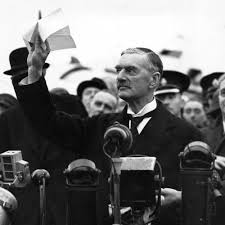
The Western capitulation to Adolf Hitler in the 1938 Munich Agreement is cited as classic appeasement that destroyed Czechoslovakia, backfired on France and Britain, and led to World War II. All of that is true.
But there was much more that caused the Munich debacle than simple Western naiveté. The full tragedy of that ill-fated agreement should warn us on the eve of the Obama’s administration’s gullible agreement with Iran on nuclear proliferation. Fable one is the idea that most people saw right through the Munich folly. True, Europeans knew that Hitler had never once told the truth and was already murdering German citizens who were Jews, Communists, or homosexuals. But Europeans did not care all that much.
Instead, the Western world was ecstatic over the agreement. After the carnage of World War I, Europeans would do anything to avoid even a small confrontation — even if such appeasement all but ensured a far greater bloodbath than the one that began in 1914.
Another myth was that Hitler’s Wehrmacht was strong and the democracies were weak. In fact, the combined French and British militaries were far larger than Hitler’s. French Char tanks and British Spitfire fighters were as good as, or superior to, their German counterparts.
Czechoslovakia had formidable defenses and an impressive arms industry. Poland and perhaps even the Soviet Union were ready to join a coalition to stop Hitler from dissolving the Czech state.
It is also untrue that the Third Reich was united. Many of Hitler’s top generals did not want war. Yet each time Hitler successfully called the Allies’ bluff — in the Rhineland or with the annexation of Austria — the credibility of his doubters sank while his own reckless risk-taking became even more popular.
Munich was hardly a compassionate agreement. In callous fashion it immediately doomed millions of Czechs and put Poland on the target list of the Third Reich.
Munich was directly tied to the vanity of Neville Chamberlain. In the first few weeks after Munich, Chamberlain basked in adulation, posing as the humane savior of Western civilization. In contrast, loud skeptic Winston Churchill was dismissed by the media and public as an old warmonger.
Hitler failed to appreciate the magnanimity and concessions of the French and British. He later called his Munich diplomatic partners “worms.” Hitler said of the obsequious Chamberlain, “I’ll kick him downstairs and jump on his stomach in front of the photographers.”
The current negotiations with the Iranians in Lausanne, Switzerland, have all the hallmarks of the Munich negotiations.
Most Westerners accept that the Iranian government funds terrorist groups such as Hezbollah and Hamas. It has all but taken over Iraq, Lebanon, Syria, and Yemen. Yet the idea of stronger sanctions, blockades, or even force to stop Iranian efforts to get a bomb are considered scarier than Iran getting a bomb that it just possibly might not threaten to use.
The U.S. and its NATO partners are far stronger than Iran in every imaginable measure of military and economic strength. The Iranian economy is struggling, its government is corrupt, and its conventional military is obsolete. Iran’s only chance of gaining strength is to show both its own population and the world at large that stronger Western powers backed down in fear of its threats and recklessness.
Iran is not united. It is a mishmash nation in which over a third of the population is not Persian. Millions of protestors hit the streets in 2009. An Iranian journalist covering the talks defected in Switzerland — and said that U.S. officials at the talks are there mainly to speak on behalf of Iran.
By reaching an agreement with Iran, John Kerry and Barack Obama hope to salvage some sort of legacy — in the vain fashion of Chamberlain — out of a heretofore failed foreign policy.
There are more Munich parallels. The Iranian agreement will force rich Sunni nations to get their own bombs to ensure a nuclear Middle East standoff. A deal with Iran shows callous disagreed for our close ally Israel, which is serially threatened by Iran’s mullahs. The United States is distant from Iran. But our allies in the Middle East and Europe are within its missile range.
Supporters of the Obama administration deride skeptics such as Democratic senator Robert Menendez and Israeli prime minister Benjamin Netanyahu as if they were doubting old Churchills.
Finally, the Iranians, like Hitler, have only contempt for the administration that has treated them so fawningly. During the negotiations in Switzerland, the Iranians blew up a mock U.S. aircraft carrier. Their supreme leader, Ayatollah Khamenei, did his usual “death to America” shtick before adoring crowds. Our dishonor in Lausanne, as with Munich, may avoid a confrontation in the present, but our shame will guarantee a war in the near future.
The downside to playing on the same team as the Iranian regime, even in just this one military campaign against ISIS, is that we are helping to enable a far more dangerous power than ISIS to extend its hegemonic dominance throughout the entire region.
****************
Iraq’s defense minister Khalid al-Obeidi is claiming victory over ISIS forces in the city of Tikrit, which ISIS had captured last summer as its forces advanced across large swaths of territory in northern and western Iraq. “We have the pleasure, with all our pride, to announce the good news of a magnificent victory,” Obeidi said. The Pentagon and a spokesman for the U.S.-led coalition were a bit more cautious, noting some residual ISIS resistance. However, they too reported that significant progress had been made in wresting control of Saddam Hussein’s birthplace from ISIS’s grip.
The next strategic military objective in pushing ISIS back from the territories it controls in Iraq is to re-take Iraq’s second largest city, Mosul.
Iran supplied significant military support to the Shiite militia forces, who were a major part of the Iraqi counter-offensive on the ground. At the same time, U.S. air strikes seemed to have helped in supporting the Iraqi ground forces’ advance into Tikrit. The precise extent of any behind-the-scenes direct or indirect coordination between the U.S. and Iran is unknown at the present time. However, according to DebkaFile {March 26, 2015), “In the last two weeks of the Tikrit operation, liaison between the US and Iranian military in Iraq was routed through the office of the Iraqi Prime Minister in Baghdad.”
There is little question that without the Iranian-backed Shiite militia and substantial military support on the ground from Iran, ISIS would most likely still be in control of Tikrit today. U.S. airstrikes may have been necessary to soften ISIS’s resistance, but only ground troops with Iran’s support could dislodge them.
The downside to playing on the same team as the Iranian regime, even in just this one military campaign against ISIS, is that we are helping to enable a far more dangerous power than ISIS to extend its hegemonic dominance throughout the entire region.
As General David Petraeus, who certainly knows something about Iraq, told the Washington Postrecently:
In fact, I would argue that the foremost threat to Iraq’s long-term stability and the broader regional equilibrium is not the Islamic State; rather, it is Shiite militias, many backed by — and some guided by — Iran… Longer term, Iranian-backed Shia militia could emerge as the preeminent power in the country, one that is outside the control of the government and instead answerable to Tehran.
Without downplaying ISIS’s horrific acts, its rapid-fire successes in Syria and Iraq (even with the setback in Tikrit), and its growing allegiances in Libya, Nigeria and areas further away from its home base including Afghanistan, the fact is that ISIS’s ambitions far exceed its current means for achieving them. ISIS is proficient in using social media for recruitment, propaganda and intimidation purposes, but that can only take ISIS so far.
Iran, by contrast, has built up its military capabilities to the point that it can back up its aggressive threats in the region. And that’s even without the nuclear arms capability that President Obama seems to be willing to risk allowing Iran to achieve in order to secure his legacy with a deal.
As a result, America’s traditional Sunni allies in the region such as Saudi Arabia and other Persian Gulf states are doubting whether they can continue to count on the United States for support. And they are taking matters into their own hands, including a decision to form a multinational Arab military force to respond to Iranian aggression and other perceived threats.
As explained by Gamal Abdel Gawad Soltan, a political scientist at the American University in Cairo and quoted by the New York Times: “The U.S. is much less trusted as an ally, as an insurance policy towards the security threats facing the governments in the region, and so those governments decide to act on their own.”
These governments know their neighborhood well and see Iran as a much graver threat to regional peace and security than ISIS. Iran’s military and financial support of the Shiite Houthi rebels in taking control of major parts of Yemen was the last straw. Saudi Arabia on its own initiative decided to launch an air campaign against Houthi positions in Yemen and has not ruled out a ground attack along with the military forces of other Arab countries.
In response to the air and sea blockade of Yemen that Saudi Arabia is imposing on Yemen, Iran’s supreme leader Ayatollah Ali Khamenei decided to dispatch “two naval task forces to sail to the Red Sea,” according to DebkaFile (March 31, 2015). “The naval task forces are being sent to draw a sea shield around the Houthi forces to defend them against Saudi-Egyptian assaults. This maneuver was orchestrated by the Al Qods Brigades chief Gen. Qassem Soleimani,” DebkaFile reported.
Soleimani certainly gets around. Earlier this month he popped up in Iraq to lead the Shiite militias in their fight against ISIS. Now the man who fought on the same side as us against ISIS in Iraq is apparently coordinating Iran’s fight to hold onto the Houthis’ gains in Yemen where they forced the American and Saudi Arabian-backed president to flee.
Soleimani is “the puppet master controlling numerous Iranian surrogates in various countries,” said Jim Phillips, Middle East analyst for the Heritage Foundation. “His organization is drenched in American blood,” Phillips added. “It’s infused with an anti-American philosophy and a cooperation with him or his followers would not be on a sustainable basis. The U.S. would regret it.”
The Obama administration is now scrambling to catch up with Iran’s multi-pronged offensives, some of which are under Soleimani’s coordination. Thus, President Obama decided to support the Sunni Gulf coalition and Egypt against Iranian-backed action by the Shiite Houthi rebels to take control of Yemen.
However, the Obama administration’s reactive tactics in dealing with the crisis in Yemen are too little too late. Saudi Arabia is reportedly looking to Pakistan for help in acquiring its own nuclear arms to counter the Saudis’ well-founded suspicions that any deal negotiated by the Obama administration with Iran will not prevent Iran from becoming a nuclear armed power. And while Obama finally lifted the arms freeze he imposed against Egypt two years ago, clearing the way for the delivery of F-16 aircraft, Harpoon missiles and tanks, he also decided to end Egypt’s ability to finance purchases of American arms by drawing credits in advance based on future aid Egypt expects to receive starting in the 2018 fiscal year. Obama also wants to reduce Egypt’s flexibility in what it can purchase with the future military aid. Thus, the Egyptian government can be expected to continue on its course to find other sources for military aid and weapons including Russia, because of doubts that the U.S. will remain a reliable supplier.
The Obama administration has been willing to sacrifice the confidence of its Arab allies, not to mention the United States’ historically close alliance with Israel, in a vain effort to lure the Iranian regime into acting as a responsible party in the Middle East that can help stabilize this volatile region. Instead, Obama should listen to the expert on Iraq, General Petraeus, whose surge victory Obama undermined completely with his precipitous withdrawal of all U.S. troops from Iraq in 2011:
The current Iranian regime is not our ally in the Middle East. It is ultimately part of the problem, not the solution. The more the Iranians are seen to be dominating the region, the more it is going to inflame Sunni radicalism and fuel the rise of groups like the Islamic State…Iranian power in the Middle East is thus a double problem. It is foremost problematic because it is deeply hostile to us and our friends. But it is also dangerous because, the more it is felt, the more it sets off reactions that are also harmful to our interests — Sunni radicalism and, if we aren’t careful, the prospect of nuclear proliferation as well.
We can rejoice in the pushback of ISIS out of Tikrit. Perhaps it is a sign of more victories over ISIS to come. However, we should not delude ourselves into thinking that we have more in common with the Iranian regime in combatting ISIS in Iraq or Syria than the Iranian regime ultimately has in common with ISIS. They may be bitter enemies in the struggle over which set of fanatical jihadists should get to rule the global Islamic ummah or caliphate they both fantasize about. However, both fervently believe in the fundamental ideological goal of universal Islamic supremacy. And both are willing to sacrifice the lives of millions of people to reach that goal, no matter how long it takes them. The difference is that a nuclear-armed Iran would be much more capable of carrying out its jihadists’ apocalyptic vision than ISIS and in a much shorter period of time.
(The views expressed in this article are not necessarily mine or those of Warsclerotic or its other editors. — DM)
Today, April fool’s day first, Obama was abducted by aliens from Venus who were concerned about His warlike stance toward the peaceful Islamic Republic of Iran.
Mars is the god of war, Venus is the goddess of peace. Aliens from Mars had been slightly disturbed that Obama’s efforts to give Iran nuclear weapons might fail, but had seen that her status as a nuclear power was inevitable and hence did nothing. Aliens from Venus were equally pleased with the prospects of Iranian nuclear weapons but were very concerned that Obama, by failing adequately to praise Iranian attempts to extend its hegemony over the entire Middle East and beyond, had retarded those praiseworthy efforts on behalf of true Islamic peace. Hence, they secretly abducted Him this morning as He deplaned from Air Force One following an off-the-books trip to His spiritual birth place in Manchuria.
Since Obama’s abduction and remedial training required only a few minutes He was not missed, even by His dear soul mate, Valerie Jarrett. Ms. Jarrett was, therefore, pleasantly surprised when Obama called a press conference in the Rose Garden to make an announcement, following a splendid rendition of Hail to the Chief:
Fellow world citizens, I have finally awakened from my slumbers to realize that Iran is the only country in the world capable of bringing true peace through submission in accord with the word of Allah, may His Holy name be forever praised by all. Israel claims to desire peace, but only through war. Saudi Arabia, Egypt, Jordan and other misbegotten specs of excrement on the face of our dear planet — now in peril of imminent death due to climate change to which their vile oil has contributed massively — have dared even to challenge Iran’s peaceful pursuits of peace throughout the Middle East in Iraq, Syria, Yemen and elsewhere.
Henceforth, it will be My supreme duty as your Commander in Chief to promote and otherwise to assist Iran in her glorious efforts for peace. I know in my heart that that’s the principal reason that you, My people, elected Me as your very own Supreme Leader. Accordingly, I pledge that My efforts will be unstintingly directed to the end that you desire.
May Allah bless Iran, Damn America, Israel and all other enemies of true peace, and give a blessed day to you all, inshallah.
Iran’s leaders, due to their extensive relations with the aliens who had abducted Obama, were not at all surprised but pretended that they were. Supreme Leader Khamenei personally accepted Supreme Leader Obama’s gracious words by saying that Obama had finally managed to tame the Great Satan and promised to do everything within his power to help, inshallah. He also commented favorably on Secretary Kerry’s use of “inshallah” in rebutting suggestions by defeatists that the P5+1 negotiations would collapse without giving Iran nuclear weapons.
Even those who had previously viewed Obama as weak and indecisive will now be forced to see Him as He truly is, a towering beacon of strength and light to a world beset with tribulation, turmoil and darkness. His legacy as the Greatest Peace Maker, Ever, is assured, inshallah.








 anneinpt
 artaxes
 danmillerinpanama
 davidking1530
 Peter Hofman
 Joseph Wouk
 Peter
Peter Louisiana Steve
 WarSclerotic
Recent Comments