Posted tagged ‘Iran and Israel’

A European-Iranian honeymoon

January 31, 2016

A European-Iranian honeymoon, Israel Hayom, Prof. Eyal Zisser, January 31, 2016

Last week, the European dam burst. While the continent was turning a cold shoulder to Israel and European entities continued with their threats of boycott, its gates were thrown open to Iran. European leaders put their obsession with Israel aside for an hour or two, and after paying the necessary lip service to International Holocaust Memorial Day, gave Iranian President Hassan Rouhani a royal welcome.

The Iranian president, the smiling face of the Islamic republic, arrived for visits to Italy and France. It was the first visit of its kind since the nuclear deal was signed, a visit that signaled the start of a European-Iranian honeymoon, a visit that will be followed by others like it all over the continent. Rouhani’s visit came days after the economic sanctions on Iran were lifted. It’s no wonder that during the visit, announcements were made about contact between the Iranians and a number of Italian and French companies on deals including a return to European cars being manufactured in Iranian plants and, of course, contracts to purchase Iranian oil. The Iranians are hungry for Europe’s products and technology, while European companies are hungry for Iranian money.

As Rouhani was being received in Europe as an honored guest, Iran’s spiritual leader Ayatollah Ali Khamenei was busy with his longtime hobby of denying the Holocaust. He posted a clip on his website in which he called to investigate whether or not the Holocaust had actually happened, as the Zionists claim it did. But no one in Europe bothered Rouhani with any minor matter like that. After all, it was U.S. Secretary of State John Kerry who urged people not to take Tehran’s calls to annihilate Israel and the U.S. seriously, saying it was only talk. The Europeans also didn’t bother to raise the question of Iranian involvement in regional destabilization, such as in Yemen and Syria, or about Tehran’s support of terrorism. Even questions about respecting human rights and freedom of expression and promoting democracy in Iran itself were removed out of respect for the agenda of the day. Europe, as we know, only asks those questions of Israel.

Indeed, despite Rouhani’s smiles, no change has taken place yet in Iran itself. The conservative camp continues to rule with a fist of iron and supreme leader Khamenei remains firmly at the wheel, or in the hands of the Revolutionary Guard and not Rouhani and his people. So while Rouhani was trying to spread the slogan of a “new Iran” throughout Europe and asking his hosts to turn over a new leaf in the relations between Iran and Europe, the conservatives at home were preparing an unpleasant surprise. Most of the reform camp’s candidates for the parliamentary election scheduled to take place on February 26 were rejected. Even the grandson of late Ayatollah Ruhollah Khomeini, Ahmed Khomeini, who wanted to be elected to the Council of Experts — the Iranian body that oversees the supreme spiritual leader and is responsible for choosing his successor — was rejected on the grounds of “not proving appropriate religious capabilities.”

Iran should be judged not by its words, but by its actions, but the Iranian record speaks for itself. A mere two months after it signed the nuclear agreement with the major world powers in July 2015, Tehran sent thousands of soldiers to Syria to fight on the side of Syrian President Bashar Assad. Painful pictures are coming out of Syria of children dying of hunger in cities under siege by Assad’s forces, Hezbollah fighters, and members of the Iranian Revolutionary Guard. But Iran has been rewarded for its doings in Syria and invited by the U.N. and western countries to take part in a discussion on Syria’s future. The Iranian record also includes ballistic missile tests, to show us what Iranian’s military ambitions are; the arrest of U.S. sailors in the Persian Gulf; and — just like in the good old days — an angry mob setting fire to the Saudi Arabian embassy in Tehran.

The Europeans are choosing to ignore all that as they announce a new chapter in Iranian-European relations. The bill for the honeymoon will be footed by others — in Syria, the Persian Gulf, and Israel.

American blackmail

January 8, 2016

American blackmail, Israel Hayom, Sarah N. Stern, January 8, 2016

Yossi Melman, noted Israeli author and security analyst, who is certainly no right-winger, wrote a piece in a recent edition of The Jerusalem Report which opens with: “The U.S administration is concerned about the possibility of a new confrontation with Prime Minister Benjamin Netanyahu following the International Atomic Energy Agency’s latest nuclear shenanigans. ‘We hope it won’t happen,’ a senior U.S. official tells The Jerusalem Report, ‘but if it does, it will be a completely different ball game. The administration will not sit idly by this time, and it will be vindictive.'”

This is akin to telling parents that a known child predator wants to abduct their children and has expressed the explicit desire to murder them, but if they notify the police, it will be a completely different ball game. The local government will not sit idly by this time, and it will be vindictive — against the parents who have the responsibility of protecting their children.

In actuality, the Obama administration’s outrage is completely legitimate, but it is directed at the wrong target: Israel. However, after seven years of the Orwellian world that we now inhabit, we have become conditioned to believe that this statement is almost normal.

Under international law, however, this is clearly upside-down and backward. It is Iran, after all, that violated U.N. Security Council Resolution 1929 (by firing missiles), the understandings reached in the July nuclear agreement and the United Nations Universal Declaration of Human Rights. Therefore, Iran should legitimately be the target of American as well as international outrage.

Iran is guilty of conspiracy to commit genocide. The IAEA is complicit in this guilt by closing the file on Iran’s nuclear program despite the fact that certain fundamental questions regarding prior military dimensions remain unanswered. The IAEA admitted as much on December 2, 2015, yet still decided to close the Iran file under what can only be explained as political pressure.

In 1948, in the immediate aftermath of the Holocaust, the U.N. passed United Nations General Assembly Resolution 260, the Convention on the Punishment and the Crime of Genocide. Article 3 of this convention lists crimes that should be punished as (a) genocide; (b) conspiracy to commit genocide; (c) direct and public incitement to commit genocide; (d) attempt to commit genocide and (e) complicity in genocide.

The Jerusalem Center for Genocide Prevention has compiled an outstanding collection of remarks made by Iranian Supreme Leader Ayatollah Ali Khamenei between 2000 and 2015. The center came up with a few significant findings, including the fact that “Iranian state incitement against Israel has been explicit in its calls for destruction of the Jewish state. Pre-war Nazi propaganda used euphemisms and never explicitly called for the destruction of the Jews.” Official Iranian threats and incitement have “lasted for more than 30 years, as compared with Nazi governmental incitement, which lasted 12 years.”

They also found that the frequency and the intensity of Iran’s incitement to commit genocide has only increased the more the international community eased sanctions.

In fact, shortly after the July 14 agreement was reached, Khamenei issued a book titled “Palestine,” outlining in painstaking detail the steps that should be taken to annihilate Israel, which he described as “a cancerous tumor” whose elimination would mean that “the threats and hegemony of the United States will be replaced by Iran.”

The book sketches out how to eliminate Israel through an eternal chain of low-intensity assaults that will eventually make life so unbearable for Israelis that they will pack their bags and leave. He also wrote that the Iranian nuclear bomb would inhibit the Israelis against any sort of retaliation.

Since the Joint Comprehensive Plan of Action was reached on July 14, both Iran and U.S. President Barack Obama have behaved in predictable ways. Iran has conducted two missile tests, one on Oct. 10 and one on Nov. 21, and on Dec. 29 fired a rocket within 1,500 yards of an American aircraft carrier, the USS Harry S. Truman in the Strait of Hormuz.

While Obama was trying to sell the JCPOA to Congress and a skeptical American public last summer, we were constantly assured of “immediate, snapback sanctions.”

According to a report in The Wall Street Journal last month, the U.S. Department of Treasury notified Congress that approximately a dozen companies or individuals in Hong Kong, the UAE and Iran were to face sanctions for working on the Iranian missile program, which not only violated the JCPOA but also U.N. Security Resolution 1929.

The Iranian government was quick to denounce the threat of new sanctions, calling them, “unilateral, arbitrary and illegal.” And just as swiftly and predictably, Obama caved under Iranian pressure and decided to delay imposing new sanctions, for an unspecified period of time. And now Iran has publicly unveiled a new underground missile site.

According to a report in The Washington Free Beacon, Democratic members of Congress who backed the deal are disappointed with the White House. Rep. Steny Hoyer of Maryland said: “We are always in a sensitive moment in our dealings with Iran, and there is never a perfect time to take such actions. … But Iran must know with certainty that violating U.N. Security Council resolutions, both inside and outside the scope of the Joint Comprehensive Plan of Action, will be met with serious consequences.”

Senator Chris Coons (D-Del.) told The Wall Street Journal: “I believe in the power of vigorous enforcement that pushes back on Iran’s bad behavior. If we don’t do that, we invite Iran to cheat.”

It appears that America’s moral backbone, the IAEA and all the Democratic members of Congress who believed Obama’s reassurances of “immediate snapback sanctions” are currently being blackmailed by Obama’s quest for a foreign policy legacy.

Yes, Obama will, indeed, have a foreign policy legacy, but it will prove to be the same as Neville Chamberlain’s.

A Strategy to Defeat Islamic Theo-fascism

January 7, 2016

A Strategy to Defeat Islamic Theo-fascism, American ThinkerG. Murphy Donovan, January 7, 2016

Surely, whatever passed for American foreign or military policy in the past three decades is not working. Just as clearly, in case anyone keeps score these days, the dark side of Islam is ascendant at home and abroad. What follows here is a catalogue of policy initiatives that might halt the spread of Islamic fascism and encourage religious reform in the Ummah.

Some observers believe that the Muslim problem is a matter of life and death. Be assured that the need for Islamic reform is much more important than either. The choices for Islam are the same as they are for Palestine Arabs; behave or be humbled. Europe may still have a Quisling North and a Vichy South; but Russia, China, and even America, at heart, are still grounded by national survival instincts – and Samuel Colt.

Call a spade a spade

The threat is Islam, both kinetic and passive aggressive factions. If “moderate” Islam is real, then that community needs to step up and assume responsibility for barbaric terror lunatics and immigrants/refugees alike. Neither America nor Europe has solutions to the Islamic dystopia; civic incompetence, strategic illiteracy, migrants, poverty, religious schisms, or galloping irredentism. The UN and NATO have no remedies either. Islamism is an Ummah, Arab League, OIC problem to solve. Absent moral or civic conscience, unreformed Islam deserves no better consideration than any other criminal cult.

Western Intelligence agencies must stop cooking the books too. The West is at war and the enemy is clearly the adherents of a pernicious ideology. A global war against imperial Islam might be declared, just as angry Islam has declared war on civilization.  A modus vivendi might be negotiated only after the Ummah erects a universal barrier between church and state globally. Islam, as we know it, is incompatible with democracy, civility, peace, stability, and adult beverages.

Oxymoronic “Islamic” states need to be relegated to the dustbin of history. If the Muslim world cannot or will not mend itself, Islamism, like the secular fascism of the 20th Century, must be defeated, humbled in detail. Sooner is better.

Answer the Ayatollahs

Recent allied concessions to Tehran may prove to be a bridge too far. If the Persian priests do not abide by their nuclear commitments, two red lines might be drawn around Israel. Firstly, the ayatollahs should be put on notice, publicly, that any attack against Israel would be considered an attack against America — and met with massive Yankee retaliation. Secondly, any future cooperation with NATO or America should be predicated on an immediate cessation of clerical hate speech and so-called fatwas, those arbitrary death sentences.

Clerical threats to “wipe Israel off the face of the earth” and “death to America” injunctions are designed to stimulate jihad and terror globally. The only difference between a Shia ayatollah and a Sunni imam in this regard these days seems to be the torque in their head threads.

Ostracize the Puppeteers

Strategic peril does not emanate from Sunni tacticians like Osama bin Laden, Mullah Omar, or Abu Bakr al-Baghadadi. Nor does the real threat begin with or end with al Qaeda, the Taliban, Hezb’allah, Hamas, or the Islamic State. Lethal threat comes, instead, on four winds: toxic culture, religious politics, fanatic fighters, and furtive finance, all of which originate with Muslim state sponsors. The most prominent of these are Saudi Arabia, the Emirates, Turkey, Iran, and Pakistan.

Put aside for a moment the Saudi team that brought down the Twin Towers in New York. Consider instead, the House of Saud as the most egregious exporter of Salifism (aka Wahabbism) doctrine, clerics, imams, and mosques from which ultra-irredentist ideologies are spread. The Saudis are at once the custodians of Islam’s sacredshrines and at the same time the world’s most decadent, corrupt, and duplicitous hypocrites. Imam Baghdadi is correct about two things: the venality of elites in Washington and Riyadh. The House of Saud, an absolutist tribal monarchy, does not have the moral standing to administer “holy” sites of any description — Mecca, Medina, or Disneyland.

The cozy relationship between Europe, the European Union, and Arabia can be summarized with a few words; oil, money, arms sales, and base rights. This near-sighted blend of Mideast obscenities has reached its sell-by date. The “white man’s burden” should have expired when Edward Said vacated New York for paradise.

Jettison Turkey and Pakistan

What Saudi Arabia is to toxic ideology in North Africa, Turkey and Pakistan are to perfidy in the Levant and South Asia. Turkey and Pakistan are Islam’s most obvious and persistent grifters. Turkey supports the Islamic State and other Sunni terror groups with a black market oil racket. Pakistan supports the Taliban, al Qaeda, and ISIS with sanctuary and tolerance of the world’s largest opium garden. Oil and drug monies from Arabia, Turkey, and South Asia are financing the global jihad. Turkey also facilitates the migration of Muslims west to Europe while sending Islamist fighters and weapons south to Syria and Iraq.

With the advent of Erdogan and his Islamist AKP, Turkey has morphed into NATO’s Achilles Heel, potentially a fatal flaw.  Turkey needs to be drummed out of NATO until secular comity returns to Ankara. Pakistan needs to be restrained, too, with sanctions until it ceases to provide refuge for terrorists. Pakistani troops harassing India could be more prudently redeployed to exterminate jihadists.

Sanctions against Russia and Israel are a study in moral and political fatuity whilst Arabs and Muslims are appeased midst a cultural sewer of geo-political crime and human rights abuses. If NATO’s eastern flank needs to be anchored in trust and dependability, Russia, Kurdistan, or both, would make better allies than Turkey. Ignoring Turkish perfidy to protect ephemeral base rights confuses tactical necessity with strategic sufficiency.

Recognize Kurdistan

Aside from Israel, Kurdistan might be the most enlightened culture in the Mideast. The Kurds are also the largest ethnic group in the world not recognized as a state. While largely Muslim, the Kurds, unlike most of the Ummah, appreciate the virtues of religious diversity and women’s rights. Indeed, Kurdish women fight alongside their men against Turkish chauvinism and Sunni misogyny with equal aplomb. For too long, the Kurds have been patronized by Brussels and Washington.

While Kurdish fighters engage ISIS and attempt to control the Turkish oil black market, Ankara uses American manufactured NATO F-16s to bomb Kurds in Turkey and Syria. Turkish ground forces now occupy parts of Iraq too. In eastern Turkey, Ergdogan’s NATO legions use ISIS as an excuse for bookend genocide, a cleansing of Kurds that might rival the Armenian Christian genocide (1915-1917).

195876_5_Kurdish angel of death

All the while, American strategic amateurs argue for a “no-fly” zone in contested areas south of Turkey. Creating a no-fly zone is the kind of operational vacuity we have come to expect from American politicians and generals. Such a stratagem would foil Kurdish efforts to flank ISIS and allow the Erdogan jihad, arms, and oil rackets to flourish. A no-fly zone is a dangerous ploy designed to provoke Russia, not protect Muslim “moderates.”

Putin, Lavrov, and the Russians have it right this time; Turkish and Erdogan family subterfuges are lethal liabilities, not assets.

Washington and European allies have been redrawing the map in Eastern Europe, North Africa, South Asia, and the Mideast since the end of WWII. The time has come to put Kurdistan on the map too. Kurdistan is a unique and exemplary case of reformed or enlightened Islam; indeed, a nation that could serve as a model for the Muslim world.  If base rights are a consideration, Kurdistan would be an infinitely more dependable ally than Turkey or any corrupt tribal autocracy in Arabia. America has a little in common with desert dictators — and fewer genuine friends there either. Indeed, at the moment America is allied with the worst of Islam.

Create New Alliances

NATO, like the European Union, has become a parody of itself. Absent a threat like the Soviet Union or the Warsaw Pact, Brussels has taken to justifying itself by meddling in East Europe and resuscitating a Cold War with the Kremlin. Indeed, having divided Yugoslavia, NATO now expands to the new Russian border with reckless abandon; in fact, fanning anti-Russian flames now with neo-Nazi cohorts in former Yugoslavia, Georgia, and Ukraine.

NATO support for the Muslims of one-time Yugoslavia is of a piece with support for Islamic troublemakers in Chechnya and China too. Throughout, we are led to believe that jihad Uighurs and caliphate Chechens are freedom fighters. Beslan, Boston, Paris, and now San Bernardino put the lie to any notion that Islamists are “victims” (or heroes). Indeed, the Boston Marathon bombing might have been prevented had Washington a better relationship with Moscow.

Truth is, America has more in common with Russia and China these days than we do with any number of traditional European Quislings. Indeed, it seems that Europe and America can’t take yes for an answer.

The Cold War ideological or philosophical argument has been won. Moscow and Beijing have succumbed to market capitalism. Islamism, in stark contrast, is now a menace to Russian, Chinese, and American secular polities alike. The logic of a cooperative or unified approach to a common enemy seems self-evident. America, China, and Russia, at least on issues like toxic Islam, is a match made in Mecca.

The late great contest with Marxist Russia and China was indeed a revolution without guns. Now the parties to that epic Cold War struggle may have to join forces to suppress a theo-fascist movement that, like its Nazi predecessor, will not be defeated without guns. The West is at war again, albeit in slow motion. Withal, questions of war are not rhetorical. Saying that you are not at war does not make it so. Once declared, by one party or the other, the only relevant question about war is who wins and who loses. Losers do not make the future.

If America and Europe were as committed to Judeo/Christian secular values as Islamists are committed to a sick religious culture, then the war against pernicious Islam would have been won decades ago. Or as Jack Kennedy once put it: “Domestic policy can only defeat us; foreign policy can kill us.

Trump Footnote

Donald Trump made several policy suggestions on the Islamism issue, one on immigration, the other on Mideast oil. On the former, he suggests a hiatus on Muslim immigration until America develops a plan or reliable programs to vet migrants. On Arab oil, he suggests, given the lives and treasure spent liberating Kuwait and Iraqi oil fields, America should have held those resources in trust and use oil revenues to finance the war against jihad, however long that takes. The problem with both Trump ideas is that they come perilously close to common sense, an American instinct in short supply these days.
 

Thumbing nose at US, Iran unveils depot for nuclear-capable missiles

January 5, 2016

Thumbing nose at US, Iran unveils depot for nuclear-capable missiles, DEBKAfile, January 5, 2016

In clear defiance of the Obama administration, Iran revealed on Tuesday a second underground facility for storing ballistic missiles capable of carrying nuclear warheads.

In a one-minute video shown on Iranian state-run television,  Ali Larijiani, speaker of Iran’s parliament, was shown inspecting the depot of “Emad” ballistic missiles along with officers from Iran’s Revolutionary Guard Corps.

DEBKAfile military sources: The Emad, which has a 750-kilogram warhead and a range of 1,700 kilometers, is capable of striking any point in Israel. Iran carried out a successful test of the missile four months ago, in October 2015.

Washington announced that the test was a violation of the nuclear agreement between Iran and Western powers. Tehran replied that it never agreed in any stage of the negotiations to limit its missile program in the framework of the agreement.

At the end of December, the Obama administration announced that it was weighing the possibility of imposing fresh sanctions on Iran following the launch of the missile. Several days later, however, Washington withdrew the plan after Tehran threatened that it would view the imposition of new sanctions as a breach of the nuclear agreement.

On Tuesday, Iran not only said it will continue to develop the Emad, but claimed the weapon is already in operational use by the Revolutionary Guard Corps.

Hizballah blows up “Mossad” patrol, sparks border clash with Israel

January 4, 2016

Hizballah blows up “Mossad” patrol, sparks border clash with Israel, DEBKAfile, January 4, 2016

Shortly after DEBKAfile’s forecast of a Hizballah revenge strike for the Samir Quntar assassination, a Hizballah roadside bomb blew up against an IDF patrol at the Shebaa Farms on the Hermon slopes Monday afternoon, Jan. 4.  No casualties were caused. The Israeli force responded with tank artillery fire on the southern Lebanese town of Al-Wazzani and was answered by rocket fire from Lebanon

Hizballah announced that it had targeted an Israeli patrol with a bomb on the ceasefire line at the Shebaa Farms targeting a civilian car carrying a “senior Mossad officer”.

The next Hizballah communiqué said: The Martyr al-Quntar Unit blew up a bomb against an Israeli patrol in the Shebaa Farms, destroying a military vehicle and causing casualties.

In a third communiqué, Hizballah said the car attacked carried a “senior Israeli army officer” – amending its previous claim of a Mossad officer.

The Israeli army has closed all northern roads to civilian traffic in case the Hizballah attack spreads into a major clash.

DEBKAfile reported earlier Monday that the rising tension between Tehran and Riyadh may serve Iran and its Lebanese proxy as an oportunity to attack Israel. The leader of that proxy, Hizballah’s Hassan Nasrallah, had repeatedly threatened to punish Israeli for the assassination of its high profile terrorist planner Samir Quntar in Damascus on Dec, 20. Quntar was freed by Israel as part of a prisoner swap in 2008, three decades after he was convicted of killing four Israelis. In September, the United States placed Quntar on its terror blacklist, saying he had “played an operational role, with the assistance of Iran and Syria, in building up Hizballah’s terrorist infrastructure in the Golan Heights.”

Tehran names Raafat Al-Bakkar as new Hizballah Golan terror ring chief

December 28, 2015

Tehran names Raafat Al-Bakkar as new Hizballah Golan terror ring chief, DEBKAfile, December 28, 2015

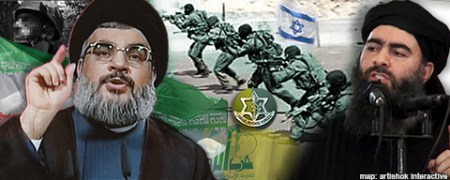
NasrallaBagdadi480

Tehran Monday, Dec. 28, further ramped up the tension between its Lebanese proxy Hizballah, whose leader Sunday threatened to avenge the death of Samir Quntar, and Israel, which is conducting a military exercise along its northern borders. Four days after Quntar was assassinated in Damascus, Tehran appointed a successor to carry on building a new terrorist network for striking Israel from the Golan.

This successor is revealed by DEBKAfile’s exclusive sources as a Lebanese called Raafat Al-Bakkar, about whom very little is known. According to our sources, the Iranians spotted Al-Bakkar as promising talent earlier this year, shortly after the Israeli air strike which on Jan. 18 killed Iranian Gen. Ali Dadi and the high-profile Hizballah leader Jihad Moughniyeh. They were caught touring the Golan around Quneitra in search of a site for a terrorist base. Al-Bakkar was sent to Tehran at that time for a course in building and running terrorist networks, and this week he was given charge of the new “National Resistance on the Golan” organization for deep strikes inside Israel.

When Nasrallah boasted Sunday that his jihadists were already on their way to punish Israel, he was looking forward to the arrival of Quntar’s successor.

See DEBKA files’ earlier report from Sunday, Dec. 27.

IDF Chief of Staff Lt. Gen. Gady Eisenkott explained why it was necessary to bring forward the launching of the new Commando Brigade by two months, when he addressed the formation ceremony on Sunday, Dec. 27, at the Ein Harod National Park: “The Commando Brigade is more necessary than ever in light of the threats from Hizballah and the Islamic State,” he said, in reference to the boasts heard in the last 48 hours from Hassan Nasrallah and Abu Bakr Al Baghdadi.

The Chief of Staff introduced Col. David Zini as the first commander of the new Brigade.

The ceremony took place shortly after the Hizballah chief Hassan Nasrallah said, “Revenge for the death of Samir Quntar is on the way… The orders have been given and execution is in the hands of resistance fighters on the ground… The Israelis are worried and rightly so – those on the borders [soldiers] and those inside the country…. We shall not let the blood of our Jihadi fighters and brothers to be spilled anywhere in the world,” he said.

DEBKAfile’s military sources report: Analysis of the kinds of threats posed by Hizballah (and ISIS) at this time, which are likely to focus more on terrorism than on tank or infantry border incursions, persuaded IDF leaders of the need for a new framework for bringing under one roof some of the top-notch, highly-trained, experienced, well-armed and determined fighting men who are willing to take on new challenges.

The self-styled Islamic State’s “caliph” Abu Bakr Al-Baghdadi, also devoted special attention to Israel, or rather “the Jews,” in his first audio speech in seven months Saturday, Dec. 26, the day before Nasrallah sounded off. His message was similar to that of his Shiite enemy, albeit in his own inimitable style:

The Islamic State would soon be in Palestine to establish an Islamic state there, he said, “Jews, soon you shall hear from us in Palestine which will become your grave… The Jews thought we had forgotten Palestinian… Not at all, Jews…The pioneers of the jihadist fighters are getting closer every day.”

If and when the Shiite Hizballah and Sunni ISIS make good on their similar but separate threats – or sooner – they will encounter Israel’s new Commando Brigade. Its fighting men are trained for combat in miscellaneous conditions of terrain, day or night, under deep cover. They are equipped with high-tech equipment, most of it classified, for gathering visual and electronic intelligence, communications, photography and targeting. They may either kill terrorists or take them captive.

In a word, these elite troops will hit the enemy in his back yard or at home, and blow the threats heard from Hizballah and ISIS leaders’ back on their own forces.

The 89th Commando Brigade is composed of four battalions:

Duvdevan specializes in operating amidst an Arab population under deep cover for locating and arresting terror suspects.

Egoz is a special kind of infantry battalion, whose commandos operate solo or in very small teams behind enemy lines, especially across the Syrian and Lebanese borders.

Maglan is skilled in the use of weaponry designed for precision operations against high quality enemy targets. These elite fighters go deep inside enemy territory to gather intelligence and use their specialized technology, exclusive for the use of this unit, for devastating assaults.

Rimon members are desert fighters who gained their experience in the terrain of the Gaza Strip and Egypt. Their experience as back-up for operations against drug smugglers is invaluable for urban combat in civilian environments.

Excluded from the new brigade are the separate IDF commando units: Sayeret Matkal, Shayetet 13 (Navy), the Oketz unit which trains dogs for anti-terror work, and Yahalom, of the Engineering Corps.

Reassuring, not challenging, Iran

December 25, 2015

Reassuring, not challenging, Iran, Israel Hayom, Elliott Abrams, December 25, 2015

Since the signing of the nuclear deal with Islamic Republic of Iran, that government has ‎treated the Obama administration with contempt. U.S. officials might have hoped Iran’s ‎conduct would improve, but it has worsened. Iran sent more Revolutionary Guard troops to ‎fight in Syria, for example; it conducted two ballistic missile tests in violation of a Security ‎Council resolution; leaders continue to chant “Death to America”; and it has imprisoned ‎more Americans.

What is the Obama administration’s response? To beg their pardon.‎

I refer to a remarkable letter sent by Secretary of State John Kerry to Iranian Foreign Minister Mohammad Javad ‎Zarif. Iran, in an additional gesture of contempt, has complained about new United States ‎visa requirements placed on persons who have traveled to Iran (or Iraq, Sudan, or Syria). ‎These requirements were recently added so that people who had visited those countries ‎could not come to the United States without getting a visa even if they were from countries ‎that are part of the “visa waiver” program. The obvious purpose: to avoid having terrorists ‎get to the United States through a program that allows them to avoid the visa application ‎process and the information it would supply.‎

Iran has complained that “Zionist lobbyists” put the new rules in place, a good reminder of ‎the nature of the regime.‎

How did the United States react? By denouncing the Iranian attacks on “Zionist lobbyists,” ‎which came from the spokesman for the Foreign Ministry? By noting that Iran is the world’s ‎worst state sponsor of terrorism? By recalling the fact that Iran just violated U.N. Security ‎Council resolutions, and continues to jail innocent American citizens?‎

Nope. By offering reassurance that we certainly do not mean to disadvantage Iran in any ‎possible way. Here is the text of Kerry’s letter:‎

“December 19, 2015‎

“His Excellency Mohammad Javad Zarif

“Minister of Foreign Affairs of the Islamic Republic of Iran Tehran

“Dear Mr. Minister:‎

“Thanks for a constructive meeting yesterday. I wanted to get back to you in response to your ‎inquiry about amendments to our Visa Waiver Program. First, I want to confirm to you that ‎we remain fully committed to the sanctions lifting provided for under the JCPOA. We will ‎adhere to the full measure of our commitments, per the agreement. Our team is working ‎hard to be prepared and as soon as we reach implementation day we will lift appropriate ‎sanctions.‎

“I am also confident that the recent changes in visa requirements passed in Congress, which ‎the Administration has the authority to waive, will not in any way prevent us from meeting ‎our JCPOA commitments, and that we will implement them so as not to interfere with ‎legitimate business interests of Iran. To this end, we have a number of potential tools ‎available to us, including multiple entry 10-year business visas, programs for expediting ‎business visas, and the waiver authority provided under the new legislation. I am happy to ‎discuss this further and provide any additional clarification.‎

“Secretary of State John Kerry”

Let’s put aside the thanks to Zarif for a “constructive meeting.” We can be sure that Zarif ‎was advancing Iranian national interests, and for doing that, he deserves no thanks from us. ‎The tone of the letter would be fine were it addressed to the foreign minister of Canada. ‎Must we really assure the representative of this vile, repressive regime that regardless of its ‎behavior, we will bend over backward and use every tool possible (“we have a number of potential tools ‎available to us, including multiple entry 10-year business visas, programs for expediting ‎business visas, and the waiver authority provided under the new legislation”) to ‎defend and advance its “legitimate business interests?”‎

Here’s one of many possible alternative formulations: The ability and willingness of the ‎United States government to use the tools at its disposal will depend on the treatment Iran ‎accords American citizens whom it has unjustly detained and imprisoned. Kerry seems ‎more worried about offending Iran than freeing those Americans — whose imprisonment was ‎an issue set aside during the nuclear negotiations. Must we set it aside forever as we ‎protect Iran’s “legitimate business interests”‎?

Tehran biennial to grant $50,000 cash prize to best cartoon on Holocaust

December 17, 2015

Tehran biennial to grant $50,000 cash prize to best cartoon on Holocaust, Tehran Times, December 17, 2015

[A] contest focusing on the portrait of Israel’s Prime Minister Benjamin Netanyahu, has been arranged on the sidelines of the competition.

**********************

TEHRAN – Organizers of the 11th Tehran International Cartoon Biennial has allocated a cash prize of $50,000 for the best cartoon on the Holocaust, the organizers announced on Wednesday.

Three other cartoonists will also receive cash prizes of 12,000, 8,000 and 5,000 dollars respectively, the secretary of the biennial, Masud Shojai-Tabatabai, told the Persian service of MNA.

He added that the competition will be held in June 2016 in Mashhad with cartoonists participating from 50 countries.

“We do not mean to approve or deny the Holocaust, however, the main question is that why is there no permission to talk about the Holocaust despite their (the West) belief in freedom of speech.

“Moreover, why should the oppressed people of Palestine pay the price for the Holocaust? We are also worried about the contemporary holocausts in which a great number of women and children are being killed in Iraq, Yemen and Syria,” he added.

Shojai-Tabatabai also said that a contest focusing on the portrait of Israel’s Prime Minister Benjamin Netanyahu, has been arranged on the sidelines of the competition.

The Palestine Museum of Contemporary Art will be hosting an exhibition of the works at the time of the competition.

Israel extremely nervous over Russian operations on its Golan border

December 2, 2015

Israel extremely nervous over Russian operations on its Golan border, DEBKAfile, December 2, 2015

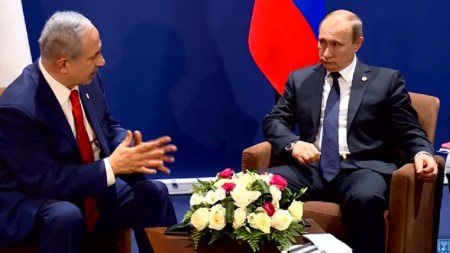
Netanyahu_speaks_with_Putin_Paris_30.11.15

Moscow may be giving Hizballah and Iran an umbrella for achieving their longstanding design to displace the Syrian rebels with Revolutionary Guards and Hizballah forces and deploy them along Israel’s Golan border.

**********************

On the outside, Israel is all smiles and full of praise for way the coordination with Moscow is working for averting clashes between its air force and Russian warplanes over Syria. This goodwill was conspicuous in the compliments Prime Minister Binyamin Netanyahu and President Vladimir Putin traded when they met on the sidelines of the Paris climate summit Monday, Nov. 30.

But the first disquieting sign appeared Tuesday, Dec. 1. Senior Russian and Israeli officers were due to meet in Tel Avid to discuss strengthening the cooperation between the two army commands. But no word from Moscow or Jerusalem indicated whether the meeting had taken place.

DEBKAfile’s military sources report that this week, the show of optimism is giving way to an uneasy sensation in the offices of the prime minister, Defense Minister Moshe Ya’alon and the IDF Chief of Staff Lt. Gen. Gady. They suspect an ulterior motive behind Russia’s military movements in southern Syria, especially its air strikes against Syrian rebels, just across from Israel’s Golan border.

In particular, Moscow may be giving Hizballah and Iran an umbrella for achieving their longstanding design to displace the Syrian rebels with Revolutionary Guards and Hizballah forces and deploy them along Israel’s Golan border.

This suspicion gained ground when Tuesday, Dec. 1, the day after the Putin-Netanyahu encounter, the combined Iranian-Syrian-Hizballah units expanded their thrust from the southern Syrian town of Deraa to the Golan town of Quneitra, within sight of Israel’s defense positions.

All that day, heavy battles raged over the rebel-held line of hills running from a point just south of Quneitra to the Israeli-Syrian-Jordanian border junction. The combined force was supported by Russian air strikes and heavy tanks and artillery, seen for the first time in this war arena.

When the fighting resumed Wednesday, the IDF placed its Golan units on high alert and an extra-vigilant eye was trained on this battle.

The Iranian-Syrian-Hizballah side is gaining a distinct advantage from the deep feud dividing rebel ranks. The Islamic State and the al-Qaeda-affiliated Syrian Nusra Front forces are tearing into each other with suicide bombers and explosive cars. Tuesday, an ISIS-rigged bomb car blew up at Nusra headquarters near Quneitra (see photo).

ISIS_car_bomb_in_Quneitra_nusra_1.12.15

But this also means that an Islamic State force has come dangerously close to the Israeli border.

However, even more perils are in store if Bashar Assad’s army backed by Iran, Hizballah and Russia manages to capture the hills opposite the Golan:

1. Two years of unrelenting Israeli military and intelligence efforts to keep Hizballah and Iranian forces away from its Golan border will have gone to naught.

2.  Hizballah will open the door for Iranian Revolutionary Guards officers to set up a command center right up to the Israeli border.

3.  Israel’s steadfast policy and military action to prevent advanced Iranian weapons reaching Hizballah in Lebanon via Syria will be superseded. On the Golan, Hizballah will have gained direct access to any weapons it wants directly from Syria and be able to deploy them at far shorter distances from Israeli targets than from their firing positions in Lebanon.

4.  Vladimir Putin attaches extreme importance to recovering southern Syria from the rebel forces backed by the US and Israel, because he regards the threat to the Assad regime as great from the south as it is from the north or the center.

5.  Israel faces a grave dilemma between keeping up its “honeymoon” with Moscow by giving way on its essential security interests, or taking the bull by the horns and keeping the enemy at bay, whatever the cost to the understanding reached with Putin.

Officials in Jerusalem point out that the threat to Golan peaked just hours after the Russian leader met the prime minister in Paris. Putin is conducting a hands-on policy on Syria and keeps close track of the slightest occurrence on the battlefield. He must have been perfectly aware of the state of play on the Golan when he met Netanyahu, but nonetheless kept it out of their conversation.

Not Satire | Iran’s Deputy Chief of Staff: ISIL Created to Maintain Israel’s Security

October 16, 2015

Iran’s Deputy Chief of Staff: ISIL Created to Maintain Israel’s Security. FARS News Agency (Iranian), October 16, 2015

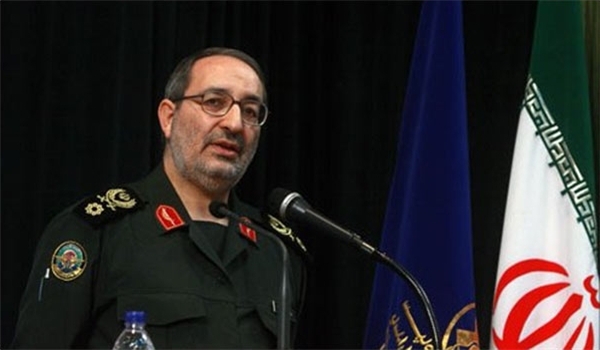
13940111000174_PhotoI
TEHRAN (FNA)- Deputy Chief of Staff of the Iranian Armed Forces Brigadier General Massoud Jazzayeri blasted the western countries for supporting the Takfiri terrorist groups, and said that the West has created the ISIL for the sake of maintaining the security of Israel.

“Today by looking at this issue (of terrorism) from every angle, we see the Americans standing behind the scene of ISIL terrorism in the region; they do this to sway away threats from Israel,” General Jazzayeri said on Friday, addressing the funeral procession ceremony held for two Iranian military commanders killed in Syria.

He pointed to Iran’s military counseling services for Syria and the martyrdom of Iranian military commanders in the Arab country, and said, “Were it not because of Iran’s wisdom, Syria would not be in the hands of the Americans and Israelis… .”

On Tuesday, two other IRGC commanders, providing military counseling services to the Syrian forces in their fight against the Takfiri terrorists, were killed in Syria.

Colonel Farshad Hasounizadeh, the former commander of IRGC’s Saberin Special Brigade, was martyred while fulfilling his duty as military adviser in Syria and fighting the Takfiri terrorists in the Muslim country.

Also, the former commander of IRGC Hazrat Hojjat 1 Brigade Hajj Hamid Mokhtar-band, nicknamed Abu Zahra, was killed in Syria.

Both Hasounizadeh and Mokhtar-band were IRGC war veterans and were martyred in Southern Syria.

Their martyrdom comes just days after another IRGC war veteran Brigadier General Hossein Hamadani was martyred during an attack by the ISIL Takfiri terrorists in the outskirts of the city of Aleppo while fulfilling his duty as military advisor and defending the holy Shiite shrines in the country, an IRGC statement said on Friday.

General Hamadani was in Syria to render military advice to the Syrian army and popular forces in their fight against the ISIL terrorists in the Arab country.

According to Iran’s military rules, those missed or killed in operation are promoted to a higher rank and that’s why in a few Persian-language sources, Colonel Hasounizadeh has been referred to as a General.

In September 2014, Deputy Chief of Staff of the Iranian Armed Forces Major General Gholam Ali Rashid announced that Iran’s military advisors are present in the friendly regional states to provide those nations with necessary military recommendations.

“Some of our commanders are in the field to give military advice to the Iraqi army, Lebanon’s Hezbollah and the Palestinian resistance movement,” Major General Rashid said, addressing a conference attended by a group of senior military commanders in Tehran.