Hundreds of thousands of soldiers are being called up for service in a surprise emergency exercise that began Monday.
The reservists – from the air, land and sea branches of the IDF, as well as the Home Front Command – began receiving automated messages calling them up to service, starting at 8:00 AM.
Most of the soldiers were only required to acknowledge the call, but thousands will have to don their uniforms and show up at enlistment points, to rehearse emergency scenarios.
A senior officer said that the Air Force will be rehearsing for the neutralization of various attacks and that the Navy will train for protecting national infrastructures, among other things.
The officer added that this will be the first time in which the IDF rehearses cyber-defense on such a large scale.
Southern Command will practice several scenarios, including rocket fire from Gaza.
Northern Command will also rehearse a war scenario, in unspecified locations.
The exercise will continue until Wednesday, and an unusually high volume of security vehicle traffic will be noticeable on Israel’s roads.
Also on Monday, the Home Front Command will be holding rescue drills at sites simulating wartime destruction in Holon and Neurim.
American weakness has brought us to this difficult moment. While we obsessed about its economic discomfort, Iran wore its duress with pride. It was never an even match. We now have to rely on a tiny ally to do the job for us. But unless we are ready to accept a nuclear Iran (and, in relatively short order, several other nuclear Middle Eastern states), get ready. The easy ways out disappeared long ago.
***************************
President Obama has made an art form of attacking his opponents rather than substantively defending his own policies, most recently regarding the Vienna agreement on Iran’s nuclear program. Essentially, Obama argues that we must either accept his wretched deal or go to war to prevent Iran from acquiring nuclear weapons.
As is typical, Obama posits the wrong choice, apparently to distract from the unpleasant reality that the agreement won’t work. It will not prevent Iran from getting nuclear weapons. So the real choice we are faced with is dealing with the consequences of military action or the consequences of a nuclear Iran. Neither is palatable, but the latter is far worse. If the real objective is stopping Iran from getting nuclear weapons, preemptive military action is now inescapable.
This rock-and-hard-place outcome has long been foreseeable. Iran’s dogged determination to become a nuclear-weapons state was fiercer and stronger than the West’s frail response. Assuming Iran scrupulously complies with every provision agreed to in Vienna — an absurdly unlikely scenario given the ayatollahs’ objectives and history — its ambitions for nuclear weapons will simply have been delayed eight to 10 years.
In all likelihood, the ayatollahs are already at work violating the accords. After all, Iran has systematically breached its voluntarily-assumed obligations under the Nuclear Non-Proliferation Treaty for more than 30 years. Now the president’s deal will allow Iran to keep the fruits of its violations. Yes, the deal includes restrictions on uranium enrichment, but Tehran can retain its enrichment program, with guaranteed international assistance in improving it. These concessions are fatal mistakes.
Moreover, Iran’s ballistic missile efforts — its development of the means to deliver nuclear weapons all over the world — will barely be touched. Nor does the deal in any way address Iran’s clandestine weaponization efforts, which it has denied and hidden from the International Atomic Energy Agency with great skill.
Last week, the news that the administration has not even seen the texts of two agreements between the energy agency and Iran, both crucial to implementation of the Vienna accords, only raises further doubts. President Obama must provide the texts of these “side deals” to Congress before any serious consideration of the overall agreement is possible.
Some critics of Obama’s plan advocate scuttling the deal and increasing economic sanctions against Iran instead. They are dreaming. Iran and the United States’ negotiating partners have already signed the accords and are straining at their leashes to implement them. There will be no other “better deal.” Arguments about what Obama squandered or surrendered along the way are therefore fruitless. As for sanctions, they were already too weak to prevent Iran’s progress toward the bomb, and they will not be reset now. To paraphrase Bruce Springsteen, “These sanctions are going boys, and they ain’t coming back.”
Patrick Clawson, the director for research at the Washington Institute for Near East Policy, provided the most recent thumbs-down assessment of sanctions: “Iran has muddled through the shock of the sanctions imposed in 2012, and its structural [economic] problems are not particularly severe compared to those of other countries.” He estimates Iran’s nuclear and terrorism-support programs to cost only about $10 billion annually. No wonder administration officials have testified that sanctions (including those imposed piecemeal before 2012) did not slow Iran’s nuclear efforts.
Nor will the deal’s “snapback” mechanism (intended to coerce Iran back into compliance if it breaches its obligations) change that reality. Tehran’s belligerent response is expressly stated in the agreement’s text: “If sanctions are reinstated in whole or in part, Iran will treat that as grounds to cease performing its commitments … in whole or in part.” Tehran does risk losing some future economic benefits should sanctions snap back, but by then it will have already cashed in the assets the deal unfreezes and signed new lucrative trade and investment contracts.
Once those benefits begin flowing all around, the pressure on world governments will only increase to ignore Iranian violations, or to treat them as minor or inadvertent, certainly not warranting the reimposition of major sanctions. The ayatollahs have dusted off Lenin’s barb that “the capitalists will sell us the rope with which we will hang them,” and applied it to the age of nuclear proliferation.
If diplomacy and sanctions have failed to stop Iran, diplomacy alone will fail worse. Like it or not, we now face this unpleasant reality: Iran probably will violate the deal; it may not be detected doing so and if detected, it will not be deterred by “snapback” sanctions. So we return to the hard question: Are we prepared to do what will be necessary to stop Iran from getting nuclear weapons?
Obama most certainly is not, which means the spotlight today is on Israel.
If Israel strikes, there will be no general Middle East war, despite fears to the contrary. We know this because no general war broke out when Israel attacked Saddam Hussein’s Osirak reactor in 1981, or when it attacked the North Korean-built Syrian reactor in 2007. Neither Saudi Arabia nor other oil-producing monarchies wanted those regimes to have nuclear weapons, and they certainly do not want Iran to have them today.
However, Iran may well retaliate. At that point, Washington must be ready to immediately resupply Israel for losses incurred by its armed forces in the initial attack, so that Israel will still be able to effectively counter Tehran’s proxies, Hamas and Hezbollah, which will be its vehicles for retaliation. The United States must also provide muscular political support, explaining that Israel legitimately exercised its inherent right of self-defense. Whatever Obama’s view, public and congressional support for Israel will be overwhelming.
American weakness has brought us to this difficult moment. While we obsessed about its economic discomfort, Iran wore its duress with pride. It was never an even match. We now have to rely on a tiny ally to do the job for us. But unless we are ready to accept a nuclear Iran (and, in relatively short order, several other nuclear Middle Eastern states), get ready. The easy ways out disappeared long ago.
European Union-American acceptance of the lie of “Arab Susiya” is a twisted anti-Semitic libel on which the entire Arab claim to all of Israel is based.
Arab girls with sign promoting the lie that they have lived there for decades. Aerial maps prove no Arabs lived there.
A fictional Palestinian Authority village is on the throes of becoming a reality that threatens a Jewish presence next to the Talmudic-period Jewish village of Susiya and would be a catalyst to support the blood libel that all of Israel was stolen from Arabs.
Arab Susiya, with several dozen tents and structures, has been built like a Broadway stage, complete with props that enable the Arabs to spin the yarn that it has existed for centuries but that the mean IDF is trying to destroy their ancient lifestyle.
The U.S. State Dept., the European Union and lazy and inherently biased international media have swallowed the tale that is chock full of romanticism and anti-Zionism.
The southern Hebron Hills until recent years was a forgotten rural region. Archaeological evidence clearly proves that Jews lived in Biblical and Talmudic times until as late as the 9th century, coinciding with the birth and rise of Islam.
Modern aerial photographs and academic researchers have categorically established that Arabs never lived in Susiya, but the world prefers to believe starry-eyed fairy tales that Jews are land thieves.
For centuries, only a few thousand Arabs populated the relatively vast southern Hebron Hills. Other Arabs came from the Hebron area to stay in caves for two months during the season for planting and reaping wheat or to grave sheep and goats.
Other than that, they were never to be seen because their homes were elsewhere.
All of that changed soon after the early 1980s when the Jews returned after 1,500 years.
The presence of Jews in the southern Hebron Hills woke up the Arab neglect of the region, where the Ottoman Empire, the British Mandate and the Jordanian occupation after the War for Independence in 1948 never issued a solitary deed of land ownership.
Yasser Arafat in Ramallah and Arabs in Hebron started getting antsy about the Jews moving into a strategic area from which Arabs staged several deadly terrorist attacks before the Six-Day War in 1967, but they had a problem. Arabs did not want to move from the urban areas of Hebron and adjacent Halhoul and Yatta and into the mountain desert where the biggest crop is rocks.
The European Union and leftist organizations came to the rescue. They pay Arabs to live in the region and to claim that their families have done so for centuries.
B’Tselem, the EU and other pro-Arab group built structures for Arabs, give them tents, solar power and water purification systems.
They have built new villages that never existed before, dotting the hillsides with a nearly contiguous presence trumpeted with a fictitious “historical claim.” For the record, the Jews have an older historical claim, as evidenced by the ancient synagogues in Susiya and in neighboring Samoa.
The focus of the creation of this lie has been Susiya, the largest Jewish community in the area, although less than 200 families live there. It is located several hundred yards from the Talmudic city, which is protected as a natural park.
The European Union and leftist groups have invested tens of thousands of dollars to bring Arabs to the narrow stretch of land separating modern and ancient Susiya. The IDF, with the approval of the Supreme Court, has issued demolition orders for some – but not all – of the illegal Arabs structures.
Most of them exist with the classic Bedouin and Arab ruse of cement buildings covered by tents to give the romantic impression they are inhabited by a group of Arabs whose love for the land is greater than the temptations to live a life of convenience in the city.
Their love for money and the love for hating Zionists are even greater.
The EU and leftists fund the Arabs to allow them to live through cold, windy and sometimes snowy winters, as well as the hot and sultry days of summer.
There are aerial photographs from two decades ago showing that not one Arab lived in Susiya, but the European Union is giving away free tickets to a play that is being billed as reality.
It has all of the elements that the anti-Israel establishment needs to beat their breasts and berate Israel for being so cruel as to destroy the lifestyle of Arabs and expel them from their ancient lifestyle, which in truth dates back to approximately 10 years.
The spokesman for the fake Arab Susiya is Nasser Nawaja, the author of today’s fiction presented as “opinion” by The New York Times. He wrote, and is quoted over and over by dummy journalists, that his mother was born in Khirbet Susiya.
And I was born in Antarctica, and you, dear reader, were born in Saudi Arabia.
Nawaja makes his living as a paid servant for B’Tselem and the European Union and whose job is to dupe the United States to adopt the illusion on which is based the Palestinian Authority claim to the rest of Judea and Samaria as well as all of Israel.
The oft-documented reports that the Palestinian Authority teaches that Haifa and Jaffa (Yafo) are part of “ancient Palestine” always were laughable and ridiculous, so thought the Israel government.
It now has woken up, years too late, and Foreign Minister spokesman Emmanuel Nachson shared with The JewishPress.com a directive it issued to its emissaries around the world to put a finger in the dike to stop the flood of fabrication.
Unfortunately, the Foreign Ministry is using logic, which is of no use, and rests its case on “long-standing agreements between Israel and the Palestinian Authority, including the Oslo agreements,” which no longer are a reference point for anything except for a study of idiocy.
The Foreign Ministry also told its foreign staff:
These clusters of structures… were built illegally and adjacent to an ancient Jewish archeological site.
Contrary to Palestinian claims that these structures have been permanently inhabited for decades, in fact, only a handful of families resided there in the 1980s and they only used the structures on a seasonal basis….
On 4 May 2015, the Supreme Court declined to issue another temporary injunction preventing demolitions.
The government is not taking to heart Deputy Foreign Minister Tzipi Hotovely’s advice to emissaries when she took office two months ago and said that the world needs to be reminded that Israel – all of Israel – belong to Jews by Biblical birthright. Anyone who does not agree can take his complaint to God.
The European Union the United Nations and especially the Obama administration do not care about the logic of legal or illegal buildings because they have adopted the entire Palestinian Authority hate libel that Israel is an “occupier” and that Jews have no right to live where Arabs want to live.
This has nothing to do with the “West Bank.” It has to do with all of Israel.
The “government of Tel Aviv” has closed its eyes for decades to the Bedouin and Arab rape of the Negev, well inside the “Green Line.” The squatters, many of whom have been imported from Judea and Samaria, have stolen tens of thousands of acres of state land – their “ancient land” – and the government has done nothing except to pay them to procreate their population bomb by winking an eye at polygamy and doling out outrageous child benefits.
“Arab Susiya” will be Israel’s Waterloo if it falls to international ignorance, in which the State Dept. has a stake.
When Indian reporter Goyal Raghubir, supposedly one of the better journalists covering Foggy Bottom, asked State Dept. spokesman John Kirby last week if he has “a reaction to reports that Israel may demolish part of a village called Susiya in the West Bank for expanding settlements,” the spokesman was ready with a prepared answer:
We’re closely following developments in the village of Susiya in the West Bank, and we strongly urge the Israeli authorities to refrain from carrying out any demolitions in the village. Demolition of this Palestinian village or of parts of it, and evictions of Palestinians from their homes would be harmful and provocative. Such actions have an impact beyond those individuals and families who are evicted. We are concerned that the demolition of this village may worsen the atmosphere for a peaceful resolution.
A “peaceful resolution” in the eyes of the Palestinian Authority, the European Union and the Obama administration is the expulsion of every Jew from all of Judea and Samaria, the Golan Heights and half of Jerusalem.
The “peaceful resolution” is build on the foundation of the lies of the “Palestinian people” and of Israel as “ancient Palestine.”
The international community has hidden its inherent anti-Semitism under propaganda spewed out as the truth by such groups as B’Tselem and Rabbis for Human Rights, who hand out to the media a perfume bottle full of a poisonous potion.
The Palestinian Authority-based Ma’an News Agency, one of the foreign media’s favorite sources for lies, told its readers last week that “Susiya villagers reportedly built homes in 1986 on agricultural land they owned, after being evicted by Israel from their previous dwellings on land declared as an archaeological site.”
Horse manure.
I have been living in this area since 1991 and frequently visited the archaeological site of Susiya. There never was a single structure in “Arab Susiya” until the late 1990s.
The State Dept. will not believe me. The European Union will not believe me. The United Nations will not believe me.
Why?
It is not because I am an “occupier;” it is not because I am a “settler’” and it is not because they care about Arabs, or “Palestinians.”
“Mr. Bean” has the answer in his portrayal of someone at the entrance to Hell, where the devil tells the Christians, “Yes, I am sorry. I am afraid the Jews were right,”
The world cannot admit it, and that is why it adopts the lie of an “Arab Susiya.”
The nuclear deal reached with Iran on Tuesday is clouded by uncertainty about whether the Iranian regime will live up to its relatively weak commitments. One outcome is almost certain, however: Israel will launch a pre-emptive strike against Iran, hoping to weaken the regime and stop, or slow, its nuclear program.
Israel will attack–possibly by year’s end–because there is no other way to disrupt Iran’s advance to regional hegemony, which will become unstoppable once the deal’s provisions–especially the non-nuclear provisions–begin to take effect.
Despite what the Obama administration and its media supporters are saying, there is almost no doubt that the Iran deal, should it survive Congress, will enable Iran to become a nuclear power.
President Barack Obama himself admitted as much in April, when he defended the provisional deal signed in Lausanne by admitting it allowed Iran to reach “breakout” shortly after the ten-year (now eight-year) expiration date. The only question is whether Iran will move that date forward and risk the meager diplomatic consequences of breaking the deal.
There are Israeli analysts–a minority–who believe that Israel can live in the shadow of a nuclear-armed Iran, at least for a while. After all, Israel has developed a lethal “second-strike” capacity, in the form of nuclear missiles aboard Dolphin-class submarines programmed to target Iran. That leaves the Iranian regime to weigh the odds of surviving an Israeli counterattack versus the chances of causing the end of the world as they know it. From a fanatical religious perspective, it is a win-win scenario–but cooler, or less pious, heads may prevail.
The problem is that the Iran deal goes so much further than the nuclear issue alone. The Iranians shrewdly bargained for a host of late concessions: an end to the international arms embargo, the lifting of a ban on ballistic missile technology, and an accelerated schedule of sanctions relief that will pour over $100 billion into depleted Iranian coffers. The regime knew that Obama would not walk away–that he had committed his political career to a deal, and he was already dismissing all other alternatives, severely undermining his own leverage.
Israel just might find a way to live with a nuclear Iran, but it cannot live with a nuclear Iran and an array of turbo-charged Iranian proxies on its borders.
Iran has already renewed its support for Palestinian terror groups in Gaza, and the U.S. has quietly allowed Iranian-backed Hezbollah to regroup in Lebanon, even as it has been weakened by losses in the Syrian civil war. Flush with cash, armed with advanced new weapons, and perhaps equipped with nuclear contaminants, these groups will pose an ever-greater threat to Israel’s security–and soon.
That is why the alternative that Israeli Prime Minister Benjamin Netanyahu presented to Congress–and he did present an alternative to the present deal, though Obama pretended not to notice–included three provisions: “first, stop its aggression against its neighbors in the Middle East; second, stop supporting terrorism around the world; and third, stop threatening to annihilate my country, Israel–the one and only Jewish state.” None of those referred directly to the Iranian nuclear program. Obama ignored Netanyahu’s suggestions and forged ahead.
An Israeli strike might not stop the Iranian nuclear program. But it could stall that program, and create a renewed sense of vulnerability around the regime, which was near collapse as recently as 2009. Israel could also make Iran pay a direct cost for arming Hezbollah, Hamas, and other terror groups–a cost historically borne by the civilians of southern Lebanon or Gaza. It could project a conventional deterrent that would affect Iran here and now, as opposed to a nuclear deterrent whose effect might only be felt after an atomic exchange (i.e. not at all).
For Israel, the costs of such an attack on Iran–even a successful one–could be severe. It would be condemned and isolated internationally. It might suffer thousands of rocket attacks from Lebanon and Gaza. It may lose thousands of soldiers and civilians in a ground war.
Obviously the consequences will be less damaging–or more bearable–if the pre-emptive strike is successful. The reason Israelis are willing to take the risk at all is twofold. First, they have done it before (Iraq 1981; Syria 2007). Second, the alternative–thanks to the Iran deal–looks far worse.
The Obama administration has done all it can to prevent an Israeli pre-emptive strike, from leaking Israeli attack scenarios to denying Israel air space over Iraq. As a result, the only realistic bombing plans–whether Israel targets Iran’s nuclear and political installations directly, or detonates an electromagnetic pulse (EMP) over the country–involve a Doolittle Raid-style attack from which Israel’s pilots will not expect to return, or a landing in Saudi Arabia. The latter was once a non-starter, but–ironically–Obama’s overtures to Iran have made it possible.
The Saudis are expected to respond to the Iran deal by seeking nuclear weapons of their own. But the monarchy could also strike an alliance with Israel–perhaps even a grand bargain.
The Saudis could give Israel landing rights, logistical support, and intelligence. In return, Israel could accept Saudi Arabia’s proposal for a Palestinian state roughly along the “1967 lines”–plus Saudi control of Jerusalem’s Muslim holy sites, which would cement the royal family’s legitimacy. (Ironically, Obama, by provoking war, would enable Arab-Israeli peace.)
The clock is ticking, however. Before the Iran deal, it was thought that Israel could only carry out a pre-emptive strike in the time period before Iran actually became a nuclear power. Now, the deadlines are even shorter, and more complex.
Israel would need to attack before Russian S-300 surface-to-air missiles, already sold to Iran, can be delivered and activated. It would also need to attack while Hezbollah and Hamas are still weak, war-weary and cash-strapped–i.e. before sanctions relief delivers billions to Iran’s regional war and terror efforts.
Israel must also be wary of attacking too soon. It will not attack in the next ten days, for example, because they coincide with a religious period of mourning for historic defeats. It would also make little sense for Israel to attack while Congress is debating the Iran deal.
But Israel will attack before it loses the option. It will do so because the purpose of Israeli statehood is to enable Jews to defend themselves, and not rely on the help or mercy of others.
Obama wants to build a new legacy, but Netanyahu has inherited an old legacy–one he cannot ignore.
Israeli Prime Minister Binyamin Netanyahu bitterly accused the “leading international powers of gambling our collective future on a deal with the foremost sponsor of international terrorism” – roundly condemning all six world powers who signed the nuclear deal with Iran in Vienna Tuesday, July 14.
President Barack Obama topped the list. Netanyahu pointed out that the president had determined on a deal with Iran at any price before he took office, which is true. Therefore, it had nothing to do with the poor relations between himself and the US President, he said in answer to critics. It was now time for Israeli leaders to set aside differences and pull together, he said. Opposition leader, the Zionist Union’s Yitzhak Herzog, agreed and said he was enlisting for the necessary effort on behalf of Israeli security. Tuesday night he received an update on the situation from the prime minister.
The special security cabinet meeting, called to discuss the ramifications of the nuclear deal, hours after it was signed, unanimously rejected it and declared “this deal does not commit Israel.”
Unfortunately, Israel was never asked for its commitment, any more than the other Middle East powers directly affected by it. The cabinet statement was therefore no more than a meaningless expression of futility, a sensation shared equally by Saudi King Salman and Egyptian President Abdel-Fatteh El-Sisi, in the face of the iron wall Obama and Secretary of State John Kerry have built for Iran in the region.
Both unceremoniously ditched Israel and its Arab neighbors in order to join hands with Iran. By this reshuffle of allies, Washington has created a new geopolitical reality in the region at the expense of its equilibrium.
The US Congress has 60 days to review the nuclear accord and reach a decision. But if Netanyahu had had any hopes of swinging the Senate around to voting down the veto President Obama promised to impose to mullify its rejection, that hope swiftly vanished in thin air. Leading presidential contender Hillary Clinton announced that if she wins the 2016 election she would abide in full by the nuclear accord Obama signed with Iran. This announcement assured Obama of a Senate majority.
The dead end reached by Netanyahu on this issue also symbolizes the end of Israeli’s special standing in Washington as “America’s leading Middle East ally.”
Iran has stepped into this position. There is little point in Israel knocking on the White House door to renew the old understanding and sympathy, as advised by former prime minister Ehud Barak and others. It does not matter who sits in the prime minister’s office in Jerusalem, as matters stand now, he/she will find themselves on the wrong side of that door.
Defense Secretary Ashton Carter will visit Israel next week. But that is only an attempt to soften the blow.
This does not mean that the Obama administration will totally abandon Israel, only that it will no longer enjoy favored status compared with other Middle East nations. By ditching the Arab world, Obama equally dumped the Palestinian issue. This has some advantages for the Netanyahu government, but is not the end of the world for the Palestinians. They, like Arab governments, have the option of seeking an understanding with Tehran, whereas that door is shut tight against Israel.
In this situation, Israel’s quiet understandings with a number of Arab leaders directed at forming a bloc to counter the US-Iran alliance, have no immediate future. When the earth shakes in a major upheaval, each individual is out to save himself and has no time to look around for allies.
In some ways, the Netanyahu government may find relief in being released from the political and strategic constraints bound up in the relationship with the Obama administration, and find the freedom to be more pragmatic and independent in its policy-making.
After all, Israel still has the strongest army and the most vibrant economy in the Middle East. Its leaders must learn to use those huge assets wisely and independently of the Obama administration.
The new Commando Brigade is designed for quiet, bold, covert and effective action against terrorist groups posing a threat from the Sinai Desert to Egyptian sovereignty and Israel’s southern border. Such action would be coordinated closely between Israeli and Egyptian military and intelligence arms.
*******************
While US president Barack Obama coined his approach to the struggle against the Islamic State with the words: “Ideologies are not defeated by guns. They’re defeated with better ideas.” – Israel and its military leaders are taking no chances against a declared enemy.
Last Friday, July 3, the Islamic State of Iraq and the Levant’s Sinai branch fired three Grad missiles across the border into the Israeli Eshkol district, while it was in mid-offensive against the Egyptian army in North Sinai. Large parts of southern Israel next door had already been declared closed military areas in consequence of that offensive.
ISIS and its affiliates, while currently preoccupied with snatching up territory from countries neighboring Israel, make no secret of their intention, confirmed by military intelligence, to reach Israel’s northern, eastern and southern borders before long.
Monday, July 6, IDF Chief of Staff Lt. Gen. Gady Eisenkott unveiled Israel’s answer to the coming challenge. It is a unique, multi-purpose commando ground force, especially tailored to fight ISIS and provide the “boots on the ground” which the US-led coalition has kept back from the Islamists’ constantly expanding warfront.
It will be trained and armed for extraordinary missions outside routine military tasks.
The revelation was something of a wake-up call for the general Israeli population. The new force’s short term tasks are to guard southern and northern Israel against hostile rocket fire and attempts by Islamist groups riding captured armored carriers to storm the border. This happened once before on Aug. 6, 2012, when Ansar Beit Al-Maqdis Islamists (who later joined ISIS) broke through the Egyptian-Israeli Kerem Shalom border crossing from Sinai. Their APCs had driven almost up to a military base before they were wiped out by Israeli warplanes.
The new Commando Brigade is designed for quiet, bold, covert and effective action against terrorist groups posing a threat from the Sinai Desert to Egyptian sovereignty and Israel’s southern border. Such action would be coordinated closely between Israeli and Egyptian military and intelligence arms.
Similar operations would also be staged if necessary from Israel’s northern border – against Hizballah or any threat from Syria.
The new outfit brings together the different skills and the high, focused fire power rendered by the four elite units’ assorted weaponry. In this sense, these units, all highly adept in different aspects of covert and stealth operations deep behind enemy lines, complement one another. This amalgam that may be loosely likened to a unique combination of US Delta, Seals, Rangers, and airborne commandoes all rolled in one.
The elite units merged into the new commando brigade are:
1. Meglan, which specializes in destroying enemy systems with the accent on armored units. Its members are equipped with intelligence technology for gathering data and its transmission in real time.
2. Duvdevan‘s tasks are to liquidate targeted terrorists and round up suspects. Its members operate under cover by blending into a hostile population in disguise. They are trained for single combat in the heart of enemy terrain.
3. Egoz commandos employ guerilla tactics borrowed from the books of terrorist organizations.
4. Rimon commandos also blend into a hostile population disguised as locals for the purpose of spotting and foiling terrorist operations in difficult and complex areas.
The commander of the new combined brigade is Col. David Zinni who defers to the 98th (Esh) Division.
Gen. Eisenkott has brought the four elite units together from the Paratroops, Golani and Givati brigades, among which they were formerly distributed. His action capped the reassessment of the IDF’s war doctrine which he found essential for dealing with the new volatile and constantly moving enemy.
The four elite units in combination offer a synergetic combination. They will train together in air, sea and tactics for missions to meet unorthodox intelligence demands. They will also be set apart from the conventional military by their special weapons, secret high-tech equipment, and separate guidelines and logistics.
The swiftness of ISIS’s climb to highest ranks of Israel’s foes caused Gen. Eisenkott to override the most recent innovation of his predecessor, Lt. Gen. Benny Gantz: the Depth Command. The Commando Brigade has made the Depth Command redundant.
Like the mainstream media in the West, the UN chooses to look the other way when Palestinians torture or kill fellow Palestinians.
The Palestinian Authority and Hamas claim that the three men committed suicide.
When three detainees die in less than a week, this should sound an alarm. But pro-Palestinian groups and human rights activists do not care about the human rights of Palestinians if Israel cannot be held responsible. Their obsession with Israel has made them blind to the plight of Palestinians living under the Palestinian Authority.
Three Palestinian men were found dead in their jail cells in the West Bank and Gaza Strip this past week.
But their stories did not attract the attention of the international media or human rights organizations in the U.S. and Europe. Nor was their case brought to the attention of the United Nations or the International Criminal Court (ICC).
By contrast, the case of 17-year-old Mohamed Kasba, who was shot dead north of Jerusalem by an Israeli army officer as he attacked the officer’s car with stones, received widespread coverage in the Western media.
The UN even rushed to condemn the killing of Kasba, and called for an “immediate end” to violence and for everyone to keep calm. “This reaffirms the need for a political process aiming to establish two states living beside each other safely and peacefully,” said UN Special Coordinator for the Middle East Peace Process, Nickolay Maldenov.
The UN official, needless to say, made no reference to the deaths that occurred in the Palestinian Authority (PA) and Hamas jails. He did not even see a need to express concern over the deaths or call for an investigation. Like the mainstream media in the West, the UN chooses to look the other way when Palestinians torture or kill fellow Palestinians.
The reason the case of the three detainees will not interest anyone in the international community is because the men did not die in an Israeli jail. Instead, the three men died while being held in Palestinian-controlled jails.
Had the three men died in Israeli detention, their names would have most likely appeared on the front pages of most leading Western newspapers. The families of the three men would have also been busy talking to Western journalists about Israeli “atrocities” and “human rights violations.”
But no respected Western journalist is going to visit any of the families of the three detainees: they did not die in an Israeli jail.
The same week that the three Palestinian men were found dead in jail, the UN Human Rights Council decided to adopt a resolution condemning Israel over the UN report into last year’s Operation Protective Edge in the Gaza Strip. Again, the UN Human Rights Council chose to ignore human rights violations by Hamas and the Palestinian Authority, who deny detainees basic rights and proper medical treatment.
Two of them died in PA security installations in Bethlehem, while the third was found dead in a Hamas-controlled jail in the Gaza Strip.
The two detainees who were found dead in their jail cells in Bethlehem are Shadi Mohamed Obeidallah and Hazem Yassin Udwan. The man who died in the Gaza Strip jail was identified as Khaled Hammad al-Balbisi.
The Palestinian Authority and Hamas claim that the three men committed suicide.
In the case of Obeidallah, the Palestinian Authority police said he hanged himself with a piece of cloth inside the jail restrooms. He was taken into custody on suspicion of committing a murder three years ago.
The second man, Udwan, died a few days later in another Bethlehem police facility. According to police officials, he too committed suicide.
The detainee in the Gaza Strip, al-Balbisi, was being held by Hamas authorities for allegedly assaulting his wife.
But al-Balbisi, 43, apparently did not commit suicide. He was very ill when he was arrested by the Hamas security forces, and did not receive proper medical care while in detention.
The Palestinian Center for Human Rights (PCHR), a Gaza-based non-profit group dedicated to protecting human rights, promoting the rule of law and upholding democratic principles in the Palestinian territories, called for an investigation into the circumstances surrounding the deaths of the detainees.
“PCHR stresses that the Palestinian Authority is responsible for the lives of prisoners and detainees under its control and is thus responsible for treating them with dignity, including offering them medical care,” the group said in a statement.
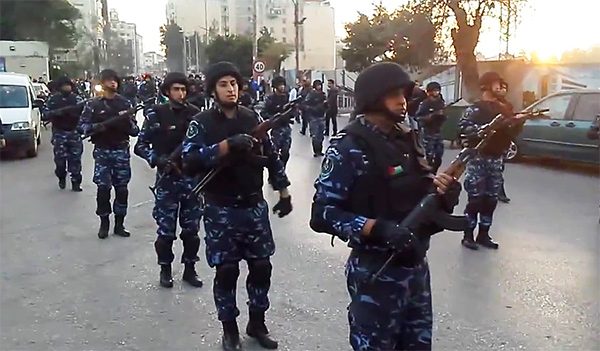
The Palestinian Authority police on parade, January 2015.
When three detainees die in less than a week in Palestinian detention, this should sound an alarm bell, especially among so-called pro-Palestinian groups and human rights activists in different parts of the world.
But these folks, like the UN and mainstream media, do not care about the human rights of the Palestinians if Israel cannot be held responsible. Their obsession with Israel has made them blind to the plight of Palestinians living under the Palestinian Authority and Hamas, as well as to the horrific crimes committed every day by Muslim terrorists in the Middle East and elsewhere.
The story of the three men who died in Palestinian jails is yet another example of the double standards that the international community and media employ when it comes to the Israeli-Palestinian conflict
An immense stretch of Sinai desert populated by half a million people is under siege, as the Egyptian army fights off a major offensive by the Islamic State’s Egyptian affiliate, the Sinai Province, against its positions in northern Sinai. The battle, which Monday, July 6, went into its sixth day, is being fought in an area bounded by the northern town of Sheikh Zuwaid, Rafah on the Gaza border, and up to Kerem Shalom and Nitzana on the Israeli border to the south. DEBKAfile’s military sources report a news blackout on the ongoing warfare except for Egyptian army handouts.
Egyptian security sources reported Monday that the latest round of helicopter strikes and ground operations had killed 63 Islamists in villages between Sheikh Zuwaid and Rafah, where four of their hideouts had been located. Our sources add that these air strikes are directed against civilian dwellings, especially in farming districts, where ISIS fighters are suspected of hiding out. No figures have been released by Cairo on civilian or Egyptian army casualties.
DEBKAfile describes the contest as an asymmetrical one between an army that depends heavily on aerial operations and ISIS terrorists, who have resorted mainly to guerilla warfare. By night, they flit swiftly on foot between the dunes to strike Egyptian army positions. By day, their foot soldiers trap Egyptian soldiers by setting up ambushes around those positions and on the roads of Sinai to keep Egyptian troops pinned down. Terrorist operations are a constant on their agenda.
The Egyptians respond with blanket air strikes which swoop on any moving object in the embattled area – whether by car or on foot
The hide-and-seek tactics employed by ISIS are sustainable in the long term, especially when the Islamists can rely on a constant influx of reinforcements, weapons and ordnance, the sources of which DEBKAfile disclosed in an exclusive report Sunday, July 5.
The Islamic State is rushing reinforcements to Egypt from Libya and Iraq for its battle with Egyptian forces in northern Sinai, which went into its fifth day Sunday, July 5, and other offensives, DEBKAfile’s intelligence and counter-terror sources report. After sustaining hundreds of casualties, both sides claim to have won the upper hand but the tenacious struggle is not over.
An Islamist manpower pool is provided by Egyptian extremists who crossed into Libya in the past and settled in bases around Benghazi. Last week, ISIS summoned them to take up positions in Cairo and the Suez Canal and wait for orders to go into action. They crossed back with the help of smugglers. Those rings, dominated by the Muslim Brotherhood underground, with branches controlled by Hamas and Hizballah, bring illicit weapons and ammunition supplies to Sinai from Libya via Egypt.
President Abdel Fatteh El-Sisi is therefore obliged to earmark substantial military and intelligence resources for defending the Suez Canal and Cairo – more even than the Sinai front.
The other source of jihadi reinforcements is Iraq, They use another branch of the smuggling network which carries them through southern Jordan to the Gulf of Aqaba where they are picked up by smugglers’ boats and ferried across to the eastern coast of the Sinai Peninsula.
The IDF had more than one reason for its decision last Wednesday to close to traffic Rte 12, Israel’s main southern highway, which runs parallel to the Egyptian border up to Eilat: It was a necessary precaution lest ISIS turned its terrorists and guns against Israel from next-door northern Sinai. The other reason was to deter the Islamists coming from Iraq from trying to transit Israel and reach Sinai with the help of Bedouin smugglers operating on both sides of the Israeli-Egyptian border.
Our military sources estimate that some 1,000 jihadists are directly engaged in the North Sinai battle with the Egyptian army, but add that they could quickly recruit supplementary fighting manpower from Bedouin tribes near the warfront who already play ball with the terrorists.
Egyptian tacticians have strictly limited the army action on this front to air and helicopter strikes and local ground and armored forces. They are focusing on defending three Sinai enclaves, the northern district around Sheikh Zuweid, El Arish port and Rafah, and Sharm el-Sheikh in the south, to pin ISIS forces down in those places and prevent them from fanning out into areas controlled by the big Bedouin tribes.
When President El-Sisi visited the troops in northern Sinai Saturday, July 5, he disclosed that only one percent of the Egyptian army of 300,000 men was assigned to Sinai. He indicated that his army was perfectly capable of wiping out the Sinai terrorist threat in no time if all its might were to be thrown into the fray.
This strategy leaves ISIS with free rein in central Sinai. However, El-Sisis, like his predecessor Hosni Mubarak, is not prepared to go all out against ISIS in its “dens” any time in the near future, because he needs all his military resources and assets he can muster to defend the capital Cairo and the Suez Canal.
Neither the Islamic Army nor the Muslim Brotherhood or any other radical Islamists make any secrets of their next plans. ISIS has announced that it is setting its sights on Egypt’s pyramids, the Sphinx of Giza, and the country’s unique historic monuments in general, after its savage vandalism and looting of other precious world heritage sites.
In a new message released Friday, July 3, a number of radical Islamist leaders, including the ISIS “caliph” Abu Bakr al-Baghdadi, told their followers that the destruction of Egypt’s national monuments, such as the pyramids and the sphinx, was a “religious duty” that must be carried out by those who worship Islam, as “idolatry is strictly banned in the religion.”
This message has sharply ratcheted up the jihadist element of ISIS military confrontation with Egypt to a higher, more inflammatory level.
Smoke rises in Egypt’s northern Sinai, as seen from the border of the Gaza Strip, on July 1, 2015, amid fierce clashes between government forces and Islamic State-affiliated gunmen. (Abed Rahim Khatib /Flash90)
The IDF has acquired intelligence that Hamas is providing weaponry and other support to the Islamic State’s Sinai affiliate, Wilayat Sinai, the group thought to be behind Wednesday’s deadly attack on Egyptian security services, a top Israeli officer said Thursday.
The coordinator of government activities in the territories, Maj. Gen. Yoav Mordechai, told the Arabic-language news network al-Jazeera that along with military support, Hamas has also been providing medical support to injured IS operatives.
Wednesday’s attack, which included a wave of suicide bombings and assaults on security installations by dozens of militants, saw Sinai’s deadliest fighting in decades. Security officials said dozens of troops were killed, along with nearly 100 attackers.
Mordechai claimed a high-ranking officer in Hamas’s military wing, named as Wa’al Faraj, has been smuggling injured Islamic State fighters into the Gaza Strip for medical treatment.
COGAT commander Maj. Gen. Yoav Mordechai, left, at the Bitunya Crossing near Ramallah (Photo credit: Yonatan Sindel/ Flash 90)
Another top Hamas commander involved in training fighters, Abdullah Kishta, had been lending his expertise to Islamic State jihadists in Sinai, Mordechai said, adding that the IDF has “proof” of these direct ties.
Wilayat Sinai (Province of Sinai) was known as Ansar Bayt al-Maqdis before it pledged its allegiance to the Islamic State.
The IDF on Thursday beefed up its presence along the border with the Sinai Peninsula following the attacks, as security officials cautioned that the IS-affiliated group could attempt to overrun the Gaza Strip.
The Israeli army deployed additional troops and was monitoring the fighting across the border using UAVs, Israel Radio reported Wednesday.
“We see in front of our eyes IS acting with extraordinary cruelty both on our northern border and at our southern border,” Prime Minister Benjamin Netanyahu said on Thursday, referring to operatives of the group who have been fighting in the Syrian civil war.
“Our hearts are with the Egyptian people, we send our condolences to the Egyptian government and the families of those who were killed in battle by cruel terror.”
Egyptian officials said the military killed 23 extremists in dawn raids Thursday in northern Sinai, just south of the border town of Rafah, near the Gaza Strip.
They said the army was also seeking out militants house to house in the town of Sheikh Zuweid — where the militants attacked at least five army checkpoints the previous day — and de-mining roads in and around the area that extremists had booby trapped with mines and improvised explosives devices.
A photo shared by the Egyptian military shows a weapons cache seized from IS-linked jihadists in the Sinai Peninsula (Facebook/Egyptian army)
The Sinai attacks were the most brazen in their scope since jihadists launched an insurgency in 2013 following the army’s overthrow of Islamist president Mohamed Morsi.
Militants took over rooftops and fired rocket-propelled grenades at a police station in Sheikh Zuweid after mining its exits to block reinforcements, a police colonel said.
“This is war,” a senior military officer told AFP. “It’s unprecedented in the number of terrorists involved and the type of weapons they are using.”
One car bomb attack against a checkpoint south of Sheikh Zuweid killed 15 soldiers.
The Islamic State group said its jihadists surrounded the police station after launching attacks on 15 checkpoints and security installations using suicide car bombers and rockets.
Troops regularly come under attack in the Sinai, where jihadists have killed hundreds of policemen and soldiers since Morsi’s overthrow.
IS said the assault had involved three suicide bombers. “In a blessed raid enabled by God, the lions of the caliphate have simultaneously attacked more than 15 checkpoints belonging to the apostate army,” it said in a statement.
Palestinian Authority Foreign Minister Riyad al-Malki (Issam Rimawi/Flash90)
alestinian Authority Foreign Minister Riyad al-Maliki was expected on Thursday to personally deliver to the International Criminal Court files describing alleged Israeli crimes in the West Bank and Gaza.
The move by the Palestinians marks a first step toward opening criminal proceedings against the Jewish state, and comes days after a UN panel found Israel could be guilty of war crimes during fighting in Gaza last summer.
Maliki was to present the files, which mainly contain background data and statistics, for review by ICC Chief Prosecutor Fatou Bensouda.
The files describe Israeli control in the West Bank, arrest policies, and daily life.
A team of ICC investigators is scheduled to arrive in Israel by the end of the month to examine Palestinian allegations of Israeli war crimes and crimes against humanity in the West Bank and Gaza Strip, though Israeli officials have described the visit as routine.
The files to be presented by Maliki are intended to aid Bensouda in deciding whether or not to upgrade the preliminary probe into a full investigation of criminal activity.
A decision to order a full investigation can only come from judges in the ICC’s pretrial department.
International Criminal Court prosecutor Fatou Bensouda (Andreas Rentz/Getty Images/ via JTA)
Should the review lead to an investigation, the court may also look into crimes allegedly committed by the Palestinians as well.
The Palestinian Authority officially joined the International Criminal Court on April 1, after having signed the court’s founding treaty, the Rome Statute, last December.
Though Israel is not a member of the court, cases could be brought before it against Israeli individuals suspected of war crimes committed in territory claimed by the Palestinians.
In January, Bensouda initiated an investigation into alleged war crimes committed by Israel during last summer’s war between Israel and armed factions in Gaza.
On Monday, a report by the UN Human Rights Council found Israel and Palestinian groups could have committed war crimes, and urged The Hague to launch an investigation.
Israel has dubbed the Palestinians’ joining the court as “scandalous,” with Prime Minister Benjamin Netanyahu warning that it turns the ICC “into part of the problem and not part of the solution.”
Meanwhile, the Israeli non-governmental organization Shurat Hadin-Israel Law Center has begun collecting incriminating information on Palestinian leaders as a deterrent measure at the ICC.
Earlier this week Shurat Hadin petitioned the ICC demanding that the court disqualify Bensouda from dealing with the matter because she has already made comments to the media about the Israeli-Palestinian situation, contravening the court’s own guidelines, the Hebrew-language Ynet website reported.









 anneinpt
 artaxes
 danmillerinpanama
 davidking1530
 Peter Hofman
 Joseph Wouk
 Peter
Peter Louisiana Steve
 WarSclerotic
Recent Comments