U.S. to probe allegations that Iran, North Korea are linked in nuclear and missile research, Washington Times, Guy Taylor, May 29, 2015
 Photo by: Yorgos Karahalis Iranian Foreign Minister Mohammad Javad Zarif addresses journalists during a news briefing in Athens, Greece, on Thursday, May 28, 2015. Iran’s foreign minister is holding out hope that a “sustainable, mutually respectful” deal can be struck with world powers in talks over his country’s nuclear program before the current deadline of June 30. (AP Photo/Yorgos Karahalis)
U.S. officials said they were seriously examining an Iranian dissident group’s claims on Thursday that Iran and North Korea are forging ballistic missile and nuclear research ties — but that the allegations are unlikely to derail ongoing nuclear negotiations between Western powers and Tehran.
“We have seen these claims, and we take any such reports seriously,” said State Department spokesman Jeff Rathke. “But we don’t have any information at this time that would lead us to believe that these allegations impact our ongoing negotiations over Iran’s nuclear program.”
He added that U.S. officials have not yet been able to verify the claims made by members of the dissident National Council of Resistance of Iran (NCRI).
The dissident group, which has offices in Paris and Washington, claims to have evidence proving that a delegation of North Korean nuclear and missile experts visited a military site near Tehran in April amid the ongoing nuclear negotiations between Iran, the U.S. and other world powers.
Analysts say the exiled NCRI has a clear political agenda to smear the government in Tehran and to try and disrupt the nuclear talks. The group has a controversial past in Washington, where the State Department for years listed a key arm of it known as the Mujahedin-e-Khalq, or “MEK,” as a terrorist organization.
But the dissident group also has a history of exposing major clandestine nuclear operations in Iran. It has long claimed credit for tipping off Western powers to the existence of the Islamic Republic’s uranium enrichment plant at Natanz and its heavy-water plutonium facility at Arak in 2002 — two facilities that Western officials have deemed to be violations of U.N. nuclear regulations.
ISIS Wins No Matter What Happens Next, The Daily Beast, Michael Weiss, May 28, 2015
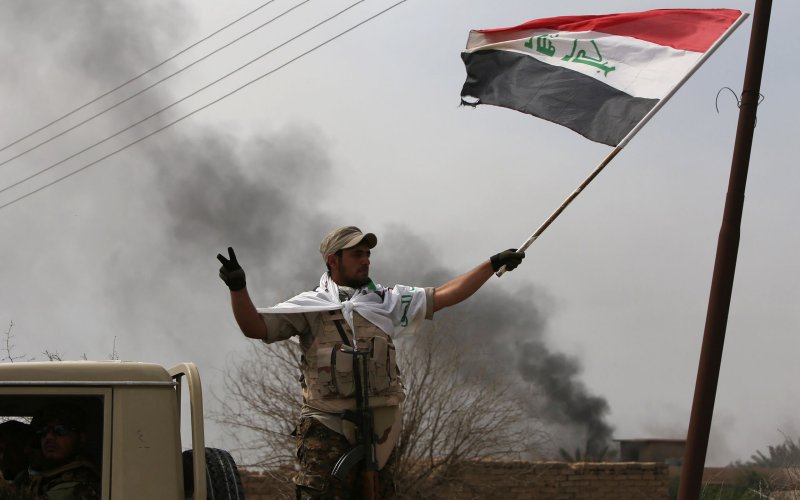 Ahmad Al-Rubaye/AFP/Getty
Usama al-Nujaifi, one of Iraq’s vice presidents and the former parliamentary speaker, pointed out that recent missteps by the militias has squandered incipient good will for Sunni reconciliation. Yesterday, during a parliamentary session, the Sunni governor of Diyala province was fired—and replaced with a Shia. “This is a real threat and a very negative message to Iraqis. This is considered a break to the rules and it contradicts what has been agreed,” Nujaifi said. “The majority in Diyala are Sunnis.”
**********************
The latest planned attack on the terror army could be playing right into their hands.
The Obama administration is being slammed from all sides for its failing strategy against ISIS—and rightly so. But amid all the scorn, one question has yet to be asked about the resiliency of the terror army, which, actually goes to the heart of its decade-old war doctrine. Namely: does ISIS actually win even when it loses?
This isn’t an academic issue. America’s allies in the ISIS war are gearing up for a major counteroffensive against the extremist group. That assault that could very well play right into ISIS’ hands.
Having superimposed its self-styled “caliphate” over a good third of Iraq’s territory, in control of two provincial capitals, ISIS is today in strongest position it has ever been for fomenting the kind of sectarian conflagration its founding father, Abu Musab al-Zarqawi, envisioned as far back as 2004.
Zarqawi’s end-game was simple: by waging merciless atrocities against Iraq’s Shia majority population (and any Sunnis seen to be conspiring with it), Zarqawi’s jihadists would have only to stand back and watch as radicalized Shia militias, many of whose members also served in various Iraqi government and security roles, conducted their own retaliatory campaigns against the country’s Sunni minority. Internecine conflict would have the knock-on effect of driving Sunnis desperately into the jihadist fold, whether or not they sympathized with the ideology of al-Qaeda in Iraq, Zarqawi’s franchise and the earliest incarnation of what we now call the Islamic State.
Indeed, in the mid-2000s, the Jordanian jihadist nearly got what he wished for by waging spectacular terror attacks against Shia civilians and holy sites, such as the Golden Mosque in Samarra, a strategy which quickened devolved Iraq’s violence from a primarily anti-American insurgency into all-out civil war. The only stopgap for a truly apocalyptic or nation-destroying result was the presence of nearly 200,000 U.S. and coalition troops. Today, however, absent such a foreign and independent military presence, the main actors left in Iraq are the same extremists —Shia militias and ISIS.
This fact was only driven home last week after thousands of U.S.-trained Iraqi Security Force personnel, including the elite counterterrorist Golden Division, fled from Ramadi, allowing the city fall to a numerically modest contingent of ISIS jihadists. Having been initially instructed by Iraq’s Prime Minister Haider al-Abadi to refrain from defending the city (no doubt at the prompting of Washington) the Hashd al-Shaabi, the umbrella organization for these Shia militias, now say they are prepping a massive counteroffensive to retake Ramadi. It promises to be a drawn-out and highly fraught counteroffensive, pitting paramilitaries—which have been accused of war crimes and atrocities by Human Rights Watch, Amnesty International and United Nations Human Rights Commission—against genocidal ISIS militants.
Many Iraqis fear, with good reason, that this counteroffensive will also extend to Sunni civilians who will now be branded “collaborators” of ISIS, as they have in previous Hashd-led operations. The result: torture, extrajudicial killing, and ethnic cleansing. Nothing would better serve the ISIS narrative or legitimate its claim to be the last custodian and safeguard of Sunni Muslims in the Middle East. Such an outcome might even precede the eventual disintegration of the modern state of Iraq into warring ethno-religious enclaves. That this was ISIS’s plan all along adds yet another grim paragraph to the obituary of American-hatched adventurism in the Middle East.
True, Hashd al-Shaabi has routed ISIS elsewhere before, namely in Amerli and Jurf al-Sakhar and Tikrit. In the aftermath, the militia was accused of committing human rights abuses, but those accusations didn’t tear the country apart.
The difference with Ramadi, however, is one of both scale and symbolism. This city of close to 200,000 is dead center in the Sunni heartland of Iraq, where ISIS has the home advantage. Ramadi was also, not coincidentally, the cynosure of the so-called “Anbar Awakening,” which saw hundreds of thousands of Sunni tribesmen rise up against ISIS’s predecessor, al-Qaeda in Iraq, in a cautious but fruitful partnership with American soldiers in the mid-2000s, a grassroots counterinsurgency whose gains were then solidified by the “surge” orchestrated by U.S. commander General David Petraeus. This time, absent any American combat forces, there are Shia Islamists who have never before tread into Ramadi. Many Iraqis dread the consequences.
“Iraq is not unified,” Iraq’s former Deputy Prime Minister Rafe Essawi, a senior Sunni political leader originally from Anbar, told The Daily Beast. “50 percent of the country belongs either to Kurds or ISIS, and 50 percent belongs to the Shia militias backed by Iran. We said too many times to our friends the Americans that we do not need to see the militias in Ramadi because this will lead to sectarian conflict.”
Yet the Americans have little on offer by way of an alternative. U.S. training efforts are still months off from fielding military units able to join the fight. With Iraq’s future resting on them, Hashd is seen as the only ready bulwark against further ISIS encroachments, though its conduct in Anbar may paradoxically purge the province of ISIS’s hard power while underwriting its soft version.
The Ramadi offensive hardly got off to a promising start. On Tuesday, Hashd spokesmen announced that the name for their Anbar offensive was, “Labeyk Ya Hussein,” a slogan roughly translated as “At your service, Hussein,” in tribute to a venerated Shia religious figure. The connotations were therefore of holy war — not exactly the multi-sectarian, pan-Iraqi message Baghdad has preferred to telegraph to international audiences.
On Wednesday, in response to criticism from U.S. officials and some Iraqi leaders—including demagogic Shiite cleric Muqtada al-Sadr (who has fallen out with Iran and has since platformed himself as a nationalist politician)—the operation’s name was changed to to more universal: “Labeyk Ya Iraq.” But the public relations rethink has not addressed underling concerns about the Hashd’s intentions, nor allayed Sunni anxieties.
“I think the careful examiner of the facts on the ground will see de facto borders are being drawn whether by design or by circumstance,” said one former Iraqi official who spoke to The Daily Beast on the condition of anonymity. “The militias have effectively cleared the Baghdad belts to the south of Sunnis, and with the Ramadi operation I expect the same will happen westward but it will entail a lot more fighting and possibly much more instability.”
This is because the war for the future Iraq isn’t being waged first and foremost by Iraqis but by their self-interested next-door neighbor, Iran, led by its elite Revolutionary Guards Corps-Quds Force, a U.S.-designated terrorist entity in its own right.
Iraq’s sectarian division, whereby Sunnis have been forced out of Shia-controlled areas under the auspices of fighting ISIS, reflects the fact that the Hashd operates more according to Tehran’s geo-strategic and ideological interests, the former official said. “I feel that Iran and some of its erstwhile allies have reached a realization that they have lost a significant ally in Syria and therefore need to buffer the ‘Shia’ zones in Iraq to protect them while paying lip service to the notion of a unified state.”
It certainly does not help matters that America’s unacknowledged ally in the anti-ISIS coalition is the IRGC-QF, whose commander, Major General Qassem Suleimani, not only blamed U.S. incompetence for the fall of Ramadi this week but labeled the United States an “accomplice” of the jihadists—a conspiratorial view of ISIS’s secret patronage widely shared amongst the Hashd rank-and-file.
The scenario described by Essawi and the ex-official is more common among the Sunni political class that either Washington or Baghdad care to acknowledge. Whether it is credible will depend on how the Hashd conducts itself on hostile terrain and whether it can break with precedence of collective punishment. If the militias act as a nationalist reserve army, under the command and control of Haider al-Abadi—something the White House has insisted as a precondition of U.S. air support—then they may be able to recruit Sunnis to their efforts, or at least earn their respect and admiration.
Essawi argues that Hashd has so far relied on coercion rather than a savvy hearts-and-minds approach for winning over Sunnis. “The Sunni tribes used to be against ISIS after [their] crimes,” he said. “Definitely there are some local supporters of ISIS, but the tribes generally speaking —almost all of them — are committed to fight. It is the government that refuses to strengthen them. So some very weak tribes have been coerced into accepting this bad choice: it’s either Hashd al-Shaabi or ISIS.”
Saleh al-Mutlaq, a Sunni deputy prime minister under Abadi, disagreed.
He emphasized that the Hashd should henceforth operate under the Iraqi flag rather than the host of competing standards their constituent militias currently brandish (including those bearing the images of Iranian ayatollahs Khomeini and Khamenei). But Mutlaq is hopeful of greater Sunni support for the Hashd. He pointed out that there are currently volunteer camps established near Ramadi to incorporate Sunnis volunteers and Iraqi policemen who fled the city into the broader counteroffensive.
“The government will give them training and weapons,” a statement issued by Mutlaq’s office read, without offering specifics. As for Shia sloganeering deemed alienating the Anbari support base, he doesn’t think this has had too dire an impact. “The Sunnis were conflicted about the intervention from the Hashd al-Shaabi because they were worried about reprisal attacks. But the Hashd is less harmful than ISIS. At least, these people are Iraqis and we can deal with them later on, but we can’t with ISIS.”
Nevertheless, Mutlaq wonders just what form a pro-government success may take and what happens the day after ISIS is routed from Ramadi. “His concern is whether Ramadi will undergo demographic changes,” his office said. “Will Sunnis be forced to relocate to others areas and will there will be any revenge attacks and conflicts between the Hashd and the tribes?”
Usama al-Nujaifi, one of Iraq’s vice presidents and the former parliamentary speaker, pointed out that recent missteps by the militias has squandered incipient good will for Sunni reconciliation. Yesterday, during a parliamentary session, the Sunni governor of Diyala province was fired—and replaced with a Shia. “This is a real threat and a very negative message to Iraqis. This is considered a break to the rules and it contradicts what has been agreed,” Nujaifi said. “The majority in Diyala are Sunnis.”
ISIS is counting on such political heavy-handedness to indemnify its own savagery. “It is that enemy, composed of Shiites joined by Sunni agents, who are the real danger with which we are confronted, for it is our fellow citizens, who know us better than anyone,” Zarqawi wrote in a 2004 letter, correctly foreseeing that the U.S. military occupation would be fleeting and incidental to the future of Iraq.
In other words, he wanted the Shia militias, principally the Badr Corps — now first among equals in the Hashd— to commit anti-Sunni atrocities as payback for Zarqawi’s own scorched-earth war against the Shia. “If we manage to draw them onto the terrain of partisan war, it will be possible to tear the Sunnis away from their heedlessness, for they will feel the weight of the imminence of danger and the devastating threat of death wielded by these Sabeans.”
If Iraq does fall apart, it will have been because Zarqawi’s apocalyptic plan got realized a decade after his death.
Filling the Vacuum in Syria, The Gatestone Institute, Yaakov Lappin, May 28,2015
As the regime of Bashar Assad continues steadily to lose ground in Syria; and as Assad’s allies, Iran and Hezbollah, deploy in growing numbers to Syrian battlegrounds to try to stop the Assad regime’s collapse, the future of this war-torn, chaotic land looks set to be dominated by radical Sunni and Shi’ite forces.
The presence of fundamentalist Shi’ite and Sunni forces fighting a sectarian-religious war to the death is a sign of things to come for the region: when states break down, militant entities enter to seize control. The idea that, because Sunni and Shi’ite elements are locked in battle with one another today, they will not pose a threat to international security tomorrow, is little more than wishful thinking.
The increased presence of the radicals in Syria will have a direct impact on international security, even though the West seems more fixated on looking only at threats posed by the Islamic State (ISIS), and disregards the possibly greater threat posed by the Iranian-led axis. It is Iran that is at the center of the same axis, so prominent in entangling Syria.
The threat from ISIS in Syria and Iraq to the West is obvious: Its successful campaigns and expanding transnational territory is set to become an enormous base of jihadist international terrorist activity, a launching pad for overseas attacks, and the basis for a propaganda recruitment campaign.
It has already become a magnet for European Muslim volunteers. Their return to their homes as battle-hardened jihadists poses a clear danger to those states’ national security.
Yet the threat from the Iranian-led axis, highly active in Syria, is more severe. With Iran, a threshold nuclear regional power, as its sponsor, this axis plans to subvert and topple stable Sunni governments in the Middle East and attack Israel. Iran’s axis also has its sights set on eventually sabotaging the international order, to promote Iran’s “Islamic revolution.”
This is the axis upon which the Assad regime has become utterly dependent for its continued survival.
Today, the radical, caliphate-seeking Sunni organization, ISIS, controls half of Syria, while hardline Lebanese Shi’ite Hezbollah units can be found everywhere in Syria, together with their sponsors, Iran’s Islamic Revolutionary Guards Corps (IRGC) personnel, fighting together with the Assad regime’s beleaguered and worn-out military forces.
The increased Iranian-Hezbollah presence needs to be closely watched. According to international media reports, an IRGC-Hezbollah convoy in southern Syria, made up of senior operatives involved in the setting up of a base designed to launch attacks on the Golan Heights, was struck and destroyed by Israel earlier this year. The Hashemite Kingdom of Jordan too hasreason to be concerned.
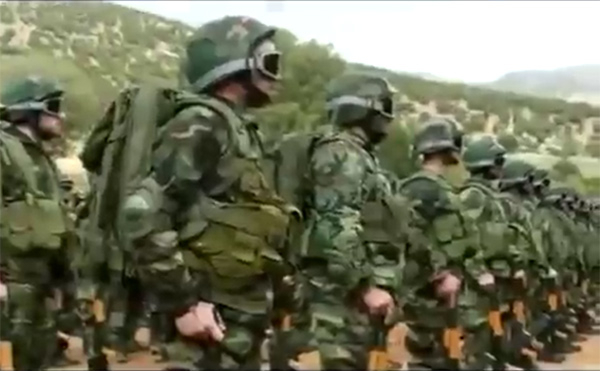 Lebanese Shi’ite Hezbollah fighters are deeply involved in Syria’s civil war. (Image source: Hezbollah propaganda video)
Syria has become a region into which weapons, some highly advanced, flow in ever greater numbers, allowing Hezbollah to acquire guided missiles, and allowing ISIS and the Al-Nusra Front to add to their growing stockpile of weaponry.
Other rebel organizations, some sponsored by Saudi Arabia, Turkey, and Qatar, are also wielding influence in Syria. These groups represent an effort by Sunni states to exert their own influence there.
Despite all the efforts to support it, the Assad regime suffered another recent setback when ISIS seized the ancient city Palmyra in recent days, making an ISIS advance on Damascus more feasible. To the west, near the Lebanese border, Al-Qaeda’s branch in Syria, the Al-Nursa Front, also made gains. It threatened to enter Lebanon, prompting Hezbollah to launch a counter-offensive to take back those areas.
These developments provide a blueprint for the future of Syria: A permanently divided territory, where conquests and counter-offensives continue to rage, and the scene of an ongoing humanitarian catastrophe, producing waves of millions of refugees that could destabilize Syria’s neighbors. Syria is set to remain a land controlled by warring sectarian factions, some of whom plan to spread their destructive influence far beyond Syria.
Events in Syria have shown that the notion that air power can somehow stop ISIS’s advance is a fantasy. More importantly, they have also illustrated that Washington’s policy of cooperation with Iran in a possible “grand bargain” to stabilize the region, while failing to take a firmer stance against the civilian-slaughtering Assad regime, is equally fruitless.
A policy of turning a blind eye to the Iran-led axis, including Syria’s Assad regime, appears to be doing more harm than good.
Obama’s Islamic State strategy sparks doubt, resentment among Pentagon officials, Washington Times, Rowan Scarborough, May 26, 2015
Beneath the glowing battle reports about Iraq from U.S. military spokesmen in recent months, there remains a strong undercurrent of dissatisfaction among the Pentagon rank and file with the Obama administration’s Islamic State strategy.
“What strategy?” asked a Pentagon official involved in counterterrorism analysis. “We are now floating along, reacting to ISIS,” using a common acronym for the Islamic State.
This source said the military has a plan for introducing ground troops and defeating the Islamist group, but the belief is that President Obama will never activate it.
Whether this unhappiness has reached the inner sanctum of the Joint Chiefs of Staff is unclear. In public, the military leadership says it is squarely behind the strategy of limited U.S.-led airstrikes coinciding with the rebuilding of the Iraq army for all the ground fighting.
But a Washington Times spot check of department officials and people who interact with the Pentagon reveals deep-seated doubts.
 Photo by: © STRINGER Iraq / Reuters Iraq’s Shiite paramilitaries claimed to have taken charge of driving the Islamic State out from the western province of Anbar. However, Pentagon officials decry what they see as an unfocused White House plan to rout the terror group. (Reuters)
The Islamic State’s rout of Ramadi on May 18 exposed more than the Iraqi army’s lack of will to fight, as Defense Secretary Ashton Carter bluntly put it over the weekend.
After months of U.S. and coalition airstrikes on hundreds of Islamic State targets, after U.S. surveillance and intelligence collection, and with senior American officers advising Iraqis at a joint command center, the battlefield outcome still was no better than the rout of Mosul 11 months ago.
A former official who is frequently in the Pentagon said, “The building is very guarded about what they say, but clearly the White House is running the campaign, which has them furious.”
This source said combat pilots can loiter over a target for hours before approval comes to strike it. Sometimes approval never comes.
“The targeting requires immaculate rules of engagement, which means they cannot drop if there is a possibility of collateral damage [civilian deaths],” the former official said.
U.S. Central Command’s list of airstrikes around Ramadi showed a smattering of tactical strikes, not concentrated air power.
On May 18, the day Ramadi fell, Central Command listed three targets as being struck around Ramadi — two tactical units and an Islamic State staging area. Destroyed there were an armored vehicle, an excavator and a resupply vehicle.
On the previous day, as Islamic State fighters were taking control of Ramadi, eight airstrikes hit targets near the city. They were three tactical units, eight buildings, two armored vehicles, two mortars, an ammunition storage area and a command center.
“This is worse than pathetic,” the former official said.
Another annoying development, the source said, is the lack of American arms making their way from the Shiite-led national government in Baghdad to Iraqi Kurdish forces in the north. They have proven to be one of the few Iraqi units willing to take on the Islamic State.
The former official said a commitment of U.S. special operations forces and some infantry “could defeat the Islamic State in weeks.”
“But then what?” the source asked, noting that the Shiite-dominated government has badly mismanaged the post-U.S. environment.
“I have never seen such disgruntlement before,” the source said of the mood in the Pentagon.
Another official said a constant theme inside the Pentagon is that the White House does not seem committed to winning. The frequent public relations spin is that this will be a long process to take down the Islamic State when, in fact, officers say, it does not have to be.
“They question whether the U.S. has any interests at stake in Iraq,” this official said. “If we do, they expect Obama to make the case.”
The Iraqi government announced Monday that it has launched a new counteroffensive aimed at retaking Ramadi, the capital of the Sunni-dominated Anbar province. U.S. Marines in the mid-2000s, in an alliance with Sunni tribal leaders, fought a protracted counterinsurgency to rid the western region of al Qaeda terrorists.
So far, the Sunni role in trying to expel the Islamic State, a Sunni extremist army, does not seem as robust. That is why Prime Minister Haider al-Abadi is now relying on Iran-directed Shiite militias to fight in Anbar, as he did in the assault on the Sunni-majority city of Tikrit.
The former defense official said that if one wants to get a sense of the unhappiness inside the Pentagon, they should listen to the few retired senior generals who are speaking out.
One is retired Army Lt. Gen. Michael T. Flynn, the former director of the Defense Intelligence Agency under Mr. Obama. Mr. Flynn is urging a much more aggressive approach to the Islamic State and jihadis worldwide.
“Unless the United States takes dramatically more action than we have done so far in Iraq, the fractious, largely Shiite-composed units that make up the Iraqi army are not likely to be able, by themselves, to overwhelm a Sunni stronghold like Mosul, even though they outnumber the enemy by ten to one,” he wrote in Politico. “The United States must be prepared to provide far more combat capabilities and enablers such as command and control, intelligence, logistics and fire support, to name just a few things.”
Globally, he said, “We must engage the violent Islamists wherever they are, drive them from their safe havens and kill them. There can be no quarter and no accommodation.”
Another is retired Marine Corps Gen. James Mattis, who was Mr. Obama’s Central Command chief until May 2013, a time when the Islamic State had not yet established itself in Iraqi territory.
“The bottom line is we do not have a global strategy,” Mr. Mattis said May 13 at the Heritage Foundation. “Right now we have an America that is starting to reduce its role in the world. That’s not good.”
He noted that Mr. Obama last August said “we don’t have a strategy yet” for defeating the Islamic State. Mr. Mattis said that statement still holds true today. “We don’t really have a good strategy right now,” he said.
He added, “This is what would be called a poor grade at the National War College, to say the least. They would have flunked you.”
Robert Gates, Mr. Obama’s first defense secretary, told MSNBC, referring to the U.S. in Middle East, “We’re basically sort of playing this day to day.”
Mr. Carter took a big step over the weekend in beginning to bluntly blame the Iraqis for failing to hold Ramadi.
“What apparently happened was that the Iraqi forces just showed no will to fight,” the defense secretary told CNN. “They were not outnumbered. In fact, they vastly outnumbered the opposing force, and yet they failed to fight.”
The White House immediately launched damage control so as not to offend Mr. Abadi’s government.
“The recent universal statement by the [secretary of defense] that the Iraqis don’t have the will to fight is unhelpful,” said retired Army Lt. Gen. James Dubik, who led the training of Iraqi troops during the war. “‘Will to fight’ is a complex phenomenon. Why do they fight like hell in some circumstances and not others? That is the real issue.”
Mr. Dubik has been playing close attention to starts and stops of the campaign against the Islamic State as an analyst at the Institute for the Study of War in Washington.
“The fall of Ramadi is a blow to the Iraqi counteroffensive, and it complicates resupply and reinforcements to Al Asad [air base],” he said. “It shows how resilient ISIS is, and how difficult the counteroffensive to re-establish the Iraq-Syria border and re-establish Iraq’s political sovereignty will be. There is no guarantee that Iraq will be successful. And if they’re not, U.S. security interests in the region, and beyond, will suffer.”
U.S. Central Command remains upbeat. On Tuesday, Marine Brig. Gen. Thomas Weidley, the war command’s chief of staff, issued a statement referring to recent setbacks as temporary.
“Positive steps and effects are occurring throughout the battle space, which, in combination, are encouraging signs of the operational-level progress to date within the campaign,” he said.
Op-Ed: Every Day is “Opposite Day” with President Barack Obama, Israel National News, Mark Langfan, May 26, 2015
In sum, either Obama is, at best, a Middle-east policy ignoramus or, at worst, an Iranian stooge. If Obama rolled dice to make his Middle-East decisions, he’d have a better average than his current total Middle-East failure on every issue. So, chances are he is not intending his Middle-East policies to bring peace, but instead planning them to bring war and sow the violence, death and destruction that they have predictably brought.
**********************
Obama has done exactly the opposite of what should be done in the Middle East for his entire term. Israel had better ignore his advice.
Following Obama’s speeches is like watchingSesame Street’s “Opposite Day”, the Sesame Street episode where everything is “opposite.” ‘Up’ is ‘down,’ ‘left’ is ‘right,’ and so on and so forth. It’s like Berra saying “It’s deja vu all over again.”
With Obama, for the past seven years, every day is “Opposite Day.” Everything he says sounds upside-down and backwards, and is proven, in the short-term, to be just that. Instead of being chastened by reality, Obama blithely still talks-the-talk like he’s reading off the Holy Grail.
Take Obama’s latest upside-down and backwards ‘Opposite-Day’ statement: “I continue to believe a two-state solution is absolutely vital for not only peace between Israelis and Palestinians, but for the long-term security of Israel as a democratic and Jewish state.” Given Obama’s 0%batting average on Middle-East strategy, it safe to conclude that keeping the “West Bank” is vital for Israel’s security.
For starters, what Middle East policy has Obama gotten right in the last seven years? Obama’s total retreat from Iraq that empowered Iranian-puppet al Maliki to castrate the Western Iraqi Sunnis that mutated into ISIS? Obama’s bombing of Qaddafi, and setting North Africa into a ball of flames? Obama’s toppling of Mubarak and coronation of the Muslim Brotherhood Sunni Islamic State of Egypt? Obama’s green-lighting Iran to set Shiite Arab against Sunni Arab as he anoints Iran as a nuclear-threshold state, and gives $50 billion to further fund its Islamic “resistance” revolution? Obama’s total protection of the genocidal Assad as he gasses Sunni Muslims to death?
Obama has made the wrong policy decision on every Middle Eastern issue, yet still speaks as if he’s the Middle-east guru.
The truth is Israel’s retention of the “West Bank” is vital not only for the peace and security of Israel, but also, most importantly, for the moderate Arabs who bathe in the warmth of Israel’s security envelope. If Israel left the “West Bank”, forget about the resulting Hamastan that once concerned us, because the result would be an ISIStan. Hamas will soon start asking Israel for protection from ISIS as that organization is beginning to attack it in Gaza. And after Assad falls, and the Sunnis start really paying Hezbollah back for its genocide against the Syrian Sunnis, the Shiites of South Lebanon will have only one protector: Israel.
Was Israel’s retreat from Gaza good for Egypt? No, it created a cancer that sent its Iranian-funded Islamic-bedlam to the Sinai, and then to Egypt-proper. Israel’s “peace-process” regarding Gaza has enabled Hamas to turn the Palestinians of Gaza into cannon-fodder for the world press, and the World Court. With Gaza’s failed-test-case, Obama’s claim that Israel repeat the same withdrawal from Judea and Samaria almost seems to present evidence of a malevolent intent to eradicate peace and security for Israel, and the moderate Arabs who are now protected by Israel.
And let us not forget Jordan. Wouldn’t Jordan “love” an ISIStan state to its west? The analogy is simple, a Hamastan Gaza is to Egypt what an ISIStan “West Bank” would be to Jordan—a formula for Jordan’s total disintegration. As it is, Jordan’s King Abdullah is facing ISIS to the north and to the south. Jordan can be easily overrun, it hardly needs additional pressure along its western border, now protected by Israel.
In sum, either Obama is, at best, a Middle-east policy ignoramus or, at worst, an Iranian stooge. If Obama rolled dice to make his Middle-East decisions, he’d have a better average than his current total Middle-East failure on every issue. So, chances are he is not intending his Middle-East policies to bring peace, but instead planning them to bring war and sow the violence, death and destruction that they have predictably brought.
If Obama says “up,” think “down;” and if he advises retreat from Judea and Samaria, Israel had better stay exactly where it is.
Muslim world reacts to Obama’s latest speech – IPhoneConservative, MEMRI TV via IPhoneConservative via You Tube, May 20, 2015
(Another update: Now the video is up at Front Page Magazine, with a caveat about Poe’s law.
Poe’s law is an internet adage which states that, without a clear indicator of the author’s intent, parodies of extremism are indistinguishable from sincere expressions of extremism.[1][2] Poe’s Law implies that parody will often be mistaken for sincere belief, and sincere beliefs for parody.[3]
– DM)
(UPDATE, May 27th: the subtitles were edited by IPhoneConservative. In a comment beneath the video, posted on May 26th, it was stated:
I must admit I find it fascinating that so many people commenting here are voicing their outrage at my editing of the subtitles in this clip from MEMRI. For those that don’t know who they are………..they are an invaluable site that documents and translates much of what goes on in Middle East media. This clip was from their site. Every day they post videos with leading Islamic figures and personalities making hideous statements about Jews and Christians. About killing gays and beating women. I wonder how many of those outraged by my use of the clip in this way are equally outraged by the real sentiments expressed on these program’s? Not enough I would guess.
– DM)
***********************
(Offensive? Yes. Well worth watching? Yes.– DM)
Video: The Ongoing War Between Islam and Europe, Front Page Magazine, , May 25, 2015
In the following video, Hanne Nabintu Herland, a Norwegian historian of religions, author, and public debater, interviews Raymond Ibrahim on the history of Islam and the West. Topics include the original (but forgotten) Arab conquests, the (demonized) Crusades, and why the modern West’s notion of “history” is immensely skewed:
Why Obama has come to regret underestimating the Islamic State, The Telegraph, Richard Spencer, May 23, 2015
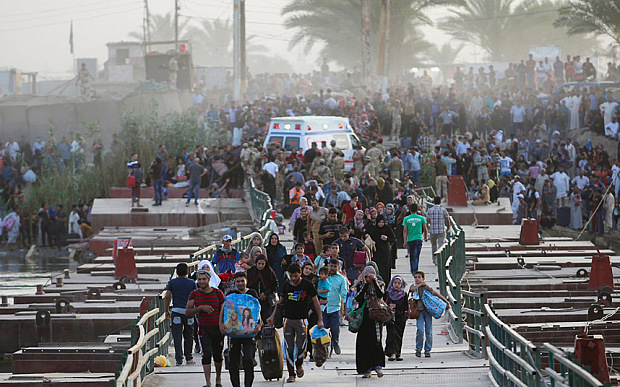
Its strategy is essentially Maoist – the comparison has not been enough made, but now that Isil has declared itself an agent of Cultural Revolution, with its destruction of history, perhaps it will be more. Like Mao’s revolutionaries, it conquers the countryside before storming the towns.
Even now, the fact that much of its territory is rural or even desert is seen as a weakness. But it is beginning to “pick off” major towns and cities with impunity. In fact, where society is fractured, like Syria and Iraq, the “sea of revolution” panics the citizenry, making it feel “surrounded” by unseen and incomprehensible agents of doom.
********************
Have any words come back to haunt President Obama so much as his description of Islamic State of Iraq and the Levant last team as a “JV” – junior varsity – team of terrorists?
This wasn’t al-Qaeda in its 9/11 pomp, he said; just because a university second team wore Manchester United jerseys didn’t make them David Beckham.
How times change. As of this weekend, the JV team is doing a lot better than Manchester United. With its capture of Palmyra, it controls half of Syria.
Its defeat in Kobane – a town of which few non-Kurds had heard – was cheered by the world; its victory in Ramadi last Sunday gives it control of virtually all of Iraq’s largest province, one which reaches to the edge of Baghdad.
Calling itself a state, one analyst wrote, no longer looks like an exaggeration.
Senior US officials seem to agree. “Isil as an organization is better in every respect than its predecessor of Al-Qaeda in Iraq. It’s better manned, it’s better resourced, they have better fighters, they’re more experienced,” one said at a briefing to explain the loss of Ramadi. “We’ve never seen something like this.”
How did Isil manage to inflict such a humiliation on the world’s most powerful country? As with many great shock-and-awe military advances over the years, it is easier to explain in hindsight than it apparently was to prevent.
Ever since Isil emerged in its current form in 2013, military and and political analysts have been saying that its success is due to its grasp of both tactics and strategy.
Its strategy is essentially Maoist – the comparison has not been enough made, but now that Isil has declared itself an agent of Cultural Revolution, with its destruction of history, perhaps it will be more. Like Mao’s revolutionaries, it conquers the countryside before storming the towns.
Even now, the fact that much of its territory is rural or even desert is seen as a weakness. But it is beginning to “pick off” major towns and cities with impunity. In fact, where society is fractured, like Syria and Iraq, the “sea of revolution” panics the citizenry, making it feel “surrounded” by unseen and incomprehensible agents of doom.
Like Mao, Isil uses propaganda – its famed dominance of social media – to terrorise its targets mentally. Senior Iraqi policemen have recounted being sent images via their mobile phones of their decapitated fellow officers. This has a chastening effect on the fight-or-flight reflex.
It then uses actual terror to further instil chaos. Isil’s main targets have been ground down by years of car bombs and “random” attacks. It seems extraordinary, but one of the reasons given by Mosul residents for preferring Isil rule is that there are no longer so many terrorist attacks: not surprising, since the “terrorists” are in control.
Only once your enemy is weak, divided, and demoralised, do you strike.
You then do so with an awesome show of force – one which can mislead as to the actual numbers involved.
The final assault on central Ramadi, which had been fought over for almost 18 months, began with an estimated 30 car bombs. Ten were said to be individually of an equivalent size to the 1995 Oklahoma bombing, which killed 168 people.
There is nothing new in saying that both Syrian and Iraqi governments have contributed greatly to the rise of Isil by failing to offer the Sunni populations of their countries a reason to support them.
Some say that focusing on the failings and injustices of these regimes ignores the fact that militant Islamism, like Maoism, is a superficially attractive, even romantic idea to many, whether oppressed or not, and that its notions must be fought and defeated intellectually and emotionally.
That is true. But relying on Islamic extremism to burn itself out, or for its followers to be eventually persuaded of the errors of their ways, is no answer. Like financial markets, the world can stay irrational for longer than the rest of us can stay politically and militarily solvent.
Rather, the West and those it supports have to show they can exert force against force, and then create a better world, one which all Iraqis and Syrians, especially Sunnis, are prepared to fight for.
In March, an uneasy coalition of Shia militias, Iraqi soldiers, and US jets took back the town of Tikrit from Isil. It remains a wasteland, whose inhabitants have yet to return, ruled over by gunmen rather than by the rule of law.
That is not an attractive symbol, for Iraqi Sunnis, of what victory against Isil looks like. If the war against Isil is to be won, the first step is to make clear to Iraqis and Syrians alike what victory looks like, and why it will be better for them.




 anneinpt
 artaxes
 danmillerinpanama
 davidking1530
 Peter Hofman
 Joseph Wouk
 Peter
Peter Louisiana Steve
 WarSclerotic
Recent Comments