Posted tagged ‘human rights’

Directive 11: Obama’s Secret Islamist Plan

June 8, 2015

Directive 11: Obama’s Secret Islamist Plan, Front Page Magazine, Daniel Greenfield, June 8, 2015
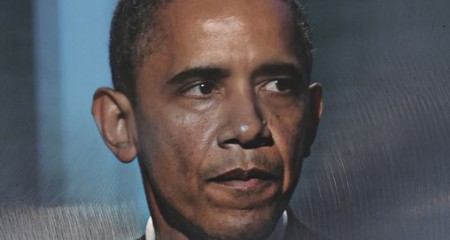
Obama-450x240

What little we know about the resulting classified 18-page report is that it used euphemisms to call for aiding Islamist takeovers in parts of the Middle East. Four countries were targeted. Of those four, we only know for certain that Egypt and Yemen were on the list. But we do know for certain the outcome.

Obama’s insistence that human rights be made a core national security interest paved the way for political and military interventions on behalf of Islamists. Obama had never been interested in human rights; his record of pandering to the world’s worst genocide plotters and perpetrators from Iran to Turkey to Sudan made that clear. When he said “human rights”, Obama really meant “Islamist power.”

********************

Behind the rise of ISIS, the Libyan Civil War, the unrest in Egypt, Yemen and across the region may be a single classified document.

That document is Presidential Study Directive 11.

You can download Presidential Study Directive 10 on “Preventing Mass Atrocities” from the White House website, but as of yet no one has been able to properly pry number 11 out of Obama Inc.

Presidential Study Directive 10, in which Obama asked for non-military options for stopping genocide, proved to be a miserable failure. The Atrocities Prevention Board’s only use was as a fig leaf for a policy that had caused the atrocities. And the cause of those atrocities is buried inside Directive 11.

With Obama’s typical use of technicalities to avoid transparency, Directive 11 was used to guide policy in the Middle East without being officially submitted. It is possible that it will never be submitted. And yet the Directive 11 group was described as “just finishing its work” when the Arab Spring began.

That is certainly one way of looking at it.

Directive 11 brought together activists and operatives at multiple agencies to come up with a “tailored” approach for regime change in each country. The goal was to “manage” the political transitions. It tossed aside American national security interests by insisting that Islamist regimes would be equally committed to fighting terrorism and cooperating with Israel. Its greatest gymnastic feat may have been arguing that the best way to achieve political stability in the region was through regime change.

What little we know about the resulting classified 18-page report is that it used euphemisms to call for aiding Islamist takeovers in parts of the Middle East. Four countries were targeted. Of those four, we only know for certain that Egypt and Yemen were on the list. But we do know for certain the outcome.

Egypt fell to the Muslim Brotherhood, which collaborated with Al Qaeda, Hamas and Iran, before being undone by a counterrevolution. Yemen is currently controlled by Iran’s Houthi terrorists and Al Qaeda.

According to a New York Times story, Obama’s Directive 11 agenda appeared to resemble Che or Castro as he “pressed his advisers to study popular uprisings in Latin America, Eastern Europe and Southeast Asia to determine which ones worked and which did not.”

The story also noted that he “is drawn to Indonesia, where he spent several years as a child, which ousted its longtime leader, Suharto, in 1998.”

The coup against Mubarak with its coordination of liberals, Islamists and the military did strongly resemble what happened in Indonesia. The most ominous similarity may be that the Muslim mobs in Indonesia targeted the Chinese, many of whom are Christians, while the Muslim mobs in Egypt targeted Coptic Christians.

Both were talented groups that were disproportionately successful because they lacked the traditional Islamic hostility to education, integrity and achievement. Islamist demagogues had succeeded in associating them with the regime and promoted attacks on them as part of the anti-regime protests.

Chinese stores were looted and thousands of Chinese women were raped by rampaging Muslims. Just as in Egypt, the protesters and their media allies spread the claim that these atrocities committed by Muslim protesters were the work of the regime’s secret police. That remains the official story today.

Suharto’s fall paved the way for the rise of the Prosperous Justice Party, which was founded a few months after his resignation and has become one of the largest parties in the Indonesian parliament. PJP was set up by the Muslim Brotherhood’s local arm in Indonesia.

His successor, Bacharuddin Jusuf Habibie, was more explicitly Islamist than Suharto and his Association of Muslim Intellectuals (ICMI) conducted a campaign against Christians, Hindus and Buddhists. It helped purge non-Muslims from government while Islamizing the government and Indonesia’s key institutions.

Habibie had been the Chairman of ICMI and ICMI’s Islamists played a key role in moving Suharto out and moving him in. It was obvious why Obama would have considered the Islamization of Indonesia and the purge of Christians under the guise of democratic political change to be a fine example for Egypt.

While we don’t know the full contents of Directive 11 and unless a new administration decides to open the vaults of the old regime, we may never know. But we do know a good deal about the results.

In its own way, PSD-10 tells us something about PSD-11.

Obama’s insistence that human rights be made a core national security interest paved the way for political and military interventions on behalf of Islamists. Obama had never been interested in human rights; his record of pandering to the world’s worst genocide plotters and perpetrators from Iran to Turkey to Sudan made that clear. When he said “human rights”, Obama really meant “Islamist power”.

That was why Obama refused to intervene when the Muslim Brotherhood conducted real genocide in Sudan, but did interfere in Libya on behalf of the Brotherhood using a phony claim of genocide.

Positioning Samantha Power in the Office of Multilateral Affairs and Human Rights at the National Security Council was part of the process that made over the NSC from national security to servicing a progressive wish list of Islamist terrorist groups that were to be transformed into national governments.

Power, along with Gayle Smith and Dennis Ross, led the Directive 11 project.

Secret proceedings were used to spawn regime change infrastructure. Some of these tools had official names, such as “The Office of The Special Coordinator For Middle East Transitions” which currently reports directly to former ambassador Anne Patterson who told Coptic Christians not to protest against Morsi. After being driven out of the country by angry mobs over her support for the Muslim Brotherhood tyranny, she was promoted to Assistant Secretary of State for Near Eastern Affairs.

“The Office” is still focused on “outreach to emergent political, economic and social forces in Egypt, Tunisia, and Libya” even though counterrevolutions have pushed out Islamists in Egypt and Tunisia, while Libya is in the middle of a bloody civil war in which an alliance of the Muslim Brotherhood and Al Qaeda controls the nation’s capital.

But even as Morsi’s abuses of power were driving outraged Egyptians into the streets, Gayle Smith, one of the three leaders of Directive 11, reached out to the “International Union of Muslim Scholars”, a Muslim Brotherhood group that supported terrorism against American soldiers in Iraq and which was now looking for American support for its Islamist terrorist brigades in the Syrian Civil War.

The men and women responsible for Directive 11 were making it clear that they had learned nothing.

Directive 11 ended up giving us the Islamic State through its Arab Spring. PSD-11’s twisted claim that regional stability could only be achieved through Islamist regime change tore apart the region and turned it into a playground for terrorists. ISIS is simply the biggest and toughest of the terror groups that were able to thrive in the environment of violent civil wars created by Obama’s Directive 11.

During the Arab Spring protests, Egyptian Foreign Minister Ahmed Aboul Gheit had told Hillary Clinton that his government could not hand over power to the Muslim Brotherhood. “My daughter gets to go out at night. And, God damn it, I’m not going to turn this country over to people who will turn back the clock on her rights.”

But that was exactly what Hillary Clinton and Obama were after. And they got it. Countless women were raped in Egypt. Beyond Egypt, Hillary and Obama’s policy saw Yazidi women actually sold into slavery.

Directive 11 codified the left’s dirty alliance with the Muslim Brotherhood into our foreign policy. Its support for Islamist takeovers paved the way for riots and civil wars culminating in the violence that birthed ISIS and covered the region in blood.

And it remains secret to this day.

Israel’s Revenge Is That “We Are Still Here”

June 7, 2015

Israel’s Revenge Is That “We Are Still Here” The Legal Insurrection, June 7, 2015

My wife and I are back, after an intense two weeks in Israel.

From the Lebanese to Gaza borders, from the Mediterranean Sea to Judea and Samaria, from the cool evenings of Jerusalem to the heat of the Negev Desert, from an apartment in the Jewish Quarter of the Old City of Jerusalem to Bedouin villages in the north and south, from university campuses to military bases, from faculty to students, from Jews to Muslims … I can’t say we saw it all, but we saw a lot.

I’ve documented most of our big events in daily posts, with the exception of our emotional meetings with the families of Edward Joffe and Leon Kanner, students killed in the 1969 Supersol supermarket bombing by Rasmea Odeh; that post is coming, but I still have new photos, documents and information I have to work through.

Here are my 5 Big Takeaways from the trip:

1. Our Revenge Is That “We Are Still Here”

Near the start of our trip, we visited Moshav Avivim straddling the Lebanese border, where we met Shimon Biton, a survivor of the 1970 bazooka attack on a school bus by the Popular Front for the Liberation of Palestine.

Biton, who was six and one-half years old, lost his father in the attack, and himself was shot point blank range by the terrorists when they realized he survived the bazooka attack.  Ten days before we met Biton, he was reunited for the first time in 45 years with the nurse who helped save him.  (Featured Image)

When we asked whether he ever wanted revenge, Biton told us that the revenge was that “we are still here and building for another 70 families.”

Moshav-Aviviv-Shimon-Biton-e1432683043370[Shimon Biton, Moshav Avivim, Israel]

When we related that story to numerous people we met along the rest of the trip, heads vigorously shook up and down.  It struck a chord, since almost every Israeli has a relative or friend impacted by terror.

Despite several decades of terrorism, particularly intense during the Second Intifada, and a world campaign against it, the People of Israel are still there.

The will to resist is underestimated.  Israel has a longer-term view, and a history.  It will not give in to boycotts, or Obama, or outside pressure that puts its security at risk.

2. “I don’t like Bibi, BUT….”

For whatever the reason, most of the people with whom we interacted self-identified as center-left or left.

There was no shortage of criticism of Israeli Prime Minister Benjamin Netanyahu: He’s egotistical, he doesn’t keep his tough promises, he is only interested in his own political survival, he’s a liar, his pre-election comment about Arab voting was shameful, and so on.

Yet with only a couple of exceptions, the negative comments always were followed with a big BUT.

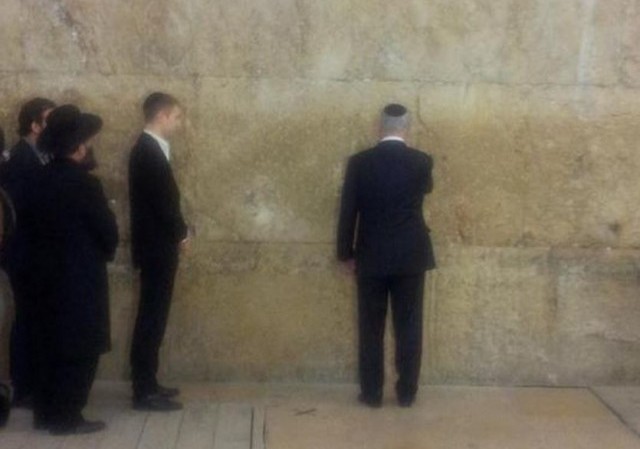
Benjamin-Netanyahu-at-Western-Wall-post-election-2015-e1426681806959[Israeli Prime Minister Benjamin Netanyahu at Western Wall after 2015 election victory.]

But he is the only Israeli politician who has the stature to handle the world pressure; but I don’t envy the position he is in with so many forces against us; but [opposition leader Yitzhak “Bougie” Herzog] Bougie is weak and no one will fear him; and so on.

These opinions pretty much were reflected in polling and the election results — Many people may not like Netanyahu, but he is the only Israeli politician capable of standing up for Israel in a hostile world.

3. I don’t like Obama, no BUTs about it

Polling in Israel shows Obama is hugely unpopular.  Our anecdotal interactions with Israelis confirmed that polling.

I  can’t recall anyone, from left to right, who had anything nice to say about Obama.  The most consistent theme was that Obama is naive and weak, and that naivitee and weakness had resulted in disaster in the Arab world as it encouraged the most aggressive Islamist elements.

They see Syria falling apart with al-Qaeda or ISIS groups likely to control large parts of the country; or if not, then Iran in control. There are no good outcomes for Israel’s Golan Heights border. Along the Lebanese border there is Hezbollah, and in Gaza Hamas and increasingly even more radical Salafist-ISIS groups.

Against this background of being surrounded by a sea of increasing threats resulting from Obama administration policy, not a single person thought the Iran nuclear deal made any sense, or trusted the Obama administration on it.

In other words, Israelis live in the real world, not the world of Obama’s delusional hope.  And they don’t appreciate Obama taking risks with their lives.

4. Are we really that popular in the United States?

The anti-Israel Boycott, Divestment and Sanctions movement was a frequent topic of conversation, almost always brought up by us as part of describing the type of coverage at Legal Insurrection.  This coincided with what I consider an irrational panic the past two weeks in the Israeli press and political discourse about BDS (more on that in a later post.)

I tried to explain that there is a complete disconnect between the BDS movement in the U.S. and the vast majority of Americans.  Gallup and Pew polling shows Israel at or near historical highs in terms of Israel’s favorability both abolutely and relative to favorability of Palestinians.  The gap between those who pick Israel over Palestinians when the question forces a choice, also is historically high.

Virtually every Israeli we met was shocked that Israel is actually so popular in the United States.  Even Israelis who have extensive American contacts and visit the U.S.

That’s not all so surprising.  Both the U.S. and Israeli media focus on the negative, though for different reasons.  The U.S. media long has had in implicit anti-Israel bias, compounded by the rise of left-leaning new media, while the Israeli media competes for readers with a “sky is falling” outlook.

(added) Israel’s enormous popularity among Americans is a strategic asset.  That strategic asset needs to be used more effectively to minimize the damage from the narrow but influential slices of the American population — radical faculty, some students, and mainstream journalists — who have explicit or implicit anti-Israel biases. The American people as a whole are the “Israeli Lobby.”

5. The Next War is Only a Matter of Time

While we were in Jerusalem, Israel underwent a national defense drill, including sirens warningof incoming rockets.

Our tour along the Gaza border, particularly near Sderot, also reflected preparation for the next round of rocket fire through reinforcing key civilian infrastructures, such as schools.

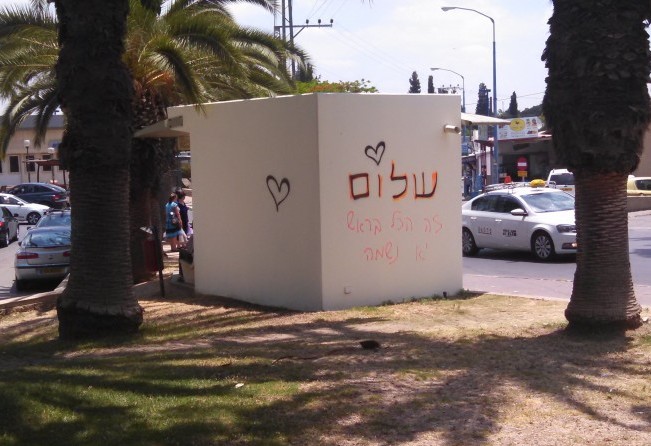
Sderot-Israel-bomb-shelter-street-e1433110130989[Sderot, Israel, street bomb shelter with “Shalom” grafitti]

There was a pervasive feeling that the calm cannot last.  And sure enough, while we were there and just after we left, rockets were fired from Gaza to Israel by Salafists suffering from a Hamas crackdown, and groups competing with Hamas for control.

That’s the logic of the region in which Israel lives: Radical groups retaliate against each other by firing rockets at … Israel.

The next war is coming.  Every Israeli knows it. It’s only a matter of time.

*  *  *  *  *

Those are my big takeaways.  I hope you enjoyed the coverage.

We will be back in Israel, hopefully next year.

Why Does the Iranian Regime Rape its Own Citizens?

June 7, 2015

Why Does the Iranian Regime Rape its Own Citizens? The Clarion Project,  Elliot Friedland, June  7, 2015

(Don’t worry. Once The Islamic Republic of Iran gets the bomb, it may become as civilized as the Islamic State. — DM)

Iran-Basij-Hooded-Men-IP_1In 2009 the Basij militia (pictured here) raped protesters as a matter of policy. (Photo: Reuters)

In prisons, virgin girls who are sentenced to death (the death penalty covers a wide variety of crimes, including the nebulous charge of Moharabeh, “enmity against God”) are typically forced into “temporary marriages” with the prison guards and raped on the night before their execution.

According to the Iran Human Rights Documentation Center this is “because the guards believed young girls executed while virgins would go to heaven” and they wanted to prevent that.

Rape and other forms of sexual assault are a means of humiliation and degrading the regime’s opponents – and are also a potent means of intimidating others into cowed obedience.

******************

Like all countries which use sharia law as state law, the Islamic Republic of Iran institutionalizes a litany of women’s rights abuses.

These include:

  • The husband is the head of the family, and his wife is legally bound to obey him. Article 1,105 of the civil code states: “In relations between husband and wife, the position of the head of the family exclusively belongs to the husband.”
  • A married woman cannot leave the country without her husband’s permission.
  • A woman’s testimony as a witness is worth half that of a man, in compliance with the Sharia basis of the legal system.
  • Women are forced to wear the hijab, a headscarf, in all public places. More broadly, Islamic modesty requirements are enforced by a morality police.
  • Polygamy and temporary marriage are permitted for men (up to four wives are allowed, subject to certain restrictions), but not for women.

Moreover, women are frequently subject to honor killings. In cases where the father kills his daughter, he is not liable for the death penalty, but only for imprisonment. This is further compounded as when someone is murdered, the family of the victim can forgive the murderer and choose to forgo punishment.

As harsh as the everyday discrimination is, however, the most serious violations are meted out against dissenters.

Use of rape as a method of torture against political opponents has been deployed widely against both men and women, as well as sexual taunts, threats and other forms of assault.

The International Campaign for Human Rights in Iran told PBS that in the aftermath of the disputed 2009 election, “rape was routinely practiced as a matter of policy to intimidate young ordinary people from ever coming out to protest again.”

In prisons, virgin girls who are sentenced to death (the death penalty covers a wide variety of crimes, including the nebulous charge of Moharabeh, “enmity against God”) are typically forced into “temporary marriages” with the prison guards and raped on the night before their execution.

According to the Iran Human Rights Documentation Center this is “because the guards believed young girls executed while virgins would go to heaven” and they wanted to prevent that.

A former Iranian Basij militia man spoke to The Jerusalem Post on the condition of anonymity and recorded his role in perpetrating these rapes when he was a prison guard.

He said, “I could tell that the girls were more afraid of their ‘wedding’ night than of the execution that awaited them in the morning. And they would always fight back, so we would have to put sleeping pills in their food. By morning, the girls would have an empty expression; it seemed like they were ready or wanted to die. I remember hearing them cry and scream after [the rape] was over. I will never forget how this one girl clawed at her own face and neck with her fingernails afterwards. She had deep scratches all over her.”

Rape and other forms of sexual assault are a means of humiliation and degrading the regime’s opponents – and are also a potent means of intimidating others into cowed obedience.

Thus, the Islamic Republic inflicts on the bodies of its citizens the purest demonstration of raw power, reminding them who rules Iran.

Spain in the Eye of the Storm of Jihad

June 6, 2015

Spain in the Eye of the Storm of Jihad, The Gatestone InstituteSoeren Kern, June 6, 2015

(Right of return? — DM)

  • The Islamists are especially interested in converts who have not yet taken on Muslim names and whose official IDs still have their Christian names, so they can purchase weapons without drawing the attention of police.
  • At least 50,000 Muslim converts are currently living in Spain. Police say that converts are especially susceptible to radicalization because they are facing increasing pressure from Islamists who are calling on them to carry out attacks to “demonstrate their commitment” to their new faith.
  • Spain has also become a key entry point for human trafficking mafias being used by jihadist veterans seeking to return to Europe after fighting in the Middle East.
  • “Turkey is the Seven-Eleven of false passports.” — Spanish agent working on a human trafficking case.

Spanish security forces have arrested a total of 568 jihadists over the past ten years in 124 separate operations against Islamic terrorism, Spanish Interior Minister Jorge Fernández Díaz revealed at an African security conference in Niger on May 14.

Fernández Díaz said that “constant police and judicial actions” have helped Spanish authorities prevent another large-scale terrorist attack similar to the March 2004 Madrid train bombings, in which nearly 200 people were killed and more than 2,000 were injured.

At the same time, Fernández Díaz has warned that it is “very probable” that Islamic terrorists will strike Spain at some point in the future; he has estimated the probability of an attack to be 70%.

At a two-day terrorism conference held in Madrid on April 23 and 24, Fernández Díaz said that at least 115 Spanish jihadists — including at least 15 women — are now known to have joined the Islamic State. He added that 14 jihadists had returned to Spain; nine of those are in prison and five remain free.

In January, Fernández Díaz said the number of Spanish jihadists abroad was 70, which implies a jump of more than 40 new jihadists in the first four months of 2015 alone. In August 2014, the first time that Fernández Díaz provided an official estimate, he said there were 51 Spanish jihadists fighting abroad.

Meanwhile, “dozens” of jihadists and other Islamic radicals are entering Spain from neighboring France, where they are said to be “asphyxiating” due to a government crackdown following theCharlie Hebdo attacks in Paris in January. (On April 29, French President François Hollande announced that a force of 7,000 troops would be deployed to patrol French streets on a permanent basis.)

According to an anonymous Spanish intelligence operative interviewed by El Confidencial, a media outlet based in Madrid, French jihadists are moving to Spain because they feel they have “greater room for movement” on the Iberian Peninsula. They include individuals “suspected” of being Islamic radicals, but for whom there is insufficient proof for either government to arrest them.

The report says that most of the jihadists from France are moving to Catalonia and Spain’s Mediterranean coast, where they are attempting to “blend in” with Muslim communities there. Also known as the Spanish Levant, the region roughly corresponds with what was once known as Xarq al-Ándalus, territories that were occupied by Muslim invaders for nearly five centuries.

Al-Andalus is the Arabic name given to those parts of Spain, Portugal and France occupied by Muslim conquerors (also known as the Moors) from 711 to 1492. Many Muslims believe that territories Muslims lost during the Christian Reconquista of Spain still belong to the realm of Islam. They claim that Islamic law gives them the right to return there and re-establish Muslim rule.

In July 2014, jihadists with the Islamic State produced a video in which they vowed to liberate al-Andalus from non-Muslims and make it part of their new Islamic Caliphate. The video showed a jihadist speaking in Spanish with a heavy North African accent, warning:

“I say to the entire world as a warning: We are living under the Islamic flag, the Islamic caliphate. We will die for it until we liberate those occupied lands, from Jakarta to Andalusia. And I declare: Spain is the land of our forefathers and we are going to take it back with the power of Allah.”

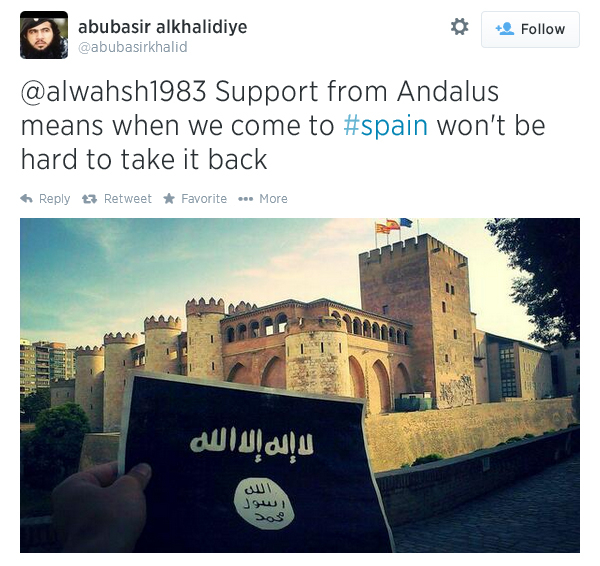
639A tweeted photo of an Islamic State supporter holding the Islamic State’s black flag of jihad in front of Aljafería Palace in Zaragoza, Spain

Counter-terrorism authorities are now warning that the Islamic State is actively looking for Spanish converts to Islam who possess gun licenses and who can legally purchase rifles and shotguns. The Islamists are especially interested in converts who have not yet taken on Muslim names and whose official IDs still have their Christian names, so that they can purchase weapons without drawing the attention of police.

At least 50,000 Muslim converts are currently living in Spain. Police say that converts are especially susceptible to radicalization because they are facing increasing pressure from Islamists who are calling on them to carry out attacks to “demonstrate their commitment” to their new faith. “Converts are the perfect breeding ground for Islamism,” according to a Spanish intelligence operative.

These concerns have been confirmed in a new report published by the Spanish Institute of Strategic Studies, an organ of the Ministry of Defense, which warned that so-called lone wolves pose the biggest threat to Spain and other European countries.

“They are activists who secretly swear allegiance to [Islamic State leader] Abu Bakr al-Baghdadi and act independently without making contact with anyone, so locating them becomes a living hell,” the report said. It added:

“Terrorists no longer need to communicate directly with the leadership of the organization to which they belong, or use the telephone or emails to know exactly what to do, when and under what circumstances. There is no longer any need for prior contact to establish the type of signals to be used, the conditions and dimensions of an attack or any restrictions.

“These tactics end the dream of the intelligence services to control everything through the systematic interception of communications and the use of satellite imagery. If there is no communication, it is not possible to intercept anything.”

Spain has also become a key entry point for human trafficking mafias being used by jihadist veterans seeking to return to Europe after fighting in the Middle East. A report prepared by Spanish border police identifies three main routes of entry — Africa, South America and Europe — and warns that human trafficking is “more lucrative than cocaine trafficking.”

According to the report:

“The proliferation of organizations trafficking in human beings and taking advantage of counterfeit documentation is resulting in the introduction of thousands of people into European countries. The problem is compounded when one considers that European jihadist veterans who have fought in Syria and Iraq on behalf of the Islamic State are using the same networks to facilitate their return. Many have arrest warrants in different countries (Spain, France, UK, etc.) and Islamic State members may cross our borders to carry out terror attacks in Europe.”

In November 2014, police in Madrid arrested 18 individuals — eight Lebanese, four Spaniards, three Syrians, one Ecuadorian, one Moroccan and one Ukrainian — accused of running smuggling operation to bring people from Syria into Spain. Police estimate that the cell, which had branches in Lebanon and Turkey, generated earnings of between €50,000 ($55,000) and €100,000 ($110,000) each month. According to one of the agents working on the case, “Turkey is the Seven-Eleven of false passports.”

Meanwhile, at least 60 jihadists in Catalonia are said to be waiting for a signal from the Islamic State to attack, according to the Madrid-based El País newspaper. The warning was given during a closed-door meeting of anti-terrorism police held in late April in Viladecans, a town near Barcelona.

The unofficial meeting was convened after a counter-terrorism operation in Catalonia was compromised, when some jihadists were allegedly tipped-off that they were about to be arrested. Although the exact circumstances of the imbroglio remain unclear, it appears to have been the result of poor inter-agency coordination between counter-terrorism police in Madrid and Catalan police known as the Mossos d’Esquadra. The two groups were apparently investigating the same Islamist cell without consulting each other.

The meeting in Viladecans, attended by 130 agents from different police forces — Mossos, Civil Guards, national and local police — from across the country, got together to discuss their mutual concerns about “the lack of training of law enforcement to combat jihadist terrorism.”

Much of the daylong meeting was used to share information about how to detect “radicalization processes” and how to distinguish ordinary Muslims from Salafists and jihadists. A counter-terrorism specialist said that one of the key problems faced by police is that “jihadists have infiltrated society, they drink alcohol, eat pork and dress like a Westerner and are undetectable.”

One of the organizers of the event, Alex Pérez of a local branch of the International Police Association, said:

“We go out on the street every day but we do not have the tools needed to combat threats against the public. Some of us are digging into our own pockets to train ourselves, protect ourselves and provide an adequate service to society.”

Another police officer summed it up this way: “We are screwed and will be much worse off in the future because there are radicals increasingly inclined to attack.”

How Islam in America Became a Privileged Religion

June 3, 2015

How Islam in America Became a Privileged Religion, Front Page Magazine, Daniel Greenfield, June 3, 2015

(Much the same nonsense infects foreign policy and propels the notion that the Islamic State is not Islamic. — DM)

islam

What is Islam? The obvious dictionary definition answer is that it’s a religion, but legally speaking it actually enjoys all of the advantages of race, religion and culture with none of the disadvantages.

Islam is a religion when mandating that employers accommodate the hijab, but when it comes time to bring it into the schools, places that are legally hostile to religion, American students are taught about Islam, visit mosques and even wear burkas and recite Islamic prayers to learn about another culture. Criticism of Islam is denounced as racist even though the one thing that Islam clearly isn’t is a race.

Islamist organizations have figured out how lock in every advantage of race, religion and culture, while expeditiously shifting from one to the other to avoid any of the disadvantages.

The biggest form of Muslim privilege has been to racialize Islam. The racialization of Islam has locked in all the advantages of racial status for a group that has no common race, only a common ideology.

Islam is the only religion that cannot be criticized. No other religion has a term in wide use that treats criticism of it as bigotry. Islamophobia is a unique term because it equates dislike of a religion with racism. Its usage makes it impossible to criticize that religion without being accused of bigotry.

By equating religion with race, Islam is treated not as a particular set of beliefs expressed in behaviors both good and bad, but as an innate trait that like race cannot be criticized without attacking the existence of an entire people. The idea that Islamic violence stems from its beliefs is denounced as racist.

Muslims are treated as a racial collective rather than a group that shares a set of views about the world.

That has made it impossible for the left to deal with ex-Muslims like Ayaan Hirsi Ali or non-Muslims from Muslim families like Salman Rushdie. If Islam is more like skin color than an ideology, then ex-Muslims, like ex-Blacks, cannot and should not exist. Under such conditions, atheism is not a debate, but a hate crime. Challenging Islam does not question a creed; it attacks the existence of an entire people.

Muslim atheists, unlike all other atheists, are treated as race traitors both by Muslims and leftists. The left has accepted the Brotherhood’s premise that the only authentic Middle Easterner is a Muslim (not a Christian or a Jew) and that the only authentic Muslim is a Salafist (even if they don’t know the word).

The racialization of Islam has turned blasphemy prosecutions into an act of tolerance while making a cartoon of a religious figure racist even when it is drawn by ex-Muslims like Bosch Fawstin. The New York Times will run photos of Chris Ofili’s “The Holy Virgin Mary” covered in dung and pornography, but refuses to run Mohammed cartoons because it deems one anti-religious and the other racist.

The equating of Islam with Arabs and Pakistanis has made it nearly impossible for the media to discuss violence against Christians in those parts of the world. The racialization of Islam has made Arab Christians, like Bangladeshi atheists, a contradiction in terms. The ethnic cleansing of the Yazidi could only be covered by giving them a clearly defined separate identity. Middle Eastern Christians are increasingly moving to avoid being categorized as Arabs because it is the only way to break through this wall of ignorance.

While racialization is the biggest Muslim privilege, race provides no protection for many Islamic religious practices. Muslims then seek religious discrimination laws to protect these practices even if it’s often a matter of debate whether their lawsuits protect their religious practices or impose them on others.

Islam is a theocracy. When it leaves the territories conquered by Islam, it seeks to replicate that theocracy through violence and by adapting the legal codes of the host society to suit its purposes.

Islamic blasphemy laws are duplicated using hate crime laws. Employers are obligated to make religious concessions to Muslim employees because of laws protecting religious practices, but many of these practices, such as refusing to carry out jobs involving pork, liquor or Seeing Eye dogs, are really ways of theocratically forcing behaviors that Islam forbids out of public life much as Saudi Arabia or Iran do.

Accusations of bigotry are used to outlaw ideas that Islam finds blasphemous and religious protection laws are used to banish behaviors that it disapproves of. By switching from race to religion and back again, Islamists construct a virtual theocracy by exploiting laws designed to protect different types of groups.

Religions in America traded theocracy for religious freedom. They gave up being able to impose their practices on others in exchange for being able to freely practice their own religions. Islam rejects religious freedom. It exploits it to remove the freedom of belief and practice of others. When it cannot do so through religious protection laws, it does so through claims of bigotry.

Religions were not meant to be immunized from blasphemy because that is theocracy. Instead religions are protected from restrictions, rather than from criticism. Islam insists on being protected from both. It makes no concessions to the freedom of others while demanding maximum religious accommodation.

While race and religion are used to create negative spaces in which Islam cannot be challenged, the creed is promoted positively as a culture. Presenting Islam as a culture allows it easier entry into schools and cultural institutions. Islamic missionary activity uses the Western longing for oriental exotica that its political activists loudly decry to inject it into secular spaces that would ordinarily be hostile to organized religion.

Leftists prefer to see Islam as a culture rather than a religion. Their worldview is not open to Islam’s clumsy photocopy of the deity that they have already rejected in their own watered down versions of Christianity and Judaism. But they are constantly seeking an aimless and undefined spirituality in non-Western cultures that they imagine are free of the materialism and hypocrisy of Western culture.

Viewing Islam as a culture allows the left to project its own ideology on a blank slate. That is why liberals remain passionately convinced that Islam is a religion of social justice. Their Islam is a mirror that reflects back their own views and ideas at them. They pretend to respect Islam as a culture without bothering to do any more than learn a few words and names so that they can seem like world travelers.

By morphing into a culture, Islam sheds its content and becomes a style, a form of dress, a drape of cloth, a style of beard, a curvature of script and a whiff of spices. It avoids uncomfortable questions about what the Koran actually says and instead sells the religion as a meaningful lifestyle. This approach has always had a great deal of appeal for African-Americans who were cut off from their own heritage through Islamic slavery, but it also enjoys success with white upper class college students.

The parents of those students often learn too late that Islam is not just another interchangeable monotheistic religion, that its mosques are not places where earnest grad students lecture elderly congregants about social justice and that its laws are not reducible to the importance of being nice to others.

Like a magician using misdirection, these transformations from religion to race, from race to culture and from culture to religion, distract Americans from asking what Islam really believes. By combining race, religion and culture, it replicates the building blocks of its theocracy within our legal and social spaces.

Separately each of these has its advantages and disadvantages. By combining them, Islam gains the advantages of all three, and by moving from one to the other, it escapes all of the disadvantages. The task of its critics is to deracialize Islam, to reduce it to an ideology and to ask what it really believes.

Islam is a privileged religion. And there’s a word for that. Theocracy.

The rational Ayatollah hypothesis

May 29, 2015

The rational Ayatollah hypothesis, Power LineScott Johnson, May 28, 2015

In his Wall Street Journal column this past Tuesday, Bret Stephens took up “The rational ayatollah hypothesis” (accessible via Google here). That hypothesis — asserted, I would say, as a thesis if not a fact by our Supreme Leader about Iran’s Supreme Leader — holds that economics and other such considerations constrain the anti-Semitic behavior of the Islamic Republic of Iran. So about those nuclear weapons that Iran is developing on — Israel is not to worry. Neither are we. It’s the Alfred E. Newman approach writ large.

Obama articulated his thesis in response to a question posed by Jeffrey Goldberg in his recent interview of Obama. I wrote about it in “Obama expounds the limits of Iran’s anti-Semitism.” I struggled because Obama’s observations are both ignorant and obtuse. Stephens takes up Obama’s thesis somewhat more elegantly than I did:

Iran has no border, and no territorial dispute, with Israel. The two countries have a common enemy in Islamic State and other radical Sunni groups. Historically and religiously, Jews have always felt a special debt to Persia. Tehran and Jerusalem were de facto allies until 1979, when Ayatollah Khomeini came to power and 100,000 Jews still lived in Iran. Today, no more than 10,000 Jews are left.

So on the basis of what self-interest does Iran arm and subsidize Hamas, probably devoting more than $1 billion of (scarce) dollars to the effort? What’s the economic rationale for hosting conferences of Holocaust deniers in Tehran, thereby gratuitously damaging ties to otherwise eager economic partners such as Germany and France? What was the political logic to Mahmoud Ahmadinejad’s calls to wipe Israel off the map, which made it so much easier for the U.S. and Europe to impose sanctions? How does the regime shore up its domestic legitimacy by preaching a state ideology that makes the country a global pariah?

Maybe all this behavior serves Tehran’s instrumental purposes by putting the regime at the vanguard of a united Shiite-Sunni “resistance” to Western imperialism and Zionism. If so, it hasn’t worked out too well, as the rise of Islamic State shows. The likelier explanation is that the regime believes what it says, practices what it preaches, and is willing to pay a steep price for doing so.

So it goes with hating Jews. There are casual bigots who may think of Jews as greedy or uncouth, but otherwise aren’t obsessed by their prejudices. But the Jew-hatred of the Iranian regime is of the cosmic variety: Jews, or Zionists, as the agents of everything that is wrong in this world, from poverty and drug addiction to conflict and genocide. If Zionism is the root of evil, then anti-Zionism is the greatest good—a cause to which one might be prepared to sacrifice a great deal, up to and including one’s own life.

This was one of the lessons of the Holocaust, which the Nazis carried out even at the expense of the overall war effort. In 1944, with Russia advancing on a broad front and the Allies landing in Normandy, Adolf Eichmann pulled out all stops to deport more than 400,000 Hungarian Jews to Auschwitz in just two months. The Nazis didn’t even bother to make slaves of most of their prisoners to feed their war machine. Annihilation of the Jews was the higher goal.

Modern Iran is not Nazi Germany, or so Iran’s apologists like to remind us. Then again, how different is the thinking of an Eichmann from that of a Khamenei, who in 2012 told a Friday prayer meeting that Israel was a “cancerous tumor that should be cut and will be cut”?”

Walter Russell Mead has more here, all of it worth reading. I thought readers who have been tracking the deep thoughts of our Supreme Leader, as we all should, might find Mead’s thoughts and Stephens’s column of interest.

Video: The Ongoing War Between Islam and Europe

May 25, 2015

Video: The Ongoing War Between Islam and Europe, Front Page Magazine,  , May 25, 2015

In the following video, Hanne Nabintu Herland, a Norwegian historian of religions, author, and public debater, interviews Raymond Ibrahim on the history of Islam and the West. Topics include the original (but forgotten) Arab conquests, the (demonized) Crusades, and why the modern West’s notion of “history” is immensely skewed:


Why Obama has come to regret underestimating the Islamic State

May 24, 2015

Why Obama has come to regret underestimating the Islamic State, The Telegraph, May 23, 2015


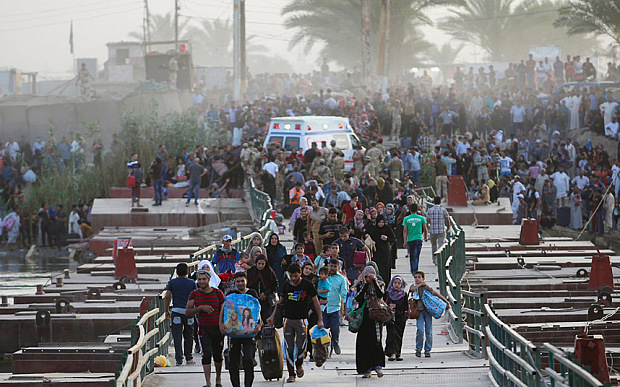
Displaced Sunni people, who fled the violence in the city of Ramadi, arrive at the outskirts of Baghdad Photo: STRINGER/IRAQ

Its strategy is essentially Maoist – the comparison has not been enough made, but now that Isil has declared itself an agent of Cultural Revolution, with its destruction of history, perhaps it will be more. Like Mao’s revolutionaries, it conquers the countryside before storming the towns.

Even now, the fact that much of its territory is rural or even desert is seen as a weakness. But it is beginning to “pick off” major towns and cities with impunity. In fact, where society is fractured, like Syria and Iraq, the “sea of revolution” panics the citizenry, making it feel “surrounded” by unseen and incomprehensible agents of doom.

********************

Have any words come back to haunt President Obama so much as his description of Islamic State of Iraq and the Levant last team as a “JV” – junior varsity – team of terrorists?

This wasn’t al-Qaeda in its 9/11 pomp, he said; just because a university second team wore Manchester United jerseys didn’t make them David Beckham.

How times change. As of this weekend, the JV team is doing a lot better than Manchester United. With its capture of Palmyra, it controls half of Syria.

Its defeat in Kobane – a town of which few non-Kurds had heard – was cheered by the world; its victory in Ramadi last Sunday gives it control of virtually all of Iraq’s largest province, one which reaches to the edge of Baghdad.

Calling itself a state, one analyst wrote, no longer looks like an exaggeration.

Senior US officials seem to agree. “Isil as an organization is better in every respect than its predecessor of Al-Qaeda in Iraq. It’s better manned, it’s better resourced, they have better fighters, they’re more experienced,” one said at a briefing to explain the loss of Ramadi. “We’ve never seen something like this.”

How did Isil manage to inflict such a humiliation on the world’s most powerful country? As with many great shock-and-awe military advances over the years, it is easier to explain in hindsight than it apparently was to prevent.

Ever since Isil emerged in its current form in 2013, military and and political analysts have been saying that its success is due to its grasp of both tactics and strategy.

Its strategy is essentially Maoist – the comparison has not been enough made, but now that Isil has declared itself an agent of Cultural Revolution, with its destruction of history, perhaps it will be more. Like Mao’s revolutionaries, it conquers the countryside before storming the towns.

Even now, the fact that much of its territory is rural or even desert is seen as a weakness. But it is beginning to “pick off” major towns and cities with impunity. In fact, where society is fractured, like Syria and Iraq, the “sea of revolution” panics the citizenry, making it feel “surrounded” by unseen and incomprehensible agents of doom.

Like Mao, Isil uses propaganda – its famed dominance of social media – to terrorise its targets mentally. Senior Iraqi policemen have recounted being sent images via their mobile phones of their decapitated fellow officers. This has a chastening effect on the fight-or-flight reflex.

It then uses actual terror to further instil chaos. Isil’s main targets have been ground down by years of car bombs and “random” attacks. It seems extraordinary, but one of the reasons given by Mosul residents for preferring Isil rule is that there are no longer so many terrorist attacks: not surprising, since the “terrorists” are in control.

Only once your enemy is weak, divided, and demoralised, do you strike.

You then do so with an awesome show of force – one which can mislead as to the actual numbers involved.

The final assault on central Ramadi, which had been fought over for almost 18 months, began with an estimated 30 car bombs. Ten were said to be individually of an equivalent size to the 1995 Oklahoma bombing, which killed 168 people.

There is nothing new in saying that both Syrian and Iraqi governments have contributed greatly to the rise of Isil by failing to offer the Sunni populations of their countries a reason to support them.

Some say that focusing on the failings and injustices of these regimes ignores the fact that militant Islamism, like Maoism, is a superficially attractive, even romantic idea to many, whether oppressed or not, and that its notions must be fought and defeated intellectually and emotionally.

That is true. But relying on Islamic extremism to burn itself out, or for its followers to be eventually persuaded of the errors of their ways, is no answer. Like financial markets, the world can stay irrational for longer than the rest of us can stay politically and militarily solvent.

Rather, the West and those it supports have to show they can exert force against force, and then create a better world, one which all Iraqis and Syrians, especially Sunnis, are prepared to fight for.

In March, an uneasy coalition of Shia militias, Iraqi soldiers, and US jets took back the town of Tikrit from Isil. It remains a wasteland, whose inhabitants have yet to return, ruled over by gunmen rather than by the rule of law.

That is not an attractive symbol, for Iraqi Sunnis, of what victory against Isil looks like. If the war against Isil is to be won, the first step is to make clear to Iraqis and Syrians alike what victory looks like, and why it will be better for them.

Obama expounds the limits of Iran’s anti-semitism

May 23, 2015

Obama expounds the limits of Iran’s anti-semitism, Power LineScott Johnson, May 22, 2015

Assuming that Obama intends his remarks to be taken seriously, which I don’t, I find Obama’s comments among the stupidest and most ignorant he has ever uttered, although I concede on this point that that the competition is stiff.

*********************

In the course of his recent interview of President Obama — painful reading from beginning to end — Jeffrey Goldberg asked a somewhat challenging question regarding the Islamic Republic of Iran. “You have argued,” Goldberg observed, “that people who subscribe to an anti-Semitic worldview, who explain the world through the prism of anti-Semitic ideology, are not rational, are not built for success, are not grounded in a reality that you and I might understand. And yet, you’ve also argued that the regime in Tehran—a regime you’ve described as anti-Semitic, among other problems that they have—is practical, and is responsive to incentive, and shows signs of rationality.” Oh, wise man, how do you square this particular circle? Obama responded:

Well the fact that you are anti-Semitic, or racist, doesn’t preclude you from being interested in survival. It doesn’t preclude you from being rational about the need to keep your economy afloat; it doesn’t preclude you from making strategic decisions about how you stay in power; and so the fact that the supreme leader is anti-Semitic doesn’t mean that this overrides all of his other considerations. You know, if you look at the history of anti-Semitism, Jeff, there were a whole lot of European leaders—and there were deep strains of anti-Semitism in this country—

Goldberg (unfortunately) interrupted him at this point. Obama then continued:

They may make irrational decisions with respect to discrimination, with respect to trying to use anti-Semitic rhetoric as an organizing tool. At the margins, where the costs are low, they may pursue policies based on hatred as opposed to self-interest. But the costs here are not low, and what we’ve been very clear [about] to the Iranian regime over the past six years is that we will continue to ratchet up the costs, not simply for their anti-Semitism, but also for whatever expansionist ambitions they may have. That’s what the sanctions represent. That’s what the military option I’ve made clear I preserve represents. And so I think it is not at all contradictory to say that there are deep strains of anti-Semitism in the core regime, but that they also are interested in maintaining power, having some semblance of legitimacy inside their own country, which requires that they get themselves out of what is a deep economic rut that we’ve put them in, and on that basis they are then willing and prepared potentially to strike an agreement on their nuclear program.

This appears to have been good enough for Goldberg, but it should make a serious man cry. Let me count the ways.

Obama is in the process of finalizing an absurd arrangement with Iran that will at the same time obviate the cost of its pursuit of nuclear weapons and reward the regime for entering into the arrangement. They will reap the economic rewards of taking advantage of President Obama’s surrender to their (absurd) terms.

The Islamic Republic continues its program of ideological anti-Semitism and regional expansion. We await Obama’s “ratchet.” The regime evidently fears it not. This is glorified hot air.

Obama reiterates “military option [he’s] made clear[.]” The word “clear” here is the tell; it demonstrates that Obama is lying. There is no United States military option. Indeed, Obama’s public relations work on behalf of the Islamic Republic of Iran is suggestive of its removal from the shelf.

How does a seriously committed anti-Semitic regime weigh the costs and benefits of its anti-Semitism? I long for Professor Obama to draw from the well of his historical learning to apply the cost-benefit analysis to the Nazi regime of 1933-1945. Somebody get this man a copy of Lucy Dawidowicz’s The War Against the Jews, 1933-1945.

The Israelis draw the lesson they refer to in the slogan “Never again.” Emanuele Ottolenghi offers reflections that are precisely on point.

How does Professor Obama apply his cost-benefit analysis to the Iran’s 1979 bombing of the AMIA (Jewish) in Buenos Aires? It targeted Jews and killed 85 people. What costs was Iran prepared to incur? What costs has Iran incurred? The applicable cost-benefit analysis might illuminate how Iran thinks about the prospect of “eliminating” Israel by means of its proxies and with the nuclear weapons it is striving at all cost to obtain.

As for the regime’s alleged need to maintain a “semblance of legitimacy” inside Iran and therefore its alleged need to “get themselves out of a deep economic rut,” what does he mean? Obama is not saying that the regime lacks a semblance of legitimacy inside Iran at present. Obama himself continues to provide the regime something more than a “semblance of legitimacy.” Is the Supreme Leader feeling the pressure? No one outside Obama’s circle of friends can take this at face value.

Assuming that Obama intends his remarks to be taken seriously, which I don’t, I find Obama’s comments among the stupidest and most ignorant he has ever uttered, although I concede on this point that that the competition is stiff.

NOTE: Noah Rothman also takes a stab at doing justice to Obama’s comments here. It occurs to me that the words of Walter Laqueur in connection with Jan Karski’s mid-war report on the Holocaust in his book The Terrible Secret also apply here: “Democratic societies demonstrated on this occasion as on many others, before and after, that they are incapable of understanding political regimes of a different character….Democratic societies are accustomed to think in liberal, pragmatic categories; conflicts are believed to be based on misunderstandings and can be solved with a minimum of good will; extremism is a temporary aberration, so is irrational behavior in general, such as intolerance, cruelty, etc. The effort needed to overcome such basic psychological handicaps is immense….Each new generation faces this challenge again, for experience cannot be inherited.” In Obama’s world, I would add, experience can’t even be experienced. Ideological blinders render him obtuse (again assuming his words are to be taken at face value, which I don’t).

Strategic Failures, the US and the Fall of Ramadi

May 21, 2015

Strategic Failures, the US and the Fall of Ramadi, Clarion ProjectRyan Mauro, May 21, 2015

Islamic-State-Victory-Parade-HPIslamic State fighters celebrate their take over of Ramadi with a victory ‘parade.’ (Photo: Islamic State social media)

The U.S. must correct its strategy by sidelining Iranian-backed militias and terrorists, leveraging influence with the Iraqi government and significantly increasing assistance to the Anbar tribes, Kurds, Iraqi government and to the persecuted Christian minority that is forming its own self-defense force.

Recent history has shown that the Iraqi government will choose the U.S. over Iran if compelled.

********************

The Islamic State (ISIS) has captured Ramadi, the capital of Iraq’s Anbar Province, reportedly “terrifying” Iraqi officials who now foresee a “tsunami of international terror.” It is an important achievement for the terrorist group aimed at pre-empting a potential Sunni tribal uprising.

The Sunni tribes in Anbar Province were critical to the success of the 2007 “surge” that ousted the Islamic State’s predecessor, Al-Qaeda in Iraq. The deterioration in the relationship between these tribes and the central Iraqi government was likewise critical to the terrorists’ comeback in Iraq.

The Islamic State remembered these lessons and acted quickly as the Iraqi government began training tribal fighters and the U.S. defense budget allotted $179 million to Kurdish and Sunni tribal forces. The U.S. forgot these lessons and has long rejected Sunni and Kurdish pleas for direct aid to fight the Islamic State.

The Obama Administration is now planning to change course and directly arm and train the Iraqi Sunni tribes after the fall of Ramadi. The White House previously chose to work only through the central Iraqi government that has given the Kurds and Sunnis inadequate support.

A delegation of 11 Sunni tribal leaders, including Sheikh Ahmed Abu Risha, the President of the Anbar Awakening Council, flew to the U.S. on January 18 to plead for direct assistance. Former President George W. Bush called Abu Risha and listened to his complaints for 20 minutes and offered to help. Administration officials were less willing. One tribal official said, “I wouldn’t call it the ‘cold shoulder,’ but it certainly was a cool one.”

The Obama Administration told them that it would only work through the elected central government. Its viewpoint was that working with forces outside the government’s authority undermines the Iraqi leadership and threatens the country’s unity.

That standpoint ignores what was learned after the fall of Saddam Hussein. Nothing threatens Iraq’s unity and the government’s authority more than instability. Direct U.S. aid to the Sunni tribes helped save Iraq from disintegration into sectarian enclaves ruled by terrorists and militias.

The Islamic State struck Ramadi during a sandstorm that delayed American air support. Former U.S. Central Command advisor Ali Khedery says that a Kurdish member of parliament informed him that 6,000 Iraqi Security Forces fled when faced with a mere 150 Islamic State fighters. About 500 Iraqi security personnel and civilians died in two days. The Iraqi officials spoke straight forwardly and  admitted that the current strategy is failing.

The Pentagon says it has finished training about 7,000 Iraqi Security Forces and another 3-4,000 are in the process of training, but training won’t solve the problem of collapsing Iraqi forces. The U.S. trained the Iraqis from 2003 until the withdrawal in 2011. The strategy of waiting for the Iraqi security forces to become strong enough to stabilize the country is the same strategy that failed before the surge.

Iraqi personnel flee because they don’t want to die for a lost cause or to fight for a replacement worse than the Islamic State.

The Iraqi Security Forces face a fundamental disadvantage when battling the Islamic State: They want to live and their enemies want to die. This disadvantage is further compounded by a lack of confidence. If given the choice to die fighting in a losing battle or to flee and perhaps regroup later with better chances of victory, they will choose the latter.

An Anbar official placed the blame on the Iraqi government, telling CNN, “If 10% of the government’s promises had been implemented, Ramadi would still in our hands and the Islamic State wouldn’t dare to be anywhere near the city.”

Iraqi Sunnis are faced with a terrible choice. The Iranian-backed Shiite militias are often nicknamed “Shiite ISIS” because their crimes are comparable to ISIS but are less known by the West because they aren’t broadcasted. However, the Anbar Provincial Council is officially welcoming them now out of desperation and perhaps an awareness that their opposition will be ignored anyway.

The Shiite militias should be expected to mistreat the local Sunnis the second after the Islamic State is expelled or even during the fighting. Tribal support is far from unanimous. The son of the largest tribe’s leader is in the U.S. asking for support right now and bluntly warned that sending the Shiite militias into Anbar Province “will cause a civil war.”

The New York Times has noticed the change in American attitude towards the Shiite militias. Pentagon spokesperson Col. Steve Warren said, “As long as they’re controlled by the central Iraqi government, there’s a place for them.” Yet, only two months ago, Central Command Commander General Austin said, “I will not—and I hope we will never—coordinate or cooperate with Shiite militias.”

The U.S. must correct its strategy by sidelining Iranian-backed militias and terrorists, leveraging influence with the Iraqi government and significantly increasing assistance to the Anbar tribes, Kurds, Iraqi government and to the persecuted Christian minority that is forming its own self-defense force.

Recent history has shown that the Iraqi government will choose the U.S. over Iran if compelled.

In March, the U.S. withheld support to Iraqi forces fighting the Islamic State in Tikrit because of the involvement of Iranian-backed militias and the Revolutionary Guards Corps. The Iranian proxies stalled and could move no further, displaying the value of U.S. air support. The Iraqis chose America and the Iranians were removed from the battle. U.S. aid delivered the victory that the Iranians could not.

The Iraqis had been asking for U.S. for more help including possibly advisors on the ground since October 2013. By March 2014, the Iraqis were asking for airstrikes on the Islamic State. The Islamic State blitz into Iraq began in June.

The Iraqi ambassador complained that the U.S. had denied requests for help including Apache helicopter sales, thereby putting Iraq “in an uncomfortable position in seeking support from whoever is available on the ground.” He emphasized that the “U.S. is our strategic partner of choice.”

Iran opposed the return of U.S. soldiers on the ground in Iraq as advisors. The Iranian-backed cleric Moqtada al-Sadr threatened to attack the advisors and two other Iranian-backed militias alsoforcefully opposed U.S. involvement. The Iraqi government went ahead anyway.

Even now, Iraqi Prime Minister Haider al-Abadi is in Russia and talking to China and Iran about delivering arms that the U.S. refuses to provide.

The U.S. needs to give the Iraqi government a clear choice: Iran or us.

The Iraqi government should be put on notice. If it is willing to restrain the Shiite militias and work with us to disband them, then we will provide all necessary aid. We will help negotiate with the Sunni tribes so their local forces operate within a national framework.

If the Iraqi government chooses Iran, then we will cut our aid and redirect it towards our Sunni, Kurdish and Christian partners while maintaining contact with friendly Shiites. We will not act as the air force for Iranian proxies. If necessary, we will talk about a role for the forthcoming Arab force led by Egypt to replace yours.

It is positive news that the Obama Administration is reversing its stance and will directly help the Sunni tribes, but the anti- Islamic State strategy requires an anti-Iran strategy.