Posted tagged ‘human rights’

Palestinians: Turning Refugee Camps into Weapons Warehouses

September 1, 2015

Palestinians: Turning Refugee Camps into Weapons Warehouses, The Gatestone InstituteKhaled Abu Toameh, September 1, 2015

  • Most of the Palestinian camps in Lebanon and Syria have long served as large weapons warehouses controlled by various militias belonging to different groups. This has been happening while the United Nations Relief and Works Agency for Palestine Refugees in the Near East (UNRWA), which is formally in charge of the refugee camps, continues to look the other way.
  • The 120,000 Palestinians living in Ain al-Hilweh are “unfortunate” because they are not being targeted by Israel. Otherwise, there would have been an international outcry and the UN Security Council would have held an emergency session to condemn Israel and call for an immediate cessation of hostilities. Instead, Ain al-Hilweh may soon fall into the hands of Al-Qaeda and Islamic State terrorists.
  • The Syrian Army has also been dropping barrel bombs on the camp almost on a weekly basis. But because Israel cannot be blamed, Palestinians killing Palestinians is not something that the international media and community are interested in.
  • Instead of admitting their responsibility for turning the camps into military bases, Palestinian leaders often prefer to blame others, preferably Israel, for the plight of their people.

Palestinians are once again paying a heavy price for allowing terror groups and armed gangs to operate freely inside their communities. But this is not happening in a refugee camp in the West Bank or the Gaza Strip. Rather, it is taking place in Lebanon, one of three Arab countries that host hundreds of thousands of Palestinians.

This explains why the international media and human rights organizations have shown little interest in what is happening inside the largest Palestinian refugee camp in Lebanon, Ain al-Hilweh.

For the past two weeks, dozens of Palestinian families from Ain al-Hilweh have fled their homes after fierce clashes that erupted between Fatah militiamen and terrorists belonging to a radical Islamist gang affiliated with Al-Qaeda and Islamic State.

The UN Security Council has clearly not heard of the fighting in Ain al-Hilweh. That is why it has not even issued a statement expressing “concern” over the plight of the Palestinians in the camp.

The international media, for its part, has thus far shown little interest in the story. Why? The answer, as usual, is simple: No Israeli involvement.

The 120,000 Palestinians living in n Ain al-Hilweh are “unfortunate” because they are not being targeted by Israel. Otherwise, there would have been an international outcry and the UN Security Council would have held an emergency session to condemn Israel and call for an immediate cessation of hostilities.

But, because Israel cannot be blamed, Palestinians killing Palestinians is not something that the international media and community are interested in.

The clashes in Ain al-Hilweh have so far resulted in the killing of four Fatah militiamen. At least 35 people were wounded in the fighting, which has been described as the worst in years. According to eyewitnesses, the rival parties have used various types of weapons to attack each other, including rocket-propelled grenades.

The four dead men have been identified as Fadi Khdeir, Ala Othman, Rabi Mashour and Hussein al-Saleh.

1233Smoke from explosions rises from Ain al-Hilweh refugee camp in Lebanon, Aug. 25, 2015. (Image source: Arab Tomorrow video screenshot)

The latest round of fighting in Ain al-Hilweh began after Islamist terrorists tried unsuccessfully to assassinate Abu Ashraf al-Armoushi, a senior Fatah security commander. Earlier, the terrorists managed to kill another top Fatah official, Talal al-Urduni.

Palestinian refugee camps in Lebanon have always been considered “extraterritorial” zones, managed exclusively by various armed groups. The Lebanese police and army have no role in maintaining law and order inside the camps. As in most similar situations, where armed clashes have erupted inside refugee camps, all that is left for the Lebanese Army to do is monitor the situation from a distance.

In 2007, however, the Lebanese Army was forced to intervene to stop armed clashes at another refugee camp, Nahr al-Bared. Dozens of people, many of them soldiers, were killed in the fighting, which also resulted in the near destruction of the camp. Nearly 30,000 Palestinians were displaced, and Nahr al-Bared remains a closed military zone.

Residents of Ain al-Hilweh are worried that they will meet the same fate as Yarmouk refugee camp in Syria. Yarmouk was once home to some 200,000 Palestinians. Today, the number of the residents has dropped to 12,000. Hundreds of Yarmouk residents have been killed and injured in fierce fighting between rival militias during the past four years. The Syrian Army has also been dropping barrel bombs on the camp almost on a weekly basis.

Yarmouk, Nahr al-Bared and Ain al-Hilweh continue to pay an extremely heavy price for agreeing to turn their camps into military bases. Most of the Palestinian camps in Lebanon and Syria have long served as large weapons warehouses controlled by various militias belonging to different groups. This has been happening while the United Nations Relief and Works Agency for Palestine Refugees in the Near East (UNRWA), which is formally in charge of the refugee camps, continues to look the other way.

As the fighting in Ain al-Hilweh shows, the Palestinians have once again fallen victim to what many of them describe as the “chaos of weapons.” It is this type of anarchy that allowed Hamas to expel the Palestinian Authority from the Gaza Strip in 2007. Refugee camps in the West Bank and Gaza Strip are also full of weapons and gunmen belonging to various groups, including Fatah and Hamas.

Maher al-Shawish, a Palestinian writer and political analyst from Lebanon, says that Ain al-Hilweh is now facing a serious humanitarian crisis due to the ongoing fighting. “If you see the destruction inside the camp, you will realize that it is facing a real catastrophe that needs to be stopped immediately,” al-Shawish said. “The clashes are disgraceful for the Palestinian cause.”

But instead of admitting their responsibility for turning the camps into military bases, Palestinian leaders often prefer to blame others, preferably Israel, for the plight of their people.

Ain al-Hilweh may soon fall into the hands of Al-Qaeda and Islamic State terrorists. Yet instead of facing this threat and calling on the international community to assist in foiling the terrorists’ plan, Gen. Subhi Abu Arab, a top Fatah security commander in Lebanon, chose to hold Israel responsible. Needless to say, Israel has nothing to do with the latest round of fighting in Ain al-Hilweh or the “chaos of weapons” inside Palestinian refugee camps.

Still, Palestinian officials such as Gen. Abu Arab never miss an opportunity to lay the blame at Israel’s door. They also continue to lie to their people by claiming that Israel is behind Islamic State. Referring to the clashes in Ain al-Hilweh, Gen. Abu Arab had no problem explaining that, “This is a Zionist scheme to eliminate the right of return, displace the Palestinians and stir trouble inside the camp by using a fifth column.”

As long as Palestinian and Arab leaders continue to believe conspiracy theories and refuse to wake up to the reality of the dangerous situation inside the refugee camps, the Palestinians of Ain al-Hilweh, like those of Yarmouk, sadly will face a bleak future.
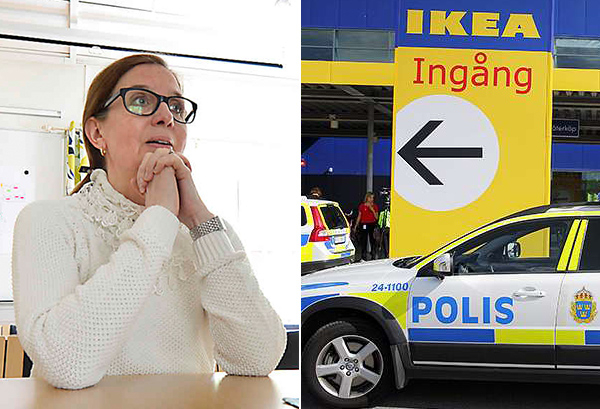
The IKEA Murders: Sweden in Crisis

August 23, 2015

The IKEA Murders: Sweden in Crisis, The Gatestone InstituteIngrid Carlqvist, August 23, 2015

  • The mosque fire received huge attention, while the rape epidemic is basically ignored. When a Swedish woman and her son are brutally knifed to death in the most Swedish of all places – an IKEA store – the Prime Minister has nothing to say.
  • The normal democratic order, where citizens can contact politicians or the media to make their voices heard, has all but evaporated in Sweden. Newspaper websites have removed the reader comment fields, and the politicians hide behind a wall of officials who brand callers expressing concern “racist,” and hang up. Sweden is governed by a power that has shut down the democratic process.
  • Questions flooded the social media: Who are these people that are let into Sweden? How many of them are not innocent victims of war, but in fact war criminals and other criminals, hiding among the refugees?
  • The most relevant question is: Why has one government after another chosen to spend Swedish taxpayers’ money to support and shelter citizens of other countries, while some of them try to kill us?
  • None of the mainstream media has confronted the government about the violent crimes committed by asylum seekers against Swedes. On the contrary – the media have done the utmost to convince Swedes that everything is safe and sound in Sweden. Better than ever, in fact.
  • “Where do I apply for asylum… when the day comes that I can no longer live here?” – “Ewa,” on Facebook.
  • Violent crime is up 300% and rape is up 1,472% since 1975, the year the Swedish Parliament decided to turn homogenous Sweden into a multicultural country.

A surge of rage has washed over otherwise docile Sweden. After a double homicide at an IKEA store in Västerås, where an illegal alien stabbed two random Swedes to death, more and more people are questioning why the government is exposing Swedish citizens to murderers from across the globe.

On August 10, news of the IKEA murders shocked Sweden. Two asylum seekers from Eritrea (the second largest source of asylum applicants in Sweden), were suspected of having grabbed knives from the kitchenware department and attacked two random Swedes. The victims were 55-year-old Carola Herlin and her 28-year-old son, Emil.

1218Carola Herlin, Director of the Moro Backe Health Center, was murdered on August 10, along with her son, in the IKEA store in Västerås, Sweden.

The elder of the two asylum seekers, a 36-year-old man, had twice been denied residency status in Sweden — because he had already been granted residency it in Italy — but he had not yet been deported. (Eritreans without residence permits in other EU-countries automatically get to stay in Sweden.)

The killer also inflicted life-threatening injuries on himself, and underwent several surgeries before the police could finally question him. On August 14, he confessed. His 23-year-old compatriot was released from custody, because the police no longer believe he had anything to do with the murders or had even known what his friend was planning to do.

Fear has now struck the Swedes. Even those who had routinely brand critics of immigration and multiculturalism racist, were shaken to the core. Questions flooded the social media: Who are these people that are let into Sweden? How many of them are not innocent victims of war, but in fact war criminals and other criminals, hiding among the refugees? And should we pay billions in taxes to support and shelter citizens of other countries, while some of them try to kill us?

The fact that the police refuse to deny the persistent rumor that one of the IKEA victims was beheaded, only adds fuel to the fear.

So many questions and no answers. No one from the government has even bothered to make a statement about the horrific double murder. None of the mainstream media has confronted the government about the violent crimes committed by asylum seekers against Swedes. On the contrary – the media have done the utmost to convince Swedes that everything is safe and sound in Sweden. Better than ever, in fact. The day after the double murder, Sweden’s largest morning paper, Dagens Nyheter, published an article titled, “After all, deadly violence on the decline.” The article begins:

“In recent weeks, several brutal murders have been committed, and many people ask themselves where society is headed. The answer is that Sweden has, after all, become a safer place. Deadly violence has been on the decline for some time.”

Nowhere does the article explain that the reason deadly violence has been on the decline is that emergency medicine is now able to save the lives of a lot more victims of knife- and gunshot-injuries. The so-called Laser Man, for example, shot a number of immigrants in Sweden in the 1990s. Forensic pathologist Jovan Rajs commented, “The Laser Man shot eleven people, and one of them died. In the 1930s eight or nine would have died, in the 1970s about five, and today probably none.”

Ergo, deadly violence remains on an even level thanks to better health care in Sweden, but all other kinds of violent crime (including attempted homicide) has gone off the charts. Violent crime is up 300% and rape is up 1,472% since 1975, the year the Swedish Parliament decided to turn homogenous Sweden into a multicultural country.

Ninety percent of asylum seekers to Sweden lack proper identification papers, so in reality no one knows how many murderers, rapists and thugs hide among the 100,000 or so people granted asylum in Sweden every year.

Frustrated Swedes are now howling with powerlessness on social media. The normal democratic order, where citizens can contact politicians or the media to make their voices heard, has all but evaporated. Newspaper websites have removed the reader comment fields, and the politicians hide behind a wall of officials, who brand callers expressing concern “racist,” and hang up. Thousands bear witness to this on Facebook. One person who actually got to talk about her uneasiness is Ewa, who writes on Facebook about calling Immigration Services:

“Well, I’ve unleashed the devil now. I called Immigration Services and demanded to talk to a Unit Manager. … I gave him an earful about every injustice I could think of, like how badly we treat our elderly and how we take away their homes and give them to asylum seekers. I also told him how unsafe Swedish women feel due to all these gang rapes perpetrated by asylum seekers and other foreigners. Also asked him if we all have to be beheaded before they stop taking in these kinds of people. … Now I’m sitting here, feeling completely empty after crying, screaming, discussing, raging and getting all this frustration out of me. Told him there are many of us who feel depressed because of what Immigration is doing. He was really sorry I feel this way. Yes, I told him, a lot of people feel this way but they are afraid to open their mouths because then they are labeled racist. You don’t even have to be a Sweden Democrat to see that our country is falling apart more and more with each passing day. Something you and all the rest at Immigration Services are responsible for. Where do I apply for asylum, I asked, when the day comes and I can no longer live here? Our country is ruined economically, socially and so forth and you are responsible. He answered that it was the politicians who decided about this, but that they would do everything in their power to make things better.”

Another woman, Amanda, wrote on Facebook that she e-mailed Prime Minister Stefan Löfven. She noted that “nothing may change, but at least I’ve made my voice heard.” Her e-mail read:

“Hi, why did the Prime Minister feel it was essential and urgent to go and talk about the fire at the mosque in Eskilstuna, no one even knew what started it when he held his speech? But now, he’s as silent as the grave. Why? It’s his/your unconditional and lax immigration policies that have enabled this culprit to move freely in society, despite having received a deportation order not just once, but twice. Can you tell me if this is something the citizens of this country should get used to, that immigrants, upon receiving deportation orders, kill people in order to get a lifelong contract with the Swedish state? It is your personal responsibility every time this happens, I hope you know that. Because this is nothing if not a political issue regarding immigration, and… its massive consequences to an entire nation.”

The mosque fire in Eskilstuna that Amanda referred to happened December 25, 2014, and is one of many incidents affecting Muslims and other immigrants that have received huge attention, while the rape epidemic in Sweden is basically ignored. After the fire, the Prime Minister was quick to make a statement:

“It is despicable, a despicable act. We will never tolerate this type of crime. People who want to practice their religion should have the right to do so. Today I feel great sympathy and empathy for those affected.”

Three months later, it turned out no crime was behind the mosque fire, and police dropped the investigation. Most likely, it was caused by an accident or children playing with fire.

But when a Swedish woman and her son are brutally knifed to death in the most Swedish of all places – an IKEA store – the Prime Minister has nothing to say.

The Swedes are not prone to rebellion. To find a citizen that took up arms and marched on the citadels of power, one has to go back to the days of Gustav Vasa – the king who during his reign, 1523-1560, founded the nation-state of Sweden.

Although Sweden today is not occupied territory, it is governed by a power that has shut down the democratic process by the “December Agreement” of 2014. In the general election that year, the only party critical of mass immigration, the Sweden Democrats (SD), became the third-largest party in Parliament. The left-wing and center-right blocs then agreed to lock SD out of political power, but SD refused to be silenced. When the left-wing minority government budget was presented one month after the election, SD voted for the opposition’s budget – a shocking and unique occurrence in the Swedish Parliament. Here, it is considered “good manners and decorum” to vote for your own budget proposition first, then lay down your vote and let the government win. But after the Sweden Democrats’ “coup,” Prime Minister Stefan Löfven (of the Social Democratic Party) was forced to govern with a center-right budget during his first year in office.

One would think that this came as a pleasant surprise to the center-right opposition, but that was not what happened. No one wants support from the “racist” Sweden Democrats. Rather than call a snap election, the two blocs entered into an agreement in which the center-right opposition promises to abstain from voting when it comes to important issues such as a proposed budget.

Thus, the December Agreement is in reality a kind of “relay-race” dictatorship: The left-wing government gets to do what it wants for the next four years, and after that, for next the four years (if there is a change of power), it will be the center-right government’s turn. This means both parties are free to ignore the 58% of Swedes who now feel that immigration is too high, and may choose to vote for the Sweden Democrats in the next election.

When the Swedes got the news about the December Agreement, they did what they usually do – clenched their fists in their pockets, formed Facebook groups and wrote angry comments on Twitter and Facebook. But the politicians congratulated each other on once again restoring order; they ignored the people’s concern that democracy had now become even more eroded.

A well-known stand-up comedian, Magnus Betnér, thought it a good idea to mock frightened Swedes in a YouTube clip:

“Yes, it’s really tragic two people were murdered in IKEA. … but… it’s not dangerous; Sweden has never been safer than it is now. … Very few of you guys watching this clip will be murdered. And those of you who are, will be murdered in your own homes.”

When the establishment refuses to take people’s concerns seriously, rumors on social media spread fast. A stubborn rumor claims that Carola Herlin was beheaded by the Eritrean murderer. According to sources interviewed by Gatestone, the woman had her throat slit and was also stabbed in the abdomen. Her son tried to defend himself, but received a deadly stab wound to the stomach.

When Dispatch International called Per Ågren, the police investigator in charge of the case, and asked him about the rumor, he said: “I’m not going to confirm… describe anything at all about what happened, except to say that two people were murdered. You won’t find out how from me.”

One of the first measures taken by the police after the IKEA murders was to start guarding all the buildings housing asylum seekers in the county. There was some apprehension concerning “dark forces,” the police claimed, without specifying who these “dark forces” were. The night of August 15, an asylum house in Arboga had to be evacuated after someone shouted something about a bomb outside. Now the mainstream media were really on their toes: Carola and Emil Herlin, according to their reports, had been “at the wrong place at the wrong time.”

The newspaper Aftonbladet interviewed an anonymous woman who said, “My cousin has lived here for over a year. He told me the Swedes are the nicest people in Europe. Then something like this happens. I could never have imagined.”

Once again, it is supposedly the Swedes who should bow their heads in shame. Supposedly, we are not the ones grieving; we do not have the right to be frightened to death over the immigration policy of our rulers – it is the asylum seekers who are the victims, even when they kill, rape, rob and abuse.

The burning question is: What will the people do, whom no one will listen to? In East Germany of 1989, the people took to the streets, scaled the Berlin wall and made the government to resign. The other communist dictatorships of Eastern Europe fell in similar ways. The Second Amendment to the U.S. Constitution (the right to bear arms), exists to ensure that the citizens are able to seize power from a tyrannical government.

If powerlessness drives people to answer violence with violence, maybe one should not ask why Swedes are “racists” if they do not want the highest immigration level in Europe?

The most relevant question is why one government after another has chosen to spend Swedish taxpayers’ money on citizens of other countries. While Swedish students take a plunge in the PISA tests, 60% of the welfare benefits go to immigrants who make up about 15% of the population. Healthcare and other social services are deteriorating, according to many Swedes, while violence is exponentially increasing. When more and more Swedes feel that they are being badly treated in their own country, the politicians have created a powder keg ready to explode at any minute.

The truth is that even the docile Swedish people have a limit. When those in power expose us to bloodbaths, whether in the Big Square of Stockholm in 1520 or at IKEA in Västerås in 2015, there will always be those who are ready to overthrow the mighty. Just as in Gustav Vasa’s day, a lot of Swedes have firearms. They are not as easy to come by as in the United States, but more and more Swedes are getting hunting licenses, and are thereafter legally able to buy guns. From now on in Sweden, anything can happen.

Recent Iranian disclosures highlight the perversity of the Iran “deal”

August 13, 2015

Recent Iranian disclosures highlight the perversity of the Iran “deal,” Dan Miller’s Blog, August 13, 2015

(The views expressed in this article are mine and do not necessarily reflect those of Warsclerotic or its other editors. — DM)

In 2011, well before the multilateral P5+1 “negotiations” with Iran began in February of 2013, Obama put Senator John Kerry in charge of  “secret bilateral negotiations on the [Iranian] nuclear dossier.” Kerry then advised Iranian officials that “we are definitely and sincerely willing, and we can resolve the issues” — including Uranium enrichment and the Possible Military Dimensions (PMDs) of Iran’s nuclear program. Iran’s nuclear weaponization and missile development programs have been substantially ignored ever since.

Ernest Moniz, who was to become Kerry’s technical adviser, was brought into the P5+1 negotiations at the specific request of the Iranian official — Moniz’ former MIT classmate — who was to be his counterpart. 

The Iran – North Korea nuclear axis, through which the rogue nations cooperate on nuke and missile development, continues to be ignored.

In earlier articles, beginning shortly after the Joint Plan of Action was published in November of 2013, I attempted to show that the focus was on pretending to curtail Iran’s Uranium enrichment programs as they expanded and then granting sanctions relief, while substantially ignoring the program’s “possible military dimensions” (PMDs). Followup articles are here, here and elsewhere. The PMDs have yet to be explored seriously and evidently will not be under the current “comprehensive” joint plan and the secret side deals between the International Atomic Energy Agency (IAEA) and Iran.

Any pretense that the IAEA will have “any time, anywhere” access to Iran’s military sites was mere rhetoric, as acknowledged by US Under Secretary of State Wendy Sherman on July 16th

“I think this is one of those circumstances where we have all been rhetorical from time to time,” Sherman said in a conference call with Israeli diplomatic reporters. “That phrase, anytime, anywhere, is something that became popular rhetoric, but I think people understood that if the IAEA felt it had to have access, and had a justification for that access, that it would be guaranteed, and that is what happened.” [Emphasis added.]

Ms. Sherman was right about the rhetorical nature of administration assertions, but wrong about IAEA access, of which there will apparently be little or none pursuant to the secret deals between Iran and the IAEA.

I. Here’s some background on Kerry

Reporting for duty

Reporting for duty with Iran

During his 2004 campaign for president, Kerry said if he were the president he would

have “offered the opportunity to provide the nuclear fuel” to Iran, to “test them, see whether or not they were actually looking for it for peaceful purposes.” Mr. Kerry’s words brought comfort to Tehran’s top mullahs, who have been seeking to buy time from the international community for the past two years while they continue perfecting their nuclear weapons capabilities. [Emphasis added.]

. . . .

Top among the pro-regime fund-raisers who have contributed to the Kerry campaign is a recent Iranian immigrant in California named Susan Akbarpour.

. . . .

The Kerry campaign credits Miss Akbarpour and her new husband, Faraj Aalaie, with each raising $50,000 to $100,000 for the presidential campaign. Mr. Aalaie is president of Centillium Communications, a Nasdaq-listed software firm.

These contributions continue . . . even though Miss Akbarpour was not a permanent U.S. resident when she made her initial contribution to Mr. Kerry on June 17, 2002, as this reporter first revealed in March. (To be legal, campaign cash must come from U.S. citizens or permanent residents).

On August 10th of this year, the Middle East Media Research Institute (MEMRI) published a lengthy article quoting Iranian officials on their dealings with Senator Kerry. Obama had put Senator John Kerry in charge of “secret bilateral negotiations on the [Iranian] nuclear dossier” well before the multilateral P5+1 “negotiations” with Iran began in February of 2013.

The MEMRI article states that Kerry had representatives of The Sultanate of Oman deliver a letter he had written to Iranian officials recognizing Iran’s Uranium enrichment rights and suggesting secret negotiations. Omani officials discussed the letter with Iranian officials and, when the Iranians appeared skeptical, the Omani official suggested,

Go tell them that these are our demands. Deliver [the note] during your next visit to Oman.’ On a piece of paper I wrote down four clearly-stated points, one of which was [the demand for] official recognition of the right to enrich uranium. I thought that, if the Americans were sincere in their proposal, they had to accept these four demands of ours. Mr. Souri delivered this short letter to the mediator, stressing that this was the list of Iran’s demands, [and that], if the Americans wanted to resolve the issue, they were welcome to do so [on our terms], otherwise addressing the White House proposals to Iran would be pointless and unjustified. [Emphasis added.]

“All the demands presented in this letter were related to the nuclear challenge. [They were] issues we had always come up against, like the closing of the nuclear dossier, official recognition of [the right to] enrichment, and resolving the issue of Iran’s past activities under the PMD [possible military dimensions] heading. After receiving the letter, the Americans said, ‘We are definitely and sincerely willing, and we can resolve the issues that Iran mentioned.’” [Emphasis added.]

The texts of the November, 2013 Joint Plan of Action, as well as the July 14, 2015 “deal,” could easily have been predicted based on Kerry’s 2011 response to the Iranians.

“After Rohani’s government began working [in August 2013] – this was during Obama’s second term in office – a new [round of] negotiations between Iran and the P5+1 was launched. By this time, Kerry was no longer a senator but had been appointed secretary of state. [But even] before this, when he was still senator, he had already been appointed by Obama to handle the nuclear dossier [vis-à-vis Iran] and later [in December 2012] he was appointed secretary of state. Before this, the Omani mediator, who was in close touch with Kerry, told us that Kerry would soon be appointed secretary of state. In the period of the secret negotiations with the Americans in Oman, there was a more convenient atmosphere for obtaining concessions from the Americans.  After the advent of the Rohani government and the American administration [i.e., after the start of Obama’s second term in office], and with Kerry as secretary of state, the Americans expressed a more forceful position. They no longer displayed the same eagerness to advance the negotiations. Their position became more rigid and the threshold of their demands higher. But the situation on the Iranian side changed too, since a very professional team was placed in charge of the negotiations with the P5+1…”

Perhaps Kerry had found it more congenial, and certainly more consistent with his and Obama’s own intentions, to be eager to help Iran during secret negotiations and to appear modestly resistant during the P5+1 sessions; they were at least slightly more in public view. Even so, according to Amir Hossein Motagh, a former aide to President Rouhani,

The US negotiating team are mainly [in Lausanne] to speak on Iran’s behalf with other members of the 5+1 countries and convince them of a deal. [Emphasis added.]

. . . .

French Foreign Minister Laurent Fabius, for example, has long been insisting that Iran come clean on its previous military activities, something we are now told that the American delegation, led by Secretary Kerry, wants to leave out of the negotiation. Why? Because the Iranians have said they will not come clean. [Emphasis added.]

That was too much even for the normally pro-Democrat Washington Post, which wrote in a column attributed to its Editorial Board last Friday that the deal was “a reward for Iran’s noncompliance.”

According to the article linked above,

Some Iranian-Americans believe that Secretary Kerry should have recused himself from the negotiations at the very outset because of his long-standing relationship to his Iranian counter-part, Mohammad Javad Zarif.

The two first met over a decade ago at a dinner party hosted by George Soros at his Manhattan penthouse, according to a 2012 book by Hooman Majd, who frequently translates for Iranian officials.

Iranian-American sources in Los Angeles tell me that Javad Zarif’s son was the best man at the 2009 wedding between Kerry’s daughter Vanessa and Behrouz Vala Nahed, an Iranian-American medical doctor.

The newlyweds went to Iran shortly after their wedding to met Nahed’s family. Kerry ultimately revealed his daughter’s marriage to an Iranian-American once he had taken over as Secretary of State. But the subject never came up in his Senate confirmation hearing, either because Kerry never disclosed it, or because his former colleagues were too polite to bring it up.

Why did Obama designate Kerry to deal with Iran in 2011? Andrew C. McCarthy, writing at The Center for Security Policy, offers this:

Clearly, there are two reasons: Obama needed someone outside the administration, and Kerry’s status and track record made him a natural.

Remember, Obama was running for reelection in 2011–12. Public opposition to Iran’s acquisition of nuclear weapons and, therefore, to Iran’s enrichment of uranium was very strong — and, indeed, remains so. Consequently, Obama pretended on the campaign trail that he would vigorously oppose Iran’s uranium-enrichment efforts . . . even as he was covertly signaling to the jihadist regime that he was open to recognizing Iran as a nuclear power. [Emphasis added.]

As my friend Fred Fleitz of the Center for Security Policy has noted, Obama asserted in the lead-up to the 2008 election that “the world must work to stop Iran’s uranium-enrichment program.” So too, in the run-up to the 2012 election, did Obama continue assuring voters that Iran “needs to give up its nuclear program and abide by the U.N. resolutions that have been in place.” Those U.N. resolutions prohibit Iran’s enrichment activities. Thus did the president proclaim, in seeking reelection, that the only deal he would accept would be one in which the Iranians “end their nuclear program. It’s very straightforward.” [Emphasis added.]

With Obama out feigning opposition to Iran’s enrichment activities, it would not do to have a conflicting message communicated to Iran by his own administration. What if Iran, to embarrass Obama, were to go public about an administration entreaty that directly addressed enrichment? It would have been hugely problematic for the president’s campaign. Obama thus needed an alternative: someone outside the administration whom Obama could trust but disavow if anything went wrong; someone the Iranian regime would regard as authoritative. [Emphasis added.]

John Kerry was the perfect choice.

I agree, but Mr. McCarthy does not address this exchange, quoted above but worth repeating here:

“All the demands presented in this letter were related to the nuclear challenge. [They were] issues we had always come up against, like the closing of the nuclear dossier, official recognition of [the right to] enrichment, and resolving the issue of Iran’s past activities under the PMD [possible military dimensions] heading. After receiving the letter, the Americans said, ‘We are definitely and sincerely willing, and we can resolve the issues that Iran mentioned.’” [Emphasis added.]

II. Ernest Moniz

Moniz, the U.S. Energy Secretary, was asked to join the P5+1 technical discussions at the request of Ali Akbar Salehi, head of Iran’s Atomic Energy Organization.

Salehi said that he was asked to join the nuclear talks when the discussions on the Natanz enrichment facility reached a dead end. Salehi said he would only join the talks if Moniz, his American counterpart, did as well. According to Salehi, this was approved by Undersecretary Wendy Sherman and Deputy Foreign Minister Abbas Araghchi, which he described as “the communications link between America and Iran.” [Emphasis added.]

Salehi said he and Moniz did not know each other well when they were at MIT, but when they first met during the talks, “there was a feeling that he has known me for years.” Salehi added, “A number of my classmates are now Mr. Moniz’s experts.”  [Emphasis added.]

According to Salehi, Moniz entering the talks was important because Salehi expressed that he had been sent with “full authority” to sign off on all technical issues in the nuclear negotiations and Moniz had told him that he had the same authority. He added, “If the negotiations did not take place with the Americans, the reality is that it would not have reached a conclusion. No [other] country was ready to sit with us and negotiate for 16 days with their foreign minister and all of its experts.”

Salehi said that one of the more difficult times negotiating with Moniz was after they reached an agreement on a particular issue. Moniz would take it to the other members of P5+1, who would then make their own requests.

Moniz was likely as forthcoming with the non-US members of P5+1 as he was with members of the U.S. Congress; not at all.

North Korea and Iran, partners in crime

This is a drum I have been beating for years. Recent articles are available here and here. The Obama Administration persists in covering up what it knows on the subject and the current “deal” with Iran is silent on the matter. So, of course, was the November 2013 Joint Plan of Action.

Forbes published an article by Claudia Rosett today (August 13th) on the subject and, beyond noting that Douglas Frantz is Kerry’s Assistant Secretary in charge of the Bureau of Public Affairs, she observes that in his former capacity as a journalist for the Washington Post and New York Times, he wrote about the nature and perils of the axis.

Frantz’ duties under Kerry include

engaging “domestic and international media to communicate timely and accurate information with the goal of furthering U.S. foreign policy and national security interests as well as broadening understanding of American values.”

But it appears that as a State Department advocate of a free and well-informed press, Frantz himself is not free to answer questions from the press about his own reporting on North Korea’s help to Iran in designing a nuclear warhead. The State Department has refused my repeated requests to interview Frantz on this subject. Last year, an official at State’s Bureau of Public Affairs responded to my request with an email saying, “Unfortunately Assistant Secretary Frantz is not available to discuss issues related to Iran’s nuclear program.” This June I asked again, and received the emailed reply: “This is indeed an important topic for Doug, but he feels that speaking about his past work would no longer be appropriate, since he is no longer a journalist.”

The real issue, of course, is not the career timeline of Douglas Frantz, but the likelihood, past and future, of nuclear collaboration between Iran and North Korea. Frantz may no longer be a journalist, but it’s hard to see why that should constrain him, or his boss, Secretary Kerry, from speaking publicly about important details of Iran’s illicit nuclear endeavors — information which Frantz in his incarnation as a star journalist judged credible enough to publish in a major newspaper.

. . . .

President Obama has been telling Congress and the American public that the Iran nuclear deal — the Joint Comprehensive Plan of Action — “cuts off all Iran’s pathways to the bomb.” That’s not true. One of the most dangerous aspects of this deal is that it does not sever the longtime alliance between Tehran and Pyongyang. If there has indeed been cooperation between these two regimes on nuclear weapons, it’s time not only for Iran to come clean, but for the Obama administration to stop covering up. [Emphasis added.]

Although that’s not the only dangerous aspect which the Obama Administration has covered up and lied about cutting off “all [of] Iran’s pathways to the bomb” it is an important one. Meanwhile, it has been reported that

Fresh satellite images suggest North Korea is expanding its uranium extraction capacity, possibly with a view to increasing its stockpile of nuclear weapons.

The images taken in Pyongyang show Kim Jong-un has begun to refurbish a major mill that turns uranium ore into yellowcake – a first step towards producing enriched uranium.

A recent report by U.S. researchers warned that Kim was poised to expand his nuclear programme over the next five years and, in a worst-case scenario, could possess 100 atomic weapons by 2020. 

Conclusions

“Negotiations” involving hostile foreign nations such as Iran are easier when led by friendly “negotiators” with compatible interests. At least since his failed 2004 campaign for the presidency, Kerry has been on Iran’s side and has favored it over the United States. While pretending for political purposes to be against Iran’s nuclear program, Obama was and remains in favor of it, pretenses to the contrary notwithstanding.

Obama, Kerry and Moniz got the deal they wanted. They, along with their P5+1 partners, richly deserve their resultant legacy of empowering Iran as an anti-American, anti-Israel, anti-Western civilization, Islamist hegemonic nuclear power with a disgraceful human rights record comparable to that of its partner, North Korea.

The Iran – North Korea nuclear axis has helped both rogue nations to develop and create nuclear bombs and the means to deliver them, with very little in the way of “adult supervision.” The failure to deal with even tangentially, or even to mention, the axis will likely become a significant part of Obama’s legacy. Ours as well.

Bringing Obama’s vision of stability to the Middle East, Allah willing.

This video is from August 2010. Now it may well be too late to stop Iran.

Egypt’s Christians in the Shadow of the Muslim Brotherhood

August 11, 2015

Egypt’s Christians in the Shadow of the Muslim Brotherhood, Washington Free Beacon, August 11, 2015

(Please see also, WFB’s Bill Gertz discusses story on Obama support for Muslim Brotherhood on Steve Malzberg Show. — DM)

Copts view the Obama administration cynically. Egyptians now whisper that the American president who pleased Arab liberals with his speech “A New Beginning” at al-Azhar in 2009 is secretly funding the Muslim Brotherhood and purposefully neglecting the Islamic State. A group of Copts protested outside of the White House in February 2015, demanding more aggressive action against IS following the beheading of the 21 Copts.

Al-Ahram, the largest newspaper in Egypt, published reports in 2013 that the United States diplomatic mission in Egypt, led by Ambassador Anne Patterson, was discouraging Coptic Christians from participating in protests against Morsi. Even though Patterson adamantly denied the accusations, the report sowed more distrust among Copts.

Tensions between the Coptic community and the administration worsened when, in the same year, an Obama Homeland Security adviser named Mohamed Elibiary suggested Copts raising awareness of their persecution were promoting “Islamophobic” bigotry.

**************************

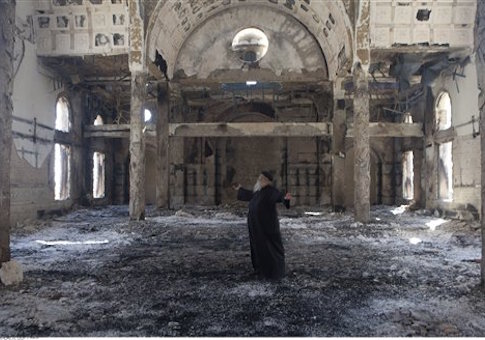
Christian Coptic Priest Father Samuel reacts as he stands inside the burned and heavily damaged St. Mousa church in Minya, Egypt / AP

In the nearly five years of turmoil that have followed the resignation of President Hosni Mubarak in 2011, no group in Egypt has suffered more than the 15 million Coptic Christians. Both a religious and ethnic minority, the Copts are descended from the native population of Egypt who lived and ruled there from the time of the pharaohs until the Roman conquest in 31 B.C. They are the largest Christian community in the Middle East today.

Copts have long been the target of discrimination and persecution in the majority-Arab nation. But this ancient people faced a terrifying new prospect in 2012: Muslim Brotherhood rule.

After Mubarak was ousted, the violence began almost immediately. Churches and schools were burned; peaceful protestors were massacred. When parliamentary elections were held nine months later, they were swept by the Muslim Brotherhood and other Islamist parties. When Mohamed Morsi won the presidential election in May 2012, the party’s victory looked complete. The same year, Morsi gave himself unlimited powers and the party drafted a new constitution inspired by Sharia law.

Morsi benefitted from the organizational advantage of the Muslim Brotherhood. Backed by imams preaching the benefits of religious rule, the previously banned political party was able to defeat the fractured coalitions of the pro-West, liberal, and secular candidates.

“They used thugs to carry out political intimidation against Christians,” a former member of Egyptian Parliament told the Washington Free Beacon. Chants celebrating the Brotherhood victory echoed through the streets of Cairo. “Morsi won! Copts out!”

Ousted president Mohamed Morsi / AP

During Morsi’s rule, Christians were murdered and tortured by the hundreds. Attacks and abductions of Christian children spiked significantly. “Most Americans do not know how vicious and bloody the Muslim Brotherhood is,” Ahmed, a 24-year old secular Muslim, said. “They really can’t understand.”

Pope Tawadros II, Egypt’s Coptic Christian leader, criticized Morsi for negligence after six Christians were killed when police and armed civilians besieged Egypt’s largest cathedral. “We want actions, not words,” the Pope said.

Public accusations of blasphemy also became ubiquitous. A Facebook post interpreted as undermining Islam could bring a mob of fundamentalists with rocks and Molotov cocktails to the homes of Christians, surrounding them with families trapped inside. Sham trials with no legal representation would follow. Anti-Christian terrorism was not punished, but the wrong words often landed Copts in prison, forcing the church to make public apologies and families to leave their towns and villages.

Lydia, an activist who provides relief supplies to torn Christian communities in Upper Egypt, and who requested that only her first name be used to preserve her safety and that of her colleagues, witnessed the Muslim Brotherhood offer the very poorest Egyptians social services that bought their allegiance. “When you have no food or money, you will listen to anyone who gives you the resources your family desperately needs,” Lydia said. “They brainwash the illiterate with extremism so they hurt Christians.”

Still, Morsi’s authoritarian rule—rewriting the constitution, disbanding the Egyptian parliament, tossing potentially obstructive judges into jail—was not long lived. Barely a year after he assumed office, a reported 35 million citizens took to the streets to protest his rule, leading the Egyptian military, under Gen. Abdel Fattah al-Sisi, to remove him from power in July 2013.

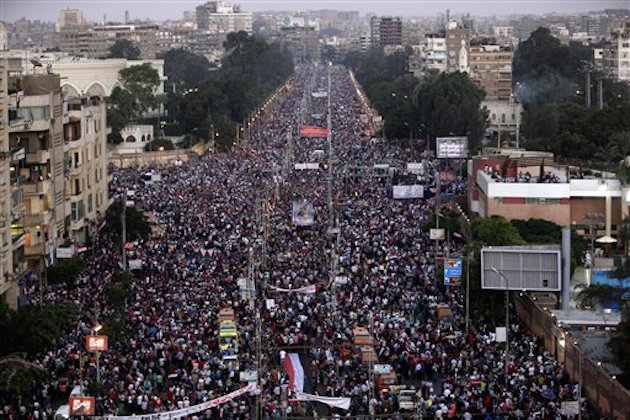
Egypt’s ousted President Mohammed Morsi protest at the presidential palace in Cairo, Egypt, Friday, July 26, 2013 / AP

Sen. James Lankford (R., Okla.) told the Free Beacon that had al-Sisi not responded, the promise of Egyptian Democracy would have died. “What it seemed the Egyptian people wanted was more opportunity to be able have some sort of functioning democracy, elections, input into their own government,” Lankford said. “It was the immediate understanding as soon as the Muslim Brotherhood was elected, that was the last election Egypt would have.”

In 2014, al-Sisi was elected Egypt’s new president. He won a solid electoral victory, giving him control of the Egyptian government with the responsibilities of forming a new constitution, a new parliament, and a new judicial system. The Coptic Church fervently supported al-Sisi’s candidacy because the new president promised Copts equality in citizenship, security in their communities, and the ability to build places of worship.

The new Egyptian president challenged the leaders of the Islamic world to push a more moderate message. In December 2014, hundreds of Christian and Muslim theologians gathered at al-Azhar, Egypt’s leading mosque and religious university, participated in a conference to fight “jihad” and promote inclusion. Al-Sisi ambitiously called for a “religious revolution” in January 2015, saying that clerics bear responsibility for the growing extremism in the Middle East.

As president, al-Sisi took many symbolic steps to integrate the Coptic community with the majority Sunni population. In a surprise to most Egyptians, al-Sisi attended a mass at Saint Mark Orthodox Cathedral in Cairo on Christmas Eve, a first for any Egyptian president. Al-Sisi regularly invites Pope Tawadros II to appear beside him when he announces major policy rollouts or requests public dialogue from senior advisers.

Al-Sisi also appointed two Copts as members of his cabinet. Under the constitution, the president of Egypt has the power to select 10 members of parliament. Political observers believe he will select Copts to fill a majority of those appointed seats to offer a more representative parliament.

“Our lives haven’t changed much but one positive result of the revolution is the Egyptian people have politically woken up,” said Hala, a Mubarak-era government official who also wished to be identified by her first name only because she fears political retribution. “We no longer accept what we are told. Egyptians are at least aware of the government’s actions and they are more aware of the troubles Copts face.”

But while al-Sisi’s administration provides a welcome change of tone toward the Coptic community, the day-to-day lives of Copts remain little changed from the Mubarak days.

Coptic Solidarity is a five-year-old public charity organization and advocacy group devoted to advancing equality for Copts in Egypt. Their efforts have helped raise awareness about the persecution Christians face in the Middle East. Alex Shalaby, an Egyptian businessman currently residing in the United States and Coptic Solidarity’s new president, believes Egypt under al-Sisi has continued many of the same practices as previous presidents Sadat, Mubarak, and Morsi.

“Discrimination is rampant, especially in Upper Egypt. We still see reconciliation tactics pressuring the closing of Christian churches and there are still very few Coptic government appointees, he explained. “Coptic Solidarity monitors all developments within Egypt and we are not able to say much has been accomplished in terms of real change to improve Coptic lives in the last 12 months.”

Human rights groups have been critical of al-Sisi’s record. Amnesty International’s Hassiba Hadj Sahraoui accused the president of “employing the same methods of torture and other ill-treatment used during the darkest hours of the Mubarak era.” The Egyptian government received heavy criticism after a court sentenced hundreds of Muslim Brotherhood members to death, intensifying its crackdown on Islamists.

Despite assurances from al-Sisi, sectarian violence still regularly occurs in the rural villages of Upper Egypt where the government has less control.

In Nasreya, Islamists responded to a video of five Christian students making fun of the Islamic State terrorist groups by demanding the students be turned over to the authorities for insulting the religion of Islam. Villagers hurled rocks at Copts and vandalized their property. No arrests were reported for the attacks but the teacher and students were imprisoned for days.

On March 26, 2015, in El Galaa another horde gathered to protest the building of a new church that served 1,400 Christians, also attacking Christian homes in a similar manner. The local government forced the new church to have no outer symbol of Christianity. In Mayana and Abu Qurqas villages, police raided churches, confiscated items from the altar, and shut down reconstruction work.

Lydia, the activist based in Upper Egypt, has witnessed firsthand the damage from these attacks. “I had to console a girl, nine years old, crying because she was afraid her parents were going to be kicked out of their own home,” she said.
“They are poor, illiterate, and now their home is burned and their own community has banned them. All because they are Christians,” she continued.

“The police don’t bother to protect Christians. They do the exact opposite in Upper Egypt,” Lydia said. “The local governments have been loaded with Islamists for years.”

But violence is not exclusive to the country’s outskirts. On June 30, 2015, the two-year anniversary of the popular uprising against Morsi, Islamists detonated bombs by the homes of well-known Christians. Additionally, The Fathers Church in Alexandria was firebombed on July 22, 2015. This summer’s assassination of Egypt’s Attorney General Hesham Barakat in a car bombing, reportedly carried out by a wing of the Muslim Brotherhood, served as an ugly reminder that Egypt’s violence has not passed.

An Egyptian policeman stands guard at the site of a car bombing that killed n Egyptian policeman stands guard at the site of a car bombing that killed Hesham Barakat / AP

Despite these problems, al-Sisi still enjoys support among prominent Copts. Amir Ramzy is a prominent Coptic judge and public figure in Egypt’s legal system, and a loyal defender of al-Sisi’s administration.

“We cannot remove prejudice overnight,” Ramzy said. “We must focus on changing the attitude of the people on the ground first.”

The judge pointed to the dire state al-Sisi found the country in when he took office as reason for slow progress.

“Egypt is fighting Islamists inside and outside our borders. Egypt is fighting a horrid economy with massive unemployment. Al-Sisi is taking on large projects to change these conditions,” Ramzy said. “It is difficult to control chaos and promote social change at the same time.”

The judge referred to the decades it took the United States to implement civil rights reforms. He asked for reasonable expectations out of Egypt’s new president and insists under al-Sisi the country is heading in the right direction. “Just one year after his election, Egypt has new roads, a new canal, new investments, and a new hope for the poor.”

Despite not being content with the pace of progress, Shalaby said al-Sisi is an improvement over his predecessor. As a retired executive, he said he understood national security and economic development should be the president’s priority. “Al-Sisi must do what is best for Egypt first. What is best for Egypt is what is best for Copts. What is good for Copts is good for Egypt.”

Abdel-Fattah al-Sisi / AP

Copts view the Obama administration cynically. Egyptians now whisper that the American president who pleased Arab liberals with his speech “A New Beginning” at al-Azhar in 2009 is secretly funding the Muslim Brotherhood and purposefully neglecting the Islamic State. A group of Copts protested outside of the White House in February 2015, demanding more aggressive action against IS following the beheading of the 21 Copts.

Al-Ahram, the largest newspaper in Egypt, published reports in 2013 that the United States diplomatic mission in Egypt, led by Ambassador Anne Patterson, was discouraging Coptic Christians from participating in protests against Morsi. Even though Patterson adamantly denied the accusations, the report sowed more distrust among Copts.

Egyptians publicly celebrated when Patterson left the country.

Tensions between the Coptic community and the administration worsened when, in the same year, an Obama Homeland Security adviser named Mohamed Elibiary suggested Copts raising awareness of their persecution were promoting “Islamophobic” bigotry. Elibiary, who generated controversy due to views perceived by some to be friendly to the Muslim Brotherhood, released a series of tweets with the R4BIA salute, perceived to be a symbol of hate by many in Egypt.

Elbiary later deleted his tweets and removed the symbol. Bishop Angaelos, Pope Tawadros II’s personal representative called the incident “disturbing.” Elbiary left the Obama administration under pressure from critics in 2014.

Following the ouster of Morsi, the United States canceled weapons deliveries to Egypt and halted all military aid. As the White House took its time to build a relationship with al-Sisi, Russian President Vladimir Putin visited the country and signed a nuclear agreement.

The White House announced in the spring of 2015 that weapons deliveries to Egypt would ultimately be resumed.

Despite the uneasiness in the country, Christians believe they will one day be equal citizens in their homeland. Such progress may be slow and painful, but amidst anxiety there is hope in Egypt.

Much of this hope is derived from the perception of al-Sisi’s decent treatment of the Copts. Ramzy, the judge, told theFree Beacon, “al-Sisi may not be perfect, but he is Copts’ best chance to promote ourselves from second class citizens. He should receive America’s support.”

State Department Interferes in Favor of PLO Terrorists

August 11, 2015

State Department Interferes in Favor of PLO Terrorists, Israel National News, Tova Dvorin, August 11, 2015

US President Barack Obama is reportedly seeking to lower that fine – following a series of conflicts between officials from the State Department and the Justice Department over the issue, an official involved in the case told the New York Times Tuesday. 

*********************

Washington asks a judge presiding over terror victims’ compensation case to reduce money paid to Israelis injured during Second Intifada.

The Obama administration has asked a judge Monday to “carefully consider” the size of the bond demanded from the Palestinian Authority (PA) for its role orchestrating years of terror attacks against Israelis and Jews – directly interfering in a US court case.

In February, the Palestine Liberation Organization (PLO) – the terror group behind the PA – was found liable to pay $218.5 million to victims of terror, a figure that was set to be tripled to $655.5 million according to the anti-terrorism laws under which the case was brought.

Legal rights group Shurat Hadin (Israel Law Center) helped represent the 11 families who charge the PA and PLO of inciting, supporting, planning and executing the seven terror attacks which killed American citizens between 2000 and 2004.

In May, the PA admitted it cannot pay such a hefty fine, however – as it is struggling under billions of debt despite an ongoing stream of aid from Israel and other countries – and called the case “political extortion.”

Now, US President Barack Obama is reportedly seeking to lower that fine – following a series of conflicts between officials from the State Department and the Justice Department over the issue, an official involved in the case told the New York Times Tuesday.

In a document entitled “Statement of Interest of the United States of America,” the Obama administration expressed concerns over the payments hurting the PA’s basic government services.

Forcing the PLO to pay “a significant portion of its revenues would likely severely compromise the P.A.’s ability to operate as a governmental authority,” deputy Secretary of State Antony J. Blinken wrote. “A P.A. insolvency and collapse would harm current and future U.S.-led efforts to achieve a two-state solution to the Israeli-Palestinian conflict.”

Blinken stressed in the document, however, that the State Department allegedly values the rights of terror victims to seek “just compensation” and was not taking a position on the case itself, only on the high bond.

“The United States strongly supports the rights of victims of terrorism to vindicate their interests in federal court and to receive just compensation for their injuries,” Blinken claimed.

Justice Department officials have maintained throughout the proceedings that any State Department interference in the case would interfere with the victims’ rights for compensation and justice.


Britain: The “Struggle of Our Generation”

August 10, 2015

Britain: The “Struggle of Our Generation”, The Gatestone InstituteSamuel Westrop, August 10, 2015

  • “We’ve got to show that if you say ‘yes I condemn terror — but the Kuffar are inferior’, or ‘violence in London isn’t justified, but suicide bombs in Israel are a different matter’ — then you too are part of the problem. Unwittingly or not, and in a lot of cases it’s not unwittingly, you are providing succour to those who want to commit, or get others to commit to, violence.” — Prime Minister David Cameron.
  • In a series of religious rulings published on its website, the Islamic Network charity advocated the murder of apostates; encouraged Muslims to hate non-Muslims; stated that when non-Muslims die, “the whole of humanity are relieved;” and described Western civilisation as “evil.”
  • The Charity Commission’s solution, however, was to give the charity’s trustees booklets titled, “How to manage risks in your charity,” and warn them not to do it again.

On July 20, Prime Minister David Cameron outlined his government’s plans to counteract Islamic extremism, which he described as the “struggle of our generation.”

In a speech before Ninestiles School, in the city of Birmingham, Cameron articulated a view of the Islamist threat that, just a couple of years ago, few else in British politics would have dared to support.

In a report for BBC Radio 4, the journalist John Ware described Cameron’s speech, and the government’s proposed counter-extremism measures, as “something no British government has ever done in my lifetime: the launch of a formal strategy to recognize, challenge and root out ideology.”

Cameron’s speech was wide-ranging. It addressed the causes, methods and consequences of Islamist extremism.

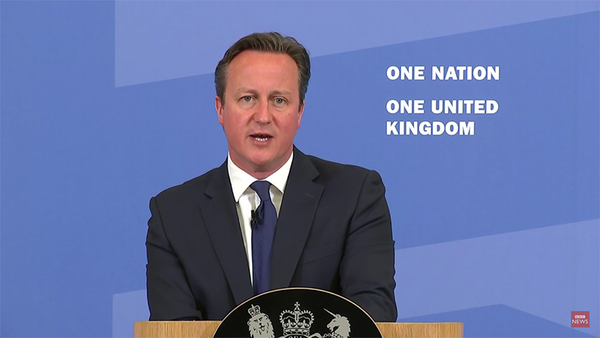
1199(Image source: BBC video screenshot)

We must recognize, Cameron reasoned, that Islamist terror is the product of Islamist ideology. It is definitely not, he argued, “because of historic injustices and recent wars, or because of poverty and hardship. This argument, what I call the grievance justification, must be challenged. … others might say: it’s because terrorists are driven to their actions by poverty. But that ignores the fact that many of these terrorists have had the full advantages of prosperous families or a Western university education.”

“Extreme doctrine” is to blame — a doctrine that is “hostile to basic liberal values … Ideas which actively promote discrimination, sectarianism and segregation. … which privilege one identity to the detriment of the rights and freedoms of others.” This is a doctrine “based on conspiracy: that Jews exercise malevolent power; or that Western powers, in concert with Israel, are deliberately humiliating Muslims, because they aim to destroy Islam.”

People are drawn to such extremist ideas, Cameron argued, because:

“[Y]ou don’t have to believe in barbaric violence to be drawn to the ideology. No-one becomes a terrorist from a standing start. It starts with a process of radicalisation. When you look in detail at the backgrounds of those convicted of terrorist offences, it is clear that many of them were first influenced by what some would call non-violent extremists.

“It may begin with hearing about the so-called Jewish conspiracy and then develop into hostility to the West and fundamental liberal values, before finally becoming a cultish attachment to death. Put another way, the extremist world view is the gateway, and violence is the ultimate destination.”

To counteract the extremist threat, Cameron concludes, the government will “tackle both parts of the creed — the non-violent and violent. This means confronting groups and organisations that may not advocate violence — but which do promote other parts of the extremist narrative.”

Further, no longer will extremist groups be able to burnish their moderate credentials by pointing to ISIS as the Islamic bogeyman:

“We’ve got to show that if you say ‘yes I condemn terror — but the Kuffar are inferior’, or ‘violence in London isn’t justified, but suicide bombs in Israel are a different matter’ – then you too are part of the problem. Unwittingly or not, and in a lot of cases it’s not unwittingly, you are providing succour to those who want to commit, or get others to commit to, violence.

For example, I find it remarkable that some groups say ‘We don’t support ISIL’ as if that alone proves their anti-extremist credentials. And let’s be clear Al-Qaeda don’t support ISIL. So we can’t let the bar sink to that level. Condemning a mass-murdering, child-raping organisation cannot be enough to prove you’re challenging the extremists.”

Rather radically for a Western leader, Cameron also asserted that, “simply denying any connection between the religion of Islam and the extremists doesn’t work… it is an exercise in futility to deny that. And more than that, it can be dangerous. To deny it has anything to do with Islam means you disempower the critical reforming voices; the voices that are challenging the fusing of religion and politics…”

Cameron’s speech was groundbreaking. No previous Prime Minister in past decades would have dared to make such statements. This is not to say, however, that it is without fault.

Cameron is not just talk. An “Extremism Analysis Unit” has been set up within the Home Office, which will serve to tackle Islamist extremism, including “non-violent” groups. According to the journalist John Ware, the new body is currently preparing lists of extremist preachers and groups.

More importantly, a variety of new legislation is being brought before Parliament. However, some of the proposed laws, critics argue, are draconian. “Banning Orders” will outlaw designated “extremist groups.” “Extremism Disruption Orders,” meanwhile, will restrict designated “extremists” from appearing on television, or publishing without the authorities’ approval. And “Closure Orders” will allow the government to close any institution deemed guilty of promoting extremism.

Cameron has correctly and radically diagnosed the problem of Islamic extremism. His solutions, however, do not appear promising.

A more useful next step would be for the government to tackle its own relationships with extremist groups. Britain’s registered charities offer a particularly vivid example of Islamist extremism going unchallenged.

In 2014, I wrote about the Islamic Network, a group that describes itself as “a da’wah[proselytizing] organisation which aims to promote awareness and understanding of the religion of Islam.”

In a series of religious rulings published on its website, the Islamic Network charity advocated themurder of apostates; encouraged Muslims to hate non-Muslims; stated that when non-Muslims die, “the whole of humanity are relieved;” and described Western civilisation as “evil.” Further, the Islamic Network directed a great deal of hatred towards the Jews. Its website claimed: “The Jews strive their utmost to corrupt the beliefs, morals and manners of the Muslims. The Jews scheme and crave after possessing the Muslim lands, as well as the lands of others.”

In spite of these views, the Islamic Network is a registered charity, which means it is entitled to subsidy from the taxpayer.

As a result of revealing the material published on the Islamic Network’s website, as well as several complaints submitted to the Charity Commission, the government opened an inquiry into the charity. After a year of deliberation, the Charity Commission published its report, which concluded that the Islamic Network had indeed published extremist material.

The Charity Commission’s solution, however, was to give the charity’s trustees booklets titled, “How to manage risks in your charity,” and warn them not to do it again.

Britain may finally have a government that understands the problem of Islamist extremism, but if government bodies fail to challenge extremist charities such as the Islamic Network, then what use is this enlightenment?

The Islamic Network is but one of many dozens of examples. Why is the British organizationInterpal, for example, still allowed to be a registered charity? Interpal is a designated terrorist organization under United States law. Its trustees regularly meet with senior leaders of the terror group Hamas. In 2013, for instance, Interpal trustee Essam Yusuf took part in a ceremony with the Hamas leader Ismail Haniyeh, at which they expressed praise for Hamas’ military wing, the Al Qassam Brigades, and glorified “martyrdom.”

Or what of Islamic Relief, one of Britain’s largest charities? Established by the Muslim Brotherhood, Islamic Relief’s directors have included Ahmed Al-Rawi, a Muslim Brotherhood leader who, in 2004, supported jihad against British and American troops in Iraq; and Essam El-Haddad, who is accused by an Egyptian court of divulging Egyptian state secrets to Hamas, Hezbollah and Iran, and using Islamic Relief to finance global terrorism.

Despite Islamic Relief’s links to Islamist extremism, the charity continues to receive millions of pounds from the British government.

David Cameron’s speech on July 20 should be applauded. If another political party had won the recent general election, no such speech would have been made. But before the Prime Minister turns his hand to censorship, perhaps the government should address extremist groups closer to home.

“Death to America” Falling on Obama’s Deaf Ears

August 10, 2015

“Death to America” Falling on Obama’s Deaf Ears, American ThinkerEileen F. Toplansky, August 10, 2015

(Please see also, It’s Not Just Iran’s Hardliners Saying ‘Death to America.’  — DM)

The Iranian curriculum is based on an Iranian-style Islam called the New Islamic Civilization (NIC).  The battle between good and evil, which is to be waged on a global scale, “is the responsibility of each Iranian citizen,” and “it begins with defense.”  America is seen as “arrogant,” and “any kind of freedom of speech, political debate or appreciation of Iranian culture or values other than those espoused by the regime are intolerable[.]”

[T]reating Iran as a normal country instead of one that inculcates acts of aggression is extraordinarily dangerous.

**********************

We are well past the point where we can ever believe Obama the man because, as those prescient about Obama’s background instinctively understood, whatever was taught  Obama the child is what is now being reflected in his dangerous anti-American actions.

Thus, the 17th-century Jesuit-inspired quotation of “give me the child, and I will mold the man” remains true.

This is why the idea that one can trust the Iranians is not only naive, but extraordinarily dangerous, given the education of their children.  In the May 2015 Special Interim Report entitled “Imperial Dreams: The Paradox of Iranian Education” by Eldad J. Pardo, the incessant propagandizing and intimidation of Iranian students is proof positive that they are being primed to attack those whom their leaders deem the enemy.  The first page of the report shows the map of a “New Dreams of World Power” with Iran at the center.  Underneath this map is a picture of “Iranian children preparing for martyrdom.”

Lest one think this is unthinkable, recall the fact that Iran and its proxies regularly send their children as suicidal bombers.  Thus, as Pardo recounts, the Iranian education curriculum includes “the ambition to impose Iranian hegemony on the world; a culture of militarism and jihad; blind obedience and martyrdom; and hostility and paranoia toward foreigners.”

In fact, “jihad war is unending,” and “the frenzied rush toward the end-of-time’s ‘horrifying battle'” is the lifeblood of continuous jihad.

The backdrop to all this education is the idea that Iran is committed to “total struggle for the creation of a just world order” and that such a “condition will remain until the coming of the Mahdi, the Shiite Messiah[.]”  The messianic ideal here is quite different from what most Westerners believe; that it is ignored will be a fatal mistake.  And Obama knows this, which is why Americans must stomach, yet again, his “compendium of demagoguery, historical revisionism and outright lying.”

Iranian students understand that “possible martyrdom on a massive scale and for which they practice from the first grade – could be launched as part of an Iranian ‘attack on countries ruled by oppressive governments.'”  Moreover, Iranian students study about “dissimulation” (taqiyya) and “misleading the enemy.”  They learn that “in time of need, dissimulation and  temporary pacts – even with ‘un-Godly, idolatrous governments’ – are proper (but only until such time as the balance of power should change).”  The idea of sacrifice is “constantly instilled in them,” as evidenced by the Teacher’s Guide for Persian, Grade 3 text.  Never is there any concern with the “human wave assault,” which includes many sacrificed schoolchildren.  Instead, enthusiasm for military participation is promoted in the first grade, for six-year-olds.

Surely Obama’s many Muslim Brotherhood advisers would have informed him of taqiyya, and since Obama early on learned the tenets of Islam, this is part of his worldview.  Whether one believes he is a pathological liar or not, the fact remains that Obama defends the Iranian deal with falsehoods and slurs.  Moreover, he recently exploited American college students at American University, much as his Iranian counterparts abuse their own children with incessant misinformation and propaganda.

The Iranian educational curriculum makes much of the Aryan-Shiite basis of Iranian identity wherein the Allies, and not Nazi Germany, are vilified, and, of course, the Holocaust is completely avoided.  Hence, the unremitting cries of “Death to Israel” fall on ears already primed to hate the Jew.  Furthermore, in echoes of Nazism, “children are instructed not to obey their parents in matters regarding martyrdom,” and pictures of soldiers are amply sprinkled in the textbooks.

This is of little concern to Obama, who has been surrounded by anti-Semites for many years.  The anti-Jewish hatred does not disturb him, nor does it deter him.  While Caroline Glick asserts that Obama maintains that “an anti-Semite is someone who refuses to recognize the 3,000-year connection between the Jews and the Land of Israel,” and “an anti-Semite is also someone who refuses to recognize the long history of persecution that the Jewish people suffered in the Diaspora,” this is hardly a ringing endorsement of ensuring that no harm will come to the Jewish people.  Acknowledging a connection to a piece of land is not the same as making certain that that land is not blown to smithereens.

The Iranian curriculum is based on an Iranian-style Islam called the New Islamic Civilization (NIC).  The battle between good and evil, which is to be waged on a global scale, “is the responsibility of each Iranian citizen,” and “it begins with defense.”  America is seen as “arrogant,” and “any kind of freedom of speech, political debate or appreciation of Iranian culture or values other than those espoused by the regime are intolerable[.]”

In essence, the “school textbooks prepare the entire Iranian population for a constant state of emergency, requiring Iranians to foment revolutions throughout the world, particularly across the Middle East, while evil arrogant enemies – who hate Iran and Islam – scheme against them.”  In fact, texts emphasize the martyrdom of women as well as cyber warfare tactics.  Most importantly, “students learn that no checks are needed on the Supreme Leader’s authority, including his right to sanctify new weapons” (italics mine).  Blind obedience to the Supreme Leader is mandatory.

In a Grade 11 Iranian text, students are enjoined to understand that jihad “covers a range of meanings including killing, massacring, murdering and fighting,” and jihad “permits its use against anyone, anywhere.”  There is “defensive jihad,” which refers to an “enemy transgressing the border or city of the Muslims, or defense of one’s own or other’s life, honor and property.”  Thus, as Muslims gain in number in American cities, it is clear that defensive jihad can be used, especially since defensive jihad is seen as a warfare that is “gradual” and that can be “military and sometimes cultural,” since it “sometimes aims at conquering a land or part of it and sometimes aims at political-economic control.”

Then there is “internal jihad,” which “represents a war with outlawed people who implement rebellion and disobedience as well as armed uprisings.”  Western ideas of freedom will be relegated to the dustbin of history, and those who desire it will be annihilated.

Finally there is “elementary jihad,” which at first glance sounds familiar to Western ears.  It is “defined as an attack on countries ruled by oppressive governments that do not allow free religious activities or freedom to listen to the call of religion.”  But there is no freedom of religion in Iran.  It can be only Islam.  There is no room for any other ideas.  And, in fact, “non-Islamic moral constraints” have no impact as Hezb’allah, Iran’s Lebanese proxy, or any other Islamic-inspired group engages in jihad.

Thus, as Jeffrey Herf writes, treating Iran as a normal country instead of one that inculcates acts of aggression is extraordinarily dangerous.  This is a war of ideas – whose will remain supreme?  In essence, Obama is painting a bull’s-eye on America, and not on Iran, who continues the “Death to America” chant on a regular basis.  And while Mona Charen claims that “Obama doesn’t take the Iranian chant seriously,” I, for one, beg to disagree.


UK: Anjem Choudary Charged With Supporting Islamic State

August 9, 2015

UK: Anjem Choudary Charged With Supporting Islamic State, The Gatestone InstituteSoeren Kern, August 9, 2015

(With which of Choudary’s precepts do the Mad Mullahs of Iran disagree? — DM)

  • A recent BBC poll found that 45% of British Muslims believe extremist clerics who preach violence against the West are not “out of touch” with mainstream Muslim opinion.
  • “Allah said very clearly in the Koran ‘Don’t feel sorry for the non-Muslims.’ So as an adult non-Muslim… if he dies in a state of disbelief then he is going to go to the hellfire… so I’m not going to feel sorry for non-Muslims.” — Anjem Choudary.
  • “Under the Shari’ah, the false Gods that people worship instead of Allah will be removed, like democracy, freedom, liberalism, secularism etc.” — Anjem Choudary.
  • “We are Muslims first and Muslim last. Passports are no more than travel documents. If you are born in a barn that doesn’t make you a horse!!” — Anjem Choudary.
  • Choudary urged his followers to quit their jobs and claim unemployment benefits so that they could have more time to plot holy war against non-Muslims. He said Muslims are entitled to welfare payments because they are a form of jizya, a tax imposed on non-Muslims in countries run by Muslims… as a reminder that non-Muslims are permanently inferior and subservient to Muslims.
  • Choudary says he is not afraid of going to prison, which he describes as a fertile ground for gaining more converts to Islam. “If they arrest me and put me in prison…” he warned, “I will radicalize everyone in prison.”

Anjem Choudary, one of the most outspoken and provocative Islamists in Britain today, has been remanded in custody, charged with the terrorism offense of encouraging people to join the Islamic State.

The charge is related to Choudary sending messages to his nearly 33,000 followers on Twitter, allegedly encouraging them to join the Islamic State — the radical Sunni Islamist group that has taken control over large parts of Syria and Iraq, and has threatened to attack targets in Europe and North America.

The effort to prosecute Choudary — well known for his relentless efforts to implement Islamic Sharia law in the UK — indicates that the British government intends to follow through on its recent pledge to crack down on radical Islam in the country.

It remains to be seen, however, if Choudary’s detention will serve as a deterrent to other Islamists in Britain. A recent BBC poll found that 45% of British Muslims believe extremist clerics who preach violence against the West are not “out of touch” with mainstream Muslim opinion.

Choudary was originally arrested in September 2014 during police raids in London, as part of an ongoing Metropolitan Police investigation into Islamist-related terrorism. He was subsequently released on bail while police continued their investigation.

On August 5, Choudary, 48, and an associate, Mohammed Rahman, 32, appeared at Westminster Magistrates’ Court and were charged with repeatedly violating Section 12 of the Terrorism Act 2000 between June 2014 and March 2015.

Addressing the court, Sue Hemming, the head of special crime and counter-terrorism at the Crown Prosecution Service, said:

“It is alleged that Anjem Choudary and Mohammed Rahman invited support for ISIS [also known as the Islamic State] in individual lectures which were subsequently published online. We have concluded that there is sufficient evidence and it is in the public interest to prosecute Anjem Choudary and Mohammed Rahman.”

When asked by the judge to indicate how he would plead, Choudary said: “Cameron and the police are guilty.” The judge replied that he took that to mean that he would be pleading not guilty. Choudary will remain in police custody until August 28, when he is set to appear at the Old Bailey, the Criminal Court of England and Wales. If convicted, Choudary faces up to ten years in prison.

Until now, Choudary, a lawyer by training, has managed to avoid prison by treading the fine legal line between the inflammatory rhetoric of Islamic supremacism and the right to free speech. He has never been convicted of any offense.

Choudary is the former leader of the Muslim extremist group, al-Muhajiroun (Arabic: “The Emigrants”). Al-Muhajiroun, which celebrated the terrorist attacks on the United States in September 2001, was banned in January 2010.

Since then, al-Muhajiroun has repeatedly reinvented itself under an array of successor aliases. These include, among others: Islam4UK, Call to Submission, Islamic Path, Islamic Dawa Association, London School of Sharia, Muslims Against Crusades and Need4Khalifah, all of which have also been banned.

A study published by the London-based Henry Jackson Society in September 2014 found that one in five terrorists convicted in Britain over more than a decade have had links to al-Muhajiroun.

A report published by the British anti-extremist group Hope Not Hate in November 2013 concluded that al-Muhajiroun was “the single biggest gateway to terrorism in recent British history.”

Al-Muhajiroun is said to have also played a major role in radicalizing Michael Adebolajo, who was found guilty of murdering (and attempting to decapitate) the British soldier Lee Rigby outside London’s Woolwich Barracks in May 2013.

Choudary said Rigby would “burn in hellfire” as a non-Muslim, and also praised Adebolajo as a “martyr.” He said:

“Allah said very clearly in the Koran ‘Don’t feel sorry for the non-Muslims.’ So as an adult non-Muslim, whether he is part of the Army or not part of the Army, if he dies in a state of disbelief then he is going to go to the hellfire.

“That’s what I believe so I’m not going to feel sorry for non-Muslims. We invite them to embrace the message of Islam. If they don’t, then obviously if they die like that they’re going to the hellfires.”

720Islamist preacher Anjem Choudary (right) praised one of the murderers of British solider Lee Rigby (left) as a “martyr” and said Rigby would “burn in hellfire” as a non-Muslim.

Police say that Choudary’s rhetoric has become more incendiary since June 2014, when the Islamic State proclaimed itself to be an Islamic Caliphate, a theocracy ruled according to Sharia law. Since then, police say, Choudary has repeatedly crossed the legal threshold for criminal prosecution for encouraging terrorism, such as justifying the beheading of the American journalist, James Foley, and the British aid worker, Alan Henning.

Choudary believes that the leader of the Islamic State, Abu Bakr al-Baghdadi, is “the caliph of all Muslims” and that Shariah law will eventually “be in command even in America and in Britain and in China and in Russia and everywhere else.”

The expansion of the Caliphate, the global implementation of Sharia law and Islamic supremacism are common themes in Choudary’s Twitter universe, where — through a daily barrage of anti-Western tweets — he repeatedly admonishes his nearly 33,000 followers to avoid assimilating into British culture.

In one tweet, Choudary wrote:

“Eventually the whole world will be governed by Shari’ah & Muslims will have authority over China Russia USA etc. This is the promise of Allah.”

He also tweeted:

“Under the Shari’ah, the false Gods that people worship instead of Allah will be removed, like democracy, freedom, liberalism, secularism etc.”

In another tweet, Choudary wrote:

“A Muslim always prefers: Shari’ah over Democracy, Submission over Freedom, Khilafah over Secularism, Jihad over oppression, Allah over [Prime Minister David] Cameron!”

Again, he tweeted:

“Cameron needs to accept that Islam is the fastest growing religion/way of life in Britain today & that one day Shari’ah will be implemented!”

On July 14, Choudary tweeted:

“The Khalifah [Caliphate] must ensure that no non-Muslim criticizes Islam or tries to convert Muslims to their own false belief, only Islam is propagated.”

On July 10, he tweeted:

“When the Shari’ah comes to UK/France/US/Russia/China we’ll ban Alcohol, Gambling, Fornication, Pornography, Usury, Democracy, Freedom, The UN etc.”

On July 6, Choudary wrote:

“The only time Muslims, Christians & Jews lived together peacefully with their honor protected in Europe was under the Shari’ah in Spain.”

After the July 2015 shootings of American servicemen by a Muslim in Chattanooga, Tennessee, Choudary tweeted:

“There’s a conflict in the world between those who believe Sovereignty belongs to Allah & those who believe it belongs to Obama! #Chattanooga.”

And again:

“The cycle of violence that we find ourselves in can be resolved. Muslims, Christians & Jews can live peacefully under Shari’ah! #Chattanooga.”

Choudary, who was born in the UK, has also explained how he feels about his British citizenship:

“We are Muslims first and Muslim last. Passports are no more than travel documents. If you are born in a barn that doesn’t make you a horse!!”

Choudary, who is married and has four children, enjoys a comfortable lifestyle that is being paid for, year after year, by British taxpayers. In 2010, the newspaper The Sun reported that he takes home more than £25,000 (€35,000; $38,000) a year in welfare benefits.

In February 2013, Choudary urged his followers to quit their jobs and claim unemployment benefits so that they could have more time to plot holy war against non-Muslims. He said Muslims are entitled to welfare payments because they are a form of jizya, a tax imposed on non-Muslims in countries run by Muslims. According to Sharia law, the jizya is a reminder that non-Muslims are permanently inferior and subservient to Muslims.

In a video, Choudary said:

“We [Muslims] take the jizya, which is ours anyway. The normal situation is to take money from the kuffar [non-Muslim]. They give us the money. You work, give us the money, Allahu Akhbar. We take the money.”

Meanwhile, Choudary’s Twitter followers have threatened violence unless he is released. In one tweet, a supporter used the hashtag #FreeAnjemChoudary with a picture of Big Ben and the flag of the Islamic State. Another tweet said: “The black days is coming to Britain if it doesnt [sic] release the Muslims.” Yet another said: “O Allah! Whoever has harmed them, then harm him, n whoever has shown enmity to them, then show enmity to them.” And another: “The shariah of Allah is the only solution for UK. #democracy is rotten.”

According to data compiled by an online analytics company, the hashtag #FreeAnjemChoudary was shared nearly 600 times in first the 24 hours after Choudary’s detention, potentially reaching 700,000 people. The data shows that most of Choudary’s supporters are living in the West: 69% of Choudary’s supporters are tweeting from Britain, Canada and the United States, and another 10% tweeting from Australia.

Choudary says he is not afraid of going to prison, which he describes as a fertile ground for gaining more converts to Islam. “If they arrest me and put me in prison, I will carry on in prison,” he warned. “I will radicalize everyone in prison.”

Nuclearizing Iran, Sabotaging Arabs

August 6, 2015

Nuclearizing Iran, Sabotaging Arabs, The Gatestone InstituteBassam Tawil, August 6, 2015

(Please see also, Obama’s Strategy Of Equilibrium. — DM)

  • Obama’s solution? To let Iran have legitimate nuclear bombs in a few years, along with intercontinental ballistic missiles to deliver them to the U.S. — or perhaps from America’s soft underbelly, South America, where Iran has been acquiring uranium and establishing bases for years. Or perhaps launched from submarines off America’s coast, which would make the identity of the attacker unknowable and a response therefore impossible. Incredibly, America’s politicians do not even seem to seem to be concerned about that.
  • We have just sacrificed Sunni stability for American ideology: empty slogans fed to us by clueless, if well-meaning, American officials.
  • As we watched one stable Arab regime fall after another, we have allowed ourselves to be destroyed from within by these bungling diplomats — from America, Europe, China and Russia. Instead of keeping our eyes on the real threat, we exhausted ourselves in wasteful, unending battles against the Jews — meanwhile letting the Iranian menace slip out of sight.
  • Obama really does deserve a Nobel Prize, but it should have been awarded by the Ayatollah Khamenei, the Supreme Leader of Iran, in gratitude for America’s surrender.

“Nation building” seems to have fallen into disrepute in the West, but it should not. It is vitally important — as the successes of Germany, Japan and South Korea attest.

Over the past few years, in our foolishness, we in the Middle East swallowed the deceptive bait of “democracy” dangled before us, even though we knew that it could not, in the misguided way it was presented, be implemented in the Middle East.

The idea was superb, but here in the Middle East, possibly in being impatient to “get credit” before the diplomats’ term of office were over, no one ever took the time to establish the institutions of democracy — equal justice under law, freedom of speech, property rights, the primacy of the individual rather than the collective, separation of religion and state — to show us in the Middle East how democracy actually operates, and to allow those institutions to take rootbefore ever holding an election.

So eager were Western leaders to take credit right away that they refused “let the rice bake.” Had the West introduced democratic elections to Japan and South Korea (where they eventually worked brilliantly) in the same way it muscled democracy into Iraq, it would never have taken root in those countries either. Had the Germans had been asked to vote right after World War II, they would most likely have reelected the Nazis — that was what they knew. It took seven years to re-educate the public to understand and accept a Konrad Adenauer.

What seems clear is that we have sacrificed Sunni stability for empty slogans — and for clueless, if well-meaning, American officials. As we watched one stable Arab regime fall after another, we allowed American ideology to destroy us from within. Instead of keeping our eyes on the real threat, we exhausted ourselves in wasteful, unending battles against the Jews — meanwhile letting the Iranian menace slip out of sight.

If we try to look at the positive side of the Iran nuclear agreement, it is just possible that Obama looked at the Sunni Arab states, fractured and at each other’s throats, and at the ruthless terrorist groups gaining ground in the expanding battle zones, and decided that we were too fractious for the U.S. to protect.

Sunni states such as Saudi Arabia, Qatar and Turkey have been worsening the situation in the Arab world by funding Sunni terrorist organizations, thereby putting it on a course of complete chaos. Despite Arab wealth and power, we have been dealing almost exclusively with the marginal issue of Palestine and the Jews, to excuse our inability to be effective in giving U.S. President Barack Obama what he really needs: regional stability.

Obama sees Iran and its terrorist organizations, which are all unified, organized and obedient, opposing the Sunni Arabs. Obama may be betting on Iran to bring order to the Middle East.

Imagine if we and our fundamentalist Sunni terrorist organizations had actually focused on stopping the Iranians in Syria, Iraq, Lebanon and Yemen. Imagine if we had abandoned, even momentarily, the dream of the Muslim Brotherhood (what the West calls “political Islam”) ruling the world. Imagine if we had stopped our stupid, useless acts of hatred, and could instead have focused on our common enemy, Iran. Our situation now would be immeasurably better. We would not be deviating from the teachings of Muhammad, because first we have to focus on the near enemy and then on the distant one. Iran is nearer and more dangerous than Europe and the United States, so Iran should have been — and still should be — the first Sunni target. We might have led Obama to adopt a different approach than allowing Iran to acquire a nuclear bomb in ten years or sooner — but we did not, because of our weakness and distraction with marginal “causes.” Thus Obama, from a desire to stabilize the Middle East, seems to be betting on the strong horse, Iran.

The truth, however, may be somewhat different. It is entirely possible that Obama, who won the Nobel Peace Prize, is employing a policy of “divide and conquer.” In the U.S., instead of trying to improve how children in the inner cities are being educated, he has been busy stoking racial and economic conflict. The Arabs are becoming increasingly suspicious that he is a historic “divide and conquer” manipulator. He may deliberately be creating fitna (civil strife) in the Arab world by whipping up conflict with Iran, so that America will one again look like the big power-broker — but at the expense of the Arabs.

We Arabs are expert conspiracy theorists, and interpret every political agenda as a hidden plot, but one only has to look at the Obama administration’s fawning support for the Muslim Brotherhood in Turkey and Egypt, and how America supported the fall of Mubarak, and it immediately becomes obvious that the U.S. is trying to manipulate the fate of the Arabs.

Anyone following America’s rejection of, and now only reluctant support for, the reformist regime of Egyptian President Abdel Fattah el-Sisi understands that the Americans prefer what they consider “backward Arabs”: those controlled by regressive Islam.

That is the reason we see Obama’s policies as backing both the Sunni Muslim Brotherhood and the theocrats in Iran. The ideologies of both the Muslim Brotherhood and Iran’s mullahs would lead to most dangerous and regressive fate of both Sunni and Shiite Muslims around the world, as well as Americans at home — and these are the Muslims most loved by the current American administration. Or maybe, as many of us say here on the street, Obama is just trying to “get even” with the West and bring it to its knees, for being white, “imperialist” and non-Muslim. Obama’s solution? To let Iran have legitimate nuclear bombs in a few years, with the intercontinental ballistic missiles to deliver them to the U.S. — or perhaps from America’s soft underbelly, South America, where Iran has been acquiring uranium and establishing bases for years. Or perhaps launched from submarines off America’s coast, which would make the identity of the attacker unknowable and a response therefore impossible. Incredibly, America’s politicians do not even seem to seem to be concerned about that.

Obama really does deserve a Nobel Prize, but it should have been awarded by the Ayatollah Khamenei, the Supreme Leader of Iran, in gratitude for America’s surrender.

1190Perhaps President Obama’s Nobel Prize should have been awarded by the Ayatollah Khamenei, the Supreme Leader of Iran, in gratitude for America’s surrender.

Obama’s Strategy Of Equilibrium

August 6, 2015

Obama’s Strategy Of Equilibrium, Middle East Media Research Institute, Yigal Carmon and Alberto M. Fernandez, August 5, 2015

(The conflict between Shiite and Sunni factions has been going on since shortly after the death of Mohamed. Obama is not likely to bring reconciliation. — DM)

This article will analyze the strategy of creating an equilibrium between Sunnis and Shiites as a means to promote peace in the Middle East. It will examine the meaning of the strategy in political terms, how realistic it is, and what its future implications might be on the region and on the United States.

“It is worth noting that the first Islamic State created in the Middle East in the last 50 years was not the one created in the Sunni world in 2014 and headed by Abu Bakr al-Baghdadi.” Rather, it was the Islamic Republic of Iran created in 1979 by Ayatollah Ruhollah Khomeini and currently ruled by his successor, Supreme Leader Ali Khamenei, who maintains – even following the Iran deal – the mantra “Death to America,” continues to sponsor terrorism worldwide, and commits horrific human rights violations.

********************

Introduction

In an interview with Thomas Friedman of The New York Times (“Obama Makes His Case on Iran Nuclear Deal,” July 14, 2015), President Obama asked that the nuclear deal with Iran be judged only by how successfully it prevents Iran from attaining a nuclear bomb, not on “whether it is changing the regime inside of Iran” or “whether we are solving every problem that can be traced back to Iran.” However, in many interviews he has given over the last few years, he has revealed a strategy and a plan that far exceed the Iran deal: a strategy which aims to create an equilibrium between Sunnis and Shiites in the Muslim world.

President Obama believes that such an equilibrium will result in a more peaceful Middle East in which tensions between regional powers are reduced to mere competition. As he told David Remnick in an interview with The New Yorker, “…if we were able to get Iran to operate in a responsible fashion…you could see an equilibrium developing between Sunni, or predominantly Sunni, Gulf states and Iran in which there’s competition, perhaps suspicion, but not an active or proxy warfare” (“Going the Distance,” January 27, 2014).

In discussing the Iran deal, the President recalled President Nixon negotiating with China and President Reagan negotiating with the Soviet Union in order to explain the scope of his strategy for the Middle East and the Muslim world. President Obama seeks, as did Presidents Reagan and Nixon with China and the Soviet Union, to impact the region as a whole. The Iran deal, even if major, is just one of several vehicles that would help achieve this goal.

This article will analyze the strategy of creating an equilibrium between Sunnis and Shiites as a means to promote peace in the Middle East. It will examine the meaning of the strategy in political terms, how realistic it is, and what its future implications might be on the region and on the United States.

The Meaning Of The Equilibrium Strategy In Political Terms

Examining the strategy of equilibrium requires the recollection of some basic information. Within Islam’s approximately 1.6 billion believers, the absolute majority – about 90% – is Sunni, while Shiites constitute only about 10%.  Even in the Middle East, Sunnis are a large majority.

What does the word “equilibrium” mean in political terms? In view of the above stated data, the word “equilibrium” in actual political terms means empowering the minority and thereby weakening the majority in order to progress toward the stated goal. However, the overwhelming discrepancy in numbers makes it impossible to reach an equilibrium between the two camps. Therefore, it would be unrealistic to believe that the majority would accept a policy that empowers its adversary and weakens its own historically superior status.

Implications For The Region

Considering the above, the implications of the equilibrium strategy for the region might not be enhancing peace as the President well intends; rather, it might intensify strife and violence in the region. The empowered minority might be persuaded to increase its expansionist activity, as can be already seen: Iran has extended its influence from Lebanon to Yemen. Iranian analyst Mohammad Sadeq al-Hosseini stated in an interview on September 24, 2014, “We in the axis of resistance are the new sultans of the Mediterranean and the Gulf. We in Tehran, Damascus, [Hizbullah’s] southern suburb of Beirut, Baghdad, and Sanaa will shape the map of the region. We are the new sultans of the Red Sea as well” (MEMRITV Clip No. 4530). Similarly, in a statement dedicated to the historically indivisible connection between Iraq and Iran, advisor to President Rouhani Ali Younesi stressed that, “Since its inception, Iran has [always] had a global [dimension]; it was born an empire” (MEMRI Report No. 5991).

In view of this reality, this strategy might create, against the President’s expectations, more bitterness and willingness on the part of the majority to fight for their status. This has already been realized; for example, when Saudi Arabia intervened in Yemen after facing the Houthi/Shiite revolution, which it perceived as a grave danger to its survival, and created a fighting coalition within a month to counter it. Similarly, Saudi Arabia has previously demonstrated that it regards Bahrain as an area where any Iranian attempt to stir up unrest will be answered by Saudi military intervention. According to reports, Saudi Arabia has been supporting the Sunni population in Iraq, and in Lebanon, a standstill has resulted because Saudi Arabia has shown that it will not give up – even in a place where Iranian proxy Hizbollah is the main power. Hence, the strategy of equilibrium has a greater chance of resulting in the eruption of regional war than in promoting regional peace.

Implications For The United States

Moreover, this strategy might have adverse implications for the United States and its interests in the Sunni Muslim world: those countries that feel betrayed by the strategy might, as a result, take action against the United States – hopefully only politically (such as changing international alliances) or economically. These countries might be careful about their public pronouncements and might even voice rhetorical support to U.S. policy, as the GCC states did on August 3, but the resentment is there.

Realpolitik Versus Moral Considerations

The analysis presented here is based on principles of realpolitik: in politics, one does not align with the minority against the majority. However, sometimes other considerations take precedence. Morality is such an example: the Allies could not refrain from fighting Nazi Germany because it was a majority power – ultimately, they recognized the moral obligation to combat the Third Reich. However, with regard to the Middle East, the two adversaries are on equal standing: the Islamic Republic of Iran is no different than the Wahhabi Kingdom of Saudi Arabia. President Obama and Secretary Kerry would be wrong to think that Mohammad Javad Zarif, the sophisticated partygoer in New York City, represents the real Iran. Zarif, his negotiating team, and President Rouhani himself, all live under the shadow and at the mercy of the Supreme Leader, the ayatollahs, and the IRGC.

“It is worth noting that the first Islamic State created in the Middle East in the last 50 years was not the one created in the Sunni world in 2014 and headed by Abu Bakr al-Baghdadi.” Rather, it was the Islamic Republic of Iran created in 1979 by Ayatollah Ruhollah Khomeini and currently ruled by his successor, Supreme Leader Ali Khamenei, who maintains – even following the Iran deal – the mantra “Death to America,” continues to sponsor terrorism worldwide, and commits horrific human rights violations.