Posted tagged ‘Hamas’

Why the US government is on track to ‘normalizing’ ISIS

August 25, 2015

Why the US government is on track to ‘normalizing’ ISIS, NY PostAlex VanNess, August 23, 2015

(That “normalizing” the Islamic State would be lunacy is itself a good argument that Obama will do it. — DM)
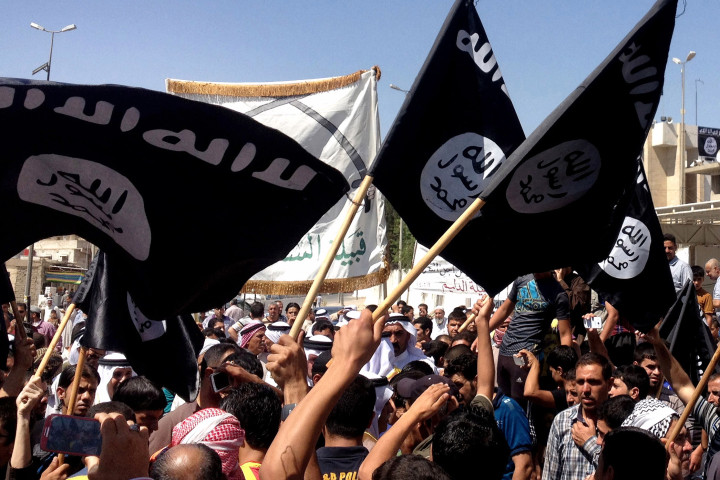
Photo: AP

How long will it take the United States to recognize the Islamic State as a legitimate actor?

That may sound ridiculous. After all, ISIS is a barbaric and sociopathic band of terrorists who proudly highlight their brutality over the Internet. Unfortunately, recent history suggests this doesn’t disqualify them, as horrific as it sounds, from eventual recognition.

Since before 9/11, the Taliban laid claim to numerous terror attacks on civilian populations throughout Afghanistan. They harbored Osama bin Laden, and since the beginning of Operation Enduring Freedom, they’ve been directly responsible for the deaths of more than 2,000 American troops.

Yet in January, White House Press Secretary Josh Earnest cryptically explained that the Taliban was not a terrorist group but instead falls under a “different classification.”

Earnest’s verbal gymnastics were deployed in the service of explaining away the president’s decision to trade five members of the Taliban for the release of American soldier-captive Bowe Bergdahl.

Hamas is an openly anti-Semitic terrorist organization that has claimed responsibility for the deaths of hundreds of innocent civilians, including several Americans. Since its creation, the Gaza-based Hamas has been dedicated to the destruction of Israel and the murder of Jews. Hamas is brutally repressive toward women and gays; they have a tendency to savagely drag dead bodies through the streets.

Last year, Palestinian President Mahmoud Abbas swore in a new unity government that incorporated Hamas-appointed ministers. Instead of cutting off financial support to the new government, as required by US law, the Obama administration jumped through hoops to legitimize the new government. Officials said they would continue supporting the Palestinian government because the new ministers were “technocrats” that “don’t represent . . . hard-core Hamas leadership.”

The legitimacy granted to Hamas by this administration is a reflection of the trend held by many pro-Palestinian protestors who now brazenly chant, “we are Hamas!” through the streets of US cities such as Miami.

Cuba has a long history of human-rights abuse. The Cuban government regularly harasses and imprisons dissidents and has been a state sponsor of terrorism for decades. Cuba continues to serve as a safe haven for terrorists and maintains close ties to both North Korea and Iran.

In 2013, Cuba was caught sending weapons to North Korea. It aids terrorist groups like the Revolutionary Armed Forces of Colombia, Iranian proxy Hezbollah and the Basque Fatherland of Liberty (ETA).

Despite this behavior, the administration still decided to take Cuba off the list of State Sponsors of Terrorism and has begun the process of normalizing the relationship between the United States and Cuba.

The State Department justified this removal by stating that “Cuba has not provided any support for international terrorism during the previous six-months” and citing vague promises that they “will not support acts of international terrorism in the future.”

So to recap, within this past year we have stopped referring to the Taliban as terrorists, provided de facto recognition and funding to Hamas and have opened up to the repressive terror-sponsoring Cuban government.

Why should we assume that ISIS will be treated any differently than these groups?

As each day passes, ISIS solidifies its presence in the region. Sure, ISIS commits terrible atrocities. The group regularly — and indiscriminately — beheads innocent people; rapes women and sells them as sex slaves and employs children as executioners.

But its leaders have undeniably been working to establish the Islamic State as, well, as a functioning state. They issue identification cards, pave roads, pick up trash, operate power stations and offer social-welfare programs.

ISIS has carved out its territory by filling the Middle East’s power vacuums, and are thus, in some places, the only game in town. How long before the international community recognizes the ISIS government?

The past precedent of legitimizing various terrorist groups and repressive dictatorships make this all too real of an issue. It’s imperative that the United States stops this trajectory of providing legitimacy to these regimes and turns back the ISIS tide, or we may one day soon be debating the opening of an embassy to the Islamic State in what used to be Iraq.

Alex VanNess is the manager of public information for the Center for Security Policy.
Looking Ahead at Middle East “Peace”

August 17, 2015

Looking Ahead at Middle East “Peace” The Gatestone InstituteShoshana Bryen, August 17, 2015

  • The U.S. has provided approximately $5 billion to the Palestinians in bilateral aid since the mid-1990s and about $540 million this year. The EU added more than €500 million ($558 million), making it the largest single-year donor. Why should Palestinian Authority (PA) not have to pay the bill for its own savage behavior? And why is the U.S. so determined to protect it?
  • According to the deputy head of UNRWA, the organization needs $101 million in order to open schools on time. Why does the Hamas government not pay for its own children to go to school? And why does the Hamas government not pay for the repair of its own people’s houses? UNRWA and the U.S. government seem to believe that the PA and Hamas cannot be expected to spend their own funds — or donated funds — on the needs of their own people. Hamas can therefore use all its funds to make war.
  • As long as Hamas and the PA are permitted both to spend sponsors’ money on terrorism and warfare while escaping responsibility for the needs of their people, and as long as Iran is a key donor — with all the temptations, means and opportunity to “wipe Israel,” as it repeatedly threatens to do — the idea of a U.S.-led “peace process” is fantasy.

The Obama Administration has made it clear that it will not pursue Israeli-Palestinian “peace talks” while the Iran deal remains fluid. But as the President heads into his last year in office, the “two state solution” apparently remains an important political aspiration. The Iran deal and the “peace process” are linked by concerns over Iranian behavior on the non-nuclear front, and concerns about American willingness to remain the sort of ally Israel has found it to be in the past.

The following stories — all involving money and how it is spent — should be understood together:

  • U.S. requests lower bond for Palestinian appeal of terror case
  • Infant mortality in Gaza
  • Schools in Gaza may not open
  • Iranian assistance to Hamas

First, the U.S. Department of Justice this week asked a judge to “carefully consider” the size of the bond he requires from the Palestinian Authority (PA) as it appeals the award of damages to the victims of six terrorist attacks that killed and injured Americans in Israel. Concerned about the possible bankruptcy of the PA, Deputy Secretary of State Antony J. Blinken added a statement to the Justice Department filing, saying, “A P.A. insolvency and collapse would harm current and future U.S.-led efforts to achieve a two-state solution to the Israeli-Palestinian conflict.”

The Palestinian Authority was proven in a U.S. court to have organized and paid for terrorist attacks that killed Americans and Israelis. The U.S. has provided approximately $5 billion to the Palestinians in bilateral aid since the mid-1990s and about $540 million this year. The EU added more than €500 million ($558 million), making it the largest single-year donor. Why should PA not have to pay the bill for its own savage behavior?

And why is the U.S. so determined to protect it?

Second, UNRWA (United Nations Relief and Works Agency for Palestine Refugees in the Near East), which maintains camps for Palestinians in Gaza, Lebanon, Syria and parts of the West Bank, released a broadside last week entitled, “Infant Mortality Rises in Gaza for the First Time in 50 Years.” Subhead: “UNRWA’s Health Director says the [Israeli and Egyptian] blockade may be contributing to the trend.”

Such a rise would be a terrible thing, and Israeli culpability would be terrible also. But is it true? It takes only a few clicks of the computer keys to find out.

Palestinian infant mortality in the West Bank and Gaza has been on a straight downward slope since 1968. Using CIA Factbook figures, infant mortality was 158 per 1000 from 1950-55; 87 per 1000 in 1968 (using an Israeli government publication); 25 per 1000 in 1985-90; and is at 14 per 1000 today in Gaza. Where is the rising trend? The UNRWA release came from an article entitled “Increasing Neonatal Mortality among Palestine Refugees in the Gaza Strip,” published by PLOS ONE, an “open access” online journal.

The study itself notes, “These estimates are based on small numbers of deaths, and the confidence intervals are wide, so the infant mortality rate could in fact be stable or continuing to decline” (emphasis added). Yet its conclusion reads, “In conclusion, we have estimated that, for the first time in five decades, the mortality rate has increased among Palestine refugee newborns in Gaza, and this may reflect inadequate neo-natal care in hospitals.”

An Israeli website that evaluated the entire study caught the inherent contradiction. “They didn’t have enough data to reach the conclusion they did… Those two statements have no place in a serious scientific paper and would merit its immediate rejection.”

Third, having dispensed with scare mongering about infant mortality, let us turn to the other UNRWA broadside of the week: “Without New Cash, UNRWA Schools Won’t Open.” According to the deputy head of the organization, UNRWA needs $101 million in order to open schools on time.

Why does the Hamas government not pay for its own children to go to school?

This is similar to a story last January, in which UNRWA suspended the repair of Palestinian houses in Gaza because of a shortage of international donor money, and it raises the question: Why does the Hamas government not pay for the repair of its own peoples’ houses?

It is UNRWA’s belief — like that of the U.S. government, apparently — that Palestinian governments, including the one on the U.S. list of sponsors of terrorism, have to be protected from the consequences of their own war-making, support for terrorism, and thievery. UNRWA and the U.S. government seem to believe that the Palestinian Authority and Hamas cannot be expected to spend their own funds — or donated funds — on the needs of their own people.

Which brings us to Iran; the only country working assiduously to ensure that its client, Hamas in Gaza, gets the assistance it needs to meet its goals, and then meets those goals.

According to Israeli government sources, Iran’s most recent assistance includes “cash, military training for Hamas fighters, weaponry, and electronics equipment including for use against Israeli drones… Hamas has also been training fighters in the use of anti-tank and anti-aircraft missiles, and is training recruits to fly paragliders across the border.”

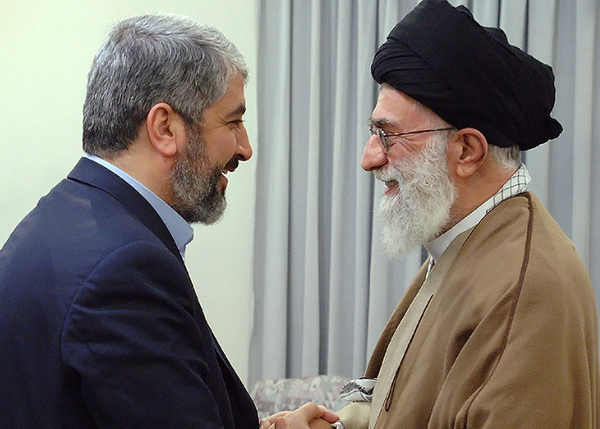
1162Bridging the Sunni-Shia divide, for the goal of genocide: Hamas leader Khaled Mashaal (left) confers with Iranian Supreme Leader Ali Khamenei, in 2010. (Image source: Office of the Supreme Leader)

UNRWA and Iran, with a supporting role played by the United States, have long made it possible for Hamas and the PA to spend other people’s money building more tunnels, arming multiplemilitias, paying “salaries” to convicted terrorists in Israeli jails, and improving the quality of their rockets and missiles. They know — and Israel knows — that between the Israeli government and the international aid agencies including, but not limited to, UNRWA, no Palestinians will starve, no one will go without medical care, no one will go homeless (except those homeless because Hamas confiscated about 20% of the cement and steel meant to restore Gaza houses damaged in last year’s war). Hamas can therefore use all its funds to make war.

As long as Hamas and the PA are permitted both to spend sponsors’ money on terrorism and warfare while escaping responsibility for the needs of their people, and as long as Iran is a key donor — with all the temptations, means and opportunity to “wipe Israel,” as it repeatedly threatens to do — the idea of a U.S.-led “peace process” is fantasy.

Our World: The anti-peace administration

August 12, 2015

Our World: The anti-peace administration, The Jerusalem PostCaroline B. Glick, August 11, 2015

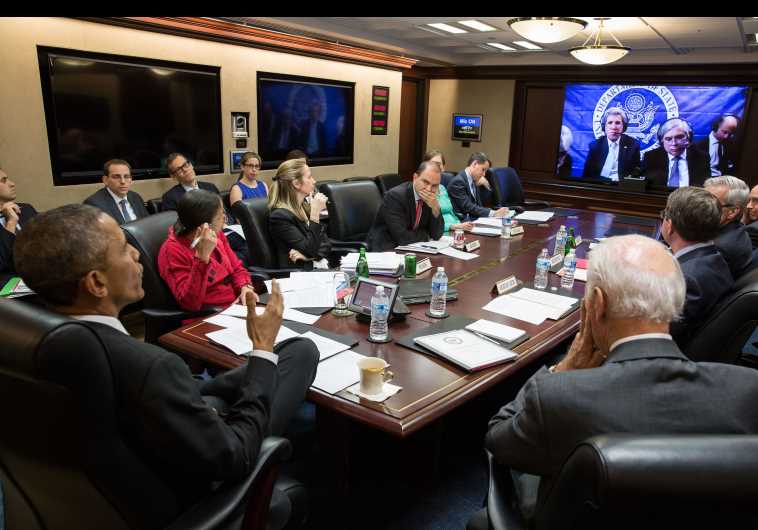
ShowImage (9)President Barack Obama, Vice President Joe Biden, and White House aides receive an update from Secretary of State John Kerry and Secretary of Energy Ernest Moniz via teleconference in Lausanne. (photo credit:WHITE HOUSE)

The US has striven to achieve peaceable relations between the states of the Middle East for nearly 70 years. Yet today, US government is disparaging the burgeoning strategic ties between the Sunni Arab states and Israel.

In a briefing to a delegation of visiting Israeli diplomatic correspondents in Washington last week, a senior Obama administration official sneered that the only noticeable shift in Israel-Arab relations in recent years is that the current Egyptian government has been coordinating security issues “more closely” with Jerusalem than the previous one did.

“But we have yet to see that change materialize in the Gulf.”

If this is how the US views the state of Israel’s relations with the Arabs, then Israel should consider canceling its intelligence cooperation with the US. Because apparently, the Americans haven’t a clue what is happening in the Middle East.

First of all, to characterize the transformation of Israeli-Egyptian relations as a mere question of “more closely” coordinating on security issues is to vastly trivialize what has happened over the past two years.

Before then Egyptian defense minister Abdel Fattah el-Sisi overthrew the US-backed Muslim Brotherhood regime headed by Muhammad Morsi in July 2013, there was a growing sense that Morsi intended to vacate Egypt’s signature to the peace deal with Israel at the first opportunity. Just a month after Morsi ascended to power in January 2013, the Muslim Brotherhood began threatening to review Egypt’s continued commitment to the peace treaty.

The main reason Morsi did not cancel the peace deal with Israel was that Egypt was bankrupt. He needed US and international monetary support to enable his government to pay for imported grain to feed Egypt’s destitute population of 90 million.

During his year in power, Morsi used Hamas as the Brotherhood’s shock troops. He embraced Iran, inviting president Mahmoud Ahmadinejad to visit Cairo in February 2013.

If Morsi were still in power today, with its $150 billion in sanctions relief Iran would have been in a position to support Egypt’s economy. So it is possible that if Morsi were still president, he would have felt he had the financial security to walk away from the peace treaty.

In happy contrast, under Sisi, Israeli-Egyptian ties are closer than they have ever been. Just last week Egyptian diplomats told Al Ahram that Israel’s support was critical for building administration support for Sisi.

Over Ramadan, Egyptian television broadcast a pro-Jewish mini-series.

Israel is closely working with the Egyptians on defeating the growing threat of Islamic State, Hamas and other Islamic terrorist groups waging a bloody insurgency against the regime in Sinai.

Last summer, it was due to the close coordination between Sisi and Israel that the US failed to force Israel to accept Hamas’s cease-fire terms, as those were represented by the Islamist regimes of Qatar and Turkey.

In part due to Israel’s critical support for Sisi’s government, and in part owing to their opposition to Iran’s rise as a regional hegemon armed with nuclear weapons, Saudi Arabia, the UAE and Jordan have all joined Egypt in viewing Israel as a strategic partner and protector.

Last year Saudi Arabia together with the UAE and Jordan supported Israel and Egypt in opposing Hamas and its American, Turkish and Qatari defenders. Had it not been for this massive Arab support, it is very likely that Israel would have been forced to accept the US’s demands and grant Hamas control over Gaza’s international borders.

In June, as negotiations between the US and the other five powers and Iran were moving toward an agreement, the Council on Foreign Relations in New York hosted a meeting between then incoming Foreign Ministry director general Dore Gold and retired Saudi General Anwar Eshki, a former advisor to the Saudi ambassador to the US. The two revealed that over the previous 18 months, they had conducted five secret meetings to discuss Iran.

Although President Barack Obama harangued Israel in his speech at American University last Wednesday, claiming that the Israeli government is the only government that has publicly opposed his nuclear deal with the Iranians, Monday US congressmen now shuttling between Egypt and Israel told Israeli reporters that Egypt opposes the nuclear deal.

As for the Gulf states, according to the US media, last week they told visiting US Secretary of State John Kerry that they support the nuclear deal.

Kerry addressed his counterparts in the Gulf Cooperation Council.

But the fact is that the only foreign minister who expressed such support was Qatari Foreign Minister Khaled al-Attiyah. To be sure, Attiyah was charged to speak for all of his counterparts because Qatar holds the GCC’s rotating chairmanship. But given that Qatar has staked out a pro-Iranian foreign policy in stark contrast to its neighbors and GCC partners, Attiyah’s statement is impossible to take seriously without the corroboration of his colleagues.

As for Qatar’s statement of support, Qatar has worked for years to cultivate good relations with Iran. It might have been expected therefore that Attiyah’s endorsement of the deal would have been enthusiastic. But it was lukewarm at best.

In Attiyah’s words, Kerry promised that the deal would place Iran’s nuclear sites under continuous inspections. “Consequently,” he explained, “the GCC countries have welcomed on this basis what has been displayed and what has been talked about by His Excellency Mr. Kerry.”

The problem of course is that Kerry wasn’t telling the truth. And the Arabs knew he was lying. The deal does not submit Iran’s nuclear sites to a rigorous inspection regime. And the GCC, including Qatar, opposes it.

In his briefing with Israeli reporters, the high-level US official rejected the importance of the détente between Israel and its Arab neighbors because he claimed the Arabs have not changed their position regarding their view of a final peace deal between Israel and the Palestinians.

But this is also nonsense. To be sure, the official position of the Saudis and the UAE is still the so-called Arab peace initiative from 2002 which stipulates that the Arabs will only normalize relations with Israel after it has ceded Jerusalem, Judea, Samaria and the Golan and allowed millions of foreign-born Arabs to freely immigrate to the shrunken Jewish state. In other words, their official position is that they will only have normal relations with Israel after Israel destroys itself.

But their official position is no longer their actual position. Their actual position is to view Israel as a strategic ally.

The senior official told the Israeli reporters that in order to show that “their primary security concern is Iran,” then as far as the Arabs are concerned, “resolving some of the other issues in the region, including the Palestinian issue should be in their interest. We would like to see them more invested in moving the process forward.”

In the real world, there is no peace process. And the Palestinian factions are fighting over who gets to have better relations with Iran. Monday we learned that PA leader Mahmoud Abbas wishes to visit Iran in the coming months in the hopes of getting the money that until recently was enjoyed by his Hamas rivals.

Hamas for its part is desperate to show Tehran that it remains a loyal client. So today, no Palestinian faction shares the joint Israeli-Saudi-Egyptian interest in preventing Iran from becoming a nuclear armed regional hegemon.

The administration showed its hand in that briefing with the Israeli reporters last week. For all their talk about Middle East peace, Obama and his advisors are not at all interested in achieving it or of noticing when it has been achieved.

Captured Hamas Operative Details Group’s Terrorist Plans

August 11, 2015

Captured Hamas Operative Details Group’s Terrorist Plans, Investigative Project on Terrorism, August 11, 2015

A Hamas operative provided a treasure trove of intelligence during Israeli interrogation concerning the terrorist group’s rebuilding efforts and future terrorist plans, Israel’s intelligence agency Shin Bet disclosed on Tuesday.

The terrorist, Ibrahim Adal Shahada Sha’ar, 21, described about Hamas’ tunnel reconstruction efforts, planned terrorist attacks against Israel, military strategy, and coordination with Iran, the Jerusalem Post reported.

He admitted working on rebuilding underground tunnels and described how some would be used in future attacks against Israel. Sha’ar disclosed the location of digging sites, tunnel entrances and underground routes, and reportedly said that a road built along the border with Israel is intended partly for terrorist attacks involving vehicles charging into Israeli territory.

He admitted that he stored several 50 kg explosive charges in his home and said that fighters kept explosives and other material in their own homes since Hamas commanders worried that the organization’s weapons depots would be targeted by Israel.

Israeli authorities arrested Sha’ar last month at the Erez Crossing after he attempted to enter Israel for “personal or humanitarian reasons.” Officers were aware of Sha’ar’s terrorist background and immediately detained him.

During last summer’s war between Israel and Hamas, Sha’ar participated in specific battlefield operations, including field logistics, transferring terrorists and weapons, and even admitted to setting up an anti-tank improvised explosion device (IED).

Sha’ar provided details of Iranian-Hamas military cooperation, including how Iran transfers funds and supplies weapons and electronics to the terrorist group. Those supplies include devices intended to jam radio frequencies to bring down Israeli drones deployed over Gaza. Furthermore, Sha’ar described how Iran trained Hamas terrorists to use hang gliders for attacks against Israel – a tactic revealed by previous Israeli interrogations of captured terrorists.

Critics of the recent Iran nuclear agreement argue that newly released funds to the Islamic Republic will bolster their regional hegemonic ambitions and global terrorist activities, including transferring more money and weaponry to its terrorist proxies.

According to Israeli intelligence, the Sha’ar detailed plans using tunnels to conduct cross-border attacks against Israeli targets, akin to Hamas’ attempts during last summer’s war. The Hamas operative confirmed that the terrorist group is diverting civilian reconstruction material for the purposes of rebuilding its terrorist infrastructure and underground tunnel network.

Sha’ar was indicted July 31 in the Beersheba District Court for being a member and engaging in activities with a banned organization, attempted murder, and forbidden military training.

Britain: The “Struggle of Our Generation”

August 10, 2015

Britain: The “Struggle of Our Generation”, The Gatestone InstituteSamuel Westrop, August 10, 2015

  • “We’ve got to show that if you say ‘yes I condemn terror — but the Kuffar are inferior’, or ‘violence in London isn’t justified, but suicide bombs in Israel are a different matter’ — then you too are part of the problem. Unwittingly or not, and in a lot of cases it’s not unwittingly, you are providing succour to those who want to commit, or get others to commit to, violence.” — Prime Minister David Cameron.
  • In a series of religious rulings published on its website, the Islamic Network charity advocated the murder of apostates; encouraged Muslims to hate non-Muslims; stated that when non-Muslims die, “the whole of humanity are relieved;” and described Western civilisation as “evil.”
  • The Charity Commission’s solution, however, was to give the charity’s trustees booklets titled, “How to manage risks in your charity,” and warn them not to do it again.

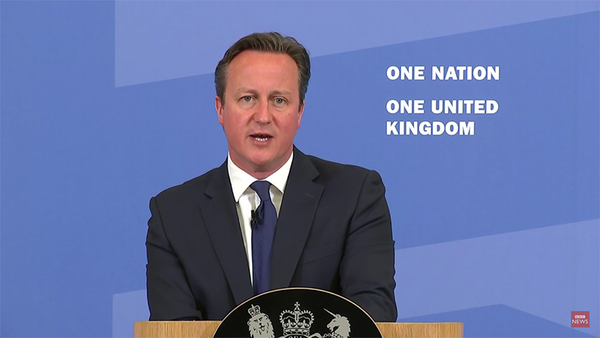
On July 20, Prime Minister David Cameron outlined his government’s plans to counteract Islamic extremism, which he described as the “struggle of our generation.”

In a speech before Ninestiles School, in the city of Birmingham, Cameron articulated a view of the Islamist threat that, just a couple of years ago, few else in British politics would have dared to support.

In a report for BBC Radio 4, the journalist John Ware described Cameron’s speech, and the government’s proposed counter-extremism measures, as “something no British government has ever done in my lifetime: the launch of a formal strategy to recognize, challenge and root out ideology.”

Cameron’s speech was wide-ranging. It addressed the causes, methods and consequences of Islamist extremism.

1199(Image source: BBC video screenshot)

We must recognize, Cameron reasoned, that Islamist terror is the product of Islamist ideology. It is definitely not, he argued, “because of historic injustices and recent wars, or because of poverty and hardship. This argument, what I call the grievance justification, must be challenged. … others might say: it’s because terrorists are driven to their actions by poverty. But that ignores the fact that many of these terrorists have had the full advantages of prosperous families or a Western university education.”

“Extreme doctrine” is to blame — a doctrine that is “hostile to basic liberal values … Ideas which actively promote discrimination, sectarianism and segregation. … which privilege one identity to the detriment of the rights and freedoms of others.” This is a doctrine “based on conspiracy: that Jews exercise malevolent power; or that Western powers, in concert with Israel, are deliberately humiliating Muslims, because they aim to destroy Islam.”

People are drawn to such extremist ideas, Cameron argued, because:

“[Y]ou don’t have to believe in barbaric violence to be drawn to the ideology. No-one becomes a terrorist from a standing start. It starts with a process of radicalisation. When you look in detail at the backgrounds of those convicted of terrorist offences, it is clear that many of them were first influenced by what some would call non-violent extremists.

“It may begin with hearing about the so-called Jewish conspiracy and then develop into hostility to the West and fundamental liberal values, before finally becoming a cultish attachment to death. Put another way, the extremist world view is the gateway, and violence is the ultimate destination.”

To counteract the extremist threat, Cameron concludes, the government will “tackle both parts of the creed — the non-violent and violent. This means confronting groups and organisations that may not advocate violence — but which do promote other parts of the extremist narrative.”

Further, no longer will extremist groups be able to burnish their moderate credentials by pointing to ISIS as the Islamic bogeyman:

“We’ve got to show that if you say ‘yes I condemn terror — but the Kuffar are inferior’, or ‘violence in London isn’t justified, but suicide bombs in Israel are a different matter’ – then you too are part of the problem. Unwittingly or not, and in a lot of cases it’s not unwittingly, you are providing succour to those who want to commit, or get others to commit to, violence.

For example, I find it remarkable that some groups say ‘We don’t support ISIL’ as if that alone proves their anti-extremist credentials. And let’s be clear Al-Qaeda don’t support ISIL. So we can’t let the bar sink to that level. Condemning a mass-murdering, child-raping organisation cannot be enough to prove you’re challenging the extremists.”

Rather radically for a Western leader, Cameron also asserted that, “simply denying any connection between the religion of Islam and the extremists doesn’t work… it is an exercise in futility to deny that. And more than that, it can be dangerous. To deny it has anything to do with Islam means you disempower the critical reforming voices; the voices that are challenging the fusing of religion and politics…”

Cameron’s speech was groundbreaking. No previous Prime Minister in past decades would have dared to make such statements. This is not to say, however, that it is without fault.

Cameron is not just talk. An “Extremism Analysis Unit” has been set up within the Home Office, which will serve to tackle Islamist extremism, including “non-violent” groups. According to the journalist John Ware, the new body is currently preparing lists of extremist preachers and groups.

More importantly, a variety of new legislation is being brought before Parliament. However, some of the proposed laws, critics argue, are draconian. “Banning Orders” will outlaw designated “extremist groups.” “Extremism Disruption Orders,” meanwhile, will restrict designated “extremists” from appearing on television, or publishing without the authorities’ approval. And “Closure Orders” will allow the government to close any institution deemed guilty of promoting extremism.

Cameron has correctly and radically diagnosed the problem of Islamic extremism. His solutions, however, do not appear promising.

A more useful next step would be for the government to tackle its own relationships with extremist groups. Britain’s registered charities offer a particularly vivid example of Islamist extremism going unchallenged.

In 2014, I wrote about the Islamic Network, a group that describes itself as “a da’wah[proselytizing] organisation which aims to promote awareness and understanding of the religion of Islam.”

In a series of religious rulings published on its website, the Islamic Network charity advocated themurder of apostates; encouraged Muslims to hate non-Muslims; stated that when non-Muslims die, “the whole of humanity are relieved;” and described Western civilisation as “evil.” Further, the Islamic Network directed a great deal of hatred towards the Jews. Its website claimed: “The Jews strive their utmost to corrupt the beliefs, morals and manners of the Muslims. The Jews scheme and crave after possessing the Muslim lands, as well as the lands of others.”

In spite of these views, the Islamic Network is a registered charity, which means it is entitled to subsidy from the taxpayer.

As a result of revealing the material published on the Islamic Network’s website, as well as several complaints submitted to the Charity Commission, the government opened an inquiry into the charity. After a year of deliberation, the Charity Commission published its report, which concluded that the Islamic Network had indeed published extremist material.

The Charity Commission’s solution, however, was to give the charity’s trustees booklets titled, “How to manage risks in your charity,” and warn them not to do it again.

Britain may finally have a government that understands the problem of Islamist extremism, but if government bodies fail to challenge extremist charities such as the Islamic Network, then what use is this enlightenment?

The Islamic Network is but one of many dozens of examples. Why is the British organizationInterpal, for example, still allowed to be a registered charity? Interpal is a designated terrorist organization under United States law. Its trustees regularly meet with senior leaders of the terror group Hamas. In 2013, for instance, Interpal trustee Essam Yusuf took part in a ceremony with the Hamas leader Ismail Haniyeh, at which they expressed praise for Hamas’ military wing, the Al Qassam Brigades, and glorified “martyrdom.”

Or what of Islamic Relief, one of Britain’s largest charities? Established by the Muslim Brotherhood, Islamic Relief’s directors have included Ahmed Al-Rawi, a Muslim Brotherhood leader who, in 2004, supported jihad against British and American troops in Iraq; and Essam El-Haddad, who is accused by an Egyptian court of divulging Egyptian state secrets to Hamas, Hezbollah and Iran, and using Islamic Relief to finance global terrorism.

Despite Islamic Relief’s links to Islamist extremism, the charity continues to receive millions of pounds from the British government.

David Cameron’s speech on July 20 should be applauded. If another political party had won the recent general election, no such speech would have been made. But before the Prime Minister turns his hand to censorship, perhaps the government should address extremist groups closer to home.

John Kerry’s Hypocrisy: “Can You Deliver?”

August 6, 2015

John Kerry’s Hypocrisy: “Can You Deliver?

By: Paul Gherkin

Published: August 6th, 2015

Latest update: August 4th, 2015

via The Jewish Press » » John Kerry’s Hypocrisy: “Can You Deliver?”.

Secretary of State John Kerry (L) seen with PA President Mahmoud Abbas.
Photo Credit: Issam Rimawi/FLASH90

{Originally posted to the author’s website, FirstOne Through}

Listening to US Secretary of State John Kerry try to explain and defend the P5+1 Iranian nuclear deal to various audiences is a spectacle to behold, regardless of one’s position on the best course of action.  One of the people who might want to watch the sessions and learn something from John Kerry is John Kerry.

Secretary Kerry argued at the Council for Foreign Relations (CFR) that Congress must support the deal or it would undermine his ability to negotiate any treaty with any government in the future. At 29:55 of the CFR talk, Kerry said: “Other people in the world are going to sit there and say ‘hey, let’s negotiate with the United States, they have 535 Secretaries of State. I mean, please! I would be embarrassed to try to go out… I mean, what am I going to say to people after this as Secretary of State? ‘Come negotiate with us?’ ‘Can you deliver?’ Please!

Kerry made the point that when two parties sit down to negotiate, it is critical for the sides to know that the negotiating parties are both authorized to negotiate and have the ability to fulfill their sides of the deal. If no such authority or ability exists, the discussions are an irrelevant waste of time.

Despite Kerry being quite clear about his logic, he has nevertheless insisted that Israeli Prime Minister Benjamin Netanyahu sit down and negotiate with Acting-President of the Palestinian Authority Mahmoud Abbas, even though it is clearly understood that Abbas can deliver nothing.

  • No Mandate: Abbas’s four-year term as president ran out in 2009. No presidential elections have been held since then.
  • No Authority: Abbas’s Fatah party lost legislative elections in 2006, winning only 33% of the parliament. No legislative elections have been held since then.
  • No Support: Abbas lags in every Palestinian poll held since 2006.
  • No Control: Abbas has no control of Gaza since his Fatah party was kicked out in 2007.
  • No Track Record: Abbas has shown zero credibility in being able to strike compromises to govern his own people, let alone deliver compromises with Israel.

Despite the glaringly obvious impotence of Abbas, the Obama administration continued to pressure Israel to negotiate with this straw man.

The Obama administration publicly acknowledged that the Palestinian Authority has absolutely no ability to deliver peace a few years ago. During the Gaza war on Israel in 2012, then US Secretary of State Hillary Clinton tried to broker a cease-fire. She made a dozen calls to various world leaders to halt the war- but not ONCE called the Abbas and the Palestinian Authority.

Compounding the inherent flaws in Abbas and the Palestinian Authority is Abbas’s insistence on bringing terms of any deal with Israel to a referendum. Abbas stated that he cannot decide on the “Right of Return” for all Palestinians, but that each of the 5 million Palestinian Arab “refugees” must make a decision for themselves. Hey Kerry- 535 “second-guessers” looks pretty good compared to 5 million! In terms of the rest of the components of a final agreement, Abbas stated that he “would go to a referendum everywhere because the agreement represents Palestinians everywhere.”  That’s impressive – he seeks the approval of 11 million “Palestinian” Arabs from all around the world!

Kerry’s comments regarding Iran are both on- and off-the-mark.  Iran and all of the parties in the negotiations know that the United States is a democracy and the political process must run its course.  Once the American people’s representatives in Congress make a decision, the government will deliver on its commitments.

However, Abbas – a complete straw man if ever there was one – with no authority or control whatsoever, openly states that millions of individuals will ultimately not only decide the fate of an Israeli-PA deal overall, but even on certain components on an individual basis.

Kerry fully appreciates that before negotiators start a process that they want to know the answer to the fundamental question: “Can you deliver“? However, he doesn’t care when he forces Israel to do exactly that with Abbas and the Palestinian Authority.


Related FirstOneThrough video and articles:

Abbas demands R-E-S-P-E-C-T

The Disappointing 4+6 Abbas Anniversary

Palestinian “Refugees” or “SAPs”?

Qatari Group Accused of Funding Hamas Hires D.C. Lobbyist

August 4, 2015

Qatari Group Accused of Funding Hamas Hires D.C. Lobbyist

Founding member Abd al-Rahman al-Nu’aym funneled millions to al Qaeda in Syria, Iraq

BY:
August 4, 2015 5:00 am

via Qatari Group Accused of Funding Hamas Hires D.C. Lobbyist | Washington Free Beacon.

A Qatar-based charity accused of funding Hamas has hired a lobbyist to represent it in the United States.

The Sheikh Eid Bin Mohammed al-Thani Charitable Foundation, located in Doha, Qatar, recently brought aboard Wendell Belew, a Washington D.C.-based lawyer, to lobby on its behalf. Belew, who will work on issues dealing with “NGO regulations and charity best practices,” previously served as chief counsel of the House Budget Committee.

The foundation was one of 36 organizations banned in Israel in July 2008 for its links to fundraising for Hamas.

“This is a significant step against the global network which assists Hamas in raising funds. The order outlaws a great number of bodies that are active abroad and which are responsible for raising very large sums,” the Israeli ministry of foreign affairs said at the time of the foundation bans.

Abd al-Rahman al-Nu’aymi, a founding member of the organization, was said by U.S. officials in 2013 to have funneled millions of dollars to al Qaeda in Syria and Iraq.

The Department of the Treasury imposed sanctions on Nu’aymi in December 2013 after he was named a specially designated global terrorist for being a “financier and facilitator who has provided money and material support and conveyed communications to al-Qa’ida and its affiliates in Syria, Iraq, Somalia and Yemen for more than a decade.”

Nu’aymi ordered the transfer of $600,000 through an al Qaeda representative in Syria with the intention of transferring at least $50,000 more at a later date, according to the Treasury. Additionally, he oversaw a transfer of $2 million per month to al Qaeda in Iraq for an unspecified period of time.

This is not the first time that Belew has worked on behalf of a group with ties to terrorist organizations.

Belew previously represented the Saudi Arabia-based Al-Haramain Islamic Foundation, an organization that was found to be a significant backer of al Qaeda.

In July 2004, Aqeel Abdulaziz Aqeel al-Aqeel, the foundation’s leader, was put on the United Nations Security Council Special Notice list of terrorists associated with al Qaeda.

In September 2004, the Treasury announced that the foundation’s American branch, which is based out of Oregon, had direct connections with Osama Bin Laden.

The Treasury investigation found “direct links” between the American branch and Osama bin Laden. It also alleged that the foundation had violated tax laws and engaged in other money laundering offenses. Individuals associated with the branch tried to conceal funds intended for Chechnya by omitting the information from their tax returns and instead claimed that the money was intended to purchase a prayer house in Springfield, Mo.

The Al-Haramain Islamic Foundation is now defunct. Wendell Belew could not be reached for comment.

Iran’s Supreme Leader Khameni publishes book on how to eliminate Israel

August 2, 2015

Iran’s Supreme Leader Khameni publishes book on how to eliminate Israel, American ThinkerThomas Lifson, August 2, 2015

Ayatollah Ali Khameni has published his version of Mein Kampf, a 416 page book outlining his strategy to eliminate Israel, which he describes as  “a cancerous tumor.” Although it is currently available only in Iran, an Arabic translation is underway, and sooner or later it will achieve wide readership in the Muslim world. The Obama administration is no doubt hoping it will achieve no notice in the United States until after the Iran deal is voted upon, because the plan advocated will be immensely aided by its implementation.

Amir Taheri of the New York Post obtained a copy from Iran:

Khamenei makes his position clear from the start: Israel has no right to exist as a state.

He uses three words. One is “nabudi” which means “annihilation.” The other is “imha” which means “fading out,” and, finally, there is “zaval” meaning “effacement.”

Khameni does not call for wiping out Israel with a nuclear bomb. He states that one of his fondest desires is to pray in Jerusalem. Instead, his plan is one of terrorism and pressure, keeping Israel from fighting back against Iran, the sponsor of terror, with the implicit threat of nuclear retaliation.

 What he recommends is a long period of low-intensity warfare designed to make life unpleasant if not impossible for a majority of Israeli Jews so that they leave the country.

His calculation is based on the assumption that large numbers of Israelis have double-nationality and would prefer emigration to the United States and Europe to daily threats of death.

Iran has many allies in this effort, including the BDS movement in the United States. Cripple Israel economically, and her economically productive people will leave. Make the political cost of supporting Israel high. That will pave the way for an internationally-sponsored plebiscite engineered to produce a Muslim state:

Under Khamenei’s scheme, Israel, plus the West Bank and Gaza, would revert to a United Nations mandate for a brief period during which a referendum is held to create the new state of Palestine.

All Palestinians and their descendants, wherever they are, would be able to vote, while Jews “who have come from other places” would be excluded.

Double standards are inherent in Islamic thinking. Any land that once fell under Muslim control belongs to Muslims by right. So Israelis who only boast a few generations in Israel are excluded, while Arabs whose families once lived in Israel generations ago are automatically qualified.

Khamenei does not mention any figures for possible voters in his dream referendum. But studies by the Islamic Foreign Ministry in Tehran suggest that at least eight million Palestinians across the globe would be able to vote against 2.2 million Jews “acceptable” as future second-class citizens of new Palestine. Thus, the “Supreme Guide” is certain of the results of his proposed referendum.

With a $150 billion war chest, thanks to the Obama deal, and the prospect of oil exploration and other business expansion in Iran, there will be plenty of money available to subsidize Hezb’allah, Hamas, and other terror attacks against Israelis and Jews (such as the attack on the Jewish Community Center in Buenos Aires).

Khamenei boasts about the success of his plans to make life impossible for Israelis through terror attacks from Lebanon and Gaza. His latest scheme is to recruit “fighters” in the West Bank to set up Hezbollah-style units.

“We have intervened in anti-Israel matters, and it brought victory in the 33-day war by Hezbollah against Israel in 2006 and in the 22-day war between Hamas and Israel in the Gaza Strip,” he boasts.

Far from a spittle-flecked madman, Khameni is coldly calculating, and explains a plan that is already underway with considerable success. And he has many allies in this country, some of them in high places.


Palestinian Summer Camps Preach Jihad and Train Youth to Become Terrorists

July 30, 2015

Palestinian Summer Camps Preach Jihad and Train Youth to Become Terrorists, Investigative Project on Terrorism, July 30, 2015

(In Gaza and at the Al-Aqsa Mosque in Jerusalem: raising a new generation of Palestinian children yearning to be free kill Jews for Allah, virgins, their parents and Palestine.  — DM)

Hamas hopes to provide 25,000 children and teenagers with military training to seed future terrorist operations against Israel. Similar to the Al-Aqsa camp, the Hamas camp heavily emphasizes religious indoctrination and radical jihadist brainwashing, according to a news report translated by MEMRI.

******************

Palestinian summer camps in Jerusalem and Gaza are actively indoctrinating young children with radical jihadist ideology and preparing them for martyrdom (suicide) operations, the Middle East Media Research Institute (MEMRI) reports.

In an Islamic summer camp at Al-Aqsa Mosque in Jerusalem, little children are subjected to a radical sheikh’s lecture on the virtues of martyrdom.


“The martyr is absolved with the first drop of his blood…the martyr also gets to vouch for seventy family members (on Judgment Day)… the martyr gets two virgins of Paradise, but the murabit [someone guarding Islam against the infidel] gets 70 – 35 times more than the martyr,” preached radical cleric Khaled Al-Maghrabi.

The children generally appear like most children their age – fidgeting, looking around, some playing with toys, seemingly disinterested in the lecture. Al-Magrabi still appears determined to impart jihadist indoctrination into the next generation of Palestinians at a very early age.

A Palestinian bystander even confronts Al-Maghrabi and tells him his message isn’t appropriate for children.

“Listen, sheik, they do not understand what you are saying. They are children…you are talking to them about ribat, martyrdom, and the virgins of Paradise. Shame on you. You can teach these lessons to (adults) like us, not to them,” said the Palestinian man.

Unfortunately, Palestinians standing up against radicalization is all too rare of an occurrence. Al-Maghrabi carried on after the distraction, leading the children in chanting, “We shall sacrifice our souls and our blood for you, Al-Aqsa!” the children chant.

In a second video illustrating Palestinian indoctrination of its young people with hate, viewers are taken inside a Hamas summer camp called “Vanguard of Liberation.” Hamas hopes to provide 25,000 children and teenagers with military training to seed future terrorist operations against Israel. Similar to the Al-Aqsa camp, the Hamas camp heavily emphasizes religious indoctrination and radical jihadist brainwashing, according to a news report translated by MEMRI.

“The goal of the camps is to instil the spirit of Jihad and of fighting in these cubs, these youth, so that they will become the next generation of liberation,” says a masked Hamas operative and camp counselor.


“Liberation” in this context means taking over all of Israel since Hamas is openly dedicated to the destruction of the Jewish state in any form.

The video features the youth running through military style courses, weapons training, and even shows a junior version of a Hamas naval commando unit dedicated to infiltrating Israel and conducting terrorist attacks.

Obama’s Gamble with Iran’s Theocratic Regime

July 28, 2015

Obama’s Gamble with Iran’s Theocratic Regime, The Gatestone InstituteRobert D. Onley, July 28, 2015

[T]he gravest consequence of Obama’s Iran deal, and the most damning of its continued defense, is that the world bestowed ideological legitimacy on the Islamic Republic’s radical theocracy, and in so doing has consigned the people of Iran to near permanent rule under the iron fist of Twelver Shi’a Islamism.

************************

  • Obama’s Iran deal is a direct manifestation of the President’s fundamentally misguided worldview, one that wishes away danger and then believes in the wishes.
  • Even more concerning is that the Iran deal may directly conflict with U.S. obligations as a signatory of the Non-Proliferation Treaty. The Iran deal may be unconstitutional, violate international law and feature commitments that President Obama could not otherwise lawfully make. By seeking approval of the deal under the UN Security Council, Obama has bound the U.S. under international law without Senate consent.
  • The gravest consequence of Obama’s Iran deal is that the world bestowed ideological legitimacy on the Islamic Republic’s radical theocracy, and in so doing has consigned the people of Iran to near permanent rule under the iron fist of Shi’a Islamism.
  • A total reversal of the Iranian regime’s behavior should have been, and still can be, a precondition for the removal of any sanctions related to Iran’s nuclear program. An end to Iran’s financial and material support for terrorist forces such as Hezbollah and Hamas must be demanded, along with the return of the four American hostages Iran is holding.
  • There is still time for a better deal that can be had.

As President Obama and Secretary Kerry dominated the airwaves with rounds of media interviews to defend the Iran deal last week, German Vice Chancellor and Economic Minister Sigmar Gabriel flew straight to Tehran for the first of what are certain to be countless meetings by P5+1 leaders to capitalize on new business opportunities in Iran.

In Europe, it seems, there is no debate to be had over the Iran deal; rather, it is a fait accompli.

But in the United States, the domestic debate is heating up, fueled by a Presidential primary campaign and increasingly justified bipartisan anxiety over the bill.

Independent of these political realities, however, the immediacy and tenacity of the White House’s defense of the Iran deal (which now has its own @TheIranDeal Twitter account, no less), betrays an acute unspoken discomfort by many Democrats with the practical flaws and global security dangers that the deal presents.

Obama’s Iran deal is a direct manifestation of the President’s fundamentally misguided worldview, one that wishes away danger and then believes in the wishes.

Haunted by his electorally-motivated premature withdrawal from Iraq in 2011; his refusal in 2013 to confront Syria’s Bashar Assad when he used chemical weapons on his own people; his betrayal by Russia’s Vladimir Putin to whom he had offered a reset button, and his impotence in failing to respond to the aggressive expansionist moves of Russia, ISIS, Iran and China, the President and Democrat Party, in signing the Iran deal, seem to be trying to absolve the United States of its role at the forefront of the global fight against Islamic radicalism and other threats.

Citing the failed EU-led negotiations with Iran in 2005, which resulted in Iran’s massive expansion of centrifuge production, defenders of the deal, such as Fareed Zakaria, have painted a bleak and zero-sum counterfactual argument. It is claimed that the result of Congress’s opposition will be an international community that forges ahead on renewed trade relations with Iran, while leaving the United States outside the prevailing global reconciliation and supposed love-in with the Islamic Republic.

There are several serious problems with this defense, and similarly with the White House’s blitzkrieg public relations campaign to fend off detractors of the Iran deal, with Secretary of State John Kerry commanding the preemptive, and often totally inaccurate, strikes against Congress. In consideration of the colossal failure represented by the North Korea nuclear precedent, let us consider the issues unique to Iran.

Foremost, opponents of the Iran deal are not universally suggesting the Iran deal be killed outright or immediately resort to “war.” This is simply disingenuous. Instead, the opponents’ fundamental premise is that a better deal was left on the table, and thus remains available. The very fact that the Iranian regime was at the negotiating table was indeed a sign of Iran’s weakness; any timelines for the P5+1 to “close” the deal were artificial constraints that surely erased further achievable concessions.

Second, much ink has already been spilled about the technical weaknesses of the Iran deal. Namely: that Iran’s vast nuclear infrastructure remains in place; that the most important restrictions expire in 10 years (a mere blip for humanity); that Iran’s uncivilized domestic and regional behavior was a naughty unmentionable; and finally, that the deal undoubtedly initiated a regional nuclear arms race while supercharging the Iranian regime’s finances.

Third, the gravest consequence of Obama’s Iran deal, and the most damning of its continued defense, is that the world bestowed ideological legitimacy on the Islamic Republic’s radical theocracy, and in so doing has consigned the people of Iran to near permanent rule under the iron fist of Twelver Shi’a Islamism.

This capitulation occurred precisely at a time when the West and the broader Middle East are facing off against the Islamic State — a terrorist force which, when stripped of its social media allure, is ultimately a Sunni-branded spin-off of the extremist Shi’a Islamism that has ruled in Iran since 1979.

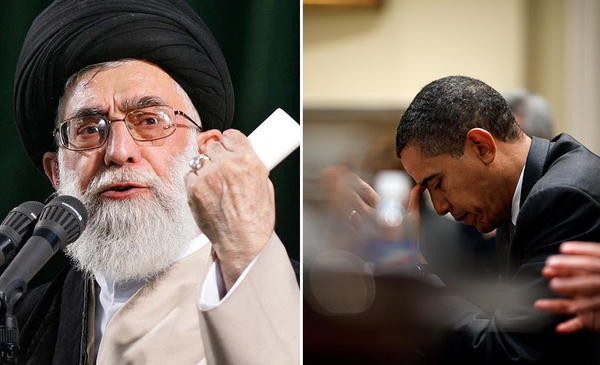
The Iranians may be convenient allies as enemies of our enemies today, but not for one second have Iran’s rulers suggested their ultimate intent is anything other than the all too familiar “Death to America” and “Death to Israel” propaganda seen for the past 36 years. In what is objectively and wholly a strange deadly obsession, the Supreme Leader of Iran, Ayatollah Khamenei, has been rousing crowds with calls for the destruction of two nation-states both during and after nuclear negotiations.

In spite of this public malice, defenders of the deal suggest that “the [Obama] administration is making a calculated bet that Iran will be constrained by international pressure.” Why exactly then is Khamenei making clear the opposite?

1173

President Obama’s willingness to concede Iran’s new-found normalized membership in the community of nations on the basis of this nuclear deal is an affront to the liberal, free, democratic principles that have stood against the forces of tyranny throughout American history.

It is also an affront the American political system and to the members of both parties who are now being cornered by the President into supporting, or not supporting, such an intrinsically dangerous and needlessly flawed bargain with an avowed enemy.

Even more concerning is that the Iran deal may directly conflict with U.S. obligations as a signatory of the Non-Proliferation Treaty (NPT). As a number of critics have pointed out, the Iran deal may be unconstitutional, violate international law and feature commitments that President Obama could not otherwise lawfully make.

By seeking approval of the deal under the UN Security Council, President Obama has bound the United States under international law without Senate consent.

If the United States is to remain the vanguard of human liberty, President Obama must distinguish between the vain pursuit of his legacy, and the civilized world’s deepest need at this consequential hour for the American President to defend comprehensively the fundamental principles that underpin the modern order. Unless his desired legacy is actually to destroy it.

As opponents of the Iran deal have noted, there is still time for a better deal that can be had.

To start, a total reversal of the Iranian regime’s behavior should have been, and still can be, a precondition for the removal of any sanctions related to Iran’s nuclear program. Congress can lobby for this change, and should maintain American sanctions and applicable provisions in the U.S. Treasury Department’s SWIFT terrorist tracking finance program.

Next, while Iran’s regional malignancy may run deep in the regime’s veins (through the many twisted arms of Tehran’s Islamic Revolutionary Guards Corps), an end to Iran’s financial and material support for terrorist forces such as Hezbollah and Hamas must be demanded, along with the return of the four American hostages Iran is holding.

Third, those who argue that Iran’s human rights record was not “on the table” in Geneva have needlessly abdicated the West’s moral and intellectual high ground to the forces of barbarism and hate that are now waging war across the region. Respect for international humanitarian norms should never be discarded in such negotiations.

At the end of the day, the deeper questions for Obama and the entire P5+1 are this: By whose standards were negotiations conducted? And whose worldview will rule the 21st century?

In defense of Obama’s approach, the deal’s supporters point out that the Iranians are a “proud, nationalistic people,” which is undoubtedly true, but irrelevant, just as it was for the leadership of Germany’s Third Reich.

The Iranian regime, by virtue of its radical religious nature, weak economy and political experiment with theocracy, should have borne the burden of coming to the negotiating table with the most to lose. Instead, President Obama, on behalf of the free world, is allowing this pariah state to guarantee its place among the nations, lavishly rewarded for having violated the Non-Proliferation Treaty, and in all its about-to-be-well-funded lethality.