Posted tagged ‘Gaza’

Light at the end of the tunnel

March 1, 2017

Light at the end of the tunnel, Israel Hayom, Boaz Bismuth, March 1, 2017

It should be noted, however, that those who praised Prime Minister Benjamin Netanyahu, then-Defense Minister Moshe Ya’alon and then-IDF Chief of Staff Lt. Gen. Benny Gantz at the time for their restraint during the unfolding events, which staved off embroilment in all-out war in Gaza and kept Hamas in power for fear of a worse replacement, are the ones now criticizing them.

*********************************

In the fight against Hamas and other terrorist organizations, decisions always have to be made: Should maximum force be used to win the fight in one week, despite the chaos likely to ensue as a result; or should Israel try to end the campaign taking into account the international community, Arab countries, the many civilian lives at stake, and the need for stability?

A decision has to be made, because you can’t have both.

In Israel, another factor must always be considered. The IDF is a unique army: On the one hand, it has to go to war to protect Israeli civilians; on the other hand, it knows in advance that any campaign of this sort also entails fighting for its reputation and defending itself against critical reports, from home or abroad. This has become part of the routine.

Operation Protective Edge was not a failure. The IDF did not lose. It even met its given objectives. With that, we would have preferred a quick “knockout.” Israel has the necessary superiority, weaponry and military to defeat a terrorist organization like Hamas and its satellites in less than 51 days. It should be noted, however, that those who praised Prime Minister Benjamin Netanyahu, then-Defense Minister Moshe Ya’alon and then-IDF Chief of Staff Lt. Gen. Benny Gantz at the time for their restraint during the unfolding events, which staved off embroilment in all-out war in Gaza and kept Hamas in power for fear of a worse replacement, are the ones now criticizing them.

We heard the pundits explain to us on Tuesday that the most notable part of the state comptroller’s report is that the Netanyahu-led government did not examine diplomatic alternatives to the military campaign in Gaza. Has so much time passed? Could it be we have already forgotten why we were fighting? Perhaps we have forgotten the abduction of the three boys and their execution at the hands of Hamas terrorists, which was ordered by the group’s leadership in Gaza?

Anyway, the mention of diplomatic alternatives is amusing. With whom would we engage diplomatically? With Ismail Haniyeh in 2014, or maybe today with his successor, Yahya Sinwar, who is even more of a militant extremist? Don’t take our word for it, go and ask the Egyptians or even our neighbors in the Palestinian Authority what they think of the diplomatic alternative Hamas offers the Middle East. If anyone wants to insult Yahya Sinwar, ask him what “diplomatic alternative” he proposes.

Israeli society does not like wars, even if it is very proud of its army. It does not like terror, it does not like Hamas and Hezbollah, and it also does not like grieving for fallen sons and daughters. However, what it likes the least are attempts to harm its “sacred cow,” the IDF. Israeli society sees this comptroller’s report as nothing more than self-pity and self-flagellation.

Yes, self-criticism is essential. The IDF examines itself after every operation and mission. With that, our desire today to perform an X-ray on everything we do is, in retrospect, hurting the army. It undermines the decision makers and mostly handicaps future operational capability.

In hindsight, a report that strives to fix things can actually do more harm than good. Fateful decisions are made by a small handful of people, unless of course we have decided to return to the days of ancient Greece. Moreover, who can say that decisions made by broader forums are necessarily better or more successful?

The underground tunnel threat was never existential. Indeed, Hamas could have had its victory image had it been able to carry out a deadly attack, via one of those tunnels, inside an Israeli border community. The terrorist organization could have also acquired that coveted image if the Iron Dome defense system had not intercepted the barrage of missiles fired at us from Gaza. Israel reasoned that the missile threat was greater than the tunnel threat, and provided a response which proved to the world that in Israel missiles protect civilians, while in Gaza civilians protect missiles.

Regardless, things have changed. Before the comptroller’s report was even published, Israel had displayed its answer to the missiles from Gaza. According to reports, it also has an answer to the tunnel threat. Hamas’ national projects are on the verge of bankruptcy.

Before the report was ever published, we already understood there was a light at the end of the tunnel. This light is not a diplomatic alternative, but a decisive victory over Hamas, if and when it makes the grave mistake of trying to harm us again.

Hamas on Tuesday claimed that it emerged victorious from Operation Protective Edge, but that is certainly not because of its performance on the field of battle. It is more because of the report.

​The next war: Hizballah tunnels, pocket drones

February 27, 2017

The next war: Hizballah tunnels, pocket drones, DEBKAfile, February 27, 2017

(Until January 20th, Israel had to deal with the anti-Israel Obama administration. Had Israel killed Hamas rather than allowing it to live and recover, U.S. policy toward Israel would have been even worse. Remember the complaints about Israel’s “disproportionate” response to Hamas rockets? With a pro-Israel president in Washingon, it seems reasonable to hope that the “no-winners, no-losers doctrine” military doctrine will quickly atrophy and die. — DM)

threatshamashizballah480eng

After years of denial, the IDF is now ready to admit that Hizballah has built two kinds of tunnel running from Lebanon under the border into Israel. One type is meant as a pathway for Hizballah Radwan Force commandos to infiltrate northern Israel and seize Galilee villages, in an area up to the Mediterranean town of Nahariya. The other type will be crammed with hundreds of kilos of explosives for remote detonation.

For Israel, this no-winners, no-losers doctrine has saved the radical Palestinian Hamas from ever having to hoist a white flag. It caused the IDF’s two successful anti-terror Gaza wars of Dec.2008-Jan. 2009 and July-Aug. 2006 to be stopped halfway through. The troops were left to cool their heels until the government decided how to proceed. In both conflicts, the troops were ordered to stop fighting in mid-operation and pull back behind the border. Although the second operation managed to halt Hamas’ long rocket barrage from the Gaza Strip and allow Israelis living within range normal lives, Hamas was left in belligerent mode.

***************************

Leaks from the State Comptroller’s report, due out Tuesday, Feb. 28, have sparked a storm of recriminations among the politicians and generals who led the IDF’s 2014 operation, which ended nearly a decade of constant Palestinian rocket fire on southern Israel. The argument centers on how the security cabinet headed by Prime Minister Binyamin Netanyahu and the military, led then by defense minister Moshe Yaa’lon and former Chief of Staff Lt. Gen. Benny Gantz, prepared for and grappled with the threat of terror tunnels. A cabinet member, the hawkish education minister, Naftali Bennett, accuses them of falling down on the job.  They charge him with going after political capital.

DEBKAfile’s military sources take exception to the furious focus on a past war – the post mortem  of any conflict will always pick at faults – when the new menaces staring Israel in the face should be at the forefront of the national discourse.

Some of the most striking examples are noted here:

1. President Bashar Assad has just informed Iran that he is willing to place Syrian territory at the disposal of the Revolutionary Guards and Hizballah for shooting missiles into Israel.

Israel’s policy of non-intervention in Syria’s six-year civil war has therefore become a boomerang. Hizballah has been allowed to relocate a second strategic missile arsenal to the Qalamoun Mountains in Syria, after procuring advanced weapons systems from Iran, and gaining combat skills on the Syrian battlefield. The Shiite terrorist group has learned out to fight alongside a regular big-power military force, such as the Russian army.

It is therefore not surprising to hear Hizballah leader Hassan Nasrallah bragging confidently about his ability to vanquish Israel.

So what is Israel doing to counter this peril? Not much. From time to time, the IDF mounts an air strike against a weapons arsenal or missile depot in Syria. That has as much effect on the military threat building up in Syria as the tit-for-tat air strikes against Hamas in the Gaza Strip.

How was Hizballah allowed to attain a capability for shooting thousands of rockets a day at Israeli cities from two countries? Why were the air strikes staged over Syria not directed against Hizballah’s rocket depots in Lebanon?

Many words have been poured out over the Hamas tunnels from the Gaza Strip., but what about Hizballah’s tunnels from Lebanon? After years of denial, the IDF is now ready to admit that Hizballah has built two kinds of tunnel running from Lebanon under the border into Israel. One type is meant as a pathway for Hizballah Radwan Force commandos to infiltrate northern Israel and seize Galilee villages, in an area up to the Mediterranean town of Nahariya. The other type will be crammed with hundreds of kilos of explosives for remote detonation.

How are Israel’s army strategists addressing this threat?

One answer came a few days ago from Maj. Gen Yoel Strick, commander of the home command, who is about to step into his new appointment as OC Northern Command.

He recently disclosed a plan to evacuate entire locations which are potentially on the front line of a conflict with Hizballah. He is aware of the shock effect on the country, which abides by the national ethos of never retreating before an enemy. But he also argues that the only way the IDF can effectively fight Hizballah invaders and eject them from Israeli soil is to keep civilians out of the way of the battle.

4. On Thursday, Feb. 23, an Israel Air Force fighter knocked down a miniature unmanned flying object over the Mediterranean coast of the Gaza Strip. It is already obvious that drones of one type or another, including the cheap and easily available quadcopter pocket drone, will serve the enemy in any future war, in large numbers.

When scores of pocket drones loaded with explosives are lofted, some may be shot down by Israeli warplanes and air defense systems, but some will escape and drop on target, because they are too small to be detected by the radar of air defense systems like Iron Dome and blown out of the sky.

Nevertheless, Israel can address these dangers, provided its generals embrace a major change of strategy, or doctrine. It is incumbent on the IDF to discard the doctrine which holds that modern wars can never end in a straight victory or defeat. This preconception has ruled the thinking of Israeli generals in the 11 years since the 2006 Lebanon war, although it is alien to the Middle East conflict environment.

Take, for example, the Syrian civil war. The Russian, Syrian, Iranian and Hizballah’s armies have clearly won that war and preserved a victorious Assad in power.

In Yemen, too, the Saudi army and its Gulf allies are fighting to win the war against the Houthi rebels but falling short of victory, notwithstanding their superior Western armaments.

In 2014, the Islamic State beat the Iraqi army and captured vast swathes of Iraq and Syria. The jihadists are still holding onto most of this territory – even against US-backed military efforts three years later. They will do so until they are vanquished on the battlefield.

For Israel, this no-winners, no-losers doctrine has saved the radical Palestinian Hamas from ever having to hoist a white flag. It caused the IDF’s two successful anti-terror Gaza wars of Dec.2008-Jan. 2009 and July-Aug. 2006 to be stopped halfway through. The troops were left to cool their heels until the government decided how to proceed. In both conflicts, the troops were ordered to stop fighting in mid-operation and pull back behind the border. Although the second operation managed to halt Hamas’ long rocket barrage from the Gaza Strip and allow Israelis living within range normal lives, Hamas was left in belligerent mode.

Because of this doctrine, Hizballah, like Hamas, feels free to build up its arsenal ready for the next war. Iran’s Lebanese proxy watches the IDF withholding action for containing its buildup. Certain that Israeli generals won’t be fighting for victory, Hizballah and Hamas have always felt they were in no danger of being wiped out.

Hamas, therefore, chose the tactic of inflicting maximum damage and casualties on Israel, without fear of major reprisals. Hence, in the early 2000s, the Palestinian terrorists ruling Gaza began shooting primitive Qassam rockets at Israeli civilian locations, moving on over the years to more advanced missiles, followed by terror tunnels and are now building an air force of exploding pocket drones.

If State Comptroller Joseph Shapiro had addressed those present and future threats when he exposed the mishandling of the tunnels of 2014, his report would have served an important security and national purpose. But since he confined himself to determining who said what to whom – and why – his report is just a platform for political bickering.

New Hamas Leader, a Vicious Killer, Portends New Rounds of Violence

February 16, 2017

New Hamas Leader, a Vicious Killer, Portends New Rounds of Violence, Investigative Project on Terrorism, Yaakov Lappin, February 16, 2017

1978

The election of Yehya Sinwar to lead Hamas in Gaza represents the completion of a lengthy takeover by the terror movement’s military wing at the expense of the political wing, and it could signal a more imminent confrontational path with Israel than previously thought.

The Izzadin Al-Kassam Brigades gradually have been pushing aside Hamas’s political wing, seeing it as an impediment to its jihadist war efforts against Israel.

Sinwar and his military wing comrades want to reestablish their alliance with Iran and boost a tactical partnership with ISIS in the Sinai Peninsula.

His rise likely means that Hamas and Iran will grow close once again, after years of turmoil over their opposing stances on the Syrian war.

In fact, Sinwar’s rise to power is being described by veteran analyst Pinhas Inbari as Iran’s taking back the reigns to Gaza, which stemmed from Iranian concerns over a more hardline policy from the United States after President Donald Trump’s election.

Inbari does not believe Sinwar’s appointment was even based on elections, saying the results came from pressure by Hamas’s military wing on the political wing, and that the development is “Iran’s way of conveying a message before the Trump-Netanyahu talks” that took place Wednesday.

Sinwar, who served 22 years in an Israeli prison for murdering Palestinians he accused of being Israeli collaborators, is a trigger-happy senior Hamas member who does not hesitate to shoot dead Gazans he perceives as being disloyal.

He was released from prison during the 2011 Schalit prisoner swap with Israel, and quickly rejoined his comrades in the military wing, under the command of Muhammad Def, who were feverishly preparing rocket attacks, and tunneling into Israel.

Sinwar ordered the execution a year ago of a Gaza City Hamas battalion commander, Mahmoud Eshtwi, who was seen as being too open and critical towards his superiors.

According to a recent report by Israel’s Coordinator of Government Activities in the Territories, Sinwar and his brutal track record are associated with an end to the “ijma” (consensus) manner in which Hamas once made strategic decisions, and the beginning of an internal Hamas dictatorship.

That could spell trouble for the Palestinian Authority, which Sinwar views as a foe, and which Hamas continuously seeks to topple in the West Bank. It could spell problems for Hamas’s other neighbors as well, like Egypt and Jordan, both of which have their own domestic Islamist and jihadist problems.

Brutal murders of any who fail to toe the party line under Sinwar could turn into a violent routine throughout the Gaza Strip, the Coordinator of Government Activities in the Territories report said.

Traditionally, Hamas’s Shura Council included the military and political wings as well as the Hamas overseas politburo. Ismael Haniyeh – Sinwar’s predecessor – moves into this position formerly held by Khaled Mashaal.

But Sinwar, a charismatic and dominant figure, has been working to undermine this system. Backed by Hamas’s “chief of staff,” Muhammed Def, and high ranking leader Marwan Issa, who acted as a ‘bridge’ between the two wings, Sinwar and his wing took over tasks such as Hamas police appointments, according to Israeli assessments. Sinwar headed a kind of Hamas defense ministry before being ‘elected.’

One of his key goals is to apply the idea that the military wing spent too much time listening to the political wing, leading to a failure in achievements against Israel.

Sinwar did not consult with the political wing before having the Gaza City battalion commander murdered and he will likely not consult with it when he moves to establish closer bonds with Tehran.

And yet, even an extreme a figure as Sinwar will have to take reality into account when it comes to his options against Israel.

Since the end of the 2014 conflict with Israel, it seems reasonable to assume that the Israel Defense Forces (IDF) may be working on a new combat doctrine together with the Shin Bet domestic intelligence agency against the terrorist regime in Gaza.

If such a change has occurred in the Israeli defense establishment, in the event of a new conflict, Israel could seek to destroy the military wing. That would be a dramatic shift from the older goals of containment and deterrence.

This potential change in doctrine may have been hinted at in comments made on occasion by Defense Minister Avigdor Liberman, who said, for example, last year, that Israel would destroy Hamas “completely” in the next war, though Jerusalem would not be the one to initiate hostilities.

The old rules, by which Hamas could initiate controlled escalations, and was free to deescalate when it accomplished its goals, appear to be gone, and it’s reasonable to assume Sinwar is aware of the risks to his regime.

Israel’s recent breakthroughs in tunnel detection capabilities, precision air power, and revamping of the Armored Corps, together with enhanced ground forces combat training, all mean that a mistake by Sinwar could prove to be the most costly to date for Hamas in Gaza.

Hamas, ISIS Affiliates, See Opportunity in Terror Truck Attack

January 11, 2017

Hamas, ISIS Affiliates, See Opportunity in Terror Truck Attack, Investigative Project on Terrorism, Yaakov Lappin, January 11, 2017

hamascelebratesImage from IDF Spokesperson

Hamas is engaged in unceasing efforts to set up and launch terror cells in the West Bank and east Jerusalem from where they try to evade Israeli intelligence, infiltrate and commit mass casualty attacks in Israeli cities. Hamas also is a main source of inciting lone Palestinian attackers.

Yet it is also in a state of conflict with Gaza-based ISIS entities, which sporadically fire rockets into Israel hoping to provoke retaliatory Israeli airstrikes on Hamas targets. In essence, ISIS-affiliated groups try to use the Israel Air Force to punish Hamas.

ISIS views Hamas as an infidel movement due to its willingness to blend jihadist doctrines with Palestinian nationalism. Nationalism has no place in ISIS’s vision of a pan-Islamic caliphate, free of so-called artificial national divides among Muslims.

******************************

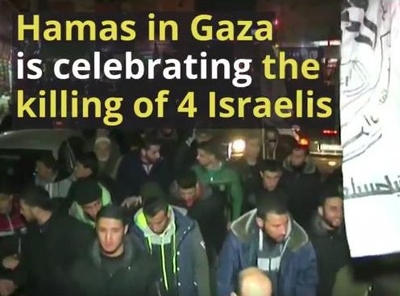
Hamas launched a public relations campaign in recent days, aimed at capitalizing on a deadly truck attack in Jerusalem Sunday that killed four Israeli soldiers. The campaign sheds a light on Hamas’s plans to encourage and launch jihadist atrocities, but also on its vulnerability to the arrival of ISIS as an ideology and movement.

The truck attacker was Fadi Ahmad Hamdan Qanbar, a father of four from east Jerusalem. He acted alone when he plowed into a cluster of soldiers gathered, according to Israeli assessments, under the influence of jihadist propaganda disseminated by ISIS.

That fact has not stopped Hamas from making multiple efforts to claim the attack as its own, celebrating it, and pushing Palestinians to emulate it. The Gazan regime’s goal of setting the West Bank alight is well served by such incidents.

Yet Hamas’s efforts to cash in on the truck ramming also strengthen its domestic challengers in Gaza – ISIS-affiliated Salafi-jihadist groups which have been just as quick to claim Qanbar as one of their own, and probably with better cause.

These same groups wasted little time in using the opportunity to launch stinging attacks on the Hamas regime, whose security forces arrest their members and repress their activities.

For example, an ISIS-affiliated group in Gaza proudly noted that Israel attributed the attack to one who “belongs to the Islamic Caliphate State,” and stated: “Praise Allah, who provided the oppressed people of Bayt Al-Maqdis [Jerusalem] with trucks they can use to run over the settler herds – [and this] instead of the haram [forbidden] organizations [the main Palestinian organizations].”

A grim jihadist competition is underway, over who can use the Jerusalem attack to boost its political power. Immediately after Qanbar’s attack, Hamas claimed he was an operative of its military wing, the Izz Al-Din Qassam Brigades.

Fathi Hamad, a member of Hamas’ political bureau, told a rally in Gaza to celebrate the murders that same night: “the [Israeli] soldiers fled from the Izz al-Din Qassam Brigades operative who carried out the attack for the sake of the Palestinians, the Arab nation and the Muslims.”

Other Hamas officials issued similar statements, praising Qanbar, and calling for his actions to reinvigorate the ‘intifada for Jerusalem.’

As the Middle East Media Research Institute (MEMRI) noted, Hamas’s official Twitter account chimed in: “We welcome the bold and heroic truck operation in Jerusalem which was a natural reaction to the crimes of the Israeli occupation.”

To be sure, Hamas is engaged in unceasing efforts to set up and launch terror cells in the West Bank and east Jerusalem from where they try to evade Israeli intelligence, infiltrate and commit mass casualty attacks in Israeli cities. Hamas also is a main source of inciting lone Palestinian attackers.

Yet it is also in a state of conflict with Gaza-based ISIS entities, which sporadically fire rockets into Israel hoping to provoke retaliatory Israeli airstrikes on Hamas targets. In essence, ISIS-affiliated groups try to use the Israel Air Force to punish Hamas.

ISIS views Hamas as an infidel movement due to its willingness to blend jihadist doctrines with Palestinian nationalism. Nationalism has no place in ISIS’s vision of a pan-Islamic caliphate, free of so-called artificial national divides among Muslims.

Meanwhile, tensions increased as relations between Hamas and the ISIS affiliate Wilyat Al-Sinai (Sinai Province), which once saw a good degree of cooperation, soured. This relationship enabled Hamas to continue smuggling arms into Gaza via tunnels, and to make Gazan hospitals available to wounded ISIS fighters and commanders. Egypt has long suspected Gaza’s Islamist rulers of being a steady source of weapons and volunteers for ISIS.

Now, the ISIS-affiliated movement in and around Gaza is openly challenging Hamas’s legitimacy. Ironically, Hamas does the same thing to the ruling Fatah movement in the West Bank, which it seeks to topple by provoking a large-scale Israeli military counter-terrorism operation, according to assessments by Israeli security sources.

This deadly jihadist “game of thrones” looks set to continue and could act as a destabilizing factor and a catalyst for further attacks.

The Israeli defense establishment sees the truck ramming as the work of a lone attacker – the hardest type to detect and thwart preemptively.

While the Shin Bet domestic intelligence agency is making progress using big data analytics to scan social media accounts and pick out potential lone terrorists, much work remains to be done in this challenging field.

Israeli Prime Minister Benjamin Netanyahu referred to this during remarks he made on the scene of the Jerusalem ramming, “I think the most important thing to understand is that we are under a new type of attack, by a lone terrorist, who becomes inspired and decides to spontaneously act.”

To counter ramming attacks, Israel has installed concrete barricades around bus stops in Jerusalem and the West Bank, he added. Additionally, Israeli security forces spent the past year intensively developing a “preventative intelligence infrastructure,” Netanyahu said, in reference to data analytics.

As the race continues to improve these techniques, Israel will need to continue to rely on the rapid responses of armed security forces and civilians who typically arrive at the scene of such incidents within seconds and open fire on terrorists.

Whether it is organized large-scale cells or lone murderers, the threat of indiscriminate jihadist violence looks set to remain with Israelis for years to come – though as the past two years have shown, Western cities are also increasingly prone to such threats.

Hamas’s Fatah and the No-State Solution

January 3, 2017

Hamas’s Fatah and the No-State Solution, Gatestone InstituteKhaled Abu Toameh, January 3, 2017

Palestinian Authority President Mahmoud Abbas declared that 2017 will be the “year of international recognition of the State of Palestine.”

The melee in Gaza exposes as the lie that it is Abbas’s repeated claim of a unified Fatah able to lead the Palestinians towards statehood. Incredibly, Abbas seeks global recognition of a Palestinian state at a time when the flames in his own backyard are set to engulf him and his questionable regime.

More bad news from the poll: if presidential elections were to be held today, Ismail Haniyeh, leader of the terrorist group Hamas, would beat Abbas by 49% to 45%.

Palestinians are now openly talking about two different Fatah factions. After Abbas’s decision to strip the legislators of their parliamentary immunity, six Fatah PLC members participated in a Hamas-sponsored meeting of the PLC in the Gaza Strip. This was the first time since 2007 that such a move had been made.

Fatah leaders in the Gaza Strip, unlike their colleagues in the West Bank, are de facto recognizing the Hamas rule over the Gaza Strip. This is wonderful news for Hamas, whose leader, Ismail Haniyeh is likely to defeat Abbas in a presidential election.

The Fatah gunmen who marched in the Gaza Strip courtesy of Hamas are not supporters of Abbas. Instead, they represent the “other face” of Fatah — the one that does not believe in any peace process with Israel and shares Hamas’s ambition of destroying Israel.

During a celebration in Ramallah marking the 52nd anniversary of the founding of his Fatah faction, Palestinian Authority (PA) President Mahmoud Abbas declared that 2017 will be the “year of international recognition of the State of Palestine.” Hailing the recent anti-settlement UN Security Council resolution 2334, Abbas said he was prepared to work with the new administration of Donald Trump “to achieve peace in the region.”

But while Abbas and his lieutenants were celebrating in Ramallah, at least 11 Palestinians were wounded in a scuffle that erupted between rival Fatah factions in the Gaza Strip. According to sources in the Gaza Strip, the fight broke out between Abbas loyalists and supporters of estranged Fatah leader Mohammed Dahlan. The confrontation, which was the most violent between the two sides in many years, is yet another sign of increasing schism in Fatah. Moreover, it is an indication of how Abbas’s control over his own faction is slipping through his hands. Hamas policemen who were at the scene did not interfere to break up the fight between the warring Fatah activists.

The melee in Gaza exposes as the lie that is Abbas’s repeated claim of a unified Fatah, able to lead the Palestinians towards statehood. Incredibly, Abbas seeks global recognition of a Palestinian state at a time when the flames in his own backyard are set to engulf him and his questionable regime.

Abbas says he wants to work with the Trump Administration to achieve peace in the Middle East, yet he cannot even achieve peace in his very own faction.

Abbas’s speech coincided with a new public opinion poll that showed that 64% of Palestinians want him to step down. The poll, conducted by the Ramallah-based Palestinian Center for Policy and Survey Research, also showed that two-thirds of Palestinians do not believe that the current Fatah leadership can achieve their aspirations.

The poll’s findings show that the percentage of Palestinians who want Abbas to resign has risen over the past three months from 61% to 64%. More bad news from the poll: if presidential elections were to be held today, Ismail Haniyeh, leader of the terrorist group Hamas, would beat Abbas by 49% to 45%.

The results of the poll should not come as a surprise to those who have been monitoring Palestinian affairs for the past few years. Judging from the sentiments on the Palestinian street, there is good reason to believe that the 81-year-old Abbas, who is now in his 12th year of his four-year term in office, has long ago lost much of his credibility among his people. The real surprise is that only 64% of Palestinians want to see him gone.

Many Palestinians hold Abbas personally responsible for the continued and rapid deterioration in the Palestinian arena. They see his incompetent and failed leadership as the main reason behind the 2007 violent Hamas takeover of the Gaza Strip. As soon as Hamas started shooting, Abbas’s fragile, corrupt and strife-ridden Palestinian Authority security forces collapsed. Critics of Abbas say that lack of leadership and decision-making on his part facilitated the Hamas seizure of the Gaza Strip.

Yet over the years, it has become evident that Abbas has not only lost the Gaza Strip and its two million inhabitants to Hamas, but that he is also losing control over his own Fatah faction there. Abbas has managed to alienate many Fatah leaders and activists in the Gaza Strip (most of whom are not necessarily affiliated with his arch-rival, Dahlan) to a point where Palestinians are now openly talking about two different Fatah factions.

Instead of devoting his energies to freeing the Gaza Strip from the iron grip of Hamas, Abbas has spent the past few years waging war against anyone in Fatah who dares to challenge his policies or criticize him. In this regard, he has resorted to a number of punitive measures that have further escalated tensions among Fatah cadres.

These measures include cutting off salaries and pensions to Fatah employees whose loyalty to Abbas is in question or who are suspected of being affiliated with Dahlan. As far as Abbas is concerned, affiliation with Hamas is less of a crime than being affiliated with Dahlan or any of his rivals in Fatah. Another measure that Abbas has taken to punish his rivals in Fatah: stripping them of their parliamentary immunity. The latest victims of this punishment: Mohamed Dahlan, Nasser Juma’ah, Shami Al-Shami, Najat Abu Baker and Jamal Al-Tirawi. Abbas took the decision without seeking the approval of the Palestinian parliament, the Palestinian Legislative Council (PLC), or any other judicial or decision-making institution. His detractors point out that the removal of the parliamentary immunity is in violation of the Palestinian Basic Law, because the PLC is the only party authorized to take such a decision.

When Fatah legislators protested against Abbas’s arbitrary measure by holding a sit-in strike inside the offices of the International Committee of the Red Cross in Ramallah, Abbas ordered his security forces to raid the compound and evict them by force. “This is a grave violation of the legislators’ rights and it is completely unjustified,” said a spokeswoman for Fatah in the Gaza Strip.

“It is also an indication of the repressive measures taken by the Palestinian Authority security forces. The legislators were holding a peaceful protest inside the offices of the Red Cross after President Abbas’s decision to remove their parliamentary immunity. We hold the president, the prime minister and the security forces responsible for the violations against human rights and public freedoms. We also condemn the silence of the Red Cross towards this despicable assault against the legislators inside the (Red Cross) offices.”

Abbas’s crackdown on his Fatah critics has driven them into the open arms of Hamas. After Abbas’s decision to strip the legislators of their parliamentary immunity, six Fatah PLC members participated in a Hamas-sponsored meeting of the PLC in the Gaza Strip. This was the first time since 2007 that such a move had been made.

The PLC has been effectively paralyzed since the Hamas takeover of the Gaza Strip. However, this has not prevented Hamas from continuing to convene sessions of the parliament in the Gaza Strip during the past few years. Until recently, Fatah legislators have boycotted these meetings because they do not recognize Hamas’s rule over the Gaza Strip. Abbas’s punitive and vengeful measures, however, have pushed Fatah legislators to change this status quo. This means that Fatah leaders in the Gaza Strip, unlike their colleagues in the West Bank, are de facto recognizing the Hamas rule over the Gaza Strip. This is wonderful news for Hamas, whose leader, Ismail Haniyeh (according to the latest poll) is likely to defeat Abbas in a presidential election.

Emboldened by the growing divisions in Fatah, Hamas leaders are also beginning to flirt with disgruntled Abbas critics who have been hurt by Abbas’s measures. For the first time in many years, the Hamas government permitted thousands of Fatah gunmen to hold a military parade in the Gaza Strip this week, marking the faction’s 52nd anniversary.

2180Pictured: For the first time in many years, Hamas permitted thousands of Fatah gunmen to hold a military parade in the Gaza Strip this week. (Image source: YouTube video screenshot)

The Fatah gunmen who marched in the Gaza Strip courtesy of Hamas are not supporters of Abbas, the overall commander of Fatah. Instead, they represent the “other face” of Fatah — the one that does not believe in any peace process with Israel and shares Hamas’s ambition of destroying Israel. The message that the Gaza Strip branch of Fatah wished to send to Abbas: Unlike you and your West Bank Fatah, we will not give up the “armed struggle” against Israel. “This parade sends a message to Abbas that Fatah has not relinquished the armed struggle,” explained Palestinian political scientist Ibrahim Abrash.

Meanwhile, Abbas appears to be living on a different planet. His ego prevents him from grasping the news that the polls reveal: most of his people are done with him. He refuses to wake up to the truth that his Fatah faction is falling into pieces, his erstwhile loyalists getting into bed with Hamas. He asks the world to recognize a Palestinian state when his own private residence in the Gaza Strip is forbidden to him. Indeed, it seems that the Palestinians are moving toward a “no-state solution” — a Gaza Strip run by Hamas and dissident Fatah members and a West Bank controlled by another Fatah that is still loyal to Abbas, largely because he is paying them salaries.

Abbas maintains that he is eager to work with the Trump Administration to achieve peace in the region. But will he have the courage to tell the new US administration some uncomfortable truths — namely that he has become a political liability to the majority of his people, and that the Palestinians have never been as divided as they are at this moment? In short, will Abbas dare to share the truth of the splintered Fatah’s no-state solution?

UN, Obama Further Radicalize Palestinians

December 29, 2016

UN, Obama Further Radicalize Palestinians, Gatestone InstituteKhaled Abu Toameh, December 29, 2016

Last week’s UN Security Council resolution sent the following message to the Palestinians: Forget about negotiating with Israel. Just pressure the international community to force Israel to comply with the resolution and surrender up all that you demand.

One thing is certain: Abbas and his Palestinian Authority cronies are not planning to return to the negotiating table with Israel. In fact, they are more belligerent, confrontational and defiant than ever. They have chosen the path of confrontation, and not direct negotiations — to force Israel to its knees.

One of Abbas’s close associates, Mohamed Shtayyeh, hinted that the resolution should be regarded as a green light not only to boycott Israel, but also to use violence against it. He said that this is the time to “bolster the popular resistance” against Israel. “Popular resistance” is code for throwing stones and firebombs, and carrying out stabbing and car-ramming attacks against Israelis.

The resolution has also encouraged the Palestinians to pursue their narrative that Jews have no historical, religious or emotional attachment to Jerusalem or any other part of Israel.

The Gaza-based Hamas and Islamic Jihad see the resolution as another step toward their goal of replacing Israel with an Islamic empire, and to “liberate all of Palestine.” When Hamas talks about “resistance,” it means suicide bombings and rockets against Israel — it does not believe in “light” terrorism such as stones and stabbings against Jews.

The UN’s highly touted “victory,” is a purely Pyrrhic one, in fact a true defeat to the peace process and to the few Arabs and Muslims who still believe in the possibility of coexistence with Israel.

The resolution has encouraged the Palestinians to move toward a diplomatic confrontation with Israel in the international arena, as well as increased terror attacks against Israel’s people — a harmful legacy of the Obama Administration.


Buoyed by the latest United Nations Security Council resolution condemning Israeli settlements as illegal, Palestinian leaders are now threatening to step up their diplomatic warfare against Israel — a move that is sure to sabotage any future effort to revive the moribund peace process. Other Palestinians, meanwhile, view the resolution as license to escalate “resistance” attacks on Israel. By “resistance,” of course, they mean terror attacks against Israel.

The UNSC resolution sent the following message to the Palestinians: Forget about negotiating with Israel. Just pressure the international community to force Israel to comply with the resolution and surrender up all that you demand.

Meanwhile, the Palestinians are not wasting any time by waiting for the international community to act against Israel on their behalf. Rather, they are thinking of ways of taking advantage of the UNSC vote to promote their campaign to isolate and delegitimize Israel, especially in the international arena. One thing is certain: Abbas and his PA cronies are not plotting to return to the negotiating table with Israel. In fact, they are more belligerent, confrontational and defiant than ever.

In the days following the UNSC vote, the voices emerging from Ramallah and the Gaza Strip clearly indicate that Palestinians have put themselves on a collision course with Israel. This bodes badly for any peace process.

Earlier this week, Abbas convened the PLO Executive Committee — a decision-making body dominated by his loyalists — to discuss the implications of the new resolution. The declared purpose of the meeting: to discuss the decisions and strategy that the Palestinian leadership needs to take in the aftermath of the resolution.

The decisions announced following the PLO meeting are a clear sign of the new approach that Abbas and the Palestinian leadership have endorsed. The Palestinian leaders have chosen the path of confrontation, and not direct negotiations, with Israel. They see the UNSC resolution, particularly the US abstention, as a charge sheet against Israel that is to be leveraged in their diplomatic effort to force Israel to its knees.

The PLO decisions include, among other things, an appeal to the International Criminal Court (ICC) to launch an “immediate judicial investigation into Israeli colonial settlements on the land of the independent State of Palestine.” Another decision envisages asking Switzerland to convene a meeting to look into ways of forcing Israel to apply the Fourth Geneva Convention to the West Bank, Gaza Strip and East Jerusalem. The Geneva Convention, adopted in 1949, defines “humanitarian protections for civilians in a war zone.”

The appeal to the ICC and Switzerland is part of Abbas’s strategy to “internationalize” the conflict with Israel by involving as many parties as possible. In this context, Abbas is hoping that the UNSC resolution will ensure the “success” of the upcoming French-initiated Middle East peace conference, which is slated to convene in Paris next month. For Abbas, the conference is another tool to isolate Israel in the international community, and depict it as a country that rejects peace with its Arab neighbors.

In addition, Abbas and his lieutenants in Ramallah are now seeking to exploit the UNSC resolution to promote boycotts, divestment and sanctions against Israel. “The PLO Executive Committee renews its call to the world countries for a comprehensive and full boycott of Israeli colonialist settlements in all fields, as well as all companies working in or dealing with these settlements.” One of Abbas’s close associates, Mohamed Shtayyeh, hinted that the UNSC resolution should be regarded as a green light not only to boycott Israel, but also to use violence against it. He said that this is the time to “bolster the popular resistance” against Israel. “Popular resistance” is code for throwing stones and petrol bombs and carrying out stabbing and car-ramming attacks against Israelis.

The UNSC resolution has also encouraged the Palestinians to pursue their narrative that Jews have no historical, religious or emotional attachment to Jerusalem or any other part of Israel. Sheikh Ekrimah Sabri, a leading Palestinian Islamic cleric and preacher at the Al-Aqsa Mosque, was quick to declare that the Western Wall, the holiest Jewish site in Jerusalem, belongs only to Muslims. Referring to the wall by its Islamic name, Sheikh Sabri announced: “The Al-Buraq Wall is the western wall of the Al-Aqsa Mosque and Muslims cannot give it up.”

So while Abbas and his Palestinian Authority consider the UNSC resolution a license to proceed with their diplomatic warfare to delegitimize and isolate Israel, Hamas and Islamic Jihad, the two groups that seek the elimination of Israel, are also celebrating. The two Gaza-based groups see the resolution as another step toward achieving their goal of replacing Israel with an Islamic empire. Leaders and spokesmen of Hamas and Islamic Jihad were among the first Palestinians to heap praise on the UNSC members who voted in favor of the resolution. They are also openly stating that the resolution authorizes them to step up the “resistance” against Israel in order to “liberate all of Palestine.”

“Resistance is the only means to end the settlements,” said a Hamas spokesman in the Gaza Strip. “We appreciate the position of those countries that voted against settlements.” He also seized the opportunity to renew Hamas’s demand that the Palestinian Authority stop all forms of cooperation with Israel, first and foremost security coordination.

When Hamas talks about “resistance,” it means launching suicide bombings and rockets against Israel. The Islamist movement does not believe in “light” terrorism such as stones and knife stabbings against Jews.

Hamas leader Khaled Mashaal, who is based in Qatar, reacted to the UNSC vote by saying that the world should now support his movement’s terror campaign against Israel. “We want the world to stand with the Palestinian resistance because it is just,” he said. “The armed resistance is the path to liberate Palestine and Jerusalem. Hamas is continuing to manufacture and smuggle weapons in preparation for a confrontation with Israel.” Mashaal did not forget to praise the US Administration’s abstention as a “correction of some American policies.”

Islamic Jihad, for its part, characterized the UNSC resolution as a “victory” for the Palestinians because it enables them to “isolate and boycott Israel” and file charges against it with international institutions. Daoud Shehab, one of the leaders of Islamic Jihad, added that the resolution means that Arabs should stop any effort to “normalize” relations with Israel or conduct security cooperation with it. The Arabs and Muslims should now work toward confronting and deterring Israel, he said.

Clearly, Hamas and Islamic Jihad see the UNSC resolution as a warning to all Arabs and Muslims against seeking any form of “normalization” with Israel. The two groups are referring to the Palestinian Authority, whose security forces continue to conduct security coordination with Israel in the West Bank, and to those Arab countries that have been rumored to be moving toward some form of rapprochement with Israel. The UN’s highly touted “victory,” is a purely Pyrrhic one, in fact a true defeat to the peace process and to the few Arabs and Muslims who still believe in the possibility of coexistence with Israel.

Thus, the UNSC resolution already has had several consequences, none of which will enhance peace between Israelis and Palestinians. Apart from giving a green light to Palestinian groups that wish to destroy Israel, the resolution has prompted Abbas and the Palestinian Authority to toughen their stance, and appear to be more radical than the radicals. Far from moving the region toward peace, the resolution has encouraged the Palestinians to move forward in two parallel paths – one toward a diplomatic confrontation with Israel in the international arena, and the other in increased terror attacks against its people. The coming weeks and months will witness mounting violence on the part of Palestinians toward Israelis – a harmful legacy of the Obama Administration.

The Palestinian Jihads against Israel

December 13, 2016

The Palestinian Jihads against Israel, Gatestone Institute, Khaled Abu Toameh, December 13, 2016

“We will not recognize Israel because it will inevitably go away. And we will not backtrack on the option of armed struggle until the liberation of all Palestine.” — Khalil Al-Haya, Hamas senior official.

The abandonment of Gaza by Israel in 2005 drove the Palestinian vote for Hamas the next year. It also explains why many Palestinians continue to support Hamas — because they still believe that violence is the way to defeat Israel.

Hamas believes that Israel does not have the right to defend itself against rockets and terror attacks. It even considers Israel’s self-defense as an “act of terror.”

In yet another sign that exposes Hamas’s ongoing preparations to attack Israel, the movement last week held a drill with live ammunition in the northern Gaza Strip.

“What has been achieved so far is a small jihad, and the big jihad is still awaiting us.” — Palestinian Authority President Mahmoud Abbas. Abbas is convinced that his “diplomatic jihad” against Israel is no less effective than Hamas’s jihad of terrorism.

Yet even if Abbas manages to achieve reconciliation with Hamas, this move should not be seen as sign of pragmatism on the part of the Islamist movement. Under no circumstances will Hamas relinquish its policy of the destruction of Israel and its replacement with an Islamist state.

From Abbas’s point of view, Hamas’s terrorism will only increase the pressure on Israel to capitulate. Here Abbas has an ally in Hamas: to multiply jihads to force Israel to its knees.

The Palestinian Islamist movement, Hamas, which is currently celebrating the 29th anniversary of its founding, misses no opportunity to broadcast its stated reason for being: to wage jihad (holy war) in order to achieve its goal of destroying Israel. Those who allege that Hamas is moving toward pragmatism and moderation might take note.

Last week, tens of thousands of Palestinians took to the streets of the Gaza Strip to participate in rallies marking the anniversary of the founding of Hamas. As in previous years, the rallies were held under the motto of jihad and “armed resistance” until the liberation of all Palestine, from the Jordan River to the Mediterranean Sea. Another message that emerged loud and clear from the rallies: Hamas will never recognize Israel’s right to exist.

This year’s rallies once again also served as a reminder of the enormous popularity that Hamas continues to enjoy among Palestinians — not only in the Gaza Strip, but also in the West Bank, where supporters of the Islamist movement celebrated the occasion, but on a smaller scale and with a lower profile, out of fear of the Palestinian Authority (PA) and Israeli security forces.

Khalil Al-Haya, a senior Hamas official, outlined in a speech before his supporters in the Gaza Strip his movement’s strategy, namely to pursue the fight until the elimination of Israel. “We will not recognize Israel because it will inevitably go away,” he declared.

“And we will not backtrack on the option of armed struggle until the liberation of all Palestine. Since its establishment, Hamas has been — and will remain — a Palestinian Islamic national and resistance movement whose goal is to liberate Palestine and confront the Israeli project. The liberation of the Gaza Strip is just the first step toward the liberation of Palestine — all Palestine. There is no future for the Israeli entity on our homeland.”

When Hamas leaders talk about the “liberation” of the Gaza Strip, they are referring to the total unilateral Israeli disengagement from that area in 2005. Hamas and many Palestinians have never viewed the full withdrawal from the Gaza Strip as a gesture on the part of Israel. Nor have they ever considered the disengagement as a sign that Israel is no longer interested in controlling the lives of nearly two million Palestinians living in the Gaza Strip.

On the contrary, Hamas and many Palestinians continue to see the Israeli disengagement from the Gaza Strip as a sign of weakness. In fact, this disengagement is why Hamas won the Palestinian parliamentary election in 2006, when it took credit for driving Israel out of the Gaza Strip through suicide bombings and rockets. Back then, this abandonment of land by Israel drove the Palestinian vote for Hamas. It also explains why many Palestinians continue to support Hamas — because they still believe that violence is the way to defeat Israel.

Many Palestinians see Israeli concessions, gestures and unilateral moves as proof of capitulation, rather than positive signs testifying to Israel’s peaceful intentions. These “concessions for peace” by Israel further increases Palestinians’ appetite for launching armed attacks against Israel. Today, many Palestinians are convinced that they can achieve more through stabbings, vehicular rammings and shooting attacks than sitting with Israel at the negotiating table.

The Qatar-based Hamas leader, Khaled Mashaal, seized the anniversary as an opportunity once again to remind everyone of his movement’s real goals. Speaking on the Al-Jazeera TV network, which serves as a platform for the Muslim Brotherhood organization (Hamas is an offshoot of Muslim Brotherhood), Mashaal said:

“We are moving forward with our resistance to achieve our national project… We are looking forward to liberating Palestine and cleansing the Al-Aqsa Mosque and protecting it from division and demolition. We also seek the return of the refugees to their homeland and the liberation of our prisoners from Israeli jails.”

When he talks about “cleansing” Al-Aqsa Mosque, the Hamas leader is referring to Jewish visits to the Temple Mount. Hamas and the Palestinian Authority have been exploiting these visits to incite their people against Israel. They claim that Jewish visitors are “desecrating” the holy site and should not be allowed to set foot there. These words mirror those used by President Mahmoud Abbas, who said that Palestinians will not allow Jews to “defile with their filthy feet” the Al-Aqsa Mosque (although no Jew has entered the mosque itself).

Mashaal, who in the past few years has been living as royalty in Qatar (the country that is the main patron of Muslim Brotherhood), went on to emphasize that Hamas has “not changed its strategy of liberating Palestine.” He also said that, “Military work remains the backbone of liberation.” Hamas, he added, “Continues to believe in the full liberation of Palestine and that jihad and resistance are the only means to expel the occupation and liberate Palestine and the blessed Al-Aqsa Mosque.” According to Mashaal, Hamas continues to look toward Arab and Islamic countries, including Iran, for the military, financial and political support to achieve its goal of destroying Israel.

Hamas’s armed wing, Ezaddin Al-Qassam, boasted on this occasion that 22 of its men have been killed since the beginning of 2016, while preparing for the next war with Israel. Most of the Hamas men were killed when the tunnels in which they were working in collapsed. Hamas continues to build new tunnels and renovate those that were destroyed during the last war with Israel in 2014. Hamas says it wants to use these tunnels in the future to infiltrate Israel and kill or kidnap Israeli civilians or soldiers.

Ironically, while Hamas pursues its round-the-clock efforts to prepare for war against Israel, its leaders do not hesitate to depict themselves as victims, and warn of supposed Israeli plans to launch a “new aggression” against Palestinians. Hamas believes that Israel does not have the right to defend itself against rockets and terror attacks. It even considers Israel’s self-defense as an “act of terror.”

Take, for example, Hamas spokesman Fawzi Barhoum’s recent assessment. Lashing out at U.S. aid to Israel, Barhoum said that the American military and financial aid to Israel constitutes “official support for terrorism.”

This is effectively Hamas’s message to the new U.S. administration: Stop supporting Israel with weapons and money because that hinders our goal of destroying Israel. In yet another sign that exposes Hamas’s ongoing preparations to attack Israel, the movement last week held a drill with live ammunition in the northern Gaza Strip. The drill enacted, among other things, an incursion into a civilian populated area. Hamas said the drill was the fruit of 380 hours of non-stop military training of its “Special Units.”

Hamas’s rhetoric and actions leave no room for doubt as to its intentions. Twenty-nine years after its establishment, a defiant Hamas continues to believe that Israel can, and should, be destroyed. The dream to eliminate Israel remains alive and well among many Palestinians, as evidenced at Hamas rallies by the massive turnouts.

Hamas and the Palestinian Authority, however, are kissing cousins when it comes to Israel. Hamas’s talk of jihad against Israel is right in line with Abbas’s speech before the 7th Congress of Fatah, which convened in Ramallah two weeks ago. “What has been achieved so far is a small jihad, and the big jihad is still awaiting us,” Abbas declared.

According to Abbas’s aides, the PA president was referring to a different type of jihad — one that relates to his ongoing efforts in the international arena to isolate and delegitimize Israel, to force it to make far-reaching concessions to the Palestinians. Abbas’s diplomatic warfare against Israel began several years ago, with the PA’s efforts to join international institutions and seek unilateral recognition in the UN of a Palestinian state. His ultimate goal is to have the international community exert pressure on Israel to withdraw fully to the pre-1967 lines. Abbas wants to establish a Palestinian state with the help of the international community, and not through direct negotiations with Israel. He is convinced that his “diplomatic jihad” against Israel is no less effective than the Hamas jihad of terrorism.

This Abbas talk of “small” and “big” jihad comes at a time when Abbas and Hamas are in courting mode. Some reports have suggested that Abbas recently sent conciliatory messages to Hamas in yet another bid to end the dispute between the two sides. He and Khaled Mashaal have had regular phone contact, with both expressing a desire to end the conflict between them. The reports have even suggested that the two rival parties may be preparing to resume their “reconciliation” talks in Doha under the auspices of Qatar. Last October, Abbas met in Doha with Mashaal and another Hamas leader, Ismail Haniyeh, as part of his rapprochement with the Islamist movement. The meeting was said to be held in a cordial atmosphere, and some Palestinian political analysts point to a warming of relations between the two sides.

677-1Last October, Palestinian Authority President Mahmoud Abbas met in Qatar with Khaled Mashaal and another Hamas leader, Ismail Haniyeh, as part of his rapprochement with the Islamist movement. Pictured above: Abbas (right) meets with Khaled Mashaal in Qatar on July 20, 2014, in a previous reconciliation attempt. (Image source: Handout from the PA President’s Office/Thaer Ghanem)

Yet even if Abbas manages to achieve reconciliation with Hamas, this move should not be seen as a sign of pragmatism on the part of the Islamist movement. Under no circumstances will Hamas relinquish its policy of the destruction of Israel and its replacement with an Islamist state. The movement’s own words on its anniversary provide the best proof of this intention. To their credit, Hamas leaders are nothing if not honest about their commitment to Israel’s destruction. Abbas certainly will not attempt to convince Hamas to abandon this fundamental goal. So, as far as Hamas is concerned, reconciliation means that Abbas will move closer to the Islamist movement and not vice versa.

In fact, Mahmoud Abbas seems to believe that Hamas’s and his jihads complement each other. Thus, Hamas will continue its deadly jihad, while Abbas will pursue his “diplomatic jihad” against Israel. From his point of view, Hamas’s terrorism will only increase the pressure on Israel to capitulate. Here Abbas has an ally in Hamas: to multiply jihads to force Israel to its knees.

Stop the Presses: Abbas Reelected Fatah Chief

November 30, 2016

Stop the Presses: Abbas Reelected Fatah Chief, The Jewish PressDavid Israel, November 30, 2016

Palestinian Authority President Mahmud Abbas (C) chairs a meeting with the Revolutionary Council of his ruling Fatah party on June 16, 2015 in the West Bank city of Ramallah. Photo by STR/Flash90 *** Local Caption *** ??? ???? ????? ???? ?????? ????? ????????? ????

Palestinian Authority President Mahmud Abbas (C) chairs a meeting with the Revolutionary Council of his ruling Fatah party on June 16, 2015 in the West Bank city of Ramallah. Photo by STR/Flash90

In an astonishing move that caught the world by surprise, about 1,250 Fatah party politicians opened their seventh conference in Ramallah on Tuesday by reappointing Mahmoud Abbas chairman. At 81, an invigorated Abbas, a.k.a. Abu Mazen, was voted in unanimously, despite speculations that this time the ruling party of the PA would entertain serious discussions of a post-Abbas future.

Fataḥ, formerly the Palestinian National Liberation Movement, is the largest faction of the Palestine Liberation Organization (PLO). Abbas was elected in January 2005 as President of the Palestinian National Authority until January 2009, but in December 2009 was voted into office indefinitely by the PLO Central Council.

An estimated 75 Fatah representatives from Gaza were not granted permits by Israel to leave the Strip to attend the conference. But its doubtful the vote in Ramallah would have been any different had they been allowed to go through.

The date picked for the conference, as it is done every conference, was November 29, the anniversary of the last time the Arabs in the Land of Israel had a real chance for statehood, which they blew, in the spirit of the late Abba Eban, who said, The Arabs never miss an opportunity to miss an opportunity. For the record, Eban did not focus solely on the Arabs who call themselves Palestinians, since he made his immortal observation after the 1973 Geneva Peace Conference with Arab countries (which Syria refused to attend).

November 29 was commemorated by the UN on Tuesday, as the International Day of Solidarity with the Palestinian People. UN General Assembly president Peter Thomson honored the occasion by wearing a Palestinian flag scarf, just like the one Yasser Arafat wore when he first appeared at the General Assembly back in 1974 as the chief of Fatah – which was established back in 1959 to “organize the armed resistance against Israel,” almost a decade before the 1967 war.

Which brings to mind another Abba Eban immortal observation, from 2004: If Algeria introduced a resolution declaring that the earth was flat and that Israel had flattened it, it would pass by a vote of 164 to 13 with 26 abstentions.

Arrests Breaks Up PIJ Recruitment Scheme

November 30, 2016

Arrests Breaks Up PIJ Recruitment Scheme, Investigative Project on Terrorism. Yaakov Lappin, November 30, 2016

1894

Israeli security forces led by the Shin Bet domestic intelligence agency have uncovered a recruitment drive by Palestinian Islamic Jihad operatives located in Pakistan, the Investigative Project on Terrorism has learned.

The operatives hail from Gaza and tried to recruit fellow students in Pakistan to create a West Bank cell, according to Israeli security sources.

The investigation illustrates the ease with which terror organizations, particularly Islamic Jihad and Hamas, recruit Palestinian students overseas, often taking advantage of extensive contact networks, the sources said.

The case is unusual for exposing Palestinian Islamic Jihad activity so far from the Palestinian territories and from Israel.

According to the Shin Bet’s investigation, 22-year-old Baha’a Abu Marhiah, a resident of the West Bank city of Hebron, is a Palestinian student who was recruited by two Palestinian Islamic Jihad operatives. Marhiah was studying for a law degree at a university in Lahore, Pakistan.

Two Islamic Jihad operatives from Northern Gaza’s Shati Refugee Camp were studying for doctorates at the same university.

Israeli security forces named them as Sharif Halabi, 34, a religious scholar and teacher, and Ramzi Shakshak, 32, who lectures at Al-Aqsa University in Gaza.

Halabi, who told students in Pakistan about “martyrs” in Gaza and incited them against Israel, gained Abu Marhiah’s trust and convinced him to join Palestinian Islamic Jihad, the investigation found.

Halabi allegedly told Abu Marhiah to keep in touch after returning to Hebron, and to await further instructions on how to conduct attacks, according to the Shin Bet. Today, Halabi and Shakshak are back in Gaza.

But Marhiah was arrested Sept. 22 in a joint Shin Bet, Israel Defense Forces, and police operation following his return.

In recent days, an IDF military court charged Abu Marhiah with carrying out a service for a banned organization, and holding contact with an enemy entity.

After Hamas, Islamic Jihad is the second largest terrorist organization in Gaza, with approximately 5,000 armed combatants split up into regional brigades and a domestically produced rocket arsenal which incorporates Iranian know-how.

Any expansion of Islamic Jihad from Gaza into the West Bank would also represent an Iranian push into the area.

Prior to 2002’s Operation Defensive Shield, Islamic Jihad maintained a high profile in the West Bank and launched a series of suicide bombing and shooting attacks against Israelis. Jenin and Hebron were considered strong areas for the organization. The terrorist group is now working strenuously to reinvigorate itself in the area.

Iran remains the principal financial backer of Palestinian Islamic Jihad in Gaza. Unlike Hamas, it has remained utterly loyal to Tehran and enjoyed sustained, continuous support from it.

While Hamas has distanced itself from Iran’s Shi’ite sectarian intervention in the region’s raging wars, particularly in Syria, Islamic Jihad has not.

In recent months, Iran has expanded efforts to create a zone of influence in the West Bank, according to Israeli defense assessments.

This included attempts by its proxies, Islamic Jihad and Hizballah, to set up terror cells there.

Israel identified and stopped efforts by Hizballah’s Unit 133, which seeks to set up terror cells among Palestinians and activate them, earlier this year.

Meanwhile Shin Bet periodically checks efforts by Islamic Jihad in Gaza to recruit West Bank attackers. Despite the successes, the Israel Defense Forces (IDF) central command assessed last year that Islamic Jihad was gaining strength in the West Bank.

The small, yet highly focused organization will continue acting as the principal flag bearer for Iran in the Palestinian arena.

IDF hits targets in northern Gaza in response to rocket strike

October 5, 2016

IDF hits targets in northern Gaza in response to rocket strike After projectile lands on a Sderot street, Israeli tanks reportedly fire on Hamas sites in Beit Hanoun

By Judah Ari Gross October 5, 2016, 11:59 am

Source: IDF hits targets in northern Gaza in response to rocket strike | The Times of Israel

A rocket launched from the Gaza Strip strikes a road in the southern city of Sderot on October 5, 2016. (Israel Police)

Israeli tanks fired on Hamas targets in the northern Gaza Strip on Wednesday in response to a rocket that landed in southern Israel earlier in the day, the army said.

According to Palestinian reports, the IDF tanks struck sites in Beit Hanoun, on the northeastern corner of the coastal enclave. The army would not immediately confirm those reports to The Times of Israel.

There were no immediate reports of Palestinian injuries.

The rocket, which had been fired from the Gaza Strip, struck a street in the city of Sderot — a few miles from Beit Hanoun — just before 10:30 a.m. on Wednesday, police said, causing damage and sending three people to the hospital suffering from anxiety attacks.

The Islamic State-affiliated Ahfad al-Sahaba-Aknaf Bayt al-Maqdis terrorist group took responsibility for the rocket launch in statements released in both Arabic and Hebrew.

“Oh you cowardly Jews: You don’t have safety in our land. [Former defense minister Moshe] Ya’alon, the failure at giving security. [Defense Minister Avigdor] Liberman to fail will be a certainty,” the Salafist group said in its statement, in poorly translated Hebrew.

The attack against Israel was apparently a response to the Strip’s Hamas rulers arresting several members of the Salafist organization, according to the group’s statement.

Though the Salafist group took responsibility for the attack, Israel has said it holds Hamas responsible for any attacks emanating from Gaza and routinely responds to such launches with strikes inside the Palestinian territory.

“We can’t go after every little group in Gaza with a couple of dozen members that goes out one night and fires a rocket,” a senior officer in the IDF’s Southern Command told reporters last month.

Ahfad al-Sahaba-Aknaf Bayt al-Maqdis released a similar statement last month, after a failed attempt to launch a rocket at southern Israel on the first day of school. The group also claimed responsibility for a rocket attack that hit Sderot
in August, landing between two houses in the southern Israeli city.

In Wednesday morning’s rocket attack, three people in Sderot “suffered anxiety attacks” and were treated by medical teams, but no one was physically hurt by the attack, according to the Magen David Adom medical service.

The three — including a 15-year-old girl and 60-year-old man — were taken to Ashkelon’s Barzilai Medical Center for further care, MDA paramedics said.

The rocket alert siren was activated at approximately 10:20 a.m. and was heard in Sderot, Nir Am, Ivim and Gevim.

A few minutes later, Israel Police officers located the rocket in Sderot. The street where it landed was damaged in the attack, as were several nearby cars and homes.

Police sappers were called to the scene, and the area was closed off to pedestrians and traffic, police said.


Police sappers dig out piece of a rocket launched from the Gaza Strip that struck a road in the southern city of Sderot on October 5, 2016.

Last month, a mortar shell was launched from the Gaza Strip and landed in a field in southern Israel, causing neither injury nor damage, the army said. The projectile hit an empty field in the Eshkol region, next to the southern Strip, according to a statement from the Israel Defense Forces.