Posted tagged ‘Funding terrorism’

US: Iran’s Support for Terror Undiminished

June 22, 2015

US: Iran’s Support for Terror Undiminished, The Clarion Project, June 21, 2015

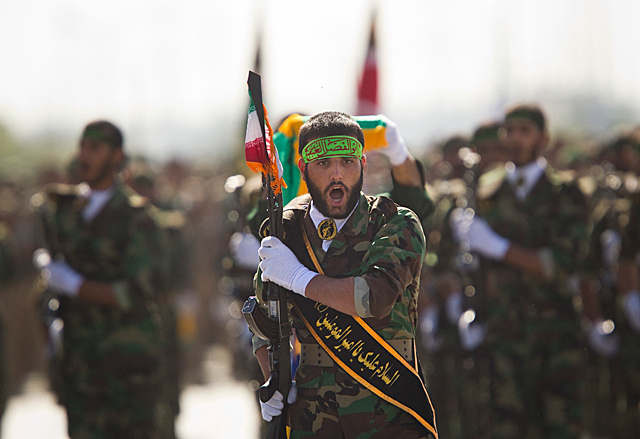
Iran-Basij-March-IP_1The Iranian volunteer Basij militia (Photo: © Reuters)

In an interview with The Atlantic, U.S. President Barack Obamas admitted that some of the money freed up the deal’s proposed sanction relief may up going towards terrorism, although he argued that Iranian government would have to make good on their commitments to improve the country’s economy.

******************

Despite the fact that Iran’s global terror activities were “undiminished” between 2013 and 2014, the U.S. State Department is still entirely committed to pursuing a nuclear deal with Iran.

“We think it’s essential that we pursue those negotiations,” said Tina Kaidanow, the State Department’s coordinator for counterterrorism, as quoted in The Wall Street Journal. “None of that implies that we would be, again, in any way taking our eye off the ball with respect to what Iran is doing as a supporter of terrorism.”

Iran’s support for terror was documented in the State Dept.’s annual report on global terrorism, which was released Friday. The report says “Iran’s state sponsorship of terrorism worldwide remained undiminished,” which makes the State Dept. “very, very concerned,” according to Kaidanow.

While the June 30 deadline for the deal is now fewer than 10 days away, the release of the report shows, “Iran continued to sponsor terrorist groups around the world,” according to Kaidanow.

The report specifically mentions Iran’s continued support for the Shiite terror organization Hezbollah in Lebanon as well as those fighting with embattled Syrian President Bashaar al-Assad.

The Clarion Project reported last week that Iran is supporting more than 100 terrorist organizations in Syria and Iraq alone.

In an interview with The Atlantic, U.S. President Barack Obamas admitted that some of the money freed up the deal’s proposed sanction relief may up going towards terrorism, although he argued that Iranian government would have to make good on their commitments to improve the country’s economy.

“I don’t think …anybody in this administration said that no money will go to the military as a consequence of sanctions relief,” Obama said. “The question is, if Iran has $150 billion parked outside the country, does the IRGC automatically get $150 billion? Does that $150 billion then translate by orders of magnitude into their capacity to project power throughout the region? And that is what we contest …”

The report also showed that between 2013 and 2014, there was a significant rise in global terror attacks, causing an increase in over 80 percent of violent deaths from the previous year (which itself had seen a 43 percent increase from the year before). In addition, the report showed:

  • There was an average of 1,122 attacks per month
  • Kidnappings increased by one-third, with more than with 9,400 people taken hostage
  • The number of global attacks rose by 35 percent
  • 32,727 people were killed worldwide (versus 17,800 in 2013)
  • 34,700 people were injured in attacks in close to 95 countries
  • In Iraq alone,  10,000 people died in 3,360 attacks representing close to a third of all people killed in terror attacks worldwide.

European Welfare Systems Milked by Jihadis

May 31, 2015

European Welfare Systems Milked by Jihadis, The Clarion Project, Soeren Kern, May 31, 2015

Khalid-AbdurahmanIPKhalid Abdurahman (center)

The disclosures show that Islamists continue to exploit European social welfare systems to finance their activities both at home and abroad — costing European taxpayers potentially millions of euros each year.

Anjem Choudary, a British-born radical Islamic cleric who lives off the British welfare state, has repeatedly urged his followers to quit their jobs and claim unemployment benefits so they have more time to plot holy war against non-Muslims.

Choudary believes that Muslims are entitled to welfare payments because they are a form of jizya, a tax imposed on non-Muslims in countries run by Muslims, as a reminder that non-Muslims are permanently inferior and subservient to Muslims.

******************

More than 30 Danish jihadists have collected unemployment benefits totaling 379,000 Danish krone (€51,000; $55,000) while fighting with the Islamic State in Syria, according to leaked intelligence documents.

The fraud, which was reported by Television 2 Danmark on May 18, comes less than six months after the Danish newspaperBT revealed that Denmark had paid unemployment benefits to 28 other jihadists while they were waging war in Syria.

The disclosures show that Islamists continue to exploit European social welfare systems to finance their activities both at home and abroad — costing European taxpayers potentially millions of euros each year.

According to Television 2 Danmark, the welfare fraud was discovered after the Danish intelligence agency PET began sharing data about known Danish jihadists with the Ministry of Employment to determine if any of these individuals were receiving unemployment benefits.

As a percentage of the overall population, Denmark is the second-largest European source of foreign fighters in Syria after Belgium. At least 115 Danes have become foreign fighters in Syria and Iraq since Syria’s civil war broke out in March 2011, according to a recent report by the Center for Terrorism Analysis, an agency of PET. The report states:

“CTA assesses that approximately half of those who have gone abroad are now back in Denmark, while a quarter of them remain in the conflict zone. CTA assesses that two thirds of these individuals have been in the conflict zone for more than a year. The remaining travelers are located elsewhere abroad. CTA assesses that at least 19 travelers from Denmark have been killed in Syria and Iraq.”

The CTA admits that, “the number may be higher” than 115. The comment is a tacit recognition that it does not know exactly how many Danes have become jihadists abroad.

In April, it emerged that the parents of Omar Abdel Hamid El-Hussein — a Danish-Jordanian jihadist responsible for the terror attacks in Copenhagen in February 2015 in which two people died — have been welfare recipients in Denmark for more than 20 years. Omar’s parents received a total of 3.8 million krone between 1994 and 2014, amounting to roughly 500,000 euros or $560,000.

Social welfare fraud of the kind perpetrated in Denmark is being repeated throughout Europe.

In Austria, police arrested 13 jihadists in November 2014 who were allegedly collecting welfare payments to finance their trips to Syria. Among those detained was Mirsad Omerovic, 32, an extremist Islamic preacher who police say raised several hundred thousand euros for the war in Syria. A father of six who lives exclusively off the Austrian welfare state, Omerovic has benefited from additional payments for paternity leave (Väterkarenz).

Austrian police also arrested, in August 2014, nine other jihadists who were attempting to join the jihad in Syria. Their trip was being financed by Austrian taxpayers by way of social welfare payments.

In Belgium, 29 jihadists from the Flemish cities of Antwerp and Vilvoorde were prevented from receiving social welfare benefits from the state. The move came after an investigation found that the individuals had been accessing their Belgian bank accounts by withdrawing money from banks in Turkey, just across the Syrian border.

Per capita, Belgium is the largest European source of jihadist fighters going to the Middle East; up to 400 Belgians have become jihadists in Syria and Iraq.

In Britain, Terri Nicholson, an assistant commander at the Metropolitan Police’s counter-terrorism command unit, told the Telegraph newspaper in November 2014 that taxpayers’ money was being claimed fraudulently and used by jihadists in Iraq and Syria. “We are seeing a diverse fraud, including substantial fraud online, abuse of the benefits system, abuse of student loans, in order to fund terrorism,” she said.

Nicholson added that women were increasingly being used to smuggle welfare money out of Britain to fund terrorists abroad, because they supposedly arouse less suspicion.

In November 2014, for example, Amal El-Wahabi, a British mother of two, was jailed for 28 months for trying to arrange to smuggle €20,000 to her husband, a jihadist fighting in Syria. She persuaded her friend, Nawal Msaad, to carry the cash in her underwear in return for €1,000. Msaad was stopped at Heathrow Airport. The money she was carrying is thought to have come from social welfare payments.

Anjem Choudary, a British-born radical Islamic cleric who lives off the British welfare state, has repeatedly urged his followers to quit their jobs and claim unemployment benefits so they have more time to plot holy war against non-Muslims.

Choudary believes that Muslims are entitled to welfare payments because they are a form ofjizya, a tax imposed on non-Muslims in countries run by Muslims, as a reminder that non-Muslims are permanently inferior and subservient to Muslims.

In 2010, The Sun reported that Choudary takes home more than £25,000 ($39,000) a year in welfare benefits. Among other handouts, Choudary receives £15,600 a year in housing benefit to keep him in a £320,000 ($495,000) house in Leytonstone, East London. He also receives £1,820 council tax allowance, £5,200 income support and £3,120 child benefits. Because his welfare payments are not taxed, his income is equivalent to a £32,500 ($50,000) salary. By comparison, the average annual earnings of full-time workers in Britain was £26,936 ($41,000) in 2014.

Although analysts are divided over the question of how many followers Choudary actually has, no one disputes the fact that he is far from alone in exploiting the British welfare system.

British taxpayers have footed the bill for the Moroccan-born Najat Mostafa, the second wife of the Egyptian-born Islamic hate preacher Abu Hamza, who was extradited to the United States in October 2012. She has lived in a £1 million, five-bedroom house in one of London’s wealthiest neighborhoods for more than 15 years, and has raised the couple’s eight children there.

Abu Hamza and his family are believed to have cost British taxpayers more than £338,000 in benefits. He has also received £680,000 in legal assistance for his failed U.S. extradition battle. The cost of keeping him in a British prison since 2004 is estimated at £500,000.

Fellow extremist Islamic preacher Abu Qatada, a Palestinian, has cost British taxpayers an estimated £500,000. He has also won £390,000 in legal aid to avoid deportation to Jordan.

The Islamic preacher Omar Bakri Mohammed, a Syrian, obtained £300,000 benefits before being exiled to Lebanon. The money was provided to raise his six children, including Yasmin Fostok, a single mother who makes a living as a pole-dancer in London nightclubs.

More instances of British welfare abuse can be found here.

In France, the government in March 2015 cut welfare benefits for 290 persons identified as jihadists. French Interior Minister Bernard Cazeneuve downplayed the problem. “We shouldn’t make a controversy of this subject or allow people to think no action has been taken. We’re taking this seriously and will continue to do so,” he said.

In Germany, an analysis of the estimated 450 German jihadists fighting in Syria found that more than 20% of them were receiving welfare benefits from the German state. In addition, the 150 jihadists who have returned to Germany are eligible to begin receiving benefits again.

The Interior Minister of Bavaria, Joachim Herrmann, said:

“It should never come to this. German taxpayers’ money should never directly or indirectly finance Islamist terrorism. The benefits of such terrorist parasites should be eliminated immediately. Not working and spreading terror at the expense of the German state is not only extremely dangerous, it is also the worst provocation and disgrace!”

Separately, a study by the Cologne Institute for Economic Research found that Muslim immigrants were more likely to be unemployed and living off the social welfare state than any other immigrant group in Germany.

According to the study, 55% of the immigrants from Lebanon are unemployed, as are 46% from Iraq, 37.5% from Afghanistan, 37.1% from Iran, 27.1% from Morocco and 21.5% from Turkey. In real terms, immigrants from Turkey (140,000) constitute the largest number of unemployed. The report said the root cause for the high unemployment rates was the lack of educational attainment and job training qualifications.

In the Netherlands, a Dutch jihadist named Khalid Abdurahman appeared in a YouTube video with five severed heads. Originally from Iraq, Abdurahman was living on social welfare benefits in the Netherlands for more than a decade before he joined the Islamic State in Syria. Dutch social services declared him to be unfit for work and taxpayers paid for the medication to treat him for claustrophobia and schizophrenia.

Meanwhile, city councils across the Netherlands are attempting to help rather than to prosecute returning jihadists. In the city of Delft, for example, local politicians are using taxpayer money to “reintegrate” jihadists and to help them “rebuild their lives.” Dutch public television explained it this way: “The idea is that the local authorities do not want to alienate the returnees by means of a repressive approach which might lead to their further radicalization.”

Separately, several Dutch-Moroccan organizations sent a letter to the Labor Party (Partij van de Arbeid, PvdA) in which they threatened to urge Dutch-Moroccans to stop supporting the party if it agreed to a proposal by its Minister of Social Affairs, Lodewijk Asscher, to cut social welfare payments to Moroccans who do not live in the Netherlands. Asscher accused the organizations of using an “improper electoral threat.”

In Spain, police arrested five Muslims in the Basque Country who allegedly pocketed the social welfare payments of Redouan Bensbih, a Moroccan immigrant killed on the battlefield in Syria in March. Despite his no longer living in Spain, Bensbih continued receiving monthly payments of €836 euros ($920), which the suspects are accused of having wired to Morocco.

Meanwhile, a network of more than 250 butcher shops, grocery stores and telephone call centers was accused of financing the Islamic State and al-Qaeda. The network used the so-called hawala system — defined by Interpol as money transfer without money movement — where money is transferred through an informal and virtually untraceable system.

According to the El País newspaper, “the secret hawala network in Spain is comprised of about 300 hawaladars — the majority of them Pakistanis — who run clandestine offices in Barcelona, Tarragona, Lleida, Bilbao, Santander, Valencia, Madrid, Logroño, León, Jaén and Almería, and other cities with large Pakistani communities.” They manage the savings of over 150,000 Muslims, many of whom are believed to be receiving social welfare payments from the Spanish state, without any legal oversight.

The network allegedly paid the salaries of Spanish jihadists in Syria: They received about $800 if they were single and $1,200 if they were married.

In February 2015, a Pakistani couple residing in the Basque capital of Vitoria was accused of falsifying identity documents to fraudulently obtain social welfare payments for 10 fictitious individuals. The man was receiving six different welfare payments and his wife was receiving four. Each welfare payment was between €6,000 ($6,600) and €10,000 ($11,000) per month. Police say that over a period of three years, the couple defrauded the Basque government of more than €395,000 ($453,000).

The Basque Country is known for its liberal social welfare policies; all residents, including illegal immigrants, are eligible to receive welfare payments. In 2012, a massive wave of immigrants from Morocco and Algeria arrived in the Basque Country in order to — in the words of a local politician — “live off of welfare benefits without working.”

According to local observers, more than 65% of the immigrants from Morocco and Algeria are receiving benefits. Auditors found that in 2012 alone the Basque Country made €86 million ($95 million) in dubious welfare payments.

In Sweden, the state employment agency, Arbetsformedlingen, terminated a pilot program aimed at helping immigrants find jobs. Information had emerged that Muslim employees at the agency were helping jobseekers find jobs as jihadists for the Islamic State. Operatives from the Islamic State had also allegedly bribed — and in some cases issued death threats against — agency employees in efforts to recruit fighters from Sweden.

Also in Sweden, the government said it wanted to impose a special tax to finance a jobs program for returning jihadists. The project is based on a scheme in the Swedish city of Örebro, where the city is using taxpayer money to help returning jihadists find employment. Town councilor Rasmus Persson said:

“We have discussed how we should work for these guys who have come back, to ensure that they do not return to the battlefield. They should be helped to process the traumatic experiences they have been through.”

The project was challenged by a Swedish soldier deployed in Afghanistan, who said that he was likely to get less help when he came back to Sweden than returning jihadists were. Soldier Fredrik Brandberg wrote:

“It would be wonderful if I was met with a comparable program after my homecoming, after which I could feel safe in having a regular job, with monthly income and a social stable situation in the society where I wouldn’t need to wonder whether I’m wanted or not.”

A spokesperson for the Swedish Armed Forces said that what happens to soldiers upon their return from war was not an issue that fell under its mandate.
Next challenge for US after Ramadi defeat: Iranian ship nears Yemeni shore

May 19, 2015

Next challenge for US after Ramadi defeat: Iranian ship nears Yemeni shore, DEBKAfile, May 19, 2015

Iran_Shahed_21.5.15Iranian aid vessel with “medical relief” personnel

DEBKAfile’s analysts strongly doubt that the USS Theodore Roosevelt carrier and strike force, which have been monitoring the Iranian flotilla’s movements, will be ordered to intervene against the Iranian ships reaching the Yemeni port.

Tehran, for its part has threatened to treat any such inspections as an act of war.

********************

Tuesday, May 19, two days after Ramadi’s fall to the Islamic State landed a major blow to Baghdad and US strategy in the region, 10,000 troops – more than half American – ended a large US-led military exercise in Jordan that was designed to practice tactics for countering ISIS. Taking part surprisingly in the two-week exercise was a heavy US nuclear-capable B-52H bomber, which flew in from the United States, crossing through Israeli air space and returning to home base when it was over.

This was the first time in the 12 years since the US invasion of Iraq that a B-52H, which can deliver nuclear weapons and bunker buster bombers, has appeared in Middle East skies for any military mission.

East of Jordan, as some 25,000 refugees from Ramadi slept in the open, the Islamist conquerors began moving on their next target, the Habbaniyah air base some 70 km west of Baghdad. Its fall would cut Baghdad off from northern and eastern Iraq and place it under siege from three directions – north, east and west.

Most Arab members have dropped out of the US-led coalition committed to fighting the Islamist terrorists in Iraq and Syria. This has left the US Air Force to bear the brunt of the aerial campaign. Its average of 19 air strikes a day is far too few to have any real effect on ISIS’s battle momentum. It certainly did not stop the long columns of black-clad Islamist fighters swarming on Ramadi from all directions in hundreds of tanks, APCs and minivans armed with heavy machine guns, and taking control of the capital of Iraq’s largest province, Anbar.

Western intelligence from the Ramadi region offered disturbing accounts of thousands of fully-armed ISIS fighters springing up apparently from nowhere to descend on the city, with no one able to see where they came from and no air action to scatter them before they entered the city.

After the Ramadi defeat, the Obama administration’s next major test in the region comes from an Iranian cargo vessel heading, accompanied by two warships, for the Yemeni Red Sea port of Hodeida and scheduled to dock Thursday, May 21. According to Tehran, the ship will unload 2,500 tons of humanitarian aid for Yemen, and the hundreds of passengers who disembark are Red Crescent medical relief workers.

The Saudi, US and Egyptian fleets have imposed a sea and air blockade on Yemen to prevent Iran provding the Yemeni Houthi rebels with fresh arms. Saudi and other regional intelligence agencies are convinced that the “paramedics” are in fact Revolutionary Guards officers and instructors in disguise, sent to strengthen the Houthi revolt.

Washington, Riyadh and Cairo have all vowed to stop the Iranian flotilla from putting into port in Yemen and said that its vessels will be forced to submit to inspections to make sure no illicit weapons are aboard and to confirm the passengers’ identities.

Tehran, for its part has threatened to treat any such inspections as an act of war.

Deputy Revolutionary Guards Commander Gen. Masoud Jazayeri put it plainly when he said: “I am distinctly stating that the patience of Iran has limits. If the Iranian aid ship is prevented from reaching Yemen then they, Saudi Arabians and United States, should expect action from us.”

DEBKAfile’s analysts strongly doubt that the USS Theodore Roosevelt carrier and strike force, which have been monitoring the Iranian flotilla’s movements, will be ordered to intervene against the Iranian ships reaching the Yemeni port. It is not a good moment for President Barack Obama to upset Tehran when he is in dire need of the Iraqi Shiite militias controlled by Iran to stand up to ISIS before its columns reach Baghdad.

Without the US, it is hard to see Saudi and Egyptian warships directly engaging an Iranian naval force and risking a major military conflagration.

Therefore, just as the B-52H came and went without action to impede ISIS’s creep closer to Baghdad, the Roosevelt is not likely to halt Iranian warships before they reach Yemen.

Documents: Feds Knew Benghazi Attack Planned in Advance

May 19, 2015

Documents: Feds Knew Benghazi Attack Planned in Advance, Washington Free Beacon, May 18, 2015

(Please see also, Arab military chiefs approve Egyptian-led intervention in Libya — DM)


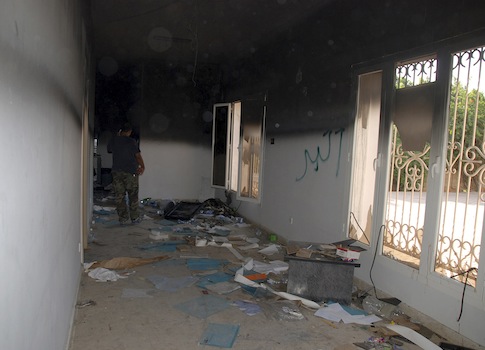
Gutted U.S. consulate in Libya / AP

Documents obtained by Judicial Watch from their May 2014 Freedom of Information Act (FOIA) lawsuits filed against the State Department and the Department of Defense revealed that the Obama administration knew about the attacks on the U.S. Consulate in Benghazi at least 10 days before the attack.

The documents also revealed that the DOD immediately reported the attacks on the consulate.

The documents included an August 2012 analysis predicting the failure of President Obama’s policy of a regime change in Syria as well as a warning about the rise of the Islamic State. The documents also included a confirmation that United States was aware of an arms shipment from Benghazi to Syria.

One of the documents from the DOD’s Defense Intelligence Agency dated September 12, 2012, the day after the attacks in Benghazi, lays out the details of the attack on the consulate and assesses that it was carefully planned by the terrorist group “Brigades of the Captive Omar Abdul Rahman.”

The group is known to have connections to the Muslim Brotherhood as well as  to al Qaeda. Rahman is serving a life sentence in prison for his role in the 1993 bombing of the World Trade Center.

The group’s goal was to “kill as many Americans as possible,” according to the documents, which were sent to Secretary of State Hillary Clinton, Defense Secretary Leon Panetta, the Joint Chiefs of Staff, and the National Security Council.

An October 2012 DOD document contained the first official document that the Obama administration knew of the shipment of weapons from the Benghazi to rebel forces in Syria.

Weapons from the former Libya military stockpiles were shipped from the port of Benghazi, Libya to the Port of Banias and the Port of Borj Islam, Syria. The weapons shipped during late-August 2012 were Sniper rifles, RPG’s, and 125 mm and 155 mm howitzers missiles.

During the immediate aftermath of, and following the uncertainty caused by, the downfall of the (Qaddafi) regime in October 2011 and up until early September of 2012, weapons from the former Libya military stockpiles located in Benghazi, Libya were shipped from the port of Benghazi, Libya to the ports of Banias and the Port of Borj Islam, Syria. The Syrian ports were chosen due to the small amount of cargo traffic transiting these two ports. The ships used to transport the weapons were medium-sized and able to hold 10 or less shipping containers of cargo.

The heavily redacted document did not reveal which weapons were sent to Syria

The DIA consistently warned of the deterioration of the situation in Iraq and warned that it creates an ideal situation for Al Qaeda to return to Mosul and Ramadi, according to an August 2012 report. During this time the U.S. was monitoring weapons flows from Libya to Syria. The agency warned of dire consequences but blocked out what most of what those consequences were.

The State Department produced a single document from a separate lawsuit that Judicial Watch had filed against the department. The document was created by Hillary Clinton’s office the morning after the attacks on the consulate in Benghazi and was sent throughout the State Department.

Neither the State Department nor Hillary Clinton have turned over any documents in regards to Benghazi or her personal email account that was used during her as well as other top aides during her time as Secretary of State.

Judicial Watch has filed multiple FOIA requests and has waited over two years for the documents that they have received.

“These documents show that the Benghazi cover-up has continued for years and is only unraveling through our independent lawsuits,” said Tom Fitton, president of Judicial Watch. “The Benghazi scandal just got a whole lot worse for Barack Obama and Hillary Clinton.”

How the Islamic Republic Is Manipulating the U.S.

May 19, 2015

How the Islamic Republic Is Manipulating the U.S., Front Page Magazine, May 19, 2015

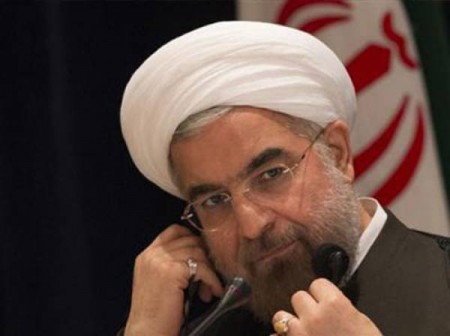
iran-s-rouhani-phones-pm-nawaz-after-soldier-s-killing-1395854702-4802-450x336

Rouhani and the moderate camp have persuaded Ayatollah Ali Khamenei that superficial diplomatic ties with the Obama administration will, in fact, empower the Islamic Republic, further its hegemonic ambitions, and raise Tehran’s economic status without the need for the Iranian leaders to give up on their revolutionary principles, anti-Americanism and anti-Semitism.

****************

There is a crucial Machiavellian (but not a strategic) tactical shift in the Islamic Republic’s foreign policy and its pursuit of regional preeminence.

First of all, Iranian leaders have realized that by superficially showing the Obama administration that the Islamic Republic is willing to restore diplomatic ties with his administration, they can in fact further advance their ideological and national interests.

Second, knowing that President Obama is desperate for a “historic” nuclear deal and the establishment of diplomatic ties with the Islamic Republic, Iranian leaders have played the role very well by attempting to satisfy President Obama’s empty goals.

Third, the ruling clerics of the Islamic Republic became cognizant of the fact that dealing with the Obama administration does not necessarily mean that they have to give up anything with respect to its domestic suppression, revolutionary Islamist principles, human rights abuses, regional hegemonic ambitions, anti-Americanism, hatred towards Israel, and foreign policy objectives.

The tactical shift, currently, is to satisfy President Obama’s personal and shallow objectives by allowing him to project that he is making historic moves (such speaking on the phone with the Iranian leaders), while simultaneously pursuing their own ideological objectives.

For example, most recently, Rouhani and the Obama administration agreed on opening new diplomatic offices in Tehran and Washington. For President Obama, opening diplomatic offices can be viewed as another “historic move” cited in his records or on his Wikipedia page. From the perspective of Iranian leaders, it is a crucial pillar for the advancement of Iran’s foreign policy and ideological objectives in the region without pressure from the US.

To pursue their objectives more efficiently, Iranian leaders have agreed to meet frequently with the diplomats at the highest level of the Obama administration, “negotiating,” and having some of their interactions publicly televised on American and Western media. In addition, the American and the Iranian flags are repeatedly shown next to each other in the high level meetings.

These moves, in fact, give legitimacy to the theocratic regime to further its ambitions.

The president was also delighted to make another “historic move” by speaking on the phone with his Iranian counterpart, President Hassan Rouhani. (One would wonder what a great accomplishment it is to pick up a phone and call another president.)

Washington and Tehran broke diplomatic ties in 1979. After the hostage crisis, high American officials and diplomats have not set foot on the Iranian soil due to Iran’s continuous violation of international norms and anti-Americanism.

Nevertheless, President Obama and Secretary of State John Kerry have decided to turn a blind eye on Iran’s egregious human rights abuses, aggressiveness and violations of international laws.

In another shallow move, Kerry claimed to be proud to set foot on Iranian “territory.” He met with Iran’s Foreign Minister, Mohammad Javad Zarif, at the residence of the Iranian ambassador to the United Nations, Gholamali Khoshroo, in New York.

Instead of attempting to change the behavior of the Ayatollahs and their revolutionary principles, President Obama and Kerry are satisfied with these superficial “historic moves.”

Since Iran’s political establishments and policies are driven, not solely by national and geopolitical interests, but also by ideological Islamist (Shiite) principles, hardliners and the office of the Supreme Leader will always view a real rapprochement with the US as taboo.

Restoring full diplomatic ties can also be analyzed as betraying the revolutionary principles of the Islamic Republic, which were based on anti-Americanism, as well as their opposition to Western models of socio-political and socio-economic landscapes.

From the perspective of Iran’s Supreme Leader, Ayatollah Ali Khamenei — who has the final say in foreign policy decisions — genuine diplomatic ties with the US will lead to the empowerment of Iranian civil society and secular factions. From the prism of the senior cadre of the IRGC, relationships with the American government might lead to the opening of the Iranian market, endangering the economic monopoly of IRGC institutions.

On the other hand, Rouhani and his technocrat team, who share the same objectives with the hardliners and want to preserve the interests of the Islamic Republic, came to the realizations that satisfying President Obama’s superficial and shallow objectives of “historic moves,” can indeed assist them in advancing their ambitions.

In conclusion, similar to the ongoing nuclear negotiations, Rouhani and the moderate camp have persuaded Ayatollah Ali Khamenei that superficial diplomatic ties with the Obama administration will, in fact, empower the Islamic Republic, further its hegemonic ambitions, and raise Tehran’s economic status without the need for the Iranian leaders to give up on their revolutionary principles, anti-Americanism and anti-Semitism.

Iran and suspension of disbelief

May 8, 2015

Iran and suspension of disbelief, Israel Hayom, Yoram Ettinger, May 8, 2015

The term “suspension of disbelief” — coined in 1817 by the philosopher Samuel Taylor Coleridge — refers to a willingness to suspend one’s critical faculties and believe the unbelievable; sacrificing reality, common sense, doubt and complexity on the altar of a pretend reality, convenience and oversimplification; infusing a semblance of truth into an untrue narrative.

U.S. President Jimmy Carter’s policy toward Iran in 1977-1979 was characterized by suspension of disbelief: energizing the Ayatollah Ruhollah Khomeini while ignoring or underestimating his track record and his radical, supremacist and violent worldview. The betrayal of the Shah transformed Tehran from “the U.S. policeman in the Gulf” to the worst enemy of the U.S.

Currently, the suspension of disbelief undermines the U.S. posture of deterrence and vital U.S. national security and commercial interests. It was demonstrated by U.S. President Barack Obama, who — irrespective of Middle East reality — referred to the brutally intolerant, terror-driven, anti-U.S., anti-infidel, repressive, tumultuous Arab tsunami as the “Arab Spring.” He said it was “casting off the burdens of the past,” “a story of self-determination,” “a democratic upheaval,” “a peaceful opposition,” “rejection of political violence” and “a transition toward [multi-sectarian, multi-ethnic] democracy.”

Suspension of disbelief, coupled with the ayatollahs’ mastery of ‘taqiyya’ (Islam-sanctioned double-talk and deception), is what led U.S. Secretary of State John Kerry to assert on November 24, 2013 that “Iran’s Foreign Minister [Mohammad Javad] Zarif emphasized that they don’t intend to acquire nuclear weapons, and Iran’s supreme leader has indicated that there is a ‘fatwa’ [an authoritative religious ruling] which forbids them to do this.”

In an April 7, 2015 NPR interview, Obama made a reality-stretching assumption which underlines the Iran policy: “If in fact Iran is engaged in international business … then in many ways it makes it even harder for them to engage in behaviors that are contrary to international norms. … It is possible that if we sign this nuclear deal, we strengthen the hand of the more moderate forces in Iran.”

Rebutting Obama’s remarks, Amir Taheri, a leading authority on Iran, wrote: “Hope is not a sufficient basis for a strategy. … [The relatively moderate former President Akbar Hashemi] Rafsanjani has little chance of surviving a direct clash with [Supreme Leader Ayatollah Ali] Khamenei.

The Saudi frustration with U.S. policy on Iran — shared by all pro-U.S. Arab regimes — was expressed on April 25, 2015 by the opinion editor of the prestigious Saudi daily Asharq Al-Awsat, which echoes the position of the House of Saud: “While the U.S. considers the ayatollahs a legitimate partner to negotiation, Saudi Arabia and other Persian Gulf states are in a state of war with Iran, which is the main source of chaos in the region.” The editor-in-chief of the Saudi daily added: “Has the axis of evil collapsed to the extent that President Obama is courting one of its key members?! Isn’t this the same Tehran that has posed a clear and present danger to the Gulf states for the past 36 years?!”

• An agreement is not the goal, but a tool to achieve the real goal.

• Transforming an agreement to a goal undermines the real goal.

• Details of an agreement are less critical than the details of the ayatollahs’ 36-year track record of supremacist, apocalyptic and megalomaniacal violence, martyrdom, sponsorship of global Islamic terrorism, subversion of pro-U.S. Arab regimes, repression, anti-U.S. hate education- and policies, a systematic noncompliance with agreements and mastery of concealment.

• Such a track record warrants a “guilty until proven innocent” approach.

• Preconditioning an agreement upon a dramatic change in the conduct of the rogue, anti-U.S. ayatollahs would be “a poison pill” to a bad deal, but a vitamin to a good deal.

• A “bad deal” would nuclearize Iran; “no deal” would allow the U.S. to choose the ways and means to prevent Iran’s nuclearization.

• Nuclear capabilities would extend the life of the repressive, rogue ayatollah regime, precluding any hope for civil liberties or home-induced regime change.

• An agreement — not preconditioned upon the transformation of the ayatollahs — would compound their clear and present threat to vital U.S. interests.

• The transformation of the nature of the ayatollahs — as a precondition to an agreement — would prevent the nuclearization of the ayatollahs.

• Precluding the option of military pre-emption has strengthened and radicalized the rogue ayatollahs, and could lead to a nuclear war.

• Misrepresenting the option of military pre-emption as war defies reality, since it should be limited to surgical — no troops on the ground — air and naval bombings of critical parts of Iran’s nuclear infrastructure from U.S. bases in Bahrain, Qatar, Saudi Arabia, Oman and the Indian Ocean, or aircraft carriers.

• A U.S. military option forced Iran to end the 1980-1988 war against Iraq, convinced Libya to give away its nuclear infrastructure in 2003, and led Iran to suspend its nuclear development in 2003.

• “Ironclad” supervision and intelligence failed to detect the nuclearization of the USSR, China, Pakistan, India and North Korea.

• Unlike the USSR, which was deterred by Mutual Assured Destruction, the apocalyptic ayatollahs would be energized by MAD-driven martyrdom.

• The zeal to strike a deal has led to a U.S. retreat from six U.N. Security Council Resolutions, which aimed to prevent Iran’s nuclearization.

• A nuclear Iran, which celebrates “Death to America Day,” would devastate cardinal U.S. interests: toppling the oil-producing Arab regimes (impacting supply and price of oil) and other pro-U.S. Arab regimes; intensifying Islamic terrorism, globally and on the U.S. mainland; agitating Latin America; collaborating with North Korea; cooperating with Russia and destabilizing Africa and Asia.

• The track record of the ayatollahs on the one hand, and compliance with agreements on the other hand, constitute an oxymoron.

• Suspension of disbelief, in the case of Iran’s nuclearization, entails overlooking facts that highlight the implausibility of a viable agreement with the ayatollahs, thus damaging crucial U.S. interests and fueling a nuclear war.

Khamenei Smashes Terms of Nuclear Agreement

April 12, 2015

Khamenei Smashes Terms of Nuclear Agreement, Clarion ProjectRyan Mauro, April 12, 2015

(Obama demands, don’t mention Iran’s mumblings about his once in a lifetime deal. Partisan wrangling must stop!– DM)

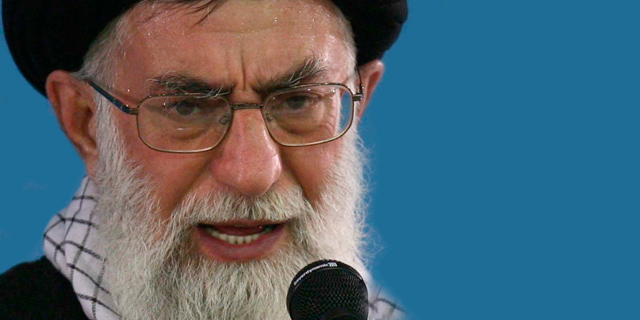
Iran-Ayatollah-Khamenei-HP_3Iranian Supreme Leader Ayatollah Kamenei (Photo: © Reuters)

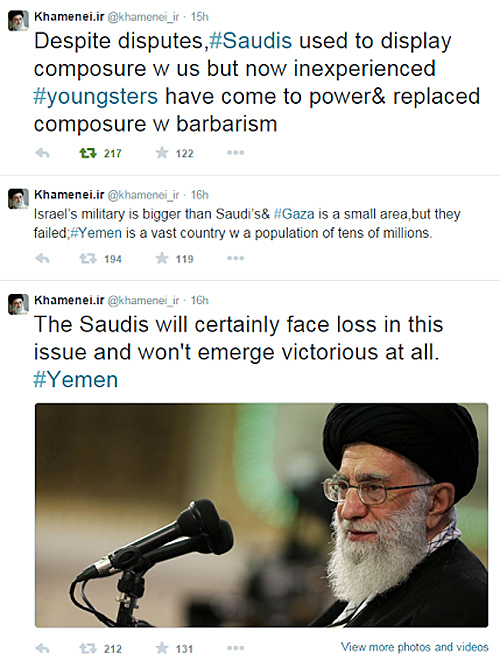
Khamenei’s accusations make Saudi Arabia a legitimate target under any understanding of jihad. He even went so far as to say the Saudis’ actions are equivalent to Israel’s so-called “genocide” in Gaza. This implies that a violent jihad against Saudi Arabia is as justifiable as one against Israel.

Iran believes that these end times prophesies correlate to the death of Saudi King Abdullah, the Houthis’ overthrow of the Yemeni government, the civil war in Syria, Saudi military action and the fierce fighting in Iraq. The regime sees the confluence of all these crises as beyond the realm of coincidence and signaling the imminent arrival of the “Hidden Imam” which will herald military victory for Iran.

Before the “Hidden Imam” can arrive, two other condition must be fulfilled: instability in Saudi Arabia and the march of a prophetic figure titled “Yamani” who will lead Shiite forces from Yemen into Mecca. The Houthis recently pledged to invade Saudi territory, capture Mecca and overthrow the royal family in Riyadh. They were likely referring to this prophecy.

“We’re not going to respond to every public statement made by Iranian officials or negotiate in public,” said State Department spokesman Jeff Rathke during a daily press briefing.

********************

Iranian Supreme Leader Ayatollah Khamenei ended his eerie silence since the nuclear framework agreement was announced with a fiery speech accompanied with “Death to America” chants. Khamenei essentially smashed the viability of the nuclear framework to pieces, signalled a major escalations in the war in Yemen and essentially endorsed a violent jihad against the Saudi royal family.

Wishful thinkers can’t dismiss the speech as theater for a domestic audience. Khamenei tweeted highlights in English to make sure the world, especially Americans, saw them. The threats and demands are so unequivocal that failing to follow through would sacrifice his entire credibility and prestige.

The Iranian Supreme Leader is unsatisfied with the nuclear framework agreement even though it generously permits Iran to retain the ability to produce nuclear weapons while getting major sanctions relief.

First, he said that the fact sheet published by the U.S. contains lies and does not reflect what Iran agreed to. The statement obliges the regime to seek significant revisions shortly after it gave President Obama the go ahead to make a high-profile victory lap.

Khamenei’s demands are inescapably incompatible with America’s requirements for a deal.

First, Iran is demanding that all sanctions be lifted on the first day that a final deal is signed. The framework only agrees to lift sanctions in phases and only those related to nuclear activity, not terrorism or human rights. Doing so would unfreeze the assets of individuals and entities involved in terrorism around the world, sparking a massive growth in Iran’s terrorist apparatus and proxy warfare.

The inherently flawed hope by the West that “moderate” President Rouhani and other Iranian figures can reign in Khamenei can be immediately ruled out, since Rouhani said the same exact thing.

Iran-Khamenei-Nuke-Tweets

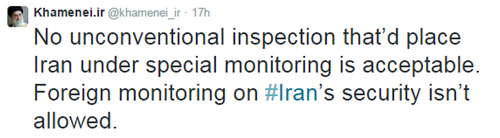
Second, Iran is insisting that there will be no “unconventional,” “special” or “foreign” inspections or monitoring. In other words, Iran will not be subject to exceptionally intrusive inspections. Khamenei’s tweets do not specify Iran’s standards, but it is clear that Iran does not intend to give the IAEA unlimited access.

Iran-Khamenei-Rejects-Inspections-Tweets

This is almost definitely a reference to military sites, to which Iran consistently says it has the option of denying access. Iran wants the ability to deny access to any location by declaring it a military institution.

This is how Iran denies access to the critical Parchin site, where damning evidence may exist to prove that Iran conducted major nuclear weapons research until at least 2003. An Iranian opposition group identified an alleged nuclear site in February that is within a military compound. It is claimed that the facility is used for uranium enrichment and the production of advanced centrifuges.

Notice the language of the tweets, which was reported to be equally non-compromising in Farsi. There is no wiggle room. Khamenei would have left some ambiguity if he was willing to budge. If you believe this is just talk, then you must believe that Khamenei made the calculated decision to cause an easily avoidable self-inflicted wound for no reason.

Another flurry of tweets related to the war in Yemen, where Iran is backing the Shiite Houthi rebels who have overthrown the government.

A U.S.-supported coalition of Sunni countries intervened militarily to support President Hadi and stop Iran from threatening the strategic Bab al-Mandeb Strait. This alliance includes Saudi Arabia, Egypt, Bahrain, Qatar, Kuwait, the United Arab Emirates, Jordan, Morocco, Turkey, Pakistan and Sudan. The last two are especially significant because of their close ties to Iran. Separately, Al-Qaeda is gaining ground in Yemen and the Islamic State (ISIS) is rising up as a competitor.

Interestingly, the tweets only threatened Saudi Arabia and did not mention any of these other participants by name. Khamenei stopped just short of a formal declaration of jihad, instead laying out the justification for it.

Iran-Khamenei-Yemen-1-Tweets
Iran-Khamenei-Yemen-2-Tweets

Khamenei’s accusations make Saudi Arabia a legitimate target under any understanding of jihad. He even went so far as to say the Saudis’ actions are equivalent to Israel’s so-called “genocide” in Gaza. This implies that a violent jihad against Saudi Arabia is as justifiable as one against Israel.

Don’t be comforted by Khamenei’s mentioning of prosecuting Saudi leaders in international courts. This is not meant to substitute jihad. Khamenei is making a point about how blatant the Saudi crimes are. He’s not even saying that this is Iran’s chosen course of action.

This comes as Iran dispatches two ships to the front in Yemen, including a destroyer to “safeguard naval routes” — meaning it will challenge the challenge the Saudi-Egyptian naval blockade.

Iran sent a flotilla to Bahrain in 2011 after Saudi and Emirati forces intervened to stomp out a revolution against the Sunni monarchy. The regime blinked at the last moment when the Arabs made it clear they would use force to stop it. However, the Yemen conflict has significant differences that Khamenei’s tweets help explain.

Khamenei is signaling that unprecedented hostilities with Saudi Arabia will now commence. The previous Saudi leaders, he says, could be dealt with. The new Saudi King and his circle must be handled more toughly.

However, Iran orchestrated massive terrorist attacks on Saudi interests even under the previous “composed” leaders, a campaign that put the U.S. economy and homeland at risk.

For example, in 2011, the U.S. prevented an Iranian Revolutionary Guards’ plot to assassinate the Saudi ambassador in Washington, D.C. by blowing up a restaurant, which inevitably would have taken the lives of American citizens as well. The scheme involved hiring a Mexican drug cartel to perpetrate the attack, along with bombings of the Israeli embassy in D.C. and the Israeli and Saudi embassies in Argentina.

In 2012, Iran launched a cyber attack on the Saudi Aramco oil company in response to the country’s policies in Bahrain and Syria. Aramco said the hackers tried to take down the country’s oil and gas production (which failed), but they did erase the data on 30,000 computers, three-fourths of the corporate computers.

Khamenei says that the new Saudi leadership is committing far worse crimes, so we should expect a far worse response.

We must also remember the prophecies cited by the Iranian regime.  Iran believes that these end times prophesies correlate to the death of Saudi King Abdullah, the Houthis’ overthrow of the Yemeni government, the civil war in Syria, Saudi military action and the fierce fighting in Iraq. The regime sees the confluence of all these crises as beyond the realm of coincidence and signaling the imminent arrival of the “Hidden Imam” which will herald military victory for Iran.

Before the “Hidden Imam” can arrive, two other condition must be fulfilled: instability in Saudi Arabia and the march of a prophetic figure titled “Yamani” who will lead Shiite forces from Yemen into Mecca. The Houthis recently pledged to invade Saudi territory, capture Mecca and overthrow the royal family in Riyadh. They were likely referring to this prophecy.

Khamenei’s speech wasn’t the typical bluster we are used to hearing from Islamist radicals and dictators. The timing, language and high-profile nature makes it very significant.

Even though the U.S. State Dept. responded by saying that sanctions against Iran would be removed gradually based on verification that Iran had kept its commitments, its response lacked conviction:

“We’re not going to respond to every public statement made by Iranian officials or negotiate in public,” said State Department spokesman Jeff Rathke during a daily press briefing.

Ayatollah Khamenei Outlines Requirements of Final Iran Nuclear Deal

April 9, 2015

Ayatollah Khamenei Outlines Requirements of Final Iran Nuclear Deal, Tasnim News Agency (Iranian), April 9, 2015

(All bold face print is from the original. — DM)

139401201524404185070453

TEHRAN (Tasnim) – Supreme Leader of the Islamic Revolution Ayatollah Seyed Ali Khamenei on Thursday defined the main points that a final nuclear deal between Iran and world powers should involve, but refused to adopt a stance on the Lausanne statement that entails no binding commitment.

Addressing a gathering in Tehran on Thursday, Ayatollah Khamenei said he has not taken a position on a statement released by Iran and the Group 5+1 (Russia, China, the US, Britain, France and Germany) after the most recent round of nuclear talks in the Swiss city of Lausanne, because nothing has been still agreed upon, nor have the parties reached any binding agreement.

“What has happened so far does not guarantee either the principle of an agreement, or the negotiations that lead to an agreement or even the content of an agreement, and it does not even guarantee that these talks would result in a deal, so congratulation has no meaning,” the Leader said.

The comments came after Iran and the six powers on April 2 reached a framework nuclear agreement after more than a week of intensive negotiations in Lausanne, Switzerland, with both sides committed to push for a final, comprehensive accord until the end of June.

Ayatollah Khamenei then reaffirmed strong support for a deal that respects the Iranian nation’s dignity, and rejected as “untrue” the reports on his opposition to any agreement.

The Leader, however, underlined that “no deal is better than a bad deal.”

Imam Khamenei then explained that he has only outlined the “general issues, the main guidelines, frameworks and red lines” regarding the nuclear talks and has not specified the details.

“I am not indifferent to the negotiations, but have not interfered in the details of the talks so far, and will not interfere in future either,” the Leader stressed.

The Supreme Leader then pointed to the unreliable nature of the US, an obvious sign of which he said was a biased fact sheet that Washington issued only two hours after the Lausanne statement was declared.

“Drafting such a statement (fact sheet) within two hours is not possible, so they (Americans) had been busy preparing a flawed and wrong statement contrary to the content of the talks at the same time that they were negotiating with us.”

The Leader further called on the country’s negotiators to hold consultations with the critics of the Lausanne statement to better deal with the talks, something known as “rapport” among Iranians.

Imam Khamenei once again made it clear that the talks with the US revolve only around the nuclear issue and nothing else, but at the same time noted that such nuclear negotiations provide an experience to test the possibility of talking on other subjects if Washington puts aside objections.

But, the Leader added, if the US keeps raising objections, Iran’s experience of mistrust of the US will be corroborated.

Commenting on the main points that have to be stipulated in a possible final nuclear deal, Ayatollah Khamenei pointed to the removal of anti-Iran sanctions all at once, adding, “This issue is very important and the sanctions should be completely terminated at the very day of the agreement.”

“If the removal of sanctions is to be conditioned by a new process, the fundamental of negotiations will be nonsense, because the purpose of the talks is lifting of the sanctions,” the Leader said.

The Supreme Leader also categorically rejected foreign access to the country’s “security and defensive” sectors under the pretext of nuclear monitoring.

Imam Khamenei said Iran’s military capabilities must be upheld and strengthened day by day, stressing that Iran’s backing for its “brothers” in the resistance front in different regions should never be diminished.

Moreover, the Leader voiced opposition to any deal that subjects Iran to “unconventional” monitoring and would make it a special case in the world, underlining that monitoring of Iran’s peaceful nuclear program should be conventional, like the other countries.

Iran’s “scientific and technical developments in different dimensions” was another requirement that the Leader emphasized a deal must include.

Ayatollah Khamenei finally said the responsibility lies with the country’s negotiators to fulfill those necessary demands in the talks, calling on them to “find the correct ways of negotiations” by using the view points of the informed and reliable individuals and listening to the critics.

COLUMN ONE: The diplomatic track to war

April 3, 2015

COLUMN ONE: The diplomatic track to war, Jerusalem Post, Caroline Glick, April 4, 2015

Iran negotiationsIran negotiations. (photo credit:REUTERS)

No one trusts Washington when Obama claims that he is committed to the security of Israel and the US’s Sunni allies in the region.

Iran is far more powerful than the PLO. But the Americans apparently believe they are immune from the consequences of their leaders’ policies. This is not the case for Israel or for our neighbors. We lack the luxury of ignoring the fact that Obama’s disastrous diplomacy has brought war upon us. Deal or no deal, we are again about to be forced to pay a price to maintain our freedom.

********************

Through their nuclear diplomacy, Obama and his comrades started the countdown to war.

The world powers assembled at Lausanne, Switzerland, with the representatives of the Islamic Republic may or may not reach a framework deal regarding Iran’s nuclear program. But succeed or fail, the disaster that their negotiations have unleashed is already unfolding. The damage they have caused is irreversible.

US President Barack Obama, his advisers and media cheerleaders have long presented his nuclear diplomacy with the Iran as the only way to avoid war. Obama and his supporters have castigated as warmongers those who oppose his policy of nuclear appeasement with the world’s most prolific state sponsor of terrorism.

But the opposite is the case. Had their view carried the day, war could have been averted.

Through their nuclear diplomacy, Obama and his comrades started the countdown to war.

In recent weeks we have watched the collapse of the allied powers’ negotiating positions.

They have conceded every position that might have placed a significant obstacle in Iran’s path to developing a nuclear arsenal.

They accepted Iran’s refusal to come clean on the military dimensions of its past nuclear work and so ensured that to the extent UN nuclear inspectors are able to access Iran’s nuclear installations, those inspections will not provide anything approaching a full picture of its nuclear status. By the same token, they bowed before Iran’s demand that inspectors be barred from all installations Iran defines as “military” and so enabled the ayatollahs to prevent the world from knowing anything worth knowing about its nuclear activities.

On the basis of Iran’s agreement to ship its stockpile of enriched uranium to Russia, the US accepted Iran’s demand that it be allowed to maintain and operate more than 6,000 centrifuges.

But when on Monday Iran went back on its word and refused to ship its uranium to Russia, the US didn’t respond by saying Iran couldn’t keep spinning 6,000 centrifuges. The US made excuses for Iran.

The US delegation willingly acceded to Iran’s demand that it be allowed to continue operating its fortified, underground enrichment facility at Fordow. In so doing, the US minimized the effectiveness of a future limited air campaign aimed at significantly reducing Iran’s nuclear capabilities.

With this broad range of great power concessions already in its pocket, the question of whether or not a deal is reached has become a secondary concern. The US and its negotiating partners have agreed to a set of understanding with the Iranians. Whether these understandings become a formal agreement or not is irrelevant because the understandings are already being implemented.

True, the US has not yet agreed to Iran’s demand for an immediate revocation of the economic sanctions now standing against it. But the notion that sanctions alone can pressure Iran into making nuclear concessions has been destroyed by Obama’s nuclear diplomacy in which the major concessions have all been made by the US.

No sanctions legislation that Congress may pass in the coming months will be able to force a change in Iran’s behavior if they are not accompanied by other coercive measures undertaken by the executive branch.

There is nothing new in this reality. For a regime with no qualms about repressing its society, economic sanctions are not an insurmountable challenge. But it is possible that if sanctions were implemented as part of a comprehensive plan to use limited coercive means to block Iran’s nuclear advance, they could have effectively blocked Iran’s progress to nuclear capabilities while preventing war. Such a comprehensive strategy could have included a proxy campaign to destabilize the regime by supporting regime opponents in their quest to overthrow the mullahs. It could have involved air strikes or sabotage of nuclear installations and strategic regime facilities like Revolutionary Guards command and control bases and ballistic missile storage facilities. It could have involved diplomatic isolation of Iran.

Moreover, if sanctions were combined with a stringent policy of blocking Iran’s regional expansion by supporting Iraqi sovereignty, supporting the now deposed government of Yemen and making a concerted effort to weaken Hezbollah and overthrow the Iranian-backed regime in Syria, then the US would have developed a strong deterrent position that would likely have convinced Iran that its interest was best served by curbing its imperialist enthusiasm and setting aside its nuclear ambitions.

In other words, a combination of these steps could have prevented war and prevented a nuclear Iran. But today, the US-led capitulation to Iran has pulled the rug out from any such comprehensive strategy. The administration has no credibility. No one trusts Obama to follow through on his declared commitment to prevent Iran from becoming a nuclear power.

No one trusts Washington when Obama claims that he is committed to the security of Israel and the US’s Sunni allies in the region.

And so we are now facing the unfolding disaster that Obama has wrought. The disaster is that deal or no deal, the US has just given the Iranians a green light to behave as if they have already built their nuclear umbrella. And they are in fact behaving in this manner.

They may not have a functional arsenal, but they act as though they do, and rightly so, because the US and its partners have just removed all significant obstacles from their path to nuclear capabilities. The Iranians know it. Their proxies know it. Their enemies know it.

As a consequence, all the regional implications of a nuclear armed Iran are already being played out. The surrounding Arab states led by Saudi Arabia are pursuing nuclear weapons. The path to a Middle East where every major and some minor actors have nuclear arsenals is before us.

Iran is working to expand its regional presence as if it were a nuclear state already. It is brazenly using its Yemeni Houthi proxy to gain maritime control over the Bab al-Mandab, which together with Iran’s control over the Straits of Hormuz completes its maritime control over shipping throughout the Middle East.

Israel, Jordan, Egypt, Saudi Arabia, Sudan and Eritrea, and their global trading partners will be faced with the fact that their primary maritime shipping route to Asia is controlled by Iran.

With its regional aggression now enjoying the indirect support of its nuclear negotiating partners led by the US, Iran has little to fear from the pan-Arab attempt to dislodge the Houthis from Aden and the Bab al-Mandab. If the Arabs succeed, Iran can regroup and launch a new offensive knowing it will face no repercussions for its aggression and imperialist endeavors.

Then of course there are Iran’s terror proxies.

Hezbollah, whose forces now operate openly in Syria and Lebanon, is reportedly active as well in Iraq and Yemen. These forces behave with a brazenness the likes of which we have never seen.

Hamas too believes that its nuclear-capable Iranian state sponsor ensures that regardless of its combat losses, it will be able to maintain its regime in Gaza and continue using its territory as a launching ground for assaults against Israel and Egypt.

Iran’s Shiite militias in Iraq have reportedly carried out heinous massacres of Sunnis who have fallen under their control and faced no international condemnation for their war crimes, operating as they are under Iran’s protection and sponsorship. And the Houthis, of course, just overthrew a Western-backed government that actively assisted the US and its allies in their campaign against al-Qaida.

For their proxies’ aggression, Iran has been rewarded with effective Western acceptance of its steps toward regional domination and nuclear armament.

Hezbollah’s activities represent an acute and strategic danger to Israel. Not only does Hezbollah now possess precision guided missiles that are capable of taking out strategic installations throughout the country, its arsenal of 100,000 missiles can cause a civilian disaster.

Hezbollah forces have been fighting in varied combat situations continuously for the past three years. Their combat capabilities are incomparably greater than those they fielded in the 2006 Second Lebanon War. There is every reason to believe that these Hezbollah fighters, now perched along Israel’s borders with Lebanon and Syria, can make good their threat to attack and hold fixed targets including border communities.

While Israel faces threats unlike any we have faced in recent decades that all emanate from Western-backed Iranian aggression and expansionism carried out under a Western-sanctioned Iranian nuclear umbrella, Israel is not alone in this reality. The unrolling disaster also threatens the moderate Sunni states including Jordan, Egypt, Saudi Arabia, Kuwait and the United Arab Emirates. The now regional war in Yemen is but the first act of the regional war at our doorstep.

There are many reasons this war is now inevitable.

Every state threatened by Iran has been watching the Western collapse in Switzerland.

They have been watching the Iranian advance on the ground. And today all of them are wondering the same thing: When and what should we strike to minimize the threats we are facing.

Everyone recognizes that the situation is only going to get worse. With each passing week, Iran’s power and brazenness will only increase.

Everyone understands this. And this week they learned that with Washington heading the committee welcoming Iran’s regional hegemony and nuclear capabilities, no outside power will stand up to Iran’s rise. The future of every state in the region hangs in the balance. And so, it can be expected that everyone is now working out a means to preempt and prevent a greater disaster.

These preemptive actions will no doubt include three categories of operations: striking Hezbollah’s missile arsenal; striking the Iranian Navy to limit its ability to project its force in the Bab al-Mandab; and conducting limited military operations to destroy a significant portion of Iran’s nuclear installations.

Friday is the eve of Passover. Thirteen years ago, Palestinian terrorists brought home the message of the Exodus when they blew up the Seder at Netanya’s Park Hotel, killing 30, wounding 140, and forcing Israel into war. The message of the Passover Haggada is that there are no shortcuts to freedom. To gain and keep it, you have to be willing to fight for it.

That war was caused by Israel’s embrace of the notion that you can bring peace through concessions that empower an enemy sworn to your destruction. The price of that delusion was thousands of lives lost and families destroyed.

Iran is far more powerful than the PLO. But the Americans apparently believe they are immune from the consequences of their leaders’ policies. This is not the case for Israel or for our neighbors. We lack the luxury of ignoring the fact that Obama’s disastrous diplomacy has brought war upon us. Deal or no deal, we are again about to be forced to pay a price to maintain our freedom.

Iran’s remarkable achievement

April 3, 2015

Iran’s remarkable achievement, Washington PostMichael Gerson, April 3, 2015

Will Iran continue to hold U.S. policy in the Middle East hostage — causing the United States to hush its reactions to Iranian aggression for fear the regime will walk out of a nuclear deal? This is precisely what American friends in the region fear. The real test — for allies and for members of Congress — will be whether Obama can accompany a final nuclear agreement with a much more aggressive resistance to Iranian ambitions in places such as Syria, Iraq and Yemen. Otherwise, Iran will simply use the wealth that comes from lifted sanctions to cause more havoc.

******************

Whatever else the Obama administration accomplished in the Iran nuclear framework, it did a good job keeping the bar of expectations low and then clearing it.

Many assumed various provisions would last 10 years or less; most are for 15 years or more. Many expected the number of operating centrifuges to exceed 6,000; the target is lower. Many expected the total amount of fissile material Iran is allowed to keep to be higher than the agreed 300 kilograms. These achievements created an initial halo of success.

But as former national security adviser Stephen Hadley emphasized to me, “things that seem too good to be true usually are.” In the days of Cold War arms-control agreements, Soviet negotiators would join in the announcement of notional goals. Later, they would claim that some elements would not fly with Moscow. The strategy was to pocket elements of consensus, then use this as the starting point for new negotiations and additional U.S. concessions.

Tehran can be expected to use every ambiguity in the agreement to its advantage as goals are converted into the language of a final deal. Disagreements are already emerging between the Obama administration and the Iranians on how and when sanctions will be lifted in exchange for compliance, with Foreign Minister Mohammad Javad Zarif essentially accusing the White House of deception.

Given the months of hard negotiations ahead, the self-congratulatory tone of President Obama’s speech announcing the agreement was extremely premature. “Depending on what we learn about critical details,” says professor Peter Feaver of Duke University, “this is not spiking in the end zone. It is spiking on the 5-yard line.”

A number of issues seem murky. What becomes of all the fissile material Iran has apparently agreed to export? What is done with the decommissioned centrifuges and infrastructure to make sure they can’t be easily reinstalled during a breakout attempt? What is the pace and ordering of sanctions relief by the United States, the European Union and the United Nations? How fully will Iran be required to account for past military dimensions of its nuclear programs?

But the largest question will not be answered by the next stage of nuclear negotiations. Will this agreement give the Iranian regime cover for what it is currently doing in the Middle East — actively spreading its influence and threatening our allies? Negotiations on the nuclear issue have taken place in isolation from the ballistic missile issue, the terrorism issue and the regional destabilization issue.

For all the praise Obama is claiming, the Iranian regime counts the most remarkable achievement. It has engaged in nuclear negotiations with the United States while actively engaged in a regional conflict against American friends and proxies. Since Obama has prioritized the nuclear negotiations — the only alternative to which, he constantly reminds us, is war — other concessions have seemed small in comparison. Opposition to Bashar al-Assad has become muted, even as he crosses every blood-red line of brutality, to avoid disrupting relations with his Iranian patron. Human rights issues within Iran have become secondary to avoid giving offense. Obama has sometimes seemed more tolerant and empathetic toward Iranian positions than those of allies and partners such as Israel.

Will Iran continue to hold U.S. policy in the Middle East hostage — causing the United States to hush its reactions to Iranian aggression for fear the regime will walk out of a nuclear deal? This is precisely what American friends in the region fear. The real test — for allies and for members of Congress — will be whether Obama can accompany a final nuclear agreement with a much more aggressive resistance to Iranian ambitions in places such as Syria, Iraq and Yemen. Otherwise, Iran will simply use the wealth that comes from lifted sanctions to cause more havoc.

If Iran is treated as a normal nation simply because of its nuclear cooperation — if it interprets a deal as a green light for its actions in the region — neither our traditional allies nor members of Congress will sustain Obama’s nuclear agreement in the long term. And the support of Congress could be dramatically helpful in surrounding a deal with snapback sanctions and the pre-authorization of military force in the event of an Iranian breach.

To secure his nuclear deal with Iran, Obama must show resistance to Iranian aggression across the range of our relationship.