Posted tagged ‘Free world’

Time to delegitimize the UN

September 24, 2015

Time to delegitimize the UN, Israel Hayom, Judith Bergman, September 24, 2015

(The UN has already made numerous heroic efforts to delegitimize itself. Isn’t it finally time for free world nations to leave the UN, stop paying for it and establish a very different organization dedicated to furthering, rather than destroying, western culture? — DM)

The appointment of Saudi Arabia to head this important U.N. Human Rights Council panel displays, once more, how deeply corrupt and truly meaningless the U.N. system and the U.N. Human Rights Council in particular are in practice.

***********************

It was recently publicized that Saudi Arabia has been elected to chair the U.N. Human Rights Council panel in charge of appointing independent experts. According to the U.N. Watch independent monitoring group, Saudi Arabia was chosen to head the Consultative Group, a five-member group of ambassadors that has the power to select applicants from around the world for more than 77 positions dealing with human rights mandates. These include positions such as the U.N. special rapporteur on violence against women and experts for working groups on the issues of discrimination against women and the rights of migrants and religious minorities.

One does not quite know whether to laugh or cry at the appointment of one of the worst human rights offenders in the world to head the selection of such experts. Indeed, Michael Moller, director-general of the United Nations Office at Geneva, does look a little bit uneasy in the photo taken of him, as he shakes the hand of the Saudi ambassador to Geneva, Faisal bin Hassan Trad, at his appointment. It must have been difficult for this Danish-born diplomat, hailing from a Scandinavian country so intensely committed to the pursuit of justice and human rights, to hide a grimace. After all, he was appointing the ambassador of a country where public beheadings are not the actions of criminals or terrorist organization like Islamic State, but a regular working feature of the legal system, which is modeled according to Shariah law. Perhaps the thought of petrodollars made the handshake easier.

Saudi Arabia was first elected to the Human Rights Council in 2013, without any protests from the U.S. and the European Union.

The appointment of Saudi Arabia to head this important U.N. Human Rights Council panel displays, once more, how deeply corrupt and truly meaningless the U.N. system and the U.N. Human Rights Council in particular are in practice. What does it say about the Human Rights Council that it appoints a country that regularly beheads dozens of its own citizens, as well as several of the 9 million foreign workers who constitute over half the workforce and frequently work in slave-like conditions for their Saudi Arabian masters?

While such an appointment clearly undermines any minuscule remnant of credibility that the U.N. Human Rights Council may have left, it should give pause to those who still believe the U.N. can play any credible role in international relations. More than anything, it shows the depraved state of the self-appointed guardian of world human rights.

Unfortunately, it would appear that most human rights advocates do not care much about this appointment, as there has been precious little reaction from them worldwide. Even more disturbing, the same human rights advocates who are so quiet about this are extremely vocal about perceived human rights violations by Israel. It only proves, once more, that they do not truly care about human rights.

What is the innocent blogger Raif Badawi, who has been sentenced to 1,000 lashes in public and 10 years in a prison in Saudi Arabia, supposed to make of this appointment, other than that the international community apparently approves of such punishment for a man who blogged about freedom of speech?

We in Israel hardly have any illusions left when it comes to the U.N., yet we still expend a lot of effort in responding to various U.N. commissions of inquiry, as if anything they conclude carries any kind of meaning or weight. Perhaps it is finally time to create an alliance of nations, with Israel in its midst, to effectively lead a campaign of delegitimization of the U.N., based on that organization’s blatant depravity and utter moral corruption. This is not something that Israel would be able to carry on its own, but although the number of decent nations in the world is shrinking fast, it is still not too late to find allies who might also have an interest in exposing the true face of the U.N. The organization is an expensive and obsolete bureaucratic monster, and there must be other states who would like to see it exposed and reformed.

Germany’s Muslim Demographic Revolution

August 31, 2015

Germany’s Muslim Demographic Revolution, The Gatestone Institute, Soeren Kern, August 31, 2015

  • The surge in Germany’s Muslim population — propelled by a wave of migration unprecedented since the Second World War — represents a demographic shift of epic proportions, one that critics of the country’s open-door immigration policy warn will change the face of Germany forever.
  • “There are 20 million refugees waiting at the doorstep of Europe.” — Johannes Hahn, EU Commissioner for European Neighbourhood Policy and Enlargement Negotiations.
  • According to Aiman Mazyek, head of the Central Council of Muslims in Germany, attendance at many mosques has doubled in the past month alone.
  • A large number (40%) are from countries in the Balkans, including Albania and Kosovo. This implies that nearly half of those arriving in Germany are economic migrants, not refugees fleeing war zones. — Thomas De Maizière, German Interior Minister.
  • Muslim men residing in Germany routinely take advantage of the social welfare system by bringing two, three or four women from across the Muslim world to Germany, and then marrying them in the presence of an imam. Once in Germany the women request social welfare benefits, including the cost of a separate home for themselves and for their children, on the claim of being a “single parent with children.” — From an exposé broadcast by RTL television.
  • “For us today, what is at stake is Europe, the lifestyle of European citizens, European values, the survival or disappearance of European nations, and more precisely formulated, their transformation beyond recognition. Today, the question is not merely in what kind of a Europe we would like to live, but whether everything we understand as Europe will exist at all.” — Viktor Orbán, President of Hungary.

Germany’s Muslim population is set to skyrocket by more than 700,000 in 2015, pushing the total number of Muslims in the country to nearly 6 million for the first time.

The surge in Germany’s Muslim population — propelled by a wave of migration unprecedented since the Second World War — represents a demographic shift of epic proportions, one that critics of the country’s open-door immigration policy warn will change the face of Germany forever.

At a press conference on August 19, German Interior Minister Thomas de Maizière revealed that a record 800,000 migrants and refugees — the equivalent of nearly one percent of Germany’s total population — are expected to arrive in Germany in 2015, a four-fold increase over 2014. He said that 83,000 migrants had arrived in July alone, and that the figure for August would be higher still.

De Maizière said that although many of the migrants are from the Middle East and North Africa, a large number (40%) are from countries in the Balkans, including Albania and Kosovo. This implies that nearly half of those arriving in Germany are economic migrants, not refugees fleeing war zones.

1229According to German public broadcaster Deutsche Welle, the Berlin refugee center pictured here receives up to 2000 applications for asylum per day. (Image source: Deutsche Welle video screenshot)

Of the 800,000 migrants and refugees arriving in Germany in 2015, at least 80% (or 640,000) are Muslim, according to a recent estimate by the Central Council of Muslims in Germany (Zentralrat der Muslime in Deutschland, ZMD), a Muslim umbrella group based in Cologne. This estimate is not in dispute.

In addition to the newcomers, the natural rate of population increase of the Muslim community already living in Germany is approximately 1.6% per year (or 77,000), according to data extrapolated from a recent Pew Research Center study on the growth of the Muslim population in Europe.

Based on Pew projections, the Muslim population of Germany reached an estimated 5,068,000 by the end of 2014. The 640,000 Muslim migrants arriving in Germany in 2015, combined with the 77,000 natural increase, indicates that the Muslim population of Germany will jump by 717,000, to reach an estimated 5,785,000 by the end of 2015. This would leave Germany with the highest Muslim population in Western Europe.

By way of comparison, the surge in Germany’s Muslim population would be equivalent to the Muslim population of the United States increasing by 3 million in just one year.

Critics say that German officials, under pressure to solve Europe’s migration crisis, are ignoring the long-term consequences of taking in so many migrants from the Middle East and North Africa.

In addition to security concerns (Islamic radicals are almost certainly trying to enter Germany disguised as refugees), they say, the surge in Muslim immigration will accelerate the Islamization of Germany, a process that is already well under way.

Islam is the fastest growing religion in post-Christian Germany. This is evidenced by the fact that an increasing number of churches in Germany are being converted into mosques, some of which are publicly sounding calls to prayer (the adhan) from outdoor loudspeaker systems. The increase is such that some neighborhoods in Germany evoke the sights and sounds of the Muslim Middle East.

Islamic Sharia law is advancing rapidly throughout Germany, with Sharia courts now operating in all of Germany’s big cities. This “parallel justice system” is undermining the rule of law in Germany, experts warn, but government officials are “powerless” to do anything about it. At the same time, German judges are increasingly referring and deferring to Sharia law in German law courts.

Polygamy, although illegal under German law, is commonplace among Muslims in all major German cities. In Berlin, for example, it is estimated that fully one-third of the Muslim men living in the Neukölln district of the city have two or more wives.

According to an exposé broadcast by RTL, one of Germany’s leading media companies, Muslim men residing in Germany routinely take advantage of the social welfare system by bringing two, three or four women from across the Muslim world to Germany, and then marrying them in the presence of an imam (Muslim religious leader). Once in Germany the women request social welfare benefits, including the cost of a separate home for themselves and for their children, on the claim of being a “single parent with children.”

Although the welfare fraud committed by Muslim immigrants is an “open secret” costing German taxpayers millions of euros each year, government agencies are reluctant to take action due to political correctness, according to RTL.

Spiraling levels of violent crime perpetrated by shiftless immigrants from the Middle East and the Balkans have turned parts of German cities into “areas of lawlessness” — areas that are de facto “no-go” zones for police.

In Wuppertal, groups of bearded Muslim radicals calling themselves the “Sharia Police” have tried to enforce Islamic law on the streets by distributing yellow leaflets that explain the Islamist code of conduct in the city’s Sharia zones. In Hamburg, Muslim radicals have infiltrated dozens of primary and secondary schools, where they are imposing Islamic norms and values on non-Muslim students and teachers.

In Berlin, local officials have waived rules prohibiting religious dress in public buildings so that Muslim women can wear headscarves. In Bavaria, Muslim children are being exempted from mandatory visits to former concentration camps as part of Holocaust education programs.

In Bremen, city officials signed an agreement with the city’s 40,000-strong Muslim community. The agreement guarantees the protection of Muslim community properties, the approval of the construction of mosques with minarets and domes, the allotment of land for Muslim cemeteries, the supply of halal food at prisons and hospitals, the recognition of three Muslim holidays, Muslim representation in state institutions and other rights and privileges.

More than 700 German Muslims have joined the Islamic State and traveled to Syria and Iraq, and some of them have continued to receive welfare benefits from the German state while on the battlefields of the Middle East. Jihadists who have returned to Germany and pose an acute threat to national security threat are nevertheless eligible to receive benefits once again.

Germany is home to more than 7,000 Salafists who adhere to a branch of radical Islam that is vehemently opposed to Germany’s democratic order. German officials say that 1,000 of these individuals are especially dangerous (some are believed to have joined sleeper cells) and could attack at any time.

At the same time, however, Salafists are allowed to openly proselytize on German streets to find new recruits and thereby increase their numbers. In a recent recruitment initiative, Salafists launched an unprecedented nationwide campaign, “A Koran in Every Home,” to distribute 25 million copies of the Koran, translated into the German language, to every household in Germany, free of charge.

And yet the guardians of German multiculturalism have been working overtime to silence critics of the rise of Islam in Germany. In Bavaria, for example, German activists opposed to the construction of a mega-mosque in Munich have been classified as “extremists” and are being monitored by German intelligence.

German media consistently accuse commentators on the rise of Islam of engaging in hate speech, in an underhanded effort to try to intimidate them into silence. A particular object of wrath is a very popular German-language website called Politically Incorrect (PI), which over the years has grown into a major information resource for people concerned about the spread of Islam in Germany. PI’s motto reads “Against the Mainstream, Pro-American, Pro-Israel, Against the Islamization of Europe.” Not surprisingly, German media elites want PI shut down.

It is quite possible that German Chancellor Angela Merkel — who recently admitted that German multiculturalism has failed — views mass immigration from the Muslim world as the solution to Germany’s collapsing birth rate, which is among the lowest in the world.

The German government expects the population to shrink from roughly 81 million today to 67 million in 2060, although Germany’s statistics office, Destatis, recently reported that high levels of immigration would cause the country’s population to shrink more slowly than previously expected.

A study by the Hamburg-based World Economy Institute has warned that the low birthrate threatens the long-term viability of the German economy. “No other industrial country is deteriorating at this speed despite the strong influx of young migrant workers,” the report said. “Germany cannot continue to be a dynamic business hub in the long-run without a strong jobs market.”

Germany will need to do a far better job of integrating immigrants if they are to be a net gain for the German economy. A recent study by the Cologne Institute for Economic Research showed that Muslim immigrants were more likely to be unemployed and living off the social welfare state than any other migrant group in Germany. The report said that root cause for the high unemployment rates is the lack of educational attainment and job training qualifications.

Meanwhile, the migration crisis shows no sign of abating. At a summit on migration held in Vienna on August 27, the EU Commissioner for European Neighbourhood Policy and Enlargement Negotiations, Johannes Hahn, said: “There are 20 million refugees waiting at the doorstep of Europe. Ten to 12 million in Syria, 5 million Palestinians, 2 million Ukrainians and about 1 million in the southern Caucasus.”

On August 21, Germany suspended the so-called Dublin Regulation — a law that requires people seeking refuge within the EU to do so in the first European country they reach — for asylum seekers from Syria. This means that Syrians reaching Germany will be allowed to stay while their applications are being processed. Critics say the move will encourage even more migrants to make their way to Germany.

Most Germans seem to be unfazed by what is happening to their country. An August 21 poll for German broadcaster ZDF showed that 60% of Germans thought their country could cope with the high number of refugees, and 86% said that Germany was a country of immigration.

In an interview with the newspaper Der Tagesspiegel, Aiman Mazyek, the head of the Central Council of Muslims in Germany, said that so many Muslims have been flowing into the country that attendance at many mosques has doubled in the past month alone. Commenting on the demographic revolution sweeping Germany, Mazyek summed it up with an understatement: “The number of Muslims in Germany will increase significantly.”

In nearby Hungary, President Viktor Orbán has been one of the few European heads of state to sound the alarm. “A year ago I said that we live in times when anything can happen, and I still say so today,” he said recently. “Who would have thought that Europe would not be capable of protecting its own borders against unarmed refugees?” He added:

“For us today, what is at stake is Europe, the lifestyle of European citizens, European values, the survival or disappearance of European nations, and more precisely formulated, their transformation beyond recognition. Today, the question is not merely in what kind of a Europe we would like to live, but whether everything we understand as Europe will exist at all.”

Into the fray: Iran- Reaping the storm that Barack sowed…

July 18, 2015

Into the fray: Iran- Reaping the storm that Barack sowed…, Jerusalem PostMARTIN SHERMAN,July 16, 2015

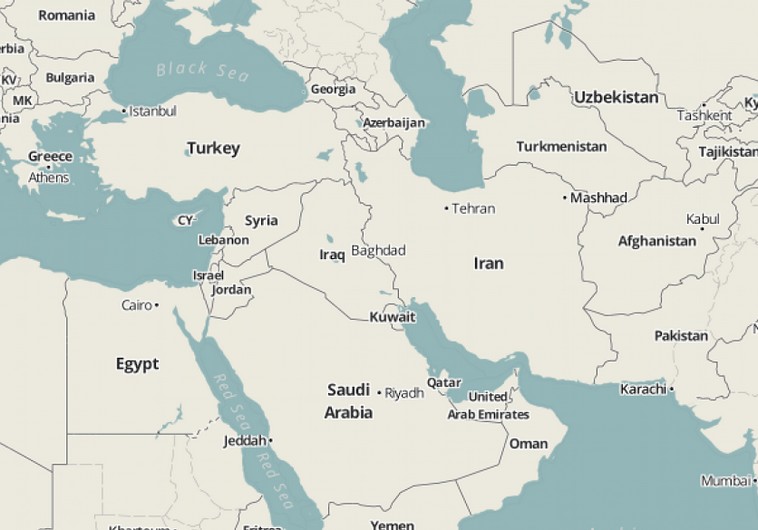
ShowImage (3)Map of Middle East. (photo credit:Courtesy)

It is through this Islamo-philic prism that the Obama administration’s attitude to, and execution of, its foreign policy must be evaluated – including its otherwise incomprehensible capitulation this week on Iran’s nuclear program.

********************

Obama is the first US president who genuinely conceives of Islam as not inherently opposed to American values or interests.

You’re absolutely right that John McCain has not talked about my Muslim faith – Barack Hussein Obama to ABC’s George Stephanopoulos, September 7, 2008

I also know that Islam has always been a part of America’s story Barack Hussein Obama, Cairo, June 4, 2009

Islam has always been part of AmericaBarack Hussein Obama, the White House, August 11, 2010

Islam has been woven into the fabric of our country since its founding Barack Hussein Obama, the White House, February 18, 2015

Barack Hussein Obama is the first US president who is explicitly and overtly unmoored, both cognitively and emotionally, from the moorings of America’s founding Judeo-Christian cultural heritage, and who genuinely conceives of Islam as not inherently opposed to American values or American interests.

A question of cultural affinity?

It is through this Islamo-philic prism that the Obama administration’s attitude to, and execution of, its foreign policy must be evaluated – including its otherwise incomprehensible capitulation this week on Iran’s nuclear program.

Almost two years ago, I wrote a column titled, “Will the West withstand the Obama presidency?” (11/28/2013). In it I warned: “For anyone who understands that the US Constitution is not a Shari’a-compliant document…

it should be alarmingly apparent that the Obama incumbency is a dramatic and disturbing point of inflection in the history of America and its Western allies… whose political practices and societal norms are rooted in Judeo-Christian foundations in a cultural rather than in any religious sense.”

There is little alternative explanation to account for the metamorphosis that has taken place in how the US has approached resolving the impasse with Tehran, as starkly laid out by two former secretaries of state, Henry Kissinger and George Shultz.

In a Wall Street Journal opinion piece, “The Iran Deal and Its Consequences” (April 7), they note that the negotiation has been turned “on its head.” As they point out: “For 20 years, three presidents of both major parties proclaimed that an Iranian nuclear weapon was contrary to American and global interests – and that they were prepared to use force to prevent it. Yet negotiations that began 12 years ago as an international effort to prevent an Iranian capability to develop a nuclear arsenal are ending with an agreement that concedes this very capability.”

Risible inspection mechanism

Even before the specifics of the risible inspection mechanism, which one Israeli minister aptly described as “worse than worthless,” Kissinger and Shultz laid out the difficulties that would render any extended inspection endeavor ineffective: “In a large country with multiple facilities and ample experience in nuclear concealment, violations will be inherently difficult to detect.”

With considerable prescience, they warn: “Devising theoretical models of inspection is one thing. Enforcing compliance, week after week, despite competing international crises and domestic distractions, is another. Any report of a violation is likely to prompt debate over its significance – or even calls for new talks with Tehran to explore the issue.

Envisaging the problems likely to arise in enforcing any agreement, they caution: “Compounding the difficulty is the unlikelihood that breakout will be a clear-cut event.

More likely it will occur… via the gradual accumulation of ambiguous evasions. When inevitable disagreements arise over the scope and intrusiveness of inspections, on what criteria are we prepared to insist and up to what point? If evidence is imperfect, who bears the burden of proof? What process will be followed to resolve the matter swiftly?”

Reminiscent of taqiya?

But even without the daunting generic difficulties described by Kissinger and Shultz, the inspection mechanism provided for in the nascent deal make a mockery of Obama’s contention (July 14): “… this deal is not built on trust; it is built on verification,” and, “Because of this deal, inspectors will also be able to access any suspicious location… [They] will have access where necessary, when necessary.”

One can hardly imagine a more grossly misleading representation of the deal – so much so that it is difficult not to find it strongly reminiscent of the Muslim tactic of taqiya (the religiously sanctioned deception of non-Muslims).

Indeed, immediately following the announcement of the agreement, Ben Rhodes, Obama’s deputy national security adviser, made a stunning admission to CNN’s Erin Burnett. Starkly contradicting the president’s contention of “access where necessary, when necessary,” Rhodes conceded, “We never sought in this negotiation the capacity for so-called anytime, anywhere,” which is diametrically opposed to the impression he conveyed in April this year when queried on this issue.

You couldn’t make this stuff up

For as it turns out, it provides the Iranians with ample warning of impending inspections on any suspected violation, and ample ability to forestall the definition of any given suspicious event as a possible violation.

Thus in the case of a suspected infringement in any undisclosed (to the international community) site, the Iranians will have at least 24 days’ notice. Moreover, inspectors will not be able to conduct surprise visits but will be required to “provide Iran the basis for such concerns and request clarification.” No kidding!!! But wait, there’s more.

If Iran’s explanations do not adequately assuage international concerns, inspectors “may request access to such locations” to make sure no illicit activity has occurred. But first they need to “provide Iran the reasons for access in writing and will make available relevant information.” You can’t make this stuff up.

But here’s the kicker: Should the Iranians and the inspectors prove unable to “reach satisfactory arrangements,” Tehran will resolve any concerns “through necessary means agreed between Iran and the IAEA.” If there is still no agreement two weeks after the initial inquiry is filed, the crisis will be resolved by vote in the so-called Joint Commission – consisting of the six world powers, a representative of EU and – wait for it – Iran.

Like warning drug dealers of a bust

Astonishingly, nearly all the decisions of the Joint Commission, tasked with overseeing/ administering the implementation of the deal, are to be made by consensus – which in effect gives Iran veto power over them. In the case of inspection access, it is sufficient for two of its eight members (say China and Russia) to abstain for Iran to block any decision it dislikes.

It is thus difficult to dispute Benjamin Netanyahu’s characterization of the deal during his address in the Knesset when he likened it to giving drug dealers notice of an impending raid: “It’s like giving a criminal organization that deals drugs a 24-day warning before inspecting its drug lab.”

But worse – the deal requires the international inspectors to expose the sources of intelligence that lead to the detection of the possible infringement – thereby virtually ensuring the termination of their effectiveness.

As Netanyahu remarked: “The agreement also requires the world powers to… show Iran the very intelligence for which they want to conduct the inspections in the first place.”

It is possible that all this could be nothing more than mind-boggling incompetence and blatant lack of foresight? Or are these glaring loopholes the reflection of intent.

Devil not in details

After all, the more you think about the unenforceable, unverifiable agreement just concocted in Vienna, the more implausible it seems. As Alan Dershowitz points out in a Jerusalem Post opinion piece this week, “The devil is not so much in the details as in the broad outlines of this deal.”

Rather than the detailed minutiae of the deal, it is its deeply flawed overall structure that makes it so difficult to comprehend – unless the motives for its conclusion are reexamined.

For unless one is imbued with the child-like naiveté to believe that the tyrannical clergy who head the totalitarian theocracy in Tehran, on seeing their defiant intransigence vindicated and having vast additional resources placed at their disposal, will suddenly change their worldview, the picture of emerging realities is decidedly bleak and bewildering.

The spectacle unfolding before us is almost incomprehensible by any rational criterion.

Virtually the entire developed world, led by the only superpower on the planet, has for all intents and purposes conceded a legitimized path to weaponized nuclear status for a fanatical fundamentalist regime, ideologically bent on the destruction of America and its allies, and a major proliferator of terrorism, committed to attaining regional hegemony at the expense of relatively pro-Western governments.

Despite dwarfing Iran in terms of military might, economic wealth, physical size and population, Tehran’s interlocutors have provided it with vast resources to enormously enhance its nefarious pursuits across the region and beyond.

The New Middle East: Conflicts on steroids

The ominous consequences are not difficult to foresee.

As Ariel Ben Solomon, the Post’s Middle East correspondent, wrote in a recent report, “Iran deal to see Middle East conflicts go on steroids,” “A stronger Iran will translate into a more robust Hezbollah in Lebanon, Houthi movement in Yemen, and Shi’ite forces in Iraq and Syria, and increasing sectarian strife fueled by Shi’ite minorities or Iranian agents throughout the Arab world.” (July 16) There is precious little reason for believing any other outcome is plausible.

In a July 15 interview, New Jersey Democrat Sen. Bob Menendez lamented another aspect of the deal, relating to easing restrictions on conventional weapons to Iran: “When you lift the arms embargo to a country that is the major sponsor of… terrorism in the world and is already destabilizing the region in Yemen, Lebanon, Syria [and] Iraq, to give them – after they are going to get $100 billion-150b. in economic relief – the opportunity to buy conventional weapons and improve their missile technology doesn’t seem to me to be in the national interest of the United States.”

The intriguing question is, of course, does this seem to President Obama to be in the national interest of the United States? And if so, why so? If so, how so?

‘No alternative’: A mindless mendacious mantra

The almost Pavlovian response of the apologists for the Iran deal is that its critics have not offered a feasible alternative. This is a claim – for want of a better word – so feeble that it barely merits a response.

As Sen. Menendez points out: “We never tested the proposition that dismantling elements of Iran’s illicit nuclear infrastructure was possible. It is pretty hard for me to believe that the world powers, sitting on one side of the table, the five permanent members of the Security Council plus Germany and the European Union looking at the Iranians… suffering under staggering sanctions… and falling oil prices couldn’t get a deal that eliminated some of that infrastructure.”

Rebutting John Kerry’s claim that such a goal was achievable only in “a world of fantasy,” Menendez retorted, “I don’t know that that is a ‘world of fantasy.’ Isn’t it possible with all the world on one side of the table, and Iran reeling with economic challenges, that you couldn’t have done better as relates to eliminating that nuclear infrastructure.”

Of course if the underlying assumption is that alternatives are only feasible if Iran deigns to accept them, then the apologists may be right. However, if the rationale were not to accommodate the ayatollahs, but to coerce them, the alternative is clear: Enhanced sanctions backed by the credible threat of military action aimed at destroying Iran’s nuclear facilities and their attendant infrastructure.

Arab arms race or Arab client states

But despite the overwhelming preponderance of power in their favor, the US and its Western allies seem to have forsworn the use of force, or even the credible specter thereof. As Kissinger and Shultz remark: “The threat of war now constrains the West more than Iran.”

This will clearly have a devastating impact on both friend and foe in the region.

It will destroy the confidence of US allies who will therefore be compelled to either acquire their own appropriate arsenals, as they can no longer rely on America for their security, or to become compliant client states of a hegemonic Iran.

For Iran it sends an equivocal message that it can violate the terms of the deal with impunity – for if what it encountered at Vienna is all the West can throw at it, what does it have to fear? There can be little doubt that what happened in Vienna this week has shredded America’s standing in the Middle East.

Some might even suspect that that was the purpose of the exercise.

Exclusive Interview – Former Israeli Ambassador Michael Oren

July 17, 2015

Exclusive Interview – Former Israeli Ambassador Michael Oren, Blackfive, July 16, 2015

Why do some in the press want to discredit Oren’s roots?  Possibly because the Ambassador is publicly warning that the Obama Administration is setting a dangerous precedent concerning the Iranian nuclear deal.  As Daniel Silva profoundly wrote in his latest book, The English Spy, “Now the president’s confronted with a world gone mad, and he doesn’t have a clue as to what to do about it.”

***************************

The following interview and book review is a special for BlackFive readers provided by Elise Cooper.  You can read all of our book reviews and author interviews by clicking on the Books category on the right side bar.

Former Israeli Ambassador Michael Oren’s latest book Ally is a riveting description of the relationship between Israel and the United States.  Readers get a behind the scenes look at how the Obama Administration has a one sided point of view. Through his numerous notes and direct insight he tells of the struggles Israel has had with the Obama Administration, especially regarding the Iranian nuclear deal.  He warns that Israel is in existential danger, that his only agenda is a reality check regarding this administration’s policies toward Israel. Blackfive.net interviewed him about his book and the Iranian nuclear deal.

He gave an exclusive to Blackfive.net, stating that he only tells those people “who come to work with me about this clip.  I ask them to watch it so that they will understand me.”  The clip (https://www.youtube.com/watch?v=ImtrifoxW4c) is about the Battle of the Bulge with interviews from participants including Oren’s father, Lester Bornstein, a US Army Corps Engineer whose duty was to clear roads and build bridges during World War II.  Yet, in the Ardennes Forest in France on December 16, 1944, Lester along with his friend Jimmy Hill became infantrymen to help fend off the German advance, which had taken the American military off guard.  He and his friend bravely disabled the first German tank in line, forcing a halt in the advance.

Oren, born in America, feels a kinship with America’s culture, principles, and spirit.  He remembers his father telling the family war stories and during his first combat mission in the war, Operation Peace for the Galilee, thought of his father’s experience, wondering “how I would conduct myself under fire.”

Throughout the book Oren emphasizes the closeness he feels with both America and Israel.  Yet, some in the media like Newsweek’s Jonathan Broder attempt to discredit him by writing, “The American-born Oren, who renounced his U.S. citizenship and now serves as a lawmaker in Netanyahu’s right-wing coalition, transforms from a measured historian into a breathless polemicist.” This is anything but the truth. Oren noted, “By Federal law any American who officially served a foreign county had to renounce their US Citizenship. My loyalties to the United States and the Jewish State are mutually validating.”

He wrote in the book how his love for America is filled with gratitude. “From the time that all four of my grandparents arrived on Ellis Island, through the Great Depression, in which they raised my parents, and the farm-bound community in which I grew up, America held out the chance to excel. True, prejudice was prevalent, but so, too, was our ability to fight it. Unreservedly, I referred to Americans as ‘we.’ The United States and Israel, are both democracies, both freedom-loving, and similarly determined to defend their independence. One could be — in fact, should be — a Zionist as well as a patriotic American, because the two countries stood for identical ideals.” Except now Israel is being thrown under the bus with the Iranian nuclear deal.

Why do some in the press want to discredit Oren’s roots?  Possibly because the Ambassador is publicly warning that the Obama Administration is setting a dangerous precedent concerning the Iranian nuclear deal.  As Daniel Silva profoundly wrote in his latest book, The English Spy, “Now the president’s confronted with a world gone mad, and he doesn’t have a clue as to what to do about it.”

Oren noted to blackfive.net about another irrational period in history and compared it to the current situation; “Lets remember one infamous example, when the Nazis pursued their insane ends.  Even during the last days of World War II, as the Allied armies liberated Europe, they diverted precious military resources to exterminating Jews.  The Israeli position is that this Iranian regime is irrational. Unlike Israel, which is in Iran’s backyard, the US is not threatened by the proximity of national annihilation. This is about our survival as a people. It’s about our children and grandchildren. What may look like an academic debate here in America is for us in Israel a matter of life and death.”

Asked if he agrees with the quote from former CIA Director Michael Hayden, who said of Iran, “the enemy of our enemy is still our enemy,” Oren told blackfive.net, that Americans should not forget that Iran “wants to wipe Israel off the face of the earth, something they have been calling for the last thirty years.  Let’s not forget they also attempted to blow up the Israeli Embassy in Washington DC and assassinate the Saudi Ambassador. Iran and its terrorist groups have killed more Americans than any other terrorist group outside of Al Qaeda.  This does not even include those in the American military who were killed by Iran during the Iraq War.  They are not friends.”

But a true friend, an ally, is defined by Oren as assisting “in saving American lives on and off the battlefield. On an ideological level, an ally is a country that shares America’s values, reflects its founding spirit, and resonates with its people’s beliefs. And an ally stimulates the U.S. economy through trade, technological innovation, and job creation. The two countries I love need to unite on issues vital to both and yet they remain separated ideologically and even strategically. However, on issues of security, anybody in the Israeli military, in the intelligence community, will tell you that security relations between Israel and the United States are better now than probably any other time in the past.”

In the Middle East Israel is America’s staunchest ally. Even though the Obama Administration appears not to recognize this, Americans do. A recent Gallup Poll shows that two out of three Americans sympathize with Israel, with support for Israel in the United States rising, not declining.

Ambassador Oren wrote this book, Ally, to send a clear message, “A friend who stands by his friends on some issues but not others is, in Middle Eastern eyes, not really a friend. In a region famous for its unforgiving sun, any daylight is searing.” Ally is a must read, because it alerts people that Israel faces the greatest challenge they have faced since World War II.

Child Trafficking Rampant in Iran

June 23, 2015

Child Trafficking Rampant in Iran, The Clarion Project, June 23, 2015

Iran-child-slaves-IPIranian children packing dates in a factory. (Photo: © Reuters)

A new special report by Al-Arabiya has exposed the problem of child trafficking in Iran. The report, part of the news outlet’s “Inside Iran” series, says that children are sold for $150 on the streets of Iran.

There are an estimated 200,000 children living on the streets in Iran. Those who are trafficked are frequently picked up from the streets and forced into child labor, begging or organ trafficking.

Those most frequently trafficked are young girls under the age of 18 from rural areas.

The U.S. State Department ranks Iran as “Tier 3” for human trafficking, the worse lowest tier.

Tier 3 is reserved for countries whose legislation does not meet international standards and whose governments are making no effort bring their countries in line.

In its 2014 report, the State Department recorded, “Iran is a source, transit, and destination country for men, women, and children subjected to sex trafficking and forced labor.”

It writes, “In Tehran, the number of teenage girls in prostitution reportedly continues to increase” while “there are 35,000-50,000 children—some as young as four or five years old—forced by their parents or well-organized criminal networks to beg in the streets of Tehran; some of these children are reportedly forced to sell drugs.”

The reports found that the Iranian regime was “unable or unwilling to consistently implement and enforce existing anti-trafficking laws due to a lack of political will and widespread corruption, including corruption within the security services and judiciary.”

Terror will not be defeated with reports

June 22, 2015

Terror will not be defeated with reports, Israel Hayom, Dr. Gabi Avital, June 22, 2015

(Please see also, US: Iran’s Support for Terror Undiminished. — DM)

Iran is led by rational and calculated religious clerics, whose goals are openly declared and well-defined. The rationality one should expect to find in the State Department has dissipated in a haze of illusions, which are exacting a heavy toll. Meanwhile, only the Islamic State stands to outflank Iran, and that is only under the assumption that these two terrorist entities are on completely divergent paths. To be sure, that is quite the baseless assumption.

Yet those who with one hand sound the alarm over an increase in terror, while with the other help the perpetrators of said terror rule the roost by giving it nuclear weapons, must provide convincing explanations. The United States, with its utter foreign policy failures — from Iraq to Yemen to Syria to Egypt and Iran — is not forthcoming with such explanations.

Where is Michael Moore when you need him? The State Department can see what is happening, but Kerry is on his way to a nuclear deal with the world’s leading sponsor of terrorism. Not much could be worse.

********************

Understanding history is a tricky proposition. Its lessons are sometimes hidden to us for long periods; often only subsequent generations can achieve the proper historical perspective, after a series of fateful events has unfolded. Even so, within less than 40 years we have witnessed global events that many political scientists correctly predicted.

The time is the late 1970s. All signs point to an oncoming revolution in Iran. However, U.S. President Jimmy Carter (whom some call the worst president ever), is instead consumed with the wording for a peace deal that undermines pre-existing agreements and international accords. Egypt wins the entire pot in a peace deal with Israel. Iran rises in prominence; the Soviet Union bolsters its standing across the globe, until the arrival of Ronald Reagan, who in an effort to defeat the Soviet Union in the ongoing Cold War, announces his Star Wars program.

We know the ending. Almost every single international relations expert points to that declaration as the beginning of the fall of the Soviet Union. In 1989, Reagan concludes two terms in office, and the Soviet Union falls apart.

Terrorism spreads across the globe. The leading sponsors are Saudi Arabia, Syria and Iran. An extensive report, examining the dangers of mass terrorist attacks on U.S. soil, is being compiled. The conservative-democratic pendulum in the U.S. swings toward the Democratic candidate, Bill Clinton. The egregious disregard of the report, now collecting dust, brings terrorism to its horrific pinnacle on Sept. 11, 2001. All fingerprints lead back to Saudi Arabia. Everything had already been laid out in the dust-covered Pentagon report. What the democratic Pentagon and State Department cooked up, the Republican George W. Bush was forced to eat.

The State Department has now published its annual report on terrorism. The seeds of this report were planted in the Carter era, when peace at all costs was championed without any understanding of the world in general and the Middle East in particular. Iran is led by rational and calculated religious clerics, whose goals are openly declared and well-defined. The rationality one should expect to find in the State Department has dissipated in a haze of illusions, which are exacting a heavy toll. Meanwhile, only the Islamic State stands to outflank Iran, and that is only under the assumption that these two terrorist entities are on completely divergent paths. To be sure, that is quite the baseless assumption.

So what does the report say? There will be a dramatic 35% rise in global terrorist acts. Iran supports terrorist organizations all over the world and in the Middle East especially; it backs the Shiite fighters in Iraq, Hezbollah in Lebanon and in Syria, with arms, training, money and intelligence. And we haven’t even mentioned Syria yet, or Hamas and Islamic Jihad.

Yet those who with one hand sound the alarm over an increase in terror, while with the other help the perpetrators of said terror rule the roost by giving it nuclear weapons, must provide convincing explanations. The United States, with its utter foreign policy failures — from Iraq to Yemen to Syria to Egypt and Iran — is not forthcoming with such explanations. Russia is back on the Cold War track; the Islamic State group is emboldened by the conduct of the U.S. president and his team at the State Department; Iran is envisioning a nuclear bomb in its arsenal; and Saudi Arabia is looking on nervously as the carpet of reciprocity is being pulled out from under it and its oil fields.

Only a week before Secretary of State John Kerry, one of the pillars of this dangerous U.S. foreign policy, takes off to pursue the deal with Iran, Tina Kaidanow, the State Department’s coordinator for counterterrorism, tells us: “We continue to be very, very concerned about [the Islamic Revolutionary Guard Corps] activity as well as proxies that act on behalf of Iran.”

What then, is Kerry really unaware of the findings in the 388-page report? And does he not understand that the deal with Iran, the seeds for which were planted in the Carter era and now being cultivated by Obama, is terrorism itself, and that there is no need for any report to merely sit and collect dust again in the State Department cellar?

Where is Michael Moore when you need him? The State Department can see what is happening, but Kerry is on his way to a nuclear deal with the world’s leading sponsor of terrorism. Not much could be worse.

Forfeiting America’s Military Leverage

June 6, 2015

Forfeiting America’s Military Leverage, American ThinkerAbraham Katsman, June 6, 2015

International diplomacy, it is said, is the art of letting the other party have your way.  While there are numerous diplomatic strategies to accomplish that, one of history’s more effective means of pursuing foreign policy goals was for a superior power to conspicuously display naval forces in the waters of the weaker power, posing a military threat until satisfactory terms with the weaker nation could be reached. Such “gunboat diplomacy” could be remarkably persuasive.

But if there is such a thing as the opposite of gunboat diplomacy, we are witnessing it in the nuclear negotiations with Iran.  There will be repercussions.

The United States and other leading nations taking part in the negotiations have military capabilities that dwarf those of Iran, at best a second-rate power. Yet, in spite of the huge military advantages — not to mention the moral gulf between the U.S and Iran, or the huge stakes of allowing Iran to go nuclear — negotiations have proceeded as if between equals.

U.S. military spending is greater than that of the next seven countries combined. Superpower America has a near-monopoly on those gunboats, as well as military aircraft and cruise missiles. But that power is only useful if there is a willingness to use it — or, more precisely, if America’s enemies believe that that there is such a willingness.

If there were ever thoughts that the U.S. under Obama would lay down the law with Iran and order, under overt military threat, the “voluntary” dismantling of the mullah’s nuclear program, they have passed quietly. Sure, President Obama occasionally makes some perfunctory mention that the military option is still on the table, but no one takes his half-hearted warning seriously, least of all the Iranians.

It doesn’t help matters when Obama says, as he did on Israeli TV this week, “A military solution will not fix [the Iranian nuclear problem]. Even if the United States participates, it would temporarily slow down an Iranian nuclear program but it will not eliminate it.”

Obama has effectively forfeited America’s military leverage. He has taken the position that the only alternative to his Iranian appeasement approach is war, and that war is not an outcome acceptable to him under any circumstances.

No Iranian misconduct disrupts Obama’s pacifism. Against American interests and those of America’s allies, Iran has expanded its reach into Syria, Lebanon, Iraq, and Yemen, ethnically cleansing Sunni communities in Iraq. It has seized a cargo ship under U.S. protection, and holds several Americans hostage (complete with an ongoing farcical “trial” against Washington Post reporter Jason Rezaian for espionage). It has increased its nuclear stockpile and violated its existing international agreements, including regarding type and number of centrifuges it may operate, and announced that it will build additional reactors with the help of China and Russia.

In fact, America’s gunboats notwithstanding, it is Iran that has been dictating the terms of a prospective agreement. Iran’s intransigence in the nuclear negotiations has been rewarded: the U.S. has already backed off demands regarding Iranian nuclear enrichment, centrifuges, missile technology, and duration of the prospective agreement — and gotten nothing in return.

Not only is the United States administration going along with all this, but it has released some $11 billion in cash assets to the Islamic Republic. On top of that, it is offering a “signing bonus” of tens of billions of additional dollars to Iran for coming to a nuclear agreement, irrespective of Iranian behavior, support for terror or holding Americans prisoners.

In this context, with no credible American military threat on the table, we should not be surprised that Iran is getting everything it wants from the negotiations at no cost and no risk. As a bonus, it gets to show the world how unserious its American arch-enemy has become.

For the last century, the United States has asserted a global foreign policy, the core of which is being ready, willing, and able to impose its military might to protect its vital interests. Is there a more compelling current American interest than to keep nuclear weapons out of the reach of a rabidly anti-American, anti-Semitic, destabilizing, theocratic, apocalyptic regime, which also threatens the world’s major oil suppliers and is the world’s greatest supporter of terror? If Obama cannot even consider the military protection of that interest, he has rendered American foreign policy impotent, and its military capabilities irrelevant.

That abandonment of longstanding American projection of military power to protect global interests does not go unnoticed, by either friend or foe. The American military’s deterrent effect has been eroded; its security umbrella to its allies looks a lot less secure. The effect on alliances both current and future is corrosive.

From Riyadh to Taipei to Jerusalem, from Moscow to Beijing to Pyongyang, the world is paying close attention. As much as these nuclear negotiations are about Iran, they are even more about America.


I Support Free Speech, But… | Afterburner with Bill Whittle

May 8, 2015

I Support Free Speech, But… | Afterburner with Bill Whittle, PJ Media via You Tube, May 8, 2015


Iran and suspension of disbelief

May 8, 2015

Iran and suspension of disbelief, Israel Hayom, Yoram Ettinger, May 8, 2015

The term “suspension of disbelief” — coined in 1817 by the philosopher Samuel Taylor Coleridge — refers to a willingness to suspend one’s critical faculties and believe the unbelievable; sacrificing reality, common sense, doubt and complexity on the altar of a pretend reality, convenience and oversimplification; infusing a semblance of truth into an untrue narrative.

U.S. President Jimmy Carter’s policy toward Iran in 1977-1979 was characterized by suspension of disbelief: energizing the Ayatollah Ruhollah Khomeini while ignoring or underestimating his track record and his radical, supremacist and violent worldview. The betrayal of the Shah transformed Tehran from “the U.S. policeman in the Gulf” to the worst enemy of the U.S.

Currently, the suspension of disbelief undermines the U.S. posture of deterrence and vital U.S. national security and commercial interests. It was demonstrated by U.S. President Barack Obama, who — irrespective of Middle East reality — referred to the brutally intolerant, terror-driven, anti-U.S., anti-infidel, repressive, tumultuous Arab tsunami as the “Arab Spring.” He said it was “casting off the burdens of the past,” “a story of self-determination,” “a democratic upheaval,” “a peaceful opposition,” “rejection of political violence” and “a transition toward [multi-sectarian, multi-ethnic] democracy.”

Suspension of disbelief, coupled with the ayatollahs’ mastery of ‘taqiyya’ (Islam-sanctioned double-talk and deception), is what led U.S. Secretary of State John Kerry to assert on November 24, 2013 that “Iran’s Foreign Minister [Mohammad Javad] Zarif emphasized that they don’t intend to acquire nuclear weapons, and Iran’s supreme leader has indicated that there is a ‘fatwa’ [an authoritative religious ruling] which forbids them to do this.”

In an April 7, 2015 NPR interview, Obama made a reality-stretching assumption which underlines the Iran policy: “If in fact Iran is engaged in international business … then in many ways it makes it even harder for them to engage in behaviors that are contrary to international norms. … It is possible that if we sign this nuclear deal, we strengthen the hand of the more moderate forces in Iran.”

Rebutting Obama’s remarks, Amir Taheri, a leading authority on Iran, wrote: “Hope is not a sufficient basis for a strategy. … [The relatively moderate former President Akbar Hashemi] Rafsanjani has little chance of surviving a direct clash with [Supreme Leader Ayatollah Ali] Khamenei.

The Saudi frustration with U.S. policy on Iran — shared by all pro-U.S. Arab regimes — was expressed on April 25, 2015 by the opinion editor of the prestigious Saudi daily Asharq Al-Awsat, which echoes the position of the House of Saud: “While the U.S. considers the ayatollahs a legitimate partner to negotiation, Saudi Arabia and other Persian Gulf states are in a state of war with Iran, which is the main source of chaos in the region.” The editor-in-chief of the Saudi daily added: “Has the axis of evil collapsed to the extent that President Obama is courting one of its key members?! Isn’t this the same Tehran that has posed a clear and present danger to the Gulf states for the past 36 years?!”

• An agreement is not the goal, but a tool to achieve the real goal.

• Transforming an agreement to a goal undermines the real goal.

• Details of an agreement are less critical than the details of the ayatollahs’ 36-year track record of supremacist, apocalyptic and megalomaniacal violence, martyrdom, sponsorship of global Islamic terrorism, subversion of pro-U.S. Arab regimes, repression, anti-U.S. hate education- and policies, a systematic noncompliance with agreements and mastery of concealment.

• Such a track record warrants a “guilty until proven innocent” approach.

• Preconditioning an agreement upon a dramatic change in the conduct of the rogue, anti-U.S. ayatollahs would be “a poison pill” to a bad deal, but a vitamin to a good deal.

• A “bad deal” would nuclearize Iran; “no deal” would allow the U.S. to choose the ways and means to prevent Iran’s nuclearization.

• Nuclear capabilities would extend the life of the repressive, rogue ayatollah regime, precluding any hope for civil liberties or home-induced regime change.

• An agreement — not preconditioned upon the transformation of the ayatollahs — would compound their clear and present threat to vital U.S. interests.

• The transformation of the nature of the ayatollahs — as a precondition to an agreement — would prevent the nuclearization of the ayatollahs.

• Precluding the option of military pre-emption has strengthened and radicalized the rogue ayatollahs, and could lead to a nuclear war.

• Misrepresenting the option of military pre-emption as war defies reality, since it should be limited to surgical — no troops on the ground — air and naval bombings of critical parts of Iran’s nuclear infrastructure from U.S. bases in Bahrain, Qatar, Saudi Arabia, Oman and the Indian Ocean, or aircraft carriers.

• A U.S. military option forced Iran to end the 1980-1988 war against Iraq, convinced Libya to give away its nuclear infrastructure in 2003, and led Iran to suspend its nuclear development in 2003.

• “Ironclad” supervision and intelligence failed to detect the nuclearization of the USSR, China, Pakistan, India and North Korea.

• Unlike the USSR, which was deterred by Mutual Assured Destruction, the apocalyptic ayatollahs would be energized by MAD-driven martyrdom.

• The zeal to strike a deal has led to a U.S. retreat from six U.N. Security Council Resolutions, which aimed to prevent Iran’s nuclearization.

• A nuclear Iran, which celebrates “Death to America Day,” would devastate cardinal U.S. interests: toppling the oil-producing Arab regimes (impacting supply and price of oil) and other pro-U.S. Arab regimes; intensifying Islamic terrorism, globally and on the U.S. mainland; agitating Latin America; collaborating with North Korea; cooperating with Russia and destabilizing Africa and Asia.

• The track record of the ayatollahs on the one hand, and compliance with agreements on the other hand, constitute an oxymoron.

• Suspension of disbelief, in the case of Iran’s nuclearization, entails overlooking facts that highlight the implausibility of a viable agreement with the ayatollahs, thus damaging crucial U.S. interests and fueling a nuclear war.

Why Obama Will Just Keep Making the Middle East Worse

May 6, 2015

Why Obama Will Just Keep Making the Middle East Worse, Front Page Magazine, Daniel Greenfield, May 6, 2015

obama9-350x350

In its own perverse way, Iran is becoming a client state of America. But it’s a client state that, like the Palestinian Authority with Israel, is actively trying to destroy us. The lesson from that failed effort was that you can’t use terrorists to stabilize territory. All that terrorists can do is destabilize it even more.

****************

A few years ago it was the Muslim Brotherhood. These days it’s Iran. Next week it may be ISIS or Al Qaeda. Obama stands with the worst elements in the Middle East. That’s always been his philosophy.

If the left had a foreign policy, it would be, “The squeaky wheel gets the grease.” But the wheel is a sword and it’s lubricated with blood. The squeakiest wheels and the bloodiest swords get the most grease from the State Department because they hate us the most. And hating us the most means that somewhere along the way we must have hurt them the worst. They hate us, therefore we’re guilty.

The squeaky wheel runs on blood and on American guilt. The worse they are, the guiltier we must be. Instead of reinforcing the moderates, whose shortage of ravening hatred suggests that they don’t have any legitimate complaints about us worth listening to, the left seeks out the extremes of extremists.

When he wasn’t vowing to lower the oceans, abolish taxes on seniors or heal up race relations, Obama was campaigning on fixing our alliances with our allies. But that’s not what he really had in mind.

Any old Joe can ally with allies. It takes a real Barack to ally with enemies.

Our allies were the problem, so he started shedding them. The least crazy Muslims went first. Then Israel. Now he’s down to deciding which enemies will be his allies and he sits on a golf course, like that little girl in the LBJ ad, picking petals off a daisy trying to choose between Iran and the Muslim Brotherhood. Meanwhile the nuclear countdown is building from one to a mushroom cloud.

Allying with moderates is out of the question. Egypt is fighting terrorists, but its moderate government forced out the Muslim Brotherhood, ruining Obama’s best appeasement effort not directed at Russia. Even the Saudis, who stone people to death like it’s a national sport, have become too sensible for him.

Obama won’t have anything to do with moderates. If they aren’t screaming, banging flabby fists on the table and threatening a nuclear war every Wednesday, they aren’t aggrieved enough to be the root cause of our problems in the region. And there’s no point in wasting our time and goodwill on them.

Animated by American guilt, the left’s foreign policy obsessively seeks to mollify the angriest and most violent enemies in the region. And that poisoned foreign policy philosophy of American appeasement leaves him with few other options.

The left insists that the conventional approach of upholding allies just reinforces a hegemony which makes us more hated. The only way to get to the root of the problem, their way, is to find those who hate us the most, apologize and work through their issues with us.

Instead of building a hegemony of allies, Obama has built up a hegemony of enemies.

But rewarding the angriest and most violent enemies in the region has made the Middle East unstable. Instead of fixing the violence and instability in the region, Obama has made it that much worse.

A policy that is inherently opposed to moderates will either end up destroying the stable countries in the region or destabilize them by involving them in regional wars. Obama’s foreign policy is hostile to moderates because it sidelines them as being incapable of resolving the problems in the region.

If you aren’t the problem, then to Obama and the left, you can’t be the solution.

The emphasis on stabilizing the region by enlisting the aid of the violent and the unstable is a dead end. It rewards exactly the sort of behavior that it claims to want to discourage while punishing the stable behavior it claims to want to encourage.

The left’s foreign policy in the region is a Pavlovian experiment for creating more terrorists and cutting down the list of countries that aren’t expansionistic or involved in terrorism.

Obama talks about stabilizing the Middle East, but you can’t fix a hole by making a bigger hole and you can’t put out a fire by pouring gasoline on it, and gasoline and holes are all he has to work with. By making the violent and angry the focus of his outreach efforts, he has made violence and anger into the unstable pivot of the region. The future of the region now belongs to the angry and the violent.

Jimmy Carter tried to stabilize Iran and the region by aiding the Ayatollah. Instead of stabilizing anything, a revolutionary Shiite Iran became a loose cannon that not only threatened the United States, but dragged the rest of the region into its wars. From the Iran-Iraq war to terrorism in Lebanon and all the way to Al Qaeda looking for some experts to teach its terrorists how to hijack a lot of planes, the peanut farmer’s crop was a harvest of wars and bombings that killed a lot of Americans and even more locals.

Obama picked up where Carter left off. And the problems are bigger, but basically the same. The difference is that Obama had the leisure and disregard for national security to move the same foreign policy philosophy into destructive testing mode. America’s traditional alliances have collapsed. The rest of the region is handling problems on its own with Obama stuck trying to lobby the Saudis or Israel on behalf of Iran. When the Saudis bomb the Shiite Houthi terrorists in Yemen, the Iranians run to Obama. When the Israelis urge sanctions on Iran, the Iranians run to Obama to fix the problem for them.

In its own perverse way, Iran is becoming a client state of America. But it’s a client state that, like the Palestinian Authority with Israel, is actively trying to destroy us. The lesson from that failed effort was that you can’t use terrorists to stabilize territory. All that terrorists can do is destabilize it even more.

But the lessons of that failed peace process were never learned and attempts to use terrorists to stabilize entire countries continued.

Obama is still attempting to negotiate with the Taliban to stabilize Afghanistan. Negotiations with Iran to stabilize the region are going so well that every Sunni Muslim country that can afford it is rushing off to get its own nuclear program started.

There’s no telling how stable the Middle East will be once it has more nuclear nations than existed in the entire world a generation ago; probably even more unstable than the atomic structure of Plutonium.

The only thing Obama can keep doing is making the Middle East worse because it’s the only possible outcome of his foreign policy. American guilt requires perpetual atonement and the only people we can get it from are tearing apart the Middle East and the world.