Posted tagged ‘France’

Brexit Contagion: Germany Fears 5 More “Leaves” –

June 25, 2016

Brexit Contagion: Germany Fears 5 More “Leaves”

June 25, 2016

by TNO Staff

Source: Brexit Contagion: Germany Fears 5 More “Leaves” –


The German government has admitted in a secret briefing paper leaked to Die Welt newspaper that another five countries—France, Austria, Finland, the Netherlands, and Hungary—might follow Britain’s example and leave the European Union.

The document warns that a prolonged and messy British exit process can have a “crucial” impact in boosting the Eurosceptic movements in all five nations.

The document, titled “Task Force: Proposed referendum on United Kingdom membership of the European Union” was developed by the German Finance Ministry for what it describes as “difficult divorce proceedings.”

The document says it was to offer the UK “constructive outlet negotiations” which will end up in Britain becoming an “associate partner country” of the EU.

The exit process—governed by Article 50 of the Lisbon Treaty—allows for a two-year withdrawal process. “This creates time and the basis for negotiations,” the document says, adding that if necessary, this time period could be extended.

The paper also says it was to “grant the UK no large benefits”—specifically that there must be no “automatic access to the EU’s single market,” because, it continues, “otherwise other EU states will follow the UK’s path.”

This danger is highlighted by the fact that there are “imitation tendencies” in other European nations, the paper says, specifically listing France, Austria, Finland, the Netherlands, and Hungary.

Die Welt said in its commentary that the German Finance Minister is therefore “trying to walk a middle ground in the fundamental question of whether the EU should make an example of the UK in order to prevent other countries from quitting, or whether it should try and bind the island [Britain] closer to the EU and try and limit the economic damage with the hope of later convincing Britain of the idea of a united Europe.”

READ  Hamburg: Police Called out 1,000 Times

Die Welt adds that the former attitude currently prevails: that Britain should not be granted any special terms and be “treated like any other country outside the EU,” otherwise other member states could also “demand special conditions for themselves through the threat of referendums. And that would be the end of the EU.”

On the other hand, Die Welt says, some know exactly how much is at stake, economically speaking. With Brexit, the EU is going to lose “almost 20 percent of its economic power,” and, more importantly, in a “tough divorce,” unforeseen political consequences may emerge.

* Meanwhile, France’s Front National leader, Marine Le Pen, has pledged to hold a French referendum if she emerges victorious in next year’s presidential elections.

In the Netherlands, a Nexit has also been postulated after Dutch voters earlier this year rejected a Ukraine-European Union treaty, and populist politician Gert Wilders—currently leading in the opinion polls—has already called for a UK-style vote.

Finally, the German taxpayers are not going to be pleased with the news that they are going to be forced to pay £2.44 billion ($3.3 billion) a year to the annual EU budget once Britain has left.

ISIS Claims ‘Allahu Akhbar’ Killing Of French Police Officer

June 14, 2016

Islamic State Claims Responsibility For ‘Allahu Akhbar’ Terror Killing Of Senior French Police Officer

by Oliver JJ Lane

14 Jun 2016

Source: ISIS Claims ‘Allahu Akhbar’ Killing Of French Police Officer

Larossi Abballa / Facebook

The Islamic State’s own news agency was quick to claim responsibility for a double murder last night after a young man stabbed a senior police officer and his wife to death in a Paris suburb.

French president Francois Hollande confirmed the attack was “unquestionably a terrorist act”, and French newspapers this morning are reporting that the killer, 25-year-old Larossi Abballa had already been convicted for terror offences.

The police Commissioner, identified as 42-year old Jean-Baptiste Salvaing was stabbed to death while in civilian clothes outside his home last night. The killer then barricaded himself inside the home where he cut Jessica Salvaing’s throat. The wife of the slain officer, Mrs. Salvaing worked for the French police in an administrative role and also died of her wounds.

While holed up in the house, it is reported by French news outlets that the killer ‘Facebook Live’ live-streamed a video feed of the killings to his profile — maintained under the pseudonym “Mohamed Ali” — and uploaded pictures of his victims.

During the video livecast which took place before his account was suspended by Facebook the killer mused what to do with the three year old child who sat near him after he killed it’s mother, and called on his followers to wage jihad against “police officers, prison guards, journalists, rappers”. According to Le Figaro the killer claimed “the euro will be a cemetery”, referring possibly to the Euro 2016 football tournament, or the continent itself.

After “several hours of negotiations”, a police commando unit stormed the house, shooting Mr. Abballa dead, but recovering the police officer’s three year old son who was said to be “shocked but unharmed”.

Police have made two arrests this morning following raids on the killer’s apartment. Although those held in police custody have not been identified, they are said to be “relations” of Abballa.

The ability of French counter-terror police to adequately track and monitor the thousands of potential terror suspects living and moving across France and the European Union through the Schengen borderless zone will again be called into question after it was revealed this morning the killer was already known to police, reports Le Figaro. Larossi Abballa was convicted in 2013 and jailed for three years for terror recruitment in a plot linking France and Pakistan.

The terrorist spent just six months in prison before being released to live close to Commissioner Salvaing.

The Islamic State claimed the attack last night, with the Amaq agency — the same ‘news’ arm of ISIS which claimed responsibility for Sunday’s Pulse nightclub killing in Orlando, Florida — reporting “Islamic State fighter kills deputy chief of the police station in the city of Les Mureaux and his wife with blade weapons near Paris”.


France is already on the highest level of terror alert in anticipation of attacks during the Euro 2016 football tournament. Following an emergency cabinet meeting at the Elysee Palace this morning French President Hollande called it a “cowardly act” and said the nation faces a “terrorist threat of great importance”. He said the state had “mobilised considerable resources” to fight the threat.

A spokesman for France’s trade union of Police Commissioners told press his colleagues were in “shock, absolute horror” at the attack. Lamenting the development in Islamist terrorism that now sees off-duty officers out of uniform targeted by killers, he said: “It’s unheard of! They now attack the police and their families at home. It is very disturbing. My thoughts go primarily to the family of these two police officers, and their three year old boy who survived the madness”.

Those who see president Hollande as having failed to protect the nation from Islamic terror have been vocal in their condemnation. Former president Nicolas Sarkozy, who hopes to run again in 2017 said the nation’s level of vigilance “must be adapted without delay”, and the government must “strengthen the security of the French, and the protection of our security forces… the whole nation is under attack”.

Riding high in the polls is Front National candidate Marine Le Pen, who called it the “umpteenth attack” against France by Islamic radicals on Twitter. She said “the massacre of these two police officers in front of their baby is a crime” and that “the relentless fight against Islamism must finally start”.


In target, motivation, and method yesterday’s killing is similar to a 2014 terror attack in Tours, France. Although hardly reported in French or international media, three police officers were hospitalised after being seriously injured by Burundian-born French citizen Bertrand Nzohabonayo stormed a police station with a knife, shouting “Allahu Akbar!”. A known criminal, 20-year-old Mr. Nzohabonayo was shot dead at the scene but wasn’t considered a terror threat by the French state, despite his brother being on a terror watch-list.

French special forces on ground in Syria

June 9, 2016

French special forces on ground in Syria – Defense Ministry

official Published time: 9 Jun, 2016 05:21 Edited time: 9 Jun, 2016 10:19

Source: French special forces on ground in Syria – Defense Ministry official — RT News

France has deployed its special forces on the ground in northern Syria to advise rebels and help them fight Islamic State, a French Defense Ministry official has revealed to AFP.

The offensive at Manbij is clearly being backed by a certain number of states including France. It’s the usual support – it’s advisory,” the official told the agency.

Until now, France admitted the presence of some 150 special forces in the region, all of them in Iraqi Kurdistan.

Manbij is a key strategic town under Islamic State (IS, formerly ISIS/ISIL) control in northern Syria. It’s a waypoint between the Turkish border and the IS-held Raqqa.

READ MORE: British Brimstone missiles in Syria are yet to kill any terrorists, MoD reveals

The latest comment isn’t the first hint at France’s presence in Syria: last Friday, Defense Minister Jean-Yves Le Drian told the Public Senat TV channel that Paris was “providing support through weapons supplies, air presence and advice.”

France isn’t the only Western country in Syria: about two weeks ago, footage emerged of US special forces fighting alongside Kurdish militia near the city of Raqqa, a month after Obama said some 250 troops would be deployed in the region.

https://youtu.be/uBET-CJsdMM

Russia wrapped up its mission in Syria in mid-March, when it withdrew the “main part” of its troops from the country. However, it continues to help Syrian government forces in their fight against IS and maintains a reconciliation center at the Khmeimim airbase.

Paris Becomes Massive Camp for Illegal Migrants

June 6, 2016

Paris Becomes Massive Camp for Illegal Migrants, Gatestone Institute,Soeren Kern, June 6, 2016

♦ The National Front party has accused Paris Mayor Anne Hidalgo of putting the concerns of migrants ahead of those of French citizens. In a statement, the party said that the number of homeless people in Paris had increased by 84% between 2002 and 2012, but that Hidalgo has shown little interest in alleviating the problem.

♦ Although the EU-Turkey migrant deal has temporarily stemmed the flow of illegal migration to Greece through Turkey, hundreds of thousands of migrants are still making their way into Europe.

♦ According to the International Organization for Migration, more than 204,000 migrants arrived in Europe (mostly Greece and Italy) during the first five months of 2016, more than twice as many as arrived during the same period in 2015.

Paris Mayor Anne Hidalgo has announced plans to build a “humanitarian camp” next to one of the busiest train stations in the city, so that thousands of illegal migrants bound for Britain can “live with dignity.”

Hidalgo, who has often sparred with French President François Hollande for his refusal to accept more migrants, says her plan to help illegal migrants from Africa, Asia and the Middle East is a “duty of humanism.”

Critics counter that Hidalgo’s plan is a cynical ploy aimed at positioning herself to the left of the current president, as part of a political strategy to wrest leadership of the Socialist Party from Hollande, whose approval ratings are at record lows.

At a press conference on May 31, Hidalgo said the camp would be built in northern Paris “near the arrival points for migrants.” She was referring to Gare du Nord — one of the busiest railway stations in Europe — from where high-speed Eurostar trains travel to and arrive from London.

Thousands of illegal migrants, many from Afghanistan, Eritrea and Sudan, have gathered at a nearby public park, the Jardins d’Eole, and turned the area into a massive squatter camp where conditions are squalid. The area, which is so dangerous that the government has classified it as a no-go zone (Zone de sécurité prioritaires, ZSP), has become a magnet for human traffickers who charge migrants thousands of euros for fake travel documents, for passage to London.

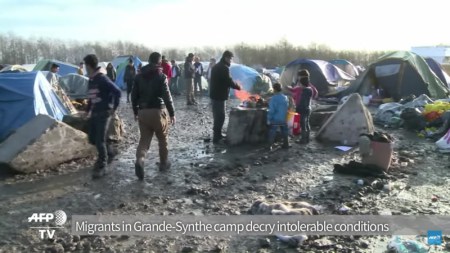
Hidalgo said her new camp, which will be built within six weeks, would be modelled on Grande-Synthe, a massive migrant camp near the French port city of Dunkirk.

Grande-Synthe, which is home to more than 2,500 illegal migrants hoping to reach Britain, was opened in February 2016 after French authorities destroyed a makeshift camp in nearby Calais known as the “Jungle,” from where thousands of migrants tried to break into the Channel Tunnel in a bid to reach London.

The upkeep of Grande-Synthe will cost French taxpayers €4 million ($4.5 million) this year, in addition to a stipend of €10 euros a day for every migrant at the camp. French taxpayers presumably will also be paying for Hidalgo’s camp in Paris.

1641Paris Mayor Anne Hidalgo has announced plans to build a camp for thousands of illegal migrants in central Paris, which is to be modelled on Grande-Synthe (pictured above), a camp housing 2,500 illegal migrants near the French port city of Dunkirk. (Image source: AFP video screenshot)

Hidalgo, who has threatened to file a lawsuit against the American media outlet Fox News for reporting about Muslim no-go zones in Paris, seems to have no qualms about turning parts of northern Paris into ghettos for illegal migrants. “Paris will not avoid taking responsibility while the Mediterranean becomes a graveyard for refugees,” she said. “I do not want to look at myself in the mirror in 10 or 15 years and say: ‘You were mayor of Paris and you are guilty of not helping people in danger.'”

Hidalgo added that “Europe and France are not living up to their history when they fail to treat outsiders with dignity.”

Hidalgo’s project has been welcomed by some, including pro-migration charity groups, and has infuriated others, such as French Housing Minister Emmanuelle Cosse. She said there already are enough refugee shelters in Paris and that Hidalgo’s announcement would only serve to draw more illegal migrants to the city.

In an interview with Europe 1 radio, Cosse said that “migrant camps are not the solution” because they amount to the establishment of migrant ghettos where integration becomes impossible. Cosse said that more than 1,000 additional illegal migrants had arrived at the Jardins d’Eole in the week since Hidalgo’s press conference, bringing the total number of migrants there to 2,300.

A political analysis by the center-right Le Figaro postulates that Hidalgo’s plan for a migrant camp is just the latest in a series of provocations in which she is attempting to establish her left-wing credentials as part of a strategy to win leadership of the Socialist Party. The report says she believes President Hollande will lose his bid for reelection in 2017, and that his defeat will pave the way for a leadership battle between Hidalgo and French Prime Minister Manuel Valls. According to Le Figaro, Hidalgo is determined to become the Socialist Party candidate for President of France in 2022.

A report by the French public radio channel France Inter describes the rivalry between Hidalgo and Valls as “war unto death.”

Hidalgo’s quest to become the first female president of France may be derailed by the head of the anti-immigration National Front party, Marine Le Pen, who is now one of the most popular politicians in France.

According to an opinion poll published by Le Monde on June 1, 28% of those surveyed said they would vote for Le Pen in 2017, compared to 21% for former president Nicolas Sarkozy and 14% for Hollande. The poll also shows that on a scale of 1 to 10, Hollande’s approval rating is at 2.1.

The National Front party has accused Hidalgo of putting the concerns of migrants ahead of those of French citizens. In a statement, the party said that the number of homeless people in Paris had increased by 84% between 2002 and 2012, but that Hidalgo has shown little interest in alleviating the problem:

“It is absolutely scandalous that Paris Mayor Anne Hidalgo uses taxpayer money to house illegal migrants. Migrants should not be housed in hotels or in modular homes within migrant camps. They should be in detention camps waiting to be taken back to their country of origin.

“Anne Hidalgo’s project is characteristic of a political class that is more concerned with migrants than citizens, a political class that has forgotten that the main role of leaders is to care above all for their own people first.”

Meanwhile, efforts by French police to tear down makeshift migrant camps have become like a game of whack-a-mole. More than 20 camps have been dismantled in Paris over the past 12 months, but each time they are rebuilt within weeks.

On May 2, police cleared a makeshift migrant camp under the Stalingrad Metro station (near Gare du Nord) after thousands of migrants brandishing metal poles and wooden planks engaged in a mass brawl on April 14. (A four-minute YouTube video of the melee can be viewed here.) The camp had previously been cleared on March 30.

Although the EU-Turkey migrant deal has temporarily stemmed the flow of illegal migration to Greece through Turkey, hundreds of thousands of migrants are still making their way into Europe.

According to the International Organization for Migration, more than 204,000 migrants arrived in Europe (mostly Greece and Italy) during the first five months of 2016, more than twice as many as arrived during the same period in 2015.

The French Appetite for Appeasement

June 4, 2016

The French Appetite for Appeasement, Gatestone InstituteGeorge Igler,  June 4, 2016

♦ France’s Socialist Party government has unveiled a new legislative program designed to decrease the likelihood of further Islamic atrocities, largely it seems that would have ensured the success of the jihadist attacks committed so far.

♦ n the measures revealed, proactively combatting criminals appears to have taken a back seat to placating the communities from which they are drawn.

♦ Whereas protests by French people against Islamization or government policy, have been rigorously curtailed by the authorities, migrant gangs have still felt able to terrorize French towns, stampede French motorways, or conduct mass armed brawls in Paris, with little fear of intervention from either security services or the law.

♦ In 2014, an ICM poll discovered that 27% of French citizens aged 18-24 supported ISIS.

Last year Muslim jihadists murdered more people in France, than were killed by terrorism in the country during the entire 20th century.

In response, the Prime Minister of France, Manuel Valls, has announced a range of innovative legal measures, introduced in response to the terrorist outrages which struck France in 2015.

On January 7, of that year, Saïd and Chérif Kouachi stormed the Paris offices of the satirical magazine Charlie Hebdo, massacring twelve and injuring eleven others.

In the days that followed, a comrade of the earlier jihadists committed a string of murders, which culminated in a siege at the kosher supermarket. Amedy Coulibaly killed five and injured eleven more.

On February 3, 2015, three military personnel guarding a Jewish community center in Nice were stabbed, by Moussa Coulibaly.

On June 26, the severed head of Hervé Cornara was placed on display, at the gas factory near Lyon where he worked, alongside twin ISIS flags, by Yassine Salhi.

On August 21, an attempted mass shooting on the Thalys high-speed train between Amsterdam and Paris, by Moroccan-born Ayoub El Khazzani, was foiled by American tourists, leading to the wounding of four.

In two days, starting on November 13, multiple jihadist attacks once again struck the French capital. 130 were killed and 352 injured, by perpetrators operating in three teams of three, which included suicide bombers.
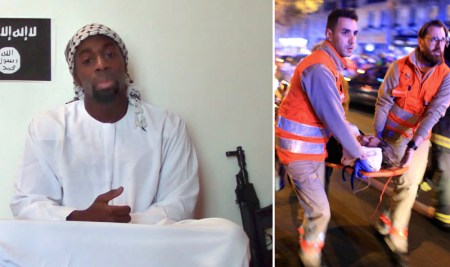
1432 (1)Last January, Amedy Coulibaly (left) murdered a policewoman and four Jews in Paris, before being shot dead by police. Right: Medics carry a victim wounded in an attack by Islamist terrorists, who shot hundreds of concert-goers, killing 90, at the Bataclan theater in Paris on November 13, 2015.

France’s Socialist Party government has unveiled a new legislative program designed to decrease the likelihood of further Islamic atrocities, largely it seems that would have ensured the success of the jihadist attacks committed so far.

“A range of measures” are set to be introduced to combat the alleged “Social, Ethnic and Territorial Apartheid” currently blighting France.

Not only were the jihadist proclivities of most of last year’s perpetrators fully known to the authorities in France, some had been released from prison early following crimes of violence involving automatic weapons.

In the measures revealed by Prime Minister Manuel Valls, however, proactively combatting criminals appears to have taken a backseat to placating the communities from which they are drawn.

The first aim of the new laws contained within the Equality and Citizenship bill, reports Le Monde, is to centralize the provision of social housing in France. Until now the growth of Islamized areas has largely been limited to suburbs around major urban centers.

Much as in Germany, where Muslim migrants to Europe are being sent directly into rural areas, the prime minister is proposing a new nationwide system designed, “to make a better distribution of the public housing supply” in France. This nationwide transformation of housing policy is aimed at curtailing “concentrations of poverty,” within problematic Islamic enclaves infamous as no-go zones.

Recalcitrant” locally-elected mayors who oppose the construction of new housing projects in their areas will be overruled by the state in the interests of “social diversity.”

Second, in the guise of improving literacy in French amongst those of immigrant descent, a new fast-track employment scheme has also been drawn up.

The scheme “will allow youths with few or no qualifications” to enter France’s “citizens’ reserve,” a government initiative established last year which links the nation’s education system with its civil service, allowing an accelerated path into state employment.

The euphemism “youths” is used in the French media to describe the country’s increasingly problematic young Muslim population. In 2014, an ICM poll discovered that 27% of French citizens aged 18-24 supported ISIS.

The glowing account given to the proposals being forwarded by Prime Minister Valls, in his country’s leading left-wing daily, fails to mention how the newly foreseen “third path” job scheme will address the greater key issues.

Unease is growing at the level of Islamist sympathies already held by state employees in France, such as members of the military and police.

Third, as nationwide protests continue to mount over migrant chaos in French towns, spread across the coast of the English Channel, even greater criminal penalties against free speech are also set to be introduced by the new bill.

Verbal communication has, apparently, been largely exempted from legal free speech curtailment in France, unless recorded and posted online. Such cases then fall under the same strict law that governs the printed word, originally passed in 1881.

This law is why Charlie Hebdo is famous for distributing its most challenging content in the form of cartoons, thereby seeking to exempt itself from strict sanctions against “defamation” in print. Fictional novels published this year about France’s Islamic future have sought to do the same.

Under the legislation currently being proposed by Valls, this existing status quo is set for a radical shake-up. The new restrictions planned for France are more in line with the Europe-wide harmonization of hate speech offences, mandated by the European Union.

The augmented provisions against incitement to hatred, previously limited to the 1881 press law, are set to be expanded throughout the French criminal justice system, under the new bill.

Much as in the UK, the new creation of aggravated offences will also ensure that any existing crime can be claimed, by its victim, also to contain a “hate speech” component, incurring far stiffer penalties against the alleged perpetrator.

The application of existing French laws, however, after the last major atrocity in Paris, on November 13, point to the likely reasons for the new proposals being put forward by France’s government.

Since the massacre at the Bataclan nightclub and suicide bombings that struck the French capital, the Republic of France has been in a state of emergency. This gives the country’s President, François Hollande, “extraordinary powers” under Article 16 of the French Constitution.

In February, the duration of these powers, which enable warrantless searches whilst limiting freedom of expression and peaceful assembly, were extended until May 26 by the lower house of the French legislature, the Assemblée Nationale.

In the intervening period, soldiers have become such a common sight in the French capital, that they often give Paris the impression of being under martial law. Half of the country’s army is now deployed on the streets of France.

Yet, whereas protests by French people against Islamization or government policy have been rigorously curtailed by the authorities, migrant gangs have still felt able to terrorize French towns,stampede French motorways, or conduct mass armed brawls in Paris, with little fear of intervention from either security services or the law.

Although the law being introduced by Mr. Valls is chiefly claimed to be about “youth engagement,” the new bill seems more the result of a realization that one group in France — its natives — can generally be relied upon to obey the law, while apparently another cannot.

There is a certain group of young people, however, with whom Manuel Valls clearly does not wish to engage. He recently excoriated members of the controversial Europe-wide Identitarian Movement, a nationalist youth group notorious for engaging in acts of civil disobedience in response to the changing culture and demography of France and Europe.

Described as the “hipster right” by some outlets, Mr. Valls decried supporters of the movement — which began in his country — as “those who want the country closed while dreaming of going back to a France that never existed.”

“I believe in my country, in its message and its universal values,” Valls added. In the interview published by Libération, on April 12, he continued:

I would like us to be capable of demonstrating that Islam, a great world religion and the second religion of France, is fundamentally compatible with the Republic, democracy, our values, and equality between men and women.

Manuel Valls was later forced to admit, in the interview, that this “compatibility” is something doubted by “a majority of our fellow citizens.”

Some 3.3 million people have dual citizenship in France, most of them Muslim. After President Hollande had announced that his country was “at war,” in the immediate aftermath of November’s attacks, the French Prime Minister unveiled plans to amend France’s constitution.

The proposed amendment was intended to strip French citizenship from dual-nationals convicted of terrorism offences. At the time Manuel Valls was described, in the left-wing media, as a “strongman” who had taken a “hard line against terror.”

On March 30, however, after a split within the Socialist Party over the issue, the Prime Minister’s plans were dropped.

The new, more comprehensive, legislative proposals are set to go before the Assemblée nationale this month.

Islamic Extremism in France Part IV: Crime and Immigration

May 25, 2016

Islamic Extremism in France Part IV: Crime and Immigration, Clarion Project, Leslie Shaw, May 25, 2016

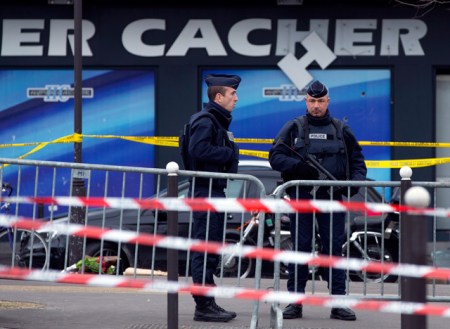
Hyper-Cacher-Policemen-France-IP_0French policemen in front of the Hyper Cacher supermarket, the site of an Islamist attack by Amedy Coulibaly, who had pledged allegiance to ISIS. Coulibaly, the son of African immigrants from Mali, was a close friend of Saïd Kouachi and Chérif Kouachi (whom he had met in jail in 2005), the gunmen in the Charlie Hebdo attack. The Kouachi brothers were sons of Algerian immigrants.

French civil servants are forbidden by law from voicing opinions that are not in line with government policy and can only express their views anonymously. In October 2015, a group of senior civil servants known as Plessis published an op-ed in the Figaro newspaper attacking the impotence of government policy and pernicious media propaganda on the issue of illegal migrants.

“This impotence, coupled with a moralizing media discourse, is increasingly disconnected from the will of the French people, who have been subject for several decades to the disorder caused by uncontrolled immigration, are worried about the threat of terrorism and demand protection and security. It is striking to observe that the current non-stop media blitz, verging on moral bullying, has failed to convince the French people.”

The disorder referred to is an omnipresent reality in France, most notably in the legal system.

In March 2015, the Administrative Court building in Toulouse was ransacked by Islamic extremists who scrawled “The Prophet Will Judge You” on the walls. One third of the 6,000 cases currently being judged by the Toulouse Administrative Court relate to illegal aliens and 30% of those are challenges to deportation orders. The attack was not covered in the national media and local reports underplayed the fact that it was perpetrated by Islamists.

French Administrative Courts rule on litigation between French citizens and the state in areas such as taxation, social housing, building permits and civil service employment, but in recent years there has been an explosion in cases brought before the court by illegal aliens supported by NGOs and these now account for over one third of cases nationwide.

In 2011 there were 53,482 such cases, and the figure is no doubt much higher today. This means that a French taxpayer or civil servant in litigation with the state or an entrepreneur trying to get an invoice paid may have to wait three or four years for a judgement. Challenges to French law brought by illegal aliens have thus thrown the legal system into chaos and are costing the French taxpayer billions of euros.

Other areas of the French judicial system have been thrown out of joint as a result of immigration as well. One example is the Tribunal Pour Enfants, or juvenile court, which handles cases involving minors.

Although it is illegal in France to compile statistics based on ethnic origins, it is sufficient to take a stroll through the corridors of the juvenile section of courthouses around France to realize that the vast majority of cases involve minors of North African or African origin.

Sociologists will put this fact down to poverty and lack of opportunity, but the reasons go deeper and are linked to the differing codes of socialization in the countries of origin of the parents and the host country.

These children underperform at school because the parents are incapable of or unwilling to push them to study. Poor results and truancy are common, and many leave high school with no qualification. Those who obtain a diploma are automatically accepted into university but lack the drive and ability to succeed.

Putting this down to deprivation is an invalid argument because the children of over 120,000 boat people from Vietnam, Cambodia and Laos who arrived in France in 1979 have succeeded in assimilating into French society and are renowned for their respectful attitude and hard work in the classroom.

Juvenile delinquency is not a problem in these communities and the reasons for this are cultural, not economic.

Another field where children of North African and African origin outnumber other ethnic groups is the Aide Sociale à l’Enfance, or child protection system. This public service deals with both juvenile delinquents and children who for various reasons have been removed from their parents.

Again, statistics are not available but one only has to go to the waiting rooms of the offices of the ASE in French cities or visit the hundreds of child care residences to realize that the vast majority of children there are from Muslim families.

I am personally familiar with the case of an 11-year old French girl who was temporarily placed in a home after being rescued from an abducting parent. Of the 35 child residents, 34 were from North African or African families. When the French child’s father sent her a miniature nativity set to decorate her room at Christmas, she was forbidden from setting it up so as not to offend the Muslim children.

The most striking disproportion is in the area of criminal justice and is reflected in the prison population, where Muslims, who represent 10% of the population, account for between 50% and 65% of inmates.

These are ballpark figures as the compilation of statistics is illegal, but again a visit to courtrooms and penitentiaries is sufficient to show the estimates are not far off the mark. Indirect methods used to calculate the number of Muslim prisoners are observation of Ramadan, first names, testimonials of imams, presence at Friday prayer and demands for halal food.

Sociologist and author Farhad Khosrokhavar puts the figure at between 50% and 80%. In his 2013 study Radicalization in Prison: The French Case, he reported that non-Muslim inmates complained they felt like they were living in a Muslim country due to the regular calls for prayer and the fact that over half the prisoners in the exercise yard were Muslim.

Whatever the real figures, the connection between juvenile delinquency, violent crime and jihadism is beyond any doubt. Most of the perpetrators of Islamic terrorism over the past 10 years had a criminal record and many were multiple offenders of a legal system that allowed them to roam freely throughout Europe.

Islamic Extremism in France Part III: Stemming the Tide

May 23, 2016

Islamic Extremism in France Part III: Stemming the Tide, Clarion Project, Leslie Shaw, May 23, 2016

(Too little, too late. — DM

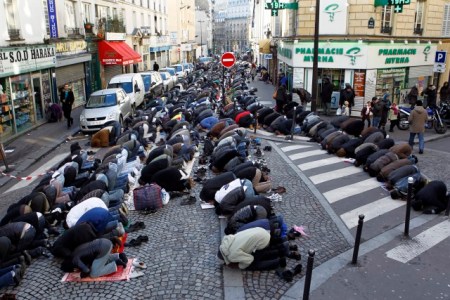
FranceMuslimPrayerStreetIP_2Illegal prayer on the street in France (Photo: © Reuters)

Radical threats require radical solutions involving measures that hurt, such as the police operations enabled by the current state of emergency. The French government’s soft, long-term strategy indicates ideological weakness and the absence of a will to fight the enemy. The enemy is global political Islam and not just a few thousand deviants that need to be neutralized or rehabilitated.

*********************

In April 2015, French Prime Minister Manuel Valls said that a Salafist minority was “winning the ideological and cultural war” for control of Islam in France.

“Salafists account for 1% of Muslims in the country, but all you hear about is their message, the messages on social media,” Valls declared in a closing address in Paris to a conference on the populist exploitation of Islamism in Europe.

“There is an activist minority of Salafist groups that is winning the ideological and cultural war,” he added, endorsing the claim of his Urban Affairs Minister Patrick Kanner that “around a hundred” French neighborhoods presented “similarities” to the Molenbeek district of Brussels, reputed to be a jihadist enclave, although deeming that “comparisons are not easy to make.”

The Prime Minister had earlier stirred controversy by speaking of “geographical, social and ethnic apartheid” after the January 2015 attacks in Paris. He reckoned that in some districts in France “an essential job of reconquest of the secular republic” was needed.

The latest figures on operations enabled by the state of emergency show that these words are finally being translated into action: 3,549 police raids, 407 people placed under house arrest, 743 arms caches seized, 395 arrests and 344 people placed in detention.

One of the mosques closed was described by Interior Minister Bernard Cazenuve as “a hotbed of radical ideology.” The closure of the Lagny-sur-Marne mosque by administrative decree in December 2015 was confirmed by the Council of State, France’s highest court, in February 2016.

The mosque, 20 miles east of Paris, had been frequented by around 200 people. During the raid, police discovered a handgun, documents on jihad and a clandestine Koranic nursery school. Nine members of the congregation were placed under house arrest and 22 more were barred from leaving France.

The mosque was run by the local Muslim Association, which managed to overturn the Council of State ruling on a technicality. The government responded by initiating proceedings to dissolve the Muslim Association, claiming it was promoting radical Islamic ideology and organizing travel for jihadists to Iraq and Syria. Mohamed Hammoumi, the 34 year-old Salafist Imam who ran the mosque until his departure for Egypt in 2014, continued to direct operations from there and acted as a go-between for the jihadists travelling from France to the combat zones.

French law enables the government to dissolve by decree, i.e. with no legal proceedings, associations whose activities are considered as amounting to a combat unit, a militia or a group agitating against the French Republic. The decision rests with the Council of State.

The role played by Muslim associations and mosques in the nationwide ecosystem of radical Islam is not just a recent discovery. The problem is that up until the 2015 attacks, nothing was done to stamp out these vectors of terror, and the few public figures who spoke out about the danger were branded as fascists, racists and Islamophobes.

At the same time, the criminals who transitioned from crime to jihad benefited from the lenience of French courts.

Ismaël Omar Mostefai, one of the Bataclan jihadists, had eight criminal convictions between 2004 and 2008 but never did any time in prison. In 2010 he was registered on the French anti-terrorism database for radicalization. He was a regular attendee at the Lucé mosque next to the historic town of Chartres. In 2004 the construction of this mosque led to demonstrations by local residents. A comment made at the time by Philippe Loiseau, a municipal politician, has turned out to be prophetic:

“I fear that this mosque will be a hotbed of radicalization that will pose a dangerous risk for the population.”

Twelve years and hundreds of deaths and injuries later, the French government has rolled out its strategy to tackle the existential threat that radical Islam poses to the country. Prime Minister Valls unveiled a new plan at a cabinet meeting on May 9. It consists of 30 existing and 50 new measures focused on six areas:

1.      Prevention and detection of youth radicalization

2.      Creation of deradicalization centres

3.      Enhanced surveillance in prisons

4.      Life sentences for perpetrators of terrorist attacks

5.      A central administrative command to co-ordinate local actions against jihadism

6.      Suspension of welfare payments for jihadists who travel to combat zones

The 30 existing measures incorporated in this new plan were rolled out at a cabinet meeting in April 2014 by Interior Minister Bernard Cazeneuve. The stated objectives were to prevent French citizens from leaving to wage jihad abroad and combat the radicalization of French Muslim youth. Two years later, these measures have proven to be ineffective. Time will tell if the 50 new measures will eradicate the threat, but it may be a case of locking the stable door after the horses have bolted.

The notion that “deradicalization,” whether in the form of prevention or rehabilitation, will stem the tide of radical Islam sweeping through France seems rather naïve. It is like telling young people not to use drugs or putting a junkie through rehab in the hope that he will never shoot up again. Half a century of measures to fight drug addiction have not solved that problem and these measures designed to combat radical Islam are likely to be as ineffective, what they really need is to check www.taylorrecovery.com to find a solution.

Radical threats require radical solutions involving measures that hurt, such as the police operations enabled by the current state of emergency. The French government’s soft, long-term strategy indicates ideological weakness and the absence of a will to fight the enemy. The enemy is global political Islam and not just a few thousand deviants that need to be neutralized or rehabilitated.a

Sisi and Mideast Peace

May 21, 2016

Sisi and Mideast Peace, American ThinkerC. Hart, May 21, 2016

Egyptian President Abdel Fatah al-Sisi’s speech on Tuesday, May 18, set ripples through Israel’s political establishment. Speaking in the southern city of Assiut, Sisi signaled to the Arab world, the Palestinians, and Israel that it is time for an historic breakthrough in peace negotiations.

Responding immediately to Sisi’s comments, Israeli Prime Minister Benjamin Netanyahu stated that he is open to working with Egypt and Arab states towards advancing the peace process, not only with the Palestinians but with the peoples of the Middle East region.

Netanyahu’s comments come on the heels of a visit to Israel by French Foreign Minister Jean-Mark Ayrault. The two men met but disagreed on how to advance peace.

France insists on hosting an international parley to force Israel and the Palestinians to come to the peace table. Israel is against the French initiative.

Netanyahu would like to go beyond the Israeli-Palestinian conflict and work directly with moderate Arab states on a comprehensive peace deal. Sisi could be instrumental in building an Arab coalition for peace which would dismiss or weaken the divisive French initiative, releasing Israel from conceding to European demands.

Former Israeli ambassador to Egypt, Zvi Mazel, is currently working as a Research Fellow at the Jerusalem Center for Public Affairs (JCPA). He is a Middle East expert who has represented Israel’s Ministry of Foreign Affairs as former Ambassador to Sweden and Romania, as well. This writer asked Mazel if Sisi’s comments were spontaneous or were released at this time for political reasons because he wants to strengthen Egypt’s position in the region by helping Israel.

“I don’t think there is a big design… I think that Sisi understands what is going on in the Middle East and he is identifying according to his view — a kind of possibility of advancing the peace process.”

Egypt, Saudi Arabia, the Gulf countries, and Israel have common enemies: Iran and Islamic State. Already there have been discreet diplomatic and business ties between Israel and these nations

According to Mazel, Sisi is also emerging as a strong respected leader among Egyptians despite the Western media’s portrayal of him as a dictator similar to former Egyptian President Hosni Mubarak.

“Sisi sees himself as a president quite stable among his people. I know that this is not the way they think in the Western media — New York Times and company. They see him as a kind of military dictator; absolutely not! He’s a good man. He’s not Mubarak. He’s Sisi.”

Mazel explains that Egypt is on the way to economic sustainable development. This is what Sisi has been focused on over the past two years and he is seeing success. Unemployment has gone down, despite the fact that almost 90 million people live in Egypt and the country is poor.

“He has started something quite positive, and Sisi thinks that the time has come for Egypt to be in the international arena.”

What that means, according to Mazel, is that Egypt’s current role is still minor. Sisi is asking Israelis and Palestinians to go forward, yet he, himself, does not have a plan. But, in the future, Egypt could emerge as a larger player in the region.

Mazel is pragmatic about the short-term. “It’s a positive step for Egypt, but it is not going to change the world.”

Current peace advances that are being prepared for release are not a positive development for Israel: (a) the French Initiative; (b) a document showing the obstacles to Israeli-Palestinian peace efforts soon to be reported by the Quartet; (c) the 2002 Arab Peace Initiative that, despite being outdated, is still considered a serious option by the Arab world.

In the coming days, the Arab League plans to meet and discuss the Israeli-Palestinian conflict. Mazel thinks that Sisi’s statement was good timing for that meeting, but otherwise, was not connected to a bigger scheme.

However, on Wednesday, May 18, American Secretary of State John Kerry arrived in Egypt one day after Sisi gave his emotional speech. Some analysts believe that the U.S. is behind Sisi’s bold words, in an effort to circumvent the French from becoming a new power broker in the Middle East.

The question is whether Sisi’s encouragement will lead to Israel courting the Arab nations and the Arab nations courting Israel, while by-passing the Palestinians. Mazel thinks that kind of change is slow in coming, because the Arabs continue to entrench themselves in old positions that favor Palestinian demands.

Refusing to sit down and negotiate with Israel, the Palestinians have insisted on preconditions which the Arab League has accepted. They demand that Israel agree on the right of return for so-called Palestinian “refugees” to Israeli land; that Israel withdraw to the 1967 borders; and, that Israel stop building in West Bank settlements (Judea and Samaria). Palestinian President Mahmoud Abbas also expects Israel to release hundreds of Palestinian prisoners, who have blood on their hands, serving time in Israeli jails because of terrorist attacks against the Israeli population.

So far, these unresolved issues have kept Abbas away from face-to-face negotiations with Netanyahu. However, his real diplomatic scheme is to get the international community to affirm the Palestinian position and force Israel to concede to Palestinian demands. Right now, Abbas sees the best venue to accomplish his goal as a French-sponsored future peace conference, followed by a stinging UN anti-Israel resolution.

Meanwhile, the future pressure on Israel will be to immediately stop settlement construction in order to get the peace process going. Mazel declares, “Absolutely not… we have to go on! Half a million people live there. And, they are the shield of Israel. We continue to build until there is peace.”

Mazel has a real problem with the demands of the Arab League, as well. “The Arab Peace Initiative is more or less the same as the Palestinian attitude. The ‘right of return’ is still there. It should be taken completely out. Most importantly, the Palestinians and the Arabs should recognize a Jewish State in Israel.”

Mazel is also not sure that Netanyahu’s insistence on widening his government, to provide greater stability, is a wise idea. Reportedly, Yisrael Beytenu Chairman Avigdor Liberman will soon become Israel’s new Defense Minister as Netanyahu brings several more ministers into his coalition. Mazel thinks this will not provide a wider diplomatic envelope; nor, will it help change European or Arab attitudes towards Israel; nor will it end the Boycott-Divestment-Sanctions (BDS) movement against Israel.

Then there is U.S. President Barack Obama’s failed Middle East policy, which includes his lackluster support of American allies in the region. Mazel says this policy cannot continue.

“It cannot be like that, because America is the most important power in the world… And, whoever will win the presidency, whether it will be Mrs. Clinton or Trump, both of them are in a certain way connected to the Middle East.”

Mazel believes that with 22 countries and more than 300 million people living in the region, the next U.S. president will be more engaged in leading the nations into greater stability.

In the meantime, currently 80% of the Egyptian people support Egyptian President Sisi. His nation has already made peace with Israel (along with Jordan). Helping Israel to extend an olive branch to other Arab countries will encourage Egypt to take up an important leadership role in a region that continues to be embroiled in major upheaval and violence.


EgyptAir flight blown up by ISIS time bomb

May 19, 2016

EgyptAir flight blown up by ISIS time Bomb, DEBKAfile,  May 19, 2016

EgyptAir804_480

EgyptAir flight MS804, which took off at 11:09 p.m. on Thursday May 19 from Charles de Gaulle airport in Paris, was supposed to land at 3:55 a.m. in Cairo. However, it dropped off the radar screens of Greek and Egyptian flight controllers at 2:45 a.m. and crashed into the Mediterranean about 10 miles inside Egypt’s territorial waters.

The Airbus A320-232 had 66 people aboard including seven crew members, three security guards, 30 Egyptian citizens, 17 French nationals as well as citizens of Iraq, Saudi Arabia and other countries. The plane, which was built in 2003, was flown by two pilots who each had thousands of hours of cockpit experience. Reports by Egypt’s airport authority said the cargo did not contain dangerous materials or anything else out of the ordinary.

Egyptian Prime Minister Sherif Ismail said terrorism could not be ruled out, emphasizing that there were no distress calls made from the cockpit and that there were no reports showing deviation from the flight path or altitude before the plane disappeared. The spokesman of the Egyptian military, Brig. Gen. Mohammed Samir, confirmed in a posting on the military’s Facebook page that the pilots did not send out a distress signal.

Following the disappearance, French President Francois Hollande convened an emergency meeting Thursday morning at the Elysee Palace.

Reports on social media said that witnesses in Greece saw a large ball of fire in the sky, which may strengthen the assumption that flight MS804 carried a time bomb that was set to explode when the plane was in Egyptian airspace.

DEBKAfile’s counterterrorism sources say that if the plane was downed by an act of terror, it would be the latest major blow by ISIS to international civilian aviation, Egyptian tourism, and the security, counterterror and intelligence services of France and Egypt.

  • It is the second time in less than a year that ISIS has succeeded in using a time bomb to down a passenger plane linked to Egypt. The first one was a Russian Airbus A321 that took off from Sharm al-Sheikh and blew up over the Sinai Peninsula on October 31. All 224 passengers and crew were killed.
  • One of the main questions in the investigation of the latest air disaster will be whether the explosive device was planted in Cairo or Paris. If it did happen in Paris, it would raise the question of whether an ISIS cell penetrated the ground crews at Charles de Gaulle airport. If confirmed, it would be a serious escalation by ISIS following the terrorist organization’s November 2015 attacks in Paris in which 130 people were killed and hundreds were wounded.
  • A sign of an escalation was that it was the second terrorist attack within three months on a civilian aviation target in a Western European capital, following the bombing of Brussels international airport in March in which 31 people were killed and about 200 were wounded.
  • But if the investigation finds that the bomb was planted on the plane in Cairo before it departed for Paris, it would mark a serious and dangerous escalation of the infiltration and operational abilities of ISIS in the Egyptian capital, and a major threat to the stability of the regime of President Abel Fattah al-Sisi.

French intelligence warned of ISIS attacks before missing Egypt Air Flight MS804

May 19, 2016

French intelligence warned the country was ‘clearly being targeted by ISIS’ and was at risk of ‘a new form of attack’ a week before Paris flight to Egypt.

Patrick Calvar, head of DGSI, warned of ‘new attacks’ on May

10 His warning to French MPs came a week before Flight MS804 went missing

Mr Calvar said ISIS and Al-Qaeda wanted to create a ‘climate of panic’

France will be hosting the Euro 2016 football tournament next month

By Chris Summers For Mailonline

Published: 02:51 EST, 19 May 2016 | Updated: 04:15 EST, 19 May 2016

Source: French intelligence warned of ISIS attacks before missing EgyptAir Flight MS804 | Daily Mail Online

The head of France’s internal intelligence agency had warned the country was being ‘clearly targeted’ by ISIS a week before the Paris to Cairo flight took off.

Egypt Air Flight MS804 has gone missing over the Mediterranean with 66 people on board amid reports of a merchant ship captain having seen a ‘flame in the sky’.

An Egyptian civil aviation authority spokesman has said the plane, with 15 French passengers and one Briton on board – most likely crashed into the sea.

Patrick Calvar (pictured), the head of French internal intelligence, warned last week that ISIS was planning new attacks and France was still their number one target

The cause of the disaster remains unknown but it comes seven months after a bomb blew up a Russian airliner over the Sinai desert, killing all 224 people on board.

ISIS later revealed images of a soda can bomb which they claimed to have used to bring the Metrojet plane down.

It has now emerged that Patrick Calvar, the head of France’s DGSI agency, told a parliamentary committee on national defence in Paris on May 10 that ISIS was planning ‘a new form of attack’.

France’s security forces have remained on high alert since the Paris attacks (pictured) in November, which killed 130 people

The DGSI (General Directorate for Internal Security) is France's equivalent of the MI5 and is responsible for guarding against internal threats

The DGSI (General Directorate for Internal Security) is France’s equivalent of the MI5 and is responsible for guarding against internal threats

France was targeted twice last year – with the Charlie Hebdo attack in January and the Paris attacks in November – and the French security forces are on a state of high alert.

Mr Calvar was quoted in The Local as saying: ‘We risk being confronted with a new form of attack: a terrorist campaign characterised by leaving explosive devices in places where big crowds gather, multiplying this type of action to create a climate of panic.’

He made no mention of attacks on aircraft but said he believed France was ‘the country most threatened’ by ISIS, which is often known as Daesh, and also warned that Al-Qaeda remained a threat and was champing at the bit to ‘restore its image’ as a major player, especially in the Maghreb and the Arabian peninsula.

Mr Calvar said while last November’s attacks in Paris that killed 130 people were conducted by suicide bombers and jihadists armed with Kalashnikovs, a new form of attack was possible.

We know that Daesh is planning new attacks…and that France is clearly targeted
Patrick Calvar

It may be several weeks or even months before it is known what brought down Flight MS804 but Mr Calvar’s comments will increase fears of spectators with less than a month to go before the start of the Euro 2016 football tournament in France.

Mr Calvar said: ‘We know that Daesh is planning new attacks using fighters in the area, taking routes which facilitate access to our territory and that France is clearly targeted.’

He said ISIS had suffered military setbacks in Syria and Iraq and wanted to take revenge on members of the coalition, including France, which were behind the air strikes on ISIS targets.

Mr Calvar said while last November’s attacks in Paris that killed 130 people were conducted by suicide bombers and jihadists armed with Kalashnikovs, a new form of attack was possible.

This is a so-called soda can bomb, published in the ISIS magazine, which they claimed to have used to destroy the Russian airliner in October, killing 224 people