Posted tagged ‘Foreign Policy’

Israel’s Resilient Decency Despite Extreme Terrorism

October 5, 2016

Israel’s Resilient Decency Despite Extreme Terrorism, Investigative Project on Terrorism, Noah Beck, October 5, 2016
1852

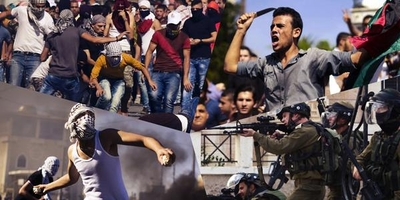
[I]n 2015, Israelis suffered about 10 terrorist attacks every day.

Adjusted for population size, the violence would equate to a staggering 150,160 attacks in a year in the United States (roughly 411 per day).

[S]tories of Israeli decency and the relative prosperity of Israel’s Muslims rarely appear in the mainstream media or get acknowledged by the EU, the UN, or human rights organizations.

The next time Western politicians, human rights groups, and journalists feel tempted to critique Israeli conduct, or demand more restraint from Israelis, they should ask themselves: “How would we respond if there were 411 jihadi terrorist attacks per day here? Would we also provide medical treatment to terrorists and their relatives? Would our society be nearly as tolerant and kind towards Muslims? Would our laws similarly protect Muslim rights and allow Muslim political groups to support organizations that want to destroy our country? How often would our headlines and coverage present a neutralized terrorist as a victim?”

*****************************

U.S. citizens got a small taste of the Islamist terror threat that hounds Israelis on Sept. 17, with four bombings or bombing attempts in the New York metropolitan area and a Minnesota stabbing attack.

Israel, a country about the size of New Jersey, endured eight terrorist attacks in a four-day period overlapping the American incidents. Even that frightening frequency does not represent “the scale of the attacks during the previous wave” of terror, according to the Meir Amit Intelligence and Terrorism Information Center, an Israeli think tank.

Israel’s experience shows that the war against Islamist terror is a long and difficult one, but it can be managed while maintaining a democracy’s core values.

Whereas the U.S. experienced about a dozen attacks during the 21 months from the start of 2015 through last month, an Israeli government list of terror attacks covering 12 months from 2015-16 totaled 407 attacks, including 165 stabbings, 87 attempted stabbings, 107 shootings, 47 vehicular (ramming) attacks, and one bus bombing. Those attacks killed 40 people and injured 558 others.

The Israeli government statistics don’t include stone throwing, petrol bombs, riots, IEDs, arson, stun grenade attacks, rocket attacks, and other types of attacks. When those are included, Israelis endured 3,754 terrorist attacks (including 3,635 by Palestinians and 119 by Israeli Arabs) from Jan. 1, 2015 to Jan. 5, 2016, according to a meticulously documented list compiled by analyst Nehemia Gershuni-Aylho.

Thus, in 2015, Israelis suffered about 10 terrorist attacks every day.

Adjusted for population size, the violence would equate to a staggering 150,160 attacks in a year in the United States (roughly 411 per day).

Of course, demographic, geographic and historic differences mean the U.S. is unlikely ever to experience that much Islamist terrorism.

Despite those differences, jihadi attacks in the United States during the last year have been enough to inject proposals like banning all Muslims from entering the country into the national political debate. No such proposals have ever been publicly discussed by any mainstream political parties in Israel.

By contrast, Israeli democracy is immensely tolerant of diverse opinions – to the point that the Arab party in the Knesset publicly supports terrorist organizations bent on destroying Israel. Last March, two Arab-Israeli political parties condemned Gulf Arab states for designating the Lebanese-based Iranian proxy Hizballah a terror organization. Hizballah openly seeks Israel’s destruction, and has more than 100,000 rockets and missiles aimed at the Jewish state. Could a parliamentary party in the EU or U.S. ever openly support an enemy terrorist group?

Remarkably, Israel spares no expense when providing medical help to the very terrorists attempting to murder Israelis.

Last December, at the height of the “Stabbing Intifida” – a series of seemingly spontaneous knife attacks by Palestinians on Israelis – the Israeli Medical Association issued a ruling requiring that the wounded be aided in order of injury severity, even if that means helping assailants before victims. Israeli medics treat Palestinian terrorists and murderers better than their Palestinian counterparts treat Israeli victims of Palestinian terror, such as the Palestinian medics who ignored an Israeli terror victim’s plea for help last November.

Another example of Israel’s incredible humanism despite extreme terrorism is the Israeli mother who was happy to donate the kidney of her son, who was murdered by a Palestinian suicide bomber, to save the life of a Palestinian girl.

The Israeli non-profit “Heart for Peace” is staffed by Israeli and Arab cardiologists who have saved the lives of more than 610 Palestinian children since 2005. Outrageously, in 2014, a Gazan mother whose young son’s heart was saved by Israeli doctors said that she hoped he would grow up to be a suicide bomber.

Israel has even provided medical services to the relatives of those seeking its destruction. Hamas leader Ismail Haniyeh may encourage ordinary Palestinians to embrace martyrdom for the sake of killing Israelis, but his mother-in-law, daughter, and granddaughter have all been treated by Israeli hospitals. During the last war with Hamas in 2014, Israel reportedly provided medical treatment to two Hamas terrorists who had infiltrated the country through a tunnel. Every year, Israel treats thousands of Gazans.

Examples of public generosity and decency may be rare in conflict zones, but they abound in Israel. When an Arab Israeli was wrongly beaten by police in May, the Israeli public raised money for the victim’s college tuition and legal fees, a story that went totally unreported by the mainstream media. Last August, a Palestinian girl whose bicycle was taken and broken by Israeli border police received a new bicycle donated by an Israeli man.

The EU routinely criticizes Israel for its relations with Muslims, yet Europe is far less tolerant of Islam in many respects. Last summer, three French cities – Corsica,Cannes, and Villeneuve-Loubet – banned “burkinis” from the beach. Germany’s interior minister called for a partial ban on burkinis, and a German public swimming pool reportedly prohibited them. By contrast, Israel allows burkinis, a fact highlighted in a New York Times video that went viral.

Four European countries – France, Belgium, the Netherlands, and now Bulgaria – ban full face veils in most public places. Israel imposes no such restrictions on Muslims.

Last summer provided an even more positive testament to how Israeli Muslims are treated, when Israel’s smartest high-school student was an Arab named “Mohammed” and the captain of Israel’s goalball team at the Rio Paralympics was a 26-year-old, Muslim woman. (Goalball is a sport created for blind athletes.)

But stories of Israeli decency and the relative prosperity of Israel’s Muslims rarely appear in the mainstream media or get acknowledged by the EU, the UN, or human rights organizations. World leaders routinely call for Israeli restraint, as if Israelis weren’t already exercising extraordinary restraint, a fact demonstrated by this graph showing how each of Israel’s last three wars with Hamas (in 2008, 2012, and 2014) was preceded by hundreds, and more often thousands, of Hamas rocket attacks against Israeli civilians. What country would tolerate thousands of deadly projectiles being fired on its civilians before responding with enough force to stop the attacks?

Similarly, when it comes to stabbings, car rammings, bombings, and other forms of Palestinian terrorism, world opinion reflexively calls for Israeli restraint and/or attempts to justify the attacks.

Last October, EU foreign affairs chief Federica Mogherini called for Israeli restraint after four Israelis had been murdered in a total of 19 terrorist attacks during the first 12 days of the month.  Secretary of State John Kerry tried to blame that wave of Palestinian terrorism on Israeli settlements. United Nations Secretary General Ban Ki-moon tried to justify Palestinian terrorism as a rational response to “occupation. “Such reactions would be unthinkable in response to similar terrorist attacks in the EU or U.S. World leaders and the global media seem unaware that Arab Muslims have been killing Jews for more than a century – long before any occupation, settlements, or even a Jewish state.

Palestinian terror attacks don’t reflect some miserably unfair existence – they are the product of raw hatred and incitement. Dozens of Israeli Arab Muslims have committed terrorist attacks even though they are not under occupation and enjoy better freedoms and living standards than most of the Arab world has. Like so many Palestinian terrorists, they are driven by the same hateful incitement that rejects any state for the Jews.

The next time Western politicians, human rights groups, and journalists feel tempted to critique Israeli conduct, or demand more restraint from Israelis, they should ask themselves: “How would we respond if there were 411 jihadi terrorist attacks per day here? Would we also provide medical treatment to terrorists and their relatives? Would our society be nearly as tolerant and kind towards Muslims? Would our laws similarly protect Muslim rights and allow Muslim political groups to support organizations that want to destroy our country? How often would our headlines and coverage present a neutralized terrorist as a victim?”
IDF hits targets in northern Gaza in response to rocket strike

October 5, 2016

IDF hits targets in northern Gaza in response to rocket strike After projectile lands on a Sderot street, Israeli tanks reportedly fire on Hamas sites in Beit Hanoun

By Judah Ari Gross October 5, 2016, 11:59 am

Source: IDF hits targets in northern Gaza in response to rocket strike | The Times of Israel

A rocket launched from the Gaza Strip strikes a road in the southern city of Sderot on October 5, 2016. (Israel Police)

Israeli tanks fired on Hamas targets in the northern Gaza Strip on Wednesday in response to a rocket that landed in southern Israel earlier in the day, the army said.

According to Palestinian reports, the IDF tanks struck sites in Beit Hanoun, on the northeastern corner of the coastal enclave. The army would not immediately confirm those reports to The Times of Israel.

There were no immediate reports of Palestinian injuries.

The rocket, which had been fired from the Gaza Strip, struck a street in the city of Sderot — a few miles from Beit Hanoun — just before 10:30 a.m. on Wednesday, police said, causing damage and sending three people to the hospital suffering from anxiety attacks.

The Islamic State-affiliated Ahfad al-Sahaba-Aknaf Bayt al-Maqdis terrorist group took responsibility for the rocket launch in statements released in both Arabic and Hebrew.

“Oh you cowardly Jews: You don’t have safety in our land. [Former defense minister Moshe] Ya’alon, the failure at giving security. [Defense Minister Avigdor] Liberman to fail will be a certainty,” the Salafist group said in its statement, in poorly translated Hebrew.

The attack against Israel was apparently a response to the Strip’s Hamas rulers arresting several members of the Salafist organization, according to the group’s statement.

Though the Salafist group took responsibility for the attack, Israel has said it holds Hamas responsible for any attacks emanating from Gaza and routinely responds to such launches with strikes inside the Palestinian territory.

“We can’t go after every little group in Gaza with a couple of dozen members that goes out one night and fires a rocket,” a senior officer in the IDF’s Southern Command told reporters last month.

Ahfad al-Sahaba-Aknaf Bayt al-Maqdis released a similar statement last month, after a failed attempt to launch a rocket at southern Israel on the first day of school. The group also claimed responsibility for a rocket attack that hit Sderot
in August, landing between two houses in the southern Israeli city.

In Wednesday morning’s rocket attack, three people in Sderot “suffered anxiety attacks” and were treated by medical teams, but no one was physically hurt by the attack, according to the Magen David Adom medical service.

The three — including a 15-year-old girl and 60-year-old man — were taken to Ashkelon’s Barzilai Medical Center for further care, MDA paramedics said.

The rocket alert siren was activated at approximately 10:20 a.m. and was heard in Sderot, Nir Am, Ivim and Gevim.

A few minutes later, Israel Police officers located the rocket in Sderot. The street where it landed was damaged in the attack, as were several nearby cars and homes.

Police sappers were called to the scene, and the area was closed off to pedestrians and traffic, police said.


Police sappers dig out piece of a rocket launched from the Gaza Strip that struck a road in the southern city of Sderot on October 5, 2016.

Last month, a mortar shell was launched from the Gaza Strip and landed in a field in southern Israel, causing neither injury nor damage, the army said. The projectile hit an empty field in the Eshkol region, next to the southern Strip, according to a statement from the Israel Defense Forces.

Ten Places the Obama Administration Says Are Not In Israel

October 3, 2016

Ten Places the Obama Administration Says Are Not In Israel Most ‘pro-Israel’ administration ever

BY:
October 3, 2016 5:00 am

Source: Ten Places the Obama Administration Says Are Not In Israel

picture added by JK

( No words needed ! )

The Obama administration ignited a firestorm over the weekend when it stripped the city of Jerusalem as being located in Israel in an official communication sent following a memorial service for recently deceased former Israeli President Shimon Peres.

The White House originally sent out a press release attributing Obama’s remarks at the memorial service as taking place in “Jerusalem, Israel.” However, shortly after that statement was sent, the White House reissued the statement with “Israel” crossed out as the location.

The White House’s move prompted criticism in Israel and throughout the pro-Israel community, including on Capitol Hill.

The Washington Free Beacon has assembled a list of ten other places that the White House does not believe are located in the state of Israel.

1. The Prime Minister of Israel’s Residence

Beit Aghion

Beit Aghion / Wikimedia Commons

Known as Beit Aghion in Hebrew, the prime minister’s official residence is located in the heart of Jerusalem and has served as the living space for senior Israeli officials since 1952, 14 years after construction was completed. Beit Aghion became the prime minister’s official residence in 1974.

2. The Prime Minister of Israel’s Office

Also located in central Jerusalem, the prime minister’s office coordinates a large number of governmental affairs and works to implement laws passed by the country’s parliament.

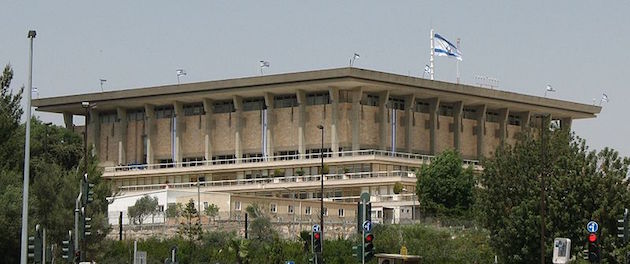
3. Israel’s Parliament, The Knesset

Knesset

Knesset / Wikimedia Commons

Hebrew for “the gathering,” the Knesset is home to Israel’s 120-member legislature. It is located in the Givat Ram neighborhood in Central Jerusalem, which plays home to many of Israel’s key government bodies.

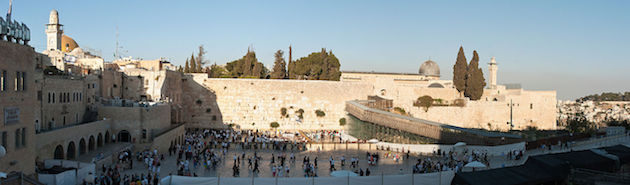
4. Judaism’s Holiest Sites, the Western Wall and the Temple Mount

The Western Wall

The Western Wall / Wikimedia Commons

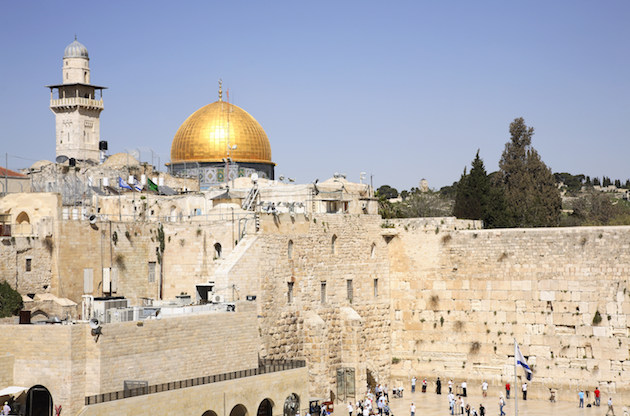
The Western Wall, or Kotel in Hebrew, is considered Judaism’s holiest site. Located behind the walls of Jerusalem’s ancient Old City, the Obama administration has long refused to acknowledge this location as Israel’s property.

5. Israel’s Holocaust Memorial Museum, Yad Vashem

Israel’s Holocaust memorial museum, located in the heart of Jerusalem, is widely viewed as one of the city’s most important modern sites. After completing the museum’s central exhibits, visitors are treated to sprawling views of Jerusalem, a reminder of how far the Jewish people have come since the Holocaust.

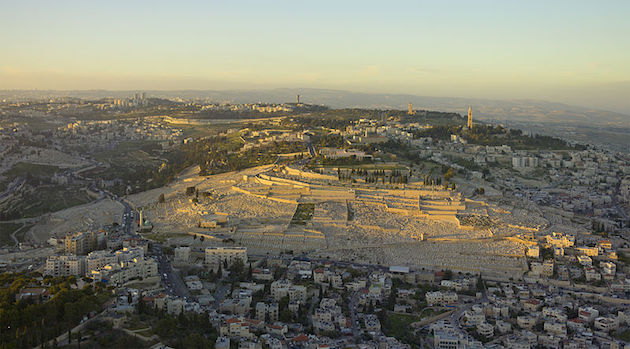
6. Judaism’s Ancient Cemetery, The Mount of Olives

Aerial view of the Mount of Olives

Aerial view of the Mount of Olives / Wikimedia Commons

A 3,000-year-old Jewish burial site, the Mount of Olives is located nearby Jerusalem’s Old City. Many of Judaism’s central figures are noted in the Bible as having ascended the mountain. In modern days, the cemetery has been a victim of vandalism by Arabs, and stands as another key site the Obama administration views as not part of Israel.

7. The Israel Museum

Due to its location in central Jerusalem, the Israel Museum—the country’s national museum—is not recognized as part of Israel by the Obama administration. The museum is home to some of Israel’s most important cultural artifacts.

8. Israel’s Supreme Court

Also located in the central Jerusalem neighborhood of Givat Ram, Israel’s supreme court has played a central role in Israeli democracy and the promotion of human rights in the Jewish state, but is not viewed as part of Israeli territory by the Obama administration.

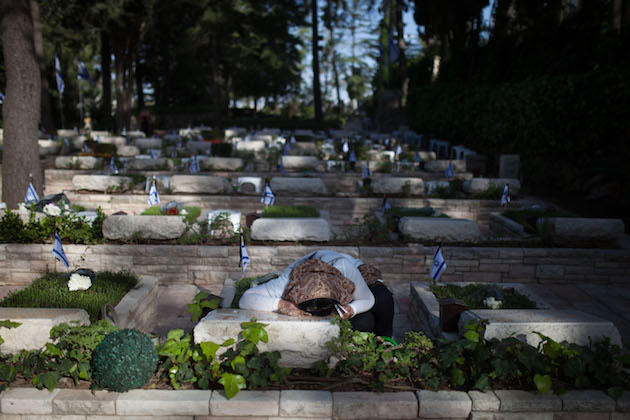
9. Israel’s National Cemetery, Mount Herzl

Mount Herzl

Mount Herzl military cemetery / AP

The site of Israel’s national cemetery, Mount Herzl is the final resting place of Israel’s founding fathers and national leaders, including former President Shimon Peres. The site is named after Theodor Herzl, the founder of Zionism. The Obama administration made clear last week that it does not view the cemetery as part of Israel.

10. Israel’s Capital City

Jerusalem

Jerusalem / AP

Since the days of the bible, Jerusalem has served as the central home of the Jewish people. Since the state of Israel was reestablished in 1948, it has served as the cultural and political center of the Jewish people. The Obama administration has been adamant since the start of its term in 2008 that it does not believe the city belongs to the Jewish state.

US, Russia on brink of military showdown in Syria

September 30, 2016

US, Russia on brink of military showdown in Syria, DEBKAfile, September 30, 2016

5-3

The fact that President Obama instituted a secret inquiry to discover which link in the American chain of command ordered the attack pointed to his suspicion that a high-up in the Pentagon or possibly the CIA, had ordered the air strike, in order to sabotage the US-Russian military cooperation deal in Syria, which Secretary Kerry obtained after long and arduous toil.

The concessions he made to Russian Foreign Minister Lavrov in those negotiations, especially his consent for extensive sharing of intelligence, were found totally unacceptable in the US Defense Department, its military and intelligence community.

********************************

There is a sense in Washington and Moscow alike that a military showdown between the US and Russia is inevitable – direct this time, not through proxies, like the downing of a Russian warplane by Turkish jets last year. When the big powers are in direct confrontation, minor players step aside and run for cover.

When President Barack Obama Friday, Sept. 30 attended the funeral in Jerusalem of the Israeli leader Shimon Peres, he must have realized he was only 514km as the crow flies from Aleppo, the raging crux of the escalating big-power conflict.

The moment after the ceremonies ended the president and his party, including Secretary of State John Kerry and his security adviser Susan Rice, made haste to head back to Washington to navigate the crisis.

The first step toward a direct showdown was taken by the United States.

By now, it is no secret in Moscow, or indeed in any Middle East capital, that the American A-10 air strike of Sept. 17 against a Syrian military position at Jebel Tudar in the Deir ez-Zour region of eastern Syria was intentional, not accidental, as originally claimed. Scores of Syrian soldiers died in the attack.

The fact that President Obama instituted a secret inquiry to discover which link in the American chain of command ordered the attack pointed to his suspicion that a high-up in the Pentagon or possibly the CIA, had ordered the air strike, in order to sabotage the US-Russian military cooperation deal in Syria, which Secretary Kerry obtained after long and arduous toil.

The concessions he made to Russian Foreign Minister Lavrov in those negotiations, especially his consent for extensive sharing of intelligence, were found totally unacceptable in the US Defense Department, its military and intelligence community.

uspalnvsrussian480

The Russian-Syrian reprisal came two days after the A-10 strike. On Sept. 19, an emergency aid convoy was obliterated on its way to the desperate population of Aleppo. Moscow and Damascus denied responsibility for the deadly bombardment, but no other air force was present in the sky over the embattled city.

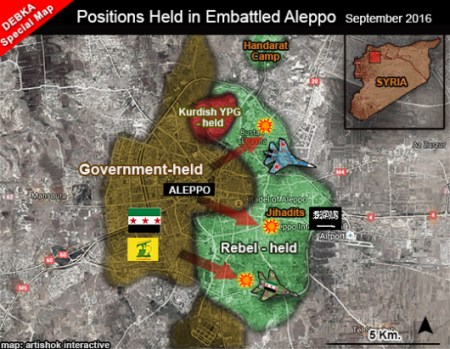
On the ground, meanwhile, an unbridled onslaught on rebel-held eastern Aleppo was launched Wednesday by the Russians, Syria, Hizballah and pro-Iranian Shiite militias under the command of Iranian Revolutionary Guards officers.

The fall of Aleppo, Syria’s second city after Damascus, would give Bashar Assad his most resounding victory in the nearly six-year civil war against his regime.

On Sept. 29, Kerry threatened Moscow that “the United States would suspend plans to coordinate anti-Islamic State counter-terrorism efforts if Moscow does not stop attacking Aleppo.”

Russia’s Deputy Foreign Minister Sergey Ryabkov answered with a sneering: “Once again there was a certain emotional breakdown yesterday against the backdrop of the Obama administration’s unwillingness to fulfill its part of the agreements.”

This was a strong hint of the knowledge in the Kremlin that someone in the US administration was holding out against the implementation in full of the cooperation deal agreed upon and was therefore responsible for its breakdown.

The United States is left with two options:

Either stand idly by in the face of the Russian-Syrian-Iranian onslaught on Aleppo, or shelve the coordination arrangements for US and Russian air operations in Syria, with the inevitable risk of a clash in the air space of Syria or over the eastern Mediterranean.

Column One: The New Middle East

September 29, 2016

Column One: The New Middle East, Jerusalem PostCaroline B. Glick, September 29, 2016

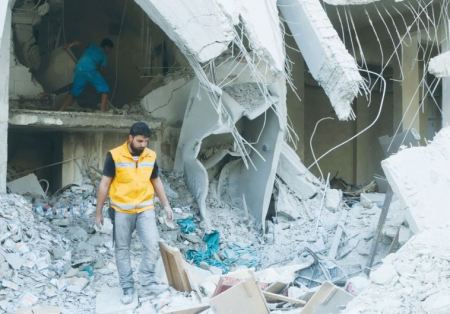
aleppo-messA RED CRESCENT aid worker inspects scattered medical supplies after an air strike on a medical depot in Aleppo on Saturday.. (photo credit:REUTERS)

So Obama let Syria burn. He let Iran and Hezbollah transform the country into their colony. And he let Putin transform the Mediterranean into a Russian lake.

A new Syria is emerging. And with it, a new Middle East and world are presenting themselves. Our new world is not a peaceful or stable one. It is a harsh place.

The new Syria is being born in the rubble of Aleppo.

The eastern side of the city, which has been under the control of US-supported rebel groups since 2012, is being bombed into the Stone Age by Russian and Syrian aircraft.

All avenues of escape have been blocked. A UN aid convoy was bombed in violation of a fantasy cease-fire.

Medical facilities and personnel are being targeted by Russia and Syrian missiles and barrel bombs to make survival impossible.

It is hard to assess how long the siege of eastern Aleppo by Russia, its Iranian and Hezbollah partners and its Syrian regime puppet will last. But what is an all but foregone conclusion now is that eastern Aleppo will fall. And with its fall, the Russian-Iranian-Hezbollah-Assad axis will consolidate its control over all of western Syria.

For four years, the Iranians, Hezbollah and Bashar Assad played a cat and mouse game with the rebel militias.

Fighting a guerrilla war with the help of the Sunni population, the anti-regime militias were able to fight from and hide from within the civilian population. Consequently, they were all but impossible to defeat.

When Russian President Vladimir Putin agreed to join the fight, he and his generals soon recognized that this manner of fighting ensured perpetual war. So they changed tactics. The new strategy involves speeding up the depopulation and ethnic cleansing of rebel-held areas. The massive refugee flows from Syria over the past year are a testament to the success of the barbaric war plan. The idea is to defeat the rebel forces by to destroying the sheltering civilian populations.

Since the Syrian war began some five years ago, half of the pre-war population of 23 million has been displaced.

Sunnis, who before the war comprised 75% of the population, are being targeted for death and exile. More than 4 million predominantly Sunni Syrians are living in Turkey, Lebanon and Jordan. More than a million have entered Europe. Millions more have been internally displaced. Assad has made clear that they will never be coming home.

At the same time, the regime and its Iranian and Hezbollah masters have been importing Shi’ites from Iran, Iraq and beyond. The process actually began before the war started. In the lead-up to the war some half million Shi’ites reportedly relocated to Syria from surrounding countries.

This means that at least as far as western Syria is concerned, once Aleppo is destroyed, and the 250,000 civilians trapped in the eastern part of what was once Syria’s commercial capital are forced from their homes and property, the Russians, Iranians, Hezbollah and their Syrian fig leaf Assad will enjoy relative peace in their areas of control.

By adopting a strategy of total war, Putin has ensured that far from becoming the quagmire that President Barack Obama warned him Syria would become, the war in Syria has instead become a means to transform Russia into the dominant superpower in the Mediterranean, at the US’s expense.

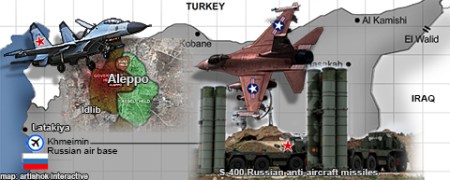
In exchange for saving Assad’s neck and enabling Iran and Hezbollah to control Syria, Russia has received the capacity to successfully challenge US power. Last month Putin brought an agreement with Assad before the Duma for ratification. The agreement permits – indeed invites – Russia to set up a permanent air base in Khmeimim, outside the civilian airport in Latakia.

Russian politicians, media and security experts have boasted that the base will be able to check the power of the US Navy’s Sixth Fleet and challenge NATO’s southern flank in the Mediterranean basin for the first time. The Russians have also decided to turn their naval station at Tartus into something approaching a fullscale naval base.

With Russia’s recent rapprochement with Turkish President Recip Erdogan, NATO’s future ability to check Russian power through the Incirlik air base is in question.

Even Israel’s ability to permit the US access to its air bases is no longer assured. Russia has deployed air assets to Syria that have canceled Israel’s regional air superiority.

Under these circumstances, in a hypothetical Russian-US confrontation, Israel may be unwilling to risk Russian retaliation for a decision to permit the US to use its air bases against Russia.

America’s loss of control over the eastern Mediterranean is a self-induced disaster.

For four years, as Putin stood on the sidelines and hedged his bets, Obama did nothing. As Iran and Hezbollah devoted massive financial and military assets to maintaining their puppet Assad in power, the Obama administration squandered chance after chance to bring down the regime and stem Iran’s regional imperial advance.

For his refusal to take action when such action could have easily been taken, Obama shares the responsibility for what Syria has become. This state of affairs is all the more infuriating because the hard truth is that it wouldn’t have been hard for the US to defeat the Iranian- Hezbollah axis. The fact that even without US help the anti-regime forces managed to hold on for four years shows how weak the challenge posed by Iran and Hezbollah actually was.

Russia only went into Syria when Putin was absolutely convinced that Obama would do nothing to stop him from dislodging America as the premier global power in the region.

As Michael Ledeen recalled earlier this week, Obama chose to stand on the sidelines in Syria because he wanted to make friends with Iran. Obama began his secret courtship of the mullahs even before he officially took office eight years ago.

After the war broke out in Syria, midway through his first term and in the following years, the Russians and the Iranians told the obsessed American president that if he took action against Assad, as strategic rationality dictated, he would get no nuclear deal, and no rapprochement with Tehran.

So Obama let Syria burn. He let Iran and Hezbollah transform the country into their colony. And he let Putin transform the Mediterranean into a Russian lake. Obama enabled the ethnic cleansing of Syria’s Sunni majority, and in turn facilitated the refugee crisis that is changing the face not only of the Middle East but of Europe as well.

And as it turns out, the deal with Iran that Obama willingly sacrificed US control of the Mediterranean to achieve has not ushered in a new era of regional moderation and stability through appeasement as Obama foresaw. It has weakened US credibility with its spurned Sunni allies. It has undermined the strategic position of Israel, the US’s only stable and reliable regional ally. It has financially and strategically fueled Iran’s hegemonic rise throughout the region. And it has facilitated Iran’s development of a nuclear arsenal.

Far from causing the Iranian to become more moderate, the nuclear deal has radicalized the regime still further.

On Wednesday Ray Takeyh wrote in The Washington Post that Supreme Leader Ali Khamenei is now grooming Ibrahim Raisi, a fanatic who makes Khamenei look moderate, to succeed him in power.

On Monday night, for the first time, Israel Air Force jets flying over Syria were shot at by Syrian anti-aircraft ordnance.

Air force sources told the media that the aircraft were never in danger and the munitions were only shot off after the aircraft had returned to Israel and were in the process off landing.

The fact that no one was hurt is of course reassuring.

But the fact that Russia targeted the planes makes clear that Putin has decided to send Israel a very clear and menacing message.

He is now the protector of the Iranian-Hezbollah colony on our northern border. If Israel decides to preemptively attack targets belong to that colony, Russia will not stand by and watch. And with the US no longer well-positioned to challenge Russian power in the region, Israel will have to deal with Russia on its own.

To face this challenge, Israel needs to look beyond its traditional reliance on air power.

There are two parts of the challenge. The first part is Iran.

As far as Israel is concerned, the problem with the Russian- Iranian takeover of Syria is not Putin.

Putin is not inherently hostile to Israel, as his Soviet predecessors were. He is an opportunist. Obama gave him the opportunity to partner with Iran in asserting Russian dominance in the Middle East and he took it. Israel is threatened by the alliance because it is threatened by Iran, not by Putin. To neutralize the alliance’s threat to its own security, Israel then needs to degrade Iran’s power, and it needs to emphasize its own.

To accomplish these goals, Israel needs to operate in two completely separate arenas. To weaken Iran, Israel should take its cue from Iran’s Revolutionary Guard Corps, and from its own past successful military ties to the Kurds of Iraq in the 1960s and 1970s.

Israel needs to deploy military trainers beyond its borders to work with other anti-Iranian forces. The goal of that cooperation must be to destabilize the regime, with the goal of overthrowing it. This may take time. But it must be done. The only way to neutralize the threat emanating from the new Syria is to change the nature of the Iranian regime that controls it.

As for Russia, Israel needs to demonstrate that it is a power that Putin can respect in its own right, and not a downgraded Washington’s sock puppet.

To this end, Israel should embark on a rapid expansion of its civilian presence along its eastern border with Syria and with Jordan. As Russia’s air base in Syria undermines Israel’s air superiority and reliance on air power, Israel needs to show that it will not be dislodged or allow its own territory to be threatened in any way. By doubling the Israeli population on the Golan Heights within five years, and vastly expanding its population in the Jordan Valley, Israel will accomplish two goals at once. It will demonstrate its independence from the US without harming US strategic interests. And it will reinforce its eastern border against expanded strategic threats from both the Golan Heights and the new Jordan with its bursting population of Syrian and Iraqi refugees.

It is ironic that the new Middle East is coming into focus as Shimon Peres, the failed visionary of a fantasy- based new Middle East, is being laid to rest. But to survive in the real new Middle East, Israel must bury Peres’s belief that peace is built by appeasing enemies along with him. The world in which we live has a place for dreamers.

But dreams, unhinged from reality, lead to Aleppo, not to peace.

The Real Middle East Story

September 25, 2016

The Real Middle East Story, The Amerian InterestWalter Russell Mead, September 23, 2016

The reason that Bibi has been more successful than Obama is that Bibi understands how the world works better than Obama does. Bibi believes that in the harsh world of international politics, power wisely used matters more than good intentions eloquently phrased.

Bibi’s successes will not and cannot make Israel’s problems and challenges go away. And finding a workable solution to the Palestinian question remains something that Israel cannot ignore on both practical and moral grounds. But Israel is in a stronger global position today than it was when Bibi took office; nobody can say that with a straight face about the nation that President Obama leads. When and if American liberals understand the causes both of Bibi’s successes and of Obama’s setbacks, then perhaps a new and smarter era of American foreign policy debate can begin.

************************

Peter Baker notices something important in his dispatch this morning: at this year’s UNGA, the Israel/Palestine issue is no longer the center of attention. From The New York Times:

They took the stage, one after the other, two aging actors in a long-running drama that has begun to lose its audience. As the Israeli and Palestinian leaders recited their lines in the grand hall of the United Nations General Assembly on Thursday, many in the orchestra seats recognized the script.

“Heinous crimes,” charged Mahmoud Abbas, the Palestinian president. “Historic catastrophe.”

“Fanaticism,” countered Benjamin Netanyahu, the Israeli prime minister. “Inhumanity.”

Mr. Abbas and Mr. Netanyahu have been at this for so long that between them they have addressed the world body 19 times, every year cajoling, lecturing, warning and guilt-tripping the international community into seeing their side of the bloody struggle between their two peoples. Their speeches are filled with grievance and bristling with resentment, as they summon the ghosts of history from hundreds and even thousands of years ago to make their case.

While each year finds some new twist, often nuanced, sometimes incendiary, the argument has been running long enough that the world has begun to move on. Where the Israeli-Palestinian conflict once dominated the annual meeting of the United Nations, this year it has become a side show as Mr. Netanyahu and Mr. Abbas compete for attention against seemingly more urgent crises like the civil war in Syria and the threat from the Islamic State.

Baker (and presumably many of his readers) don’t go on to the next, obvious question: What does this tell us about the relative success or failure of the leaders involved? The piece presents both Netanyahu and Abbas as irrelevant. They used to command the world stage, but now nobody is interested in their interminable quarrel.

What the piece doesn’t say is that this situation is exactly what Israel wants, and is a terrible defeat for the Palestinians. Abbas is the one whose strategy depends on keeping the Palestinian issue front and center in world politics; Bibi wants the issue to fade quietly away. What we saw at the UN this week is that however much Abbas and the Palestinians’ many sympathizers might protest, events are moving in Bibi’s direction.

There is perhaps only one thing harder for the American mind to process than the fact that President Obama has been a terrible foreign policy president, and that is that Bibi Netanyahu is an extraordinarily successful Israeli Prime Minister. In Asia, in Africa, in Latin America, Israel’s diplomacy is moving from strength to strength. Virtually every Arab and Middle Eastern leader thinks that Bibi is smarter and stronger than President Obama, and as American prestige across the Middle East has waned under Obama, Israel’s prestige — even among people who hate it — has grown. Bibi’s reset with Russia, unlike Obama’s, actually worked. His pivot to Asia has been more successful than Obama’s. He has had far more success building bridges to Sunni Muslims than President Obama, and both Russia and Iran take Bibi and his red lines much more seriously than they take Obama’s expostulations and pious hopes.

The reason that Bibi has been more successful than Obama is that Bibi understands how the world works better than Obama does. Bibi believes that in the harsh world of international politics, power wisely used matters more than good intentions eloquently phrased. Obama sought to build bridges to Sunni Muslims by making eloquent speeches in Cairo and Istanbul while ignoring the power political realities that Sunni states cared most about — like the rise of Iran and the Sunni cause in Syria. Bibi read the Sunnis more clearly than Obama did; the value of Israeli power to a Sunni world worried about Iran has led to something close to a revolution in Israel’s regional position. Again, Obama thought that reaching out to the Muslim Brotherhood (including its Palestinian affiliate, Hamas) would help American diplomacy and Middle Eastern democracy. Bibi understood that Sunni states like Egypt and its Saudi allies wanted Hamas crushed. Thus, as Obama tried to end the Gaza war on terms acceptable to Hamas and its allies, Bibi enjoyed the backing of both Egypt and Saudi Arabia in a successful effort to block Obama’s efforts. Israel’s neighbors may not like Bibi, but they believe they can count on him. They may think Obama has some beautiful ideas that he cares deeply about, but they think he’s erratic, unreliable, and doesn’t understand either them or their concerns.

Obama is an aspiring realist who wanted to work with undemocratic leaders on practical agreements. But Obama, despite the immense power of the country he leads, has been unable to gain the necessary respect from leaders like Putin and Xi that would permit the pragmatic relationships he wanted to build. Bibi is a practicing realist who has succeeded where Obama failed. Bibi has a practical relationship with Putin; they work together where their interests permit and where their interests clash, Putin respects Bibi’s red lines. Obama’s pivot to Asia brought the US closer to India and Japan, but has opened a deep and dangerous divide with China. Under Bibi’s leadership, Israel has stronger, deeper relationships with India, China and Japan than at any time in the past, and Asia may well replace Europe as Israel’s primary trade and investment partners as these relationships develop.

The marginalization of Abbas at the UN doesn’t just reflect the world’s preoccupation with bigger crises in the neighborhood. It reflects a global perception that a) the Sunni Arab states overall are less powerful than they used to be and that b) partly as a result of their deteriorating situation, the Sunni Arab states care less about the Palestinian issue than they used to. This is why African countries that used to shun Israel as a result of Arab pressure are now happy to engage with Israel on a variety of economic and defense issues. India used to avoid Israel in part out of fear that its own Kashmir problem would be ‘Palestinianized’ into a major problem with its Arab neighbors and the third world. Even Japan and China were cautious about embracing Israel too publicly given the power of the Arab world and its importance both in the world of energy markets and in the nonaligned movement. No longer.

Inevitably, all these developments undercut the salience of the Palestinian issue for world politics and even for Arab politics and they strengthen Israel’s position in the region and beyond. Obama has never really grasped this; Netanyahu has based his strategy on it. Ironically, much of the decline in Arab power is due to developments in the United States. Fracking has changed OPEC’s dynamics, and Obama’s tilt toward Iran has accelerated the crisis of Sunni Arab power. Netanyahu understands the impact of Obama’s country and Obama’s policy on the Middle East better than Obama does. Bibi, like a number of other leaders around the world, has been able to make significant international gains by exploiting the gaps in President Obama’s understanding of the world and in analyzing ways to profit from the unintended consequences and side effects of Obama policies that didn’t work out as Obama hoped.

Bibi’s successes will not and cannot make Israel’s problems and challenges go away. And finding a workable solution to the Palestinian question remains something that Israel cannot ignore on both practical and moral grounds. But Israel is in a stronger global position today than it was when Bibi took office; nobody can say that with a straight face about the nation that President Obama leads. When and if American liberals understand the causes both of Bibi’s successes and of Obama’s setbacks, then perhaps a new and smarter era of American foreign policy debate can begin.

DHS Provides the Security Islamists Need and Want

September 24, 2016

DHS Provides the Security Islamists Need and Want, Dan Miller’s Blog, September 23, 2016

(The views expressed in this article are mine and do not necessarily reflect those of Warsclerotic or its other editors. — DM) 

However, the Department of Homeland Security does not provide the security the rest of us need and want; instead, it does its level best to diminish it. Providing a reasonable level of security would contradict Obama’s view of Islam, Life, the Universe and Everything.

Refugee Fraud

On September 22nd, members of the U.S. Congress made public an internal Department of Homeland Security memo in which it was acknowledged that Refugee fraud is easy to commit and much tougher to detect:

The U.S. has relaxed requirements for refugees to prove they are who they say they are, and at times may rely solely on testimony. That makes it easier for bogus applicants to conspire to get approved, according to the department memo, which was obtained by the House Judiciary and Oversight committees. [Emphasis added.]

“Refugee fraud is easy to commit, yet not easy to investigate,” the undated memo says.

 The memo said there are clear instances where “bad actors … have exploited this program,” gaining a foothold in the U.S. through bogus refugee claims.

The revelation comes just a week after the administration said it was boosting the number of refugees it wants to accept next year to 110,000, up from 85,000 this year. Officials also said they’ll take more Syrians than the 12,000 they’ve accepted so far this year — and they are on pace to resettle as many as 30,000 in 2017. [Emphasis added.]

The President’s decision to increase overall refugee resettlement – and specifically that of Syrian refugees – ignores warnings from his own national security officials that Syrians cannot be adequately vetted to ensure terrorists are not admitted. Revelations about fraud, security gaps, and lack of oversight have demonstrated that the program is creating national security risks,” Reps. Jason Chaffetz and Bob Goodlatte said in a letter to Homeland Security on Thursday. [Emphasis added.]

The Director of the U.S. Immigration and Customs Enforcement acknowledged that she had never seen the internal DHS memo. Why not? Isn’t ICE in charge of enforcing “our” immigration laws?

Countering Violent Extremism

The video provided above explains how CVE has been implemented thus far.

The head of DHS’s “countering violent extremism” program acknowledged on the same day, September 22nd, that its thus far year-long-in-the-brewing “strategic plan” for “combatting violent extremism” has not yet been completed.

George Selim, director of the Office of Community Partnerships at DHS, was repeatedly asked by members of the House Homeland Security Thursday why he could not provide a document outlining the organization’s $10 million plans for countering the spread of terrorism.

. . . .

Selim finally admitted the plan is not finished, stating that a finalized version is “nearly ready.”

He added that he didn’t want to give the impression that the organization is without any strategy after being up and running for a year, and stressed that he takes the use of taxpayer dollars seriously.

Congress appropriated $10 million in funding to the Countering Violent Extremism initiative, which can issue grants to nonprofit organizations working in local communities to prevent radicalization. [Emphasis added.]

But when asked by Rep. Barry Loudermilk R-Ga., to provide evidence that the program was not a “black hole” for taxpayers, Selim could only answer that he has seen positive changes “anecodally” and could not provide any metrics for success.

“I can’t sit hear before you today and definitively say that person was going to commit an act of terrorism with a pressure cooker bomb, but we’re developing that prevention framework in a range of cities across the country,” said Selim.

When asked whether any of the funding provided to DHS for its “countering violent extremism” was being given to terror-linked groups, Mr. Selim responded that

there is no blacklist of non-governmental organizations prohibited from applying for federal funding in the government. He did not say whether their current vetting process has ever mistakenly funded groups that jeopardize national security when questioned, but argued there is always room for improvement when a program is in its infancy. [Emphasis added.]

Mr. Selim’s reply was not responsive; there may be no Federal blacklist, but that an NGO is not on one should not authorize DHS to fund it. The Council on American-Islamic Relations (CAIR) is, of course, one of the principal Hamas/Muslim Brotherhood-linked Islamist organizations upon which the “countering violent extremism” farce relies. Secretary Johnson recently delivered an address to the Islamic Society of North America, which is similarly linked. The countering violent extremism farce focuses, not on root problem of preventing Islamist terrorism, but on rooting out “Islamophobia.”

Here’s a video of Dr. Zuhid Jasser’s testimony before Congress on September 22nd

on Identifying the Enemy: Radical Islamist Terror. This hearing examines the threat of radical Islamist terrorism, the importance of identifying the threat for what it is, and ways to defeat it.

A transcript of Dr. Jasser’s testimony is available here

Former Congressman Pete Hoekstra also testified:

According to the blurb beneath the video,

Former Congressman and Chairman of the House Intelligence Committee Pete Hoekstra at the Subcommittee on Oversight and Management Efficiency of the House Homeland Security Committee of the U.S. Congress. Congress must ask the Obama administration about PSD-11, which made official the US Government’s outreach to the Muslim Brotherhood and other Islamist groups. [emphasis added.]

In His efforts to push the narrative that the Islamic State has nothing to do with Islam, Obama has (a) shared His erroneous perception of the Islamic State and (b) tried to suggest that the Islamic State is the only entity which diverges from “true” Islam. His argument as to (a)

is a strawman argument: the real question isn’t whether ISIS “represents” Islam, but whether ISIS is a byproduct of Islam.  And this question can easily be answered by looking not to ISIS but Islam.  One can point to Islamic doctrines that unequivocally justify ISIS behavior; one can point to the whole of Islamic history, nearly 14 centuries of ISIS precedents.

Or, if these two options are deemed too abstract, one can simply point to the fact that everyday Muslims all around the world are behaving just like ISIS. [Emphasis added.]

For example, Muslims—of all races, nationalities, languages, and socio-political and economic circumstances, in Arab, African, Central and East Asian nations—claim the lions’ share of Christian persecution; 41 of the 50 worst nations to be Christian in are Islamic.  In these countries, Muslim individuals, mobs, clerics, politicians, police, soldiers, judges, even family members—none of whom are affiliated with ISIS (other than by religion)—abuse and sometimes slaughter Christians, abduct, enslave and rape their women and children, ban or bomb churches, and kill blasphemers and apostates.

. . . .

Or consider a Pew poll which found that, in 11 countries alone, at least 63 million and as many as 287 million Muslims support ISIS.  Similarly, 81% of respondents to an Arabic language Al Jazeera poll supported the Islamic State. [Emphasis added.]

Do all these hundreds of millions of Muslims support the Islamic State because they’ve been suckered into its “narrative”—or even more silly, because we have—or do they support ISIS because it reflects the same supremacist Islam that they know and practice, one that preaches hate and violence for all infidels, as America’s good friends and allies, the governments of Saudi Arabia and Qatar—not ISIS—are on record proclaiming? [Emphasis added.]

It is this phenomenon, that Muslims the world over—and not just this or that terrorist group that “has nothing to do with Islam”—are exhibiting hostility for and terrorizing non-Muslims that the Obama administration and its mainstream media allies are committed to suppressing.  Otherwise the unthinkable could happen: people might connect the dots and understand that ISIS isn’t mangling Islam but rather Islam is mangling the minds of Muslims all over the world. [Emphasis added.]

Hence why White House spokesman Josh Earnest can adamantly dismiss 14 centuries of Islamic history, doctrine, and behavior that mirrors ISIS: “That is mythology. That is falsehood. That is not true.” Hence why U.S. media coverage for one dead gorilla was six times greater than media coverage for 21 Christians whose heads were carved off for refusing to recant their faith.

As to (b),

The powers-that-be prefer that the debate—the “narrative”—be restricted to ISIS, so that the group appears as an aberration to Islam.  Acknowledging that untold millions of Muslims are engaged in similar behavior leads to a much more troubling narrative with vast implications. [Emphasis added.]

Conclusions

obamaatun

Obama has what one might wish were a unique world view. However, as Obama has not yet discovered, wishing that something were true does not make it true. He elucidated His world view in His recent address to the United Nations.

U.S. President Barack Obama sang his swan song this week at the United Nations, and seemed baffled by the stubborn refusal of the world to reform itself in his image and on his say-so. [Emphasis added.]

How can there still be “deep fault lines in the international order,” Obama wondered aloud, with “societies filled with uncertainty and unease and strife?”

Shouldn’t his identity as a man “made up of flesh and blood and traditions and cultures and faiths from a lot of different parts of the world” have served as a shining and irresistible example of blended global peace? How can it be that, after eight years of his visionary leadership, peoples everywhere aren’t marching to his tune of self-declared superior “moral imagination”? [Emphasis added.]

It is indeed a “paradox,” Obama declared.

In his preachy, philosophical and snooty address to the U.N. General Assembly on Wednesday, Obama expressed deep disappointment with the world. Alas, it seems peoples and nations are just not sophisticated enough to comprehend his sage sermonizing, smart enough to follow his enlightened example, or deep enough to understand his perfect policies. [Emphasis added.]

Why does the world not snap to order as he imperiously wishes and drool in his presence?

. . . .

The words “enemy, “threat” or “adversary” do not appear even once in Obama’s 5,600-word address. They are not part of his lexicon, nor are concepts like “victory” for the West or “beating” the bad guys. He won’t even names foes, such as “radical Islam” or “Islamist terror.”

All this high-minded intellectualizing, self-doubt and equivocation leave the U.S. with little ability to actually drive towards a more ordered world and provide a modicum of global security.

Instead, we have only Obama’s “belief” that Russia’s imperialist moves in Ukraine and Syria, China’s power grabs in Asia, and Iran’s hegemonic trouble-making in the Middle East (and by inference, Israel’s settlement policies in Judea and Samaria) will “ultimately backfire.”

Obama has many such unsubstantiated and illusory “beliefs.” It is very important for him to tell us what he “believes,” and he does so repeatedly. Clearly, he believes in the overwhelming potency of his own beliefs, despite the global security collapse. In fact, the U.N. speech reads like chapter one of the expected Obama memoirs, which surely will be filled with more inane “beliefs” and other ostentation. [Emphasis added.]

Fortunately, Obama will soon leave the presidency.

It falls to Congress and the next president to redirect U.S. policy and hopefully base it less on whimsical, wayward beliefs and more on a hard-nosed, forceful reassertion of Western interests.

Unfortunately, Hillary shares many of not most of Obama’s delusions.

Fortunately, Trump does not and seems to have a pretty good chance of becoming our President.

China to Obama: America Forced Norks to get Nukes and Must Negotiate a Deal

September 20, 2016

China to Obama: America Forced Norks to get Nukes and Must Negotiate a Deal, Dan Miller’s Blog, September 20, 2016

(The views expressed in this article are mine and do not necessarily reflect those of Warsclerotic or its other editors. — DM)

In an article titled North Korean Nukes, South Korea, Japan, China and Obama, posted the day after North Korea’s most recent nuke test, September 9th, I contended that China would not honor Obama’s request to make North Korea stop developing and testing nukes. China has remained a faithful ally of North Korea since the end stage of the Korean Conflict and “sees Obama, not as the representative of the world’s greatest power, but as a joke. He has no clout internationally and is a national embarrassment.”  NB: I had hoped to publish this article more than a week ago, but my internet was down or at best intermittent from September 13th until September 19th.)

I was right, but it’s a bit worse than I had thought.

On September 12th, an article was published by Xinhua titled China urges U.S. to take responsibility on Korean Peninsula nuclear issueXinhua is

the official press agency of the People’s Republic of China. Xinhua is the biggest and most influential media organization in China. Xinhua is a ministry-level institution subordinate to the Chinese central government. Its president is a member of theCentral Committee of China’s Communist Party.

According to Xinhua,

U.S. Defence Secretary Ashton Carter reportedly called for further pressure on the DPRK last Friday after the country carried out a new nuclear test and said China bears “responsibility” for tackling the problem. [Emphasis added.]

The essence of the Korean Peninsula nuclear issue is the conflict between the DPRK and the United States, spokesperson Hua Chunying said at a press conference. [Emphasis added.]

As a permanent member of the UN Security Council and a close neighbor of the DPRK, China has made unremitting efforts to maintain peace and stability on the Korean Peninsula and safeguard the international nuclear non-proliferation regime, Hua said.

A statement released by the Foreign Ministry of the DPRK Sunday said the United States compelled the DPRK to develop nuclear warheads, and the nuclear threat it has constantly posed to the DPRK for decades is the engine that has pushed the DPRK to this point. [Emphasis added.]

Blindly increasing the pressure and the resulting bounce-back will only make the nuclear issue on the Korean Peninsula “a firm knot,” Hua said, calling for responsibility from all relevant parties.

Hua reiterated that China will remain committed to resolving issues concerning the Peninsula through dialogue to realize long-term peace and stability.

China strongly urges all parties to speak and act cautiously with the larger picture in mind, avoid provoking each other and make genuine efforts to achieve denuclearization, peace and stability on the Korean Peninsula, Hua said.

. . . .

“We have seen the twists and turns in the situation on the Korean Peninsula since the six-party talks have stalled,” Hua said, noting that it proves that simple sanctions cannot solve the issue. [Emphasis added.]

Hua said the security concerns of parties on the Korean Peninsula must and can only be resolved in a way that serves the interests of all parties.

Any unilateral action based on one’s self-interest will lead to a dead end, and it will not help resolve one’s security concerns but will only aggravate the tension, complicate the issue, and make it more difficult to achieve relevant goals, Hua said. [Emphasis added.]

The six-party talks, involving China, the DPRK, the United States, the Republic of Korea (ROK), Russia and Japan, were a multilateral mechanism aimed at solving the Korean Peninusla nuclear issue. The talks began in 2003 and stalled in December 2008. The DPRK quit the talks in April 2009.

“Resuming the six-party talks is difficult, but we cannot give up easily ,” Hua said.

China will continue to keep close communication with relevant parties and call on them to return to the right track of solving issues related to the Korean Peninsula through dialogue and negotiation, the spokesperson said.

China clearly appears to be following the line of Kim Jong-un on why North Korea needs nukes:

https://www.youtube.com/watch?v=iJBJtohbLT0

The Obama administration cannot engage in successful negotiations with North Korea, for several reasons. They are, in no particular order: Obama will be gone in about four months; Kerry is Obama’s Secretary of State; The Obama-Clinton-Kerry Iran Scam gave the Islamic Republic everything it sought and, at best, left Iran on the highway to nukes. North Korea and Iran are different in at least one major respect: Iran claimed that it did not have nukes and had not tried to develop them; Supreme Leader Khamenei was claimed to have issued a fatwa against the acquisition, development and use of nukes — despite propaganda videos showing how Iran will use nukes against the “great and little Satan.” North Korea has and has tested five nukes. Kim brags about them and threatens to use them.

The nuke threat

38 North is a think tank largely devoted to obtaining and publishing reliable information about North Korea’s nuke and missile programs. An article there by , published on September 12th, concludes:

What are the greatest threats from the rapidly expanding North Korean nuclear program? Left unchecked, Pyongyang will likely develop the capability to reach the continental United States with a nuclear tipped missile in a decade or so. Much more troubling for now is that its recent nuclear and missile successes may give Pyongyang a false sense of confidence and dramatically change regional security dynamics. The likely ability of the DPRK to put nuclear weapons on target anywhere in South Korea and Japan and even on some US assets in the Pacific greatly complicates the regional military picture. That situation would be exacerbated if Pyongyang decides to field tactical nuclear weapons as its arsenal expands and its confidence in its nuclear arsenal grows.

More bombs and better bombs also increase the potential of accidents and miscalculations with greater consequences as the number and sophistication of bombs increase. Rendering the nuclear enterprise safe and secure in case of internal turmoil or a chaotic transition in the North becomes more difficult. We also cannot rule out that a financially desperate leadership may risk the sale of fissile materials or other nuclear assets, perhaps to non-state actors. [Emphasis added.]

So, what to do? The latest nuclear test demonstrates conclusively that attempting to sanction the DPRK into submission and waiting for China to exert leverage over Pyongyang’s nuclear program do not work. Increasing sanctions and adding missile defenses in South Korea to that mix will also not suffice and make China even less likely to cooperate. What’s missing is diplomacy as much as Washington may find it repugnant to deal with the Kim regime.

On September 20th, North Korea announced that it had tested a new long-range rocket engine, suggesting that it “can be used for an intercontinental ballistic missile (ICBM), which is capable, in theory, of hitting targets on the U.S. mainland.” The September 9th nuke test is claimed to have involved “a miniaturized nuclear warhead that could be mounted on a ballistic missile.” How close in North Korea to being able to nuke the U.S. mainland? I don’t know and don’t want to find out by having it happen.

Can diplomacy, even if undertaken by a new administration after Obama leaves office, be successful? Continued sanctions got Iran to engage in negotiations; both Iran and Obama’s America very much wanted the sanctions lifted so that Iran would become an honorable member of the community of nations. There are few if any significant sanctions to lift on North Korea and China will not impose or enforce any; China’s role has been to help North Korea evade sanctions.

In China Won’t Stop Kim Jong-un. The U.S. Must Stand Up to Both of Them, published by Slate Magazine on September 13,  had some perhaps useful suggestions:

[T]he United States should rally the same sort of campaign that revved up the pressure against Iran before those nuclear talks got underway. In other words, the international community should apply sanctions not only against North Korea but also against all institutions that do business with North Korea—an action that would affect some major Chinese banks, which provide it with energy supplies, other goods, and hard currency. [Emphasis added.]

Yes, this would stir tensions in U.S.-China relations; but so do a lot of other actions, many of them instigated by China (for instance, the dodgy territorial claims in the South China Sea), and in this case, any perceptions of American aggression would be offset, to some degree, by a realization—at least by some Chinese officials—that it’s time for Beijing to face up to its problem and reassess its strategic priorities accordingly. (Longtime China-watchers say that some of Xi’s senior comrades have been advocating tougher action against Kim.)

He also suggests that if an end is put to North Korea’s nuclear ambitions and work, America should agree to terminate its no longer necessary THAAD deployments in South Korea and Japan. Further, the next president

should take steps, especially with China, to prevent Pyongyang from deploying a nuclear missile; but if that proves fruitless, he or she should make very clear that North Korea’s use of nuclear weapons—or even a conventional invasion of South Korea (which might be accompanied by a brandishing of nukes to deter anyone from coming to Seoul’s aid)—will be regarded as an attack on the United States and will be dealt with accordingly. There should be no ambiguity about this. Kim Jong-un may be crazy, but his eccentricities have always been in the service of his survival—and he should understand that he’s putting his survival on the line. Daniel Sneider, associate director of Stanford University’s Shorenstein Asia-Pacific Research Center, thinks we should deploy more nuclear-capable aircraft on U.S. bases in Asia to drive this point home fiercely.

It seems worth noting that among the reasons to expect that a Russian-assisted attack on South Korea would be successful, which Kim Il-sung suggested to Stalin in 1950, was that Secretary of State Dean Atcheson had delivered an important address in which he listed the nations to the defense of which America would come if attacked. South Korea was not on the list. As I observed here in November of 2010,

When Kim il-Sung secretly visited Moscow between March 30 and April 25, he assured Stalin that his attack would succeed in three days: there would be an uprising by some two hundred thousand party members and he was convinced that the United States would not intervene. Secretary of State Dean Acheson’s January 12, 1950 speech was persuasive evidence. There, Secretary Acheson had omitted South Korea from a list of nations which the United States would defend if attacked. Stalin gave the go-ahead.

Conclusions

China has encouraged North Korean nuclearization and wants America and her allies, principally South Korea, to cease their “provocations” against the Kim regime. Yet Kim thrives on, and encourages his supporters by, engaging in provocations far more serious and dramatic than anything thus far done by America and South Korea. It seems likely that the North Korean nuke – missile problem will continue until Kim is (a) taken out and (b) replaced with someone less narcissistic and more interested in feeding his people than his ego. Whether such a replacement will emerge is unknown. However, if a Kim clone emerges instead, he seems likely to be more concerned than Kim about his prospects for a long and happy life, even with protection from China.

North Korean Nukes, South Korea, Japan, China and Obama

September 10, 2016

North Korean Nukes, South Korea, Japan, China and Obama, Dan Miller’s Blog, September 10, 2016

(The views expressed in this article are mine and do not necessarily reflect those of Warsclerotic or its other editors. — DM)

On September 9th, North Korea conducted its fifth nuke test, of its most powerful nuke thus far. Can Obama get China to help make North Korea stop developing and testing nukes? Nope. China sees Obama, not as the representative of the world’s greatest power, but as a joke. He has no clout internationally and is a national embarrassment.

China and North Korea – a very short history

Here’s a link to an article I posted on June 25, 2013 about the Korean conflict. To summarize, China and the Democratic People’s Republic of Korea (North Korea) have a long history of acting together. China views the Republic of Korea (South Korea), which borders North Korea to the south and is an American ally, as a threat. She does not want reunification of the Korean peninsula under a government favorable to America.

When, on June 25, 1950, North Korea invaded South Korea with Russian aircraft, weaponry, training and other substantial support, China did not assist North Korea. North Korean forces pushed the South Korean government, as well as the few American military advisers (then under the command of the Department of State), south to the Pusan perimeter. Following General MacArthur’s unexpected and successful Inchon invasion which began on September 15th, American and other United Nations forces pushed the North Korean forces back north: MacArthur sent his by then greatly augmented forces east to Wonson and eventually managed to push North Korean forces to the northern side of the Yalu River. However, Chinese forces struck back en masse and MacArthur’s forces were driven back to Seoul.

Ever since bringing to an end MacArthur’s successes in the Korean Conflict, China has supported North Korea. She has opposed, and has then declined to enforce, significant sanctions responsive to North Korean nuclear and missile development and testing. While China may acquiesce in weak UN resolutions condemning North Korean provocations, she rarely goes beyond that.

China, Japan and the two Koreas

China has a long memory and still resents, bitterly, the lengthy period prior to and during World War II when Japan occupied significant parts of China. Ditto South Korea, all of which was under Japanese occupation for a lengthy period prior to and during World War II. Although China has substantial trade with both South Korea and Japan, she is more hostile to Japan than is South Korea; the latter two have substantial mutual interests transcending trade.

Perhaps the most important current dispute between China on the one hand, and Japan-South Korea-America on the other, involves the plans of Japan and South Korea to defend against North Korean missiles by the installation of THAAD anti-missile weapons provided by America. China’s stated reason for opposition to the THAAD system is that it could be used against Chinese, as well as North Korean, missiles. Why does China assert this objection unless she hopes to fire missiles at one or both of them? If China fires missiles at Japan and/or South Korea, they have every right to destroy her missiles and to respond in kind with U.S. assistance if requested.

President Obama

condemned Pyongyang’s fifth nuclear test today in the “strongest possible terms as a grave threat to regional security and to international peace and stability” as outraged lawmakers from both parties called for tougher action to stop North Korea’s nuclear program. [Emphasis added.]

That may well be all that Obama does — despite the warnings of Rep. Adam Smith (D-Wash.), the top Democrat on the House Armed Services Committee, that

we have to make it absolutely clear that if they engage in any military activity, they will be destroyed. We have to have a credible deterrent. That seems to be the only thing that will stop North Korea from engaging in military action… We have sanctioned them, and we should keep sanctioning them, but it’s not going to stop them from developing the nuclear weapons.” [Emphasis added.]

Obama won’t do that:

In a statement Friday, President Obama vowed to “take additional significant steps, including new sanctions, to demonstrate to North Korea that there are consequences to its unlawful and dangerous actions.”

Obama did not suggest what He might have in mind, beyond historically ineffective sanctions and condemnations “in the strongest possible terms,” to let North Korea know that there will be “consequences.”

A September 9th article at the New York Times provides an unpleasant analysis of the options Obama now has, and which His successor will have, in dealing with North Korea.

A hard embargo, in which Washington and its allies block all shipping into and out of North Korea and seek to paralyze its finances, risks confrontations that allies in Asia fear could quickly escalate into war. But restarting talks on the North’s terms would reward the defiance of its young leader, Kim Jong-un, with no guarantee that he will dismantle the nuclear program irrevocably.

For more than seven years, President Obama has sought to find a middle ground, adopting a policy of gradually escalating sanctions that the White House once called “strategic patience.” But the test on Friday — the North’s fifth and most powerful blast yet, perhaps with nearly twice the strength of its last one — eliminates any doubt that that approach has failed and that the North has mastered the basics of detonating a nuclear weapon.

Despite sanctions and technological backwardness, North Korea appears to have enjoyed a burst of progress in its missile program over the last decade, with experts warning that it is speeding toward a day when it will be able to threaten the West Coast of the United States and perhaps the entire country. [Emphasis added.]

. . . .

Mr. Obama has refused to negotiate with the North unless it agrees first that the ultimate objective of any talks would be a Korean Peninsula without nuclear arms. But Mr. Kim has demonstrated, at least for now, that time is on his side. And as he gets closer to an ability to threaten the United States with a nuclear attack, and stakes the credibility of his government on it, it may be even more difficult to persuade him to give up the program.

 In a statement Friday, Mr. Obama condemned the North’s test and said it “follows an unprecedented campaign of ballistic missile launches, which North Korea claims are intended to serve as delivery vehicles intended to target the United States and our allies.”

“To be clear, the United States does not, and never will, accept North Korea as a nuclear state,” he said.

Many experts who have dealt with North Korea say the United States may have no choice but to do so. [Emphasis added.]

“It’s too late on the nuclear weapons program — that is not going to be reversed,” William Perry, the defense secretary under President Bill Clinton during the 1994 nuclear crisis with North Korea, said in August at a presentation in Kent, Conn. The only choice now, he argued, is to focus on limiting the missile program. [Emphasis added.]

Obama has taken no significant steps to limit Iran’s continuing missile development and testing program. How can He limit that of North Korea without Chinese cooperation?

Yet the latest effort to do that, an agreement between the United States and South Korea to deploy an advanced missile defense system in the South, has inflamed China, which argues the system is also aimed at its weapons. While American officials deny that, the issue has divided Washington and Beijing so sharply that it will be even more difficult now for them to come up with a joint strategy for dealing with the North. [Emphasis added.]

China has been so vocal with its displeasure over the deployment of the American system that Mr. Kim may have concluded he could afford to upset Beijing by conducting Friday’s test. [Emphasis added.]

Fueling that perception were reports that a North Korean envoy visited Beijing earlier this week.

North Korea almost certainly sees this as an opportunity to take steps to enhance its nuclear and missile capabilities with little risk that China will do anything in response,” Evans J.R. Revere, a former State Department official and North Korea specialist, said in a speech in Seoul on Friday. [Emphasis added.]

The breach between China and the United States was evident during Mr. Obama’s meeting with President Xi Jinping last week. “I indicated to him that if the Thaad bothered him, particularly since it has no purpose other than defensive and does not change the strategic balance between the United States and China, that they need to work with us more effectively to change Pyongyang’s behavior,” Mr. Obama said, referring to the Terminal High Altitude Area Defense system, as the advanced missile defense project is known. [Emphasis added.]

North Korea and Iran

Iran and North Korea have a long history of cooperation in developing nukes and missiles with which to deliver them. In the past, Iranian scientists have been present at North Korean nuke tests, and vice versa. They have also assisted each other in the development of nukes and missiles.

Iran and North Korea have substantial reasons to cooperate: by virtue of the Iran scam, Iran now has lots of money but is at least minimally restricted in its nuke development. North Korea has little usable currency, needs whatever it can get, and no attempts to halt or even to limit its nuke development have worked.

A missile fired recently by North Korea bore a striking resemblance to an Iranian missile.

Photos released by North Korea of its launch of long-range ballistic missiles are the latest proof of the close military cooperation between Pyongyang and Tehran, an Israeli expert in the field told the news site IsraelDefense on Tuesday.

According to Tal Inbar — head of Space and UAV Research Centre at the Fisher Institute for Air & Space Strategic Studies — what was new in the photos was the shape of the warheads attached to the Nodong missiles, known in Iran as the Shahab-3.

Until now, such warheads — first detected by Inbar in Iran in 2010 — have not been seen in North Korea. At the time, Inbar dubbed them NRVs (or, “new entry vehicles”), which became their nickname among missile experts around the world. [Emphasis added.]

Inbar told IsraelDefense: “The configuration that we saw [on Tuesday] is identical to what we saw in Iran six years ago. In principle, its penetrating body (warhead) is identical to that of Scud missiles, but is mounted on the Shahab-3, and creates a more stable entity than other Shahab/Nodong warheads.”

Inbar said this was the third time that something of this nature had appeared in Iran before it did in North Korea. “But we must remember that the two countries engage in close cooperation where military and space-directed missiles are concerned,” he said. “It is thus possible that both plans and technology are being transferred regularly from one to the other.” [Emphasis added.]

Are North Korea and Iran rational? According to this New York Times analysis, North Korea is.

North Korea’s actions abroad and at home, while abhorrent, appear well within its rational self-interest, according to a 2003 study by David C. Kang, a political scientist now at the University of Southern California. At home and abroad, he found, North Korean leaders shrewdly determined their interests and acted on them. (In an email, he said his conclusions still applied.) [Emphasis added.]

“All the evidence points to their ability to make sophisticated decisions and to manage palace, domestic and international politics with extreme precision,” Mr. Kang wrote. “It is not possible to argue these were irrational leaders, unable to make means-ends calculations.” [Emphasis added.]

Victor Cha, a Georgetown University professor who served as the Asian affairs director on George W. Bush’s National Security Council, has repeatedly argued that North Korea’s leadership is rational.

I submit that the same analysis, applied to Iran, produces the same result. Iran’s leaders know what they want, and are sufficiently rational to achieve it; they did. Obama, not the leader of a dictatorial theocracy, is sufficiently irrational to believe that what he wants for the Islamic Republic of Iran is what America needs it to have. It is not.

Obama and Iran

Obama’s Iran scam would be farcical were it not potentially deadly. He did not do what would have been best for America and the free world in general — increase sanctions until Iran complied fully with UN resolutions on missile testing, ceased Uranium enrichment and disposed of the means to do it, ceased all nuke research as well as all nuke cooperation with North Korea and ceased supporting all terrorist groups, including Hezbollah and Hamas. Instead, perhaps considering Himself above such trivia, Obama sought little more than what He considered His greatest achievement — His legacy:

iranian-navy-copy-1

Conclusions

If Obama were viewed internationally as the powerful leader of the world’s most powerful nation, He might be able to get China to clamp down, severely and successfully, on North Korea’s nuke and missile development. Were China to reject His overtures, He could arrange for it to wish that it had acceded. That’s not who Obama is, as demonstrated by, among His other actions, entering into the Iran Scam deal with Iran.

Perhaps Kim Jong-un needs to dress like an Iranian mullah to convince Obama to give him a “deal” similar to the one He gave to Iran. He had better hurry: that won’t work with President Trump.

Obama hands Syria over to Putin

September 10, 2016

Obama hands Syria over to Putin, DEBKAfile, September 10, 2016

putin_obama_g-20_china-1

The Syrian cease-fire agreement that US Secretary of State John Kerry and Russian Foreign Minister Sergey Lavrov announced Friday night, September 9, in Geneva hands Syrian affairs over to Russia’s President Vladimir Putin and the country’s military.

The accord marked a sharp reversal for Washington. In his meeting with Putin in China last week, US President Barack Obama did not agree to those steps for the simple reason that such an agreement would be in line with the policy and stance of Republican presidential nominee Donald Trump, not those of the Democratic nominee Hillary Clinton.

Trump suggested several months ago that the US should let Putin finish the war in Syria, asserting that the Russian leader would be able to do it better.

Under the current situation it is no wonder that Kerry and Lavrov agreed not to release the details of the agreement.

Publication of the details would reveal that the rebels in the Aleppo area, and perhaps in all of Syria, have been abandoned.

The Syrian rebels now find themselves trapped by both the Russian-Turkish agreement and the Russian-US agreement, with a noose seemingly closing around them.

Meanwhile, on Friday, DEBKAfile released the following report:

The fledgling “initiatives” reverberating this week in Washington, Moscow, Ankara, Jerusalem and the G20 summit were nothing but distractions from the quiet deals struck by two lead players, Russia and Turkey to seize control of the region’s affairs. Recep Tayyip Erdogan knew nothing would come of his offer on the G20 sidelines to US President Barack Obama to team up for a joint operation to evict ISIS from Raqqa. And, although Moscow was keen on hosting the first handshake in almost a decade between Israeli Prime Minister Binyamin Netanyahu and the Palestinian leader Mahmoud Abbas (Abu Mazen), neither were known to be ready for the last step toward a meeting.

But the game-changing events to watch out for took place in Hangzhou without fanfare – namely, the Obama-Putin talks and the far more fruitful encounter between Putin and Erdogan.

According to DEBKAfile’s intelligence and Mid East sources, Putin virtually shut the door on further cooperation with the United States in Syria. He highhandedly informed Obama that he now holds all the high cards for controlling the Syrian conflict, whereas Washington was just about out of the game.

Putin picked up the last cards, our sources disclose, in a secret deal with Erdogan for Russian-Turkish collaboration in charting the next steps in the Middle East.

The G20 therefore, instead of promoting new US-Russian understanding, gave the impetus to a new Russian-Turkish partnership.

Erdogan raked in instant winnings: Before he left China, he had pocketed Putin’s nod to grab a nice, 4,000-sq.km slice of northern Syria, as a “security zone” under the control of the Turkish army and air force, with Russian non-interference guaranteed.

This Turkish zone would include the Syrian towns of Jarablus, Manjib, Azaz and Al-Bab.

Ankara would reciprocate by withdrawing its support from the pro-US and pro-Saudi rebel groups fighting the Assad army and its allies in the area north of Aleppo.

Turkey’s concession gave Putin a selling-point to buy the Syrian ruler assent to Erdogan’s project. Ankara’s selling-point to the West was that the planned security zone would provide a safe haven for Syrian refugees and draw off some of the outflow perturbing Europe.

kremlinwhitehouse480-1

It now turns out that, just as the Americans sold the Syrian Kurds down the river to Turkey (when Vice President Joe Biden last month ordered them to withdraw from their lands to the eastern bank of the Euphrates River or lose US support), so too are the Turks now dropping the Syrian rebels they supported in the mud by re-branding them as “terrorists.”

The head of this NATO nation has moreover gone behind America’s back for a deal with the Russian ruler on how to proceed with the next steps of the Syrian conflict.

Therefore, when US Secretary of State John Kerry met Russian Foreign Minister Sergei Lavrov in Geneva Thursday and Friday, Sept. 8-9, for their sixth and seventh abortive sit-downs on the Syrian issue, there was not much left for them to discuss, aside from continuing to coordinate their air traffic over Syria and the eastern Mediterranean.

Washington and Moscow are alike fearful of an accidental collision in the sky in the current inflammable state of relations between the two powers.

As a gesture of warning, a Russian SU-25 fighter jet Tuesday, Sept 6, intercepted a US Navy P8 plane flying on an international route over the Black Sea. When the Russian jet came as close as 12 feet, the US pilots sent out emergency signals – in vain, because the Russian plane’s transponder was switched off. The American plane ended up changing course.

Amid these anomalies, Moscow pressed ahead with preparations to set up a meeting between the Israeli and Palestinian leaders, as the Russian Foreign Ministry announced Thursday.

Putin is keen to succeed where the Obama administration failed. John Kerry abandoned his last effort at peacemaking as a flop two years ago.  But it is hard to see Netanyahu or Abu Mazen rushing to play along with the Russian leader’s plan to demean the US president in the last months of his tenure – especially when no one can tell who will win the November 8 presidential election – Hillary Clinton or Donald Trump – or what policies either will pursue.

All the region’s actors will no doubt be watching closely to see how Turkey’s “Russian track” plays out and how long the inveterate opportunists can hang together.