Posted tagged ‘Foreign Policy’

Russian submarine with 20 ICBMs and 200 nuclear warheads is sailing to Syria

September 7, 2015

Russian submarine with 20 ICBMs and 200 nuclear warheads is sailing to Syria, DEBKAfile, September 7, 2015

Dmitriy_Donskoy_BDmitri Donskoy TK-208 submarine heads for Syria

The world’s largest submarine, the Dmitri Donskoy (TK-208), Nato-coded Typhoon, has set sail for the Mediterranean and is destined for the Syrian coast, DEBKAfilereports exclusively from its military and intelligence sources. Aboard the sub are 20 Bulava (NATO-code SS-N-30) intercontinental ballistic missiles with an estimated up to 200 nuclear warheads. Each missile, with a reported range of 10,000km, carries 6-10 MIRV nuclear warheads.

The Russian sub set sail from its North Sea base on Sept. 4, escorted by two anti-sub warfare ships. Their arrival at destination in 10 days time will top up the new Russian military deployment in Syria.

President Vladimir Putin’s introduction of a nuclear force opposite Syrian shores builds up what first looked like an operation to fortify Assad’s regime in Damascus into a military expedition capable of an air and sea confrontation with US forces in the Middle East.

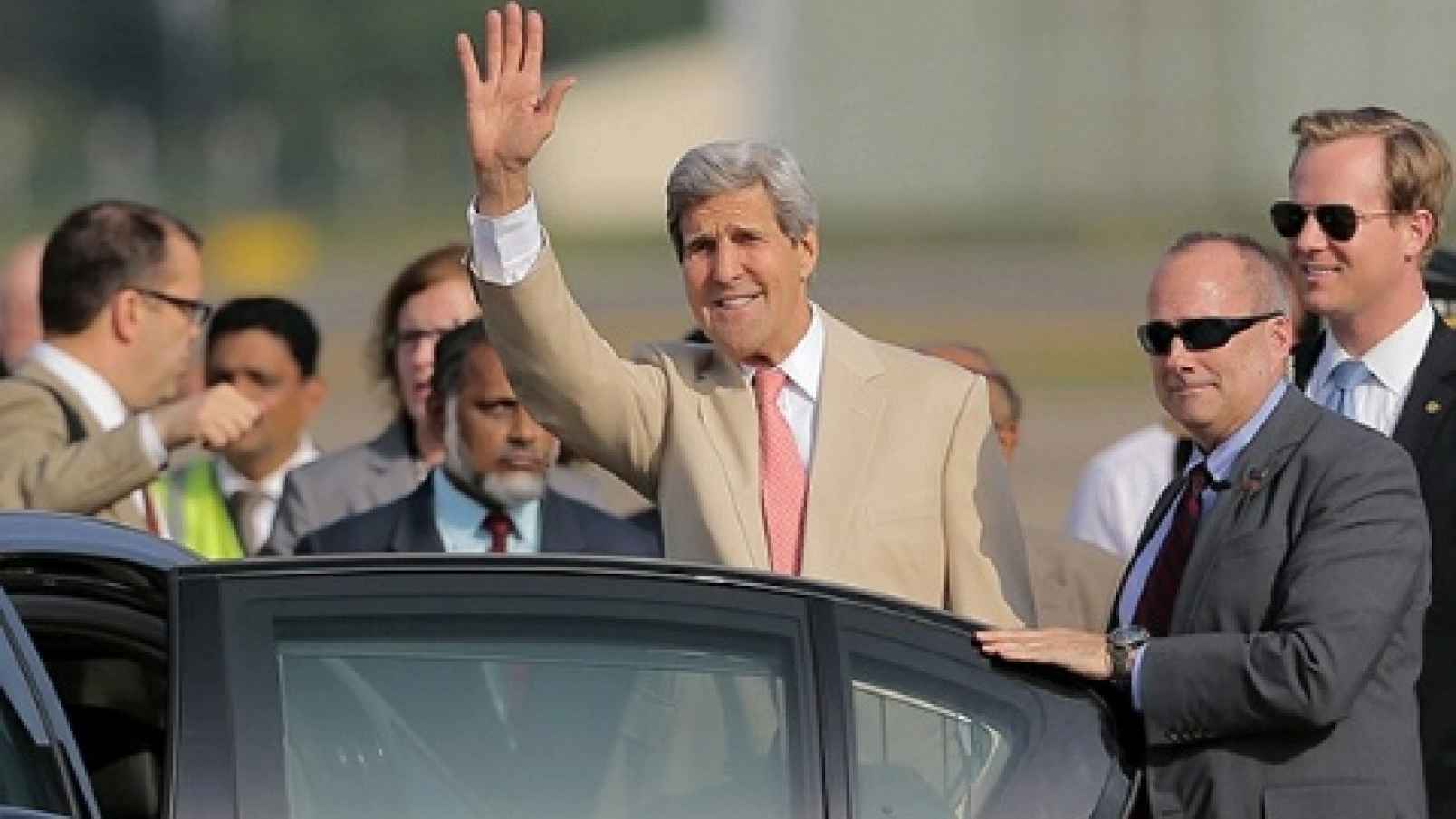
US Secretary of State John Kerry suggested as much Saturday, Sept. 5, when he expressed concern over reports of Russia’s “increasing military build-up in Syria” in a phone call to Russian Foreign Minister Sergey Lavrov. The State Department reported: “The Secretary made clear that if such reports were accurate, these actions could further escalate the conflict, lead to greater loss of innocent life, increase refugee flows and risk confrontation with the anti-ISIL coalition operation in Syria.”

Kerry was referring to potential Russian interference with US-led coalition air strikes against the Islamic State in Syria.

DEBKAfile’s sources in Washington and Moscow report that the dispatch of a nuclear sub to Syrian waters is taken as a strong message that the Kremlin will not let the US impede its military intervention in the Syrian conflict and will go to extreme lengths to keep the way open for the flow of Russian troops to the war-torn country.

This situation has gone a long way beyond Obama administration intentions when US-Russian talks were initially held for US forces posted in Turkey and Iraq, together with the Russian troops arriving in Syria, to launch a combined effort against the Islamic State. Those talks came to naught.

In its coming issue out Friday, Sept. 11, DEBKA Weekly 678 will reveal for the first time how Putin intends to array the Russian forces he is consigning to Syria, their operational planning, their military coordination with Iran and, above all, how the new Russian intervention in Syria may impact US Middle East policy and Israel.


What is to be done?

September 7, 2015

What is to be done? Power LineScott Johnson, September 7, 2015

(In this context, the refusal of Obama — a rogue president — to comply with U.S. law jeopardizes our national security. He will probably continue to get away with it until he leaves office. — DM)

President Obama has failed to comply with the conditions of the Iran Nuclear Agreement Review Act (the Corker-Cardin bill) that he himself signed into law. By its express terms the law required Obama to transmit to Congress “the agreement. . . . including all related materials and annexes.” He was obligated to do this “not later than five days after reaching the agreement.”

Obama has not done so. The administration has failed or refused to submit the IAEA side deal with Iran regarding the possible military dimensions of Iran’s research at the Parchin military facility to Congress.

Indeed, the administration claim not even to have seen the IAEA side deal. Rather, administration officials claim only to have been briefed by the IAEA on the terms of the side deal. They claim it is cloaked in secrecy that prevents its disclosure. The side deal is nevertheless an integral part of the JCPOA and its disclosure expressly required by the act.

Whether or not the side deal is “confidential” matters not one iota under the terms of the Corker-Cardin bill. It should be noted, however, that the administration appears to have constructed an elaborate pretense regarding the side deal. Fred Fleitz has advanced a highly plausible case that administration officials themselves drafted one or more side deals including this one for the IAEA including the Parchin side deal. He calls the arrangement “a national security fraud.”

Obama’s noncompliance with the act is more than problematic. It precludes (or should) the president’s authority to waive sanctions. It prevents (or should) the JCPOA itself from coming to a vote in Congress. Yet little notice has been taken of any of the serious issues that Obama has created in the service of his Iranian fantasies. As always, Obama acts by the executive equivalent of main force and trusts others to fall into line.

Rep. Mike Pompeo and attorney David Rivkin take note in a brief Washington Post column. They write:

Congress must now confront the grave issues of constitutional law prompted by the president’s failure to comply with his obligations under the act. This is not the first time this administration has disregarded clear statutory requirements, encroaching in the process upon Congress’s legislative and budgetary prerogatives. The fact that this has happened again in the context of a national security agreement vital to the United States and its allies makes the situation all the more serious.

For Congress to vote on the merits of the agreement without the opportunity to review all of its aspects would both effectively sanction the president’s unconstitutional conduct and be a major policy mistake. Instead, both houses should vote to register their view that the president has not complied with his obligations under the act by not providing Congress with a copy of an agreement between the IAEA and Iran, and that, as a result, the president remains unable to lift statutory sanctions against Iran. Then, if the president ignores this legal limit on his authority, Congress can and should take its case to court.

At the least, the congressional leaders should refuse to call up the JCPOA for a vote of approval and “register their view” as Pompeo and Rivkin suggest. Congress should force the issue in other ways within the scope of their powers. I don’t know about the proposed judicial remedy; it seems like weak tea. I don’t have the answer, but Congress should not proceed as though the conditions precedent to a vote of approval and the waiver of sanctions have occurred as required under the Corker-Cardin bill; they have not.

Nuclear Jihad

September 7, 2015

Nuclear Jihad, Gatestone InstituteDenis MacEoin, September 7, 2015

    • In the year 628, Muhammad, now ruling in Medina, signed the ten-year Treaty of Hudaybiyyah with his long-time enemies, the tribal confederacy of Quraysh, who ruled Mecca. Twenty-two months later, under the pretext that a clan from a tribe allied with the Quraysh had squabbled with a tribe allied to the Muslims, Muhammad broke the treaty and attacked Mecca, conquering it. It is as certain as day follows night, that the Iranian regime will find a pretext to break the deal. Already, on September 3, the Supreme Leader Ayatollah Khamene’i made it clear that he would back out of the deal if sanctions were not completely removed at once.
    • The Iranian regime not only despises democracy; it considers all Western law, including international law, invalid.
    • The Shi’a consider themselves underdogs, who are willing to sacrifice all to establish the rights of their imams and their successors. That was what the 1979 revolution was all about, and it is what present the Iranian regime still insists on as the justification for its opposition to Western intrusion, democracy, women’s rights and all the rest, which are deemed by Iran’s leadership as part of a plot to undermine and control the expansion of the Shi’i faith on the global stage. These are not Anglican vicars.
    • The Iranian Army and the Islamic Revolutionary Guard Corps “have responsibility… for a religious mission, which is Holy War (Jihad) in the path of God and the struggle to extend the supremacy of God’s law in the world.” — Iran’s Constitution, Article “The Religious Army”.
    • A Third World War is already taking place. The Iran deal strengthens the hands of a regime that is the world’s terrorist state, a state that furthers jihad in many places because its clerical hierarchy considers itself uniquely empowered to order and promote holy war.
    • Obama’s trust in Khamene’i’s presumed fatwa of 2013, forbidding nuclear weapons, rests on the assumption that it even exists. It does not. Even if it did,fatwas are not permanent.
    • Why, then, is this deal going ahead at all? Why is one of the world’s most tyrannical regimes being rewarded for its intransigence, and especially for repeatedly violating the Non-Proliferation Treaty?

“[Some] analysts,” writes the historian and former Israeli Ambassador to the United States, Michael Oren, “claimed the president [Barack Obama] regarded Iran as an ascendant and logical power — unlike the feckless, disunited Arabs and those troublemaking Israelis — that could assist in resolving other regional conflicts. I first heard this theory at Georgetown back in 2008, in conversation with think tankers and former State Department officials. They also believed Iran’s radical Islam was merely an expression of interests and fears that the United States could with sufficient goodwill, meet and allay. … Iran, according to Obama was a pragmatic player with addressable interest. For Netanyahu, Iran was irrational, messianic, and genocidal – ‘worse,’ he said, ‘than fifty North Koreas.'”[1]

Since the signing of the deal at the UN, hot-tempered criticisms and defences have gone into overdrive in the political, journalistic, and diplomatic spheres. Acres have been written and are still being written about the deal, making it the hottest political potato of recent years. Expert analysts such as Omri Ceren and, more recently, Joel Rosenberg have cut through the deliberate obfuscation to show the extent of the dangers the deal presents to the Middle East, the United States, Israel, and the world.

The deal’s supporters insist that it will bring peace and calm to the region, while a host of denigrators — chief among them Israeli Prime Minister Binyamin Netanyahu — have exposed the enormous risks it entails. Already, a vast majority of American citizens are opposed to the deal.

Within the U.S. Congress, bipartisan opposition to the deal is high and mounting. Yet, on September 2, President Obama succeeded in winning over a 34th senator, enough that ultimate passage of the deal is a foregone conclusion. That does not, however, mean that the debate will end. In all likelihood, it will grow fiercer as time passes and true consequences become clearer to the public and politicians alike.

Recent revelations that the International Atomic Energy Agency (IAEA), which oversees nuclear developments worldwide, has agreed that only Iranians will be allowed to inspect the most controversial of Iran’s nuclear sites, have raised anxieties about proper monitoring of the deal. The military complex of Parchin, where Iran is suspected of work on nuclear weapons, will be closed to outside inspection, making it certain that, if Iran decides to cheat (something it has done before), it will be able to do so with impunity. Sanctions will not be re-imposed. And, as we shall see, cheating on the deal can be justified by the Iranians who could always refer to the practice of the prophet Muhammad with the Quraysh tribe in Mecca.

Obama, his Secretary of State John Kerry, and the entire US administration are not merely behind the deal, but almost fanatically so. Many argue that Obama is more interested in securing his “legacy” as the world’s greatest peacemaker (or war-creator, as the case may well turn out to be), the statesman par excellence who alone could bring the theocratic regime of Iran in from the cold and shower the Middle East with true balance in its troubled affairs.

To bring this about, Obama has had to diminish, if not leave totally open to obliteration, American support for Israel, the single country in the world most clearly exposed to a possible genocide should the Iran’s Islamic regime choose to exterminate it, as it has so often threatened to do.

Mahmoud Ahmadinejad’s words mellal-e Eslami bayad Esra’il-ra qal’ o qam’ kard – “the Islamic nations must exterminate Israel” — have been given renewed vigour now that it is highly likely that Iran, evading serious inspections by the IAEA, will soon possess the weapons to do just that.

Even if the treaty is a done deal, it is time to show yet another massive hole in the administration’s strategy. Already, Obama, Kerry and the tightly knit administration have shown themselves remarkably obdurate in turning a blind eye to the many concerns that surround the deal. At the end of the “sunset period,” if not sooner, Iran gets to have, legitimately, as many bombs as it likes. Other problems include breakout times; centrifuge production; centrifuge concealment; uranium enrichment by stealth; refusal to allow the IAEA to inspect military sites; the acquisition of intercontinental ballistic missiles — presumably to be used intercontinentally at guess who. It is no secret that the hardliners in Iran still speak of America as “The Great Satan” and consider it their enemy. That does not even include the implications of lifting sanctions on, and paying billions of dollars to, the world’s main sponsor of terrorism.

As Michael Oren has shown, however, the American president presumably thinks he is doing a deal with a logical and pragmatic regime. Barack Obama, an intelligent, well-read man of Muslim origin, knows almost nothing about Islam; that is the greatest flaw in the Iran deal he has fought so hard to inflict on the human race. With access to platoons of experts, to some of the greatest libraries with holdings in Islamic doctrines and history, and with the Mullahs and Iran’s public still daily promising to destroy America, Obama apparently still believes Islam is a religion of peace and that a theocratic, terror-supporting, medieval regime should have the power to make nuclear bombs. The obverse is that he might like, perhaps not wittingly, to see America, Israel and the West brought to their knees.

This author has previously exposed one aspect of Iran’s serious lack of logic, rationality, or pragmatism — namely the extent to which apocalyptic thinking, messianic prophecy, and dreams of Islamic transcendence through universal conflict pervade the clerical elite, a high percentage of the masses, and even the Islamic Revolutionary Guard Corps. One might assume that this would be especially true when they are flush with cash and nuclear weapons, and the risk to their own survival is substantially lower.

On August 17, just over a month after the signing of the nuclear deal, Iran’s Supreme Leader, ‘Ali Khamene’i, addressed a religious conference, where he expressed his undying hatred for the United States. He said, for example:

We must combat the plans of the arrogance [i.e. the West, led by the U.S.] with jihad for the sake of Allah. … jihad for the sake of God does not only mean military conflict, but also means cultural, economic, and political struggle. The clearest essence of jihad for the sake of God today is to identify the plots of the arrogance in the Islamic region, especially the sensitive and strategic West Asian region. The planning for the struggle against them should include both defense and offense.

The deal has done nothing whatever to stop military threats to Israel, an ally of the United States (though treated with disrespect by America’s president). Speaking on 2 September, the Islamic Revolutionary Guard Corp’s top commander in Tehran province, Brigadier General Mohsen Kazemayni, stated that, “… they [the US and the Zionists] should know that the Islamic Revolution will continue enhancing its preparedness until it overthrows Israel and liberates Palestine.”

There is a simple word for this: warmongering.

Why is the U.S. President insisting on a bad deal with a warmongering regime?

When a military force at its strongest fantasizes about the coming of a Messiah (the Twelfth Imam) to lead them to victory over all infidels, talk of logic, rationality and pragmatism seems acutely out of touch with reality.

Obama’s assumption that there is something solid about the Iranian regime that makes it suitable as a recipient for such largesse and the chance to enrich uranium until kingdom come seems to be based on false consciousness. The regime has been in place for almost forty years, quite a respectable time for a dictatorship. In part, that has been because it has mastered the art of suppression, giving its people a degree of freedom that is missing in several other Islamic countries, such as Saudi Arabia, Sudan, or Afghanistan. These partial freedoms, especially for young people, lull the population into risk-averseness, possibly helped along by the memory in 2009 of pleas for more freedom, which the United States ignored and the mullahs savaged.

Obama, in his ongoing attempt to portray Islam as benign — and a dictatorial regime as a sold basis for peace and understanding in the Middle East — ignores the religious element of the theocracy, as well as the sadistic repression, and in doing so misses a lot.

First of all, Shi’ite Islam is different from its Sunni big brother. It is deeply imbued with features largely absent from Sunni Islam. The most important Shi’i denomination is that of the Twelvers (Ithna’ ‘Ashariyya), who, from the beginning of Islam, have believed themselves to be not only the true version of the faith, but the group destined by God to rule in its name. Beginning with ‘Ali, the son-in-law of the Prophet and the fourth Caliph of the Sunnis, the Shi’a began as his supporters. (Please see the Appendix that follows this article: it contains material that even Barack Obama and his advisors need to know; without it, they simply will not “get” what the ayatollahs are about. It comes to an important conclusion that has considerable bearing on today’s events — and not the one you may expect.)

Beneath the smiles and banter lie the unsmiling masks and the taqiyya-flavoured lies. Beneath the wheeling and dealing and the refusals to compromise lies a sense of destiny for the regime, a belief that it stands on the brink of the realization of the centuries-old Shi’ite dream: that God will finally set his people on the pinnacle of the world and usher in the never-ending reign of the Imam Mahdi, with all injustice gone, the martyrs in paradise, the ayatollahs and mujtahids andmaraji’ in glory, and all the infidels in hell.

It is precisely because Barack Obama and his aides have never got down and dirty to take in hard information that they have remained utterly out of touch with the real springs and cogs of Iranian Shi’ite thinking.

Obama has, when all is said and done, let himself be deluded by the charm offensive of Hassan Rouhani and his henchman Javad Zarif. Obama may not believe in the mystical land of Hurqalyaor the white steed on which the Twelfth Imam will ride to the world’s last battle any more than you or I do. But the clerical elite of Iran, and those who follow them blindly — men and women brought up from birth on these tales, and who travel in the thousands every day to send a message to the Imam at the Jamkaran Mosque near Qom — believe these things with absolute devotion, and that is why this story matters, because it has political consequences.

Shi’i Muslim law enshrines jihad, holy war, as fully as does Sunni law. For Sunnis, jihad has always been possible under the authority of a Caliph, whether fought under his orders or led by kings and governors under his broad aegis.

The Shi’a, however, do not recognize the Caliphate and have often been the victims of Sunni jihads. They may feel impelled to fight a holy war, but under what authority could they do so?

The power of the clergy had waned under the anti-clerical reign of Iran’s Pahlavi dynasty (1925-1979), only to burst out more strongly than ever in the Islamic Revolution, which placed all authority in a new system of government: rule by a religious jurist, a faqih.[2] Overnight, a jihad state was brought into existence; a jihad state with vast oil reserves, modern military equipment, and, at first, the support of almost the entire Iranian population. The clerical hierarchy under Ayatollah Ruhollah Khomeini did not just intend to prepare the way for the coming of the Mahdi. They were now his earthly deputies, in whose hands lay life and death for millions.

The new Shi’ism allowed the clergy to take on powers they had never imagined. More and more economic and legal power came to be concentrated in the hands of a narrow body of scholars, and sometimes a single man could be the source of religious and legal authority for the entire Shi’i world — in Iran, Afghanistan, eastern Arabia, Bahrain, and so on. Thus were the foundations laid for the revolutionary rank of Supreme Leader, taken by the Ayatollahs Khomeini and Khamene’i.

Look for a moment at the preamble to the Constitution of the Islamic Republic of Iran.[3] You will see quickly that this does not read like any other constitution you have seen. The preamble sets the tone. Here, in an account of the circumstances leading to the revolution we read of the clergy as the ruhaniyyat-e mobarez, “the militant or fighting clergy.” These are not Anglican vicars at their prayers or rabbis studying Talmud. A mobarez is a warrior, a champion, a fighter. Not far down the preamble, one encounters a description of their struggle as “The Great Holy War,”jihad-e bozorg. We are not in Obama’s world of logical and pragmatic striving for political and diplomatic coherence. This is made even clearer in one of the constitution’s earlier articles, “The Religious Army.” Here, we read that the Iranian Army and the Islamic Revolutionary Guard Corps “have responsibility… for a religious mission, which is Holy War (Jihad) in the path of God, and the struggle to extend the supremacy of God’s law in the world.”

How do you reach a compromise and a pragmatic deal with a regime that thinks in this way? Are the U.S. administration and the P5+1 blind to something the Iranians have never even bothered to conceal? Do they really take everything in the talks at face value? Perhaps they think references to jihad and fighting clergy are nothing more than pious talk “for domestic consumption,” as they tried to explain — as real and everyday as the myths and legends of other faiths. If they do, then they have far less excuse for their blindness, for the Iranian regime is already at war and is already fighting its jihad.

In Iraq, for example, a country with a majority Twelver Shi’i population, Iranian-backed militias have been at war for many years, first against the Americans, then the Sunnis, and now the hordes of Islamic State. In June 2014, Grand Ayatollah al-Sayyid ‘Ali al-Husayni al-Sistani issued a fatwa calling on Iraqis to fight against Islamic State, justifying their fight as jihad wajib kafa’i: a Jihad that is compulsory for those who choose it, but not for the entire population. The ruling calls for a struggle against ISIS’s irhab – their “terrorism.” Jihad is a religious and legal duty, and even though ISIS may call its fighting jihad, it is here condemned as terror.

Hezbollah, created and backed by Iran, is by far the largest terrorist group in the region. Hezbollah is considered a state within a state, with forces and infrastructure inside Lebanon and Syria. It has used the name “Islamic Jihad Organization” to cover its attacks on Israeli forces in Lebanon. In its 1988 Open Letter (Risala maftuha), it describes its followers as “Combatants of the Holy War” and goes on — in terms similar to those in the Hamas Covenant — “our struggle will end only when this entity [Israel] is obliterated. We recognize no treaty with it, no cease fire, and no peace agreements, whether separate or consolidated.”

Hezbollah and its creator, the Iranian Islamic regime, have a curious link to the Palestinian terror movement, Hamas, despite Hamas being exclusively Sunni. By financing, arming, and defending Hamas, Iran is fighting a strange proxy jihad that serves its own purposes of defying the West, achieving regional hegemony, and winning praise from all Muslims in the world for its own war against Israel. It also furthers the goals of the Muslim Brotherhood (of which Hamas is the Palestinian branch) in the same struggle.

I have dragged you through the briars and mud because it is important here to see another culture through its own eyes. If we insist in pretending that Shi’i Muslims think like Sunni Muslims or, worse still, like Jews or Christians — if we brush all that history and all those doctrines under the carpet of “any deal is better than no deal ” — we will go on making the same mistakes. We will believe that a purely political and diplomatic enterprise to bring Iran in from the cold and create a new trading alliance will transform an evil regime into a land of sweetness and light.

Members of the U.S. Congress must wake up and examine, in however cursory a fashion, these views that motivate the Iranian leadership, and must stop pretending that they are as logical and pragmatic as would be convenient for the wishes of the West.

Not that Obama and Kerry have ever sounded logical or pragmatic in how they have approached this debate and this deal-making process. In an act of supreme folly, the White House has dismissed Ayatollah Khamene’i’s recent call for “Death to America;” they pretend it is just empty rhetoric for the Iranian people.

1169Left: Senior Iranian cleric Ayatollah Mohammad Ali Movahedi Kermani, speaking on July 17 in Tehran, behind a banner reading “We Will Trample Upon America” and “We defeat the United States.” Right: Iran’s Supreme Leader, Ali Khamenei, proclaims “Death to America” on March 2

We are walking with a blindfold toward sure disaster. Forget the dreams of a Messiah if you will, but do not for one moment let yourself be lulled into thinking that only ISIS is serious about waging a jihad.

Despite their oft-expressed delusion that “Islam is a religion of peace,” President Obama, Secretary John Kerry and other leaders are, like it or not, already engaged in a war against jihad. They have already fought it in Afghanistan, Iraq, Libya and elsewhere. However much Obama wants to stand off from involvement in the jihad struggles of the Middle East, he cannot: Western states are fighting jihad, sometimes abroad, increasingly at home.

A Third World War is already taking place, a war the Islamists and Islamic states understand, but which many in the West still refuse to grasp. They are not even willing to respect the true motivations of the enemies against whom they fight. The Iran deal strengthens the hands of a regime that is the world’s terrorist state, a state that furthers jihad in many places because its clerical hierarchy considers itself uniquely empowered to order and promote holy war.

Let us for the moment ignore the nuclear aspect of this deal and look instead on what it offers the world’s leading jihad state. The removal of sanctions coupled with the business deals Europeans and others are rushing to secure, the delivery of perhaps $150 billion to Tehran, and the turning of many blind eyes to both Iran’s internal repression and its jihad wars in Iraq, Syria, Yemen, Gaza, and Lebanon leave the ayatollahs poised to dominate much of the Middle East.

And that is not all. Obama’s belief in the stability of the Iranian regime seems to rest on its endurance since 1979. His trust in Khamene’i’s presumed fatwa of 2013, forbidding nuclear weapons rests on the assumption that it even exists. It does not. No one has ever seen it. Even if the fatwa did exist, fatwas are not permanent. They are always regarded as temporary rulings with Twelver Shi’ism. This is a crucial technical point that the White House seems incapable of — or ill-disposed to — grasping.

Further, Obama’s faith in Iranian President Hassan Rouhani as a reformer and moderate flies in the face of Rouhani’s devotion to the hardline clerical leadership of which he is a part. Here are a few facts:

  • ‘Ali Khamene’i is 76 years old, but his health is poor and he may not live much longer. Already, factions within the hierarchy will be jostling for the Supreme Leadership.
  • In the Usuli Twelver version of Shi’ism, once a Mujtahid dies, his fatwas are no longer valid. A new Mujtahid or, in this case, a new Supreme Leader, has to issue fatwas of his own. A new fatwa may confirm an old one or radically differ from it.
  • A new Supreme Leader is an unpredictable personality.
  • The Iranian nuclear program is already up and running.
  • The breakout time for weapons grade materials may be as short as three months.
  • Iran already has and is acquiring ballistic missiles with an intercontinental range.
  • Jihad is hard-wired into the regime’s philosophy.
  • Iran is already conducting a series of jihad wars abroad.
  • Mahmoud Ahmadinejad has expressed a hope to return to the presidency in 2017. Ahmadinejad and his clique are bent on apocalyptic outcomes and actions to bring the Hidden Imam back to this world.

We only have to get this wrong once. Chants of “Death to America” and “Death to Israel” are not narcotic iterations of slogans but sincerely felt expressions of intent.

Khamene’i last month praised the Iranian people for calling for the deaths of the USA and Israel, and said that he hoped God would answer their prayers because in at most ten years, the Iranian mullahs and their IRGC will possess the power to exterminate Israel, if they and their God so wish.

Why, then, is this deal going ahead at all?

Why are sanctions against the world’s leading exporter of jihadi terrorism being lifted, not strengthened?

Why is one of the world’s most tyrannical regimes being rewarded for its intransigence, and especially for repeatedly violating the Non-Proliferation Treaty?

Why has Israel’s Prime Minister been vilified and sidelined simply for drawing attention to the weaknesses of a deal that could lead to the death of all of his people?

Why have the P5+1 never taken seriously the Shi’ite rule that it is permitted to lie to infidels and conceal one’s own true intentions?

Why are secrets being kept — such as the contents of the two side-deals?

Why is the U.S. Congress being asked to vote without the benefit of full disclosure?

Why is the IAEA banned from spontaneously inspecting only declared Iranian nuclear sites, and why are military sites completely off-limits?

The questions are so many and so critical that we remain in the dark about where this will lead mankind. No one who has ever done a financial or political deal would ever sign on the dotted line until they had answers to all their questions. Far more hangs on this deal than perhaps any deal in history. Yet those who want to make it enforceable under international law are uninformed about the most basic contents of the deal, as well as the beliefs and historical roots of their enemy.

Such folly is almost without precedence, except possibly in the process of appeasement that endeavoured to placate the Third Reich and treat Adolf Hitler as the best friend of democracy.

The Iranian regime not only despises democracy, it considers all Western law — including international law — invalid. This view has several deep roots. For both Sunni and Shi’i Muslims, only rule under God is valid, under a Caliph or a clerical theocracy under a Supreme Ruler. Human beings have no right to interfere. Democracy leads to the making of human laws that may contradict shari’a law, and such effrontery is considered arrogant and presumptuous. The democratic elements in Iran are tightly controlled, and supremacy rests in all areas beneath clerical authority. The same principle applies to international law, UN resolutions, treaties and so forth.

Iran has openly genocidal intent, as well as a devotion to holy war that goes to the very deepest level.

Before we leave the subject of jihad, there is one other factor that everyone has overlooked. It is the Treaty of Hudaybiyyah, the most important agreement in early Islamic history. In the year 628, Muhammad, now ruling in Medina, signed the ten-year Treaty of Hudaybiyyah with his long-time enemies, the tribal confederacy of Quraysh, who ruled Mecca. Twenty-two months later, under the pretext that a clan from a tribe allied with the Quraysh had squabbled with a tribe allied to the Muslims, Muhammad broke the treaty and attacked Mecca, conquering it.

What is important about this is that Muhammad had made the treaty while he was still relatively weak. But in the months after signing it, his alliances and growing conversions meant that he now possessed superior military strength — and that was when he pounced.

In 1994, the treaty became crucial to the issue of peace between Israel and the Palestinians.[4]In September 1993, Palestinian leader Yassir Arafat signed the Oslo Accords along with Israeli Prime Minister Yitzhak Rabin, and the following year the two leaders were awarded the Nobel Peace Prize.

However, even as he awaited that prize, Arafat spoke at a mosque in Johannesburg alluded to the Treaty of Hudaybiyyah and referred to “a jihad to liberate Jerusalem”: “I see this agreement,” he said, “as being no more than the agreement signed between our Prophet Muhammad and the Quraysh in Mecca.”

Non-Muslims may well have misunderstood this as a reference to some early Muslim peace-making. But Arafat made his meaning clear: “We now accept the peace agreement, but [only in order] to continue on the road to Jerusalem.”[5]

The nuclear deal that President Obama and his supporters have imposed will strengthen Iran considerably, removing sanctions and delivering perhaps $150 billion to the country. It is as certain as day follows night, that the Iranian regime will find a pretext to break the deal. Already, on September 3, the Supreme Leader Ayatollah Khamene’i made it clear that he would back out of the deal if sanctions were not completely removed at once.

Whatever happens in the days ahead, the U.S. Congress, backed by a majority of the American public, needs to strike this madcap deal down before it wreaks a storm of tribulations on everyone.

Denis MacEoin has a PhD (Cambridge 1979) in Persian Studies and has written widely on Iran and its religious beliefs.

Appendix

‘Ali became the first in a line of twelve imams, all deemed the true leaders of Islam, but all denied their right to rule and all but one assassinated (or so it is claimed) by the Sunni Caliphs. From this comes the Shi’i sense of suffering, injustice, oppression by despots, neglect and rights — all of which played an important part in the 1979 revolution and continue to play out across society.

The Shi’a are the underdogs who are willing to sacrifice all to establish the rights of their imams and their successors. That was what the 1979 evolution was all about, and it is what present the regime still insists on as the justification for its opposition to Western intrusion, democracy, women’s rights and all the rest, which are deemed by Iran’s leadership as part of a plot to undermine and control the expansion of the Shi’i faith on the global stage.

The twelfth imam, according to Shi’ite legend, was a young boy, Muhammad al-Mahdi, the son of the murdered eleventh imam. Born in 869 in the Iraqi city of Samarra during the reign of the Sunni Abbasid Caliphate, his father, Hasan al-‘Askari, died when Muhammad was born.

It is said that young Muhammad, in order to avoid his enemies, went into something called Occultation (ghayba). Even if this originally was physical, he was never seen alive again and is supposed to have entered the celestial realm of Hurqalya, from which he will one day return as the promised Saviour, the Qa’im bi’l-Sayf, the One Who will Arise with the Sword to do battle with injustice and infidelity.

This belief is what waters modern Shi’i apocalypticism, something promoted intensely by former president Mahmoud Ahmadinejad. This expectation has considerable significance for Iran’s drive to nuclear power. But that is not why I raise the issue here. There is another, more mundane, aspect to the Imam’s disappearance and continued Occultation, and it may be even more relevant to the matters at hand.

The answer to what authority they could fight under was that only the Imam in each generation could order or lead jihad. But when the twelfth Imam vanished from human sight, was jihad to remain in abeyance until his return or could it be fought under another authority? The answer was not at first simple, but one thing started to happen: the Shi’a began to consider their religious scholars to be the intermediaries with the Imam, and this laid the basis for the possibility that they might have the right to order jihad. For some time, this was just conjectural, for the Shi’a had little worldly power.

In 1501, a new dynasty, the Safavids, came to power in Iran, forced most of the population to convert to Shi’ism, and created a line of kings under whom the clerical class became more and more powerful. The Shah could still lead jihad, but the clergy were needed to give permission. The Safavid dynasty lasted till 1722, and an interregnum was followed by the emergence of a new line of Shahs, the Qajars, who ruled from 1796 to 1925.

Under the Qajars, the Shi’i clerical hierarchy underwent deep and lasting changes, producing today’s version of Twelver Islam, the Usulis.

The newly powerful ‘ulama of the 19th century took on the mantle of deputies for the Hidden Imam and ordered jihads in 1809 and 1826 (against Russia), 1836, 1843, and 1856-7 (against the British). In 1914, when the British occupied Iraq at the start of World War I, the Shi’i clergy in the shrine centres there declared jihad to reinforce the call for Holy War by the Ottoman empire.

__________________________________

[1] Ally by Michael Oren

[2] As in Khomeini’s theory and book, Velayat-e Faqih, the Custodianship of the Jurisprudent.

[3] Here in English, here in Persian.

[4] For a detailed discussion of the treaty and its implications for making peace with Muslims, see Daniel Pipes, “Lessons from the Prophet Muhammad’s Diplomacy,” The Middle East Quarterly, September 1999, pp. 65-72.

[5] Natasha Singer, “Arafat Text Raises Ire,” Forward, May 27, 1994.

Four parties caused Syria’s genocidal calamity. Should Israel get involved?

September 6, 2015

Four parties caused Syria’s genocidal calamity. Should Israel get involved? DEBKAfile, September 6, 2015

migrants_along_railways_5.9.15Refugees flooding into Europe

Chapter by chapter, a long list of the guilty parties must bear responsibility for the Syrian catastrophe hacking the ruined country into bleeding parts.

1.  The first culprit is undoubtedly its insensate president Bashar Assad and his close family, who have had no qualms about spilling the blood of some 300,000 men, women, children and old people – some estimate as many as half a million – and making some 11 people homeless, to keep himself in power. No one has ever counted the number of people maimed and crippled by the war, but they are conservatively estimated at one million.

These figures add up to genocide or serial mass murder, which has been allowed to go into its fifth year.

2.  Iran warrants second billing for this mass crime.

Tehran has laid out the stupendous sum of some $40 billion to keep the mass marderer Assad in power with total disregard for his methods of survival. The motives behind the ayatollahs’ military and political boost are well recorded. Worth mentioning here is that Tehran not only pressed its Lebanese proxy, the Shiite Hizballah group, into service alongside Assad’s army, but sent its its own generals to orchestrate the war, led by the Al Qods Brigades chief Qassem Soleimeni.

We can reveal here that 22 Iranian generals have died fighting for the Assad cause.

3. The third place belongs to the United States and President Barack Obama. His refusal to put American boots on the ground may have been the correct decision for the US, but it had four direct consequences:

a)  The slaughter of the Syrian people continued unchecked. Even after President Obama declared that chemical warfare was a red line, he backed down at the last minute against intervening and ordered the US fleet to draw back from the Syrian coast.

To this day, Assad continues to use chemical weapons to poison his enemies.

b)  Obama and his Secretary of State John Kerry let Iran use its military backing for Assad as a high card in the negotiations for a nuclear accord. Instead of making it a condition for a deal against the lifting of sanctions, Washington allowed Tehran to come away from the table with US non-intervention in Syria as one of its concessions for buying Iran’s assent to the Vienna deal.

Tehran, in a word, won Washington’s tacit approval for propping up the atrocious Syrian ruler.

c)  The rest of the world, including the United Nations and the European Union, followed the Obama administration’s lead and stood aside as at least 11 million Syrians became homeless refugees.

The lifeless body of a three-year old Syrian child washed up from the sea has figured in the Western media as a symbol of the tragic fate of Syria’s refugees. However, his tragedy came after the hair-raising atrocities endured by millions of those refugees for nearly five years.

Many families were forced to sell their daughters as sex slaves to buy food, their young sons to pedophile predators. The slave markets were centered on the Persian Gulf. Young Alan Kurdi died aged three. Many thousands of Syrian refugee children still live in appalling circumstances. No humanitarian organization has started an outcry or a campaign to rescue them.

d)  US refusal to intervene in the most savage humanitarian tragedy the world has seen for many decades opened the door to the belligerent branch of al Qaeda, the Islamic State of Iraq and the Levant, to march into the vacuum. The videotaped records of beheadings, the massacre of the Iraqi Yazdi people, the enslavement of its women and the burning alive of “apostates,” followed in quick succession.

The strongest nation in the world fought back with an ineffective trickle of air strikes on ISIS targets, allowing the group to go forward to conquer terrain and gain in strength.

4.  Russia bears a heavy weight of guilt – and Israel would do well to watch its cynical conduct and draw the right conclusions. Like the ayatollahs, President Vladimir Putin led the second world power to total commitment for keeping Bashar Assad in power. Among other motivations, Putin pursued this policy to settle a score with Obama for the overthrow of Libya’s Muammar Qaddafi.

With one world power on the sidelines and a second jumping in with two feet, the Syrian imbroglio was bound to have devastating historical repercussions.

Throughout the Syrian conflict, Israel refrained from interfering, with only one exception: It supported Syrian rebel groups holding a strip of southern Syria, as a buffer against Iranian, Hizballah and Syrian army encroachment on its northern borders.

More than a thousand injured Syrians were treated and their lives saved in Israeli hospitals after receiving first aid at a field hospital on the Israeli-Syria border.

The esteemed Israeli historian Prof. Shlomo Avinery said Sunday, Sept 6, that Prime Minister Binyamin Netanyahu did the right thing in steadfastly keeping Israel out of the Syrian conflict. He very much doubted that Syrian refugees would seek asylum in a country they regard as the Zionist enemy.

Israel’s opposition leader Isaac Herzog nonetheless urged the government to take in a limited number of Syrian asylum seekers from among those flooding into Europe, and not to forget that “we are Jews.”

 One wonders why he never had a word to say about US dereliction when Assad committed his atrocities across Israel’s border.

Herzog’s favorite advice to Netanyahu is to go to Washington right now, beard President Obama in the Oval Office and hammer out an agreed policy on Iran.

Netanyahu referred to the Syrian refugee crisis at the weekly cabinet meeting Sunday: “While Israel is not indifferent to the human tragedy of refugees from Syria and Africa, it is a small country that cannot throw its doors open to them,” he said.

“We have conscientiously treated thousands of wounded from the fighting in Syria, and we have helped them rebuild their lives,” the prime minister recalled. “But Israel is a very small country, with neither demographic nor geographic depth, and therefore we must control our borders.”

Regarding a visit to Washington, the prime minister has a problem: Just as President Obama has not invited any Syrian refugees to come to America, he has not issued Netanyahu with an invitation to come to DC, whether to discuss the Iranian or the Syrian questions.

John Kerry “deeply concerned” about Russian buildup in Syria

September 6, 2015

John Kerry “deeply concerned” about Russian buildup in Syria, Front Page Magazine, Daniel Greenfield, September 6, 2015

kerry_whitehousegov

Can I just say for the record that I remain deeply concerned that John Kerry is the Secretary of State instead of the headwaiter at a third rate French restaurant in Washington D.C.

*********************

Hold on to your hats. John Kerry is “deeply concerned” about something. Not just “concerned,” but deeply concerned. The gloves are really coming off now. Also possibly the pants.

Secretary of State John Kerry told his Russian counterpart on Saturday the United States was deeply concerned about reports that Moscow was moving toward a major military build-up in Syria widely seen as aimed at bolstering President Bashar al-Assad.

This is no vague concern. John Kerry wanted there to be no doubt as to his exact degree of concern.

The official, speaking on condition of anonymity, said Moscow’s exact intentions remained unclear but that Kerry called Russian Foreign Minister Sergei Lavrov to leave no doubt of the U.S. position.

Deep. Concern.

In response to Russian troop movements, Kerry called Lavrov and expressed “deep concern” and then had an anonymous flunky leak the conversation to Reuters to show how tough a line he was taking.

This is the SmartPower(TM) diplomacy that has brought twelve continents and several galaxies to their knees. This is the awesome diplomatic powerhouse that is known and respected around the world. Somewhere Lavrov is giggling like a little girl while replaying the tape of the conversation to a bunch of the FSB’s finest while Putin gets another shot of Botox between the eyes.

“The secretary made clear that if such reports were accurate, these actions could further escalate the conflict, lead to greater loss of innocent life, increase refugee flows and risk confrontation with the anti-ISIL coalition operating in Syria,” the State Department said, using an acronym for Islamic State.”

These days Lavrov probably doesn’t wait for Kerry to hang up to start laughing. And can you blame him?

But don’t worry. John Kerry doesn’t just throw around loaded words like “deep concern” on any old occasion. Okay, he does.

“The United States is deeply concerned by Nigeria’s enactment of the Same Sex Marriage Prohibition Act.”

“Well, let me just affirm very, very clearly we are deeply concerned about what is happening in Iraq.”

“We. . .remain deeply concerned about the large deployments of Russian forces in Crimea and along the eastern border with Russia.”

Can I just say for the record that I remain deeply concerned that John Kerry is the Secretary of State instead of the headwaiter at a third rate French restaurant in Washington D.C.

U.S. and West Victimize Christians Fleeing ISIS

September 6, 2015

U.S. and West Victimize Christians Fleeing ISIS, Gatestone InstituteRaymond Ibrahim, September 6, 2015

  • Western nations are not merely ignoring Muslim persecution of Christians in the Middle East, they are actively supporting it by sponsoring “moderate” rebels who in reality are as “radical” and anti-Western as the Islamic State.
  • “Why the federal government has failed to take steps to expedite such reunification in cases where family and religious leaders are willing to vouch for and help those seeking asylum here… remains an unfathomable mystery.” —East County Magazine, San Diego.
  • Such “unfathomable mysteries” are reminiscent of the U.S. State Department’s habit of inviting Muslim representatives but denying visas to Christian representatives. Since the start of 2015, 4,205 Muslims have been admitted into the U.S. from Iraq, but only 727 Christians. For every Christian granted asylum, the U.S. grants asylum to five or six Muslims — even though Christians, as persecuted “infidel” minorities, are in much greater need of sanctuary.
  • “Most European governments, especially those that are Christian explicitly or implicitly, are failing in their duty to look after their fellow Christians in their hour of need.” — Lord Weidenfeld.
  • When persecuted Christian minorities manage to flee the Islamic State and come to the West for asylum, they are imprisoned again. All the while, Muslims — in the Mideast and in the West — are being empowered and welcomed in the West with open arms.

Not only does the West facilitate the persecution of Christians in the Middle East, but in the West as well.

According to a recent NPR report, the U.S. supported “moderate” coalition fighting both Bashar Assad and the Islamic State in Syria “has extremists in its own ranks who have mistreated Christians and forced them out of their homes” — just as the Islamic State (IS) has done.

Christian minorities forced out of their homes who manage to reach Western nations — including the United States — sometimes encounter more trouble.

Despite having family members to sponsor them, a group of 20 Christians who fled the Islamic State in Iraq have been imprisoned indefinitely, some since February, at the Otay Detention Facility in San Diego, even though they have local family members and Christian leaders who vouch for them (a primary way that the majority of detained foreign nationals are released is to the supervision of American citizens who vouch for them).

Activists say that the men and women in detention have been held for too long, including by the U.S. government’s own standards. Some have been imprisoned for over seven months with no hearing date for release even set.

“They are being held without a real reason…. They’ve escaped hell. Let’s allow them to reunite with their families,” said Mark Arabo, a spokesman for the Chaldean community in San Diego.

The detainees include a woman who had escaped the clutches of IS, and who had pleaded to see her sickly mother. Her mother died before she could see her. “She had been begging to be let out to see her dying mother,” said a priest familiar with the case.

Discussing the ongoing plight of these Iraqi Christians, San Diego’s East County Magazine concluded: “Why the federal government has failed to take steps to expedite such reunification in cases where family and religious leaders are willing to vouch for and help those seeking asylum here, then, remains an unfathomable mystery.”

Such “unfathomable mysteries” are reminiscent of the U.S. State Department’s habit of inviting Muslim representatives but denying visas to Christian representatives. Since the start of 2015, 4,205 Muslims have been admitted into the U.S. from Iraq, but only 727 Christians. For every one Christian the U.S. grants asylum, it grants asylum to five or six Muslims — even though Christians, as persecuted “infidel” minorities, are in much greater need of sanctuary, not to mention more assimilating to American culture than Muslims.

Faith McDonnell, of the Institute on Religion & Democracy, said regarding the detainment of Iraqi Christians in San Diego:

This follows the disturbing pattern that we have seen from the State Department of ignoring the particular targeting of Christians by ISIS while giving preferential treatment for asylum to other groups with expedited processing — like Somalis, Iraqis, and Syrians, some of whom could very well be members of jihadist movements.

The same is happening in the United Kingdom. Church leaders accuse David Cameron of “turning his back” on Christians facing genocide in Syria and Iraq by failing to grant them refuge in the UK — even though thousands of Muslims have been allowed entry.

Lord Carey, the former Archbishop of Canterbury, signed a petition calling on the UK government to “welcome Christian refugees and give them priority as asylum seekers,” emphasizing that “Syrian and Iraqi Christians are being butchered, tortured and enslaved.”

Similarly, Lord Weidenfeld, 95, who fled Nazi-occupied Austria in 1938 with the help of British Quakers, said:

Why is it that the Poles and the Czechs are taking in Christian families and yet the British government stands idly by?

This mood of indifference is reminiscent of the worst phases of appeasement, and may have catastrophic consequences. Europe must awake and the Conservative British Government should be leading from the front.

Most European governments, especially those that are Christian explicitly or implicitly, are failing in their duty to look after their fellow Christians in their hour of need.

This is not necessarily true of east European nations. Along with countries like Poland and Czechoslovakia, Slovakia recently went so far as to say it will only accept Christians when it takes in Syrian refugees under an EU relocation scheme. The Slavic nation argues that “Muslims would not be accepted because they would not feel at home,” including because there are no mosques in Slovakia.

Meanwhile, many of those Christians who are granted asylum in Western countries arrive there only to be further persecuted by Muslim asylum seekers — indicating, once again, who does and who does not really need asylum; who does and who does not assimilate in Western culture.

Most recently in Sweden, two small families of Christian asylum seekers from Syria were recently harassed and abused by approximately 80 Muslim asylum seekers, also from Syria.

The Christians and Muslims — described by one Swedish newspaper as “fundamentalist Islamists” — resided in the same asylum house. Among other humiliations, the Muslims ordered the Christians not to wear their crosses around their necks and not to use the communal areas when in use by Muslims.

1224Asylum seekers in the Swedish city of Kalmar, where Christian refugees were forced to move out of public housing after being harassed and threatened by Muslims.

After continuous harassment and threats, these Christian refugees, who had managed to escape the Islamic State, left the Swedish asylum house “fearing for their own safety.” A spokesman for the government migration agency responsible for the center they had been staying in said:

“They dared not stay. The atmosphere became too intimidating. And they got no help… They chose themselves to organize new address and moved away without our participation because they felt a discomfort.”

Western nations are not merely ignoring Muslim persecution of Christians in the Middle East, they are actively supporting it by sponsoring “moderate” rebels who in reality are as “radical” and anti-Western as the Islamic State. And when these persecuted Christian minorities manage to flee the Islamic State and come to the West for asylum, they are imprisoned again. All the while, Muslims — in the Mideast and in the West — are being empowered and welcomed in the West with open arms.

Genocide, Islam and weaponized empathy

September 5, 2015

Genocide, Islam and weaponized empathy, The Declination, The study of a civilization in decline

(A powerful narrative. — DM)

But back to the central point, why, then, if America sheltered my family, must the West turn back the refugees of Syria, of Somalia, of Libya?

Because they bring the source of infection with them. Armenians had managed, through some strength I sometimes find difficult to fully grasp, to hang on to their European culture and Christian religion through millenia of conflict with Islam. They had stubbornly resisted assimilation into Islam and its ideals. These refugees, for all that my heart yearns to give them sanctuary and a place to escape to, nonetheless carry Islam with them.

Leftists, take your Weaponized Empathy elsewhere. We understand that the world is full of terrible things, of children dying, of women enslaved. But we have to find our resolve and protect our own.

************************

As some of my readers know, I am part Armenian by ancestry. It used to be a thing that didn’t enter into my daily thought process, for I am also partially of English descent and am fully American, in culture, language and appearance. Armenians can generally tell that I am of Armenian ancestry, but few others can. But as militant Islam made its presence felt, increasingly in recent years, that identity has resurfaced because of the connection my own family has to the affair.

Then I saw this photo of a drowned Syrian boy:

2464-300x180

Leftists would have you believe that us on the Right have no empathy. We wish to deny the endless migrations away from crisis areas in the Islamic world and that, they would tell us, is incompatible with human rights, dignity, empathy and so on.

My grandfather told me stories of Armenia (Armenians, then, lived throughout Anatolia), which he remembered only dimly. For he had been only a few years old when my family escaped, just ahead of the genocide in the dying Ottoman Empire. Mostly, he remembered it through the stories told in the Armenian exile community.

Entire villages were erased, all the inhabitants slaughtered, the buildings burnt to the ground, the movable wealth stolen and melted down. Nothing of them remained. In the days before the genocide, two dialects of the Armenian language existed, colloquially referred to as the Western, or Anatolian, dialect and the Eastern dialect. The Western dialect has mostly gone extinct, spoken only by a few elders in the diaspora. My grandfather could speak it, but my mother knew only a few words. Only the Eastern dialect survives. Half of Armenia ceased to exist.

These were hardy Christians who had survived on the edge of the Byzantine and Islamic worlds for centuries. They had fought alongside Greeks and Crusaders. They were among the earliest — perhaps the very first — nations to convert to Christianity. They spoke an ancient language, a variant of the Indo-European language set that appears distantly related to Greek, and unrelated to any other.

Islam nearly erased them.

Now that Christians in the Middle-East are approaching extinction, the new target is the insufficiently Muslim. The Yazidis with their syncretic half-Muslim religion, or the Kurds who elevate their own nationalism over their religion (a rarity in the Muslim world).

I feel for them. I really do. In fact, I cannot tell you how much it pains me to see these things. On my grandfather’s knee, I heard the stories of Armenian survivors. In particular, one woman stands out. She was a child when the Turks came for her family, but she was comely and pretty. Her parents and brothers were killed and she was sold as a slave for a wealthy Turk’s harem. Her story of survival and escape was terrifying to me as a child, and it instilled a sense of resolve where Islam was concerned that has not abated to this day.

Can you imagine this? Seeing your family slaughtered, and only surviving to be used as a sex slave by those who did the deed? Blacks in America lecture me about my White privilege, saying that their ancestors were slaves. Mine were slaves much more recently than theirs. Mine were slaughtered wholesale.

But back to the central point, why, then, if America sheltered my family, must the West turn back the refugees of Syria, of Somalia, of Libya?

Because they bring the source of infection with them. Armenians had managed, through some strength I sometimes find difficult to fully grasp, to hang on to their European culture and Christian religion through millenia of conflict with Islam. They had stubbornly resisted assimilation into Islam and its ideals. These refugees, for all that my heart yearns to give them sanctuary and a place to escape to, nonetheless carry Islam with them.

There are good Muslims in the world, and I want to make this clear. My own family lived only because an Ottoman official warned my great-grandfather that genocide was coming. This man, whose name I cannot remember — something that genuinely pains me, for my grandfather died when I was young and his stories are almost dream-like to me, now — paid for the ticket to America for my family, for English language lessons, and everything else needed to escape before it was too late.

I hope that I will meet this good and righteous man in the life to come. I hope God saw fit to accept him into His kingdom.

But Islam nonetheless is a contagion, even if some maintain a stubborn moral immunity to the infection. Where Islam goes, this violence will follow. You will never save all the little boys, you will never stop the slaughter. All you will do is bring it to your own shores.

And if there is something I know for certain, it is that my ancestors did not escape Islam only to see their descendants fight it again, once more in their own homes.

There were tears in my grandfather’s eyes, at times, as he recounted the things he knew. And I know what his reaction would be to this boy’s death. He would feel empathy and sadness, far more acutely than the moral busybodies of Progressive Leftism. But then he would turn off the TV and tell me the truth: that we could not help them without also dooming ourselves to the same.

So, Leftists, take your Weaponized Empathy elsewhere. We understand that the world is full of terrible things, of children dying, of women enslaved. But we have to find our resolve and protect our own.

For if we do not, it could be my son laying on that distant beach, and that I will not allow.

Iranian Regime Celebrates Its Victory In The Nuclear Agreement

September 4, 2015

Iranian Regime Celebrates Its Victory In The Nuclear Agreement, MEMRI, September 4, 2015

After Iran and the P5+1 announced the JCPOA on July 14, 2015, top Iranian officials, headed by Supreme Leader Ali Khamenei, said that the country was a superpower with standing equal to that of the U.S., and that this status would become even stronger because of the agreement. They boasted of Iran’s might and said that it had forced the superpowers to surrender to it and its demands.

Following are highlights from these statements:

Iranian Defense Minister: The Superpowers Surrendered To Iran And “Obeyed The Iranian Rights”

At an armed forces general command ceremony on August 30, 2015, Iranian Defense Minister Hossein Dehghan said: “Today, Iran has attained such status that the superpowers have surrendered to it, because of its majesty, its steadfastness, its resistance, and its unity. Despite their great pride, the regime of the arrogance [the West, led by the U.S.] sat humbly behind the negotiating table and obeyed the rights of the Iranian nation.”[1]

Leader Khamenei: “Those Who Levelled Sanctions Against Us Yesterday Are Dying Today – Because Iran Has Become The Region’s Foremost Military Power”

On August 24, 2015, the website of Iranian Supreme Leader Ali Khamenei published a poster titled “The Iron Fist,” symbolizing Iran’s might following the agreement. The text on the poster states: “Those who levelled sanctions against us yesterday are dying today, because Iran has become the region’s foremost military power. The Islamic Republic of Iran has proven that it works diligently to defend itself. The entire nation unites as a solid fist, standing fast against the aggressors who lack all reason.” The poster features a fist adorned with Iranian flags breaking through clouds; the fist is made up of military equipment, including missiles, jets, ships, tanks, and so on.[2]

24758

IRGC Website Javan: “Iran Is Becoming A Power… Equal To America In The World”

On July 15, 2015 the Javan website, which is affiliated with Iran’s Islamic Revolutionary Guard Corps (IRGC), claimed that Iran has become a superpower with standing equal to that of the U.S., and that this is why the U.S. agreed to conduct a dialogue with Iran in nuclear talks: “In his speech following the agreement between Iran and the P5+1, Obama stated: ‘This deal is also in line with a tradition of American leadership. It’s now more than 50 years since President Kennedy stood before the American people and said, “Let us never negotiate out of fear, but let us never fear to negotiate.” He was speaking then about the need for discussions between the United States and the Soviet Union.’[3]

“This speech clearly shows the sunset of American power and that [the U.S.] has been downgraded from a superpower to an ordinary power. First, Obama considers diplomacy and negotiations to be America’s leadership tradition, while its record indicates that since it emerged in the international arena during World War I, it has chosen no path but military force. The wars in Korea, Vietnam, Iraq, and Afghanistan, the bombing of Hiroshima and Nagasaki, and the dozens of other crimes in Latin America show that America’s leadership tradition has never been diplomacy. Superpowers see themselves as too big to waste their time in negotiations and diplomacy with third-world or smaller countries. They are used to determining how others should behave by waving their finger, and fulfilling their interests by way of military assault. America’s diplomatic record includes several rounds of talks with the former Soviet Union. Therefore, we can say that from World War II to 1990, America’s leadership tradition championed diplomacy or negotiations only vis-à-vis powers of equal standing…

“Obama’s statements defending negotiating with Iran can lead to one of two conclusions: Either America views Iran and its deterrence as equal to those of the former Soviet Union… or America does not have the status it once did…

“What has happened now is that the U.S. Secretary of State [John Kerry] has abandoned all his duties and his life to negotiate with Iran – to haggle, to capitulate, to call on the Europeans to help in the talks, and he does not consider Iran to be like Vietnam, Korea, Afghanistan, and Iraq. So what really happened here?

“In his televised speech on April 5, 2015, following the Lausanne agreement, Obama said that of the three options – attack, sanctions, and negotiations – he saw no other option but negotiations, and even before that he said, ‘If I could have, I would have dismantled Iran’s entire nuclear [project].’ The other side of the ‘if I could have’ coin is ‘I can’t.’ How can we understand this ‘I can’t?’ After all, America has a military presence in 50 places around the globe, including in the Persian Gulf…

“America’s conduct in the absence of the Soviet Union shows that Iran is becoming a power that is second to, or even equal to America in the world. [Therefore,] America does not have the courage to attack it militarily or even to conduct bilateral talks [with it], so it is being helped by three European countries [France, Britain, and Germany].

“It is not unreasonable that America believes that our military capabilities do not surpass its own, but it fears [Iran’s] soft power, which is stronger than military bombardment… This soft power has two main avenues: an covenant between the nation and the Imam [Ayatollah Ruhollah Khomeini]… and an alliance with the countries of the region [that is based on] emotion and faith. The Iraqi nation is an example of this alliance; there, America sacrificed 4,400 troops and ousted Saddam [Hussein], but the friends of the Islamic Revolution [of Iran] sat on Saddam’s throne and did not in any way allow [the Americans] to seize power there. This soft power cannot carry out a military assault, which is why the Islamic Revolution’s increasing might has caused America to transform itself, due to fear, from a stupid enemy into a relatively clever one.”[4]

Senior Khamenei Advisor In IRGC: Nuclear Agreement Will Improve Iran’s Status And Might

Yadollah Javani, senior advisor to Khamenei in the IRGC, wrote in the July 27, 2015 editorial of the IRGC weeklySobh-e Sadeq: “Will war break out between Iran and America? This cannot be decisively answered with a yes or no. But we can prove that in past years, the U.S. was incapable of carrying out, and could not work up the courage to carry out, a military assault on Iran. In the past decade, the Americans and Zionists have repeatedly threatened to attack Iran, but due to their deep concerns regarding the implications of a possible war against [Iran], they have not followed through with their threats… Therefore, American officials announced that Iran’s nuclear dossier would only be resolved by diplomatic means.

“After the [April 2, 2015] Lausanne statement, U.S. President Obama announced that war or increased sanctions would not subdue Iran or destroy its nuclear industry. Throughout all these years the Americans threatened to attack Iran militarily, but both they and others, including the Iranian nation, knew full well that this threat was mainly psychological warfare, and that America could not start another war in West Asia.

“With its record of empty military threats, the Americans once again began to boast about the issue of a military assault on Iran, after the conclusion of the Vienna talks and the signs of an emerging nuclear agreement between Iran and the P5+1. The military threat has come from Obama, U.S. Secretary of State John Kerry, Defense Secretary Ashton Carter, and other American officials in recent days; they have all stressed the option of military force against Iran in the future…

“So far the Americans have not attacked, because of Iran’s deterrence, which is steadily increasing. A decade ago, the Americans were stronger than they are today, and the Islamic Republic of Iran was weaker. In the past decade, the power of America and its allies in the region has eroded, while the power of the Islamic Republic and its allies has only increased. Therefore, the regional upheavals during the past decade have worked in Iran’s favor, and to the detriment of the U.S.. Thanks to the nuclear agreement, this process will not take a turn for the worse for Iran, but could only add special might to it.

“This is precisely the cause of the concern regarding the nuclear agreement that has been expressed by officials of the Zionist regime and of America’s other allies in the region, such as the Al-Saud regime. Therefore, the boasting by America, following the acknowledgement of a nuclear Iran by the agreement between Iran and the P5+1, comes from necessity, and reflects America’s attempt to maintain the façade of its status as a world superpower.

“However, the truth is that the time of this superpower has passed, and America must accept the facts of the new world. The world’s balance of power is shifting, and a new international political order is being shaped. [This new world order] includes the acknowledgement of a nuclear-fuel-cycle-Iran with decisive deterrent capabilities in the region by the world’s six main powers…”[5]

__________________

Endnotes:

[1] Tasnimnews.com (Iran), August 30, 2015.

[2] Farsi.khamenei.ir, August 24, 2015.

[3] Whitehouse.gov, July 14, 2015.

[4] Javan (Iran), July 15, 2015.

[5] Sobh-e Sadeq (Iran), July 27, 2015.

What the axis of evil owes Obama

September 4, 2015

What the axis of evil owes Obama, Israel Hayom, Ruthie Blum, September 4, 2015

His presidency has been paved not with failures, but with a string of the most successfully orchestrated disasters in history. For this, the “axis of evil” Obama so stringently denies owes him a great debt of gratitude.

********************

On Wednesday, U.S. President Barack Obama fulfilled a lifelong dream he has spent nearly seven years in office trying to realize.

It is a very different dream from that of Martin Luther King Jr., whom Obama invokes whenever it feeds his own visions of a particular form of grandeur.

This is not to say that rising from modest means to becoming the head of the United States and, by extension, the leader of the free world, is not already about as grand as one can get. But it is America’s greatness — not Obama’s — that enabled him to make it to the White House in the first place.

His ability to pull it off a second time, in spite of a bad economy and the sweeping radicalization of the Middle East, is a measure of how well he had already implemented the methods of his mentor, “Rules for Radicals” author Saul Alinsky, of infiltrating the country’s institutions and destroying them from within.

Indeed, the previously imperfect, but still functional, systems he tackled to chip away at the fabric of society were health, education, welfare and, of course, the family unit. He even set back the very societal strides that allowed for the election of a black president, creating an environment in which race relations took a sharp turn for the worse.

All of this made America ripe for the picking of its enemies.

This is where Obama’s foreign policy comes into play. Like the chisel he took to domestic affairs, Obama strived to strip the United States of its global superpower status. The crowning moment of this endeavor took place in July in Vienna, when the tireless efforts of the U.S.-led P5+1 to persuade the Islamic Republic of Iran to sign an agreement Obama desperately wanted finally paid off.

According to the agreement, Iran will be able to continue to develop and hone its nuclear weapons program, unfettered by the financial constraints of economic sanctions, and increase the flow of funds to its strategically placed terrorist proxies the world over. In exchange, Russia and China, two laughable members of the P5+1, get to do dubious deals with the mullahs in Tehran; Europe, inundated with refugees from Muslim countries, gets phony guarantees about its short-term safety; and Obama gets to tell himself he has finally earned the Nobel Peace Prize he was awarded about five minutes into his presidency.

This week, he scored his ultimate coup — over Congress. Faced with a majority of the House and Senate opposing the deal, Obama announced that if it did not pass when put to a vote in September, he would exercise his presidential veto power and force it down the throats of the American people.

The only thing that could have prevented this from happening was a veto-override majority. Alas, one was not to be had. By Wednesday, the fate of the deal was sealed by the Obama camp.

Obama deserves full credit for this and the other disasters he has wreaked.<

Where Iran is concerned, one need only look back in time to the early months of Obama’s first term to grasp what he was up to then, and how it led to where we are today.

On June 12, 2009, a rigged election in Iran reinstated then-President Mahmoud Ahmadinejad. Though opposition candidate Mir-Hossein Mousavi clearly had come out ahead of the incumbent, the latter declared victory and hailed his reign as the “will of the people.”

Millions of Iranians took to the streets to protest the false claims on the part of the regime they had intended to replace with what they believed would be a more democratic one.

During these demonstrations, in the course of which Iranians begged the U.S. to help them, a young woman named Neda was gunned down, and the photo of her bullet-ridden body and haunted eyes became the key symbol of the Iranian people’s wish to be free of the repression the Islamic Revolution of 1979 had imposed on them.

Viewing these events from behind his desk in the Oval Office, Obama was “impartial.” He had entered the White House only five months earlier, pledging to overturn his predecessor’s policies. Among these was George W. Bush’s position on radical Muslim regimes and groups in general, and on Iran specifically.

Claiming that the only way to rid Iran of its nuclear and hegemonic ambitions would be by extending goodwill gestures to its leaders, Obama abandoned the term “axis of evil,” which Bush had coined to define state sponsors of terrorism, Iran being a prime example.

Convinced, as well, that the U.S. had become a pariah among nations for being a capitalist, imperialist bully, Obama set about to show the world that America was in no way superior to other countries and cultures.

His wife, Michelle, shared this dim view of her country. Her response to her husband’s electoral victories in a series of Democratic primaries was to say it was the first time in her adult life that she was proud to be an American.

It was neither ignorance nor oversight, then, which caused Obama to abandon the genuine freedom-seekers in Iran, and try to engage the vicious ayatollahs. It was part of his plan, born of a twisted ideology that America was to blame for the hatred it inspired among despots — so ridiculous a notion that it allows for ignoring the plight of truly terrorized populations, prey to the tyrannical oppression of their leaders.

It is also at the core of his appalling attitude towards Israel. As a traditional ally of the U.S., with shared values, it, too — in Obama’s eyes — is to blame for the enmity it arouses.

It is impossible to get into Obama’s head to determine whether he actually believes the nuclear pact he is signing with the devil is the lesser of all evils.

One thing is clear, however: His presidency has been paved not with failures, but with a string of the most successfully orchestrated disasters in history. For this, the “axis of evil” Obama so stringently denies owes him a great debt of gratitude.

Iran Promises to ‘Set Fire’ to U.S. Interests

September 3, 2015

Iran Promises to ‘Set Fire’ to U.S. Interests, Washington Free Beacon, September 3, 2015

(Despite a the “deal” that favors Iran on every point, Obama’s Iranian friends keep saying “death to America.” He does not seem to mind. Who are his real friends and enemies?

Obama's enemies

— DM)

(AP Photo/Office of the Supreme Leader)

A senior Iranian military official has vowed to “set fire” to all U.S. interests in the region and maintained that the Islamic Republic welcomes war with America, according to regional reports demonstrating that Tehran is still committed to fighting the United States in the wake of a recently inked nuclear accord.

“In threatening remarks,” a top Iranian commander of the Revolutionary Guard Corps (IRGC) stated that Iran is prepared to “annihilate” U.S. and Israeli war forces should they “take the slightest military move against Iran,” according to Iran’s state-controlled Fars News Agency.

“We monitor their acts day and night and will take every opportunity to set fire to all their economic and political interests if they do a wrong deed,” Brigadier General Hossein Salami, the IRGC’s lieutenant commander, was quoted as saying in Tehran on Thursday.

In a direct threat to both the United States and Israel, Salami promised to “cut off enemies’ hands and fingers will then send its dust to the air,” according to the report.

These Iranian military officials were responding to multiple claims by U.S. officials that a military option against Tehran still remains on the table, despite the recently inked accord, which aims to constrain the Islamic Republic’s contested nuclear program.

In May, Salami said that Iran desires a war with the United States.

“We have prepared ourselves for the most dangerous scenarios and this is no big deal and is simple to digest for U.S.; we welcome war with the U.S. as we do believe that it will be the scene for our success to display the real potentials of our power,” he said at the time.

The comments came on the say day that the Iranian military unveiled a new missile defense system to track enemy threats.

“The system can detect and trace targets, take decisions for the operation of the missile systems, decide about the type of weapon systems needed, assess and foresee hostile targets, and field commanders can easily take a final decision with the data provided by the command and control system,” according to Fars.

Meanwhile, Iranian Supreme Leader Ali Khamenei on Thursday said that Iran is not open to negotiate with the United States on any other issue outside of the nuclear portfolio.

Khamenei “reiterated the complete ban on any negotiation between the Iranian officials and the Americans on other issues, and said there won’t be any other talks with the White House, except for the nuclear issue,” according to Fars.

“The U.S. positions are fully against the stances of the Islamic Republic,” Khamenei was quoted as saying in a wide-ranging speech.

Khamenei also called on the country’s leaders to attack U.S. critics of the deal.

“In the nuclear talks with are negotiating with the 5+1, but the U.S. administration is, in fact, the main party; but the U.S. officials speak very badly and a decision needs to be taken about the manner they speak,” Khamenei told the country’s powerful Assembly of Experts.

“Don’t say that the Americans are uttering these words to convince their internal rivals; of course, I believe that the internal disputes in the U.S. are real and they have differences and the reason for such a difference is clear to us, but what is officially said needs a response and if no response is given to them, the other side’s remarks will be entrenched,” Khamenei said.