Posted tagged ‘Foreign Policy’

A Strategy to Defeat Islamic Theo-fascism

January 7, 2016

A Strategy to Defeat Islamic Theo-fascism, American ThinkerG. Murphy Donovan, January 7, 2016

Surely, whatever passed for American foreign or military policy in the past three decades is not working. Just as clearly, in case anyone keeps score these days, the dark side of Islam is ascendant at home and abroad. What follows here is a catalogue of policy initiatives that might halt the spread of Islamic fascism and encourage religious reform in the Ummah.

Some observers believe that the Muslim problem is a matter of life and death. Be assured that the need for Islamic reform is much more important than either. The choices for Islam are the same as they are for Palestine Arabs; behave or be humbled. Europe may still have a Quisling North and a Vichy South; but Russia, China, and even America, at heart, are still grounded by national survival instincts – and Samuel Colt.

Call a spade a spade

The threat is Islam, both kinetic and passive aggressive factions. If “moderate” Islam is real, then that community needs to step up and assume responsibility for barbaric terror lunatics and immigrants/refugees alike. Neither America nor Europe has solutions to the Islamic dystopia; civic incompetence, strategic illiteracy, migrants, poverty, religious schisms, or galloping irredentism. The UN and NATO have no remedies either. Islamism is an Ummah, Arab League, OIC problem to solve. Absent moral or civic conscience, unreformed Islam deserves no better consideration than any other criminal cult.

Western Intelligence agencies must stop cooking the books too. The West is at war and the enemy is clearly the adherents of a pernicious ideology. A global war against imperial Islam might be declared, just as angry Islam has declared war on civilization.  A modus vivendi might be negotiated only after the Ummah erects a universal barrier between church and state globally. Islam, as we know it, is incompatible with democracy, civility, peace, stability, and adult beverages.

Oxymoronic “Islamic” states need to be relegated to the dustbin of history. If the Muslim world cannot or will not mend itself, Islamism, like the secular fascism of the 20th Century, must be defeated, humbled in detail. Sooner is better.

Answer the Ayatollahs

Recent allied concessions to Tehran may prove to be a bridge too far. If the Persian priests do not abide by their nuclear commitments, two red lines might be drawn around Israel. Firstly, the ayatollahs should be put on notice, publicly, that any attack against Israel would be considered an attack against America — and met with massive Yankee retaliation. Secondly, any future cooperation with NATO or America should be predicated on an immediate cessation of clerical hate speech and so-called fatwas, those arbitrary death sentences.

Clerical threats to “wipe Israel off the face of the earth” and “death to America” injunctions are designed to stimulate jihad and terror globally. The only difference between a Shia ayatollah and a Sunni imam in this regard these days seems to be the torque in their head threads.

Ostracize the Puppeteers

Strategic peril does not emanate from Sunni tacticians like Osama bin Laden, Mullah Omar, or Abu Bakr al-Baghadadi. Nor does the real threat begin with or end with al Qaeda, the Taliban, Hezb’allah, Hamas, or the Islamic State. Lethal threat comes, instead, on four winds: toxic culture, religious politics, fanatic fighters, and furtive finance, all of which originate with Muslim state sponsors. The most prominent of these are Saudi Arabia, the Emirates, Turkey, Iran, and Pakistan.

Put aside for a moment the Saudi team that brought down the Twin Towers in New York. Consider instead, the House of Saud as the most egregious exporter of Salifism (aka Wahabbism) doctrine, clerics, imams, and mosques from which ultra-irredentist ideologies are spread. The Saudis are at once the custodians of Islam’s sacredshrines and at the same time the world’s most decadent, corrupt, and duplicitous hypocrites. Imam Baghdadi is correct about two things: the venality of elites in Washington and Riyadh. The House of Saud, an absolutist tribal monarchy, does not have the moral standing to administer “holy” sites of any description — Mecca, Medina, or Disneyland.

The cozy relationship between Europe, the European Union, and Arabia can be summarized with a few words; oil, money, arms sales, and base rights. This near-sighted blend of Mideast obscenities has reached its sell-by date. The “white man’s burden” should have expired when Edward Said vacated New York for paradise.

Jettison Turkey and Pakistan

What Saudi Arabia is to toxic ideology in North Africa, Turkey and Pakistan are to perfidy in the Levant and South Asia. Turkey and Pakistan are Islam’s most obvious and persistent grifters. Turkey supports the Islamic State and other Sunni terror groups with a black market oil racket. Pakistan supports the Taliban, al Qaeda, and ISIS with sanctuary and tolerance of the world’s largest opium garden. Oil and drug monies from Arabia, Turkey, and South Asia are financing the global jihad. Turkey also facilitates the migration of Muslims west to Europe while sending Islamist fighters and weapons south to Syria and Iraq.

With the advent of Erdogan and his Islamist AKP, Turkey has morphed into NATO’s Achilles Heel, potentially a fatal flaw.  Turkey needs to be drummed out of NATO until secular comity returns to Ankara. Pakistan needs to be restrained, too, with sanctions until it ceases to provide refuge for terrorists. Pakistani troops harassing India could be more prudently redeployed to exterminate jihadists.

Sanctions against Russia and Israel are a study in moral and political fatuity whilst Arabs and Muslims are appeased midst a cultural sewer of geo-political crime and human rights abuses. If NATO’s eastern flank needs to be anchored in trust and dependability, Russia, Kurdistan, or both, would make better allies than Turkey. Ignoring Turkish perfidy to protect ephemeral base rights confuses tactical necessity with strategic sufficiency.

Recognize Kurdistan

Aside from Israel, Kurdistan might be the most enlightened culture in the Mideast. The Kurds are also the largest ethnic group in the world not recognized as a state. While largely Muslim, the Kurds, unlike most of the Ummah, appreciate the virtues of religious diversity and women’s rights. Indeed, Kurdish women fight alongside their men against Turkish chauvinism and Sunni misogyny with equal aplomb. For too long, the Kurds have been patronized by Brussels and Washington.

While Kurdish fighters engage ISIS and attempt to control the Turkish oil black market, Ankara uses American manufactured NATO F-16s to bomb Kurds in Turkey and Syria. Turkish ground forces now occupy parts of Iraq too. In eastern Turkey, Ergdogan’s NATO legions use ISIS as an excuse for bookend genocide, a cleansing of Kurds that might rival the Armenian Christian genocide (1915-1917).

195876_5_Kurdish angel of death

All the while, American strategic amateurs argue for a “no-fly” zone in contested areas south of Turkey. Creating a no-fly zone is the kind of operational vacuity we have come to expect from American politicians and generals. Such a stratagem would foil Kurdish efforts to flank ISIS and allow the Erdogan jihad, arms, and oil rackets to flourish. A no-fly zone is a dangerous ploy designed to provoke Russia, not protect Muslim “moderates.”

Putin, Lavrov, and the Russians have it right this time; Turkish and Erdogan family subterfuges are lethal liabilities, not assets.

Washington and European allies have been redrawing the map in Eastern Europe, North Africa, South Asia, and the Mideast since the end of WWII. The time has come to put Kurdistan on the map too. Kurdistan is a unique and exemplary case of reformed or enlightened Islam; indeed, a nation that could serve as a model for the Muslim world.  If base rights are a consideration, Kurdistan would be an infinitely more dependable ally than Turkey or any corrupt tribal autocracy in Arabia. America has a little in common with desert dictators — and fewer genuine friends there either. Indeed, at the moment America is allied with the worst of Islam.

Create New Alliances

NATO, like the European Union, has become a parody of itself. Absent a threat like the Soviet Union or the Warsaw Pact, Brussels has taken to justifying itself by meddling in East Europe and resuscitating a Cold War with the Kremlin. Indeed, having divided Yugoslavia, NATO now expands to the new Russian border with reckless abandon; in fact, fanning anti-Russian flames now with neo-Nazi cohorts in former Yugoslavia, Georgia, and Ukraine.

NATO support for the Muslims of one-time Yugoslavia is of a piece with support for Islamic troublemakers in Chechnya and China too. Throughout, we are led to believe that jihad Uighurs and caliphate Chechens are freedom fighters. Beslan, Boston, Paris, and now San Bernardino put the lie to any notion that Islamists are “victims” (or heroes). Indeed, the Boston Marathon bombing might have been prevented had Washington a better relationship with Moscow.

Truth is, America has more in common with Russia and China these days than we do with any number of traditional European Quislings. Indeed, it seems that Europe and America can’t take yes for an answer.

The Cold War ideological or philosophical argument has been won. Moscow and Beijing have succumbed to market capitalism. Islamism, in stark contrast, is now a menace to Russian, Chinese, and American secular polities alike. The logic of a cooperative or unified approach to a common enemy seems self-evident. America, China, and Russia, at least on issues like toxic Islam, is a match made in Mecca.

The late great contest with Marxist Russia and China was indeed a revolution without guns. Now the parties to that epic Cold War struggle may have to join forces to suppress a theo-fascist movement that, like its Nazi predecessor, will not be defeated without guns. The West is at war again, albeit in slow motion. Withal, questions of war are not rhetorical. Saying that you are not at war does not make it so. Once declared, by one party or the other, the only relevant question about war is who wins and who loses. Losers do not make the future.

If America and Europe were as committed to Judeo/Christian secular values as Islamists are committed to a sick religious culture, then the war against pernicious Islam would have been won decades ago. Or as Jack Kennedy once put it: “Domestic policy can only defeat us; foreign policy can kill us.

Trump Footnote

Donald Trump made several policy suggestions on the Islamism issue, one on immigration, the other on Mideast oil. On the former, he suggests a hiatus on Muslim immigration until America develops a plan or reliable programs to vet migrants. On Arab oil, he suggests, given the lives and treasure spent liberating Kuwait and Iraqi oil fields, America should have held those resources in trust and use oil revenues to finance the war against jihad, however long that takes. The problem with both Trump ideas is that they come perilously close to common sense, an American instinct in short supply these days.


Saudi Arabia stews in policy hell

January 4, 2016

Saudi Arabia stews in policy hell, Asia Times, January 3, 2016

Last week’s mass executions in Saudi Arabia suggest panic at the highest level of the monarchy. The action is without precedent, even by the grim standards of Saudi repression. In 1980 Riyadh killed 63 jihadists who had attacked the Grand Mosque of Mecca, but that was fresh after the event. Most of the 47 prisoners shot and beheaded on Jan. 2 had sat in Saudi jails for a decade. The decision to kill the prominent Shia cleric Nimr al-Nimr, the most prominent spokesman for restive Saudi Shia Muslims in Eastern Province, betrays fear of subversion with Iranian sponsorship.

Saudi-beheading22-300x183Official Saudi beheading

Why kill them all now? It is very hard to evaluate the scale of internal threats to the Saudi monarchy, but the broader context for its concern is clear: Saudi Arabia finds itself isolated, abandoned by its longstanding American ally, at odds with China, and pressured by Russia’s sudden preeminence in the region. The Saudi-backed Army of Conquest in Syria seems to be crumbling under Russian attack. The Saudi intervention in Yemen against Iran-backed Houthi rebels has gone poorly. And its Turkish ally-of-convenience is consumed by a low-level civil war. Nothing has gone right for Riyadh.

Worst of all, the collapse of Saudi oil revenues threatens to exhaust the kingdom’s $700 billion in financial reserves within five years, according to an October estimate by the International Monetary Fund (as I discussed here). The House of Saud relies on subsidies to buy the loyalty of the vast majority of its subjects, and its reduced spending power is the biggest threat to its rule. Last week Riyadh cut subsidies for water, electricity and gasoline. The timing of the executions may be more than coincidence: the royal family’s capacity to buy popular support is eroding just as its regional security policy has fallen apart.

For decades, Riyadh has presented itself as an ally of the West and a force for stability in the region, while providing financial support for Wahhabi fundamentalism around the world. China has been the kingdom’s largest customer as well as a provider of sophisticated weapons, including surface-to-surface missiles. But China also has lost patience with the monarchy’s support for Wahhabi Islamists in China and bordering countries.

According to a senior Chinese analyst, the Saudis are the main source of funding for Islamist madrassas in Western China, where the “East Turkistan Independence Movement” has launched several large-scale terror attacks. Although the Saudi government has reassured Beijing that it does not support the homegrown terrorists, it either can’t or won’t stop some members of the royal family from channeling funds to the local jihadis through informal financial channels. “Our biggest worry in the Middle East isn’t oil—it’s Saudi Arabia,” the analyst said.

China’s Muslims—mainly Uyghurs in Western China who speak a Turkish dialect—are Sunni rather than Shia.  Like Russia, China does not have to worry about Iranian agitation among Shia jihadis, and tends to prefer Iran to the Sunni powers. As a matter of form, Beijing wants to appear even-handed in its dealings with Iran and Saudi Arabia, for example in recent contacts between their respective navies. Chinese analysts emphasize that Beijing has sold weapons to both—more in absolute to terms to Iran but more sophisticated weapons to the Saudis.

More pertinent than public diplomacy, though, is where China is buying its oil.

Nonetheless, China’s oil import data show a significant shift away from Saudi Arabia towards Russia and Oman (which China considers part of the Iranian sphere of influence). Russia’s oil exports to China have grown fourfold since 2010 while Saudi exports have stagnated. Given the world oil glut, China can pick and choose its suppliers, and it is hard to avoid the inference that Beijing is buying more from Russia for strategic reasons.  According to Russian sources, China also has allowed Russian oil companies to delay physical delivery of oil due under existing contracts, permitting Russia to sell the oil on the open market for cash—the equivalent of a cash loan to Russia.

saudioil1-768x558

China’s interests in Syria coincide with Russia’s. Both have reason to fear the growth of ISIS as a magnet for their own jihadis.  Thousands of Chinese Uyghurs make their way into Southeast Asia via the porous southern border of Yunnan province, with financial assistance from Saudi supporters and logistical support—including passports—from local Turkish consulates. Chinese Uyghurs were implicated in the bombing of Bangkok’s Erawan Temple last August, and have linked up with ISIS supporters as far south as Indonesia. Turkey reported last month that most jihadists crossing its border into Syria to join ISIS are Chinese Muslims.

With Kurdish and allied forces gaining control of Syria’s border with Turkey, aided by Russian air support, Chinese Uyghurs may lose access to Syria. Late in December Kurdish forces crossed to the western bank of the Euphrates River and are in position to link up with Kurdish militias in northwestern Syria, eliminating Turkish hopes of a “safe zone” controlled by Turkey on the southern side of the Syrian border.  For its part, Turkey risks paralysis from a low-intensity civil war with its Kurdish population. The Kurdish-majority southeast of the country is under siege and fighting has spread to Turkey’s western provinces.

It’s an ill wind that blows nobody good, and China seems hopeful that it has contained its jihadist problem. On New Year’s Day, the Communist Party leader in China’s Xinjiang province declared that “the atmosphere for religious extremism has weakened markedly.”

China is extremely reluctant to commit military forces to overseas conflicts, and its military is ill-prepared to do so even if Beijing were to change its mind. The People’s Liberation Army lacks ground attack aircraft like the two squadrons of Russian Su-24 and Su-25 deployed in Syria. Nonetheless, Beijing is happy that Russia is reducing ISIS forces in Syria as well as Saudi- and Turkish-backed Sunni Islamists like the Army of Conquest.

It will be hard to evaluate the success of Russian bombing in Syria until the dust settles, but there is a great deal of dust in the air. According to Israeli sources, Russia is dumping vast amounts of its Cold War inventory of dumb bombs on Syrian Sunnis with devastating effect. The Russian bombing campaign makes up in volume what it lacks in sophistication, killing far more civilians than Western militaries would tolerate, but changing the situation on the ground. That explains Russian President Vladimir Putin’s newfound popularity among world leaders. He is doing their dirty work.

Saudi Arabia’s proxies in Syria are in trouble. Early in 2015, the Army of Conquest (Jaish al-Fateh), a coalition of al-Qaida and other Sunni Islamists backed by the Saudis, Turks and Qataris, had driven the Syrian army out of several key positions in Northwest Syria, threatening the Assad regime’s core Alawite heartland. The coalition began breaking up in November, however, and the Syrian Army recently retook several villages it had lost to the Army of Conquest. One of the Army of Conquest’s constituent militias, Failaq al-Sham, announced Jan. 3 that it was leaving the coalition to defend Aleppo against regime forces reinforced by Russia.

Everything seems to have gone wrong at once for Riyadh. The only consolation the monarchy has under the circumstances is that its nemesis Iran also is suffering from the collapse of oil revenues and the attrition of war. Iran began withdrawing its Revolutionary Guard forces from Syria in December, largely due to high casualties. The high cost of maintaining the war effort as Iran’s finances implode also may have been a factor. Iran’s Lebanese Shia proxy, Hezbollah, has suffered extremely high casualties, virtually neutralizing its whole first echelon of combat troops. And Russia has shown no interest in interfering with Israeli air strikes against Hezbollah.

The oil price collapse turns the competition between Saudi Arabia and Iran into a race to the bottom. But the monarchy’s panicked response to its many setbacks of the past several months raises a difficult question. In the past, the West did what it could to prop up the Saudi royal family as a pillar of stability in the region, despite the Saudis’ support for jihadi terrorism. Soon the West may not be able to keep the House of Saud in power whether it wants to or not.

Iran-Saudi crisis spurs Hizballah strike on Israel

January 4, 2016

Iran-Saudi crisis spurs Hizballah strike on Israel, DEBKAfile, January 3, 2016

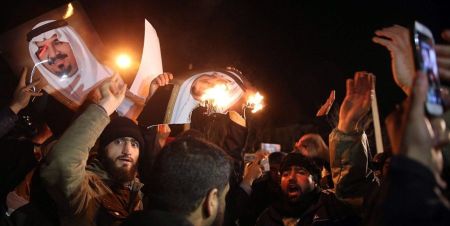
Iranian_protesters_set_fire_to_pictures_of_the_Saudi_royal_family_3.1.16

The heated verbal battle between Tehran and Riyadh over Saudi Arabia’s execution of a Shiite cleric escalated Sunday night, Jan 3, with the severance of diplomatic relations. On the broader front, the repercussions from the quarrel between the two leaders of the Muslim world’s Shia-Sunni split are widely seen in Middle East military and intelligence circles as spurring a fast-track Hizballah attack on Israel.

Among the 47 people executed by Saudi Arabia Saturday on terrorism charges was Sheikh Nimr al-Nimr, Saudi Shiite leader and a prominent Shiite cleric in the region. Put to death with him were several Saudi Shiite and Sunni activists, which enraged Iran’s supreme leader Ayatollah Ali Khamenei to the point of threatening the Saudi royal family with “divine revenge.”

From Iran’s perspective, the Saudis committed the unpardonable act of executing Shiites together with Sunni Al Qaeda and ISIS terrorists. This made the House of Saud the first ruling power ever to treat Shiite and Sunni terrorists alike. This, more than anything, incensed Iran and its Lebanese proxy Hizballah, who are deep in a bloody war against the Sunni Islamic State and the Nusra Front terrorists in Syria. Iran’s Revolutionary Guards are additionally locked in a bitter conflict with ISIS in Iraq.

The Iranian war effort is backed by the US in Iraq and by Russia in Syria.

By the mass executions of both classes of terrorist at the same time, Riyadh issued four messages:

1. Washington and Moscow are wrong. The Iranians and the forces they back in the Persian Gulf, Syria and Iraq are just as much terrorists as ISIS and Al Qaeda.

2. The House of Saud is determined to fight both with equal resolve and severity

3. Riyadh has already taken Tehran on in Yemen, and indirectly in Syria, and is now ready to take the fight against Tehran all the way to the war on terror.

4. Taking off the diplomatic gloves, Saudi Foreign Minister Adel al-Jubeir Monday night severed relations with Iran and ordered all Iranian diplomats to leave the kingdom within 48 hours. The foreign ministry said that by condemning the Nimr execution, Iran was supporting terrorism.

Saudi diplomats were already gone after protesters in Tehran torched and ransacked the Saudi embassy Saturday.

Amid all the sound and fury, Tehran’s attention was drawn to comments made by Israeli Prime Minister Binyamin Netanyahu in the light of a major terrorist attack in Tel Aviv. He pointed out that, in addition to the Palestinians, Israel is threatened by two streams of radical Islam, the Shiites and the Sunnis.

He was clearly referring to Iran and its terrorist arm, Hizballah, on the one hand, and ISIS and Al Qaeda, on the other, inspired less by the Tel Aviv outrage than by the gathering clouds of terror darkening the region, which place the Saudi royal family and Israel on the same side, sharing a similar perception of the two foes facing both countries.

Policymakers in Jerusalem noted the odd statement by Turkish President Tayyip Erdogan to reporters on Saturday, January 1 on the way home from a visit to Riyadh. After years of reviling the Jewish state, he said, “Israel is in need of a country like Turkey in the region. We have to admit that we also need Israel.”

He sounded as though he was urging the resumption of the old political and military alliance binding the two countries years ago.

DEBKAfile’s Middle Eastern sources point out that, since his comment came directly after his talks with Saudi King Salman in Riyadh, it appeared to open a path toward the possible creation of a new Middle East bloc consisting of Turkey, Saudi Arabia, perhaps Egypt, and Israel, bound by the same enemies. This grouping could serve as a counterweight against the Sunni-Shiite bloc of Iran, Iraq, Syria and Hizballah, which has the backing of the US and Russia on one hand, and fights ISIS on the other.

Iran’s leaders may curse the House of Saud without restraint, but they are canny enough not to go from words to deeds, knowing they would be on their own if they attacked the oil kingdom and earn no backing from either Washington or Moscow.

However, it might be easier for Tehran to take advantage of Netanyahu’s tough predicament in his war on terror, by sending Hizballah to strike Israel and, meanwhile, pre-empt the formation of a new anti-Tehran alliance. Speeding up Hassan Nasrallah’s promised revenge for the assassination of its master terrorist Samir Quntar would serve this purpose.

This possibility has prompted the IDF to keep artillery units pounding areas bordering on Israel during the past few days. The IDF says this action is necessary to stop Hizballah exploiting the stormy, snowy winter weather to attack Israel. Its military chiefs appear to be acting on information received of an approaching Hizballah operation as its leader has threatened.

Palestinians: Save Us from the Good-Hearted Westerners!

January 1, 2016

Palestinians: Save Us from the Good-Hearted Westerners! Gatestone InstituteBassam Tawil, January 1, 2016

(How many other “Palestinians” agree with Tawil? — DM)

♦ Every Palestinian knows in his heart that we do not want a state of our own alongside Israel, but rather instead of Israel. This includes all the land of Palestine and Israel. It means that Jews have no right to exist on even one speck of it.

♦ Palestinian President Mahmoud Abbas claims he wants to reach a peace agreement with Israel. But at the same time he and his henchmen incite the Palestinians to stab, run over and shoot Israelis to death, while he idealizes, glorifies and finances — with the funds he receives from the West — the terrorists and their families.

♦ The Palestinian people are already almost totally radicalized, even in the West Bank. They do not seem concerned about living under an Islamist regime run by Hamas or Islamic State.

♦ Abbas’s goal is now, with the help of the international community, to impose a solution on Israel. The solution he seeks – a full withdrawal to the 1967 lines – would pose an existential threat to Israel. It would also just be a matter of time before the Palestinian state will be run by Hamas or Islamic State.

What can be done with these Americans and Europeans? They always seem pining for a dialogue between the Israelis and the Palestinians that would end in a peace agreement, yet oddly all of them seem aware that the Palestinians have not, in all honestly, met Israel’s most minimal demands: the cessation of incitement (agreed to even under the Oslo accords — and requiring no funding!) and the recognition of Israel as a Jewish State. Many throughout the world still view Israel as potentially the next — and 22nd — Arab state.

As hard as it is to say it, the Jews have a point. There is a legitimate concern that without such a stipulation, there will be two Palestinian States: the West Bank and Israel – actually three if you count Gaza.

The Americans and Europeans seem not to realize that, for the Jewish people, the request for a state has to be a precondition for any discussion of Jerusalem, as well, based on its history. Before 1967, when half of Jerusalem was in the hands of Jordan — what the international community says it wants Israel to go back to — around 38,000 ancient Jewish headstones were taken from the Mount of Olives cemetery by Arab residents and used to pave latrines.[1]

These good-hearted Americans and other Westerners nevertheless pressure Israel to act as the “responsible adult” and make unilateral gestures of goodwill. They ask the Israelis to withdraw from the occupied territories and to take Jewish residents of the West Bank settlements with them. They seem already to have forgotten what happened just over ten years ago, in the Gaza Strip, when the Israelis did offer a unilateral gesture of good will. The Israelis unilaterally evacuated every meter of Gaza in 2005, so the Palestinians could build a Singapore — no conditions attached! In return, they were met by Hamas and a nine-year war of rockets. If anyone thinks the Israelis are about to try that again, they have a surprise coming.

As a Palestinian, I welcome the humanistic approach that calls on the strong to cede to the weak; but an honest examination of the issues makes me wonder if Westerners even understand the Middle East. In trying to find a just solution, they keep making every possible mistake. First, they keep demanding from the Israelis concessions that would undermine the country’s security — and they do not demand from the Palestinians so much as a statement, such as “Israel has the right to exist.”

Westerners, it seems, want to frighten Israel into making concessions. What seems to have been forgotten is that under UN Security Council Resolution 242, the territories would be occupied until the dispute is settled. Now, that makes a nice game of rope-a-dope: You never end the dispute, so the territory stays occupied, then you blame the other side for occupying you! Even we can see that.

The Westerners’ latest good-hearted demand — so devastating to the employment situation for Palestinians — is to label goods from the occupied territories. This requirement is asked of no other occupying nation: not Russia in Crimea and Ukraine, Turkey in Cyrus, Pakistan in Kashmir, nor China in Tibet. It is basically a form of Boycott, Divestment and Sanctions (BDS), presumably intended to crush Israel economically.

What these good-hearted Westerners fail to see is that their threats only strengthen Israel’s perception of danger, and end up creating a result that is the opposite of what the Europeans intended. Instead of bringing the Israelis and the Palestinians to the negotiating table, such a move understandably strengthens Israel’s resolve to protect itself. But exerting pressure on Israelis will not induce them to commit collective suicide. Rather, it will make both the Israelis and Palestinians more intransigent than ever.

The American threat of Israel turning into a binational state is meant to frighten Israel into waiving its vital interests while getting nothing from the Palestinians in return. In reality, the threat just stiffens the Palestinians’ resolve and keeps our leaders from granting even the least of Israel’s demands. The American threat is an obstacle to peace.

Most of all, what, staggeringly, Westerners do not seem to understand, is that the aim of the current incitement and attacks by the Palestinian Authority (PA) comes from a desire to replaceIsrael with a Palestinian state.

Look for a minute at the Palestinian Authority. In the Middle East, sooner or later, anything that can collapse, collapses — regardless of efforts to shore it up. The Israelis, all too experienced in such matters, are understandably not about to cast their lot with the PA’s current leader, Mahmoud Abbas. The death rattle of his regime gets louder every week, as even Westerners can surely see. So if the PA can expire at any time, how can anyone even think of asking the Israelis to place their future in Abbas’s trembling hands? Do Westerners seriously mean for the Israelis to give up their security in return for the empty promises of a regime a few faltering steps from implosion?

Unfortunately, the Israelis already know — again from history — that so far, at least, Palestinian promises are not worth an old shoe. Again, just as one example, in the Oslo Accords, the Palestinians signed an agreement no longer to use terrorism to advance political aims.

Mahmoud Abbas may serve as the President of Palestine, but whom does he represent? He certainly does not represent the Palestinians in the Gaza Strip, Israel, Jordan, Lebanon, Syria and anyplace else there are Palestinians. He does not even represent the Palestinians in his own West Bank. Broad swaths of Palestinians in the West Bank no longer consider Abbas their lawful representative. His term of office ended years ago; he is now in the eleventh year of his four-year term. I can promise to sell you that that olive tree over there, but what do I do if it is not my olive tree to sell? He cannot truthfully promise anything to anyone.

The Palestinians in Gaza also reject the legality of Abbas’s reign. They support Hamas. Not only that, but in the West Bank, supporters of Hamas make up roughly half of the population. Their goal is to destroy the Palestinian Authority and Mahmoud Abbas along with it.

Israelis therefore regard the Palestinian president as terminally ill, on life support — also known as the Israeli security forces, Israeli economic support and Western handouts.

Despite relying totally on this charity, Abbas’s position is so weak that to remain in power, he needs to pander to his opponents, to the “resistance front” and the Islamist terrorist organizations in the Palestinian camp. He therefore claims he wants to reach a peace agreement with Israel and that “Palestinian hands are extended in peace;” but at the same time he relentlessly attacks Israel on the international front, in UN agencies and in the International Criminal Court. Meanwhile, he and his henchmen incite the Palestinians to stab, run over and shoot Israelis to death, while he idealizes, glorifies and finances — with the funds he receives from the West — the terrorist “shaheeds” [martyrs] and their families.

Hamas and ISIS at least tell the truth. They openly and repeatedly declare their intentions to destroy “infidel” places such as Israel and Rome — the same way Islam conquered the former seat of Christianity, Constantinople. Mahmoud Abbas, by contrast, is a merely a cowardly hypocrite who successfully dupes the world by talking peace while inciting terror.

If an Islamist terrorist organization does take control of the Palestinian Authority, it will actually make life far easier for Israel. Israel will be able to explain its security position to the world and fight terrorism in the occupied territories — without having to negotiate, make concessions or beg the Palestinians for recognition.

There are some Israelis who worry about the possible fall of Mahmoud Abbas and a radical Islamist takeover of the West Bank. But no Western country will support the establishment of an Islamic emirate in the West Bank. The Islamists will kill the Palestinian Authority’s leaders, the same way Hamas did in 2006-2007 in Gaza. And as usual, only the Palestinians will suffer.

The only people rightly frightened by the thought of a Hamas or ISIS takeover of the West Bank are Mahmoud Abbas and his Fatah loyalists. The Palestinian leadership will be summarily executed and their ill-gotten gains confiscated.

The Palestinian people, on the other hand, already almost totally radicalized, and do not seem even slightly concerned about living under an Islamist regime run by Hamas or Islamic State. They are Muslims: many feel it will make them more pure.

The Palestinian refusal to recognize Israel as a Jewish state is not only a matter of semantics that could change over time. It is a deep-seated ideology that will never change; it is part and parcel of the militant Palestinian-Islamist perception that the Jews are a religious sect — not a nation — and therefore not deserving of sovereignty, a homeland or nationhood.

The Palestinians, like other Muslims all over the world, believe that any land once conquered by Islam becomes part of the waqf, Islam’s religious endowment, owned by Islam in perpetuity. This includes the land of Palestine and Israel, and means that the Jews have no right to exist on even one speck of it.

Our leaders know that recognition of the Jewish state would mean relinquishing the “right of return” of the Palestinian refugees to the State of Israel, and instead settling them only in the future Palestinian state. They simply cannot agree to that.

Every Palestinian knows in his heart that we do not want a state of our own alongside Israel, but rather instead of Israel. Palestinians have not relinquished, and will not relinquish, the right of return; deep down, they hope it will lead to Israel’s demographic extinction and, on its ruins, the establishment of a State of Palestine.

The Jews living in the Middle East understand Middle Eastern dynamics and the challenge of maintaining an independent, democratic state in a region beset by chaos and internecine conflict. They know that anyone who blinks is perceived as weak, and that any blink is perceived by an adversary as an open door.

Despite the threats from the West, the Israelis do not seem particularly shaken. Israel has opened vast new markets in the Far East and appear to be doing brilliantly. Demographically, the number of Jews between the Jordan River and the Mediterranean Sea is rising.

What our past-the-expiry-date leaders have failed to grasp is that the Israelis have set a trap for us: they are building their plans on the foundation of our intransigence. Our leaders are only encouraged by the false hopes and unreasonable expectations given them by the good-hearted Westerners.

Their intentions may even be good, but they persistently refuse to see that our leaders simply do not have the will, the courage or the ability to deliver so much as a dish full of mud. Mahmoud Abbas and the Palestinian Authority leadership prefer to leave things as they are rather than be denounced as traitors by their people for sitting with Israelis at a negotiating table.

1410Palestinian Authority President Mahmoud Abbas is regularly fêted by good-hearted Westerners such as France’s President François Hollande (left) and top European Union officials like Federica Mogherini and Jean-Claude Juncker (right).

Abbas knows — as many of the leaders in Europe apparently do not — that without Israel’s presence in the West Bank, Hamas and Islamic State would execute him, along with his aides, in a public square tomorrow.

Abbas does not want to return to negotiations with the Israelis because he knows has absolutely nothing to offer. His main goal is now, with the help of the international community, to impose a solution on Israel. The solution he seeks — a full withdrawal to the 1967 lines — would pose an existential threat to Israel. It would also just be a matter of time before the Palestinian state will be run by Hamas or Islamic State.

We thank these good-hearted Westerners for all their good intentions. But they are causing suffering to everyone and accomplishing nothing. Our wish for the New Year is, please, for these good-hearted Westerners good-heartedly to stop.

____________________

[1] On the Mount of Olives, the Jordanian Arabs removed 38,000 tombstones from the ancient cemetery and used them as paving stones for roads and as construction material in Jordanian Army camps, including use in latrines. When the area was recaptured by Israel in 1967, graves were found open with the bones scattered. Parts of the cemetery were converted into parking lots and a gas station, and an asphalt road was built through it.

U.S. Foreign Policy: From Bad to Worse in 2016?

December 31, 2015

U.S. Foreign Policy: From Bad to Worse in 2016? Power LinePaul Mirengoff, December 31, 2015 

2015 was a bad foreign policy year for America. Our enemies in Tehran won a pathway to prosperity and additional regional influence without losing the ability to obtain nuclear weapons within 10 to 15 years, or sooner if they choose. Our enemy in Moscow enjoyed an enormous expansion of his influence in the Middle East and continues to menace U.S. allies in Europe.

Our enemy in Damascus, propped up by Iran, Russia, and Hezbollah, is probably the comeback world player of the year, now that he’s winning in the battlefield and the U.S. has signaled that his removal from power is no longer an objective. Moreover, Assad’s resurgence has not coincided with substantial losses for ISIS in Syria. Indeed, the limited setbacks ISIS experienced this year within its “caliphate” were probably offset by gains elsewhere, plus success in exporting terror to the West.

A bad foreign policy year for America isn’t necessarily a bad year for President Obama, though. He seems to be okay or better with Iranian prosperity and regional dominance, and indifferent to the successes of Putin and Assad. Inject him with truth serum and the president would probably say that his biggest foreign policy setback of the year was the reelection of Benjamin Netanyahu.

What does 2016 have in store for U.S. foreign policy. More of the same but with increased success in combating ISIS, I would have guessed.

However, Lee Smith predicts that “next year will be worse.” He writes:

What will make the next year especially dangerous is the White House itself. Obama is eager to wrap everything up before he leaves office, and John Kerry no doubt clings to the hope that Syrian peace talks could bring him the Nobel Peace Prize he thought he earned with the Iran deal. The administration is in a hurry, and the only way it sees forward is in caving to Iranian and Russian demands—above all, the demand that Assad stay in power. Indeed, as Kerry made clear two weeks ago, the White House has finally come clean and admitted it’s no longer interested in deposing Assad, if it ever was.

What are the likely consequences?

To begin with, the only opposition groups that can agree to a political process in which Assad is not removed are those that are in fact or in effect pro-Assad. All others will have to be excluded from peace talks, and some will be labeled terrorists, like Jaish al-Islam, one of the most effective anti-Assad units, whose leader Zahran Alloush was recently killed in a Russian airstrike. This drove home the fact that Putin’s campaign was never about fighting ISIS—rather, it was about defending Assad (and securing Moscow’s Syrian bases).

Therefore, in promoting a peace process that protects Assad, the White House is giving political and diplomatic cover to Moscow and Tehran. John Kerry will be acting as Putin’s enforcer, telling America’s traditional regional allies that the war against Assad is over and it’s time to give up.

However — and I’m not sure whether this is good news or bad — our allies are unlikely to listen to the lame duck Secretary:

Saudi Arabia can ill afford an Iranian victory of that magnitude, and it would be an even worse outcome for Turkey. Ankara is hosting millions of refugees who will never return to Syria so long as the regime that butchered their family and friends is still in power. It’s a major domestic issue for the Turks, and with three unfriendly powers on its border—Russia, Iran, and Assad—the Syrian war is a national security matter.

Therefore, Turkish president Recep Tayyip Erdogan believes it is vital to keep open his supply lines to anti-Assad groups, even as Putin’s forces are campaigning to close them down. In other words, Kerry’s “peace process” is driving a NATO member toward crisis, and perhaps a shooting war with Russia.

Finally:

Israel may soon find itself in a similarly dangerous situation. Yes, even with Russian troops present in Syria, Jerusalem has continued to attack arms convoys heading across Syria to Hezbollah in Lebanon, as well as Iranian assets inside Syria, like Lebanese terrorist Samir Kuntar. However, it’s not clear how long this state of affairs can last, or if the Iranians will press their Russian partners to clarify whose side they’re on.

It has long seemed clear that the primary damage Obama would be able to inflict on America during his second term would be in the realm of foreign policy (although Obama is inflicting more damage than I expected domestically, and if Republicans cooperate will inflict even more through the mass release of drug dealers from prison). If Smith is right, 2016 will be the apotheosis of Obama’s damage to the United States in the world.

It’s Not ISIS We Need to Beat — It’s the Caliphate

December 29, 2015

It’s Not ISIS We Need to Beat — It’s the Caliphate, Front Page Magazine, Daniel Greenfield, December 29, 2015

isil

A recent report by, of all places, the Tony Blair Faith Foundation, found that the Syrian rebels were mostly Islamic Jihadists and that even if ISIS were defeated there were 15 other groups sharing its worldview that were ready to take its place. 

And that’s just in Syria. 

The official ISIS story, the one that we read in the newspapers, watch on television and hear on the radio, is that it’s a unique group whose brand of extremism is so extreme that there is no comparing it to anything else. ISIS has nothing to do with Islam. Or with anything else. It’s a complete aberration. 

Except for the 15 other Jihadist groups ready to step into its shoes in just one country.

Islamic Supremacist organizations like ISIS can be graded on the “Caliphate curve”. The Caliphate curve is based on how quickly an Islamic organization wants to achieve the Caliphate. What we describe as “extreme” or “moderate” is really the speed at which an Islamic group seeks to recreate the Caliphate.

ISIS is at the extreme end of the scale, not because it tortures, kills and rapes, but because it implemented the Caliphate immediately. The atrocities for which ISIS has become known are typical of a functioning Caliphate. The execution of Muslims who do not submit to the Caliph, the ethnic cleansing and sexual slavery of non-Muslims are not aberrations. They are normal behavior for a Caliphate.

The last Caliphate, the Ottoman Empire, was selling non-Muslim girls as sex slaves after the invention of the telephone.  ANew York Times report from 1886 documented the sale of girls as young as twelve, one of them with “light hazel eyes, black eyebrows and long yellow hair”. An earlier report from the London Post described Turks, “sending their blacks to market, in order to make room for a newly-purchased white girl”. This behavior is not a temporary aberration, but dates back to Mohammed’s men raping and enslaving non-Muslim women and young girls as a reward for fighting to spread Islam.

The ISIS behaviors that we find so shocking were widely practiced in even the most civilized parts of the Muslim world around the time that the Statue of Liberty was being dedicated in New York City.

To Muslims, the end of slavery is one of the humiliations that they had to endure because of the loss of the Caliphate. Europeans forced an end to the slave trade. The British made the Turks give up their slaves. The United States made the Saudis give up their slaves in the 1960s. (Unofficially they still exist.) When the Muslim Brotherhood took over Egypt, its Islamist constitution dropped a ban on slavery.

The Muslim Brotherhood is on the moderate side of the Caliphate curve not because it doesn’t want to bring back the Caliphate, it does, or because it doesn’t want to subjugate non-Muslims, it does, but because it wants to do so gradually over an extended period of time using modern political methods.

But whether you take the long road along the Caliphate curve or the short one it still ends up in the same place. Everyone on the Caliphate curve agrees that the world, including the United States, must be ruled by Muslims under Islamic law and that freedom and equal rights for all must come to an end.

ISIS is just doing right now what the Muslim Brotherhood would take a hundred years to accomplish.

We are not at war with ISIS. We are at war with everyone on the Caliphate curve. Not because we choose to be, but because like Hitler’s Thousand Year Reich or Communism’s vision of one world under the red flag, the Caliphate is a plan for imposing a totalitarian system on us  to deprive us of our rights.

The Nazis and the Communists had a vision for the world. So do the Islamic Supremacists who advocate the restoration of the Caliphate. All three groups occasionally played the victim of our foreign policy, but they were not responding to us, they were trying to bring about their positive vision of an ideal society.

Nazi, Communist and Islamist societies just happen to be living nightmares for the rest of us.

No one on the Caliphate curve is moderate. Some on the Caliphate curve are just more patient. They put up billboards, create hashtags and try to ban any criticism of their ideology as Islamophobic. But that’s just Caliphatism with a human face. And that makes them a much more dangerous enemy.

ISIS is in some ways our least dangerous enemy. We haven’t defeated ISIS, because we haven’t even tried. Instead Obama fights a war in which 75 percent of strikes on ISIS are blocked and leaflets are dropped 45 minutes before a strike on oil tankers warning ISIS to flee. If we were to fight ISIS by the same rules as our wars in the last century, the Islamic State would have been crushed long ago.

A insta-Caliphate like ISIS isn’t hard to beat. The global networks of Al Qaeda employing more conventional terror tactics are a trickier force because they are embedded within the stream of Muslim migration. And the Muslim Brotherhood is the trickiest of them all because it is so deeply embedded within Muslim populations in the West that it represents and controls those populations.

What ISIS accomplishes by brute force, the Muslim Brotherhood does by setting up networks of front groups. Both ISIS and the Brotherhood control large Muslim populations. ISIS conquers populations in failed states. The Muslim Brotherhood however exercises control over populations in the cities of the West. We could bomb Raqqa, but can we bomb Dearborn, Jersey City or Irvine?

This is where the Caliphate curve truly reaches its most terrifying potential.

The original Islamic expansionism was so devastating not because it managed to seize control over the hinterlands of Arabia, but because it conquered and subjugated civilized cities such as Alexandria, Constantinople, Jerusalem, Athens and Delhi. ISIS envisions repeating these conquests and more, but if it succeeds it will not be because of its military strategy, but because it targets have been colonized.

We can destroy ISIS tomorrow, but we will still be in an extended war with a hundred other groups who all have a vision for restoring the Caliphate. This war will never end until we crush their supremacist agenda by demonstrating that we will never again allow such a horror to exist on this earth. As long as Muslim groups hold out hope for a restoration of the Caliphate this war, in its various forms, will go on.

We are not at war with an organization, but with the idea that Muslims are superior to non-Muslims and are endowed by Allah with the right to rule over them, to rob them, to rape them and enslave them. ISIS is the most naked expression of this idea. But it’s an idea that everyone on the Caliphate curve accepts.

Until we defeat this racist idea, new Islamic groups will constantly keep arising animated by this vision. Wars fueled by supremacist beliefs have historically only ended when the illusion of superiority was destroyed by utterly defeating and humiliating the attackers. It worked with Japan and Nazi Germany.

Our war now will not end until we destroy the supremacist faith in the Caliphate curve.

Assad again controls Damascus thanks to Russian air strikes and intelligence

December 26, 2015

Assad again controls Damascus thanks to Russian air strikes and intelligence, DEBKAfile, December 26, 2015

Allous_Killed_25.12.15

Less noticed, was the UN plan to remove at the same time several thousands ISIS fighters from the Syrian capital and transport them to their Syrian headquarters. The latter project has not been trumpeted for good reason: It implies UN recognition of ISIS as a party in the Syria war.

***************************

The Russian air strike that Friday, Dec. 25, killed Zahran Aloush, founder of the most powerful Syrian rebel group Jaysh al-Islam and his deputy, gave President Bashar Assad a big break in the Syrian war, thanks to his powerful backer, Vladimir Putin.

This grave loss will accelerate the breakup of Syrian rebel strongholds in and around Damascus. It will also hasten the evacuation under a UN-sponsored ceasefire of at least 2,000 rebels from the Damascus region. Less noticed, was the UN plan to remove at the same time several thousands ISIS fighters from the Syrian capital and transport them to their Syrian headquarters. The latter project has not been trumpeted for good reason: It implies UN recognition of ISIS as a party in the Syria war.

For nearly five years, the war seesawed back and forth, with neither the Syrian army nor the insurgents gaining the upper hand for long, even after Tehran threw its Lebanese proxy, Hizballah,  into the fray to bolster Assad’s army.

Interventions by the US, Saudi Arabia, Qatar, the UAE, Jordan and Israel were too trifling and hesitant to tilt the balance in favor of the anti-Assad insurgent militias. Weapons supplies were inferior and tardy and kept the rebels heavily outgunned by the Syrian army’s tanks, helicopters and fighter jets, and helpless against the Iranian-made barrel bombs dropped by the Syrian air force.

The Obama administration was the architect of this uneven support strategy, going so far as to constrain the rebels’ other foreign backers against giving them the resources for carrying the day, aside from local victories.

This strategy had the effect of prolonging the vicious conflict – until it was cut short by two events:

1. In the summer of 2014, the Islamic State of Iraq and the Levant arrived in full force to capture the northern Iraqi city of Mosul, scattering seven Iraqi armed divisions to the four winds, and grabbing  their sophisticated American weapons, along with their arsenals, that were crammed with good American tanks, armored personnel carriers, and an assortment of surface, antitank and antiair missiles.

Part of this booty was diverted to ISIS Syrian headquarters in Raqqa.

2.  A year later, in late September 2015, President Vladimir Putin embarked on a massive buildup of Russian military strength in Syria – notably, his air and missile forces – for direct intervention in the war.

In contrast to President Barack Obama, who sought to keep his hand on the conflict by a complicated system of dribbling arms to select Syrian rebel groups, Putin went all out with massive military and strategic backing to assure the Syrian ruler and his Iranian ally of victory.

The Russian strategy is now becoming evident:  It is to drive the rebels out of the areas they have captured around the main cities of Latakia, Aleppo, Idlib, Homs, Hama and the capital, Damascus, giving them two options: join the opposition front around the table for negotiating an end to the war, or total eradication – even though Moscow and Washington have yet to agree which of the rebel militias belong around that table.

According to Moscow’s scale of priorities, the fight against the Islamic State must wait its turn until after Bashar Assad’s authority as president is fully restored and his country returns to his army’s control.

But on the way to this objective, Putin has run up against a major impediment: the failure of Iranian, Shiite militia, Hizballah and Syrian army ground forces keep up with his pace. The plan was for Russian air strikes and missiles to clear rebels out of one area after another and for pro-Assad ground troops to storm in and take over.

But these troops are proving too slow to press the advantage given them by the Russians.

Last week, the Russians decided to use their intelligence assets to speed things up. They borrowed an Israeli counter-terror tactic to start targeting key rebel chiefs for liquidation.

The death of the Jaysh al-Islamc commander as the result of a Russian airborne rocket strike on Friday was an intelligence feat rather than a military one. Just as Israel last Sunday used its clandestine assets in Damascus to precisely target the Hizballah-Iranian arch terrorist Samir Quntar at his home in the Jaramana district, so the Russians directed their agents on the ground to mark the secret meeting of Jaysh al-Islam commanders at Marj al-Sultan at the precise moment for taking them down.

This blow to the rebel movement, plus the mass-evacuation of its fighters from the Syrian capital, are major steps towards bringing the Syrian capital back under the control of the Syrian dictator.

Reassuring, not challenging, Iran

December 25, 2015

Reassuring, not challenging, Iran, Israel Hayom, Elliott Abrams, December 25, 2015

Since the signing of the nuclear deal with Islamic Republic of Iran, that government has ‎treated the Obama administration with contempt. U.S. officials might have hoped Iran’s ‎conduct would improve, but it has worsened. Iran sent more Revolutionary Guard troops to ‎fight in Syria, for example; it conducted two ballistic missile tests in violation of a Security ‎Council resolution; leaders continue to chant “Death to America”; and it has imprisoned ‎more Americans.

What is the Obama administration’s response? To beg their pardon.‎

I refer to a remarkable letter sent by Secretary of State John Kerry to Iranian Foreign Minister Mohammad Javad ‎Zarif. Iran, in an additional gesture of contempt, has complained about new United States ‎visa requirements placed on persons who have traveled to Iran (or Iraq, Sudan, or Syria). ‎These requirements were recently added so that people who had visited those countries ‎could not come to the United States without getting a visa even if they were from countries ‎that are part of the “visa waiver” program. The obvious purpose: to avoid having terrorists ‎get to the United States through a program that allows them to avoid the visa application ‎process and the information it would supply.‎

Iran has complained that “Zionist lobbyists” put the new rules in place, a good reminder of ‎the nature of the regime.‎

How did the United States react? By denouncing the Iranian attacks on “Zionist lobbyists,” ‎which came from the spokesman for the Foreign Ministry? By noting that Iran is the world’s ‎worst state sponsor of terrorism? By recalling the fact that Iran just violated U.N. Security ‎Council resolutions, and continues to jail innocent American citizens?‎

Nope. By offering reassurance that we certainly do not mean to disadvantage Iran in any ‎possible way. Here is the text of Kerry’s letter:‎

“December 19, 2015‎

“His Excellency Mohammad Javad Zarif

“Minister of Foreign Affairs of the Islamic Republic of Iran Tehran

“Dear Mr. Minister:‎

“Thanks for a constructive meeting yesterday. I wanted to get back to you in response to your ‎inquiry about amendments to our Visa Waiver Program. First, I want to confirm to you that ‎we remain fully committed to the sanctions lifting provided for under the JCPOA. We will ‎adhere to the full measure of our commitments, per the agreement. Our team is working ‎hard to be prepared and as soon as we reach implementation day we will lift appropriate ‎sanctions.‎

“I am also confident that the recent changes in visa requirements passed in Congress, which ‎the Administration has the authority to waive, will not in any way prevent us from meeting ‎our JCPOA commitments, and that we will implement them so as not to interfere with ‎legitimate business interests of Iran. To this end, we have a number of potential tools ‎available to us, including multiple entry 10-year business visas, programs for expediting ‎business visas, and the waiver authority provided under the new legislation. I am happy to ‎discuss this further and provide any additional clarification.‎

“Secretary of State John Kerry”

Let’s put aside the thanks to Zarif for a “constructive meeting.” We can be sure that Zarif ‎was advancing Iranian national interests, and for doing that, he deserves no thanks from us. ‎The tone of the letter would be fine were it addressed to the foreign minister of Canada. ‎Must we really assure the representative of this vile, repressive regime that regardless of its ‎behavior, we will bend over backward and use every tool possible (“we have a number of potential tools ‎available to us, including multiple entry 10-year business visas, programs for expediting ‎business visas, and the waiver authority provided under the new legislation”) to ‎defend and advance its “legitimate business interests?”‎

Here’s one of many possible alternative formulations: The ability and willingness of the ‎United States government to use the tools at its disposal will depend on the treatment Iran ‎accords American citizens whom it has unjustly detained and imprisoned. Kerry seems ‎more worried about offending Iran than freeing those Americans — whose imprisonment was ‎an issue set aside during the nuclear negotiations. Must we set it aside forever as we ‎protect Iran’s “legitimate business interests”‎?

Get Ready for a “Bigger Powers That Be Attack”!

December 24, 2015

Get Ready for a “Bigger Powers That Be Attack”! Zero Point via You Tube, December 24, 2015

(??????????? — DM)


According to the blurb following the video,

The so-called Islamic State (ISIS) is armed with biological and chemical weapons but Europeans don’t take the existential threat seriously, according to a European Union parliament document..

Israeli experts last week also said ISIS is armed with weapons forbidden by the Geneva Convention and that it is a state in every sense of the word, with its own currency, a university and even license plates..

The London Express reported that the parliamentary report states that ISIS “may be planning to try to use internationally banned weapons of mass destruction in future attacks.” The document was prepared by the Parliament’s political analyst following the ISIS massacres in Paris last month..

ISIS has been trafficking in chemical weapons and also is able to manufacture them by putting together a team of experts with degrees in chemistry and physics..

The EU report, quoted by the Express, states:

Chemical, biological, radiological or nuclear substances (CBRN) have been carried undetected into the European Union. Interpol’s monthly CBRN intelligence reports show numerous examples of attempts to acquire, smuggle or use CBRN materials..

At present, European citizens are not seriously contemplating the possibility that extremist groups might use chemical, biological, radiological or nuclear (CBRN) materials during attacks in Europe. Under these circumstances, the impact of such an attack, should it occur, would be even more destabilizing..

Experts at an Israeli conference said that ISIS is a genuine state even if it not recognized by others, Globes reported..

It controls approximately one-third of Syria’s land, nearly 10 million people and earns approximately $300 million in day from the sale of oil it has confiscated in Iraq and Syria..

Besides its well-publicized black flag and army of barbaric terrorists, ISIS runs courts, schools, welfare agencies and even issues license plates. One of the experts said, “There is no precedent for anything like this in the past 100 years”..

Dr. Ronen Yitzchak, head of the Middle East Dept. at the Western Galilee College, said that the Western coalition has succeeded in seriously damaging the infrastructure of ISIS and in limiting its expansion.

However, he added:

Despite weaknesses in the organization, it will not disappear and will continue to be present for many years. The Islamic State is not a temporary episode. It will continue to present a danger to the West and the entire world..

Terror will worsen in Europe, whether it is because of terrorists who are there now or because of those who be recruited in the future..

ISIS has succeeded in recruiting cells in dozens of countries, “something that has never been seen in terror groups,” Yitzchak said..

ISIS has its own currency, has minted gold and silver coins and soon will introduce bronze coins..

Its radical Islamic school system forbids studies in music, arts and Western subjects such as psychology..

The expert panel also revealed that every family is required to “contribute” one male adult to fight in the ISIS army, which comprises estimated 35,000-50,000 men…

Jews Denied Security Clearance While Huma Infiltrates the Government

December 24, 2015

Jews Denied Security Clearance While Huma Infiltrates the Government, Front Page MagazineJoseph Klein, December 24, 2015

(This has nothing to do with Islam or Obama? Please see also, The United States and Islam: What Is Going On? — — DM)

huma_abedins_muslim_brotherhood_ties

The Obama administration’s anti-Israel sentiment knows no bounds. The latest example involves the denial of a security clearance to a Jewish-American dentist, Dr. Gershon Pincus, on the grounds that he has “divided loyalties.” All that Dr. Pincus wanted to do was to use the experience and skills he had gained over a lifetime of private practice to give back to his country – the United States of America. He wanted to serve American troops as a dentist at an off-base U.S. Navy clinic. Nothing doing, decided the Obama administration after a second security investigation of the dentist. Using a McCarthyite guilt by association rationale, the dentist was disqualified because of his close family ties in Israel and the possible contact of his family members with their Israeli neighbors. 

Dr. Pincus’s original security investigation had reached a positive conclusion: “There is nothing in subject’s background or character that would make him vulnerable to blackmail, extortion, coercion or duress.” That should have ended the matter. After all, Dr. Pincus was not applying for a sensitive job in the Department of Defense or the CIA. He was simply seeking to provide dental services at an off-base U.S. Naval clinic.

However, the Obama administration was not through investigating Dr. Pincus. It ordered a second investigation, conducted this time by a contract investigator sent by the Office of Personnel Management. The bill of particulars resulting from this second investigation are set out in the “Statement of Reasons” for denying Dr. Pincus’s request for security clearance. They included such shocking details as the fact that the dentist’s ailing mother now lives in Israel along with his brother and sister. He sends money to his mother to help her pay her rent. He calls his family members and has even visited Israel three times in the last eight years for his father’s funeral, his niece’s wedding and to see his mother. Dr. Pincus’s deceased son was a dual citizen of the U.S. and Israel and also served for six months in the Israeli Army.

“Foreign contacts and interests may be a security concern due to divided loyalties or financial foreign interests,” quoted the Statement of Reasons from the federal government’s Adjudicative Guideline B – Foreign Influence. They “may be manipulated or induced to help a foreign person, group, organization, or government in a way that is not in U.S. interests, or is vulnerable to pressure or coercion by any foreign interests.”

Just regurgitating this expression of security concerns from the Guideline is meaningless without considering the context in which it is supposed to be applied. Guideline B lists a number of mitigating circumstances that investigators are expected to take into account, among which are whether “the nature of the relationships with foreign persons, the country in which these persons are located, or the positions or activities of those persons in that country are such that it is unlikely the individual will be placed in a position of having to choose between the interests of a foreign individual, group, organization, or government and the interests of the U.S.”

In Dr. Pincus’s case, the Statement of Reasons explaining the decision to deny his security clearance does not point to any security risk posed by the dentist himself or his relatives living in Israel. There is not a single shred of evidence cited, including any questionable statements or associations, which calls into question the loyalty of Dr. Pincus’s family members to the United States.  Nor are any activities referenced that could pose a conflict of interest for Dr. Pincus in serving as a dentist at the Navy clinic. The dentist’s son who had served in the Israeli army is no longer alive. His mother is ailing. His brother does not want to become an Israeli citizen. His sister does hold dual citizenship, but there is nothing to indicate that she is in a position of influence in Israel that would force Dr. Pincus to have to choose between Israel’s interests and the interests of the United States, assuming there were even a circumstance in which his dental activities and access to the Navy clinic could cause a problem.

Moreover, the Statement of Reasons admits that Dr. Pincus himself has “no intentions of moving to Israel, or obtaining Israeli citizenship.” Nevertheless, the second investigation led to his disqualification.

This disgraceful decision was not an isolated occurrence. Although subject to an appeal, there is not much cause for optimism that it will be reversed. A Wall Street Journal Op Ed by Bret Stephens reported that “there have been a total of 58 cases in which Israeli ties were a significant factor in the decision. Of these, 36 applicants—an astonishing 62% of the total—lost their appeals and had their clearance applications denied.”

Contrast the arbitrary, discriminatory treatment of a Jewish American dentist who has family ties to Israel with a Muslim American who has family ties to Saudi Arabia and the Muslim Brotherhood.  The latter, Huma Abedin, was allowed to serve in the Obama State Department and remains a close confidante of Hillary Clinton.

Obama’s Office of Personnel Management and State Department evidently did not consider Ms. Abedin a security risk for a much more sensitive job than serving as a dentist at an off-base Navy clinic, despite the following undisputed facts:

1. Although born in the United States, Huma Abedin grew up in Saudi Arabia, where her parents were recruited by Abdullah Omar Naseef (a jihadist affiliated with al-Qaeda and the Muslim World League) to establish an organization known as the Institute of Muslim Minority Affairs (IMMA). The principle underlying the notion of Muslim Minority Affairs is to discourage assimilation of Muslim minority populations into the culture and society of their host non-Muslim majority countries. Such separatism would enable the Muslim minority population to grow over time and expand the influence of sharia law in their host countries.

2. Huma Abedin returned to the United States from Saudi Arabia to attend George Washington University, where she was an executive board member of George Washington University’s Muslim Brotherhood-affiliated Muslim Students Association.

3. Huma’s late father founded IMMA’s Journal of Muslim Minority Affairs, now run by Abedin’s mother, Saleha Mahmood Abedin.  Saleha Abedin is a sociologist with ties to numerous jihadist organizations, including the Muslim Brotherhood. She has directed the Jordan-based International Islamic Committee for Woman and Child (IICWC), which supports the implementation of strict sharia law. Saleha Abedin still lives in Saudi Arabia.

4. Huma Abedin served as an assistant editor for the Journal of Muslim Minority Affairs for twelve years, leaving shortly before she joined the State Department in 2009. The first seven of the years in which Huma was an assistant editor overlapped with the al-Qaeda-affiliated Naseef’s active presence at IMMA, including one year in which Huma and Naseef served together on the editorial board of the journal.

5. Huma Abedin did not distance herself from her mother, despite her mother’s jihadist views that place sharia law over man-made law and self-governance. In fact, Huma Abedin introduced Hillary Clinton to her mother during a visit to Saudi Arabia, while Hillary was serving as Secretary of State.

In short, Huma Abedin has a family connection to Saudi Arabia, the source of the Wahhabi jihadist ideology and the country where fifteen of the nineteen 9/11 hijackers came from. She grew up there. Huma’s mother is a well-known jihadist in Saudi Arabia still active in pushing a sharia law agenda that is antithetical in material respects to the Constitution of the United States and American values. Dr. Gershon Pincus has a mother, brother and sister living in Israel, which, at least prior to the Obama administration, has been our closest ally in the Middle East. His mother has dementia and neither she, nor Dr. Pincus’s siblings, have expressed any ideology incompatible with the U.S. Constitution or American values.

Yet Huma Abedin, a self-proclaimed “proud Muslim,” slid through her security screening to a highly sensitive job at the State Department and is now a key adviser to the leading Democratic candidate for president. No such luck for Dr. Pincus, who just wanted to take care of the dental needs of some Navy personnel. If this isn’t an example of blatant discrimination against American Jews with family members living in Israel, then pray tell what is?