Posted tagged ‘Europe’

With The Terror Threat Growing, Europe Changes Course

August 31, 2016

With The Terror Threat Growing, Europe Changes Course, Investigative Project on Terrorism, Abigail R. Esman, August 31, 2016

Sixteen years ago, when Dutch commentator Paul Scheffer published his “Multicultural Drama” declaring that multiculturalism in the Netherlands had failed, the response was swift and angry. Critics across Europe called him racist, bigoted, nationalistic. Others dismissed his views as mere rants and ramblings of a Leftist in search of a cause.

Not anymore.

With over 275 people killed in 10 Islamic terrorist attacks since January 2015, Europeans harbor no more illusions about the multiculturalist vision: where immigrants from Muslim countries are concerned, that idealist vision has more than just failed. It has produced a culture of hatred, fear, and unrelenting danger. Now, with European Muslim youth radicalizing at an unprecedented rate and the threat of new terrorist attacks, Europe is reassessing its handling of Muslim communities and its counterterrorism strategies and laws.

Among the changes being considered are a reversal of laws that allow radical Muslims to receive handouts from the very governments they seek to destroy; restricting foreign funding of mosques; and stronger surveillance on private citizens.

Chief among the new counterterrorism approaches is a program to coordinate intelligence data among European Union countries – a tactic that has not been pursued with any regularity or such depth before now. But following the November attacks in Paris, the Dutch intelligence agency AIVD initiated weekly meetings among intel agencies from all EU countries, Switzerland, and Norway, with the objective of sharing information, exchanging new clues, insights, and suspect alerts, and discussing improvements to a Europe-wide system of counterterrorism and intelligence.

Through these meetings and the improved shared database, it is now possible for each country to contextualize its intelligence and understand links between individuals and various groups from one city to another – and so, between radicals and radical groups as they pass through a borderless EU.

Concurrently, EU members are now beginning to share information about web sites and even details about private citizens where needed. Most countries had been reluctant to make such exchanges, citing both privacy concerns and the need to protect their sources. Other cooperative efforts include an EU initiative begun in February 2015 to counteract Islamic extremist propaganda. The project received a major €400 million boost in June, indicating the high priority Europe now places on fighting recruitment.

Earlier this month, Europol began a new effort to screen refugees still awaiting placement in Greek asylum centers. According to a report from Europa Nu, an initiative between the European parliament and the University of Leiden, Europol agents “specifically trained to unmask and dismantle terrorists and terror networks” will be dispatched to the camps to try to prevent terrorists from infiltrating the flood of refugees to Europe.

Some EU measures, however, have been based more in politics than counterterrorism, including efforts to crack down on the ability of radical Muslims to benefit from welfare programs. British citizens, for instance, reacted with outrage when it was discovered that the family of “Jihadi John” had received over £400,000 in taxpayer support over the course of 20 years. In Belgium, Salah Abdeslam, the terrorist accused of participating in the Nov. 13 Paris attacks, pulled in nearly €19,000 in welfare benefits from January 2014 and October 2015, according to Elsevier. And Gatestone reports that more than 30 Danish jihadists received a total of €51,000 in unemployment benefits all while battling alongside the Islamic State in Syria.

Such concerns have also spread to the United States. Earlier this year, U.S. Rep. Bruce Poliquin, R-Maine, introduced the “No Welfare For Terrorists Act.”

“Terrorist victims and their families should never be forced to fund those who harmed them,” he said in a statement. “This bill guarantees this will never happen.”

But not all of Europe’s new approaches to the terror threat are being coordinated out of Brussels. Many more, in fact, are country-specific, such as England’s decision to follow an example set earlier by the Netherlands and Spain, separating jailed terrorists and terror suspects from other prisoners. The measures follow others the country adopted after the July 7, 2005 bombings of a London underground and buses, to criminalize “those who glorify terrorism, those involved in acts preparatory to terrorism, and those who advocate it without being directly involved,” the New York Times reported.

In fact, prisons worldwide, including in the U.S., have long been viewed as warm breeding grounds for radicals and potential terrorists. Ahmed Coulibaly, the gunman at the Porte de Vincennes siege in January 2015, was serving time for a bank robbery, for instance, when he met Cherif Koauachi, one of the Charlie Hebdo attackers. Both converted to Islam there. It was in that same prison that the two encountered Djamel Beghal, an al-Qaida operative who attempted to blow up the American Embassy in Paris in 2001.

Hence many experts now argue in favor of isolating those held on terrorism-related charges as a way to stop them from radicalizing their fellow inmates.

Yet British officials have until now resisted creating separate wings for terror suspects, arguing that doing so gives them “credibility” and makes it harder to rehabilitate them. But a recent government report on Islamist extremism in British prisons forced a change in thinking, in part by noting that “other prisoners – both Muslim and non-Muslim – serving sentences for crimes unrelated to terrorism are nonetheless vulnerable to radicalization by Islamist Extremists [sic].”

Similarly, France, the site of the worst attacks of the past two years, also balked at first at the idea of separating terrorists from other prisoners, arguing that doing so “forms a terrorist cell within a prison.” But the Charlie Hebdo attacks of January 2015 changed all that. Now, officials are even going further, looking at other potential sources of radicalization: the mosques.

Shortly after the Bastille Day attack in Nice, Prime Minister Manuel Valls announced plans to ban foreign financing for French mosques as part of an effort to establish a “French Islam,” led by imams trained only in France. France hosts dozens of foreign-financed mosques – many sponsored by Saudi Arabia and Morocco – which preach Salafism, an extreme version of Islam practiced in the Saudi Kingdom and the root of much radical Islamist ideology. And according to a new report on counter-radicalization, about 300 imams come from outside France.

That same report also calls for “regular surveys” of France’s 4-5 million Muslims,according to France 24, in order “to acquire a better understanding of this population in a country where statistics based on religious, ethnic, or racial criteria are banned.”

Both proposed measures have been met with resistance. The “surveys,” as even the report itself notes, are a means of circumventing laws against gathering information on the basis of religious criteria – and so, go against democratic principles. And many French officials also oppose the ban on foreign funding for mosques, arguing that French government intervention in places of worship contradicts separation between church and state. Besides, they claim, radicalization doesn’t take place there anyway.

But Dutch authorities and counter-extremism experts are not so sure. The announcement earlier this month that Qatar would finance an Islamic center in Rotterdam, for instance, set off alarms even among Muslim moderates, including Rotterdam’s Moroccan-born mayor Ahmed Marcouch. There are good reasons for this. The Salafist Eid Charity, which sponsors the project, has been on Israel’s terror list since 2008, according to Dutch daily NRC Handelsblad. Moreover, in 2013 the U.S. Treasury Department accused the charity’s founder, Abd al-Rahman al-Nu’aymi, of providing funding for al-Qaida and its affiliates, and named him a “specially designated global terrorist.”

Plans for the center sound much like those of the now-abandoned plans for New York’s “Ground Zero mosque,” with sports facilities, prayer space, tutoring for students, Islamic child care, and, reports Dutch newspaper Volkskrant, imam training.

Yet the center’s prospective director, Arnoud van Doorn, a convert to Islam and former member of the far-right, anti-Islam political party PVV, insists that any fears about the project are unfounded. “Our organization has nothing to do with extremism,” he told theNRC. “We want only to provide a positive contribution to Dutch society.”

Notably, though, France’s proposal to ban foreign mosque funding and the Qatari backing of the Rotterdam center point to some of the deepest roots of Europe’s radical Islam problem, and, despite all the new initiatives now underway, the greatest challenges to ending it. When Muslim immigrants came to Europe in the 1970s, they carved prayer spaces wherever they could: the backs of community grocery stores, in restaurants and tea rooms. But these soon became too small to handle the growing Muslim population. Mosques – real mosques – would have to be built.

But by whom? The Muslim communities themselves were too poor. Western governments, wedded to the separation of church and state, could not subsidize them with taxpayer funds. And so the door was opened to foreign – mostly Saudi – investment, and the placement of Saudi-trained and Saudi-backed imams in European mosques. Europe had, in essence, rolled out the welcome mat for Salafism.

Now they want to roll it in again. But is it too late? Even as Western intelligence is now uniting to fight radical Islam, Islamic countries are pooling together in Europe to expand it. The result, as Manuel Valls told French daily Le Monde, is that, “What’s at stake is the republic. And our shield is democracy.”

Hence as the number attacks against Western targets increase, many Europeans are coming to understand that preserving the core of that democracy may mean disrupting some of the tenets on which it’s built, like certain elements of privacy, for instance, and religious principles that violate the freedom that we stand for . It is, as it were, a matter of destroying even healthy trees to save the forest. But in this tug-of-war between the Islamic world’s efforts to shape the West, and Western efforts to save itself, only our commitment to the very heart of our ideals will define who wins this fight.
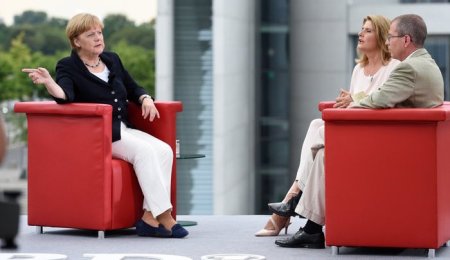
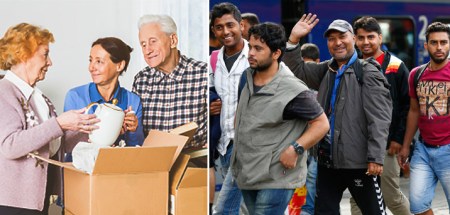
Merkel slams European countries that say they won’t take Muslim refugees

August 28, 2016

Merkel slams European countries that say they won’t take Muslim refugees, Jihad Watch

”What I continue to think is wrong is that some say ‘we generally don’t want Muslims in our country, regardless of whether there’s a humanitarian need or not.’ We’re going to have to keep discussing that.”

It is actually doubtful that she will allow, or participate in, any genuine discussion of that. She is much more likely to content herself with consigning all concerns about Muslim migrants to “racism,” and never engaging in any discussion of Islamic supremacism, the Sharia imperative to subjugate non-Muslims as inferiors denied basic rights, the nature of Sharia as political as well as religious, etc.

Merkel honest discussion

 “Merkel rejects Muslim migrant ban, urges fair distribution,” Associated Press, August 28, 2016:

BERLIN (AP) — German Chancellor Angela Merkel on Sunday slammed those countries in Europe who say they won’t take in Muslim refugees, a position that several eastern European governments have taken in response to the influx of migrants from the Islamic world.

Merkel said she was hopeful that European Union members would reach an agreement on outstanding questions arising from the migrant crisis, one of which is how to fairly distribute asylum-seekers among all the bloc’s 28 member states.

She told German public broadcaster ARD that “everybody has to do their bit” and didn’t rule out the possibility of letting some countries take in fewer migrants if they contribute more financially instead.

“How the individual components are weighted will have to be seen,” said Merkel.

But she reiterated her stance that blocking refugees based on their religion was misguided.

“What I continue to think is wrong is that some say ‘we generally don’t want Muslims in our country, regardless of whether there’s a humanitarian need or not,’” she said. “We’re going to have to keep discussing that.”

Her comments come almost a year after Merkel’s decision to allow hundreds of thousands of migrants stuck in other European countries to come to Germany.

That move prompted a further wave of migration through the Balkans that culminated in the daily arrival of more than 10,000 asylum-seekers at German borders at one point.

Officials have spoken of more than a million arrivals in 2015, but Germany’s top migration official said the actual figure was likely lower once duplicate registrations and people who traveled on to other countries are excluded.

Frank-Juergen Weise, the head of the Federal Office for Migration and Refugees, said in an interview in the German weekly Bild am Sonntag that he expects a sharp drop in numbers in 2016 compared with last year.

Weise told German weekly Bild am Sonntag that his agency is planning for between 250,000 and 300,000 new arrivals this year.

The influx prompted countries such as Hungary to sharply criticize Merkel, and even accuse her of threatening Europe’s stability.

In Germany, anti-migrant feeling has increased too. A nationalist party to the right of Merkel’s Christian Democrats has received a surge in support and chancellor, who has stuck by her motto “we will manage,” has seen her popularity ratings fall….

Europe: The Substitution of a Population

August 27, 2016

Europe: The Substitution of a Population, Gatestone InstituteGiulio Meotti, August 27, 2016

♦ In one generation, Europe will be unrecognizable.

♦ Eastern Europe now has “the largest population loss in modern history”, while Germany overtook Japan by having the world’s lowest birth rate.

♦ Europe, as it is aging, no longer renews its generations, and instead welcomes massive numbers of migrants from the Middle East, Africa and Asia, who are going to replace the native Europeans, and who are bringing cultures with radically different values about sex, science, political power, culture, economy and the relation between God and man.

Deaths that exceed births might sound like science fiction, but they are now Europe’s reality. It just happened. During 2015, 5.1 million babies were born in the EU, while 5.2 million persons died, meaning that the EU for the first time in modern history recorded a negative natural change in its population. The numbers come from Eurostat (the statistical office of the European Union), which since 1961 has been counting Europe’s population. It is official.

There is, however, another surprising number: the European population increased overall from 508.3 million to 510.1 million. Have you guessed why? The immigrant population increased, by about two million in one year, while the native European population was shrinking. It is the substitution of a population. Europe has lost the will to maintain or grow its population. The situation is as demographically as seismic as during the Great Plague of the 14th Century.

This shift is what the British demographer David Coleman described in his study, “Immigration and Ethnic Change in Low-Fertility Countries: A Third Demographic Transition.” Europe’s suicidal birth rate, coupled with migrants who multiply faster, will transform European culture. The declining fertility rate of native Europeans coincides, in fact, with the institutionalization of Islam in Europe and the “re-Islamization” of its Muslims.

In 2015, Portugal recorded the second-lowest birth rate in the European Union (8.3 per 1,000 inhabitants) and negative natural growth of -2.2 per 1,000 inhabitants. Which EU country had the lowest birth rate? Italy. Since the “baby boom” of the 1960s, in the country famous for its large families, the birth rate has more halved. In 2015, the number of births fell to 485,000, fewer than in any other year since the modern Italy was formed in 1861.

Eastern Europe now has “the largest population loss in modern history“, while Germany overtook Japan by having the world’s lowest birth rate, when averaged over past five years. In Germany and Italy, the decreases were particularly dramatic, down -2.3% and -2.7% respectively.

1263 (2)Out with the old, in with the new… Europe, as it is aging, no longer renews its generations, and instead welcomes massive numbers of migrants from the Middle East, Africa and Asia, who are going to replace the native Europeans, and who are bringing cultures with radically different values about sex, science, political power, culture, economy and the relation between God and man.

Some businesses are no longer even interested in European markets. Kimberly-Clark, which makes Huggies diapers, has pulled out of most of Europe. The market is simply not cost-effective. Meanwhile, Procter & Gamble, which produces Pampers diapers, has been investing in the business of the future: diapers for old people.

Europe is becoming gray; you can feel all the sadness of a world that has consumed itself. In 2008, the countries of the European Union saw the birth of 5,469,000 children. Five years later, there were nearly half a million fewer, 5,075,000 — a decrease of 7%. Fertility rates have not only fallen in countries with aching economies, such as Greece, but also in countries such as Norway, which sailed through the financial crisis.

As Lord Sacks recently said, “falling birth rates could spell the end of the West“. Europe, as it is aging, no longer renews its generations, and instead welcomes massive numbers of migrants from the Middle East, Africa and Asia, who are going to replace the native Europeans, and who are bringing cultures with radically different values about sex, science, political power, culture, economy and the relation between God and man.

Liberals and secularists tend to dismiss the importance of demographic and cultural issues. That is why the most important warnings come from some Christian leaders. The first to denounce this dramatic trend was a great Italian missionary, Father Piero Gheddo, who explained that, due to falling birth rates and religious apathy, “Islam would sooner rather than later conquer the majority in Europe”. He was followed by others, such as Lebanese Cardinal Bechara Rai, who leads the Eastern Catholics aligned with the Vatican. Rai warned that “Islam will conquer Europe by faith and birth rate“. A similar warning just came from yet another cardinal, Raymond Leo Burke.

In one generation from now, Europe will be unrecognizable. People in Europe now largely seem to feel that the identity of their civilization is threatened primarily by a frivolous libertarianism, an ideology under the guise of freedom, that wants to deconstruct all the ties that bind man to his family, his parentage, his work, his history, his religion, his language, his nation, his freedom. It seems to come from an inertia that does not care if Europe succeeds or succumbs, if our civilization disappears, drowned by ethnic chaos, or is overrun by a new religion from the desert.

As a paper in the Washington Quarterly explains, the fatal meeting between Europe’s falling birth rates and rise of Islam has already had significant consequences: Europe has turned into an incubator of terrorism; formed a new poisonous anti-Semitism; seen a political shift to the far right; undergone the biggest crisis in European authoritarian unity and witnessed a refocusing of foreign policy since Europe’s withdrawal from the Middle East.

Demographic suicide is not only experienced; it appears to be wanted. The xenophile European bourgeoisie, which today controls politics and the media, seem imbued with a snobbish and masochistic racism. They have turned against the values of their own Judeo-Christian culture and combined it with a hallucinatory, romanticized view of the values of other cultures. The sad paradox is that Europeans are now importing young people in large numbers from the Middle East to compensate for their lifestyle choices.

An agnostic and sterile continent — deprived of its gods and children because it banished them — will have no strength to fight or to assimilate a civilization of the zealous ad [sic] the young. The failure to counter the coming transformation seems to come down on the side of Islam. Is what we are seeing the last days of summer?

What’s the Plan for Winning the War?

August 25, 2016

What’s the Plan for Winning the War?, Counter Jihad, August 25, 2016

Who is even thinking about how to win the war?  Will the legacy of the Obama administration be a shattered NATO, a Turkey drawn into Russia’s orbit, an Iranian hegemony over the northern Middle East, and a resurgent Russia?  It certainly looks to be shaping up that way.  Russia is playing chess while the US is playing whack-a-mole.  The absence of a coherent governing strategy is glaring.

**********************

Michael Ledeen makes a clever observation:

Everyone’s talking about “ransom,” but it’s virtually impossible to find anyone who’s trying to figure out how to win the world war we’re facing.  The two keystones of the enemy alliance are Iran and Russia, and the Obama administration, as always, has no will to resist their sorties, whether the Russians’ menacing moves against Ukraine, or the Iranians’ moves against us.

The moves are on the chessboard, sometimes kinetic and sometimes psychological warfare.  Like a chess game, we are in the early stages in which maneuver establishes the array of forces that will govern the rest of the game.  Russia’s deployment of air and naval forces to Syria stole a march on the Obama administration.  Its swaying of Turkey, which last year was downing Russian aircraft, is stealing another.  Its deployment of bombers and advanced strike aircraft to Iran is another.  That last appears to be in a state of renegotiation, as Ledeen notes, but that too is probably for show.  The Iranians have too much to gain in terms of security for their nuclear program, at least until they’ve had time to build their own air force.

Iran is making strategic moves as well.  Ledeen notes the “Shi’ite Freedom Army,” a kind of Iranian Foreign Legion that intends to field five divisions of between twenty and twenty-five thousand men each.  Overall command will belong to Quds Force commander Qassem Suliemani, currently a major figure in the assault on Mosul, having recovered from his injury in Syria commanding Iranian-backed militia in the war there.  The fact of his freedom of movement is itself a Russian-Iranian demonstration that they will not be governed by international law:  Suliemani is under international travel bans for his assassination plot against world diplomats, but was received in Moscow and now travels freely throughout the northern Middle East.

Turkey, meanwhile, has been effectively cut off by Iran’s and Russia’s success in the opening game of this global chess match.  As late as the Ottoman Empire, the Turks looked south through Iran and Iraq to power bases as far away as Arabia.  Now the Ayatollahs are going to control a crescent of territory from Afghanistan’s borders to the Levant, leaving the Turks locked out.  One might have expected the Turks to respond by doubling their sense of connection to Europe and NATO.  Instead, the purge following the alleged coup attempt is cementing an Islamist control that leaves the Turks looking toward a world from which they are largely separated by the power of this new Russian-Iranian alliance.  The Turks seem to be drifting toward joining that alliance because being a part of that alliance will preserve their ties to the Islamic world.

For now, the Obama administration seems blind to the fact that these moves are closing off America’s position in the Middle East.  This is not a new policy.  Eli Lake reports that the Obama administration told the CIA to sever its ties to Iranian opposition groups in order to avoid giving aid to the Green revolution.  Their negotiation of last year’s disastrous “Iran deal” has led to Iran testing new ballistic missiles and receiving major arms shipments from Russia.  Yet while all these moves keep being made around them, the Obama administration proceeds as if this were still just an attempt to crush the Islamic State (ISIS).  The commander of the XVIIIth Airborne Corps has been given a task that amounts to helping the Iranians win.  Our incoherent policy has left us on both sides in Syria.  Our only real ally in the conflict, the Kurds, stand abandoned by America.

Who is even thinking about how to win the war?  Will the legacy of the Obama administration be a shattered NATO, a Turkey drawn into Russia’s orbit, an Iranian hegemony over the northern Middle East, and a resurgent Russia?  It certainly looks to be shaping up that way.  Russia is playing chess while the US is playing whack-a-mole.  The absence of a coherent governing strategy is glaring.

Our World: Soros’s campaign of global chaos

August 23, 2016

Our World: Soros’s campaign of global chaos, Jerusalem PostCaroline B. Glick, August 22, 2016

soros

The DCLeaks exposed the immensity of the Soros-funded Left’s campaign against the foundations of liberal democracies. The “direct democracy” movements that Soros support are nothing less than calls for mob rule.

********************

Major media outlets in the US have ignored the leak of thousands of emails from billionaire George Soros’s Open Society Foundation by the activist hacker group DCLeaks. The OSF is the vehicle through which Soros has funneled billions of dollars over the past two decades to non-profit organizations in the US and throughout the world.

According to the documents, Soros has given more than $30 million to groups working for Hillary Clinton’s election in November, making him her largest single donor. So it is likely the case that the media’s support for Clinton has played some role in the mainstream media’s bid to bury the story.

It is also likely however, that at least some news editors failed to understand why the leaked documents were worth covering. Most of the information was already public knowledge. Soros’s massive funding of far-left groups in the US and throughout the world has been documented for more than a decade.

But failing to see the significance of the wider story because many of the details were already known is a case of missing the forest for the trees. The DCLeaks document dump is a major story because it exposes the forest of Soros’s funding networks.

The first thing that we see is the megalomaniacal nature of Soros’s philanthropic project. No corner of the globe is unaffected by his efforts. No policy area is left untouched.

On the surface, the vast number of groups and people he supports seem unrelated. After all, what does climate change have to do with illegal African immigration to Israel? What does Occupy Wall Street have to do with Greek immigration policies? But the fact is that Soros-backed projects share basic common attributes.

They all work to weaken the ability of national and local authorities in Western democracies to uphold the laws and values of their nations and communities.

They all work to hinder free markets, whether those markets are financial, ideological, political or scientific. They do so in the name of democracy, human rights, economic, racial and sexual justice and other lofty terms.

In other words, their goal is to subvert Western democracies and make it impossible for governments to maintain order or for societies to retain their unique identities and values.

Black Lives Matter, which has received $650,000 from Soros-controlled groups over the past year, is a classic example of these efforts. Until recently, the police were universally admired in the US as the domestic equivalent of the military. BLM emerged as a social force bent on politicizing support for police.

Its central contention is that in the US, police are not a force for good, enabling society to function by maintaining law and order. Rather, police are a tool of white repression of blacks.

Law enforcement in predominantly African American communities is under assault as inherently racist.

BLM agitation, which has been accused of inspiring the murders of police in several US cities, has brought about two responses from rank and file police. First, they have been demoralized, as they find themselves criminalized for trying to keep their cities safe from criminals.

Second, their willingness to use force in situations that demand the use of force has diminished. Fear of criminal charges on the one hand, and public condemnation as “racists” on the other causes police to prefer inaction even when situations require that they act.

The demoralization and intimidation of police is very likely to cause a steep increase in violent crimes.

Then there are Soros’s actions on behalf of illegal immigration. From the US to Europe to Israel, Soros has implemented a worldwide push to use immigration to undermine the national identity and demographic composition of Western democracies. The leaked emails show that his groups have interfered in European elections to get politicians elected who support open border policies for immigrants from the Arab world and to financially and otherwise support journalists who report sympathetically on immigrants.

Soros’s groups are on the ground enabling illegal immigrants to enter the US and Europe. They have sought to influence US Supreme Court rulings on illegal immigration from Mexico. They have worked with Muslim and other groups to demonize Americans and Europeans who oppose open borders.

In Israel as well, Soros opposes government efforts to end the flow of illegal immigration from Africa through the border with Egypt.

The notion at the heart of the push for the legalization of unfettered immigration is that states should not be able to protect their national identities.

If it is racist for Greeks to protect their national identity by seeking to block the entrance of millions of Syrians to their territory, then it is racist for Greece – or France, Germany, Hungary, Sweden the US or Poland – to exist.

Parallel to these efforts are others geared toward rejecting the right of Western democracies to uphold long-held social norms. Soros-supported groups, for instance, stand behind the push not only for gay marriage but for unisex public bathrooms.

They support not only the right of women to serve in combat units, but efforts to force soldiers to live in unisex barracks. In other words, they support efforts aimed at denying citizens of Western democracies the right to maintain any distance between themselves and Soros’s rejection of their most intimate values – their sexual privacy and identity.

As far as Israel is concerned, Soros-backed groups work to delegitimize every aspect of Israeli society as racist and illegitimate. The Palestinians are focal point of his attacks. He uses them to claim that Israel is a racist state. Soros funds moderate leftist groups, radical leftist groups, Israeli Arab groups and Palestinian groups. In various, complementary ways, these groups tell their target audiences that Israel has no right to defend itself or enforce its laws toward its non-Jewish citizens.

In the US, Soros backed groups from BLM to J Street work to make it socially and politically acceptable to oppose Israel.

The thrust of Soros’s efforts from Ferguson to Berlin to Jerusalem is to induce mayhem and chaos as local authorities, paralyzed by his supported groups, are unable to secure their societies or even argue coherently that they deserve security.

In many ways, Donald Trump’s campaign is a direct response not to Clinton, but to Soros himself.

By calling for the erection of a border wall, supporting Britain’s exit from the EU, supporting Israel, supporting a temporary ban on Muslim immigration and supporting the police against BLM, Trump acts as a direct foil to Soros’s multi-billion dollar efforts.

The DCLeaks exposed the immensity of the Soros-funded Left’s campaign against the foundations of liberal democracies. The “direct democracy” movements that Soros support are nothing less than calls for mob rule.

The peoples of the West need to recognize the common foundations of all Soros’s actions. They need to realize as well that the only response to these premeditated campaigns of subversion is for the people of the West to stand up for their national rights and their individual right to security. They must stand with the national institutions that guarantee that security, in accordance with the rule of the law, and uphold and defend their national values and traditions.

Migrant Problems Still Threaten Europe

August 20, 2016

Migrant Problems Still Threaten Europe, Gatestone InstituteGeorge Igler, August 20, 2016

♦ In September 2015, a Canadian broadcaster, Ezra Levant, suggested that what Europe was experiencing, was not primarily an influx of “refugees” fleeing conflict, but rather a new Gold Rush, in which young men from the Muslim world were seeking to improve their fortune at Europe’s expense.

♦ Rome-based journalist Barbie Latza Nadeu seriously asked whether Italy was “enabling the ISIS invasion of Europe.”

♦ Profits in the people-smuggling business often flow to terrorist-backed gangs operating in Italy. The numbers drowning in the Mediterranean continue to mount.

Chaotic scenes have erupted on the coastal Mediterranean frontier between Italy and France. On August 4, for instance, hundreds of migrants, chiefly from Eritrea, Ethiopia and the Sudan sought to storm the crossing in their attempts to make it to Northern Europe.

“Both the Italian and French forces at the border were taken by surprise,” remarked Giorgio Marenco, a police commander in Ventimiglia, where tear gas was used to disperse the migrants. Others merely braved the choppy waters of the sea to breach the crossing by swimming towards their goal.

The Italian town contains the last train station in Italy near the border. The besieged terminus lies three miles from the French Riviera. It has been a gathering point for the predominantly Muslim migrants since June 2015. A fractious tent city for migrants has sprung up, mirroring others spread across Italy. The capital of the French holiday district is Nice, which experienced a jihadist massacre on July 14.

Although mercifully free from mass terrorist outrages this year, Italy has already endured several alarming scenes of disorder and protest resulting from the pressure of accepting increasing illegal migrants.

On May 7, violent attempts by “open borders” activists took place, aimed at forcing open the frontier between Italy and Austria. On May 21, various groups in Rome organized mass demonstrations against Italy’s “invasion” by migrants. Apparently the prevalence of populist politics in the country has created movements which do not lie within the usual “Left-Right” political spectrum in which analysts usually classify parties.

The chief example is the presence in Italy of the Five Star Movement, founded in 2009 by the comedian Beppo Grillo, and now considered Italy’s second largest political force. Having taken a back seat after frequently being condemned for his “Islamophobic” anti-mass immigration rhetoric, Grillo’s party nevertheless helped to elect Virginia Raggi, in July, as the new mayor of Rome.

Despite the assurances of Angelino Alfano, the Italian Interior Minister, that Ventimiglia would not turn into “our Calais” — a reference to migrants amassed at the French channel port who are seeking illegal entry into the United Kingdom — the challenges faced by Italy lie not merely in numbers.

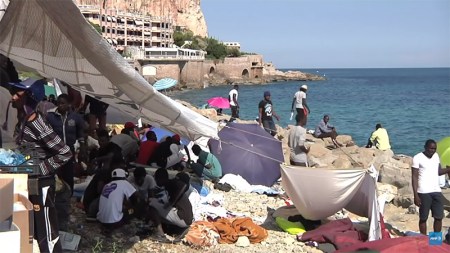
1221 (1)African migrants camp out on the beach in the northern Italian town of Ventimiglia, along the French border, as they wait for the opportunity to cross into France, in 2015. (Image source: AFP video screenshot)

Italy’s terror alert status remains at “Level Two” — the second highest in its security index. On March 30, the Rome-based journalist, Barbie Latza Nadeu, seriously asked whether the country was “enabling the ISIS invasion of Europe.”

After the collapse of Libya — occasioned in 2011 by military intervention masterminded by then French President Nicolas Sarkozy and then UK Prime Minister David Cameron — the North African nation has become the gathering point for those on the continent farther south, who possess the will or resources to push into Europe.

Two separate governments are currently attempting to wrest control from each other in Libya, a former colony of Italy, while ISIS forces also maintain their foothold. It is through this seemingly unresolvable ongoing chaos that people-smugglers ply their lucrative trade.

Waves of migrants heading into Europe, primarily through a corridor beginning in Turkey and resulting in short crossings to nearby Greek islands, are still stranded in the so-called Western Balkan route into the continent.

After the widely derided imposition by the Prime Minister of Hungary of a razor-wire border fence on his country’s southern frontier, other nations nearby, that were subjected to migrant pressure, soon followed suit.

Remaining conscious of Hungarian Prime Minister Viktor Orbán’s analysis, that only half a year’s total migrants come to Europe between January and October, with the other half arriving through the remainder of the year, the steady focus in 2016 is likely to be on Europe’s “soft underbelly” — a term Winston Churchill used during the Second World War to refer to the susceptibility of Italy being invaded by sea — as opposed the susceptibility of the Balkans.

The enthusiasm of the present government of Chancellor Angela Merkel to import Muslims into Germany apparently remains undiminished. As reported by Markus Mahler, a succession of migrant flights into Germany from Turkey are now taking place – in one instance, more than 11 planes landed during the same night at Cologne-Bonn airport – as some analysts predicted last year.

In September 2015, a Canadian lawyer and broadcaster, Ezra Levant, suggested that what Europe was experiencing, was not primarily an influx of “refugees” fleeing conflict, but rather a new Gold Rush, in which young men from the Muslim world were seeking to improve their fortune at Europe’s expense.

Sea crossings from Africa into Italy, which initially targeted the small Italian island of Lampedusa, had begun in 1996. Since then, they have magnified in number year on year, considerably aided between 2013-2014 by the Mare Nostrum program of the Italian navy, which picked up stranded vessels and brought their occupants to Italy, rather than returning migrants to their countries of origin. This program was then superseded by Operation Triton, run by the European Union’s border agency, Frontex.

It is often simpler for migrant ships to send a distress signal while near Italian coastal waters, as happened in January 2015 with the ship Ezadeen, abandoned by its crew of smugglers, after they set the ship on autopilot pointed towards Italy’s southern shore. The ship’s 450 migrant passengers were towed to harbor by a Frontex ship from Iceland.

Profits in the people-smuggling business often flow to terrorist-backed gangs operating in Italy. The numbers drowning in the Mediterranean continue to mount.

Successful migrants from Africa usually then traverse Italy, but can remain stranded if their attempts to penetrate further into Europe become frustrated. That situation frequently leads to violence at migrant camps and outrage at local government level as the migrants are then distributed across the country.

Despite the swelling number of illegal sea crossings, there seems little interest in curtailing them by force, given the existence of international refugee conventions and European legislation on human rights, which some migrants appear to be exploiting.

During four days in July alone, 10,000 illegally crossed by sea into Italy. As in 2015, the vast majority looking for “asylum seeker” status in Europe are military-aged Muslim males seeking eventual European citizenship.

Meanwhile, relations between Italians and their existing established Muslim communities seem to be rapidly eroding. The introduction of gay marriage into Italy on June 5, against fierce opposition in the home of the Roman Catholic Church, has had unforeseen consequences.

As a reciprocal gesture in the spirit of “civil rights,” Hamza Piccardo, the founder of the Union of Islamic Communities and Organizations in Italy, has demanded the legalization of polygamy.

As the pressures grow on the Euro, the currency which binds 19 European nations together both politically and economically, the long-term future of Italy’s banking system has already been called into question.

The picture drawn by the present migration into Europe may fundamentally undermine the “Refugees Welcome” narrative that dominated news reports last year, but the continent-wide economic ramifications of its effects on a country such as Italy, already subject to considerable political tumult, should not be underestimated.

The Real Weak Link in Europe

August 17, 2016

The Real Weak Link in Europe, American ThinkerAlex Alexiev, August 17, 2016

With some weeks now past since the event, the Brexit doom and gloom-mongers have taken a well deserved break from conjuring up the imminent demise of the U.K., the EU, and perhaps the world itself.  This may be an appropriate opportunity to consider whether or not there might be an even better candidate for such end-of-times prognostications: Germany.

On the face of it, this is surely preposterous.  Europe’s largest economy, its most stable government, and the main if not only pillar of the EU and the euro is hardly a destabilizing factor, most would agree.  Germany may indeed be all of that, but only in comparison to the rest of the EU, which has been stagnating economically for a decade and is beset by major political instability and terrorism.  Since 2007, German labor productivity growth has been close to zero, while GDP growth has averaged a miserable 0.8% per annum, even as Germany’s largest company, Volkswagen, is being prosecuted around the world for cheating, while its very symbol of stability, Deutsche Bank, has been called by the IMF “the biggest contributor to risk in global finance.”

Serious as these are, much more disturbing are unmistakable trends that Germany may be going in directions hardly congenial to European and Western policies vis-à-vis Russia.  A case in point is the new Nord Stream 2 pipeline project, designed to bring up to 80% of the Russian gas supply to Europe while bypassing Ukraine and Eastern Europe.  A blatantly political ploy by Mr. Putin and Gazprom, it will guarantee that Moscow can blackmail Eastern Europe at will.  Despite that, the project enjoys support not only among companies likely to profit from Nord Stream 2, but also by significant parts of the German establishment, including Chancellor Angela Merkel, who quite disingenuously claims that it is just a commercial project.

To understand why this is now possible in Germany, one must note the rapid growth of pro-Russian, anti-Western, and anti-American sentiments in all segments of German society of late.  These attitudes often run counter to the official policies of the Merkel government, which may actually make them even more significant.  Mrs. Merkel, for instance, is known as a key supporter and architect of the sanctions regime against Russia following its aggression against Ukraine, yet her government coalition partner, the social-democratic party (SPD), argues ever more forcefully that the sanctions should be lifted or, at the very least, made less onerous.  This not only undermines the authority of the Berlin government, but also makes the continuation of the sanctions when they expire at the end of the year unlikely.  This will please Germany’s export community, but only at the cost of outraging its partners in Eastern Europe.

Even more striking is the emerging anti-Western consensus among radical parties at both extremes of the political spectrum.  The former communist party of East Germany now repackaged as “Die Linke” and the right-wing, anti-immigrant Alternative for Germany (AfD) share essentially identical anti-Western and anti-American platforms that call for disbanding NATO and a new security alliance with Russia.  These parties may be extreme, but they are not without influence.  Die Linke is currently in power in one German state (Thuringia), while the AfD is supported by 12% of German voters according to the latest polls.

NATO is being undermined from yet another side, and that is the renewed EU discussions of the ostensible need for a European army independent of NATO.  Both European Commission president Jean-Claude Juncker and French president François Hollande have publicly supported the idea, and so have German officials, who cite the limited German-Dutch armed forces integration as a model.  The idea is, of course, complete nonsense if for no other reason than because no EU country is even contemplating, let alone seriously considering the massive amounts of money that would have to be spent to bring this about.  It is nonetheless a dangerous bit of nonsense, since nothing will deny NATO’s very raison d’être, and with it American commitment to the defense of Europe, faster than a standing European army outside the alliance command structures.

Finally, the most destabilizing German policy by far continues to be immigration policy.  Despite signs that it is an abject failure, Mrs. Merkel insists on continuing on the same course, leading to even greater conflict with Eastern Europe and others (Brexit) that reject it wholesale.  Poland has already announced that it will refuse to take any migrants, while Czech president Milos Zeman, a socialist, has called for a referendum on EU membership and even urged the Czechs to arm themselves for self-defense.

Merkel government officials have already proclaimed their migrant policies to be a success, but such claims should be taken with a large chunk of salt.  Here are the available statistics.  In 2015, 1.1 million migrants came to Germany after Merkel essentially invited them in on  Sept. 4, 2015.  Of those, 476,649 applied for political asylum.  The rest neither applied nor left the country, and their whereabouts are not known.  According to Eurostat, in the first quarter of 2016, 287,100 migrants, or nearly 100,000 more than in 2015 applied for asylum in the EU, which would mean that even if migrants to Germany have fallen off from the 2015 pace, the EU as a whole will get more than 1 million by the end of the year, and a similar number is expected in 2017.

More important than the sheer numbers is what this massive influx means for society.  Even though German authorities try to suppress such information, there is overwhelming evidence that rape and sexual assault by migrants has reached epidemic proportions in all 16 federal states, as documented in this report by the Gatestone Institute.  More troubling still is evidence that large numbers of terrorists and jihadists have used the migrant wave to organize “hit squads” in Germany.  According to Bavarian intelligence official Manfred Hauser, “irrefutable evidence exists that there is an IS [Islamic State] command structure in place.”

What all of this means for German and European security should not be difficult to foresee.  German officials openly acknowledge that the police cannot handle this massive threat and are now openly discussing setting in place a 400,000-strong “national guard” type of organization.  Before they do that, it might be useful to first consider changing Mrs. Merkel’s failed policies.


Islam’s “Quiet Conquest” of Europe

August 10, 2016

Islam’s “Quiet Conquest” of Europe, Gatestone InstituteGiulio Meotti, August 10, 2016

♦ “Islam is a French religion and the French language is a language of Islam.” — Tariq Ramadan.

♦ In 1989, Dalil Boubakeur, rector of the Grand Mosque of Paris, justified the persecution of Salman Rushdie by Ayatollah Khomeini. Last year, Boubakeur called for the conversion of churches into mosques.

♦ In Britain, mainstream Muslim organizations are “justice” through more than 85 sharia courts attached to mosques.

♦ Civil war in France is what the Islamic State is looking for: unleashing a blind repression so that the Muslim population will show solidarity with the revolutionary minority. Yet, there is still worse possible outcome: that nothing happens and we continue as is.

♦ Real “moderate Muslims” are silenced or murdered.

Last month, the Wall Street Journal published an interview with France’s director of domestic intelligence, Patrick Calvar. “The confrontation is inevitable,” Mr. Calvar said. There are an estimated 15,000 Salafists among France’s seven million Muslims, “whose radical-fundamentalist creed dominates many of the predominantly Muslim housing projects at the edges of cities such as Paris, Nice or Lyon. Their preachers call for a civil war, with all Muslims tasked to wipe out the miscreants down the street.”

These Salafists openly challenge France’s way of life and do not make a secret of their willingness to overthrow the existing order in Europe through violent means, terror attacks and physical intimidation. But paradoxically, if the Islamists’ threat to Europe were confined to the Salafists, it would be easier to defeat it.

There is in fact another threat, even more dangerous because it is more difficult to decipher. It has just been dubbed by the magazine Valeurs Actuelles,the quiet conquest“. It is “moderate” Islam’s sinuous project of producing submission. “Its ambition is clear: changing French society. Slowly but surely”.

That threat is personified in the main character of Michel Houellebecq’s novel, Submission:Mohammed Ben Abbes, the “moderate” Muslim who becomes France’s president and converts the state to Islam. And from where does President Ben Abbes start his Islamization? The Sorbonne University. It is already happening: Qatar recently made a significant donation to this famous university, to sponsor the education of migrants.

In France, the quiet conquest has the face of the Union of the Islamic Organizations of France (UOIF), which a Simon Wiesenthal Center report charged with “anti-Semitism, advocacy and financing of terrorism and call to Jihad… ”

Not only does UOIF not encourage the integration of Moslems in France,” the report states, “it actually provides a nursery for the most radical Islamist positions.”

In Italy we have just witnessed the strategy of this “moderate Islam.” The largest and most influential Islamic organization, l’Unione delle comunità ed organizzazione islamiche in Italia (Ucoii), sponsored Milan’s first Muslim councilwoman, Sumaya Abdel Qader, a veiled candidate of the center-left coalition. Qader’s husband, Abdallah Kabakebbji, openly called for the destruction of the State of Israel: “It is a historical mistake, a scam”, he wrote on Facebook. His solution? “Ctrl + Alt + Delete”.

Qader won the race over a real moderate Muslim, the unveiled Somali activist, Maryan Ismail. I met Mrs. Ismail at a pro-Israel forum in Milan. After losing the election, she broke with Italy’s Democratic Party in an open letter: “The Democratic Party has chosen to dialogue with obscurantist Islam. Once again, the souls of modern, plural and inclusive Islam were not heard”.

Take two “stars” of this French “moderate Islam.” The first one is Tariq Ramadan, the grandson of Hassan al-Banna, the founder of the Muslim Brotherhood, the motto of which is: “Allah is our objective; the Prophet is our leader; the Quran is our law; Jihad is our way; dying in the way of Allah is our highest hope.”

Ramadan does not hide in Raqqa or shoot at French citizens. By applying for French citizenship, he would like to become one of them. His office is in the Parisian suburb of Saint Denis; he has written 30 books and he has two million Facebook followers. Ramadan has academic chairs all over the world, he is the director of the Research Center for Islamic Law in Doha (Qatar) and the president of the European Muslim Network. He publicly campaigns for Islam along with Italy’s former prime minister, Massimo D’Alema. Ramadan recently explained his vision for Europe and France: “Islam is a French religion and the French language is a language of Islam”.

Ramadan’s project is not the hoped-for Europeanization of Islam, but the not-hoped-for frightful Islamization of Europe. He opposes the assimilation of Muslims into French culture and society. A few days before the election in Milan, Ramadan was in Italy to endorse the candidacy of Sumaya Abdel Qader.

The second French “star” is Dalil Boubakeur, the rector of the Grand Mosque of Paris. In 1989, Boubakeur justified the persecution of Salman Rushdie by Ayatollah Khomeini. In 2002, he testified for the prosecution against the writer Michel Houellebecq. In 2006, he sued Charlie Hebdo in court, after the publication of the Danish Mohammed cartoons. Last year, Boubakeur called for the conversion of churches into mosques and asked to “double” the number of mosques in France.

1772Dalil Boubakeur, rector of the Grand Mosque of Paris, last year called for the conversion of churches into mosques and asked to “double” the number of mosques in France. (Image source: TV5 Monde)

In the United Kingdom, mainstream Muslim organizations are dispensing “Islamic justice” through more than 85 sharia courts attached to mosques. Divorce, polygamy, adultery and wife-beating are only some of these courts’ matters of jurisprudence. In Germany, vice-chancellor Sigmar Gabriel criticized Saudi Arabia for financing Islamic extremism in Europe. It is the same kingdom which last year offered to build 200 new mosques in Germany.

Qatar, with its Al Jazeera television megaphone, is also very active in sponsoring Muslim Brotherhood Islamic radicalism all over Europe. The Qatari royal family, for example, in 2015 donated £11 million to Oxford’s St. Anthony’s College, where Tariq Ramadan teaches. Qatar also announced that it was willing to spend $65 million in the French suburbs, home to the vast majority of the six million Muslims in France.

Today in Europe, several scenarios are possible, including the worst. Among them, there is a civil war, which many are beginning to talk about, including Patrick Calvar, the director of domestic intelligence. This is what the Islamic State is looking for: unleashing a blind repression so that the Muslim population will show solidarity with the revolutionary minority. Yet, there is still worse possible outcome: that nothing happens and we continue as is.

The end is more important than the means. The Islamic State has the same goal as most of the members of so-called “moderate Islam”: domination under the sharia. Many supposedly “moderate Muslims”, even if they do not commit violent acts themselves, support them quietly. They support them by not speaking out against them. If they do speak out against them, they usually do so in coded terms, such as that they are “against terrorism,” or that what concerns them about violent acts by Muslims is the possibility of a “backlash” against them.

Violent jihadis, however, are not the only means of transforming Europe, and perhaps are even counterproductive: they could awaken the nations they attack. Soft and more discreet means, such as social pressure and propaganda, are even more dangerous, and possibly even more effective: they are harder to see, such as the West’s acceptance of dual judiciary and legal systems; sharia finance (if there had been a “Nazi finance” system, in which all financial transactions went to strengthening the Third Reich, what effect might that have had on World War II?), and the proliferation in the West of mosques and extremist Islamic websites. Although there are indeed many real “moderate Muslims”, there are also still many who are not.

To conservative Muslims, however, any Muslim who does not accept every word of Allah — the entire Koran — is not a true Muslim, and is open to charges of “apostasy”, the punishment for which is death. According to a leading Sunni theologian, Yusuf al-Qaradawi, based in Qatar, “If they [Muslims] had gotten rid of the punishment for apostasy, Islam would not exist today.”

That is why the late writer Oriana Fallaci once said to The New Yorker: “I do not accept the mendacity of the so-called Moderate Islam”. That is why real “moderate Muslims” are silenced or murdered.

This might summarize the current Islamic mainstream mentality: “Dear Europeans, continue to think about a shorter working week, early retirement, abortion on demand and adultery in the afternoon. With your laws, we will conquer you. With our laws, we will convert you”.

Erdogan-Gulen Power Struggle Divides European Turks

August 8, 2016

Erdogan-Gulen Power Struggle Divides European Turks, Investigative Project on Terrorism, August 8, 2016

(Please see also, Plotting Jihad in the Poconos—Who the Hell is Fethullah Gulen? — DM)

1167

Millions of European Turks – both immigrants and subsequent generations – ally themselves with the Gulenist movement, or Hizmet. While some call it a cult and claim it represents a zealous Islamic religious movement, others view it as a more moderate strain of Islam and praise Gulen for his interfaith initiatives, and for the hospitals, schools and universities he has founded internationally, including over 100 charter schools in the United States. But since the split between the two men, tensions have also emerged between pro-Gulen and pro-Erdogan groups that are far more virulent than the disputes between those who favor Hizmet and those who condemn it.

********************

On the night of July 15, members of the Turkish military stormed the state-run TRT news agency in Ankara and forced an anchorwoman to read a statement calling President Recep Tayyip Erdogan a “traitor.” Within moments, tanks began to drive menacingly through the streets of Ankara and Istanbul as military planes roared over Turkish skies. The Parliament was bombed. The fifth military coup in the history of modern Turkey had begun, taking even the most anti-government Turks by surprise.

But Erdogan regained complete control within hours, thanks to his fervent supporters who took to the streets in his defense. Throughout the night, pro- and anti-Erdogan military and civilians clashed across the country, leaving nearly 300 dead and 2,100 injured by morning.

The attempted coup and its aftermath, however, soon exploded into more than just a national crisis; it has had incendiary repercussions globally, particularly in the Turkish communities of Europe.

Erdogan declared a state of emergency July 16, and began cracking down on suspected members of the coup plot and their allies. By July 20, more than 45,000 people had been arrested, including 2,700 judges and 15,000 teachers. As Erdogan called for reinstating the death penalty, credible reports emerged of prisoners being tortured and raped.

In the meantime, tens of thousands of others have been fired from their jobs as the state takes over or shuts down nearly all the country’s media outlets – including three news agencies, 16 television channels, 45 newspapers and 15 magazines, Reutersreports. And on Monday, more than three weeks after the failed coup, Turkey recalled five senior diplomats from its embassy in The Hague.

All who have been sacked are accused of complicity in the coup, based on their (ostensible) ties to Fethullah Gulen, a powerful cleric now living in self-imposed exile in Pennsylvania. Once one of Erdogan’s closest allies, Gulen has become his most despised enemy in recent years, thanks in large part to Gulen’s criticism of Erdogan during the 2013 Gezi Park demonstrations. Now Turkey’s president accuses Gulen of being behind the coup attempt, demands his extradition from the United States. Meantime, he continues his crackdown on the cleric’s followers.

But those followers are not just in Turkey, and neither are Tayyip Erdogan’s. Millions of European Turks – both immigrants and subsequent generations – ally themselves with the Gulenist movement, or Hizmet. While some call it a cult and claim it represents a zealous Islamic religious movement, others view it as a more moderate strain of Islam and praise Gulen for his interfaith initiatives, and for the hospitals, schools and universities he has founded internationally, including over 100 charter schools in the United States. But since the split between the two men, tensions have also emerged between pro-Gulen and pro-Erdogan groups that are far more virulent than the disputes between those who favor Hizmet and those who condemn it.

As a result, the clashes between the conflicting sides have spilled beyond the Turkish borders into Europe, and have now exploded since the coup. Often, they have been violent, with pro-Erdogan protesters hurling stones into the windows of Gulen organizations in Gelsenkirchen, Germany and Rotterdam, Holland, or calling to set fire to a building housing a Gulenist organization in Beringen, Belgium (“Burn them alive!” the protesters shouted.). Arsonists also attacked several Gulen buildings in the Netherlands.

In other instances, the attacks are quieter but more sinister: members of 70 different Gulen-affiliated groups in the Netherlands report receiving hate messages and death threats. People believed to support the movement – or who fail to support Erdogan – report being banned from mosques and refused entry to restaurants. Dutch children have told each other “I can’t talk to you anymore.” A number of Gulen followers have gone into hiding, fearing for their safety.

And in Germany, home to Europe’s largest Turkish community, estimated at nearly 3 million, some 30-40,000 Erdogan supporters marched through Cologne on July 31. And while the demonstrations went off without incident, they represent a chasm within the country – not just between Germans and Turks, but – as in the Netherlands – among the Turks themselves. Noted Deutsch-Welle‘s Gero Schliess in an editorial, “After the coup attempt in Turkey, divisions have emerged in this country that no one had seen for a long time – or hadn’t wanted to see. The failed coup and President Erdogan’s massive onslaught against civil rights have deeply divided the Turkish community in Germany. The split runs right through families and neighborhoods, regardless of social strata or profession.”

But at least as disturbing is the idea of 30-40,000 people marching in support of the man who has led the profoundly anti-democratic crackdown in Turkey. While it may be understandable to oppose a military coup, it is something else entirely to continue marching in support in light of the abuses that have followed. Moreover, according to Politico, the situation has also “reignited a decade-long debate in Germany about the Turkish state steering public opinion within the German-Turkish community through a web of lobbying groups, religious institutions, media outlets and public figures.”

Religious groups seem to be chief among those, such as the Turkish-Islamic Union for Religious Affairs, sponsored by the Turkish state. That Turkey is therefore subsidizing mosques in Germany demonstrates the strength not only of the country’s influence on the political visions of German Turks, but on their religious ideas as well. And in an increasingly Islamist Turkey, those ideas no longer reflect the secular, humanist values of Ataturk; rather, they are based on an increasingly strict vision of Sunni Islam in which the state and the mosque are one.

Other Turkish religious groups, including Milli Gorüs, an Islamist group headquartered in Cologne, are also believed to hold sway over European Turks, particularly in the Netherlands.

Behind them all, particularly in Belgium, is the Diyanet, the official Turkish Directorate of Religious Affairs .

Ataturk created the Diyanet soon after the founding of the Turkish republic, to help ensure that imams preached moderate interpretations of Islam. They were critical to maintaining the separation between mosque and state. With the rise of Erdogan and his AK Party, however, it has served to do just the opposite: it now promotes Islamist views in Turkey and among the Turkish community abroad. As Istanbul-based journalist David Lepeska noted last year, the Diyanet‘s budget has quadrupled since 2006 to over $2 billion, with a 2015 budget allocation that was “40 percent more than the Ministry of the Interior’s and equal to those of the Foreign, Energy, and Culture and Tourism ministries combined.” In addition to presiding over Turkey’s own mosques, the directorate governs hundreds of mosques across Europe, has increased the number of religious classes in public schools, and, reports Lepeska, “runs a 24-hour television station, Diyanet television, available via satellite, cable, and YouTube, and manages a Facebook page (with nearly 230,000 fans), two Twitter accounts (more than 50,000 followers), and an Islamic lifestyle hotline.”

The result is a toxic mixture of religion and politics that could not be further from the secular ideals of the founder of modern Turkey. Add Erdogan’s and the AKP’s human rights abuses and dictatorial leanings to this and the cauldron boils hotter and more dangerous than ever. Whatever problems existed previously, the post-coup situation bears far too many parallels to the impulses and ideologies of radical Islamism: whoever does not support Erdogan becomes the enemy. And Erdogan, as the leader of Turkey, is the leader of the Diyanet.

The outcome is a kind of tribalism that already infects the rest of the Middle East: to be outside the Erdogan support core is to be outside the realm of the Diyanet – an apostate of sorts, threatened with death.

That this could become the future of Ataturk’s secular democratic republic is tragic. But there is also a very real possibility of the impulse spreading into Europe. Other events this year, such as the attacks on Dutch journalist Ebru Umar and German comedian Jan Bohmermann, both of whom criticized the Turkish president, demonstrate that many European Turks lean towards such a radicalized and tribalist vision. It is a vision Europe’s leaders would do well to extinguish while they still can.

Not Satire | Commander Says Emergence of Takfiris Part of West’s Plot against Islam

August 6, 2016

Commander Says Emergence of Takfiris Part of West’s Plot against Islam, Tasnim News Agency, August 6, 2016

Gen Tafkir

The terrorist groups, which claim to be Islamic but whose actions are anything but, have been committing heinous crimes not only against non-Muslims, but mostly against Muslims in the region.

*********************

TEHRAN (Tasnim) – Lieutenant Commander of the Islamic Revolution Guards Corps (IRGC) Brigadier General Hossein Salami said certain Western countries are behind a plot to prevent the spread of Islam in the West by giving rise to Takfiri terrorist groups.

After the victory of the Islamic Revolution in 1979, Islam began to spread quickly in the West, Brigadier General Salami said in a speech in the western province of Lorestan on Saturday.

He added that nearly 50,000 Britons embraced Islam every year and the number of mosques in Europe rose “from a handful to thousands” during the early years after the revolution.

“The emergence of Takfiris was the West’s scenario to destroy Islam’s attractions, create hatred and stop spread of the religion in the West,” the commander said.

He further deplored the terrorist acts of Takfiri groups committed in the name of Islam, saying that Islam is a completely humane school of thought and regards killing one innocent human being as “killing the entire humanity”.

In recent years, the Middle East region has been plagued with Takfiri terrorist groups like Daesh (also known as ISIS or ISIL), which are believed to have been created and supported by the West and some regional Arab countries.

The terrorist groups, which claim to be Islamic but whose actions are anything but, have been committing heinous crimes not only against non-Muslims, but mostly against Muslims in the region.