Posted tagged ‘Europe’

Europe Begins to Take Immigration Seriously

November 23, 2016

Europe Begins to Take Immigration Seriously, Counter Jihad, November 22, 2016

seriously

The victory of Donald Trump cements the fear among European elites that was first stoked by Brexit. Can they change quickly enough for their voters?

The Prime Minister of France says that both his nation and Germany are in danger, and the European Union may fall apart.  The hazard?  Governments refusing to listen to their people’s concerns about immigration and Islamist terror.

Immigration was one of the main drivers of Britons’ vote to leave the EU, and Valls said the bloc, which more than a million migrants entered last year, had to regain control of its borders.

He said the Brexit vote and Donald Trump’s election victory showed how important it was to listen to angry citizens, and that politicians scared of making decisions were opening the door to populists and demagogues.

Valls is worried chiefly about France’s National Front party, which has a number of similarities to the forces that recently won stunning come-from-behind victories in the United Kingdom and the United States.  In the United States, the election of Donald Trump came in large part because of his frequently repeated promises to get tough on immigration.  In the United Kingdom, the so-called “Brexit” campaign struck a blow for Merry England.  Though there are significant security challenges associated with Brexit, in all the results have so far been reassuring to those who backed the Leave campaign.  Voters in that nation reasserted control over their national destiny and character, with the result that in the wake of this election concerns about immigration fell to a recent low among English citizens.  Though immigration concerns remain the single largest issue for Britons, it has in the wake of Brexit fallen to the level of an ordinary political concern — only a few more citizens are very worried about it than are very worried about poverty, for example.

In Germany, however, concerns about immigration are still sky high.

On the other side of the scale are nations like Germany, where a grand total of 15 per cent of residents are immigrants and 38 per cent express concern, and Sweden where 14 per cent are immigrants and 36 per cent are worried.

Also high among German concerns is worries about crime and extremism. Thirty-five per cent of Germans told interviewers they were worried about terror, 28 per cent about extremism, and 36 per cent about crime and violence.

The result has been the repeated success of political movements in Germany at the local levels.  Even Angela Merkel has begun to take notice.  During her recent trip to Niger, the German leader cautioned refugees not to come to Germany.  Ostensibly she is worried about the rate of drownings associated with refugee ships crossing the Mediterranean sea.  However, like Valls, she has to be feeling the pressure of the electoral wave.

Merkel’s shift puts her in good company.  Self-described “liberal” politicians in Germany are also now demanding a new crackdown on immigrants, especially those who — as these politicians phrase it — “reject our state and act against our social order.”  It is pretty clear to what that coded language intends to refer.  However, if anyone doubts that the issue is radical Islam, they need only look to the proposed policy solution:  “an expansion of faith-led Islamic classes, which they say should be taught under state supervision in German, by teachers with full training.”  (Emphasis added.)

That move to take direct government control of how Islam is taught represents a solution far too radical for Americans, whose First Amendment protects the church from any such government intervention.  Nevertheless, that such solutions are even under discussion should go a long way to demonstrating that the public’s patience with governing elites is largely gone.  A political community is not just a market, as Aristotle said, but a group bound by shared values and common beliefs.  That basic idea, as old as ancient Greece, is being restored to its central role in public life by another Greek idea:  democracy.

Marine Le Pen, ‘far right’ anti-globalist, takes commanding lead in polls for president of France

November 21, 2016

Marine Le Pen, ‘far right’ anti-globalist, takes commanding lead in polls for president of France, American ThinkerThomas Lifson, November 21, 2016

(Please see also, Donald Trump and the Return of European Anti-Americanism. — DM)

A specter haunts Europe, and its name is Trump.  A nightmare looms for the globalist elites, as France looks as though it will follow votes for Brexit in the U.K. and Trump in the United States, rejecting the unlimited flow of foreign nationals and the doctrine of multiculturalism that surrenders national culture.  The U.K. Independent reports that Marine Le Pen, habitually dismissed as “far right,” could become the president of France next spring, if current levels of support continue.

Front National leader Marine Le Pen has taken a sizeable lead over Nicolas Sarkozy in a new French presidential election poll.

The far-right leader had 29 per cent of the vote when pitted against Les Républicains’ former president, who was eight points behind, and held a 15-point lead over the Parti de Gauche’s Jean-Luc Mélenchon in the poll released by Ipsos.

It was one of five scenarios for the first round of France’s 2017 presidential elections on 23 April, although one that did not include Les Républicains’ Alain Juppé – who remains strong favourite to succeed Francois Hollande as leader.

While Mr Juppé holds leads of between 4 and 7 per cent in three other scenarios including him, the results are likely to add to growing fears that the rise of global populism could see Ms Le Pen secure a surprise victory in the wake of the UK’s Brexit vote and Donald Trump’s US election win.

Under the French election system, barring the unlikely possibility one candidate gains an overall majority in the first round vote, the two candidates with the most votes will contest a second and decisive round on 7 May.

As Michael Walsh of PJ Media points out, Sarkozy has just about been ruled out as an opponent:

It’s offical — Nicholas Sarkozy is out of the running to regain the office he once held:

Fance’s former president Nicolas Sarkozy conceded defeat Sunday in the race to choose the conservative nominee for next year’s presidential election. With more than 3.2 million votes counted from about 80 percent of polling stations, former prime minister Francois Fillon had 44 percent, former prime minister Alain Juppe had 28.1 and Sarkozy had 21.1 percent.

The two candidates confirmed as winning the most votes advance to the Nov. 27 runoff.

In a speech from his campaign headquarters in Paris on Sunday, Sarkozy called on his supporters to vote for Fillon in the second round. “I did not succeed in convincing a majority of voters. I do respect and understand the will of those (voters) who have chosen for the future other political leaders than me,” Sarkozy said.

The rest of Europe’s leaders (this means you, Frau Merkel) had better wake up.  They have screwed up badly, and their voters don’t.like being held hostage in their own homes by gangs of “youth” who terrify them.

Rick Moran comments:

It’s impossible to overstate the trepidation being felt by Euro-leftists at this point.  A new poll on the presidential race shows National Front’s Marine Le Pen leading in a three-way race, and only 3 points behind in the expected four-way battle for the presidency next spring.

Here’s the reaction of prominent leftist philosopher Bernard-Henri Lévy:

“If Trump is possible, then everything is possible. Nothing, from now on, is unimaginable,” Mr Lévy told The Telegraph

“As for Le Pen it is unlikely that she wins but it is possible, and that is partly because the people have lost interest in policy, instead focusing on personality.

“The people listen less and less to policy and they even seem less concerned about whether the candidates are telling the truth or not.

“They are more interested in the performance, in the theatrical quality of what is said than whether it is true. And as we know, a fascist can put on a very successful performance.”

Gee…the people have lost interest in what the establishment has to say.  Where have we heard that before?

Turkey: Lies, Cheap Lies and Cheaper Lies

November 21, 2016

Turkey: Lies, Cheap Lies and Cheaper Lies

by Burak Bekdil

November 21, 2016 at 4:30 am

Source: Turkey: Lies, Cheap Lies and Cheaper Lies

  • In President Recep Tayyip Erdogan’s view, Belarus is decent and peaceful, but Western Europe is not. Merely because Belarus’s dictator, Alexander Lukashenko, agreed to open a mosque to lure some Turkish investment.
  • Back in Turkey, things look very Belarusian — even worse — rather than Western European, a culture Erdogan despises.
  • President Erdogan’s crackdown on dissent goes at full speed. Asli Erdogan, a peace activist and novelist, worked for Ozgur Gundem, a pro-Kurdish newspaper. She has remained in prison since her August arrest. The prosecutors demand an aggravated life sentence plus 17.5 years in jail for her. How did Asli Erdogan, the novelist, “support terror”? This is from the indictment: “… in an understanding of a novelist [the accused] portrayed terrorists as citizens in her columns.”
  • “In the history of the program, there has never been such an extraordinary situation where I think we can say that a democracy is threatening to turn itself into a dictatorship.” — Frank Schwabe, German Social Democratic lawmaker and human rights expert.
  • Europe’s unpleasant game with Turkey should end at once, with Brussels and Ankara admitting that the planned marriage was an awfully bad idea from the beginning.

Reading his public speeches, one may think that Turkish President Recep Tayyip Erdogan must be joking; that he is a celebrity stand-up comedian, the best in his profession. In reality, he is not joking. He believes in what he says. And he does not want to make people laugh. He is just an Islamist strongman.

Visiting Minsk, the capital of Belarus, in the first week of November for the opening of a mosque in a dictatorial country where there are 100,000 Muslims, Erdogan accused Western Europe for “intolerance that spreads like the plague.”

Erdogan described Belarus, which Western countries describe as a dictatorship, as “a country in which people with different roots live in peace.” In Erdogan’s view Belarus is decent and peaceful, but Western Europe is not. Merely because Belarus’s dictator, Alexander Lukashenko, agreed to open a mosque to lure some Turkish investment.

Turkish President Recep Tayyip Erdogan meets with Belarus President Alexander Lukashenko in Minsk on November 11, 2016. (Image source: TRT Haber video screenshot)

Back in Turkey, things look very Belarusian — even worse — rather than Western European, a culture Erdogan despises.

In August, an Istanbul court ordered Asli Erdogan, a prominent author and journalist, arrested on charges of membership in an armed terror organization. Asli Erdogan, a peace activist and novelist, worked for Ozgur Gundem, a pro-Kurdish newspaper. She has remained in prison since her arrest. The prosecutors demand an aggravated life sentence plus 17.5 years in jail for her.

How did Asli Erdogan the novelist “support terror”? This is from the indictment: “… in an understanding of a novelist [the accused] portrayed terrorists as citizens in her columns.” The prosecutor’s “evidence” is four columns by Asli Erdogan. Mehmet Yilmaz, a columnist, suggested that Turkish law faculties, after this indictment, should be closed down and converted into imam schools.

President Recep Tayyip Erdogan’s crackdown on dissent goes at full speed. An opposition, pro-Kurdish party, the Peoples’ Democratic Party, announced that it would suspend its legislative activity after a dozen of its lawmakers, including its co-chairpersons, were arrested on terror charges. Meanwhile Erdogan accuses Europe of abetting terrorism by supporting Kurdish militants as the Turkish government tries to suppress them. He said: “Europe, as a whole, is abetting terrorism.”

German lawmakers, including leading representatives of the Social Democrats, the Greens and the Left Party, announced an initiative to “adopt” their Turkish colleagues after Erdogan’s government rescinded the legal immunity of 53 of 59 Kurdish members of parliament and arrested dozens of lawmakers, party employees and journalists.

“In the history of the program, there has never been such an extraordinary situation where I think we can say that a democracy is threatening to turn itself into a dictatorship,” said German Social Democratic lawmaker and human rights expert Frank Schwabe. “We have a lot of Turkish opposition parliamentarians under threat, so we had to apply the parliamentary sponsorship program in an extraordinary way.”

In another speech, Erdogan said that Turkey was ready to abandon its EU candidacy if “Europe told us they do not want us.” He said he would put EU membership to referendum. It may look amusing if an applicant threatens to withdraw his application to a club he knows and declares he does not belong to. But the incompatibility between the democratic cultures of Western Europe and Turkey are now too visible to ignore or tone down in diplomatic language.

There are signs, albeit weak, in Europe that Islamist Turkey does not belong to the Old Continent. Austria’s defense minister, Hans Peter Doskozil, told the German daily, Bild, that “Turkey is on its way to becoming a dictatorship.” Past perfect tense instead of present may have described Turkey’s case better, but there is a European “awakening” on Turkish affairs.

Austria’s foreign minister, Sebastian Kurz, said: “Over recent years Turkey has moved farther and farther away from the EU, but our policy has remained the same. That can’t work. What we need are clear consequences.” He is right: “That” cannot work.

A tiny EU state was bolder in calling a cat a cat. Speaking of Erdogan’s increasingly savage crackdown on dissidents, particularly after the failed coup of July 15, Luxembourg’s foreign minister, Jean Asselborn, said: “These are methods, one must say this bluntly, that were used during Nazi rule … And there has been a really, really bad evolution in Turkey since July that we as the European Union cannot simply accept.”

Europe’s unpleasant game of pretension with Turkey should end at once, with Brussels and Ankara admitting that the planned marriage was an awfully bad idea from the beginning; that Turkey does not belong to Europe, as its leader proudly says, and that there are better formats to frame diplomatic relationships than lies, cheap lies and cheaper lies. Let Turkey go on its voyage to become another peaceful Belarus.

Burak Bekdil, based in Ankara, is a Turkish columnist for the Hürriyet Daily and a Fellow at the Middle East Forum.

Obama tells world ‘My vision’s right,’ warns of dangers of Trump’s populism

November 16, 2016

Obama tells world ‘My vision’s right,’ warns of dangers of Trump’s populism, Washington TimesDave Boyer, November 16, 2016

(These grapes sure are sour. — DM)

obamaairfarcePresident Barack Obama points as he boards Air Force One in Andrews Air Force Base, Md., Sunday, Nov. 6, 2016, en route to Florida, where he will speak at a campaign event for Democratic presidential candidate Hillary Clinton at Osceola …

Facing rejection of his worldview on both sides of the Atlantic, President Obama doubled down Tuesday on the dangers of populism and declared that Donald Trump’s supporters don’t realize how good they’ve had it for the past eight years.

Declaring, “My vision’s right,” the president said Mr. Trump won the presidential election by exploiting conservatives’ “troubling” rhetoric to play on Americans’ skepticism of globalization and diversity. He accused Republicans of fanning flames of “anger and fear in the American population” over economic uncertainty to help Mr. Trump win, and warned that similar forces are threatening the European Union.

“You’ve seen some of the rhetoric among Republican elected officials and activists and media,” Mr. Obama said at a news conference in Athens, Greece, with Greek Prime Minister Alexis Tsipras. “Some of it [was] pretty troubling and not necessarily connected to facts, but being used effectively to mobilize people. And obviously President-elect Trump tapped into that particular strain within the Republican Party and then was able to broaden that enough and get enough votes to win the election.”

Asked if the election of Mr. Trump and British voters’ decision to leave the European Union amounted to a rejection of his worldview, Mr. Obama pointed to his relatively high approval ratings and retorted, “Last I checked, a pretty healthy majority of the American people agree with my worldview on a whole bunch of things.”

It was a remarkable display of cockiness for a president whose favored candidate just lost the election to succeed him and who failed to persuade British voters last spring to remain in the EU.

Nile Gardiner, director of the Margaret Thatcher Center for Freedom at the Heritage Foundation, said Mr. Obama was displaying hubris and a lack of understanding of the anti-EU forces rising in Europe.

“He is a president really in denial with regard to the sweeping changes that are taking place both at home and abroad, especially across the Atlantic,” Mr. Gardiner said in an interview. “The biggest development in Europe in the last few years has been growing support for sovereignty and self-determination. He continues to lecture Europe and European politicians about the right path forward. I think it’s a message that is stuck in a time warp.”

The lame-duck president, whose legacy initiatives are imperiled by an incoming Republican president and Republican-led Congress, said Americans will realize eventually how dangerous it is to foment discrimination based on race or religion. He said it’s a lesson that Europeans who favor breaking up the European Union should heed as well.

“My vision’s right on that issue,” Mr. Obama said. “It may not always win the day in the short term in any political circumstance, but I’m confident it will win the day over the long term.”

After eight years of denying that he pays attention to polls, Mr. Obama pointed to his job approval ratings (57 percent in Gallup) as proof that there was a “mismatch … between frustration and anger” among Mr. Trump’s voters. He speculated that voters simply felt a “need to shake things up.”

Mr. Obama also pushed a theme of “You’ll miss me when I’m gone,” predicting that voters in the U.S. and Britain will eventually realize that he was correct in his assessment of the political forces at work. He forecast that Mr. Trump’s supporters will grasp soon, probably before the Republican faces re-election, how good things have been during his administration.

“Time will now tell whether the prescriptions that are being offered, whether Brexit or with respect to the U.S. election, ends up actually satisfying those people who have been fearful or angry or concerned,” Mr. Obama said. “I think that’s going to be an interesting test, because I think I can make a pretty strong argument that the policies we put forward were the right ones, that we’ve grown faster than just about any advanced economy. The country is indisputably better off, and those folks who voted for the president-elect are better off than they were when I came into office, for the most part. But we’ll see whether those facts affect people’s calculations in the next election.”

He said he has pushed an agenda for economic equality over the past eight years but congressional Republicans have blocked him.

The president’s 52nd and final foreign trip was not supposed to become a postelection autopsy. It was planned before the election as part sightseeing tour — Mr. Obama had never been to Greece — and partly to offer a fond farewell in person to German Chancellor Angela Merkel, whom Mr. Obama counts as his closest partner over his two terms.

Mr. Trump’s defeat of Hillary Clinton changed all that. Now Mr. Obama is traveling on a mission to reassure anxious European allies that Mr. Trump will keep the U.S. commitment to alliances such as NATO and will largely preserve the continuity of U.S. foreign policy.

Mr. Obama praised Greece as one of only five NATO members that spends the advised 2 percent of gross domestic product on defense, despite its heavy debt burden and austerity measures.

Thousands of Greeks protested Mr. Obama’s visit. Riot police fired tear gas Tuesday night at demonstrators marching a few miles from the presidential mansion where Greek leaders were hosting a state banquet for Mr. Obama.

About 7,000 people, among them many hooded protesters and members of the communist-affiliated group PAME, marched through the streets of central Athens holding banners reading, “Unwanted!”

Police clashed with the protesters after they tried to break through cordon lines to reach the parliament building and the U.S. Embassy. Some demonstrators threw two gas bombs at police before dispersing into nearby streets close to Athens’ main Syntagma Square.

In a separate protest in the northern city of Thessaloniki, protesters burned a U.S. flag.

Mr. Obama was visiting two days before the anniversary of a bloody 1973 student revolt that helped topple a military junta that took power in 1967 with U.S. government support.

Before Mr. Obama left Washington on Monday, he conducted an hourlong press conference at the White House, hoping that questions about Mr. Trump’s election wouldn’t follow him overseas. They did.

A reporter for NBC News reminded Mr. Obama of an interview he conducted in January with “Today” show co-host Matt Lauer, who had asked the president if he felt responsible for creating the conditions for Mr. Trump’s candidacy. At the time, Mr. Obama replied, “Talk to me if he wins.”

The NBC reporter asked the president Tuesday if he felt responsible for Mr. Trump’s victory.

“I still don’t feel responsible for what the president-elect says or does,” Mr. Obama said. “But I do feel a responsibility as president of the United States to make sure that I facilitate a good transition and I present to him, as well as the American people, my best thinking, my best ideas about how you move the country forward.”

Mr. Obama warned that “we are going to have to guard against a rise in a crude sort of nationalism or ethnic identity or tribalism that is built around an ‘us’ and a ‘them.’”

“I will never apologize for saying that the future of humanity and the future of the world is going to be defined by what we have in common as opposed to those things that separate us and ultimately lead us into conflict,” he said. “Take Europe. We know what happens when Europeans start dividing themselves up and emphasizing their differences and seeing a competition between various countries in a zero-sum way. The 20th century was a bloodbath.”

Mr. Gardiner said Mr. Obama has no real understanding of the forces reshaping Europe.

“I think President Obama remains a figure of tremendous hubris who does not really understand the changes taking place across the world, and whose administration has been incredibly weak-kneed in terms of projection of American influence and power,” he said.

“For a president with such an embarrassing foreign policy record, President Obama’s been an extraordinarily self-confident figure. His record doesn’t match his arrogance,” he said.

⦁ This article is based in part on wire service reports.

Donald Trump Boosts Europe’s Anti-Establishment Movement

November 13, 2016

Donald Trump Boosts Europe’s Anti-Establishment Movement “What America can do we can do as well.”

by Soeren Kern

November 13, 2016 at 5:00 am

Source: Donald Trump Boosts Europe’s Anti-Establishment Movement


  • “America has just liberated itself from political correctness. The American people expressed their desire to remain a free and democratic people. Now it is time for Europe. We can and will do the same!” — Geert Wilders, Dutch MP, head of the Party for Freedom (PVV), and now on trial in the Netherlands for free speech.
  • “2016 is, by the looks of it, going to be the year of two great political revolutions. I thought Brexit was big but boy this looks like it is going to be even bigger.” — Nigel Farage, MEP and leader of the UK Independence Party.
  • “The political class is reviled across much of the West, the polling industry is bankrupt and the press just hasn’t woken up to what’s going on in the world.” — Nigel Farage.
  • “In a democracy, when the people feel ignored and despised, they will find a way to be heard. This vote is the consequence of a revolt of the middle class against a ruling elite that wants to impose what they should think.” — Laurent Wauquiez, leader of the French opposition party The Republicans.

Donald Trump’s electoral victory has come as a shock to Europe’s political and media establishment, which fears that the political sea change underway in the United States will energize populist parties in Europe.

Anti-establishment politicians, many of whom are polling well in a number of upcoming European elections, are hoping Trump’s rise will inspire European voters to turn out to vote for them in record numbers.

Commenting on Trump’s victory, Dutch lawmaker Geert Wilders, wrote: “America has just liberated itself from political correctness. The American people expressed their desire to remain a free and democratic people. Now it is time for Europe. We can and will do the same!”

More than a dozen elections will be held in Europe during the next twelve months, beginning with a re-run of the Austrian presidential election scheduled for December 4. Polls show that Norbert Hofer, of the anti-immigration Austrian Freedom Party, is on track to win that race.

Also on December 4, Italians will vote in a referendum on reforming the constitution. Observers say Trump’s victory will make it more difficult for Italian Prime Minister Matteo Renzi, one the few world leaders publicly to endorse Hillary Clinton, to prevail. They say Renzi’s open support for Clinton will hurt Italy’s relations with the United States. Renzi has said he will resign if he loses the referendum, which calls for curbing the role of the Senate. Most opinion polls show the “no” camp ahead. Renzi says the move will simplify decision-making, but opponents say it will reduce checks and balances.

General elections are scheduled in 2017 for the Czech Republic, France, Germany and the Netherlands, EU countries where anti-establishment candidates are challenging the established order.

Mainstream politicians and the media have sought to discredit populist leaders by branding them as neo-Nazi and xenophobic for their opposition to mass migration, multiculturalism and the rise of Islam in Europe. If Donald Trump can demonstrate that he is able to govern the United States and produce tangible results, especially by growing the economy and curbing illegal immigration, Europe’s political establishment will have a much harder time stigmatizing dissenters.
Anti-establishment politicians in Europe, such as Party for Freedom leader Geert Wilders (left) in the Netherlands and UK Independence Party leader Nigel Farage (right), have embraced Donald Trump and hope his rise will inspire European voters to turn out to vote for them in record numbers.

What follows is a selection of official European reactions to Trump’s election victory. Anti-establishment politicians have embraced Trump, while establishment politicians have mostly issued pro forma congratulatory statements that are polite but formal and distant.

Austria. The leader of the Freedom Party, Heinz-Christian Strache, congratulated Trump on Facebook. He wrote:

“Little by little, the political left and the out-of-touch and corrupt establishment is being punished by voters and driven from power. This is a good thing, because the law comes from the people. The Austrian mainstream media, which has been campaigning against Trump for weeks and prematurely declared Hillary Clinton the victor, were embarrassed by the voting public.”

Belgium. The populist Vlaams Belang (Flemish Interest) party congratulated Trump and said his unexpected election victory could be repeated in Europe. Party chairman Tom Van Grieken tweeted: “U.S. election shows again how far politicians are from the people.” In another tweet, he wrote: “The rise of Trump is not an isolated phenomenon. In Europe too, more and more voters want real change.”

Britain. Prime Minister Theresa May said:

“I would like to congratulate Donald Trump on being elected the next President of the United States, following a hard-fought campaign. Britain and the United States have an enduring and special relationship based on the values of freedom, democracy and enterprise. We are, and will remain, strong and close partners on trade, security and defense.”

The leader of the UK Independence Party, Nigel Farage, who successfully campaigned for the “Brexit” referendum for Britain to leave the European Union, said Trump’s victory did not surprise him. He tweeted:

“2016 is, by the looks of it, going to be the year of two great political revolutions. I thought Brexit was big but boy this looks like it is going to be even bigger.”

He also tweeted: “I hand over the mantle to @RealDonaldTrump! Many congratulations. You have fought a brave campaign.”

Speaking to ITV, Farage said: “The political class is reviled across much of the West, the polling industry is bankrupt and the press just hasn’t woken up to what’s going on in the world.”

Czech Republic. President Milos Zeman said Trump’s election was a victory over “media manipulation.” He said:

“I would like to cordially congratulate Donald Trump. I had, as one of few European politicians, declared public support for this candidate because I agree with his opinions on migration as well as the fight against Islamic terrorism. I appreciate Donald Trump’s public demeanor. He speaks clearly, sometimes roughly, but understandably, and avoids what is sometimes called political correctness.”

European Union. European Council President Donald Tusk wrote:

“Europe and the United States simply have no option but to cooperate as closely as possible. I listened with attention to President-elect Trump’s call for American unity. And I, in turn, would like to call for European and transatlantic unity. I do not believe that any country today can be great in isolation. But I do believe that America and Europe can, should and will work together. It is in our common interest. We have to recognise that this will take major efforts from both sides. The EU is a strong and reliable partner and will remain so. We expect the same from America and its new President.”

France. President François Hollande tweeted: “The American people have expressed themselves. They elected Donald Trump. I congratulate him. I am also thinking of Hillary Clinton.”

The French Ambassador to the US, Gérard Araud, tweeted: “This is the end of an epoch. After Brexit and this vote anything is possible. The world is crumbling in front of our eyes.” He later deleted the tweet.

Former Prime Minister Dominique de Villepin said: “What’s happening in the US could happen in France.”

Former Prime Minister Jean-Pierre Raffarin said: “The boundaries of reason disappeared with Brexit, the main lesson for France is that Le Pen can win.”

Laurent Wauquiez, leader of the opposition party The Republicans, said: “In a democracy, when the people feel ignored and despised, they will find a way to be heard. This vote is the consequence of a revolt of the middle class against a ruling elite that wants to impose what they should think.”

The leader of the National Front party, Marine Le Pen, tweeted: “Congratulations to the new president of the United States Donald Trump and the free American people!”

Le Pen’s father, party founder Jean-Marie Le Pen, tweeted: “Today the United States, tomorrow France.”

Germany. Chancellor Angela Merkel, who did not mention Trump by name, lectured the president-elect on values:

“Germany and America are connected by values of democracy, freedom and respect for the law and the dignity of man, independent of origin, skin color, religion, gender, sexual orientation or political views. I offer the next president of the United States close cooperation on the basis of these values.”

Vice Chancellor Sigmar Gabriel was less gracious. He said:

“Trump is the harbinger of a new authoritarian and chauvinist international movement. He is also a warning for us. Our country and Europe must change if we want to counter the authoritarian international movement.”

Foreign Minister Foreign Frank-Walter Steinmeier said:

“We hope that we are not facing greater instability in international politics. During his campaign, Trump was critical not just of Europe, but also of Germany. I believe we must prepare for American foreign policy becoming less predictable. We must prepare for a situation in which America will be tempted to make decisions on its own more often.

“I do not want to sugarcoat it: Nothing will be easier and much will be more difficult. Just as we Germans learned a lot in the past from our American friends, we should now encourage our American friends to stay true to past partnerships and to us.”

Defense Minister Ursula von der Leyen said Trump’s victory was “a big shock” and “not a vote for him but rather against Washington, against the establishment.” She added:

“Of course we Europeans, as a NATO ally, know that if Donald Trump becomes president, he’ll ask: What are you contributing to this alliance? But we’re also wondering, what’s your position on this alliance?”

Justice Minister Heiko Maas tweeted: “The world won’t end. But it will get crazier.”

The leader of the populist Alternative für Deutschland (AfD) party, Frauke Petry, predicted that Trump’s victory would result in a political change in Europe too. On Facebook, she wrote:

“It was high time that in the United States of America, people who feel disaffected withdrew their vote for the political establishment. While 93% of voters in Washington, DC voted for Clinton in order to retain their own power structures, the majority of voters across the country want a political new beginning, an economic recovery for the stricken middle class and an end of division in what is still the most powerful country in the world.

“This election result is encouraging for Germany and for Europe, because Trump really has the cards for political sea-change in his hand. I congratulate Donald Trump on his election victory and on this historic chance….

“Like Americans, citizens of Germany must have the courage to put a tick in the ballot box and not remain complacent. Their opinion counts, even if political correctness would appear to have elevated the decreed consensus to the level of a new doctrine.”

Beatrix von Storch, an AfD Member of the European Parliament, wrote:

“Donald Trump’s victory is a clear signal that citizens of the Western world want political change. This is a surprise only to the establishment. In the USA as well as Germany, citizens wish for secure borders, less globalism, and politics that focus with common sense on issues in their own country.”

Hungary. Prime Minister Viktor Orbán wrote on Facebook: “What great news. Democracy is still alive.”

Italy. The founder of the anti-establishment 5-Star Movement, Beppe Grillo, hailed Trump’s victory. He wrote:

“This is proof that these millions of demagogues are not the people, they are journalists, intellectuals, anchored to a world that no longer exists. There are similarities between these events in America and our movement…. We are going to govern and they will ask: ‘But how did they do it?’ They channelled the collective anger.”

The Netherlands. Dutch lawmaker Geert Wilders said:

“America regained its national sovereignty, its identity, it reclaimed its own democracy, that’s why I call it a revolution.

“Now there is a leader, despite all the negativity spread about him by the political elite and the press, that has only one concern, and that is the national interest of the voters of America who are concerned about immigration, who are concerned about the job loss as a result of globalization, who are concerned about the Islamization of their society. And he tends to say the truth and convince people that if they start moving, anything is possible, and I believe the historical event of yesterday will have an enormous effect on European politics as well.

“The lesson for Europe is, what America can do we can do as well.”

In an essay published by Breitbart, Wilders wrote:

“Yesterday, the American people made it quite clear that they do not want to follow in Western Europe’s footsteps. They do not want to give their country away. They want to preserve their nation, their freedoms, their prosperity. They felt the time for liberation had come.

“The American voters no longer want to be represented by politicians who do not take their concerns seriously. They felt Donald Trump was the only one who listens to them….

“America has just liberated itself from political correctness. The American people expressed their desire to remain a free and democratic people. Now it is time for Europe. We can and will do the same!”

Europe’s Planned Migrant Revolution

November 12, 2016

Europe’s Planned Migrant Revolution, Gatestone InstituteYves Mamou, November 12, 2016

Between 2005 to 2014, Germany welcomed more than 6,000,000 people.

Two essential questions about integration must be put on the table: 1) What do we ask of newcomers? And 2) What do we do to those who do not accept our conditions? In Europe, these two questions of integration were never asked of anyone.

In the new migrant order, the host population is invited to make room for the newcomer and bear the burden not of what is an “integration,” but the acceptance of a coerced coexistence.

“No privileges are granted to the Europeans or to their heritage. All cultures have the same citizenship. There is no recognition of a substantial European culture that it might be useful to preserve.” — Michèle Tribalat, sociologist and demographer.

“We need people that we welcome to love France.” — French Archbishop Pontier, Le Monde, October 2016.<

When “good feelings” did not work, however, the authorities have often criminalized and prosecuted anti-immigration critics. The Dutch politician Geert Wilders is currently on trial for trying to defend his country from Moroccan immigrants whose skyrocketing crime wave has been transforming the Netherlands.


Everyone now knows — even German Chancellor Angela Merkel — that she committed a political mistake in opening the doors of her country to more than a million migrants from the the Middle East, Africa and Asia. It was, politically, a triple mistake:

  • Merkel may have thought that humanitarian motives (the war in Syria and Iraq, the refugee problem) could help Germany openly pursue a migration policy that was initially launched and conducted in the shadows.
  • Merkel mainly helped to accelerate the defense mechanisms against the transformation of German society and culture into a “multicultural” space — the “multi” being a segregated, Islamic way of life. The anti-immigration party Alternative for Germany (AfD) is now a big player on the German political scene.
  • Merkel raised anxiety all over Europe about the migrant problem. She might even have encouraged the United Kingdom to Brexit and pushed central European countries such as Hungary to the point of seceding from the European Union.

For many years, Germany was the country in Europe most open to immigration. According to Eurostat, the official data body of the European Union, between 2005 to 2014, Germany welcomed more than 6 million people. [1]

Not all six million people came from Middle East. The vast majority of them, however, were not from Europe. Clandestine immigration is not, of course, included in these figures.

Other countries also participated in a migrant race. In the same time frame, 2005-2014, three million people immigrated to France, or around 300,000 people a year. In Spain, the process was more chaotic: more than 700,000 migrants in 2005; 840,000 in 2006; almost a million in 2007 and then a slow decrease to 300,000 a year up to 2014.

The “refugee crisis,” in fact, helped to make apparent what was latent: that behind humanitarian reasons, a huge official immigration policy in Europe was proceeding apace. For economic reasons, Europe had openly decided years ago to encourage a new population to enter, supposedly to compensate for the dramatic projected shrinking of Europe’s native population.

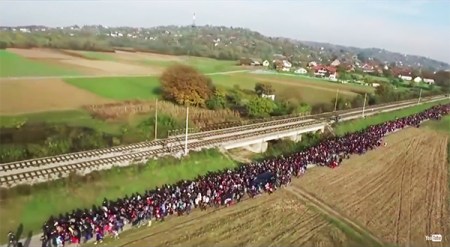
1340Thousands of migrants cross illegally into Slovenia on foot, in this screenshot from YouTube video filmed in October 2015.

According to population projections made by Eurostat in 2013, without migrants, Europe’s population would decline from 507.3 million in 2015 to 399.2 million by 2080. In roughly 65 years, a hundred million people (20%) would disappear. Country by country, the figures seemed even were more terrifying. By 2080, in Germany, 80 million people today would become 50 million. In Spain, 46.4 million people would become 30 million. In Italy, 60 million would decline to 39 million.

Some countries would be more stable: by 2080, France, with 66 million in 2015 would grow to 68.7 million, and England, with 67 million in 2015, would shrink only to approximately 65 million.

Is migration in itself a “bad” thing? Of course not. Migration from low-income countries to higher-income countries is almost a law of nature. As long as the number of births and deaths remains larger than the number of migrants, the result is considered beneficial. But when migration becomes the major contributor to population growth, the situation changes and what should be a simple evolution becomes a revolution.

It is a triple revolution:

  1. Because the number of migrants is huge. The 2015 United Nations World Population Prospects report states: “Between 2015 and 2050, total births in the group of high-income countries are projected to exceed deaths by 20 million, while the net gain in migrants is projected to be 91 million. Thus, in the medium variant, net migration is projected to account for 82 per cent of population growth in the high-income countries.”
  2. Because of the culture of the migrants. Most of them belong to a Muslim and Arabic (or Turkish) culture, which was in an old and historical conflict with the (still?) dominant Christian culture of Europe. And mainly, because this Muslim migration process happens at a historic moment of a radicalization of the world’s Muslim population.
  3. Because each European state is in position of weakness. In the process of building the European Union, national states stopped considering themselves as the indispensable integrator tool of different regional cultures inside a national frame. On the contrary, to prevent the return of large-scale chauvinistic wars such as World War I and World War II, all European nation-states engaged in the EU process and decided to program their own disappearance by transferring more and more power to a bureaucratic, unelected and untransparent executive Commission in Brussels. Not surprisingly, alongside Islamist troubles in all European countries, weak European states have now to cope with the strong resurgence of secessionist and regionalist movements, such as Corsica in France, Catalonia in Spain, and Scotland and Wales in United Kingdom.

Why did France, Germany and many other countries of the European Union opt for massive immigration, without saying it and without letting voters debate it? Perhaps because they thought a new population of taxpayers could help save their healthcare and retirement systems. To avoid the bankruptcy of social security and the social troubles of “dissatisfied retirees,” the EU took the risk of transforming more or less homogenous nation-states into multicultural societies.

Politicians and economists seem blind to multicultural conflicts. They seem not even to suspect the importance of identity questions and religious topics. These questions belong to nations and since WW II, “the nation” is considered “bad.” In addition, politicians and economists appear to think any cultural and religious problem is a secondary question. Despite the growing threat of Islamist terrorism (internal and imported from the Middle East), for example, they seem to persist in thinking that any violent domestic conflict can be dissolved in a “full-employment” society. Most of them seem to believe in U.S. President Barack Obama’s imaginary jobs-for-jihadists solution to terrorism.

To avoid cultural conflicts (Muslim migrants vs non-Muslim natives) Germany could, of course, have imported people from the countries of Europe where there were no jobs: France, Spain, Italy. But this “white” workforce is considered “expensive” by big companies (construction, care-givers and all services…) who need cheap imported workers no matter the area (Middle East, Turkey, Northern Africa) they are coming from. Internal migration inside the EU would not have solved either the main problem of a projected shrinking European population as a whole. Added to that, in a world where competition is transferred partially from nations to global regions, the might of European countries might be thought to lie in their population numbers.

Can Europe borrow a Muslim population from Turkey, Northern Africa, sub-Saharan Africa and the Middle East, and become a European world power, based on a population that is multicultural and multi-religious?

In theory, one can do that. But to succeed and avoid being crossed, day after day, by racial and religious tensions, two essential questions about integration must be put on the table: 1) What do we ask of newcomers? And 2) What do we do to those who do not accept our conditions?

In other words, integration is an asymmetrical process where the newcomer is expected to produce the effort to adapt.

Of course, if the flow of migrants is big, the host society will change, but that is evolution; the sense of cultural and historical continuity will not be demanded into a decline.

In Europe, these two questions of integration were never asked of anyone. According to Michèle Tribalat, sociologist and demographer:

“EU countries agreed at the Council of 19 November 2004, on eleven common basic principles to which to commit. When it is question of integration they disclaim any asymmetry between the host society and newcomers. No privileges are granted to the Europeans or to their heritage. All cultures have the same citizenship. There is no recognition of a substantial European culture that it might be useful to preserve. The social bond is designed as a horizontal one, between the people in the game. Its vertical dimension in reference to history and to the past seems to be superfluous. They speak about values, but these values appear to be negotiable”.

In France, in Germany, and in Sweden, it became rapidly clear that growing flow of a radicalized Muslim population began to change the rules of the integration game. The migrants did not have to “adapt” and are free to reproduce their religious and cultural habits. By contrast, the local “natives” were ordered not to resist “environmental” changes produced by immigration. When they tried to resist anyway, a political and media machine began to criminalize their “racist” behavior and supposed intolerance.

In the new migrant order, the host population is expected to make room for the newcomer and bear the burden of not what is “integration”, but the acceptance of a coerced coexistence.

France’s Archbishop Pontier declared to Le Monde in October 2016:

“We need people that we welcome to love France. If we always offer a negative view, they cannot love the country. However, if we see them as people who bring us something new, we get to grow together”.

When “good feelings” did not work, however, the authorities have often criminalized and prosecuted anti-immigration critics. The Dutch politician Geert Wilders is currently on trial for trying to defend his country from Moroccan immigrants whose skyrocketing crime wave has been transforming the Netherlands.

He may go to jail for as long as a year and could be fined a maximum of ‎€7,400 ($7,000 USD).

In France, the Paris prosecutor opened a preliminary investigation for an “apologia of terrorism” against the anti-immigration writer Eric Zemmour. In an interview with the magazine Causeur, published October 6, Zemmour said that “Muslims must choose” between France and Islam. He added that he had “respect for jihadists willing to die for what they believe.” The Paris prosecutor chose to take this sentence out of context to prosecute him.

Will this double movement — the injunction to love Islam plus criminalizing anti-Islam critics — be enough to kill off any opposition to the EU’s migration policy, and serve to Islamize the continent?

We shall find out.

______________________

[1] Statistical breakdown:

  • 707.352 migrants in 2005
  • 661.855 in 2006
  • 680.766 in 2007
  • 682.146 in 2008
  • 346.216 in 2009
  • 404.055 in 2010
  • 489.422 in 2011
  • 592.175 in 2012
  • 692.713 in 2013
  • 884.893 in 2014

Europe’s New Blasphemy Courts

November 4, 2016

Europe’s New Blasphemy Courts, Gatestone InstituteDouglas Murray, November 4, 2016

(Please see also, America’s “Arab Spring” — DM)

Europe is currently seeing the reintroduction of blasphemy laws through both the front and back doors, initiated in a country which once prided itself on being among the first in the world to throw off clerical intrusion into politics.

By prosecuting Wilders, the courts in Holland are effectively ruling that there is only one correct answer to the question Wilders asked. They are saying that if someone asks you whether you would like more Moroccans or fewer, people must always answer “more,” or he will be committing a crime.

At no point would it occur to me that anyone saying he did not want an endless flow of, say, British people coming into the Netherlands should be prosecuted. Nor would he be.

The long-term implications for Dutch democracy of criminalising a majority opinion are catastrophic. But the trial of Wilders is also a nakedly political move.

The Dutch courts are behaving like a religious court. They are trying to regulate public expression and opinion when it comes to the followers of one religion. In so doing they obviously aspire to keep the peace in the short term, but they cannot possibly realise what trouble they are storing up for our future.


Europe is currently seeing the reintroduction of blasphemy laws through both the front and back doors. In Britain, the gymnast Louis Smith has just been suspended for two months by British Gymnastics. This 27-year old sportsman’s career has been put on hold, and potentially ruined, not because of anything to do with athletics but because of something to do with Islam.

Last month a video emerged online of the four-time Olympic medal-winner and a friend getting up to drunken antics after a wedding. The video — taken on Smith’s phone in the early hours of the morning — showed a friend taking a rug off a wall and doing an imitation of Islamic prayer rituals. When the video from Smith’s phone ended up in the hands of a newspaper, there was an immediate investigation, press castigation and public humiliation for the young athlete. Smith — who is himself of mixed race — was forced to parade on daytime television in Britain and deny that he is a racist, bigot or xenophobe. Notoriously liberal figures from the UK media queued up to berate him for getting drunk or for even thinking of taking part in any mockery of religion. This in a country in which Monty Python’s Life of Brian is regularly voted the nation’s favourite comic movie.

After an “investigation,” the British sports authority has now deemed Smith’s behaviour to warrant a removal of funding and a two-month ban from sport. This is the re-entry of blasphemy laws through the back door, where newspapers, daytime chat-shows and sports authorities decide between them that one religion is worthy of particular protection. They do so because they take the religion of Islam uniquely on its own estimation and believe, as well as fear, the warnings of the Islamic blasphemy-police worldwide.

The front-door reintroduction of blasphemy laws, meantime, is being initiated in a country which once prided itself on being among the first in the world to throw off clerical intrusion into politics. The Dutch politician Geert Wilders has been put on trial before. In 2010 he was tried in the courts for the contents of his film “Fitna” as well as a number of articles. The trial collapsed after one of the expert witnesses — the late, great Dutch scholar of Islam, Hans Jansen — revealed that a judge in the case had tried in private to influence him to change his testimony. The trial was transparently rigged and made Dutch justice look like that of a tin-pot dictatorship rather than one of the world’s most developed democracies. The trial was rescheduled and, after considerable legal wrangling, Wilders was eventually found “not guilty” of a non-crime in 2011.

But it seems that the Dutch legal system, like the Mounties, is intent on always getting its man. On Monday of this week the latest trial of Geert Wilders got underway in Holland. This time Wilders is being tried because of a statement at a rally in front of his supporters in March 2014. Ahead of municipal elections, and following reports of a disproportionate amount of crimes being committed in Holland by Muslims of Moroccan origin, Wilders asked a crowd, “Do you want more or fewer Moroccans in this city and in the Netherlands?” The audience responded, “Fewer, fewer.” To which Wilders responded, “Well, we’ll arrange that, then.”

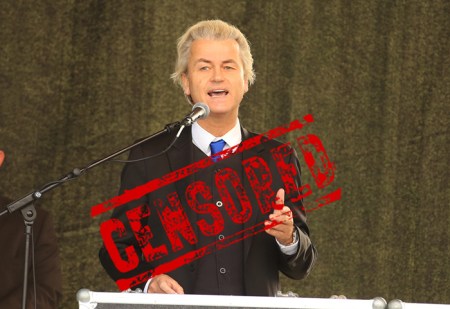
1546By prosecuting Dutch member of parliament Geert Wilders for making “politcially incorrect” statements, Dutch courts are behaving like a religious court. They are trying to regulate public expression and opinion when it comes to the followers of one religion. (Source of Wilders photo: Flickr/Metropolico)

Opinion polls suggest that around half the Dutch public want fewer Moroccans in the Netherlands and many opinion polls going back decades suggest that the Dutch people want less immigration in general. So at the very least Wilders is being put on trial for voicing an opinion which is far from fringe. The long-term implications for Dutch democracy of criminalizing a majority opinion are catastrophic. But the trial of Wilders is also a nakedly political move.

Whether or not one feels any support for Wilders’s sentiments is not in fact the point in this case. The point is that by prosecuting someone for saying what he said, the courts in Holland are effectively ruling that there is only one correct answer to the question Wilders asked. They are saying that if someone asks you whether you would like more Moroccans or fewer, people must always answer “more,” or they will be committing a crime. What kind of way is that to order a public debate on immigration or anything else? People may say, “He wouldn’t be allowed to say that about any other group of people.” And Wilders himself may not say that about any group of people, because he has his own political views and his own interpretation of the problems facing his country.

It is worth trying a thought-experiment: If Wilders or any other politician got up and asked a crowd “Do you want more or fewer British people in Holland,” I may not — as a British person — feel terribly pleased with him for asking the question, or terribly happy with the crowd if they chanted “Fewer.” Although if British expats in Holland were responsible for a disproportionate amount of crime and disorder in the country, some mitigating sympathy for the sentiment may be forthcoming. But at no point would it occur to me that anyone saying he did not want an endless flow of British people coming into the Netherlands should be prosecuted. Nor would he be.

Like the behaviour of the British Gymnastics association, the Dutch courts are behaving like a religious court. They are trying to regulate public expression and opinion when it comes to the followers of one religion. In so doing, they obviously aspire to keep the peace in the short term, but they cannot possibly realise what trouble they are storing up for our future.

Putin hits Europe for letting Muslim migrants get away with crimes: “A society that cannot defend its children has no future”

November 3, 2016

Putin hits Europe for letting Muslim migrants get away with crimes: “A society that cannot defend its children has no future”, Jihad Watch

Russia has become the bogeyman of the 2016 presidential election, with the Democrats far more exercised about the threat from Moscow than they ever were during the Cold War (which they spent ridiculing those who thought there was a genuine threat from the Soviet Union). But however villainous one may think Putin is, he is absolutely right here: the massive influx of Muslim migrants in Europe has caused a “dissolution of traditional national values,” and indeed, “a society that cannot defend its children has no future.” That’s the United Kingdom, with its massive Muslim rape gang activity that authorities feared being called “racist” and “Islamophobic” if they stopped, and Austria with its release of the Muslim migrant who raped a 10-year-old boy — indeed, the illness has overtaken all of Europe’s political and media elites.

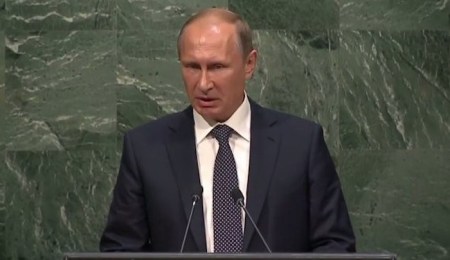
putin

“‘A society that can’t defend its children has no tomorrow’: Putin condemns Europe’s handling of migrants and says the child rape in Austria shows ‘a dilution of national values,’” by Jennifer Newton, MailOnline, November 3, 2016:

Vladimir Putin has waded into the migrant crisis condemning Europe’s handling of asylum seekers and saying a case of child rape in Austria ‘dilutes national values’….

The Russian president has largely kept quiet over the refugee crisis in Europe but has now spoken out of his disbelief over its handling claiming that a continent that ‘can’t protect its children’ has no future.

His comments come off the back of a case in Austria last week, which saw an Iraqi migrant have his conviction of raping a 10-year-old boy at a swimming pool in Vienna overturned.

He was originally convicted of the crime but it was overturned because a court didn’t prove he realised the boy was saying no.

It came after the migrant, identified as 20-year-old Amir A., claimed that it was a ‘sexual emergency’ because he had not had sex for four months.

A second trial for the rape is expected to take place next year, but the attacker is likely to remain in custody until then.

And speaking at a press conference this week, Putin slammed Europe’s migration policy and cited the case, where the victim was from a Serbian family living in Austria.

He said: ‘In a European country, a child is raped by a migrant, and the court releases him.

‘It doesn’t fit into my head what on earth they’re thinking over there.

‘I can’t even explain the rationale – is it a sense of guilt before the migrants? What’s going on? It’s not clear.’

He also claimed that the case highlighted ‘the dissolution of traditional national values’ adding: ‘A society that cannot defend its children has no future.’

And Putin’s words appeared to have struck a chord, as he is extremely popular with Serbs.

In the rape case, the boy had arrived in Austria with his Serbian mother, who paid for him to go to the Theresienbad swimming pool, where he was violently attacked.

The boy was so badly injured that he needed hospital treatment but he will be forced to go back to court for the Iraqi man’s second trial, outraging the Austrian Serbian community….

In March, Konstantin Romodanovsky, head of Russia’s Federal Migration Service accused leaders of willfully ignoring cultural differences that have caused such widespread friction and chaos across the Continent.

He also added that ‘multiculturalism has failed’ because Europe never formed a unified strategy to integrate refugees into Western society….

Romodanovsky also accused EU countries of ignoring the ‘differences in culture, religious traditions, and customs’ with the refugees, the vast majority of whom are Islamic.

Germany Captures ISIS Infiltrator in Refugee Flow

November 3, 2016

Germany Captures ISIS Infiltrator in Refugee Flow, Counter Jihad, November 3 , 2016

How many of those who have “gone missing” did so in order to build terrorist cells, or to plan attacks?  We will likely find out only as each attack occurs, as the police resources are vastly overstretched by the scale of the refugee flows. Belgian police correctly identified some of the Brussels bombers, but had to drop its inquiry into them because it could not spare the resources for that particular case.  German police are likewise facing a crime wave that is overwhelming their available resources.  Leaked reports indicate that German police only expect this refugee crime wave to worsen, as they lack the resources to stop it — or even to track where the refugees go once admitted to the country.

********************

A young Syrian man has been captured in Germany after conducting pre-attack surveillance and recruiting at least one German to join the fight for the Islamic State (ISIS).  The Syrian, identified as Shaas Al-M., presented himself as a refugee from the conflict in Syria.  In fact, he was an ISIS fighter on a mission to conduct terrorist attacks inside Europe.

He is not alone, the British newspaper Express reports.

There were two Islamist attacks by migrants in July.

Earlier this month another bogus Syrian migrant was captured after a bomb he was building was found in his apartment in the easter city of Chemnitz.

The phrase “bogus Syrian migrant” is confusing.  This was a legitimately a migrant from Syria, and not (say) a Korean trying to pass himself off as Syrian in order to migrate to Germany.  However, this migrant was not genuinely a refugee from the violence.  Rather, he came for the express purpose of creating new Islamist violence.  His job was to conduct attacks in Europe’s heartland in order to create pressure on them not to intervene against ISIS within the physical space of its Caliphate.

Politicians in Europe and America have alike defended the idea that refugees do not represent a serious security challenge to the West.  Candidate Hillary Clinton has argued for an increase of 550 percent in the number of refugees admitted to the United States from Syria.  Former political appointees from Homeland Security for the Obama administration have likewise tried to sell the idea that “vetting” will solve whatever problems these refugees pose, although in fact there are no longer intact security services within Syria with whom we might vet them — nor any reason the Assad regime, our enemy, would tell us the truth about them if it could do so.

Meanwhile, security professionals have been giving increasingly loud warnings about the danger of terrorists in the refugee flows.  The Supreme Allied Commander, Europe, said that terrorists were appearing in refugee flows “daily.”  Head of the CIA John Brennan said that terrorists were definitely using the refugee flows to penetrate Western Europe and, from there, America.

Even Hillary Clinton herself admitted in one of her private paid-for speeches, disclosed only by an unauthorized leak, that “we can’t possibly vet all those refugees.”

It turns out that even the ones who are not terrorists still bring substantial crime and social instability.  Germany’s new police figures show a spike of well over a hundred thousand new crimes in the first half of this year, tied to refugees.

Migrants in Germany have committed 142,500 crimes in just six months, police figures have revealed

This was the equivalent of 780 crimes a day – an increase of nearly 40 percent over 2015, according to data from Germany’s Federal Criminal Police Office…  ‘Migrant crime statistics for all of 2016, when they become available, are likely to show a significant increase over the 2015 numbers. One reason for this is that thousands of migrants who entered the country as ‘asylum seekers’ or ‘refugees’ have gone missing.’

How many of those who have “gone missing” did so in order to build terrorist cells, or to plan attacks?  We will likely find out only as each attack occurs, as the police resources are vastly overstretched by the scale of the refugee flows. Belgian police correctly identified some of the Brussels bombers, but had to drop its inquiry into them because it could not spare the resources for that particular case.  German police are likewise facing a crime wave that is overwhelming their available resources.  Leaked reports indicate that German police only expect this refugee crime wave to worsen, as they lack the resources to stop it — or even to track where the refugees go once admitted to the country.

We Will Assassinate Enemies of the Republic Abroad: Iran

November 2, 2016

We Will Assassinate Enemies of the Republic Abroad: Iran, Clarion Project, November 2, 2016

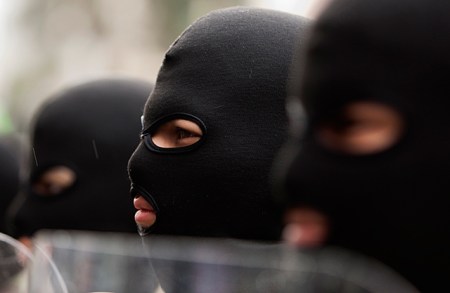
iran-basij-hooded-men-ip_4Members of Iran’s volunteer paramilitary organization Basij (Photo: © Reuters)

Salami accused those who oppose the Iranian regime of being the agents of countries of the region (i.e. Saudi Arabia) and Israel, saying “enemies are seeking to overthrow the system and we have to defeat the enemy using the ‘great jihad’ to confront and fight the infidels.”

******************************

Speaking at a ceremony in Nahavand Mosalla, Salar Abnoush, vice coordinator of the Islamic Republic Guards Corps (IRGC), declared that “soon the IRGC will be formed in Europe and the United States.”

“The Islamic Republic Guards Corps in various cultural, construction fronts have brought the enemy to their knees” the Times of IsraelPersian language edition quotes Abnoush as saying. “This includes the construction of the world’s largest refinery and construction of the world’s largest tunnels – both are a big successes. So all the world must know that soon Revolutionary Guards forces will be formed in the U.S. and Europe.”

The declaration was echoed by Brigadier General Hossein Salami, Iran’s deputy commander of IRGC said, while speaking at a government ceremony in Urmia. Addressing his comments specifically to members of the Kurdistan Democratic Party of Iran, Salami said, “They should not try us again twice because our armed forces proved [they were capable of] this for years, and the enemy suffered heavy losses by the children of this umma (Islamic nation) outside of Iran.”

Salami accused those who oppose the Iranian regime of being the agents of countries of the region (i.e. Saudi Arabia) and Israel, saying “enemies are seeking to overthrow the system and we have to defeat the enemy using the ‘great jihad’ to confront and fight the infidels.”

In reporting Salami’s comments, Iran Global notes that more than 300 members and officials of Kurdish Democratic Party of Iran were assassinated outside of Iran by Iran’s special Intelligence teams within a few years after Iran -Iraq war ended. Two leaders of Kurdish Democratic Party, Dr. Abdol Rahman Ghassemlou and Sadegh Sharafkandi, along with other members and officials of the party, were killed by the Iranian regime in Austria and Germany.

Although Iran later pledged to the European Union it would stop the assassinations of Iranian dissidents in Europe, the news agency notes that history has shown that in order to achieve its goals, the Islamic Republic often does not abide by its international obligations.

According to Tasnim News Agency, Salami declared, “Not long ago, a few mercenaries with provoking from a few regional counties and with the support of the United States and the Zionists tried to re-challenge the Islamic Republic of Iran again, but everyone saw the very strong response of our defenders and how they all were killed by our forces.

“We warn the enemies of Islamic Republic of Iran: Do not make this mistake again as the revolutionary forces will chase them and kill them anywhere in the world. For chasing our enemies, we do not have any limit or red line and our armed forces have proved this in the last few years.”