Posted tagged ‘Egypt’

Dr. Jasser discusses the Pope’s visit to Egypt in the wake of Palm Sunday attack

April 12, 2017

Dr. Jasser discusses the Pope’s visit to Egypt in the wake of Palm Sunday attack, AIFD via Fox via YouTube, April 11, 2017

According to the blurb beneath the video,

Dr. Jasser joins Fox Business’ Risk and Reward discussing the Pope’s visit to Egypt in the wake of the Palm Sunday attack and that the west is ignoring the Christian genocide that is occurring in the Middle East.

Also discussed are X-Men comic books in which the Muslim artist has insert subliminal opinions.

Rephidim, Amalek then: Bir Gafgafa, ISIS now

April 10, 2017

Rephidim, Amalek then: Bir Gafgafa, ISIS now, DEBKAfile, April 10, 2017

Bir Gafgafa’s mission is to provide the Egyptian forces fighting in Sinai with a shield, as well as securing the Suez, one of the world’s most important waterways, against ISIS attack.

It will also serve as a hub for coordinating air operations over Sinai and the Libyan border. It is vitally important to prevent the jihadist networks based in ungoverned Libya and the lawless heartland of the Sinai Peninsula from reaching Egypt’s main cities.

**********************************

They camped at Rephidim, but there was no water for the people to drink. The people quarreled with Moses, and said, “Give us water to drink.” Moses said to them, “Why do you quarrel with me? Why do you test the Lord?” The Lord said to Moses, take in your hand the staff with which you struck the Nile, and go. Strike the rock, and water will come out of it.” Moses did so, in the sight of the elders of Israel. He called the place Massah and Meribah, because the Israelites quarreled and tested the Lord. Then Amalek came and fought with Israel at Rephidim.  Whenever Moses held up his hand, Israel prevailed; and whenever he lowered his hand, Amalek prevailed. And Joshua defeated Amalek and his people with the sword. (Exodus 17)

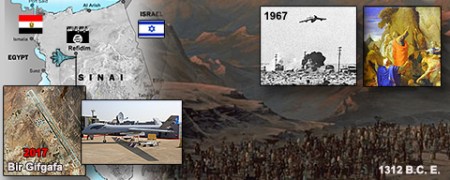
About 3,200 years later, Moses would not have recognized Rephidim. In 1967 it was called Bir Gafgafa and was the site of the Egyptian Air Force’s biggest air facility in Sinai, known as “Egyptian Air Force Base 244.”

From there, Egyptian ruler Gemal Abdul Nasser declared that year: “If Rabin wants war, let’s go!”

And so when the Israeli Air Force preemptively wiped out Nasser’s air force on the ground at the outset of the Six-Day war, Bir Gafgafa was hit first. Rephidim was next transformed into Baha 3, the main Israeli Air Force operations base in Sinai during the War of Attribution and the Yom Kippur war. It was supported 8 kilometers away by a radar and electronic warfare station.

But then, Rephidim aka Bir Gafgafa stepped back into history in its next reincarnation as the very first base from which Israeli withdrew in late 1979 after Israeli Prime Minister Menachem Begin and Egyptian President Anwar Sadat signed the Camp David peace accords, Israel’s first peace pact with an Arab nation.

Another 37 years went by and in 2017 Rephidim now serves another Egyptian President, Abdul-Fatteh El-Sisi, for his life-and-death struggle with the Islamic State’s Sinai affiliate.

The Egyptian Air Force is in the course of transforming the small air field there into the largest air base in Egypt, this time with Israel’s concurrence. The base is being tailored to serve a wide variety of warplanes, attack helicopters and UAVs, with long runways, hangars and storage depots for bombs, missiles and fuel.

The Egyptian have built an enormous hangar 70×57 meters for housing long-range Wing Loong UAVs purchased from China, which are 9 meters long with a 14-meter wing spread. The Wing Loongs are also being deployed at the Uthman Air base in the Western Desert just 68km from the Libyan border.

The huge base will also have a large civilian passenger terminal at its northeastern end to serve the large army contingents deployed in Sinai. Today the 2nd and 3rdArmies are waging war against terror in Sinai supported by Border Guard units which are undertaking special training in anti-terror warfare.

Rephidim is today hemmed in by packs of the new Amalek, the Ansar Beit al-Maqdis which has pledged loyalty to the Islamic State and its leader Abu Bakr al-Baghdadi El-Sisi and is battling Egypt under his direction. The base is accessible only by air or convoys escorted by armored vehicles.

But El-Sisi has big plans for defeating them, DEBKAfile’s military sources report. Bir Gafgafa’s mission is to provide the Egyptian forces fighting in Sinai with a shield, as well as securing the Suez, one of the world’s most important waterways, against ISIS attack.

It will also serve as a hub for coordinating air operations over Sinai and the Libyan border. It is vitally important to prevent the jihadist networks based in ungoverned Libya and the lawless heartland of the Sinai Peninsula from reaching Egypt’s main cities.

The importance of this mission was demonstrated this week. On April 9, President El-Sisi reported that three gangs of terrorists had infiltrated the country from Libya and sent two suicide bombers to blow up two Coptic churches celebrating Palm Sunday, taking the lives of 45 people and injuring 150.

The jihadist menace points more than one way. The next day, Israel closed the Taba crossing into Egyptian Sinai to Israeli holidaymakers bound for the beach resorts, after its security services had received intelligence of an imminent ISIS death-cum-abduction attack afoot for the 10,000 Israeli trippers.

Double Bombing Hits Egypt on Palm Sunday

April 9, 2017

Double Bombing Hits Egypt on Palm Sunday, Clarion ProjectElliot Friedland, April 9, 2017

At least 37 people were killed and more than 100 injured in two separate bombing attacks that struck churches in Egypt. The blasts ripped through services for Palm Sunday on April 9.

The Islamic State terrorist group claimed responsibility for the attacks.

A bomb placed under a seat in the main prayer hall of St. George’s Coptic Church in Tanta, northern Egypt, ripped the hall apart, killing at least 26 and wounded 60 others.

“Everything is destroyed inside the church,” eyewitness Peter Kamel told media outlets after the attack.

A suicide bombing hit Saint Mark’s Coptic Orthodox Cathedral in Alexandria a few hours later. According to state TV reports, police officers prevented the suicide bomber from entering the Church, and he detonated his device outside.

At least 11 people were killed and 35 others wounded in that attack. Pope Tawadros II, the head of the Coptic Church in Egypt, had just lead mass for Palm Sunday but is unharmed as he reportedly had just left the building.

Grand Sheikh Ahmed el-Tayeb, The head of Egypt’s Al-Azhar University, the most prestigious institution of learning in Sunni Islam, condemned the attack, calling it a “despicable terrorist bombing that targeted the lives of innocents.”

The Coptic community in Egypt has long faced discrimination, but that has worsened since the 2011 revolution that overthrew longtime dictator Hosni Mubarak and replaced him first with the Islamist Muslim Brotherhood’s president Mohammed Morsi and then with former general, President Abdefattah el-Sisi.

Breakaway Muslim Brotherhood factions and ISIS affiliates have been targeting Coptic Christians in an effort to destabilize the state and cleanse Egypt of non-Muslims.

In February, ISIS released a propaganda video featuring a terrorist who carried out a previous attack on St Mark’s Cathedral in Alexandria, threatening to eliminate Egypt’s Christians and “liberate Cairo.”

Middle East: A Shift from Revolution to Evolution

April 8, 2017

Middle East: A Shift from Revolution to Evolution, Gatestone InstituteNajat AlSaied, April 8, 2017

The lesson the Trump administration might learn from the disastrous mistakes of its predecessor is that the main sources of terrorism in the region are political Islam and all its related religious groups. All these radical groups, including ISIS, Al-Qaeda, Jabhat Al-Nusra and Hamas have been spawned by a political Islam driven by the ideology of the Muslim Brotherhood.

The fight, therefore, should not be against Islam, but against political Islam. Islam needs to be practiced the way other religions are, as a private personal faith that should be kept separate from public life and politics, and whose expression should be confined to worship only.

Mosques, whether in the Arab and Muslim world or in the West, should be places of worship only and must not transformed to centers for polarizing society or for recruitment by political religious groups.

After each Islamist terrorist attack in the West, the public is divided into two camps: one angry and one indifferent. The problem with defeating Islamist terrorism seems to be that either it is attacked by conservatives who call Islam an evil cult or it is forgiven entirely by liberal apologists. What, then, is the answer?

One of the main failures in Western analyses of the origins of terrorism in the Middle East and North Africa is that the West attributes them to a lack of democracy and a lack of respect for human rights. This is, indeed, part of the cause, but the root of the problem is a lack of development and modernity. U.S. President Donald Trump did not exaggerate when he said that the Obama administration’s foreign policy was disastrous. It was catastrophic mainly for two reasons. One was the knee-jerk support for the “Arab Spring” and for extremist Islamic political groups such as the Muslim Brotherhood. The second was the alliances the Obama administration built with unreliable countries such as Qatar, which supports radical political groups such as the Muslim Brotherhood. In addition, Obama made the mistake of continuing to try to appease Iran’s theocratic regime.

The Arab Spring’s uncalculated, hasty attempt to establish so-called democracy only generated more turmoil and chaos in the region. Certain radical political groups simply exploited the elections to serve their own political and sectarian agendas; that swoop for power only resulted in more authoritarian and dictatorial regimes, as have played out, for instance, in Egypt, where we have witnessed the murder of civilians and police officers by the Muslim Brotherhood. In other countries, the situation is even worse; attempts to install democracy have totally destroyed the state and facilitated the spread of terrorist militias, as in Libya.

It is ironic that Western countries and their advocates stress the need to apply democratic practices in Arab countries, but evidently do not recall that development and secularism preceded democracy in Western Europe. The United Kingdom, which has the oldest democratic system, did not become fully democratic until 1930. France became fully democratic only in 1945, 150 years after the French Revolution.

The Emir of Qatar, Sheikh Tamim bin Hamad Al-Thani, at the Arab Summit in Jordan on March 28, 2017 delivered a speech in which he indicated his continuous support for the Muslim Brotherhood:

“If we are serious about focusing our efforts on armed terrorist organizations, is it fair to consider any political party we disagree with as terrorist? Is our goal to increase the number of terrorists?”

Many Arab leaders were infuriated by his speech; at the forefront was President Abdel Fattah el-Sisi of Egypt, who left the Arab Summit Hall during the speech to meet King Salman of Saudi Arabia.

Most Arab leaders and analysts, in fact, are enraged by Qatar’s continuous support for Islamist political groups such as the Muslim Brotherhood, because these groups are a threat to their national security.

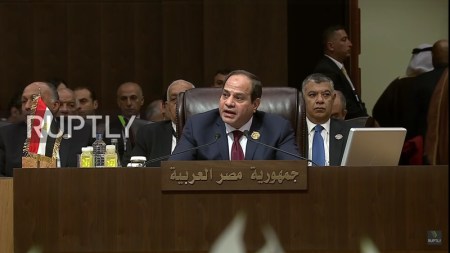
President Abdel Fattah el-Sisi of Egypt speaks at the Arab Summit, on March 29. The previous day, Sisi walked out of a speech by the Emir of Qatar, Sheikh Tamim bin Hamad Al-Thani. Sisi was infuriated by Al-Thani’s declaration of support for the Muslim Brotherhood. (Image source: Ruptly video screenshot)

Another consequence of Obama’s foreign policy — in particular attempts to get close to Iran’s hostile regime — has been a fraying of relationships with old Arab allies of the United States. Some of Obama’s advisors thought that replacing Saudi Arabia with Iran was somehow “better” for the United States, if Iran “is beginning to evolve into a very civilized and historically important country” — an analysis that can be described as completely short-sighted.

The Saudi regime, with all its flaws, is a monarchy run by princes; the Iranian regime is a theocracy run by clerics. The Saudi regime is not a theocratic regime but a hybrid structure, which is neither wholly secular nor wholly religious. As such, the religious class functions under the authority of the ruling class. Princes are driven by self-interest; clerics are driven by ideology. In terms of extremism, the Iranian regime is pushing for hegemony, whilst Saudi Arabia has been taking only a defensive, rather than an expansionist, position.

The motivation of Saudi Arabia in exporting mosques world-wide and installing radical Saudi imams is defensive, not expansionist as in Iran. Saudi Arabia’s impetus is to confront Iran’s hegemony and the spread of its hostile ideology. It is this strategy, which Saudi Arabia has practiced since 1979 to balance Iran’s power and to combat its rebellious ideology, that must change.

That Iran’s Khomeini regime sought to embarrass Saudi Arabia — a country that is home to Islam’s two holiest mosques, in Mecca and Medina — by portraying it as not sufficiently Islamic, meant that the foundational Islamic Wahhabism of the Saudi Kingdom was aggressively reinforced. This emphasis resulted in even more constraints being put in place in Iran: especially on entertainment. Since the Khomeini revolution in 1979, all plays, fashion shows, international events, and cinemas have been banned. As for women, the Commission for the Promotion of Virtue and Prevention of Vice has increasingly harassed them. As for minorities, especially Shia challenging the Iranian Shia regime and its support for Shia militias — particularly the dominant Revolutionary Guards — books were published attacking the Shia:

More books appeared, attacking the Shias and especially Khomeini’s views. These books – like the arguments of Khomeini’s followers – rejected modern thinking as an “intellectual invasion.” Saudi Arabia, considered the guardian of Sunni Islam, spent billions of dollars on challenging the Khomeini-backed Shiites.

This religious one-upmanship — a competition over which body can be the “most religious” — must stop. Saudi Arabia would do well to understand that in order to confront the hegemony of the Iranian theocratic regime, the answer is not to radicalize Saudi society but to return to the way it was before 1979.

The best way to defeat the rebel hostile regime in Iran might be through creating an inclusive and tolerant society in Saudi Arabia. Saudi Arabia needs to change its approach towards Iran because the current strategy has not worked. The current strategy has done nothing except to strengthen the Iranian regime’s dominance; distort, globally, the image of Saudi Arabia and accelerate terrorism.

The lesson the Trump administration might learn from the disastrous mistakes of its predecessor is that the main source of terrorism in the region are political Islam and all its related religious groups. All these radical groups including ISIS, Al-Qaeda, Jabhat Al-Nusra and Hamas have been spawned by a political Islam driven by the ideology of the Muslim Brotherhood. Extremist jihadists such as Osama bin Laden, Abdullah Azzam and Ayman al-Zawahiri were all taught by the Muslim Brotherhood.

Political Islam practiced by the Iranian theocratic regime has been comfortably generating Shia radical militias, including the terrorist group, Hezbollah. The fight, therefore, should not be against Islam, but against political Islam. Islam needs to be practiced the way other religions are, as a private personal faith that should be kept separate from public life and politics, and whose expression should be confined to worship only. Mosques, whether in the Arab and Muslim world or in the West, should be places of worship only and must not transformed to centers for polarizing society or for recruitment by political religious groups. Unfortunately, Western countries have turned a blind eye to the political activities inside these mosques.

The danger of these religious political groups is that they do not believe in democracy or human rights; they just use elections to grasp power in order to impose a system of “Islamic Caliphate” as their only form of government. Most of these groups use religion as an ideology to oppose governments other than their own, and when they are criticized or attacked, they play the role of the oppressed.

The Trump administration needs to take advantage of the fact that the majority of people in the Middle East and North Africa have lost faith in religious political groups, especially since the failure of the Muslim Brotherhood in Egypt and Tunisia.

Before the Arab Spring, support for these groups was huge; now it stands at less than 10% of the population. This study was conducted in the Arab world, not including Turkey. The Muslims who support Turkish President Recep Tayyip Erdogan are the Muslim Brotherhood.

Most recent polls indicate that the majority of people in Arab and Muslim countries prefer religion to be kept separate from politics.

The country that is working the most systematically to fight these religious political groups in the region is the United Arab Emirates (UAE). There are several institutes and think tanks researching how to combat these groups. Dr. Jamal Sanad Al-Suwaidi, Director General of the Emirates Center for Strategic Studies and Research (ECSSR), has given a robust analysis of these groups and how to combat them in his book, The Mirage. In it, he cites a study on public opinion on political religious groups: A survey of the UAE population, on how these groups are able to influence the public by taking advantage of certain flaws in the system: 53.9% because of corruption; 47.9% because of poverty and 29.1% because of an absence of civil society groups that confront these opportunists.

The Middle East-North Africa region will undoubtedly have to go through several stages before it can successfully establish democracy. An evolutionary developmental approach will definitely be better than the failed revolutionary democratic one pursued by the Obama administration.

Secularization is also crucial in the fight against terrorism. Trying to build a democracy before going through the stages of secularism and political reformation — which includes rectifying existing flaws, such as corruption; modernization which means the liberation of the region from extremist totalitarian religious dogma and all other forms of backwardness in order to kick-start a renaissance; and scientific development — will not only be inadequate but will actually generate more terrorism by helping radicals to keep gaining power. It would be like a farmer who wants to plant roses in arid desert soil full of thorns.

Sisi as key to Arab anti-ISIS pact with Israel

April 3, 2017

Sisi as key to Arab anti-ISIS pact with Israel, DEBKAfile, April 3, 2017

(Please see also, Restore the U.S.-Egyptian Strategic Alliance, Designate the Muslim Brothers as Terrorists. — DM)

Our Washington sources report that President Trump aims to complete his plan for bringing together Egypt, Saudi Arabia, Jordan and Israel on a new footing by September.

*********************************

US President Donald Trump’s first face to face with Egyptian President Abdel-Fatteh El-Sisi at the White House Monday, April 3, focuses on four main topics, DEBKAfile reports: The fight against Islamist State terror rampant in Egyptian Sinai and neighboring Libya; topping up US military assistance to Cairo, aid for easing Egypt’s dire economic straits and, finally, the effort to bolster normal relations between the Arab world (including the Palestinians) and Israel.

From the moment he assumed the Egyptian presidency in June 2014, El-Sisi has waged a never-ending war on Islamist terror against Ansar Beit-al Maqdis, which later pledged alliance to the Islamic State’s leader Abu Bakr Al-Baghdadi. The Egyptian army has so far been worsted.  The Egyptian president is not deaf to the criticism of the Second and Third Armies’ failure to overcome a few thousand armed men, even though they can at a moment’s notice raise several thousand more fighters from the Bedouin tribes of Sinai. US intelligence has rated the Egyptian forces as slow-moving and unwieldy; but for limited forays, its contingents preferring to sit safely in their barracks rather than risk going out and pursuing the enemy across the Peninsula.

Shortly before President El-Sisi’s trip to Washington, the Egyptian air force conducted intense bombardments of ISIS concentrations around the northern town of El Arish, killing at least 14 terrorists, nabbing 22 and seizing large caches of roadside bombs. But they too long delayed bearding the Islamists in their main stronghold atop Mount Jabal Hala in central Sinai. ISIS is therefore free to move around the territory and strike at will, the while expanding its operations into Egypt proper.

The weekend air strikes came after months in which ISIS overran sections of El Arish, Sinai’s biggest town (pop: 100,000). Their grip is such that Egyptian forces no longer dared venture into those lawless neighborhoods, especially at night. Earlier this year, terrible persecution including executions forced the few thousand indigenous Christians, most of them Copts, to flee their homes in El Arish. Egyptian forces proved unequal to safeguarding the US-led international observer force (MFO) monitoring the 1972 Egyptian-Israel peace treaty at a nearby station.

American military aid to Egypt stands today at $1.3bn a year. Even though the US president means to slash foreign aid programs, he may make an exception in this case and expand military assistance -, possibly in the coin of advanced military hardware, given the country’s unending frontline battle against Islamist terror.

Its presence in El Arish, 130km from the Egyptian-Israeli border, plants the peril on the doorsteps of Egypt’s neighbors as well: Northern Sinai borders on Israel, its northwestern district shares a border with the Gaza Strip, abutting in the east on Jordan and in the southwest on Libya. The cities of western Sinai sit on the banks of the Suez Canal.

The Islamic State’s Sinai affiliate is closely allied with Salafi organizations in the Gaza Strip and works hand in glove with its Palestinian Hamas rulers, especially in the lucrative arms-smuggling business.

Al-Baghdadi last year posted a group of Iraqi officers in his service to the Sinai contingent. They travelled through southern Jordan to reach the peninsula. The Islamist cells in Libya have moreover made ISIS-held turf in Sinai their safe highway for traveling undetected to their other strongholds across the Middle East.

To stamp out this sprawling, multi-branched menace, the Trump administration needs to bring Egypt, Jordan and Israel into a coalition for a sustained, common campaign.

The Obama administration, which boycotted President El-Sisi for persecuting Egypt’s Muslim Brotherhood, tried unsuccessfully to build Turkey, Egypt and Israel into a counterterrorism pact. The Trump administration, for which the Brotherhood is anathema, has a better chance. But first, relations between the Arab world and Israel need to be placed on a regular footing. Some groundwork already exists in the informal bilateral military ties Egypt and Jordan maintain with Israel. DEBKAfile’s military sources have revealed in past reports the limited give-and-take relations for fighting terror Saudi Arabia and Abu Dhabi maintain with Israel.

The US President’s advisers recognize that before a broad, effective front against ISIS and Al Qaeda can be put together from these partial, often covert ties, progress is necessary towards normalizing relations between the Arab governments and the Jewish state, including the Israeli-Palestinian track.

Trump will certainly want to hear what role his Egyptian guest is willing to take for bringing this process forward. He will ask his next Middle East visitor, Jordan’s Abdullah II, the same question, when he arrives in Washington Tuesday. As for the Palestinian leader Mahmoud Abbas, he was promised an invitation to the White House this month, but not yet been given a date. He is clearly being left to wait until the senior players in the region have had their say. Our Washington sources report that President Trump aims to complete his plan for bringing together Egypt, Saudi Arabia, Jordan and Israel on a new footing by September.

Restore the U.S.-Egyptian Strategic Alliance, Designate the Muslim Brothers as Terrorists

April 3, 2017

Restore the U.S.-Egyptian Strategic Alliance, Designate the Muslim Brothers as Terrorists, Center for Security Policy

(Please see also, Leftist Media Narrative Surfaces in Advance of al-Sisi’s White House Visit…  It’s a very long, and excellent, article on President al-Sisi’s impact on Egypt, the Muslim Brotherhood and efforts to reform Islam.– DM)

Donald Trump will do something today that his predecessor refused to do. He will meet with the elected leader of Egypt, Abdel Fatteh el-Sisi.

President Obama made no secret of his enmity for his Egyptian counterpart. After all, as his country’s senior military officer in 2013, then-General el-Sisi fulfilled the demands of many millions of Egyptians by ending the misrule of the Muslim Brotherhood government – a regime Mr. Obama helped bring to power.

The Brothers were banished in part because they sought to impose their totalitarian Sharia code on Egypt, a goal they seek world-wide. President Obama embraced the Muslim Brothers. Donald Trump came to office rejecting their agenda and the “radical Islamic terrorism” it spawns.

President Trump can prove the vital U.S.-Egyptian alliance is restored by joining President el-Sisi in designating the Muslim Brotherhood what it is: a terrorist organization.

Egypt’s Sisi to Visit Washington in First Week of April: Newspaper

March 19, 2017

Egypt’s Sisi to Visit Washington in First Week of April: Newspaper, Breitbart, March 19, 2017

Adam Berry/Getty

CAIRO (Reuters) – Egyptian President Abdel Fattah al-Sisi will make his first state visit to Washington during the first week of April at the invitation of U.S. President Donald Trump, Egyptian state-owned newspaper Al-Ahram reported on Sunday.

The trip will be Sisi’s first U.S. state visit since being elected president in 2014 as former U.S. President Barack Obama had never extended an invitation.

Sisi was elected a year after leading the military’s ousting of the Muslim Brotherhood’s President Mohamed Mursi after mass protests. Trump invited Sisi in January but the date of the visit had not been announced.

Read more here. (But there is no more there. — DM)

Reports On Creation Of Muslim Brotherhood Lobby In U.S. To Prevent Trump Administration From Designating The Movement A Terrorist Organization

March 17, 2017

Reports On Creation Of Muslim Brotherhood Lobby In U.S. To Prevent Trump Administration From Designating The Movement A Terrorist Organization, MEMRI, March 16, 2017

(As I understand the Muslim Terrorist Designation Act, passage would impair CAIR and other Islamist organizations in America previously supported by the Obama administration and its “countering violent extremism” program. That would be a good thing. — DM)

Introduction

Following Donald Trump’s election to the U.S. presidency, the issue of designating the Muslim Brotherhood (MB) a terrorist organization resurfaced. During and after his presidential campaign, Trump’s Middle East advisor Walid Phares repeatedly stated that the new president would act for the passage of a bill doing so. For example, following Trump’s September 2016 meeting with Egyptian President ‘Abd Al-Fatah Al-Sisi on the margins of the UN General Assembly, Phares told the Egyptian daily Al-Watan that Trump had promised Al-Sisi that he would promote a bill that is already before Congress that designates the MB a terrorist organization.[1] After the election, Phares reiterated these remarks to the press.[2]

It should be mentioned that in November 2015, Senator Ted Cruz (R-TX) and Rep. Mario Diaz-Balart (R-FL) announced that they had introduced a bill designating the MB a terrorist organization.[3] In January 2017, Cruz tweeted that he and Diaz-Balart had reintroduced the bill on this matter: “Proud to introduce Muslim Brotherhood Terrorist Designation Act w @MarioDB [Mario Diaz-Balart]. It’s time to call the enemy by its name.”[4]
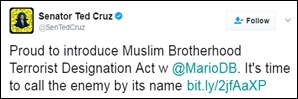
Ted Cruz’s tweet

In light of this bill, and in light of statements by Trump administration officials about its intent to promote it, the MB began preparations to confront the bill and prevent its passage. Launching a widespread informational media campaign, including the hiring of U.S. lobbying and legal firms, outreach to the press in the U.S., and dissemination of informational content aimed at improving its image in the West, particularly in the U.S., the MB attempted to convey that it is not a terrorist organization, but rather an ideological movement whose methods of operation are peaceful.

On the other hand, the Egyptian regime has been working to persuade the new U.S. administration that the MB is indeed a terrorist organization, as well as an umbrella organization for other terrorist outfits. In addition it was reported that Egyptian intelligence too had hired an American lobbying firm to improve the image of the Egyptian regime in the U.S.[5] Egyptian parliamentary representatives met in January 2017 with U.S. members of Congress to impress upon them the necessity of designating the MB as terrorist. Another visit by an Egyptian parliamentary delegation was scheduled for January but has apparently been postponed to April. Additionally, the Egyptian daily Al-Yawm Al-Sabi’, which is close to the regime, has in recent weeks been criticizing Western media, particularly The New York Times, for providing a platform for the promotion of MB ideas. The Egyptian press in general expressed criticism of the regime for failing to sufficiently counter the MB’s media campaign.

This report will review MB media efforts to counter U.S. legislative and legal moves to designate it a terrorist organization, efforts by the Egyptian regime and official media to prove that it does indeed engage in terrorism, and claims by Egyptian writers that the regime is not doing enough to combat the MB’s campaign in the West.

MB Works To Create U.S. Lobby

In fact, already in November 2016, immediately after Donald Trump’s victory in the U.S. presidential elections, the movement began preparing to counter U.S. moves to designate it terrorist. The Egyptian Institute for Political and Strategic Studies, which belongs to the MB and operates from Turkey under the directorship of Amr Darrag, who served as minister of planning and international cooperation in the administration of former Egyptian president Mohamed Morsi, published a document by Dr. Badr Shafi’i on November 26 with recommendations for the movement on how to deal with America’s intent to promote a terrorist designation of the MB. The recommendations include: Appointing elements within the movement to supervise these steps and make contact with experts on international relations; contacting politicians, clerics, and countries that could sympathize with the MB in order to improve its image in Congress; establishing a legal-media team and hold ties with members of Congress; hiring a U.S. law firm and public relations teams; and establishing a substantial Islamic lobby in the U.S., while strengthening ties with movements opposing Trump’s policy.[6]

Recommendations published by the Egyptian Institute for Political and Strategic Studies (Eipss-eg.org, November 2016)

In January and March 2017, the institute published two more documents by Shafi’i that also dealt with this issue, in which he reiterated his recommendations.[7]

In addition, in recent months, the Arab press in general, and the Egyptian press in particular, reported on MB efforts to prevent the Trump administration from listing it as a terrorist organization. Thus, for example, MB sources outside of Egypt told the daily Al-Shurouq that the global MB organization was conducting widespread activity to this end. According to these sources, the movement was being assisted by the governments of Turkey, Tunisia, and Morocco, and by the governments of countries where the MB has substantial parliamentary blocs such as Kuwait, Jordan, and Algeria. The sources also disclosed that the movement’s steps, not only in Egypt but in 82 countries around the world, as well as its contacts with members of Congress and senior U.S. writers and civil society organizations, are meant to prevent the decision.[8]

Evidence of these moves could be seen in comments by London-based MB official Mohamed Soudan, who said in late January that MB elements were speaking to American politicians, State Department officials, members of Congress, and academics, in order to explain the nonviolent history of the movement since its establishment in 1928.[9]

In other statements to the media, Soudan said that most of the MB’s contacts in the U.S. were done via a public relations firm, and added: “We will defend our history and the movement’s future with all possible legitimate and legal means.” According to him, the MB will not sit idly by but rather operate on all fronts and conduct meetings with all American parties in order to prevent a U.S. decision designating it a terrorist organization.[10]

On February 5, the Saudi website Elaph reported that the MB had signed a contract with an American lobbying firm, paying it $4.8 million to help it establish ties with Trump administration officials in order to improve its image in U.S. media. According to the report, the contract included organizing meetings with Trump administration officials, submitting documents on Egyptian government mistreatment of the movement and its members, publishing articles in American media, and providing platforms for movement officials in American print and TV media. Elaph added that elements close to the Obama administration had helped the movement sign the contract with this firm, whose officials include figures close to Obama’s election campaign  and to Hillary Clinton. According to Elaph, the firm employs dozens of former White House and State Department staffers who have extensive ties to members of Congress and political and strategic research centers in the U.S.[11]

Furthermore, former MB official Tareq Abu Al-Sa’ad claimed that as part of its efforts to improve its image in the U.S., the movement relies on specific American families who are members of the MB and have close ties to the U.S. administration. He mentioned a family which he said has ties to American officials and research institutes, as well as other MB officials that are expected to contact human rights organizations to help improve its image in Washington.[12]

One example of the MB’s efforts on this front is a New York Times article by Gehad Al-Haddad, a former Egyptian MB spokesman who was arrested in 2013 and is currently incarcerated in Tora Prison in Egypt. Gehad is the son of Essam Al-Haddad, an aide to former Egyptian president Mohamed Morsi.[13] In the February 22 article, titled “I Am a Member of the Muslim Brotherhood, Not a Terrorist,” Al-Haddad rejected claims that the MB was a terrorist organization, stating that its ideology stems from the Islamic interpretation based on social justice, equality, and rule of law. He stressed that despite the Egyptian regime’s hostility, the movement always fought for the weak in society and that it believes in democracy and pluralism, adding that during the Mubarak era, it even worked together with democratic movements to prevent him from bequeathing the presidency to his son Gamal. He added that the MB opposes violence and has always operated peacefully, and that violent movements that are said to have grown out of the MB actually left the movement because it could not accept their violent methods.[14] Elements close to the movement said it had chosen Gehad Al-Haddad to pen the article because he had held close ties with U.S. officials during Morsi’s presidency.[15]

Al-Haddad’s New York Times article (New York Times, February 22, 2017)

Another New York Times article on February 20, by Declan Walsh, argued that a terror listing for the MB, which has millions of followers, could have negative consequences, especially for countries where MB-linked parties are in power or are prominent in Parliament, with serious implications for domestic politics, American diplomacy and the broader fight against Islamist extremism.  It stated further that marginalizing this movement could mean discouraging some of its moderate branches that have won wide praise for their democratic engagement, while empowering jihadist groups. Moreover, the proposed designation would reaffirm Trump’s embrace of Egyptian President Al-Sisi, who has faced severe international criticism for Egypt’s dismal human rights record in recent years and its ruthless persecution of the MB.

It should be mentioned that on February 23, Al-Masri Al-Yawm quoted Mohamed Soudan as saying that the MB had managed to convince Congress to not designate it a terrorist organization. The report quoted Soudan as saying that the global MB organization had managed to hold contacts with administration and Congress officials and had used documents to convince them that the MB was not and would never be involved in terrorist attacks, and that it routinely issues condemnations for attacks that take place in most countries of the world.”[16] However, the following day Soudan denied the statements attributed to him by Al-Masri Al-Yawm, and posted an article from the Egyptian daily Al-Misriyyoun on his Facebook page with the comment: “I know nothing of this statement and these comments, and I don’t know where they (Al-Masri Al-Yawm) got this fiction.”[17]

Al-Sisi Regime Responds To MB Media Campaign

The Egyptian regime does not seem to working as intensively to promote the U.S. Congressional bill to designate the MB terrorist as the MB is to prevent such a designation. In January 2017, Mohamed Al-‘Orabi, former Egyptian foreign minister and current member of the Egyptian parliament’s foreign relations committee, and Ahmed Al-Fadaly, head of the Independent Party Current, attended President Trump’s inauguration, and also met with members of Congress and administration officials. They presented President Trump with a memo demanding quick action to designate the MB as terrorist. Al-‘Orabi said during the visit that the Egyptian parliament would soon launch a widespread campaign to advance this issue.[18]

However, besides this visit, and MP statements about their intentions to act on the matter, no actual measures are reported to have been taken to promote the U.S. Congress’s anti-MB bill.

In mid-January 2017, it was reported that a delegation on behalf of the Egyptian parliament’s Foreign Relations Committee would travel to the U.S. later that month to meet with members of Congress and deliver a report on “the MB’s violent and terrorist acts.” Tarek Radwan, a representative of the committee, said that attempts were being made to arrange a meeting between the delegation and Sen. Cruz and Rep. Mario Diaz-Balart.[19] The visit, however, apparently never took place. On March 6, it was reported that delegation would visit the U.S. in April.[20]

Egyptian Foreign Minister Sameh Shoukry, asked by the daily Al-Watan whether he had discussed the designation of the MB as terrorist during his late February 2017 visit to the U.S., responded: “I did not address this matter, but I told [U.S. officials] that it was important to note that the MB provides the philosophical and religious basis for radical ideology, and that we cannot combat terrorism [solely] by designating [organizations] in different ways, since all terrorist organizations are interconnected. Thus, [for example] even if ISIS is eliminated, new groups will continue to spring up as long as the source of radical ideology exists.” Shoukry added that the U.S. officials had grasped his point, that he was following the efforts of several members of Congress on the issue, and that the issue remains controversial.[21]

Egyptian Daily: New York Times Supports Terrorism, Slandered Egypt

In contrast to Egyptian officials, the daily Al-Yawm Al-Sabi’, which is close to Egyptian authorities and intelligence apparatuses, dealt extensively with the issue of designating the MB as terrorist, publishing a number of articles attacking the organization. It also criticized the U.S. media, particularly The New York Times, stating that it was enabling MB terrorism. On February 23, the day after The Times published Gehad Al-Haddad’s op-ed, Al-Yawm Al-Sabi’ published an article titled “New York Times Supports MB Terrorism, Publishes Article by Gehad Al-Haddad…”[22] On February 24, it published an article titled “Questionable MB Plot to Slander Egypt in Western Media… Islamist [elements]: Organization Spending Millions of Dollars to Spread Its Poison.”[23]

On March 2, Al-Yawm Al-Sabi’ published an article headlined “New Disgrace for New York Times: Paper Refuses to Publish Article Proving MB Terrorism; [Egyptian-American journalist and researcher] Michael Morgan after His Article Was Rejected for Publication…: ‘The Paper Has Become an [MB] Movement Platform and the U.S. Will Pay the Price.”[24]

Another Al-Yawm Al-Sabi’  article, published March 12, stated: “Since the onset of the June 30 [2013] revolution that ousted the MB regime, The New York Times has specialized in improving the MB’s image and slandering Egypt.” It quoted Islamic affairs expert Ahmed ‘Atta as saying that the MB International Organization secretary-general Ibrahim Munir Mustafa had paid global media outlets, chiefly the Times, $50 million to continue its attacks on Donald Trump because of Trump’s anti-MB stance.[25]
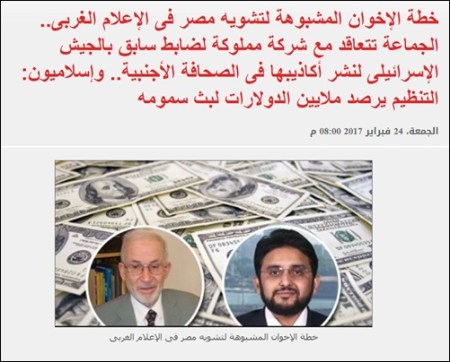
Al-Yawm Al-Sabi’ February 24 article attacking the New York Times

Egyptian Journalists To Al-Sisi Regime: Be More Decisive In Countering MB Media Campaign

Several Egyptian writers criticized the regime’s inertia in the face of the MB’s media campaign. On February 22, Al-Ahram columnist Ahmed ‘Abd Al-Tawab wrote that the MB’s media campaign shows that the movement fears being designated a terrorist organization. He wrote that it is “Egypt’s responsibility” in this matter, “due to its decades-long experience with MB crimes, to provide the Trump administration with information and historical and current evidence that will help it combat the movement on the legal, political, and cultural levels, in accordance with the human rights [principles] that the MB endangers…”[26]

Al-Ahram writer Muhammad Salmawi also wrote of the need for Egypt to step up its activity vis-à-vis the U.S. on the MB issue. In an article titled “The Voice of the MB – and Our Silence,” Salmawi wrote of his surprise  at Egypt’s feeble reaction to Gehad Al-Haddad’s New York Times article. The MB, he said, realizes that the way to influence American society is through public relations and lobbying firms, and the Egyptian regime needs to do likewise: “Those who follow the American press at this time cannot help but notice the intense campaign to improve the MB’s image and cleanse them of any blood spilled now or in the past in the name of Islam. This campaign has a specific goal – to stop the Trump administration from designating the movement a terrorist organization, thus fulfilling one of [Trump’s] campaign promises. To this end, the campaign twists facts with reckless abandon, made possible by the absence of an opposing viewpoint that could have corrected the erroneous information and responded to [the MB’s] notorious lies. How much longer will we remain silent in light of a campaign that has raised its voice and spread throughout the American media since the onset of the June 30, 2013 revolution?

“Last week I read the article by the former official MB spokesman [Gehad Al-Haddad], penned from his Egyptian prison cell and published by The New York Times. I was surprised that some of the few [Egyptian writers] who addressed this matter settled for pondering how such a message was smuggled out of prison in Egypt… The problem is not how it was leaked, but how we could not deliver a similar message [in Western media]…

“How easy it is to criticize security measures that allow messages to be smuggled out of Egyptian prisons and given to newspaper offices… in New York. How easy it is to step up measures against all the prisoners [as a result]. But the MB continues to be heard in the American press – while our position cannot be found in the international arena…

“First, we must examine how the other side managed to gain such a noticeable presence in Western media – and such an examination is not difficult. The ongoing publication of pro-MB positions in Western media, and [this media’s]  disregard for the Egyptian popular will, stems not from some global plot against us or global sympathy with the mother movement that birthed all the groups that accuse others of heresy – but mostly from [the MB’s] accurate grasp of how to operate vis-à-vis American social institutions, and of the active role played by large PR firms in society – whether in the press, the media, in Congress, or elsewhere…

“The way to actively operate in the U.S. is by arriving at an understanding with these large institutions – whether during a presidential or congressional campaign, or in the fight to influence decision-making circles by means of the press and media, or by means of members of Congress. Such a campaign is undoubtedly costly, but losing is costlier still…”

Salmawi, who is known for his antisemitic views,[27] added: “The Jewish lobby in the U.S. has already understood the power of the PR institutions and the influence they wield over American society on all levels. Using this and other methods, they control the political decision[-makers] in the U.S. The MB and the other international elements that fund them have [also] understood this. Is it not time for us to understand what our enemies already have?!”[28]

* C. Meital is a research fellow at MEMRI; H. Varulkar is Director of Research at MEMRI.


[1] Al-Watan (Egypt), September 20, 2016.

[2] Al-Ahram (Egypt), November 11, 2016.

[3] Cruz.senate.gov, November 4, 2015.

[4] Twitter.com/SenTedCruz, January 10, 2017.

[5] Rassd.com, March 5, 2017.

[6] Eipss-eg.org, November 26, 2016.

[7] Eipss-eg.org, January 28, March 3, 2017.

[8] Al-Shurouq (Egypt), February 8, 2017.

[9] Aa.com.tr, January 31, 2017.

[10] Elaph.com, February 5, 2017; Al-Masri Al-Yawm (Egypt), February 23, 2017.

[11] Elaph.com, February 5, 2017. Elements in Egypt affirmed the reports about the MB’s efforts to form a lobby. Gamal Al-Minshawi, an Islamic affairs researcher and former official in Al-Gama’a Al-Islamiyya, told the daily Al-Yawm Al-Sabi’ that the MB pays millions of dollars to foreign newspapers and news sites for positive coverage. Al-Yawm Al-Sabi’ (Egypt), February 24, 2017.

[12] Al-Yawm Al-Sabi’ (Egypt), February 17, 2017.

[13] Al-Yawm Al-Sabi’ (Egypt), February 24, 2017. It should be mentioned that in 2007-2012 Al-Haddad was director of the Clinton Foundation’s Climate Initiative in Egypt. Washingtontimes.com , September 18, 2013.

[14] New York Times (U.S.), February 22, 2017.

[15] Al-Yawm Al-Sabi’ (Egypt), February 24, 2017. It should be mentioned that after Al-Haddad’s article was published, a website close to the MB reported that Egyptian prison authorities had penalized him by placing him in solitary confinement. Rassd.com, February 27, 2017. MB associates also said that Al-Haddad and other MB prisoners manage to smuggle writings out of prison with the help of their lawyers, but an Egyptian security source said that Al-Haddad did not pen the article himself, and that smuggling such writings out of prison was impossible. Al-Watan (Egypt), February 23, 2017; Al-Yawm Al-Sabi’ (Egypt), February 24, 2017.

[16] Al-Masri Al-Yawm (Egypt), February 23, 2017.

[17] Al-Misriyyoun (Egypt), February 24, 2017; Facebook.com/FreedomJusticeFrMohamedSoudan, February 25, 2017.

[18] Al-Yawm Al-Sabi’ (Egypt), January 20, 2017; Al-Watan (Egypt), January 22, 2017.

[19] Al-Yawm Al-Sabi’ (Egypt), January 12, 2017.

[20] Motamemservice.com, March 6, 2017.

[21] Al-Watan (Egypt), March 10, 2017.            `

[22] Al-Yawm Al-Sabi’ (Egypt), February 23, 2017.

[23] Al-Yawm Al-Sabi’ (Egypt), February 24, 2017.

[24] Al-Yawm Al-Sabi’ (Egypt), March 2, 2017. Michael Morgan is an Egyptian-American researcher at the London Center for Policy Research, who promotes the designation of the MB as a terrorist organization.

[25] Al-Yawm Al-Sabi’ (Egypt), March 12, 2017.

[26] Al-Ahram (Egypt), February 22, 2017.

[27] In an article he published in the French-language Egyptian weekly Al-Ahram Hebdo, titled “Look for the Jews,” Salmawi criticized  the French law criminalizing antisemitism and Holocaust denial, stating that it does not forbid denying crimes against humanity but only crimes against six million Jews who “allegedly” suffered a holocaust during World War II. He also wrote that whoever wants to understand the connection between the Monica Lewinsky affair in the U.S., the trial against “French thinker” Roger Garaudy (who was convicted in 1998 of Holocaust denial) and the barring of Holocaust denier David Irving from several countries needs to “look for the Jews.” Al-Ahram Hebdo, Egypt, February 4-10, 1998.

[28] Al-Ahram (Egypt), March 5, 2017.
Russian elite units land on Egypt-Libya border

March 14, 2017

Russian elite units land on Egypt-Libya border, DEBKAfile, March 14, 2017

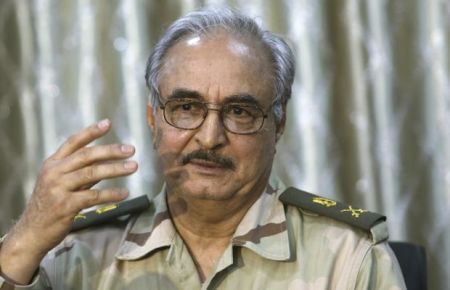
General Khalifa Haftar 

Russian elite units armed with attack drones were detected on Tuesday, March 14 landing at the big Egyptian air base of Sidi Barrani in the Western Desert near the Libyan border, US military sources reported The incoming Russian troops took up position 95 km from the Libyan border and 240km from the eastern Libyan oil and gas terminals at Tobruk port in eastern Libya. They arrived after their Libyan ally suffered a major defeat.

On March 3, Gen. Khalifa Hafter’s Libyan National Army (LNA) militia was attacked in the central region by the rival Benghazi Defense Brigades and driven out of five towns, including the country’s biggest oil terminals at Ras Sidi and Ras Lanuf.

Officials in Washington, Moscow and Cairo declined to comment on whether or not the Russians had acted in coordination the Trump administration.

According to DEBKAfile’s military sources, the Russians and Egyptians appear to be preparing to support a counter-offensive by Hafter’s militia to recover the oil facilities.

For some months now, Moscow, Cairo and Qatar have been working together to bolster Gen. Haftar, who strongly challenges the UN-backed government of Tripoli. His LNA has taken delivery of Russian fighter jets and tanks, while the Egyptian air force has bombed the mostly Islamist militias fighting him, some of them branches of the Islamic State or Al Qaeda.

Although Haftar’s troops are engaged in battle with rival militias across a broad swathe of territory, from Sirte in central Libya to Tobruk in the east, his main objective is to seize control of the oil and gas fields and refineries in the eastern ports.

For President Vladimir Putin, support for Gen, Hafter is a key step in Russia’s military and strategic reach for footholds across the Middle East. He has chosen Tobruk as the next Russian air and naval base in the Mediterranean as a counterpoint to Latakia in Syria. Hafter’s LNA will provide protection.

DEBKAfile first picked up on this development three months ago, when our military sources spotted the Russian aircraft carrier, Admiral Kuznetsov leaving Syrian waters and heading west. The carrier sailed into Tobruk port on Jan. 12. Gen. Hafter was invited on board for a tour of the ship’s facilities and connected to Defense Minister Sergei Shoigu in his Moscow office for a videotaped chat. This was an exceptional gesture on Moscow’s part in support of a controversial Middle East figure.

More recently, the Libyan general visited Cairo to discuss the details of cooperation between the Egyptian army and the LNA with President Abdel-Fatteh El-Sisi.

Opposition Builds Against Mattis Pick Who Met With Muslim Brotherhood

March 13, 2017

Opposition Builds Against Mattis Pick Who Met With Muslim Brotherhood, Washington Free Beacon, March 13, 2017

(Why and for what purpose does General Mattis want her at the Department of Defense? What do her views on the Muslim Brotherhood and anything else have to do with Department of Defense activities? The article does not indicate. — DM)

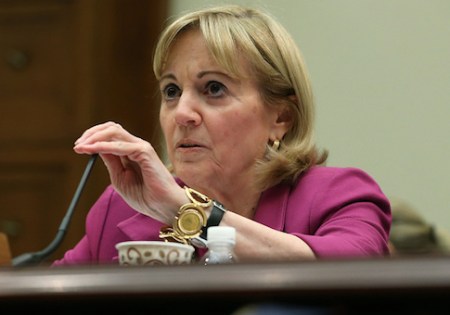
WASHINGTON, DC – NOVEMBER 04: Assistant Secretary of State for Near Eastern Affairs, Anne Patterson testifies during a House Foreign Affairs Committee hearing on Capitol Hill, November 4, 2015 in Washington, DC. (Photo by Mark Wilson/Getty Images)

Opposition is mounting on Capitol Hill and in conservative foreign policy circles over Defense Secretary James Mattis’s efforts to hire a former Obama administration official who lobbied in favor of engagement with the Muslim Brotherhood and spearheaded efforts to criticize Israeli counter-terrorism efforts, according to multiple sources close to the Trump administration.

Mattis is lobbying to hire former diplomat Anne Patterson as undersecretary of defense for policy, according to multiple reports, a position that would make her the third most powerful voice at the Defense Department.

Multiple sources on Capitol Hill and those close to the Trump foreign policy teams are voicing concerns about the pick, warning that Patterson would seek to continue some of the former Obama administration’s most controversial foreign policies, such as conducting outreach to the Muslim Brotherhood.

Patterson, who served as U.S. ambassador to Egypt when the Muslim Brotherhood rose to power, advocated in favor of negotiating with the terror group. Her efforts drew outrage in the Egyptian reformist community, which still views Patterson as working to legitimize the Muslim Brotherhood.

As assistant secretary of state for near east affairs in the Obama administration, Patterson also led efforts to criticize Israeli authorities after they killed a Palestinian-American terrorist who was attempting to stab civilians.

Patterson’s record under the Obama administration has raised concerns on Capitol Hill, where she would require Senate confirmation in order to assume the Defense Department post.

Multiple sources who spoke to the Washington Free Beacon about the matter expressed opposition to the pick and outlined larger concerns about efforts by Mattis to hire former Obama administration officials who conservatives view as responsible for multiple failures in U.S. foreign policy.

These sources also expressed concern about the Trump administration’s failure to remove former Obama officials from the administration, citing the efforts by some to kneecap President Donald Trump’s foreign policy team and preserve Obama-era policies.

“This would be a disastrous choice,” one senior congressional aide tracking the matter told the Free Beacon. “Patterson has a well-documented track record of sticking up for extremist groups at every turn. Her selection would mean elevating someone whose views not only run counter to the president’s, but U.S. national security as well. The administration should seriously reconsider.”

A second senior Republican Senate aide expressed similar concerns. Patterson’s views run counter to the foreign policy outlook expressed by Trump on the campaign trail, the source noted.

There is mounting concern over the promotion of Patterson to such a senior role, according to the source, who said this would “would send the wrong message given her background in Egypt, in particular her sympathies to the Muslim Brotherhood.”

Insiders close to Trump’s national security team described mounting concern over Mattis’s efforts to hire Patterson.

“People concerned about the U.S.-Egypt relationship don’t know what to make of Mattis’s support for Anne Patterson,” said one source, who explained that Patterson’s record on Egypt is vastly different that Mattis’ own comments about recalibrating relations with the country.

“Egyptians I have spoken to, both in and outside government, are extremely worried right now,” the source added. “First, they can’t believe they might have to contend with Patterson’s pro-Brotherhood polices; and second, it’s causing them to re-evaluate who they thought Secretary Mattis is.”

As the Trump administration looks to reset years of strained relations with Cairo, the selection of Patterson could draw outrage from secular leaders who are still angered by her engagement with the Muslim Brotherhood, sources explained.

One Egyptian opposition leader who spoke to the Free Beacon during the 2013 revolution in Egypt described Patterson as “the first enemy of the revolution,” claiming “she is hated even more than [former Muslim Brotherhood leader Mohammed] Morsi.”

Patterson met in 2012 with Brotherhood leader Mohammed Badie, who has been extremely critical of the United States.

Patterson still has strained relations with current Egyptian President Abdel Fattah al-Sisi. Reports in Middle Eastern publications indicated that Patterson pressured al-Sisi to release imprisoned Muslim Brotherhood members and later threatened him when he refused to do so.

Sources also raised questions about Patterson’s commitment to Trump’s foreign policy, which seeks to isolate fanatical religious organizations such as the Brotherhood and Iran’s Revolutionary Guard Corps, or IRGC.

Patterson cast doubt during a 2015 Senate hearing on efforts to designate the IRGC as a terrorist group, efforts that are likely to be revisited by Trump’s team.

One senior Republican foreign policy adviser who has close ties to the White House told the Free Beacon that Patterson would represent a continuation of the Obama administration’s failed engagement in the Middle East.

“Anne Patterson is the embodiment of the Obama administration’s failed approach to the Middle East, which focused on crowding out our traditional Arab allies with radical Islamists from Iran and the Muslim Brotherhood,” said the source, who requested anonymity to speak freely about the administration.

“As the post-Kerry State Department becomes less and less relevant, and the White House and Defense Department take over foreign policy strategy, it’s beyond irresponsible to put her in charge of the Pentagon’s policy apparatus,” the source said.