Posted tagged ‘Department of Defense’

Obama set for Mosul battle, leaves Aleppo to Putin

October 8, 2016

Obama set for Mosul battle, leaves Aleppo to Putin, DEBKAfile, October 8, 2016

(Please see also, The Obama administration is pushing Iraq into further chaos. — DM)
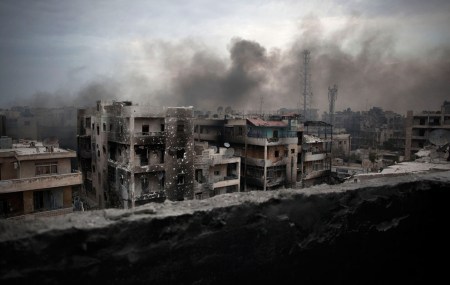
aleppo_destruction

Obama is brooking no distractions from his main objective, He hopes the Mosul operation will be over and done with by mid-December, so that when he exits the White House in January, he will have chalked up a major victory against the Islamic State as part of his legacy.

****************************

The warlike rhetoric heard from Washington over the plight of the stricken Syrian town of Aleppo does not represent any current Obama administration plan for military intervention to halt the ever-mounting carnage.

President Barack Obama’s mind is elsewhere.

This was discovered by his national security adviser Susan Rice every time she tried to arrange for Defense Secretary Ashton Carter and the Chairman of the Chiefs of Staff Gen. Joseph Dunford to be received by the president. After the collapse of diplomacy with Moscow for a cessation of hostilities, they had drawn up a plan for limited US military intervention in Syria that would enable essential humanitarian aid to reach the population.

Obama refused to hear what the trio had to say and the plan was shelved.

DEBKAfile’s Washington sources report that, for now, the US president’s mind is fixed exclusively on the preparations for the Oct. 19 offensive for the liberation of the Iraqi city of Mosul from ISIS occupation. US, Iraqi, Iraqi and Kurdish forces are aligned for the battle.

Obama is brooking no distractions from his main objective, He hopes the Mosul operation will be over and done with by mid-December, so that when he exits the White House in January, he will have chalked up a major victory against the Islamic State as part of his legacy.

In the process, the Democratic president intends to debunk the Republican candidate Donald Trump’s criticism of his administration as showing weakness in the face of ISIS.

Russian President Vladimir Putin is exploiting Obama’s preoccupation with the Mosul offensive to snatch a free hand for pushing the Aleppo battle to its barbaric limit. He is letting Bashar Assad and his allies conduct a scorched earth policy – even if this means reducing Syria’s second town to ruins.

Russian and Syrian jets are bombing the city, building by building, leaving the 8,000 rebels still fighting there with little hope of survival, since food, water, medicine or ammunition and anti-air missiles are out of their reach. The only form of resistance remaining to them is marksmen sniping from the rubble in an attempt to slow the advance of Syria, Iranian and Hizballah foot soldiers.

Obama, Putin and Assad are not alone in sentencing Aleppo to its doom: Turkish President Tayyip Erdogan, after grabbing 5,000 sq. km of northern Syria, is letting his army stand by idly as every attempt to bring life-saving assistance from Turkey to the beleaguered population is thrown back.

The Turkish leader is shielding himself with his secret deal with Putin, whereby his army is given a free hand in northern Syria without Russian interference, while the Aleppo arena becomes a Russian-Syrian precinct that is off-limits to Turkey.

This secret deal has also neutralized the US special operations forces deployed in northern Syria as well as the small Syrian rebel militias they trained and sponsor. Washington has therefore lost any leverage for swaying events in that part of the country. Since they are hemmed in on all sides, Obama refuses to hear of any military intervention in an area under Russian-Turkish control.

As he sees the larger picture, the northern Syrian devolution as a sphere of Turkish-Russian influence is balanced by US-Iraqi-Kurdish domination of northern Iraq

On paper, the US plans and preparations afoot for the liberation of Mosul are impressive.

Elite US troops are being pumped into the Mosul region – 600 just this week. Altogether an estimated 12,500 US servicemen are assigned for the offensive, which is due to be launched in 11 days, on Oct. 19.

This is the largest American military force to fight in Iraq since the battles against Al Qaeda during 2006-2007.

US military engineers are working overtime on the construction of bases around Mosul for the intake of US and Iraqi army units. The Kurdish Republic’s Peshmerga army is in position to the north.

Two new US facilities have just been completed. One is near the Mosul Dam, which regulates the flow of the Tigris River bisecting the targeted city. A second is located in the Bashiqa Mountains north of Mosul.

The two bases plus Kurdish army posts are designed as jumping-off points on the city from the south, east and Uninvited military forces are hovering nearby hoping to pick up a piece of the action. Among them are Turkish military units, local Iraqi militias, such as Turkmen, which the Turkish army is training for combat, and pro-Iranian Iraqi militias, such as the Badr Brigades and the Popular Mobilization Forces.

US commanders are intent on keeping these hangers-on out of the action, because their participation in the Mosul offensive would deepen the discord dividing Iraq’s Shiite, Sunni and Kurdish communities, and throw the city into chaos after the jihadists are driven out. US officers failed to check the sectarian violence that erupted in another Sunni-dominated town, Fallujah, in the wake of the battles for its recovery from ISIS in May and June.

Pentagon still unsure of whether to link Islam with violent jihad

October 7, 2016

Pentagon still unsure of whether to link Islam with violent jihad, Jihad Watch

(Round and round the discussion goes and where will stop everyone knows. However, even if the question is answered factually rather than ideologically in the Puzzle Palace, Obama won’t agree; as long as he — in person or via Hillary — is the president, his ideology will prevail. — DM

Islamic jihadists routinely link Islam with violent jihad. In all their communiques and all their appeals for support, and in all their attempts to recruit peaceful Muslims, they invoke the Qur’an and Muhammad. The fact that this is controversial and still being discussed fifteen years after 9/11 is an indication of how deep the denial, and how serious the crisis, is in Washington.

pentagon

“Pentagon still unsure whether to link Islam & violent Jihad,” by Hillel Fendel, Israel National News, October 7, 2016 (thanks to David):

Staffers in various departments in the Pentagon (the U.S. Defense Department) are busy preparing a document known as the National Military Strategy – but have not yet come to an agreement on at least one critical point regarding the worldwide terror threat.

The biennial document, intended for senior U.S. military commanders around the world, sets out big picture strategy guidance in light of the myriad threats they may face in the line of duty. This is the first one prepared under the guidance of Gen. Joseph Dunford, who took office as Chairman of the Joint Chiefs of Staff exactly a year ago.

The debate taking place at present concerns whether or not to clearly specify the strong connection between extremist Islam and terrorism.

Staffers of the Special Operations Command (SoCom) in the Pentagon believe that the report must note that Salafi jihadism is the branch of Sunni Islam that is responsible for most global terrorism in the world today. Salafi jihadism is the ideology shared by the Islamic State and al-Qaeda.

“Pretending there is no relationship between the violent jihadists and Islam isn’t going to win,” a source knowledgeable about the National Military Strategy told The Washington Times. “We’re completely ignoring the war of ideas. We’re still in denial. We’re pretending the enemy doesn’t exist.”

 The source said that the issue cannot be viewed only in terms of those who believe in active violence: “It’s a much bigger problem, because it’s not just the violent jihadists; it’s the non-violent jihadists who support them.”

SoCom is the branch of the military charged with hunting down and killing terrorists. Countering its opinion, Gen. Dunford’s staff is reportedly not convinced that the term “Salafi jihadism” should be included in the report.

US, Russia on brink of military showdown in Syria

September 30, 2016

US, Russia on brink of military showdown in Syria, DEBKAfile, September 30, 2016

5-3

The fact that President Obama instituted a secret inquiry to discover which link in the American chain of command ordered the attack pointed to his suspicion that a high-up in the Pentagon or possibly the CIA, had ordered the air strike, in order to sabotage the US-Russian military cooperation deal in Syria, which Secretary Kerry obtained after long and arduous toil.

The concessions he made to Russian Foreign Minister Lavrov in those negotiations, especially his consent for extensive sharing of intelligence, were found totally unacceptable in the US Defense Department, its military and intelligence community.

********************************

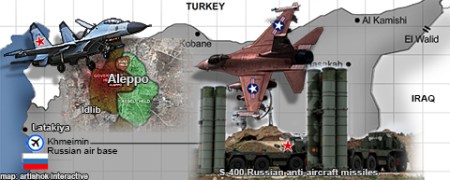
There is a sense in Washington and Moscow alike that a military showdown between the US and Russia is inevitable – direct this time, not through proxies, like the downing of a Russian warplane by Turkish jets last year. When the big powers are in direct confrontation, minor players step aside and run for cover.

When President Barack Obama Friday, Sept. 30 attended the funeral in Jerusalem of the Israeli leader Shimon Peres, he must have realized he was only 514km as the crow flies from Aleppo, the raging crux of the escalating big-power conflict.

The moment after the ceremonies ended the president and his party, including Secretary of State John Kerry and his security adviser Susan Rice, made haste to head back to Washington to navigate the crisis.

The first step toward a direct showdown was taken by the United States.

By now, it is no secret in Moscow, or indeed in any Middle East capital, that the American A-10 air strike of Sept. 17 against a Syrian military position at Jebel Tudar in the Deir ez-Zour region of eastern Syria was intentional, not accidental, as originally claimed. Scores of Syrian soldiers died in the attack.

The fact that President Obama instituted a secret inquiry to discover which link in the American chain of command ordered the attack pointed to his suspicion that a high-up in the Pentagon or possibly the CIA, had ordered the air strike, in order to sabotage the US-Russian military cooperation deal in Syria, which Secretary Kerry obtained after long and arduous toil.

The concessions he made to Russian Foreign Minister Lavrov in those negotiations, especially his consent for extensive sharing of intelligence, were found totally unacceptable in the US Defense Department, its military and intelligence community.

uspalnvsrussian480

The Russian-Syrian reprisal came two days after the A-10 strike. On Sept. 19, an emergency aid convoy was obliterated on its way to the desperate population of Aleppo. Moscow and Damascus denied responsibility for the deadly bombardment, but no other air force was present in the sky over the embattled city.

On the ground, meanwhile, an unbridled onslaught on rebel-held eastern Aleppo was launched Wednesday by the Russians, Syria, Hizballah and pro-Iranian Shiite militias under the command of Iranian Revolutionary Guards officers.

The fall of Aleppo, Syria’s second city after Damascus, would give Bashar Assad his most resounding victory in the nearly six-year civil war against his regime.

On Sept. 29, Kerry threatened Moscow that “the United States would suspend plans to coordinate anti-Islamic State counter-terrorism efforts if Moscow does not stop attacking Aleppo.”

Russia’s Deputy Foreign Minister Sergey Ryabkov answered with a sneering: “Once again there was a certain emotional breakdown yesterday against the backdrop of the Obama administration’s unwillingness to fulfill its part of the agreements.”

This was a strong hint of the knowledge in the Kremlin that someone in the US administration was holding out against the implementation in full of the cooperation deal agreed upon and was therefore responsible for its breakdown.

The United States is left with two options:

Either stand idly by in the face of the Russian-Syrian-Iranian onslaught on Aleppo, or shelve the coordination arrangements for US and Russian air operations in Syria, with the inevitable risk of a clash in the air space of Syria or over the eastern Mediterranean.

Rockets on Golan, Pentagon flouts Obama, no truce

September 18, 2016

Rockets on Golan, Pentagon flouts Obama, no truce, DEBKAfile, September 17, 2016


syria_golankipat

The Pentagon and US army are not following the orders of their Commander-in-Chief Barack Obama in the execution of the military cooperation accord in Syria concluded by US Secretary of State John Kerry and Russian Foreign Minister Sergei Lavrov in Geneva on Sept. 12.

Five days after the truce they agreed would go into effect Monday, fighting was still raging Saturday, Sept. 17.

DEBKAfile was the only Western publication to foresee this eventuality in an article published on July 18.

It was already evident then that any military cooperation agreement between the two powers would be contingent on America exposing its intelligence-gathering methods to Russia – not just in Syria but worldwide.

As our military sources predicted, this new intelligence sharing arrangement would necessarily extend to the Syrian Air Force as a third partner.

In advance of the deal, Moscow deployed its aircraft carrier, the Admiral Kutzenov, post haste to Syrian waters, to make sure that the Joint Implementation Center set up by the Kerry-Lavrov deal for intelligence-sharing would also apply to the warplanes and cruise missiles on the carrier’s decks and its escort of missile cruisers.

This deal was perceived in Moscow as an opportunity to study the combat methods and tactics practiced by the US Navy and Air force in real battlefield conditions.

But this eventuality was far from the intentions of US security and intelligence chiefs at a time of deepening adversity between Washington and Moscow.

The remarks of State Department spokesman Mark Toner on Thursday, Sept. 5 hinted at these conflicting perceptions: “I don’t think anyone in the US government is necessarily taking at face value Russia’s – or certainly not the Syrian regime’s – commitment to this arrangement.” He went on to say: “What really matters here is that the president of the United States supports this agreement, and our system of government works in such a way that everyone follows what the president says.”

Is that really so?

The fact that Kerry’s spokesman found it necessary to emphasize that “everyone follows what the president says,” strongly indicated that not everyone in Washington was in fact obeying the president.

Such disobedience is almost unheard of and would never be admitted publicly. In this case, it is being kept carefully under wraps.

Defense Secretary Ashton Carter and Chairman of the US Chiefs of Staff Gen. Joseph F. Dunford will never on any account admit that, in the execution of military collaboration with Russia in the Syrian conflict, they are not exactly carrying out the president’s precise instructions.

syrianceasefire480

But Washington sources report that Defense Secretary Carter maintains that he can’t act against a law enacted by Congress. He was referring to the law that prohibits all military-to-military relations with Russia as a result of Moscow’s annexation of the Crimea region of Ukraine.

According to DEBKAfile’s military sources, they are simply dragging their feet in ground operations. This is driving Vladimir Putin and his generals into fits of rage.

Friday, Sept 16, Lavrov accused the US of “stalling on its promise to separate moderate rebel groups in Syria from terrorists,” adding, “US progress in delivering on the promise is slow.”

Saturday, Putin himself burst out that the rebels were “regrouping under the ceasefire.” He put the blame on those “rebels” for the failure of the agreed truce to take effect after five days.

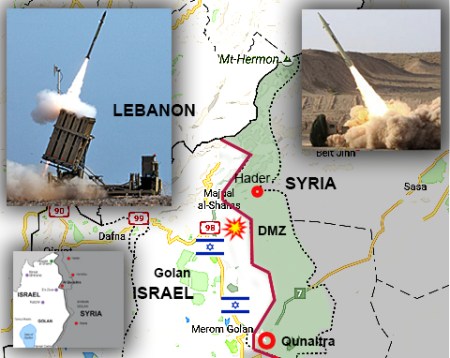
Our military and intelligence sources see a connection between Putin’s angry outburst and the rising tensions on the Syrian-Israeli border in the past week, culminating in the two Syrian rockets that were shot down Saturday over the Golan by Israel’s Iron Dome batteries.

For some time, the Russians and Syrians have made no bones about their objection to Israel’s policy of supporting a motley assortment of Syrian rebel groups in southern Syria close to its border. Among these groups is Al Qaeda’s Syrian arm Jabhat Al-Nusra (the Nusra Front) that has renamed itself Jahat Fath Al-Sham.

Whatever Assad, Iran or Hizballah may accept or reject, President Putin utterly refuses to tolerate Israel allowing the Nusra Front to control parts of this border sector.

Therefore, the rockets and missiles apparently “straying” across the border onto the Golan may well multiply in the coming days.

Yet another complication raised its head over the weekend when the US-backed rebel militia, the Free Syrian Army, vented its fury over the Kerry-Lavrov truce deal by driving away American Special Operations troops helping them in the battle for Al-Rai and abusing them as “infidels.”

The US blames the Russian leader for failing to force Bashar Assad to hold his fire and to let emergency supplies reach the beleaguered population in Aleppo, thereby undermining their ceasefire accord.

But it is becoming evident that the brutal standoff in Syria will be sustained until Putin is satisfied that the US is cooperating with Russian forces in Syria and the Mediterranean region in all spheres.

Before he decides to lean hard on Assad to cease hostilities, he will want to see the White House twisting the arms of the Pentagon and US forces to play ball in the most sensitive spheres.

Understanding the Dispute Over Peshmerga Command

August 21, 2016

Understanding the Dispute Over Peshmerga Command, Kurdistan News, Laurie Mylroie, August 20, 2016

The battle to liberate Mosul, as well as the ongoing “shaping operations,” in which Peshmerga are prominently involved, is not the responsibility of the State Department. It is the job of the Defense Department—one reason to question the authoritativeness of State Department statements on this matter.

Moreover, there is a crucial difference between how the State and Defense Departments interpret White House guidance on Iraq.

******************

A dispute has erupted between Washington and Erbil over command and control of Peshmerga forces. Most probably, the argument reflects a State Department misunderstanding.

On Wednesday, the State Department’s Deputy Spokesperson was questioned about the recent remarks of Iraqi Prime Minister Haider al-Abadi, in which he said, “The Peshmerga should stay where they are now, and they should not expand their presence even if they help the Iraqi Army.”

When asked to comment on that statement, the Spokesperson replied, “The Peshmerga and all the various fighting groups in Iraq need to be under the command and control of the Iraqi Government and the Iraqi military.”

In turn, the Ministry of Peshmerga Affairs of the Kurdistan Regional Government (KRG) responded, “The Peshmerga are not under the command or control of the Iraqi government. According to the Iraqi constitution, the Peshmerga are part of Iraq’s defense system, but the Iraqi government has not supplied the Peshmerga with weapons or military training, and they have not assumed any responsibility toward the Peshmerga.”

The battle to liberate Mosul, as well as the ongoing “shaping operations,” in which Peshmerga are prominently involved, is not the responsibility of the State Department. It is the job of the Defense Department—one reason to question the authoritativeness of State Department statements on this matter.

Moreover, there is a crucial difference between how the State and Defense Departments interpret White House guidance on Iraq.

According to that guidance, Baghdad is in the lead, and the US (and others) follow its direction. The White House believes this is the best way to ensure Baghdad’s continuing cooperation in the fight against IS.

But the interpretation of that guidance varies. The State Department tends to adhere to it strictly; the Defense Department applies it more loosely.

For example, the Defense Department decided to support the Peshmerga directly, rather than channel aid through Baghdad. In July, it signed a Memorandum of Understanding with Erbil. The Pentagon secured Baghdad’s approval by telling the Iraqis what it intended to do and then asking them if they had any objection.

The State Department, however, tends to leave such decisions to the Iraqi government, as it did regarding the anti-ISIL Coalition meetings in Washington last month. KRG representation was minimal because Iraq’s Foreign Minister decided, as he liked.

The State Department’s restrictive interpretation of this guidance led them to make a major misstatement before. That came in response to a query of mine, following the recent International Pledging Conference that raised $2.1 billion in humanitarian aid for Iraq.

What mechanisms existed to ensure that the Kurdistan Region—which hosts 2/3 of the refugees and Internally Displaced Persons in Iraq—received its fair share, given Baghdad’s notorious corruption?, I asked a State Department Spokesperson.

She did not address the issue of Baghdad’s corruption but clearly affirmed, “Funding and support will go through Baghdad.”

That statement also prompted protest from Erbil. But it turned out to be wrong. The State Department soon clarified that the international aid would go through the UN, not Baghdad.

The State Department’s answer to any question that raises criticism of the Iraqi government, as I have learned, is likely to begin with an affirmation of US backing for Baghdad, and the rest of the answer will probably not address the criticism.

When the question involves a dispute between Baghdad versus Erbil, almost certainly, the answer will favor Baghdad. So I have learned not to ask such questions, unless Baghdad’s actions are so clearly wrong that the question itself will highlight the folly of the answer—and the policy behind it.

The spokespersons are the messengers, not the decision-makers, I regularly remind myself. Their deference to Baghdad’s decision-making may prove a grave error, as it does not seem to acknowledge the sectarian nature of the Iraqi government and the influence Tehran exerts over it. But they are not responsible for that policy.

And their jobs are not easy. For an hour each day, they stand before a camera, answering questions, which can be quite hostile, about a wide range of topics. Such questions may come from ambitious journalists who seem to think that their incessant, repetitive questioning may trap the spokespersons into revealing the kernel of some big scoop. Or they may come from the representatives of hostile states, who seem to think that through their barrage of queries, they can embarrass the US.

This situation happens in real time, on an indelible record, to be posted for the whole world to view. The spokespersons bear the hour with unflagging courtesy, and sometimes even good humor, all the while aware that certain slip-ups can create an international incident.

My guess is that is what happened with the misguided statement about command and control of the Peshmerga.


Ten Most Troubling Finds Inside House Probe of Pentagon’s ‘Distorted’ Intel on Islamic State

August 13, 2016

Ten Most Troubling Finds Inside House Probe of Pentagon’s ‘Distorted’ Intel on Islamic State, BreitbartAaron Klein, August 13, 2016

(Please see also, The Trickle-Down Erosion of Honesty in Obama’s White House. — DM)

islamic-state-executions-640x480

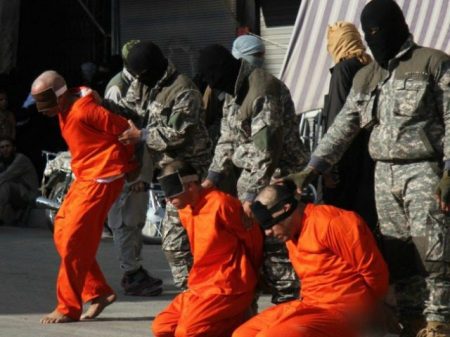
TEL AVIV – A damning investigation by House Republicans released on Wednesday has found that the intelligence arm of the U.S. Military’s Central Command (CENTCOM) routinely produced intelligence that “distorted, suppressed, or substantially altered” the results of the campaign against the Islamic State.

Breitbart Jerusalem reviewed the House report and herein presents the ten most troubling finds, in no particular order.

1 – Top CENTCOM leaders modified intelligence assessments to present an “unduly positive” assessment of combating the Islamic State and training the Iraqi Security Forces (ISF).

The complaint alleges that senior leaders within the CENTCOM Intelligence Directorate and JIC, including the Director of Intelligence and other senior intelligence staff, violated regulations, tradecraft standards, and professional ethics by modifying intelligence assessments to present an unduly positive outlook on CENTCOM efforts to train the ISF and combat ISIL.

Media outlets have also raised allegations of possible reprisals against individuals within the CENTCOM Intelligence Directorate. …

According to multiple interviewees, operational reporting was used as a justification to alter or “soften” an analytic product so it would cast U.S. efforts in a more positive light. No interview provided any instances where operational reporting was used as a justification to come to a more pessimistic conclusion. Additionally, numerous interviewees indicated that analytical products which conflicted with operational reporting were routinely subject to more stringent scrutiny than those that did not.

2 – Intelligence analysts declined to be interviewed, possibly out of fear of reprisals from CENTCOM leadership, while the interviews that did take place were under the watchful eyes of DOD officials.

Additionally, the Joint Task Force requested interviews with four more analysts whose positions provided them with visibility into the allegations. These analysts declined to be interviewed. Although they did not express their reasons for declining, the Joint Task Force is concerned that some of the analysts may have done so out of fear of potential reprisals for their testimony.

For example, as the Joint Task Force’s interviews were commencing, the Director of the DIA publicly characterized reports of the whistleblower’s allegations as exaggerations.

It must also be noted that, pursuant to longstanding arrangements between DOD and the Armed Services Committee, DOD insisted on having department officials present during Joint Task Force interviews.

3 – CENTCOM intel agents operated within a ‘toxic’ leadership environment.

The Republican lawmakers fingered CENTCOM leaders, and noted the intelligence process was cleaner under previous officials and Lloyd Austin III, who served as commander from 2013 to 2016. Dozens of analysts viewed the “subsequent leadership environment as toxic”:

Survey results provided to the Joint Task Force demonstrated that dozens of analysts viewed the subsequent leadership environment as toxic, with 40% of analysts responding that they had experienced an attempt to distort or suppress intelligence in the past year.

4 – General Austin’s claim to Congress that IS was in a “defensive crouch” did not reflect the data possessed at the time by CENTCOM senior leaders.

Although no interviewee remembered the process of preparing the specific press releases and congressional testimony highlighted here, interviewees described a process in which congressional testimony and public affairs statements did not necessarily reflect contemporaneous intelligence assessments. In particular, the Joint Task Force was dismayed to learn that Intelligence Directorate senior leaders seemed unfamiliar with General Austin’s statements to Congress that ISIL was in a “defensive crouch” and indicated this characterization did not reflect their best assessments at the time.

5 – CENTCOM established an intelligence “fusion center” for IS-related intel, but kept out analysts whose views conflicted with senior intelligence leaders.

In June 2014, with the ISIL threat apparent, CENTCOM established an intelligence “fusion center,” a specially equipped JIC facility staffed around-the-clock, to serve as a “focal point” for ISIL-related intelligence. Interviewees recalled only informal communications noting the center’s establishment, and some were also uncertain about the center’s organizational structure, responsibilities, and how it was determined which JIC analysts would participate. The establishment of the Intelligence Fusion Center also removed some analysts who had the most experience with respect to ISIL and Iraq, including those whose analytic views often conflicted with those of CENTCOM’s senior intelligence leaders, from the production of daily intelligence products. This impact was especially significant given the critical analytic tasks of the Intelligence Fusion Center at this time of paramount importance in the theater.

6 – Restrictions were implemented for analysts whose views dissented from the mainstream inside CENTCOM.

Public statements by CENTCOM representatives emphasized close collaboration with other elements of the IC, but many interviewees indicated that in late 2014, senior CENTCOM Intelligence Directorate leaders instructed analysts to cease all external coordination with other IC analysts. The authority to coordinate was restricted to senior officials only, including to leaders of the Fusion Center. Other special arrangements were also put into place to notify the Director of Intelligence in the event that analysts sought to formally “dissent” from analysis produced elsewhere. The restrictions on collaboration have since been partially rescinded.

7 – Analysis was minimized in favor of details from coalition forces while intelligence was skewed to be ‘optimistic.’

Furthermore, senior leaders also relied on details reported from coalition forces rather than more objective and better documented intelligence reporting. The Joint Task Force can find no justifiable reason why operational reporting was repeatedly used as a rationale to change the analytic product, particularly when the changes only appeared to be made in a more optimistic direction. By supplanting analytic tradecraft with unpublished and ad hoc operational reporting, Joint Intelligence Center (JIC) leadership circumvented important processes that are intended to protect the integrity of intelligence analysis.

8 – Shocking survey results showed analysts believed data was “distorted, suppressed, or substantially altered” by their supervisors.

The annual Analytic Objectivity and Process Survey, directed by the ODNI, was conducted from August through October 2015, and included responses from 125 analysts and managers within CENTCOM. The survey results were significantly worse than those of other IC agencies or COCOMs, and showed that a substantial number of CENTCOM respondents felt their supervisors distorted, suppressed, or substantially altered analytic products.

Over 50% of analysts responded that CENTCOM procedures, practices, processes, and organizational structures hampered objective analysis, and 40% responded that they had experienced an attempt to distort or suppress intelligence in the past year. Yet despite receiving these results in December 2015, CENTCOM and IC leaders did not take corrective actions to address many of the issues identified in the survey results.

9 – Even after whistleblower complaints and the “alarming” internal survey last year, the Pentagon took no steps to correct its allegedly distorted intelligence process.

The Joint Task Force is troubled that despite receiving the whistleblower complaint in May 2015 and receiving alarming survey results in December 2015, neither CENTCOM, the Defense Intelligence Agency (DIA), the Under Secretary of Defense for Intelligence, nor the Office of the Director of National Intelligence (ODNI) took any demonstrable steps to improve the analytic climate within CENTCOM. The survey results alone should have prompted CENTCOM and IC leaders to take corrective action without other inducements.

10 – Mirroring the Benghazi House Committee’s complaints against the State Department, the Joint Task Force here writes it “did not receive access to all the materials it requested” and details a process of denying information and records.


Ex-CIA Chief’s Comments Reflect ‘What US is Secretly Doing in Syria’

August 11, 2016

Ex-CIA Chief’s Comments Reflect ‘What the US is Secretly Doing in Syria , from Sputnik News, August 10, 2016

(??????????????????????????? — DM)

Former CIA Deputy Director Michael Morell, who has recently endorsed Hillary Clinton, has caused a firestorm when he said that the United States should covertly kill Russians and Iranians in Syria, with Russian lawmakers denouncing the remarks as “monstrous” and experts saying that he merely confirmed what Washington has secretly been doing.

Vladimir Vasilyev, a senior research fellow at the Moscow-based Institute of US and Canada Studies of the Russian Academy of Sciences, maintained that Morell’s comments should be taken at face value.

This is “what the United States has secretly and surreptitiously been doing and most importantly what Washington will do if Hillary wins presidential election,” he told RIA Novosti. “Russia should understand who it is dealing with. In fact, Moscow could thank Morell for leaking important informationon Washington’s true goals in Syria.”

“Monstrous remarks”

Russian MP Irina Yarovaya, the head of the State Duma Committee for Security, echoed these sentiments, saying that Morell made “monstrous remarks.” He essentially confirmed that Washington is capable of carrying out “covert killings … to pursue its own devastating plans.”

Yarovaya also noted that Morell’s comments point to a hidden agenda in Washington’s counterterrorism activities. “The US State Department must issue a clear statement on the issue. Otherwise, there are grounds to assume that the former CIA deputy director inadvertently revealed an existing top secret CIA plan.”

Morell’s remarks are meant to “fuel tensions between Russia and the US,” Dmitry Gorovtsov, the deputy chairman of the State Duma’s Committee for Security, told RIA Novosti, adding that such rhetoric is unacceptable. He also called Morell’s plan “extremist” and “akin to fascist ideology.”

Morell “does not understand what he is talking about”

First deputy chairman of the defense and security committee in the Federation Council of Russia Franz Klintsevich referred to Morell’s remarks as “absurd.”

“I think that Michael Morell does not understand what he is talking about. Modern surveillance equipment that covers all Syria renders any ‘covert’ killings impossible,” he said. Russia’s cutting edge technologies allow Moscow to determine the name, the date, the place and the goal of any such activity if it took place.

Moreover, Morell’s advice “would automatically lead to an open confrontation between Russia and the US, which the Americans, as far as I understand, do not need,” Klintsevich added.

On Monday, Michael Morell, who served as CIA’s acting director twice, told talk show host Charlie Rose that the US “must make” Russia and Iran “pay a price” in Syria by “covertly” killing their nationals. “You don’t tell the world about it, right? You don’t stand up at the Pentagon and say, ‘we did this.’ Right? But you make sure they know it in Moscow and Tehran,” he added.

Morell also suggested “scaring” Bashar al-Assad by bombing government offices and presidential guard positions, but added that he did not urge to assassinate the Syrian president.

Journalist and political commentator Murtaza Hussain pointed out that the former CIA deputy director championed “efforts that later helped incubate al-Qaeda,” referring to a strategy that the United States employed in Afghanistan in the 1980s.

He also warned that if Morell’s plan is given the green light, it “would entail a massive escalation of American covert military involvement in Syria that would bring the United States much closer to direct confrontation with Russia and Iran.”

House Task Force: ISIS Intel Reports Altered to Skew Success of U.S.-Led Campaign

August 10, 2016

House Task Force: ISIS Intel Reports Altered to Skew Success of U.S.-Led Campaign, Washington Free Beacon, August 10, 2016

FILE - In this Monday, June 17, 2013 file photo, U.S. special operations forces watch a rehearsal by special operations forces from Iraq, Jordan, and Lebanon as part of Eager Lion, a multinational military exercise in Zarqa, Jordan. The government-owned Al-Rai newspaper says a Jordanian policeman opened fire on American contractors at a police training center, killing two and injuring three. (AP Photo/Maya Alleruzzo, File)

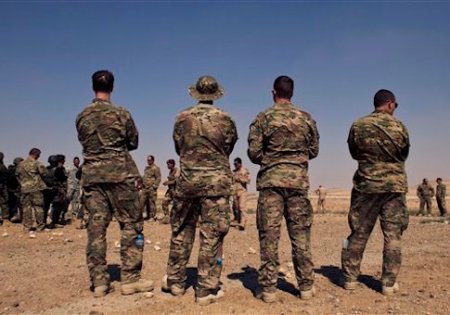
FILE – In this Monday, June 17, 2013 file photo, U.S. special operations forces watch a rehearsal by special operations forces from Iraq, Jordan, and Lebanon as part of Eager Lion, a multinational military exercise in Zarqa, Jordan.

The U.S. military’s Central Command distorted intelligence reports to make the American-led campaign against the Islamic State and al Qaeda appear more successful than it actually was, a House Republican task force found.

Officials familiar with the task force’s findings told the Daily Beast that the roughly 10-page report, which is expected to be publicly released by the end of next week, will confirm earlier complaints from lower level analysts at the Defense Intelligence Agency that Centcom higher-ups had doctored intelligence.

Leaders of Centcom’s intelligence directorate also pressured their subordinates to downplay the threat of ISIS in military reports, the officials said.

The task force, which included members of the House Armed Services and Intelligence committees and the Defense Appropriations subcommittee, was formed after more than 50 intelligence analysts filed a formal complaint accusing senior Centcom officials of inappropriately altering their reports on ISIS and al Qaeda’s branch in Syria.

The complaint, sent to the Pentagon’s inspector general, said senior officials had created a “Stalinist” work environment where subordinates felt “bullied” into drawing conclusions unsubstantiated by facts.

President Obama unwittingly repeated some of the altered intelligence during briefings, the Daily Beast reported. When the initial Centcom complaint came to light last year, Defense Secretary Ash Carter demanded that military officials provide “unvarnished intelligence.”

The report does not contain decisive evidence that senior Obama administration officials had ordered alterations to the ISIS and al Qaeda intelligence.

One official familiar with the House task force’s findings said that while the investigation was “ongoing,” the report “substantiates” claims from lower-level Centcom employees.

Is Hillary Guilty?

July 14, 2016

Is Hillary Guilty? Bill Whittle Channel via YouTube, July 13, 2016

Humor | China builds artificial island in middle of Pearl Harbor

July 13, 2016

China builds artificial island in middle of Pearl Harbor, Duffel Blog, July 13, 2016

pearl-harbor-aerialA satellite photo showing the nearly complete island. (Google Maps images.)

“Secretary of State Kerry has assured me his office is working on a ‘sternly worded’ note,” Harris said. “We are exploring every avenue to make it clear to China that we are not okay with this.”

********************

HONOLULU — China has claimed a key new territory in its efforts to expand its reach in the Pacific region this week, building an artificial island inside Pearl Harbor, Hawaii.

The presence of Chinese dredging crews on a shoal in the middle of the U.S. Navy’s Pacific Fleet headquarters was first reported to Naval Intelligence in early February. But the information was not shared with the Chief of Naval Operations, the Secretary of Defense, or the State Department because the Chief of Naval Intelligence was not told about it because he doesn’t actually have a security clearance.

Adm. Harry B. Harris, Commander in Chief, Pacific, says the Navy is “cautiously optimistic” that China will stand down.

“Secretary of State Kerry has assured me his office is working on a ‘sternly worded’ note,” Harris said. “We are exploring every avenue to make it clear to China that we are not okay with this.”

“They have to respect our 12 mile limits, and we’d better not catch them doing any fishing.”

China’s construction of artificial islands has come under intense scrutiny following this week’s decision by the Permanent Court of Arbitration in The Hague to reject China’s claims to the South China Sea, Vietnam, the Philippines, and most of Australia’s wine-producing regions.

China was also trying to claim it owned San Francisco, Los Angeles, and New York City, since it had put forth a copyright claim on the name “Chinatown.”

Cdr. Liam Phillips, commanding officer of the USS Gabrielle Giffords, says his crew is ready to “circle the encroaching island impotently” until CINCPAC “can assemble a freedom of navigation operation — essentially, a large group of ships that everyone hopes won’t get shot, but kind of hopes they do, too.”

A spokesman for China’s Navy could not be reached for comment, since he was too busy taking photographs of women on the beach from what is being called Panda Harbor.