Posted tagged ‘Britain’

A Month of Islam in Britain: May 2016

June 13, 2016

A Month of Islam in Britain: May 2016, Gatestone InstituteSoeren Kern, June 13, 2016

♦ “A Muslim man with way too many extremist links to be entirely coincidental is now the Mayor of London. … In a couple more decades Britain may well have its first Muslim Prime Minister. … Reality cannot argue with demographics, so the realistic future for Britain is Islamic.” — Paul Weston, British politician.

♦ One-third of Muslim adults in Britain do not feel “part of British culture,” according to a new report on British multiculturalism. Nearly half (47%) of Muslims consider their Islamic faith to be the most important part of their identity.

♦ The government was accused of burying a report on prison extremism which warns that staff have been reluctant to tackle Islamist behavior for fear of being labelled “racist,” according to the Sunday Times. Belmarsh, a maximum-security prison in London, has become “like a jihadi training camp,” according to testimony from a former inmate. There are more than 12,000 Muslims in prisons across England and Wales.

♦ Former MP Ann Cryer suffered verbal abuse and was accused of “demonizing” the Asian community when she began a campaign more than a decade ago to get the authorities to tackle child sex grooming in Keighley.

♦ “At the end of the assault, when Mr. Zimmerman was lying motionless and defenseless on the floor of the ticket hall, the defendant crouched over him and quite deliberately began to cut Mr. Zimmerman’s throat with a knife blade.” — Prosecutor in the attempted murder trial of Somalia-born Muhiddin Mire, who attacked a random stranger in the London Underground.

May 1. Mubashir Jamil, a 21-year-old man from Luton, was arrested on suspicion of attempting to travel to Syria and engage in “violent jihad” with the Islamic State. He was charged with “engaging in conduct in preparation for committing acts of terrorism.”

May 2. A senior British jihadi who boasted of recruiting hundreds of Britons for the Islamic State was killed in a drone strike in Syria, according to the Independent. Raphael Hostey, also known as Abu Qaqa al-Britani, left Manchester to join the Islamic State in 2013. The 23-year-old graphic designer became a key recruiter of British fighters and jihadi brides for the terror group and was also heavily involved in its propaganda. At least 700 people from the UK have travelled to support or fight for jihadist groups in Iraq and Syria.

May 4. The “Department of Theology” of the Blackburn Muslim Association ruled that it is “not permissible” for a woman to travel more than 48 miles — deemed to be the equivalent of three days walk — without her husband or a close male relative. The group also ruled that men must grow beards and women must cover their faces. The rulings were accompanied by the catchphrase: “Allah knows best.”

May 7. Labour Party politician Sadiq Khan was sworn in as mayor of London. He is the first Muslim to lead a major European capital. During the election campaign, Khan faced a steady stream of allegations about his past dealings with Muslim extremists and anti-Semites.

British politician Paul Weston warned that Khan’s rise is a harbinger of things to come:

“The previously unthinkable has become the present reality. A Muslim man with way too many extremist links to be entirely coincidental is now the Mayor of London. … In a couple more decades Britain may well have its first Muslim Prime Minister. … Reality cannot argue with demographics, so the realistic future for Britain is Islamic.”

May 7. Mohammed Shaheen, a 43-year-old father of seven, was sentenced to 16 years in prison for raping underage schoolgirls. Shaheen, an immigrant from Pakistan, told the court he was a devout Muslim who had been framed by his victims. Judge Martin Steiger QC said: “He masqueraded as religious when all along he was behaving in this hypocritical way.”

May 8. The Times reported that Britain’s biggest Muslim charity will brand hundreds of buses around the country during Ramadan with a slogan proclaiming glory to Allah. The initiative by Islamic Relief, a government-backed organization, is an attempt to “break down barriers” and portray Islam in a positive light. Islamic Relief has paid for hundreds of buses in Birmingham, Bradford Leicester, London and Manchester to carry advertisements with the slogan “Subhan Allah,” which means “Glory be to Allah” in Arabic.

May 8. Six Algerian terror suspects with links to al-Qaeda were allowed to stay in Britain after winning a protracted legal battle. The Special Immigration Appeals Commission (SIAC) ruled that there was a “real risk” the men would be tortured by the Algerian security services if they were deported. This would have violated Article 3 of the Human Rights Act, which guards against “torture or degrading or inhuman treatment.”

May 9. A Muslim man who was found guilty of threatening to behead a candidate of the United Kingdom Independence Party (UKIP) had his sentence overturned on appeal. Aftab Ahmed, 45, had been found guilty of making threats to kill David Robinson-Young, but a Newcastle Crown Court judge said he believed that Ahmed did not intend to act on his threat.

May 10. The Greater Manchester Police (GMP) apologized for a counter-terrorism exercise in which a mock suicide bomber shouted “Allahu Akbar” (Allah is the Greatest). Eight hundred volunteers took part in the overnight drill to make it as realistic as possible. Manchester peace activist Erinma Bell criticized the use of a “Muslim terrorist.” She said “a terrorist can be anyone” and “we need to move away from stereotypes.” A local Muslim leader, Syed Azhar Shah, said it was “shocking to portray Muslims as terrorists” and accused the GMP of “institutional racism.” A statement released by GMP said:

“The scenario for this exercise is based on an attack by an extremist Daesh-style organization and the scenario writers have centered the circumstances around previous similar attacks of this nature, mirroring details of past events to make the situation as real life as possible for all of those involved. However, on reflection we acknowledge that it was unacceptable to use this religious phrase immediately before the mock suicide bombing, which so vocally linked this exercise with Islam. We recognize and apologize for the offense that this has caused.”

May 10. The trial began of three Muslims who plotted to behead British citizens after being inspired by an Islamic State order “to kill civilians everywhere in the West.” The court heard that Haseeb Hamayoon, 29, Yousaf Syed, 20, and his cousin Nadir Syed, 22, planned to carry out a terrorist atrocity after a fatwa was issued by Islamic State spokesman Abu-Mohammad al-Adnani. Hamayoon, who has a Pakistani passport, had bought a “Rambo First Blood II” hunting knife online using his wife’s bank account. British born Nadir Syed had stored images of Lee Rigby’s killers, and the three men had allegedly shared images of beheadings.

May 11. Prime Minister David Cameron apologized to Suliman Gani, a Muslim extremist, for saying he is a supporter of the Islamic State. Gani said accusations that he backs the Islamic State are defamatory and must be retracted. In a statement, Cameron said he was referring to reports that Gani supports “an” Islamic state rather than “the” Islamic State. The Muslim Council of Britain called on Cameron to repeat his apology in Parliament, and for an “urgent review” of Islamophobia in the Conservative party.

May 15. The BBC’s religious output is too Christian, an internal review concluded. A report by Aaqil Ahmed, the BBC’s head of religion and ethics, argued that that Muslim, Hindu and Sikh faiths should get more airtime. One Muslim leader suggested the review could lead to Friday prayers from a mosque being broadcast in the same way that Christian church services currently feature in the BBC’s programming. Ahmed’s appointment to the BBC in 2009 was controversial because of allegations he had shown a pro-Islam bias in his previous role at Channel 4, according to the Telegraph.

May 16. The government confirmed that Sharia-compliant student loans will be offered for the first time in Britain as part of an effort to boost the number of young Muslims applying to university. The new halal (permitted or lawful) finance model complies with Sharia law, which forbids Muslims from taking out loans on which they would be charged interest. In a white paper, the government said:

“We will introduce an alternative finance system to support the participation of students who, for religious reasons, might feel unable to take on interest-bearing loans…. To ensure participation and choice are open to all, we plan to legislate for the creation of an alternative model of student finance.”

May 17. One-third of Muslim adults in Britain do not feel “part of British culture,” according to a new report on British multiculturalism. Nearly half (47%) of Muslims consider their Islamic faith to be the most important part of their identity. Only half (54%) of British adults believe there are a set of values that all nationalities and religions in Britain can agree upon in the future.

May 17. Belmarsh, a maximum-security prison in London, has become “like a jihadi training camp,” according to testimony from a former inmate. Now a whistleblower, the former inmate said that a group of jihadists who call themselves “the Brothers,” or “the Akhi” (Arabic for brother), have gained control of the prison, where many convicted terrorists and terror-related offenders mix freely with ordinary prisoners. “The problem is that Belmarsh is also a holding prison and so young people who are brainwashed and indoctrinated then go out into the wider prison system and create wider Akhi networks.” In the five years to December 31, 2014, the number of Muslim inmates at Belmarsh has more than doubled to 265, or 30% of the total prisoners.

May 17. A Muslim convert who was arrested for a plot to behead a British soldier had his sentence reduced. Brusthom Ziamani, 20, was arrested in east London; he was carrying a 12-inch knife, a hammer and an Islamic flag. At his trial, the court was told that he had researched the location of Army bases in London and had shown his ex-girlfriend weapons, described Lee Rigby’s killer, Michael Adebolajo, as a “legend” and told her he would “kill soldiers.” The judges reviewing his sentence said: “Given his youth, we consider that the custodial part of the sentence, namely 22 years, was too long.” Instead they gave him 19 years.

May 18. Ofsted, the official government agency responsible for inspecting and regulating British schools, admitted that it failed properly to inspect a school run by the Deobandis, a conservative Muslim sect, because the inspector was “prohibited” from talking to pupils or staff. The inspector’s report into child safety at the private Zakaria Muslim Girls’ High School in Batley said that celebrations for the Islamic festival of Eid meant he could only speak to senior managers. After Sky News reported on the issue, Ofsted said it was taking “appropriate action” against the inspector concerned and has re-inspected the school, which teaches 149 girls aged 11 to 16. Deobandis, many of whom are said to shun non-Muslims, are thought to control around half of Britain’s private Islamic schools.

May 18. The Queen’s Speech, setting out the government’s program for the next session of parliament, unveiled a controversial new counter-extremism bill that includes powers to gag individuals and ban organizations deemed as extremist. The bill does not, however, include a definition of extremism. Until now the main focus of British policy has been to prevent violent extremism. Simon Cole, the police lead for the government’s Prevent anti-radicalization program, said that the proposals targeting alleged extremists are not enforceable and risk creating “thought police” in Britain by making police officers judges of “what people can and cannot say.”

May 18. A Muslim man who was arrested after giving police a false name filed a lawsuit against the City of London Police for discrimination. Akmal Afzal, 23, claims he was arrested at the 2012 Olympics because he was an “Asian man with a beard.” Afzal, a Briton of Pakistani descent, was released without charge but is suing for false imprisonment, assault and discrimination. His lawyer said: “His position is he did nothing wrong and he says the reason he was treated in the way he was relates to his ethnic origin and/or his religion.”

May 22. The government was accused of burying a report on prison extremism which warns that staff have been reluctant to tackle Islamist behavior for fear of being labelled “racist,” according to the Sunday Times. The independent review, commissioned by Secretary of State for Justice Michael Gove, says that Islamist inmates have exploited the “sensitivity to racism” among prison staff by making false complaints that they are victims of discrimination. The review recommended the creation of “specially designated units” in high-security prisons to house the most “dangerous, extreme and subversive” Islamists. There are more than 12,000 Muslims in prisons across England and Wales, according to the latest figures.

May 23. British and American intelligence services identified 27-year-old El Shafee Elsheikh as the fourth member of the Islamic State execution cell responsible for beheading 27 hostages. The four guards, led by “Jihadi John,” were nicknamed the “Beatles” because of their English accents. Elsheikh, who was granted asylum in Britain when he was seven, left for Syria in 2012 after being radicalized in just 17 days after attending mosques in London.

May 23. A British Muslim woman who wanted raise her children in the Islamic State in Syria was jailed for two and a half years. Lorna Moore, 34, who failed to tell authorities that her husband, Sajid Aslam, 34, had left for Syria, was planning to take her three young children, one of them 11 months old, to the war zone. During sentencing at the Old Bailey, Judge Charles Wide said Moore, a Muslim convert from Walsall, West Midlands, “knew perfectly well of [her] husband’s dedication to terrorism.”

May 23. A survey conducted by ComRes on behalf of Ahmadiyya Muslim Community UK found that 33% of British adults believe that Islam promotes violence in the UK. The study also found that 56% of Britons disagree with the view that Islam is compatible with British values.

May 24. The BBC reported that a National Health Service (NHS) doctor who spent seven years working in Britain left his wife and two children in Sheffield to join the Islamic State. Issam Abuanza, 37, a Palestinian doctor with British citizenship, is the first practicing NHS doctor known to have joined the Islamic State.

May 25. Police in West Yorkshire revealed that they are currently investigating 220 alleged cases of child sex grooming in Keighley and Bradford. The cases involve 261 suspects and 188 victims. The revelation came after Keighley’s former MP, Ann Cryer, called for the perpetrators of the crimes to be brought to justice. Cryer suffered verbal abuse and was accused of “demonizing” the Asian community when she began a campaign more than a decade ago to get the authorities to tackle child sex grooming in Keighley.

May 25. A Nigerian man launched an appeal against a decision by the Home Office to strip him of his British nationality. The man, known only as L2 for legal reasons, is directly associated with close friends of Michael Adebolajo, who murdered Lee Rigby in London in May 2013, and Mohammed Emwazi, or “Jihadi John.” L2 was deemed such a national security threat that Home Secretary Theresa May personally signed an order removing his British nationality in 2013.

May 26. Home Secretary Theresa May established an independent review into the “misuse” of Sharia law in Britain. The inquiry will examine if Sharia ideas are being “misused or exploited” to discriminate against women. The review will not, however, examine whether Sharia law itself is discriminatory against women. A Home Office statement said: “It will not be a review of the totality of Sharia law, which is a source of guidance for many Muslims in the UK.” According to May, many British people “benefit a great deal” from Sharia teaching.

Baroness Cox, who has spearheaded a parliamentary drive to rein in unofficial Sharia courts in Britain, said:

“My reservation is that it won’t get to the root of the problem. … a lot of Muslim women I know say that the men in their communities just laugh at this proposed investigation, that they will go underground so the investigation will have to be very robust.

“But the aspects which are causing such concerns — such as that a man can divorce his wife by saying ‘I divorce you’ three times — that is inherent; the right to ‘chastise’ women is inherent; polygamy is inherent. I don’t think those things are a distortion of Sharia law. These are aspects of Sharia law which are unacceptable.”

May 27. A British citizen who plotted to carry out a suicide bomb attack at Heathrow Airport was sentenced to 40 years in prison. Minh Quang Pham, 33, was sentenced in New York for travelling to Yemen to train with members of al-Qaeda in the Arabian Peninsula (AQAP). Pham pled guilty to three counts of terrorist-related activity based on his support for the group, but denied he intended to carry out his plot and no attack ever occurred. Pham, a Vietnamese born British convert to Islam, was first arrested in Britain in June 2012 and was extradited to the U.S. in February 2015.

May 29. Music festivals, big sports venues and nightclubs have been placed on “high alert” for potential jihadist attacks, according to a senior anti-terrorism officer interviewed by the Sunday Times. Neil Basu, the deputy assistant commissioner of the Metropolitan Police, said that crowded places — including Glastonbury, billed as the world’s largest music festival, which will draw 135,000 people to Somerset from June 22 to 26 — are a major concern for police this summer. Basu warned: “These people are perfectly happy to target civilians with the maximum terror impact. Crowded places were always a concern for us, but now they are right at the top of the agenda.”

May 31. The trial began of a Muslim man who tried to decapitate a random stranger in the London Underground. Somalia-born Muhiddin Mire, 30, attacked musician Lyle Zimmerman, 56, at Leytonstone Underground station on December 5 with a knife while yelling, “This is for my Syrian brothers; I am going to spill your blood.” The jury was told that after the attack, police found images of Islamic State hostages having their throats cut on Mire’s cellphone. The prosecutor said:

“At the end of the assault, when Mr. Zimmerman was lying motionless and defenseless on the floor of the ticket hall, the defendant crouched over him and quite deliberately began to cut Mr. Zimmerman’s throat with a knife blade. Mercifully, Mr. Zimmerman survived the ordeal because, although he suffered three jagged wounds to the front of his neck, none of them caused any damage to any of the major blood vessels in that area.”
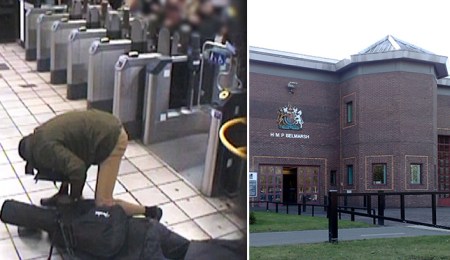
1648Left: Muhiddin Mire, a Somalia-born Muslim, tried to behead musician Lyle Zimmerman at a London Underground station with a knife while yelling “this is for my Syrian brothers.” Right: Belmarsh maximum-security prison in London has become “like a jihadi training camp,” according to testimony from a former inmate.
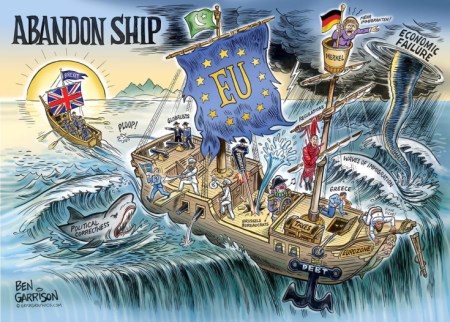
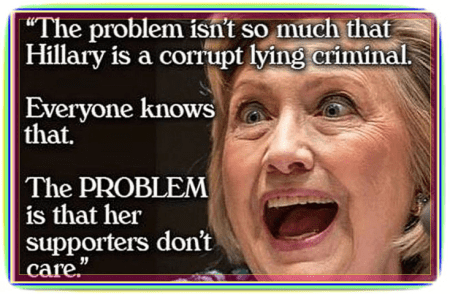
 

Cartoons of the Day

June 12, 2016

H/t Joopklepzeiker

EU over the falls


Hillary keeps lying

Public Support for the European Union Plunges

June 9, 2016

Public Support for the European Union Plunges, Gatestone InstituteSoeren Kern, June 9, 2016

♦ Public anger is also being fueled by the growing number of diktats issued by the unelected officials running the Brussels-based European Commission, the powerful administrative arm of the bloc, which has been relentless in its usurpation of sovereignty from the 28 nation states that comprise the European Union.

♦ Although the survey does not explicitly say so, the findings almost certainly reflect growing anger at the anti-democratic nature of the EU and its never-ending power grabs.

♦ On May 31, the EU, in partnership with Facebook, Twitter, YouTube and Microsoft, unveiled a “code of conduct” to combat the spread of “illegal hate speech” online. Critics say the EU’s definition of “hate speech” is so vague that it could include virtually anything deemed politically incorrect by European authorities, including criticism of mass migration, Islam or  even the EU itself.

♦ On April 20, the European Political Strategy Centre, an in-house EU think tank that reports directly to Juncker, proposed that the European Union establish its own central intelligence agency, which would answer only to unelected bureaucrats.

Public opposition to the European Union is growing in all key member states, according to a new survey of voters in ten EU countries.

Public disaffection with the EU is being fueled by the bloc’s mishandling of the refugee and debt crises, according to the survey, which interviewed voters in Britain, France, Germany, Greece, Hungary, Italy, the Netherlands, Poland, Spain and Sweden.

Public anger is also being fueled by the growing number of diktats issued by the unelected officials running the Brussels-based European Commission, the powerful administrative arm of the bloc, which has been relentless in its usurpation of sovereignty from the 28 nation states that comprise the European Union.

The 17-page report, “Euroskepticism Beyond Brexit,” was published by the Pew Research Center on June 7, just two weeks before the June 23 referendum on whether Britain will become the first country to leave the European Union (Brexit blends the words Britain and exit).

The following are excerpts:

  • Much of the disaffection with the EU among Europeans can be attributed to Brussels’ handling of the refugee issue. In every country surveyed, overwhelming majorities disapprove of how Brussels has dealt with the crisis. This includes 94% of Greeks, 88% of Swedes and 77% of Italians. In Hungary and Poland, disapproval of how the refugee crisis has been managed stands at 72% and 71%, respectively. In France, 70% disapprove; in Germany the figure is 67%. The strongest approval of EU management of the refugee crisis is in the Netherlands, but that backing is a tepid 31%.
  • The EU’s handling of economic issues is another huge source of disaffection with Brussels. About nine-in-ten Greeks (92%) disapprove of how the EU has dealt with the ongoing economic crisis. Roughly two-thirds of the Italians (68%), French (66%) and Spanish (65%) similarly disapprove. (France and Spain are the two nations where the favorability of the EU has recently experienced the largest decline.) Majorities in Sweden (59%) and the UK (55%) also disapprove of the EU’s job in dealing with economic challenges. The strongest approval of Brussels’ economic efforts is in Poland and Germany (both 47%).
  • Nearly two-thirds (65%) of Britons say they want the EU to return certain powers to national governments. This Euroskepticism is not limited to Britain. In Greece, 68% of those surveyed want some EU powers devolved to the national government, followed by Sweden (47%); the Netherlands (44%) and Germany (43%).
  • A median of 42% of Europeans across the ten countries surveyed say they want to reclaim some powers from Brussels, while just 19% favor greater centralization (27% prefer the status quo).
  • Conversely, there is little enthusiasm for transferring more power to Brussels. Only 6% of Britons, 8% of Greeks and 13% of Swedes favor more power for the EU. The strongest backing for an ever closer Europe is only 34%, in France. In most countries, a quarter or more of the public prefers to keep the current division of power.
  • Three-quarters of Britons who disapprove of the EU’s handling of economic problems and 71% of those who have an unfavorable view of the bloc’s handling of the refugee crisis believe that Brussels should return powers to national governments.
  • The strongest backers of the EU are the Poles (72%) and the Hungarians (61%). In many other nations, support is tepid. Just 27% of the Greeks, 38% of the French (down from 69% in 2004) and 47% of the Spanish (down from 80% in 2007) have a favorable opinion of the EU. Notably, 44% of the British view the EU favorably, including 53% of the Scottish.
  • EU favorability is down in five of the six nations surveyed in both 2015 and 2016. There has been a double-digit drop in France (down 17 percentage points) and Spain (16 points), and single-digit declines in Germany (8 points), the United Kingdom (7 points) and Italy (6 points).
  • Young people — those ages 18 to 34 — are more favorable toward the European Union than people 50 and older in six of the 10 nations surveyed. The generation gap is most pronounced in France — 25 percentage points — with 56% of young people but only 31% of older people having a positive opinion of the EU. There are similar generation gaps of 19 points in the UK, 16 points in the Netherlands, 14 points in Poland and Germany, and 13 points in Greece. It remains unclear why young Europeans are so favorable to the EU, where youth unemployment is near 50% in some EU countries.
  • There is overwhelming sentiment across Europe that Brexit would be a bad thing for the European Union: 89% in Sweden, 75% in the Netherlands and 74% in Germany say the British leaving would not be good for the EU. France is the only country where more than a quarter (32%) of the public says it would be positive for the EU if the UK departed.

Although the survey does not explicitly say so, the findings almost certainly reflect growing anger at the anti-democratic nature of the EU and its never-ending power grabs.

On May 31, the European Union, in partnership with Facebook, Twitter, YouTube and Microsoft,unveiled a “code of conduct” to combat the spread of “illegal hate speech” online in Europe. Critics say the initiative amounts to an assault on free speech in Europe because the EU’s definition of “hate speech” and “incitement to violence” is so vague that it could include virtually anything deemed politically incorrect by European authorities, including criticism of mass migration, Islam or even the European Union itself.

On May 24, the unelected president of the European Commission, Jean-Claude Juncker, vowed to use sanctions to isolate far-right or populist governments that are swept into office on the wave of popular anger against migration. Under powers granted to the European Commission in 2014, Juncker can trigger a “rule of law alert” for countries that depart from “the common constitutional traditions of all member states.” Rather than accepting the will of the people at the voting booth, Juncker can impose sanctions to address “systemic deficiencies” in EU member states.

On May 4, Juncker warned that EU countries that failed to “show solidarity” by refusing take in migrants would face a fine of €250,000 ($285,000) per migrant.

On April 20, the European Political Strategy Centre, an in-house EU think tank that reports directly to Juncker, proposed that the European Union establish its own central intelligence agency, which would answer only to unelected bureaucrats. According to the plan, the 28 EU member states would have a “legally binding duty to share information.”

The British Minister of State for the Armed Forces, Penny Mordaunt, responded:

“These matters are supposed to be, and must be the competence of member states. Intelligence sharing can only be done on a bilateral basis. This latest EU integration project not only shows how little the EU cares for the sovereignty of nation states, but also how little it understands the business of counter-terrorism.”

On December 15, 2015, the European Commission unveiled plans for a new European Border and Coast Guard force that can intervene anywhere in the EU, even without the host country’s consent.

On March 8, 2015, Juncker said that the EU needed its own military in order to restore the bloc’s standing around the world: “Europe’s image has suffered dramatically and also in terms of foreign policy, we don’t seem to be taken entirely seriously.”

1642Jean-Claude Juncker, the unelected president of the European Commission, recently vowed to use sanctions to isolate far-right or populist governments that are swept into office on the wave of popular anger against migration. In December 2015, the Commission unveiled plans for a new European Border and Coast Guard force that can intervene anywhere in the EU, even without the host country’s consent. (Image source: © European Union 2015 – European Parliament)

In a recent interview with Le Monde, Juncker said that if Britons voted to leave the EU, they would be treated as “deserters”:

“I am sure the deserters will not be welcomed with open arms. If the British should say ‘No’ — which I hope they do not — then life in the EU will not go on as before. The United Kingdom will be regarded as a third country and will have its fur stroked the wrong way (caresser dans le sens du poil). If the British leave Europe, people will have to face the consequences. It is not a threat but our relations will no longer be what they are today.”

In an interview with the Telegraph, Giles Merritt, director of the Friends of Europe think tank in Brussels, summed it up this way:

“The EU policy elites are in panic. If the British vote to leave the shock will be so ghastly that they will finally wake up and realize that they can no longer ignore demands for democratic reform. They may have to dissolve the EU as it is and try to reinvent it, both in order to bring the Brits back and because they fear that the whole political order will be swept away unless they do.”

UK Prison Course on Islam Teaches Violent Jihad, Says Cleric

June 5, 2016

UK Prison Course on Islam Teaches Violent Jihad, Says Cleric, Clarion Project, June 5, 2016

PrisonMuslimHP_0_0Illustrative picture (Photo: Screenshot from Clarion Project’s Film The Third Jihad)

Sheikh Musa Admani, who has extensive experience with counter-radicalization programs, raised objections to a section of the “Tarbiyah program” which has been used in British prisons since 2011. He told the BBC he felt the section on “The Principle of Jihad” placed undue emphasis on the “external jihad,” i.e., religious war, as opposed to the “internal jihad,” understood as an internal struggle.

“There may necessitate a time to pick up arms and physical [sic] fight such evil” the course says. “It is one of the noblest acts.”

Although the document sets out the different kinds of jihad, Sheikh Admani argues that undue emphasis is placed on violent jihad.

“This document sets out the steps and then addresses various forms of jihad and then goes on to emphasize a particular type, i.e. the killing and the fighting,” he says.

“It incites people to take up arms… It prepares people for violence. It could turn people when they come out of prison, supposedly rehabilitated, back into violence.”

Just war traditions exist in a number of different ethical systems, not just Islam. The problem is an overemphasis on violent jihad. There are Islamic theories of non-violence which could also be taught.

A former inmate at Belmarsh prison also attested to the spread of radical ideas in prison.

“People convicted of terrorism, people in the public domain that are very well known, are roaming around freely and being able to manipulate young minds,” he told the BBC.

“The fact they’re able to learn the Tarbiyah programme and Arabic, coupled with the fact that inmates [convicted of terrorism] have access to extremist literature and narrations that aren’t related to the prophet but they relate it to the prophet — coming from them it seems so realistic, you start believing this is the true Islam, the true Islam is [the militant group Islamic State] IS.”


Watch a clip from the Clarion Project’s film, The ThirdJihad about radicalization in U.S. prisons:

Brexit is the Only Way to Secure Great Britain

June 4, 2016

Brexit is the Only Way to Secure Great Britain, Breitbart, Christopher Carter, June 4, 2016

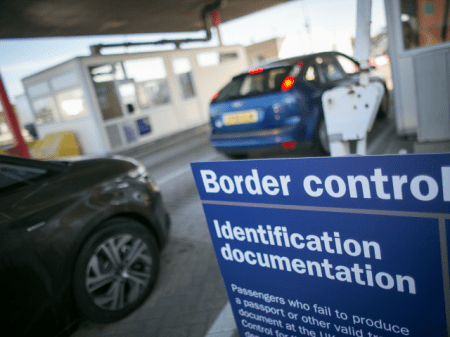
Border control

A few weeks ago David Cameron made contemptible warnings over Brexit and its implications for UK security. He even went so far as to suggest the Islamic State leader Abu Bakr al-Baghdadi “might be happy” if the country votes to Leave the EU.

It is rather telling that since this intervention the PM has chosen to focus on prophesizing economic collapse and hardship rather than discussing this vital issue of Britain’s national security. It is not surprising – considering the recent interventions and revelations concerning how the UK’s membership of the EU impacts on our security.

A report by the EU itself has revealed how there will be a greater risk of terrorist attacks as a result of the Turkey visa-waiver scheme. This has been supported by the ex-head of MI6, Sir Richard Dearlove, who strongly criticised the EU’s attempt to solve the migrant crisis by offering visa-free access to millions of Turks, saying it was “like storing gasoline next to the fire one is trying to extinguish”.

Added to the short-term security threat posed by 77 million Turks having access to all the countries within the EU, there are the long-term political ramifications of the deal, which has the potential to accelerate the resurgence of the far-Right across Europe.

The fact President Erdogan is willing to simply pocket the €3 billion he has demanded the EU send Turkey in aid is hardly going to improve the mood of governments currently forcing through major austerity measures.

He is even threatening to renege on the deal he made over the Greek borders if he doesn’t get his way. His recent warning to the German Parliament not to pass a resolution declaring the mass killings of Armenians in 1915 as genocide are typical of his despotic interventions.

It is clear the EU’s deal with Turkey will have lasting consequences for the whole of the EU, and only by Leaving can we protect the UK.

Of huge concern are the rulings of the European Court of Justice (ECJ), the official court of the EU. Not content with simply supporting the European Commission in its drive to create a federal superstate, its interventions are now putting UK citizens at risk.

Particularly worrying is the recent ruling by the ECJ on freedom of movement. The ECJ is now insisting if a Member State wants to restrict a citizen’s right to ‘free movement’ if they suspect the person has been involved in terrorist activities for example, it must explain exactly why – even though this would endanger national security.

This raises the prospect of British Intelligence officials being forced to hand over highly sensitive documents to people they suspect of terrorism. The UK’s own Court of Appeal has since ruled the rights enshrined in the Charter of Fundamental Rights of the European Union “cannot yield to the demands of national security”.

Yesterday the Justice Secretary, Michael Gove spoke of his frustration at the inability of the UK Government to refuse entry to EU citizens who are suspected of terrorist links. It is clear the European elite are perfectly happy to put the lives of the people of Europe at risk in order to protect the deeply flawed principle of ‘free movement’.

These revelations completely undermine the claims of the Remain campaign that we are safer inside the EU. It is not at all surprising the Prime Minister has now backtracked, choosing to orchestrate a smear campaign against his Leave opponents, rather than addressing the important issue of our national security.

Whilst David Cameron is happy making ludicrous claims about Brexit causing a World War 3, he is clearly uncomfortable addressing the very real threats we will face if we vote to Remain inside the EU.

There is only one way to regain control of our borders and our security and this is to Vote to Leave, to Get Britain Out of the EU.

The Moment of Truth

May 31, 2016

The Moment of Truth, Pat Condell via YouTube, May 31, 2016

(Brexit the Movie is available at Warsclerotic, here. — DM)


The blurb beneath the video states,

Do we want to live in a sovereign democracy or a federal dictatorship?

Please watch ‘Brexit The Movie’ before the referendum, not after. This is the most important political decision we will ever make.
https://www.brexitthemovie.com

UK Labour Party Inquiry: Deny, Divert, Cover Up

May 30, 2016

UK Labour Party Inquiry: Deny, Divert, Cover Up, Gatestone InstituteDouglas Murray, May 30, 2016

♦ Today, as the leader of Her Majesty’s Opposition, Jeremy Corbyn has the opportunity either to tackle anti-Semitism or mainstream it into the UK body politic. The evidence that he has any interest in doing the former are not good.

♦ Whenever the specific question of anti-Semitism was raised, Corbyn would say how opposed he was to all forms of racism, “including Islamophobia.” It has apparently proven impossible for Corbyn to realize the specific nature of anti-Semitism; whenever it has come up, he has used the opportunity to talk not about racial hatred against Jews but what he believes to be an epidemic of hatred towards Muslims.

♦ The British Labour party today evidently is riddled with anti-Semitism from top to bottom, and led by people who want to divert attention from the fact or cover it over entirely. Things can only get worse.

How would you push away a problem you did not want to deal with? The best way, as any addict could tell you, is to pretend that you have dealt with it. The drug-addict pretends to have given up drugs. The alcoholic pretends to have cut down on drink. And the British Labour party pretends to have dealt with its anti-Semitism problem.

Since the start of this year, stories of routine anti-Semitism have emerged from the most junior levels of the Labour party (the Oxford University Labour Club) to the highest levels (a member of Parliament and a member of the party’s National Executive Committee). No one who had followed the career and hobby-horses of the current Labour party leader, Jeremy Corbyn, could have been surprised by this. Anti-Semitism is a swamp he has spent his political life swimming in. But today, this has become not just a problem for him. In recent decades, Jeremy Corbyn’s activities had been of interest only to the small number of people who had hoped to keep the Labour stable clean of anti-Semitism. Today, as the leader of Her Majesty’s Opposition, he has the opportunity either to tackle anti-Semitism or mainstream it into the UK body politic.

The evidence that he has any interest in doing the former are not good. Last month, after online media released anti-Semitic tropes shared and composed by the Labour MP Naz Shah, she was suspended from the party, pending an investigation. The former Mayor of London and Labour grandee Ken Livingstone then spent a week trying to defend Shah by (among other things) explaining which of Hitler’s early policies were not that objectionable. Every day for more than a week, the national newspapers were running headlines about Labour’s anti-Semitism problem. Finally, even this Labour leader realized that something had to be done. And of course the best way to do “something” is to announce an inquiry that will do nothing. This Corbyn soon did, announcing an inquiry that would be led by Shami Chakrabarti, a left-wing human rights advocate, with no expertise in anti-Semitism and a tendency to think well of Islamist extremists. Oddly enough, Chakrabarti — who has made a virtue of her non-party affiliation throughout her career — joined the Labour party on the day that the inquiry was announced.

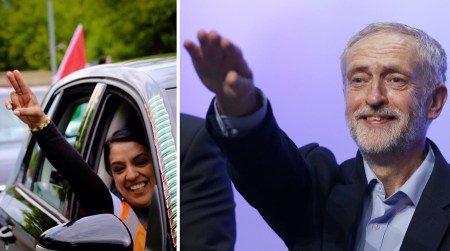
1579Labour Party MP Naz Shah (left), was recently suspended from the party for composing and sharing anti-Semitic tropes. Labour Party leader Jeremy Corbyn (right), has a tendency to hang around with Holocaust deniers, anti-Semitic hate-preachers and others of a similar ilk, and is a self-declared “friend” of the terror outfits Hamas and Hezbollah.

From the outset, she showed that she was willing to do the precise bidding of her party leader. Not least in ensuring that the point of any inquiry was entirely missed. For immediately upon being announced as the leader of the party’s inquiry into anti-Semitism, Chakrabarti announced that it would make no sense “only” to look into anti-Semitism, and that the inquiry must instead also look into “other forms of racism, including Islamophobia.” In a subsequent interview, she went on to question why the Conservative party had not set up an inquiry into what she alleged was its “Islamophobia.” Of course, this is a side-step that Jeremy Corbyn has very much made his own.

In the run-up to his election as Labour party leader, Corbyn was often asked about his tendency to hang around with Holocaust deniers, anti-Semitic hate-preachers and others of a similar ilk. Apart from not quite owning up to his connections to such people, the other technique he employed at this time was to put on a look of extreme affront and say that he had spent his entire life “fighting racism.” Whenever the specific question of anti-Semitism was raised, he would say how opposed he was to all forms of racism “including Islamophobia.” It has apparently proven impossible for Corbyn to realize the specific nature of anti-Semitism; whenever it has come up, he has used the opportunity to talk not about racial hatred against Jews but what he believes to be an epidemic of hatred towards Muslims.

Leaving aside the obvious fact that Muslims are not a race, there is in any case no evidence whatsoever to support the allegation of Corbyn and others that there is an epidemic of “Islamophobia” in the UK, and specifically no evidence of such an issue in the Conservative party. But this attempt to turn around the narrative was pushed by certain Labour apparatchiks to complain that any and all questioning of the newly elected London Mayor, Sadiq Khan, for his past affiliations with Islamist extremists was not a legitimate line of questioning of the judgement of anyone running for elected office, but instead an “Islamophobic” attack purely motivated by “racism.” Even now, Corbyn supporters are trying to distract attention from their own party’s very evident problem and turn racism allegations around on the Conservative party. None of which suggests any serious desire to get on top of their problem.

We can already predict what the conclusions of the Chakrabarti Inquiry will be, from the manner in which she has started it. Will she able to explain that the main originator of anti-Semitism in the Labour party today comes from its growing Muslim base? If she does identify that, will she then need to have an inquiry into herself for such flagrant “Islamophobia”? More likely she will find the party entirely blameless. Just a few dozen bad apples, and so on. And even then, we now have a nice demonstration of what will happen if any unpleasant findings do accidentally slip through.

The Labour party has another inquiry: into allegations, reported earlier this month, of anti-Semitism at its Oxford University club. Amazingly enough, while that inquiry (led by Baroness Royall) found “difficulties,” it claimed to find no “institutional anti-Semitism.” These careful headline facts having been released, the rest of the report was then swiftly supressed on the orders of the Labour party. Only a bland executive summary and some recommendations were made public, evidently leaving even the author of the inquiry “frustrated.” So there is the state of the British Labour party in 2016. A party evidently riddled with anti-Semitism from top to bottom, and led by people who want to divert attention from the fact or cover it over entirely. The Labour party has a serious problem, and it is in institutional denial. Things can only get worse.

Related Video: Douglas Murray on “Anti-Semitism in Britain’s Labour Party”

Anti-Brexit Shocker: Economists and Faith Leaders Plot Britain’s Downfall

May 30, 2016

Anti-Brexit Shocker: Economists and Faith Leaders Plot Britain’s Downfall, The Daily Bell, Staff, May 30, 2016

broken-uk-flag

Economists overwhelmingly reject Brexit in boost for Cameron  … Poll shows 88% of 600 experts fear long-term fall in GDP if UK leaves single market, and 82% are alarmed over impact on household income. -Guardian

Once again, economists remind us that that their profession is at least a questionable one.

Presumably healthy economies are based in private competition not public regulation. Economic progress is made via individual human action.

One person has a product or service and competes against another. And one company against another.

There is room for more than one product or service as consumers have different priorities.

And thus an “economy” is built.

But for some reason, British economists seem to believe that the authoritarian mess that is the European Union is necessary for prosperity.

More:

Relatively few economists have publicly come out saying that leaving the EU would be good for British growth, and only a handful have signed up in support of the pro-Brexit group Economists for Britain.

Most studies of the impact on Britain’s economy of a decision to quit the EU show the uncertainty will hit growth in the short term and the loss of access to the EU’s single market will damage growth for decades to come.

The poll was administered by Ipsos MORI, and received responses from more than 600 economists.

These economists believed in great numbers that leaving the EU would damage the British economy for years to come. Some 61% believe unemployment would expand.

Economists from top institutions such as the Royal Economic Society and the Society of Business Economists replied voluntarily.

The article also tells that 37 “faith leaders” have just written a letter to the Observer newspaper claiming Brexit damages both peace and prosperity.

It’s not clear from the article why leaving the EU would damage peace and prosperity.

The article makes a clearer case for what economists are worried about: “Loss of access to the single market” (67%) and “increased uncertainty leading to reduced investment” (66%).

Presumably economists (and faith leaders?) see their professions somehow enhanced by the EU and diminished by Brexit.

But these views still don’t make much sense.

There are currently reports that the EU is pushing hard for the federalization of Europe via a new tax ID number and also via plans for a pan-European army.

A national insurance number will allow Brussels to identify European (and British) taxpayers and would be a further step toward the institution of an aggressive European tax.

Additionally, new legislation will ban sovereign states from reducing corporate taxation to below 15 percent.

Neither plans for a European army nor the new tax ID number are apparently getting much coverage in Britain.

It really doesn’t matter though. Brussels have proven several times over that the EU’s goal is a United States of Europe.

Surely the economists involved in the survey understand the level of corruption currently infecting the EU.

Those affiliated with the EU receive enormous compensation for useless activities. Regulatory advantages are routinely sold to the highest bidder.

And surely they understand that the decision-making bodies have been purposefully divorced from Parliament. The entire setup of the EU is aimed at producing a mega-state responsible only to a handful of bureaucrats.

How on earth British economists, let alone “faith leaders” can endorse the EU is difficult to imagine.

If Britain stays in the EU, within a decade the country – as it has existed for perhaps a thousand years – will be disassembled.

These economists and faith leaders are content to support the end of Britain.

Faith will not be diminished and industry will not leave if Brexit occurs. But the country will not survive as a historical entity if it remains within Europe.

Conclusion: These two groups are willfully presiding over the end of Britain.

Brexit: “An Off Ramp From the Road to Serfdom”

May 30, 2016

Brexit: “An Off Ramp From the Road to Serfdom” Power LinePaul Mirengoff, May 29, 2016

Next month, Great Britain will vote on whether to exit the European Union. One of the main arguments against a “Brexit” seems to be that Germany and company will punish Britain economically if it exits in order to deter other states from following or perhaps just out of spite.

For some, though, this reality may be an argument in favor of leaving. Why remain attached, and cede more and more authority, to an entity this powerful and vindictive?

The core argument for leaving is forcefully set forth by George Will. He points to the EU’s “democracy deficit” and contends that it flows inexorably from the very point of the EU — to create a continent-wide administrative state.

In Europe, as in the United States, the administrative state exists to marginalize politics — to achieve [the] goal of “replacing the government of persons by the administration of things.” The idea of a continent-wide European democracy presupposes the existence of a single European demos, the nonexistence of which can be confirmed by a drive from, say, Stettin in the Baltic to Trieste in the Adriatic.

Quoting Michael Gove, secretary of justice and leader of the Brexit campaign, Will maintains that the ongoing concentration of power in Brussels guarantees “regulation in the interest of incumbents” who “do not want a dynamic, innovative Europe.” Under Europe’s administrative state, interest groups are stronger than ever and they prefer social stasis to the uncertainties of societies that welcome the creative destruction of those interests that thrive by rent-seeking.

Then there is the matter of mass migration. Will states:

If, as some serious people here fear, Europe’s current crisis of migration is just the beginning of one of the largest population movements in history, the E.U.’s enfeebled national governments must prepare to cope with inundations. But each E.U. member’s latitude for action exists at the sufferance of E.U. institutions.

I would move the analysis back one step and argue that the EU’s national governments should be able to decide the extent, if any, to which their country shall be inundated.

Consider the issue of Syrian refugees. The German chancellor wants a large influx of them because her country doesn’t have enough people. Trying to make the mass influx of Syrians acceptable to the German public, she insists that other EU countries take “their fair share” of refugees, and claims they have a moral duty to do so.

But some EU nations don’t lack for people. Thus, their interests diverge sharply from those of Germany and certain other EU countries. And because they don’t share Germany’s guilt over World War II or its level of prosperity, their sense of moral responsibility may diverge, as well.

Separate entities with separate demographic interests and separate views of what is morally required should be able to make separate decisions about immigration. As I argued here, it’s one thing for the EU to dictate banking rules or antitrust policy. It’s quite another to tell a nation whom it must allow to settle inside its borders.

That the EU apparently perceives no material distinction illustrates how dangerous it is.

Will concludes:

If Britain rejects continuing complicity in the E.U. project — constructing a bland leviathan from surrendered national sovereignties — it will have rejected the idea that its future greatness depends on submersion in something larger than itself. It will have taken an off-ramp from the road to serfdom.

Exactly.

FULL: Donald Trump at Morning Joe, May 20, 2016- ‘Would you consider Sanders as your running mate?’

May 20, 2016

FULL: Donald Trump at Morning Joe, May 20, 2016- ‘Would you consider Sanders as your running mate?’ May 20, 2016

(Spoiler alert: The question about Sanders as Trump’s VP choice comes at the tail end of the interview, and Trump’s answer was that Sanders should run as an independent. The interview is wide-ranging and deals with foreign policy, China, Mexico, the Islamist threat, the terrorist attack on EgyptAir and a bunch of other stuff. — DM)

https://www.youtube.com/watch?v=B36FldQmVq4