Posted tagged ‘BREXIT’

Why Britain could have a great future outside a broken EU

June 22, 2016

DAILY MAIL COMMENT: If you believe in Britain, vote Leave. Lies, greedy elites and a divided, dying Europe – why we could have a great future outside a broken EU

By Daily Mail Comment

Published: 17:41 EST, 21 June 2016 | Updated: 03:46 EST, 22 June 2016

Source: Why Britain could have a great future outside a broken EU | Daily Mail Online

Throughout this long and often acrimonious referendum campaign, the most striking fact about the Remainers is that they have failed to articulate a single positive reason for staying in the EU.

Instead, they have subjected voters to a barrage of scaremongering, with the aid of a once proudly independent Civil Service, pinning all their hopes on persuading the British people that the dangers of withdrawing from Brussels outweigh the many drawbacks of belonging to it.

In doing so, they have had to seek the support of the likes of Jeremy Corbyn, Ed Miliband, Gordon Brown and Tony Blair — from the very party voters rightly rejected at the last election on the grounds that they couldn’t be trusted.

Throughout the campaign Remainers have failed to articulate a single positive reason for staying in the EU 

The European Commission, which proposes European Law, is undemocratic - neither its lawmakers nor its 85,000 bureaucrats (only 3.6 per cent of whom are British) are accountable through the ballot box

The EU has provided the conditions for far-left and far-right parties to thrive. Supporters of the Greek extreme-right ultra nationalist party Golden Dawn in 2012

But then the EU is an edifice built on lies — starting with the blatant untruth, peddled when we signed up to the Common Market in 1973, that we were joining nothing more threatening than a tariff-free trading zone, which would involve no sacrifice of sovereignty.

More than 40 years on, some 50 or 60 per cent of our laws and 70 per cent of regulations are dictated to us by Brussels, whose power is only matched by its incompetence, corruption and hunger to impose ever more statist regulations on 28 utterly diverse member nations.

And though we do less than 10 per cent of our total business with the EU — with 80 per cent of our trade being within the UK — every firm in the country must submit to its throttling red tape.

Then there’s the great lie that the EU is a guarantor of prosperity for its members. In truth, while the economies of other countries have forged ahead, the Continent’s share of global commerce has been shrinking for decades. Meanwhile, the proportion of the UK’s overseas trade that we conduct with our partner nations has actually declined since we joined, from about 55 to 45 per cent.

The irrefutable fact is that the EU is ruled by a secretive, unelected commission, whose diktats are backed by a court able to override elected democracies

As for the 19 countries locked into the catastrophic, one-size-fits-all single currency — the very apotheosis of the European dream of ever closer political and economic union — just ask the jobless young people of Greece, Spain or France if the euro has underpinned their prosperity.

Indeed, in Greece, crushed in bankruptcy by arrogant German intransigence, daily living is a nightmare. In other parts of southern Europe, youth unemployment is a terrifying 50 per cent and more, with half a generation’s prospects of a decent life sacrificed on the altar of EU empire-building.

Or take Italy, a country with an economy roughly comparable in size to our own. Its growth rate over the past eight years has been just 3 per cent. In the same period, free from the shackles of the euro, Britain has grown 35 per cent.

Yet far from realising their mistake and helping those whose lives have been laid waste by the single currency, Europe’s political elites are pressing ahead with the project, determined — in the face of bitter opposition from the people — to achieve ever closer political and economic union.

Next, there’s the lie that the EU is popular with those it governs, spreading peace and harmony between nations. Certainly, this was among its founding fathers’ dreams, when Europe lay ravaged by World War II. The reality has turned out very differently.

A survey earlier this year by Pew, the highly respected U.S. think tank, found that 61 per cent in France had unfavourable feelings about Brussels, as did 71 per cent of Greeks and 48 per cent of Spaniards. Even in Germany, whose exports have benefited from the weak euro, 44 per cent were against the EU.

Jean-Claude Juncker at a Brussels working lunch before he became European Commission president in 2014. At least 10,000 EU employees are staggeringly paid more than David Cameron

Brussels has long set its sights on establishing a European army. Thousands of soldiers in vehicles with EU stickers gathered on Salisbury Plain (pictured) for a two-week military exercise just weeks ahead of the referendum

 Brussels has long set its sights on establishing a European army. Thousands of soldiers in vehicles with EU stickers gathered on Salisbury Plain (pictured) for a two-week military exercise just weeks ahead of the referendum

Unsurprisingly, then, with deep racial and national fissures opening up and barbed wire fences dividing countries, tensions within Europe are perhaps greater than at any time since the War. Witness the alarming rise of far-Right and far-Left parties — Golden Dawn in Greece, the Freedom Party in Austria, AFD in Germany, the National Front in France and Communism resurgent.

We needn’t look far for the explanation. For not only is the euro destroying livelihoods, but the madness that is the free movement of peoples has brought waves of migrants sweeping across Europe, depressing wages, putting immense strain on housing and public services, undermining our security against criminals and terrorists — and making communities fear for their traditional ways of life.

Which brings us to David Cameron’s deceptions over migration. The first was his ‘no ifs, no buts’ pledge to bring numbers down to manageable levels by 2020, promising in his manifesto to aim for a net figure of less than 100,000 a year.

Even as he made that pledge, as his former guru Steve Hilton exposed devastatingly in yesterday’s Mail, he had been ‘directly and explicitly’ warned by civil servants that it would be impossible to keep while we remained members of the EU.

Yet he went ahead and made it anyway. But then who cares, when votes are at stake, if our population is spiralling towards an estimated 80 million by 2039? As for the effects of demographic upheaval, a dramatic 8 per cent increase in just a year in the number of primary school pupils in class sizes over the ‘legal limit’ of 30 has recently been revealed.

Then there is the PM’s second deception on migration — so obviously untrue that he even seems increasingly embarrassed to repeat it. This is his claim that the frankly pathetic ‘reforms’ he secured during his humiliating tour of European capitals will have any impact on numbers.

Indeed, his failed renegotiation demonstrates another unpalatable truth about the EU — that it is institutionally incapable of meaningful reform. After all, if the Brussels bureaucracy refuses to listen to the British public’s concerns with a referendum gun held at its head by its second biggest contributor, what hope can there be that it will mend its ways if we vote to remain?

And reform it desperately needs. Not even the most passionate of Remain campaigners have dared to suggest the 28-member bloc is democratically run.

Neither its lawmakers nor its 85,000 bureaucrats (only 3.6 per cent of whom are British) are accountable through the ballot box to the 500 million people they rule. And how many of us can name our MEP?

For years economies in southern and eastern Europe have struggled with unemployment rates spiralling out of control. A demonstrator clashes with Greek security forces during a protest against the economic policies of the European Union in 2015 

Far-right groups across the EU have grown in number and strength in recent years in response to mass migration across the continent 

No, the irrefutable fact is that the EU is ruled by a secretive, unelected commission, whose diktats are backed by a court able to override elected democracies.

True, we cannot predict exactly what will happen if we pull out (though we can surely be confident that the EU won’t want to inflict damage on itself by erecting trade barriers against the world’s fifth biggest economy and a huge net buyer of its exports). But then nor can we know what the EU will do next if we vote to remain.

But we can make educated guesses. For one, Brussels has long set its sights on establishing a European army (and how significant that so many of our top generals and admirals support Brexit). And it is only for the duration of our referendum campaign that it has shelved policies that threaten serious damage to the City, British ports and our dominance of the global art market.

Indeed, our service industries (which are not subject to the single market) have long been the envy of Germany and France, which crave more of the action for themselves. There can be little doubt that they would take a Remain vote as their cue to seize it.

Our ancestors shed oceans of blood to uphold and defend this country’s right to govern itself

Meanwhile, with Albania, Macedonia, Montenegro, and Serbia set to join, the EU continues its relentless expansion.

Mr Cameron has desperately tried to silence talk of Turkey’s application for membership, which would give its 80 million largely Muslim population the right to free movement.

But how can we trust a Prime Minister who told Turkish journalists six years ago: ‘I will remain your strongest possible advocate for EU membership. This is something I feel very passionately about?’

True, the EU is loved by its greatest beneficiaries — Europe’s political elites, the mighty corporations that spend millions lobbying Brussels, determined to get the bureaucrats to enforce their monopolies. Then there are the unscrupulous banks such as Goldman Sachs and fat cats such as Richard Branson and the egregious euro-supporting George Soros, who made a fortune from almost destroying the Bank of England.

Indeed, it is the EU fervour of these globalised elites, telling democracies how to vote, that has enraged working class communities in Britain who, more than anyone, have had to cope with mass migration and have every right to feel abandoned.

No, if the Remainers have been unable to make a positive popular case for our membership, this is because the task is virtually impossible. But the irony is that there is a wonderfully positive case to be made for withdrawal.

Steve Hilton, former spin doctor for David Cameron, has backed the Leave campaign. He told the Mail on Tuesday how Cameron had been warned by civil servants that it would be impossible to keep the promise to reduce migration to the 'tens of thousands'

David Cameron has deceived the nation over migration. There was a ‘no ifs, no buts’ pledge to bring numbers down to manageable levels by 2020. Migrants and refugees escorted by Slovenian soldiers and police officers in 2015 (pictured)

A vote to leave would enable us to fulfil our destiny as one of the world’s greatest trading nations, free to strike deals with any country we like. It would also give us back our seats on international bodies, instead of being one voice in 28, represented by a bureaucrat without our interests at heart.

Remainers are fond of branding Leavers as ‘little Englanders’. But there is nothing petty-minded about being proud of our traditions and history as a great seafaring country, with enterprise in our DNA, unafraid to reach out to Europe and beyond — especially as that is now where the wealth increasingly lies.

Indeed, it is a sclerotic EU, with its terror of competing with the great economies of the world (to this day, it has no trade deals with America, China, Japan, Brazil or India) which is backward-looking and locked into the past.

Our ancestors shed oceans of blood to uphold and defend this country’s right to govern itself, pass its own laws, raise its own taxes and — most pertinently — get rid of politicians when they abuse our trust. Why on earth should we now want to belong to a dysfunctional club that denies us these rights — a club with an imploding economy, pursuing a frankly mad policy of open borders which, if not checked, will lead to violence between the ugly left and ugly Right across Europe?

This is our one chance. We must seize it

The truth is that no one — apart, it seems, from a plutocratic elite — knows what will happen if we choose Brexit. We do know, however, that as the world’s fifth largest economy we should be able to forge deals with countries keen to sell to our affluent consumers.

We do know that the Germans will still hunger to sell us their cars, the Spaniards to welcome our currency-rich holidaymakers, and the world will want the unique skills of the City of London. And if the pound falls, that will be good for exports, as it was when the Exchange Rate Mechanism collapsed.

It was Tony Benn who said in the last referendum in 1975 that Britain was signing up for something that was undemocratic and run in the interest of elites. ‘I can think of no body outside the Kremlin that has such power without a shred of accountability,’ he declared.

If you believe in the sovereignty of this country, its monarchy, its unwritten constitution and its judicial system; if you believe in the will of the people and don’t want to be ruled by faceless bureaucrats; if you are concerned about uncontrolled immigration; if you wish to control the destiny of the UK; if you want a government you can vote for and in turn vote out of office if it breaks its promises; and if you believe in Britain, its culture, history and freedoms, there is only one way to vote. Brexit.

This is our one chance. We must seize it.

Brexit: Welcome, Britain, To Our Revolution

June 21, 2016

Brexit: Welcome, Britain, To Our Revolution, The Federalist, June 20, 2016

(America will have her own “Brexit” to vote on this November. Many of the same issues are involved in both. — DM)

As an American, the Brexit — Britain’s upcoming referendum on whether to exit the European Union — does not directly affect me, nor do I have a vote on it. But from the perspective of American history, I think I can offer some relevant context and advice.

The Brexit is a good opportunity to welcome the mother country to our revolution, because the fundamental issue in the Brexit is exactly the same as the one that impelled us to separate from Britain more than two centuries ago.

I recently took the kids to Colonial Williamsburg, a reconstruction of Virginia’s colonial capital that has been turned into a kind of living museum of revolutionary era America, where you can see re-enactors take the stage in the personae of Patrick Henry, George Washington, Thomas Jefferson, James Madison, and the rest of that crowd, and debate the big political issues relating to the Amerexit.

Oh yes, and we also got together in a mob outside Raleigh Tavern and hanged Lord North in effigy. See the photo at the top of this article. Most of you, I suspect, will not know who Lord North was or why we were (symbolically) hanging him. But it’s entirely relevant today.

Lord North was His Majesty’s Prime Minister during the crucial years of the American Revolution, from 1770 to 1782. The specific infractions for which he was subjected to mock trial and hanging in effigy were the Intolerable Acts, a series of punitive measures against Boston that were widely interpreted as a declaration of war against colonial America.

Today, we tend to think of the American Revolution as a war against King George III. But it was just as much a war against the British Parliament and its leadership, which was increasingly regarded by Americans as a “foreign” body that did not represent them. We already had our own, long-established legislatures (Virginia’s General Assembly, for example, will soon celebrate its 400th anniversary and is one of the oldest in the world), and we considered them to be our proper representatives, solely authorized to approve legislation on our behalf.

That was the key issue of the American Revolution: the consent of the governed. The question was whether we were to be subject to laws passed by representatives elected by and accountable to us or whether we were to be subject to the decisions of an institution that was not answerable to the people it governed. So it’s not just about rejecting the sovereignty of a hereditary monarch. It’s also about rejecting control by a distant and unaccountable bureaucracy.

Which, in an interesting historical irony, is precisely the issue Britain faces in its relationship with the European Union.

The Telegraph‘s Ambrose Evans-Pritchard puts the issue succinctly and in terms that are totally recognizable to a student of American history

Stripped of distractions, it comes down to an elemental choice: whether to restore the full self-government of this nation, or to continue living under a higher supranational regime, ruled by a European Council that we do not elect in any meaningful sense, and that the British people can never remove, even when it persists in error.

The effect of the European Union, as currently organized, is to send the mother of parliaments to a rest home. As Evans-Pritchard has recently pointed out, Britain’s judicial system has already been put into an impossible position, forced to issue a warning to the European Court that it will resist its mandates if they conflict with such ancient guarantees as the Magna Carta and the English Bill of Rights.

The key issue — the breaking point — is the European Union’s practice of seeking to validate its authority through popular referendums then ignoring them when they don’t get the result they wanted.

The EU crossed a fatal line when it smuggled through the Treaty of Lisbon, by executive cabal, after the text had already been rejected by French and Dutch voters in its earlier guise. It is one thing to advance the Project by stealth and the Monnet method, it is another to call a plebiscite and then to override the outcome.
He is referring to the 2005 attempt to push through the European Constitution, which was resoundingly rejected by France and the Netherlands, only to be substantially resurrected as the Lisbon Treaty in 2008.

The whole premise of the EU has become the idea of a bureaucratic clerisy holding power beyond the reach of the people. It’s the great dream of the party of big government here, too. They want to impose their policies on every issue — global warming, immigration, gun control, transgender bathrooms, and on and on — by way of regulatory rulings by an entrenched civil service, without ever having to put anything up for an actual vote by the people’s representatives. The European Union takes that idea farther, placing the bureaucratic aristocracy at an even greater remove from its subjects.

The pro-EU side of Britain’s debate makes it sound as if the Brexit would be an act of destructioncarried out in a fit of irrational anger. But this is not about destroying institutions. It’s about preserving them.

It was no different for America. After I recently defended the idea of the right to depose tyrants, a friend of mine who is an historian sent me an interesting, minor correction. The Founding Fathers, he told me, described the creation of America as a “revolution,” not a “rebellion.” It’s a distinction that has largely been lost today, but they viewed a rebellion as an insurrection against legitimate authority, while a revolution was a legitimate exercise of the people’s right to change their government and its leadership, in this case by firing their “chief magistrate,” the king. But they viewed this as a way of re-establishing and reforming the legitimate authority of their own, long-established colonial legislatures.

And when you think of it, we were just following the British example. Britain had faced its own conflicts between the authority of Parliament and the overreaching ambitions of its kings, and they had already set the example of removing the king to preserve the power of Parliament. Before we did it in the 18th century, they did it in the 17th century — twice. Britain itself had established the precedents of the rule of law and the consent of the governed. I don’t know why they would want to throw that away now.

British citizens shouldn’t fear that leaving the EU will cause Britain to be “isolated.” The American example is instructive. After a little more unpleasantness (let’s not mention that unfortunate incident with the White House in 1814), Britain and America eventually settled down into our “special relationship.” Our common bonds of commerce and culture were too strong and deep to be disrupted permanently. The same will be true of Britain and Europe, only more so, since its departure will be on friendlier terms. There is no reason Britain cannot do as other European nations have done and remain part of a common market without submitting to the authority of the European Union.

That’s the choice Britain faces: to maintain the legitimate authority of its own government or to turn the country into a mere colony of Brussels. If the British want to preserve their ability to govern themselves, they will vote to leave the European Union.

Cartoons of the Day

June 20, 2016

H/t Joopklepzeiker

eunboarding1068-2


Leaders

Leave while you can, your vote will never again make a difference in Brussels

June 19, 2016

Leave while you can, your vote will never again make a difference in Brussels

Jun 18 Posted by Peter Reedijk

Source: Leave while you can, your vote will never again make a difference in Brussels | Peter Reedijk

Last April, the Dutch had a referendum on the EU association treaty with Ukraine. The outcome is frustratingly predictable, but it is still worth offering some details of the proceedings, especially in light of the upcoming Brexit referendum on June 23rd. The EU is proving once more that it is not just undemocratic, but even anti-democratic – and that is a lesson the British should take to heart.

After the vote

After a majority voted against the ratification of the Ukraine association treaty, the Dutch government could withdraw its ratification (which would be the democratic thing to do), or it could ignore the will of the people (which would at least still be within the definition of the referendum law). But instead, the government is doing nothing at all. Dutch Prime Minister Mark Rutte has been surprisingly open about the reasons for our government not following its own law: Brussels won’t allow it.

During a parliamentary debate one week after the referendum Rutte declared negotiations about the Ukraine treaty could take place in the open only after the Brexit referendum. There are several interesting things about that single statement. Firstly, as mentioned, the EU is telling the Dutch government not to adhere to its own law. Secondly, the Dutch government itself is not following its own law by entering into negotiations for which the referendum law offers no basis, likely because the result of the referendum is displeasing to the pro-EU establishment. Thirdly, there will be talks behind closed doors in the coming months, precisely while the referendum was intended to help restore democracy and bring the process out into the open. Lastly, the EU’s leadership does not want the Dutch referendum “to interfere” with the Brexit referendum – there is only one logical explanation for this: the EU and the Dutch government intend to ignore (once again) the will of the people, but they are afraid to show that the EU does’t care about democratic votes because that would fuel the Leave campaign.

The campaign

The Netherlands has a (quite young) referendum law which allows the people to organize an consultative referendum on newly passed laws, provided they can collect 300,000 signatures in 6 weeks. Then there is another obstacle, which is a minimum required voter turnout of 30% for the result to be valid. The turnout on referendum day (April 6th) was 32.2% and the treaty was rejected by no less than 61.1% of the voters. A clear success, and although our government is not bound by law to follow the people’s vote, a parliament majority had promised beforehand to do so anyway.

It was a campaign between the elite, consisting of most major political parties together with establishment news outlets, and the people, represented by a coalition of citizen groups and a popular right-leaning blog (and supported by Nigel Farage for their campaign climax). Representatives of the ruling parties (who were officially not going to campaign) were given communication guidelines, with tips like “no fearmongering”. But it is tradition to meet challengers of EU expansion with threats of chaos and catastrophe, so obviously Jean-Claude Juncker warned that a No-vote would lead to a “continental crisis” and Herman Van Rompuy insisted a No would be an embarrassment for the Dutch, adding that it would mean that the Ukrainians who have lost their lives on Maidan Square would have died in vain.

So much for that plan. Luckily the Yes-camp still had character assassination up its sleeve. The initiators of the referendum were painted as liars, clowns, senseless troublemakers, even racists (because “if all else fails”, apparently…). But the No-camp had better arguments (with an added dose of healthy anti-EU sentiment) and their clowns went on to win several televised debates.

History in the making

The Netherlands does not have much of a history with referendums, in that we have only had one before and the result was blatantly ignored when we rejected the European Constitution and got it anyway under a different name. Most of us who voted to reject the Ukraine association treaty knew what was coming, and as much as the establishment are looking for excuses to reduce the value of this result – and referendums in general – the facts are clear.

This referendum was a rebellion of the people against the elite, and the elite is demonstrating precisely why it needs to be challenged. The EU’s architects were unabashed about their disregard for democracy, but they have overplayed their hand. The EU has turned into an anti-democratic behemoth, and one of the biggest symbols of elitism in the world. What they are doing now can only be understood as an effort by the EU to avoid showing British voters how little it cares about democracy so shortly before the Brexit referendum. And that is why voting to leave the EU is the only reasonable choice: whether Britain stays or leaves, June 23rd will be the last time your vote will make any difference to Brussels.

Why This American Supports ‘Brexit

June 18, 2016

Why This American Supports ‘Brexit, PJ MediaRoger L Simon, June 17, 2016

roger_brexit_article_banner_6-17-16-1.sized-770x415xc

But what this is really about, what Britain and we really need from this vote, is a firewall against Islamization. Economic niceties aside, that is finally how “Brexit” will be judged—here and in Europe. The Brits have to suck it up, brave the inevitable accusations of Islamophobia and put poor old Hannan out of a job.

****************************

For those of us of a “certain age,” Europe was the height of old world cool and sophistication—Anouk Aimée and Jean-Louis Trintignant, the glorious Julie Christie. We wanted to be like them. That was a long time ago. No more Nouvelle Vague. No more Beatles. Now it’s a continent on the verge of imploding with moribund or worse economies, intermittent (and, in the case of France, persistent) violence, and a growing Islamization that is turning countries once among the most free on Earth into Sharia-laced nightmares.

The European Union—consciously or unconsciously—has been complicit in all that, an ever-growing bureaucratic miasma that seems more distant from the needs of its constituents than even our own government.

Americans—concerned ones anyway—watch from afar as right-wing separatist parties have sprung up across the continent, gaining popularity from Austria to the UK. Are they avatars of the World War II-era fascist parties the liberal-left (our guardians at The Guardian) would have us believe or are they natural responses to this monolithic EU and its fruits and therefore the true protectors of the Enlightenment?

It’s hard to say at this point. A welter of conflicting forces are at play. The only thing that is clear is that things are bad.

Those of us who travel often to Europe have seen it, ever-expanding Islamic enclaves in and around many of the major cities that are now larger, quite literally, than any since the days of Muslim-ruled Spain. The “Reconquista” is in progress via what Robert Spencer calls “the stealth jihad.” (Sometimes, as we know, it’s not so stealthy.) Putting up barely a fight, Europe appears to be relinquishing the values they have fought for since the Magna Carta. Who cares about misogyny, homophobia or that outdated separation of church and state when you don’t have any religion of your own to separate? We’re multicultural!  We’re diverse! We’re…. dead?  Well, not quite but wait.

Meanwhile, here in the US of A, the same process has been revving up. Under the Obama administration we’re on track to admit a million new Muslim immigrants—and that doesn’t include those overstaying their visas, etc. Our politically correct, morally narcissistic president has decreed that these people are culturally our equal and deserving of citizenship even though roughly half (probably more if we really knew) of those already here, and therefore supposedly assimilated,  believe in that oppressive religious legal system straight out of the Dark Ages—Sharia law.

Is that what we want? Call me a bigot, but I don’t think so. There are lots of places believers in Sharia can live, thank you, and I have long passed my tolerance for wife beatings, adultery stonings, and repellent women-hating rape laws—even, maybe especially,  if they’re only practiced in secret—not to mention mass shootings in Florida gay bars and at California Christmas parties in the name of somebody’s twisted vision of God, events that are from from secret.

Which leads me to “Brexit” (Britain-exit) and the coming June 23 vote on whether the United Kingdom will remain in the European Union.  Enough ink has been spilled to fill every issue of theTimes Literary Supplement back to its 1902 founding with a few Virginia Woolf novels thrown in about the economic ins and outs of the UK leaving the EU. I am not knowledgeable enough to have an opinion about that, but suspect the witty Daniel Hannan, a 17-year Member of the European Parliament who asked to be “sacked” by his readers in his recent book on Brexit, is a more than reliable source. Hannan makes the case that Brussels has become ground zero for crony capitalism—hardly a surprise, alas.

But what this is really about, what Britain and we really need from this vote, is a firewall against Islamization. Economic niceties aside, that is finally how “Brexit” will be judged—here and in Europe. The Brits have to suck it up, brave the inevitable accusations of Islamophobia and put poor old Hannan out of a job.

There may not “always be an England,” but let’s give her a chance, even if her neighbors have given up (some of them, anyway). The arrogant moral narcissism of Angela Merkel and her ilk has caused enough problems. It was truly tragic and horrible that that Labor MP was murdered by a psychotic the other day —this time a right-wing one—but I sincerely hope it won’t overly affect the vote.  I can’t cast one myself, but were I a Brit, I’d be voting “LEAVE” wholeheartedly.

The Sun urges our readers to vote for Brexit and vote LEAVE on the June 23 EU referendum

June 14, 2016

SUN SAYS We urge our readers to beLEAVE in Britain and vote to quit the EU on June 23 THIS is our last chance to remove ourselves from the undemocratic Brussels machine … and it’s time to take it

By The Sun 13th June 2016, 9:58 pm

Source: The Sun urges our readers to vote for Brexit and vote LEAVE on the June 23 EU referendum

WE are about to make the biggest ­political decision of our lives. The Sun urges everyone to vote LEAVE.

We must set ourselves free from dictatorial Brussels.

Throughout our 43-year membership of the European Union it has proved increasingly greedy, wasteful, bullying and breathtakingly incompetent in a crisis.

Next Thursday, at the ballot box, we can correct this huge and ­historic mistake.

It is our last chance. Because, be in no doubt, our future looks far bleaker if we stay in.

Outside the EU we can become richer, safer and free at long last to forge our own destiny — as America, Canada, Australia, New Zealand and many other great democracies already do. And as we were the first to do centuries ago.

If we stay, Britain will be engulfed in a few short years by this relentlessly expanding ­German dominated federal state.

For all David Cameron’s witless assurances, our powers and values WILL be further eroded.

ANA-MPA   Collapse … Riots in Greece, which has crumbled under the EU’s watch

Staying in will be worse for immigration, worse for jobs, worse for wages and worse for our way of life.

Greece is bankrupt.

Italy is in danger of going the same way, with even more disastrous consequences.

In Spain, 45 per cent of those under 25 are out of work.

And numerous even poorer and worse-governed countries are now joining the EU.

Overcrowded ... Uncontrolled immigration will impact our public services
Getty Images
Overcrowded … Uncontrolled immigration will impact our public services

To remain means being powerless to cut mass immigration which keeps wages low and puts catastrophic pressure on our schools, hospitals, roads and housing stock.

In every way, it is a bigger risk.

The Remain campaign, made up of the corporate establishment, arrogant europhiles and foreign banks, have set out to terrify us all about life outside the EU.

Their “Project Fear” strategy predicts mass unemployment, soaring interest rates and inflation, plummeting house prices, even world war.

The Treasury, Bank of England, the IMF and world leaders have all been wheeled out by Downing Street to add their grim warnings.

This is our chance to make Britain even greater, to recapture our democracy, to preserve the values and culture we are rightly proud of

Nonsense! Years ago the same politicians and economists issued apocalyptic predictions about our fate if we didn’t join the euro.

Thank God we stopped that. The single currency’s stranglehold has since ruined the EU’s poorer nations and cast millions on the dole.

Euro trash ... Thank goodness we didn't listen to pro-EU lobby over joining the Euro

Getty Images
Euro trash … Thank goodness we didn’t listen to pro-EU lobby over joining the Euro

We are told we cannot be in the single market without accepting all the rules, free movement of people included.

If so, let’s leave it and, using our enormous clout as the world’s fifth biggest economy, strike great trade deals with the other 85 per cent of the world.

And pick and choose the best migrants from the whole world.

If we stay in the EU, as Cameron wants, we will finally give up any chance of controlling our population. Cameron admits it.

Sovereignty ... We should have the ultimate say over our own laws

Getty Images
Sovereignty … We should have the ultimate say over our own laws

Vote Leave, and we will reassert our sovereignty — embracing a future as a self-governing, powerful nation envied by all.

We will re-establish the basic principle that we are governed by politicians we elect or eject every five years, not foreign bureaucrats.

The Sun has campaigned relentlessly against the ever-expanding superstate.

But the EU cannot reform.

Remain has conducted a deceitful campaign. It has been nasty, cynical, personally abusive and beneath the dignity of Britain.

Our country has a glorious history.

This is our chance to make Britain even greater, to recapture our democracy, to preserve the values and culture we are rightly proud of.

A VOTE FOR LEAVE IS A VOTE FOR A BETTER BRITAIN

Cartoons of the Day

June 12, 2016

H/t Joopklepzeiker

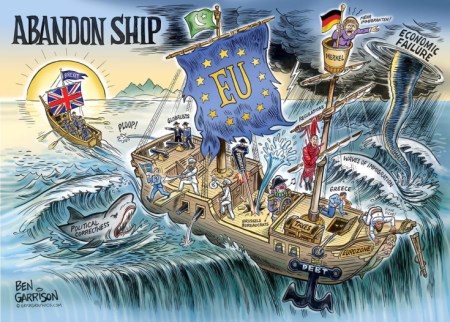
EU over the falls


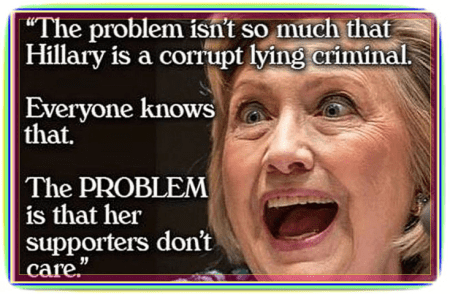
Hillary keeps lying

Public Support for the European Union Plunges

June 9, 2016

Public Support for the European Union Plunges, Gatestone InstituteSoeren Kern, June 9, 2016

♦ Public anger is also being fueled by the growing number of diktats issued by the unelected officials running the Brussels-based European Commission, the powerful administrative arm of the bloc, which has been relentless in its usurpation of sovereignty from the 28 nation states that comprise the European Union.

♦ Although the survey does not explicitly say so, the findings almost certainly reflect growing anger at the anti-democratic nature of the EU and its never-ending power grabs.

♦ On May 31, the EU, in partnership with Facebook, Twitter, YouTube and Microsoft, unveiled a “code of conduct” to combat the spread of “illegal hate speech” online. Critics say the EU’s definition of “hate speech” is so vague that it could include virtually anything deemed politically incorrect by European authorities, including criticism of mass migration, Islam or  even the EU itself.

♦ On April 20, the European Political Strategy Centre, an in-house EU think tank that reports directly to Juncker, proposed that the European Union establish its own central intelligence agency, which would answer only to unelected bureaucrats.

Public opposition to the European Union is growing in all key member states, according to a new survey of voters in ten EU countries.

Public disaffection with the EU is being fueled by the bloc’s mishandling of the refugee and debt crises, according to the survey, which interviewed voters in Britain, France, Germany, Greece, Hungary, Italy, the Netherlands, Poland, Spain and Sweden.

Public anger is also being fueled by the growing number of diktats issued by the unelected officials running the Brussels-based European Commission, the powerful administrative arm of the bloc, which has been relentless in its usurpation of sovereignty from the 28 nation states that comprise the European Union.

The 17-page report, “Euroskepticism Beyond Brexit,” was published by the Pew Research Center on June 7, just two weeks before the June 23 referendum on whether Britain will become the first country to leave the European Union (Brexit blends the words Britain and exit).

The following are excerpts:

  • Much of the disaffection with the EU among Europeans can be attributed to Brussels’ handling of the refugee issue. In every country surveyed, overwhelming majorities disapprove of how Brussels has dealt with the crisis. This includes 94% of Greeks, 88% of Swedes and 77% of Italians. In Hungary and Poland, disapproval of how the refugee crisis has been managed stands at 72% and 71%, respectively. In France, 70% disapprove; in Germany the figure is 67%. The strongest approval of EU management of the refugee crisis is in the Netherlands, but that backing is a tepid 31%.
  • The EU’s handling of economic issues is another huge source of disaffection with Brussels. About nine-in-ten Greeks (92%) disapprove of how the EU has dealt with the ongoing economic crisis. Roughly two-thirds of the Italians (68%), French (66%) and Spanish (65%) similarly disapprove. (France and Spain are the two nations where the favorability of the EU has recently experienced the largest decline.) Majorities in Sweden (59%) and the UK (55%) also disapprove of the EU’s job in dealing with economic challenges. The strongest approval of Brussels’ economic efforts is in Poland and Germany (both 47%).
  • Nearly two-thirds (65%) of Britons say they want the EU to return certain powers to national governments. This Euroskepticism is not limited to Britain. In Greece, 68% of those surveyed want some EU powers devolved to the national government, followed by Sweden (47%); the Netherlands (44%) and Germany (43%).
  • A median of 42% of Europeans across the ten countries surveyed say they want to reclaim some powers from Brussels, while just 19% favor greater centralization (27% prefer the status quo).
  • Conversely, there is little enthusiasm for transferring more power to Brussels. Only 6% of Britons, 8% of Greeks and 13% of Swedes favor more power for the EU. The strongest backing for an ever closer Europe is only 34%, in France. In most countries, a quarter or more of the public prefers to keep the current division of power.
  • Three-quarters of Britons who disapprove of the EU’s handling of economic problems and 71% of those who have an unfavorable view of the bloc’s handling of the refugee crisis believe that Brussels should return powers to national governments.
  • The strongest backers of the EU are the Poles (72%) and the Hungarians (61%). In many other nations, support is tepid. Just 27% of the Greeks, 38% of the French (down from 69% in 2004) and 47% of the Spanish (down from 80% in 2007) have a favorable opinion of the EU. Notably, 44% of the British view the EU favorably, including 53% of the Scottish.
  • EU favorability is down in five of the six nations surveyed in both 2015 and 2016. There has been a double-digit drop in France (down 17 percentage points) and Spain (16 points), and single-digit declines in Germany (8 points), the United Kingdom (7 points) and Italy (6 points).
  • Young people — those ages 18 to 34 — are more favorable toward the European Union than people 50 and older in six of the 10 nations surveyed. The generation gap is most pronounced in France — 25 percentage points — with 56% of young people but only 31% of older people having a positive opinion of the EU. There are similar generation gaps of 19 points in the UK, 16 points in the Netherlands, 14 points in Poland and Germany, and 13 points in Greece. It remains unclear why young Europeans are so favorable to the EU, where youth unemployment is near 50% in some EU countries.
  • There is overwhelming sentiment across Europe that Brexit would be a bad thing for the European Union: 89% in Sweden, 75% in the Netherlands and 74% in Germany say the British leaving would not be good for the EU. France is the only country where more than a quarter (32%) of the public says it would be positive for the EU if the UK departed.

Although the survey does not explicitly say so, the findings almost certainly reflect growing anger at the anti-democratic nature of the EU and its never-ending power grabs.

On May 31, the European Union, in partnership with Facebook, Twitter, YouTube and Microsoft,unveiled a “code of conduct” to combat the spread of “illegal hate speech” online in Europe. Critics say the initiative amounts to an assault on free speech in Europe because the EU’s definition of “hate speech” and “incitement to violence” is so vague that it could include virtually anything deemed politically incorrect by European authorities, including criticism of mass migration, Islam or even the European Union itself.

On May 24, the unelected president of the European Commission, Jean-Claude Juncker, vowed to use sanctions to isolate far-right or populist governments that are swept into office on the wave of popular anger against migration. Under powers granted to the European Commission in 2014, Juncker can trigger a “rule of law alert” for countries that depart from “the common constitutional traditions of all member states.” Rather than accepting the will of the people at the voting booth, Juncker can impose sanctions to address “systemic deficiencies” in EU member states.

On May 4, Juncker warned that EU countries that failed to “show solidarity” by refusing take in migrants would face a fine of €250,000 ($285,000) per migrant.

On April 20, the European Political Strategy Centre, an in-house EU think tank that reports directly to Juncker, proposed that the European Union establish its own central intelligence agency, which would answer only to unelected bureaucrats. According to the plan, the 28 EU member states would have a “legally binding duty to share information.”

The British Minister of State for the Armed Forces, Penny Mordaunt, responded:

“These matters are supposed to be, and must be the competence of member states. Intelligence sharing can only be done on a bilateral basis. This latest EU integration project not only shows how little the EU cares for the sovereignty of nation states, but also how little it understands the business of counter-terrorism.”

On December 15, 2015, the European Commission unveiled plans for a new European Border and Coast Guard force that can intervene anywhere in the EU, even without the host country’s consent.

On March 8, 2015, Juncker said that the EU needed its own military in order to restore the bloc’s standing around the world: “Europe’s image has suffered dramatically and also in terms of foreign policy, we don’t seem to be taken entirely seriously.”

1642Jean-Claude Juncker, the unelected president of the European Commission, recently vowed to use sanctions to isolate far-right or populist governments that are swept into office on the wave of popular anger against migration. In December 2015, the Commission unveiled plans for a new European Border and Coast Guard force that can intervene anywhere in the EU, even without the host country’s consent. (Image source: © European Union 2015 – European Parliament)

In a recent interview with Le Monde, Juncker said that if Britons voted to leave the EU, they would be treated as “deserters”:

“I am sure the deserters will not be welcomed with open arms. If the British should say ‘No’ — which I hope they do not — then life in the EU will not go on as before. The United Kingdom will be regarded as a third country and will have its fur stroked the wrong way (caresser dans le sens du poil). If the British leave Europe, people will have to face the consequences. It is not a threat but our relations will no longer be what they are today.”

In an interview with the Telegraph, Giles Merritt, director of the Friends of Europe think tank in Brussels, summed it up this way:

“The EU policy elites are in panic. If the British vote to leave the shock will be so ghastly that they will finally wake up and realize that they can no longer ignore demands for democratic reform. They may have to dissolve the EU as it is and try to reinvent it, both in order to bring the Brits back and because they fear that the whole political order will be swept away unless they do.”

Brexit is the Only Way to Secure Great Britain

June 4, 2016

Brexit is the Only Way to Secure Great Britain, Breitbart, Christopher Carter, June 4, 2016

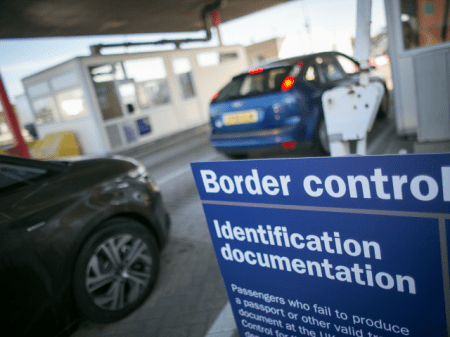
Border control

A few weeks ago David Cameron made contemptible warnings over Brexit and its implications for UK security. He even went so far as to suggest the Islamic State leader Abu Bakr al-Baghdadi “might be happy” if the country votes to Leave the EU.

It is rather telling that since this intervention the PM has chosen to focus on prophesizing economic collapse and hardship rather than discussing this vital issue of Britain’s national security. It is not surprising – considering the recent interventions and revelations concerning how the UK’s membership of the EU impacts on our security.

A report by the EU itself has revealed how there will be a greater risk of terrorist attacks as a result of the Turkey visa-waiver scheme. This has been supported by the ex-head of MI6, Sir Richard Dearlove, who strongly criticised the EU’s attempt to solve the migrant crisis by offering visa-free access to millions of Turks, saying it was “like storing gasoline next to the fire one is trying to extinguish”.

Added to the short-term security threat posed by 77 million Turks having access to all the countries within the EU, there are the long-term political ramifications of the deal, which has the potential to accelerate the resurgence of the far-Right across Europe.

The fact President Erdogan is willing to simply pocket the €3 billion he has demanded the EU send Turkey in aid is hardly going to improve the mood of governments currently forcing through major austerity measures.

He is even threatening to renege on the deal he made over the Greek borders if he doesn’t get his way. His recent warning to the German Parliament not to pass a resolution declaring the mass killings of Armenians in 1915 as genocide are typical of his despotic interventions.

It is clear the EU’s deal with Turkey will have lasting consequences for the whole of the EU, and only by Leaving can we protect the UK.

Of huge concern are the rulings of the European Court of Justice (ECJ), the official court of the EU. Not content with simply supporting the European Commission in its drive to create a federal superstate, its interventions are now putting UK citizens at risk.

Particularly worrying is the recent ruling by the ECJ on freedom of movement. The ECJ is now insisting if a Member State wants to restrict a citizen’s right to ‘free movement’ if they suspect the person has been involved in terrorist activities for example, it must explain exactly why – even though this would endanger national security.

This raises the prospect of British Intelligence officials being forced to hand over highly sensitive documents to people they suspect of terrorism. The UK’s own Court of Appeal has since ruled the rights enshrined in the Charter of Fundamental Rights of the European Union “cannot yield to the demands of national security”.

Yesterday the Justice Secretary, Michael Gove spoke of his frustration at the inability of the UK Government to refuse entry to EU citizens who are suspected of terrorist links. It is clear the European elite are perfectly happy to put the lives of the people of Europe at risk in order to protect the deeply flawed principle of ‘free movement’.

These revelations completely undermine the claims of the Remain campaign that we are safer inside the EU. It is not at all surprising the Prime Minister has now backtracked, choosing to orchestrate a smear campaign against his Leave opponents, rather than addressing the important issue of our national security.

Whilst David Cameron is happy making ludicrous claims about Brexit causing a World War 3, he is clearly uncomfortable addressing the very real threats we will face if we vote to Remain inside the EU.

There is only one way to regain control of our borders and our security and this is to Vote to Leave, to Get Britain Out of the EU.

The Moment of Truth

May 31, 2016

The Moment of Truth, Pat Condell via YouTube, May 31, 2016

(Brexit the Movie is available at Warsclerotic, here. — DM)


The blurb beneath the video states,

Do we want to live in a sovereign democracy or a federal dictatorship?

Please watch ‘Brexit The Movie’ before the referendum, not after. This is the most important political decision we will ever make.
https://www.brexitthemovie.com