Posted tagged ‘BREXIT’

Brexit Disrupts Nonchalant European Union Meddling

July 13, 2016

Brexit Disrupts Nonchalant European Union Meddling, Gatestone InstituteMalcolm Lowe, July 13, 2016

♦ In respect of the Palestinian problem, the European political elites have only the means to destabilize the status quo without installing an alternative. But Israel’s leaders can take heart. Any declarations made at French President François Hollande’s conference will be unenforceable, because the EU on its own lacks the means and because its energies must now focus on stopping its own disintegration.

♦ The underlying reasons for Brexit and for EU disintegration in general have still not been widely understood. Brexit was not merely a vote of no confidence in the EU but also in the UK establishment. Similar gaps between establishment and electorate now exist in several other major European states. In some cases, however, governments are united with their electorates in detesting the EU dictatorship in Brussels.

The June 23 vote by the United Kingdom electorate to leave the European Union should be seen in the context of two other recent European events. Three days earlier, on June 20, the EU’s Foreign Ministers Council decided to solve the Palestinian problem by Christmas with its endorsement of French President François Hollande’s “peace initiative.” Three days after the vote, on June 26, the second election in Spain within a few months failed once again to produce a viable majority for any government. Worse still, the steadily rising popularity of nationalist parties in France, Germany, Austria and the Netherlands suggests that political paralysis in other EU countries is on the way.

In short, the ambitions of the ruling political cliques of Europe to solve the problems of the world are being undermined by their own neglected electorates, which are increasingly furious at the failure of those cliques to solve the problems of Europe itself. Four years ago, we wrote about Europe’s Imminent Revolution. Two years ago, about the attempt and failure of those cliques to turn the EU into a make-believe copy of the United States. Today, that revolution is creeping ahead month by month.

Before threatening Israel’s security and local supremacy, the EU foreign ministers could have recalled the results of their previous nonchalant meddling in the area. We were all rightly horrified by the threat of Muammar Gaddafi to hunt down his enemies “street by street, house by house,” as he began by shooting hundreds in his capital, in February 2011. Hollande’s predecessor, Nicolas Sarkozy, rallied European leaders — first and foremost the UK’s David Cameron — to do something about it. President Obama turned up to give a speech, something that he is good at. More importantly, Obama supplied warplanes from the NATO base in Naples. The idea was to enable victory for the Libyan rebel forces by paralyzing Gaddafi’s own air force and bombing his land forces.

Victory was achieved. But the rebels were united only in their hatred of Gaddafi. So Libya has descended into a chaos that could have been prevented only by a massive long-term presence of European land forces, which Europe — after repeated cuts in army strength — does not have. Now it is the local franchise of the Islamic State, among others, that is hunting down enemies house by house.

Europe was incapable of achieving anything in Libya without the United States, and incapable of replacing a detestable regime with a superior alternative. The lesson could have been learned from Iraq. Here, a massive American military presence accompanied a constitutional revolution and the beginnings of parliamentary rule. But the whole costly achievement collapsed when Obama decided to remove even the residual military presence needed to perpetuate it.

In respect of the Palestinian problem, too, the European political elites have only the means to destabilize the status quo without installing an alternative. But Israel’s leaders can take heart. At Hollande’s conference in December, the UK will be half in and half out, if present at all. Neither Obama nor his by then elected successor will turn up to make a speech. Any declarations made at Hollande’s conference will be unenforceable because the EU on its own lacks the means and because its energies must now focus on stopping its own disintegration.

Of the authors of the Libyan adventure, David Cameron resigned after the vote for Brexit. Obama will shortly leave after what may charitably be called a mixed record in foreign affairs. Sarkozy’s aspiration to be reelected and succeed the unpopular Hollande, whose approval rate is now just 12%, has been challenge by a recent French court decision.

Sarkozy was trying to sue Mediapart, a French investigative agency, for publishing a letter of 2007 from Gaddafi’s intelligence chief about an “agreement in principle to support the campaign for the candidate for the presidential elections, Nicolas Sarkozy, for a sum equivalent to Euro 50 million.” (The maximum individual contribution permitted in French law is 1500 euros.) The judges investigating the corruption case against Sarkozy have ruled that the letter is genuine. The suspicion, then, is that Sarkozy’s campaign to eliminate Gaddafi was at least partly motivated by the need to eliminate the supplier of a bribe.

The underlying reasons for Brexit and for EU disintegration in general have still not been widely understood. Brexit was not merely a vote of no confidence in the EU but also in the UK establishment. Out of 650 members in the House of Commons, only around 150 — nearly all Conservatives — are estimated to have voted for Brexit. Against Brexit was also a clear majority of leading figures in commerce, academia and the churches. Similar gaps between establishment and electorate now exist in several other major European states. In some cases, however, governments are united with their electorates in detesting the EU dictatorship in Brussels.

That glaring discrepancy between the UK establishment and the electorate explains the establishment’s quick acceptance of Brexit, for fear of becoming totally discredited. A contributory reason was the broad consensus on both sides of the debate that the operative style of EU institutions is deeply flawed and often detrimental to UK interests. The concessions obtained by Cameron from the EU before the vote were widely regarded as derisory. Moreover, the President of the European Parliament, Martin Schulz, had loudly proclaimed that he could obtain a vote to cancel those concessions. The real issue, therefore, was whether a Remain vote could help to reform the EU, in cooperation with other member states, or whether the EU was fundamentally unreformable. The UK electorate decided for the latter view and the establishment is committed to implementing it.
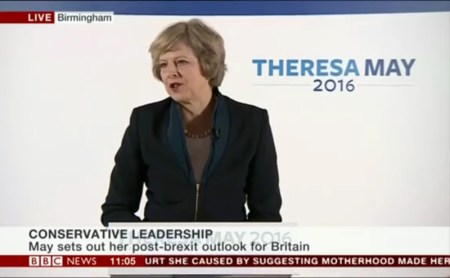
1693The glaring discrepancy between the UK establishment and the electorate explains the establishment’s quick acceptance of Brexit, for fear of becoming totally discredited. Pictured above: Theresa May launches her campaign for leader of the UK Conservative party on July 11, 2016, saying “Brexit means Brexit.”

The two earlier articles mentioned above first spotted the phenomenon of European disintegration and then explained it. Today, the intervening events have made the explanation all the simpler. Basically, the European political elites were correctly convinced, long ago, that considerable European integration was desirable, but their very successes in this area made them grossly overestimate what could and should be done further.

Up to a decade ago, it seemed that a similar pattern was becoming established in one EU country after another: the parliament was dominated by a large center-right party and a large center-left party that alternated in power from one election to another. The parallel to the United States seemed obvious, but the parallel was illusory, as we shall show.

Emboldened, the political parties concerned made the fatal mistake of trying to combine for the purpose of elections to the EU Parliament. Thus emerged a pan-European center-right pseudo-party, the “European People’s Party” (EPP), whose origins go back to a get-together of Christian Democrat parties in 1976. And a pan-European center-left pseudo-party, the “Party of European Socialists” (PES), founded in 1992 as an alliance between old-style Social Democrat parties and the former so-called Eurocommunist parties. The latter first emerged during the decline and discreditation of the Soviet Union in the 1970s and 1980s, then changed their names after its disappearance in December 1991. Thus, the core of Italy’s current Democratic Party derives from the Italian Communist Party (PCI), the major opposition party of post-war Italy.

Curiously but inevitably, the more those parties tried to unite, the more they lost support in their own countries of origin. Thus the Dutch Christian Democrats (CDA) are today a minor party of the right and the Panhellenic Socialist Movement (PASOK) barely crosses the threshold of 5% needed for entry into the Greek Parliament. (Incongruously, the last PASOK Prime Minister of Greece, George Papandreou, continues to be President of the Socialist International.) The reason for this development, however, is not far to seek.

Nationalism, it was forgotten, is an essential component of center-right sentiment. So a center-right party that prefers an international interest at the expense of the national interest of its own country loses credibility among its own core supporters; it becomes vulnerable to the rise of far-right upstart parties. Examples of this process in the EU are now so evident as not to need enumeration.

The attraction of socialism, it was forgotten, is that its core supporters expect increases in government social spending at the expense of financial stability. This becomes more difficult, the more a country is constrained by participation in a shared international framework. It becomes impossible to maintain once a country joins a common currency, since the usual remedy for socialist overspending is devaluation of the national currency. This is why PASOK has been eclipsed in Greece by the far-left SYRIZA, why the Spanish franchise of the PES (the PSOE) has lost severely to the upstart Podemos, and why support for its Dutch franchise (the PvdA) is now down to about the same as for each of two other left-wing parties.

It is also why in Britain, where the electoral system obstructs the rise of new parties, Jeremy Corbyn was voted leader by the Labour Party membership to the horror of the party establishment. Corbyn himself was a pronounced Euroskeptic until recently and only half-heartedly spoke in public for Remain, creating suspicions that he secretly voted for Leave.

A far-right party, like the Freedom Party (OFP) of Austria, has an easy sales pitch. Not so the far-left ones: after they come to power, it quickly and painfully becomes evident that they have no more ability than their derided Social Democrat predecessors to defy the constraints imposed by membership in the Eurozone.

Thus SYRIZA came to power in Greece and won a referendum to end austerity. The result was that all Greeks found that their bank accounts were virtually frozen: they were allowed to withdraw only sixty Euros a day. SYRIZA then split. The larger faction won the resulting general election and accepted the harsh conditions that the referendum had rejected. The paradoxical result in Greece is that the current government is a coalition of an upstart far-left party, SYRIZA, and an upstart nationalist party (the Independent Hellenes) that lies to the right of New Democracy (the Greek franchise of the EPP).

In other EU countries, however, the typical development has been the opposite: the erstwhile competing franchises of the EPP and the PES are in coalition against the motley upstart breakaway parties, since neither of the two gets an absolute majority in parliament any more. That is, their former raison d’être as competing alternatives has been abandoned in the need to survive in power at all. The paralysis in Spain comes from the fact that the two local franchises there are descended from the two sides in the murderous Civil War of 1936-1939. Joint government is still hardly imaginable especially for the losing socialists, who continued to suffer persecution long after the war.

Likewise, in the elections to the EU Parliament in May 2014, the EPP and the PES won only 221 and 191 seats respectively out of 751, each far short of a majority. So they clubbed together to make the top candidate of the EPP, Jean-Claude Juncker, President of the EU Commission and to retain the top candidate of the PES, Martin Schulz, as President of the Parliament. The incredible response of Juncker to Brexit has been to demand even tighter integration: he wants to force into the Eurozone the eight EU member states (other than the UK) that still have independent currencies. He also reiterated his proposal, originally made last March, to unite the armed forces of all states (with the UK gone) into a European army. For this he has the support of Schulz’s home party, the German SPD. That is, they want more and more of what the European electorates want less and less.

Especially in Eastern Europe, there are now also governments that resent the relentless centralizing urges of the EU establishment. In Hungary, for example, the government has rejected the demand of the EU Commission to absorb a quota of the immigrants currently streaming into Europe; it has scheduled a referendum on the matter for October 2. On the same day, Austria will hold a revote for the presidency, which the Freedom Party may narrowly win after narrowly losing the first time around.

These governments are among the new friends of Israel described in a recent Reuters article, titled “Diplomatic ties help Israel defang international criticism.” As it notes:

“Whereas a few years ago Israel mostly had to rely on Germany, Britain and the Czech Republic to defend its interests in the EU, now it can count Italy, Greece, Cyprus, Austria, Hungary and a handful of others among potential allies.”

These allies have no desire to penalize Israel on behalf of increasingly tedious Palestinians. On the contrary:

“Like Turkey, which last week agreed to restore diplomatic ties with Israel after a six-year hiatus, they see a future of expanding business, trade and energy ties.”

By “energy ties” is meant Israel’s recently discovered vast fields of natural gas, the phenomenon that we earlier dubbed “Israel as a Gulf State.” That is: just as governments care little for the human rights record of, say, Qatar in their eagerness to acquire its natural gas, so also the self-righteous moaning of the Palestinian Authority does not deter those governments from going for what Israel has to offer. As the Reuters article quotes a European ambassador: “There’s just no appetite to go toe-to-toe with Israel and deliver a really harsh indictment. No one sees the upside to it.”

Israel’s government is not, of course, gloating over the discontent spreading in the EU. But it surely appreciates some of the side effects.

New PM for Britain by Wednesday

July 11, 2016

David Cameron gives Theresa May full support After becoming clear that Theresa May is the only candidate for the head of the Conservative party, the resigned British prime minister said that he would leave his position on Wednesday and that May receives his full support.

Jul 11, 2016, 8:26PM
Judith Abramson

Source: New PM for Britain by Wednesday | JerusalemOnline

Cameron and May Reuters/Channel 2 News

After Theresa May became the last candidate to become the UK’s prime minister, David Cameron announced today (Monday) that he will hand in his resignation on Wednesday afternoon.

“Theresa May will receive my full support,” said Cameron tonight. He added that he believes May to be just the strong leader the country so needs. According to estimates, Theresa May should move into Downing 10 that very evening and will become the UK’s new prime minister – just two weeks after Brexit.

May strongly objected leaving the EU, but made very clear that she will abide by the voters’ decision: “Brexit means Brexit – as prime minister, I will make sure that we leave the EU or rejoin through the back door.”

Nigel Farage Press Conference: Brexit – Let’s Get Things Started

July 7, 2016
Published on Jul 6, 2016

http://www.ukipmeps.org | http://www.ukip.org/join
• European Parliament, Strasbourg, 06 July 2016


We Saved Our Democracy

July 7, 2016

We Saved Our Democracy, Pat Condell via YouTube, July 7, 2016

(Perhaps American will vote for her own Brexit on November 8th. — DM)

Trump, Brexit, Iceland, Turin, and Rome

June 30, 2016

Trump, Brexit, Iceland, Turin, and Rome, Gingrich Productions, Newt Gingrich, June 29, 2016

There has been a lot of commentary about the British decision to leave the European Union and its implications for Trump and the American presidential race.

Trump was at his golf course in Turnberry, Scotland the day after the vote. He was enthusiastic about Brexit and claimed it was a model for the American choice. He suggested the British hostility to bureaucracy in Brussels paralleled the American hostility to bureaucracy in Washington. He felt the concerns about massive immigration and Syrian refugees were the same in both countries. He drew a direct comparison between the British desire to be independent again and the American desire to put America first in foreign relations. And of course, he did the entire press conference wearing a “Make America Great Again” hat.

Clinton took the opposite approach. Despite the defeat of the British establishment and its “Remain” campaign, she was committed to stability and risk avoidance. She emphasized the dangers of Brexit whereas Trump had emphasized the opportunities.

Yet focusing on Brexit creates much too narrow a basis for understanding the winds of change sweeping through the Western world.

The first harbinger of change this year was May 23, the day of the Austrian presidential elections.

In the first round, the two parties that had dominated Austria for the past half-century came in fourth and fifth. An independent came in third. The two formerly minor parties in the run-off were a hardline conservative anti-immigrant candidate and a green who favored more immigration. The entire national establishment mobilized to block the anti-immigrant candidate. He got 49.65 percent of the vote.

The second big signal of change was the Italian municipal elections. Out of disgust with widespread corruption, an Italian comedian named Beppe Grillo launched the Five Star Movement in 2009. In the 2013 elections, it came in second. This month, the Five Star Movement candidates won the mayor’s offices in both Turin and Rome.

Virginia Raggi, 37, became the first female mayor in Rome’s 2,800-year history. In the midst of a corruption scandal which forced the previous mayor to resign, Raggi got 67 percent of the vote against the Prime Minister’s party. In Turin, the results were similar and the reform movement won in 17 other cities.

Brexit, then, was at least the third big-change election in the West this year. The entire British establishment, the business leadership, President Obama and Hillary Clinton all came out for the Remain side. They lost 52-48 in a stunning upset which the polls did not predict. In England and Wales, the margins were much higher as people voted to make Britain independent again.

Fourth and finally, last Sunday was the little-noticed election of a new president in Iceland. The former president had resigned in a scandal caused by release of the Panama Papers. He had broken no laws but his previously secret investments were very unpopular. The winner of the presidential elections with 39 percent of the vote was Gudni Johannesson, a history teacher. Second, with 28 percent of the vote, was Halla Tomasdottir, a businesswoman. The leading professional politician, a former prime minister, got 13 percent.

These results from four different countries show a consistent momentum toward throwing out established politicians and rejecting the establishment.

There are real warnings here for Clinton and real signs of encouragement for Trump.

Right Angle Special Edition: The Brexit

June 29, 2016

Right Angle Special Edition: The Brexit via YouTube, June 28, 2016

(Bill Whittle tried to turn the conversation to the U.S. 2016 elections, briefly and without much success.)

Brexit: What it Means to Have Our Freedom Back

June 29, 2016

Brexit: What it Means to Have Our Freedom Back, Gatestone Institute via YouTube,June 28, 2016

The Accusations Begin: David Cameron Blames Brexit On Merkel And EU “Immigration Failure”

June 29, 2016

The Accusations Begin: David Cameron Blames Brexit On Merkel And EU “Immigration Failure”

by Tyler Durden

Jun 29, 2016 2:40 AM

Source: The Accusations Begin: David Cameron Blames Brexit On Merkel And EU “Immigration Failure” | Zero Hedge

The Brexit vote is history, and so is David Cameron’s reign as Britain’s prime minister whose gamble to allow an EU referendum backfired spectacularly. And today, in what Bloomberg earlier dubbed his “last summer” Cameron had the unpleasant task of telling his Eurocrat peers during what is hist last Brussels summit why he failed. Only he didn’t and instead, as the FT writes, Cameron flipped the tables and told European leaders he lost the EU referendum because they failed to address public concerns over immigration, as tensions rose ahead of looming Brexit negotiations.

The British prime minister said at his final summit in Brussels on Tuesday that fears of mass immigration were “a driving factor” behind the vote and free movement would have to be addressed in Brexit talks. While he did not call her out by name, Cameron was effectively blaming Angela Merkel, whose overly accepting immigration policy in 2015 unleashed a historic refugee wave which ultimately ended up being the deciding factor behind the referendum outcome.

As the FT writes, Angela Merkel, the German chancellor, and other leaders “blocked British demands before the referendum for an “emergency brake” on migrant numbers and the idea remains anathema to many member states.  Cameron, who announced his ­resignation after last week’s referendum, said that he wanted Britain and the EU to retain “as close an economic relationship as possible”. But, at an emotional dinner, he warned that the UK could not continue to accept large numbers of EU migrants, even if that meant losing access to the single market.”

His remarks underscored the hard task facing both sides in reaching a new accord. Addressing the German Bundestag before the Brussels summit, Ms Merkel warned the UK that there would be no “cherry picking” in its Brexit negotiations. European Commission president Jean-Claude Juncker underscored this when he said that he wants the article 50 “letter to be sent as soon as possible.” Giving the UK instructions on how to proceed, Juncker said during a press conference that “if someone from the Remain camp will become British prime minister, this has to be done in two weeks after his appointment. If the next British PM is coming from the Leave campaign, it should be done the day after his appointment.”

Juncker urged the UK “swiftly” to clarify its position regarding its plans to break from the EU, warning that the bloc could not be “embroiled in lasting uncertainty”. He also hit back at criticism of him in some parts of the British press, claiming he was not a “faceless bureaucrat” and “would like to be respected”.

More importantly, Cameron’s resignation – not literal but figurative – suggests that any hope the Remain camp may have had for a redo of the referendum has been extinguished.

It wasn’t just Cameron: even before the session began there had been signs of renewed hostility towards Downing Street. After a heated debate, which at one point degenerated into catcalls and boos for Nigel Farage, the UK Independence party leader, the European Parliament voted for a resolution calling on Britain to begin divorce proceedings immediately.

Some of Mr Cameron’s fellow EU leaders made similar testy remarks. “Married or divorced, but not something in between,” said Xavier Bettel, the Luxembourg prime minister. “We are not on Facebook, with ‘It’s complicated’ as a status.”

As explained over the weekend, the pace and nature of Britain’s exit from the EU together with the triggering of Article 50, have become the most contentious issues in both London and Brussels since last week’s vote. Most of the leaders of the UK’s Leave campaign, who are likely to form the core of a new British government, have said they want to begin Brexit negotiations before invoking Article 50 of the EU treaties, which would formally trigger two-year exit proceedings.

Merkel made it clear that she and other EU leaders have refused to engage in negotiations until Article 50 is invoked, setting up the first of what could be years of difficulties facing Cameron’s successor. Mark Rutte, the Dutch premier and formerly one of Mr Cameron’s closest allies, argued for Britain to be granted “some space”. But he was unforgiving in his reasons why, saying: “England has collapsed politically, monetarily, constitutionally and economically.” Which, incidentally, is what Brussels calls a victory for Democracy.

Manuel Valls, the French prime minister, said it was not for Britain to dictate the pace of talks. “It’s not up to the British Conservative party to set the agenda,” he told the National Assembly in Paris.

What happens next?

On Wednesday, Mr Cameron will be asked to leave the summit while the remaining 27 members hold informal talks on how to approach Brexit negotiations and how to stop them from stretching out over many years.

Addressing the German Bundestag before the Brussels summit, Ms Merkel warned the UK that there would be no “cherry picking” in its Brexit negotiations, her toughest response yet to the Leave campaign’s hopes of securing access to the EU’s internal market while limiting freedom of movement.


She spelt out that the EU’s internal freedoms were indivisible: if Britain, like Norway, wanted access to the internal market then, like Norway, it would have to accept freedom of movement, she said.

Which goes back to the original point Cameron made, namely that it is Merkel’s stickiness on freedom of movement that led to the victory of the Leave camp.

The winner today, however, was Nigel Farage, who stole the limelight when he was booed after he called on the EU to take a “grown-up and sensible” attitude to negotiations with the UK. He claimed the result would offer a “beacon of hope” to “democrats” across Europe and threatened that  “the UK will not be the last member state to leave the European Union.

As we showed earlier, Farage concluded: “When I came here 17 years ago and said I wanted to lead a campaign to get Britain to leave the European Union, you all laughed at me. Well, I have to say, you’re not laughing now, are you?”


Farage’s moment in the spotlight aside and Cameron’s apparent concession on the possibility of a second referendum, the reality is that while all EU leaders would be delighted to see Britain reverse course and choose to stay, most would be loath to offer any concessions for fear that succumbing to blackmail would encourage others.

Cited by the FT,  a senior adviser to one the eurozone’s most powerful leaders said that “this is a matter of survival for us. We cannot allow these tactics to succeed.

Countries such as France and the Netherlands that were once sympathetic to Britain’s plea for curbs on free movement of workers would now be some of the most opposed to further concessions.

As the FT adds, yielding to British pressure would be a gift to anti-EU politicians that the French and Dutch leaders are trying to defeat in elections early next year. Eastern European leaders, meanwhile, appear as implacably opposed to overturning cherished free movement rights.

Then again, as we reported last night, it is now too late, and most likely by design: sensing the Brexit crisis “opportunity”, Italy is already planning how to bend Eurozone rules against the use of public funds for bank bailouts, and is strategizing how to funnel €40 billion of European cash into its insolvent banking system. Should Europe reject Italy’s overture? Then Italy’s PM Renzi will simply threaten with his own referendum, which considering the recent shocking wins by the Euroskeptic 5 Stars Movement in the Rome and Torino mayoral election, will be all he needs to say to get his way.

Or rather not his way, but the way of the person who is quietly covering up all his tracks: after all why are Italy’s banks insolvent? Well, who was governor of the Bank of Italy from 2005 to 2011 when he blessed all of the hundreds of billions of now non-performing loans? Why former Goldman Sachs employee and current head of the ECB, Mario Draghi of course, who just may end up the biggest winner from the Brexit crisis. Because as everyone knows, one should never leave a crisis go to waste.

From Brexit to Visions of a UN Exit?

June 29, 2016

From Brexit to Visions of a UN Exit? PJ MediaClaudia Rosett, June 28, 2016

(The UN is a disgrace. The best, if not only, reason I have thought of not to leave it is that, as a permanent member of the Security Council, America has a veto over all of its resolutions. Absent that veto, much could be done to harm us and our allies.– DM)

UN building

Britain’s vote last week to leave the European Union — the Brexit — was a vote for freedom, a revolt against an unaccountable bureaucracy in Brussels. Amid the excitement, Fox News briefly reported the story as even bigger than it was, with a TV screen banner proclaiming not that the U.K. was leaving the EU, but “UK VOTES TO LEAVE UN.”

Yes, some things are too good to be true, and this was one.

As parody, it would have been genius. As a piece of news reporting, the Fox mixup of the EU and UN inspired  plenty of derision — a bit of comic relief, gleefully seized upon by the stricken members of a pro-EU global elite and commentariat. They cannot fathom why a majority of British voters would choose to reclaim from the commissars of the EU the full freedom to control Britain’s own borders, bananas and vacuum cleaners. In that context, Fox’s botching of a news banner helps feed the narrative that the Brexit vote was some boorish mistake cooked up by a know-nothing mob.

Except that’s false, in ways far more profound than the mistake in the Fox chyron. For an eloquent defense of Brexit, see Roger Kimball’s “Focused on Disaster Narrative, Media Ignores Obvious Benefits of Brexit.” To this I’d add that even in Fox’s erroneous UN-exit caption there was, along with the comedy, some grist for serious thought.

I’m not defending Fox’s proofreaders. Accuracy matters, even on TV. But it’s not completely daft that a copywriter in a hurry would read “EU” and write “UN.” There are some pernicious similarities between the two. Both belong to the clan of multilateral institutions set up with the mission of promoting peace and prosperity, post-World War II. Both have proved better at promoting themselves and their own backroom deals. They are clubs of governments, breeding big, intrusive and unelected bureaucracies; largely self-serving, unaccountable and in various ways damaging to and divorced from the real interests of the populations they claim to serve. As Ambassador John Bolton writes in a piece on “How America Should Answer the Brexit Vote,” peace in Europe since 1945 is a product not of the EU, but of the U.S.-led military alliance of NATO.

Both the EU and the UN have a distinct tilt toward central planning, with all the warped incentives, waste and disregard for free choice that this entails. In the EU, this takes the form of regulation. At the UN, it is packaged as an endless array of UN-orchestrated development goals, capacity-building programs and bureaucratically-directed spending of other people’s money, much of it funneled through despotic governments whose oppressive misrule is the main reason for the poverty and perils the UN proposes to alleviate.

We’ve all read plenty in recent times about the troubles within the EU. Let’s take a moment to reprise just a few of the problems with the UN. A good place to start would be a June 17th article by a former Swedish diplomat and UN whistleblower, Anders Kompass, who recently resigned from the UN Office of the High Commissioner for Human Rights. In this article, headlined “The ethical failure — Why I resigned from the UN,” Kompass writes:

Cholera in Haiti, corruption in Kosovo, murder in Rwanda, cover-up of war crimes in Darfur: on too many occasions the UN is failing to uphold the principles set out in its Charter, rules and regulations. Sadly, we seem to be witnessing more and more UN staff less concerned with abiding by ethical standards of the international civil service than with doing whatever is most convenient — or least likely to cause problems — for themselves or for member states.

Kompass ran afoul of his UN bosses in 2014, when he reported to French authorities that French UN peacekeepers were sexually abusing children in the Central African Republic. The UN accused Kompass of sharing confidential information, suspended him from his job and asked him to resign. Many months later, he was exonerated, but he writes that the UN has done nothing to address the “systemic issues of internal accountability” raised by his case.

But now, he despairs of the UN generally:

I still believe in the defence of human rights. I still believe that a universal organization is needed to improve the chances of world peace and progress. But I also believe that without great changes aimed at resurrecting ethical behavior within the UN, the organisation will not be able to successfully address the challenges of today and of tomorrow.

It would be nice to think that Kompass’s case is unusual. It is nothing of the kind. He joins a long line of disenchanted and mistreated UN whistleblowers, at UN agencies including — to name just a few — the World Meteorological Organization, the World Intellectual Property Organization and the UN’s flagship agency, the UN Development Program — which was exposed in 2007, in the Cash-for-Kim scandal, funneling cash and dual-use goods to North Korea.

That’s just a small sampling of the staggering roster of UN scandals, abuses, cover-ups and failures. Along with the apparently chronic problem of peacekeeper rape (despite a policy of “zero tolerance”), and a bigoted fixation on condemning first and foremost the democratic state of Israel, the UN has gone from the globally corrupt 1996-2003 Oil-for-Food relief program for Iraq, to massive bribery and kickback scandals in its procurement department, to narcotics in the mailroom, to the current drama surrounding a former head of the UN General Assembly, the late John Ashe. Ashe was facing criminal charges in a million-dollar-plus bribery case, accused by U.S. prosecutors of having turned his UN post into a “platform for profit,” when — having pleaded not guilty — he was found dead just last week in his Dobbs Ferry, N.Y. home. According to the medical examiner, he was killed in an accident in which a barbell fell on his neck.

If all this sounds like the saga of a global mafia that happens to have acquired diplomatic immunity, plus an annual multi-billion-dollar entitlement from U.S. taxpayers, plus a luxurious headquarters complex in midtown Manhattan, plus a neo-colonial globe-girdling empire of offices, programs, staff, “public-private partnerships,” trust funds and influence, you’ve got the idea.

Meantime, the UN in its role as promoter of world peace has done nothing to effectively deter turf grabs by Russia and China; has given its eager approval to President Obama’s rotten Iran nuclear deal; has failed despite umpteen Security Council resolutions, sanctions and statements to stop North Korea’s nuclear missile program — or for that matter, North Korea’s hideous human rights abuses. In the UN General Assembly, the second-largest voting bloc, the 120-member Non-Aligned Movement, has been chaired since 2012 by the world’s leading state sponsor of terrorism, Iran.

The UN, for all its trappings of democratic process, is a collective of 193 member states, of which the majority are not free. Their governments do not actually account to the people they pretend to represent. The UN’s system and priorities are such that there is no place for the government of the genuinely democratic Republic of China on Taiwan, but there is a seat, with accompanying privileges, for the totalitarian Kim dynasty of North Korea.

As a rule, the only member state that every so often tries to reform the UN is its chief sugar-daddy, the U.S., with some help from the British and (during the recent tenure of Prime Minister Stephen Harper) the Canadians. As another rule, the UN — with its immunities, opacity and spigots of money flowing as an entitlement from the world’s developed democracies — is pretty much impervious to reform. It’s been tried, over and over. The chief result is a UN that keeps getting bigger, not better.

What is to be done?

Calling for the U.S. to leave the UN sounds unserious. It would be complicated. A leap into the unknown. Any move by a major power, especially the U.S, to massively defund or even exit the UN — mothership of post-World War II multilateral collectives — would meet huge resistance from the same global elite now professing shock and horror over the Brexit. The standard defense of the UN is that it may be imperfect, but it’s all we’ve got.

The real question is, just how imperfect can we afford to let it get, before we start looking quite seriously for a better way? Or, as British voters apparently asked themselves, what are the opportunity costs of sticking with the devil we know? In politics, as in love, getting out of a bad relationship may not be cheap or easy, but in the long-run it can prove a brilliant move. (I’ve been wondering what immediate effect the July 4, 1776 Declaration of Independence had on markets, as they then were).

As the immediate panic over Brexit subsides, it is time for a serious debate not only about the future of the EU, but the UN, and what might replace these corrosive institutions with arrangements more beneficial to the modern world.

Cartoons of the Day

June 28, 2016

H/t Power Line

Brexit-Cuck-copy


Brexit-Dog-copy


Brexit-Fimger-copy


Brexit-Tea-Party-copy