Posted tagged ‘Austria’

Austrian Freedom Party: Victory in Defeat

May 24, 2016

Austrian Freedom Party: Victory in Defeat, Gatestone InstituteSoeren Kern, May 24, 2016

♦ European political and media elites have been quick to hail the election of Van der Bellen, who campaigned on a pro-immigration, pro-EU platform. They seem to believe his razor-thin win validates their uninterrupted pursuit of European multiculturalism.

♦ Meanwhile, European elites have expressed relief at Norbert Hofer’s defeat. Their reactions would indicate that they unaware that they are largely responsible for the rise of anti-establishment parties in Austria and other parts of Europe.

♦ “Europe has been polarized for years by misguided policies pursued by the old major parties, not only in Germany but in many European countries. The fact is that it must be our task to preserve freedom, democracy and the rule of law across the continent. And the policy of open borders does exactly the opposite.” — Frauke Petry, Alternative for Germany party.

Norbert Hofer of the anti-immigration Austrian Freedom Party (FPÖ) has been narrowly defeated in his bid to become Austria’s next president.

Alexander Van der Bellen, former leader of Austrian Greens party, won 50.3% of the vote, compared to 49.7% for Hofer. The margin of victory was 31,026 out of nearly 4.5 million votes cast.

European political and media elites have been quick to hail the election of Van der Bellen, who campaigned on a pro-immigration, pro-EU platform. They seem to believe his razor-thin win validates their uninterrupted pursuit of European multiculturalism.

But Hofer can claim victory even in defeat. By winning half the ballots cast, Hofer has exposed Austria’s gaping political divide on immigration and relations with the European Union. Hofer’s rise, which has effectively upended Austria’s political system, has also inspired anti-establishment parties in other parts of Europe.

Hofer had been in the lead after polls closed on May 22, with 51.9% of the vote to Van der Bellen’s 48.1%. In the end, however, the race was decided by 700,000 mail-in votes, accounting for 14% of eligible voters. Van der Bellen won 2,254,484 votes to Hofer’s 2,223,458, according to the Interior Ministry.

1620In this month’s Austrian presidential election, Alexander Van der Bellen (left), who campaigned on a pro-immigration, pro-EU platform, defeated Norbert Hofer (right) of the anti-immigration Austrian Freedom Party. (Image source: ORF TV video screenshot)

In what amounted to a political earthquake, Hofer won 36% of the vote in the first round of voting on April 24. Hofer — who campaigned on a platform calling for strict limits on immigration and tough rules for asylum seekers — defeated all of the other candidates, including those from the two governing parties, the Social Democrats and the Austrian People’s Party, which have dominated Austrian politics since the end of World War II.

Although the role of president in Austria has traditionally been largely ceremonial, Hofer had suggested that he would try to remove the current government led by newly appointed Chancellor Christian Kern and force new parliamentary elections. Opinion polls suggest that if parliamentary elections were held today, the Freedom Party would win. The next polls are scheduled for some time in 2018.

Van der Bellen, a 72-year-old economist, was gracious in victory, pledging to be “non-partisan president for all of those living in Austria.” He added: “All Austrians are equal. Austria consists of two halves. The one half is just as important as the other half.”

An analysis in the German newspaper Die Welt warned that Van der Bellen will not have it easy:

“It will be up to Van der Bellen to find the right tone and to show that he not only embodies the Austria of the city dwellers, but the whole country. He will have to bear in mind that according to the polls, 40% of those who voted for him did so only because they wanted to prevent a president from the Freedom Party.”

Conceding the election, Hofer wrote on Facebook: “Of course, it is a sad day. But please do not be discouraged. The effort in this election campaign is not wasted. It is an investment for the future.”

Hofer’s meteoric rise has focused the minds of the establishment parties. On April 27, just three days after Hofer’s initial electoral victory, the Austrian Parliament adopted what may be one of the toughest asylum laws in Europe.

Under the new law, Austria will declare a “state of emergency” on the migration crisis. This will allow Austrian authorities to assess asylum claims directly at the border. Only asylum seekers with immediate family members already in Austria, or those who can prove they are in danger in neighboring transit countries, will be allowed to enter the country. Other migrants will be turned away. The new law also limits any successful asylum claim to three years.

Austria received 90,000 asylum requests in 2015, the second-highest number in the European Union on a per capita basis, but this pales in comparison to what may lie ahead. In a radio interview on April 28, Interior Minister Wolfgang Sobotka warned that up to one million migrants are poised to cross the Mediterranean Sea from Libya to Europe.

Mass migration to Austria has been accompanied by a spike in migrant-related rapes, sexual assaults and other crimes across the country, and has contributed to the rise of the Freedom Party.

Reflecting on the outcome of the presidential election, Hofer’s campaign manager, Herbert Kickl, said: “This is a huge achievement. Hofer managed to convince half of the population in defiance of the system.”

In France, where polls show that the leader of the National Front, Marine Le Pen, is leading polls for presidential elections in 2017, party secretary general Nicolas Bay wrote on Twitter: “Despite the disappointment, a historic score for our ally from the Freedom Party. The future belongs to patriots!”

Meanwhile, European elites have expressed relief at Hofer’s defeat. Their reactions would indicate that they unaware that they are largely responsible for the rise of anti-establishment parties in Austria and other parts of Europe.

The president of the European Commission, Jean-Claude Juncker, said anti-EU parties should be completely shunned: “Neither a debate nor a dialogue is possible with right-wing populists.”

German Foreign Minister Frank-Walter Steinmeier said: “The election result removes a heavy burden for all of Europe.” Ralf Stegner, the deputy director of Germany’s Social Democrats (SPD)commented on Twitter: “This must serve as a warning that we can never again allow it [the rise of anti-establishment parties] go this far and that we have to combat this threat to our democracy with full force!”

But the leader of the Alternative for Germany party, Frauke Petry, said the vote was “an important day, not only for Austria, but for all of Europe.” She added:

“Europe has been polarized for years by misguided policies pursued by the old major parties, not only in Germany but in many European countries. The fact is that it must be our task to preserve freedom, democracy and the rule of law across the continent. And the policy of open borders does exactly the opposite.”

The outcome of the Austrian presidential election will not be official until June 1, the deadline for legal challenges to the vote count. Some Freedom Party members have expressed anger at the opaque manner in which mail-in ballots are counted.

Migrant Rape Epidemic Reaches Austria

May 5, 2016

Migrant Rape Epidemic Reaches Austria, Gatestone InstituteSoeren Kern, May 5, 2016

♦ A 20-year-old asylum seeker from Iraq confessed to raping a 10-year-old boy at a public swimming pool in Vienna. The Iraqi said the rape was a “sexual emergency” resulting from “excess sexual energy.”

♦ Those who dare to link spiraling crime to Muslim mass migration are being silenced by the guardians of Austrian multiculturalism.

♦ According to data compiled by the Austrian Interior Ministry, nearly one out of three asylum seekers in Vienna was accused of committing crimes in 2015. North African gangs fighting for control over drug trafficking were responsible for roughly half of the 15,828 violent crimes — rapes, robberies, stabbings and assaults — reported in the city during 2015.

♦Austria received 90,000 asylum requests in 2015, the second-highest number in the EU on a per capita basis, but this pales in comparison to what may lie ahead. Interior Minister Wolfgang Sobotka warned last month that up to one million migrants are poised to cross the Mediterranean from Libya to Europe.

The brutal gang rape of a woman by three Afghan asylum seekers in central Vienna on April 22 has shocked the Austrian public and drawn attention to a spike in migrant-related rapes, sexual assaults and other crimes across the country.

The migrant crime wave comes as the anti-immigrant Freedom Party of Austria (FPÖ) has surged in opinion polls. The party’s candidate, Norbert Hofer, won the first round of Austria’s presidential elections on April 24, and is on track to win the presidency in the second round, run-off election scheduled for May 22.

The three Afghans — two 16-year-olds and one 17-year-old — followed the woman, a 21-year-old exchange student, into a public restroom at the Praterstern train station, one of the main transportation hubs in Vienna. One of the migrants held the woman down while the other two took turns raping her.

A passerby called the police after she heard the woman screaming. By the time police arrived, the men had gone. The suspects, who were arrested as they were attempting to flee the station, do not speak German. Through an interpreter, the migrants told police they were drunk and do not remember carrying out the crime.

If convicted, they face a maximum sentence of seven-and-a-half years in prison. Due to the lenient nature of the Austrian judicial system, however, they may end up spending only two years behind bars, according to local observers.

It is also unlikely that the migrants will be deported: according to European law, sending them back to Afghanistan would be a violation of their human rights. Instead, observers say, the Afghans will qualify for Austrian social welfare benefits — €830 ($950) per month plus free healthcare — and probably for the rest of their lives become wards of Austrian state.

The assault in Praterstern is one of a growing number of migrant sex crimes in Austria (other migrant rapes and sexual assaults are included in the appendix below):

  • A 20-year-old asylum seeker from Iraq confessed to raping a 10-year-old boy at a public swimming pool in Vienna. The Iraqi said the rape was a “sexual emergency” resulting from “excess sexual energy.” The man, who left his wife and child behind in Iraq, said he had been unable to control his libido because he had not had sexual relations since arriving in Austria in September.
  • An 18-year-old asylum seeker from Afghanistan was sentenced to 20 months in prison for raping a 72-year-old woman in Traiskirchen. “First he beat the woman black and blue, then he raped her, and then he took her underwear as a trophy,” local police said. In addition to a lenient sentence, the man will be allowed to remain in Austria and, after he leaves prison, collect social welfare benefits.
  • A 20-year-old asylum seeker from Afghanistan was arrested after he coerced 13-year-old girl from the town of Korneuburg repeatedly to have sex with him. The man, who was living in an asylum shelter in Hollabrunn, first established contact with the girl over the Internet. Each time they met in person, he verbally threatened her until she agreed to have sex. The man was arrested after the girl told her parents about the relationship, which had been going on for more than three months.
  • Mobs of Arab migrants sexually assaulted dozens of women in Vienna, Salzburg andInnsbruck on New Year’s Eve. The sex attacks, known in Arabic as taharrush (“harassment”), were similar to those carried out that day by North African migrants in Cologne, Germany and other cities. Police initially denied that the attacks had taken place, but later admitted to lying, purportedly to protect the privacy of the victims.

Those who dare to link spiraling crime to Muslim mass migration are being silenced by the guardians of Austrian multiculturalism.

In April, for example, the Austrian Press Council (Presserat) — a group that enforces a politically correct “code of ethics” to ensure that Austrian media outlets toe the line of state-sanctioned multiculturalism — censured the left-leaning magazine, Falter, for “blanket discrimination” against Muslims.

The magazine’s editors — otherwise faithful proponents of European multiculturalism — appear to have had enough of migrants raping their way through Europe with virtual impunity. For the January-February 2016 edition, Falter’s cover featured a black and white drawing of five “light skinned” European women surrounded by large numbers of “dark skinned” Arab males. The image evoked images of the taharrush assaults in Cologne.

In a three-page “decision,” the Presserat ruled that the image violates the “code of ethics” because it amounts to “blanket slander and discrimination” against Arab men:

“The men are all portrayed with the same fierce-looking facial expression, dark hair and noticeably dark eyebrows. In this way — in the context of the attacks in Cologne — the artist is constructing a prototype of men from North Africa, i.e., the Arab world. The uniformity of the image suggests that, rather than portraying individuals, it depicts a homogenous group whose members all behave in the same way.

“Therefore, readers could be left with the impression that the sexual assaults in Cologne were not the acts of individual persons or person groups, but that such conduct is typical for men from North Africa, i.e., the Arab world. The image could leave the impression that all North Africa men who are here in Europe fail to conduct themselves correctly vis-à-vis women.”

The editors of Falter defended themselves against accusations of racism:

“The fact is that North Africans were overwhelmingly responsible for the assaults in Cologne. This is what took place and we should be allowed to represent it as such.”

Vienna is the epicenter of migrant crime in Austria. According to data compiled by the Austrian Interior Ministry, nearly one out of three asylum seekers in Vienna was accused of crimes in 2015. Of the nearly 21,000 officially approved asylum seekers in the capital, 6,503 were known to have committed crimes in 2015, a jump of nearly 50% over 2014. The data shows that 2,270 of the criminals were under the age of 20, a 72% jump over 2014. Seven were under age nine, while 31 were under age 13.

According to Vienna Police Chief Gerhard Pürstl, North African gangs fighting for control over drug trafficking were responsible for roughly half of the 15,828 violent crimes — rapes, robberies, stabbings and assaults — reported in the city during 2015.

The area around the Praterstern station, where the exchange student was raped, has become overrun by shiftless migrants from Afghanistan and North Africa who are selling drugs, fighting turf battles and assaulting female passersby. Police were dispatched to the area a total of 6,265 times in 2015, or an average of 17 times a day, according to local media. But local authorities appear unable or unwilling to restore order to the area.

1585 (1)The area around Praterstern train station in Vienna is overrun by shiftless migrants from Afghanistan and North Africa who are selling drugs, fighting turf battles and assaulting female passersby. Police were dispatched to the area 6,265 times in 2015, or an average of 17 times a day.

The head of the Austrian Police Union, Hermann Greylinger, estimates that Vienna needs around 1,200 more police officers in order to establish order in the capital:

“If we are allowing in our country 111,000 migrants, few of whom have had background checks, then clearly the police must be massively increased. Almost all asylum claimants are moving to Vienna. We now have more migrants than the population of the city of Salzburg, the fourth-largest city in Austria.”

Austria’s migrant crime problem is being exacerbated by an extremely lenient criminal justice system. On May 4, for example, a 21-year-old migrant from Kenya randomly killed a 54-year-old woman on a busy street in Vienna by hitting her over the head with an iron bar. It soon emerged that the Kenyan was well known to city police: since arriving in Austria in 2008, he had committed at least 18 previous crimes — including dealing drugs, attacking police officers and hitting someone over the head with an iron bar — but he has repeatedly been set free.

Given the growing insecurity, it comes as no surprise that Austrian voters are looking for a change in political direction.

In what amounts to a political earthquake, Freedom Party (FPÖ) candidate Norbert Hofer won 36% of the vote in the first round of Austria’s presidential election on April 24. Hofer — who has campaigned on a platform calling for strict limits on immigration and tough rules for asylum seekers — defeated all of the other candidates, including those from the two governing parties, the Social Democrats and the Austrian People’s Party, which have dominated Austrian politics since the end of World War II.

Hofer, who says that as president he will be the “protector of Austria,” is now on track to defeat the Green Party’s Alexander Van der Bellen, a 72-year-old economist who is opposed to limits on immigration, in a run-off ballot to be held on May 22.

Hofer’s meteoric rise is focusing the minds of the establishment parties. On April 27, just three days after Hofer’s electoral victory, the Austrian Parliament adopted what may be one of the toughest asylum laws in Europe.

Under the new law, Austria will declare a “state of emergency” on the migration crisis. This will allow Austrian authorities to assess asylum claims directly at the border. Only asylum seekers with immediate family members already in Austria, or those who can prove they are in danger in neighboring transit countries, will be allowed to enter the country. Other migrants will be turned away. The new law also limits any successful asylum claim to three years.

Interior Minister Wolfgang Sobotka said the new law is needed to stem the flow of migrants and refugees: “We cannot shoulder the whole world’s burden.”

Austria received 90,000 asylum requests in 2015, the second-highest number in the European Union on a per capita basis, but this pales in comparison to what may lie ahead. In a radio interview on April 28, Sobotka warned that up to one million migrants are poised to cross the Mediterranean Sea from Libya to Europe.

Appendix

Sexual Assaults and Rapes by Migrants in Austria, January-April 2016.

Gatestone Institute has reported about the migrant rape epidemic in Germany and Sweden. The problem has now spread to Austria. Following are a few cases from the first four months of 2016:

April 29. A 35-year-old migrant from Algeria attempted to rape a woman at a bus stop in Linz. The man beat the woman unconscious, but not before she broke his nose. He was arrested after he went to a local hospital seeking medical attention. It later emerged that the Algerian has a long criminal record, including other attempted rapes, but cannot be deported because Algeria will not take him back.

On April 25, Kronen Zeitung, the largest newspaper in Austria, reported that an “Arabic-looking man” attempted to rape a 27-year-old woman at a bus stop in Vienna. “All he could say was sex, sex, sex,” the woman said. The man pulled a condom out of his pants pocket and then dropped his trousers. “I screamed as loud as I could,” the woman said, “until the man ran away.” She said that city police have been wholly uninterested in her case: “They have not even asked me for my name.” After local media reported on her case, police issued an apology and blamed their failure to take her seriously on a “regrettable misunderstanding.”

April 24. An unidentified migrant raped a 19-year-old woman in Eisenstadt.

April 22. Three asylum seekers from Afghanistan gang-raped a 21-year-old woman at a train station in Vienna.

April 22. A 17-year-old asylum seeker from Afghanistan attempted to rape a 20-year-old woman in Graz.

April 21. A 17-year-old asylum seeker from Afghanistan sexually assaulted a 19-year-old woman on a train in Grieskirchen. The train’s conductor intervened after he heard the woman scream. The Afghan told police that the woman was lying and demanded an apology.

April 20. Two North African migrants sexually assaulted a woman in front of the main train station in Salzburg. When a 26-year-old passerby attempted to intervene, the migrants punched and kicked him so hard that he was rushed to a nearby hospital. One of the attackers is a 31-year-old asylum seeker from Morocco. The other suspect remains at large.

April 15. A 42-year-old migrant from Slovenia was arrested for attempting to sexually assault two 18-year-old women in Leibnitz.

April 13. An “Arab looking” man sexually assaulted three women at a bus stop in Vienna.

March 24. Two Afghan migrants were arrested for raping a 20-year-old woman in Wels.

March 21. A migrant from North Africa assaulted a 27-year-old woman on a packed subway train in Vienna. The man began touching the woman on her hands. When she got up to find another seat, the man grabbed her and began kissing her on the mouth. Police told the woman there was nothing they could do because kissing does not qualify as sexual assault.

March 12. A 16-year-old asylum seeker from Libya attempted to kidnap and rape two women inVienna. After the three met on a subway train, the Libyan promised to take the women to a nightclub. He took them instead to an apartment where he attempted to lock the women in the basement and rape them. One of the women escaped and called the police.

March 8. A 20-year-old asylum seeker from Afghanistan was observed pointing to his genitals in front of a seven-year-old girl at a public swimming pool in Vienna. The pool director and a swimming instructor held the man until police arrived. The police let him go.

March 6. A “foreign looking” man sexually assaulted a 37-year-old woman at a public swimming pool in Klagenfurt after she intervened to prevent him from molesting her four-year-old boy.

February 25. A “southerner” sexually assaulted two teenage girls at a shopping mall inInnsbruck.

February 22. An 18-year-old migrant from Afghanistan was arrested for raping a 52-year-old woman in Innsbruck.

February 14. Six migrants sexually assaulted a 49-year-old woman on a subway in Vienna. Two of the men, an 18-year-old asylum seeker from Afghanistan and a 23-year-old asylum seeker from Iraq, were arrested as they tried to exit the station. The other four remain at large.

February 11. A 33-year-old migrant from Iran masturbated in front of female patrons at a public swimming pool in Linz.

February 8. A 22-year-old migrant from Macedonia identified only as Ibrahim J. was arrested inVienna for sexually assaulting more than 20 women in Vienna and other parts of Austria. Among other crimes, the man is accused of raping a 15-year-old girl.

February 6. A group of 28 male asylum seekers sexually harassed female patrons at an outdoor ice skating rink in Stockerau. The migrants then attacked security guards who tried to intervene. Police were needed to restore order.

February 4. Six “southerners” assaulted a 53-year-old woman in front of a grocery store in Spittalafter she refused to give them money.

February 3. Three migrants sexually assaulted a 16-year-old girl at a streetcar stop in Leonding. One of the men held the girl down while the other two took turns assaulting her.

January 26. A 24-year-old asylum seeker from Gambia raped and murdered a 25-year-old American woman in Vienna. The woman from Colorado, who was working as an au pair (nanny), had given the man, Abdou I., shelter in her apartment. He had fled his asylum shelter because his asylum request was denied and he feared being deported. After the murder, the man fled to Switzerland, where he was arrested after police traced his cellphone. It later emerged that he was wanted in Germany for sexually assaulting an underage girl.

January 23. A migrant from Macedonia attempted to rape a 21-year-old woman in Vienna. The man made eye contact with the woman on a subway and followed her after she got off the train.

January 16. A 21-year-old asylum seeker from Afghanistan raped an 18-year-old woman at the Prater, a large public park in Vienna.

January 10. A 29-year-old asylum seeker from Afghanistan tried to molest a six-year-old boy at a public swimming pool in Linz. The mother of the child said: “I noticed six migrants enter the building. Two of them sat down at the edge of the pool for children. One of them began stimulating his genitals while flirting with my youngest child.”

January 1. Mobs of Arab men sexually assaulted at least 24 women in Vienna, Salzburg and Innsbruck.


Europe’s Migration Crisis: No End in Sight

May 2, 2016

Europe’s Migration Crisis: No End in Sight, Gatestone Institute, Judith Bergman, May 2, 2016

♦ According to France’s Defense Minister, Jean-Yves Le Drian, 800,000 migrants are currently in Libyan territory waiting to cross the Mediterranean.

♦ The multitude of very costly social problems that Muslim migration into Europe has caused thus far, do not exist in this whitewashed European Union report, where the “research” indicates that migrants are always a boon. Similarly, any mention of the very real security costs necessitated by the Islamization occurring in Europe, and the need for monitoring of potential jihadists, simply goes unmentioned.

♦ Several European states have a less optimistic picture of the prospect of another three million migrants arriving on Europe’s borders than either the Pope or the European Commission do.

Pope Francis, on his recent visit to the Greek island of Lesbos, said that Europe must respond to the migrant crisis with solutions that are “worthy of humanity.” He also decried “that dense pall of indifference that clouds hearts and minds.” The Pope then proceeded to demonstrate what he believes is a response “worthy of humanity” by bringing 12 Syrian Muslims with him on his plane to Italy. “It’s a drop of water in the sea. But after this drop, the sea will never be the same,” the Pope mused.

The Pope’s speech did not contain a single reference to the harsh consequences of Muslim migration into the European continent for Europeans. Instead, the speech was laced with reflections such as “…barriers create divisions instead of promoting the true progress of peoples, and divisions sooner or later lead to confrontations” and “…our willingness to continue to cooperate so that the challenges we face today will not lead to conflict, but rather to the growth of the civilization of love.”

The Pope went back to his practically migrant-free Vatican City — those 12 Syrian Muslims will be hosted by Italy, not the Vatican, although the Holy See will be supporting them — leaving it to ordinary Europeans to cope with the consequences of “the growth of the civilization of love.”

There is nothing quite as free in this world as not practicing what you preach, and what the Pope is preaching is the acceptance of more migration into Europe, and more migration — much more — is indeed what is in the cards for Europe.

At the UN’s Geneva conference on Syrian refugees on March 30, Italy’s Minister of Foreign Affairs, Paolo Gentiloni, put the total number of asylum seekers into Italy in the first three months of 2016 at 18,234. This is already 80% higher than in the same period in 2015.

According to Paolo Serra, military adviser to Martin Kobler, the UN’s Libya envoy, migrants currently in Libya will head for Italy in large numbers if the country is not stabilized. “If we do not intervene, there could be 250,000 arrivals [in Italy] by the end of 2016,” he said. According to France’s Defense Minister, Jean-Yves Le Drian, the number is much higher: 800,000 migrants are currently in Libyan territory waiting to cross the Mediterranean.

Already in November 2015, the European Union estimated — in its Autumn 2015 European Economic Forecast, authored by the European Commission — that by the end of 2016, another three million migrants will have made it into the European Union.

Nevertheless, the European Commission optimistically noted that, “while unevenly distributed among countries, the estimated additional public expenditure related to the arrival of asylum seekers is limited for most EU member states.” It even concluded that the migrant crisis could have a small, positive impact on European economies within a few years citing that “Research indicates that non-EU migrants typically receive less in individual benefits than they contribute in taxes and social contribution.”

This is the classic, politically correct denial of facts on the ground. The multitude of very costly social problems that Muslim migration into Europe has caused thus far do not exist in this whitewashed report, where the “research” indicates that migrants are always a boon. Similarly, any mention of the very real security costs necessitated by the Islamization that is occurring in Europe and the consequent need for monitoring of potential jihadists, simply goes unmentioned. One wonders whether the EU bureaucrats, who authored this report, ever descend from their ivory towers and move about in the real Europe.

Several European states have a less optimistic picture of the prospect of another three million migrants arriving on Europe’s borders than either the Pope or the European Commission do. In February, Austria announced that it would introduce border controls at border crossings along frontiers with Italy, Slovenia and Hungary. On April 12, Austria began preparations for introducing border controls on its side of the Brenner Pass, the main Alpine crossing into Italy, by starting work on a wall between the two countries.

The Austrian decision to close the Brenner pass has received harsh criticism from the EU. European Commission spokeswoman Natasha Bertaud criticized the measure as unwarranted, claiming that “there is indeed no evidence that flows of irregular migrants are shifting from Greece to Italy”. Is Bertaud deliberately misrepresenting the issue? The issue is not whether the migrants are shifting from Greece to Italy after the EU’s unsavory deal with Turkey (they probably will) but the up to 800,000 migrants are already waiting to cross into Italy from Libya.

EU Migration Commissioner Dimitris Avramopoulos joined in the criticism of Austria, saying, “What is happening at the border between Italy and Austria is not the right solution.” He had criticized Austria already in February, when Vienna announced that it would cap asylum claims at 80 per day. At the time, Avramopoulos said,

“It is true that Austria is under huge pressure… It is true they are overwhelmed. But, on the other hand, there are some principles and laws that all countries must respect and apply… The Austrians are obliged to accept asylum applications without putting a cap.”

In response, Austria’s Chancellor Werner Faymann told the EU that Austria could not just let the influx of migrants continue unchecked — nearly 100,000 have applied for asylum in Austria — and he called for the EU to act. The EU has not yet acted.

The EU should hardly be surprised that a sovereign state decides to take matters into its own hands in the face of the EU’s failure to heed that call, and as it anticipates a repeat of last year’s migration chaos — which, given the predicted estimates, is bound to occur this year with even greater force.

Predictably, Italy has also criticized the decision, with Italian Interior Minister Angelino Alfano saying that Austria’s decision to erect the barrier is “unexplainable and unjustifiable.” Italy, however, only has itself to blame for Austria’s restrictions at the Brenner Pass. In 2014 and the first half of 2015, around 300,000 migrants arrived in Italy, mainly from Libya. Despite EU rules that require Italy to register those migrants, Italy simply let most of them pass through the country and continue into Austria. From there, most went further into Germany and Northern Europe. Clearly, Austria does not expect the Italians to change their practices.

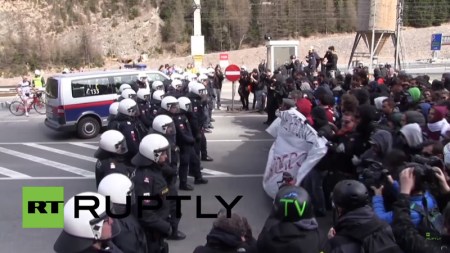
1573Austrian police prepare to hold the line at the Brenner Pass border crossing with Italy, as a crowd tries to break through during a violent protest on April 3, 2016, against Austria’s introduction of border controls to stem the flow of migrants. (Image source: RT video screenshot)

While the bureaucrats of the EU bicker with their member states over those states’ unwillingness to follow EU regulations — evidently not made to cope with a migration crisis of these huge proportions — Turkey’s President, Recep Tayyip Erdogan is threatening to drop his obligations under a recent EU-Turkey migration deal. Those obligations include taking back all new “irregular migrants” crossing from Turkey into Greek islands, as well as taking any necessary measures to prevent the opening of new sea or land routes for migration from Turkey to the EU. “There are precise conditions. If the European Union does not take the necessary steps, then Turkey will not implement the agreement,” Erdogan warned recently in a speech in Ankara.

Erdogan knows that in the current European reality, his words have the effect he intends: When he threatens to flood Europe with migrants unless it does what he wants — in other words, blackmail — EU leaders will do what he says. German Chancellor Angela Merkel, one of the driving forces behind the EU-Turkey deal, also recently bowed to Erdogan’s demands that Germany prosecute the satirist Jan Böhmermann, after he mocked and insulted the Turkish president in a poem. The German criminal code prohibits insults against foreign leaders, but leaves it to the government to decide whether to authorize prosecutors to pursue such cases. Angela Merkel gave her authorization, a decision widely criticized. Her own ministers — Foreign Minister Frank-Walter Steinmeier, and Justice Minister Heiko Maas — said they did not believe that the authorization should have been granted.

Another indication that Erdogan has no reason to fear any misbehavior on the part of the European Union regarding the EU-Turkey deal is that the European Parliament just voted in favor of making Turkish an official European Union language. Ostensibly, the vote came about in order to back an initiative by the president of Cyprus, Nicos Anastasiades, who asked the Dutch EU Presidency to add Turkish to the bloc’s 24 official languages in order to boost attempts to reach a reunification agreement for Cyprus.

In his letter to the EU presidency, Anastasiades noted that Cyprus had already filed a similar request during its EU entry talks in 2002, but, at that time, it “was advised by the [EU] institutions not to insist, taking into account the limited practical purpose of such a development … as well as the considerable cost”. Turkey’s occupation of northern Cyprus, which Turkey invaded in 1974, is one of the issues blocking Turkey’s accession negotiations with the EU.

Making Turkish an official language is seen by Turkey, according to a senior Turkish official, as “a very important, very positive gesture” for the Cyprus peace talks and for EU-Turkish ties more broadly. “If the blockage is lifted because of Cyprus being solved, then we can proceed very quickly,” the Turkish official said.

All of the other official and working languages of the European Union are tied to states which are full members of the EU. Although the vote has to be approved by the European Commission before the decision can come into effect, it speaks volumes about the EU’s deference to Erdogan.

In light of these developments, the granting of visa-free travel to European Union states for 80 million Turks looks as if it is a done deal, despite the 72 conditions, which Turkey, at least on paper, is expected to live up to. These include increasing the use of biometric passports and other technical requirements. So far, Turkey has only met half of these conditions. Perhaps that is why European Commission President Jean-Claude Juncker recently felt the need to mention that, “Turkey must fulfill all remaining conditions so that the Commission can adopt its proposal in the coming months. The criteria will not be watered down.” The question is whether Juncker himself even believes his own words.

With the provisions on visa-free travel for 80 million Turks, the EU may just have gone from the frying pan into the fire. The visa-free admission of Turks into Europe would give Erdogan completely free rein to control the influx of migrants into Europe. Moreover, anyone believing that Erdogan would not take great advantage of this opportunity would have to be dangerously naïve. The European Union may yet conclude that the migrant crisis, in all its enormity, is the far lesser evil.

Migrant Violence Breaks Out at Austria-Italy Border

April 4, 2016

WATCH: Violence Breaks Out at Austria-Italy Border Over New Immigration Controls

by Thomas D. Williams, Ph.D

.4 Apr 2016

Source: Migrant Violence Breaks Out at Austria-Italy Border

Demonstrations by pro-migrant social centers at the Austrian Brenner border with Italy tuned violent Sunday, with protesters hurling stones and flares at the Austrian police, injuring five officers, according to reports.

Some 700 protesters from Italy, Austria and Germany spent the day on Sunday at the Brenner Pass, publicly criticizing Austria’s plans to deploy soldiers at the Brenner border to deal with rising numbers of migrants trying to get to northern Europe.

The demonstrators gathered in front of the Italian train station near the crossing and from there marched across the border into Austria. A number of the protesters wore life jackets to call to mind the migrants who have drowned trying to cross the sea into Europe.

Austrian riot police numbered approximately 100 officers, aided by a helicopter, and the Red Cross was present with seven ambulances as well.

brenner pass

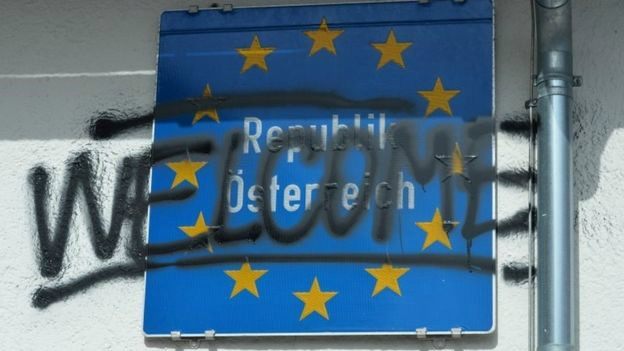
Pro-migrant advocates sprayed graffiti over EU signs at the border post (via AP)

Austrian Defense Minister Hans Peter Doskozil announced Saturday that not only would Vienna tighten border controls, but that it would also enforce them with a military presence.

“As the EU’s external borders are not yet effectively protected, Austria will soon ramp up strict border controls. That means massive border controls at the Brenner (Pass), and with soldiers,” Doskozil said.

The number of migrants entering Germany from Austria fell sharply in March to below 5,000, the result of the closing of the “Balkan route” into northern Europe, but observers fear that desperate migrants will now focus on the central Mediterranean route up through Italy.

“We expect strong use to be made of the central Mediterranean route in the coming weeks,” said Doskozil. “When the weather gets better, these numbers will increase strongly.”

Protesters took to Twitter using the hashtag #Brenner to illustrate their point:


Günther Platter, the governor of Tyrol, criticized the protesters’ use of violence against the police.

“Violence must be rejected in every way and it is not tolerable for the protesters to have attacked the police, who were committed to ensuring the peaceful outcome of the event,” he said.

None of us wanted checkpoints set up at Brenner, Platter said, but if European states are not able to secure external borders, Austria is forced to establish controls at its borders.

Muslim Refugee Rapes 72-Year-Old Woman, Gets to Stay in Europe

January 30, 2016

Muslim Refugee Rapes 72-Year-Old Woman, Gets to Stay in Europe, Front Page Magazine, Daniel Greenfield, January 30, 2016

Run girl run

Who’s afraid of a few “orphans”? The 72 year-old women who don’t want to be raped by them.

The 72-year-old woman, identified only as Christina F., said: “It was a really hot day and I decided to take my dog for a walk along the Schwechat River, and saw two young men swimming there.”

She said that one of the young men had reached out his hand to her, asking her to help him onto the bank, which she did. She said: “Suddenly, I felt a blow from behind.”

She was grabbed and then pushed to the ground, and the attacker put his hand over her mouth and used his other hand to tear off her clothing.

A friend of the old woman, Hans Vesely, 72, said: “The dog that she had with her was 13 years old and was sadly not up to protecting his mistress from the attack.”

“She is not the same woman anymore. She doesn’t trust being left on her own and does not leave home, and she’s become very weak since the incident,” Vesely said.

The attacker was only caught because he committed another crime after the rape, and was forced to give a DNA sample. The DNA sample provided matched the one found on his elderly victim, and he was arrested.

The teenager, identified only as Wahab M., initially denied the rape, claiming that he was drunk and could not remember what happened. In addition, his friend who was also arrested told police he had not seen anything.

Because at the time he was only 17 years old, Wahab M. was punished by the youth court where the maximum sentence is five years, but because he had no previous convictions and eventually admitted the rape in the face of the DNA evidence, it was reduced to 20 months. The shorter length of sentence means he will not face deportation.

Now if Wahab had done something truly terrible, like be a European who criticizes Muslim migrants, he would be spending years in prison.