Posted tagged ‘Arab nations’

Hamas Wants Quiet As It Prepares For Next Assault on Israel

April 27, 2017

Hamas Wants Quiet As It Prepares For Next Assault on Israel, Investigative Project on Terrorism, Yaakov Lappin, April 27, 2017
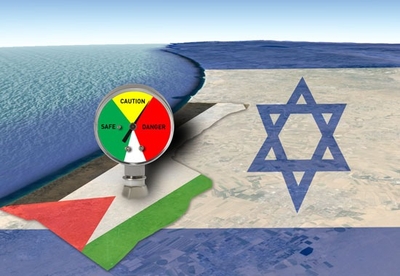
In the long run, Sinwar and his regime plan to continue to prepare for the ‘grand’ destiny they have chosen for Gaza. So long as Hamas rules Gaza, it will be the base of unending jihad against Israel, buffered by tactical ceasefires, until conditions are ripe for a new assault.

**************************

Strategically, Hamas remains as committed as ever to its objective of destroying Israel and toppling the Fatah-run Palestinian Authority in the process. Tactically, however, Hamas exhibits pragmatism and won’t rush into wars with Israel when conditions are ill suited.

Hamas looks at the long run, and remains convinced that it can eradicate Israel, even if it takes decades or centuries. Yet it would prefer to bide its time, and build up its force until the next clash while working to decrease its acute regional isolation. For this to happen, Hamas needs to avoid plunging Gaza into a new war any time soon. Yet it remains far from clear that it will be able to do this.

Should a war erupt in the near future, it likely will be triggered by unplanned dynamics of escalation.

Gaza’s woeful living standards and infrastructure are among those factors. Crises such as the ongoing electricity supply problem plaguing the Strip could facilitate an early conflict, as Hamas may try to distract the population’s frustrations from its failings, and divert them to Israel.

The Palestinian Authority (PA) is threatening to make matters worse by cutting off cash for Gaza’s power plant. It’s part of the ongoing feud between the Fatah-run PA in Ramallah and Hamas in Gaza. Gazans now receive electricity only four to six hours a day due to this feud. In January, Gazans took the unprecedented step of protesting power cuts, making Hamas extremely nervous.

In addition to tensions over the electricity crisis, a Hamas-run terror cell could spark conflict if it carries out a mass casualty attack that spawns Israeli retaliation.

The sheer scope of such plots that Israel thwarts every year is enormous.

Last year, 184 shooting attacks, 16 suicide bombings, and 16 kidnapping plots were foiled, Shin Bet chief Nadav Argaman testified last month before the Knesset’s Foreign Affairs and Defense Committee. Hamas had “significantly increased” efforts to pull off attacks in the West Bank and in Israel, he said, adding that Israeli security forces arrested more than 1,000 Hamas members in the West Bank last year and broke up 114 cells.

These are risks Hamas is prepared to take, since the day that it ceases all attempts to carry out jihadist terrorism against Israel is the day that it stops being Hamas.

Yet Hamas is also a government now, and it must consider the Gazans it rules. Hamas is keenly aware of Palestinian sentiment. Its leaders grew up in Gaza’s refugee camps and always have their finger on the pulse of Gazan society.

Hamas leaders seem to understand that the public opposes a new damaging war with Israel. They recognize that the Palestinian public cannot stomach a war with Israel every two years. The reconstruction program in Gaza following the 2014 conflict is far from complete. There are still Gazans whose homes haven’t been repaired from the damage inflicted in 2014.

The general population, despite being exposed to Hamas’s daily propaganda diet of jihadist rhetoric, would likely be reluctant to be again be used as human shields by the military wing, barely three years since the end of the last clash.

The price of Hamas’s policy of embedding its rocket launchers and fighters in Gaza’s civilian areas also is not alluring to many Gazans.

On the flip side, one of Hamas’s worst fears is of being perceived as weak. After one of its senior operatives was mysteriously killed recently, it executed three people it accused of collaborating with Israel.

Hamas also responded to Mazen Fuqaha’s murder by sending threatening messages to Israel promising vengeance. Hamas videos suggest it will target senior Israeli security officials for assassination.

Fuqaha was a key figure in the Izzadin Al-Qassam Brigades, and reportedly in charge of setting up multiple terrorist cells in the West Bank. His bullet-ridden body was found last month outside of his Gazan apartment building.

The Israeli defense establishment takes these Hamas threats seriously. Despite the noise, however, Hamas has not rushed to respond just yet – underlining the fact that Hamas is aware of the restraints factors that it is under.

Since the end of the 2014 war with Israel, the Islamist regime has shied away from escalating the security situation with Israel.

Hamas’s leadership sees unfavorable regional conditions. They lack any powerful regional backer following the 2013 downfall of Muhammad Morsi, the Muslim Brotherhood president in neighboring Egypt, in whom Hamas staked so many of its hopes.

In the past, Hamas enjoyed many partnerships, enjoying arms support and funding from the Shi’ite axis (Iran and Hizballah) – and forming relationships with Sunni powers.

But the Middle Eastern regional upheaval, which pits Sunnis against Shiites, and Islamists against non-Islamists, forced Hamas to make choices. It could no longer be on the same side of both Shi’ite Iran and Sunni Saudi Arabia, who are locked in a transnational proxy war. In the same vein, Hamas cannot be on the same side as both the Assad regime and the Sunni rebels fighting to remove him.

Worst of all from Hamas’s perspective, Morsi’s departure means it cannot rely on its primordial impulse to attach itself to a Sunni Muslim Brotherhood-led backer.

Five years ago, there were initial signs of a regional wave of Muslim Brotherhood successes. The Brothers rose to power in Egypt, Turkey, Tunisia, and had Qatari backing. Morsi’s 2013 fall changed Hamas’s fortunes for the worse. The rise of Egyptian President Abdel Fattah El-Sisi, a leader who identifies Hamas as a Gazan branch of his domestic arch-enemy, the Egyptian Muslim Brotherhood, guaranteed Hamas’s isolation.

Relations with Cairo remain rocky despite recent Hamas attempts to improve ties. Egypt may open its Rafah border crossing a few days a week, but this does not change its core view of Hamas as a true enemy, to be held at bay, weakened, and deterred.

Hamas has also fallen out with Saudi Arabia. And Hamas and Iran do not get along very well either, despite Iran continuing to be the chief sponsor of the military wing, paying it $50-$60 million a year, according to various estimates.

This leaves Hamas with just two stalwart friends: Qatar and Turkey, neither of which can back them substantially. Turkey is not an Arab state, meaning that its role in the Arab world is limited, and its desire to lead the Arab world will always be met with suspicion. A failure by Turkey to infiltrate the region means that it can only do so much to assist Gaza. Qatar, though wealthy, is politically weak, and geographically distant.

New Hamas leader Yihyeh Sinwar, despite his fundamentalist inclinations, must consider these constraints and see that his Islamist-run enclave has little real backing.

To compound its problems, Hamas also has serious financial issues. It has three main sources of income: Donations from states, donations from private individuals, and Hamas’s network of investments.

Hamas gets far less money than it used to from its donors, according to Israeli assessments. Only Qatar and Turkey donate on a regular basis, while Iran continues to finance the military wing, but not the entire movement.

Hamas is a large organization, with operations in the West Bank, Qatar, and Turkey in addition to Gaza. In the Strip, it needs to pay salaries, and prepare for its next clash with Israel. Hamas also seeks to export terrorism to the West Bank and build up political support among West Bank Palestinians. All of this costs money. It is has offices and headquarters in multiple states overseas that require annual budgets.

Private Gulf State donors are drying up. Wealthy Saudis are more interested in supporting Syrian rebels. Hamas’s cause has moved to the back of the line.

Its investments, meant to be saved for a rainy day, now must be tapped.

So what can Hamas do? First and foremost, it continues its domestic military build-up, mass producing rockets, mortar shells, variants of shoulder-fired missiles, drones, and digging tunnels – all at the expense of the welfare of the 2 million Palestinians it rules.

That’s because Hamas drew many operational lessons from its last conflict with Israel, and is keen on rebuilding its terrorist-guerrilla army without interruptions.

One lesson was to focus on a perceived Israeli vulnerability through short-range strikes. To that end, it is building new rockets that carry 200 kilogram warheads – significantly larger than past rockets made in Gaza.

These projectiles are not accurate, but would cause enormous damage if they slammed into a southern Israeli town or village.

Hamas weapons factories produce simple RPGs as well.

Second, Hamas is trying to becoming more ‘acceptable’ to the region and to the world. It is about to unveil a new charter which will be an attempt to obfuscate its jihadist ideological leanings and ties with the Muslim Brotherhood, and present itself as being merely a national “resistance” organization.

In the long run, Sinwar and his regime plan to continue to prepare for the ‘grand’ destiny they have chosen for Gaza. So long as Hamas rules Gaza, it will be the base of unending jihad against Israel, buffered by tactical ceasefires, until conditions are ripe for a new assault.

Yaakov Lappin is a military and strategic affairs correspondent. He also conducts research and analysis for defense think tanks, and is the Israel correspondent for IHS Jane’s Defense Weekly. His book, The Virtual Caliphate, explores the online jihadist presence.

Al-Qaeda Mocks Arabs for Submitting to Haley’s ‘Kick in High Heels’

April 21, 2017

Al-Qaeda Mocks Arabs for Submitting to Haley’s ‘Kick in High Heels’, PJ Media, Bridget Johnson, April 20, 2017

U.S. Ambassador to the UN Nikki Haley speaks with media at UN Headquarters in New York on April 20, 2017. (Albin Lohr-Jones/Sipa via AP Images)

Al-Qaeda mocked Arab rulers for being at the mercy of “the kicks of the high heels” of Ambassador Nikki Haley after her warning that things are going to change at the United Nations.

“I wear heels. It’s not for a fashion statement. It’s because if I see something wrong, we’re going to kick them every single time,” Haley said in a speech at the American Israel Public Affairs Committee conference last month in Washington.

“So how are we kicking? We’re kicking by, No. 1, putting everybody on notice, saying that if you have our back, we’re going to have the backs of our friends. But our friends need to have our backs, too,” she continued. “If you challenge us, be prepared for what for what you are challenging us for because we will respond.”

In the most recent issue of al-Qaeda’s al-Nafir Bulletin, published in several languages and distributed online by the Global Islamic Media Front, the terror group said “the representative of the bearer of the Cross America” — Haley — “sent a message to the apostate Arab rulers filled with sarcasm and mockery.”

The bulletin added that America was “the Hubal of the era to its worshippers the Arab rulers,” referring to a moon god worshipped at Mecca before Islam.

“You will not go beyond your worth, and you will receive a kick in high heels as punishment for any statement… that criticizes the Zionists,” they summarized Haley’s message to Arab rulers after quoting her directly.

“American and its Crusader allies will never allow anyone to stand before their support of the Zionists and the apostates of the Arabs and foreigners from the Muslim rulers, and they will not accept to end their robbery of the fortunes and resources of the Ummah [Muslim community], and that any Islamic project that seeks to establish the Shariah, and spread justice, and distribute fairly the fortunes of the Ummah, will face bombs and guided rockets, with the supporter of the apostate rulers who are ready to receive the kicks of the high heels from the Zionist Haley in case they go beyond the allowed limit, and gave wrong criticisms of the nation of the sons of Zion,” the bulletin stated.

Al-Qaeda added that the only “salvation” for Muslims “out of this delusion in the sea of weakness” was “targeting the real enemy.”

“O youth of Islam, attack global infidelity headed by America, and show Allah what is required of you,” the terror group told followers. “Shake their thrones, and bring down their interests, and target their great criminals.”

Al-Qaeda has previously used issues of the al-Nafir Bulletin to call for action against the United States. In February, the terror group accused the U.S. of withholding necessary medication from “Blind Sheikh” Omar Abdel-Rahman, the mastermind of the deadly 1993 World Trade Center bombing who died behind bars that month.

They also released a final statement from the sheikh complaining of strip searches that explored his private parts “front and back,” claiming that he could be poisoned behind bars and calling for “the most powerful and violent revenge” in the event of his demise.

Last month, the bulletin told jihadists to go forth and just kill Americans without any Islamic consultations first. Al-Qaeda called a U.S. airstrike that struck a mosque complex in Al-Jinah, Syria, “a horrible crime among the crimes of America and its damned president, Trump.”

INTO THE FRAY: Middle East meltdown

April 14, 2017

INTO THE FRAY: Middle East meltdown, Israel National News, Dr. Martin Sherman, April 14, 2017

But of course the most troubling of questions regarding the regional integration question is this: If the allegedly moderate regimes really desire Israel’s help in confronting formidable common threats (the menace of Jihadi cohorts and the specter of nuclear Iran), why would they predicate that help on precisely the same concessions from Israel that they demanded prior to those threats arising?  And were Israel to refuse those concessions would these “moderates” deny themselves the aid Israel could provide them—for the sake of the Palestinian-Arabs, for whom they have shown consistent disdain and contempt over decades?

Furthermore, if the “moderate” states see Israel’s strength as a determining factor in making it an attractive ally in combatting the common threat of radical Islamism, why would they insist on concessions that weaken it, and expose it to greater perils as a precondition to accepting its aid? Why would they press for concessions that are likely to fall—as they did in Gaza—to the very Jihadi elements that both they, and Israel, see as a common enemy?

****************************

Worst Chemical Attack in Years; US blames Assad  – New York  Times, April 4, 2017.

Death toll climbs in clashes at Palestinian camp in Lebanon – Reuters, April 9, 2017.

Deadly blasts hit Coptic churches in Tanta, Alexandria – Al Jazeera, April 10, 2017.

Five Sudanese soldiers killed in Yemen conflict – Reuters, April 12, 2017.

These four recent headlines, spanning barely a week, bear chilling testimony to the grim and grisly realities of the Arab world.

Barbaric business as usual   

After all, had the several score killed in the April 4th chemical attack in Northern Syria been beheaded, or lynched, or burnt alive or slaughtered by any one of the other gruesome methods by which hundreds of thousands of civilians have lost their lives in the Syrian Civil War over the last five years, it is more than likely that their deaths would have gone largely unnoticed and unreported.Indeed, it would have been nothing more than brutal, barbaric business as usual for the region.

Across virtually the entire Arab world , from the Atlantic Ocean in the West to the Persian Gulf in the East; from the Sahara desert in the South to the upper reaches  of the Euphrates in the North, naked violence engulfs entire countries – Syria, Iraq, Yemen, Libya.  Others – like Lebanon and Egypt—are perennially on the cusp of its eruption; and in others (like Bahrain and Saudi Arabia), it lurks, simmering just below the surface, constrained only by the iron grip of police-state tyranny.

With painfully few—and dubious—exceptions (such as Iraq, teetering on the brink of failed state status and Tunisia, once the poster-child of the “Arab Spring”, now   increasingly threatened by Jihadi Salafi insurgents—see here and here), the Arab regimes are a noxious brew of theocratic tyrannies, military dictatorships and/or nepotistic monarchies. The violent exchanges that rage throughout the region occur between a wide range of protagonists and across a myriad of schisms: Sunni vs Shia, radicals vs. monarchs, rebel insurgents vs incumbent rulers, Islamist extremists vs traditional regimes.

Death, depravity and despotism

It is against this doleful and daunting backdrop that the fatal follies of the past and of the emerging prescriptions for the future course of what has been perversely dubbed “the peace process”, must be assessed.

For as growing numbers of erstwhile advocates of the two-state paradigm are becoming increasingly skeptical—indeed, even despairing—of its viability within any foreseeable future, rather than admit the enormity of their error, they are now turning to a new false deity, no less ppreposterous or perilous than the tarnished chimera of two-statism.

This is the new cult of “regionalism”, which attempts to invert the twisted logic of two- statism—but leaves it just as twisted.

At the core, regionalism is the idea that, rather than strive for an agreement with the Palestinians as a necessary precursor to its acceptance by the states of the region, Israel can, and should, establish a pan-regional alliance with allegedly “moderate” states, driven by a recognition of common threats (the menace of Jihadi cohorts and the specter of nuclear Iran)—thereby paving its way to a resolution of the Palestinian issue.

Central to this new cult is the bizarre belief that Israel’s “integration” into region—which, as we have seen, is little more than a cesspool of death, depravity and despotism –is a goal both necessary and worthy—and one that the nation ought to strive to achieve.

Risible regionalism

Significantly, there are several glaring logical inconsistencies, non sequiturs and factual inaccuracies that plague the regional-integration doctrine.

First of all, as commonly presented, it almost inevitably entails circular reasoning – i.e. Israel should pursue relations with the moderate Arab states as a means of arriving at a resolution of the Palestinian problem; but the only way to arrive at such relations with the Arab world is to reach an agreement with the Palestinians.  So, resolving the Palestinian issue becomes both the objective of the regional-integration and the means to achieve it!

Thus, for instance in an article, Regional integration only way for Israel to achieve security, Atlantic Council senior fellow H.A. Hellyer writes: “…the only realistic way for Israelis to thrive in the long term is for them to be integrated into the wider region, beginning with a comprehensive and just peace settlement…”

This statement is not only of dubious veracity—since Israel seems to be thriving rather well without (thankfully) being “integrated into the wider region—but seems to collide with a later contention by Hellyer, who writes elsewhere: “A sustainable peace for Israelis is predicated on their eventual integration into the wider region.”

So there you have it: “Integration into the wider region” must be preceded by “peace”; but “peace” must be predicated on (i.e. preceded by) “integration into the region”.  Thus, resolving the Palestinian issue (a.k.a. “peace”) is presented both as the cause and effect of integration –having to precede it on the one hand, while being predicated on it, on the other.

Confusing, isn’t it??

Puzzling Pardo

But perhaps one of the most puzzling and perturbing endorsements of the regional-integration paradigm came in a speech delivered by Tamir Pardo the former Head of Israel’s Secret Intelligence Service, Mossad.

In it, Pardo identified the emergence of “a rare confluence of interests between Israel and the moderate Arab states.”

Pointing to the drawbacks of relations that are entirely covert, he remarked: “Secret relations that take place “under the radar” are by their nature transitory.” Accordingly, he advocated Israel’s overt integration into the region: “The key to regional integration is to build economic and social bridges between countries, facilitating trade and tourism…. The deeper, the more open and above board relations are, the better suited they will be to survive the inevitable shocks and disruptions that take place from time to time…. Israel’s regional integration is a key to its very survival.”

But he warned “None of this will happen without a resolution of the Palestinian problem.”

There are several disturbing defects—both conceptual and empirical–in this portrayal by Pardo, which seem to indicate that his undoubted ability in covert operations is not matched by a commensurate acumen for political analysis.

So, while Pardo may well be correct in his doubts as to the durability of secret relations, his faith in more overt one seems wildly at odds with Israel’s experience in past decades, causing one to puzzle over what could possibly be the basis  for his unfounded contention, and his reasons for making it.

Puzzling (cont) 

Indeed, the examples of Iran and Turkey clearly indicate that robust overt “economic and social bridges” as well as “trade and tourism” are of little value if the regime should change. After all, the relations with pre-revolutionary Iran and pre-Islamist Turkey could hardly have been closer or more cordial.

Yet, with the ascent to power of Khomeini in Iran and Erdogan in Turkey these ties proved, indeed, “transitory”.  Of course, the metamorphosis was particularly dramatic and rapid in Iran, where Israel was transformed from being a trusted ally to a hated enemy almost immediately. In Turkey, the process was more gradual and less drastic, but there can be little comparison between the tight strategic ties of yesteryear and the hostile attitude that prevails today.

This volatility in relations between nations is one of the most profound flaws in the regional-integration proposal—especially when it is predicated on a resolution of the Palestinian issue. For while it is true that countries like Jordan, under the Hashemite dynasty,  Egypt under Sisi, and the incumbent regimes in the Gulf may face common threats, it would be more than a stretch to characterize this as sharing long-term mutual interests with Israel.

Indeed, a yawning gulf separates between the seminal values that define the differing societies – with regard to individual liberties, gender equality, social diversity, religious pluralism—which clearly portends ample room for renewed adversarial relations once the common threat has been eliminated.

Palmerston…on perpetual allies

Israel would do well to heed the words of British Prime Minister, Lord Palmerston (1784-1865) on the fickleness of nations and their international ties “We have no eternal allies, and we have no perpetual enemies. Our interests are eternal and perpetual, and those interests it is our duty to follow”.This caveat is particularly pertinent in the case of the regional-integration paradigm. For in essence the deal to be struck is as follows: Israel is called upon to make perilous permanent concessions (to resolve the Palestinian issue) in exchange for a temporary alliance, based on the (ephemeral) word of rulers, who head not only some of the most decadent and despotic regimes on the planet, but also some of the most threatened.

Accordingly, there is little guarantee that the Arab entity that makes commitments toward Israel will be the entity called upon to honor them when need be. After all, what would be the value of any understanding on integration entered into in 2010 with say Syria, or Iraq or Libya…
Moreover, Israel was unable to prevent an Islamist takeover of Gaza.  It is, therefore, highly unlikely that it could prevent an Islamist takeover by a resurgent Muslim Brotherhood in Egypt, or an Islamist coup in Jordan.

Thus, given the fact that the concessions Israel is called upon to make to resolve the Palestinian issue, are largely irrevocable, while the pledges given it are largely retractable, any regime change in Cairo and even more so in Amman would have potentially disastrous ramifications.

With an Islamist state abutting the envisaged Palestinian state from the East, dispatching irredentist insurgents to destabilize any purportedly peaceable Palestinian regime in the territory evacuated by Israel; with a regime in Cairo no longer interested in, or capable of, countering the Jihadi warlords in Sinai, pressing against Israel’s 200 km frontier and the land route to Eilat, Israel is likely to rue any credence it placed in regional integration.

The most troubling of questions 

But of course the most troubling of questions regarding the regional integration question is this: If the allegedly moderate regimes really desire Israel’s help in confronting formidable common threats (the menace of Jihadi cohorts and the specter of nuclear Iran), why would they predicate that help on precisely the same concessions from Israel that they demanded prior to those threats arising?  And were Israel to refuse those concessions would these “moderates” deny themselves the aid Israel could provide them—for the sake of the Palestinian-Arabs, for whom they have shown consistent disdain and contempt over decades?

Furthermore, if the “moderate” states see Israel’s strength as a determining factor in making it an attractive ally in combatting the common threat of radical Islamism, why would they insist on concessions that weaken it, and expose it to greater perils as a precondition to accepting its aid? Why would they press for concessions that are likely to fall—as they did in Gaza—to the very Jihadi elements that both they, and Israel, see as a common enemy?

Indeed one might ask: Why should Israel have to make any concessions so that the Arab states would deign to accept its aid in their battle against a grave common menace?

As Lewis Carroll’s Alice in Wonderland once sighed “It would be so nice if something made sense for a change.”   It sure would! Regional integration: What Isaiah would say?

Of course one can only puzzle over what merit proponents of regional integration see in its implementation. Do they really want Israel to be absorbed into the morass of cruelty, corruption and cronyism that is the Middle East?  What values that pervade their Arab neighbors, would they urge it to adopt in order to “integrate”?Misogynistic gender bias? Homophobic persecution of gays? Intolerance of social diversity? Repression of minority religious faiths?  Suppression political dissidence? For were Israel to resist adopting these and other regional values, how on earth could it integrate into the region?

So, with the Mid-East on the cusp of melt-down, one can only imagine what Isaiah (5:20) would say of the proponents of regional integration:  Woe unto them that call evil good, and good evil; that put darkness for light, and light for darkness; that put bitter for sweet, and sweet for bitter.  

Martin Sherman is the founder and executive director of the Israel Institute for Strategic Studies.

Tehran’s treacherous reconciliation offer

April 13, 2017

Tehran’s treacherous reconciliation offer, Washington Times, Mohammed Alsulami, April 12, 2017

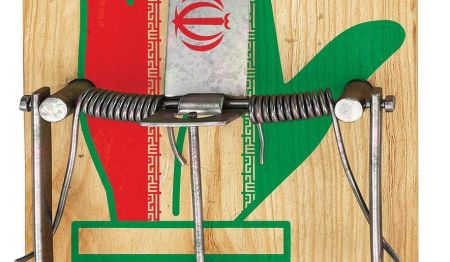
Illustration on Iranian treachery by Linas Garsys/The Washington Times

ANALYSIS/OPINION:

Iran has recently been reaching out to its Arab neighbors to propose a fraternal reconciliation.

Some Arab nations have been criticized for their less-than-enthusiastic response to these overtures. But that criticism is naive. Iran’s history and political structure make clear that these efforts are nothing more than a poor attempt at public relations spin and cannot be trusted. The recently Arab Summit in Jordan passed 15 resolutions indicting Iran’s behavior in the region — its backing of terror groups, its meddling in the internal affairs of neighboring nations, its incitement of Sunni-Shiite conflict, its intervention in the Syrian civil war and several other of its hostile policies.

If Iran were actually trying to turn a page with its Arab neighbors — which have endured decades of Iran-sponsored interference and terrorism within their borders — Iran should show some evidence it has truly changed.

In fact, nothing has changed.

What signals have the Iranian regime given to indicate a serious wish to reconcile with the Arab nations of the region? What changes has it made to its policies and actions?

The answer: none. Tehran is continuing its business-as-usual sponsorship and export of terror in the region, backing Hezbollah in Syria, the Houthis in Yemen and other militant groups. More to the point, if this reconciliation attempt is to believed, who in Tehran should Arab nations respond to? Should they deal with the official Iranian government or the real power base — Supreme Leader Ali Khamenei and the Islamic Revolutionary Guard Corps (IGRC)?

Has Iran made any structural changes to its ruling class that would persuade Arab neighbors that things are really different in Tehran? Absolutely not. The clerics remain in charge in Iran and have the final say.

All of the Iranian government’s diplomatic efforts and political decisions are controlled by the theocratic leadership, the IRGC and its extremist sectarian affiliates. If that remains the case, any reconciliation offer is bogus.

This was demonstrated during the negotiations for the Iran nuclear deal. Iranian Foreign Minister Javad Zarif insisted on moving the negotiation team during the talks to Tehran to enable Ayatollah Khamenei and the IRGC to monitor the discussions and to approve or reject every detail of the agreement until it met with the real leaders’ approval. This is proof that the Iranian government cannot act independently or make any binding commitments without the approval of the clerical and military leadership.

But might Ayatollah Khamenei himself seek reconciliation with Iran’s Arab neighbors? Isn’t peace good for everybody?

This assumption might be valid if it ignored the fact that Iran’s jurist leadership has prioritized “exporting the revolution” as a core tenet of the Islamic republic’s constitution. The IRGC masterminds and implements the regime’s aggressive interventionist policies and is inextricably intertwined with the theocratic leadership. The IRGC is synonymous with the country’s national security, which is the sole prerogative of Supreme Leader Khamenei.

If the Iranian regime were serious about wishing to hold negotiations with Arab nations, these would be led by the country’s supreme leader, not by the administration under his control. The government and the diplomatic corps have no independent power and are his tools.

Tehran’s latest efforts to initiate unilateral negotiations with its neighbors via its powerless administration are a fruitless exercise. The empty offer by Iranian leadership is to buy more time to advance its regional agenda of destabilization and terror and to evaluate other nations’ stances toward Iran, particularly that of the new U.S. presidential administration.

Without radically changing its policies, particularly its funding and deployment of extremist sectarian militias in Syria, Iraq and Yemen, and its interference in the internal affairs of Lebanon, Bahrain and Saudi Arabia, the Iranian regime’s reconciliation rhetoric and talk of negotiations should be disregarded.

Any real negotiation requires mutual confidence and respect, which Tehran is unwilling to grant.

The international community should understand that Arab nations’ sour history with the Iranian regime’s duplicitousness and its brutal regional military expansionism gives them every right to be skeptical about this recent offer of reconciliation. The primary objective behind Tehran’s new diplomatic strategy is to convince the international community and Western powers that Tehran is a normal, reasonable and pragmatic government.

No one should fall for this ploy. Arabs in the United States and around the world will not.

• Mohammed Alsulami is a researcher at Umm Al-Qura University in Saudi Arabia, specializing in Iranian studies.

Middle East: A Shift from Revolution to Evolution

April 8, 2017

Middle East: A Shift from Revolution to Evolution, Gatestone InstituteNajat AlSaied, April 8, 2017

The lesson the Trump administration might learn from the disastrous mistakes of its predecessor is that the main sources of terrorism in the region are political Islam and all its related religious groups. All these radical groups, including ISIS, Al-Qaeda, Jabhat Al-Nusra and Hamas have been spawned by a political Islam driven by the ideology of the Muslim Brotherhood.

The fight, therefore, should not be against Islam, but against political Islam. Islam needs to be practiced the way other religions are, as a private personal faith that should be kept separate from public life and politics, and whose expression should be confined to worship only.

Mosques, whether in the Arab and Muslim world or in the West, should be places of worship only and must not transformed to centers for polarizing society or for recruitment by political religious groups.

After each Islamist terrorist attack in the West, the public is divided into two camps: one angry and one indifferent. The problem with defeating Islamist terrorism seems to be that either it is attacked by conservatives who call Islam an evil cult or it is forgiven entirely by liberal apologists. What, then, is the answer?

One of the main failures in Western analyses of the origins of terrorism in the Middle East and North Africa is that the West attributes them to a lack of democracy and a lack of respect for human rights. This is, indeed, part of the cause, but the root of the problem is a lack of development and modernity. U.S. President Donald Trump did not exaggerate when he said that the Obama administration’s foreign policy was disastrous. It was catastrophic mainly for two reasons. One was the knee-jerk support for the “Arab Spring” and for extremist Islamic political groups such as the Muslim Brotherhood. The second was the alliances the Obama administration built with unreliable countries such as Qatar, which supports radical political groups such as the Muslim Brotherhood. In addition, Obama made the mistake of continuing to try to appease Iran’s theocratic regime.

The Arab Spring’s uncalculated, hasty attempt to establish so-called democracy only generated more turmoil and chaos in the region. Certain radical political groups simply exploited the elections to serve their own political and sectarian agendas; that swoop for power only resulted in more authoritarian and dictatorial regimes, as have played out, for instance, in Egypt, where we have witnessed the murder of civilians and police officers by the Muslim Brotherhood. In other countries, the situation is even worse; attempts to install democracy have totally destroyed the state and facilitated the spread of terrorist militias, as in Libya.

It is ironic that Western countries and their advocates stress the need to apply democratic practices in Arab countries, but evidently do not recall that development and secularism preceded democracy in Western Europe. The United Kingdom, which has the oldest democratic system, did not become fully democratic until 1930. France became fully democratic only in 1945, 150 years after the French Revolution.

The Emir of Qatar, Sheikh Tamim bin Hamad Al-Thani, at the Arab Summit in Jordan on March 28, 2017 delivered a speech in which he indicated his continuous support for the Muslim Brotherhood:

“If we are serious about focusing our efforts on armed terrorist organizations, is it fair to consider any political party we disagree with as terrorist? Is our goal to increase the number of terrorists?”

Many Arab leaders were infuriated by his speech; at the forefront was President Abdel Fattah el-Sisi of Egypt, who left the Arab Summit Hall during the speech to meet King Salman of Saudi Arabia.

Most Arab leaders and analysts, in fact, are enraged by Qatar’s continuous support for Islamist political groups such as the Muslim Brotherhood, because these groups are a threat to their national security.

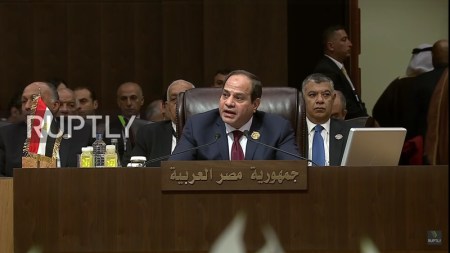
President Abdel Fattah el-Sisi of Egypt speaks at the Arab Summit, on March 29. The previous day, Sisi walked out of a speech by the Emir of Qatar, Sheikh Tamim bin Hamad Al-Thani. Sisi was infuriated by Al-Thani’s declaration of support for the Muslim Brotherhood. (Image source: Ruptly video screenshot)

Another consequence of Obama’s foreign policy — in particular attempts to get close to Iran’s hostile regime — has been a fraying of relationships with old Arab allies of the United States. Some of Obama’s advisors thought that replacing Saudi Arabia with Iran was somehow “better” for the United States, if Iran “is beginning to evolve into a very civilized and historically important country” — an analysis that can be described as completely short-sighted.

The Saudi regime, with all its flaws, is a monarchy run by princes; the Iranian regime is a theocracy run by clerics. The Saudi regime is not a theocratic regime but a hybrid structure, which is neither wholly secular nor wholly religious. As such, the religious class functions under the authority of the ruling class. Princes are driven by self-interest; clerics are driven by ideology. In terms of extremism, the Iranian regime is pushing for hegemony, whilst Saudi Arabia has been taking only a defensive, rather than an expansionist, position.

The motivation of Saudi Arabia in exporting mosques world-wide and installing radical Saudi imams is defensive, not expansionist as in Iran. Saudi Arabia’s impetus is to confront Iran’s hegemony and the spread of its hostile ideology. It is this strategy, which Saudi Arabia has practiced since 1979 to balance Iran’s power and to combat its rebellious ideology, that must change.

That Iran’s Khomeini regime sought to embarrass Saudi Arabia — a country that is home to Islam’s two holiest mosques, in Mecca and Medina — by portraying it as not sufficiently Islamic, meant that the foundational Islamic Wahhabism of the Saudi Kingdom was aggressively reinforced. This emphasis resulted in even more constraints being put in place in Iran: especially on entertainment. Since the Khomeini revolution in 1979, all plays, fashion shows, international events, and cinemas have been banned. As for women, the Commission for the Promotion of Virtue and Prevention of Vice has increasingly harassed them. As for minorities, especially Shia challenging the Iranian Shia regime and its support for Shia militias — particularly the dominant Revolutionary Guards — books were published attacking the Shia:

More books appeared, attacking the Shias and especially Khomeini’s views. These books – like the arguments of Khomeini’s followers – rejected modern thinking as an “intellectual invasion.” Saudi Arabia, considered the guardian of Sunni Islam, spent billions of dollars on challenging the Khomeini-backed Shiites.

This religious one-upmanship — a competition over which body can be the “most religious” — must stop. Saudi Arabia would do well to understand that in order to confront the hegemony of the Iranian theocratic regime, the answer is not to radicalize Saudi society but to return to the way it was before 1979.

The best way to defeat the rebel hostile regime in Iran might be through creating an inclusive and tolerant society in Saudi Arabia. Saudi Arabia needs to change its approach towards Iran because the current strategy has not worked. The current strategy has done nothing except to strengthen the Iranian regime’s dominance; distort, globally, the image of Saudi Arabia and accelerate terrorism.

The lesson the Trump administration might learn from the disastrous mistakes of its predecessor is that the main source of terrorism in the region are political Islam and all its related religious groups. All these radical groups including ISIS, Al-Qaeda, Jabhat Al-Nusra and Hamas have been spawned by a political Islam driven by the ideology of the Muslim Brotherhood. Extremist jihadists such as Osama bin Laden, Abdullah Azzam and Ayman al-Zawahiri were all taught by the Muslim Brotherhood.

Political Islam practiced by the Iranian theocratic regime has been comfortably generating Shia radical militias, including the terrorist group, Hezbollah. The fight, therefore, should not be against Islam, but against political Islam. Islam needs to be practiced the way other religions are, as a private personal faith that should be kept separate from public life and politics, and whose expression should be confined to worship only. Mosques, whether in the Arab and Muslim world or in the West, should be places of worship only and must not transformed to centers for polarizing society or for recruitment by political religious groups. Unfortunately, Western countries have turned a blind eye to the political activities inside these mosques.

The danger of these religious political groups is that they do not believe in democracy or human rights; they just use elections to grasp power in order to impose a system of “Islamic Caliphate” as their only form of government. Most of these groups use religion as an ideology to oppose governments other than their own, and when they are criticized or attacked, they play the role of the oppressed.

The Trump administration needs to take advantage of the fact that the majority of people in the Middle East and North Africa have lost faith in religious political groups, especially since the failure of the Muslim Brotherhood in Egypt and Tunisia.

Before the Arab Spring, support for these groups was huge; now it stands at less than 10% of the population. This study was conducted in the Arab world, not including Turkey. The Muslims who support Turkish President Recep Tayyip Erdogan are the Muslim Brotherhood.

Most recent polls indicate that the majority of people in Arab and Muslim countries prefer religion to be kept separate from politics.

The country that is working the most systematically to fight these religious political groups in the region is the United Arab Emirates (UAE). There are several institutes and think tanks researching how to combat these groups. Dr. Jamal Sanad Al-Suwaidi, Director General of the Emirates Center for Strategic Studies and Research (ECSSR), has given a robust analysis of these groups and how to combat them in his book, The Mirage. In it, he cites a study on public opinion on political religious groups: A survey of the UAE population, on how these groups are able to influence the public by taking advantage of certain flaws in the system: 53.9% because of corruption; 47.9% because of poverty and 29.1% because of an absence of civil society groups that confront these opportunists.

The Middle East-North Africa region will undoubtedly have to go through several stages before it can successfully establish democracy. An evolutionary developmental approach will definitely be better than the failed revolutionary democratic one pursued by the Obama administration.

Secularization is also crucial in the fight against terrorism. Trying to build a democracy before going through the stages of secularism and political reformation — which includes rectifying existing flaws, such as corruption; modernization which means the liberation of the region from extremist totalitarian religious dogma and all other forms of backwardness in order to kick-start a renaissance; and scientific development — will not only be inadequate but will actually generate more terrorism by helping radicals to keep gaining power. It would be like a farmer who wants to plant roses in arid desert soil full of thorns.

Sisi, Trump, and the Politics of Designating the Muslim Brotherhood

April 6, 2017

Sisi, Trump, and the Politics of Designating the Muslim Brotherhood, National Review, Clifford Smith, April 6, 2017

President Trump welcomes Egyptian President El-Sisi to the White House, April 3, 2017. (Reuters photo: Carlos Barria)

Hopes that the Trump administration will designate the Muslim Brotherhood as a terrorist organization have hit rough waters, with anonymous officials citing concerns about diplomatic blowback and frayed relationships with Muslims at home and abroad. The leaks come on the eve of a historic visit to Washington by Egyptian president Abdel Fattah el-Sisi, a key Arab ally and devoted Muslim who is locked in a life-or-death struggle with the Brotherhood.

The irony is hard to miss, particularly given that Egypt and several other Arab countries have already designated the Brotherhood a terrorist organization.

Whatever the truth behind the leaks, they underscore that the inside-the-Beltway conventional wisdom — that the Brotherhood is “moderate” and so popular that designation would be seen as “a declaration of war against . . . Islam itself” — will not die as easily as many hoped.

This thinking is rooted in a failure to understand the difference between Islamists — a sizable but distinct minority of Muslims who adhere to a totalitarian religious ideology — and the moderate majority of Muslims, who are our friends and allies. President el-Sisi, who has publicly called out extremism to clerics in Egypt, understands this. After all, Egypt is not the only state in which the Brotherhood engaged in attempts to kill its way to power. It did the same in Syria in the early 1980s.

Despite the Brotherhood’s long history of bloodshed, claims that it is “moderate,” or opposes violence, are still prominent. While above-ground Brotherhood organizations use peaceful means when effective, they are “prepared to countenance violence . . . where gradualism is ineffective,” as a 2015 report by the British government noted with significant understatement.

Claims that designation will complicate U.S. relationships with certain Arab allies are overblown. While it is true that some allies, such as Jordan, have Muslim Brotherhood–affiliated parties represented in their parliaments, this is easy enough to finesse. Members of Hezbollah, a U.S.-designated terrorist organization, have long served in Lebanon’s parliament, but American diplomats manage to avoid contact with them and still do business with the Lebanese.

Moreover, failure to designate the Brotherhood complicates some alliances. The Egyptian public has grown deeply suspicious of the U.S. government precisely because under Obama the U.S. came to be seen as overly sympathetic to the Brotherhood. When Senator Ted Cruz introduced the Muslim Brotherhood Terror Designation Act, many Egyptians saw it as a sign the U.S. may be waking from its long slumber. A tweet introducing the bill was the subject of a segment by popular Egyptian talk-show host Amr Adib and was retweeted 17,000+ times.

Domestically, in the wake of Trump’s admittedly troubling comments suggesting a “Muslim ban” during his presidential campaign last year, some fear that designation will fuel anti-Muslim bigotry and pave the way for “a legal assault on the institutions of American Muslim life.” After all, several organizations claiming to represent U.S. Muslims, particularly the Council on American–Islamic Relations (CAIR), have deep Muslim Brotherhood ties.

But groups such as CAIR are hardly “institutions of American Muslim life” — they’re just pretending to be. A 2011 Gallup poll found support for CAIR among U.S. Muslims to be just under 12 percent. Britain’s inquiry into the Brotherhood found that its activists in the U.K. “appear to be unable to generate any grassroots support.”

Frankly, however, if public support for CAIR were higher, that would be all the more reason to be concerned. Notwithstanding its carefully crafted public image, CAIR was named an unindicted co-conspirator in the 2007–09 Holy Land Foundation terror-finance case, and was blacklisted by the FBI as a result. Unfortunately, the Obama administration failed to aggressively continue an FBI investigation into CAIR after it conspired to fund terrorist-designated organization Hamas, the Palestinian wing of the Muslim Brotherhood. Indeed, the United Arab Emirates has declared CAIR itself a terrorist organization.

Trump’s rhetorical excesses cannot be understood without recalling the Obama administration’s refusal to name the problem. Using euphemisms such as “violent extremism” and feigning puzzlement as to the motives of obvious jihadists made the administration’s rhetoric concerning terrorism a national joke. In both the U.S. and Europe, when elites insist that voters must believe them, rather than their own “lying eyes,” the voters turn sharply in the opposite direction. The cure for Trump’s rhetorical excesses is increased security, not denial.

Trump laid out a number of smart proposals on radical Islam during his campaign. His administration should now use President el-Sisi’s visit to move forward with these ideas. In particular, it should follow up designation of the Brotherhood with the formation of a congressionally authorized commission on radical Islam tasked with developing a strategy for winning the war against Islamic extremists and explaining the threat of Islamism to the American people. Both are badly needed. Wrongheaded conventional wisdom won’t keep Americans, or our Muslim allies, safe.

Sisi as key to Arab anti-ISIS pact with Israel

April 3, 2017

Sisi as key to Arab anti-ISIS pact with Israel, DEBKAfile, April 3, 2017

(Please see also, Restore the U.S.-Egyptian Strategic Alliance, Designate the Muslim Brothers as Terrorists. — DM)

Our Washington sources report that President Trump aims to complete his plan for bringing together Egypt, Saudi Arabia, Jordan and Israel on a new footing by September.

*********************************

US President Donald Trump’s first face to face with Egyptian President Abdel-Fatteh El-Sisi at the White House Monday, April 3, focuses on four main topics, DEBKAfile reports: The fight against Islamist State terror rampant in Egyptian Sinai and neighboring Libya; topping up US military assistance to Cairo, aid for easing Egypt’s dire economic straits and, finally, the effort to bolster normal relations between the Arab world (including the Palestinians) and Israel.

From the moment he assumed the Egyptian presidency in June 2014, El-Sisi has waged a never-ending war on Islamist terror against Ansar Beit-al Maqdis, which later pledged alliance to the Islamic State’s leader Abu Bakr Al-Baghdadi. The Egyptian army has so far been worsted.  The Egyptian president is not deaf to the criticism of the Second and Third Armies’ failure to overcome a few thousand armed men, even though they can at a moment’s notice raise several thousand more fighters from the Bedouin tribes of Sinai. US intelligence has rated the Egyptian forces as slow-moving and unwieldy; but for limited forays, its contingents preferring to sit safely in their barracks rather than risk going out and pursuing the enemy across the Peninsula.

Shortly before President El-Sisi’s trip to Washington, the Egyptian air force conducted intense bombardments of ISIS concentrations around the northern town of El Arish, killing at least 14 terrorists, nabbing 22 and seizing large caches of roadside bombs. But they too long delayed bearding the Islamists in their main stronghold atop Mount Jabal Hala in central Sinai. ISIS is therefore free to move around the territory and strike at will, the while expanding its operations into Egypt proper.

The weekend air strikes came after months in which ISIS overran sections of El Arish, Sinai’s biggest town (pop: 100,000). Their grip is such that Egyptian forces no longer dared venture into those lawless neighborhoods, especially at night. Earlier this year, terrible persecution including executions forced the few thousand indigenous Christians, most of them Copts, to flee their homes in El Arish. Egyptian forces proved unequal to safeguarding the US-led international observer force (MFO) monitoring the 1972 Egyptian-Israel peace treaty at a nearby station.

American military aid to Egypt stands today at $1.3bn a year. Even though the US president means to slash foreign aid programs, he may make an exception in this case and expand military assistance -, possibly in the coin of advanced military hardware, given the country’s unending frontline battle against Islamist terror.

Its presence in El Arish, 130km from the Egyptian-Israeli border, plants the peril on the doorsteps of Egypt’s neighbors as well: Northern Sinai borders on Israel, its northwestern district shares a border with the Gaza Strip, abutting in the east on Jordan and in the southwest on Libya. The cities of western Sinai sit on the banks of the Suez Canal.

The Islamic State’s Sinai affiliate is closely allied with Salafi organizations in the Gaza Strip and works hand in glove with its Palestinian Hamas rulers, especially in the lucrative arms-smuggling business.

Al-Baghdadi last year posted a group of Iraqi officers in his service to the Sinai contingent. They travelled through southern Jordan to reach the peninsula. The Islamist cells in Libya have moreover made ISIS-held turf in Sinai their safe highway for traveling undetected to their other strongholds across the Middle East.

To stamp out this sprawling, multi-branched menace, the Trump administration needs to bring Egypt, Jordan and Israel into a coalition for a sustained, common campaign.

The Obama administration, which boycotted President El-Sisi for persecuting Egypt’s Muslim Brotherhood, tried unsuccessfully to build Turkey, Egypt and Israel into a counterterrorism pact. The Trump administration, for which the Brotherhood is anathema, has a better chance. But first, relations between the Arab world and Israel need to be placed on a regular footing. Some groundwork already exists in the informal bilateral military ties Egypt and Jordan maintain with Israel. DEBKAfile’s military sources have revealed in past reports the limited give-and-take relations for fighting terror Saudi Arabia and Abu Dhabi maintain with Israel.

The US President’s advisers recognize that before a broad, effective front against ISIS and Al Qaeda can be put together from these partial, often covert ties, progress is necessary towards normalizing relations between the Arab governments and the Jewish state, including the Israeli-Palestinian track.

Trump will certainly want to hear what role his Egyptian guest is willing to take for bringing this process forward. He will ask his next Middle East visitor, Jordan’s Abdullah II, the same question, when he arrives in Washington Tuesday. As for the Palestinian leader Mahmoud Abbas, he was promised an invitation to the White House this month, but not yet been given a date. He is clearly being left to wait until the senior players in the region have had their say. Our Washington sources report that President Trump aims to complete his plan for bringing together Egypt, Saudi Arabia, Jordan and Israel on a new footing by September.

UN Watch Fires Back at Countries Accusing Israel of Abuses, ‘Where are your Jews?

March 24, 2017

UN Watch Fires Back at Countries Accusing Israel of Abuses, ‘Where are your Jews? Washington Free Beacon, March 24, 2017

UN Watch Executive Director Hillel Neuer shot back at countries accusing Israel of apartheid and violence against Palestinians, asking them where the Jewish populations in their countries have gone.

During a meeting of the UN Human Rights Council on Monday, several Middle Eastern countries took turns bashing Israel, saying that it has imposed apartheid and violence against Palestinians. A Palestinian representative was joined by Qatar, Sudan, Syria, Bahrain and Saudi Arabia in criticizing Israel.

Neuer was then recognized to respond to the accusations from the representatives, as well as those from a UN report.

“Everything we just heard, from the world’s worst abusers of human rights, of women’s rights, of freedom of religion, of the press, of assembly, of speech, is absolutely false and indeed Orwellian,” Neuer said.

As Neuer went to defend Israel, the Palestinian representative attempted to make a point of order as he tried to silence Neuer’s rebuttal. Egypt and Pakistan joined the protest by the Palestinians. Neuer was allowed to continue.

“Israel’s 1.5 million Arabs, whatever challenges they face, enjoy full rights to vote and to be elected in the Knesset, they work as doctors and lawyers, they serve on the Supreme Court,” Neuer said.

Neuer then went directly after Israel’s accusers.

“How many Jews live in your countries? How many Jews lived in Egypt, Iraq, Jordan, Kuwait, Lebanon, Libya, Morocco?” Neuer pointed out. “Once upon a time, the Middle East was full of Jews.”

Neuer went through a list of those countries asking, “Where are your Jews?” after stating how many Jews used to live there.

“Where is the apartheid, Mr. President?” Neuer asked.

“Why are we meeting today on an agenda item singling out only one state, the Jewish state, for targeting? Where is the apartheid, Mr. President?” Neuer said.

For a substantial amount of time following Neuer’s remarks, the council was silent.

Facing Trump Administration, Iran Shows Fear And Military Self-Restraint, Halts Provocations, Threats, And Incitement – While Boosting Morale At Home And Delegating The Bulk Of Conflict To Its Proxies

March 20, 2017

Facing Trump Administration, Iran Shows Fear And Military Self-Restraint, Halts Provocations, Threats, And Incitement – While Boosting Morale At Home And Delegating The Bulk Of Conflict To Its Proxies, MEMRIA. Savyon and Yigal Carmon* March 20, 2017

Introduction

Since the establishment of the administration of U.S. President Donald Trump, which is known to be against Iran’s revolutionary regime, Iran has faced a new reality. On the one hand, the U.S. is acting to organize the Gulf countries and Arab countries into an arrangement that Arab media have dubbed an “Arab NATO” which is aimed against Iran. On the other hand, Iran senses that despite the Iran-Russia cooperation in recent years and in various areas, Russia is abandoning it for its other vital interests, such as an understanding with the U.S. in order to advance the lifting of the sanctions against it, and an understanding with Turkey as its top regional partner.[1]

These developments have given rise in Tehran to a sense that it is besieged and under an emerging existential threat, in light of the crystallization of a comprehensive U.S.-Russia-Arab (including Israel) front against the Iranian revolutionary regime.

This report will review the overall Iranian reaction to this new situation:

The Iranian Response To The New Developments

Iran’s response to these new developments is characterized by fear of U.S. activity against its regime, as can be seen in several areas:

1. Considerable military restraint and a halt to long-range missile tests, in response to the warning by President Trump: Following Iran’s failed January 29, 2017 launch of its long-range Khorramshahr missile, the Trump administration announced that Iran was being “put on notice.” At that time, Iran had been making preparations to launch yet another long-range missile, and had made the practical arrangements for doing so; the launch was cancelled following the U.S. warning. Islamic Revolutionary Guard Corps (IRGC) Aerospace Force commander Amir Ali Hajizadeh complained, on March 9, that Iran had been so firmly deterred that it is even refraining from using a missile to launch a satellite into orbit: “We have a missile for non-military purposes for launching satellites. But it is being put into storage because of America’s angry tone?! … How much longer will we be blackmailed and forced to compromise? If we do not change our strategy, and continue to operate according to orders from officials who are stuck in the mud, our situation will deteriorate daily.”[2]

The satellite images below, taken by ImageSat International (ISI),[3] show the launch site in Semnan. The first image, taken January 17, shows the launch site and launch pedestal as inactive; it also shows, on the ground, the emblem of the Iranian Space Agency (ISA) and the emblem of the Simorgh (“Phoenix”) orbital carrier rocket that is used to launch satellites. The second image, taken February 3, shows the launch pedestal ready for launch and many vehicles at the launch site.

Left to right: Image 1: Launch site in Semnan showing inactive launch pedestal, with emblems, taken January 17, 2017; Image 2: Launch site showing pedestal ready for launch and vehicles surrounding the site, taken February 3, 2017.

Images 3 and 4 below, also taken February 3, show the integration facility during a visit by a VIP in advance of the launch. The VIP’s vehicle, and many others, including jeeps from the VIP’s motorcade, can be seen.

Left to right: Images 3 and 4, showing integration facility during the VIP’s visit; taken February 3, 2017.

Image 5, taken two days later, on February 5, shows that the launch site is again inactive.

Image 5 – launch site again inactive, taken February 3, 2017.

The day after the cancellation of the missile launch, on February 4, IRGC Aerospace Force commander Amir Ali Hajizadeh said: “America is looking for excuses surrounding our missile tests, because the enemy has set its sights on [harming] our security. The enemy deals with issues such as [our] nuclear capabilities and science, the might of [our] missiles, and so on. These are all merely excuses [to justify] their hostility towards the Islamic regime and the Iranian nation.”[4]

Also indicating Iran’s military self-restraint were February 9, 2017 statements by Defense Minister Hossein Dehghan. On the eve of Iran’s Revolution Day, he spoke about “the new claim by American elements and media outlets regarding an additional missile test by Iran. These false claims,” he added, “are a type of creating an enemy and Iranophobia. This is planned by the Zionist regime, which incites while spreading lies.

“First, this is a false claim, and nothing like [such a missile launch] happened; second, even if such a test was conducted, it had nothing to do with them at all; and third, Iran’s missile program is a standard program, and missile tests are part of these plans, which are made in advance; these tests are conducted in order to maintain our country’s defensive readiness.”[5]

  1. A halt to provocations against U.S. Navy vessels, and even an official IRGC statement that responsibility for handling the crews of foreign vessel apprehended penetrating Iranian territorial waters was being transferred from the IRGC to the civilian Ports & Maritime Organization (PMO): This is due to fear of a harsh response by the Trump administration to humiliation of American captives – as happened in January 2016, even though there had been no real response to this from the Obama administration.[6]
  2. A halt to public threats to burn and sink U.S. Navy vessels in the Persian Gulf,[7] and a near-total moratorium on hostile anti-U.S. statements: The slogan “death to America” has disappeared almost entirely from the official discourse of regime spokesmen, including Iranian Supreme Leader Ali Khamenei himself,[8] as have public burnings of the American flag.[9]

In a March 16, 2017 article, the ideological camp mouthpiece Kayhan attacked the government of Iranian President Hassan Rohani, stating that the government is claiming that “when Trump was elected, [Rohani government officials] said that Trump was unpredictable and makes unconsidered decisions – and that is why it is better for us to refrain from saying anything to offend him…”[10]

  1. Boosting morale and persuading Iranians of the might of their country and of the need for faith in God and in the armed forces’ ability to face down the U.S.: One example of this was a television interview with Defense Minister Dehghan on February 7, 2017, on the eve of Revolution Day. In it, Dehghan said that today, that is, after Trump took office, Iran is on the defensive against the American threat: “We consider defense to be necessary for our country, for other Muslim countries, and for Muslims [in general]… It is certain that the enemies are lying in wait for our regime. It is our duty to equip ourselves to the point that no one dares threaten us, blackmail us, or attack our country. All defensive elements, together with the nation as a whole, stand against the enemy to prevent an attack by it, and if the enemy attacks, we will punish it…

“The countries around us are no threat to us. The threat to us is an extra-regional threat known as the regime of arrogance [i.e. the U.S.], which is why we must acquire anything that gives us the upper hand – that is, asymmetric warfare. We must operate so that on the designated day [when war breaks out], not only will we not be caught off guard strategically, but we will surprise the enemy and inflict the maximum damage on it…”[11]

One example of efforts to boost national morale was a speech by IRGC Deputy Commander Hossein Salami, who had often issued threats to the U.S. and had said that Iran would destroy its forces in the Gulf. On February 2, 2017, Salami highlighted Iran’s defensive capabilities in light of the uniting of ranks by its enemies: “Today, the enemies have joined forces against our great revolution, but their plans have been defeated. The entire world wants to wipe us off the geographical map… but the martyrs have shown that any superpower can be confronted with reliance on faith, with Islam, and with obedience to the leader. By relying on jihad and martyrdom, we can confront any power and defend the honor of Muslims.

“Our glorious history is full of victories over the arrogance [i.e. the U.S.]… The Islamic regime of Iran has succeeded in gaining major influence in the Islamic world… Our nation is so mighty… We are involved in a great jihad, and as long as the Muslims [meaning the Shi’ites] dream of martyrdom and rely on the directives of the Koran, which light our way, we will never be defeated, but we will defeat the enemy…

“Iran’s mighty missile force is included in the list of unprecedented global deterrents. If the enemy fears our nuclear might, it can flee to the bomb shelters.

“The Iranian nation has learned to create might by reliance on internal faith… Every day, the number of defensive missiles, warships, and launchers increases. The air, land, and sea are under the control of this nation… here, in the land of heroes and martyrs.”[12]

Also in his February 4 speech, IRGC Aerospace Force commander Amir Ali Hajizadeh highlighted Iran’s ability to withstand an American attack: “The threats to Iran made by certain American elements are merely boasts. Due to my knowledge of the capabilities of our armed forces, I confidently say that a foreign threat will not influence our Islamic regime. We rely on the infinite might of God, while America relies on earthly equipment and might. We will emerge victorious from the arena in any possible scenario. We will not hesitate for a single moment in creating and strengthening our defensive capabilities… 24 hours a day, we work to defend the security of the nation, and if the enemy makes the smallest error, our missiles will land on its head like a thunderclap.”[13]

  1. Strengthening the resistance front and delegating the fight against Iran’s enemies – the West, Israel, Saudi Arabia, and the Gulf states – to Iran’s proxies: These proxies include the Shi’ite militias in Iraq and the Houthis in Yemen, as well as Syria, Hizbullah, and the Palestinian organizations, which are operated by Iran, to revive the battlefront against Israel (see MEMRI Special Dispatch No. 6811, Iran Prepares Militarily And Politically Vis-à-vis Trump Administration: Strategic Alliance With Russia, Dragging Israel Into War With Hizbullah, Palestinians, March 3, 2017).

The Iran-backed Houthis in Yemen have recently been firing missiles at Saudi Arabia: On March 17, the Houthis fired a medium-range ballistic missile at an Aramco facility in Jazan, Saudi Arabia.[14] Also on March 17, the Houthis fired three missiles at a mosque in an army base in Ma’rib Governorate during Friday prayers. The attack killed and wounded dozens of officers and soldiers.[15] Additionally, a locally made Yemeni Borkan-2 missile was fired at the King Salman airbase in Riyadh.[16]

Further, the Syrian regime has been escalating its responses to Israeli attacks on convoys transferring strategic missiles from Iran to Hizbullah. Unlike in the past, this week the Syrian regime fired anti-aircraft missiles at Israeli aircraft. MEMRI assesses that this was the result of Iranian pressure on Syrian President Bashar Al-Assad and on Hizbullah to respond in accordance with Iranian policy in order to spark a military confrontation with Israel.

Furthermore, it should be mentioned that as part of the Iranian regime’s efforts to revive the Palestinian front against Israel, on February 21, 2017, Tehran held the Sixth Conference in Support of the Palestinian Intifada. In his opening remarks at the conference, Supreme Leader Khamenei stressed the need to assist resistance movements in their military struggle against Israel, and said that Iran’s aid to these movements is directly tied to the level of these movements’ commitment to the principles of “resistance” (i.e. the struggle against Israel). He especially highlighted the need to continue aiding the resistance in the West bank, saying: “The main pivot of the Resistance is the steadfastness and endurance of the Palestinian people who have raised courageous and resistant children. Meeting the needs of the Palestinian people and Palestinian resistance is an important and vital responsibility which should be carried out by all of us. In doing so, we should not ignore the basic needs of the Resistance in the West Bank because the West Bank shoulders the main burden of the suppressed intifada.” (see MEMRI Special Dispatch No. 6795, Khamenei In Speech At Iran’s Sixth International Conference In Support Of Palestinian Intifada: ‘We [Stand] With Every Group That Is Steadfast On This Path [Of Resistance]’; ‘Cancerous Tumor’ Israel Must Be Cured In Several Phases, February 21, 2017).

It should also be mentioned that as part of Iranian efforts against Israel, Hizbullah secretary-general Hassan Nasrallah has recently made aggressive statements about Israel in interviews with Iranian and Lebanese media.

  1. Attempting to connect Russia to Iran in a strategic alliance (see MEMRI Special Dispatch No. 6795, Iran Prepares Militarily And Politically Vis-à-vis Trump Administration: Strategic Alliance With Russia, Dragging Israel Into War With Hizbullah, Palestinians, March 3, 2017).
  2. Clinging insistently to the JCPOA, even in light of actions by the U.S. that Iranian representatives had once stated would lead Iran to revert to a pre-JCPOA situation.

Moreover, in this context, MEMRI assesses that Iran will under no circumstances withdraw from the JCPOA, even if the Trump administration increases the sanctions against it, and even if the U.S. takes military action against Iranian interests in the region. This is because the JCPOA is an historic achievement for Iran, since it grants it the status of a nuclear state. Furthermore, according to the Iranian regime mouthpiece Kayhan, the Rohani government had presented the JCPOA as a tool to prevent a war against the Iranian regime.[17]


*A. Savyon is Director of the MEMRI Iranian Media Project; Y. Carmon is President of MEMRI.


[1] See MEMRI Inquiry and Analysis No. 1303, ‘Iran Diplomacy’ Following Tripartite U.S.-Russia-Turkey Military Chiefs of Staff Meeting: ‘If You Aren’t Sitting At The Table, You Are Being Eaten At The Table,‘ March 15, 2017.

[2] Tasnim (Iran), March 9, 2017.

[3] ISI – ImageSat International – is a privately owned company which provides confidential earth imagery acquisition under prioritized tasking management with very high resolution image quality.

[4] Tasnim (Iran), February 4, 2017.

[5] Asr-e-Iran (Iran), February 9, 2017.

[6] According to IRGC Navy commander Ali Fadavi, the IRGC signed an agreement with the Ports and Maritime Organization of Iran (PMO) under which the crews of all foreign naval vessels penetrating Iranian territorial waters and captured by the IRGC would be handed over to the PMO. Defapress.ir February 27, 2017.

[7] An isolated incident on March 4, 2017 saw IRGC boats approach an American destroyer, forcing it to change course. The Iranians later argued that the incident came about because the destroyer had deviated from its regular path. Tasnim (Iran), March 8, 2017.

[8] Assembly of Experts head and Guardian Council secretary Ayatollah Ahmad Jannati was the one official who did use the “death to America” slogan during a Revolution Day parade on February 10, 2017. He said: “Today, we all chant the slogan ‘death to America’ and trample its flag. This means we will not compromise nor back down to evil. We are not alone in the world, and throughout the world there are many nations that trample the American flag. Hostility towards America is the slogan of all those who are oppressed and desire freedom. We will never end our hostility towards evil, and we will always chant the slogan ‘no to humiliation.'” Fars (Iran), February 10, 2017.

[9] It should be noted that some attempted to justify this by calling it a sign of respect for the American people who voted against Trump.

[10] Kayhan (Iran), March 16, 2017. It should be mentioned that while the ideological camp’s hawks, such as the IRGC and Kayhan, accuse the pragmatic camp and President Rohani of responsibility for this policy of self-restraint, Supreme Leader Khamenei consents to this policy, and even leads it himself.

[11] Tasnim (Iran), February 8, 2017.

[12] Tasnim (Iran), February 2, 2017.

[13] Tasnim (Iran), February 4, 2017.

[14] Al-Akhbar (Lebanon), March 18, 2017.

[15] ‘Okaz (Saudi Arabia), March 18, 2017.

[16] Al-Quds Al-Arabi (London), March 18, 2017.

[17] Kayhan (Iran), March 16, 2017.

IRGC-controlled Iraqi militia forms ‘Golan Liberation Brigade’

March 13, 2017

IRGC-controlled Iraqi militia forms ‘Golan Liberation Brigade’, Long War Journal, , March 12, 2017

(Please see also, Iran’s Islamic Revolutionary Guards now opposite Israeli troops on 1967 ceasefire line in Golan Heights — DM)

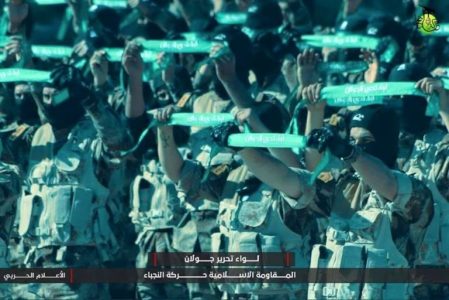
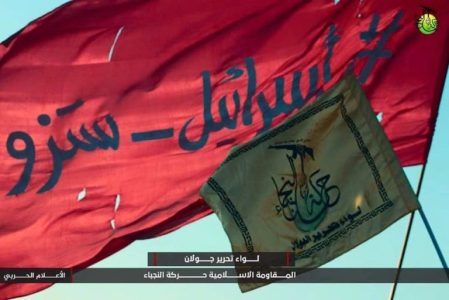
Photo 1: Harakat al Nujaba Golan Liberation Brigade, as portrayed in propaganda video.

The IRGC’s goals in southern Syria are to crush Syrian opposition forces, and build the capability to open another front against Israel. The IRGC hopes a viable Golan foothold would serve as deterrence against Israel and US, and that it could activate in a future conflict, such as another Israel-Hezbollah war. For now, the IDF’s fortified posture in the Golan remains a difficult, if not futile, target for the Guard and its allies. The IRGC nevertheless intends to project steadfast commitment to ideological principles and defiance of adversaries.

*****************************

The Iranian-controlled Iraqi militia Harakat al Nujaba this week announced the formation of its “Golan Liberation Brigade.” While it is not uncommon for entities to name themselves after areas they aim to “liberate,” the militia’s spokesman has said that the unit could assist the Syrian regime in taking the Golan Heights, a region in the Levant that has been controlled by Israel since the 1967 Six-Day War.

If true, the unit would likely participate in a future offensive to capture territory from Syrian opposition in the part of the Golan Heights still controlled by Syria, before moving on to the much taller order of dislodging the Israelis across the border. This week’s announcement reflects Tehran’s priorities in southern Syria since finally taking the fiercely contested city of Aleppo late last year: crush Syrian opposition, and pose military threat to Israel from the Golan Heights. While the Islamic Republic is incapable of credibly challenging the Jewish state’s fortress in the Golan, reaffirming ideological commitment to fighting Israel signals defiance to a global audience amid a reportedly converging American-Arab-Israeli military alliance against Tehran.

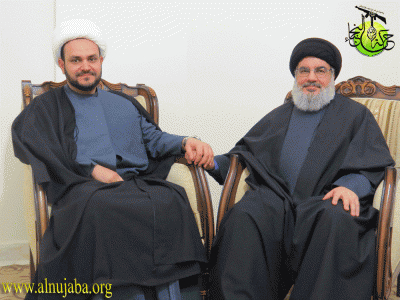
Harakat al Nujaba, or Movement of the Noble, has sustained operations in the Syrian and Iraqi combat zones. An offshoot of the Iranian-backed militias Asaib Ahl al Haq and the Hezbollah Brigades, Harakat al Nujaba was formed in 2013 to fight in the Syrian Civil War as part of Iranian-led Iraqi expeditionary forces. The militia joined the Popular Mobilization Forces, the umbrella organization of Iraqi militia, the following year, after the Islamic State incursion into Iraq. Operating as one of the largest Iraqi-Shiite militia contingents in Syria, the militia has claimed to field 10,000 forces. Harakat al Nujaba played an important role in assisting Iran’s Islamic Revolutionary Guard Corps (IRGC) and pro-Syrian regime forces conquer Aleppo late last year.

The Iraqi militia functions as an extension of the Islamic Republic. Having sworn full allegiance to Iran’s Supreme Leader, Ayatollah Ali Khamenei, the militia promotes velayat-e faqih (guardianship of jurisprudence), the Islamic Republic’s founding ideology. Harakat al Nujaba takes direct orders from Major General Qassem Soleimani, the chief of the IRGC extraterritorial branch the Qods Force. Last year, the Iraqi militia, which is also known as Harakat Hezbollah al Nujaba, proclaimed that it and Lebanese Hezbollah, Iran’s most powerful foreign militia, were “the twins of resistance.”

The militia leader Akram al Kabi is close to the top Iranian leadership, including the supreme leader. A co-founder of the Asaib Ahl al Haq – itself an offshoot of the Mahdi Army – Kabi was designated in September 2008 by the US Treasury as a terrorist for aiding Iraqi insurgents. In 2015, he openly said he would depose the Iraqi government if Khamenei issued the order. Last year, top Iranian officials close to Khamenei gave Kabi a highly publicized reception in Tehran, unprecedented in scope and scale for a militia leader. This past December, Harakat al Nujaba publicized Kabi’s meeting with Khamenei on the sidelines of a conference in Tehran.

Harakat al Nujaba has divulged some details about the Golan Liberation Brigade. The commander of the militia’s forces in Syria released a statement declaring the unit to be a synthesis of combat experiences gained in Lebanon, Syria and Iraq. The militia’s official spokesman confirmed the event as a press conference March 8 in Tehran at the IRGC-affiliated Tasnim News Agency, saying the unit was formed following “recent victories” (an implicit reference to Aleppo). He claimed the Golan unit is comprised of “special” forces.

“Should the Syrian government make the request, we are ready to participate in the liberation of occupied Golan with our allies,” the spokesman said. “We will not permit the soil of Arab countries to remain in the grasps of occupiers.”

Harakat al Nujaba also released a video promoting the Golan unit that showed fighters marching in columns and carrying a banner reading, “Israel will be destroyed.”

(The video is at the link. — DM)

Tehran’s goal of establishing a foothold in the Golan Heights is not a secret. Last year, the head of the Israeli foreign and defense legislative committee revealed without divulging details that Israel had repelled several Iran-directed attempts to move forces into Syrian Golan Heights.

Senior Iranian military commanders are known to operate in Syrian Golan. Last July, the then-commander of the IRGC Basij paramilitary publicized an inspection of Quneitra by the Israel border. In January 2015, an Israeli strike in the area killed several high-value targets including IRGC Brigadier General Mohammad Ali Allah-Dadi and multiple Hezbollah operatives.

A chasm remains between the capabilities and ambitions of Harakat al Nujaba and the IRGC to retake the Golan from Israel. The combined forces of the Syrian regime and IRGC-led militias are no match for the Israel Defense Forces (IDF), and this disparity is expected to hold for the foreseeable future. Israel could also adopt a more proactive approach in Syria to foil IRGC encroachment by the Golan, for example coordinating with Syrian rebels positioned in the area. Syrian Golan’s flat geography furthermore denies the IRGC suitable terrain to replicate the southern Lebanon model of concealing rocket launch sites dispersed across a widespread area, making it easier for the IDF to search and destroy weapons systems. For years, the IDF has been fortifying positions in the rocky plateau of Golan to face greater capabilities than the IRGC and its allies can muster.

Yet the claim to retake Israeli Golan underscores Harakat al Nujaba’s ideological commitment to the IRGC’s and Khamenei’s declared goal of destroying Israel. Khamenei and his top Guard generals have frequently spoken that that the divine hand would aid the faithful who take steps towards “divine-inspired” ideological principles.

Brandishing the formation of the Golan unit also challenges Arab countries on the Palestinian issue, as the Tehran has accused them of abandoning the cause in service of Israel. The Islamic Republic has slammed reported Arab-Israeli rapprochement and talks to form a US-brokered military coalition with the goal of countering Tehran, as covered in The Wall Street Journal. Last month, top Iranian government officials hosted another round of the Support of Palestinian Intifada Conference in a show of unity and defiance. This past week, Tehran’s interim Friday prayer leader this week excoriated “some leaders in Islamic countries who are with Zionists,” calling them “not human.” Suffering from loss of legitimacy over support of Syrian President Bashar al Assad against a Sunni-Arab uprising and nervous over a converging Israeli-Arab alliance, the Islamic Republic is projecting to the globe and “sell-out”Arab leaders a defiant commitment to fighting Israel.

The Iraqi militia’s Golan unit and IRGC-led expeditionary forces could help pro-Syrian regime forces take opposition-held areas in the south. In February 2015, IRGC-led forces launched a failed campaign in the Daraa and Quneitra in the south. Since conquering Aleppo last year, the IRGC-led expeditionary forces and other pro-Syrian regime forces have been able to redirect their dwindling assets to several fronts in north, central, and south Syria. Pro-regime forces backed by Russian air power have been pounding Daraa in the south for more than a month to slow an opposition offensive, and have recently launched a new bid to capture it. An IRGC colonel was also killed last month in the area. A pro-Syrian regime propaganda outlet late last month reaffirmed the government’s intention to retake all of Daraa and open a major border crossing with Jordan. Meanwhile, pro-regime forces have made progress in the northern pocket of Quneitra Governorate, located in the Syrian-controlled part of the Golan.

Map 1: southern Syria front, March 2017. Red: pro-Syrian regime forces. Green: rebel forces including Free Syrian Army and al Qaeda-affiliate Jabhat Fath al Sham. Black: Islamic State affiliates. Credit: Liveuamap.

The IRGC’s goals in southern Syria are to crush Syrian opposition forces, and build the capability to open another front against Israel. The IRGC hopes a viable Golan foothold would serve as deterrence against Israel and US, and that it could activate in a future conflict, such as another Israel-Hezbollah war. For now, the IDF’s fortified posture in the Golan remains a difficult, if not futile, target for the Guard and its allies. The IRGC nevertheless intends to  project steadfast commitment to ideological principles and defiance of adversaries.

Photo 2.
Photo 3: Harakat al Nujaba Golan Liberation Brigade flag at front, and “Israel will burn” banner in the back.

Amir Toumaj is a Research Analyst at Foundation for Defense of Democracies.