Posted tagged ‘Al Qaeda’

Afghanistan’s terrorist resurgence: Al Qaeda, ISIS, and beyond

April 27, 2017

Afghanistan’s terrorist resurgence: Al Qaeda, ISIS, and beyond, Long War Journal, April 27, 2017

More than 15 years after the U.S. military invaded Afghanistan to destroy al-Qaeda, the group maintains a persistent and significant presence in the country. Despite the Obama administration’s surge of U.S. forces in Afghanistan from 2010 to 2012, the Taliban, which has maintained its close alliance with al-Qaeda, is resurgent and today holds more ground in the country since the U.S. ousted the jihadists in early 2002.

And the threat posed by jihadist groups in Afghanistan has expanded. The Islamic State has established a small, but significant, foothold in the country. Pakistani jihadist groups that are hostile to the U.S. – such as the Movement of the Taliban in Pakistan, Lashkar-e-Taiba, and Harakat-ul-Muhajideen – operate bases inside Afghanistan as well.

For nearly seven years, the Obama administration wrote off al-Qaeda as a spent force. The group has been described as “decimated.” After Osama bin Laden was killed in Pakistan, President Obama said the “core of al-Qaeda in Pakistan and Afghanistan is on a path to defeat.” The Obama administration pushed this narrative hard, with many counterterrorism analysts adopting the line that al-Qaeda was either defeated or close to it.

Between 2010 and 2016, Obama administration officials, including CIA Director Leon Panetta, as well as other U.S. military and intelligence officials, characterized al-Qaeda’s presence in Afghanistan as minimal and consistently told the American public that the group has a presence of just 50 to 100 fighters. “I think at most, we’re looking at maybe 50 to 100, maybe less. It’s in that vicinity. There’s no question that the main location of al-Qaeda is in tribal areas of Pakistan,” Panetta said on ABC News This Week.


***********************************

Editor’s note: Below is Bill Roggio’s testimony before the House Committee on Foreign Affairs Subcommittee on Terrorism, Nonproliferation. A PDF of the testimony, with footnotes, can be downloaded here.

Chairman Poe, Ranking Member Keating, and other members of this subcommittee, thank you for inviting me here today to speak about the terrorist groups based in Afghanistan and their continuing threat to U.S. national security.

More than 15 years after the U.S. military invaded Afghanistan to destroy al-Qaeda, the group maintains a persistent and significant presence in the country. Despite the Obama administration’s surge of U.S. forces in Afghanistan from 2010 to 2012, the Taliban, which has maintained its close alliance with al-Qaeda, is resurgent and today holds more ground in the country since the U.S. ousted the jihadists in early 2002.

And the threat posed by jihadist groups in Afghanistan has expanded. The Islamic State has established a small, but significant, foothold in the country. Pakistani jihadist groups that are hostile to the U.S. – such as the Movement of the Taliban in Pakistan, Lashkar-e-Taiba, and Harakat-ul-Muhajideen – operate bases inside Afghanistan as well.

U.S. Estimates on al-Qaeda in Afghanistan Were Incorrect

For nearly seven years, the Obama administration wrote off al-Qaeda as a spent force. The group has been described as “decimated.” After Osama bin Laden was killed in Pakistan, President Obama said the “core of al-Qaeda in Pakistan and Afghanistan is on a path to defeat.” The Obama administration pushed this narrative hard, with many counterterrorism analysts adopting the line that al-Qaeda was either defeated or close to it.

Between 2010 and 2016, Obama administration officials, including CIA Director Leon Panetta, as well as other U.S. military and intelligence officials, characterized al-Qaeda’s presence in Afghanistan as minimal and consistently told the American public that the group has a presence of just 50 to 100 fighters. “I think at most, we’re looking at maybe 50 to 100, maybe less. It’s in that vicinity. There’s no question that the main location of al-Qaeda is in tribal areas of Pakistan,” Panetta said on ABC News This Week.

This assessment, which contradicted the U.S. military’s own press releases announcing raids against al-Qaeda in Afghanistan, was consistently repeated by U.S. intelligence and military officials. In June 2015, the U.S. military claimed in its biannual Enhancing Security and Stability in Afghanistan report that al-Qaeda “has a sustained presence in Afghanistan of probably fewer than 100 operatives concentrated largely in Kunar and Nuristan Provinces, where they remain year-round.” The December 2015 report claimed that al-Qaeda is “primarily concentrated in the east and northeast.

This estimate of al-Qaeda’s strength, which consistently downplayed al-Qaeda’s presence in Afghanistan, came crashing down in mid-October 2015, when the U.S. military and Afghan forces orchestrated a large-scale operation against two al-Qaeda camps in the Shorabak district in the southern Afghan province of Kandahar.

The scale of al-Qaeda’s presence at the two camps in Shorabak quickly disproved the longstanding 50 to 100 estimate. A U.S. military statement, quoting spokesman Brigadier General Wilson Shoffner, described the raid as “one of the largest joint ground-assault operations we have ever conducted in Afghanistan.” It took U.S. and Afghan forces more than four days to clear the two camps, with the aid of 63 airstrikes.

Shoffner’s description of the al-Qaeda facilities indicated that they had been built long ago. “The first site, a well-established training camp, spanned approximately one square mile. The second site covered nearly 30 square miles,” Shoffner said. “We struck a major al-Qaeda sanctuary in the center of the Taliban’s historic heartland,” he added.

Weeks later, General John F. Campbell, then the commander of U.S. Forces – Afghanistan and NATO’s Resolute Support mission, described one of the camps, which was run by al-Qaeda in the Indian Subcontinent (AQIS), al-Qaeda’s branch in South Asia, as “probably the largest training camp-type facility that we have seen in 14 years of war.”

It has been estimated that at least 150 al-Qaeda fighters were killed during the raids on the two camps in Shorabak. This is 50 more al-Qaeda fighters than the upper end of the Obama administration’s estimate of al-Qaeda’s strength throughout all of Afghanistan. And the al-Qaeda members were killed in southern Afghanistan, not in the northeastern provinces of Kunar and Nuristan, where we have been told they were concentrated.

The U.S. military was ultimately forced to concede its estimate of al-Qaeda’s strength in Afghanistan was wrong. In mid-December 2016, General Nicholson admitted that the U.S. military killed or captured 50 al-Qaeda leaders and an additional 200 operatives during calendar year 2016 in Afghanistan.

In April 2016, Major General Jeff Buchanan, Resolute Support’s deputy chief of staff, told CNN that the 50 to 100 estimate was incorrect based on the results of the Shorabak raid. “If you go back to last year, there were a lot of intel estimates that said within Afghanistan al-Qaeda probably has 50 to 100 members, but in this one camp we found more than 150,” he said. The estimate of al-Qaeda operatives in Afghanistan was revised upwards to about 300.

However, well before the Shorabak raids, it was evident to those of us closely watching the war in Afghanistan that al-Qaeda was stronger in Afghanistan than the official estimates, and was not confined to small areas in the northeast. Al-Qaeda consistently reported on its operations throughout Afghanistan, and the U.S. military, up until the summer of 2013, reported on raids against al-Qaeda cells in multiple provinces.

Surely, there was something seriously wrong with the CIA and the U.S. military’s ability to properly report on al-Qaeda’s presence in Afghanistan.

Al-Qaeda’s footprint inside Afghanistan remains a direct threat to U.S. national security and, with the resurgence of the Taliban, it is a threat that is only growing stronger.

The Enduring Taliban-al-Qaeda Relationship

Al-Qaeda’s presence in Afghanistan has not occurred in a vacuum. It has maintained its strength in the country since the U.S. invasion, launched a new branch, AQIS, and established training camps with the help and support of the Taliban.

When Generals Campbell and Buchanan discussed al-Qaeda in the wake of the Shorabak raid, they described the group as resurgent. Campbell described the Taliban-al-Qaeda relationship as a “renewed partnership,” while Buchanan said it “has since ‘grown stronger.’”

But like the estimate that al-Qaeda maintained a small cadre of 50 to 100 operatives in Afghanistan between 2010 and 2016, the idea that the Taliban and al-Qaeda have only recently reinvigorated their relationship is incorrect. Al-Qaeda would not have been able to maintain a large cadre of fighters and leaders inside Afghanistan, conduct operations in 25 of Afghanistan’s 34 provinces, establish training camps, and relocate high-level leaders from Pakistan’s tribal areas to Afghanistan without the Taliban’s long-term support.
Al-Qaeda has remained loyal to the Taliban’s leader, which it describes as the Amir al- Mumineen, or the “Commander of the Faithful,” since the U.S. invaded Afghanistan in 2001. Osama bin Laden maintained his oath of allegiance to Mullah Omar, the Taliban’s founder and first emir. When bin Laden died, Ayman al-Zawahiri renewed that oath. And when Mullah Omar’s death was announced in 2015, Zawahiri swore bayat (an oath of allegiance) to Mullah Mansour, the Taliban’s new leader. Mansour publicly accepted Zawahiri’s oath.

The close relationship between the two jihadist groups is also evident with the assent of the Taliban’s new deputy emir, Sirajuddin Haqqani, who leads the powerful Taliban subgroup known as the Haqqani Network. Sirajuddin and the Haqqani Network have maintained close ties to al-Qaeda for years. The relationship is evident in the U.S. government’s designations of multiple Haqqani Network leaders. Two documents seized from Osama bin Laden’s compound show that Siraj has closely coordinated his operations with al-Qaeda in Afghanistan and Pakistan.

The Taliban-al-Qaeda relationship remains strong to this day. And with the Taliban gaining control of a significant percentage of Afghanistan’s territory, al-Qaeda has more areas to plant its flag.

Rise of the Islamic State

Shortly after Abu Bakr al-Baghdadi declared the establishment of the caliphate in 2014, announcing the formation of the Islamic State, a small number of disgruntled jihadists from the Afghan and Pakistani Taliban, as well as al-Qaeda, discarded their oaths to the Taliban, pledged their fealty to Baghdadi, and established the so-called Khorasan province.

While the Islamic State dominates the jihad in Iraq and is a major player in Syria, the group has posed a smaller threat in Afghanistan and Pakistan when compared to the Taliban, al-Qaeda, and their jihadist allies. The U.S. military estimated the group had upwards of 2,000 fighters at the beginning of 2016, but had lost between 25 and 30 percent of its men in the months that followed. While U.S. military estimates of the strength of jihadist groups in Afghanistan must be taken with a grain of salt, this number is likely in the right ballpark.
The Islamic State has a much smaller presence in Afghanistan when compared to the Taliban. While the Taliban controls or contests more than 200 of Afghanistan’s 400 districts, the Islamic State only controls terrain in several districts in the eastern province of Nangarhar. The group also reportedly has a presence in the Afghan north.

The Islamic State’s Khorasan province has remained entrenched in Nangarhar and has withstood multiple U.S.-backed offensives over the past two years. The U.S. military has had success in killing key leaders, but the group has proven resilient.

Still, the so-called caliphate’s Khorasan province has remained on the margins of the Afghan war. It has conducted a limited number of suicide attacks and other operations in the Afghan capital of Kabul and elsewhere, but has not come close to matching the Taliban’s operational tempo.

Khorasan province has had a difficult time gaining traction throughout much of Afghanistan and Pakistan, as it is unwilling to cooperate with other, long-entrenched jihadist groups. In fact, the Taliban crushed the Khorasan province’s forces in Helmand, Farah, and Zabul after they demanded that the Taliban’s fighters swear allegiance to Baghdadi.

Pakistani Jihadist Groups Operating in Afghanistan

In addition to the Taliban, al-Qaeda, and the Islamic State, numerous Pakistan-based jihadist groups are known to operate in Afghanistan. For the most part, these organizations remain in the Taliban and al-Qaeda sphere, and leaders of the groups often backfill leadership positions when al-Qaeda commanders are killed in U.S. airstrikes.

The three largest Pakistani groups operating in Afghanistan are the Movement of the Taliban in Pakistan, Lashkar-e-Taiba, and Harakat-ul-Muhajideen.

The Movement of the Taliban in Pakistan (TTP) is largely made up of Taliban groups from Pakistan’s tribal areas. It is closely allied with the Afghan Taliban and al-Qaeda. In 2010, the TTP organized the Times Square bombing plot.

The TTP has taken advantage of the turbulent and ungoverned Afghan-Pakistani border to shift its base of operations when the Pakistani military targets it in offensives. The U.S. has killed several TTP leaders in airstrikes in Afghanistan.

Lashkar-e-Taiba (LeT) is a dangerous jihadist group that is backed by Pakistan’s military and Inter-Services Intelligence Directorate. The LeT is known to operate training camps in Afghanistan and attacked the Indian Consulate in Herat in 2014.26 The U.S. has killed several senior LeT operatives in airstrikes in northeastern Afghanistan over the years. The U.S. has also listed several senior LeT operatives, including Hafiz Saeed, the group’s emir, as Specially Designated Global Terrorists.

Harakat-ul-Mujahideen (HuM) is another Pakistani jihadist group that is known, as of August 2014, to operate training camps in Afghanistan.27 HuM has been involved in numerous acts of terror in the region, including hijacking an Indian airplane, attacking the U.S. Consulate in Karachi, and murdering Wall Street Journal reporter Daniel Pearl.

Al-Qaeda Mocks Arabs for Submitting to Haley’s ‘Kick in High Heels’

April 21, 2017

Al-Qaeda Mocks Arabs for Submitting to Haley’s ‘Kick in High Heels’, PJ Media, Bridget Johnson, April 20, 2017

U.S. Ambassador to the UN Nikki Haley speaks with media at UN Headquarters in New York on April 20, 2017. (Albin Lohr-Jones/Sipa via AP Images)

Al-Qaeda mocked Arab rulers for being at the mercy of “the kicks of the high heels” of Ambassador Nikki Haley after her warning that things are going to change at the United Nations.

“I wear heels. It’s not for a fashion statement. It’s because if I see something wrong, we’re going to kick them every single time,” Haley said in a speech at the American Israel Public Affairs Committee conference last month in Washington.

“So how are we kicking? We’re kicking by, No. 1, putting everybody on notice, saying that if you have our back, we’re going to have the backs of our friends. But our friends need to have our backs, too,” she continued. “If you challenge us, be prepared for what for what you are challenging us for because we will respond.”

In the most recent issue of al-Qaeda’s al-Nafir Bulletin, published in several languages and distributed online by the Global Islamic Media Front, the terror group said “the representative of the bearer of the Cross America” — Haley — “sent a message to the apostate Arab rulers filled with sarcasm and mockery.”

The bulletin added that America was “the Hubal of the era to its worshippers the Arab rulers,” referring to a moon god worshipped at Mecca before Islam.

“You will not go beyond your worth, and you will receive a kick in high heels as punishment for any statement… that criticizes the Zionists,” they summarized Haley’s message to Arab rulers after quoting her directly.

“American and its Crusader allies will never allow anyone to stand before their support of the Zionists and the apostates of the Arabs and foreigners from the Muslim rulers, and they will not accept to end their robbery of the fortunes and resources of the Ummah [Muslim community], and that any Islamic project that seeks to establish the Shariah, and spread justice, and distribute fairly the fortunes of the Ummah, will face bombs and guided rockets, with the supporter of the apostate rulers who are ready to receive the kicks of the high heels from the Zionist Haley in case they go beyond the allowed limit, and gave wrong criticisms of the nation of the sons of Zion,” the bulletin stated.

Al-Qaeda added that the only “salvation” for Muslims “out of this delusion in the sea of weakness” was “targeting the real enemy.”

“O youth of Islam, attack global infidelity headed by America, and show Allah what is required of you,” the terror group told followers. “Shake their thrones, and bring down their interests, and target their great criminals.”

Al-Qaeda has previously used issues of the al-Nafir Bulletin to call for action against the United States. In February, the terror group accused the U.S. of withholding necessary medication from “Blind Sheikh” Omar Abdel-Rahman, the mastermind of the deadly 1993 World Trade Center bombing who died behind bars that month.

They also released a final statement from the sheikh complaining of strip searches that explored his private parts “front and back,” claiming that he could be poisoned behind bars and calling for “the most powerful and violent revenge” in the event of his demise.

Last month, the bulletin told jihadists to go forth and just kill Americans without any Islamic consultations first. Al-Qaeda called a U.S. airstrike that struck a mosque complex in Al-Jinah, Syria, “a horrible crime among the crimes of America and its damned president, Trump.”

What’s really behind Trump’s laptop ban

March 23, 2017

What’s really behind Trump’s laptop ban, Long War Journal, , March 23, 2017

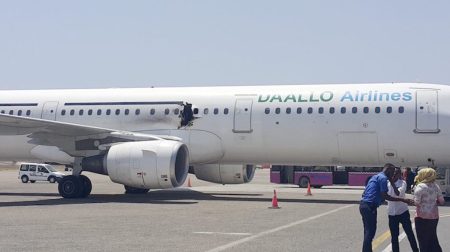
Shabaab, al Qaeda’s branch in Somalia, detonated a laptop bomb on this Daallo Airlines aircraft in February 2016.

[Editor’s note: this article was originally published at Politico.]

More than 15 years after the September 11 hijackings, the U.S. government has issued yet another warning about airline security. On Tuesday, the Department of Homeland Security (DHS) announced new restrictions on electronics brought on board certain U.S.-bound flights. Passengers on planes leaving from 10 airports throughout the Middle East and North Africa will no longer be able to carry laptops or similar electronics with them into the cabin of the plane. Cell phones and smaller electronics are unaffected by the new measures, but computers will have to be checked in luggage.

The move instantly generated controversy and questions. Namely, why now? Some dismissed the DHS announcement as a protectionist move aimed at boosting the futures of U.S. carriers, who have complained of unfair competition from Gulf airlines for years. Twitter wags called it a “Muslim laptop ban,” whose secret aim was to discourage travel from the Arab world. But by now it should be clear that the new restrictions are deadly serious, even if there are legitimate questions about how it is being implemented.

Initial press reports, including by the New York Times, cited anonymous officials as saying that the restrictions were not a response to new intelligence. But the DHS announcement implies otherwise. One question on the DHS web site reads, “Did new intelligence drive a decision to modify security procedures?” The answer: “Yes, intelligence is one aspect of every security-related decision.” The British government’s quick decision to follow suit also suggests that something new is afoot here.

Subsequent reports from CNN and The Daily Beast indicate that intelligence collected during a U.S. Special Forces raid in Yemen in January led to the restrictions. That is possible. The raid was highly controversial, but the Trump administration argues the costs were worth it because the U.S. learned key details about al Qaeda in the Arabian Peninsula’s (AQAP) plotting. A Navy SEAL perished during the operation, as did a number of women and children. Within hours, jihadists began circulating a photo of an adorable little girl who died in the crossfire. The girl was the daughter of Anwar al Awlaki, a Yemeni-American al Qaeda ideologue killed in a September 2011 drone strike. Al Qaeda immediately called for revenge in her name.

Whether new intelligence led to the decision or not, we already know for certain that al Qaeda has continued to think up ways to terrorize the skies. For years, Al Qaeda operatives in Somalia, Syria, Yemen and elsewhere have been experimenting with sophisticated explosives that can be smuggled onto planes.

DHS points to the “attempted airliner downing in Somalia” in February 2016 as one reason for ongoing concerns. That bombing was carried out by al Shabaab, al Qaeda’s official branch in Somalia. Al Shabaab attempted to justify the failed attack by claiming “Western intelligence officials” were on board the flight, but that excuse may be a cover for something more sinister.

Some U.S. officials suspect that al Qaeda’s elite bomb makers wanted to test one of their newest inventions, a lightweight explosive disguised as a laptop that is difficult to detect with normal security procedures. At the very least, Shabaab’s attack demonstrated that al Qaeda has gotten closer to deploying a laptop-sized explosive that can blow a hole in jetliners. While no one other than the terrorist who detonated the bomb was killed, the plane was left with a gaping hole in its side.

Al Qaeda-linked terrorists have tested their contraptions before. In December 1994, a bomb was detonated on board a Philippine Airlines flight, killing one of the passengers and severely damaging the plane. The device was implanted by Ramzi Yousef, the nephew of 9/11 mastermind Khalid Sheikh Mohammed. Yousef planned to blow up several airliners at once as part of “Project Bojinka” and he wanted to try out his invention beforehand. Authorities ultimately scuttled his plot, but al Qaeda didn’t forget Yousef’s idea. Instead, the terrorist organization returned to it again in 2006, when a similar plan targeting jets leaving London’s Heathrow Airport was foiled.

Al Qaeda’s failure in 2006 didn’t dissuade the group from pressing forward with a version of Yousef’s original concept, either.

In September 2014, the U.S. began launching airstrikes against an al Qaeda cadre in Syria described by the Obama administration as the “Khorasan Group.” There was some initial confusion over what the Khorasan Group really is, with some opining that it was simply invented by American officials to justify bombings, or a separate terror entity altogether. In reality, it was simply a collection of al Qaeda veterans and specialists who were ordered by the group’s leader, Ayman al Zawahiri, to begin laying the groundwork in Syria for operations against the West.

As far as we know, the Khorasan Group never did attempt to strike the U.S. or Europe. Perhaps this is because a number of its leaders and members were killed in the drone campaign. But there is an additional wrinkle in the story: Zawahiri didn’t give his men the final green light for an operation. Instead, Zawahiri wanted the Khorasan cohort to be ready when called upon. In the meantime, al Qaeda didn’t want an attack inside the West to jeopardize its primary goal in Syria, which is toppling Bashar al Assad’s regime.

The Islamic State gets all the headlines, but Al Qaeda has quietly built its largest guerrilla army ever in Syria, with upwards of 10,000 or more men under its direct command. The group formerly known as Jabhat al Nusra merged with four other organizations to form Hay’at Tahrir al Sham (“Assembly for the Liberation of Syria”) in January. Brett McGurk, the special presidential envoy for the anti-ISIS coalition, told the Senate Foreign Relations Committee months earlier, in June 2016, that Nusra was already al Qaeda’s “largest formal affiliate in history” with “direct ties” to Zawahiri. The merger gives al Qaeda control over an even larger force.

Al Qaeda could easily repurpose some of these jihadists for an assault in Europe, or possibly the U.S., but has chosen not to thus far. That is telling. Zawahiri and his lieutenants calculated that if Syria was turned into a launching pad for anti-Western terrorism, then their efforts would draw even more scrutiny. At a time when the U.S. and its allies were mainly focused on ISIS, al Qaeda’s potent rival, Zawahiri determined the West could wait.

But Zawahiri’s calculation with respect to Syria could change at any time. And the organization maintains cadres elsewhere that are still plotting against the U.S. and its interests.

The Khorasan Group included jihadists from around the globe, including men trained by AQAP’s most senior bomb maker, a Saudi known as Ibrahim al Asiri. U.S. officials have fingered al Asiri as the chief designer of especially devious explosive devices. Al Asiri has survived multiple attempts to kill him. But even if the U.S. did catch up with al Asiri tomorrow, his expertise would live on. Some of his deputies have trained still others in Syria.

Al Qaeda now has units deployed in several countries that are involved in anti-Western plotting. Testifying before the Senate Armed Services Committee in February 2016, Director of National Intelligence James Clapper warned that al Qaeda “nodes in Syria, Pakistan, Afghanistan, and Turkey” are “dedicating resources to planning attacks.”

The Pentagon regularly announces airstrikes targeting al Qaeda operatives, some of whom, identified as “external” plotters, have an eye on the West. Incredibly, more than a decade and a half after the 9/11 hijackings, al Qaeda members in Afghanistan are still involved in efforts to hit the U.S. In October 2016, for instance, the U.S. struck down Farouq al Qahtani in eastern Afghanistan. The Defense Department explained that Qahtani was “one of the terrorist group’s senior plotters of attacks against the United States.”

Meanwhile, ISIS has also proven it is capable of downing an airliner. Thus far, ISIS leader Abu Bakr al Baghdadi’s men have used low-tech means. In October 2015, the so-called caliphate’s Sinai province claimed the bombing of a Russian airliner. If the group’s propaganda is accurate, then a Schweppes Gold soft drink can filled with explosives and equipped with a detonator led to the deaths of all 224 people on board. This beverage bomb was a far cry from the sleek explosives al Qaeda’s bomb makers have been experimenting with, but it was effective nonetheless. All it required was proper placement next to a fuel line or some other sensitive point in the airliner’s infrastructure. ISIS could have more sophisticated bomb designs in the pipeline as well.

The truth is that the threat to airliners isn’t going away any time soon. However, this doesn’t mean that every counterterrorism measure intended to protect passengers is the right one. Some quickly questioned the Trump administration’s policy. Why does it impact only flight carriers in some countries? Were security measures found to be lax in some airports, but not others? Why is the threat of a laptop bomb mitigated if it is in checked luggage, as opposed to on board the plane? And what about the possibility of al Qaeda or ISIS slipping a bomb onto connecting flights, before the planes head for the U.S. homeland?

These are all good questions that should be asked. And the Trump administration should answer them.

Before US whacks ISIS-Syria, Al Qaeda is resurgent

March 13, 2017

Before US whacks ISIS-Syria, Al Qaeda is resurgent, DEBKAfile, March 13, 2017

After the breakup of defeated Syrian rebel groups, who were forced to leave the northern town and head for neighboring Idlib, hundreds of rebels remained and refused to lay down arms. Instead, they joined Al Qaeda and have made the Islamist terrorist group the most powerful independent rebel force still fighting in northern Syria as well as in the surrounding areas of the main towns, including Damascus, Homs and Hama.

********************************

The main thrust of the campaign against the Islamic State in Syria ordered by the Trump administration is still ahead, but ISIS forces did not wait in their Raqqa stronghold for the axe to fall. They moved southeast into the Deir ez-Zour region, where they are beating back Hizballah’s elite Radwan Battalion, which has just been deployed there.

But meanwhile a new-old menace has raised its head: Al Qaeda and its Syrian affiliates which are seizing upon the mounting upheaval in the Syria for a fresh wave of terror. Saturday, March 11, two bomb explosions killed 74 pilgrims, most of them Iraqi Shiites, on a visit to an ancient cemetery in the Old City of Damascus. The second explosion was delayed so as to hit full on the Syrian police and rescuers rushing to the scene.

The same Al Qaeda branch planned and perpetrated the large-scale terrorist attack on Syrian government military facilities in the town of Homs on Feb. 25. Two generals were among the scores of dead troops.

Counterterrorism experts are warning US President Donald Trump to tread very carefully in the offensive he is preparing to launch against ISIS in Syria, since this organization’s defeat may well open the door to an Al Qaeda comeback in full and deadly spate to the Syrian arena.

This is what happened in the wake of the Russian-led Syrian victory in Aleppo in January, DEBKAfile’s military and intelligence sources note. After the breakup of defeated Syrian rebel groups, who were forced to leave the northern town and head for neighboring Idlib, hundreds of rebels remained and refused to lay down arms. Instead, they joined Al Qaeda and have made the Islamist terrorist group the most powerful independent rebel force still fighting in northern Syria as well as in the surrounding areas of the main towns, including Damascus, Homs and Hama.

On Jan. 26, Al Qaeda announced its merger with four smaller factions under another new brand name, Hayat Tahrir al-Sham (Liberation of the Levant Organization). The new outfit attracted many new recruits who had never before been attached to Al Qaeda.

Hashim al-Sheikh aka Abu Jabir, who fought the Americans in the Iraq war under Abu Mussab al-Zarqawi, was named leader of the new Islamist terror alliance. Reputed to be a skilled war tactician who never gives up, his appointment attracted another wave of Syrian rebel fighters.

Al Nusra’s first commander, Abu Mohammad al-Joulani, has meanwhile reappeared as head of a group calling itself Hay’at Tahrir al-Sham. Joulani has tried claiming he operates independently of Al Qaeda, although in fact he follows the orders of Ayman Al-Zawahiri to the letter and, according to some sources, is secretly working hand in glove with Hashim al-Sheikh.

An additional source of Al Qaeda’s renewed strength comes from the success of the combined Russian-Iranian-Hizballah forces to smash all the Syrian rebel groups who once fought the jihadist organization. Their disintegration has left Zawahiri’s following in Syria without effective adversaries. But it has Its Achilles heel too in the turf wars among the Syrian branch’s component groups – especially in the northern Idlib Province.

According to our military sources, the Russian, Syrian, Iranian and Hizballah commanders are together weighing an operation for taking control of Idlib. However, there too, if the Syrian rebels, who are fugitive from other fronts, are driven east or the south, Al Qaeda may again turn out to be the winner..

Therefore, even if President Trump and his generals are resolved to focus fully on a military operation to capture the ISIS stronghold of Raqqa – which has meanwhile emptied out of fighter – it is essential to detach enough fighting strength for dealing with the resurgent Al Qaeda. Failing to do so would leave the US forces at the Raqqa front vulnerable to attack from the rear by Al Qaeda, as the Russians and Iranians have found since they conquered Aleppo.

US blitzes AQAP in Yemen with an unprecedented 30 airstrikes

March 5, 2017

US blitzes AQAP in Yemen with an unprecedented 30 airstrikes, Long War Journal, March 4, 2017

The large number of strikes over a short period of time indicates the US is changing its tactics in fighting AQAP in Yemen. The US military previously described AQAP as one of the most dangerous terrorist networks that is determined to strike US interests, yet it had been overly cautious in targeting the group. Over the previous five years, the US military averaged just two to three strikes against AQAP a month.

***************************************

The US military has launched more than 30 airstrikes against al Qaeda’s branch in Yemen in three separate provinces over the last several days. Such a large number of strikes is unprecedented in Yemen and indicates a changing US approach to attacking al Qaeda in the Arabian Peninsula, possibly acting on new intelligence gained from a controversial raid by US special operations forces in late January.

It is unknown how many AQAP fighters were killed during the operation. AQAP has not announced the death of any senior leaders.

The Department of Defense announced the airstrikes against al Qaeda in the Arabian Peninsula in a statement attributed to Pentagon spokesman Captain Jeff Davis.

“More than 30 strikes in Yemen” hit “militants, equipment and infrastructure in the governorates of Abyan, Al Bayda and Shabwah,” according to the statement.

Davis described the Yemeni government as “a valuable counterterrorism partner” and said the blitz was coordinated with and approved by the government and its president, Abd Rabbo Mansour Hadi. Davis noted that AQAP continues to use “ungoverned spaces in Yemen to plot, direct, and inspire terror attacks against the United States and our allies.”

The attacks “will degrade the AQAP’s ability to coordinate external terror attacks and limit their ability to use territory seized from the legitimate government of Yemen as a safe space for terror plotting,” according to the statement.

The latest press release also described AQAP as an “extremely dangerous al Qaeda affiliate.”

With the more than 30 strikes against AQAP over the past several days and an additional five in January, the US has already come close in the first two-plus months of 2016 to exceeding the average number of yearly strikes since the program began in 2009. Only two other years (38 in 2016 and 41 in 2012) have a higher strike total.

The large number of strikes over a short period of time indicates the US is changing its tactics in fighting AQAP in Yemen. The US military previously described AQAP as one of the most dangerous terrorist networks that is determined to strike US interests, yet it had been overly cautious in targeting the group. Over the previous five years, the US military averaged just two to three strikes against AQAP a month.

Additionally, the military may have obtained more information about AQAP’s network and exploited it with a series of quick hits over a short period of time to shock the group. The US military and the Trump administration claimed that a controversial raid by US special operations forces against AQAP in Al Baydah province in January netted significant intelligence. One US Navy Seal, two senior AQAP leaders, and at least 13 civilians, including the eight year old daughter of slain radical AQAP cleric Anwar al Awlaki, were among those killed during the raid, which quickly evolved into a heavy firefight that also resulted in the loss of an Osprey aircraft.

Despite years of targeting AQAP, the group retained significant capacity. Davis estimated that AQAP maintains a strength in the “low thousands,” and that the group “can skillfully exploit the disorder in Yemen to build its strength and reinvigorate its membership and training.”

AQAP still controls rural areas of central and southern Yemen despite both attacks from the US and a United Arab Emirates-led ground offensive, which ejected the group from major cities and towns that it held between March 2016 and the summer of 2016. AQAP claims to still operate training camps in Yemen to this day. In mid-July, AQAP touted its Hamza al Zinjibari Camp, where the group trains its “special forces.” Zinjibari was an AQAP military field commander who was killed in a US drone strike in Feb. 2016.

Taliban rejects US general’s call for reconciliation

March 3, 2017

Taliban rejects US general’s call for reconciliation, Long War Journal, March 2, 2017

It is high time that US officials and military commanders put an end to calls for the Taliban to reconcile. After 15 plus years of war, the Taliban has proven to be a committed enemy unwilling to compromise to achieve its objective of ruling Afghanistan again. The Taliban and al Qaeda remain close allies to this day. When US leaders plead with the Taliban to make peace, they deliver the Taliban all of the fodder it needs to score a propaganda victory and show how disillusioned the US remains about their enemy.

********************************

Hours after The FDD’s Long War Journal noted the Taliban would likely reject US General John Nicholson’s call for reconciliation, the Taliban did just that yesterday.

Nicholson, the commander of US Forces – Afghanistan and Resolute Support, was quoted in a press release announcing the death of Mullah Abdul Salam, the Taliban’s shadow emir for Kunduz province:

Salam’s death is an opportunity for change. The people of Afghanistan want peace and the Government of Afghanistan is committed to achieving peace through reconciliation. The Taliban know the only path forward is reconciliation.

US, European, and Afghan officials had been urging the Taliban to reconcile for well over a decade. But the Taliban had proven unwilling to negotiate a peace deal and join the government, even after suffering setbacks.

Taliban spokesman Zabihulllah Mujahid rejected the call for reconciliation in a statement entitled “Response by spokesman of Islamic Emirate to comments by General Nicholson.” Predictably, Mujahid said that the Taliban would fight until NATO forces withdraw from Afghanistan and “accept the lawful demands of the valiant Afghan,” which means the return of a Taliban government. The crux of Mujahid’s argument is quoted at length below:

The Muslim Afghan nation views you Americans with the same eye as the invading English and Soviets and with the blessing of Jihad and help of Allah, will throw you out of their motherland in a similar fashion.

We do not view the martyrdom of Mullah Abdul Salam as failure or regret but as honor and victory which has intensified the thirst for revenge of the people of Kunduz and Afghanistan. It has revealed the truthfulness of the Mujahideen and has further increased the love for Mullah Abdul Salam and his companions in the community. Understand that we are a nation that loves martyrdom in the path of Allah as you love the short life of this fleeting world.

These are not our emotions or assumptions talking but are the realities which forced over one hundred and fifty thousand fully equipped troops to kneel.

If you do not end this occupation and accept the lawful demands of the valiant Afghan nation then this nation (Allah willing) will force you out of Afghanistan as the commander of US and NATO forces with all your might and technology just as this resistance broke, deranged and forced out your most celebrated commanders and experienced generals.

It is high time that US officials and military commanders put an end to calls for the Taliban to reconcile. After 15 plus years of war, the Taliban has proven to be a committed enemy unwilling to compromise to achieve its objective of ruling Afghanistan again. The Taliban an al Qaeda remain close allies to this day. When US leaders plead with the Taliban to make peace, they deliver the Taliban all of the fodder it needs to score a propaganda victory and show how disillusioned the US remains about their enemy.

Al Qaeda back in the crosshairs–and with good reason

February 6, 2017

Al Qaeda back in the crosshairs–and with good reason, Terror Trends Bulletin, Christopher W. Holton, February 5, 2017

map-al-qaeda-2015

There is growing evidence that, not only did Barack Obama allow the Islamic State caliphate to become established and metastasize on his watch, but he also looked the other way while Al Qaeda became resurgent.

Sean Durns over at the Washington Examiner has an article that summarizes how Al Qaeda has spread in recent years…

Al Qaeda, the group responsible for the worst terrorist attack in United States history, never really left. Instead, while news media coverage inordinately focused on the Islamic State, al Qaeda re-tooled and re-established itself for a new age.

To paraphrase Mark Twain, reports of al Qaida’s death were greatly exaggerated. Anticipatory obituaries appeared after the death of al Qaida founder Osama bin Laden on May 2, 2011. Then-President Barack Obama, for instance, said on Sept. 10, 2011 that al Qaeda was “on a path to defeat.” Similarly, then-Secretary of Defense Leon Panetta said in July 2011 that the U.S. was “within reach of strategically defeating al Qaeda.”

But as terror analysts Daveed Gartenstein-Ross and Bridget Moreng pointed out in an April 2015 op-ed, “The Islamic State’s offensive through Iraq and Syria last year has dominated the headlines, but the jihadist group that has won the most territory in the Arab world over the past six months is Al Qaeda.”

http://www.washingtonexaminer.com/al-qaeda-is-back/article/2613929

As a result, not only has Donald Trump inherited the Islamic State caliphate, he has also inherited an Al Qaeda that is rebounding.

As Trump promised in his campaign, he is taking the war to the enemy. U.S. Special Operations Forces carried out a raid on an Al Qaeda in the Arabian Peninsula (AQAP), a raid that has been the subject of much partisan bickering.

The Leftist news media is predictably celebrating the raid as “botched,” which is typical of their ignorance of military operations. They have evidently grown used to drone strikes which kept national command authority’s image squeaky clean, but also failed to achieve much of anything, given the growth of both Al Qaeda and the Islamic State. To put it mildly, the media is overeager to see the new administration fail and will report everything as a failure.

Nevertheless, the raid reportedly killed two senior AQAP Jihadists, Sultan al-Dhahab and Abd-al-Ra’uf al-Dhahab. It was sufficiently successful to prompt the leader of AQAP, Qasim Al-Raymi, to issue a call for revenge against the U.S.

The media is also all-too eager to buy into the enemy propaganda that the U.S. raid killed civilian women and children. There is no evidence either way and there is sufficient precedent for women and even children to act as combatants for Jihadist organizations, so if they were killed, they are simply casualties of war.

Bill Roggio at Long War Journal has a good report on the renewed campaign against Al Qaeda…

http://www.longwarjournal.org/archives/2017/02/us-military-says-aqap-leaders-killed-in-raid.php

Al Qaeda Chief: Use of Female Guard Denies Him Justice, Violates Muslim Rights

February 3, 2017

Al Qaeda Chief: Use of Female Guard Denies Him Justice, Violates Muslim Rights, Judicial Watch, February 2, 2017

An Al Qaeda leader and close associate of 9/11 mastermind Khalid Sheikh Mohammed (KSM) accused the U.S. government of denying him justice because a female guard escorted him to a recent court hearing in violation of his Islamic religious beliefs. His name is Abd al Hadi al Iraqi, one of 17 high-value prisoners at the U.S. military compound in Guantanamo Bay, Cuba and he’s being tried for running Al Qaeda’s army in Afghanistan, ordering attacks against American and coalition forces and civilians.

Judicial Watch was present at Hadi’s proceedings and has covered almost all the Military Commission hearings since KSM’s arraignment in 2008. The Department of Defense (DOD) approved Judicial Watch to monitor the terrorist trials as a Non-Governmental Organization (NGO) and Judicial Watch attorneys, investigators and reporters have witnessed a deep commitment to justice by military and civilian lawyers involved in the proceedings. Trials and hearings are held in a specially constructed, top security courtroom at the Naval Station in southeastern Cuba. Judicial Watch has also covered every proceeding conducted by President Obama’s special Guantanamo Periodic Review Board (PRB) via live broadcasts at the Pentagon. Comprised of senior officials from the departments of Defense, Homeland Security, Justice and State, the board reviews whether continued detention of certain individuals remains necessary to protect against significant threat to the security of the United States.

The charges against Hadi, an Iraqi national in his 50s, extend more than ten pages and outline his relationship with Osama bin Laden and plans to execute Al Qaeda’s objectives of “killing Americans and other civilians.” He is also charged with killing a U.S. solider, injuring and killing numerous German soldiers and planning a number of other attacks. In 2002, Hadi and KSM plotted to assassinate Pakistani President Pervez Musharraf, according to his DOD charging document. At the same time, KSM gave Hadi $100,000 for Al Qaeda operations and Hadi ordered numerous attacks against coalition forces in Afghanistan as well as civilians working for the United Nations. Hadi was captured in Gaziantep, Turkey while traveling from Afghanistan to Iraq in October 2006, the military file states.

During a recent arraignment in Gitmo, Hadi refused to be transferred to the courtroom by a group of guards that included a female because being touched by a strange woman violates his religious beliefs. His attorneys asked the military judge to replace the female guard with a man, but the judge refused. No criminal justice system in the world allows the defendant to decide the rules of the court. Furthermore, sidelining a woman at the request of the defendant goes against any moves the military has made to treat men and women equally. Hadi was eventually brought into the courtroom against his will, shackled into a wheelchair with straps that resembled a seatbelt on an airplane. He waved his arms, requesting permission to address the court and the military judge allowed it. Hadi rambled on about his religious rights and said that when a female guard tries to escort him he will not be able to meet with his lawyers and won’t come to court. “So I don’t know how we can achieve justice here,” he told the judge. A Middle Eastern news report on Hadi’s arraignment points out that the Islamic State is notorious for raping helpless Kurdish women and no extremist organization, including Al Qaeda, complains that it violates Islamic rules.

In 2015 Hadi’s attorneys filed a request for religious accommodation with the Office of Military Commissions in an effort to dictate the compound’s guard schedule. The document says Hadi is a “devout Muslim” and it’s a violation of his Islamic faith to have physical contact with females that aren’t his wife or close relatives. “Islam is two things—worship and rules,” the document states. “Both come from God as revealed to the Prophet.” The document proceeds to reveal that Hadi has been forcibly extracted three times because of his religious beliefs and that he will continue to resist when a female guard is assigned to him. “If female guards must have physical contact with me to bring me to meetings with my attorneys or to court, my faith requires me to refuse those movements, and I will continue to refuse them…”

UK jihadi freed from Guantanamo flees to Syria to join al-Qaeda

January 8, 2017

UK jihadi freed from Guantanamo flees to Syria to join al-Qaeda, Jihad Watch

All the UK-related Guantanamo inmates have now been released and, between them, have received a total of £20 million in High Court compensation paid for by the British taxpayer.

The money was handed over after detainees sued MI5 and MI6 for complicity in their alleged torture at the hands of the Americans.

*********************************

Obama plans, in his final days in office, to replenish the enemy ranks even further by freeing more hardened, committed, battle-trained jihadis from Guantanamo.

guantanamo

“British jihadi who was freed from Guantanamo Bay ‘has fled to Syria to join Al Qaeda,’” by Omar Wahid and Nick Craven, The Mail on Sunday, January 7, 2017 (thanks to David):

A jihadi from Britain who claims to be a former Guantanamo Bay detainee has fled to Syria where he is now fighting for Al Qaeda.

The terrorist – who has dubbed himself Abu Mugheera Al-Britani, meaning ‘from Britain’ – has written in detail about his experience in the notorious US prison camp.

Although Al-Britani’s real identity has not been established, at least 16 UK nationals and residents were held at the military camp in Cuba.

His account will fuel concerns that some freed terror suspects have not abandoned their fanatical ideology and could remain a threat to the public. It will also raise fears that compensation paid to former inmates is helping to fund terror campaigns.

All the UK-related Guantanamo inmates have now been released and, between them, have received a total of £20 million in High Court compensation paid for by the British taxpayer.

The money was handed over after detainees sued MI5 and MI6 for complicity in their alleged torture at the hands of the Americans.

Al-Britani claims he ‘spent years’ at Guantanamo Bay, where more than 700 of the world’s most dangerous Islamic terrorists were imprisoned in the aftermath of 9/11.

In an online magazine for fanatics, he writes: ‘Sitting in the blessed land of al-Shaam [Greater Syria], reflecting on those weeks and days spent behind bars, I thank Allah for releasing me and providing me with the opportunity of carrying out jihad in his path again.’…

German ambassador killed by Nusra jihadist

December 19, 2016

German ambassador killed by Nusra jihadist, DEBKAfile, December 19, 2016

(The author probably meant Russian ambassador rather than German ambassador. Update: DEBKAfile fixed it. Please see also, Video: Turkish Muslim screaming “Allahu akbar” murders Russian ambassador. — DM)

russianambasador480

The 22-year old Turkish special operations police officer Mevlut Mert Altintas, who assassinated Russian Ambassador Andrei Karlov in Ankara Monday, Dec. 12, was a member of the Nusra Front, Al Qaeda’s Syrian branch. Atlintas approached the ambassador as he gave a speech opening a photo exhibit in the Turkish capital and shot him in the back five times. After yelling “We die in Aleppo, you die here,” he recited sentences from an Arabic prayer which are Nusra’s anthem. He went on shouting “We made an oath to die in martyrdom…it is revenge for Syria and Aleppo.”

He is believed to have added: “Until they are safe, you will not taste safety. Get back, only death will take me from here.”

It is not clear if the killer was a member of the detail guarding the ambassador, or obtained access to the gallery because the guards knew him and did not stop him going up to his target. He was smartly turned out in a dark suit and tie (like the terrorists from Jordan who attacked a Tel Aviv market on June 8 and killed three people)

Moscow’s decision to substantially intervene in the Syrian war in September to save the Assad regime was prompted additionally by the outstanding combat performance of the Nusra Front rebels. Furthermore, according to new figures just released in Moscow, 2,000 Russian jihadists were killed on the Syrian front against Assad. DEBKAfile’s sources have found that the majority belonged to the Nusra Front.

Its members are being evacuated from Aleppo in large numbers in the last 24 hours, after being driven out of east Aleppo in a bitter defeat. The Nusra chief Mohammad al-Jawlani holds Russia and especially President Vladimir Putin responsible and views them as the group’s nemesis.

Since the assassin was killed, it will be difficult to establish whether he acted alone and who his contacts were in Turkey and Syria. It won’t be easy to discover if and how far Turkish Special Forces have been penetrated by Al Qaeda’s Nusra agents.

The very fact that one of those agents, a Turk, was admitted to an elite police outfit without being discovered by Turkey’s MIT intelligence service indicates how vulnerable Turkey is to insider attack by radical Islamist organizations.

DEBKAfile’s counterterrorism and intelligence sources report that the last three terrorist atrocities perpetrated in the Middle East attest to the increasing audacity of the Islamist organizations, and the incompetence of national counter-terror agencies to cope with this new wave of violence.

The Dec. 12, assault on the Coptic cathedral in Cairo, which left 25 dead, was conducted by an ISIS team from Raqqa in Syria, which spent some time in the city without discovery.

Sunday, Dec. 18, saw a string of terrorist attacks in Jordan, in which 10 people were killed that were also tied to ISIS. And the next day, Monday, the Russian ambassador to Turkey was assassinated by an operative of Al Qaeda’s Nusra front.

Also on Monday, a truck crashed into a Christmas market in Berlin, killing several people, in what appears to be part of the holiday offensive threatened by ISIS in Europe as well as the Middle East. A similar Islamist truck attack in the summer holiday in Nice, the French Riviera, killed 87 people. .