Posted tagged ‘Abbas’

The day after Abbas

May 27, 2016

The day after Abbas, Israel Hayom, David M. Weinberg, May 27, 2016

The day Mahmoud Abbas departs his post as president of the Palestinian Authority, or is deposed from his dictatorial perch, could be a watershed moment. It could and should force a reassessment of conventional thinking about the feasible contours of accommodating Palestinian independence.

That moment may be coming soon. Abbas is old, sick and tired. He has little to show for his persistent efforts to isolate Israel diplomatically and force Israel into hasty withdrawals. His regime is viewed as utterly corrupt by 95.5% of Palestinians (according to a recent Palestinian poll). The tens of billions of dollars in international aid he has swallowed have failed to build any real institutional basis for a good or democratic Palestinian government.

Abbas’ thuggish underlings are jockeying aggressively around him for pole position in the battle to succeed him as West Bank despot. Hamas, too, smells blood.

On the diplomatic front, Abbas’ departure will leave nothing behind but scorched earth. He has fled from real negotiation and compromise with Israel, espoused maximalist positions, stoked hatred toward Israelis and Jews, venerated terrorists and pushed the criminalization of Israel internationally. He basically convinced most Israelis that there is no reasonable peace deal to be had with the Palestinians.

And yet, the Obama administration and much of the global community nonsensically still considers Abbas and his gang to be viable partners for a two-state peace arrangement. What will it take for them to move beyond this rotten reliance on Fatah leadership and the creaky two-state construct?

Nevertheless, most Israelis, including Prime Minister Benjamin Netanyahu, still seek to move toward some clarity of borders, stability, and improved quality of life for Israelis and Palestinians alike.

They seek to do so without embarking on insane Israeli withdrawals that would likely lead to the establishment of a second “Hamastan” in the West Bank, or worse, an Islamic State-type regime.

So it’s time for Israel to re-articulate its thinking about the possibilities of an Israeli-Palestinian modus vivendi. Netanyahu should capitalize on his newly broadened government, and the coming transitions in Palestinian and American politics, to reset the diplomatic table. He can outline the acceptable contours of a conflict amelioration process in which Israel can pragmatically participate.

Doing so is especially urgent since the Obama administration is, in extremis, not-so-subtly readying to move the global goal posts farther away from Israel. This, of course, will only make the likelihood of Palestinian compromise with Israel even more remote.

Here are some guidelines and red lines that the Israeli government may want to adopt:

• Regional solutions: Unconventional alternatives to the struggling two-state paradigm must be on the table, including: a Palestinian-Jordanian federation; shared sovereignty with Israel in the West Bank; a three- or four-way land swap involving Egypt and Jordan; and, possibly, a combination of all these approaches.

The major Western powers must be willing to drive serious exploration of such alternatives. Arab states too can take responsibility for solving the Israeli-Palestinian conflict and consider investment of tangible resources in “regional” solutions.

• Baseline: Israel’s position at the outset of talks should be that 100% of the West Bank belongs to Israel, by historical right, and that this right is richly buttressed by political experience, legitimate settlement and security necessity. Only then can Israel hope to obtain a sensible compromise.

Talks should not begin from a 68-year-old armistice line forced upon Israel by Arab aggression; nor “from the point that talks last left off” eight years ago under a previous, defeatist Israeli government; nor from the defensive security fence line forced upon Israel by Palestinian terrorism; nor from any borders high-handedly dictated in advance by U.S. President Barack Obama or the international community.

• Security: The radical Islamic winter buffeting this region, and its inroads into the Palestinian national movement, means that the security envelope encompassing Israeli and Palestinian areas must be militarily controlled by the IDF, fully and indefinitely. This includes the Jordan Valley and the mountain ridges on both sides of Judea and Samaria.

• The Temple Mount: One way in which to wring Palestinian recognition of the Jewish people’s ancient ties to this holy land is to insist on Jewish prayer on the Temple Mount. This can be modestly facilitated either through a time-sharing arrangement (similar to that in place at the Tomb of the Patriarchs in Hebron), or through a small synagogue tucked away on the fringes of the vast Temple Mount plaza (which won’t overshadow the two large Muslim structures on the Mount).

Palestinian denial of Jewish religious, historical and national rights in Israel is the essence of the conflict. It is time to tackle this head-on, cautiously but candidly, at the core — in Jerusalem.

In conclusion, Netanyahu should leverage this turning point to reframe the parameters of how Israel can live astride the very problematic Palestinian national movement.
Secretary-General Of Palestinian Presidency Delivers Speech On Behalf Of President ‘Abbas: In Fighting For Palestine, Our People ‘Loves Death More Than Life’

May 24, 2016

Secretary-General Of Palestinian Presidency Delivers Speech On Behalf Of President ‘Abbas: In Fighting For Palestine, Our People ‘Loves Death More Than Life’ MEMRI, May 24, 2016

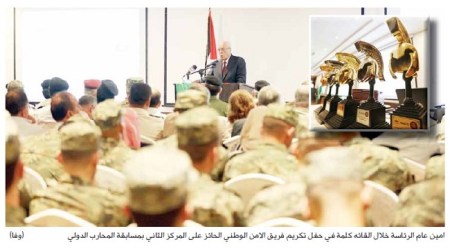
On May 22, 2016, Palestinian Presidency Secretary-General Al-Tayeb ‘Abd Al-Rahim delivered a speech on behalf of Palestinian President Mahmoud ‘Abbas to a group of Palestinian National Security Forces. The speech was part of a ceremony celebrating their second-place win in the international 8th Annual Warrior Competition, which took place in Jordan on May 2-6, 2016.[1]

In his speech, ‘Abd Al-Rahim condemned attempts to intimidate the Palestinian people and divert it from its path, and called such attempts futile, as “our [Palestinian] people loves death more than life.” He added that the National Security Forces victory was a step on the way to establishing an independent Palestinian state, and rejected the notion of establishing a separate independent entity in Gaza, or a state with temporary borders in the West Bank alone.

The following are excerpts from the speech:

28164Abd Al-Rahim speaking at the ceremony (Al-Ayyam, PA, May 23, 2016)

“Today we celebrate the Palestinian man, who suffers a lack of means and opportunity, but has will power and is determined to keep the Palestinian flag flying so that it [the flag] remains in the hearts of peace-loving and liberty-loving peoples. We were very happy with this victory [in the Warrior Competition], and the honorable president and commander-in-chief, president Abu Mazen [Mahmoud ‘Abbas], has expressed his esteem for the brothers who won this award and his pride in their achievements. Many commanders in Arab military institutions have also expressed their pride in this new Palestinian man, who is always new and always renewing [himself].

“The occupation wagered that we would forget our cause and that, as the generations passed, we would dissolve into the societies around us… However, the occupation was the first to realize that each new generation was more determined and had a stronger desire to achieve the goals that the martyrs had died for in the distant and the near past and [are still dying for] in the present. Our blood is still being spilled at the roadblocks and the checkpoints by the gangs of settlers and the extremist soldiers of the occupation, some of whom have acknowledged that they do not act according to moral standards when facing our people and children…

“Occupiers are always destined to fail. This fact should be in our minds forever. We must always cling to hope. Our morale will not be influenced or shaken by anything. We will not grow soft or deviate towards personal interests for the sake of dubious goals such as establishing a state or an emirate in Gaza, or establishing a state with temporary borders in the West Bank. We must always tirelessly stick to our truth, and our faith in victory must never falter. It is the faith in our hearts that will lead us to our rights and to the realization of our righteous and legitimate goals…

“Every achievement is a step on the road to establishing an independent state and strengthens our belief that the future is ours, that tyrants will disappear, and that the aggressors will end up in the trash bin of history. Indeed, they are trying to intimidate us today with people who threatened to strike Gaza or the Aswan Dam [a reference to incoming Israeli defense minister Avigdor Liberman], but these threats are hollow as we are a people who loves death more than life when it fights for Palestine.”[2]

Endnotes:

[1] The Annual Warrior Competition is a combat-oriented competition held at the King Abdullah II Special Operations Training Center (KASOTC) in Amman (Warriorcompetition.com).

[2] Al-Hayat Al-Jadida (PA), May 23, 2016.

French Political Gymnastics and How to Help the Palestinians

May 23, 2016

French Political Gymnastics and How to Help the Palestinians, Gatestone InstituteShoshana Bryen, May 23, 2016

“I call on the Palestinian people to elect new leaders, leaders not compromised by terror. I call upon them to build a practicing democracy, based on tolerance and liberty. If the Palestinian people meet these goals, they will be able to reach agreements with Israel, Egypt and Jordan on security and other arrangements for independence.” — President George W. Bush, 2002.

The Palestinians do not have “a practicing democracy based on tolerance and liberty,” but erasing Israel evidently remains their goal.

Rather than offering the Palestinians no-cost recognition, the French should demand a few changes first.

The French government seems to be falling over itself to undo its craven vote in favor of a UNESCO resolution accusing Israel — referred to as the “Occupying Power” in Jerusalem — of destroying historic structures on the Temple Mount:

  • Prime Minister Manuel Valls apologized. “This UNESCO resolution contains unfortunate, clumsy wording that offends and unquestionably should have been avoided, as should the vote.”
  • Interior Minister Bernard Cazeneuve apologized. [I do] “not take a supportive view of the text.” The resolution “should not have been adopted” and “was not written as it should have been.”
  • President François Hollande apologized. [The vote was] “unfortunate,” and, “I would like to guarantee that the French position on the question of Jerusalem has not changed… I also wish to reiterate France’s commitment to the status quo in the holy places in Jerusalem… As per my request, the foreign minister will personally and closely follow the details of the next decision on this subject. France will not sign a text that will distance her from the same principles I mentioned.”
  • Foreign Minister Jean-Marc Ayrault did not quite apologize: “France has no vested interest but is deeply convinced that if we do not want to let the ideas of the Islamic State group prosper in this region, we must do something.”

It sounds as if they thought they had made a mistake. But the vote was not a mistake. Underestimating the depth of Israel’s anger about it might have been a mistake, but not the vote. The French — who, according to their foreign minister, have “no vested interest” but need to “do something” about Islamic State — could not have thought that a UNESCO resolution that offended Israel would do anything to slow ISIS “in the region” or in Europe. There is no way it could; the two are not connected.

The French however, apparently thought a vote accusing Israel of something, anything, would keep the Palestinian Authority from presenting a resolution on Palestinian independence to the UN Security Council; Ayrault implied in Israel that the UNESCO vote was a quid pro quo. Why? The French have a veto they could exercise in the UN Security Council. But the Palestinians might then object to France replacing the U.S. as the “Great Power” in the “peace process.” They already have experience with a veto-wielding interlocutor — the U.S. — and they do not want another. The price of an elevated status for the French appears to entail not vetoing Palestinian resolutions, voting for them in UNESCO, and sacrificing Israel in a process that will end in French recognition of a Palestinian State, whether Israel agrees to be bound to the altar or not.

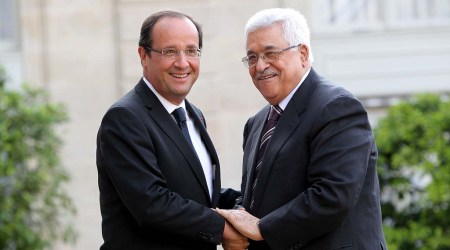
1614French President François Hollande welcomes Palestinian Authority President Mahmoud Abbas in Paris, July 8, 2012. (Image source: Office of the President of France)

It should be noted that the Russians immediately put out a statement that the UN-sponsored Middle East Quartet is the “only mechanism” for resolving the Palestinian issue. It is not clear whether Putin was supporting American or Israeli interests. Iran and ISIS are similarly disinclined to see the French ascend on this issue.

The Palestinians, on the other hand, are thrilled to have an international conference where others will make demands of Israel as the Palestinian experiment in self-government degenerates into poverty and chaos by its own economic, political and social choices, looking more like Venezuela every day.

For Palestinians in the street, killing Jews in the “knife intifada” did not take the edge off the popular anger and frustration with their own leadership.

Under the circumstances, the French, and France’s enabler, U.S. Secretary of State John Kerry, might usefully consider the approach taken in fact by President George W. Bush, which required changes in Palestinian behavior as a prerequisite for support for statehood. Honored mainly in the breach, Bush’s 2002 speech nevertheless remains the best statement of American, and Western, interest in moving the Palestinians toward a functioning state:

It is untenable for Israeli citizens to live in terror. It is untenable for Palestinians to live in squalor and occupation. And the current situation offers no prospect that life will improve. Israeli citizens will continue to be victimized by terrorists, and so Israel will continue to defend herself…

Peace requires a new and different Palestinian leadership, so that a Palestinian state can be born.

I call on the Palestinian people to elect new leaders, leaders not compromised by terror. I call upon them to build a practicing democracy, based on tolerance and liberty. If the Palestinian people meet these goals, they will be able to reach agreements with Israel, Egypt and Jordan on security and other arrangements for independence.

And when the Palestinian people have new leaders, new institutions and new security arrangements with their neighbors, the United States of America will support the creation of a Palestinian state whose borders and certain aspects of its sovereignty will be provisional until resolved as part of a final settlement in the Middle East.

I wrote at the time that,

“Mr. Bush made one huge leap of faith in the speech when he said, ‘I’ve got confidence in the Palestinians. When they fully understand what we’re saying, that they’ll make the right decisions when we get down the road for peace.’ What, in fact, will the U.S. do if the Palestinian people weigh a new constitution and free political parties and STILL decide that blowing up Jews is better? What if they have transparent government, economic advancement and an independent judiciary, and STILL decide Jewish sovereignty must be eradicated with the blood of their children?”

The Palestinians have answered half the question. They do not have a “practicing democracy based on tolerance and liberty,” but erasing Israel evidently remains their goal. Rather than offering no-cost recognition, the French should demand a few changes first.

Sisi and Mideast Peace

May 21, 2016

Sisi and Mideast Peace, American ThinkerC. Hart, May 21, 2016

Egyptian President Abdel Fatah al-Sisi’s speech on Tuesday, May 18, set ripples through Israel’s political establishment. Speaking in the southern city of Assiut, Sisi signaled to the Arab world, the Palestinians, and Israel that it is time for an historic breakthrough in peace negotiations.

Responding immediately to Sisi’s comments, Israeli Prime Minister Benjamin Netanyahu stated that he is open to working with Egypt and Arab states towards advancing the peace process, not only with the Palestinians but with the peoples of the Middle East region.

Netanyahu’s comments come on the heels of a visit to Israel by French Foreign Minister Jean-Mark Ayrault. The two men met but disagreed on how to advance peace.

France insists on hosting an international parley to force Israel and the Palestinians to come to the peace table. Israel is against the French initiative.

Netanyahu would like to go beyond the Israeli-Palestinian conflict and work directly with moderate Arab states on a comprehensive peace deal. Sisi could be instrumental in building an Arab coalition for peace which would dismiss or weaken the divisive French initiative, releasing Israel from conceding to European demands.

Former Israeli ambassador to Egypt, Zvi Mazel, is currently working as a Research Fellow at the Jerusalem Center for Public Affairs (JCPA). He is a Middle East expert who has represented Israel’s Ministry of Foreign Affairs as former Ambassador to Sweden and Romania, as well. This writer asked Mazel if Sisi’s comments were spontaneous or were released at this time for political reasons because he wants to strengthen Egypt’s position in the region by helping Israel.

“I don’t think there is a big design… I think that Sisi understands what is going on in the Middle East and he is identifying according to his view — a kind of possibility of advancing the peace process.”

Egypt, Saudi Arabia, the Gulf countries, and Israel have common enemies: Iran and Islamic State. Already there have been discreet diplomatic and business ties between Israel and these nations

According to Mazel, Sisi is also emerging as a strong respected leader among Egyptians despite the Western media’s portrayal of him as a dictator similar to former Egyptian President Hosni Mubarak.

“Sisi sees himself as a president quite stable among his people. I know that this is not the way they think in the Western media — New York Times and company. They see him as a kind of military dictator; absolutely not! He’s a good man. He’s not Mubarak. He’s Sisi.”

Mazel explains that Egypt is on the way to economic sustainable development. This is what Sisi has been focused on over the past two years and he is seeing success. Unemployment has gone down, despite the fact that almost 90 million people live in Egypt and the country is poor.

“He has started something quite positive, and Sisi thinks that the time has come for Egypt to be in the international arena.”

What that means, according to Mazel, is that Egypt’s current role is still minor. Sisi is asking Israelis and Palestinians to go forward, yet he, himself, does not have a plan. But, in the future, Egypt could emerge as a larger player in the region.

Mazel is pragmatic about the short-term. “It’s a positive step for Egypt, but it is not going to change the world.”

Current peace advances that are being prepared for release are not a positive development for Israel: (a) the French Initiative; (b) a document showing the obstacles to Israeli-Palestinian peace efforts soon to be reported by the Quartet; (c) the 2002 Arab Peace Initiative that, despite being outdated, is still considered a serious option by the Arab world.

In the coming days, the Arab League plans to meet and discuss the Israeli-Palestinian conflict. Mazel thinks that Sisi’s statement was good timing for that meeting, but otherwise, was not connected to a bigger scheme.

However, on Wednesday, May 18, American Secretary of State John Kerry arrived in Egypt one day after Sisi gave his emotional speech. Some analysts believe that the U.S. is behind Sisi’s bold words, in an effort to circumvent the French from becoming a new power broker in the Middle East.

The question is whether Sisi’s encouragement will lead to Israel courting the Arab nations and the Arab nations courting Israel, while by-passing the Palestinians. Mazel thinks that kind of change is slow in coming, because the Arabs continue to entrench themselves in old positions that favor Palestinian demands.

Refusing to sit down and negotiate with Israel, the Palestinians have insisted on preconditions which the Arab League has accepted. They demand that Israel agree on the right of return for so-called Palestinian “refugees” to Israeli land; that Israel withdraw to the 1967 borders; and, that Israel stop building in West Bank settlements (Judea and Samaria). Palestinian President Mahmoud Abbas also expects Israel to release hundreds of Palestinian prisoners, who have blood on their hands, serving time in Israeli jails because of terrorist attacks against the Israeli population.

So far, these unresolved issues have kept Abbas away from face-to-face negotiations with Netanyahu. However, his real diplomatic scheme is to get the international community to affirm the Palestinian position and force Israel to concede to Palestinian demands. Right now, Abbas sees the best venue to accomplish his goal as a French-sponsored future peace conference, followed by a stinging UN anti-Israel resolution.

Meanwhile, the future pressure on Israel will be to immediately stop settlement construction in order to get the peace process going. Mazel declares, “Absolutely not… we have to go on! Half a million people live there. And, they are the shield of Israel. We continue to build until there is peace.”

Mazel has a real problem with the demands of the Arab League, as well. “The Arab Peace Initiative is more or less the same as the Palestinian attitude. The ‘right of return’ is still there. It should be taken completely out. Most importantly, the Palestinians and the Arabs should recognize a Jewish State in Israel.”

Mazel is also not sure that Netanyahu’s insistence on widening his government, to provide greater stability, is a wise idea. Reportedly, Yisrael Beytenu Chairman Avigdor Liberman will soon become Israel’s new Defense Minister as Netanyahu brings several more ministers into his coalition. Mazel thinks this will not provide a wider diplomatic envelope; nor, will it help change European or Arab attitudes towards Israel; nor will it end the Boycott-Divestment-Sanctions (BDS) movement against Israel.

Then there is U.S. President Barack Obama’s failed Middle East policy, which includes his lackluster support of American allies in the region. Mazel says this policy cannot continue.

“It cannot be like that, because America is the most important power in the world… And, whoever will win the presidency, whether it will be Mrs. Clinton or Trump, both of them are in a certain way connected to the Middle East.”

Mazel believes that with 22 countries and more than 300 million people living in the region, the next U.S. president will be more engaged in leading the nations into greater stability.

In the meantime, currently 80% of the Egyptian people support Egyptian President Sisi. His nation has already made peace with Israel (along with Jordan). Helping Israel to extend an olive branch to other Arab countries will encourage Egypt to take up an important leadership role in a region that continues to be embroiled in major upheaval and violence.


Perception as deterrence – Israel’s new Defense Minister

May 20, 2016

Perception as deterrence – Israel’s new Defense Minister, American ThinkerRon Jager, May 20, 2016

The recent news that Avigdor Liberman, a former Israeli Foreign Minister and head of the Yisrael Beiteinu party, a small right-wing party, will replace Moshe “Bogie” Ya’alon as the new Israeli defense minister  and has been portrayed by the Israeli media and their elitist opinion makers with dismay and stupefaction.  In Tel-Aviv, a city known for its progressive and leftist inclination, many muttered that the municipality should start opening up the air raid shelters as Lieberman’s appointment hit the airwaves. Lieberman, a politician feared and despised by the Israeli left, is being demonized and delitigitimized even before his appointed has gone into effect. Yet the potential appointment of Avigdor Lieberman as Defense Minister has thrown the whole Palestinian leadership and Israeli Arab politicians into a frenzy, making the reaction by Israel’s leftist elite seem mild. Claiming that Israel is adopting characteristics of a fascist regime and calling for the boycott of Israel; stating that “the Israeli government is sending a message to the world that Israel prefers extremism, dedication to the occupation and settlements over peace,” and encouraging blatant racism, are only a fraction of the derogatory and slanderous accusations against a veteran politician who has been democratically elected.

The potential appointment of Avigdor Lieberman to the position of Defense Minister may very well herald a new and more effective deterrence against the Palestinians’ desire to get up in the morning and murder a Jew. The Palestinian Arab perception of Lieberman as a person who believes in the sanctification of power, ruthlessness, violence, and ignorance with murderous potential can very well be exactly what will cause the Palestinians to adopt a more realistic assessment of what a negotiated settlement will look like.

This is their dilemma, and this is their choice. Either continue and deny reality, taking their chances with a Defense Minister who is perceived as having no problems with employing a strict crackdown wherever Palestinian terror erupts, who has no qualms about enforcing strict rules of engagement, making it crystal clear that Israel’s strategy is based on the adage of our Sages, “If someone rises to kill you, kill him first,” or begin to negotiate seriously and honestly to achieve a sustainable peace agreement with Israel. The perception of Avigdor Lieberman by the Palestinian Arabs could very well facilitate this change.

As Israel’s strategic deterrence and capabilities have been proven to be highly effective in recent years with land, sea, and air strategic capabilities becoming literally impenetrable, the main task facing Israel’s Defense Minister will be primarily in the Palestinian theatre. The Middle East, being a region highly susceptible to a cultural disposition to base one’s reaction on who how one perceives one’s enemy, may very well bring the Palestinian Arab leadership to fold their cards and start the arduous and unavoidable process of negotiating with Israel.

For the majority of the past eight years, President Obama and State Department “experts” have been treating the Israeli-Palestinian conflict as the central generator of political upheaval ravaging the Middle East. They do not realize just how marginal the conflict with the Palestinian Arabs has become or understand that as far as the Sunni Arab nations of the Middle East, the future Palestinian State, should it be established, will be just another failed Arab nation in perpetual conflict with its own people and with her neighbors.

As far as the Palestinian Authority (PA) that resides in Ramallah is concerned, the lack of legitimacy in the eyes of their own people is only exceeded by the widespread and institutionalized corruption by its leaders, sustained by international funding from the United States and the European Union. Having rejected over the years any possibility of a negotiated settlement, the PA leadership have proven without a doubt that they have no intention of reaching any agreement.. The only goal of the Palestinian Arab leadership has been to gain territories and use them for the next attack aimed at minimizing and weakening Israel. Apart from that, there is nothing: No democracy, no economy, no law and no future for the Palestinian Arabs other than being in a perpetual cycle of meaningless and unsuccessful conflict with Israel. Israel will continue to move ahead and forge alliances with Sunni Arab neighbors and the Palestinian Arabs will wallow in their misery as they continue to deny reality and believe in their own made-up propaganda narrative.

The unprecedented political changes having taken place in the Middle East in recent years mainly due to Obama’s irresponsible and failed strategic policy decisions have resulted in new emerging alliances between Israel and her neighbors. Despite the challenges that Iran continues to pose to Israel and the potential of her leaders who might use the conflict with Israel as a means of rallying political support in her war with the Sunni Arab nations, the threat of renewed conventional conflict between Israel and her Arab neighbors has been downgraded, while more realistic scenarios envision a greater focus on economic cooperation and regional stability. Although it is far too early to predict the success of the new political alliances and strategic order that will eventually emerge from the changes in the Arab world, the inherent asymmetry of the conflict between Israel and the Palestinian Arabs will maintain this conflict on low burner for the foreseeable future with sporadic eruptions of terror and limited missile attacks similar to what that the Israeli population has had to endure in recent years.


The French Peace Initiative: From de Gaulle to Haaretz

May 17, 2016

The French Peace Initiative: From de Gaulle to Haaretz, Gatestone InstituteFred Maroun, May 17, 2016

♦ France’s peace initiative is French President François Hollande’s equivalent of de Gaulle’s betrayal of Israel.

♦ France has already announced that if the peace initiative fails, France will recognize a Palestinian state. Israeli Prime Minister Benjamin Netanyahu has rightly concluded that “this ensures that a conference will fail.”

♦ France knows that the peace initiative is pointless, but it is using it for theatrical value to embarrass Israel’s government and curry favor with Arab regimes.

♦ Those who claim to support peace, but who in fact work to undermine it, are partly responsible for the anti-Semitic campaign against Israel. They should be prominently named and exposed for collaborating with bigots, anti-Semites, and terrorists.

When I hear about the current French peace initiative for Israel and the Palestinians, I have to keep pinching myself to make sure that I am not dreaming. After the powerful United States tried repeatedly and unsuccessfully to bring peace between these protagonists, what makes the French think that they can do better?

France’s boldness is particularly shocking, since France long ago lost the right to be considered a friend of Israel. In 1967, French President Charles de Gaulle imposed an arms embargo on Israel when the Jewish nation was under threat from a coalition of Arab countries. In doing so, de Gaulle threw the Jews under the bus in order to improve France’s relations with the Arab world. Thanks to Israeli ingenuity and resiliency, Israel still defeated the Arab coalition in the Six Day War and impressed the United States, which then replaced France as Israel’s main ally.

France’s peace initiative, which includes an international summit in Paris on May 30 to discuss the “parameters” of a peace deal, is French President François Hollande’s equivalent of de Gaulle’s betrayal of Israel. France has already announced that if the peace initiative fails, France will recognize a Palestinian state. Israeli Prime Minister Benjamin Netanyahu has rightly concluded that “this ensures that a conference will fail.”

1602France’s peace initiative, which includes an international summit in Paris on May 30 to discuss the “parameters” of a peace deal, is French President François Hollande’s equivalent of de Gaulle’s betrayal of Israel.

It is clear that no solution would be acceptable to Israel unless it protects Israel against continued Arab aggression, and unless it finds a solution to the millions of descendants of Palestinian refugees with which the Arab world insists on flooding Israel.

There is no sign that the Arab world, including the Palestinians, are anywhere close to accepting these conditions. France’s recognition of “Palestine” without any deal would mean that France does not consider those two conditions necessary.

France’s recognition of “Palestine” without any deal would provide no solution for Palestinian refugees. It would provide no solution to Palestinian terrorism. It would not make the concept of a Palestinian state any more real than it is today. It would not provide Israel with secure borders.

France’s unilateral recognition of “Palestine” would simply provide one more moral victory for the corrupt Palestinian President Mahmoud Abbas, and one less reason for him to negotiate peace in good faith or to give his people what they really need: a thriving economy and a functioning civil society.

If France’s initiative had any chance of success at all (which is doubtful considering the U.S. failures under more favorable circumstances, when the Palestinian leadership was keener on negotiations and when Hamas was weaker), France eliminated that chance by announcing that it would recognize “Palestine” regardless of what happens.

Is the French government so naïve that it would play into Abbas’ hands and sabotage its own initiative? Maybe, but the more likely explanation seems to be that France knows that the peace initiative is pointless, but it is using it for theatrical value to embarrass Israel’s government and curry favor with Arab regimes.

The Israeli newspaper Haaretz, which is often more “pro-Palestinian” (read anti-Israel) than the Palestinians, demands that Netanyahu accept the French initiative.

Haaretz takes the position that “there is no reason to reject the French initiative, which, even if it doesn’t resolve the fundamentals of the conflict, will at least put it back on the global agenda.” The theory that the conflict remains unresolved due to it not being on the “global agenda” is mind-boggling, considering the vocal and vicious worldwide anti-Israel movement. The conflict is very much on the “global agenda” — too much so, in fact — compared to other conflicts that are deadlier and get far less attention.

Haaretz claims that the French initiative “may also generate some original ideas and steps toward a solution.” Considering the attention that this conflict receives, the lack of “ideas” is far from being the problem. Pro-Israel and anti-Israel editorialists and bloggers have generated an immense body of “ideas,” most of which are totally impractical, and all of which are unrealistic until the Arab side of the conflict stops promoting hate against Israel and starts negotiating in good faith.

Haaretz‘s pathetic defense of the French initiative is followed by wholesale accusations, which have no substance, against Netanyahu. Haaretz, for instance, tries to convince readers that Netanyahu’s willingness to negotiate without conditions is itself a condition! As Haaretz is into the business of redefining words, why not say that the conflict is not really a conflict and be done with it!

Haaretz concludes by saying that Netanyahu “should give it [the French initiative] substance that will ensure the security and well-being of Israel’s citizens.” If this were possible, that would indeed be commendable, but as France, by promising the Palestinians recognition without negotiation, destroyed what little chance of success the initiative might have had. Asking Netanyahu miraculously to give the initiative “substance” is at best naïve, and at worst treacherous.

It could also be a trap to set Netanyahu up for failure, which, considering Haaretz‘s antipathy towards Israel’s Prime Minister, is likely.

Contrary to Haaretz‘s assertion that “there is no reason to reject the French initiative,” as the initiative is almost certain to fail, its failure will be one more weapon used by anti-Israel activists to demonize Israel, so there is every reason to not lend the initiative a legitimacy it does not deserve.

Israel survived de Gaulle’s betrayal, and it will likely survive Hollande’s betrayal. But one more failed initiative and one more meaningless recognition of “Palestine” will push peace and Palestinian statehood even farther away.

As Alan Dershowitz wrote recently, those who aided the Nazis in killing Jews, even indirectly, hold a part of the responsibility for the Holocaust. Those — in France, at Haaretz, or elsewhere — who claim to support peace but in fact work to undermine it, are partly responsible for the anti-Semitic campaign against Israel. They should be prominently named and exposed for collaborating with bigots, anti-Semites, and terrorists.

Palestinian Leaders and Child Sacrifice

May 13, 2016

Palestinian Leaders and Child Sacrifice, Gatestone InstituteKhaled Abu Toameh, May 13, 2016

♦ The Palestinian Authority (PA) is now hoping that the tragedy of the Abu Hindi family will push Palestinians in the Gaza Strip to revolt against Hamas.

♦ Hamas is hoping that the tragedy will further undermine the credibility of the Palestinian Authority among Palestinians, shown as being complicit in the blockade on the Gaza Strip to prevent it from receiving weapons.

♦ These charges and counter-charges constitute yet more proof that the PA and Hamas are determined to pursue their fight to the last Palestinian child.

♦ What happened in the Abu Hindi home is an unspeakable family tragedy. What is happening to the Palestinian people, who have forever been led by leaders who care nothing for their well-being, is a tragedy of national proportions.

The tragic death of three Palestinian siblings, killed in a fire that destroyed their house in the Gaza Strip on May 6, demonstrates yet again the depth to which Palestinian leaders will go to exploit their children for political purposes and narrow interests.

The three children from the Abu Hindi family — Mohamed, 3 years old, his brother Nasser, 2 years old and their two-month infant sister Rahaf, died in a fire caused by candles that were being used due to the recurring power outages in the Gaza Strip.

The electricity crisis in the Gaza Strip is the direct result of the continued power struggle between the two Palestinian rival forces, Hamas and the Palestinian Authority (PA).

In recent months, the crisis has deepened, leaving large parts of the Gaza Strip without electricity for most of the day. Hamas blames the Palestinian Authority for the crisis because of its failure to cover the costs of the fuel needed to operate the power plants in the Gaza Strip. The PA has retorted by blaming Hamas’s “corruption” and “incompetence.”

The Abu Hindi family resides in the Shati refugee camp, where Hamas leader Ismail Haniyeh and other leaders of the Islamist movement live. But unlike the senior Hamas leaders, the Abu Hindi family could not afford to purchase their own power generator to supply them with electricity during the power outages. Instead, the tragedy-stricken family, like most families in the Gaza Strip, resorted to the cheapest alternative lighting method — candles.

On that horrific evening, the Abu Hindi’s three children went to sleep while the candles were burning. Hours later, the charred bodies of the three siblings were taken from the house while it was still on fire and engulfed with smoke.

In any other country, this incident would have been reported as a routine tragedy — one of the kind that could happen in any city such as New York, London or Paris.

Here, however, the death of the three children is not just another personal tragedy. This was a case, rather, of child sacrifice: the Abu-Hindi children were sacrificed on the altar of the decade-long war being waged between the Palestinian Authority and Hamas. And these children are far from the first or last such victims.

In equal measure, the PA and Hamas are exploiting the tragedy of the Abu Hindi family to wage a smear campaign against each other. It is not as though these rivals have lived in harmony until now. But the political mud-slinging at the expense of the three dead children has reached repulsive levels.

The children were not even buried before Hamas leaders pointed their fingers at Palestinian Authority President Mahmoud Abbas and his prime minister, Rami Hamdallah, who it claimed were held personally responsible for the electricity crisis in the Gaza Strip.

Hamas spokesman Sami Abu Zuhri claimed that the electricity crisis was part of the PA leadership’s effort to keep the entire Gaza Strip under blockade. The PA’s ultimate goal, he explained, is to see Hamas undermined and removed from power in the Gaza Strip.

Other Hamas officials said the crisis was the direct result of the Palestinian Authority’s instance on imposing a tax on the fuel it supplies to the power plants in the Gaza Strip — a financial burden that Hamas could not afford to pay because of the already high cost of the fuel. They said that the tax was unjustified because the PA, through an arrangement with Israel (from which it purchases the fuel), gets the tax refunded. In addition, they pointed out, the PA has refused to file a request with Israel to increase its supply of electricity to the Gaza Strip.

Translation: Hamas takes no responsibility for the fact that two million Palestinians in the Gaza Strip spend nearly 12 hours a day without electricity. Instead, in their view, it is the sole responsibility of Mahmoud Abbas and his prime minister, whose only interest is to strip Hamas of its power.

But where did the millions of internationally donated dollars go? How much do the tunnels cost, the ones Hamas uses to launch terrorist attacks against Israel? Funding terrorists and their families? Might not that money have been better invested in keeping children from burning to death from candle fire?

Hamas leaders staged the smear well. In an unprecedented move, masked members of Hamas’s military wing, Ezaddin Al-Qassam, were dispatched to attend the funeral of the three children. Hamas leaders such as Ismail Haniyeh were also present, offering condolences to the family. The cameras caught all this, demonstrating the family’s affiliation with Hamas and implying that Abbas and his Palestinian Authority were responsible for the tragedy.

1595Masked Hamas gunmen pose for the media at the funeral of the Abu Hindi children in Gaza, May 7, 2016.

The Palestinian Authority is also seeking to cash in on the tragedy by waging a war of defamation against Hamas. Yusuf Al-Mahmoud, spokesman for the Palestinian Authority government, dismissed the Hamas charges. “Those who continue to hijack the people of the Gaza Strip are responsible for this tragedy,” he said, referring to Gaza’s Hamas rulers. “The tragedy of the children in the Gaza Strip is the tragedy of all Palestinians. Hamas is responsible for the ongoing split (between the West Bank and Gaza Strip).” Abbas’s ruling Fatah faction has even gone as far as presenting the dead children’s grieving father as one of its own.

The Palestinian Authority is now hoping that the tragedy of the Abu Hindi family will push Palestinians in the Gaza Strip to revolt against Hamas.

Hamas is hoping that the tragedy will further undermine the credibility of the Palestinian Authority among Palestinians, shown as being complicit in the blockade on the Gaza Strip to prevent it from receiving weapons.

These charges and counter-charges constitute yet more proof that the PA and Hamas are determined to pursue their fight to the last Palestinian child.

Yet Abbas is trying to persuade the world to back his plan for establishing a sovereign Palestinian state in the West Bank and Gaza Strip. It is hard to imagine how he will even be able to step foot in Gaza after this funeral.

What happened in the Abu Hindi home is an unspeakable family tragedy. What is happening to the Palestinian people, who have forever been led by leaders who care nothing for their well-being, is a tragedy of national proportions.

Netanyahu says he’s ready to meet Abbas for talks ‘right now’

May 13, 2016

Netanyahu says he’s ready to meet Abbas for talks ‘right now’ PM claims he’s taken unprecedented steps for peace, tells Palestinian leader to heed calls for direct negotiations

By Times of Israel staff

May 13, 2016, 2:46 am

Source: Netanyahu says he’s ready to meet Abbas for talks ‘right now’ | The Times of Israel

Prime Minister Benjamin Netanyahu speaks to the diplomatic corps at the President’s Residence in Jerusalem on May 12, 2016. (Haim Zach/GPO)

Prime Minister Benjamin Netanyahu said Thursday that he was ready to meet with Palestinian Authority President Mahmoud Abbas “today” for direct peace talks if the Palestinian leader was so willing, charging that he’d done more to advance peace than any other Israeli leader in history.

In a speech before the diplomatic corps at the President’s Residence in Jerusalem to mark Israel’s 68th Independence Day, Netanyahu said he was willing “to meet President Abbas today in Jerusalem. If he’d like, in Ramallah. Right now. Today.”

Acknowledging the “skepticism” about his position, Netanyahu claimed he has “taken steps that no other prime minister in Israel’s history has taken to advance peace,” adding that “so far, they’ve not been answered.”

Netanyahu told the roomful of foreign ambassadors, honorary consuls and military attachés that he continued to “support two states for two peoples: a demilitarized Palestinian state that recognizes the Jewish state.”

Denouncing the Palestinian refusal to recognize Israel as a Jewish state, a key Israeli demand for a peace agreement, Netanyahu said it “remains the core of this conflict,” and “why this conflict preceded the [1967] Six Day War by nearly 50 years.”


The Israeli leader called on members of the diplomatic corps to urge Abbas to accept the call for direct talks, maintaining these were the only way to reach an enduring peace deal.

“Every minute that President Abbas refuses to accept my call for peace robs Palestinians and Israelis of the opportunity to live without fear. It robs our children and our grandchildren the opportunity they so richly deserve,” Netanyahu said.

Expressing optimism for a wider peace arrangement with regional countries and a “deep and abiding faith…that our century-long conflict will end,” the prime minister said he was heartened to see “formerly hostile states in the region and beyond form new and deep partnerships with us.”

“We might solve the Israeli-Palestinian problem by enjoying the support of Arab states who now see Israel more and more not as an enemy, but as an ally against the forces that threaten their own countries as well,” he said, an apparent reference to Iran who last year signed a nuclear deal with world powers which sought the rein in its atomic program in exchange for sanctions relief.

Israel and many Sunni Arab states were deeply opposed to the accord.

US-brokered peace talks between Israel and the Palestinians collapsed in April 2014 and the prospects of fresh dialogue have appeared increasingly remote.

Op-Ed: Read Peter Beinart and you’ll vote Donald Trump

May 6, 2016

Op-Ed: Read Peter Beinart and you’ll vote Donald Trump, Israel National News, David Friedman, May 6, 2016

Several weeks ago, I was “outed” as one of Donald Trump’s two advisors on the relationship between the United States of America and the State of Israel. It is an honor and a privilege to advise Mr. Trump on a critical issue that is near and dear to my heart, and I fervently hope that I have the opportunity to assist him in developing and implementing policies that strengthen both countries and the unbreakable bond between them.

Right now, however, the bloodsport of American presidential politics is in full bloom, and within that scented garden emerges a recent Op-Ed piece by CNN panelist, Peter Beinart, published in Israel’s left-wing paper Haaretz. Beinart, a well-known supporter of J Street, New Israel Fund and the BDS movement, decries Trump’s selection of Israel advisors as a cynical charade by which Trump leverages Jews in his employ to go “all in” on Israel solely to garner political capital. According to Beinart, these token Jews, myself included, are just willing pawns in a modern day Game of Thrones, all willing to fall on their proverbial swords for Trump the King.

I have never met Mr. Beinart nor do I care to, and he knows absolutely nothing about me. Had he made the slightest inquiry (apparently no longer necessary for modern journalists), he would have known that I am not in Mr. Trump’s employ,  have hundreds of other clients, and hold views on Israel that are entirely independent of any political movement or candidate.  Those views have been developed over more than thirty years of study of historical accounts and scholarly works, interaction with Israeli political, military and business leaders, and probably 100 trips or more to the Holy Land. I didn’t just come out of “central casting,” as Beinart implies, to facilitate some political theatre, and my beliefs are not for sale to the highest bidder. The same holds true for Jason Greenblatt, Mr. Trump’s other advisor, whom I have known for years.

But I do want to thank Mr. Beinart for getting this issue out on the table, albeit clumsily and disingenuously. Because his reflexive reaction to my involvement in the Trump candidacy lays bare how dangerous the Jewish left is to the State of Israel.

Let’s look at the criticisms offered by Mr. Beinart of views that I have previously expressed. He thinks I’m no good because  (1) I have accused President Obama of “blatant anti-Semitism,” (2) I have questioned the wisdom of Israel bestowing the benefits of citizenship, including free tuition at some of its best universities, upon those who advocate the overthrow of the State, and (3) I have likened J Street supporters to “kapos during the Nazi era.” Let’s unpack each of those a bit.

First, Obama’s anti-Semitism. Here’s the context – Hamas puts on school plays in which 10 year olds dressed as terrorists plunge fake knives into 10 year olds dressed as Jews to the delight of the audience, and Palestinian Authority leaders (they’re supposed to be the “moderate ones”) bestow praise upon all participating in the “knife intifada.” Asked to comment on the unspeakable tragedy of innocent Jewish civilians being murdered by knife-wielding Islamic radicals, Obama and Kerry do little more than condemn the proverbial “cycle of violence.” I’m sorry, but this is pure and outright murder and any public figure who finds it difficult to condemn it as such without diluting the message with geo-political drivel is engaging in “blatant anti-Semitism.”

Second, the wisdom of free stuff for those engaged in advocating the overthrow of the State of Israel. Every civilized country other than Israel punishes treason. In the United States, advocating to overthrow the government by force or violence can get you life in prison. In Israel, Islamic radical citizens speak this way all the time, often on the way back and forth from world class institutions of higher learning which they attend for free. Is this a good idea? Is there no minimal allegiance required for Israeli citizenship? Sure seems like a fair question to me.

Finally, are J Street supporters really as bad as kapos? The answer, actually, is no. They are far worse than kapos – Jews who turned in their fellow Jews in the Nazi death camps. The kapos faced extraordinary cruelty and who knows what any of us would have done under those circumstances to save a loved one? But J Street? They are just smug advocates of Israel’s destruction delivered from the comfort of their secure American sofas – it’s hard to imagine anyone worse.

Mr. Beinart, therefore, has done us a service, albeit unintentionally. He has shown us the danger of the Jewish left – the lost souls who blame Israel for not making a suicidal “peace” with hateful radical Islamists hell bent on Israel’s destruction. This is Hillary Clinton’s crowd, and they are no friends of Israel.

Donald Trump’s view of Israel isn’t quite as nuanced as that of Mr. Beinart nor as academic as that of President Obama. He thinks that when radical Islamic terrorists are trying to kill you, the right thing to do is kill them first. Don’t negotiate, reason or cajole. Just defeat them. Or as Mr. Trump would say, “win.”

So please read Peter Beinart’s latest column. It will leave you convinced to vote for Donald Trump.

French toast

April 22, 2016

French toast, Israel Hayom, Ruthie Blum, April 22, 2016

It comes as no surprise that the honchos in Ramallah are welcoming the French initiative to hold a summit of world foreign ministers to discuss and plan an international Israeli-Palestinian peace conference.

The Palestinian Authority knows full well that “peace” is a euphemism for complete Israeli capitulation to Palestinian demands, with nothing but bloodshed in return. Indeed, if PA President Mahmoud Abbas and his henchmen were actually interested in bringing about an end to conflict with Israel, they could do so in a split second — you know, by putting a stop to their own behavior. This includes, but is not restricted to, glorifying and funding the families of terrorists, particularly those who die for the cause in the process of killing Jews.

Contrary to what those who are either not paying attention or who hate the Jewish state for their own reasons may believe, Abbas’ ultimate goal is neither peace nor its companion misnomer, a “two-state solution.” No, his aim is to retain an international stamp of legitimacy as a world leader, to protect him from assassination on the one hand and oblivion on the other, and to keep the dollars and euros flowing.

Palestinian statehood is therefore not in his interest. But pretending to strive for it while portraying himself and his people as victims of Israeli “occupation” and “brutality” is what he’s really after. Meanwhile, he benefits from the West’s ostrich syndrome — the very phenomenon responsible for the nuclear deal with the Islamic Republic of Iran, the greatest state sponsor of global terrorism; the one that keeps Palestinian murder machines like Hezbollah in clover. And armed to the teeth.

This is all very old news, as is the fact that an ever-declining Europe and the United States under President Barack Obama would prefer to abdicate all political, moral and military superiority to Third World Islamist thugs than call the shots. It is this Western trait that is at the root of hostility to Israel, which — in spite of its all-too-Jewish inclination to follow suit — dares to defend and steel itself to the Cheshire Cat smiles of its sworn enemies and wagging fingers of its alleged friends.

The irony is that Abbas, like the ayatollahs in Tehran, would be the first to agree with this assessment. Indeed, it is the one thing on which Israel and the Palestinians agree, though the latter would never admit it in any language other than Arabic. Nor do PA apologists bother to believe the translations of such sentiments into English, French or German. They would rather spend their energy interpreting the forked-tongue dialect of parties with whom they insist on engaging in diplomacy.

Which brings us back to the Paris plan for renewed talks between Israel and the Palestinians. To avoid being left with scrambled egg on its face, France has decided that the only foreign ministers who will not be invited to next month’s pre-peace-conference summit are those of — you guessed it — Israel and the PA.

PA Foreign Minister Riad Malki was not too happy about this. But he did receive reassurance from the French that the initiative would not be hindered “in any way” by the Palestinian draft of a U.N. Security Council resolution condemning Israeli settlements as the true obstacle to “peace.”

Never mind little details like Monday’s bus bombing in Jerusalem, perpetrated by a Palestinian terrorist from Bethlehem, who apparently botched the bigger job he had in mind when the explosive device he was carrying went off before he reached his destination. According to American officials, he may not even have been a terrorist in the conventional sense, but rather one of those “lone wolves” — or, as U.S. Vice President Joe Biden called them, “misguided cowards.”

Yes, across the ocean, Biden took to the podium at the left-wing J Street conference to chastise the Jewish state, which was still reeling from the 20 wounded victims of the latest act of bloody aggression against innocent people going about their business, in this case, Passover preparations.

“I firmly believe that the actions that Israel’s government has taken over the past several years — the steady and systematic expansion of settlements, the legalization of outposts, land seizures — they’re moving us and more importantly they’re moving Israel in the wrong direction,” Biden said, reiterating his administration’s “overwhelming frustration” with Israel and “profound questions” about its ability to remain both Jewish and democratic without further and more massive territorial withdrawals than it has already made. Biden failed to mention that all previous Israeli attempts to appease the Palestinians resulted in terrorism the likes of which European capitals haven’t even begun to experience — though it appears they are starting to get a taste of it.

Still, they tell themselves that Islamic State terrorism is a different kettle of fish from that of Fatah, Hamas and Islamic Jihad. And that Israel is ultimately a provocateur.

It is thus that Prime Minister Benjamin Netanyahu responded to reports of the upcoming “ministerial” summit and precursor to a wider peace conference with disdain.

“Can anyone explain what this initiative is about? Even the French don’t know,” he said.


