Terror at the Louvre: Knife-wielding attacker shouts ‘Allahu Akbar’

Posted February 3, 2017 by Joseph Wouk
Categories: Uncategorized

Source: Terror at the Louvre: Knife-wielding attacker shouts ‘Allahu Akbar’ – TheBlaze

Terror at the Louvre: Knife-wielding attacker shouts ‘Allahu Akbar’

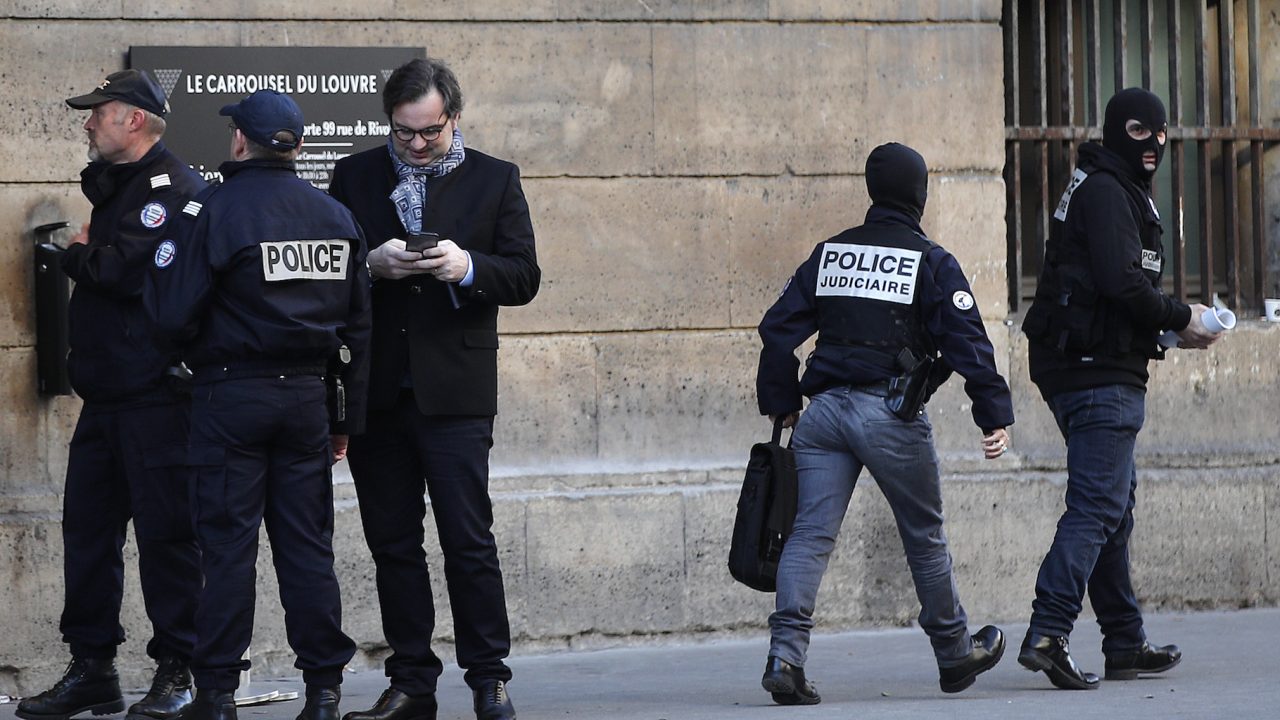
Police officers cordon off the area near the Louvre museum near where a soldier opened fire after he was attacked in Paris, Friday, Feb. 3, 2017. Police say the soldier opened fire outside the Louvre Museum after he was attacked by someone, and the area is being evacuated. (AP Photo/Christophe Ena)

A man with a machete attacked French soldiers Friday morning while they were on patrol outside the famous Louvre museum in Paris. According to eyewitness reports, the man shouted “Allahu Akbar.” French Prime Minister François Hollande has called the act “terrorist in nature.”

The suspect reportedly attacked the soldiers at an entrance to the shopping mall connected to the museum, and the soldiers first tried to subdue him using non-lethal force before opening fire. The suspect was shot in the abdomen and is seriously injured, according to BBC. CBS news also confirmed that the attacker was heard to shout “Allahu Akbar” during his attack.

French authorities said the suspect was carrying two backpacks and two machetes, and began his attack after the soldiers told him he couldn’t carry his backpacks into the shopping mall. “That’s when he got the knife out and that’s when he tried to stab the soldier,” said Yves Lefebvre, a French police official.

The Louvre was on lockdown as four soldiers tried to fight off the suspect before firing five shots at the assailant. One soldier sustained a slight head injury but is expected to recover. The suspect was taken to the hospital after being shot in the stomach, but Police Chief Michael Cadot told reporters he was still conscious and moving. He also said another person who was “acting suspiciously” was arrested at the time but did not appear to be involved.

Interior Ministry spokesman Pierre-Henry Brandet told reporters that about 1,000 people were inside the Lourve museum at the time and were safe in lockdown until the all-clear was given and they were evacuated in an orderly fashion after security checks.

Authorities searched the backpacks but no explosives were found.

The suspect is said to be in his mid-30s and did not have any identity papers. The attack at the Louvre is the latest in a string of attacks in Europe in which the assailants have used machetes, buses, or other non-firearm weapons for sometimes deadly attacks.

According To Iranian Officials, Obama Administration Gave Unwritten Consent In The Nuclear Talks And In The JCPOA Negotiations For Iran To Develop Ballistic Missiles With A Range Of Only 2,000 km – That Is, Capable Of Striking Israel But Not Europe

Posted February 3, 2017 by danmillerinpanama
Categories: Iran and Israel, Iran and Jews, Iran scam, Iran secret deals, Iranian missiles, Obama and Iran, Obama and Iran scam, Obama and Israel

Tags: , , , , , , ,

According To Iranian Officials, Obama Administration Gave Unwritten Consent In The Nuclear Talks And In The JCPOA Negotiations For Iran To Develop Ballistic Missiles With A Range Of Only 2,000 km – That Is, Capable Of Striking Israel But Not Europe, MEMRI, A. Savyon and Yigal Carmon and U. Kafash*, February 2, 2017

“Likewise, the Zionist regime is the most important enemy of Iran in the regionregion, and is less than 1,200 km away. Therefore, short- and medium-range missiles are sufficient to strike U.S. bases near Iran, and long-range missiles are sufficient to strike the occupied territories [Israel]. The diagram shows several of these American bases and [also] the missiles that are counting [down] to the moment [when they will be able to] strike them.”

*********************

Introduction

On January 30, 2017, U.S. sources announced that Iran had conducted a failed test of a new ballistic missile, the Khorramshahr. According to reports, the missile exploded after a 965-km flight.[1] Both Iranian Foreign Minister Zarif (on January 31) and Defense Minister Dehghan (on February 1) stressed that Iran “asks permission from no one in the matter of its defense program.”[2]

It should be emphasized that contrary to statements by Iranian regime spokesmen who say that Iran’s missile program is defensive, missiles with a 2,000-km range are strictly offensive and strategic. This is why Iran has faced constant demands to stop developing them.

In the years that preceded the U.S.-Iran nuclear talks, Iran developed ballistic missiles with ranges of 2,500-5,000 km that threaten Europe and even the U.S.

Dr. Hassan Abbasi, theoretician of Iran’s Islamic Revolutionary Guards Corps (IRGC) and director of the IRGC Center for Borderless Security Doctrinal Analysis, said in 2004: “We have a strategy drawn up for the destruction of Anglo-Saxon civilization and for the uprooting of the Americans and the English.

“Our missiles are now ready to strike at their civilization, and as soon as the instructions arrive from Leader [Ali Khamenei], we will launch our missiles at their cities and installations… And because of Khatami’s policies and dialogue between the civilizations, we have been compelled to freeze our plan… and now we are [again] about to carry out the program… The global infidel front is a front against Allah and the Muslims, and we must make use of everything we have at hand to strike at this front, by means of our suicide operations or by means of our missiles.”[3]

The London-based Saudi daily Al-Sharq Al-Awsat also reported, on June 14, 2004, that the Shihab 4 and Shihab 5 long-range missile projects had been revived, on orders from Iranian Supreme Leader Ali Khamenei.[4]

It should be noted that a December 14, 2013 report on Iran’s missile program published by the IRGC-affiliated Mehr news agency immediately following the Geneva Agreement provided details on the various Shihab models. According to the report, Shihab 3D missiles, with a range of 2,200-3,000 km, “can easily reach the occupied territories [Israel]… and cover their entire area.” The report also stated that the Shihab 4 has a range of 3,000 km and the ability to launch satellites into orbit, and that “very little information” has been published about the Shihab 5. The diagrams in the article also feature a Shihab 6 model.[5]

U.S. Approves Iranian Development Of Missiles With A Range Of Only 2,000 km – That Is, Capable Of Reaching Israel

However, after U.S.-Iran negotiations began, and at the end of their first stage, in Geneva in November 2013, Iranian officials began reporting that Iran’s missile program for missiles with ranges above 2,000 km was being restricted.

Thus, for example, immediately after the interim agreement was reached in Geneva, on December 10, 2013, and in reference to it, IRGC commander Mohammad Ali Jafari said that Iran is capable of producing missiles with a range of over 2,000 km but that Khamenei had restricted the IRGC to a 2,000-km range: “We want to increase the range of the IRGC’s missiles, but despite this, the Leader [Khamenei] has restricted us to a range of 2,000 km. We have the capability to increase the range of our missiles, and our missiles should obviously reach Israel… The regime’s red lines were not crossed during the nuclear talks with the P5+1 [Group] and in the Geneva Agreement.”[6]

Indeed, IRGC commanders stressed that the most important thing for the regime was missiles capable of striking Israel; see, for example, comments by IRGC Aerospace and Missile Division director Amir Ali Hajizadeh, who said following a 2016 missile launch: “For us, Israel’s evil is totally clear, and the 2,000-kilometer range of our missiles [is intended] to confront the distant Zionist regime.”[7]

Extensive quotes regarding the Iranian regime’s explicit intent to target Israel with its missiles can be found in MEMRI Inquiry & Analysis No. 1135, Iranian IRGC Missile Unit Commanders: We’ve Developed 2,000-km Range Missiles And Equipped Hizbullah With 300-km Range Missiles; Fars News Agency: Israel’s Illusions About Its Natural Gas Fields Will Be Buried In The Mediterranean, December 3, 2014, and Special Dispatch No. 6349, Iran Launches Long-Range Missiles Emblazoned With Slogan: ‘Israel Should Be Wiped Off The Face Of The Earth’, March 16, 2016.
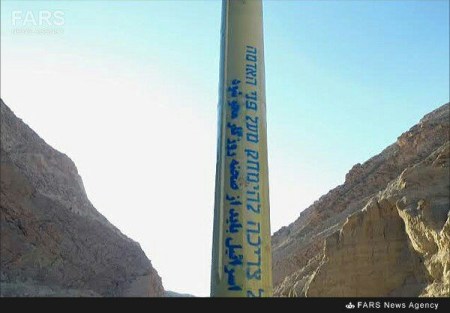
1298aIranian missile emblazoned with the slogan ‘Israel Should Be Wiped Off The Face Of The Earth” (Fars, Iran, March 9, 2016)

On November 17, 2014, the IRGC-affiliated Tasnim news agency posted a diagram explaining that Iran “makes do” with a range of 2,000 km, which it considers “desirable” and which covers all of Israel: “On the Firing Line – The commanders of the army of the Islamic Republic [of Iran] have said several times that with its attainment of long-range missiles with a range of up to 2,000 km, Iran has arrived at the range ceiling that it considers desirable, and that ‘in the meantime’ there is no need to increase this range. Although the U.S. is 11,000 km from Iran, in recent years it has approached the borders of Iran, [and therefore] its military bases, equipment, and forces are a target for Iran’s missiles.

“Likewise, the Zionist regime is the most important enemy of Iran in the region, and is less than 1,200 km away. Therefore, short- and medium-range missiles are sufficient to strike U.S. bases near Iran, and long-range missiles are sufficient to strike the occupied territories [Israel]. The diagram shows several of these American bases and [also] the missiles that are counting [down] to the moment [when they will be able to] strike them.”[8]

Additionally, Defense Minister Hossein Dehghan said on August 18, 2015 in response to a reporter’s question on the manufacture of missiles with a range greater than 2,000 km: “We do not produce missiles with ranges greater than 2,000 km.”[9]

Is U.S. Permission For Iran To Develop Missiles With Ranges Up To 2,000 km – Which Reach Israel – A Secret Annex Of The JCPOA, Or Simply Unwritten Consent?

In statements, IRGC officials hinted that restrictions on the range of Iranian missiles so that they reach Israel but not Europe were part of the Iran deal. Thus, for instance, IRGC commander Mohammad Ali Jafari referred to the IRGC’s November 2, 2015 consent to UN Security Council Resolution 2231, saying: “One of the points in this resolution was the matter of restrictions, which some military elements feared. Therefore, we held meetings in [Iran’s] Supreme National Security Council, and also went to the Leader [Khamenei]. The [Iranian] negotiating team told the Westerners that we do not agree to these restrictions. They [the Westerners] said that these issues must be included in the resolution. Even when I met with the Leader, he said that there were no restrictions on developing defensive capabilities. The only restriction relates to nuclear missiles, which, obviously, we never wanted.”[10]

The next day, on November 3, 2015, Iranian Army chief of staff Hassan Firouzabadi referred to Jafari’s remarks, saying: “I confirm statements by the IRGC commander that Iran’s missile activity is not restricted. We will follow two restrictions: The first is mentioned in the JCPOA, in the matter of no nuclear planning, and the second is the range of 2,000 km, which has already been noted previously by all elements in Iran.”[11]

It should be noted that the Hebrew version of this news, which IRIB published on November 4, 2015 explicitly mentioned, in both the headline and the text, that the JCPOA allows Iran to possess ballistic missiles of a range of 2,000 km. The Hebrew news item read:

“Firouzabadi: The Nuclear Agreement Promises Iran Missiles With 2,000-km Range

“The chief of staff of Iran’s armed forces, Maj.-Gen. Hassan Firouzabadi, stressed that the state, under orders from the general commander [i.e. Khamenei] of the IRGC, undertakes, inter alia, to restrict nuclear planning, but that it is entitled to produce missiles with a range of 2,000 km.

“Firouzabadi made these statements yesterday (Tuesday) to a group of Islamic regime leaders and officials, and referred to [statements by] the IRGC general commander emphasizing that Iran would commit to the sections of the nuclear agreement with the West that include a restriction on nuclear planning, and that in addition, Iran is entitled to possess missiles with a range of 2,000 km.”[12]

These statements indicate that although the permission given to Iran to develop missiles capable of striking Israel is likely not a secret annex of the JCPOA, it still constitutes unwritten consent that is an integral part of the nuclear deal. It is convenient for both sides not to publish this understanding in written form – for Iran because it rejects any public reference to its missile program, which it defines as defensive but is in fact offensive; and for the Obama administration, because there would be repercussions if it were to be revealed that it had given Iran permission to develop missiles capable of striking Israel.

It should be noted that UN Security Council Resolution 2231 (2015) constitutes an additional concession by the Obama administration to Iran, in comparison with the previous resolution 1929 (2010). This concession has two components:

One, UNSCR 1929 banned Iran from conducting any activity concerning missiles capable of carrying nuclear warheads, while UNSCR 2231 replaced the word “capable,” which refers to objective specifications, with the word “intended,” which concerns fluid political matters.

Two, while UNSCR 1929 banned Iran from conducting any missile activity, UNSCR 2231 rescinds this ban.

Following Iran’s May 9, 2016 missile test, which took place after the JCPOA’s Implementation Day – and which embarrassed the Obama administration – IRGC Aerospace and Missile Division director Amir Ali Hajizadeh said: “The Americans are telling [us]: ‘Don’t talk about missile affairs, and if you conduct a test or maneuver, don’t mention it.'”[13]

*A. Savyon is Director of MEMRI’s Iran Media Project; Y. Carmon is President of MEMRI; U. Kafash is a Research Fellow at MEMRI.


[1] Foxnews.com, January 30, 2017.

[2] Yjc.ir, January 31, 2017; Tasnim (Iran), February 1, 2017.

[3] Shargh (Iran), June 5, 2004; Al-Sharq Al-Awsat (London), May 28, 2004. Also see MEMRI Inquiry & Analysis No. 181, The Internal Debate in Iran: How to Respond to Western Pressure Regarding Its Nuclear Program, June 17, 2004; MEMRI Special Dispatch No. 723, Iran’s Revolutionary Guards Official Threatens Suicide Operations: ‘Our Missiles Are Ready to Strike at Anglo-Saxon Culture… There Are 29 Sensitive Sites in the U.S. and the West…’, May 28, 2004; and MEMRI TV Clip No. 252, Iranian Revolutionary Guard Official In Tehran University Lecture (Part II): We Plan To Target US Nuclear Warheads On US Soil; Should Take Over England, May 22, 2004.

[4] A military source in the Iranian Defense Ministry stated: “In a meeting last week with Revolutionary Guards commanders, Khamenei said that Israel was planning to attack Iran’s nuclear installations and the Iranian military soon, and therefore defense and military preparedness should be boosted as soon as possible. Khamenei stressed that the increase in petroleum prices allowed Iran to allocate a larger budget to its military projects. [Iran’s] Ministry of Defense received $1 billion to resume its Shihab 4 and Shihab 5 project. It is known that in the past, Iran conducted an experiment with Shihab 3 missiles whose range is 1,200 kilometers [and which can reach Israel], but [President] Khatami halted the project of the Shihab 4, whose range is 2,800 [which covers Western Europe], and the Shihab 5, whose range is 4,900-5,300 km [and which can reach the U.S.], because he thought it was a project incompatible with Iran’s strategic interests and defense needs.” Al-Sharq Al-Awsat (London), June 14, 2004.

[5] Mehrnews.com, December 14, 2013.

[6] ISNA (Iran), December 10, 2013.

[7] Fars (Iran), March 9, 2016. See MEMRI Special Dispatch No. 6349, Iran Launches Long-Range Missiles Emblazoned With Slogan: ‘Israel Should Be Wiped Off The Face Of The Earth’, March 16, 2016.

[8] Tasnim (Iran), April 17, 2014. See MEMRI Inquiry & Analysis No. 1135, Iranian IRGC Missile Unit Commanders: We’ve Developed 2,000-km Range Missiles And Equipped Hizbullah With 300-km Range Missiles; Fars News Agency: Israel’s Illusions About Its Natural Gas Fields Will Be Buried In The Mediterranean, December 3, 2014.

[9] Yjc.ir, August 18, 2015.

[10] Fars (Iran), November 2, 2015.

[11] Mashregh (Iran), November 3, 2015.

[12] Hebrew.irib.ir, November 4, 2015.

[13] See MEMRI Special Dispatch No. 6430, IRGC Aerospace And Missile Force Commander: The Americans Are Telling Us ‘Don’t Talk About Missile Affairs, And If You Conduct A Test… Don’t Mention It’, May 15, 2016.

Why Mexico’s Governors Became A Prime Target of Criminal Groups

Posted February 3, 2017 by danmillerinpanama
Categories: Crime, Mexican cartels, Mexican government, Mexico

Tags: , , ,

Why Mexico’s Governors Became A Prime Target of Criminal Groups, Insight Crime, Patrick Corcoran, January 31, 2017

(Please see also, Mexico’s President Cancels White House Visit After Trump Hits Cartels. — DM)

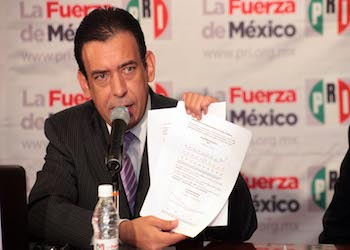
G23051125.JPG MÉXICO, D.F.-Conferencia-Moreira. El presidente nacional del PRI, Humberto Moreira durante conferencia de prensa la mañana de este lunes en la sede nacional de dicho instituto político. EGV. Foto: Agencia EL UNIVERSAL/Juan Boites.

MÉXICO, D.F.-Conferencia-Moreira. El presidente nacional del PRI, Humberto Moreira durante conferencia de prensa la mañana de este lunes en la sede nacional de dicho instituto político. EGV. Foto: Agencia EL UNIVERSAL/Juan Boites.

A growing stream of corruption allegations against governors in Mexico exemplifies how changes in the country’s political landscape have inadvertently served to expand these officials’ role in enabling organized crime.

As reported by InSight Crime and other sources, a reputed financial operator for the Zetas criminal group accused former Coahuila Gov. Humberto Moreira of accepting $2 million in monthly payments in exchange for allowing the gang to open hundreds of so-called “narcotiendas” (narco-stores) and giving them virtually free rein to operate throughout the state. As part of the bargain, the Zetas intimidated and attacked political and business enemies of Moreira, according to the testimony of the former Zetas member.

Moreira has denied the charges, and while they have not been verified, they do fit with the broader pattern of Moreira’s tenure at the head of the Coahuila state government, which lasted from 2005 to 2011. After having operated primarily as an offshoot of the Gulf Cartel in Tamaulipas, the Zetas took control of Coahuila in 2007 and 2008. In so doing, they initiated a campaign of kidnapping and extortion that had no local precedent and turned certain cities, such as Torreón, into virtual war zones. Rumors that Moreira was directly responsible for the Zetas‘ rise were rampant during his tenure, and since his exit, Moreira’s alleged ties to the criminal group have sparked multiple criminal investigations, including some convictions, against him and his subordinates in the United States.

The grim arc of Moreira’s career is not unusual. Two former governors of Tamaulipas, Tomás Yarrington and Eugenio Hernández, are facing indictments in the United States for allegedly aiding criminal groups. Former Veracruz Gov. Javier Duarte is a fugitive with a raft of corruption cases hanging over his heard, while his former counterpart from Sonora, Guillermo Padrés, turned himself in to Mexican authorities in November amid similar allegations.

InSight Crime Analysis

This confluence of stories on governors’ wrongdoing is not a coincidence, but rather a byproduct of a Mexican political system that concedes enormous and largely unchecked authority to the statehouse.

In the post-Mexican Revolution political system that dominated the 20th Century, while Mexican governors enjoyed a great deal of autonomy strictly within their domain, they operated at the orders of a near-omnipotent president. The power of the presidency provided an important check on their power. The multi-party system that emerged in the 1990s and 2000s brought the days of the all-powerful president to an end, but this opening had the unintended effect of vastly increasing the practical control that governors exercised.

If a gang secures the support of a single governor whose state controls a major port or a border crossing, it has likely guaranteed itself a major role in the national criminal landscape.

It is not a coincidence that one of the first examples of the so-called narco-governor essentially coincided with the end of the PRI’s monopoly on Mexican politics. Former Quintana Roo Governor Mario Villanueva went underground days before the end of his term in 1999, amid rampant rumors that, in exchange for bribes much like those Moreira is accused of receiving, he had given the Juarez Cartel of Amado Carrillo free use of his state. After being arrested in Mexico in 2001, Villanueva was later extradited to the United States. After serving a lengthy prison sentence, earlier this month Villanueva was returned to Mexico and subsequently arrested. He is reportedly awaiting another lengthy prison term.

Today, governors rather than presidents exercise practical control over their states’ congressional delegations. They often wield substantial influence over the municipal governments within their states as well, as mayors rely on them for budgetary transfers and for support in advancing their political futures.

This shift in the political landscape over the past two decades has made governors collectively the most important cohort in Mexican politics, frequently described as modern-day viceroys. Working as a unit, they are capable of scuttling a president’s agenda.

This has consequently turned them into an irresistible target for criminal groups looking for allies within government. The scope of governors’ authority makes it ideal for criminal groups to try to corrupt or otherwise co-opt them. If a gang secures the support of a single governor whose state controls a major port or a border crossing, it has likely guaranteed itself a major role in the national criminal landscape. The Familia Michoacana and the Knights Templar, for example, were largely concentrated in a single state, but that has been enough to make the gangs major players over the past decade.

A gang can leverage the support of a key governor in any number of ways. They can use his government as a sort of beachhead amid a territorial expansion, as the Zetas allegedly did. Most governors control large and relatively effective state police forces, which, when deployed at the service of a criminal group, can be extremely valuable allies.

Criminal groups can also use political support indirectly to lean on local governments. Governors can help gangs by pressuring prosecutors to limit prosecutions against their members, as many laws targeting organized crime are in the realm of state courts. As the chief interlocutors with the federal government, governors can also obstruct federal efforts to target one group or another.

From a criminal group’s perspective, governors are also more reachable than the president. The fact that they occupy a lower profile than the president makes dealing with governors far less risky. In addition, governors are not burdened with the prerogatives of statesmanship, from monetary policy to foreign relations, which limit time for focusing on law enforcement and security matters. Relative to presidents, governors are also more isolated from pressure from the US government to crack down on criminal groups.

This collective dynamic is behind the spate of cases like Moreira’s and Yarrington’s, among many others. Although much of the commentary on security issues in Mexico focuses on the goals and missteps of the presidency, a great deal of the government’s efforts are channeled through other offices. And as long as Mexican governors in key states are actively boosting the interests of powerful crime groups like the Zetas, there will be a limit to what federal policies can accomplish.

Trump Changes US Policy on Settlements, But Will Netanyahu Pick Up the Ball?

Posted February 3, 2017 by danmillerinpanama
Categories: Israel settlements, Netanyahu and Trump, Obama and Israel, Trump and Israel, Two state solution

Tags: , , , ,

Trump Changes US Policy on Settlements, But Will Netanyahu Pick Up the Ball?, The Jewish Press, Stephen Leavitt, February 3, 2017

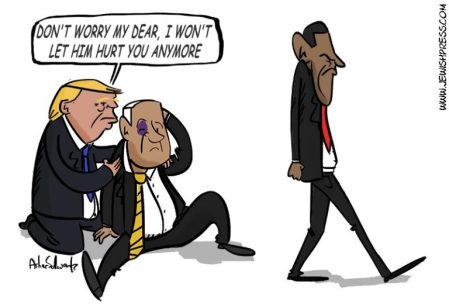
battered-bibi-syndrome-2-768x525Photo Credit: Asher Schwartz

The official White House statement thoroughly rejects the JPost’s quote, craftily eliminating both concerns: Trump is not committed to a two-state solution, and he does not consider the settlements an obstacle to peace.

**********************************

For the first time in many years, the White House on Thursday released a statement regarding Jewish settlements in Judea and Samaria without the adjectives “illegal” or “illegitimate” next to the word “settlements.”

While not 100 percent perfect — a policy of benign neglect would be best — it is clearly a complete turnaround from previous administration positions, particularly former-President Obama’s “not one brick anywhere” policy, including Jerusalem.

The White House
Office of the Press Secretary
For Immediate Release

Statement by the Press Secretary

“The American desire for peace between the Israelis and the Palestinians has remained unchanged for 50 years. While we don’t believe the existence of settlements is an impediment to peace, the construction of new settlements or the expansion of existing settlements beyond their current borders may not be helpful in achieving that goal. As the President has expressed many times, he hopes to achieve peace throughout the Middle East region. The Trump administration has not taken an official position on settlement activity and looks forward to continuing discussions, including with Prime Minister Netanyahu when he visits with President Trump later this month.”

In other words, what began a few months ago as a video of Prime Minister Benjamin Netanyahu asking why should having Jews living in Judea and Samaria be considered an impediment to peace – is now US foreign policy.


In addition to the biggest item of recognizing the legitimacy of the settlements, by omitting the words “illegal” and “illegitimate,” the statement actually declares, for all the world to see: “We don’t believe the existence of settlements is an impediment to peace.”

It should be noted that even that one seemingly negative-note in the Trump statement against new settlements or expansion isn’t exactly that:

“the expansion of existing settlements beyond their current borders may not be helpful in achieving that goal.”

First of all, the statement gives implicit approval to construction within existing settlements, and not just to communities within the settlement blocs (i.e. Gush Etzion, Ariel, etc), but rather to all settlements. This is a much wider definition, and includes many smaller Jewish communities that exist outside of the blocs, representing some 80,000 Jews.

Not to name names, but that’s more settlement legitimacy than what even some members of Netanyahu’s cabinet recognize.

Furthermore, it doesn’t actually forbid or rebuke Israel if it does build a new settlement or expand beyond the borders of an existing one. The White House statement merely questions if it is helpful to achieving peace, and leaves that question open for further discussion.

The other glaring omission in the Trump White House statement is the term “two-state solution,” so beloved by every Administration since the 1993 Oslo Accords. Why, only last Wednesday, the new, relatively pro-Israel UN Secretary-General, Antonio Guterres, had his spokesperson release a statement saying that,

“the recent announcement by the Israeli Government to advance 5,000 settlement units in the occupied West Bank could […] threaten to unravel plans for a two-State solution between Israelis and Palestinians. […] We once again warn against any unilateral actions that can be an obstacle to a negotiated two-state solution.”

Having praised the Trump statement so much, it’s also easy to realize that there must be some conflict within the Administration over the settlements issue, with one faction obviously pushing the traditional State Department line.

Rumor has it that the White House statement was released not so much as a response to Netanyahu’s recent settlement construction announcements, but in response to an unauthorized leak from within the Administration to the Jerusalem Post, which the latter reported Thursday:

“The White House warned Israel on Thursday to cease settlement announcements that are ‘unilateral’ and ‘undermining’ of President Donald Trump’s effort to forge Middle East peace, a senior administration official told The Jerusalem Post. For the first time, the administration confirmed that Trump is committed to a comprehensive two-state solution to the Israeli- Palestinian conflict negotiated between the parties.”

The official White House statement thoroughly rejects the JPost’s quote, craftily eliminating both concerns: Trump is not committed to a two-state solution, and he does not consider the settlements an obstacle to peace.

Indeed, the White House statement acknowledges the value and validity of the Israeli PM in forging US foreign policy:

“The Trump administration has not taken an official position on settlement activity and looks forward to continuing discussions, including with Prime Minister Netanyahu when he visits with President Trump later this month.”

This is tantamount to an Obama statement saying: “The Obama administration will decide on the Iran nuclear deal after continued discussions with Prime Minister Netanyahu when he visits to speak to Congress on March 3, 2015.” Yes, that’s how impossibly big this statement is.

It is now entirely up to Prime Minister Netanyahu.

Will Netanyahu have what it takes to change forever Israel’s future? Will he take full advantage of Trump’s invitation to help forge US foreign policy in a way that bolsters the Zionist vision? Will he step back from his Bar Ilan speech, and return to his former, maximalist positions?

From the White House statement it appears that the ball is completely in Netanyahu’s court.

Trump: ‘Nothing off the table’ in response to Iran missile test

Posted February 3, 2017 by Joseph Wouk
Categories: Uncategorized

Source: Trump: ‘Nothing off the table’ in response to Iran missile test | The Times of Israel

US president issues another warning to Tehran, as Republicans back tougher line

February 2, 2017, 9:59 pm
US President Donald Trump in the White House February 2, 2017 in Washington, DC. (AFP/ Brendan Smialowski)

US President Donald Trump in the White House February 2, 2017 in Washington, DC. (AFP/ Brendan Smialowski)

US President Donald Trump said that “nothing is off the table,” when it came to a response to Iran’s controversial test this week of a ballistic missile capable of carrying a nuclear warhead.

Speaking to reporters Thursday, Trump was responding to a question about whether a military response to Iran was under consideration.

“Nothing is off the table,” he replied, borrowing a phrase Prime Minister Benjamin Netanyahu has used for years vis-à-vis Tehran’s nuclear program.

Trump’s comment followed a string of remarks by Republican senators, including the House Speaker, backing additional sanctions on Iran in the wake of the missile test, which prompted an emergency UN Security Council session and a call by Netanyahu to reimpose punitive measures.

“I would be in favor of additional sanctions on Iran,” House Speaker Paul Ryan said at a weekly press conference on Thursday. “We need to have a tough-on-Iran policy… We should stop appeasing Iran.”

“I think the last administration appeased Iran far too much. I think they went too far with Iran and I think as a result Iran is far more activist than it otherwise would be,” he said.

In this Sept. 21, 2016 file photo, House Speaker Paul Ryan of Wisconsin speaks during a news conference on Capitol Hill in Washington. (AP Photo/Manuel Balce Ceneta, File)

In this Sept. 21, 2016 file photo, House Speaker Paul Ryan of Wisconsin speaks during a news conference on Capitol Hill in Washington. (AP Photo/Manuel Balce Ceneta, File)

“Iran, don’t forget … is the biggest state sponsor of terrorism in the world. Iran writes on their missiles in Farsi, Hebrew and English ‘Death to America’, ‘Death to Israel’ and then tests them. So this is not a friendly country that has global peace or national security interests in their minds,” Ryan added.

Trump had earlier on Thursday tweeted that “Iran has been formally PUT ON NOTICE for firing a ballistic missile. Should have been thankful for the terrible deal the US made with them!” echoing remarks made Wednesday by his national security adviser, Michael Flynn.

Also Thursday, Senator Bob Corker, the chairman of the Senate Foreign Relations Committee, told Reuters, “I think there’s a lot that we can do, now, that we were unable to do before to push back against Iran,” adding that the committee was “in the early stages” of working on legislation related to the nuclear deal.

“The administration, thankfully, is going to follow through on appropriately holding Iran accountable for the violations that are taking place,” he said.

Senator Lindsey Graham joined the chorus Thursday, telling CNN that “the world should not only condemn Iran but we should have multi-national sanctions against the regime for their continued violation of the UN Security Council resolutions regarding their missile program.”

On January 29, Iran is said to have tested a 4,000-kilometer (2,500-mile) ballistic missile capable of carrying a nuclear warhead. On Thursday, the German newspaper Die Welt reported that Iran also tested a home-made cruise missile with the same capabilities: The Soumar, with a range of up to 3,000 kilometers (1,864 miles), flew 600 kilometers (373 miles) on its maiden voyage, according to the German report.

It is reportedly a re-engineered Russian KH-55 cruise missile, which is capable of reaching Israel from Iran, and has the advantage that it can be launched from ships, aircraft and submarines.

The Soumar cruise missile at its unveiling in March 2015. (YouTube screenshot)

The Soumar cruise missile at its unveiling in March 2015. (YouTube screenshot)

The missiles are not covered by UN Resolution 2231, which was passed shortly after the nuclear deal with Iran was signed in July 2015 and calls on Tehran “not to undertake any activity related to ballistic missiles designed to be capable of delivering nuclear weapons, including launches using such ballistic missile technology.” Iran argues that its ballistic missile program is also not covered by the resolution because it does not have a nuclear weapons program.

During his campaign, Trump promised both to “dismantle the disastrous deal” and to “force the Iranians back to the bargaining table to make a much better deal, but in a call to the Saudi king on Sunday promised to “vigorously enforce” the controversial agreement.

Netanyahu on Thursday demanded the reimposition of sanctions against Iran, terming the test a “flagrant breach” of UN Security Council resolutions, and said he would discuss with Trump a reevaluation of the “entire failed nuclear accord” during their February 15 meeting in Washington.

US setting up a confrontational approach with Iran

Posted February 3, 2017 by Joseph Wouk
Categories: Uncategorized

Source: US setting up a confrontational approach with Iran | The Times of Israel

Trump administration is immediately taking a more aggressive posture, at least rhetorically, on Tehran’s missile tests and regional aggression

February 3, 2017, 5:20 am
In this Sept. 21, 2016 file photo, Iranian armed forces members march in a military parade marking the 36th anniversary of Iraq's 1980 invasion of Iran, in front of the shrine of late revolutionary founder Ayatollah Khomeini, just outside Tehran, Iran. (AP Photo/Ebrahim Noroozi, File)

In this Sept. 21, 2016 file photo, Iranian armed forces members march in a military parade marking the 36th anniversary of Iraq’s 1980 invasion of Iran, in front of the shrine of late revolutionary founder Ayatollah Khomeini, just outside Tehran, Iran. (AP Photo/Ebrahim Noroozi, File)

DUBAI, United Arab Emirates (AP) — By putting Iran “on notice,” the new US administration is laying the groundwork for a more confrontational approach toward the Islamic Republic.

What that means in practice is anyone’s guess, since the White House isn’t saying. That is in line with President Donald Trump’s desire to keep America’s adversaries guessing and boost US leverage.

The US has plenty in its toolbox should it choose to confront Iran more aggressively, from ratcheting up sanctions all the way to full-out war. Each carries real risks.

That’s because Iran, however unpopular in Washington, is not a failed-state pushover. It is sure to respond if it feels it is under threat.

Here are some of the main issues:

Why is Iran ‘on notice?’

In his surprise appearance in the White House briefing room, Trump’s national security adviser, Michael Flynn, blasted Iran for threatening American allies and “malign actions — including weapons transfers, support for terrorism, and other violations of international norms.”

He also linked Iran directly to missile attacks by Yemeni Shiite rebels known as Houthis on Saudi and Emirati ships. Saudi Arabia and the United Arab Emirates are leading a coalition supporting Yemen’s internationally recognized government against the Iranian-backed rebels. Iran denies arming the rebels.

US National Security Adviser Michael Flynn speaks during the daily news briefing at the White House, in Washington, Wednesday, Feb. 1, 2017. (AP Photo/Carolyn Kaster)

US National Security Adviser Michael Flynn speaks during the daily news briefing at the White House, in Washington, Wednesday, Feb. 1, 2017. (AP Photo/Carolyn Kaster)

What appeared to trigger the notice being served, however, was Iran’s Sunday launch of a medium-range ballistic missile. A UN Security Council resolution prohibits Iran from testing ballistic missiles specifically designed to carry a nuclear warhead.

The US and Iran disagree on whether this and previous launches — including one in March 2016 involving a missile emblazoned with the phrase “Israel must be wiped out” in Hebrew — violate the ban.

What happens next?

Senior Trump administration officials have said they are considering options including economic measures and more support for Iran’s regional rivals.

Among the biggest of those adversaries are Saudi Arabia, Israel and the UAE, whose foreign minister has voiced support for Trump’s decision to temporarily block entry to citizens of Iran and six other Muslim-majority countries.

The Saudis and Emiratis would welcome deeper American involvement for the war in Yemen, which they view in large part as a proxy fight against Iran. The US has provided logistical support to the Saudi-led coalition since it intervened in March 2015, but in December the Obama administration halted some arms sales to the Saudis over concerns about civilian deaths.

Washington could implement further unilateral sanctions against Iran. Nuclear-related sanctions were removed last year after Iran agreed to a deal with world powers limiting its nuclear activities, but Washington has maintained other sanctions related to support for terrorism and other actions as far back as the 1979 Islamic Revolution.

Torbjorn Soltvedt, a Middle East analyst at risk consulting firm Verisk Maplecroft, predicted that any new sanctions related to ballistic missile tests would target Iran’s engineering industry.

“There is no doubt now that further flare-ups could translate into additional sanctions,” he wrote.

The view from Iran

Iran is as distrustful of the United States as Washington is of Tehran, and the countries’ views of one another often seem like distorted mirror images.

From Iran’s perspective, the US is a meddlesome outside power that has kept it surrounded for years with warships and troops in neighboring Afghanistan and Iraq.

The USS Stennis, which is heading to the Persian gulf. (photo credit: Department of Defense/Randi R. Brown, U.S. Navy)

File: The USS Stennis on its way to the Persian Gulf in 2012. (Department of Defense/Randi R. Brown, US Navy)

Iran has not responded directly to Flynn’s comments, although the Revolutionary Guard’s acting commander was defiant that it would continue its missile development program.

“Iran’s great missile power is one of the world’s unmatched deterrent powers today,” Gen. Hossein Salami was quoted as saying by the semi-official Tasnim news agency Thursday.

Iran’s leaders are likely to see any new US measures as a provocation in the wake of the nuclear deal.

The agreement was cheered by many in Iran because it lifted crippling economic sanctions and is opening up new business opportunities with the West, including a historic, $16.6 billion deal with Boeing to buy 80 US-made jetliners.

Is a military clash possible?

US officials have not confirmed whether military action is on the table. It’s unlikely to be the first step.

Maha Yahya, director of the Carnegie Middle East Center in Beirut, said a push for tougher sanctions or some form of diplomatic censure is more likely for now.

“It’s far too early in the game for us to see any kind of military moves,” she said.

US President Donald Trump in the White House February 2, 2017 in Washington, DC. (AFP/ Brendan Smialowski)

US President Donald Trump in the White House February 2, 2017 in Washington, DC. (AFP/ Brendan Smialowski)

Still, US forces are already in place should Trump decide to launch at least a limited strike.

Guided-missile destroyers and other US warships attached to the Navy’s 5th Fleet routinely patrol the Persian Gulf and occasionally have unnervingly close encounters with Iranian Revolutionary Guard vessels. Just this week, 17 ships from the US, Australia, Britain and France took part in joint naval exercises in the Gulf.

At least one US aircraft carrier is usually in the region, although not right now. The nearest one was last reported to be in the Western Pacific.

The US does have warplanes capable of carrying out airstrikes stationed elsewhere in the region, including Qatar and the UAE. They have been actively targeting positions of the Islamic State group in Iraq and Syria.

How could Iran respond?

Iran is likely to calibrate its responses based on how the US acts.

Tougher US sanctions could convince Tehran to start reinterpreting the terms of the nuclear deal, said Mohammad Marandi, a political analyst in Tehran.

“The Iranians will reciprocate,” he said. “The more the Americans disregard the agreement … the more the Iranians will find new ways of interpreting the text that do not work to the benefit of the United States.”

Iranian President Hassan Rouhani gives a press conference in Tehran on Jaunary 17, 2017, to mark the first anniversary of the implementation of the  nuclear deal. (AFP/Atta Kenare)

Iranian President Hassan Rouhani gives a press conference in Tehran on Jaunary 17, 2017, to mark the first anniversary of the implementation of the nuclear deal. (AFP/Atta Kenare)

More direct action could include an uptick in harassment of US warships by Revolutionary Guard speedboats in the Gulf, or new cyberattacks like one that crippled the network of Saudi Arabia’s state oil company in 2012.

Iran also could boost support for regional allies such as Lebanon’s Hezbollah or the Houthis in Yemen.

A military strike could elicit a much more damaging response.

Iranian officials have repeatedly vowed to shut the Strait of Hormuz at the mouth of the Gulf if Iran comes under threat. Doing so would stop the flow of a nearly a third of all oil traded by sea and likely draw the US into a naval battle.

Iran could also target US military bases or allied countries in the region with existing missiles, which it says can travel up to 2,000 kilometers (1,200 miles). Much of the Middle East, including Israel, falls within that range.

Copyright 2017 The Associated Press.

Satire? | Iraq Planning on U.S. Invasion to Establish Democracy

Posted February 3, 2017 by danmillerinpanama
Categories: Iraq, Satire, Trump's taxes, Trump's vile dictatorship, UN and Trump

Tags: , , , ,

Iraq Planning on U.S. Invasion to Establish Democracy, Huffington Post, David Fagin, February 2, 2017

(It may be necessary to mobilize the Cub Scouts to deal with this potential disaster. — DM)

trumpimage

The tension between the two countries came to a head last week when the White House refused to allow U.N. inspectors access to President Trump’s tax returns. A violation of the Geneva convention. England, Australia, France, Germany, Kuwait, Jordan, and Saudi Arabia have all pledged to commit troops to the invasion.

The invasion, dubbed “Operation: American Freedom”, will commence precisely at midnight, March 2nd.

****************************

Reports out of Baghdad confirm that the Iraqi government has given President Trump thirty days to vacate power or be removed by military force.

According to Hamari Humsa, Iraqi Ambassador to the U.N., “The atrocities being committed during President Trump’s ten days in office leave us no choice but to act to protect the sovereignty of the American People and the world at large.”

At a recent press conference, Iraqi President, Fuad Masum, stated, “The world cannot sit idly by and do nothing while a fascist chooses blind aggression towards his own people, as well the peace-loving world. Threatening to invade both Mexico and Australia, which would mean thousands of innocent lives lost, was the last straw. We will act on behalf of the entire civilized world and bring democracy to our friends in America.”

The tension between the two countries came to a head last week when the White House refused to allow U.N. inspectors access to President Trump’s tax returns. A violation of the Geneva convention. England, Australia, France, Germany, Kuwait, Jordan, and Saudi Arabia have all pledged to commit troops to the invasion.

“The stated policy of Iraq is regime change. … However, if President Trump were to meet all the conditions of the United Nations, the conditions that I have described very clearly in terms that everybody can understand, and admit once and for all that his inauguration crowd was smaller than Obama’s, that in itself will signal the regime has changed, and military action can be avoided,” said President Masum.

While many Iraqis believe there should be more talks with America before going to war, a good portion believe it’s the right thing to do, considering the nuclear capability Trump possesses. However, an overwhelming number of Americans support the invasion.

“The guy’s a loose cannon. If he doesn’t like you, he will firebomb your house and throw your family in jail,” said one American who wished to remain anonymous. “No one should live with that kind of fear.”

Some say Iraq’s motivation is solely to get their hands on America’s oil reserves, which they took from Iraq back in 2003.

The invasion, dubbed “Operation: American Freedom”, will commence precisely at midnight, March 2nd.

President Trump is Right to be Angry at Australian PM

Posted February 2, 2017 by danmillerinpanama
Categories: Australia, Islamic terrorism, Obama and Islamic terrorism, President Trump, Trump and Australia, Trump and Islamic terrorism

Tags: , , , , ,

President Trump is Right to be Angry at Australian PM, Front Page Magazine (The Point), Daniel Greenfield, February 2, 2017

(Please see also, WTF! Obama to import 1,800 Muslim illegals from Australia. President Trump is angry with Obama and Turnbull because both consider America a garbage dump. — DM)

dealwithit

Obama arranged to take in large numbers of illegal, mostly Muslim migrants, that Australia did not want. The deal was made after an election in which voters had very explicitly rejected that position.

The move, like so many others, including those aimed at Jews and Cuban-Americans, was part of a malicious pattern of political vandalism by a defeated movement. Knowing the situation, Australian PM Malcolm Turnbull should never have agreed to it. Just as the United States would not angry [sic?] to say, accept the handover of Sydney to us by an angry outgoing Australian government determined to do as much damage as possible on the way.

It’s common sense and common decency.

Turnbull just saw a way to get rid of an irritating problem and didn’t care that the arrangement would poison relations with the next administration. And he should have.

It wasn’t Trump who torched relations with Australia. It was Turnbull who torched relations with America. He knew that the next United States government would hate the deal and that he was making an arrangement with a lame duck who didn’t really have the authority to make it anymore.

With the phone call, Turnbull had the opportunity to drop the deal once he saw President Trump was opposed to it. Considering the dubiousness of the whole thing, it would have been the sensible thing to do. Instead Turnbull prioritized dumping Muslim illegal migrants on America over his relationship with the United States.

Instead of viewing America as an ally, Turnbull saw it as a dumping ground for people even he didn’t want.

Is anyone really surprised that this infuriated Trump? Forget all the pious lectures about how close allies are treated. Turnbull was the one abusing the alliance. It wasn’t Trump making unreasonable demands of Australia. It was Turnbull insisting that Trump ignore the wishes of his own voters while creating a national security problem for America.

According to the Washington Post, during his call with Turnbull, Trump said the Obama administration’s agreement to take in 1,250 refugees from an Australian detention center was “the worst deal ever,” and accused the country of seeking to send the “next Boston bombers” to the United States. Trump abruptly ended the call with the leader of one of the United States’ closest allies before its scheduled conclusion, the Post reported.

After reports about the phone call started to circulate, Trump took to Twitter to call the Obama administration’s deal “dumb.”

Andrew Bolt at Australia’s Herald Sun has some common sense commentary.

Turnbull thought he could outsmart Donald Trump and trap him into taking 1250 of our boat people.

Huge mistake, and now he’s been humiliated.

There is no surprise that an angry Trump attacked Turnbull in their call at the weekend and hung up halfway through, after just 25 minutes.

What did Turnbull expect?

This political disaster was always on the cards from the moment Turnbull announced, on November 13 last year, that he’d signed a deal with then US president Barack Obama to take our boat people detained on Nauru and Manus Island.

That was very dumb because just five days earlier Trump had been unexpectedly elected the next president, having campaigned hard against exactly this kind of thing.

Trump is angry. And he’s right to be angry.

Ayaan Hirsi Ali Slams Women’s March Organizer Linda Sarsour: ‘Defender Of Sharia’

Posted February 2, 2017 by danmillerinpanama
Categories: Ayaan Hirsi Ali, Feminists, Islam and females, Linda Sarsour, Sharia law, Women's march

Tags: , , , , ,

Ayaan Hirsi Ali Slams Women’s March Organizer Linda Sarsour: ‘Defender Of Sharia’, Fox News via YouTube, February 1, 2017


Palestinians Turn Jerusalem Into a Tool of Terror

Posted February 2, 2017 by danmillerinpanama
Categories: Fatah, Hamas, Israel, Jerusalem, Palestinian Authority, Palestinian incitement, Palestinian terrorists, Palestinian truth, President Trump, Temple Mount, U.S. Embassy

Tags: , , , , , , , , , ,

Palestinians Turn Jerusalem Into a Tool of Terror, Investigative Project on Terrorism, Noah Beck, February 2, 2017

1960

Palestinian and other Arab leaders threatened violence in response to President Trump’s pledge to move the U.S. embassy from Tel-Aviv to Jerusalem. While Bill Clinton and George W. Bush also promised such a move as candidates, each backed off.

The terrorist who killed four Israelis in Jerusalem Jan. 8 by mowing them over with his truck expressed agitation after hearing a sermon at a local mosque criticizing Trump’s embassy relocation promise.

The Palestinian Authority (PA) leadership reportedly instructed the mosques it controls to focus their religious sermons on the embassy relocation. Worse still, the PA promised the terrorist’s widow a lifetime, $760-per-month stipend for her husband’s “martyrdom for Allah.”

Arab reactions to Trump’s embassy plans are more heated than they were to those of candidates Bush and Clinton perhaps because of Trump’s pledge to recognize Jerusalem as Israel’s capital and relocate the embassy there from Tel Aviv, not only as a candidate (including during his address at last year’s AIPAC Policy Conference) but also as president-elect, issuing public reassurances on the issue. Trump even planned to visit the Temple Mount as a candidate, although the visit never materialized and – as president – he said last Thursday that it was “too early” to discuss moving the U.S. Embassy.

Nevertheless, Palestinian and Arab leaders have warned that moving the embassy could lead to unrest and violence. Influential Iraqi Shiite cleric Muqtada al-Sadr called the idea “a declaration of war against Islam.” PA President Mahmoud Abbas said he could revoke the PLO’s recognition of Israel, while his Fatah party warned the move “would open the gates of hell.”

Such declarations by political and religious leaders give a green light to Palestinians to react violently, as the Jerusalem terrorist truck attack shows.

Palestinian leaders, including the “more moderate” Palestinian Authority, regularly deny that Jews have any historical or religious connection to the Temple Mount.

PA Jerusalem Affairs Minister Adnan al-Husseini demanded an apology Sunday after United Nations Secretary-General Antonio Guterres said it was “completely clear that the Temple that the Romans destroyed in Jerusalem was a Jewish temple.” The statement “violated all legal, diplomatic and humanitarian customs and overstepped his role as secretary general,” al-Husseini said.

This is not the first time that the Palestinians, including the “more moderate” Palestinian Authority, manipulated Jerusalem into an incendiary trigger for terror.

As Palestinian Media Watch reported, Abbas led calls in 2015 for Palestinians to act violently to “defend” Muslim holy sites. He blessed “every drop of blood that has been spilled for Jerusalem” and presented violence in “defense” of holy sites and against the Jews’ “filthy feet” as a religious imperative.

Indeed, the “stabbing intifidah” was launched in 2015 by false rumors that Israel was trying to change the status quo on the Temple Mount.

“Arabs are convinced that Israel is set on destroying, desecrating or ‘Judaizing’ Haram al-Sharif, the Jerusalem compound that includes al-Aqsa, Islam’s third-holiest site,” Benny Avni wrote in the New York Post. Such incitement persists, Avni noted, even though “Israel points out that the arrangements that have existed since 1967, when it seized control of the Temple Mount, Judaism’s holiest site, are intact, and will remain so: A Jordanian trust, the Waqf, maintains the Mount. Jews can visit, but not pray there.”

Even worse, President Obama’s State Department reinforced the dangerously false incitement about Jerusalem promoted by Palestinians.

Writing about the 2015 “Stabbing Intifida,” journalist Jeffrey Goldberg rightly pointed out that it was “prompted in good part by the same set of manipulated emotions that sparked the anti-Jewish riots of the 1920s: a deeply felt desire on the part of Palestinians to ‘protect’ the Temple Mount from Jews.”

In the 1929 Arab riots, Arabs killed more than 130 Jews, and nearly as many Arabs died when British police responded. Among the findings of a subsequent investigation by the Shaw Commission was that “the Mufti was influenced by the twofold desire to confront the Jews and to mobilise Moslem opinion on the issue of the Wailing Wall” (in Jerusalem) and that one of the chief causes of the riots was “Propaganda among the less-educated Arab people of a character calculated to incite them.”

Arab incitement against Jews happens regularly, often without the explosive element of Jerusalem. In a sermon broadcast on Hamas’s Al-Aqsa TV in early January, a Hamas leader name Marwan Abu Ras, accused Jews of sending “AIDS-infected girls to fornicate with Muslim youths.” He also claimed that Israel was allowing drugs to be smuggled through tunnels into Gaza, while blocking the entry of essential goods. “Their state is about to disappear,” Abu Ras said. “…My brothers, know that people, stones, and trees all hate [the Jews]. Everyone on Earth hates this filthy nation, a nation extrinsic to Mankind. This fact was elucidated by the Quran and the Sunna.”

But adding Jerusalem to Arab incitement against Israelis can make the resulting violence even more explosive.

Qanta Ahmed, a pro-Israel Muslim reformer who visited both the Jewish and Muslim holy sites at the Temple Mount, eloquently noted the Islamist thinking that enables the weaponization of Jerusalem: “Forbidding worshippers from entering holy sites in Islam, including non-conforming or pluralist Muslims who reject both the ideology and accouterments of Islamism is an impassioned pastime of fervent Islamists who foolishly believe only they are the keepers of our Maker…”

Unfortunately, Jerusalem has a long and bloody history of being manipulated by Muslim leaders into an explosive tool of incitement. But if Islam truly is a religion of peace, its leading practitioners should stop turning religious holy sites into weapons of war, and instead embrace Doctor Ahmed’s tolerance.