Panel Mocks Democratic Party Response to Trump’s Joint Address, MSNBC via YouTube, February 28, 2017
President Donald Trump Addresses Joint Session Of Congress via YouTube, February 28, 2017
The future of counterterrorism: Addressing the evolving threat to domestic security, Long War Journal, February 28, 2017
Below is Thomas Joscelyn’s testimony to the House Committee on Homeland Security, Subcommittee Counterterrorism and Intelligence, on the future of counterterrorism and addressing the evolving threat to domestic security.
Chairman King, Ranking Member Rice, and other members of the committee, thank you for inviting me to testify today. The terrorist threat has evolved greatly since the September 11, 2001 hijackings. The U.S. arguably faces a more diverse set of threats today than ever. In my written and oral testimony, I intend to highlight both the scope of these threats, as well as some of what I think are the underappreciated risks.
My key points are as follows:
– The U.S. military and intelligence services have waged a prolific counterterrorism campaign to suppress threats to America. It is often argued that because no large-scale plot has been successful in the U.S. since 9/11 that the risk of such an attack is overblown. This argument ignores the fact that numerous plots, in various stages of development, have been thwarted since 2001. Meanwhile, Europe has been hit with larger-scale operations. In addition, the U.S. and its allies frequently target jihadists who are suspected of plotting against the West. America’s counterterrorism strategy is mainly intended to disrupt potentially significant operations that are in the pipeline.
-Over the past several years, the U.S. military and intelligence agencies claim to have struck numerous Islamic State (or ISIS) and al Qaeda “external operatives” in countries such as Afghanistan, Iraq, Libya, Pakistan, Syria, Yemen, and elsewhere. These so-called “external operatives” are involved in anti-Western plotting. Had they not been targeted, it is likely that at least some of their plans would have come to fruition. Importantly, it is likely that many “external operatives” remain in the game, and are still laying the groundwork for attacks in the U.S. and the West.
-In addition, the Islamic State and al Qaeda continue to adapt new messages in an attempt to inspire attacks abroad. U.S. law enforcement has been forced to spend significant resources to stop “inspired” plots. As we all know, some of them have not been thwarted. The Islamic State’s caliphate declaration in 2014 heightened the threat of inspired attacks, as would-be jihadists were lured to the false promises of Abu Bakr al Baghdadi’s cause.
-The Islamic State also developed a system for “remote-controlling” attacks in the West and elsewhere. This system relies on digital operatives who connect with aspiring jihadis via social media applications. The Islamic State has had more success with these types of small-scale operations in Europe. But as I explain in my written testimony, the FBI has uncovered a string of plots inside the U.S. involving these same virtual planners.
-The refugee crisis is predominately a humanitarian concern. The Islamic State has used migrant and refugee flows to infiltrate terrorists into Europe. Both the Islamic State and al Qaeda could seek to do the same with respect to the U.S., however, they have other means for sneaking jihadists into the country as well. While some terrorists have slipped into the West alongside refugees, the U.S. should remain focused on identifying specific threats.
-More than 15 years after 9/11, al Qaeda remains poorly understood. Most of al Qaeda’s resources are devoted to waging insurgencies in several countries. But as al Qaeda’s insurgency footprint has spread, so has the organization’s capacity for plotting against the West. On 9/11, al Qaeda’s anti-Western plotting was primarily confined to Afghanistan, with logistical support networks in Pakistan, Iran, and other countries. Testifying before the Senate in February 2016, Director of National Intelligence (DNI) James Clapper warned that the al Qaeda threat to the West now emanates from multiple countries. Clapper testified that al Qaeda “nodes in Syria, Pakistan, Afghanistan, and Turkey” are “dedicating resources to planning attacks.” To this list we can add Yemen. And jihadists from Africa have been involved in anti-Western plotting as well. Incredibly, al Qaeda is still plotting against the U.S. from Afghanistan.
Both the Islamic State and al Qaeda continue to seek ways to inspire terrorism inside the U.S. and they are using both new and old messages in pursuit of this goal.
The jihadists have long sought to inspire individuals or small groups of people to commit acts of terrorism for their cause. Individual terrorists are often described as “lone wolves,” but that term is misleading. If a person is acting in the name of a global, ideological cause, then he or she cannot be considered a “lone wolf,” even if the individual in question has zero contact with others. In fact, single attackers often express their support for the jihadists’ cause in ways that show the clear influence of propaganda.
Indeed, al Qaeda and al Qaeda in the Arabian Peninsula (AQAP) first began to aggressively market the idea of “individual” or “lone” operations years ago. AQAP’s Inspire magazine is intended to provide would-be jihadists with everything they could need to commit an attack without professional training or contact. Anwar al Awlaki, an AQAP ideologue who was fluent in English, was an especially effective advocate for these types of plots. Despite the fact that Awlaki was killed in a U.S. airstrike in September 2011, his teachings remain widely available on the internet.
The Islamic State capitalized on the groundwork laid by Awlaki and AQAP. In fact, Abu Bakr al Baghdadi’s operation took these ideas and aggressively marketed them with an added incentive. Al Qaeda has told its followers that it wants to eventually resurrect an Islamic caliphate. Beginning in mid-2014, the Islamic State began to tell its followers that it had already done so in Iraq, Syria, and elsewhere. Baghdadi’s so-called caliphate has also instructed followers that it would be better for them to strike inside their home countries in the West, rather than migrate abroad for jihad. The Islamic State has consistently marketed this message.
In May 2016, for instance, Islamic State spokesman Abu Muhammad al Adnani told followers that if foreign governments “have shut the door of hijrah [migration] in your faces,” then they should “open the door of jihad in theirs,” meaning in the West. “Make your deed a source of their regret,” Adnani continued. “Truly, the smallest act you do in their lands is more beloved to us than the biggest act done here; it is more effective for us and more harmful to them.”
“If one of you wishes and strives to reach the lands of the Islamic State,” Adnani told his audience, “then each of us wishes to be in your place to make examples of the crusaders, day and night, scaring them and terrorizing them, until every neighbor fears his neighbor.” Adnani told jihadists that they should “not make light of throwing a stone at a crusader in his land,” nor should they “underestimate any deed, as its consequences are great for the mujahidin and its effect is noxious to the disbelievers.”
The Islamic State continued to push this message after Adnani’s death in August 2016.
In at least several cases, we have seen individual jihadists who were first influenced by Awlaki and AQAP gravitate to the Islamic State’s cause. Syed Rizwan Farook and his wife were responsible for the December 2, 2015 San Bernardino massacre. They pledged allegiance to Baghdadi on social media, but Farook had drawn inspiration from Awlaki and AQAP’s Inspire years earlier.
Omar Mateen swore allegiance to Baghdadi repeatedly on the night of his assault on a LGBT nightclub in Orlando, Florida. However, a Muslim who knew Mateen previously reported to the FBI that Mateen was going down the extremist path. He told the FBI in 2014 that Mateen was watching Awlaki’s videos. It was not until approximately two years later, in early June 2016, that Mateen killed 49 people and wounded dozens more in the name of the supposed caliphate.
Ahmad Khan Rahami, the man who allegedly planted bombs throughout New York and New Jersey in September 2016, left behind a notebook. In it, Rahami mentioned Osama bin Laden, “guidance” from Awlaki, an also referenced Islamic State spokesman Adnani. Federal prosecutors wrote in the complaint that Rahami specifically wrote about “the instructions of terrorist leaders that, if travel is infeasible, to attack nonbelievers where they live.” This was Adnani’s key message, and remains a theme in Islamic State propaganda.
The Department of Justice (DOJ) has alleged that other individuals who sought to support the Islamic State were first exposed to Awlaki’s teachings as well.
These cases demonstrate that the jihadis have developed a well of ideas from which individual adherents can draw, but it may take years for them to act on these beliefs, if they ever act on them at all. There is no question that the Islamic State has had greater success of late in influencing people to act in its name. But al Qaeda continues to produce recruiting materials and to experiment with new concepts for individual attacks as well.
Al Qaeda and its branches have recently called for revenge for Sheikh Omar Abdel Rahman, who died in a U.S. prison earlier this month. Rahman was convicted by a U.S. court for his involvement in plots against New York City landmarks in the mid-1990s. Since then, al Qaeda has used Rahman’s “will” to prophesize his death and to proactively blame the U.S. for it. Approximately 20 years after al Qaeda first started pushing this theme, Rahman finally died. Al Qaeda’s continued use of Rahman’s prediction, which is really just jihadist propaganda, demonstrates how these groups can use the same concepts for years, whether or not the facts are consistent with their messaging. Al Qaeda also recently published a kidnapping guide based on old lectures by Saif al Adel, a senior figure in the group. Al Adel may or may not be currently in Syria. Al Qaeda is using his lectures on kidnappings and hostage operations as a way to potentially teach others how to carry them out. The guide was published in both Arabic and English, meaning that al Qaeda seeks an audience in the West for al Adel’s designs.
Both the Islamic State and AQAP also continue to produce English-language magazines for online audiences. The 15th issue of Inspire, which was released last year, provided instructions for carrying out “professional assassinations.” AQAP has been creating lists of high-profile targets in the U.S. and elsewhere that they hope supporters will use in selecting potential victims. AQAP’s idea is to maximize the impact of “lone” attacks by focusing on wealthy businessmen or other well-known individuals. AQAP has advocated for, and praised, indiscriminate attacks as well. But the group has critiqued some attacks (such as the Orlando massacre at a LGBT nightclub) for supposedly muddying the jihadists’ message. AQAP is trying to lay the groundwork for more targeted operations. For example, the January 2015 assault on Charlie Hebdo’s offices in Paris was set in motion by al Qaeda and AQAP. Inspire even specifically identified the intended victims beforehand. Al Qaeda would like individual actors, with no foreign ties, to emulate such precise hits.
Meanwhile, the Islamic State has lowered the bar for what is considered a successful attack, pushing people to use cars, knives, or whatever weapons they can get in their hands. The Islamic State claimed that both the September 2016 mall stabbings in Minnesota and the vehicular assault at Ohio State University in November 2016 were the work of its “soldiers.” It may be the case that there were no digital ties between these attackers and the Islamic State. However, there is often more to the story of how the Islamic State guides such small-scale operations.
The Islamic State has sought to carry out attacks inside the U.S. via “remote-controlled” terrorists.
A series of attacks in Europe and elsewhere around the globe have been carried out by jihadists who were in contact, via social media applications, with Islamic State handlers in Syria and Iraq. The so-called caliphate’s members have been able to remotely guide willing recruits through small-scale plots that did not require much sophistication. These plots targeted victims in France, Germany, Russia, and other countries. In some cases, terrorists have received virtual support right up until the moment of their attack. The Islamic State has had more success orchestrating “remote-controlled” plots in Europe, but the jihadist group has also tried to carry out similar plots inside the U.S.
Since 2015, if not earlier, the U.S.-led coalition has launched airstrikes against the Islamic State operatives responsible for these operations. Jihadists such Rachid Kassim, Junaid Hussain, and Abu Issa al Amriki have all been targeted. Both Hussain and al Amriki sought to “remotely-control” attacks inside the U.S. They have reached into other countries as well. For example, British Prime Minister David Cameron connected Hussain to plots in the UK. And Hussain’s wife, Sally Jones, has also reportedly used the web to connect with female recruits.
Kassim was tracked to a location near Mosul, Iraq earlier this month. Hussain was killed in an American airstrike in Raqqa, Syria on August 24, 2015. Along with his wife, al Amriki perished in an airstrike near Al Bab, Syria on April 22, 2016. But law enforcement officials are still dealing with their legacy and it is possible that others will continue with their methods.
In this section, I will briefly outline several cases in which Hussain and al Amriki were in contact with convicted or suspected terror recruits inside the U.S. In a number of cases, the FBI has used confidential informants or other methods in sting operations to stop these recruits. It should be noted that it is not always clear how much of a threat a suspect really posed and the press has questioned the FBI’s methods in some of these cases. I have included the examples below to demonstrate how the Islamic State’s digital operatives have contacted potential jihadists across the U.S.
For example, Hussain was likely in contact with the two gunmen who opened fire at an event dedicated to drawing pictures of the Prophet Mohammed in Garland, Texas on May 3, 2015. As first reported by the SITE Intelligence Group, Hussain (tweeting under one of his aliases) quickly claimed the gunmen were acting on behalf of the caliphate. Then, in June 2015, Hussain claimed on Twitter that he had encouraged Usaamah Rahim, an Islamic State supporter, to carry a knife in case anyone attempted to arrest him. Rahim was shot and killed by police in Boston after allegedly wielding the blade. The DOJ subsequently confirmed that Rahim was “was communicating with [Islamic State] members overseas, including Junaid Hussain.”
On July 7, 2016, Munir Abdulkader, of West Chester, Ohio, pleaded guilty to various terrorism-related charges. According to the DOJ, Abdulkader communicated with Hussain, who “directed and encouraged Abdulkader to plan and execute a violent attack within the United States.” In conversations with both Hussain and a “confidential human source,” Abdulkader discussed a plot “to kill an identified military employee on account of his position with the U.S. government.” Abdulkader planned to abduct “the employee at the employee’s home” and then film this person’s execution. After murdering the military employee, Abdulkader “planned to perpetrate a violent attack on a police station in the Southern District of Ohio using firearms and Molotov cocktails.” Hussain repeatedly encouraged Islamic State followers to attack U.S. military personnel, just as Abdulkader planned.
On August 11, 2016, Emanuel Lutchman of Rochester, New York pleaded guilty to conspiring to provide material support to the Islamic State as part of a planned New Year’s Eve attack. Lutchman admittedly conspired with Abu Issa al Amriki after he “initiated online contact” with the Islamic State planner on Christmas Day 2015. “In a series of subsequent communications,” DOJ noted, al Amriki “told Lutchman to plan an attack on New Year’s Eve and kill a number of kuffar [nonbelievers].” Al Amriki wanted Lutchman “to write something before the attack and give it to” an Islamic State member, “so that after the attack the [Islamic State] member could post it online to announce Lutchman’s allegiance” to the so-called caliphate. Lutchman wanted to join the Islamic State overseas, but al Amriki encouraged him to strike inside the U.S., as it would better serve the jihadists’ cause. “New years [sic] is here soon,” al Amriki typed to Lutchman. “Do operations and kill some kuffar.” Al Amriki also promised Lutchman some assistance in traveling to Syria or Libya, if the conditions were right. Lutchman divulged his contacts with al Amriki to individuals who, “unbeknownst to Lutchman,” were “cooperating with the FBI.”
On November 7, 2016, Aaron Travis Daniels, also known as Harun Muhammad and Abu Yusef, was arrested at an airport in Columbus, Ohio. He was reportedly en route to Trinidad, but he allegedly intended to travel to Libya for jihad. According to DOJ, Daniels was in contact with Abu Issa al Amriki, who acted as a “recruiter and external attack planner.” Daniels said at one point that it was al Amriki who “suggested” he go to Libya “to support jihad” and he allegedly “wired money to an intermediary” for al Amriki. The DOJ did not allege that Daniels planned to commit an attack in Ohio or elsewhere inside the U.S. Still, the allegations are significant because Daniels was allegedly in contact with al Amriki.
On November 29, 2016, Justin Nojan Sullivan, of Morganton, North Carolina, pleaded guilty to terrorism-related charges. “Sullivan was in contact and plotted with now-deceased Syria-based terrorist Junaid Hussain to execute acts of mass violence in the United States in the name of the” Islamic State, Acting Assistant Attorney General for National Security Mary B. McCord said in a statement. Sullivan and Hussain “conspired” to “plan mass shooting attacks in North Carolina and Virginia,” with Sullivan intending “to kill hundreds of innocent people.”
On February 10, 2017, the DOJ announced that two New York City residents, Munther Omar Saleh and Fareed Mumuni, pleaded guilty to terror-related charges. “Working with [Islamic State] fighters located overseas, Saleh and Mumuni also coordinated their plot to conduct a terrorist attack in New York City,” the DOJ explained. Saleh, from Queens, sought and received instructions from an [Islamic State] attack facilitator to create a pressure-cooker bomb and discussed with the same [Islamic State] attack facilitator potential targets for a terrorist attack in New York City.” Saleh “also sought and received religious authorization from an [Islamic State] fighter permitting Mumuni to conduct a suicide ‘martyrdom’ attack by using a pressure-cooker bomb against law enforcement officers who were following the co-conspirators and thus preventing them from traveling to join” the Islamic State. Federal prosecutors revealed that the “attack facilitator” Saleh was talking to was, in fact, Junaid Hussain.
Also on February 10, 2017, Mohamed Bailor Jalloh, a Virginia man and former member of the Army National Guard, was sentenced to 11 years in prison and five years supervised release for attempting to provide material support to the Islamic State. According to the DOJ, Jalloh was in contact with Islamic State members both in person and online. He met Islamic State members in Nigeria during a “six-month trip to Africa” and also “began communicating online with” an Islamic State member located overseas during this time. The Islamic State member “brokered” Jalloh’s “introduction” to the FBI’s confidential human source. This means the U.S. government’s intelligence was so good in this case that the digital handler was actually fooled into leading Jalloh into a dead-end. Still, Jalloh considered “conducting an attack similar to the terrorist attack at Ft. Hood, Texas,” which left 13 people dead and dozens more wounded.
More than 15 years after the 9/11 hijackings, al Qaeda is still plotting against the U.S.
Al Qaeda has not been able to replicate its most devastating attack in history, the September 11, 2001 hijackings. But this does not mean the al Qaeda threat has disappeared. Instead, al Qaeda has evolved. There are multiple explanations for why the U.S. has not been struck with another 9/11-style, mass casualty operation. These reasons include: the inherent difficulty in planning large-scale attacks, America’s improved defenses, and a prolific counterterrorism campaign overseas.
In addition, contrary to a widely-held assumption in counterterrorism circles, al Qaeda has not made striking the U.S. its sole priority. In fact, al Qaeda leader Ayman al Zawahiri has even ordered his men in Syria to stand down at times, as they prioritized the war against Bashar al Assad’s regime over bombings, hijackings, or other assaults in the West. However, Zawahiri could change his calculation at any time, and it would then be up to America’s intelligence and law enforcement officials to detect and thwart specific plots launched from Syria. One additional caveat here is warranted. Despite the fact that Zawahiri has not given the final green light for an anti-Western operation launched from Syrian soil, al Qaeda has been laying the groundwork for such attacks in Syria and elsewhere. There is a risk that al Qaeda could seek to launch Mumbai-style attacks in American or European cities, bomb trains or other mass transit locations, plant sophisticated explosives on Western airliners, or dream up some other horrible attack.
In September 2014, the Obama administration announced that it launched airstrikes against al Qaeda’s so-called “Khorasan Group” in Syria. There was some confusion surrounding this group. The Khorasan Shura is an elite body within al Qaeda and part of this group is dedicated to launching “external operations,” that is, attacks in the West. Several significant leaders in the Khorasan Group were previously based in Iran, where al Qaeda maintains a core facilitation hub. In fact, at least two Khorasan figures previously headed al Qaeda’s Iran-based network, which shuttles operatives throughout the Middle East and sometimes into the West. As I have previously testified before this committee, some foiled al Qaeda plots against the West were facilitated by operatives based in Iran.
Al Qaeda began relocating senior operatives to Syria in 2011. And the U.S. has targeted known or obscure al Qaeda veterans in Syria in the years since, often citing their presumed threat to the U.S. and the West. I will not list all of these operatives here, but we regularly track the al Qaeda figures targeted in drone strikes at FDD’s Long War Journal.
During the final months of the Obama administration, American military and intelligence officials highlighted al Qaeda’s continued plotting against the U.S. on multiple occasions. And there was also a shift in America’s air campaign, from targeted strikes on individual al Qaeda operatives in Syria to bombings intended to destroy whole training camps or other facilities. In addition, the U.S. Treasury and State Departments began to designate terrorist leaders within al Qaeda’s branch in Syria who may not play any direct role in international operations. This change in tactics reflects the realization that al Qaeda has built its largest paramilitary force in history in Syria. And while only part of this force may have an eye on the West, there is often no easy way to delineate between jihadists involved in al Qaeda’s insurgency operations and those who are participating in plots against America or European nations.
In October 2016, the Defense Department announced that the U.S. had carried out “transregional” airstrikes against al Qaeda’s “external” operatives in Syria, Yemen, and Afghanistan. Al Qaeda “doesn’t recognize borders when they conspire to commit terrorist attacks against the West, and we will continue to work with our partners and allies to find and destroy their leaders, their fighters and their cells that are planning attacks externally,” Pentagon spokesman Navy Capt. Jeff Davis said shortly after the bombings. Davis added that some of al Qaeda’s “external” plotters enjoyed a “friendly, hospitable environment” within Al Nusrah Front, which was the name used by al Qaeda’s guerrilla army in Syria until mid-2016. Davis added that the jihadists targeted “are people who are from outside Syria in many cases and who are focused on external operations.”
The Pentagon provided short descriptions for each of the al Qaeda operatives targeted in October 2016. On October 17, Haydar Kirkan was killed in Idlib, Syria. He was “a long-serving and experienced facilitator and courier for al Qaeda in Syria,” who “had ties to al Qaeda senior leaders, including Osama bin Laden.” Davis added that Kirkan “was al Qaeda’s senior external terror attack planner in Syria, Turkey and Europe.” Kirkan oversaw a significant network inside Turkey. The U.S. has killed a number of individuals with backgrounds similar to Kirkan since 2014.
On October 21, an AQAP leader known as Abu Hadi al-Bayhani and four others were killed in a U.S. airstrike in Yemen’s Marib governorate. The Pentagon tied al-Bayhani to AQAP’s “external” plotting, noting that the al Qaeda arm relies on “leaders like Bayhani to build and maintain safe havens” from which it “plans external operations.”
Then, on October 23, two senior al Qaeda leaders, Farouq al-Qahtani and Bilal al-Utabi, were killed in airstrikes in Afghanistan. Qahtani was one of al Qaeda’s most prominent figures in the Afghan insurgency, as he was the group’s emir for eastern Afghanistan and coordinated operations with the Taliban. Osama bin Laden’s files indicate that Qahtani was responsible for re-establishing al Qaeda’s safe havens in Afghanistan in 2010, if not earlier. But Qahtani was also tasked with plotting attacks in the West.
General John W. Nicholson, the Commander of NATO’s Resolute Support and U.S. Forces in Afghanistan, described the threat posed by Qahtani in a recent interview with the CTC Sentinel, a publication produced by the Combating Terrorism Center at West Point. Gen. Nicholson described Qahtani as al Qaeda’s “external operations director,” saying that he was “actively involved in the last year in plotting attacks against the United States.” Nicholson added this warning: “There’s active plotting against our homeland going on in Afghanistan. If we relieve pressure on this system, then they’re going to be able to advance their work more quickly than they would otherwise.”
Kirkan, Bayhani, and Qahtani are just some of the men involved in anti-Western plotting who have been killed in recent bombings. And these targeted airstrikes are just part of the picture.
In October 2015, the U.S. and its Afghan allies destroyed what was probably the largest al Qaeda training camp in Afghanistan’s history in the Shorabak district of Kandahar. The facility was an estimated 30 square miles in size, making it bigger than any of al Qaeda’s pre-9/11 camps.
The U.S. military says that approximately 250 al Qaeda operatives were killed or captured in Afghanistan in 2016. This is far more than the U.S. government’s longstanding estimate for al Qaeda’s entire force structure in all of Afghanistan. For years, U.S. officials claimed there was just 50 to 100 al Qaeda jihadists throughout the entire country.
On January 20, the Defense Department announced that “more than 150 al Qaeda terrorists” had been killed in Syria since the beginning of 2017. In addition to individual terrorists involved in plotting against the West, the U.S. struck the Shaykh Sulayman training camp, which had been “operational since at least 2013.”
The reality is that al Qaeda now operates large training camps in more countries today than on 9/11. The next 9/11-style plotters could be in those camps, or fighting in jihadist insurgencies, right now. If so, it will be up to America’s offensive counterterrorism campaign and its defenses to stop them.
What to Remember in Fighting Radical Islam, Gatestone Institute, Saied Shoaaib, February 28, 2017
Religious reform in Islam did not find support, as it did in the West. What does Trump need to do? There needs to be a stop to any form of cooperation with the varieties of political Islam and certainly the terrorist organizations.
Add to that: Dismantle the ideology that produces Islamic terrorism by supporting the disintegration of the ideology of terrorism through Islamic jurisprudence, Islamic schools, mosques, books, radio stations and television stations. Dry up the external financing and private Saudi and Gulf Islamic institutions in the West. And thus give to the Muslims what is normal in the West. We need to promote other Islamic religious choices, completely out of the ideology of the Islamic terrorist prison, and to encourage being part of the building and development of human civilization rather than the cause of its destruction.
***********************
In every Muslim-majority country, especially in the Middle East, the Islamic terrorist genie came out from under the ashes, built the Islamic state and threatened the West — both with terrorist operations and from inside, in a more surreptitious, seemingly peaceful manner, as the Muslim Brotherhood does.
It is important to understand that Islam is a religion that includes, in its structure, political power that governs and controls and spreads the force of arms.
US President Donald J. Trump has succeeded in naming a jihadi problem, political Islam, but it is hard to single out defective products from the factory without closing the factory — if one does not want them to appear again.
This does not mean that what Trump intends to do is not important; on the contrary, we need him after most Western politicians faced Islamic terrorism awkwardly, if they faced it at all. Sometimes they even cooperated with these terrorist organizations, invited their members to the White House; to Iftar dinners during Ramadan, and hugging what they falsely call “moderate Islam” — especially the Muslim Brotherhood, the incubator that most terrorist organizations come out of — instead of the true “moderate Muslims” who have been struggling to be heard above the crush of “influence,” infiltration and petro-dollars.
We can say that so far “Trumps’s recipe” for facing radical Islam had been tried before and failed. Dictatorships and military regimes in the Middle East, such as the presidents of Egypt Nasser, Sadat and Mubarak, and now el-Sisi, faced political and radical Islam. Russia did, and Saddam did in Iraq, Gaddafi in Libya, Bourguiba in Tunisia and others.
Perhaps the saddest failure is the Turkish model. Mustafa Kemal Atatürk built a dictatorship-state on the ruins of the Ottoman Empire. He decisively confronted all forms of political Islam, and destroyed the military wing of the army that dreamed of restoring that Empire. Atatürk founded a dictatorship guarded by the army’s broad powers, but within a constitutional and legal framework, to deter Islamists who might want to change his modernist structure. It was also meant to stop any move to Islamic rule that might want to change the relatively open and pro-Western ideas of the Kemalist Republic.
Atatürk dominated the religious institutions, and made them work for him; they gave him a legitimate Islamic platform. He wanted Islamic culture to prevail, but under his control.
Unfortunately, this model also failed. Turkey’s current president, Recep Tayyip Erdogan, prosecuted the leaders of the army with trumped-up testimony; lowered the retirement age of the judiciary to force them out; fired educators, jailed journalists is building his Islamic state step by step.
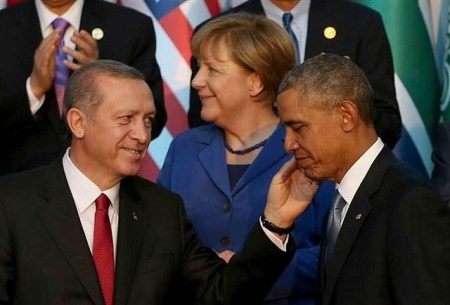 Many Western politicians have cooperated with Islamists and Islamist organizations. (Image source: RT video screenshot)
In every Muslim-majority country, especially in the Middle East, the Islamic terrorist genie came out from under the ashes, built an Islamic state and threatened the West — both with terrorist operations and from inside, in a more surreptitious, seemingly peaceful manner, as the Muslim Brotherhood does.
Most of those who fought Islamic terrorism focused their efforts on the hunt for dangerous products from the factory of Islamic ideology, such as Anwar al-Awlaki or Osama bin Laden. This is important, but no one tried to shut down and destroy the factory itself.
Perhaps we remember that the West, in the fight against the ideology of communism, used weapons only rarely. The major part of the fight was against the ideology itself: encouraging and supporting its opponents, and disseminating ideas to counter those the Communists were exporting. There was a focus on the disadvantages of Communist ideology, such as oppression, tyranny and human rights violations. And suddenly the world woke up one day to find the Soviet Empire collapsed from inside.
We need from the West a positive energy to rebuild the civilization after the destructive energy that hollowed it out. And we need to dismantle the prevailing Islamic ideology that produces terrorism.
It is important to understand that Islam is a religion that includes, in its structure, political power that governs and controls and spreads the force of arms. First the Islamic prophet Muhammad published his call peacefully for nearly 13 years in Mecca, when the Quran verses called for tolerance, freedom of belief and other human values. But then Muhammad and some of his companions moved to the city of al-Madina and turned religion into a political authority aiming to expand and defend itself. It entered into a political and military struggle against its opponents within al-Madina and outside, especially with his tribe of Quraish.
At that time, Muhammad established what we might call political Islam. It was based on a new call: that Islam was no longer interested in the relationship between the individual and his God, as well as a good relationship with those around him, whether they agreed with his religious faith or not.
He turned the religion into a ruling political organization, undertaking to control — religiously, politically, socially and economically — Muslims and others. It builds on the culture of the tribe, spreads the force of arms and increases its numbers and the territories governed by them.
It became the religion of loyalty — meaning loyalty to the governor and vice-versa.
This structure continued after the death of Muhammad. Many ruled out of Quraish, the most prominent Turks, Al-Othmanin and the Ottoman Empire that expanded through force of arms to Persia; swept away the Christian Byzantine Empire; conquered by force North Africa, the Middle East, Greece, Spain and Eastern Europe
During this long history was established the Islamic culture that now prevails among the millions of Muslims in all corners of the world. It was founded on the sacred religious texts: the verses of the Quran and hadiths (the Prophet’s biography). Add to this a religious jurisprudence established during this imperial tide that swept the world. All of this, ordinary Muslims imprison inside them, unhappy. Some of them become potential soldiers for terrorist organizations and all varieties of political Islam.
This culture, prevalent in the West, is backed by money from Saudi Arabia and the Gulf States, especially Qatar, and often backed by money from the West itself — along with many politicians, often opportunistic.
What is the solution? From within. Islamic political power controls the Islamic world, whether military or in an everyday dictatorial form.
Religious reform in Islam did not find support, as it did in the West. What does Trump need to do? There needs to be a stop to any form of cooperation with the varieties of political Islam and certainly the terrorist organizations.
Add to that: Dismantle the ideology that produces Islamic terrorism by supporting the disintegration of the ideology of terrorism through Islamic jurisprudence, Islamic schools, mosques, books, radio stations and television stations. Dry up the external financing and private Saudi and Gulf Islamic institutions in the West. And thus give to the Muslims what is normal in the West. We need to promote other Islamic religious choices, completely out of the ideology of the Islamic terrorist prison, and to encourage being part of the building and development of human civilization rather than the cause of its destruction.
Islamic State teaching its jihadis to eat non-Muslims, Jihad Watch,
Many thought that nothing could match the repugnance of the Islamic State blowing up a baby in an explosives training session; now comes grisly news that the Islamic State is teaching its jihad fighters to eat infidels:
ISIS chiefs even give advice on what parts of the body to eat and how to prepare them and comes after a sickening report a mother was fed the remains of her own son when she was told by the terrorists it was meat and rice.
Perhaps even more troubling is that while the Islamic State is routinely dismissed as hideously extreme, the same practice of cannibalism was reportedly taught to youngsters at the highly prestigious Al Alzhar university in Cairo. High school aged youth were instructed that “they can kill and eat apostates, as long as they don’t cook them.”
…there have been similar Fatwas on cannibalism before, and they involve eating human flesh when you are truly hungry, as implied by “necessary condition.”
But according to Pope Francis, “Muslim terrorism does not exist.”

“ISIS CANNIBALS: Terror group are teaching their fighters to EAT non-Muslims”, by Gareth Davies, UK Daily Mail, February 27, 2017:
Islamic State terrorists are teaching their fighters to eat non-Muslims, it has emerged.
A handbook found in the terror group’s training school has been found by a British counter-extremism think tank, revealing the horrifying new stance of the jihadis.
ISIS chiefs even give advice on what parts of the body to eat and how to prepare them and comes after a sickening report a mother was fed the remains of her own son when she was told by the terrorists it was meat and rice….
He said if there are no food supplies available during what they describe as a time of jihad, terrorists were encouraged to kill non-Muslims or Muslims who do not share their version of Islam for food.Practicing Muslim Mr Rafiq said he found the discovery utterly revolting, and that their most horrific finding was that cannibalism was being taught in classrooms….
Trump Admin, Congress Behind Effort to Cut U.S. Aid to Palestinians, Washington Free Beacon,
(Please see also, Perez, Ellison and the Meaning of Anti-Semitism. How many leftist Democrats will vote for the bill? –DM)
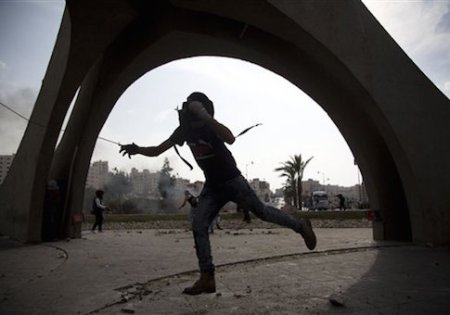
A Palestinian hurls a stone during clashes with Israeli troops, near Ramallah, West Bank, Tuesday, Oct. 20, 2015. (AP Photo/Majdi Mohammed)
The White House is signaling its support for a new congressional effort to cut all U.S. funding to the Palestinian Authority due to its continued support of terrorism against Israelis and Americans, according to senior lawmakers and senior White House officials.
Leading lawmakers in the House and Senate gathered Tuesday on Capitol Hill to introduce legislation that would cut all U.S. funding to the Palestinian government, which has been criticized for providing financial incentives to terrorists who kill American and Israeli civilians.
The White House signaled its support for the legislation in a vast departure from the Obama administration, which worked against similar efforts when in power.
A senior White House official familiar with the effort told the Free Beacon that the Trump administration welcomes this effort and will sign it into law if it passes Congress.
“The Palestinian Authority’s use of its resources to provide material support for terrorism—indiscriminately targeted at American and Israeli civilians—is a grotesque example of how well-intentioned U.S. generosity can be turned against us,” a senior White House official told the Free Beacon.
The legislation, which aims to tighten the financial noose on the Palestinian government and force it to abandon its practice of paying terrorists, is a first step to reforming the notoriously corrupt government, the official said.
“This legislation highlights practical steps the PA can take to demonstrate a real commitment to ending the vicious cycle of hatred and violence that has prevented the Palestinian people from the prosperity and security they could otherwise be enjoying,” the official said.
The new legislative effort, titled the Taylor Force Act after an American who was killed in a Palestinian terror attack, cuts off all U.S. aid to the Palestinians as a direct response to its longstanding policy of paying salaries to terrorists and supporting those imprisoned for terrorist attacks.
“We can’t continue to financially support a government who looks to the so-called martyrs schedule,” said Sen. Roy Blunt (R., Mo.), who is spearheading the effort alongside Sens. Lindsey Graham (R., S.C.) and Tom Cotton (R., Ark.).
“It’s an outrageous concept to be in law anywhere,” Blunt said. “You can either stop doing what you’re doing or you won’t have our money at least to do it with.”
“We shouldn’t allow killers and ruthless attackers to become recognized as martyrs in a system that we’re part of,” Blunt added.
The Palestinian Authority receives around $300 million in aid annually from U.S. taxpayers. Lawmakers backing the bill expressed concern that at least a portion of this money is funding the Palestinian government-backed policy of paying salaries to terrorists imprisoned in Israeli jails.
“Most Americans have no idea this is a problem,” Graham said. “Not only are Israelis victims of this practice, Americans are victims of this practice. We’re going to change this. We’re going to get the Palestinian Authority’s attention by withholding their money.”
Graham also noted that “anti-Semitism is on the rise” in America. The bill represents an effort to push back against this.
“I want people to understand who America is when it comes to the one and only Jewish state,” Graham said.
Sen. Ted Cruz (R., Texas), who has long backed similar efforts, told the Free Beacon it is long past due for Congress to take the lead on this effort now that Obama administration officials can no longer lead efforts to block it.
“After eight years of the Obama administration, the U.S. must take long overdue action to hold the Palestinian leadership accountable for incentivizing and rewarding acts of terrorism,” Cruz told the Free Beacon. “Roughly $300 million annually is provided in monthly salaries and benefits to terrorists jailed in Israel, their families, and the families of those who died committing such horrific atrocities against Israeli and American citizens, including Taylor Force. Enough is enough. We must stand up for victims of Palestinian terrorism. No more U.S. taxpayer dollars should be provided until the Palestinian leadership stops engaging in this heinous practice. The incitement and glorification of terrorism must end.”
A Test for the Anti-Trump Movement, Tablet Magazine, Bari Weiss, February 28, 2017
(Please see also, Perez, Ellison and the Meaning of Anti-Semitism. — DM)
A movement that has so much to say about the value of black lives, of transgender lives, of women’s lives, of Latino lives, of Muslim lives, of the lives of the disabled and the poor and the weak, but becomes mealy-mouthed and contingent about the lives of Jews when those Jews happen to live in the land of Israel should make any person of conscience question the sincerity of that movement.
Indeed, what’s perhaps even more disturbing is the increasing tendency on the part of Jews to silence themselves on these fundamental moral matters to fit in or to avoid accusations of being soft on Trump. On this, our leaders must do better, even though it will surely mean fewer likes and retweets from popular progressives. It’s incumbent upon those who assert themselves as representatives of the Jewish community not to paper over this disturbing hypocrisy—especially if what they are trying to do is convince amcha that it’s still in their best interest to be at the anti-Trump table.
Somehow it seems that Jews are always the ones being asked to check their identity at the door in movements driven by identity politics. We may assiduously follow the “two-thirds and 51 percent” rule, but our partners often do not. If asking for something so minimal—to disassociate and condemn a woman who murdered innocent Jews—seems impolite or greedy, then perhaps the compromise we have made is rotten.
*************************************
In the week leading up to the presidential election, like hockey players who refuse to shave during the playoffs, the women of the Weiss family lived in their “Pussy Grabs Back” T-shirts. For months, our family texts had buzzed day and night with emoji-laden reactions to the latest Trump outrage, while my mother waged a very personal campaign against the Republican candidate. When the first Tuesday in November was upon us, my dad, who has a giant poster of William F. Buckley in his office, bowed to shalom bayit and wrote in Steph Curry.
All of this camaraderie put me in a strange position. Since the crucible of my college years—in which being an outspoken Zionist made you fascist, supporting the war in Iraq made you an imperialist, and believing that some cultures are indeed more enlightened than others a hegemon—I’ve gotten used to feeling politically homeless. I’m typically the hardass among the squishes. All of a sudden, I found myself making common cause with those whom I disagree with vehemently on, say, the Iran deal (bad), the necessity of teaching Western Civ. (good), and most certainly Israel. It is the difference on the Jewish state that has been the starkest and the most painful, as anyone who has paid any attention to the increasingly leftward tilt of the Democratic Party will not be surprised to learn.
One of the rising stars of this new generation of progressive politicos is Linda Sarsour, who was honored as a “champion of change” by the Obama administration and is now one of the anti-Trump movement’s most visible leaders. Sarsour, a longtime Arab-American community organizer, was one of the heads of the Women’s March in Washington and is the named plaintiff in the high-profile lawsuit against Trump’s immigration ban. The image of her, hijab-clad and flashing a defiant smile, rivaled the pink knitted hat as the unofficial symbol of the march.
She is also a proudly outspoken supporter of BDS. “Nothing is creepier than Zionism,” she has tweeted, a remark that, along with the fact that in December she posed for a photo with a former Hamas operative, stirred a series of critical pieces on right-wing websites in the days following the march on the capital. Within hours, Sarsour’s newfound friends and supporters—do I even need mention that Mark Ruffalo and Susan Sarandon were among them?—burst forth with a social-media-driven campaign dubbed #IMarchWithLinda, in which the stories about her background and views were presented as vicious hatchet jobs by pro-Trump legions determined to slow the momentum of the anti-Trump brigades. Indeed, how could a woman who last week made headlines for organizing a fundraising drive that raised more than $56,000 to repair the desecrated Jewish cemetery in St. Louis harbor hostility to Jews?
Among those who have pledged allegiance to Sarsour are prominent Jewish leaders and rabbis. Criticism of the Muslim activist was nothing but “a deliberate smear campaign from the far right to delegitimize the march itself,” said Los Angeles Rabbi Sharon Brous, expressing the view of many other anti-Trump Jews. “This is a time for serious coalition-building, for standing beside other minority populations that are targeted. It is time for people to stand for and with each other. There will be in the mix a number of different perspectives. I don’t feel at all uncomfortable about that,” Brous has said. “A much greater problem would be if the Jewish community stepped out of activism because we’re afraid that someone on the stage has a position on BDS different than our own.”
This was something of a dodge, because, as Brous and others must know, Sarsour’s odious views aren’t limited to BDS, and stretch particularly into issues that directly relate to the systemic oppression of women. “You’ll know when you’re living under Sharia Law if suddenly all your loans & credit cards become interest-free. Sound nice, doesn’t it?” Sarsour tweeted about the Islamic law code that justifies beating women and considers the testimony of a woman half that of a man. She has also denigrated the anti-Islamist feminist Ayaan Hirsi Ali in astonishingly vulgar terms, insisting that Hirsi Ali is “not a real woman” and joking that she wishes she could take away Ali’s vagina—a particularly vicious bon mot, given that Hirsi Ali was well-known as a victim of genital mutilation in her native Somalia.
Still, anti-Trumpers argued, Sarsour’s personal imperfections didn’t come close to forcing Jews to disavow her and her movement. Echoing Brous, Yehuda Kurtzer, president of the Shalom Hartman Institute of North America, pushed back against those who use support of Israel as a single-issue litmus test. In a piece in the Jewish Journal, he made the case that American Jews should stick to what he dubbed the “two-thirds and 51 percent” rule: “We identify in political communities, or organize for particular causes, with people who share, or at least do not operate in contradistinction to, two-thirds of our core moral imperatives, and with whom we agree on a minimum of 51 percent of our moral concerns,” he writes. By this standard, Sarsour’s leadership role is not a deal breaker. “Rotten compromise, the kind we must not do,” wrote Kurtzer, “entails making common cause with evil.”
So what does boundary-crossing evil look like? Is it OK, for example, to support the civil rights of Palestinians, undocumented immigrants, and women who wear hijab while also calling for the denial of the national and indigenous rights of Jews, and rejecting the rights of women in Muslim-majority countries to control their own bodies? Is that a fair definition of Kurtzer’s 51-percent rule? If you call for the death of Zionists but support Palestinian nationalism, is being against Donald Trump the moral tie-breaker that makes you a legitimate ally of American Jews like me—and immune from our criticism? Kurtzer doesn’t say, but the assumption was that nothing had thus far emerged in the anti-Trump movement to meet the rotten compromise test.
That logic resonated with almost all the anti-Trump Jews I know, who either actively rallied around Sarsour, or—like me—held their tongues. I justified it by telling myself that no political movement is perfect, no coalition entirely pure. Opposing this president, I reasoned, is too critical a priority.
Now, unhappily, the anti-Trump movement has produced a leader far worse than Sarsour: a woman whose actions must surely qualify as evil. If they don’t, the problem doesn’t belong to Zionists or Jews, but to the movement itself—and even more so to the spiritual health of the political party angling to benefit from it.
***
The names Leon Kaner and Edward Jaffe are now lost to history, but Rasmea Odeh surely remembers them well. Kaner and Jaffe are the 21-year-old and 22-year-old who went to a Jerusalem supermarket on Feb. 21, 1969 to pick up food for a trip and were blown up thanks to a bomb that Odeh and an accomplice had placed there. Nine others were injured in the blast. Four days later, a second bomb that the duo planted exploded at the British Consulate. Odeh was sentenced to life in prison by Israel but was released in a prisoner exchange in the early 1980s.
This convicted terrorist has surfaced since the march on Washington as a new leader of the women’s movement, announcing its next global action in the pages of the Guardian: a worldwide women’s strike on March 8. Along with Angela Davis and several others, Odeh called for a day of “striking, marching, blocking roads, bridges, and squares, abstaining from domestic care and sex work, boycotting, calling out misogynistic politicians and companies, striking in educational institutions.” And the organizers of the Washington March followed Odeh’s lead, recently announcing their participation in this international “day without women.”
The political stupidity of embracing Odeh is plain. What better ammunition could there possibly be for a White House all too keen to dismiss a genuine grassroots movement as paid professional protestors and anti-American anarchists than the public participation of a bona fide terrorist? If the anti-Trump movement is going to stand for tolerance, genuine liberalism, civility, and decency—everything we disdain Trump for disdaining—Odeh and her ilk can have no place in it.
But there is a deeper, darker point here beyond strategy: It concerns the alarming cheapness of Jewish blood. A movement that has so much to say about the value of black lives, of transgender lives, of women’s lives, of Latino lives, of Muslim lives, of the lives of the disabled and the poor and the weak, but becomes mealy-mouthed and contingent about the lives of Jews when those Jews happen to live in the land of Israel should make any person of conscience question the sincerity of that movement.
Indeed, what’s perhaps even more disturbing is the increasing tendency on the part of Jews to silence themselves on these fundamental moral matters to fit in or to avoid accusations of being soft on Trump. On this, our leaders must do better, even though it will surely mean fewer likes and retweets from popular progressives. It’s incumbent upon those who assert themselves as representatives of the Jewish community not to paper over this disturbing hypocrisy—especially if what they are trying to do is convince amcha that it’s still in their best interest to be at the anti-Trump table.
Somehow it seems that Jews are always the ones being asked to check their identity at the door in movements driven by identity politics. We may assiduously follow the “two-thirds and 51 percent” rule, but our partners often do not. If asking for something so minimal—to disassociate and condemn a woman who murdered innocent Jews—seems impolite or greedy, then perhaps the compromise we have made is rotten.
Perez, Ellison and the Meaning of Anti-Semitism, Front Page Magazine, Caroline Glick, February 28, 2017
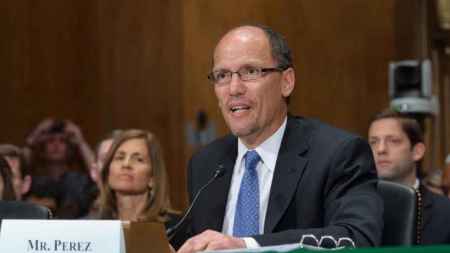
Originally published by the Jerusalem Post.
While America as a whole will suffer from the radicalization of the Democratic Party, perhaps no group will suffer more from the far Left’s takeover of the party than the American Jewish community. The vast majority of American Jews give their partisan allegiance to the Democratic Party and their ideological allegiance to the Left.
With each passing day, the Left becomes more open in its embrace of anti-Jewish voices. If Sarsour’s leadership role last month in the anti-Trump women’s protests constituted a new low in progressive politics, a month later the bar has dropped even lower. At the next round of women’s protests, Ramsea Odeh is one of the announced organizers.
Whereas Sarsour simply supports the terrorist murder of Jews, Odeh is an actual terrorist murderer of Jews. Odeh participated in a PLO terrorist attack at a Jerusalem supermarket in 1970 in which two Jews were murdered.
****************************
Was former secretary of labor and assistant attorney-general Tom Perez’s victory over Congressman Keith Ellison over the weekend in the race to serve as the new chairman of the Democratic National Committee a victory of centrist Democrats over radical leftists in the party? That is how the mainstream media is portraying Perez’s victory.
Along these lines, Prof. Allen Dershowitz, a lifelong Democrat who promised to quit the party if Ellison was elected due to his documented history of antisemitism and hostility toward Israel, hailed Perez’s election. Speaking to Fox News, Dershowitz said that Perez’s election over Ellison “is a victory in the war against bigotry, antisemitism, the anti-Israel push of the hard Left within the Democratic Party.”
There are two problems with Dershowitz’s view. First, Perez barely won. Ellison received nearly half the votes in two rounds of voting.
Tipping his hat to Ellison’s massive popularity among the party’s leadership and grassroots, Perez appointed the former Nation of Islam spokesman to serve as deputy DNC chairman as soon as his own victory was announced.
There is a good reason that Perez is so willing to cooperate with Ellison in running the DNC. And this points to the second problem with the claim that Perez’s election signals a move toward the center by Democratic leaders.
Perez is ready to cooperate with Ellison because the two men have the same ideological worldview and the same vision for the Democratic Party. As Mother Jones explained, “There’s truly not much ideological distance between the two.”
Far from being a victory for the centrist forces in the party, Perez’s win marks the solidification of the far Left’s control over the party of Harry Truman. Only hard leftists participated in a meaningful way in the race for leadership of the second largest party in America – a party that less than a decade ago controlled the White House and both houses of Congress.
The implications of this state of affairs are disastrous for the US generally. It is inherently destabilizing for a nation when one of the parties in a two-party political system is taken over by people who have a negative view of the country.
While America as a whole will suffer from the radicalization of the Democratic Party, perhaps no group will suffer more from the far Left’s takeover of the party than the American Jewish community. The vast majority of American Jews give their partisan allegiance to the Democratic Party and their ideological allegiance to the Left.
While Perez made a name for himself by fighting the enforcement of US immigration and naturalization laws against illegal immigrants, and Ellison rose to prominence for his activism in radical African American and Islamic circles, thanks to the so-called intersectionality of the far Left, that makes the cause of one faction the cause of all factions, today Perez is as much an apologist for Israel bashers as Ellison.
Perhaps in response to the danger that the far Left’s takeover of the Democratic Party represents, Malcolm Hoenlein, the long-serving professional head of the Conference of Presidents of Major American Jewish Organizations called on Sunday for the convening of a global conference on antisemitism. In a meeting with The Jerusalem Post’s editorial board, Hoenlein said that one of the goals of the proposed conference would be to reach a universally accepted definition of antisemitism.
At the same meeting at the Post, Hoenlein insisted that “we can’t afford a split” on Israel among the Republicans and the Democrats.
On the surface, Hoenlein’s position makes sense. Israel and the Jewish community in the US are both endangered by the partisan split. If a broad consensus can be reached on the definition of antisemitism, in theory, such a move could force the radical Left, which now controls the Democratic Party, to eschew Jew hatred.
The problem with Hoenlein’s view is that to get everyone on board, it is necessary to pretend that even antisemites oppose antisemitism.
This sad state of affairs has been on prominent display in the wake of the recent spate of antisemitic attacks against Jewish cemeteries in the US. Muslim Americans with records of antisemitism have been quick to condemn the attacks.
On the face of it, statements by Ellison, Hamas supporter Linda Sarsour and others condemning the attacks on Jewish cemeteries are welcome. Sarsour’s support for Palestinian mass murderers of Jews and open calls for Israel’s destruction have been ongoing for more than a decade. It’s nice that she is suddenly raising money to repair broken Jewish graves in St. Louis.
The problem is if Sarsour and her Jew hating comrades are viewed as legitimate partners in fighting antisemitism, when they themselves are abetting and popularizing antisemitism, then the notion of fighting antisemitism is destroyed.
If Sarsour, who wrote in 2012 that “nothing is creepier than Zionism,” is a legitimate voice in the fight against anti-Jewish discrimination and violence, then the fight against anti-Jewish discrimination and violence is reduced to farce.
Sarsour, like Ellison, is no fringe figure on the Left. She has become a major mover and shaker in the second party in America. Sarsour was one of the organizers of the anti-Trump women’s protests the day after the president was inaugurated.
Sarsour’s rising prominence in progressive and Democratic circles despite her open support for Hamas shows why it is important today to draw a line in the sand and reject the notion that antisemites can suddenly become defenders of Jews.
With each passing day, the Left becomes more open in its embrace of anti-Jewish voices. If Sarsour’s leadership role last month in the anti-Trump women’s protests constituted a new low in progressive politics, a month later the bar has dropped even lower. At the next round of women’s protests, Ramsea Odeh is one of the announced organizers.
Whereas Sarsour simply supports the terrorist murder of Jews, Odeh is an actual terrorist murderer of Jews. Odeh participated in a PLO terrorist attack at a Jerusalem supermarket in 1970 in which two Jews were murdered.
According to Politico, the radical Left’s takeover of the Democratic Party apparatus through Perez and Ellison isn’t enough to satisfy the party’s young activists. They also want for long-serving Democratic lawmakers in Congress to retire and clear the path for their takeover of the Democratic congressional roster.
Following my column last week, where I harshly criticized Senator Robert Menendez for questioning the loyalty of David Friedman, Trump’s ambassador designate to Israel, a number of prominent American Jews insisted that in asking the question Menendez was not embracing the antisemitic dual loyalty slur. He was trying to protect Friedman from his more radical Democratic colleagues.
There is good reason to accept their argument. Menendez has a long record of standing up for Israel and he has paid a political price for that support.
The problem is that such justifications of Menendez’s actions indicate that American Jews have already lowered the bar on what constitutes antisemitism too far and made defending their own interests all but impossible.
The Democrats are in a dangerous place for themselves, for the US and for the American Jewish community. They will not move back to the center if standards for judging what it means to be antisemitic are lowered. The only chance that they will return to their senses is if they are made to choose between the Sarsours of the world and the Dershowitzes. And this cannot happen by looking for a consensus on what antisemitism means. It can only be done – if it can be done at all – by drawing a line and demanding that it be respected.
EXCLUSIVE: Geert Wilders on “the patriotic spring” sweeping the West, Rebel Media, Ezra Levant, February 27, 2017
The Netherlands has its Parliamentary elections in a couple of weeks, and the man who is leading the polls right now is Geert Wilders.
Wilders is the leader of the Party for Freedom. His chief campaign focus is de-Islamification:
Stopping mass immigration, for sure, but more specifically, stopping the cultural, legal, criminal and social ramifications of bringing in a million Muslims into a country of 17 million Dutch.
(That’s twice the Islamification that Canada has, proportionately; we have just over a million Muslims in a population of 36 million.)
I sat down with Geert Wilders in The Hague on Thursday morning.
That very day, news broke that one of Wilders’ own security staff was caught secretly passing on information about Wilders’ movements to a Moroccan jihadist group.
Of course they want to kill him. He’s the only one trying to close the door, while the rest of the politicians there are prying it further open, in return for power or votes or money…
Watch all the footage from my trip by clicking here.
Muslim Brotherhood: We’re Spending $5 Million on PR in U.S., Clarion Project, Ryan Mauro, February 28, 2017
 Muslim Brotherhood-linked groups in the U.S. include the Council of American Islamic Relations. Shown here are CAIR’s Founder and Executive Director Nihad Awad (R) and National Communications Director and Spokesperson Ibrahim Hooper (L). Awad was present at the 1993 secret meeting of the U.S. Muslim Brotherhood Palestine Committee in Philadelphia that was wiretapped by the FBI. Participants of the meeting discussed how to support Hamas and, in the words of U.S. District Court Judge Solis “goals, strategies and American perceptions of the Muslim Brotherhood.”(Photo: © Reuters)
The allotment of money for this campaign is an indirect acknowledgement by the Brotherhood that it exists in the U.S., and its activity in the country is important enough to fight for. The claim that the Brotherhood has an American wing will earn you a branding as a bigoted “Islamophobe,” but it isn’t so controversial in the Arab press (even though the Brotherhood insinuates the same thing there).
Foreign influence operations are at the top of the news right now in the U.S., but they center about Russia. Why is it acceptable to say that Russia would try to influence our policy, but it is bigoted to suggest that the Brotherhood—the largest Islamist movement in the world—would do the same?
*********************************
A senior Muslim Brotherhood official in Sudan told an Arab newspaper* that the group’s international leadership has launched a major PR campaign to influence the U.S. media and members of Congress to oppose the designation of the Muslim Brotherhood as a Foreign Terrorist Organization.
The Brotherhood official predicted that the group would not be designated by the Trump Administration and that the Muslim Brotherhood Terrorist Designation Act introduced into Congress would fail.
He claimed that his organization had made contact with governmental officials and members of Congress and convinced them that the Brotherhood is opposed to terrorism, even though the Brotherhood’s Palestinian wing—Hamas—is designated as a Foreign Terrorist Organization by the U.S. State Department.
The author of the article reports that, according to sources within the Brotherhood, the group has spent $5 million on the PR campaign, with contracts being signed last month. The effort to influence American media included having articles and essays published to argue against designation of the Brotherhood.
Indeed, a slew of articles defending the Brotherhood were published as it was reported that the Trump Administration was planning to designate the Brotherhood. Most of these argue that the Brotherhood is opposed to terrorism and violence. As I wrote in December 2014, this notion is patently false.
The Brotherhood also thanked the leaders of Turkey and Qatar for defending the organization. Egypt, the United Arab Emirates, Bahrain and Saudi Arabia have designated the Brotherhood as a terrorist group.
The Egyptian government warned that the Brotherhood has a lobby in the U.S. disguised as civil society organizations. An Egyptian government website cited a study done by a think-tank in Cairo that concluded that the Brotherhood is trying to influence U.S. policy using affiliates in America that “aim to spread the Muslim Brotherhood’s extremist ideologies in the U.S.,” in the words of the website.
A senior UAE official likewise said that the Brotherhood’s American lobby was responsible for political blowback over his country’s previous designation of the Brotherhood and two of its U.S.-based entities, the Council on American-Islamic Relations (CAIR) and the Muslim American Society (MAS).
The allotment of money for this campaign is an indirect acknowledgement by the Brotherhood that it exists in the U.S., and its activity in the country is important enough to fight for. The claim that the Brotherhood has an American wing will earn you a branding as a bigoted “Islamophobe,” but it isn’t so controversial in the Arab press (even though the Brotherhood insinuates the same thing there).
Foreign influence operations are at the top of the news right now in the U.S., but they center about Russia. Why is it acceptable to say that Russia would try to influence our policy, but it is bigoted to suggest that the Brotherhood—the largest Islamist movement in the world—would do the same?
*This article was first noticed by Eric Trager of the Washington Institute for Near East Policy. It was then reviewed by Clarion Project’s Arabic translator.




 anneinpt
 artaxes
 danmillerinpanama
 davidking1530
 Peter Hofman
 Joseph Wouk
 Peter
 Louisiana Steve


Recent Comments