H/t Power Line

Gaza on the Brink, Commentary Magazine, Evelyn Gordon, June 2, 2017
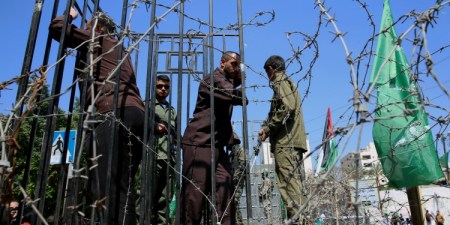
in Gaza City, Monday, April 17, 2017. (AP Photo/Adel Hana)
The testimony of these Gazan refugees in Greece provides a rare opportunity to hear what Palestinians say when they’re out of reach of their own repressive governments and can speak freely. It thereby offers a glimpse at the true source of much Palestinian suffering – and a rebuke to all the journalists, diplomats, and NGOs who have collaborated with both Palestinian governments to hide this truth from the world.
******************************
If you ask Palestinians in either Gaza or the West Bank who’s responsible for their suffering, most would probably say Israel. But what would they say if they were safely overseas and no longer needed to fear their own governments? That’s not a question reporters, diplomats, or nongovernmental organizations usually bother asking. We now have an answer to it, at least with regard to Palestinians who fled Gaza. They left not because of anything Israel did, but because of persecution by Gaza’s Hamas-run government
Their testimony was brought by Haaretz reporter Zvi Bar’el, who went to Greece in search of Syrian refugees but accidentally stumbled instead on Palestinians from Gaza–thousands of them, by their own count. One Gazan refugee estimated there were about 6,000 Palestinians from Gaza in Athens alone. The Badil Resource Center for Palestinian Residency and Refugee Rights says the real figure is probably higher.
And that’s just those who have been able to leave. Many would like to but are stuck in Gaza because the border crossing to Egypt is open only a few days per month. Even when it’s open, only a few hundred people per day can leave. Osama, one of the Palestinians Bar’el interviewed, said that when he left Gaza (via a cross-border smuggling tunnel) over 25,000 people were on the waiting list to leave via the official border crossing.
And why have so many Gazans fled or tried to flee? The Palestinians Bar’el met had a uniform answer: Hamas. Not a single one of them even mentioned Israel in their responses.
“There’s a Palestinian doctor here who came with his wife and three children,” Osama told Bar’el. “Imagine, a doctor, a respectable person with a profession, has to flee Gaza only because he was suspected of disloyalty to Hamas.”
Ayman, who has been listening to the conversation in silence, joins in. “I’m a cartoonist, an artist, and I’ve had exhibitions in Gaza. Hamas didn’t like my cartoons and they forbade me to draw, and they also arrested me. After I spent time in a Hamas prison I decided to escape,” he says.
“They tied my hands and feet, they beat me, and after I was injured from the blows they transferred me to a hospital where I was for more than a month. In the meantime they also arrested my brother to get information out of him about me.”
Naji, another Gazan, showed Bar’el a deep scar on his leg that he said came from being tortured in a Hamas prison.
“One day I even tried to commit suicide. I slammed my head hard against a windowpane and put my neck up against the broken glass. But they pulled me back and I wasn’t successful,” he says, pointing to an ugly scar on his neck. “I’m telling you, Gaza is on the brink of civil war and no one knows what’s happening there. No one is interested.”
There are numerous UN agencies ostensibly devoted exclusively to helping the Palestinians, while human rights groups allocate disproportionate attention to this issue. In both cases, their only real interest in Palestinian suffering is finding some way to blame Israel for it. They couldn’t care less about protecting Palestinians from the abuses of their own government. That’s why they keep issuing reports accusing Israel of being the “key cause” of Palestinian suffering, as one UN agency put it this week, despite all evidence to the contrary.
Yet their blatant bias often obscures a larger problem that affects even well-meaning journalists, NGOs, diplomats and almost everyone else involved in telling the world about what’s happening in the West Bank and Gaza–a failure to understand the way fear affects what people say in nondemocratic societies. For Palestinians, blaming anyone other than Israel for their problems risks serious repercussions from either their own governments or vigilante groups affiliated with both governments. And that’s true not just in Hamas-run Gaza, as people like Ayman and Naji discovered to their sorrow, but also in the Fatah-run West Bank, where journalists, businessmen, and Palestinian security officers have all suffered arrest and financial sanctions for daring to criticize the Palestinian Authority or its president, Mahmoud Abbas. Blaming Israel is always the safest solution, even in cases where it’s patently untrue.
Responsible journalists, NGOs, and diplomats would take this fear factor into account and try to dig a little deeper to try to get at the truth. They would also recognize that the very fact that Israel is the one party no Palestinian fears to criticize is in itself a potent refutation of Palestinian claims that Israel is an oppressive regime. People who truly live under an oppressive regime are generally afraid to go on record criticizing it.
Instead, these opinion shapers take everything they hear from Palestinians in the West Bank and Gaza at face value and parrot it uncritically. That does nothing to better the Palestinians’ lot, but a great deal to bolster the Palestinians’ own repressive governments by absolving them of all scrutiny and pressure to reform.
The testimony of these Gazan refugees in Greece provides a rare opportunity to hear what Palestinians say when they’re out of reach of their own repressive governments and can speak freely. It thereby offers a glimpse at the true source of much Palestinian suffering – and a rebuke to all the journalists, diplomats, and NGOs who have collaborated with both Palestinian governments to hide this truth from the world.
Iran and Middle East Instability, American Thinker, Shahriar Kia, June 3, 2017
During President Donald Trump’s trip to the region and beyond Iran was strongly condemned by the American leader and senior Saudi officials for its support for terrorism, destructive role across the Middle East, and meddling in Syria, Iraq, and Yemen. Tehran is most specifically concerned with world leaders denouncing Iran’s human rights violations and acknowledging how the Iranian people are the main victims of the mullahs’ atrocities.
The Arabs, as the flagbearers of implementing U.S. sanctions, have launched the domino of freezing Iran’s money abroad. Iranian bank accounts in countries such as Turkey, Oman, and the UAE, especially in Dubai and Abu Dhabi, are being blocked one after another. This can be considered the prelude to comprehensive sanctions on Iran’s banking network.
***********************
The end result of Iran’s presidential election has created further rifts and launched a more intense power struggle amongst the regime’s senior ranks. Supreme Leader Ali Khamenei, fearing a repeat of the 2009 scenario of nationwide uprisings, failed to “engineer” the election results with the aim of unifying his regime apparatus. Khamenei sought to prepare conservative cleric Ebrahim Raisi as his heir by first placing him in the presidency, similar to the process he himself went through.
The elections, however, failed to provide such a finale and in fact prompted all candidates to unveil corruption in the most senior ranks. This has prompted the general public to increase their demands. Protests and demonstrations are witnessed these days in more than 30 cities and towns across Iran, with sporadic reports of clashes, following the bankruptcy of two state-run financial firms, Caspian and Arman.
Iran is also facing major foreign dilemmas, with a new international coalition shaping and targeting Tehran’s interests. The Arab-Islamic-American alliance, with the presence of 55 States, and Iran’s absence, delivered a major blow to the mullahs’ objectives in the Middle East.
On the other hand, Iranian opposition People’s Mojahedin Organization of Iran (PMOI/MEK), transferring all its members from Iraq to a number of European countries, has become ever more powerful. Through a vast network of supporters inside Iran, the PMOI/MEK was able to significantly influence the recent elections and place the regime in a quagmire like never before.
A major rally is scheduled for July 1st by supporters of the National Council of Resistance of Iran (NCRI), the political umbrella group of Iranian dissidents, including the PMOI/MEK. Policymakers and influential figures from across the globe will be gathering to provide a concrete plan to evict the mullahs’ presence from the region, how to establish freedom and democracy in Iran, and thus result in peace and stability in the Middle East. Last year more than 100,000 people took part in this convention.
During President Donald Trump’s trip to the region and beyond Iran was strongly condemned by the American leader and senior Saudi officials for its support for terrorism, destructive role across the Middle East, and meddling in Syria, Iraq, and Yemen. Tehran is most specifically concerned with world leaders denouncing Iran’s human rights violations and acknowledging how the Iranian people are the main victims of the mullahs’ atrocities.

Despite the heavy blows and new sanctions against Tehran, Khamenei has chosen to remain completely silent. This is in complete contrast to the Obama era, where the mullahs’ leader resorted to harsh outbursts in response to even the slightest hint of threats by U.S. officials.
To this end, adopting a strong approach against Tehran has proven to be correct, parallel to the weakness seen in Tehran following the presidential election.
To add insult to injury for Iran, the Trump administration has imposed sanctions on dozens of Iran’s companies, sending a highly important message.
Sanctions have now expanded from ballistic missiles and reached the human rights perspective, and specifically targeting the Revolutionary Guards (IRGC) with the objective of designating this entity as a foreign terrorist organization
The IRGC-affiliated Fars news agency described a new U.S. Senate bill as an “effort to bring Europe aboard in nuclear sanctions.”
“Foreign investment in Iran during the past four years has halved during the past four years, lowering from $4.6 billion to $2.05 billion,” according to Naseem Online citing a UN report.
The Arabs, as the flagbearers of implementing U.S. sanctions, have launched the domino of freezing Iran’s money abroad. Iranian bank accounts in countries such as Turkey, Oman, and the UAE, especially in Dubai and Abu Dhabi, are being blocked one after another. This can be considered the prelude to comprehensive sanctions on Iran’s banking network.
Is Rouhani able, or even willing?
Rouhani is neither willing nor able to carry out any measures outside of Khamenei’s framework. The entire apparatus and power structure is controlled by the Supreme Leader. As long as Iran remains under the mullahs’ regime structure, one should set aside all expectations of change emanating from within Iran. A look at Mohammad Khatami’s tenure is president from 1997 to 2005, andRouhani’s first term, are undeniable proof to this reality.
“They want to change our behavior, but changing it means changing our regime,”Khamenei said recently, signaling his red line.
Rouhani defending Iran’s missiles
The regime’s president recently said that Tehran would continue its ballistic missile program.
“… US officials should know whenever we need to technically test a missile, we will do so and will not wait for their permission,” he said in a news conference.
The Iranian regime reported recently the construction of a third underground ballistic missile production factory and will keep developing its missile program.
This came in the same week when Trump in his foreign visit described Iran as a supporter of militia groups and a threat to all Middle East countries.
Rouhani is an “utterly ruthless operator,” who had presided since 2013 over a collapsing economy and what Amnesty International called “a staggering execution spree,” murdering and imprisoning so many dissidents that Iran has per capita the highest execution rate in the world, according to Christopher Booker in a recent Telegraph article.
Obama’s departure ended the period of appeasement and golden opportunities for Tehran’s mullahs. The road ahead promises to be very difficult, to say the least.
The past four decades have proven that only regime change will bring about what the Iranian people desire and deserve. This is something that is supported by the NCRI and Rajavi’s ten-point plan, calling for a free and democratic Iran where equal opportunities are provided to all citizens regardless of gender, ethnicity, and religion. During the short campaigning season, Iranians manifested their support for Rajavi’s plan by putting up posters reading “Maryam Rajavi is our president.”
Published time: 3 Jun, 2017 02:27
Source: Charges mulled against Wilders over anti-Islam tirade implying Koran incites terrorism — RT News
Wilders, whose PPV came second in Dutch parliamentary elections in March, faces charges of incitement in the complaint filed by the human rights advocacy group back in March 2015, when he claimed that Islam “calls on people to be terrorists” and “be violent” and that the “Koran leaves no doubt about it.”
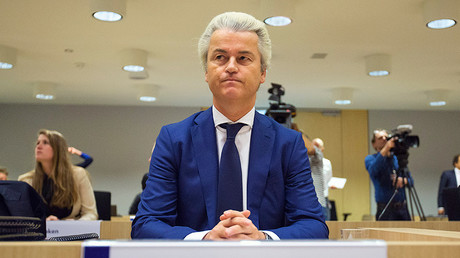
The provocative statements made by Wilders during a speech at the conference of PPV’s Austrian ally Freedom Party (FPO) drew ire of the local Austrian Muslim Initiative (AMI) group. Its chairman, Tarafa Baghajati, lodged a criminal complaint against Wilders, accusing him of resorting to “Nazi rhetoric of the 1930s,” Dutch News.nl reported.
“They (Austrian prosecutors) must now investigate whether Wilders has committed nation incitement and whether he insulted Islam as a religion,” Baghajati told Der Telegraaf at the time.
Acting on the complaint, Austria investigators opened a probe into Wilders’ remarks. On Friday, Dutch public prosecutor’s spokesman revealed that Austrian authorities appealed to their Dutch colleagues to take over the case. Confirming that the prosecutors in the Hague have been “busy studying” the request, he said it is not clear yet if the formal investigation is to be launched into the controversial statements.
Explaining their decision to ditch the dragged-on probe, Austrian prosecutors said it was a result of “practical consideration.”
Meanwhile, Wilders hit back at the Dutch prosecutors, saying that instead of tackling crime and fighting terrorism, they focus on hunting “a politician for speaking the truth about Islam,” he wrote on Twitter, accompanying the message with #legaljihad hashtag.

In his March 2015 speech, which has now become subject to scrutiny, Wilders already called out the authorities for clamping down on him while turning a blind eye on a threat arising from Islamic extremism.
“When we warn against Islam, the authorities call it hate speech and bring us to court. But when the grim forces of hatred march down our streets, the police look on and do not interfere,” he said, calling the approach “a disgrace” and “a scandal.”
Wilders, a far-right politician who has repeatedly courted controversy inside and outside his country by calling freedom and Islam “not compatible,” has also likened the Koran to Hitler’s Mein Kampf.
In December last year, he was found guilty of discrimination against Moroccans in the Netherlands. In 2014, he asked his supporters at a rally, if they want fewer or more Moroccans on the streets, provoking a chant: “Fewer! Fewer! Fewer!”
Wilders denouncing the ruling, which however does not impose any punishment on him, as politically motivated, calling it “madness” carried out by “three PVV hating judges.”
Putin’s best quotes at SPIEF — RT News

© Mikhail Metzel / TASS / Host Photo Agency / Reuters
There have been no secret agreements between the Russian ambassador to the US, Sergey Kislyak and the Trump administration, Putin said at Friday’s Q&A session in St. Petersburg.
“My answer is – no!… No talks had even started,” the president told the forum, adding that he was surprised with all the fuss surrounding the work of the Russian diplomat in the US and calling anti-Moscow allegations “delirious.”
“It’s not even clear where all the people spreading such information come from… So, the ambassador meets someone. And what is an ambassador supposed to do? It’s his job, he’s being paid for that. He must be meeting people, discussing pending issues, making agreements. What else is he supposed to do there? Visit some venues that would then see him fired?” Putin wondered.

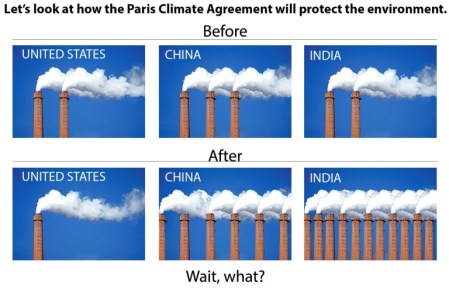
The panic surrounding some of Trump’s decisions is blown way out of proportion, Putin noted at the forum. Commenting on the US president’s decision to pull out of the Paris Climate Agreement, the Russian leader joked that now any weather-related issues can be blamed on “American imperialism.”
“By the way, we should be thankful to President Trump. I’ve heard it has been snowing in Moscow today, and here it’s raining, and terribly cold. Now we can blame it all on him and on American imperialism, hold them accountable,” Putin said. “But we will not do that,” he added, smiling.
Noting that the decision on the Paris climate deal had been taken by another US president, Barack Obama, Putin said that the new administration would probably just rework the agreements, or come up with a new climate deal.
“[Trump] is not refusing to work on the issue, as far as I know… The [Paris] agreement will come into effect in 2021. So we still have time, and if we all work constructively, we can agree on something,” the Russian leader said, then switched to English and added tunefully: “Don’t worry, be happy.”
READ MORE: Putin on Paris climate change agreement: ‘Don’t worry, be happy’

Those who accuse Moscow of the defeat of the US Democratic Party in last year’s elections behave like those who blame the Jews for everything, the Russian president said.
“It’s easier to say that it’s not our [US Democrats’] fault, but Russians’ fault, say that they interfered with the elections… It reminds me of anti-Semitism, when everything is Jews’ fault. Someone is a mutt, can’t do a thing, but the Jews are to be blamed. But we know where such an attitude leads to, it never ends well,” Putin said.
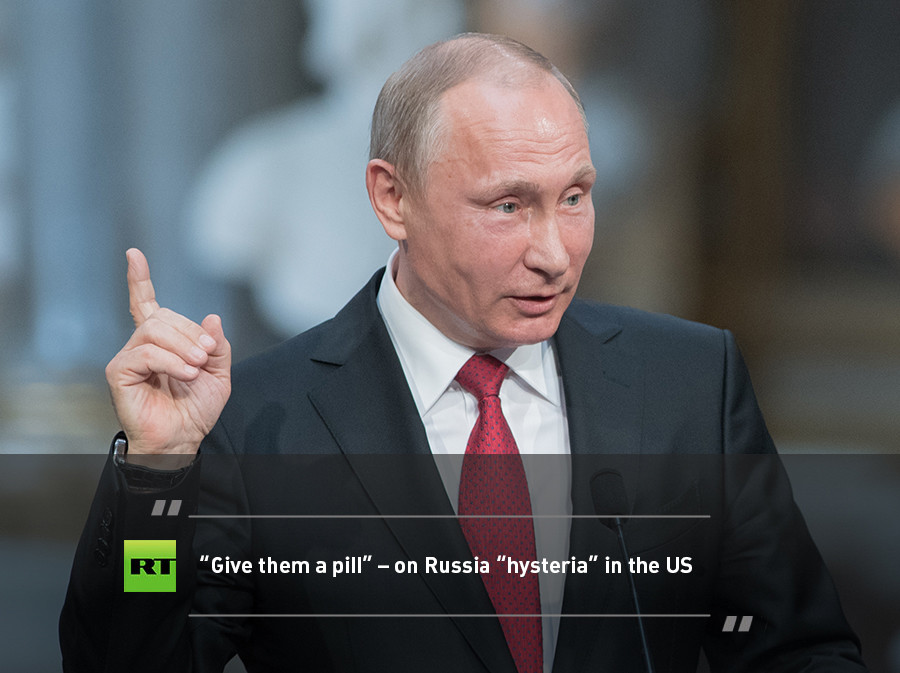
Once again asked to comment on the situation surrounding Russian diplomats in the US, who allegedly tried to tempt some Trump people into favoring Russia, Putin reacted quite emotionally, saying he was tired of the “hysteria” which the US “fails to cease.”
“Should you be given some pill? Does anyone have a pill? Give [them] a pill! Seriously now,” the Russian president said.
The Russian president also called on the West to stop meddling in Russia’s domestic policies.
“Look at your colleagues, what they are doing here,” Putin told NBC journalist Megyn Kelly, who was asking questions at the forum. “They are all over our domestic policy, they’re sitting on our head, dangling their feet and chewing a bubble gum. Entertaining themselves. It’s a systematic, rude and absolutely unceremonious interference in our domestic policies that lasts for many years, also at a diplomatic level,” he said.

Having called NATO “an instrument of US foreign policy,” the Russian president said that the lack of “constructive dialogue” with the military alliance impedes joint efforts on fighting terrorism. Having wondered what is the purpose of the alliance if both the Soviet Union and the Warsaw Pact are no more, the president said that the failed dialogue with NATO is not Russia’s fault.
Asked to comment on reported disagreements within the alliance, Putin commented, with irony: “Well, if you suggest that NATO could fall apart, then these [disagreements] would help us. But so far we don’t see it coming.”
Commenting on the Syrian issue, the Russian president said that the conflict in the Middle East should “in no way be used as means to sort out [someone’s] pressing political issues.”
“And we sometimes see such attempts [in Syria],” Putin said, explaining that forces within the country are being used by other foreign parties to fight Assad.

“You use them today, and never know what happens to you tomorrow. They might be fighting you… So, Al-Qaeda was at some point created to fight against the Soviet Union in Afghanistan, and then Al-Qaeda hit the US on September 11,” Putin pointed out.
The Syrian President, Bashar Assad, “might have made mistakes,” but the groups he’s fighting within the country “are no angels either,” Putin said, adding that the latest chemical attack in Syria was a provocation against the government.
“Regarding the people who were killed and suffered from weapons, including chemical weapons – this information is false. As of today, we are totally convinced that it was just a provocation. Assad did not use that weapon. It was all done by the people who wanted to blame him for it,” Putin said.
by Geert Wilders
June 2, 2017 at 10:00 am
Source: Selling Out Pentecost to Islam
Next Sunday, Christians are celebrating the feast of Pentecost. A Protestant church in the Netherlands is using the occasion to propose the abolishment of the public holiday for the second day of Pentecost. The Dutch have officially been enjoying this holiday since 1815, but the church wants it replaced by an official holiday on Eid-al-Fitr, the day marking the end of the Islamic holy month of Ramadan.
With its proposal, the Christian group says, it wants “to do justice to diversity in religion.” That is politically-correct claptrap. Browsing through today’s papers, I can, however, understand why many Dutch are in a festive mood once Ramadan is over! These days, the headlines are full of incidents, which De Telegraaf, the leading newspaper in the Netherlands, describes as Ramadan rellen (Ramadan riots).
Suppose Christians would, on an annual basis, start to riot after leaving church on Pentecost and demolish property, arson cars, attack police, throw stones through the neighbor’s windows. Suppose the police would feel obliged to mark the Christian Lent in the calendar as days of heightened tensions. Would we not begin to wonder whether there was something wrong with Christianity?
Or suppose Jewish gangs would terrorize entire town districts on Yom Kippur day. Would we not beginning to wonder what they were being taught in their synagogues? Or would we just accept it, celebrate it even, as indications of the cultural “diversity” of our society?
I am writing these lines in my office in the Dutch Parliament in The Hague, barely a few minutes away from the house where the great 17th century Dutch and Jewish philosopher Baruch Spinoza lived and died. Spinoza gave the world a philosophy of tolerance and freedom.
However, what we must never do is be tolerant to intolerance. Because if tolerance becomes a snake devouring its own tail, soon there will be no freedom left and the intolerant will rule the world. Indeed, we are almost there. Three and a half centuries after Spinoza, in the city where he lived, I am writing these lines in a heavily protected sector of the parliament building. The windows are blinded, the doors are armored, and police officers are standing watch outside. They are there to protect me against the intolerance which has in recent decades entered our country – an intolerance that is neither Christian nor Jewish or secular, but Islamic. I am not an extremist if I say that. I am telling the truth. And that is my duty.
For here is the crux of the matter: If we want to remain the free and tolerant society which we used to be, we must realize that the West has a concrete identity. Our identity is not Islamic, but based on Judaism, Christianity and humanism. Our freedoms result from this identity. By depriving Islam of the means to destroy our identity, we are not violating freedom; we are preserving our identity and guaranteeing freedom.
The terrible situation we are in today is caused by our tolerance of evil. We are too tolerant to intolerance, we are too tolerant to Islam. We think that by allowing freedom to the enemies of freedom we prove to the world that we stand for freedom. But in reality, by refusing to draw boundaries to our tolerance, we are handing away our freedom.
We live in an age where people like the idea of rights, so long as they do not have to pay a price for it. The political and media elites are all in favor of speaking the truth, so long as the “truth” is a cliché. But when duty and honor command them to stand athwart history and yell “Stop!” they flee. And those who do their duty are called extremists, dragged to court, silenced.
Earlier today, I learned that the Dutch Public Prosecutor in The Hague is investigating a speech which, two years ago, I gave in Vienna, Austria. He is doing this at the request of his colleague, the Public Prosecutor in Vienna, who accuses me of Verhetzung (incitement). The latter is a criminal offense in Austria and is comparable to incitement.
I find this truly unbelievable. Let them catch bandits and terrorists instead of prosecuting a politician for speaking about Islam. It is a disgrace that this is happening in the city of Spinoza, who was not only a great defender of tolerance but also of freedom of thought and speech. Spinoza’s face used to adorn one of our bank notes in the time when we still had our own currency. Too bad that this is no longer the case today.
Unbelievable also because it would be the third time in a few years that I would be prosecuted for saying things the elites do not want to hear. It is a legal jihad. While the elites are to blame for the existential crisis we are currently in. With their open border-policies and unprecedented love for Islam and their cultural relativism, they sell us out completely and put our freedom and security at stake. They have abandoned the legacy of Spinoza and introduced the totalitarianism of Mohammedanism in our nations. I say: no more. It is time to do our duty and defend our freedom and the freedom of our children.
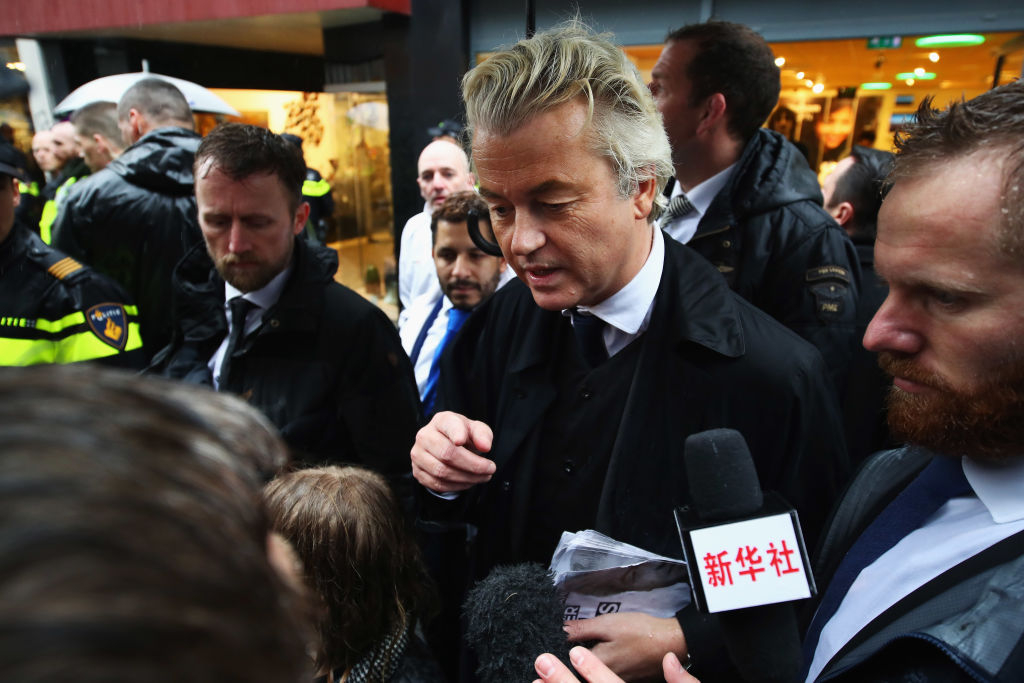 Geert Wilders on March 8, 2017 in Breda, Netherlands. (Photo by Dean Mouhtaropoulos/Getty Images) Geert Wilders on March 8, 2017 in Breda, Netherlands. (Photo by Dean Mouhtaropoulos/Getty Images) |
Geert Wilders MP is leader of the Party for Freedom (PVV) in The Netherlands.
Palestinians: Israel’s Goodwill Gestures Send Wrong Messages, Gatestone Institute, Bassam Tawil, June 2, 2017
Here is what is being said on the Palestinian street: Today Israel runs away from the West Bank or the Gaza Strip; tomorrow Israel will run away from Ashkelon, then from Tel Aviv and from there to the sea, and we have achieved our goal of destroying Israel. Therefore, we need to continue attacking Israel.
As with the Gaza Strip, the withdrawal from Lebanon taught the Palestinians that terrorism could drive Israelis out of their country.
Never have the Palestinians given Israel credit for its goodwill steps. On the contrary, they scoff at these moves and describe them as “cosmetic changes”. The Palestinian line is that Israel’s steps are “insufficient” and “unhelpful.” Its concessions are regarded as gestures of a terrified people and as the rightful reward for terrorism. Far from satiating the appetite of the terrorists, such steps prompt them to step up their attacks against Israelis.
The West suffers under a major misconception concerning the Israeli-Palestinian conflict: that “goodwill gestures” and territorial concessions on the part of Israel boost the prospects of peace in the Middle East. The facts, however, suggest that precisely the opposite is true.
Last week, Israel’s Channel 10 television station reported that the U.S. administration was pushing Israel to transfer parts of Area C — areas under full Israeli security and civilian control in the West Bank — to the control of Mahmoud Abbas’s Palestinian Authority (PA). According to the report, the U.S. believes that the transfer of the territory to the PA would be a “goodwill step” towards the Palestinians, paving the way for the revival of the stalled peace process with Israel.
This assumption, of course, has already proven wrong. The experiences of the past few decades have shown clearly that Israeli concessions have always sent the wrong message to the Palestinians.
In fact, Palestinians read Israeli goodwill steps as signs of weakness and retreat. This misinterpretation on the part of the Palestinians then leads to more violence against Israel. It would be hard for anyone not to conclude that if pressure works, keep on pressuring.
The past 24 years are littered with examples of how the Palestinians react to Israeli concessions.
The Oslo Accords that were signed between Israel and the PLO in 1993 were seen by Palestinians as a first step by Israel towards total capitulation.
The accords, which brought the PLO from several Arab countries to the West Bank and Gaza Strip, came after five years of the first Palestinian Intifada. By allowing the PLO to assume control over large parts of the West Bank and Gaza Strip, Israel sent a message that it was caving in to the violence and terrorism of the First Intifada.
Barely a breath after Oslo, Israel was again asked to conciliate the Palestinians: this time, hundreds of prisoners, many with Jewish (and Arab) blood on their hands, were released from Israeli prison in order to create an atmosphere “conducive” to the peace process.
Instead of viewing the prisoner release for what it was, namely a generous gesture, many Palestinians considered it a “victory” for terrorism and violence. Worse, it was not long before many of the released prisoners were rearrested for their role in further terrorism against Israel. The release of prisoners also sent a message of recidivism to Palestinians: terror does indeed pay! A short stint in an Israeli prison is sure to lead to release in some Israeli “confidence-building measure” or other.
According to statistics, at least half of released Palestinian prisoners have returned to terrorism.
Despite the grim statistics, the international community regularly demands that Israel release more convicted terrorists as a “gesture” towards Mahmoud Abbas and other Palestinians.
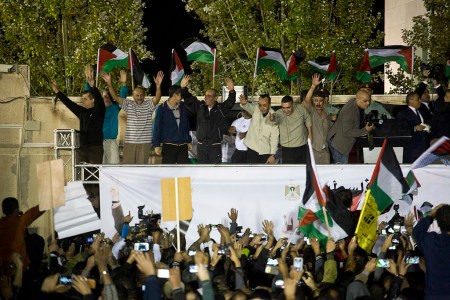
RAMALLAH, WEST BANK – OCTOBER 30: Released Palestinian prisoners stand on a sage as they arrive to the Mukata Presidential Compound in the early morning hours on October 30, 2013 in Ramallah, West Bank. The 26 Palestinian prisoners were released by Israel as part of the terms of renewed U.S.-brokered peace talks. (Photo by Oren Ziv/Getty Images)
Since 1993, Israel has complied again and again with such international pressure, only to reinforce the message to Palestinians: terrorism is indeed worth the trouble.
Let us consider, for a moment, Gaza. In 2005, Israel unilaterally withdrew from the Gaza Strip, after destroying 21 Jewish settlements and expelling more than 8,000 Jews from their homes there.
In Palestinian eyes, however, the Israeli “disengagement” from the Gaza Strip was anything but an olive branch of peace. The withdrawal came after five years of the bloody Second Intifada, when Palestinians waged a massive campaign of suicide bombings and rocket attacks against Israelis.
Thus, for Palestinians, Israel was once again retreating in the face of unremitting bloodshed.
Here is what is being said on the Palestinian street: Today Israel runs away from the West Bank or the Gaza Strip, tomorrow Israel will run away from Ashkelon, then from Ashdod and Tel Aviv and from there to the sea, and we have achieved our goal of destroying Israel. Therefore, we need to continue attacking Israel.
Moreover, it was also precisely the Israeli pullout from Gaza that launched Hamas to its current pinnacle of popularity among Palestinians. Hamas took credit for expelling the Jews from the Gaza Strip through terrorism. A few months later, Hamas even won the Palestinian parliamentary election because Palestinians gave Hamas total credit for driving Israel out of the Gaza Strip.
The Israeli pullout told Palestinians in no uncertain terms: Why bother negotiating when terror will do the trick?
Five years earlier, the Israeli withdrawal from southern Lebanon also had the same effect: it emboldened the Iranian-backed Hezbollah terror group. As with the Gaza Strip, the withdrawal from Lebanon taught the Palestinians that terrorism could drive Israelis out of their country.
In the past few years, additional Israeli goodwill gestures, such as removing security checkpoints and the easing travel restrictions in the West Bank, led to yet more violence, claiming the lives of yet more Israelis.
Abbas and his top officials have always responded to Israeli gestures with cynicism. Never have they given Israel credit for its goodwill steps. On the contrary, they scoff at these moves, and describe them as “cosmetic changes aimed at beautifying Israel’s ugly face” or as public-relations stunts.
For the sake of clarity, let us say it clearly: handing over areas in the West Bank to the Palestinian Authority, and the release of convicted murderers, does not contribute to any sort of “peace process;” it only contributes to the death of more Israelis.
The Palestinian line is that Israel’s steps are “insufficient” and “unhelpful.” Its concessions are regarded as gestures of a terrified people and as the rightful reward for terrorism. Far from satiating the appetite of the terrorists, such steps prompt them to step up their attacks against Israelis. The next time Americans and Europeans think of asking Israel to cede yet more to the Palestinians, let them consider what Israel might be receiving in return, other than the spilling of more Jewish blood.
Bassam Tawil is a Muslim based in the Middle East.
Former Gitmo Captive on Saudi Payroll Arrested in French ISIS Cell, Judicial Watch, June 2, 2017
Despite his disturbing Pentagon document, the Obama administration released Lahmar from the top security compound at the U.S. Naval base in southeast Cuba in 2009 after France agreed to take him. This week he was arrested in Bordeaux as part of a terrorist cell that operated a recruiting network for the Islamic State in Iraq and Syria (ISIS).
As far back as 2010 former president Barack Obama’s National Intelligence Director confirmed that one in four inmates released from Gitmo resume terrorist activities against the United States. A year earlier the Pentagon’s Defense Intelligence Agency, which gathers foreign military intelligence, disclosed that the number of Gitmo prisoners who returned to the fight since their release had nearly doubled in a short time.
******************************
Surprise, surprise, another inmate released from the U.S. military prison in Guantanamo Bay, Cuba has been arrested for reengaging in terrorism. His name is Sabir Mahfouz Lahmar and his Department of Defense (DOD) file says he has links to “multiple terrorist plots” and as a member of the Algerian Armed Islamic Group (GIA) plotted with Al Qaeda to attack the United States Embassy in Sarajevo.
“Detainee advocated hostilities against US forces and the international community in Bosnia, and is linked to multiple terrorist plots and criminal related activity,” according to Lahmar’s DOD file. “Detainee had intentions to travel to Afghanistan and Iran, and is reported as doing so prior to his capture. Detainee has demonstrated a commitment to jihad, and would likely engage in anti-US activities if released.” Lahmar ended up at Gitmo in 2002 because the Algerian government refused to take him into custody after Bosnian authorities exhausted the legal limits for detention. The Pentagon recommended continued detention and determined that he was a high risk that posed a threat to the U.S., its interests and allies. Lahmar was also labeled a “high threat” from a detention perspective and of high intelligence value.
Also of note in the DOD file is that Lahmar was on Saudi Arabia’s payroll as an employee of the Saudi High Commission for Relief (SHCR), a non-governmental organization (NGO). He was arrested and convicted in 1997 for assaulting an American Citizen in Bosnia but was released, “after the SHCR intervened on his behalf,” the military file states. “After his release, detainee returned to work for the SHCR in Sarajevo.” Authorities in Croatia believe Lahmar was involved in the 1997 bombings in Travnik and Mostar and that he served in the el-Mujahid Brigade conducting training for acts of terrorism in the 1990s. Other reports link Lahmar to car theft and document forgery and indicate he’s wanted in Belgium and France for his involvement in violent activities, the military file says.
Despite his disturbing Pentagon document, the Obama administration released Lahmar from the top security compound at the U.S. Naval base in southeast Cuba in 2009 after France agreed to take him. This week he was arrested in Bordeaux as part of a terrorist cell that operated a recruiting network for the Islamic State in Iraq and Syria (ISIS). A British newspaper report says Lahmar was one of six people—four men and two women—captured as part of an aggressive crackdown on a jihadist recruiting network in the European nation that’s been rocked by multiple terrorist attacks in recent years. Just a few years ago a former Gitmo captive, 46-year-old Moroccan Lahcen Ikassrien, was arrested in Spain for operating a sophisticated recruitment network for the Syrian and Iraqi-based terror group known as Islamic State of Iraq and the Levant (ISIL).
Like Lahmar and Ikassreien, many of the captives released from Gitmo have predictably returned to terrorist causes and it has long been documented in military and intelligence assessments. Just last year a report issued by the Office of the Director of National Intelligence (ODNI) showed that of the 161 Gitmo detainees released by the Obama administration, nine were confirmed to be “directly involved in terrorist or insurgent activities” and that 113 of the 532 Gitmo captives released during the George W. Bush administration have engaged in terrorist activities. “Based on trends identified during the past eleven years, we assess that some detainees currently at GTMO will seek to reengage in terrorist or insurgent activities after they are transferred,” according to the ODNI, which is composed of more than a dozen spy agencies, including Air Force, Army, Navy, Treasury and Coast Guard intelligence as well as the Federal Bureau of Intelligence (FBI) and the Central Intelligence Agency (CIA). The agency also stated in its report that “former GTMO detainees routinely communicate with each other, families of other former detainees, and previous associates who are members of terrorist organizations. The reasons for communication span from the mundane (reminiscing about shared experiences) to the nefarious (planning terrorist operations). We assess that some GTMO detainees transferred in the future also will communicate with other former GTMO detainees and persons in terrorist organizations.”
Other examples of recidivism among Gitmo captives include dozens who have rejoined Al Qaeda in Yemen, the country where the 2009 Christmas Day airline bomber proudly trained, and a number of high-ranking Al Qaeda militants in Yemen involved in a sophisticated scheme to send bombs on a U.S.-bound cargo plane. A few years ago, a Gitmo alum named Mullah Abdul Rauf, who once led a Taliban unit, established the first ISIS base in Afghanistan. In 2014, Judicial Watch uncovered an embarrassing gaffe involving an Al Qaeda operative liberated from Gitmo years earlier. Turns out the U.S. government put him on a global terrorist list and offered $5 million for information on his whereabouts!
As far back as 2010 former president Barack Obama’s National Intelligence Director confirmed that one in four inmates released from Gitmo resume terrorist activities against the United States. A year earlier the Pentagon’s Defense Intelligence Agency, which gathers foreign military intelligence, disclosed that the number of Gitmo prisoners who returned to the fight since their release had nearly doubled in a short time. The assessment was made by using data such as fingerprints, pictures and other intelligence reports to confirm the high rate of recidivism among the released prisoners.
Iran’s 1988 Mass Executions Result in US Congress Resolution, Iran News Update, June 2, 2017
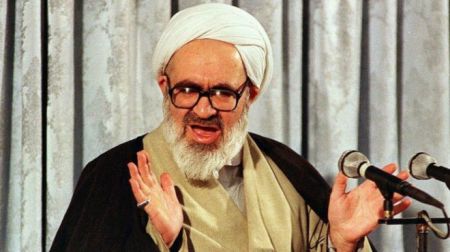
A recently introduced resolution in the U.S. Congress, H.Res. 159, refers to the horrific mass executions of political prisoners by the Islamic Republic of Iran. Mike McCaul, the House Homeland Security Chair, introduced the resolution, and it was cosponsored by Ed Royce, the House Foreign Affairs Committee Chair, as well as Ranking Member Eliot Engel, and Rules Committee Chair Representative, Peter Sessions.
It came as Iranian President Hassan Rouhani, recently re-elected to a second term, and was addressing the 71st Session of the United Nations General Assembly.
The Associated Press reported that thousands of people gathered outside the United Nations to protest Iran’s human rights abuses, executions, and the 1988 massacre of more than 30,000 prisoners.
Speakers for the Resolution included former Democratic vice Presidential candidate, Senator Joe Lieberman, and Sir Geoffrey Robertson, former Head of UN war crimes tribunal for Sierra Leone. Robertson wrote a report on Iran’s 1988 massacre, published on the United Nations Arts Initiative.
The resolution “condemns the Government of the Islamic Republic of Iran for the 1988 massacre of political prisoners and [calls] for justice for the victims.”
It adds that “over a 4-month period in 1988, the Government of the Islamic Republic of Iran carried out the barbaric mass executions of thousands of political prisoners and many unrelated political groups. … [A]ccording to a report by the Iran Human Rights Documentation Center, the massacre was carried out pursuant to a fatwa, or religious decree, issued by then Supreme Leader Ayatollah Ruhollah Khomeini, that targeted the People’s Mojahedin of Iran (PMOI), also known as the Mujahedeen-e-Khalq (MEK).”
The resolution quotes one of Iran’s own senior former officials, the late Hussein Ali Montazeri, a grand ayatollah who served as Khomeini’s chief deputy, who said the 1988 massacre was ‘’the greatest crime committed during the Islamic Republic, for which history will condemn us.”
Accordingly, in 1988, the Islamic Republic executed the thousands of prisoners who had even slight affiliations with the main opposition movement Mujahedin-e Khalq (MEK), because of their political beliefs. The victims were buried in mass graves in Iran after they were shot or hung over a period of just a few months.
Amnesty International reported on November 2, 2007, ‘’between 27 July 1988 and the end of that year, thousands of political prisoners [in Iran], including prisoners of conscience, were executed in prisons nationwide.”
Noted by H.Res. 159, “Those personally responsible for these mass executions include senior officials serving in the current Government of Iran; … [P]risoners were reportedly brought before the commissions and briefly questioned about their political affiliation, and any prisoner who refused to renounce his or her affiliation with groups perceived as enemies by the regime was then taken away for execution.”
Accordingly, “thousands of people, including teenagers and pregnant women, imprisoned merely for participating in peaceful street protests and for possessing political reading material, many of whom had already served or were currently serving prison sentences,” were among the victims.
Stated in the congressional resolution, “[P]risoners were executed in groups, some in mass hangings and others by firing squad, with their bodies disposed of in mass graves.”
According to Amnesty International, ‘’the majority of those killed were supporters of the PMOI [MEK], but hundreds of members and supporters of other political groups . . . were also among the execution victims.’’
The resolution further states, “The later waves of executions targeted religious minorities, such as members of the Baha’i faith, many of whom were often subjected to brutal torture before they were killed.” It add “The families of the executed were denied information about their loved ones and were prohibited from mourning them in public”.
The resolution mentions a recently disclosed audiotape, where Hussein Ali Montazeri can be heard to say that the 1988 mass killings were “the greatest crime committed during the Islamic Republic, for which history will condemn us.”
Amnesty International’s report concluded, “there should be no impunity for human rights violations, no matter where or when they took place. The 1988 executions should be subject to an independent impartial investigation, and all those responsible should be brought to justice, and receive appropriate penalties’’
The resolution says, “The current Supreme Leader Ali Khamenei was reportedly aware of, and later publicly condoned the massacre.”
The Montazeri audiotape was released by Ayatollah Hossein Ali Montazeri’s son, Ahmad, a moderate cleric, who posted the confidential audio of his father on his website. He was ordered by the intelligence to remove it, and was later arrested.
On the tape, Montazeri states, “You [Iranian officials] will be in the future etched in the annals of history as criminals. The greatest crime committed under the Islamic Republic, from the beginning of the Revolution until now, which will be condemned by history, is this crime [mass executions] committed by you.”
Ironically, the people Montazeri is addressing and warning on the tape appear to enjoy high positions currently. They include:
• Mostafa Pourmohammadi was appointed by the Hassan Rouhani to be justice minister. After the release of a tape, Pourmohammadi defended the commission of the massacre and said he is “proud“ to have carried out “God’s commandments” in killing the political opponents.
• Ebrahim Raeisi was appointed as the head of Astan Quds Razavi, which has billions of dollars in revenues.
• Hussein Ali Nayeri is now the deputy of the Supreme Court of Iran. In his memoir, Montzari writes that he told Nayeri to stop the executions at least in the month of Moharram religious holidays, but according to the BBC, Nayeri said, “We have executed so far 750 people in Tehran… we get the job done with [executing] another 200 people and then we will listen to whatever you say.”
These people are only few of those who were involved in the 1988 massacre. They have been awarded more senior positions, power, and money.
Montazeri warned them, “Beware of 50 years from now, when people will pass judgment on the leader (Khomeini) and will say he was a bloodthirsty, brutal and murderous leader.”
The message from Iran’s ex-heir Supreme Leader highlights the methods that the officials of the Islamic Republic use to oppress the opposition. Executions or brutal punishments are common, as Iran ranks top in the world when it comes to executions per capita. Crimes against humanity continue to occur. These are the means that the government uses to silence the opposition.
Human rights organizations, the United Nations, and the International Criminal Court (ICC) must conduct investigations, and bring those who have committed and continue to commit these crimes to justice. Calls for justice are increasing. Those who commit crimes against humanity should be held accountable.
Congress must follow up on the recent Congressional resolution.


 anneinpt
 artaxes
 danmillerinpanama
 davidking1530
 Peter Hofman
 Joseph Wouk
 Peter
Peter Louisiana Steve

Recent Comments