We Need Regime Change in Iran

Posted January 12, 2018 by danmillerinpanama
Categories: Iran - regime change, Iranian protestors - communications, Iranian protestors - food, Khamenei

Tags: , , ,

We Need Regime Change in Iran, PJ MediaMichael Ledeen, January 11, 2017

(Please see also, What we Have Learned From the Iran Protests. — DM)

(AP Photo/Vahid Salemi)

The White House and Congress are trying to legislate policy on Iran. It’s a good idea, since, unless you think press releases and speeches constitute policy, we don’t have one at this potentially world-changing moment. Nor will legislation regarding the JCPOA (aka the Iran Nuclear Deal) give us the sort of policy we need. We need action now, not a law about what we can or cannot do some years from now.

The debate over renewal of sanctions is paradoxically important, but irrelevant to this revolutionary moment. Sanctions are excellent but they are slow — their impact takes time to take effect. Iran’s regime is both challenged in the streets and torn apart by internal strife (see my many essays on “the war of the Persian succession”).

The policy we need, fiercely and fast, is to support the Iranian revolutionaries. There are several ways to do it and we should do them all. They are said to be starving, so airlift food to them. It would be delightfully appropriate to seize some of Supreme Leader Khamenei’s stolen loot, buy food with it, and then deliver it to the revolutionaries via drone or parachute.

Whenever the insurrectionaries are asked what they need, they invariably tell you “communications,” which means they need a way to sabotage the regime’s stranglehold on digital networks. Developing such capacity will not only further regime change in Iran today, it will help us deal with China and Russia as well. It also helps our words of support reach a wider audience inside the country at the same time that it demonstrates our ability to support free speech within the repressive Islamic Republic.

The best way to reach the Iranian people is via our broadcasting networks, including Voice of America and Radio Free Europe/Radio Liberty. This was an extraordinarily effective instrument in bringing down the failed Soviet system in the Cold War. But over the years, these invaluable tools to expose the failures and evils of dictatorships, and get the dissidents the facts about the situation on the ground throughout the country, have fallen into the wrong hands, and we now need a thorough restaffing. Voice of America’s Farsi service is as often as not anti-American and apologizes for the cruel Khamenei regime. We need more of the sort that so irritated Gorbachev. But there is no sign that such an important move is in the works.

In addition, we must establish a conversation with the revolutionaries. That means that Americans have to meet face to face with Iranian dissidents, just as Americans met with Soviet, Polish and other satellite dissidents in the eighties. A note of caution: we should not send CIA personnel. Many key opposition leaders do not trust the agency, which has a poor track record on Iran. It has rarely foreseen explosive political developments (eg. 2009) and invariably declares that uprisings there are leaderless. They were wrong in 2009, and if I read the American press correctly, they are saying the same wrong thing today. Military intelligence is better, even if Secretary Mattis, like National Security Advisor McMaster and Secretary of State Tillerson, has proven disappointingly risk-averse, timorous even, when it comes to directly challenging the regime and vigorously supporting the freedom fighters.

Back in the Bush days—the W days—I once recommended sending a military officer with lots of medals to talk to the Green leaders. But so far as I know, there has been no communication with the dissidents since the phony 2009 elections.

We need regime change and we need it now. That’s what the president should focus on. And then fight for

What we Have Learned From the Iran Protests

Posted January 12, 2018 by danmillerinpanama
Categories: Iranian protests, Khamenei, Trump and Iran scam, Trump and Iranian protests

Tags: , , ,

What we Have Learned From the Iran Protests, Iran News Update, January 11, 2018

INU – The Iran protests loom ever more important with U.S. President Trump’s upcoming on Friday regarding the Iran nuclear deal.

Although Iran’s state media claims the protests have come to an end, still, cities and towns continue to express their discontent. The struggle remains, between the Iranian people and this regime — already weakened by domestic unrest, internal rifts, and international pressures.

An important issue that sets this apart from the previous nationwide protests in 2009 and 1999 is the reference made by Iranian Supreme Leader Ali Khamenei to the party behind these rallies. While Tehran pointing fingers at Washington, London, Israel and the Saudis is not new, Khamenei made a statement in which he pointed to the Iranian opposition People’s Mojahedin Organization of Iran (PMOI/MEK). The significance of this is that it may be an indication of the regime’s real concerns.

According to Reuters, “As well as Washington and London, Khamenei blamed the violence on Israel, exiled dissident group People’s Mujahedin of Iran and ‘a wealthy government’ in the Gulf, a probable reference to Iran’s regional rival, Saudi Arabia.”

In his article for Forbes, Heshmat Alavi writes, “This recent wave of protests is setting the grounds with new sets of rules and understandings.” Displayed below, are what Alavi indicates as these new rules and understandings:

1) The Iranian people no longer fear in expressing their true feelings, seen in the nationwide slogan of “Death to Khamenei.” Such a brave measure in the past would bear the potential of earning you a heavy prison term, if not a death sentence.

Once the Islamic Republic’s greatest taboo, chanting “Death to Khamenei” is now the norm in #Iran.Southern schoolkids chant against regime’s Supreme Leader. Doesn’t take a genius to work out Khamenei’s approval rating among parents in the city – via #MEK activists. #IranProtests — M. Hanif Jazayeri (@HanifJazayeri) 2:58 PM – Jan 8, 2018

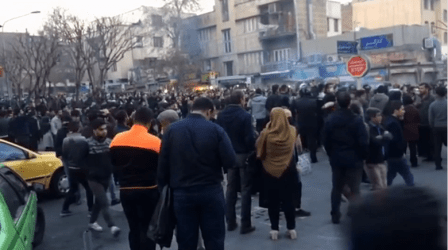
2) Unlike previous uprisings, these demonstrations are mushrooming across the country, reaching over 130 cities and towns, according to activists. Places less heard of before, such as Izeh, Dorud, Shahin Shahr and etc. are now seen leading the growing wave of protests. Brave demonstrators are threatening the regime’s very pillars to an extent that security forces have opened fire and killed dozens of protesters, arresting thousands, according to reports.

3) From the second day of this uprising protesters have shown their overcoming of prior fears through responding to the security forces’ attacks and quelling. State vehicles, motorcycles, makeshift police stations and other facilities are being set ablaze by protesters in response to the regime’s unbridled crackdown.

It is SO easy !

Posted January 12, 2018 by Peter Hofman
Categories: Uncategorized

H/T http://barenakedislam.com/2018/01/12/have-a-great-night-sleep-well-with-a-smile-susan-k/

Curing Trump’s quarterly Iran headache

Posted January 12, 2018 by Joseph Wouk
Categories: Uncategorized

Source: Our World: Curing Trump’s quarterly Iran headache – Opinion – Jerusalem Post

BY CAROLINE B. GLICK
 JANUARY 11, 2018 22:11
Trump is right that he’s damned if he maintains Obama’s nuclear deal with Iran and damned if he kills the deal
Iran rocket launch

 Rocket launch in Iran. (photo credit: FARS)

It’s that time of the year again. In accordance with the Iranian Nuclear Agreement Review Act, by Sunday US President Donald Trump must either certify that Iran is complying with the nuclear deal his predecessor Barack Obama concluded with the Iranian regime, or he must announce that Iran is breaching the accord.

Last October, after angrily certifying compliance at his two previous deadlines, Trump decertified Iranian compliance.

Trump could have walked away from the nuclear deal by reinstating the sanctions on Iran’s oil and gas industries, its banking sector and other foundations of Iran’s economy that were lifted when the deal was implemented. Doing so would have effectively killed the nuclear accord.

But Trump opted instead to pass the burden on to Congress. He gave lawmakers 90 days to put together a new sanctions bill that he would sign that could punish Iran’s misbehavior while presumably leaving the nuclear deal intact.

Congress failed to respond. No sanctions were passed. Democrats, keen to protect Obama’s most significant foreign policy legacy, have promised to filibuster any sanctions bill.

So now it is Trump’s problem to deal with, again. And he faces the same options.

Trump can stick with the deal, or he can walk away.

Media reports from the past two days indicate that Trump has opted to stick with the deal. Trump’s National Security Adviser H.R. McMaster has convinced him to certify Iranian compliance.

Reportedly, Trump’s biggest problem with the nuclear deal is not that it gives Iran a clear path to the bomb inside of a decade. It is that the Iranian Nuclear Agreement Review Act requires him to revisit the issue every 90 days.

The certification process puts Trump in a no-win situation. If he certifies Iranian compliance, he angers his supporters and the overwhelming majority of Republican lawmakers. If he refuses to certify Iranian compliance, he will face the wrath of the media, the Washington foreign policy establishment, and the European Union.

All of the deal’s defenders argue that canceling it will destabilize the international security environment while empowering Iran’s “hard-liners.”

On Wednesday The Washington Free Beacon reported that McMaster, together with Sens. Bob Corker and Ben Cardin, the chairman and ranking member of the Senate Foreign Affairs Committee, respectively, are lobbying Trump to agree to a package that would amend the Iranian Nuclear Agreement Review Act to strip him of the need to recertify Iranian compliance every 90 days. As for sanctions, the amended law would call for sanctions to be reinstated in six years, if Iran is not complying with the agreement.

The implications of McMaster’s reported proposal are enormous. Trump would lose his power to abrogate the deal, while Iran would be immune from sanctions until a really long time from now. The US would lose its leverage against the deal in respect not only to Iran but toward the Europeans, Russians and Chinese as well.

On the face of it, McMaster is right to want to keep the Iranian nuclear issue on the back burner. After all, there is the nuclear crisis with North Korea to consider. Moreover, the Europeans are dead set on protecting the deal.

On Thursday, the EU’s Foreign Affairs Commissioner Frederica Mogherini and her French, British and German counterparts met in Brussels with Iranian Foreign Minister Jawad Zarif to pledge their allegiance to the nuclear deal and stand as one against a possible US pullout from the agreement.

The Europeans will certainly be very angry if Trump walks away from the deal they made with Obama. But then, it isn’t clear why that should matter. Aside from passive aggressively voting against the US at the UN, as they did last month, Mogherini and her comrades don’t have much leverage. Will they prefer economic deals with Iran to their trade with the US?

THIS BRINGS us to North Korea.

Iran and North Korea are partners in nuclear and ballistic missile proliferation. They partnered in building the nuclear installation in Syria that Israel reportedly destroyed in September 2007. Iran’s ballistic missiles are based on North Korean designs. Iranians have reportedly been present during North Korea’s nuclear tests.

All of this information is public knowledge, and we can only speculate how much deeper their collaboration actually is. Given what is known and must be assumed about their collaboration, it is beyond foolish to treat the Iranian and North Korean nuclear programs as unrelated to each other.

If North Korea cannot be set aside, neither can Iran.

Then there is the fact that hundreds of thousands of Iranians have been on the streets for weeks calling for the overthrow of the regime due to its squandering of Iran’s national wealth on wars and graft.

Nuclear deal supporters insist that reinstating sanctions will only harm the protesters. The regime, they argue, is not harmed by sanctions. The regime passes the economic losses Iran incurs from sanctions onto ordinary citizens. They suffer while the regime prospers through whatever sanctions busting trades they concoct with the Turks, Qataris, Russians and Chinese.

This claim is both morally repugnant and contradicted by the protests themselves.

If the regime were able to support itself without pilfering from the public, there wouldn’t be any protesters on the streets calling for Iranian dictator Ayatollah Ali Khamenei to die.

Iran received more than $100 billion in sanctions relief from the nuclear deal. Obama administration officials promised the regime would not use the sanctions relief windfall to underwrite terrorism and war and develop advanced weapons. Instead, Obama and his underlings promised it would go to ordinary Iranians. Iranian prosperity, they offered, would cause the regime to become moderate and peaceful.

On Thursday Iran sanctions expert Jonathan Schanzer from the Foundation for Defense of Democracies tweeted, “A US official I spoke to today believes Iranian expenditures on foreign adventures, nuclear research and missiles, coupled with losses from graft and corruption, have cost the regime $150b.-$200b. since the signing of the [initial draft nuclear deal with Iran in late]… in 2013.”

In other words, the regime is a parasite that has lives on international welfare and the wealth of its people. Instead of developing Iranian society, Khamenei and his henchmen steal the people’s wealth and national treasure and use both to line their pockets and pay for their wars abroad.

In an interview with Lee Smith at RealClearPolitics, Iranian banking expert Saeed Ghasseminejad revealed that in addition to squandering their earnings from sanctions relief, the regime has been stealing the savings of the Iranian middle class. First, regime-controlled banks, (including those that will be barred from the international financial system if Trump reinstates the sanctions) gave large loans to regime officials who never repaid them. The losses were passed to the regular account holders.

Second, Ghasseminejad related details of a regime-licensed Ponzi scheme. Private banks offering high interest rates appeared out of nowhere. Their high rates attracted middle class investors who deposited their life savings.

When depositors tried to withdraw their money, the banks declared bankruptcy.

No one has been prosecuted and a large number of formerly middle class Iranians are now impoverished.

According to Ghasseminejad, these newly impoverished Iranians are now in the streets calling for the regime to be overthrown.
If Trump decides to keep sanctions frozen, it will serve as a rebuke to the protesters. And if media reports that the protests are dissipating are to be believed, then a decision by Trump to certify regime compliance with the nuclear deal will be their death knell.

It isn’t that there is no risk to killing the nuclear deal. As The Jerusalem Post reported this week, in an interview with Iranian television Wednesday, Behrooz Kamalvandi, the deputy chief of Iran’s Atomic Energy Organization, threatened Trump that if he reinstates sanctions, “Iran is ready to increase the speed of its nuclear activities in various areas, especially enrichment, several times more than [in the] pre-nuclear deal era.”

And he may be telling the truth.

But the financial pressure on the regime will be far greater and the headwinds now facing the protesters calling for its overthrow will become a tailwind if Trump walks away from the deal. Middle class families that have not joined the protesters are more likely to take to the streets if sanctions are reinstated. Not only will they be hurt financially, they will become convinced that the regime is not invincible.

Whereas the deal’s proponents insist that leaving killing the deal will harm “moderates” in the regime, if the protests tell us anything, they tell us – once again – that there is no distance between so-called “moderates” like President Hassan Rouhani and Zarif, and so-called “extremists like Revolutionary Guard Corps terror boss Qassem Suleimani. Their theft of the wealth of the Iranian people, their corruption and sponsorship of terrorism is no different than Suleimani’s. The only way to help the Iranians on the streets is to weaken the regime as a whole, because the regime as a whole oppresses the Iranian people and robs them blind.

Israeli experts who were close to the Obama administration are calling for Trump to keep the deal alive. A paper published on Thursday by the left-leaning Institute for National Security Studies called for Trump to keep the deal alive, but enforce it fully.
Co-authored by Obama’s ambassador to Israel Dan Shapiro and former security brass who oppose the Netanyahu government, the paper claimed that the US should insist that Iran open its military nuclear sites to UN inspectors.

The problem with the recommendation is that there is no chance it will be implemented. Iran refuses to open its military sites to inspectors, and the Europeans side with them against the US.

Trump is right that he’s damned if he maintains Obama’s nuclear deal with Iran and damned if he kills the deal. But his supporters are right on this issue and the Washington establishment, Europe and the media are wrong.

If Trump walks away, he will empower the Iranians calling for a new regime. He will weaken the regime’s ability to maintain its global war against the US and its allies. He will force the Europeans to abandon their love affair with the corruption kings in Tehran by making them choose between the US market and the Iranian market.

And he will accomplish all of these things while freeing himself from the quarterly requirement to either lie and pretend Iran is behaving itself and be pilloried by his supporters, or tell the truth about its behavior and be pilloried by the people who always attack him.

Most important, by walking away from a deal built on lies, distortion and corruption, Trump can quickly pivot to a policy based on truth. Unlike the nuclear deal, such a policy would have a chance of ending Iran’s nuclear ambitions, its sponsorship of terrorism, and its oppression of its long-suffering people once and for all.

http://www.CarolineGlick.com
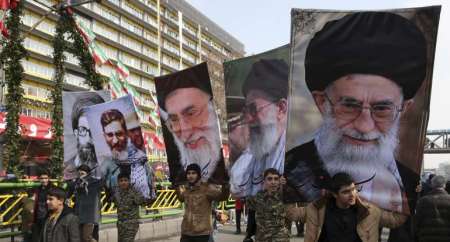
In Epic Twitter Rant, Khamenei Blasts U.S., Israel for Iran Protests, Threatens a “Response”

Posted January 11, 2018 by Louisiana Steve
Categories: Mad Mullahs

Tags:

Source: In Epic Twitter Rant, Khamenei Blasts U.S., Israel for Iran Protests, Threatens a Response – The Tower

{Khamenei says, “Iranian people have lived a life of dignity and honor, and by God’s grace their economic problems will be solved.” Well, Mr. Khamenei, I have a question. By whose grace gave your people the economic problems in the first place? – LS}

Iran’s supreme leader, Ayatollah Ali Khamenei’s, said in a string of comments posted on his Twitter account on Tuesday that the “U.S and Zionists” were behind the anti-government protests in the Islamic Republic and threatened this action would have consequences.

“U.S. officials should know that, firstly, they have missed their target: and if they target Iran again, they will fail. Secondly, they have inflicted damage upon Iran in recent days, and they should know this won’t be left without a response,” Khamenei tweeted.

The supreme leader also boasted about Iran’s hegemonic ambitions in the Middle East and the political and military advances it enjoyed in the 2010s. The Obama administration launched a round of dialogue and rapprochement with the regime that ultimately resulted in the nuclear accord signed in 2015.

“The U.S. President says the Iranian establishment is terrified by their power,” Khamenei wrote. “Well, if we were so terrified by you, how did we kick you out of Iran in late 70s and send you packing, out of the entire region, in the 2010s?” he asked.

“The U.S. is utterly angry….They’re angry at everyone and everything, the nation, the establishment, and the Islamic Revolution of Iran; because they’ve been defeated by your great movement,” Iran’s Supreme Leader continued.

He also denied the grim economy conditions in the country. While the Iranian people suffer great poverty, the regime has invested the financial windfall from the nuclear accord in military adventurism and terrorism across the region. “Iranian people have lived a life of dignity and honor, and by God’s grace their economic problems will be solved!” Khamenei claimed.

He also appeared to enter the debate over allegations about the mental health of President Trump. “Thirdly, this man who sits at the head of the White House— although, he seems to be a very unstable man–he must realize that these extreme and psychotic episodes won’t be left without a response,” he said.

In the United States, politicians of both parties have declared support for the protests, which swelled in major cities across Iran in recent weeks, and which claimed the lives of at least 22 activists and resulted in the arrest of thousands more. Khamenei, President Hassan Rouhani, the Iranian Revolutionary Guard Corps, and Tehran’s top prosecutor have all dismissed the unrest as a U.S.-led scheme supported by Israel and Saudi Arabia.

President Donald Trump quickly announced America’s backing of the Iranian people against the regime and United States ambassador to the United Nations, Nikki Haley,  called a U.N. Security Council emergency session to condemn Iran’s human rights abuses last week.


Palestinian Authority paid jihad terrorists and their families nearly $350 million in 2017

Posted January 11, 2018 by Louisiana Steve
Categories: Palestinian Authority and peace

Tags:

By

Source: https://www.jihadwatch.org/2018/01/palestinian-authority-paid-jihad-terrorists-and-their-families-nearly-350-million-in-2017

{The truth is in the numbers. – LS}

But deep down, they really, really want peace!

Yes, of course, I’m being sarcastic. But there are respected policy analysts in Washington at this very moment who actually believe that.

“Palestinian Authority Paid Terrorists and Their Families Nearly $350 Million in 2017,” by Deborah Danan, Breitbart, January 10, 2018:

TEL AVIV – In accordance with its “pay-for-slay” law, the Palestinian Authority last year paid terrorists and their families over $347 million, Defense Minister Avigdor Liberman said Tuesday.

Citing the PA’s own data, terrorists with three to five year prison sentences receive $580 dollars a month – equivalent to the average Palestinian income, Liberman told a session of the Knesset Foreign Affairs and Defense Committee on Tuesday.

Terrorists sentenced to 20 years or more – usually for the murder of Israeli civilians – receive more than $2,900 per month for their entire lives, five times the amount of a “small time” terrorist.

On top of the PA salary, Arab terrorists who hold Israeli citizenship receive a $145 bonus, more than the average Israeli income of around $2,700.

In addition, there are additional stipends for wives and children.

Defense Minister Avigdor Liberman said, “The PA pays over a billion shekels a year to terrorists and their families, thus encouraging and perpetuating terrorism.”

“The minute the amount of the payment is decided according to the severity of the crime and the length of the sentence – in other words, whoever murders and is sentenced to life in prison gets much more – that is funding terrorist attacks against Israeli citizens. There is nothing that better illustrates the PA’s support for terrorism. We must stop this,” he added.

Liberman also presented his bill proposing to deduct the amount paid by the Palestinian Authority to terrorists and their families from monies owed by Israel in taxes.

The PA has paid out NIS 4 billion ($1.12 billion) over the past four years towards terrorist salaries, as per PA law. According to Brig.-Gen. (res.) Yossi Kuperwasser, who served as the director general of the Ministry of Strategic Affairs, the longer a Palestinian security prisoner is jailed, “the higher the salary. … Anyone who has sat in prison for more than 30 years gets NIS 12,000 ($3,360) per month.”…

In August, Breitbart Jerusalem reported that PA President Mahmoud Abbas told President Donald Trump’s senior adviser and son-in-law Jared Kushner that he wouldn’t stop payments to convicted terrorists until his “dying day.”

After his meeting with Kushner, Abbas issued a statement on Facebook in which he vowed again: “I will never stop [paying] the allowances to the families of the prisoners and released prisoners, even if this costs me my position and my presidency.”

“I will pay them until my dying day,” he added.

Trump flipflop: US bases to stay in post-war Syria for blocking Russian-Iranian consolidation

Posted January 11, 2018 by Joseph Wouk
Categories: Uncategorized

Source: Trump flipflop: US bases to stay in post-war Syria for blocking Russian-Iranian consolidation – DEBKAfile

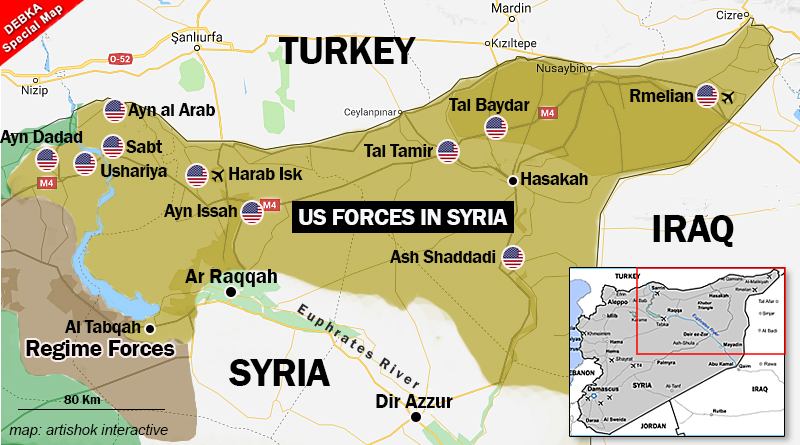
 President Trump’s decision to keep US troops in post-war Syria comes ahead of his Friday deadline for re-certifying the nuclear accord with Iran, DEBKAfile reports exclusively from Washington.

The decision to retain US bases in northern Syria after the Islamic State’s defeat not only poses a challenge for the plans Moscow has drawn up for Syria, but is another slap in the face for Tehran. It is a reversal of the former White House policy, designed by Trump’s advisers led by National Security Adviser Gen. HR McMaster, to try and work together with President Vladimir Putin on the shape of post-war Syria. They had recommended the drawdown of US troops in the country, following the removal of all foreign forces, especially Iran’s Revolutionary Guards, Hizballah and the various pro-Iranian Shiite militias fighting for the Assad regime.

This approach, our Washington sources reveal, was turned on its head by certain momentous events in the past week, most significantly the arrival of game-changing Iranian weapons to Syria, without a demurral from Moscow. Putin was emerging not as America’s partner in Syria’s future, but the active associate in Tehran’s scheme to establish itself permanently in Syria after the war was over. DEBKAfile’s military sources reveal that Israel’s three air strikes of the al Qutaifa base west of Damascus (not east as widely reported) focused on a single target. US military sources noted later than when an air raid is repeated on the same target, it is evidence of an undivided resolve to wipe it off the face of the earth. The same sources also pointed at Russia’s silence on the Israeli air strike and its consequences, although it was the heaviest Israel has staged in many years.

Trump’s flipflop for keeping US boots where they are in northern Syria (see attached map) puts Syria back in the role of central US arena of contention against Russia and its alliance with Iran and Turkey.

Trump Threatens to Deal Another Blow to the Palestinian Cause

Posted January 11, 2018 by danmillerinpanama
Categories: Arab states and Palestinians, Trump and Palestinian funding, Trump and Palestinians

Tags: , ,

Trump Threatens to Deal Another Blow to the Palestinian Cause, Town HallVictor Davis Hanson, January 10, 2018

Trump may be rash and unfamiliar with the stagnant Middle East peace process, but his political instincts are probably correct. Polls show that less than 20 percent of Americans support the Palestinian cause. Many U.S. citizens are tired of subsidizing those who claim that they do not like their benefactors in the United States.

It finally may be time for the Palestinian factions to fund their own causes and go their own ways.

********************************

President Trump set off another Twitter firestorm last week when he hinted that he may be considering cutting off hundreds of millions of dollars in annual U.S. aid to the Palestinians. Trump was angered over Palestinian unwillingness to engage in peace talks with Israel after the Trump administration announced the move of the U.S. Embassy in Israel to Jerusalem.

Given that the U.S. channels its Palestinian aid through third-party United Nations organizations, it’s unclear how much money Trump is talking about it. But in total it may exceed $700 million per year, according to reports.

A decade ago, the U.S. row with the Palestinian Authority would have been major news. But not now.

Why?

The entire Middle East has radically changed — and along with it the role and image of the Palestinians.

First, the U.S. is now one of the largest producers of fossil-fuel energy in the world. America is immune from the sort of Arab oil embargo that in 1973-74 paralyzed the U.S. economy as punishment for American support of Israel. Even Israel, thanks to new offshore oil and natural gas discoveries, is self-sufficient in energy and immune from Arab cutoffs.

Second, the Middle East is split into all sorts of factions. Iran seeks to spread radical Shiite theocracy throughout Iraq and Syria and into the Persian Gulf states — and is the greatest supporter of Palestinian armed resistance. The so-called “moderate” Sunni autocracies despise Iran. Understandably, most Arab countries fear the specter of a nuclear Iran far more than they do the reality of a democratic and nuclear Israel.

A third player — radical Islamic terrorism — has turned against the Arab status quo as well as the West. Because Palestinian organizations such as Hamas had flirted with Iran and its appendages (such as the terrorists of Hezbollah), they have become less useful to the Arab establishment. The terrorist bloodlettings perpetrated by groups such as the Islamic State and al-Qaida have discredited terror as a legitimate means to an end in the eyes of the Arab world, despite previous support for Palestinian terrorists.

Third, the world itself may have passed the Palestinian issue by.

Israel was founded in 1948. Palestinian rhetoric that they would push the Jews into the sea is by now stale. There have been seven decades of failed intifadas and suicide bombing campaigns, along with full-scale Arab-Israeli wars.

Equally futile were endless “peace processes,” “peace initiatives,” “road maps” and “multiparty talks,” plus Middle East “conferences,” “summits” and “memoranda” all over the world, from Madrid and Oslo to Camp David.

In the meantime, most other “refugees” the world over have long ago moved on. Around the time Israel was created, some 13 million German speakers were ethnically cleansed from East Prussia and Eastern Europe. The word “Prussia” no longer exists as a geographical or national label. Seven decades later, the grandchildren of refugees do not replay World War II. “Prussians” do not talk about reclaiming their ancestral homelands in present-day Poland, Hungary and the Czech Republic. German-speaking youth do not demand a “right of return” to their grandparents’ homes to the east.

Fourth, the Palestinians have never been able to craft a successful, transparent, consensual government. After 30 years of waiting, the world has mostly given up on their rhetoric of self-government and reform on the West Bank.

Since the Palestinian proclamation of independence in 1988, there have been only two “presidents”: Yasser Arafat and Mahmoud Abbas. Neither has allowed open and transparent elections. A Palestinian president gets power by seizing it. He loses it only by dying in office. Over the same period, Israel has elected seven different prime ministers from a variety of political parties.

The Palestinian political party Fatah is engaged in a deadly rivalry with the terrorist-inspired Hamas organization that has run Gaza for over a decade. The beef is not over democracy, but over which faction will bury the other.

The Palestinians’ inability to rule the West Bank in constitutional fashion is why hundreds of thousands of expatriate Palestinians voice their solidarity from a safe distance while living in North America or Europe. More than a million Palestinians prefer to stay put in Israel. They are convinced that they will have more security, freedom and prosperity in a democratic state than under dictatorial Palestinian rule a few miles away.

Trump may be rash and unfamiliar with the stagnant Middle East peace process, but his political instincts are probably correct. Polls show that less than 20 percent of Americans support the Palestinian cause. Many U.S. citizens are tired of subsidizing those who claim that they do not like their benefactors in the United States.It finally may be time for the Palestinian factions to fund their own causes and go their own ways.

History Channel – Israel’s Mossad Documentary 

Posted January 11, 2018 by Joseph Wouk
Categories: Uncategorized


BDS banned! – Hear them whine

Posted January 11, 2018 by anneinpt
Categories: BDS, Boycott of Israel, NGO's

Tags: , , , , ,

BDS banned! – Hear them whine | Anne’s Opinions, 10th January 2018

Back in August I wrote about anti-Israel boycotters being banned, and the irony of their complaints at having a taste of their own medicine.

Last week the Israeli government expanded on their original decision by publishing a list of about 20 anti-Israel organizations whose members will be denied entry to Israel:

“We have switched from defense to offense,” said Public Security and Strategic Affairs Minister Gilad Erdan.

“The boycott organizations need to know that the State of Israel will act to stop them and prevent their representatives from entering the country to harm its citizens.”

The list features BDS groups who, according to the ministry, carry out campaigns of “falsehood and incitement” in an effort to undermine Israel’s legitimacy worldwide.

The blacklisted groups “consistently and continuously act against the State of Israel by pressuring groups, institutions and states to boycott Israel,” the ministry said.

Among the groups on the list are six US based organizations, including Jewish Voice for Peace, and 10 European organizations, including leading BDS groups in Italy, France, Norway and Sweden.

The ban is set to be enforced beginning in March and will be limited to people who hold senior positions or who are very active within the organizations.

“The formulation of this list is another step forward in our battle against the incitement and lies of the BDS organizations. No country would grant entrance to visitors who seek to harm it, especially ones whose goal is to terminate Israel as a Jewish state,” said Erdan.

The ministry added that it will be passing the names of the organizations over to the Interior Ministry and border patrol.

Interior Minister Arye Deri said, “As the minister in charge of the Israel Entry Law, I made it perfectly clear that I would use my authority to prevent individuals and representatives of groups, whose sole purpose is to harm Israel and its security, from entering its borders.”

“These people are trying to take advantage of the law and our hospitality in order to act against and defame Israel,” he added.

Erdan claims a certain degree of success in this new method for deterring BDS:

The ministry pointed out that this approach is successful in curtailing BDS efforts, highlighting the recent announcements by Denmark and Norway, who said they would toughen their stances against the funding of pro-Palestinian organizations.

The ministry also touted their efforts which they claim led 24 US states, as well as the federal government, to pass anti-BDS legislation.

The BDS-ers themselves dispute this of course:

The organizations on the list, however, seem undeterred by the latest tactic. Several organizations on the list issued statements on Sunday, claiming that Israel’s move only serves as proof that the BDS movement is spreading and having an impact.

Rebecca Vilkomerson, executive director of Jewish Voice for Peace, issued a statement and said the ban was “disconcerting but not surprising, given the further erosion of democratic norms and rising anxiety about the power of BDS as a tool to demand freedom.”

The Ireland Palestine Solidarity Campaign issued a statement via its Facebook page and said being on the list was a “badge of honor” and that it was “in good company.”

In fact Prof. Gerald Steinberg, director of NGO Monitor, warned that the ban, while a good idea in theory, might backfire by giving the haters free publicity:

Professor Gerald Steinberg, founder and president of the NGO Monitor watchdog group, told JNS that the government’s move signals that Israel “won’t turn a blind eye to those who work to delegitimize it — but the downside is that it also serves to raise the profiles of these groups.”

The list drew fire from “rights” groups – that is, rights for everyone except Jews. I can’t say I am surprised or even disappointed. They are acting precisely as I expected.

See these tweets for example:

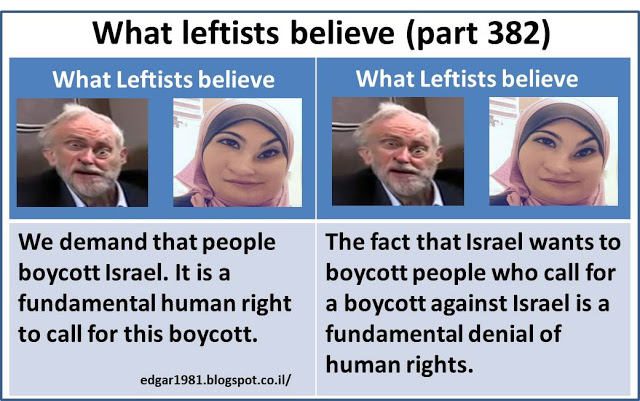
The blogger Edgar Davidson has a nifty graphic illustrating the hypocrisy of the boycotted boycotters:

And here is the full list of the banned organizations – or at least the leaders of the following organizations:

United States:
• AFSC (American Friends Service Committee)
• AMP (American Muslims for Palestine)
• Code Pink
• JVP (Jewish Voice for Peace)
• NSJP (National Students for Justice in Palestine)
• USCPR (US Campaign for Palestinian Rights)

Europe:
• AFPS (The Association France Palestine Solidarité)
• BDS France
• BDS Italy
• ECCP (The European Coordination of Committees and Associations for Palestine)
• FOA (Friends of al-Aqsa)
• IPSC (Ireland Palestine Solidarity Campaign)
• Norgeׂׂ Palestinakomitee (The Palestine Committee of Norway)
• PGS Palestinagrupperna i Sverige (Palestine Solidarity Association in Sweden)
• PSC (Palestine Solidarity Campaign)
• War on Want
• BDS Kampagne

Latin America
• BDS Chile

South Africa
• BDS South Africa

Other
• BNC (BDS National Committee)

In my humble opinion the ban does not go far enough. There are many more such hateful organizations, plus the ban should include everyone who has been active in these groups, not just the leaders. Why should anyone working to undermine the State of Israel, and especially those trying to harm it, whether physically or politically, be permitted to enter and carry out their despicable work on our own turf? Let them try to do it by remote.

If you would like a further reminder of what BDS is all about see this post of mine about the malicious aims of BDS.