Russia: Trump would make ‘big mistake’ by leaving Iran deal

Posted January 13, 2018 by Peter Hofman
Categories: Uncategorized

Moscow ‘gradually coming to the conclusion that an internal decision by the US to leave the deal has already been made or is close to being made,’ vowing to ‘do everything in its power to save the agreement,’ says deputy foreign minister.
https://www.ynetnews.com/articles/0,7340,L-5070307,00.html

Russia on Saturday said Washington would be making a grave mistake by pulling out of the Iran nuclear deal, adding that Moscow would work hard to keep the landmark agreement alive.Deputy Foreign Minister Sergei Ryabkov criticized remarks by US President Donald Trump, who on Friday said the US will not reimpose nuclear sanctions on Iran for the moment, but would withdraw later this year unless the terms of the deal are changed.”We are gradually coming to the conclusion that an internal decision by the US to leave the (Joint Comprehensive Plan of Action) has already been made or is close to being made,” Ryabkov said in an interview with Interfax news agency.

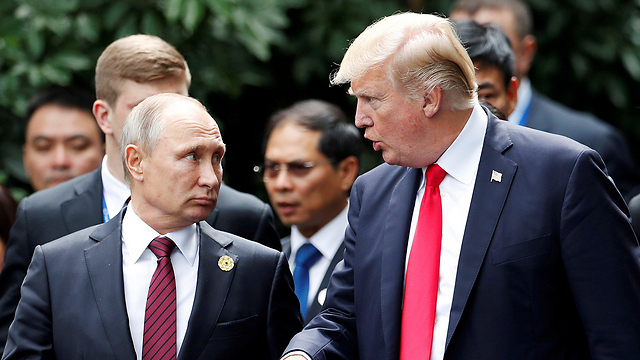
Russian President Putin; US President Trump (Photo: Reuters)

Russian President Putin; US President Trump (Photo: Reuters)

“This could be one of Washington’s big foreign policy mistakes, a big miscalculation in American policy,” he said.

Under the hard-won 2015 deal with Russia, the US, China, France, Britain, Germany and the EU, Iran agreed to curb its nuclear program in exchange for lifting of a raft of international sanctions.

Trump on Friday gave an ultimatum to “either fix the deal’s disastrous flaws, or the United States will withdraw.”

America’s allies see the accord as the best way to thwart Iran’s nuclear ambitions and a victory for multilateral diplomacy. Tehran categorically denies it is seeking to develop atomic weapons.

But Trump argues that his predecessor Barack Obama gave away too much to Iran in sanctions relief, without forcing the Islamic republic to end its ballistic missile program and support for militant groups.

Ryabkov said Moscow must unite with Europe and China and undertake “intense work” to keep the existing plan intact and decried what he said was a US attempt to strongarm the situation.

“In what we heard yesterday, I don’t see any invitation for Iran to enter dialogue,” he said. “This defies the logic of the agreement.”

“Russia will do everything in its power to save the agreement,” he said.

The Palestinian Terror Party: Celebrating Murder

Posted January 13, 2018 by Peter Hofman
Categories: Uncategorized

Trump Issues Ultimatum to ‘Fix’ Iran Nuclear Deal

Posted January 13, 2018 by Peter Hofman
Categories: Uncategorized

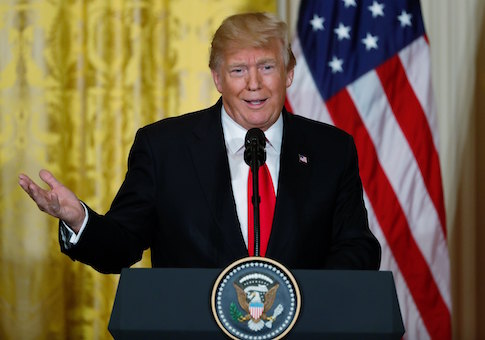
U.S. President Trump holds joint news conference with Norwegian Prime Minister Solberg at the White House in Washington

Reuters

BY:

Trump Issues Ultimatum to ‘Fix’ Iran Nuclear Deal

By Steve Holland

WASHINGTON (Reuters) – U.S. President Donald Trump on Friday gave the Iran nuclear deal a final reprieve but warned European allies and Congress they had to work with him to “fix the terrible flaws” of the pact or face U.S. withdrawal.

Trump said he would waive sanctions against Iran lifted as part of the deal but only as a “last chance” and would not do so again. The ultimatum puts pressure on Europeans – key backers and parties to the 2015 international agreement – to satisfy Trump, who has called the deal to curb Iran’s nuclear program “the worst ever.”

Trump wants the deal strengthened with a separate agreement within 120 days or the United States will unilaterally withdraw from the international pact, warning: “No one should doubt my word.”

Iranian Foreign Minister Mohammad Javad Zarif responded on Twitter that the deal was not renegotiable and that Trump’s stance “amounts to desperate attempts to undermine a solid multilateral agreement.”

Trump, who has sharply criticized the deal reached during Democrat Barack Obama’s presidency, had privately chafed at having to once again waive sanctions on a country he sees as a rising threat in the Middle East.

“This is a last chance,” Trump said in a statement. “In the absence of such an agreement, the United States will not again waive sanctions in order to stay in the Iran nuclear deal. And if at any time I judge that such an agreement is not within reach, I will withdraw from the deal immediately.”

Underscoring the difficulty now facing Europeans, a European diplomat, speaking under condition of anonymity, said: “It’s going to be complicated to save the deal after this.”

While Trump approved the sanctions waiver, the Treasury Department announced new, targeted sanctions against 14 entities and people, including the head of Iran’s judiciary.

Trump now will work with European partners on a follow-on agreement that enshrines certain triggers that the Iranian regime cannot exceed related to ballistic missiles, said a senior administration officials who briefed reporters on the decision.

One official said Trump would be open to remaining in a modified deal if it was made permanent.

“I hereby call on key European countries to join with the United States in fixing significant flaws in the deal, countering Iranian aggression, and supporting the Iranian people,” Trump said in the statement. “If other nations fail to act during this time, I will terminate our deal with Iran.”

Republican Senator Bob Corker said “significant progress” had been made on bipartisan congressional legislation to “address the flaws in the agreement without violating U.S. commitments.”

SEVERAL CONDITIONS

Trump laid out several conditions to keep the United States in the deal. Iran must allow “immediate inspections at all sites requested by international inspectors,” he said, and that provisions preventing Iran from possessing a nuclear weapon must not expire. Trump said U.S. law must tie long-range missile and nuclear weapons programs together, making any missile testing by Iran subject to “severe sanctions.”

Trump wants the U.S. Congress to modify a law that reviews U.S. participation in the nuclear deal to include “trigger points” that if violated would lead to the United States reimposing its sanctions, the official said.

This would not entail negotiations with Iran, the official said, but rather would be the result of talks between the United States and its European allies. Work already has begun on this front, the official said.

Analyst Richard Nephew said whether Trump’s conditions could be met depended on whether he wants a face-saving way to live with the nuclear deal with the political cover of tough-sounding U.S. legislation, or whether he really wants the deal rewritten.

Nephew, a former White House and State Department Iran sanctions expert, said legislation could be drafted that might appear to assuage Trump’s concerns but that getting Iran to agree to allow unfettered international inspections or to no time limits on the nuclear deal’s restrictions was impossible.

He said Trump appeared to be looking for the deal to be rewritten in Congress.

“That’s not going to happen,” Nephew said. “If we were walking on a ledge before, now we are on a tightrope.”

Trump has argued behind the scenes that the nuclear deal makes the United States look weak, a senior U.S. official said. The argument for staying in, the official said, was to allow time to toughen the terms of the agreements.

A decision to withhold a waiver would have effectively ended the deal between Iran, the United States, China, France, Russia, Britain, Germany and the European Union. Those countries would have been unlikely to join the United States in reimposing sanctions.

Hailed by Obama as key to stopping Iran from building a nuclear bomb, the deal lifted economic sanctions in exchange for Tehran limiting its nuclear program but Trump has argued that Obama negotiated a bad deal.

PRESSURE FROM EUROPE

Britain, France and Germany called on Trump on Thursday to uphold the pact.

Iran says its nuclear program is only for peaceful purposes and that it will stick to the accord as long as the other signatories respect it but will “shred” the deal if Washington pulls out.

Two EU diplomats said EU foreign ministers will discuss what to do now at their next regular meeting, scheduled for Monday Jan. 22 in Brussels.

The U.S. Congress requires the president to decide periodically whether to certify Iran’s compliance with the deal and issue a waiver to allow U.S sanctions to remain suspended.

Trump in October chose not to certify compliance and warned he might ultimately terminate the accord. He accused Iran of “not living up to the spirit” of the agreement even though the International Atomic Energy Agency says Tehran is complying.

Hard-liners on Iran in the U.S. Congress have called for the reimposition of the suspended sanctions and an end to the nuclear deal, while some liberal Democrats want to pass legislation that would make it harder for Trump to pull Washington out without congressional consent.

Trump and his top advisers have been negotiating with U.S. lawmakers on Capitol Hill to try to change sanctions legislation so that he does not face a deadline on whether to recertify Iranian compliance with the nuclear deal every 90 days.

(Additional reporting by Jeff Mason, Doina Chiacu and David Alexander and Arshad Mohammed in Washington; Robin Emmott in Brussels, John Irish in Paris and Parisa Hafezi in Ankara; Editing by Yara Bayoumy and Bill Trott)

PLO moves to withdraw recognition of Israel and cut ties with it

Posted January 13, 2018 by Peter Hofman
Categories: Uncategorized

By – on

https://pamelageller.com/2018/01/plo-withdraw-recognition.html/

When did the PLO ever recognize the Jewish state? Never. Back in 1993, the PLO recognized “the right of the State of Israel to exist in peace and security.” That is all that they recognized. That doesn’t say anything about Israel existing in peace and security as a Jewish state. It doesn’t indicate any renunciation of the PLO’s jihad imperative to conquer Israel “from the river to the sea” and transform it into a vastly different kind of state. At this point, should they succeed, it would be an Islamic state. So the withdrawal of this “recognition” is as meaningless as the recognition itself.

But if they’re going to withdraw it, since it has been the linchpin of the spurious “peace process,” can we get the trillions of US taxpayer dollars that we have paid to this terror organization back now?

“PLO moves to withdraw recognition of, cut ties to Israel,” by Dimu Abumaria, Jerusalem Post, January 11, 2018 (thanks to Mark):

The Executive Committee of the Palestine Liberation Organization (PLO), the umbrella organization that is internationally-recognized as the representative of the Palestinian people, will push to withdraw formal recognition of Israel and end Washington’s longstanding role as mediator of the peace process. Instead, the PLO will pursue an “international formula” for achieving statehood. The developments were outlined in a report that aims to redefine not only the parameters for future relations with Israel and the Unites States, but also change the status of the Palestinian Authority from a “transitional authority” to a “state under occupation.” The details are intended to be finalized in a follow-up meeting of the PLO mid-month.

The PA was formed as an interim governing body by the 1993 Oslo Accords—signed by then-prime minister Yitzhak Rabin and previous PLO chief Yasser Arafat—and was meant to be dissolved after no later than five years as part of a final peace agreement.

Two-and-a-half decades later, the PLO is now threatening to do just that, which, in its view, would release the Palestinians from political obligations stipulated in agreements with Israel.

According to PLO Executive Committee member Ahmed Majdalani, Israel “didn’t commit to any of the terms,” thereby effectively absolving the PA of its responsibilities. “I believe we are late in making these decisions and implementing them,” he told The Media Line, “which has created a gap between the Palestinian leadership and the Palestinian people.”

In this respect, there does, indeed, appear to be a growing chasm between the PA and the Palestinian “Street,” with a number of individuals expressing to The Media Line a distrust of Ramallah, the administrative capital of the Palestinian Authority. One businessman, who spoke to The Media Line on condition of anonymity, called on PA leaders to resign, as they are no longer “qualified” to make decisions “that have no impact on the ground.”

Another Palestinian, Bashar, noted that PLO leaders have made similar threats numerous times in the past, yet cooperation with Israel, security coordination foremost, remains intact. “They practice double standards,” he exclaimed, whereas another person, who asked not to be identified, went so far as to suggest that the PA shares “mutual interests” with “the [Israeli] occupation” and thus cannot be expected to advance the Palestinian cause.

Even those supportive of the PLO’s newly stated goals do not believe that they will be implemented. “These decisions might be good for Palestine,” one Ramallah resident told The Media Line, “as they could potentially change the [negative] situation caused by the Oslo Accords.” Nevertheless, she qualified, “I don’t think the PA is capable of forging a better agreement, unless they focus on a national agenda to support the Palestinian public.” Many other Palestinians echoed these sentiments, calling on the PA to change course after years of failed negotiations.

To this end, Saeb Erekat, Secretary General of the PLO Executive Committee and chief Palestinian negotiator, reiterated on Tuesday the PA’s refusal to engage in any peace initiative sponsored by the US unless the Trump administration retracts its recognition of Jerusalem as Israel’s capital. This comes after Erekat earlier this month slammed American threats to cut aid to the Palestinians, describing the prospect as tantamount to “starving refugees…in support of Israeli positions.”…

Protests in Iran Undermine a Key Premise of the Nuclear Deal

Posted January 13, 2018 by Louisiana Steve
Categories: Iran - civil unrest

Tags:

– The Tower

Source: Protests in Iran Undermine a Key Premise of the Nuclear Deal

{As the clouds of the Obama legacy clear, a new light will shine upon the land. – LS}

When President Barack Obama was interviewed by The Atlantic‘s Jeffrey Goldberg in 2015 about the soon to be agreed on nuclear deal with Iran, Goldberg pressed the president on the wisdom of trusting Iran to act rationally, he responded:

Well the fact that you are anti-Semitic, or racist, doesn’t preclude you from being interested in survival. It doesn’t preclude you from being rational about the need to keep your economy afloat; it doesn’t preclude you from making strategic decisions about how you stay in power; and so the fact that the supreme leader is anti-Semitic doesn’t mean that this overrides all of his other considerations.

In essence, the president was arguing Iranian practices could be called “rational anti-Semitism” and would therefore not risk violating the deal because of the consequences.

Furthermore, when Goldberg asked if Secretary of Treasury Jack Lew’s assessment that more of the sanctions relief would be used to build up Iran’s economy and infrastructure than building up its military and proxies was a bit optimistic, Obama replied:

Then [Iranian President] Rouhani and, by extension, the supreme leader have made a series of commitments to improve the Iranian economy, and the expectations are outsized. You saw the reaction of people in the streets of Tehran after the signing of the agreement. Their expectations are that [the economy is] going to improve significantly. You have Iranian elites who are champing at the bit to start moving business and getting out from under the restraints that they’ve been under.

So not only was Obama arguing that Iran’s declared anti-Semitic intention was “rational,” which would ensure that it abided by the nuclear deal, but also that there would be political constraints limiting Iran’s regional aggression. Furthermore, he added that sanctions had, in fact, strengthened Iran’s Islamic Revolutionary Guard Corps (IRGC), the military organization that not only attempts to spread Iran’s revolution abroad but also is behind the regime’s repression at home. Easing sanctions “may actually lessen” the means the IRGC developed to raise money while sanctions were in full force.

The protests against the regime in recent weeks, however, show how wrong Obama was in assessing the behavior of the Iranian regime.

Rather than being rational and spending the freed up billions on civilian infrastructure, Tehran used its windfall to raise a regional Shiite army, propped up Syria’s dictator Assad and sent ballistic missiles to the Houthi rebels in Yemen. The largess Iran provided to its proxies was not lost on the protesters.

Rather than weakening Supreme Leader Ayatollah Ali Khamenei and the IRGC, the nuclear deal strengthened both of them.

The regime says that it has arrested some 3,700 protesters and at least 22 have been reported killed.

It’s pretty clear that, contrary to Obama’s assertions, the nuclear deal has strengthened the hands of those who would put down the protests.

In its pursuit of regional hegemony, Iran has ignored the needs of its citizens at the expense of its grandiose ambitions, including the destruction of Israel. Certainly, from the standpoint of its own people, Khamenei, President Hassan Rouhani, and the rest of the government have irrationally pursued its anti-Semitic goals.

There is, however, one way in which Iran’s post-nuclear deal behavior is rational: it knows what it can get away with in terms of the rest of the world.

In the Goldberg interview, Obama claimed, “we will continue to ratchet up the costs, not simply for their anti-Semitism, but also for whatever expansionist ambitions they may have.”

In fact, the Obama administration did nothing of the sort. We know now that the Obama administration allowed the pace of the slaughter in Syria to increase, stopped the investigation into Hezbollah’s drug smuggling operations, and allowed numerous Iranians connected to the regime’s proliferation efforts to go free.

In August 2015, just after the nuclear deal was agreed to, IRGC-Qods Force Commander Qassem Soleimani, who is under an international travel ban, went to Moscow to enlist Russia’s support in supporting Assad. In the past two years, the Syrian army, backed by Russian planes and Iran-backed Shiite militias, have recaptured much of Syria, killing thousands in the process. Yet at the time, neither the United States nor any of its partners in the nuclear deal took any action against this blatant violation of international law.

Even now, the European Union invited Iranian Foreign Minister Mohammad Javad Zarif for talks and everyone appeared to have a good time, despite the fact that he’s the face of a regime violently putting down dissent.

Iran is rational in this way: if it knows it will pay no significant cost for its aggression, its aggression will continue.

The challenge now is to change that equation and make Iran’s destabilizing behavior too costly for it to continue. The Justice Department’s recently announced team to investigate Hezbollah’s drug trafficking is an important step in the right direction. With the European Union besotted with the idea of doing commerce with the world’s leading state sponsor of terror, the U.S. may just have to stand alone and use its financial clout to bring Iran under control.

Did Obama Tip Off Iran to Israeli Plan To Take Out World’s Premier Terrorist?

Posted January 12, 2018 by danmillerinpanama
Categories: Hezbollah and drugs, Hezbollah and Iran, Hezbollah crimes in America, Hezbollah in America, Israeli security, Obama and Iran, Obama and Soleimani, Soleimani

Tags: , , , , , , ,

Did Obama Tip Off Iran to Israeli Plan To Take Out World’s Premier Terrorist? FrontPage MagazineAri Lieberman, January 12, 2018

We thought the Obama administration could stoop no lower when it was revealed that the administration transferred $1.7 billion in untraceable cash to the Islamic Republic as ransom for the release of four Americans hostages they were holding. We were wrong. In its twilight weeks, the administration gave its consent to allow the Iranians to receive 116 metric tons of natural uranium from Russia as compensation for its export of tons of reactor coolant. According to experts familiar with the transaction, the uranium could be enriched to weapons-grade sufficient for the production of at least 10 nuclear bombs

If you thought that the administration’s betrayal of America’s security could go no further, you were wrong. Last month Politico, not known as a bastion of conservatism, published a bombshell 50-page exposé detailing the Obama administration’s efforts to delay, hinder and ultimately shut down a highly successful DEA operation – codenamed Project Cassandra – aimed at tracking and thwarting Hezbollah drug trafficking, arms trafficking and money laundering schemes. As a result, Hezbollah continued to import drugs into the United States, continued to provide anti-U.S. insurgents with deadly EFPs and continued to launder drug money to the tune of billions.

If you thought that was the end of the story, you were wrong. It seems that with each passing day, another layer of deceit and betrayal committed by the Obama administration is uncovered. The latest Obama scandal involves a reported effort by the administration to thwart an Israeli operation to liquidate Iranian general, Qassem Soleimani. 

The Kuwaiti newspaper Al-Jarida reported that three years ago, Israel was on the verge of liquidating Soleimani near Damascus but the Obama administration tipped off Teheran of Israel’s plans. Soleimani is no ordinary general. He is arguably the world’s premier terrorist and is commander of Iran’s Quds Force, a branch of the Iranian Revolutionary Guard Corps, responsible for its overseas mischief-making. Where there is drugs, misery and conflict, it’s a sure bet that Soleimani and his Quds Force are involved.

The elimination of Soleimani would have been a tremendous coup for the West, on par with or perhaps surpassing the assassination of Imad Mughniyah, chief of Hezbollah’s special operations. But the Obama administration, in its sycophantic zeal to curry favor with the mullahs, sabotaged the operation.

Of course, the facts alleged by Al-Jarida are just allegations and have not been confirmed but there is ample reason to believe the veracity of the claim. First, this would not the first time that the Obama administration betrayed an Israeli covert operation.

In 2012, the Obama administration leaked damaging information that inexplicably sought to sabotage a burgeoning strategic alliance between Israel and Azerbaijan. Such an alliance would have enabled Israel to seek alternate bases in close proximity to Iran from which it could conduct military operations including surveillance and rescue missions, refueling and maintenance and even direct military strikes. The embarrassing disclosure shed unwanted light on a covert military alliance that would have greatly enhanced Israel’s strategic capabilities vis-à-vis the Islamic Republic.

Then again in 2013, Israeli officials bitterly complained to the Obama administration over leaks sourced to administration officials that the Israeli Air Force had struck a military base near the Syrian port city of Latakia. The Israelis termed the leak “scandalous” and bitterly noted that it was not the first time that administration officials had publicly linked Israel to attacks aimed at preventing arms from falling into the hands of Hezbollah terrorists. At the time, the Israelis were attempting to keep a low profile but the administration’s leaks blew everything and Israel’s involvement could no longer be concealed.

But perhaps the most intriguing validation of the Kuwaiti newspaper’s allegation emerged from an unlikely source, a remarkable twitter exchange between New York Times columnist Bret Stephens and Obama’s former U.S. National Security spokesman, Tommy Vietor.

Stephens asked Obama’s National Security Adviser (and former aspiring fiction scribe) Ben Rhodes if there was any validity to the story. Tellingly, the normally talkative Rhodes refused to answer but Vietor chimed in to offer some revealing insight, calling the story unsubstantiated and noting the Obama administration does not condone assassinations.

Stephens hit back noting that the administration utilized SEAL teams and drone strikes to liquidate America’s enemies. Now here’s where it gets interesting. Vietor differentiated between Osama bin Laden and Qassem Soleimani referring to the latter as an “Iranian political leader,” and added that “an assassination of QS by Israel would be destabilizing to put it mildly.”

So there you have it. A top former Obama administration official, intimately involved with peddling Obama’s deleterious Iran policy, believes that Qassam Soleimani is a politician whose elimination from the scene would be “destabilizing.” Try selling that arrant rubbish to 470,000 dead Syrians.

Israel Tries Its Hand at a Travel Ban

Posted January 12, 2018 by danmillerinpanama
Categories: Anti-Israel propaganda, Anti-Zionism, Antisemitism, Antisemitism in America, Israel and BDS supporters, Israeli government, Israeli security

Tags: , , , , , ,

Israel Tries Its Hand at a Travel Ban, American Thinker,  Michael Curtis, January 12, 2018

Israel is proposing to prevent foreign supporters of BDS from entering Israel, although ministers have the right to deny individuals entry on a case-by-case basis, as in the case of Omar Barghouti, one of the founders of BDS, who is married to an Israeli citizen of Palestinian origin.  On January 7, 2018, Israel announced it plans to establish a task force to identify the hundreds of activists already in Israel and deport or deny entry to individuals who support BDS.

*********************************

Commenting on President Woodrow Wilson’s “long overdue ” decision to enter World War I, Winston Churchill wrote that if the president had acted earlier, it would have meant abridgment of the slaughter, sparing of the agony, and prevention of ruin and catastrophe.  Even if the parallel is not exact, Israeli authorities are acting to prevent further harm to their country by imposing a travel ban blocking members of organizations supporting BDS, the Palestinian-led boycott, divestment, and sanctions movement, from entering the country.

Mark Twain in his book Innocents Abroad wrote that travel is fatal to prejudice, bigotry, and narrow-mindedness.  Unfortunately, as Israel has found, hostile activists can also encourage those qualities.

The travel ban implements the intention of the law passed in March 2017 that bars entry into the country by groups that actively promote anti-Israeli boycotts.  The ban is virtual recognition of the adage, “Oh, I have taken too little care of this.”  Israel has now taken the offense against those who are not simply rational critics of Israeli policies and actions, but either implicitly or explicitly refuse to acknowledge the legitimacy of the State of Israel or seek its elimination.

By banning any foreign activist who has knowingly signed a public call to boycott Israel or pledged to take part in a boycott, Israel is preventing harm to its citizens.

On January 7, 2018, Israel issued a ban on 20 worldwide organizations, including 11 European and six U.S. groups, that are involved and active in BDS activities.  They include the American Friends Service Committee (AFSC); Code Pink; the U.S.-based Jewish Voice for Peace; the U.K.-based Palestinian Solidarity Campaign; of which Labor Party leader Jeremy Corbyn is a patron; the British group War on Want; and BDS organizations in France, Italy, Norway, and the Netherlands.

It is worth looking, if only as illustration of hypocrisy, at War on Want, an organization founded in 1951 in London as an antipoverty charity.  It supported liberation movements in Africa.  For a time, the anti-Israeli George Galloway was its general secretary; during that time, there were accounting irregularities, and reports were “materially misstated.”  In 2006, War on Want launched its Palestinian Rights movement and advocated BDS, calling for an embargo on arms to Israel.

One controversial incident resulting from this policy of banning occurred in 2016, when Isabel Phiri, a Malawian citizen living in Switzerland, the assistant general secretary of the World Council of Churches (WCC) in Geneva and former professor of African theology in South Africa, was refused a visa by Israel.  Israeli authorities maintained that she has been involved in BDS, and it was the first time a foreign national was refused for that reason.  Though the WCC has not formally called for an outright boycott against Israel, it believes that the “Israeli occupation of the Palestinian territories is a tragedy for the Palestinian occupied.”

Let us be straightforward on this controversial issue.  The argument against the travel ban is that it violates freedom of expression, and of course, to some extent, this is true in a democratic country such as Israel.  The problem with this is that not only does the freedom to call for a boycott exist everywhere, but much of the expression on Israel is based on falsehood and misrepresentations and the Palestinian Narrative of Victimhood.

Taking two examples illustrates the point.  The AFSC that won a Nobel Peace Prize in 1947 announced extravagantly on January 8, 2018 that “for 51 years Israel has denied Palestinians in the occupied territories their fundamental human rights in defiance of international law. ”  Then there is the absurdly disproportionate announcement issued on February 13, 2015 by over 100 British artists, including some well known personalities such as film directors Ken Loach and Mike Leigh, explaining their cultural boycott of Israel as based on the fact that “Palestinians have enjoyed no respite from Israel’s unrelenting attack on their land, their livelihood, their right to political existence.”

The BDS campaign calls for economic, cultural, and academic boycotts against the State of Israel and Israeli citizens.  But its real intention is not to advocate measures to alleviate the condition of Palestinians, but to implement the Palestinian campaign for the academic and cultural boycott of Israel, founded mainly by Omar Barghouti, to refuse to recognize Israel as a legitimate state.

What is important is that boycott activity is counterproductive, against peace.  It results in increasing hatred, and as Israeli president Reuven Rivlin has remarked, it symbolizes all that stands in the way of dialogue, debate, and progress.  It is against cooperation toward a peaceful solution of the Israeli-Palestinian conflict.

A reminder of the past may be helpful in understanding the Israel travel ban.  On November 9-10, 1938, Kristallnacht occurred in German cities, with a pogrom against Jews, involving murders; beatings; and destruction of Jewish property and businesses as well as synagogues.  At the core and the call to German citizens was a boycott of Jews in all forms.

Obviously, actions such as calling for Israel to be excluded from international oganizations such as the world soccer governing body FIFA and the insistent commands by rock star Roger Waters to fellow performers not to perform in Tel Aviv are not on a par with the Nazi Holocaust, but it would be foolish to ignore the implications of BDS.  Implicitly if not explicitly, it promotes anti-Semitism as well as tolerating terrorist activity against Israel.

It does this by not criticizing the funds that the Palestinian Authority (P.A.), through its Martyrs’ Fund, gives to terrorists in Israeli prisons or to the families of those terrorists killed by Israel.  It is encouraging that the U.S. Senate by the Taylor Force bill is considering the issue in an appropriate way.  Named after the American citizen, a former U.S. army officer and a Vanderbilt University student, murdered in March 2016 by a Palestinian terrorist in the West Bank, the Taylor Force Act, introduced in 2016, aims to stop all U.S. economic aid to the P.A. as long as it continues to pay those salaries to terrorists and families.

Israel is proposing to prevent foreign supporters of BDS from entering Israel, although ministers have the right to deny individuals entry on a case-by-case basis, as in the case of Omar Barghouti, one of the founders of BDS, who is married to an Israeli citizen of Palestinian origin.  On January 7, 2018, Israel announced it plans to establish a task force to identify the hundreds of activists already in Israel and deport or deny entry to individuals who support BDS.

The Israeli travel ban might be considered in the context of the continuing war on Jews.  It is three years since Hypercacher, the Jewish Paris supermarket, was attacked by terrorists.  Four were killed.  Coinciding with the Israeli travel ban, on January 9, 2018, an arson attack burned down a French kosher grocery store in Creteil, a suburb of Paris, and the store was completely gutted by fire.  Six days earlier, two stores in the area were targeted with paintings of swastikas.

Hatred and anti-Semitism: this is the real essence of the boycott of Israel and Jews.
Trump keeps Iran nuclear program, waives sanctions – for the last time

Posted January 12, 2018 by danmillerinpanama
Categories: Europe, Iran - sanctions, Iran scam, Iran scam termination, Iranian protests, JCPOA - renegotiation, JCPOA compliance certification, Trump and Iran scam

Tags: , , , , , , ,

Trump keeps Iran nuclear program, waives sanctions – for the last time, DEBKAfile, January 12, 2018

Among the other entities blacklisted for sanctions are the Revolutionary Guards Corps cyber unit for repressing social media networks to suppress protest.

**************************

US President Donald Trump Friday extended the waivers on Iran nuclear sanctions and kept alive the 2015 deal, but stressed this was for the last time – unless US and Europe can reach agreement on Iranian enrichment and ballistic missile development.  The US gave Europe 120 days to agree to overhaul the deal before the next deadline in May, or else the US would pull out. The US also imposed sanctions on 14 Iranian non-nuclear entities, including the powerful head of the judiciary, Ayatollah Sadeq Larijani, for human rights abuses against anti-government protesters. Among the other entities blacklisted for sanctions are the Revolutionary Guards Corps cyber unit for repressing social media networks to suppress protest.

The Trump administration also wants the “follow-on” deal to eliminate the “sunset clauses” of the current nuclear agreement, under which Iran is allowed to resume enrichment when the deal expires, and expanded inspections that could trigger re-imposed sanctions if Iran failed to comply.

Germany: Berlin’s Police Problem

Posted January 12, 2018 by danmillerinpanama
Categories: German police, German police accademy, Islam in Germany, Islamic invasion, Islamisation of Germany

Tags: , , , ,

Germany: Berlin’s Police Problem, Gatestone InstituteStefan Frank, January 12, 2018

According to reports, frequent, habitual and sometimes criminal misconduct by Berlin’s police cadets, especially those with a migrant background, is rampant in the Berlin-Spandau police academy.

Recently, an Arab intern, working at a Berlin police precinct, copied confidential data from investigations into a Lebanese organized-crime clan, and sent it to unidentified recipients.

Pior to Anis Amri’s jihadist attack on the Berlin Christmas market, where he murdered 12 people, Berlin’s police had allowed Amri to move around freely, even though they had numerous chances to detain him on charges of terrorism or a range of other serious crimes. Other government agencies requested that the Berlin police put Amri under permanent surveillance and inform them of his whereabouts, but were left unanswered

One year after the Berlin Christmas market massacre, Germans need to be concerned about the state of their police forces, as well as the politicians who are supposed to be overseeing law enforcement.

Berlin’s local government has come under fire after reports of frequent, habitual and sometimes criminal misconduct by Berlin’s police cadets. According to the reports, such misconduct, especially by those with a migrant background, is rampant in the Berlin-Spandau police academy.

The scandal was revealed when a private WhatsApp voicemail was leaked to the public. The author, a paramedic who had given classes in the academy, complained:

“Today I held a class at the police academy. I’ve never experienced anything like it. The classroom looked like a pigsty. Half of the class [are] Arabs and Turks, rude as hell. Dumb. Could not express themselves. I was about to expel two or three of them because they disturbed the class or were actually sleeping. German colleagues related that some of them had threatened to beat them. … [Some students] speak virtually no German. I am shocked, and afraid of them. The teachers … believe that when they expel them, they will destroy the cars on the street. … These are not our colleagues, this is the enemy among us. I have never before felt such hatred expressed in the classrooms. … They throw punches during class — you cannot imagine that.”

The paramedic sent the voicemail to several people, one of whom brought it to the attention of Berlin’s Chief of Police, Klaus Kandt.

The first reaction came from police spokesman Thomas Neuendorf, who acknowledged that there were “frequently problems” at the police academy; he also admitted that some of the cadets committed crimes — but “they are immediately expelled.” Neuendorf then attacked the paramedic by saying that “the tone and the form” of his criticism had been “inappropriate”. Moreover, Neuendorf said, the paramedic should have reported these things only to his superior.

At the same time, it emerged that Berlin’s police commanders and the Senate had been aware of problems with cadets “of migrant background” long before this exposé.

The newspaper Die Welt quoted from the leaked minutes of a high-level police meeting, according to which the staff of the police academy complained about problems that “developed in the course of hiring officers with a migrant background (currently 30%).” Some of them could not swim, even though this was a requirement for employment. Many police candidates had a “lack of professional ethics”. Some candidates showed “condescending behavior toward female employees, whom they treat like cleaning women.”

“Feeling of fear” in the police academy

According to the newspaper’s investigations, there is a “feeling of fear” inside Berlin’s police academy. One police commander told Die Welt: “There were teachers who wanted to meet with representatives of the political parties to discuss the grievances. But pressure was put on him [to refrain from doing so].”

Marcel Luthe, a spokesman for the opposition Free Democrats Party (FDP) confirmed that “the police union had arranged a talk between us and the teaching staff. It was cancelled.” Luthe said he was not aware of any instance in which the Berlin’s Chief of Police had done “anything else than deny the problem”.

Shortly after the publication of the voicemail and the internal report, all claims were corroborated by a senior official of Berlin’s Landeskriminalamt (LKA, State Office of Criminal Investigation). He sent an open letter to the Chief of Police; local newspapers also received copies of the letter. Although the author chose to stay anonymous, sources from within the LKA confirmed the letter’s authenticity, according to the weekly magazine Focus. The sources also confirmed that “at least one person involved in organized crime is currently undergoing the police training”.

The whistleblower defended his decision not to reveal his identity:

“When instructors address the public anonymously, it is only because a dialogue with the senior leadership does not take place. Incidents are watered down, downplayed, belittled, or covered up with a cloak of silence.”

He also spoke of conflicts between different ethnic groups within the police. “It is only a question of time until someone fires the first shot at a colleague,” he said.

Finally, the LKA official warned about the danger of criminal clans infiltrating the police and administration: “This has already begun”.

That admission triggered attacks by journalists and politicians, who said that the official’s claim was not backed up by evidence. But at the same time, a case surfaced which lent credibility to the allegation: It was revealed that a 20-year-old Arab student of public administration, who had worked as an intern at a police precinct in Berlin-Schöneberg, had used her access to the police computers copy data from investigations into a Lebanese organized-crime clan. She sent the confidential data through WhatsApp to unidentified recipients.

Political whitewashing

On December 6th — only a few weeks after the allegations were raised — Berlin’s Chief of Police presented an 83-page “special report” addressing the paramedic’s criticism. Surprisingly, the report does not contain any first-hand testimony. Instead, it offers a “summary of descriptions and perceptions from the cadets’ point of view”. The statements are not even attributed to individuals but to groups of cadets:

  • “Persons present in the class conceded that they found it difficult to focus because there were too few breaks and a lack of oxygen in the class room.”
  • “The cadets concerned cannot understand how the author of the voice message could think that the classroom was dirty. After the class, the pupils put all tables and chairs back to their original places. They were not alerted to possible defects.”
  • “Persons present in the class feel that they are being ostracized and treated in a xenophobic manner, especially as the author of the voice message mentions certain persons with a migrant background.”

The cadets, according to the report, denied that there were any cases of serious misconduct and went on the offensive. They attacked instructors for their alleged lack of interest and their refusal to take questions. The report does not quote a single instructor or other member of staff. It then addresses “isolated cases” of misconduct:

  • A police cadet who had dealt with stolen cameras had been expelled. Since he filed an objection, the verdict is pending and reviewed by the administration court.
  • Two police cadets had sold drugs in the police academy. After the incident had been investigated by the LKA, it was decided that their behavior constituted “no crime”.
  • A police cadet had acted in a pornographic movie. “Considering the circumstances (a single appearance with no obvious reference to the Berlin police department), and the positive achievements and ability to reason shown by the candidate, the head of the authority agreed to appoint him to the status of a probationary official.”
  • A police cadet is on trial for serious financial fraud. A search of his house and office has corroborated the charges. “It is intended to start the process to expel him.”

The report identifies “the police’s tradition as an extremely hierarchical system” as one of the core problems. “It is detrimental to a constructive culture of criticism.” The authors then go on to praise the police command for large problem-solving bureaucracy, featuring, among others:

  • The Conflict Committee (“Its goal is to find sustainable solutions for existing conflicts”)
  • The Diversity Office (“Its goal is to create an atmosphere of openness and bring to bear diversity”)
  • Social Contact Persons (for “work-related conflicts, mobbing, sexual conflicts and problems arising from a same-gender lifestyle”)
  • Contact Persons for Intercultural Questions (offering “counsel in intercultural questions and act as contact to the Conflict Commission”)

Did Berlin’s police aid and abet jihadi terrorist Anis Amri?

Even before the new scandals emerged, Berlin’s police department had endured a rough year. It was criticized for failing to arrest the Tunisian ISIS jihadist Anis Amri prior to his truck attack on the Berlin Christmas market on December 19, 2016. Twelve people were murdered and 55 injured in the massacre. Berlin’s police had allowed Amri to move around freely, even though they had numerous chances to detain him on charges of terrorism or a range of other serious crimes. Other government agencies requested that the Berlin police put Amri under permanent surveillance and inform them of his whereabouts, but were left unanswered.

In February 2016 — ten months before Amri attacked — investigators in Berlin had even warned Amri that he was under surveillance. A few months later, the surveillance was stopped, for undisclosed reasons. New investigations revealedthat “at least” two LKA officers forged documents in the wake of the terror attack to cover up what had been known about Amri’s criminal activities. Berlin police had known that Amri was a “commercial-scale drug dealer”. This information was part of a file dating from November 1, 2016. In January 2017, however, that file was changed: the document suddenly stated that Amri “might deal with drugs on a miniscule scale”. The officers in question are now charged with obstruction of justice.

The big picture is troubling. “Wherever you look,” said FDP spokesman Luthe, “whether it is terrorism, the 15% increase in crime since 2011, the lowest percentage of cases solved, areas with open drug dealing, or now the police academy — the Police Chief fails miserably.”

(Photo by Carsten Koall/Getty Images)

In light of the Anis Amri scandal, no one should be surprised if the disclosures of malfeasance in Berlin’s police academy and criminal moles copying secret police data are just the tip of an iceberg. In Berlin’s state parliament, the FDP and the anti-immigration party Alternative for Germany have called for a committee of inquiry, but have failed to reach the threshold of 25% of MPs needed to establish it. The Christian Democrats (CDU) are hesitating, while Berlin’s ruling coalition of Social Democrats (SPD), former Communists (Linke) and Green party are against any further investigations. Torsten Akmann (SPD), Berlin’s Secretary of the Interior, says: “That would be like shooting sparrows with a cannon.”

One year after the Berlin Christmas market massacre, Germans need to be concerned about the state of their police forces, as well as the politicians who are supposed to be overseeing law enforcement.

Stefan Frank is a journalist and author based in Germany.

Report: Saudi Arabia Seeks Reform Towards ‘Moderate Islam

Posted January 12, 2018 by danmillerinpanama
Categories: Saudi Arabia and females, Saudi crown prince Mohammed bin Salman and modernization, Saudi Wahhabi religious establishment

Tags: , ,

Report: Saudi Arabia Seeks Reform Towards ‘Moderate Islam, BreitbartJohn Hayward, January 11, 2018

AFP STRINGER

The Wall Street Journal (WSJ) noted on Thursday that Crown Prince Mohammed bin Salman (MBS) is pushing a return to “the tolerant, moderate Islam that is open to the world, to all the religions and traditions of its people” as part of Saudi Arabia’s major economic reform plan.

At the heart of Saudi Arabia’s recent cultural and political upheaval is an understanding that the country must become more compatible with the Western world and more hospitable to foreign investment, in order to manage the transition away from an oil-based economy with limitless deep pockets. Possibly the trickiest aspect of this transformation will be an Islamic reformation in the notoriously strict kingdom.

As the Journal goes on to note, MBS is looking quite a way back into history for that memory of moderate Saudi Islam, since its harsh blend of strict Wahhabi Islam was brewed up in the 18th Century by the eponymous cleric Mohammed Ibn Abd al-Wahhab. Tribal influences, and of course the presence of Islam’s holy cities of Mecca and Medina, have pushed the kingdom in an Islamist direction ever since.

The key event in recent Saudi Islamic history is often underappreciated by outside observers: the siege of the Grand Mosque in Mecca, in which militants occupied the holiest shrine of Islam for 15 days in 1979. The WSJ mentions it only briefly, but the siege dovetailed with the revolution in Iran to change both the Sunni and Shiite wings of the Islamic world.

It is best understood as a theocratic coup, and not an unsuccessful one because it permanently altered the relationship between Saudi Arabia’s royal family, secular bureaucracy, and hardline Islamist clergy. The government did much to curry favor with the Wahhabi extremists to prevent anything like the Grand Mosque attack from happening again. The most pessimistic interpretation of the aftermath is that fundamentalists effectively blackmailed the wealthy Saudi government into bankrolling extremism and terrorism. The siege made the government look weak, dishonest, and decadent to many Saudis.

The Grand Mosque terrorist incident was also a landmark moment in deteriorating relations between Saudi Arabia and Iran, and by extension Sunni and Shiite Islam, since Iran was widely believed to be involved in the attack. A dismal contest between Saudi Arabia and Iran began to demonstrate which was more pious and faithful to Islamic law. Fundamentalism spread rapidly across formerly liberal and cosmopolitan cities across the Middle East, which until the Islamist upheaval of the late Seventies resembled American and European cities of the same era. It didn’t help matters that Islamic fundamentalism mixed easily with Marxist quackery.

Some find the speed of Crown Prince Mohammed bin Salman’s reforms astonishing, or worry that he is moving too quickly, but Margherita Stancati at the Wall Street Journalrecalls that fundamentalism descended upon Saudi Arabia very quickly forty years ago:

The mixing of unrelated men and women, let alone singing and dancing, was no longer acceptable. Cinemas closed and music stopped.

In public, women were forced to wear face-covering veils, which in parts of the country such as Asir had been virtually nonexistent. The religious police, formally known as the Committee for the Promotion of Virtue and the Prevention of Vice, was given the job of enforcing the new order.

Radical Islamists infused the school curriculum with the teachings of Wahhabi scholars. Textbooks instructed students to hate Christians and Jews and denigrated Shiite Muslims. Some of the more extreme views often came from teachers, who sometimes recruited students to extremist causes.

Saudi charities linked to the government helped spread that interpretation of Islam beyond the kingdom’s borders, inspiring generations of jihadists.

As Stancati notes, even young women eager for reform in Saudi Arabia today grew up being taught that drawing pictures of animals was an insult to Allah’s sacred and unique ability to create life, or that listening to music for pleasure would get them tortured for all eternity in the afterlife by having hot metal poured in their ears. Top Saudi clerics criticized the government for giving women the right to drive by saying it would give them easy access to worldly temptation, and “as we know, women are weak and easily tempted.”

However, the Saudi public overwhelmingly supports ending the ban on women drivers. Younger Saudis in particular grasp that they need to become more socially compatible with the rest of the world if they are to compete on the global stage, in an era when oil is no longer the bottomless spring of easy money it once was.

Crucially, there does not seem to be any massive fundamentalist pushback lurking, comparable to how Saudi modernization at the beginning of the oil boom fed the resentments that erupted in 1979. The government is making a serious effort to nourish more moderate interpretations of Islam and improve education.

Granted, some of the social liberalization described by Stancati is incremental, such as upscale Riyadh women getting to decide what color fabric they wish to be wrapped in from head to toe, instead of having to settle for all black. Also, liberalization in the big Saudi cities is much more noticeable than in small towns and distant areas.

Retired Pacific Fleet commander Admiral James Lyons noted in the Washington Times in December that Saudi demographics are now remarkably skewed toward the younger generation, as 70 percent of the population is under 30 years old, and they have little patience for “onerous Islamic restrictions.” He also noted that the post-oil Saudi economy will have to welcome women into the workforce, which necessarily involves lifting restrictions upon them, such as allowing them to drive.

Lyons is willing to cut the crown prince a lot of slack for playing rough as he consolidates power, because it’s necessary to implement rapid reforms against bureaucratic and social inertia in Saudi Arabia. There is also some comfort in knowing that MBS has practical dollars-and-cents reasons to make his reforms stick; if his sense of idealism flags, the sound of a doomsday clock ticking on a trillion-dollar economic collapse should strengthen his resolve.