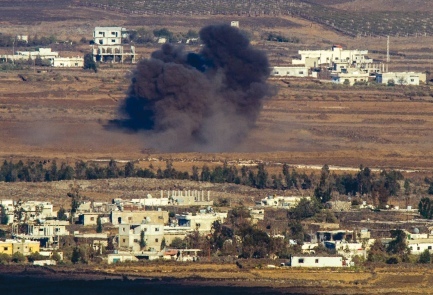
US official: Israel conducted air strike near Abu Kamal. DEBKAfile: Pro-Iranian Iraqi militia targeted 

Posted June 19, 2018 by Joseph Wouk
Categories: Uncategorized

Source: US official: Israel conducted air strike near Abu Kamal. DEBKAfile: Pro-Iranian Iraqi militia targeted – DEBKAfile

A US official disclosed that the airstrike on Sunday, June 18, which killed dozens of fighters near the Syrian-Iraqi border town of Abu Kamal, was conducted by Israel.
Syrians sources reported that between 40 and 50 Syrian army and Shiite Iraqi militia fighters were killed.  DEBKAfile’s military and intelligence sources disclose that the Israeli air strike, if the US official’s account is confirmed, was a major operation for stemming the influx of several brigades of the pro-Iranian Iraqi Kata’ib Hizballah militia as they crossed into Syria from Iraq. This militia is part of the Popular Mobilization Forces (PMU) umbrella organization, which takes its orders from Iran’s Al Qods chief Gen. Qassem Soleimani.

Our sources add that the Kata’ib Hizballah brigades were on their way to southwestern Syria to deploy along the Israeli and Jordanian borders. The air strike caused major havoc in their ranks and a larger number of casualties than reported. As a result, the Iraqi brigades withdrew from Syria and pulled back across the border to Iraq.

Iraq denounces mysterious Syria airstrike attributed to Israel

Posted June 19, 2018 by Joseph Wouk
Categories: Uncategorized

Source: Iraq denounces mysterious Syria airstrike attributed to Israel | The Times of Israel

Iraqi military denies positioning Iran-backed fighters in Syrian territory after paramilitary group says 22 of its members among the dead

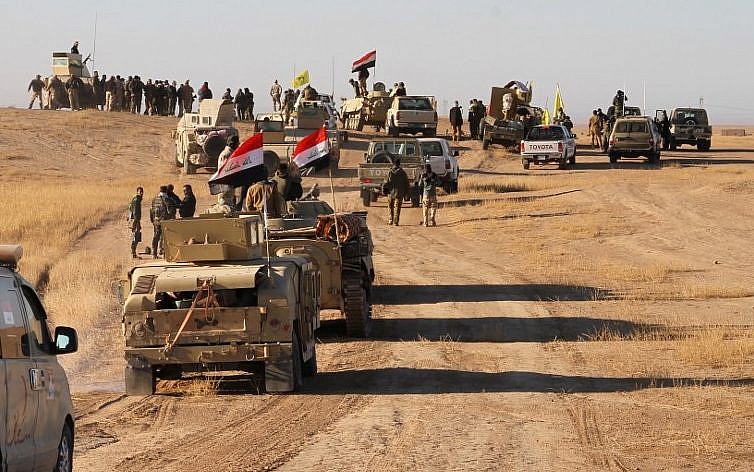
Iraqi forces, supported by members of the Hashed al-Shaabi (Popular Mobilization units), advance in the western desert in the northern Iraqi region of al-Hadar, 105 kilometers south of Mosul, on November 23, 2017, as they attempt to flush out remaining Islamic State group fighters (AFP/Stringer)

Iraqi forces, supported by members of the Hashed al-Shaabi (Popular Mobilization units), advance in the western desert in the northern Iraqi region of al-Hadar, 105 kilometers south of Mosul, on November 23, 2017, as they attempt to flush out remaining Islamic State group fighters (AFP/Stringer)

Iraq on Tuesday denounced an airstrike in Syria attributed to Israel in which over 50 pro-regime fighters, including some 20 members of an Iran-backed Iraqi paramilitary group, were killed.

The Iraqi foreign ministry said it “expresses rejection and condemnation of any air operations targeting forces in areas where they are fighting ISIS, whether in Iraq or Syria or any other area where there is a battlefield against this enemy that threatens humanity,” according to the Reuters news agency.

The ministry also called for countries to work together against “extremist groups.”

The bombing raid hit Al-Hari, a town near the Iraqi border controlled by regional militias fighting in Syria’s seven-year war alongside President Bashar Assad’s forces.

Both Syrian authorities and Iraqi forces pointed the finger at the US-led coalition, which denied it was involved in Sunday night’s attack.

“We have reasons to believe that it was an Israeli strike,” a US official told AFP on condition of anonymity on Monday.

Illustrative: A masked fighter of the Hashed al-Shaabi (Popular Mobilization) paramilitaries poses for a picture carrying a Kalashnikov assault rifle by defensive positions on the outskirts of Tal Afar west of Mosul, on February 18, 2017. (AFP Photo/Ahmad Al-Rubaye)

Israel declined to comment, but a strike so far from its border would veer from most other raids in Syria that are attributed to Israel, which have largely taken place closer to Syria’s borders with Israel and Lebanon.

The target, apparently Shiite Iraqi militia fighters loyal to Assad, would also mark a shift for Israel, which has previously only carried out airstrikes against Iran’s forces and its proxies, according to reports.

At a cabinet meeting on Sunday, Prime Minister Benjamin Netanyahu warned that Israel was “taking action — against efforts to establish a military presence by Iran and its proxies in Syria both close to the border and deep inside Syria. We will act against these efforts anywhere in Syria.”

Sunday’s raid slammed into a regime-controlled position in the border town and left at least 52 fighters dead, according to a Britain-based monitor.

Among them were fighters from Iraq’s powerful Hashed al-Shaabi military alliance, some of whom have crossed into Syria to fight against IS.

The Iran-backed Hashed claimed that “US planes fired two guided missiles at a fixed position of Hashed al-Shaabi units on the border with Syria, killing 22 fighters and wounding 12.”

The bodies of three Iraqi fighters killed in the raid were returned to their hometowns for burial, said AFP’s correspondent in the southern Iraqi city of Nasiriyah.

The Syrian Observatory for Human Rights said a total of 30 Iraqi forces were among the dead in Al-Hari, as well as 16 Syrian forces and six unidentified fighters.

Hashed said its fighters had been deployed along the porous frontier with Syria on the orders of the Iraqi authorities.

However, late Monday the Iraqi military command denied it had positioned forces in Syrian territory, implying the dead fighters had acted without its consent.

Regretting the deaths, the command said it had been assured by the coalition that it was not responsible for the strikes.

Hashed is vital to the fight against IS in Iraq, but has also battled the jihadists across the border in their eastern Syria bastions.

BUSTED: Former Israeli Energy Minister Caught Spying for Iran

Posted June 19, 2018 by Louisiana Steve
Categories: Spying

Tags:

By by Jacob Wohl June 18, 2018 Via Gateway Pundit

Source Link: BUSTED: Former Israeli Energy Minister Caught Spying for Iran

{I’m sure the leftists are calling this political. – LS}

Gonen Segev has long been known as a Israeli public servant who went astray of the law. Following a stent as a military pilot in the Israeli Airforce in the 1970’s, Zegev became a doctor before being elected to the Knesset in 1992 as part of the now defunct Tzomet Party. In April 2004, after leaving Israeli politics to focus on his business career, Segev was arrested for attempting to smuggle tens of thousands of ecstasy tablets from Amsterdam to Tel Aviv, disguised and M&M’s. On Monday, Israel’s elite counter-intelligence force, Shin Bet, arrested Segev for spying on behalf of Iran.

As the Jerusalem Post first reported, the indictment for suspicion of assisting the enemy in a time of war was entered against Segev in the Jerusalem District Prosecutor’s Office on June 15. After being first entered under seal, the indictment was approved by the Attorney General and State Attorney almost immediately. The indictment alleges that Segev provided sensitive and classified information related to Israel’s energy infrastructure to his Iranian handlers.

According to the Shin Bet investigation, Israeli authorities first became suspicious of Gonen Segev in 2012 when he made an unusual visit to the Iranian Embassy in Abuja, Nigeria. According to Israeli intelligence officials, Segev knew the people who invited him to the embassy to be Iranian intelligence operatives. On the dimly lit Udi Street Embassy, Segev’s initial meeting with his new Iranian handlers lasted late into the night. Due to the suspicious nature of his meeting, Shin Bet immediately started a case file and sought the resources of Israel’s signal intelligence specialists in Unit 8200.

In hotels, bars and sporting events in the 5 years following his initial 2012 meeting, Segev passed information to his Iranian handlers. Segev maintained his ties to unwitting members of Israel’s security and energy apparatus, and used them as sources for the information he eventually passed to Iran.

Gonen Segev’s attorneys Eli Zohar and Moshe Mazor said in a statement: “Most of the details are confidential at the request of the state. Even at this early stage, it is possible to say that the publication that was permitted makes things even more difficult, even though from the indictment, whose full details remain confidential, a different picture emerges.”

Segev requested a pardon from Israeli Health Minister Ya’acov Litzman in 2016, so that he could return to Israel to again work as a medical doctor for the first time since being convicted of smuggling MDMA pills into Israel. At this point, Segev’s concern will no longer be getting into Israel. Israeli legal and national security experts say Segev is unlikely to leave the country ever again.

Syrian handler paid Hamas cell $100,000 to attack Israeli cities, Shin Bet reveals

Posted June 18, 2018 by Louisiana Steve
Categories: Counter-terrorism intelligence

Tags:

Shin Bet security agency says it foiled major terrorist attacks on Israeli cities at “11th hour” after uncovering 20-member terrorist cell with “extraordinary” infrastructure in Nablus • Cell comprised mostly Hamas operatives, paid by Syrian, agency says.

By Shlomi Diaz June 18, 2018 Via Israel Hayom

Source Link: Syrian handler paid Hamas cell $100,000 to attack Israeli cities, Shin Bet reveals

{I assume the Syrian operative paid more than money for his actions. – LS}

Note:  I’ll be taking a much needed vacation all next week.  My grandson is playing in a baseball tournament in Pigeon Forge, Tennessee.  The cool nights, majestic Smoky Mountains, and Tennessee moonshine will be on the agenda as well.  And then, there’s ‘Dollywood’ for the kids.  The only problem is moonshine and roller coasters don’t mix too well.  I am, however,  looking forward to the trip, but not the drive.  At my age, driving 85mph on the interstate for 700 miles can be quite tiring.

A Hamas plan to carry out terrorist attacks in ‎Israeli cities has been thwarted, the Shin Bet security ‎agency revealed Sunday.‎

According to available details, Shin Bet agents, in collaboration with the military and police, uncovered ‎terrorist infrastructure they described as “extraordinary in its size ‎and level of activity” operating in the Nablus area in the West Bank.

According to the Shin Bet, the leader of the 20-‎member cell was paid $100,000 by a Syrian operative to target ‎major Israeli cities. ‎

The investigation so far has revealed that the cell became operational in October 2017 and ‎remained active until late April, when all 20 ‎suspects were arrested. ‎

According to the Shin Bet, most of the ‎suspects are Hamas operatives and some have previous records that include terrorist activities, ‎especially building bombs.‎

During their interrogation, the suspects revealed ‎that they were tasked with carrying out a number of ‎known terrorist attack attempts, including a bombing in Tel Aviv, a suicide attack in Jerusalem, an attack in the ‎Samaria community of Itamar, and several shooting ‎attacks across Judea and Samaria. ‎

The cell also enlisted the help of a Palestinian ‎‎chemistry teacher to manufacture explosives. ‎

The Shin Bet said these attacks were foiled “at the ‎11th hour.”

Security ‎forces who raided the suspects’ hideouts seized weapons and explosives, and uncovered ‎information leading to other Hamas terrorist ‎cells, the Shin Bet said. ‎

‎”The arrests were carried out smoothly. We surprised ‎them where they least expected it, in places where ‎they thought they would be safe. It was a complex ‎operation,” a Golani officer who took part in the ‎raid told Israel Hayom.‎

The Shin Bet identified the cell’s leaders as ‎Mutassem Muhammad Salem, 35, and Fares Kamil Zebidi, ‎‎33. ‎

Details of the investigation had been under a gag order that ‎was partially lifted on Sunday, when Salem and ‎Zebidi were indicted in a military court.‎

Salem is accused of acting on the orders of a Nusra ‎Front operative in Syria. The two communicated via ‎the Telegram messaging application, which allows for ‎encrypted communications.‎

According to the indictment, the Nusra Front operative offered Salem $100,000 to ‎prepare and detonate an explosive device in Israel, ‎and he agreed. ‎

‎”Discovering this cell demonstrates Hamas’ efforts ‎to establish terrorist infrastructure in Judea and ‎Samaria, as well as its constant desire to carry out ‎terrorist attacks against Israeli targets in an ‎effort to undermine the relative calm,” the Shin Bet ‎said.‎

Commented on the ‎arrests Sunday, Prime Minister Benjamin Netanyahu  said, “The Shin Bet security agency, ‎IDF and the Israel Police have thwarted a Hamas ‎terrorist cell that sought to carry out horrific ‎attacks in Jerusalem and Tel Aviv, from Nablus in ‎Judea and Samaria. ‎

‎”Hamas is trying to attack us both from Gaza and ‎from Judea and Samaria. This is why we will continue ‎to maintain security control of all areas west of ‎the Jordan River.”

Ex-‘Israeli NSA’ chief: Target Iran, Hezbollah energy infrastructure first

Posted June 18, 2018 by Joseph Wouk
Categories: Uncategorized

Source: Ex-‘Israeli NSA’ chief: Target Iran, Hezbollah energy infrastructure first – Israel News – Jerusalem Post

Energy is a major pillar of economies, and for some it is their cardiovascular system.

BY YONAH JEREMY BOB
 JUNE 18, 2018 04:13
Ex-‘Israeli NSA’ chief: Target Iran, Hezbollah energy infrastructure first

The first cyber target that Israel should go after in any future conflict with Iran or Hezbollah should be its adversaries’ energy infrastructure, former Unit 8200 “the Israeli NSA” chief Brig.-Gen. Ehud Schneorson said on Sunday.

Speaking at a cyber conference at Tel Aviv University, Schneorson said: “Energy is a major pillar of economies, and for some it is their cardiovascular system,” seemingly emphasizing the importance, especially to Iran’s economy.

He said that this kind of attack would have a greater, broader impact in a conflict than neutralizing the weapons systems of Israel’s adversaries, which he said was important in gaining tactical superiority, but would not have as big a strategic impact.

Schneorson’s comment was notable as traditionally, Israeli officials, even out of service, have avoided discussing major cyber attack targets.

The former-IDF Unit 8200 chief said, “There were still targets which should never be put into cyber operations” for ethical reasons, including the water, food and healthcare sectors. He also advised against attacking adversaries’ banking sectors “due to the butterfly effect” it could incidentally have on the global economy.

On cyber defense, he said, Israel’s biggest priority is blocking cyberattacks on its anti-missile defense shield, such as the Iron Dome and Arrow missile systems, as well as its “C4I systems, which bring efficiencies to the battlefield” in networking the IDF’s targeting and “collaboration between differences forces.”

During the same panel, top Defense Ministry official and retired Brig-Gen. Dan Gold said that a major focus of cyber operations is fighting back against “enemies trying to jam our radars for finding aircraft.” He said that Israel has a cyber “technique to clear jamming, to stop hundreds of fake targets, which really look like real aircraft,” from overloading its radar system that tracks enemy aircraft.

Former national security council chief Maj.-Gen. (ret.) Yaakov Amidror discussed the importance of adopting lessons from classical warfare into the cyber arena.

Amidror, who is now a fellow at the Jerusalem Institute for Security Studies, said that Israel “must presume that its cyber defense line will be penetrated by the enemy.”

He explained that classical warfare had two major moves for when you anticipated that an enemy could penetrate your defense line. “One answer was multiple defense lines to lead the enemy into a killing zones where you have the chance to destroy it,” he said. “But if you are smart, you don’t destroy the enemy. You set a honey trap. You give him some information, so he thinks he is in the right place… You manipulate the enemy into thinking he had a huge success.”

Amidror said that if the cyber enemy thinks it hacked into the right area, it will not realize that it should be planning another attack and will try to stay in the fake cyber deception system, where it has been contained.

Retired IDF cyber official, Brig.- Gen. Yaron Rosen, emphasized the importance of fighting cyber adversaries “asymmetrically.”

“We need SWAT teams in cyberspace, a national level division of responsibilities and accountable forces… When I ask who is accountable and see more than one hand, I know that” no one is really accountable, he said.

Rosen also highlighted the importance of figuring out a system of “deterrence in cyberspace” against potential enemies, though he said that this was a very tough challenge due to potential, unpredictable escalation.

Rockets fired toward Israel from Gaza Strip, IDF strikes terrorist targets 

Posted June 18, 2018 by Joseph Wouk
Categories: Uncategorized

Source: Rockets fired toward Israel from Gaza Strip, IDF strikes terrorist targets – Israel News – Jerusalem Post

Several rounds of red alert sirens were heard in the Hof Ashkelon Regional Council, the Ashkelon industrial zone, Kibbutz Yad Mordechai and Netiv Ha’asara.

BY JULIANE HELMHOLD
 JUNE 18, 2018 06:22
Rockets fired toward Israel from Gaza Strip, IDF strikes terrorist targets

Three rockets were fired from the Gaza Strip towards Israel early Monday morning, one of which landed in the Gaza Strip, according to the IDF spokesperson.

Several rounds of red alert sirens were heard in the Hof Ashkelon Regional Council, the Ashkelon industrial zone, Kibbutz Yad Mordechai and Netiv Ha’asara.

In response to the rockets, IAF fighter jets struck 9 military targets in two military compounds and in a munition manufacturing site belonging to the Hamas terror organization in the northern Gaza Strip.

“These are terrorist acts that endanger Israeli residents living in southern Israel and damage extensive areas in Israeli territory,” the IDF spokesperson commented.

“We have fired warning shots against groups who were responsible for the arson and destruction in Israel, and have carried out attacks against infrastructure used by these groups. The IDF’s intelligence and operational capabilities will allow it to increase these strikes as necessary. We are determined to continue to act with increasing intensity against these acts of terror as long as required, using the variety of tools at its disposal.”

On Sunday, an Israeli aircraft fired at a group of Palestinians who were launching arson balloons in the southern Gaza Strip as well as infrastructure from which the group had been operating and a vehicle they had been using.

“The Hamas terror organization is accountable for all violence emanating from the Gaza Strip and it will bear the consequences,” the IDF spokesperson emphasized.

Over the last few weeks, extensive damage to farmland surrounding the Gaza Strip was caused by arson balloons and incendiary kites send from within the coastal enclave.

On Sunday alone, 21 fires broke out in the Kissufim and Be’eri Forest and caused extensive damage to flora and fauna, according to the KKL-JNF.

15 fires in Gaza border communities, IDF strikes targets in Gaza in response

Posted June 16, 2018 by Joseph Wouk
Categories: Uncategorized

Source: 15 fires in Gaza border communities, IDF strikes targets in Gaza in response – Arab-Israeli Conflict – Jerusalem Post

The Israel Air Force attacked two Hamas observation points in retaliation for explosive rigged balloons over the weekend as fires continued to rage across southern Israel.

BY ANNA AHRONHEIM, JPOST.COM STAFF
 JUNE 16, 2018 18:46
15 fires in Gaza border communities, IDF strikes targets in Gaza in response

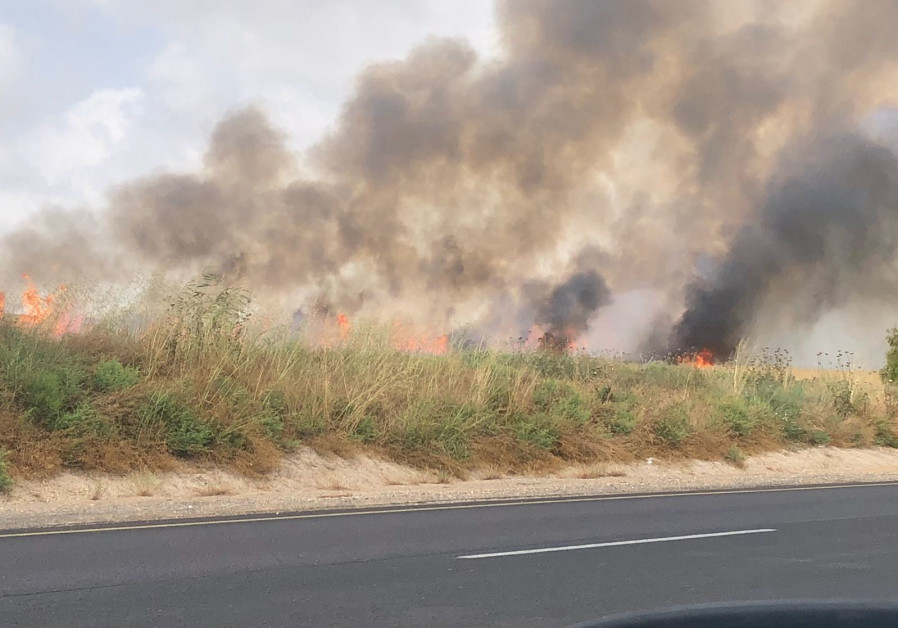
Palestinian incendiary kite and balloon terror continues on Saturday as 15 fires currently rage in the south of the country.

Fires reported near the Kerem Shalom area, in the Kissufim-Re’im area, Erez, and surrounding outposts. Road 232 was blocked in the Bari area early on Saturday.

There was also a large fire in Mavki’im, a town just a few miles north of Gaza. Fire fighters worked to protect the town and gain control over the fire.

The Israel Air Force attacked two Hamas observation points in retaliation for explosive rigged balloons over the weekend as fires continued to rage across southern Israel from incendiary devices launched from the Gaza Strip.

“The IDF views with great severity the use of incendiary kites and balloons and will act to prevent their use,” read a statement by the IDF’s Spokesperson’s Unit on Friday just hours after another aircraft fired warning shots at a group of Gazans who were launching incendiary kites and balloons close to the security fence in the southern part of the coastal enclave.

One explosive balloon with the lettering “I love you” landed on an Israeli road in the Shaar HaNegev Regional Council and was neutralized in a controlled explosion by the Israel police.

Gazans have been protesting along the border with Israel since March 30th as part of what organizers have called the “Great March of Return.” Demonstrators have been throwing stones, Molotov cocktails and rocks toward Israeli troops and flying incendiary kites into Israeli territory, destroying over 9,000 dunams of forest, nature reserves and agricultural fields.

On Thursday reports out of Gaza said that Palestinians planned to launch 5,000 incendiary balloons and kites towards Israel to mark Eid al-Fitr.

Amid hot weather on Saturday several fires broke in southern Israel. One broke out between the communities of Ein HaShlosha and Kissufim in the Eshkol Regional Council because of an incendiary balloon that landed in the area. Another fire broke out close to an IDF post due to an incendiary kite flown from Gaza and a Molotov cocktail attached to a balloon caused a fire near Sderot.

Last week for the first time Palestinian demonstrators launched kites and helium balloons (which can fly farther) with explosive devices, such as pipe bombs, attached to them that are set off by cellphones once they approach troops. Last Friday, one of dozens of these devices exploded in the air above troops, causing no injuries.

Iran’s Ayatollah Khamenei says his plans for destroying Israel are “progressive”

Posted June 15, 2018 by Louisiana Steve
Categories: Mad Mullahs

Tags:

By Elder of Ziyon Friday, June 15, 2018

Source Link: Iran’s Ayatollah Khamenei says his plans for destroying Israel are ‘progressive’

{Next thing the progressive Ayatollah will be telling us destroying Israel is good for global warming. – LS}

In a surreal statement, Iranian leader Ali Khamenei said:

Concerning this usurper entity (Israel), Gamal Abdel Nasser forty or fifty years ago created slogans and said, “we would throw the Jews into the sea”…..

The Islamic Republic has not said this ever, but we have submitted a proposal from the beginning and we said that democracy and consideration of public opinion and the voices of the people today represent a modern and advanced method  agreed by the whole world.

A referendum can be established. This is what was said years ago to the United Nations as the opinion of the Islamic Republic. This is our opinion: Palestinians had been Palestinians for no less than a hundred years were Muslims, Jews and Christians. The voices of these Palestinians wherever they are, whether they were in the occupied territories, the land of Palestine, or outside of Palestine, and any system these will determine the fate of the land of Palestine, what will be the ruling regime, whatever they want.

Is this opinion a bad opinion? Is this view not progressive? The Europeans are not willing to understand this talk, and then you see that deadly side of the evil, pimply children who go there pretending to be oppressed and say that Iran wants to eliminate us and eliminate several million people …

See? he says Jews can vote – as long as they lived in Palestine a hundred years ago. The millions who returned to their ancestral homeland cannot vote, of course; the millions Palestinian Arabs who fled in 1948 can vote, of course.

This is the kind of progressive democracy that Iran embraces, where only the people they allow can vote for only the people they allow to run.

I’m not quite sure how his “progressive” voice fits in with forcing a million of his citizens to go out last Friday to chant “Death to Israel!” but, on second thought, a lot of Western self-proclaimed “progressives” do the exact same thing….


The Donald Trump Negotiations Academy – Opinion 

Posted June 15, 2018 by Joseph Wouk
Categories: Uncategorized

Source: Column One: The Donald Trump Negotiations Academy – Opinion – Jerusalem Post

Trump’s playbook involves doing essentially the opposite of what American and Israeli negotiators have been doing for the past 30 years.

BY CAROLINE B. GLICK
 JUNE 15, 2018 09:27
Column One: The Donald Trump Negotiations Academy

We didn’t learn this week whether North Korea will give up its nuclear weapons. Only time will tell.

But we did learn that US President Donald Trump knows how to negotiate.

All of the negotiations experts insist the opposite is true. “How could they agree to a presidential summit without first guaranteeing its end product?” they sigh, knowingly.

“Trump’s showmanship is dangerous and counterproductive,” they sneer.

“At the end of the day, for this to work, Trump will have to copy Barack Obama’s nuclear deal with Iran,” they insist.

Dennis Ross, who mediated the negotiations between Israel and the PLO that led directly to the largest Palestinian terrorism campaign against Israel in history, and Wendy Sherman, who negotiated Bill Clinton’s horrible nuclear deal with North Korea in 1994 and Obama’s disastrous nuclear deal with Iran in 2015, as well as all their esteemed colleagues have taken up their pens and stood before the cameras and clucked about how Trump’s Singapore show is amateur hour.

But what we actually saw in Singapore, for the first time since Ronald Reagan went to Reykjavik, was a US president who actually knew how to negotiate with America’s enemies.

Indeed, Singapore was the first time a Western leader from any nation has gotten the better of his opponent at the negotiating table.

There are three dangers inherent to the process of negotiating with enemies. And to understand how Trump succeeded where everyone since Reagan has failed, it is important to keep them in mind.

First, you have no guarantee that the other side will agree to a deal.

Trump can make the case for denuclearization to Kim. But he can’t make Kim agree to denuclearize.

Since the US has not defeated North Korea militarily, only Kim can decide whether to go along with Trump or not.

The first inherent danger of negotiating then, is that the other side walks away and – as PLO chief Yasser Arafat did in 2000 – chooses to make war instead of peace. Negotiations give credibility to the other side and may, as a consequence, make war a more attractive option for your opponent after a period of negotiations than it was when the talks began.

The last two dangers inherent to negotiations have to do with the actions of Western negotiators and leaders.

Democratically elected leaders have a greater tendency than dictators to become convinced that their political survival is dependent on their ability to deliver a deal. Once that happens, once a leader believes that the risk of failure is too great to accept, he becomes a hostage of the other side.

In 2000, then-prime minister Ehud Barak believed that his only chance of political survival was to convince Arafat to accept a peace deal with Israel. As a consequence, Barak stayed in the negotiations even after Arafat rejected his offer and tanked the Camp David summit in July. He remained in talks with Arafat and his deputies even after they launched the most murderous terror war Israel had ever seen.

The third danger inherent to negotiating with your enemy is related to the second danger. If a leader believes his future depends on getting a deal, the likelihood that he will accept a terrible deal skyrockets.

Obama made reaching a nuclear deal with Iran the chief aim of his second term. To achieve this goal, Obama abandoned every redline he set for himself. He let Iran continue enriching uranium.

He made no demand that Tehran curtail its ballistic missile development. He agreed to gut the inspections regime to the point of meaninglessness. And so on down the line.

Obama was so averse to coming home empty- handed that he agreed to a deal that far from blocking Iran’s path to a nuclear arsenal, paved Iran’s path to a nuclear arsenal. And he threw in $150 billion in sanctions relief to pay for Iran’s efforts to achieve regional hegemony as a sweetener.

With these risks in mind, we turn to the Singapore Summit. Trump’s playbook involves doing essentially the opposite of what American and Israeli negotiators have been doing for the past 30 years.

Five lessons stand out.

1. Don’t make light of your counterpart’s failings, play them up.

For decades, Israeli negotiators praised Arafat as a man of courage and Abbas as a moderate. Obama and his team praised Iranian President Hassan Rouhani as a moderate. By praising their opponents, the Israelis and Americans justified making concessions to their counterparts, without requiring them to reciprocate. In other words, Israeli and US negotiators put the burden to prove good intentions on themselves, rather than their opponents, who actually had no credibility at all.

Trump took the opposite approach. After North Korea tested an intercontinental ballistic missile last July, Trump called Kim “Little Rocket Man” and a “madman.”

By polarizing Kim and blaming him for the growing danger to US national security, Trump made the case that Kim had to prove his good intentions to Trump, not the other way around, as a precondition for negotiations. Kim was required to release three American hostages and blow up his nuclear test site.

He was the one who needed to prove his credibility. Not Trump.

2. Intimidate, don’t woo, your opponent’s friends.

Trump’s three predecessors all begged the Chinese to rein in the North Koreans. In doing so, Clinton, George W. Bush and Obama handed all the leverage to Beijing. To curb North Korea even temporarily, the Chinese demanded continuous US concessions, and they received them.

Trump on the other hand, threatened China. He linked US-China trade deals to Chinese assistance in curtailing North Korean threats and aggression and agreeing to a US goal of denuclearizing China’s client state.

To prove his seriousness, Trump managed to lob 58 missiles at Syrian targets in retaliation for Bashar Assad’s use of chemical weapons while he was eating dinner with Chinese President Xi Jinping at his golf club in Florida.

Trump’s linkage of US-China trade to North Korean denuclearization has paid off. Xi cut off North Korean coal exports to China and limited fuel shipments from China to North Korea. A month later, Kim announced he wanted to meet with his South Korean counterpart.

3. Make it easy for your side to walk away from the table and hard for the other side to jump ship.

Trump accomplished this goal through a series of moves. First, he and Defense Secretary James Mattis threatened to destroy North Korea. Second, Trump coupled the threats with the largest increase in defense spending in memory. Third, Trump has repeated, endlessly, that he has no idea whether talks with Kim will lead to an agreement, but he figures it’s worth a shot. Finally, after Kim insulted National Security Adviser John Bolton, Trump canceled the summit.

Not only did Trump’s polling numbers not suffer from canceling the summit, they improved. As for Kim, Trump’s nixing the summit taught him two lessons. First, he learned the price of failure.

Second, Kim learned that unlike his predecessors, Trump doesn’t fear walking away. Indeed, he’ll walk away over something that none of his counterparts would ever dream of jumping ship for. If Kim wants to negotiate with Trump, he will respect Trump’s choices.

4. Appoint hard-line negotiators.

Kim’s attack on Bolton was reasonable from his perspective. Ever since Clinton signed his failed nuclear deal with Kim’s father in 1994, Bolton has been the most outspoken critic of nuclear diplomacy with North Korea in Washington. Bolton opposed – rightly – every diplomatic initiative and agreement every administration adopted with Pyongyang. There is literally no one in Washington more skeptical of the chances that an agreement with North Korea will succeed than Bolton.

And there he was on Tuesday, sitting at the negotiating table in Singapore.

For the past generation, American and Israeli leaders engaging in negotiations with their enemies have given their opponents a say – indeed, they have routinely given them veto power – over the members of their negotiating teams. US and Israeli leaders used their team roster as yet another tool to appease the other side. This, while ignoring the concerns of their domestic constituencies.

Trump took the opposite approach. After setting up the talks in a manner that minimizes the cost of walking away from the table for him and maximizes the cost for Kim, he chose negotiators that would both minimize the chance of reaching a bad deal and assuage and encourage his constituents that he can be trusted. Both Trump’s supporters and detractors know that so long as Bolton is at the table, the chance of the US agreeing to a bad deal is fairly close to zero. Trump’s rising poll numbers and the fact that the majority of Americans support his negotiations with Kim show that his efforts have paid off politically.

5. Take control of the clock.

Reporters in Singapore were shocked when Trump informed them Tuesday afternoon that he and Kim were about to sign an “agreement.” But sure enough, shortly thereafter, they were shepherded into a grand hall for a formal signing ceremony.

A quick look at the “agreement” showed that there was really nothing there beyond platitudes.

Trump’s many critics were quick to take him to task for his “deal” because it was purely aspirational.

But they missed the point. The point wasn’t to reach a serious agreement. The point was to sign a piece of paper that said “Agreement” on it.

By signing the piece of paper, Trump took all time pressure off of himself and his team. They have their deal. He signed it. In a ceremony with a fancy fountain pen. They have all the time they need now to do what it takes to get Kim to cough up all of his nukes.

On the other hand, time is working against Kim.

US Secretary of State Mike Pompeo said on Wednesday that the economic sanctions on North Korea will remain in place until after North Korea has denuclearized in a verifiable manner. In other words, assuming Kim cares about his economy and is in this for the money, Kim will want to reach a deal and implement it as quickly as possible.

Trump’s critics in the US ratcheted up their attacks against his summitry with Kim on Wednesday and Thursday. But everything they say just discredits them. Trump is only dealing with a nuclear armed North Korea because all of his predecessors enabled Pyongyang’s nuclear armament through feckless diplomacy. He’s only there to try a new approach because their old approach gave Kim the theoretical ability to nuke New York.

And now that he’s actually negotiating, it is clear that what they really fear is not that he will fail like they did. They fear that he will succeed, like only he – a loudmouthed real estate mogul and reality show star from Queens who couldn’t care less what they think of him and happened to write a book called The Art of the Deal – can do.
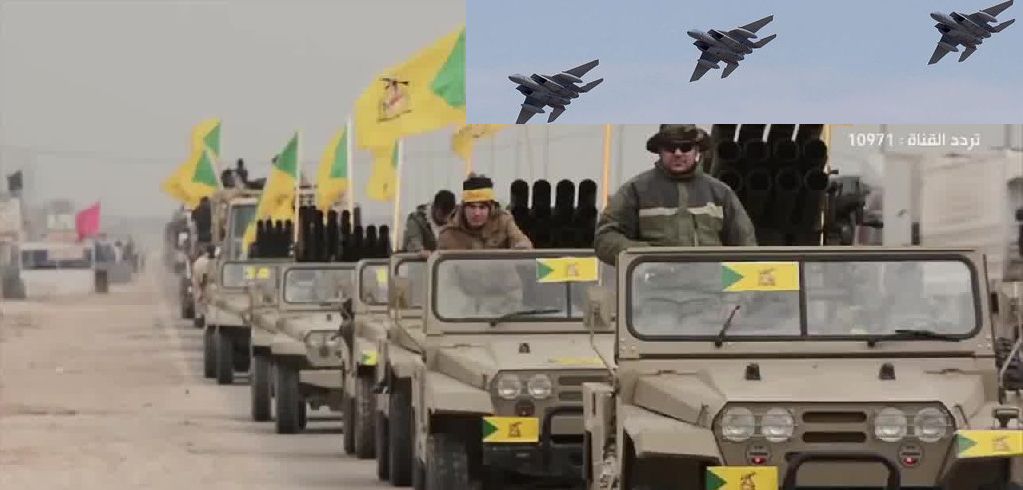
US says will take ‘firm, appropriate measures’ against Syria violations 

Posted June 15, 2018 by Joseph Wouk
Categories: Uncategorized

Source: US says will take ‘firm, appropriate measures’ against Syria violations – Israel Hayom