Congress Seeks to Ban Iran From International Financial System

Posted June 22, 2018 by Peter Hofman
Categories: Uncategorized

Lawmakers encourage blacklist as a result of Iran’s continued money laundering efforts and financial support to terror groups

President Hassan Rouhani in front of a portrait of Iran's Supreme Leader Ayatollah Ali Khamenei

President Hassan Rouhani in front of a portrait of Iran’s Supreme Leader Ayatollah Ali Khamenei / Getty Images

BY:

Congress Seeks to Ban Iran From International Financial System

Leading members of Congress are urging the Trump administration to pressure world leaders to ban Iran from accessing international financial systems following revelations the former Obama administration secretly helped Tehran skirt international sanctions to potentially access billions in hard currency, according to a letter sent Thursday to the Treasury Departments.

Sen. Rob Portman (R., Ohio) and Rep. Ed Royce (R., Calif.) are petitioning the Trump administration to urge members of the Financial Action Task Force (FATF), an international organization formed to combat money laundering, to put Iran back on its blacklist as a result of the country’s ongoing support for terrorism.

Iran was taken off the FATF blacklist as part of a package of incentives provided by the Obama administration to Iran in order to help pave the way for the landmark nuclear deal killed by President Trump earlier this year.

Lawmakers are demanding that Iran be put back on FATF’s blacklist as a result of its continued money laundering efforts and financial support to terror groups across the Middle East, including Hamas, Hezbollah, and other militants operating in the region.

Portman and Royce—chair of the Senate Permanent Subcommittee on Investigations and chair of the House Foreign Affairs Committee, respectively—say that recent revelations from a congressional investigation into the Obama administration’s secret diplomacy on Iran’s behalf make it all the more important for the current administration to take concrete action against Iran’s terror support networks.

FATF members will meet next week in Paris, where the lawmakers hope to see this issue raised by the Trump administration.

“This upcoming FATF session is particularly important following the recent release of the Senate Permanent Subcommittee on Investigations’ report exposing new details about the previous administration’s efforts to give Iran access to the U.S. financial system, including through consideration of a general license for the ‘conversion of two non-USD currencies through the limited use of the USD as an intermediate currency,'” the lawmakers write in the letter, which was sent to Treasury Secretary Steven Mnuchin.

“In the push to save its deeply flawed nuclear deal, the Obama administration unwisely backed a wide range of economic relief for Iran—including through the FATF,” the lawmakers note. “In June 2016, the administration supported the FATF’s decision to suspend ‘counter-measures’ against Iran for one year, following Tehran’s submission of an Action Plan to the FATF to address deficiencies in its anti-money laundering/counter-terrorist financing policies.”

Restrictions on Iran are still being lifted every six months by FATF, despite Trump’s decision to abandon the deal and pursue tough new sanctions on Tehran. The lawmakers argue that Iran must be placed back on FATF’s blacklist due to its increasing support for terror groups.

“For the last two years, the FATF has continued to suspend these countermeasures at six-month intervals, despite the continued dangerous and belligerent actions of the Iranian regime,” the lawmakers write. “Many reports have indicated the regime in Tehran actually increased financial support for its terror proxies in the wake of the nuclear deal.”

Iran has skirted restrictions on terror financing by designating its cash for groups such as Hamas and Hezbollah as “legitimate popular resistance against colonial domination and foreign occupation,” the lawmakers note.

This has allowed “Iran to continue financing terrorist organizations, including Hamas and Hezbollah,” according to the letter.

“It’s time to recognize that Iran has failed to take the necessary steps—despite its pledges two years ago—to be removed from the list of FATF’s high-risk and non-cooperative jurisdictions,” the letter states. “The United States should now utilize its influence within the FATF to reimpose countermeasures against Iran and protect the international financial system.”

Russia Promises ‘Tough Response’ to Creation of US Space Force

Posted June 22, 2018 by Louisiana Steve
Categories: Military technology, U.S. Military, U.S. military technology

Tags:

If President Trump executes his plans to create a U.S. Space Force, there will be repercussions, promise Russian diplomats and politicians.

By Alicia Powe June 21, 2018 Via Gateway Pundit

Source Link: Russia Promises ‘Tough Response’ to Creation of US Space Force

{Sound familiar? This is similar to the SDI initiative Reagan used in negotiating with the Soviet Union. The reaction we see from Putin is not surprising. They couldn’t afford it then and they cannot afford it now. – LS}

The president declared Monday that the United States must return to outpacing China and Russia as competitors in space exploration and directed Pentagon leadership to create a a sixth, space-oriented branch within the U.S. military.

Russia warns Trump it will retaliate if the president proceeds to build a U.S. Space Force, arguing the development of military presence in outer space would disregard a treaty banning nuclear weapons in outer space

“Militarization of outer space is the path to disaster,” Victor Bondarev, head of the Russian Parliament’s Upper House Committee on Defense and Security, told state media Tuesday.”Let’s hope the American political elite still have the remnants of reason and common sense.”

“But if the United States withdraws from the 1967 treaty banning nuclear weapons in outer space, then, of course, not only ours, but also other states, will follow with a tough response aimed at ensuring world security,” he said, referencing the 1967 Outer Space Treaty.

According to the U.S. State Department’s archives, the 1967 Outer Space Treaty is one of several “non-armament” treaties that sought to prevent “a new form of colonial competition” in the cosmos.

Russian Foreign Ministry spokeswoman Maria Zakharova also criticized the formation of an American space force Wednesday.

“What makes this piece of news most alarming is the purpose of the instruction was described in very clear terms — dominance in space,” Zakharova told state media.

“Naturally, we keep the closest watch on Washington’s intentions and analyze the likely effects,” she added. “A military buildup in space, in particular, after the deployment of weapons there, would have destabilizing effects on strategic stability and international security.“

While Russia does have a branch of the military described as “space forces,” their activities are “purely defensive,” the spokeswoman said. “Our country is not interested in tackling any tasks in space with the use of attack weapons,” Zakharova said.

Former Secret Service Agent Files RICO Suit Against Clintons, Soros, Podesta, Brock

Posted June 22, 2018 by Peter Hofman
Categories: Uncategorized

Conspiracy theorists (and conspiracy factists) are running wild as infamously outspoken former Secret Service agent Gary Byrne has filed a Racketeer Influenced and Corrupt Organizations (RICO) suit against what some call the Democrat Deep State.

Defendants in the case include:

CLINTON FOUNDATION, CLINTON-GIUSTRA ENTERPRISE PARTNERSHIP, MEDIA MATTERS FOR AMERICA, CORRECT THE RECORD, AMERICAN BRIDGE 21ST CENTURY, CITIZENS FOR RESPONSIBILITY AND ETHICS IN WASHINGTON, SHAREBLUE, DAVID BROCK, WILLIAM JEFFERSON CLINTON, HILLARY RODHAM CLINTON, GEORGE SOROS, JOHN PODESTA, JONATHAN WACKROW, JAN GILOOLY and CLINTON GLOBAL INITIATIVE.

Quite a rogue’s gallery.

Here’s the summary of Byrne’s case…

For the past decade in which relevant predicate acts were corruptly carried out by the named defendants as “payback” for Plaintiff Gary Byrne’s role in the Clinton impeachment and his status as a “Clinton enemy” (for his temerity in telling the truth concerning obstruction of justice and gross abuse of power), along with their corrupt surrogates and collaborators (referenced individually and collectively as the “Enterprise”), David Brock and William and Hillary Clinton have been synonymous with criminal  behavior, malicious baseless attacks (using mainly the illicit and vicious defamatory tactics against  perceived political enemies (like Officer Gary Byrne, the Plaintiff here) of those willing to compensate  participants like Brock) – and coordinating by mail and wire to violate myriad Federal and State laws in the exploitation of Enterprise nonprofit entities they use for purely partisan purposes.

This Enterprise has taken such attacks to an unprecedented and chilling new level – involving illegal domestic human and electronic surveillance, and tradecraft such as “lures” run at Byrne in order to obstruct the Hillary Clinton e-mail and Clinton Foundation Investigations by the agencies of the Obama government, all against private citizens in order to assist Hillary Clinton become the 45th President of the United States, destroy Gary Byrne, and enrich themselves. According to investigations of the United States Congress, and as anticipated to emerge from numerous ongoing government investigations, Hillary Clinton and certain other Enterprise named and unknown named, and high-level surrogates, colluded with Russian intelligence (SVR and FSB) and a disgraced (and according to a referral from the United States Senate Committee on the Judiciary, a putative criminal) former British intelligence officer (Christopher Steele) to accomplish their illicit and unconstitutional objectives. These Enterprise defendants, surrogates and  participants have their opportunity to properly respond before a court they knowingly misled many times using the most powerful counterintelligence tools available. Let them do so now.

Ten years ago, defendant Brock’s malfeasance became more precisely organized in the Enterprise, and thus fully weaponized, as he joined forces with former president William Jefferson Clinton (“William Clinton” or “President Clinton”), Hillary Rodham Clinton and funder George Soros (“Soros”), and at various stages of the illegal Enterprise, the other defendants named here. They, and the Enterprise they formed to control the Democratic Party, took illicit advantage of a previously inviolate structural arrangement (between all three branches of our government) codified in the Foreign Intelligence Surveillance Act (“FISA”) by arranging for payment through smear merchants Fusion GPS to the Russian SVR and FSB and British (former) agent Christopher Steele (“Steele”). To abolish their enemies, in other words, the Enterprise defendants were willing to defy all legal and constitutional dictates – including certain actors within the Obama Department of Justice ineffably misleading Article III colleagues resident in this very Court.

This is sedition, bordering on treason, and patently illegal.

The presiding judge – Paul L. Friedman – is a Bill Clinton appointee.

Of course this is a civil filing, which is something anyone can file for anything, so don’t start the ‘lock her up’ chants quite yet.

As a reminder, here is Mr.Byrne’s view of Clinton et al. from two years ago

Following the release of former secret service officer Gary Byrne’s book in 2016, Clinton campaign officials have tried to play down his accusations with ad hominum attacks at Byrne as opposed to denying any of his allegations. However, as his book gains traction, RealClearPolitics reports that during his appearance of FOX News’ Hannity show, Byrne talked Hillary Clinton’s temperament, her “terrified staff,” Bill Clinton carrying on affairs, drug use in the White House and more with host Sean Hannity. Byrne said Clinton was feared by her staff and was notorious for her yelling. Byrne told Hannity that she has “blown up” at him and other Secret Service agents…

“She gets angry at things that are policy issues that, you know, take time to fix, and she’s got this attitude where she wants things fixed right now, immediately. She screams and yells at people,”

“There’s many examples that I site in my book where she blows up at people,” Byrne said. “Like I’ve said, she has blown up at me before, and agents, and her staff. At one time, I saw her staff so afraid to tell her about a mistake that was made. They weren’t upset about the waste of the mistake, ordering the wrong invitations, they were terrified that someone was going to have to tell Hillary Clinton that there was a mistake made.

Byrne says Clinton’s behavior during his tenure in the Secret Service proved to him that she does not have the temperament for the Oval office.

BYRNE: I feel so strongly that people need to know the real Hillary Clinton and how dangerous she is in her behavior. She is not a leader. She is not a leader.

SEAN: She does not have the temperament?

BYRNE: She doesn’t have the temperament. She didn’t have the temperament to handle the social office when she was First Lady, she does not have the temperament.

SEAN: She’s dishonest.

BYRNE: She’s dishonest, she habitually lies, anybody that can separate themselves from their politics and review her behavior over the past 15 years…

SEAN: You’re going to be accused of being political.

BYRNE: Absolutely I’m sure I will be, I have already and it’s not.

SEAN: And what’s your answer?

Byrne: It’s got nothing to do as politics.

Byrne talked wrote about then-President Bill Clinton’s behavior, accusing him of carrying on multiple affairs and gave his perspective on the Monica Lewinsky affair and the scandal as it was happening. Byrne talked about several different affairs and how the Secret Service was expected to clean up after him.

HANNITY: How many women do you know, for sure, that he had affairs with in the Oval Office?

BYRNE: In the White House complex? I’d say easily three, maybe four, that I know of.

HANNITY: And you could see Monica Lewinsky from a mile away?

BYRNE: Sure. Sure.

HANNITY: You knew she wanted to be near him.

BYRNE: She was certainly manipulated some of the staff, other officers, myself to find out where he was—

HANNITY: She wasn’t manipulating if you saw through it.

BYRNE: Yeah, I agree. But I saw through it right away, but she was trying to place herself in his path, as he would move throughout the complex.

Byrne talks drug use in the White House:

HANNITY: Before I get into all the issues involving Bill and Hillary and what she knew and didn’t know and covering up and lying and you being put in the middle of all this. People use drugs the at the White House?

BYRNE: There were some issues. One of the ones I comment in my book, and I’m very careful not to tell too much about it because I don’t want — hopefully this person got on with their lives and lived a healthy life. But there was one particular staff member that they had come in in the morning, and they’d be so beat up and exhausted looking, worn out, exhausted to the point where they couldn’t be seen saying good morning. And they’d go in their office and go the bathroom and come out of the bathroom completely elevated and happy and smiling.

HANNITY: It was obvious you thought coke was being used?

BYRNE: I did. And later on, I was told that this particular person actually, they did something similar to an intervention and got her help and got her to a clinic, and I never did see her again. But I understand she did all right.


Netanyahu’s water tech offer draws wave of Iranian support

Posted June 22, 2018 by davidking1530
Categories: "Humanitarian aid", Iran

This is a follow up to this post:

Netanhyahu offers water tech to Iranians

Looks like there has been a strong, positive response from the Iranian people.

So there is hope, after all….

Netanyahu’s water tech offer draws wave of Iranian support

http://www.israelhayom.com/2018/06/18/netanyahus-water-tech-offer-draws-wave-of-iranian-support/

Some 100,000 Iranians join Israel’s Farsi-language Telegram account as a result of PM Netanyahu’s video offering Iranians water tech to combat country’s water crisis

Iranian internet users hail Israel: “We wish them death, they bless us with life.”

Prime Minister Benjamin Netanyahu’s video offering to share Israeli water technology with the Iranians racked up 5 million views in the first five days it was online, 1.6 million of which were on Netanyahu’s own social media channels.

Perhaps more significantly, nearly 100,000 Iranians joined the Israeli government’s Farsi-language Telegram account within 24 hours of the video going live.

All in all, this was the second-most watched Netanyahu video, after a presentation in April in which Netanyahu unveiled an Iranian nuclear archive smuggled out of Iran by Israeli agents.

In the video, posted a week ago, Netanyahu addresses the Iranian people directly, offering to teach Iran how to manage its water resources.

In the video, Netanyahu pours himself a glass of water and says, “I want to help save countless Iranian lives. Here’s how: Iran’s meteorological organization says that nearly 96% of Iran suffers from some levels of drought.”

“Israel has the know-how to prevent environmental catastrophe in Iran. I want to share this information with the people of Iran. Sadly, Iran bans Israelis from visiting,” Netanyahu says in the video.

Netanyahu also said that Israel would be setting up a Farsi website that would teach the Iranian people how to recycle water.

The video received wide media coverage in Iran, including on the state news agency IRNA and the website of Radio Farda (the most popular station in the country) and Radio Zaman.

However, news agencies affiliated with the Iranian regime were, unsurprisingly, critical of Netanyahu’s video. The ISNA agency claimed that “while the residents of Gaza are suffering because the Zionist regime took away their water, the leader of the Zionist regime announces that he wants to help the Iranians overcome the drought.”

The coverage of the video was so widespread that even the regime itself was forced to discuss it. Iranian Energy Minister Reza Ardakanian told reporters on Wednesday that Iran was not in need of any external help to solve its water crisis, adding that “the prime minister of this regime [Israel] or anyone else who claims to have the ability to manage water resources is aware that Iran is a country that has a proven record going back thousands of years in the field.”

Iranian Foreign Ministry Spokesman Barham Qassemi attacked Netanyahu, saying that Tehran had no need for a “trickster” to solve its water shortage problem.

While the Tehran regime rejected Israel’s offer, Iranian Internet users welcomed the idea and leveled criticism at their own government.

One user commented, “We wish them [Israelis] death and they bless us with life. I am ashamed to be Iranian.”

Another posted: “God will bless Israel and Netanyahu. I’m sure that Iran and Israel will once again be allies.”


Line of Fire – The Six Day War 1967 

Posted June 20, 2018 by Joseph Wouk
Categories: Uncategorized


Israel’s 50th anniversary of the “miracle war.”


Hamas’ new equation: Rockets in response to every IDF strike

Posted June 20, 2018 by Joseph Wouk
Categories: Uncategorized

Source: Hamas’ new equation: Rockets in response to every IDF strike

Analysis: Operating under the perception that Israel isn’t interested in a war in Gaza, the terror organization has adopted an unprecedented new policy of attacking Gaza border communities with rockets during or immediately after any IAF strike on its targets in the strip; Israeli officials believe Hamas’ desire to change the rules of the game is also driven by frustration in light of its failures in recent months.
The IDF has detected that the massive barrages of 45 rockets and mortar shellsfired at the Gaza border communities on Tuesday night was carried out by members of Hamas’ military wing as a new policy adopted by the terror organization.
According to this policy, which wasn’t even adopted in the years before Operation Protective Edge, Hamas attacks the Gaza vicinity communities with rockets during or immediately after any Israel Air Force strike on its targets in the strip.

An IAF strike in Gaza, Tuesday night

An IAF strike in Gaza, Tuesday night

Hamas operatives began firing rockets on Tuesday night after the IAF bombed a Hamas military facility in Rafah in response to incendiary kites dispatched from the strip, which sparked major fires in Gaza vicinity fields. The operatives thereby proved that a similar incident earlier this week, in which three rockets were fired at Israel, was intentional rather than random.

The targets attacked by Israel on Tuesday night included Hamas posts, warehouses, offices and an underground training facility for the organization’s operatives.

Defense establishment officials believe that Hamas is operating under the perception that Israel isn’t interested in a war in the south right now, four years after Operation Protective Edge. As a result, the organization is allowing itself to adopt what it considers an unprecedented and bold retaliation policy.

Fire sparked by incendiary kites in the Or HaNer area in southern Israel

Fire sparked by incendiary kites in the Or HaNer area in southern Israel

Nevertheless, the Hamas rocket fire is still limited to the Gaza vicinity areas and is only carried out at night. Israeli officials believe that Hamas’ desire to change the rules of the game is driven by its frustration in light of its failures in recent months and the measured exacerbation of the Israeli policy against the incendiary kites.

About two weeks ago, the IAF started firing warning shots among kite flyers. In the past few days, it begun attacking empty vehicles of senior members of Hamas’ kite unit, kite-flying infrastructures, and finally Hamas targets as well.

The organization is also frustrated by the fact that the border with Israel wasn’t breached as planned since the beginning of the fence protests in late March, while more than 165 Palestinians—mostly Hamas operatives, according to the IDF—were killed in the clashes and some 100 targets in the strip were attacked by the IAF, affecting the organization’s military power.

Damage caused by Hamas rocket fire in a Gaza border community  (Photo: Eshkol Security)

Damage caused by Hamas rocket fire in a Gaza border community (Photo: Eshkol Security)

Israel has been conveying indirect messages to Hamas that its perception concerning the Israeli policy is wrong, and that the IDF will step up its attacks even at the cost of a deterioration if the current situation continues, despite the political echelon’s desire “not to stop playing by the rules” vis-à-vis Gaza.

“At this time, thereis more pressure from Tel Aviv and Jerusalem residents concerning the fires caused by the incendiary kites than from Gaza vicinity residents,” a security source told Ynet on Tuesday. “We are making a lot of progress in the technological efforts to find a solution to the kite phenomenon, but even in the future there will be no hermetic solution.

“Ministers’ statements that kite flyers must be attacked directly are intended primarily for public opinion purposes and have nothing to do with security. As far as Hamas is concerned, the use of the kite phenomenon is a win-win situation to raise awareness to their issue in the global public opinion.”

U.S. leaving UN human rights council

Posted June 20, 2018 by Joseph Wouk
Categories: Uncategorized


God bless Niki Haley….


US quits the UN’s Human Rights Council, citing its ‘chronic bias against Israel’

Posted June 20, 2018 by Joseph Wouk
Categories: Uncategorized

Source: US quits the UN’s Human Rights Council, citing its ‘chronic bias against Israel’ | The Times of Israel

Haley calls global body ‘a cesspool of political bias’; announces US departure after protracted criticism of its obsessive focus on Israel; US official says move is ‘immediate’

The United States is withdrawing from the UN Human Rights Council, US Ambassador to the UN Nikki Haley said Tuesday, branding the global body a “cesspool of political bias.”

“We take this step because our commitment does not allow us to remain a part of a hypocritical and self-serving organization that makes a mockery of human rights,” she said at a press conference announcing the move.

The council, she added, has a “chronic bias against Israel.”

Haley said that if the council reforms, the United States “would be happy to rejoin.”

Although the US could have remained a non-voting observer on the council, a US official said it was a “complete withdrawal” and that the United States was resigning its seat “effective immediately.” The official wasn’t authorized to comment publicly and insisted on anonymity.

US officials said earlier Tuesday that the administration had concluded that its efforts to promote reform on the council had failed, and that withdrawal was the only step it could take to demonstrate its seriousness. It was not immediately clear if the US would remain a non-voting observer on the council.

US Secretary of State Mike Pompeo, appearing alongside Haley at the State Department, said there was no doubt that the council once had a “noble vision.”

But today we need to be honest,” Pompeo said. “The Human Rights Council is a poor defender of human rights.”

Haley and Pompeo stressed the decision had been made after a long year of efforts to shame the council into reform and to remove member states that themselves commit abuses.

“These reforms were needed in order to make the council a serious advocate for human rights,” Haley said. “For too long, the Human Rights Council has been a protector of human rights abusers, and a cesspool of political bias. Regrettably, it is now clear that our call for reform was not heeded.”

The Geneva-based body was established in 2006 to promote and protect human rights worldwide, but its pronouncements and reports have often infuriated the US — in particular, the council’s relentless focus on Israeli policies toward the Palestinians.

But, as Haley stressed, Washington also believes it comes up short on criticizing even flagrant abuses by US opponents like Venezuela and Cuba.

“Countries have colluded with each other to undermine the current method of selecting members,” Pompeo said. “And the council’s continued and well-documented bias against Israel is unconscionable,” he said.

“Since its creation, the council has adopted more resolutions condemning Israel than against the rest of the world combined,” he noted.
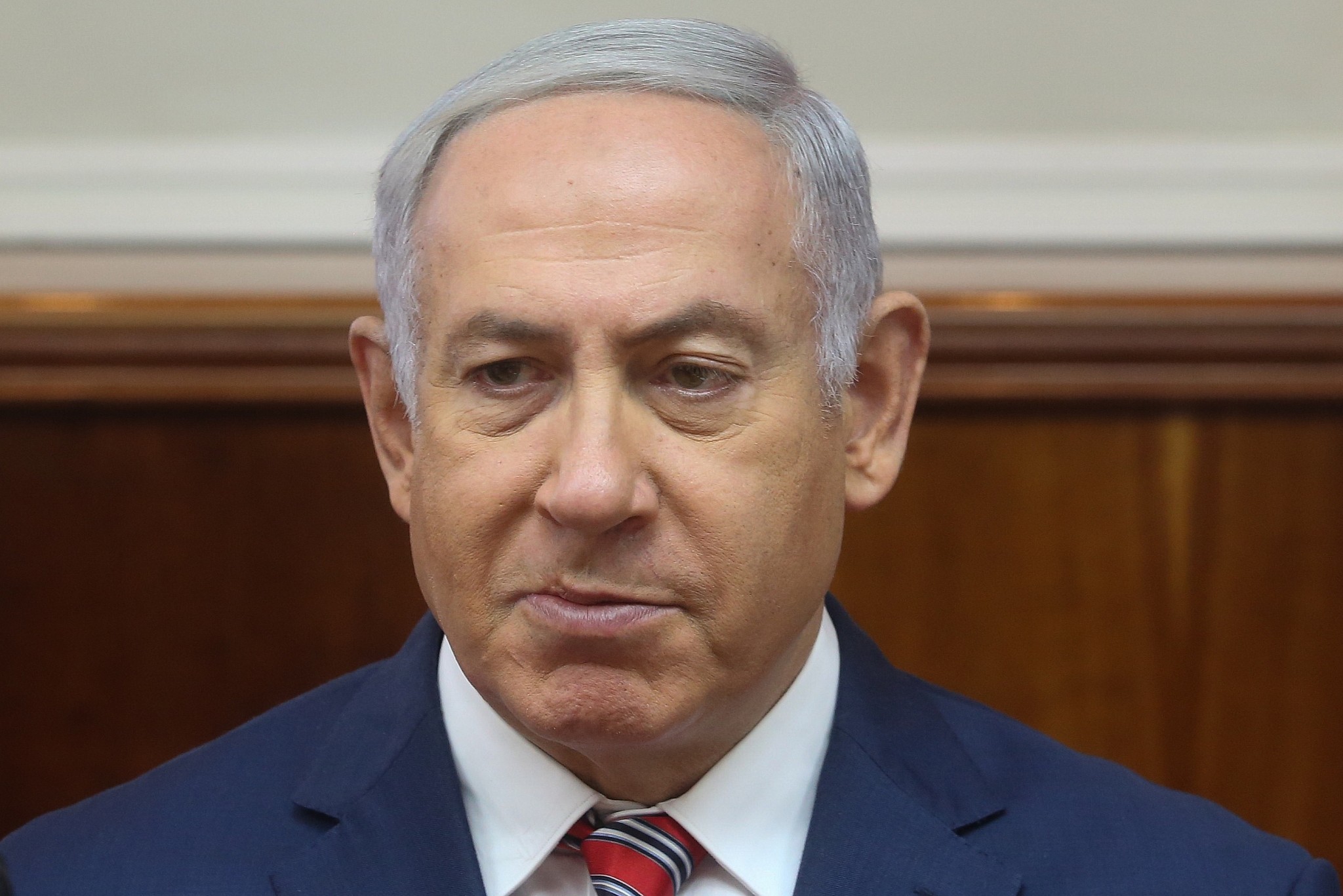
Prime Minister Benjamin Netanyahu leads the weekly government conference at the Prime Minister’s Office in Jerusalem on June 17, 2018.(Marc Israel Sellem/POOL)

Israel’s Prime Minister Benjamin Netanyahu welcomed the US move, branding the council “a biased, hostile, anti-Israel organization that has betrayed its mission of protecting human rights.”

Haley, who issued a warning a year ago that Washington would make good on its threat to leave the council if reforms were not carried through, used even starker language.

“We take this step because our commitment does not allow us to remain a part of a hypocritical and self-serving organization that makes a mockery of human rights,” she said.

UN Secretary-General Antonio Guterres regretted the US decision, adding: “The UN’s human rights architecture plays a very important role in the promotion and protection of human rights worldwide.”
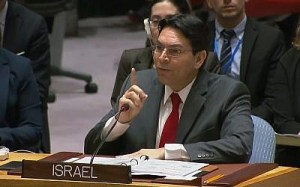
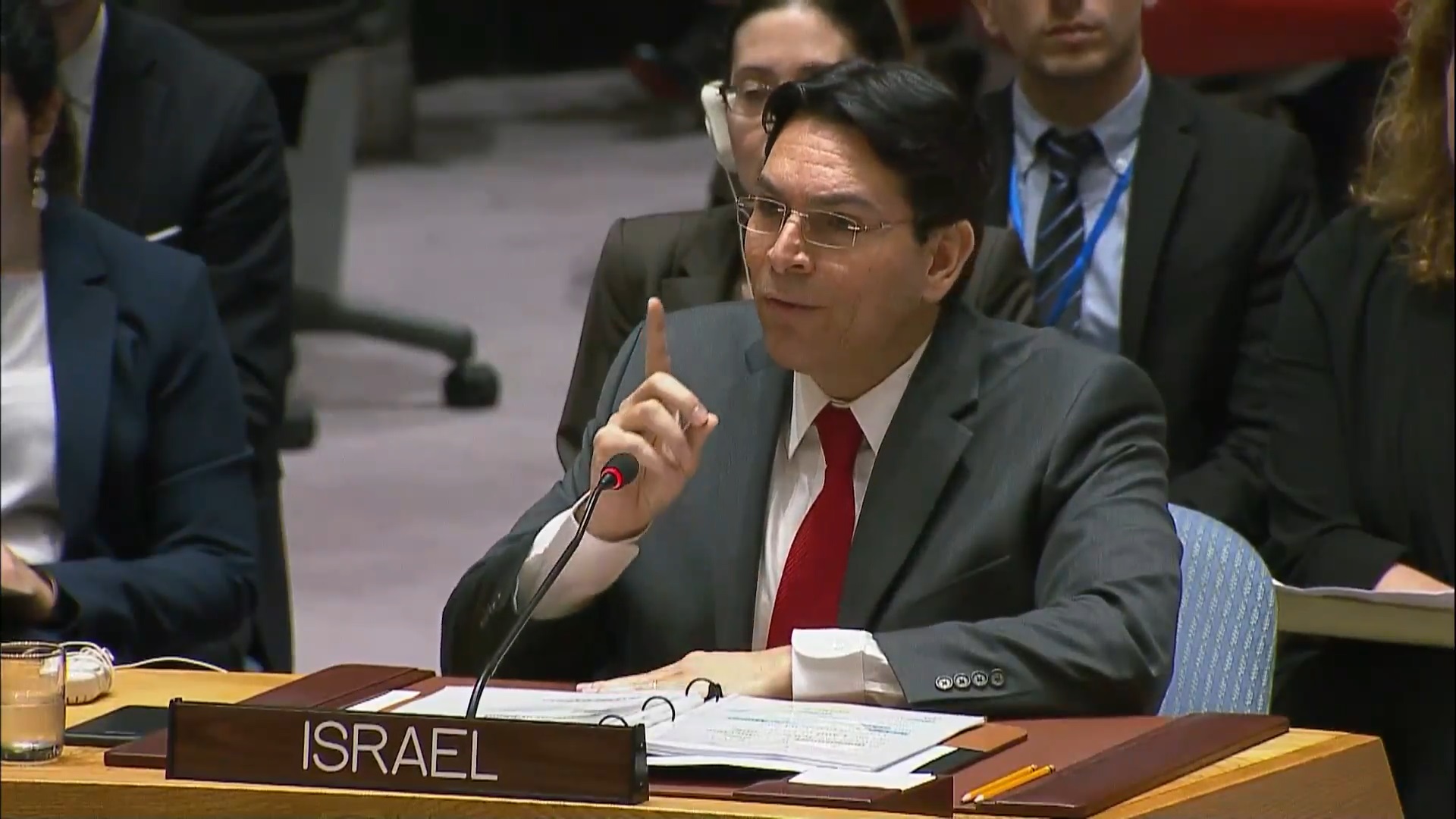
Danny Danon addressing the UN Security Council on February 20, 2018. (screen capture: UNTV)

Israel’s Ambassador to the UN Danny Danon welcomed the announcement, saying in a statement that the US “has proven, yet again, its commitment to truth and justice and its unwillingness to allow the blind hatred of Israel in international institutions to stand unchallenged.”

“The Human Rights Council has long been the foe of those who truly care about human rights around the world,” Danon said immediately after Haley spoke. “We thank President Donald Trump, Secretary of State Mike Pompeo and Ambassador Nikki Haley for their leadership, and call on the moral majority at the UN to hold all of its institutions accountable.”

Haley had threatened to withdraw from the council in June 2017 unless it reformed, including by removing its built-in procedural mechanism to bash Israel.

The council’s “relentless, pathological campaign” against a state with a strong human rights record “makes a mockery not of Israel, but of the council itself,” she said at the time during a speech in Geneva, hours before she made her way to Israel for her first visit to the Jewish state.

Haley had listed several conditions for the US remaining in the council, including the need to abolish Agenda Item 7 (“the human rights situation in Palestine and other occupied Arab territories”), which since its adoption in 2007 has singled out Israel for perpetual censure, a measure that no other country faces at the UN body.
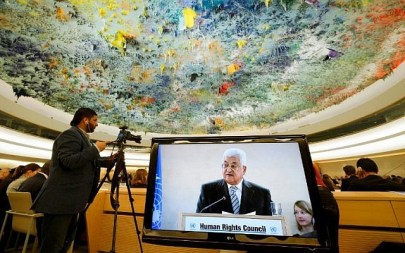
Palestinian Authority President Mahmud Abbas is seen on a TV screen while speaking during a meeting of the United Nations Human Rights Council on February 27, 2017 in Geneva, Switzerland (AFP/Fabrice Coffrini)

“There is no legitimate human rights reason for this agenda item to exist,” Haley said last year. “It is the central flaw that turns the Human Rights Council from an organization that can be a force for universal good, into an organization that is overwhelmed by a political agenda.”

A full pullout by the US would leave the council without one of its traditional defenders of human rights. In recent months, the United States has participated in attempts to pinpoint rights violations in places like South Sudan, Congo and Cambodia.

Opposition to the decision from human rights advocates was swift. A group of 12 organizations including Save the Children, Freedom House and the United Nations Association – USA said there were “legitimate concerns” about the council’s shortcomings but that none of them warranted a US exit.

“This decision is counterproductive to American national security and foreign policy interests and will make it more difficult to advance human rights priorities and aid victims of abuse around the world,” the organizations said in a joint statement.

Added Kenneth Roth, the executive director of Human Rights Watch: “All Trump seems to care about is defending Israel.”

The announcement came just a day after the UN human rights chief, Zeid Ra’ad al-Hussein, denounced the Trump administration for separating migrant children from their parents.

There are 47 countries in the Human Rights Council, elected by the UN’s General Assembly with a specific number of seats allocated for each region of the globe. Members serve for three-year terms and can serve only two terms in a row.

A key question will be where a US pullout will leave Israel if its biggest and most powerful defender abandons its voting rights or drops out of the council altogether.
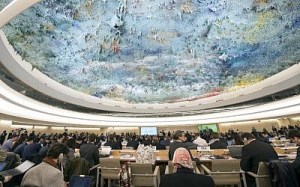
A general view of the 37th session of the United Nations Human Rights Council on February 26, 2018 in Geneva. (AFP Photo/Jean-Guy Python)

Since last year, Haley’s office has pushed the council and its chief not to publish a UN database of companies operating in West Bank settlements, a so-called blacklist that Israel is concerned could drive companies away and cast a further pall over its presence in the Palestinian-claimed West Bank.

Last month, Defense Minister Avigdor Liberman called for Israel and the United States to withdraw from the council over what he termed its “hypocrisy” in criticizing the Jewish state’s Gaza policy.

But Israel has never been a member state of the Human Rights Council, whose members are elected by the UN General Assembly.

“We are cooperating with the council and we have an embassy to the UN institutions in Geneva… but we are not currently members of the council,” Foreign Ministry spokesperson Emmanuel Nahshon said on Tuesday, a few hours before the US announcement.

A US pullout might also be largely symbolic: The United States’ current term on the council ends next year, when it could revert to the observer status held by other countries that are not members. In that situation, the US would be able to speak out on rights abuses, but not to vote.

The United States has opted to stay out of the Human Rights Council before: The administration of president George W. Bush decided against seeking membership when the council was created in 2006. The US joined the body only in 2009 under president Barack Obama.

The expected US announcement was welcomed by Israel’s Deputy Minister for Diplomacy, Michael Oren.

“Amb. Nikki Haley will soon announce America’s withdrawal from the UN Human Rights Council. This is a welcomed response to a body that condemned Israel more than all other countries combined. The US now signals its refusal to lend legitimacy to UN bias against Israel and Jews,” he tweeted earlier on Tuesday,
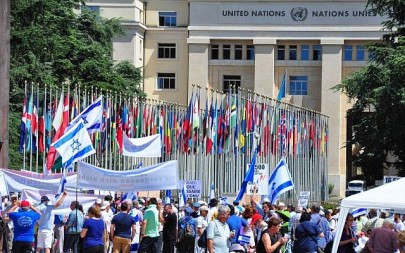
Supporters of Israel rallying outside the UN building in Geneva as the Human Rights Council met, June 29, 2015 (World Jewish Congress)

Reaction to the anticipated move from human rights advocates was equally swift.

“The Trump administration’s withdrawal is a sad reflection of its one-dimensional human rights policy: Defending Israeli abuses from criticism takes precedence above all else,” said Kenneth Roth, the executive director of Human Rights Watch.

“All Trump seems to care about is defending Israel,” he said, adding that it would be up to the remaining members to ensure that the council addresses serious abuses.

UN spokesman Stephane Dujarric declined commenting directly, saying: “We will wait to hear the details of that decision before commenting fully.”

But, he added: “What is clear is that the secretary-general is a strong believer in the human rights architecture of the UN and the active participation of all member states in that architecture.”

United Nations High Commissioner for Human Rights Zeid Ra’ad Al Hussein talks with president of the Human Rights Council Vojislav Suc (R) during the opening of the 38th session of the UN Human Rights Council on June 18, 2018 in Geneva. (AFP PHOTO / ALAIN GROSCLAUDE)

The withdrawal also follows strong UN criticism of Trump’s policy to separate migrant children from their families at the US-Mexico border, though the Trump administration has not yet explicitly cited that criticism, delivered Monday by UN rights chief Zeid Ra’ad Al-Hussein, as a reason for pulling out.

Speaking of the Trump administration policy, Hussein said, “the thought that any state would seek to deter parents by inflicting such abuse on children is unconscionable.”

Since Trump took office, the United States has quit the UN cultural agency UNESCO, cut UN funding, and announced plans to quit the UN-backed Paris climate agreement.


Dozens of rockets launched from Gaza Strip, IDF strikes Hamas target

Posted June 20, 2018 by Joseph Wouk
Categories: Uncategorized

Source: Dozens of rockets launched from Gaza Strip, IDF strikes Hamas target – Arab-Israeli Conflict – Jerusalem Post

No injuries reported, but one of the projectiles landed near a kindergarten in the Eshkol regional council.

BY JERUSALEM POST STAFF
 JUNE 20, 2018 08:01

Dozens of Hamas rockets were fired on Israel from the Gaza Strip late Tuesday night and early Wednesday morning.  At least three projectiles landed in Israeli communities causing no injuries, but slight damage to buildings and vehicles in southern Israel.

The  IDF spokesperson’s office reported that seven rockets were intercepted by the Iron Dome and three of those fired landed within the Gaza Strip.

Residents of the south got little sleep as warning sirens blared throughout the night. Early Wednesday morning, it was decided that schools would remain open, under increased security protection.

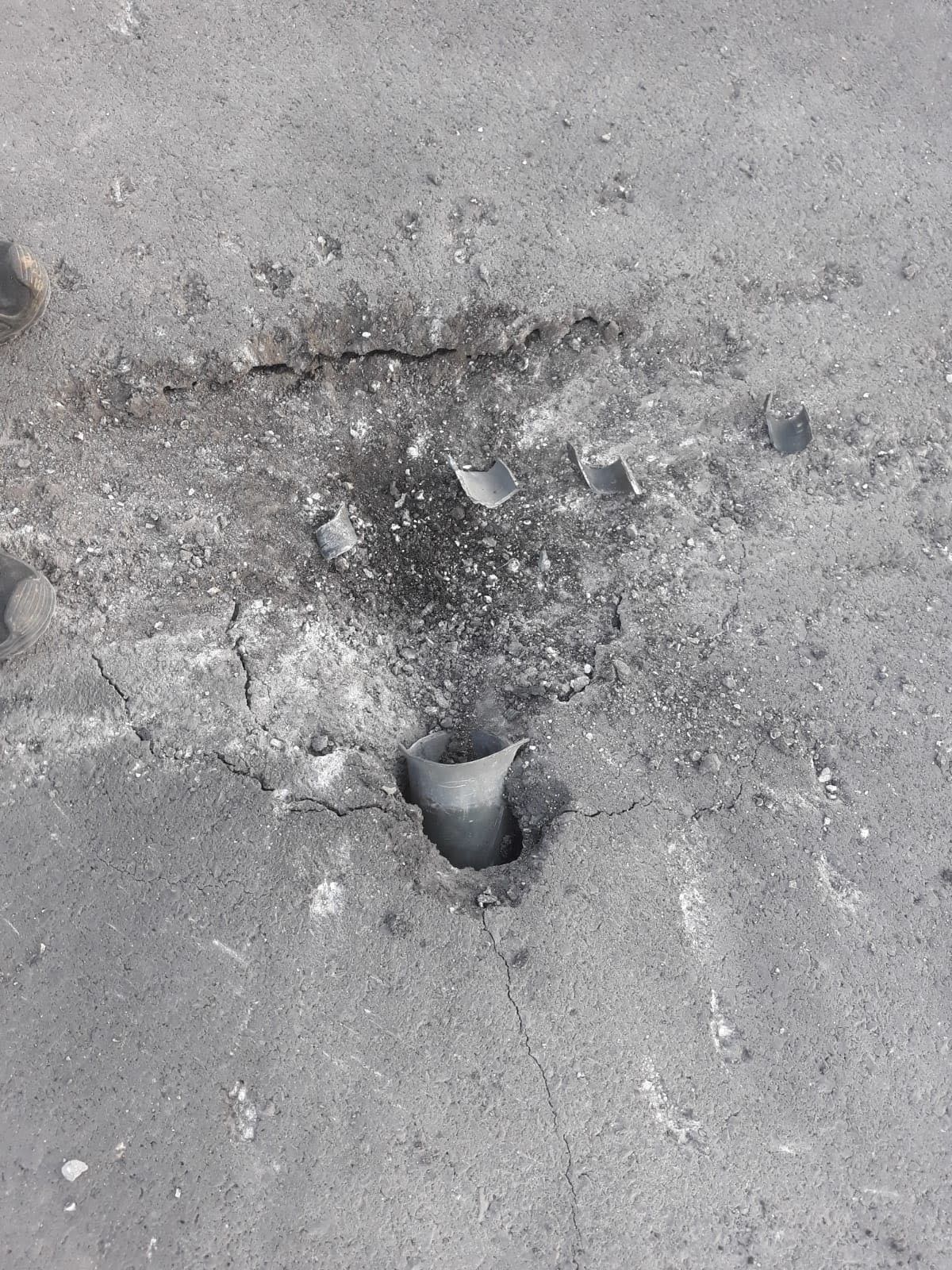
A shell of a rocket fired from Gaza scars the road in the Eshkol regional council (Courtesy)

The strikes came in retaliation to the ongoing launching of incendiary kites and balloons into Israeli territory all throughout Tuesday. These makeshift devices sparked forest and brush fires in 15 locations in the Gaza periphery.

In a second round of IAF activities, eight targets were struck including three Hamas bases.

During a third round of IAF operation, eleven targets were struck in retaliation for the rockets being fired on Israel, including four Hamas bases, the IDF spokesperson reported.

View image on TwitterView image on Twitter

In response to over 45 rockets launched by Hamas towards southern Israeli communities, the IDF targeted military objectives in the Gaza Strip belonging to HamasA shell of a rocket fired from Gaza scars the road in the Eshkol regional council (Courtesy)

In retaliation to Hamas activity, the IAF struck 25 Hamas targets in three separate rounds of retaliatory strikes overnight. Two Hamas security men were lightly hurt in one air strike in the southern Gaza Strip, residents said.

The escalation began after Israeli fighter jets attacked three targets in a Hamas base located in the southern part of the Gaza Strip.

According to Hebrew news site Walla! one of the projectiles landed near a kindergarten in the Eshkol regional council.  

The IDF warned that it is ready to use “a variety of tools and means” to respond in an increasing intensity to such acts of terror.

“The message of tit for tat attacks is that the resistance is the one that defines the equation of the conflict and we will not let the enemy isolate our people,” a Hamas spokesman said on Twitter Wednesday after the violence had died down.

Minister for Regional Cooperation Tzachi Hanegbi stated Tuesday that “there was never any idea” voiced in the cabinet to open fire on Palestinians who are flying incendiary kites into Israel.

“We do not kill those who launch kites,” Hanegbi stated, “the cabinet backs the position of the security forces that as long as this will go on more and more Hamas assets will be bombed.”

Since its last war with Gaza’s dominant Hamas Islamists in 2014, Israel has stepped up efforts to prevent cross-border attacks, improving rocket interceptors and investing in technologies for detecting and destroying guerrilla tunnels.

In recent weeks, Palestinians have sent kites dangling coal embers or burning rags across the Gaza border to set fire to arid farmland and forests, others have carried small explosive devices in a new tactic that has caused extensive damage.

At least 127 Palestinians have been killed by Israeli troops during mass demonstrations along the Gaza border since March 30 and the men sending the kites over the fence believe they have found an effective new weapon.Reuters contributed to this report.

THE WAR THAT CHANGED THE MIDDLE EAST

Posted June 19, 2018 by Louisiana Steve
Categories: History, History of Jews in Israel

Tags:

And gave Israel a bargaining chip for peace.

By Joseph Puder June 19, 2018 Via Front Page Mag

Source Link: THE WAR THAT CHANGED THE MIDDLE EAST

{A lasting victory for a lasting peace. – LS}

Last week marked the 51st anniversary of the June, 1967 Six Day War.  It was a war I took part in as a young airman in the Israel Defense Forces (IDF).  For many Israelis, the Six Day War was a God given miracle, and a deliverance against immense odds.  The national anxiety that preceded the War was marked by the Israeli government stockpiling coffins and rabbis consecrating parks as emergency cemeteries. The triumph of Israeli arms over the combined Arab forces was a sweet and exhilarating moment in history.  Moreover, the liberation of the Old City of Jerusalem and its Western Wall was a most moving event.

The War was not of Israel’s choosing.  Egypt’s dictator Gamal Abdul Nasser sought to avenge the humiliation of the 1948 Egyptian defeat. Having received massive amount of arms from the Soviet Union, and financial aid to boot, he was confident of victory.  In 1948, Nasser was deputy commander of the Egyptian Expeditionary forces that secured the Falluja pocket.  In August, 1948, his brigade was surrounded by the Israeli forces.  Appeals for help from Jordan’s Arab Legion went unheeded. The brigade refused to surrender, however, negotiations between Israel and Egypt resulted in the ceding of the Falluja Pocket to Israel.

Some historians believe that Nasser did not want to engage in a war with Israel, principally because his army was bogged down in Yemen. Nasser however, managed to escalate his rhetoric and actions. On May 13, 1967, the Soviet Union delivered a warning to Cairo that Israel was amassing troops on the border with Syria and would attack within a week.  Twenty-four hours following the Soviet alert, Egypt’s Supreme commander Abdul Hakim Amer ordered the Egyptian army to be on full alert for war.

Forty-eight hours later, Nasser ordered the UN peacekeepers stationed in the Sinai to get out.  The UN peacekeepers had patrolled the border area between Egypt and Israel since 1957, following the Sinai Campaign in which Israel captured the Sinai only to return it to Egypt under American pressure, but with guarantees that Israel would have freedom of navigation through the Suez Canal and the Straits of Tiran.  The departing UN peacekeepers were replaced by Egyptian soldiers Nasser dispatched to the Sinai border with Israel.

Nasser’s belligerency stepped up a notch higher when he announced Egypt’s blockade of the port of Eilat by shutting the Straits of Tiran to Israeli ships.  That in itself was an act of war.  Western powers, including the U.S., did nothing to reverse Nasser’s actions despite guarantees given to Israel.  On May 16, 1967, Nasser sent a message to the UN Emergency Force commander stationed in Gaza, stating, “I gave my instructions to all United Arab Republic (the name remained even after the Egyptian-Syrian merger dissolved) forces to be ready for action against Israel the moment it might carry out any aggressive action against any Arab country. Due to these instructions our troops are already concentrated in Sinai on our Eastern border.  For the sake of complete security of all UN troops, I request that you issue your orders to withdraw all troops immediately.”

Using the “Voice of the Arabs” (Sawt al-Arab) radio broadcast to whip up the Egyptian masses and the fawning Arab masses throughout the Middle East, Nasser, through this mouthpiece announced on May 18, 1967, “The Zionist barrack in Palestine is about to collapse and be destroyed. Every one of the hundred million Arabs has been living for the past nineteen years on one hope – to live to see the day Israel is liquidated. There is no life, no peace, nor hope for the gangs of Zionism to remain in the occupied land.  As of today, there no longer exists an international emergency force to protect Israel.  The sole method we shall apply against Israel is a total war which will result in the extermination of the Zionist existence.”

On May 20th, 1967, Syria’s Defense minister and later President Hafez Assad declared: “Our forces are now entirely ready, not only to repulse aggression, but to initiate the act ourselves and to explode the Zionist presence in the Arab homeland of Palestine. The Syrian army, with its finger on the trigger, is united. I believe that time has come to begin a battle of annihilation.”  Not to be undone, Iraq’s President, Abdul Rahman Arif chimed in, declaring on May 31st, 1967, “Our goal is to wipe Israel off the map.”

In the meantime, Israel’s Prime Minister Levi Eshkol made a disastrous broadcast to the anxious nation on May 28, 1967. He stammered and fluffed, which compounded insecurity in the nation.  As a result, he was compelled to vacate the Defense Ministry portfolio he held.  Moshe Dayan became the Defense Minister, which raised the national morale.  The young “sabra” (native born Israelis) generals now got the green light to mobilize the reserves.  On June 1, 1967, Israel formed a National Unity Government that included Menachem Begin, and on June 4, 1967, the cabinet made the decision to go to war.

The balance of forces gave the Arab armies (Egypt, Syria, Jordan and Iraq) total advantage.  According to U.S. Major John W. Dorough, the Arabs had more than four times the advantage in artillery pieces; 203 for Israel against 962 for the Arabs. The Arabs had more than three times more SAM missiles; 160 versus only 50 for Israel.  In manpower, tanks and combat aircraft, Dorough’s estimates were 210,000 Israeli troops vs. 309,000 for the Arabs (not including Iraq’s Third Armored Division with another 15,000-20,000 troops), 1,000 Israeli tanks vs. 2,337 tanks for the Arabs, and more than twice the aircraft, 286 for Israel vs. 682 for the Arabs.

At this reporter’s airbase, all leaves were canceled, and feverish work ensued to prepare every aircraft for combat.  During the night of June 4th, the Jordanians, under Egyptian command, shelled our base.  The next morning, on June 5th, war broke out.  At noon, our base commander announced with great emotion that “as of this moment the Arab Air Forces ceased to exist.” By the end of the week, Israel was in control of the Sinai, the West Bank, Jerusalem and the Golan Heights.  A week later, our squadron toured the Old City of Jerusalem, the Wall, and Hebron.  We didn’t arrive as conquerors, but rather as liberators. We returned to our most cherished historical and religious roots.

The Six Day War changed the map of the Middle East. It gave Israel more secure borders and lent the Jewish state an aura of invincibility (at least until the 1973 Yom Kippur War in which Israel triumphed albeit at a high cost).  Most importantly however, it provided Israel with a bargaining chip for peace.  Israel was ready to return the Sinai to Egypt for peace, and 10 years later President Anwar Sadat came to Jerusalem, thus stunning the world and Israelis in particular.  In 1979, at Camp David, a peace treaty was signed between Egypt, the largest and most important Arab state, and Israel.  Jordan followed Egypt in 1994.  Minor border adjustments were made to satisfy the Jordanians, and to date, a solid peace has endured.  Israel still controls defensible and natural borders along the Jordan River and the Golan Heights.

Perhaps the most profound change in the Middle East has been the realization by the moderate Sunni-Arab states that Israel will not be defeated militarily, and that it is a permanent fixture in the region.  In fact geo-politically, Jordan, Egypt, Saudi Arabia, and the Gulf states no longer see Israel as a threat but as an ally against a hegemonic Iran.  The Six Day war was the catalyst in that change.