Posted June 23, 2018 by Joseph Wouk Categories: Uncategorized
( Ringo is coming to Israel this week for 2 concerts… –
JW )
“It Don’t Come Easy” is a song by English musician Ringo Starr that was released as a non-album single in April 1971. Apart from in North America, where “Beaucoups of Blues” had been a single in October 1970, it was Starr’s first single release since the break-up of the Beatles. The song was a commercial success, peaking at number 1 in Canada and number 4 in both the US and UK singles charts.
The recording was produced by Starr’s former bandmate George Harrison, who also made an uncredited contribution as a composer. Starr performed the song with Harrison at the Concert for Bangladesh in August 1971 and it has remained one of his most popular hits as a solo artist.
Lyrics
It don’t come easy
You know it don’t come easy
It don’t come easy
You know it don’t come easy
Got to pay your dues if you wanna sing the blues
And you know it don’t come easy
You don’t have to shout or leap about
You can even play them easy
Open up your heart, let’s come together
Use a little love
And we will make it work out better
I don’t ask for much, I only want your trust
And you know it don’t come easy
And this love of mine keeps growing all the time
And you know it don’t come easy
Peace, remember peace is how we make it
Here within your reach
If you’re big enough to take it
Got to pay your dues if you wanna sing the blues
And you know it don’t come easy
You don’t have to shout or leap about
You can even play them easy
Peace, remember peace is how we make it
Here within your reach
If you’re big enough to take it
I don’t ask for much, I only want your trust
And you know it don’t come easy
And this love of mine keeps growing all the time
And you know it don’t come easy
Hezbollah flag flies in Lebanon (CC Upyernoz/Wikipedia)
Facebook and Twitter accounts belonging to Hezbollah have been closed, the Lebanese terror group said Saturday.
Hezbollah said on the Telegram encrypted messaging app that the closures came without warning and were “part of the propaganda campaign against the resistance due to the important role of the organization’s information apparatus in various arenas.”
There was no immediate explanation from either Facebook or Twitter on the decision to block the accounts.
Despite the closures, internet users were directed to new and already existing pages associated with Hezbollah, the Ynet news site reported.
While the companies have previously blocked pages belonging to the Iran-backed terror group, the shutting down of the accounts came after recent threats by Israeli officials to take legal action against social media companies for hosting the accounts of terror groups.
Public Security Minister Gilad Erdan earlier this month sent a letter to Twitter CEO Jack Dorsey warning the company could face prosecution in Israel if it does not block accounts belonging to Hezbollah and Palestinian terror groups Hamas and Islamic Jihad.
Erdan said unlike other social media companies, Twitter in many cases has declined to remove content posted by terrorist groups.
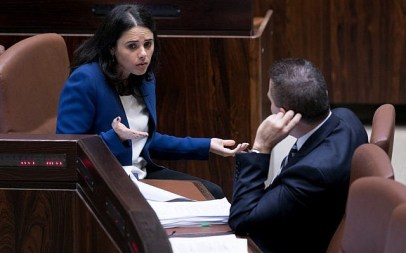
Justice Minister Ayelet Shaked has also threatened legal action against Twitter over the social media giant’s alleged refusal to crack down on posts by terror operatives.
Justice Minister Ayelet Shaked, left with Public Security Minister Gilad Erdan during a plenum session in the Knesset, Jerusalem, on November 16, 2016. (Yonatan Sindel/Flash90)
The blocking of the Hezbollah accounts also came a day after the terror group released new footage on social media from the 2006 border attack on Israeli soldiers that sparked the Second Lebanon War.
The footage uploaded to a Twitter account associated with the terror group appears to show the moments after Hezbollah operatives shot and killed Israeli troops patrolling along the border with Lebanon.
The grainy video clip shows an Israel Defense Forces Humvee following the attack that killed three soldiers in July 2006.
Two bodies appear to be lying to the vehicle’s right as Hezbollah men are seen running away from the car. A bomb then goes off inside the vehicle.
The video then goes on to show footage that appears to depict the terrorists fleeing the scene of the attack, both on foot and by car.
It was not immediately clear what prompted the video’s release.
Hezbollah has broadcast footage from the attack in the past.
In 2016 al-Mayadeen, a television channel affiliated with the Shiite organization, aired a three-episode documentary series commemorating the war’s 10-year anniversary. It included footage of Hezbollah fighters training for the attack.
Hezbollah also released videos in 2007 and 2012, including footage from the attack and audio from the IDF’s communications that day. The video released in 2012 included the part of the raid in which Hezbollah fighters opened fire on the IDF Humvee and crossed the border into Israeli territory. The clip ended right as the Hezbollah commandos reach the ruined vehicle.
The attack and subsequent abduction of the bodies of soldiers Ehud Goldwasser and Eldad Regev led to hostilities that developed into the Second Lebanon War.
The 34-day war, which saw thousands of Hezbollah rockets pummeling northern towns, claimed the lives of 165 Israelis, including 44 civilians. Over 1,100 Lebanese, including both Hezbollah fighters and civilians, were killed.
Dr. Charles Krauthammer, perhaps the most luminous and incisive columnist of this generation, had announced two weeks ago that he was stricken with terminal cancer and had only weeks to live. He passed away Thursday. I feel an obligation to pay homage to this incredible man, and to add a Jewish, Zionist and personal angle to the many tributes to him that have rightly poured forth.
For 38 years, Krauthammer’s columns, essays and lectures have stood as pillars of conservative principle and moral clarity. On foreign policy matters, he was unquestionably the most radiant intellectual hawk in America, and on Middle East affairs he was the most consistent defender of Israel and the U.S.-Israel special relationship.
Two examples of his razor-sharp writing regarding Israel and American Middle East policy will suffice, among hundreds of exhibits.
Krauthammer wrote in a 2014 op-ed in The Washington Post about “Kafkaesque ethical inversions” that make for Western criticism of Israel. The world’s treatment of Israel is Orwellian, he wrote, “fueled by a mix of classic anti-Semitism, near-total historical ignorance and reflexive sympathy for the ostensible Third World underdog.”
He understood that eruptions featuring Palestinian casualties (such as recent Hamas assaults on the Gaza border) were “depravity.”
The goal, according to Krauthammer, is to produce dead Palestinians for international television: “To deliberately wage war so that your own people can be telegenically killed is indeed moral and tactical insanity.” But it rests on a very rational premise. “The whole point is to draw Israeli counterfire,” to produce dead Palestinians for international television, and to ultimately undermine support for Israel’s legitimacy and right to self-defense.
In 2015, again in The Washington Post, he repeatedly skewered President Obama’s nuclear deal with Iran, calling it “the worst agreement in U.S. diplomatic history.” To Obama, he wrote accusingly: “You set out to prevent proliferation and you trigger it. You set out to prevent an Iranian nuclear capability and you legitimize it. You set out to constrain the world’s greatest exporter of terror threatening every one of our allies in the Middle East and you’re on the verge of making it the region’s economic and military hegemon.”
Krauthammer’s profound understanding of Jewish history, his admiration for Israel, and his very deep concern for its future were on fullest display in a masterful essay he published in The Weekly Standard in 1998 entitled “At Last, Zion.” The essay contained a sweeping analysis of Jewish peoplehood, from Temple times and over 2,000 years of Diaspora history to the modern return to Zion.
Krauthammer understood that American Jewry was dying. “Nothing will revive the Jewish communities of Eastern Europe and the Islamic world. And nothing will stop the rapid decline by assimilation of Western Jewry.” The dynamics of assimilation were inexorable in America and elsewhere, he wrote.
Israel, Krauthammer understood, was different. “Exceptional,” he called it – because Israel was about “reattachment of Russian and Romanian, Uzbeki and Iraqi, Algerian and Argentinean Jews to a distinctively Hebraic culture,” and this gave it civilizational and societal staying power for the long term.
“The return to Zion is now the principal drama of Jewish history,” he wrote. “What began as an experiment has become the very heart of the Jewish people – its cultural, spiritual, and psychological center, soon to become its demographic center as well. Israel is the hinge. Upon it rest the hopes – the only hope – for Jewish continuity and survival.”
However, because “soon and inevitably the cosmology of the Jewish people will have been transformed again, turned into a single-star system with a dwindling Diaspora orbiting around,” Krauthammer was apprehensive. “The terrible irony is that in solving the problem of powerlessness, the Jews have necessarily put all their eggs in one basket, a small basket hard by the waters of the Mediterranean. And on its fate hinges everything Jewish,” he wrote.
Israel’s centrality, he feared, was a “bold and dangerous new strategy for Jewish survival” because of the many security threats posed to the country, chiefly among them the specter of Iranian nuclear weapons.
Indeed, Krauthammer’s essay thinks the unthinkable and contemplates Israel’s disappearance. And while Jewish political independence has been extinguished twice before and bounced back following centuries of dispersion, Krauthammer doubted that the Jewish People could pull the trick again. “Only the Jews defied the norm. Twice. But never, I fear, again.”
I challenged Krauthammer about his pessimistic perspective on the survival of Israel and the Jewish People at a Tikvah Fund seminar in 2016, where he engaged the Fund’s erudite chairman, Roger Hertog, in the deepest of conversations on strategy and identity.
In this lengthy conversation (which you can watch and read online here), Krauthammer admitted to “trembling doubt” about God alongside belief in some transcendence in the universe, and then he repeated his sobering solicitudes about Israel’s precariousness. He spoke of the impossibility of a fourth Jewish commonwealth – were Israel, transcendence forbid, to be crushed.
I gently reproached Krauthammer on theological terms, by saying that “those of us who moved to Israel out of a grand meta-historic sense of drama believe that our third Jewish commonwealth won’t fail. Whatever it takes, we’ll make it work.”
I sensed that Krauthammer was glad for my emotive intervention, since he immediately and poignantly responded (in Hebrew): “Netzach Yisrael lo yishaker” (the eternity of Israel will not lie, or fail).
Krauthammer continued: “That’s what my father used to say when he talked about Israel. I feel as an obligation to make sure of that throughout my life, I did what I could, because that prospect would be, would make everything I’ve done lose its value. There’s nothing more important than that.”
And then referencing my aliyah, Krauthammer said, “I honor your choice. … I commend you for that.” He went on to describe how he too considered moving to Israel after college, at the urging of his then-philosophy professor David Hartman.
And then Krauthammer asked me: “I wonder what it’s like, and maybe you could tell me, to be an Israeli putting your kids on your bus, not for terrorism reasons, but just going to school and raising them, knowing, what will it be like if and when Iran has the bomb? … It’s the existence of the Iranian bomb, knowing that it’s out of your hands. The whole point of Israel is to put it back in the hands of the Jews, back where it was in 68 A.D., that was the point. Assuming Israel’s deterrence works and all that, once that happens, once it’s in the hands of genocidists, then what does that feel like? Do you think there might be emigration as a result? Do you have a feeling about that?”
I answered: “My personal sense is that Israeli society is becoming more traditional, more deeply rooted, more ideological than before. I’m talking about secular Israeli society, digging in for the long term and not being frightened away despite the shadow that you’re talking about.”
And Krauthammer responded to me, again in Hebrew: “As you people say, ‘kol hakavod.'” (“Bravo.”)
So now it’s time for me to return the compliment, and say to Dr. Charles Krauthammer: Kol hakavod to you! On behalf of so many Jews, Americans and Israelis alike, thank you for your resilience, brilliance and steadfast support. We miss you already.
David M. Weinberg is vice president of the Jerusalem Institute for Strategic Studies, jiss.org.il. His personal website is davidmweinberg.com.
Military is collaborating with several defense contractors in a bid to devise measures to counter the growing threat posed by incendiary kites and balloons • IDF braces for border riots as terrorist groups warn strikes on Gaza will prompt rocket fire on Israel.
Nikki Guttman, Daniel Siryoti and Israel Hayom Staff
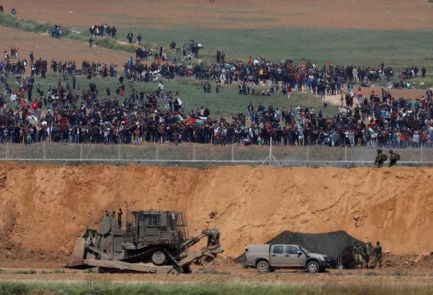
A Hamas demonstration on the Gaza-Israel border
|Photo: PA
Tensions on the Israel-Gaza Strip border ran high Friday, in the wake of Wednesday’s rocket salvo on southern Israel and ahead of yet another Hamas-orchestrated demonstration on the security fence.
Hamas officials urged Gazans to amass at the fence in honor of those killed and wounded in the border riots campaign since it was launched on March 30. Organizers said they plan to hold memorials for the 120 Palestinians killed near the security fence over the past three months.
The Israeli military deployed additional troops near the border, including special forces, snipers and sappers and, for the first time, it plans to use cutting-edge lasers and sensors to combat the kite terrorism that has been wreaking havoc on the Gaza-vicinity communities for weeks.
The new sensors are designed to spot particularly small targets like incendiary kites and balloon, which usually evade the radar systems deployed in the area.
Once a sensor identifies a flaming object, military drones will be launched to intercept it.
The IDF’s Southern Command and GOC Army Headquarters are collaborating with several defense contractors in their effort to devise a solution for kite terrorism.
Palestinian arson terrorism continued to rage Thursday, as 20 fires erupted as a result of incendiary kites and balloons sent over the border.
Authorities say that over 8,000 acres of forest and agricultural land on the Israeli side of the border have been reduced to ash over the past six weeks, causing tens of millions of shekels in damage.
With incendiary kites and balloons posing a growing threat to the safety and livelihoods of residents in Israeli communities near the border, as well as to local wildlife and vegetation, there has been a growing demand from the residents for the IDF to intensify its response against terrorist kite cells.
While some politicians and defense officials have advocated surgical strikes against such cells – a policy the IDF employs against terrorists firing rockets at Israel – the military has cautioned that targeting kite flyers, most of whom are teenagers, would lead to a rapid security escalation opposite the Gaza Strip that, in turn, is likely to lead to a full-fledged military campaign.
Also on Thursday, the Katif Center in the border-adjacent community of Nitzan dedicated an electronic memorial commemorating soldiers and civilians killed in the area.
Deputy Defense Minister Eliyahu Ben-Dahan (Habayit Hayehudi) spoke at the ceremony, saying that the tensions on the border prove that the 2005 disengagement from Gaza was a mistake.
”Anyone in their right mind that looks at what is happening now can see that we made a foolish mistake. We may have thought we were promoting a new Middle East, but today we see exactly how untrue that assumption was.”
Yesh Atid leader Yair Lapid visited the Gaza-vicinity communities Thursday and said, “It’s not just the fields that are burning here, it’s Israeli deterrence. Hamas has to be made to pay a price.”
Hamas and Islamic Jihad leaders, for their part, warned Thursday that any Israeli strike on the coastal enclave will be met with rocket fire on Israel.
( Pink Floyd is my favorite band of all time. Gilmore’s music has never been surpassed, and Waters lyrics stand with the best. Great artists can and have been horrible antisemites; take Wagner or Straus as examples. FUCK ROGER WATERS !! – JW )
During his show, Roger Waters accuses Israel of being anti-Semitic, but denies his own anti-Semitism • He screens a cartoon of Trump giving a Nazi salute and goes after Mark Zuckerberg • But ultimately, Israel’s number one enemy is shallow and stupid.
Adi Rubinstein
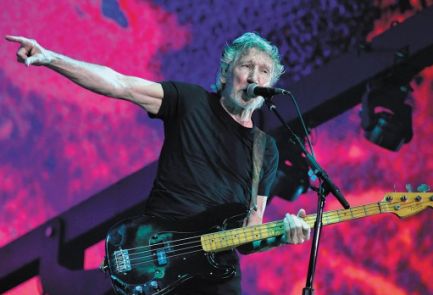
Roger Waters performs in Cologne last week
|Photo: AFP
For a long time, I debated whether or not I should buy a ticket to a Roger Waters concert. It wasn’t the exorbitant price (€164) that gave me pause, nor was it the veteran musician’s waning musical enthusiasm (evident in his last album, riddled with banality). The conflict I felt in regard to this concert was far deeper and more existential than that.
The tour, which began in December, has been dubbed the “Us + Them” tour, named after the 1973 Pink Floyd hit “Us and Them.” To me, the name perfectly describes the reality surrounding Roger Waters. Over the last 10 years, he has positioned himself at the forefront of the vicious attacks on Israel’s right to exist. He is the number one enemy of our foreign policy. So why should I go to his concert if I am obviously not welcome?
But curiosity got the better of me. I wanted to see whether Waters the artist was a different man than Waters the BDS activist. I wanted to see whether his act was faithful to art or to a narrow political stance. I wanted to solve the riddle of the musician who performed in an Israeli chickpea field in Neve Shalom in the summer of 2006, and hasn’t stopped maligning Israel since. That is how I found myself in Cologne, Germany, last Monday, watching Waters and his band take the stage at a local arena.
Despite the prohibitive ticket cost, the 20,000 seats in the venue filled up long before the start of the show. The average age in the audience hovered around 50 – a crowd of white, conservative, local concertgoers, loyal to the artist. Here and there, young faces could be seen, coming to listen to the timeless Pink Floyd classics that were about to be heard.
Waters’ set list comprised mainly Pink Floyd songs, interspersed with songs from his less successful solo career. The show itself was divided into two parts, with the 75-year-old frontman taking a much-needed rest in between. Waters moved across the stage heavily and did not sing very much. The excellent band around him did most of the work. It was evident from the first note that music was not the reason Waters was on stage.
So why was he there? Simply, to deliver the political messages, rife with hatred and incitement, that he had prepared. Most of them, incidentally, were badly formulated, somewhere between those of an overzealous but ignorant high-schooler and a shameless online comment.
Visually, the concert was outdated and detached from today’s standards. Whether it was the overuse of laser lights, which have long gone out of style, or the 1980s videos flashing on the screen, the set reflected the fact that Waters is past his prime and that his performance was mainly nostalgic.
In the first part of the show, Waters and the band cranked out one Pink Floyd hit after another. “Wish You Were Here” and “The Great Gig in the Sky” were enough to satisfy the sleepy audience. Waters, dressed in black and hunched, waved his hands a lot and paced the stage.
When he performed “The Last Refugee,” a song featured on his latest solo album, I was reminded of a post that had appeared on the concert tour’s Facebook page, written by a Syrian refugee living in Cologne.
“You sing a lot of songs about refugees and you talk about their plight,” the post said. “But you don’t offer reduced price tickets to refugees. We tried to contact the tour organizers, but we received no response.”
The last two songs in the first set were the two parts of perhaps the most well-known Pink Floyd song, “Another Brick in the Wall.” Local schoolchildren acted out a revised version of the schoolchildren in the famous video, and took the stage in orange jumpsuits and black hoods, like the victims of the Islamic State terrorist group, to stand alongside Waters. Just as the children were about to be “decapitated,” they removed their hoods, to the famous lyrics of “we don’t need no education.”
The children, most of them about 10 years old, continued to march in their orange jumpsuits. It was the first of many provocations in the show, but perhaps the least stupid one. At the end of the song, Waters thanked the children and explained that they had barely had time to rehearse.
“Be proud of your children,” he yelled into the microphone, and the German crowd applauded.
Then he took a break.
During the intermission, instructions shot from the screen. The word “resist” appeared a number of times. At first, the audience, who had only come to see a rock show, was told to resist anti-Semitism in general. Then we were told to resist Israeli anti-Semitism.
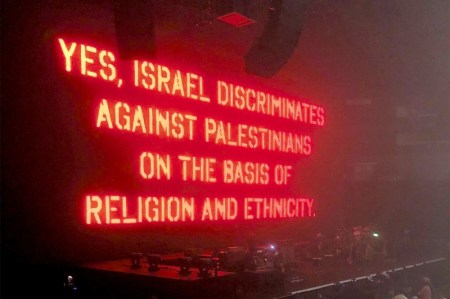
My blood slowly began to boil. The next message sent my nerves into overdrive: “Yes, Israel discriminates against Palestinians on the basis of religion and ethnicity.”
The stage at a Roger Waters concert last week
Waters then set his sights on the United States and another of his archenemies, Facebook founder Mark Zuckerberg. Absurdly, Waters ignores Facebook’s enormous contribution in spreading his anti-Israel message around the world. For him, opposition is automatic, not rational. He is a knee-jerk responder.
The concertgoers around me were not fazed by the messages. Some said they had only come for the music, but others appeared to have absorbed Waters’ incitement, even if just a little.
Waters was a year old when his father was killed while serving in the British army in World War II. His father’s death appears to have left quite a few scars and anxiety, bordering on paranoia. In the past, Waters has dismissed allegations of anti-Semitism with the argument that his father fought to defend the Jews – a narrow and self-serving view of reality.
Judging by his show, the current reawakening of evil in Germany and the re-emergence of racism and nationalist sentiments don’t seem to bother Waters. He showered the German audience with praise and compliments. When talking about Israel’s misdeeds, he failed to mention the 20,000 Cologne Jews who were murdered in the Holocaust.
But why complain? The profit from the concert was coming from the Germans, and Waters knows how to behave accordingly. The same was true when he performed in front of an Israeli audience 12 years ago, and enjoyed the profits generated by Israeli ticket sales and the perks provided by the Israeli concert promoter. The same promoter whom Waters now calls a supporter of apartheid.
Anyone who supports or stands by Israel becomes a target for Waters. It was only a matter of time before U.S. President Donald Trump was incorporated into his show. A giant pig flew over the crowd and compromising images of the American president in all sorts of embarrassing positions appeared on stage. In the most offensive picture featured a cartoon of Trump giving the Nazi salute. The screens said “TRUMP IS A Schwein” in a strange combination of English and German, using the German word for pig, and the audience’s automatic response was to cheer.
Mimicking Pink Floyd performances, which featured images of world leaders, the Waters show included the images of Israeli Prime Minister Benjamin Netanyahu alongside Trump, as well as German Chancellor Angela Merkel, in an effort to incite. The German audience booed the world leaders, or perhaps it was Waters they were booing.
The second part of the show also included a few songs (yes, there were songs there somewhere). Waters played “Brain Damage” and “Money,” but the atmosphere of resistance was artificial, forced. A bourgeois provocation dripping with hate.
In a step that broke his own record of ridiculousness, Waters tied himself in chains and hung in the middle of the stage, just before the encore. It was a sad and grotesque thing to see – an aging musician screaming and grunting while tied up in chains. I almost forgot that this man was a revered artist worth nearly 300 million dollars. It was very hard to believe him when he declared that he feels chained in a terrible world.
But just as I thought that I had witnessed the biggest rock farce in history, a bigger farce began with the encore. Before he began playing “Comfortably Numb,” which he co-wrote with Pink Floyd member David Gilmour, Waters screened a few clips from a bombarded Gaza Strip. Wrapping up the hour and 45 minute long lesson he had given us, Waters began his closing argument: “I want to tell you about something absurd that happened,” he said. “As you know, my tour was sponsored by a number of German radio stations, but here, in Cologne, the local radio station refused to sponsor the show. You want to know why? Because of a women named Malca Goldstein-Wolf. She sent a letter to the local radio station and to other German bodies claiming that I’m an anti-Semite and a Jew hater.”
The audience began to laugh uneasily. “Me? A Jew hater? I’m an anti-Semite? Look at my entire career and you’ll see that there is nothing about me to suggest that I hate Jews. On the contrary. I say that we were all born equal and that all living things are equal. Why should the Israeli animal be worth more than the Palestinian animal? Does that make me anti-Semitic? Does that make me a Jew hater? You tell me. What do you think?”
The crowd erupted into bursts of applause, but most of the people around me looked at each other sheepishly. Waters did not let up, and transitioned into mudslinging: “People like Malca Goldstein-Wolf are trying to ruin my career. But I’m a fighter. It’s not an easy fight, it is constant, but I am fighting with all my strength.”
Waters ended his preposterous speech with a call for civil responsibility, urging the concertgoers to pressure their leaders not to bomb civilian populations. The needle of the cliché meter was already off the charts, threatening to explode. But before the crowd dispersed, thousands of confetti flakes dropped from the sky, with the word “RESIST” written on them. On the screens, Mark Zuckerberg’s face emerged. Waters selected Zuckerberg as his last target for incitement, muttering something about Zuckerberg controlling the world (wait, Zuckerberg is Jewish, isn’t he?) and complaining about how Facebook blocks many of Waters’ hate-filled posts.
Beyond the musical disappointment – the music was sterile like a pharmacy or an operating room. It lacked the grit that characterized Waters’ original lineup – it was amazing to discover how shallow and superficial Waters’ political message was, and how much of it is born of ignorance and prejudice. He calls on everyone to resist everyone else but doesn’t explain why.
It is hard to understand how artists around the world are still able to take Waters seriously. It is even harder to understand how there are still Israelis who choose to support and disseminate his message. It is one thing to talk about the occupation – allegations of discrimination and racism can be discussed – but the agenda in Waters’ show was fueled by pure anti-Semitism, so there is nothing to discuss. It was a flood of fast, emotional hatred, the kind that would have resonated in 1930s Germany.
Coming out of the concert, observing the reactions of the aging German crowd, it was apparent that Waters still retains his status as a musical authority. But I doubt the show changed anyone’s political views.
But still, there is damage to be done, and, as always, Waters’ victims are the Israeli concert promoters. The summer of 2018 in Israel is expected to be disappointing in terms of international acts, certainly compared to the level we have become accustomed to in the years following Operation Protective Edge (in 2014). Famous artists around the world, like Sting, who already performed in Israel more than once, and Florence and the Machine, have announced that they would not perform in Israel, under pressure from Waters and the BDS movement. According to Israeli promoters, many of these artists are using Waters as a pretext to avoid concerts that would ultimately prove unprofitable, considering the logistics involved in performing here.
Either way, Waters never tires of inciting. Two days after his Cologne concert, he performed in Munich, where he continued to pontificate about Syria, Gaza and Mark Zuckerberg.
It is important to note that at the same time as Waters’ Germany concerts, a host of more successful musicians gave performances across the country to audiences peppered with Israelis. At a Foo Fighters concert in Hamburg, for example, frontman Dave Grohl spotted a fan holding an Israeli flag and quickly raised his glass with a “l’chaim” (cheers) in Hebrew. Iron Maiden frontman Bruce Dickinson performed in Berlin, at the Waldbuehne, where the Nazi party first convened, and said, “In the place where we are standing now, once stood a man with a Charlie Chaplin mustache who walked funny and wanted to take freedom away from people.” The German audience strongly identified with the sentiment and roared in contempt.
Waters, therefore, is a fringe phenomenon. But he manages to exert a degree of influence on his captive audience and on certain artists. I struggled with whether or not to report on this hate concert, given the superficiality of his arguments, but ultimately, I decided to do it. I needed to expose the bluff. The main takeaway from the concert in Cologne was this: Anyone who takes this man seriously, or believes him, is no less stupid than Waters himself.
Syria’s moves in the southwest this week followed Russia’s failure to persuade Israel to stand aside and allow Assad’s army to take charge of the Quneitra and Daraa regions on the Israeli and Jordanian borders.
Moscow hoped that the Syrian rebel forces defending the two areas would lay down their arms and go over to Bashar Assad’s army. DEBKAfile’s military sources report that the Netanyahu government spurned Russia’s plan – not least for lack of trust, suspecting that the Syrians would cheat and let Hizballah reach its border.
Last month, an attempt was made to trick Israel, after its consent to a previous Russian plan to hand the Beit Jinn enclave on Mt Hermon to Syria, by providing Hizballah troops with Syrian Army 4th Division uniforms.
The same deception is being practiced at present in the southwest regions of Daraa and Quneitra. Russian and Syrian propaganda machines claim that Hizballah and pro-Iranian Shiite militiamen are being withdrawn from the Israeli and Jordanian borderlands, when in fact they are not moving after being disguised in Syrian army uniforms. The Russians don’t mention an Iranian withdrawal because Moscow pretends they don’t exist, when in fact an Iranian command center is fully operational in that part of Syria.
The statements coming from the Russian ambassador to Beirut, Alexander Zasypkin, to Hizballah medium outlets add to the perplexity in Jerusalem about Moscow’s intentions in Syria. He declared a few days ago: “We say that the Syrian army now, with support from Russian forces, is recovering its land in the south and restoring the authority of the Syrian state.”
Jerusalem tried to find out what is really going on, according to our intelligence sources. Does the Russian ambassador include Hizballah troops disguised as Syrian soldiers and officers in his comment? No answer came from Moscow.
The Netanyahu government and the Trump administration are keeping close watch on events in southern Syria in close interaction, because the Russians are trying to sell the same sort of deal to the US as they did to Israel.
While Israel was being lobbied to drop its support for the Syrian rebel groups holding Quneitra, the Russians seek US consent to ditch the rebel Syrian Free Army holding Daraa on the Jordanian border. This concession would produce a chain reaction, forcing the US to abandon its key outpost at Al Tanf at the border junction between Syria, Jordan and Iraq.
In response to Russia’s machinations and trickery, the Trump administration on Thursday, June 21, sternly warned Moscow and Damascus that Syrian military movements in the southwest would have “serious repercussions,” because they violate the Trump-Putin accord reached in Hamburg in July 2017 to set up deescalation zones in the Daraa and Quneitra regions.
DEBKAfile’s military sources report that the US warning and Israel’s repudiation of the Russian deal have had the initial effect of holding back the Syrian army’s advance on the two sensitive border regions. Syrian forces are shelling rebel-held areas and on Friday, sent two or three helicopters over to drop bombs, but are otherwise stationary. However, more than half of Assad’s fighting strength is poised in the southwest ready for a general offensive, which he has promised, to take the area and may launch at any moment. It is hard to tell how Israel and the US will react.
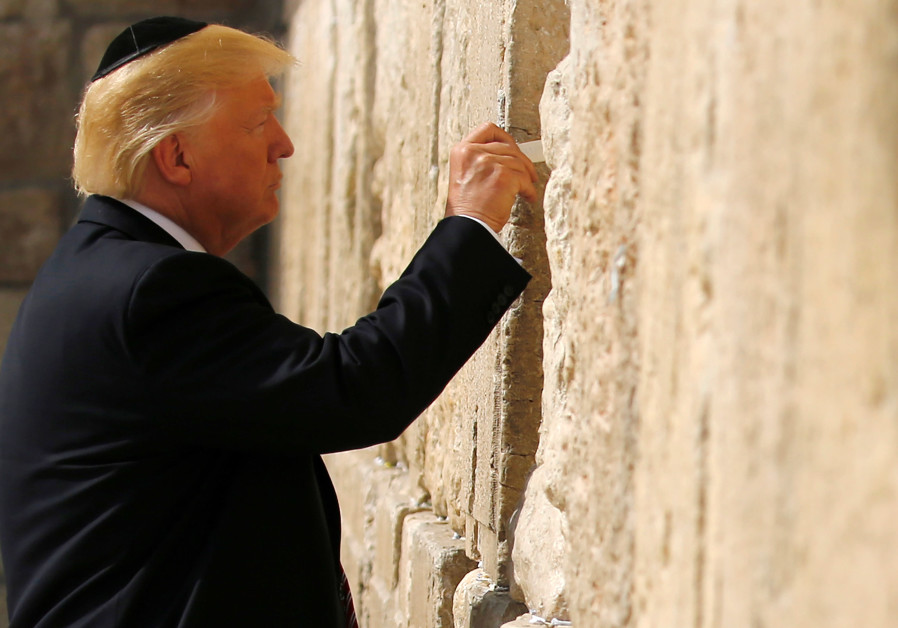
US President Donald Trump leaves a note at the Western Wall, Judaism’s holiest prayer site, in Jerusalem’s Old City May 22, 2017. (photo credit: RONEN ZVULUN / REUTERS)
A Google search of the terms “Trump Nazi,” brings up 70,900,000 results.
There are a number of distressing aspects to this state of affairs. First and foremost, it is pure libel to call US President Donald Trump a Nazi.
His daughter Ivanka is Jewish. His daughter-in-law is Jewish. Half his grandchildren are Jewish and his non-Jewish ex-daughter-in-law is half Jewish. How many Nazis have Hanukka celebrations in their homes starring their Jewish grandchildren?
Beyond his Jewish immediate family, Trump has shown extraordinary friendship to the Jewish state. It isn’t simply that Trump kept the promise none if his predecessors kept and moved the US Embassy to Jerusalem, although that would have sufficed to prove his friendship.
Trump shows his friendship and respect for Israel every single day.
Last week he agreed to sell Israel mid-air refueling planes. His predecessor, Barack Obama, refused to sell Israel the aircraft in order to protect Iran’s nuclear sites from Israeli air strikes. Trump agreed to sell them to enable such Israeli strikes in the event they become necessary.
This week, Trump approved UN Ambassador Nikki Haley and Secretary of State Mike Pompeo’s determination that the US should withdraw from the institutionally antisemitic UN Human Rights Council. The Obama administration joined the council claiming it would use its membership to influence the council for the better and proceeded to legitimize council’s anti-Jewish witch hunt for eight years.
The people of Israel recognize Trump’s friendship. Nearly 80% of Israelis view him as a friend. So what explains the 70,900,000 results to the “Trump Nazi” Google search?
One answer came this week with the media outcry over the US government policy of separating illegal immigrant minors from their illegal immigrant parents.
The policy is cruel. Indeed, recognizing its cruelty, Trump signed an executive order banning the practice.
But the policy isn’t new. This was the Obama administration’s policy following a court order prohibiting children from joining their parents in detention.
Rather than soberly acknowledge that law enforcement, including immigration law is often a cruel business and recognize that to remain a state of laws sometimes authorities undertake difficult and harsh actions, the anti-Trump media ignored reality and went straight for the kill. David Remnick, Frank Bruni and countless others didn’t care that the Obama administration separated children from their parents, placed them in cages and wrapped them in aluminum foil.
As far as they are concerned, the continuation of the same cruel policy under Trump is proof that Trump is a Nazi.
Gen. Michael Hayden, the former director of the NSA and the CIA posted a photo of the entrance to Auschwitz on his Twitter feed with a caption “Other governments have separated mothers and children.”
As much as Hayden and his comrades hate Trump, by claiming that enforcing laws of Congress is Nazi behavior, they are demonizing the US and engaging in rank antisemitism. Mexican children separated from their parents because they broke properly constituted laws of a liberal republic are not the moral equivalent of the million Jewish children murdered by the Nazis for the “crime” of breathing while Jewish. Congress is not the Reichstag. And the Rio Grande is not Auschwitz.
Hayden and his comrades are not idiots. So why are they making these unhinged, libelous claims? The answer is that their actions are part of a wider move by Democrats to politicize antisemitism.
Much has been made of the fact that support for Israel is becoming a partisan issue. Whereas Republicans are almost unanimous in support for the US alliance with Israel, support among Democrats is flagging and becoming a minority view on the rapidly growing far Left.
What has gone largely unmentioned is that antisemitism is also becoming a partisan issue. As their party becomes more hostile to Israel, Democrats are increasingly highlighting the neo-Nazi elements at the fringe of the Republican Party as a means of implicating the entire Republican Party – led by Trump – as antisemitic and dangerous.
At the same time, even as leading members of the Democratic Party like Keith Ellison and luminaries like Linda Sarsour openly espouse anti-Jewish sentiments and propagate antisemitic conspiracy theories, Democrats ignore, whitewash, deny and minimize the significance of the swelling chorus of antisemitism within their ranks.
Compare the responses of Democrats and Republicans to the appearance of antisemites on their ballots.
In the current election cycle, three white supremacists have sought office as Republican candidates. Arthur Jones, a 70-year-old white supremacist Nazi, running for Congress in Illinois’s 3rd Congressional district ran a stealth campaign for the safe Democratic seat. He quietly collected the requisite signatures to file his papers with the state election commission, blindsiding the GOP, which had not planned to field a candidate to run against incumbent Dan Lipinski who has won the last seven elections by a 70-30 margin.
In response to Jones’s maneuver, the state and national GOP condemned and disavowed him in the harshest terms. The state party announced it would field an independent candidate to run in the general election against Jones and Lipinski.
Then there is Patrick Little. Little, another Nazi, ran in California’s open primary for Senate as a Republican. Ten other Republicans also ran. In one poll, which included Little and one other Republican candidate only, he was the top ranked Republican candidate in the open Senate race against Democratic incumbent Diane Feinstein.
Rather than acknowledge the poll’s statistical insignificance, the Forward, Newsweek and Yahoo news ran stories about Little and the poll claiming that it proved that empowered by Trump, Nazis are taking over the Republican Party. The fact that the California GOP forcibly removed Little from their state convention was barely reported in the national media.
Paul Nehlen, a Democratic candidate for Congress in House Speaker Paul Ryan’s district was supported by many conservatives until last December when it came out that he is a white supremacist. As soon as his positions – which he had deliberately hidden – were revealed, every major and minor conservative media outlet and politician condemned him.
But that hasn’t stopped CNN from waging a campaign against Virginia Republican Senate nominee Corey Stewart for having endorsed Nehlen a month before his positions were publicized. Stewart unconditionally condemned Nehlen once his anti-Jewish bigotry was exposed.
In the Democratic tent itself, things are a bit different.
Rising stars in the Democratic Party, including Rep. Ellison and Women’s March leaders Tamika Mallory and Linda Sarsour along with the Congressional Black Caucus embrace Louis Farrakhan, and defend his notorious, virulent hatred of Jews. They demonize Israel and its Jewish supporters.
Far from being attacked or otherwise denounced for their actions, these Democrats are advanced and promoted. Ellison is the vice-chairman of the Democratic National Committee. Mallory and Sarsour, Maxine Waters and other members of the CBC are feted by party leaders including Senators Bernie Sanders and Elizabeth Warren.
Democratic Jews have to date refused to mobilize to oppose them in any significant way. Indeed, in some cases they support antisemites.
Take the Jewish community of Charlottesville, Virginia’s reaction to the Congressional candidacy of Democrat Leslie Cockburn. Cockburn is the co-author, with her husband, Andrew Cockburn, of the 1991 book, Dangerous Liaison: The Inside Story of the US-Israeli Covert Relationship.
The New York Times review of the book said, “Their book, supposedly a history of the secret ties between Israel and the United States, is largely dedicated to Israel-bashing for its own sake. Its first message is that win or lose, smart or dumb, right or wrong, suave or boorish, Israelis are a menace. The second is that the Israeli-American connection is somewhere behind just about everything that ails us.”
Rather than excoriate Cockburn for her history of propagating antisemitic conspiracy theories, the Washington Jewish Week wrote an empathetic article about her quest to have an open exchange with the Jewish community in her district. One member of the Jewish community who was prominently cited as an authority on her outreach to the community, noted approvingly that in a meeting with Jewish constituents Cockburn “pointed out that her views on Israel align with J Street.”
New York Times reporter and author Jonathan Weisman epitomizes the Democrats’ simultaneous promotion of leftist antisemitism and castigation of the Republicans as the new Nazi party. During the 2015 battle over the Obama administration’s nuclear deal with Iran, Weisman, who is Jewish, co-authored an article singling out by name the Jewish members of Congress who opposed the deal. In other words, he engaged in antisemitism to demonize Jewish opponents of the Obama administration’s anti-Israel policy of empowering Iran.
In 2017 Weisman wrote a widely cited book, (((Semitism))): Being Jewish in America in the Age of Trump.
Weisman’s basic argument in his book is that Trump’s populism empowers far-Right antisemites and so threatens the Jewish community in the US.
It isn’t that antisemitism on the far Right is nothing to be concerned about it. To the contrary. There is great reason to be concerned, even alarmed by the Jew-hating rhetoric emanating from the far Right. To their credit, cognizant of the danger, Republican leaders, including Trump have consistently condemned and marginalized these voices and actors in their party.
There is also reason to be concerned with left-wing antisemitism, including when it takes the form of a New York Times journalist singling out for rebuke Jewish members of Congress who oppose an anti-Israel policy. Left-wing antisemitism should be should be fought without prejudice even when it is being propagated by minority groups. Farrakhan should not get a pass, nor should his African-American supporters.
Because the US has a two-party system, marginal forces always seek to use the machinery of the large parties to advance their positions and causes. As a consequence, it is not surprising that antisemites on the Right seek to penetrate the GOP. And it isn’t surprising that their leftist counterparts are seeking to take over the Democratic Party. But again, while the state and national Republican Party condemns and disowns antisemites, the Democrats woo them for their votes and political support and elect them to office. And as they do these things, they libel the Republican Party and Trump accusing them of Nazi sympathies and goals.
It is hard to see a happy end to the story. By attacking Trump, the most pro-Jewish president in living memory, as a Nazi, while ignoring the dangers of the growing power and numbers of antisemites in their own party, Jewish Democrats are doing themselves no favors. So long as Jewish Democrats go along with the rise of antisemitic forces in their party on the one hand, and assault the Republicans as Nazis on the other, the situation will only get more dangerous for them and for the Jewish community in the US as a whole.
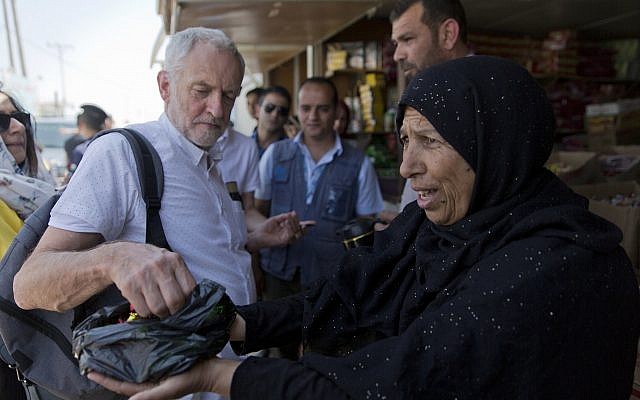
United Kingdom’s Labour party leader Jeremy Corbyn walks in the main market road during his visit to the Zaatari Syrian Refugee Camp, in Mafraq, Jordan, Friday, June 22, 2018. Arabic in background reads “Hamoudah restaurant, Arabic Falafel.” (AP Photo/Nasser Nasser)
ZAATARI REFUGEE CAMP, Jordan — British opposition leader Jeremy Corbyn said Friday that a government under his leadership would recognize a Palestinian state “very early on” and push hard for a political solution to the Syrian civil war.
Corbyn spoke during his first international trip outside Europe since he was elected Labour Party leader in 2015.
On Friday, he toured Zaatari, Jordan’s largest camp for Syrian refugees. On Saturday, he is to visit a decades-old camp for Palestinians uprooted during Arab-Israeli wars.
In Zaatari, he walked through the camp market, lined by hundreds of stalls, where he sampled falafel and chatted with a sweets vendor who told him his dream is to return to Syria as soon as possible. Corbyn also inspected a sprawling solar power installation that provides about 12 hours a day of electricity to the camp’s 80,000 residents.
Labour under Corbyn gained parliament seats, but narrowly lost to Prime Minister Theresa May’s Conservative Party in 2017 snap elections.
Opinion polling suggests the two parties are neck and neck. Britain is not scheduled to have another election until 2022, but there could be an early vote if May’s fragile minority government suffers a major defeat in Parliament.
With his visit to Jordan, Corbyn appeared to be burnishing his foreign policy credentials.
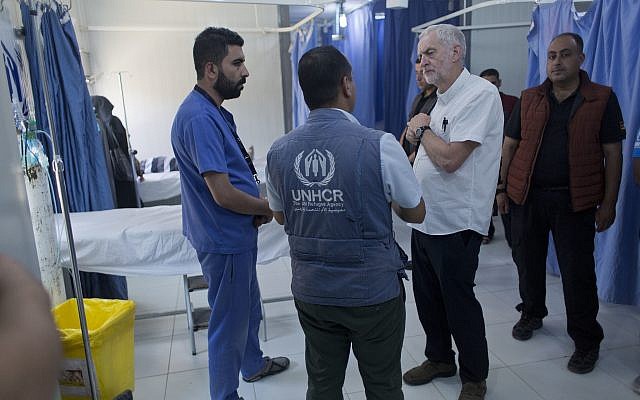
United Kingdom’s Labour party leader Jeremy Corbyn inspects a primary health care center during his visit to the Zaatari Syrian Refugee Camp, in Mafraq, Jordan, Friday, June 22, 2018. (AP Photo/Nasser Nasser)
Taking questions from reporters in the Zaatari market, he said that a Labour government would “work very, very hard to regenerate the peace process” in Syria. He said two parallel sets of talks about a solution for Syria would need to “come together,” but did not offer specifics.
Without a solution in Syria, “the conflict will continue, more people will die in Syria and many many more will go to refugee camps, either here in Jordan or come to Europe or elsewhere,” he said.
More than 6 million Syrians have fled civil war in their homeland, with a majority finding refuge in neighboring host countries such as Jordan. Hundreds of thousands more have migrated onward to Europe, with Germany taking in the bulk.
Corbyn said Britain could do much more to shelter Syrian refugees, particularly unaccompanied children, arguing that the government’s quota of 20,000 refugees is “very, very small compared to any other European country.”
Regarding the Israeli-Palestinian conflict, Corbyn said the Trump administration’s decision to recognize Jerusalem as Israel’s capital and move the US Embassy there was a “catastrophic mistake.”
The Palestinians seek to establish a state in the West Bank, Gaza and East Jerusalem, lands Israel captured in the 1967 war.
“I think there has to be a recognition of the rights of the Palestinian people to their own state which we as a Labour Party said we would recognize in government as a full state as part of the United Nations,” he said. Such recognition would come “very early on” under a Labour government, he said.
United Kingdom’s Labour party leader Jeremy Corbyn is offered candy by Syrian refugee Sohela Sobeihi, 52 while talking to refugees at the main market road, during his visit to the Zaatari Syrian Refugee Camp, in Mafraq, Jordan, Friday, June 22, 2018. (AP Photo/Nasser Nasser)
Since Corbyn’s election as Labour leader, allegations of anti-Semitism in the party have grown. Some in the party have claimed that Corbyn, a longtime critic of Israel, has allowed abuse to go unchecked.
Asked to respond, Corbyn said Friday that “there is no place whatsoever for anti-Semitism in our society.”
“There has to be a peace process, and there has to be a right of the Palestinian people to live in peace, as well as the right of Israel (to live in peace),” he said.
In April, Israel’s opposition Labor party said it was suspending relations with Corbyn, accusing him of showing hostility to the Jewish community and allowing anti-Semitic statements and actions from his party officials.
Head of the Zionist Union faction Avi Gabbay leads a faction meeting at the Knesset, on January 01, 2018. (Miriam Alster/Flash90)
Labor leader Avi Gabbay sent a letter to Corbyn informing him of the decision. The suspension of ties applies only to Corbyn’s office and not the party as a whole.
“It is my responsibility to acknowledge the hostility that you have shown to the Jewish community and the anti-Semitic statements and actions you have allowed as leader of the Labour Party UK,” Gabbay wrote.
“This is in addition to your very public hatred of the policies of the Government of the State of Israel, many of which regard the security of our citizens and actions of our soldiers — policies where the opposition and coalition in Israel are aligned.”
Corbyn called for Britain to review its arms deals with Israel amid deadly clashes along the Gaza border and slammed the “silence from the international powers.” He also said in April that the UK must investigate the latest “illegal and inhumane” incidents carried out by the Israel Defense Forces there.
He also faced sharp criticism from some of his own lawmakers for attending a Passover event hosted by a Jewish far-left group that has dismissed claims of anti-Semitism in Labour as “faux-outrage” and called for Israel to be “disposed of.”
Corbyn has been criticized in the past for referring to Lebanon’s powerful Shiite terror group Hezbollah as “friends” and urging dialogue with the Hamas Islamist terror group.
In 2016, Corbyn reportedly refused an invitation from Gabbay’s predecessor Isaac Herzog to visit Israel in general and the Yad Vashem Holocaust museum in particular, amid the ongoing anti-Semitism controversy surrounding large numbers of officials and activists affiliated with Labour.
The Iran nuclear deal is in “intensive care” and it’s possible that Tehran will have to withdraw from the pact if an agreement cannot be reached with its European signatories, the country’s deputy FM Abbas Araghchi has warned.
Iran wants to preserve the deal but adjustments need to be made as a result of Washington’s decision to withdraw from the landmark accord, Abbas Araghchi said in an interview to Euronews. The deal has “lost its balance” due to the US withdrawal, he added, so “if Europeans, and other remaining participants of the JCPOA are interested in Iran remaining in the deal, they should compensate [for] the absence of the US, and the re-imposition of US sanctions.”
Tehran has repeatedly stated that it wants to salvage the deal, but has expressed frustration over European proposals for preserving the accord. Ali Akbar Salehi, chief of Iran’s Atomic Energy Organization (AEOI), said on Tuesday that Europe’s proposals to save the deal after the US withdrawal were not acceptable to Tehran. “If it continues like this, all sides will lose,” Salehi said.
The European Union is considering a range of options to help breathe life into the faltering deal. Federica Mogherini, the European Union’s chief diplomat, said in May that the bloc was considering deepening Europe’s economic ties with Iran, shielding banking transactions with Tehran, and maintaining Iranian oil and gas purchases – as well as using EU finance to boost investment in the Middle East country. Like Araghchi, she likened the nuclear deal to “a relative in intensive care.”
But the desire of some European states to widen the scope of the accord has angered Tehran. German Chancellor Angela Merkel and French President Emmanuel Macron have been trying to broaden the terms of the agreement to cover Iran’s ballistic missile program and involvement in regional conflicts. Iran’s Supreme Leader, Ayatollah Ali Khamenei, said in June that “limiting our missile development is a dream that will never come true.”
Tehran has repeatedly warned that the deal’s collapse will prompt it to bolster its uranium-enrichment program. In June, Khamenei ordered the AEOI to prepare the Natanz facility for resuming the enrichment process. The installation is expected to be ready to house 60 enrichment centrifuges in a month, according to Iranian officials. The decision to resume the enrichment process does not violate the 2015 agreement, officially known as the Joint Comprehensive Plan of Action (JCPOA), as the country is allowed to enrich small amounts of uranium for medical and research purposes. However, if the deal collapses, Tehran says it will reopen a second uranium-enrichment facility in Fordow.
In May, President Donald Trump withdrew the United States from the deal. He called the historic accord – which saw Iran curbing its nuclear military program in exchange for the lifting of international sanctions – deeply flawed and demanded a revised deal that would both limit Tehran’s ballistic missile program and its increasing influence in regional affairs.
Most alarming to the U.S. has been Canadian Prime Minister Justin Trudeau’s position on Iran, where the regime seems to want to increase its influence in Canada due to its proximity to the U.S. Trudeau has been enabling this penetration.
The discord between Canada and the U.S. was evident on a series of matters related to the North American Free Trade Agreement, but what went on behind the scenes was far more critical.
As long as leaders in the West who hold such views remain in power, Canada will be on the watchlist of those who oppose the spread of Islamic extremism and theocratic dictatorships. Canada may well be living through its highest-risk moment since World War II.
On June 12, Canadian Prime Minister Justin Trudeau led the Liberal Party in supporting a Conservative Party motion condemning “the current regime in Iran for its ongoing sponsorship of terrorism around the world, including instigating violent attacks on the Gaza border.” It also called for designating the Islamic Revolutionary Guards Corps (IRGC) as a terrorist organization.
Trudeau’s vote marked a sudden, unprecedented U-turn from more than 10 years of his personal and very public support for pro-Islamist causes and Iran, beginning in 2008 when he entered the parliament.
Since Justin Trudeau’s election two and a half years ago, however, the U.S. has grown increasingly worried about the Canadian government in general, and the prime minister in particular. Trudeau has called those who oppose the return of ISIS fighters to Canada “Islamophobic.” He also has said that ISIS fighters can be a “powerful voice for preventing radicalization” in Canada, even though his government does not have a deradicalization program. In addition, the government has yet to appoint a leader for the Canada Centre for Community Engagement and Prevention of Violence.
The approximately 60 ISIS fighters who have returned to Canada roam the country freely. None has been charged or convicted. The government has shown no will to deal with them, not even when one was caught on tape describing how he had executed prisoners. Canada also has stopped sending the names of known ISIS fighters to the UN registry of terrorists, in spite of the fact that some of them are reported to be a chemical-weapons risk.
Most alarming to the U.S., however, has been Trudeau’s position on Iran, where the regime seems to want to increase its influence in Canada due to its proximity to the U.S. Trudeau has been enabling this penetration. He allowed Tehran to re-open its embassy in Canada. He has already lifted Canadian sanctions against Iran, and his government has downgraded its travel warnings to citizens wishing to go there, despite ongoing arrests and torture of Canadians and others. In the run-up to his election, Trudeau told a Khomeinist newspaper with Hezbollah sympathies that he would have a special immigration program for Muslims.
Justin Trudeau’s father, former Prime Minister Pierre Trudeau, had held rather radical views in his youth. Typical of the days of his youth and education (1930s to early 1940s) he held views which included anti-Semitism and pro-fascism, not unusual in many intellectual circles at the time. views. He also held pro-separatist views for Quebec. As he matured, and certainly after assuming the role of prime minister, he moderated his positions and became a Canadian Federalist who was tough on terrorism. But he remained overtly friendly with dictators, such as Cuba’s Fidel Castro.
Like his father before him, Justin Trudeau too has maintained an admiration for dictatorships. After the death of Cuba’s Fidel Castro in 2016, Justin Trudeau wrote a fawning eulogy for him. When questioned in an open and friendly forum about which country he admires most outside of Canada, Trudeau said he admired the basic dictatorship of the Chinese Communist government.
In a column for the Toronto Star, Justin Trudeau’s brother, Alexandre “Sacha” Trudeau, wrote that Castro’s “intellect is one of the most broad that can be found … Combined with a Herculean physique and extraordinary courage, this monumental intellect makes Fidel the giant that he is.” He did not address the issue of Castro’s having been one of the world’s most brutal dictators, who systemically imprisoned, tortured and murdered his own people for more than five decades.
Four years earlier, Sacha — who is also a filmmaker — cooperated with Iran’s state-owned PressTV to co-produce a flattering documentary, entitled “The New Great Game,” about the Islamic Republic. According to the documentary, Iran’s nuclear program is for “defensive” purposes only, and serves as an effective “deterrent” against supposed Israeli aggression and belligerence. While not initially disclosed at the time of the program’s airing, it became clear later that Al Jazeera Arabic had also contributed to it. Al Jazeera is the media mouthpiece of the government of Qatar and under the heavy influence of the Muslim Brotherhood.
In another documentary (“The Fence“), Sacha Trudeau profiled Zakaria Zubeidi, the then-leader of the terrorist group, the Al Aqsa Martyrs Brigade, the military arm of Fatah. The film portrayed Zubeidi as a Robin Hood-like “leader of the resistance;” he did not focus on the suicide bombers who gave the group its “martyrs” name.
So extreme has Sacha been that even Canada’s state broadcaster, CBC, called one of his anti-Israel films — “Peace, Propaganda, and the Promised Land” – itself a piece of propaganda that never should have been broadcast. His mother, Margaret Trudeau, has observed that, from a very young age, Sacha has always been a bit of a revolutionary,
As for Justin Trudeau: Although he himself is not an Islamist, his cooperation with Islamists is part of his overall ideology in relation to Canada’s political, cultural and value systems. According to him, Canada has “no core identity” with “no mainstream.” He believes that Canada is the “first post-national state,” and that the nation is no longer shaped by its European national origins, but by a “pan-cultural heritage.” This is false. Canada simply is not that different from many other Westphalian states in being “post-national” or any other way.
The totalizing nature of Trudeau’s positions, however, appears to be a goal, rather than a statement of the current reality. His views appear to include the belief that only the so-called globalist “elites” can be trusted to shape the future of the world, and that the populace cannot be trusted with such things as referenda or a direct role in governance.
In December 2015, newly elected Prime Minister Trudeau sent a video message to the Toronto-based “Reviving the Islamic Spirit” conference — which has morphed into a virtual “Who’s Who” of Islamists in Canada and the U.S. Its speakers have included Tariq Ramadan, the grandson of Muslim Brotherhood founder Hassan al Banna; and Imam Siraj Wahhaj, an unindicted co-conspirator in the 1993 World Trade Center bombing. The conference was also sponsored by IRFAN Canada — until it lost its charitable status for funding terrorism.
Trudeau had the option of not sending any message at all, or of conveying one of assimilation. The message he did send, however, included repeated and direct references to how he shared the values and vision of the conference. What values, exactly, did he mean by this? Those similar of the Muslim Brotherhood and other radical Islamists?
That brings us to the question of why Trudeau supported the Conservative Party’s anti-Iran motion. What happened for him to make a complete policy reversal on one of his only consistent beliefs throughout his political career?
The answer lies in the events at the G7 summit in Quebec on June 8-9. The discord between Canada and the U.S. was evident on a series of matters related to the North American Free Trade Agreement, but what went on behind the scenes was far more critical.
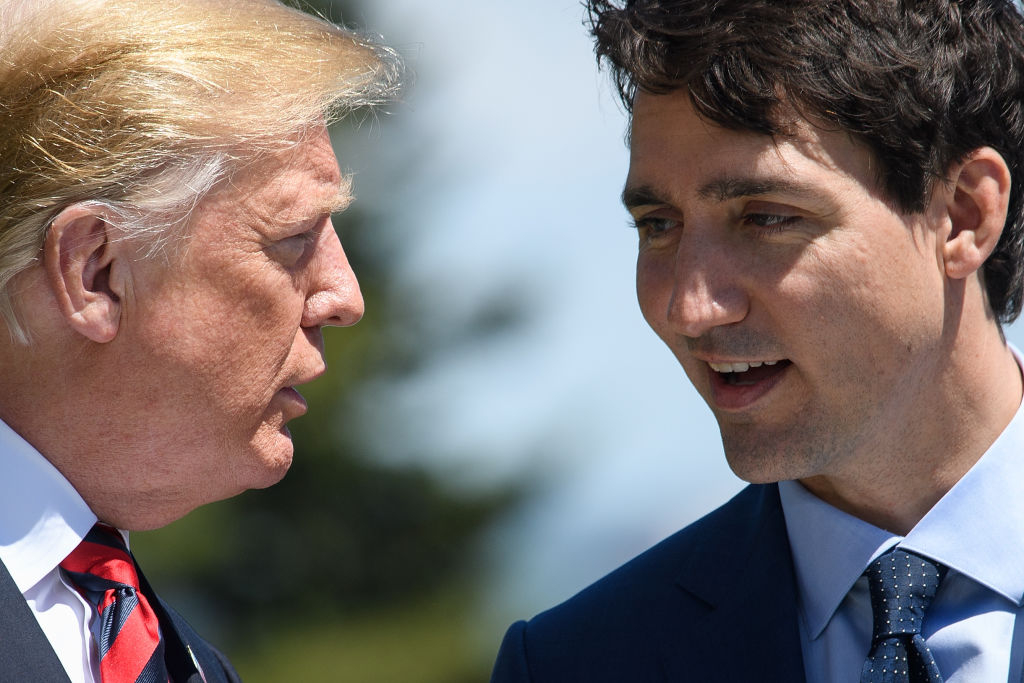
Pictured: U.S. President Donald Trump and Canada’s Prime Minister Justin Trudeau converse at the G7 Summit, on June 8, 2018 in La Malbaie, Canada. (Photo by Leon Neal/Getty Images)
In attendance at the summit was President Donald Trump’s recently appointed National Security Adviser, John Bolton, whose hard-line views on the Middle East in general and on Iran in particular have not exactly been a secret. Under his watch, the U.S. has threatened sanctions against Iran, especially in the wake of America’s withdrawal from the “nuclear deal.” Trudeau, on the other hand, was instrumental in the deal that would see Canadian company Bombardier sell aircraft to a firm in Iran owned by the Revolutionary Guards.
It is interesting to note that on June 12 — the day of the Canadian vote — U.S. Homeland Security Secretary Kirstjen Nielsen addressed the first International Homeland Security Forum in Israel, which dealt with threats to the West, and stated: “From Ottawa to Berlin, our communities are now on the frontlines.” Her referring to Canada first should not be lost on Canadians.
Two things are clear from all of the above. The first is that Trudeau did not vote willingly for the Conservative motion; he seems to have been encouraged into it by Trump and Bolton. (In any event, the motion did not succeed in having the IRGC designated as a terrorist group. Doing so requires a long process that can be dragged out for months, most likely past the next election in November 2019.)
Second, and most important, Trudeau’s temporary aberration is not likely to change his ideology. As long as leaders in the West who hold such views remain in power, Canada will be on the watchlist of those who oppose the spread of Islamic extremism and theocratic dictatorships. This does not bode well for Canada. It may well be living through its highest-risk moment since World War II.
Tom Quiggin is a former military intelligence officer, a former intelligence contractor for the Royal Canadian Mounted Police and a court appointed expert on jihadist terrorism in both the Federal and criminal courts of Canada. He is the author of SUBMISSION: The Danger of Political Islam to Canada – With a Warning to America, written with co-authors Tahir Gora, Saied Shoaaib, Jonathon Cotler, and Rick Gill with a foreword by Raheel Raza. The book is available on Amazon.com in both paperback and Kindle versions. He is also the primary contributor to the QUIGGIN REPORT podcast.








 anneinpt
 artaxes
 danmillerinpanama
 davidking1530
 Peter Hofman
 Joseph Wouk
 Peter
Peter Louisiana Steve
 WarSclerotic
Recent Comments