Quake Devastates Italian Mountain Towns, 73 Dead

Posted August 24, 2016 by Peter Hofman
Categories: Uncategorized

Tags: , ,

WATCH: Major Quake Devastates Italian Mountain Towns, 73 Dead And Thousands Left Homeless

By Breitbart London

24 Aug 2016

Source: Quake Devastates Italian Mountain Towns, 73 Dead

A major earthquake has rocked central Italy, demolishing ancient hill towns, killing scores and leaving thousands homeless.

Update 15.20 BST – 73 people have died

At least 73 people have killed in the 6.2 magnitude quake, including a family of four who were found trapped beneath rubble showing no signs of life, Reuters reports.

Update 14.55 BST – The latest images from the region show a destroyed medieval church and a hastily assembled field hospital. 
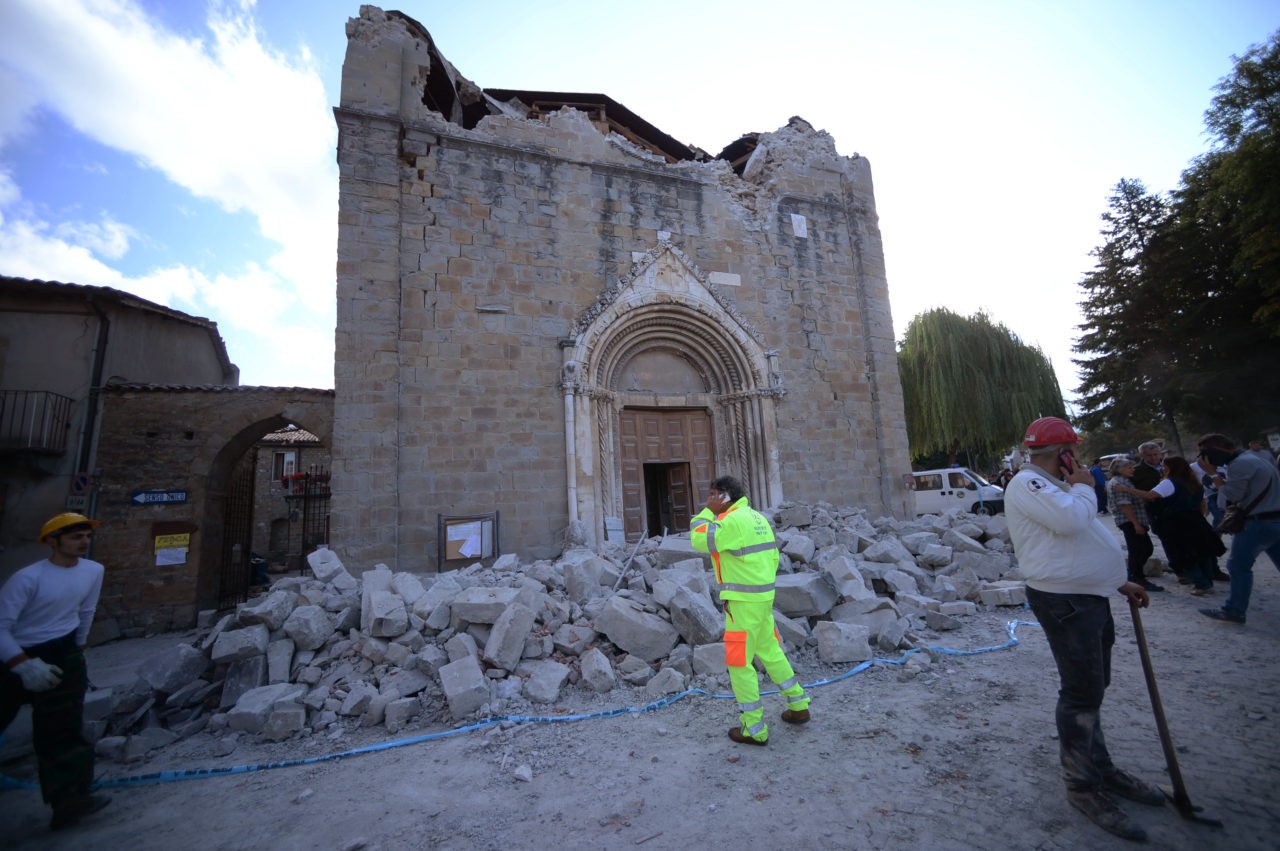
People stand in front of a damaged church in Amatrice on August 24, 2016 after a powerful earthquake rocked central Italy. The earthquake left 38 people dead and the total is likely to rise, the country's civil protection unit said in the first official death toll. Scores of buildings were reduced to dusty piles of masonry in communities close to the epicentre of the quake, which had a magnitude of between 6.0 and 6.2, according to monitors. / AFP / FILIPPO MONTEFORTE (Photo credit should read FILIPPO MONTEFORTE/AFP/Getty Images)

People stand in front of a damaged church in Amatrice on August 24, 2016 (FILIPPO MONTEFORTE/AFP/Getty Images)

Rescuers set up a first aid camp in the courtyard of the hospital of Amatrice on August 24, 2016 after a powerful earthquake rocked central Italy. The earthquake left 38 people dead and the total is likely to rise, the country's civil protection unit said in the first official death toll. Scores of buildings were reduced to dusty piles of masonry in communities close to the epicentre of the pre-dawn quake in a remote area straddling the regions of Umbria, Marche and Lazio. / AFP / FILIPPO MONTEFORTE (Photo credit should read FILIPPO MONTEFORTE/AFP/Getty Images)

Rescuers set up a first aid camp in the courtyard of the hospital of Amatrice on August 24, 2016 a (FILIPPO MONTEFORTE/AFP/Getty Images)
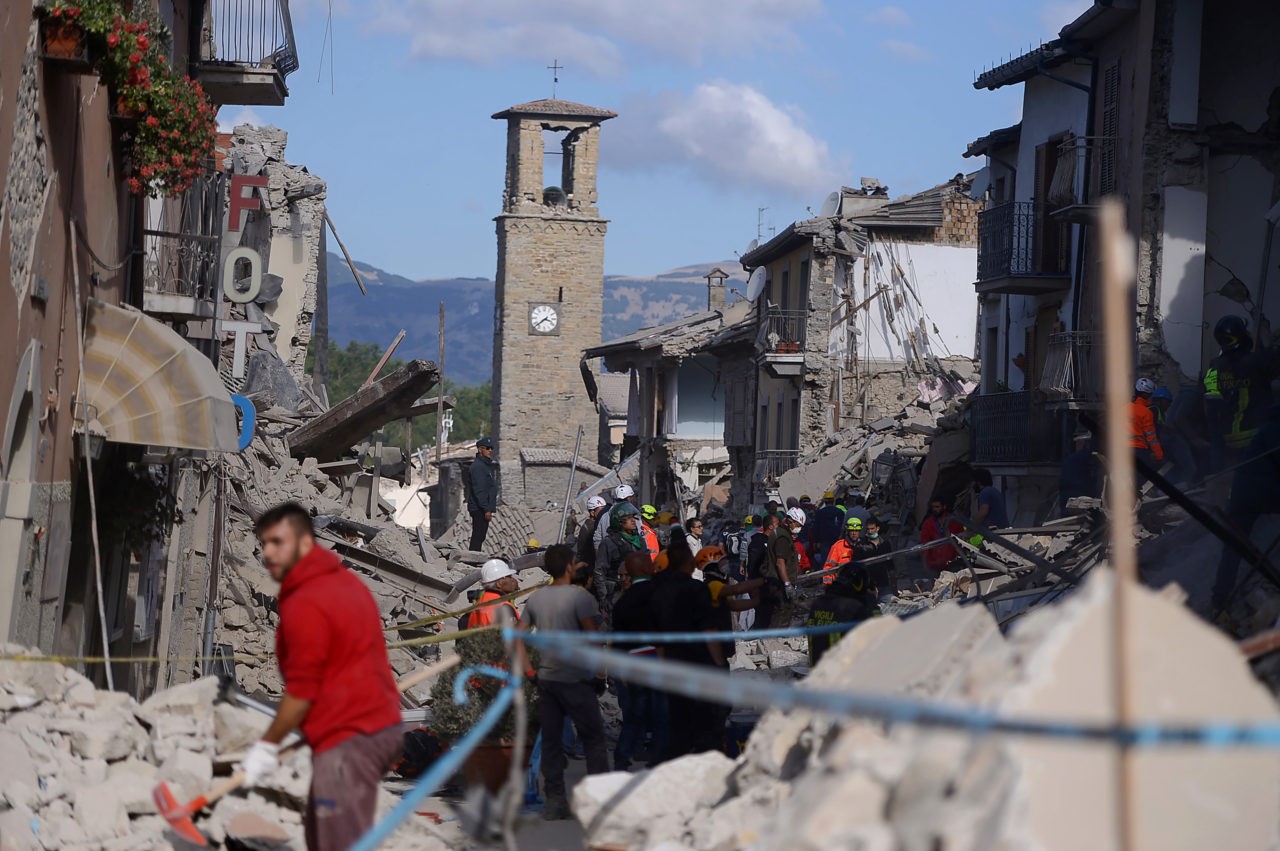
Rescuers and firemen inspect the rubble of buildings in Amatrice on August 24, 2016 after a powerful earthquake rocked central Italy. The earthquake left 38 people dead and the total is likely to rise, the country's civil protection unit said in the first official death toll. Scores of buildings were reduced to dusty piles of masonry in communities close to the epicentre of the pre-dawn quake in a remote area straddling the regions of Umbria, Marche and Lazio. / AFP / FILIPPO MONTEFORTE (Photo credit should read FILIPPO MONTEFORTE/AFP/Getty Images)

Rescuers and firemen inspect the rubble of buildings in Amatrice on August 24, 2016 (FILIPPO MONTEFORTE/AFP/Getty Images)

Update 1430 BST — Death Toll Over 60

Germany’s Zeit reports the death toll has now hit 63, with many having died in hospital after being pulled from the rubble. some 2,500 have been left homeless in just one town, Accumoli, where the mayor has vowed to build a “tent city” as a short term fix.

Update 11.27 BST – Italian Prime Minister addresses the nation.

Matteo Renzi said that, “when things don’t go well the whole of Italy demonstrates its most beautiful aspect”.

The story so far from Reuters

(REUTERS) – A powerful earthquake devastated a string of mountainous towns in central Italy on Wednesday, trapping residents under piles of rubble, killing at least 38 people and leaving thousands homeless.

The quake struck in the early hours of the morning when most residents were asleep, razing homes and buckling roads in a cluster of communities some 140 km (85 miles) east of Rome.

A family of four, including two boys aged 8 months and 9 years, were buried when their house in Accumoli imploded.

As rescue workers carried away the body of the infant, carefully covered by a small blanket, the children’s grandmother blamed God: “He took them all at once,” she wailed.

The army was mobilized to help with special heavy equipment and the treasury released 235 million euros ($265 million) of emergency funds. At the Vatican, Pope Francis canceled part of his general audience to pray for the victims.

Aerial photographs showed whole areas of Amatrice, voted last year as one of Italy’s most beautiful historic towns, flattened by the 6.2 magnitude quake.
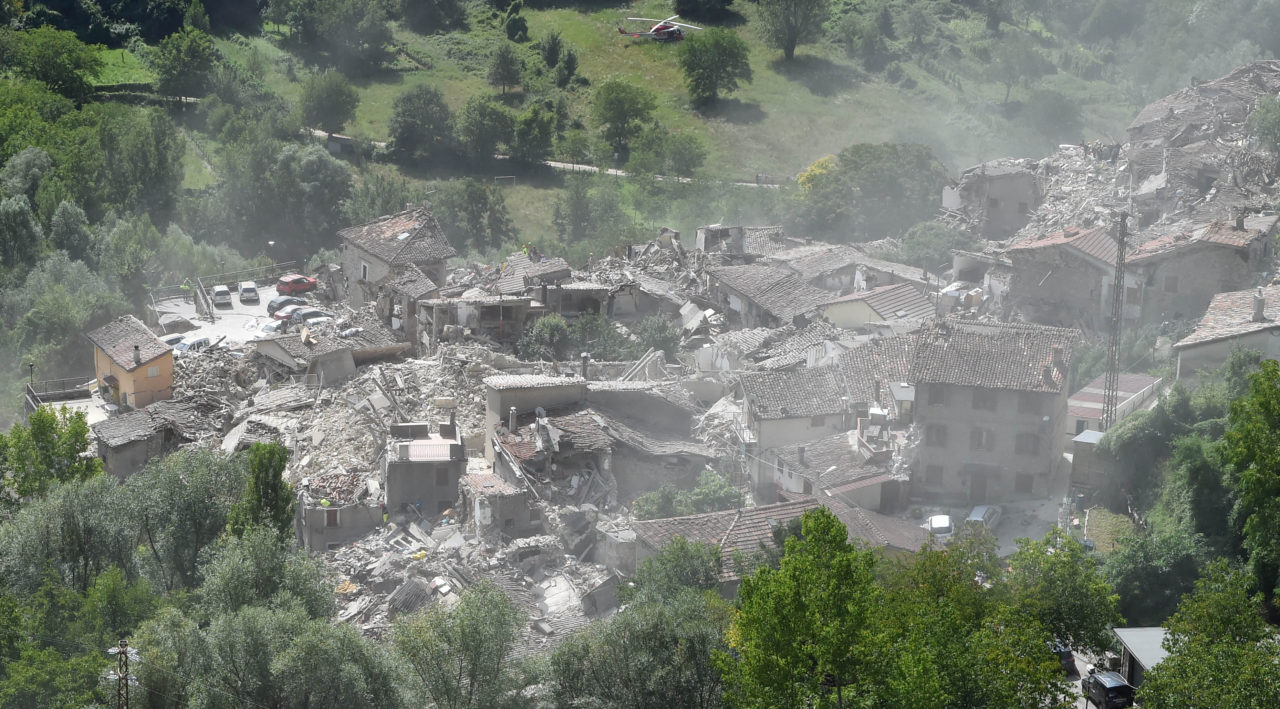
PESCARA DEL TRONTO, ITALY - AUGUST 24: A general view of Pescara del Tronto town destroyed by the earthquake on August 24, 2016 in Pescara del Tronto, Italy. Central Italy was struck by a powerful, 6.2-magnitude earthquake in the early hours, which has killed at least thirty seven people and devastated dozens of mountain villages. Numerous buildings have collapsed in communities close to the epicenter of the quake near the town of Norcia in the region of Umbria, witnesses have told Italian media, with an increase in the death toll highly likely (Photo by Giuseppe Bellini/Getty Images)

A general view of Pescara del Tronto town destroyed by the earthquake on August 24, 2016 in Pescara del Tronto, Italy. (Giuseppe Bellini/Getty Images)

“It’s all young people here, it’s holiday season, the town festival was to have been held the day after tomorrow so lots of people came for that,” said Amatrice resident Giancarlo, sitting in the road wearing just his underwear.

“It’s terrible, I’m 65-years-old and I have never experienced anything like this, small tremors, yes, but nothing this big. This is a catastrophe,” he said.

Accumoli mayor Stefano Petrucci said some 2,500 were left homeless in the local community, which is made up of 17 hamlets.

ARQUATA DEL TRONTO, ITALY - AUGUST 24: The body of an unidentifeid child lies on a bench on August 24, 2016 in Arquata del Tronto, Italy. Central Italy was struck by a powerful, 6.2-magnitude earthquake in the early hours, which has killed at least thirteen people and devastated dozens of mountain villages. Numerous buildings have collapsed in communities close to the epicenter of the quake near the town of Norcia in the region of Umbria, witnesses have told Italian media, with an increase in the death toll highly likely (Photo by Giuseppe Bellini/Getty Images)

ARQUATA DEL TRONTO, ITALY – AUGUST 24: The body of an unidentifeid child lies on a bench on August 24, 2016 in Arquata del Tronto, Italy. (Photo by Giuseppe Bellini/Getty Images)

Victims and rescuers walk among the rubble of houses after a strong heartquake hit Amatrice on August 24, 2016. Central Italy was struck by a powerful, 6.2-magnitude earthquake in the early hours, which has killed at least three people and devastated dozens of mountain villages. Numerous buildings had collapsed in communities close to the epicenter of the quake near the town of Norcia in the region of Umbria, witnesses told Italian media, with an increase in the death toll highly likely. / AFP / FILIPPO MONTEFORTE (Photo credit should read FILIPPO MONTEFORTE/AFP/Getty Images)

Victims and rescuers walk among the rubble of houses after a strong heartquake hit Amatrice on August 24, 2016. (FILIPPO MONTEFORTE/AFP/Getty Images)

Residents responding to wails muffled by tonnes of bricks and mortar sifted through the rubble with their bare hands before emergency services arrived with earth-moving equipment and sniffer dogs. Wide cracks had appeared like open wounds on the buildings that were still standing.

The national Civil Protection Department said some survivors would be put up elsewhere in central Italy, while others would be housed in tents that were being dispatched to the area.

Italian Prime Minister Matteo Renzi said he would visit the disaster area later in the day: “No one will be left alone, no family, no community, no neighborhood. We must get down to work .. to restore hope to this area which has been so badly hit,” he said in a brief televised address.

The quake hit during the summer when the area, usually sparsely populated, hosts large numbers of holidaymakers.

A spokeswoman for the civil protection department, Immacolata Postiglione, said the dead were in Amatrice, Accumoli and other villages including Pescara del Tronto and Arquata del Tronto. She put the initial death toll at 38, but said rescue teams had only just reached some stricken areas.

The earthquake caused damage in three regions — Umbria, Lazio and Marche — and was felt as far away as the southern Italian port city of Naples.
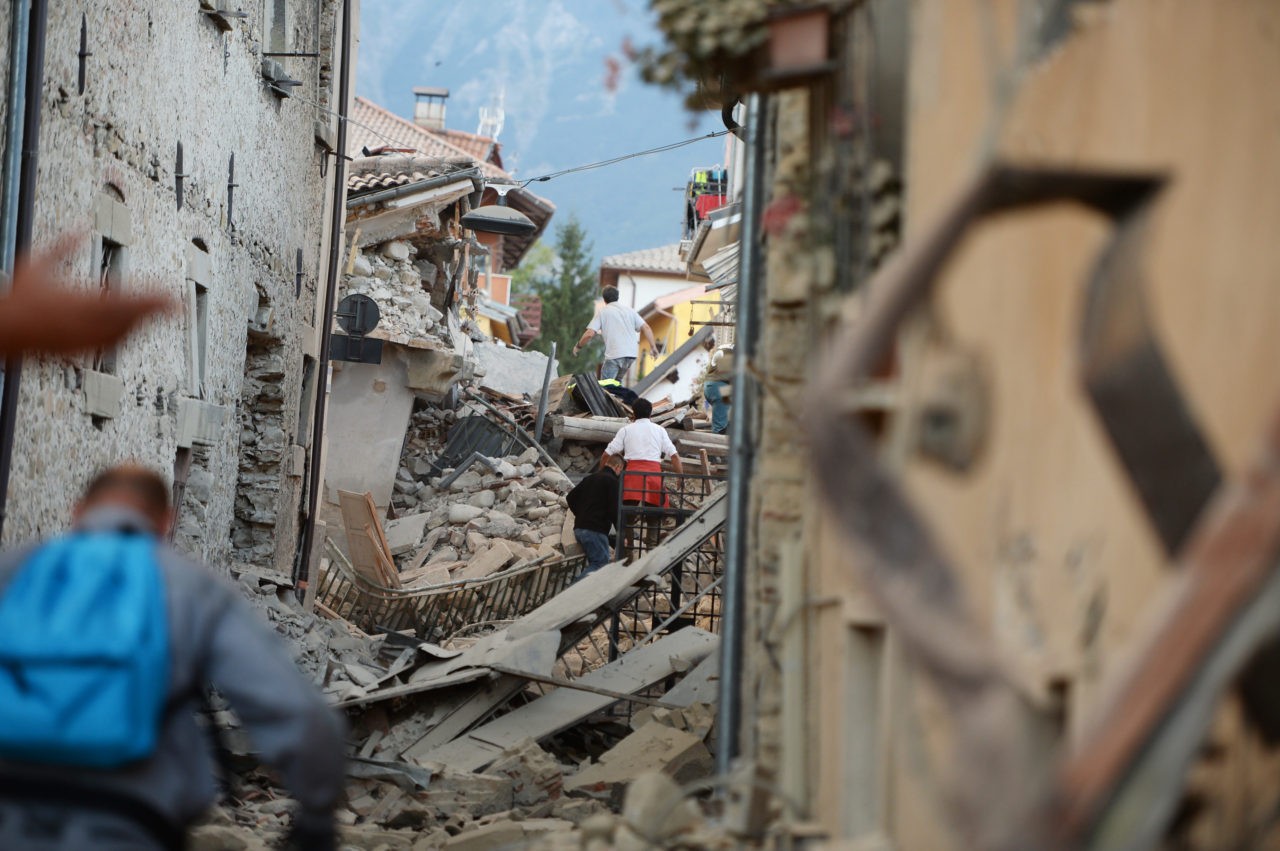
Residents search for victims among damaged buildings after a strong heartquake hit Amatrice on August 24, 2016. Central Italy was struck by a powerful, 6.2-magnitude earthquake in the early hours, which has killed at least three people and devastated dozens of mountain villages. Numerous buildings had collapsed in communities close to the epicenter of the quake near the town of Norcia in the region of Umbria, witnesses told Italian media, with an increase in the death toll highly likely. / AFP / FILIPPO MONTEFORTE (Photo credit should read FILIPPO MONTEFORTE/AFP/Getty Images)

Residents search for victims among damaged buildings after a strong heartquake hit Amatrice on August 24, 2016.
(FILIPPO MONTEFORTE/AFP/Getty Images)

DISAPPEARING IN DUST

The hospital in Amatrice was among the buildings that were badly damaged, and patients were moved into the streets.

“Three quarters of the town is not there anymore,” Amatrice mayor Sergio Pirozzi told state broadcaster RAI. “The aim now is to save as many lives as possible. There are voices under the rubble, we have to save the people there.”

RAI reported that two Afghan girls, believed to be asylum-seekers, were also missing in the town.

The U.S. Geological Survey, which measured the quake at 6.2 magnitude, said it struck near the Umbrian city of Norcia, while Italy’s earthquake institute INGV registered it at 6.0 and put the epicenter further south, closer to Accumoli and Amatrice.

The damage was made more severe because the epicenter was at a relatively shallow 4 km below the surface of the earth. Residents of Rome were woken by the tremors, which rattled furniture, swayed lights and set off car alarms in most of central Italy.
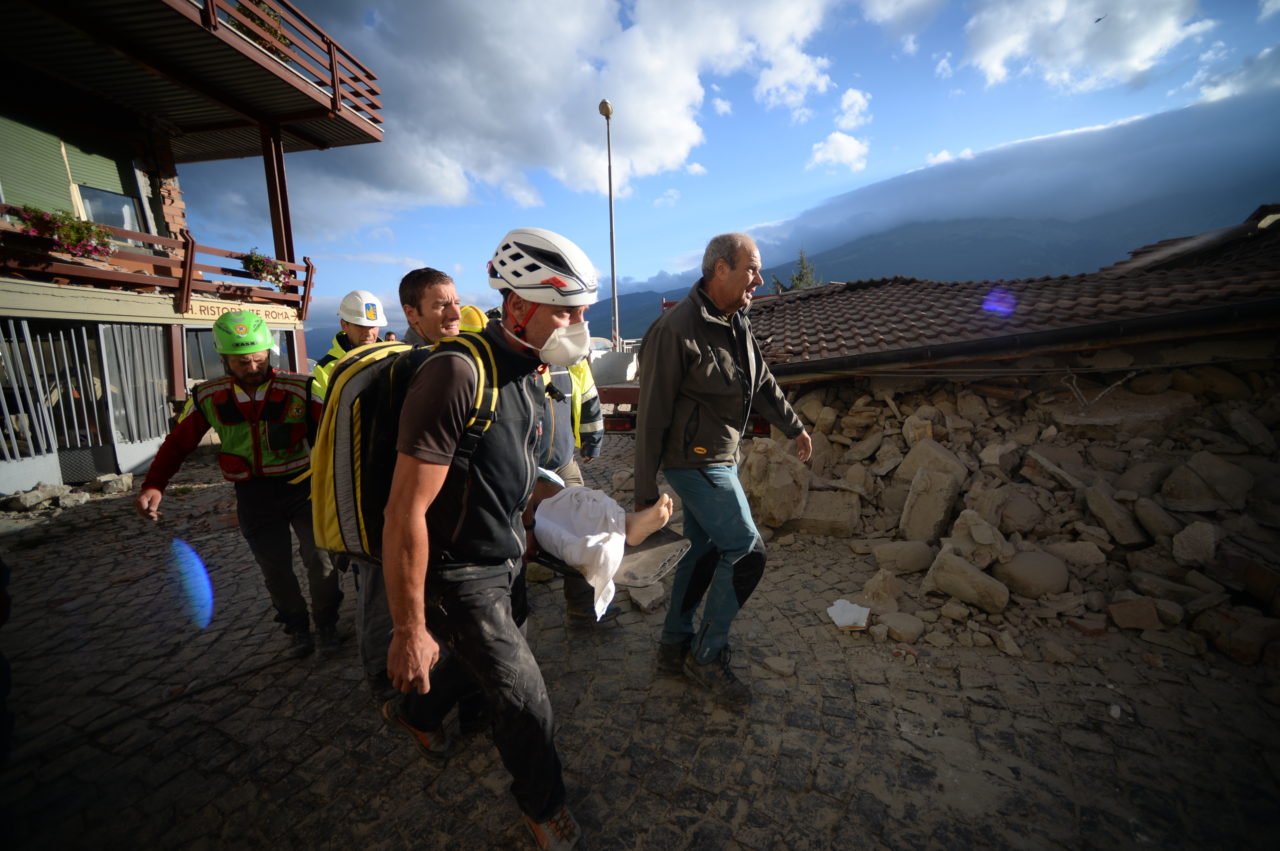
Rescuers carry an injured man among damaged homes after a strong heathquake hit Amatrice on August 24, 2016. Central Italy was struck by a powerful, 6.2-magnitude earthquake in the early hours, which has killed at least three people and devastated dozens of mountain villages. Numerous buildings had collapsed in communities close to the epicenter of the quake near the town of Norcia in the region of Umbria, witnesses told Italian media, with an increase in the death toll highly likely. / AFP / FILIPPO MONTEFORTE (Photo credit should read FILIPPO MONTEFORTE/AFP/Getty Images)

Rescuers carry an injured man among damaged homes after a strong heathquake hit Amatrice on August 24, 2016. (FILIPPO MONTEFORTE/AFP/Getty Images)
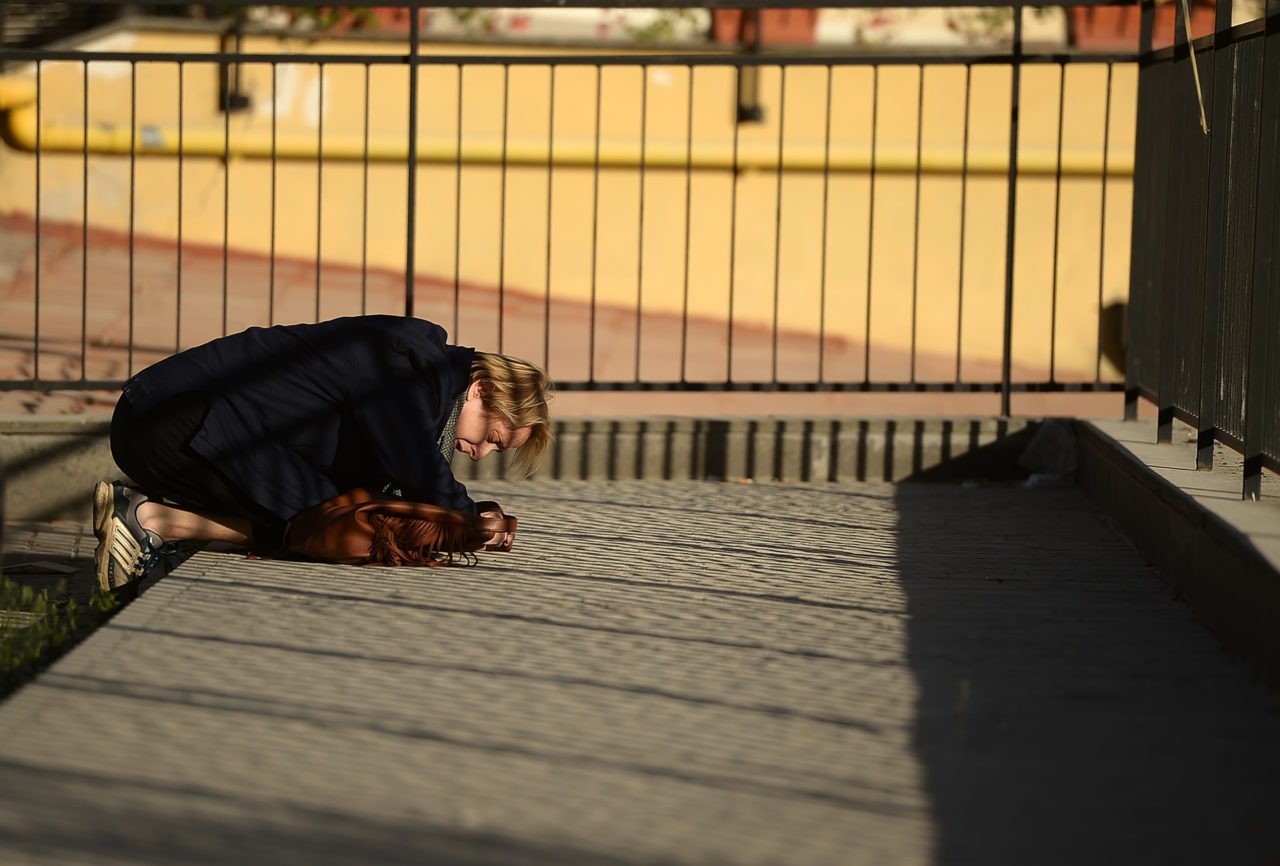
A woman reacts in front of her damaged home after a strong heathquake hit Amatrice on August 24, 2016. Central Italy was struck by a powerful, 6.2-magnitude earthquake in the early hours, which has killed at least three people and devastated dozens of mountain villages. Numerous buildings had collapsed in communities close to the epicenter of the quake near the town of Norcia in the region of Umbria, witnesses told Italian media, with an increase in the death toll highly likely. / AFP / FILIPPO MONTEFORTE (Photo credit should read FILIPPO MONTEFORTE/AFP/Getty Images)

A woman reacts in front of her damaged home after a strong heathquake hit Amatrice on August 24, 2016. (FILIPPO MONTEFORTE/AFP/Getty Images)

“It was so strong. It seemed the bed was walking across the room by itself with us on it,” Lina Mercantini of Ceselli, Umbria, about 75 km away from the hardest hit area, told Reuters. Olga Urbani, in the nearby town of Scheggino, said: “Dear God it was awful. The walls creaked and all the books fell off the shelves.”

INGV reported 60 aftershocks in the four hours following the initial quake, the strongest measuring 5.5.

Italy sits on two fault lines, making it one of the most seismically active countries in Europe.

The last major earthquake to hit the country struck the central city of L’Aquila in 2009, killing more than 300 people.

The most deadly since the start of the 20th century came in 1908, when an earthquake followed by a tsunami killed an estimated 80,000 people in the southern regions of Reggio Calabria and Sicily.

(Writing by Crispian Balmer and Philip Pullella, reporting by Steve Scherer, Philip Pullella, Stephen Jewkes, Eleanor Biles and Giulia Segreti.; Editing by Nick Macfie, Robert Birsel and Peter Graff)
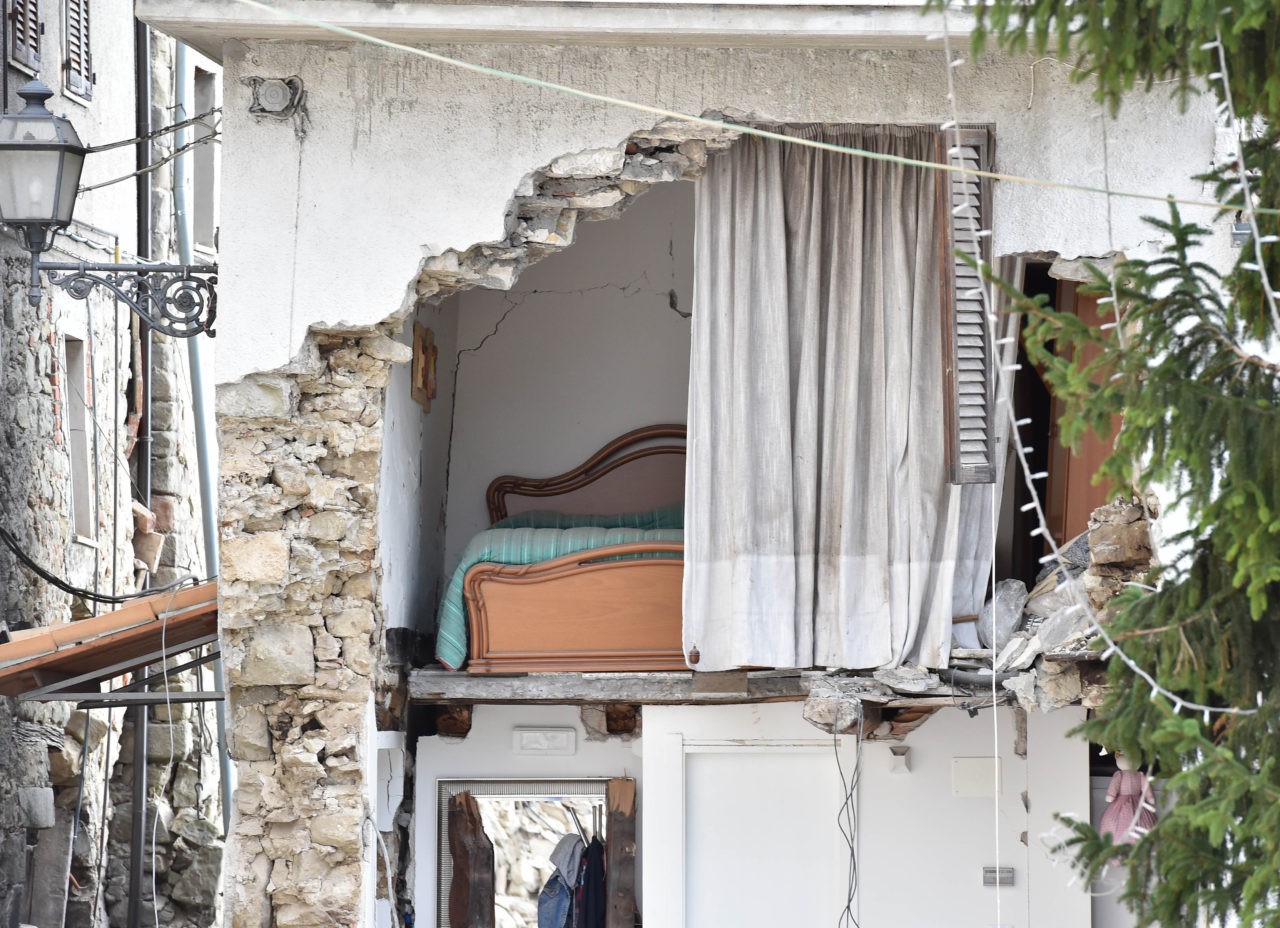
ARQUATA DEL TRONTO, ITALY - AUGUST 24: Damged houses are seen on August 24, 2016 in Arquata del Tronto, Italy. Central Italy was struck by a powerful 6.2-magnitude earthquake in the early hours which has killed at least three people and devastated dozens of mountain villages. Numerous buildings have collapsed in communities close to the epicenter of the quake near the town of Norcia in the region of Umbria, witnesses have told Italian media, with an increase in the death toll highly likely. (Photo by Giuseppe Bellini/Getty Images)

Damged houses are seen on August 24, 2016 in Arquata del Tronto, Italy. (Photo by Giuseppe Bellini/Getty Images)

Stunning: Egyptian Foreign Minister says Israel’s treatment of Palestinians not ‘terrorism’

Posted August 24, 2016 by danmillerinpanama
Categories: Egypt, Israel and Egypt, Palestinians, Saudi Arabia, Sisi, Terrorism

Tags: , , , , ,

Stunning: Egyptian Foreign Minister says Israel’s treatment of Palestinians not ‘terrorism’, American Thinker, Thomas Lifson,, August 24, 2016

It is an article of faith in the Arab world that Israel is guilty, guilty, guilty of terrorizing the poor Palestinians, which is why Jews deserve to be terrorized worldwide.  The origins of violence lie exclusively on the Jews, too.  So Arabs and all Muslims have a duty to defend their brothers and sisters by acts of extreme cruelty against Israelis in particular, and Jews in general.

This dogma is extremely important because it avoids any scrutiny of Koranic and other scriptural incitements of violence – even genocide – against Jews. I thus serves a dual purpose. And as a result, it must remain unquestioned.  And for decades, there has been rhetorical solidarity on this point.

Until now.

The fall of the Muslim Brotherhood in Egypt and its replacement by the anti-MB regime of General Sisi, along with the spread of chaos in the Arab world has changed matters. Meanwhile, Israel is quietly building itself into a tiny superpower, its high tech economy and rapid development of offshore gas and onshore fracking making it a global economic power, able to finance a high tech military.

As a result, a stunning break with the past happened, beyond the notice of our mainstream media. The Jerusalem Post reports:

Egyptian Foreign Minister Sameh Shoukry said on Sunday that Israel’s actions against Palestinians does not constitute terrorism, eliciting an angry response from a Hamas spokesman who said Egypt’s top diplomat is blind.

Shoukry’s comments came during a Q&A session with students held at the Egyptian Foreign Ministry, where he was asked why Palestinians children killed in the conflict with Israel were not considered victims of terrorism.

“When looking at this issue, it can be defined as a ‘regime of force,’” the Egyptian media quoted Shoukry as saying. He said there was no evidence to link Israel to terrorist organizations.

“There is nothing that leads to this conclusion,” he said.

Shoukry added that Israel’s history has made it very sensitive to security issues, and as a result tightens control over its territory and border crossings to ensure its security.

The reaction has not been favorable among other Arab regimes. In public, at least. Speaking from Qatar, a major Clinton Foundation donor (and recipient of questionable favors):

Husam Badran, a Hamas spokesperson in Qatar, slammed the Egyptian foreign minister in a Twitter post, saying, “He who does not see the crimes of the Zionist occupation as terrorism is blind.”

The Egyptian cozying up with Israel is far ahead of public opinion there. It is inconceivable to me that Shoukry made these comments without first discussing them with Saudi Arabia, Egypt’s primary financial backer.

Tectonic plates are shifting in the Arab world, with some pragmatic leaders realizing that the primary problems of Arabs are created by themselves, and Israel has much more to offer as a friend than as a mortal enemy.

Hat tip: Clarice Feldman


Muslim cleric from terror sponsor Iran praises Pope for saying Islam is peaceful

Posted August 24, 2016 by danmillerinpanama
Categories: Iran and Christians, Iran and terror, Iranian Islam, Islam - the religion of peace everlasting, Pope Francis

Tags: , , , ,

Muslim cleric from terror sponsor Iran praises Pope for saying Islam is peaceful, Jihad Watch,

He is thanking the Pope for furthering what he must know are false statements that keep people ignorant and complacent about the jihad threat. He is, in effect, thanking the Pope for being a tool of the global jihad.

*****************

“Grand Ayatollah Makarem Shirazi of Qom wrote in a letter to the Pope: ‘I am really delighted to have heard your comments during your last trip to Poland in which you stated “Islam is not equal to terrorism” and further dismissed the association of violence and harshness with any and all divinely-sent religions.’”

Grand Ayatollah Makarem Shirazi of Qom must know better. He must know that the Qur’an and Sunnah teach warfare against unbelievers, as I demonstrate here and in many other places. He is thanking the Pope for furthering what he must know are false statements that keep people ignorant and complacent about the jihad threat. He is, in effect, thanking the Pope for being a tool of the global jihad.

grand anat

“Top Muslim cleric praises Pope Francis for saying it is wrong to identify Islam with violence,” by Carey Lodge, Christian Today, August 23, 2016:

A top Iranian religious leader has praised Pope Francis for saying it is wrong to identify Islam with violence.

Grand Ayatollah Makarem Shirazi of Qom wrote in a letter to the Pope: “I am really delighted to have heard your comments during your last trip to Poland in which you stated ‘Islam is not equal to terrorism’ and further dismissed the association of violence and harshness with any and all divinely-sent religions.

“Your wise and logical stance regarding Islam in disassociating the religion from the inhumane actions and atrocities of the Takfiri groups such as Daesh is truly admirable.”

Pope Francis told reporters on his plane back from Poland last month: “I think it is not right to identity Islam with violence. This is not right and this is not true.”

He was speaking following the murder of Father Jacques Hamel, an 85-year-old Catholic priest in Rouen, France, in an attack that was claimed by Islamic State.

“I think that in nearly all religions there is a always a small fundamentalist group,” the Pope said. “I don’t like to talk about Islamic violence because every day when I look at the papers I see violence here in Italy – someone killing his girlfriend, someone killing his mother-in-law. These are baptised Catholics.

“If I speak of Islamic violence, I have to speak of Catholic violence. Not all Muslims are violent.”

In his letter, Shirazi said that “such barbaric acts have nothing to do with divinely-sent religions and their various schools of thought. Rather, they originate from the inferior materialistic objectives of some corrupt superpowers who seek nothing but to obtain more illegitimate wealth.”…

New Study: Extremist Literature Common in Canadian Mosques

Posted August 24, 2016 by danmillerinpanama
Categories: Canada, Islamic indoctrination, Islamic indoctrination of children, Islamic radicalization, Islamic State, Islamic terrorism, Islamisation, Islamists in Canada, Mosques, Schools

Tags: , , , , , , , , ,

New Study: Extremist Literature Common in Canadian Mosques, Clarion Project, Elliot Friedland, August 24, 2016

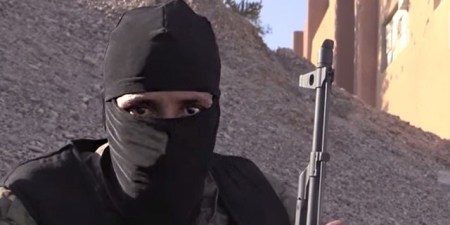
Islamic-State-Fighter-1-HP_1Illustrative picture. (Photo: © Screenshot from video)

Extremist literature is widely available in mosques and Islamic schools in Canada, according to a new study, reported by the National Post.

The study was conducted by Thomas Quiggin a former intelligence analyst with the Privy Council Office and the Royal Canadian Mounted Police (RCMP) and Saied Shoaaib, a journalist originally from Egypt.

The study found that not only was the material available, but in some places it was the majority of the literature available.

The co-authors argued that politicians have reacted insufficiently to the threat, and that extremists were gaining the upper hand ideologically.

“Further research is required to determine the depth and breadth of this problem,” the study concluded.

The findings are especially troubling in the light of another study, published earlier in August, which interviewed Canadian citizens who had travelled to Syria or Iraq to fight for jihadist organizations such as the Islamic State (ISIS, ISIL), as reported by Macleans.

In this study, titled Talking to Foreign Fighters: Socio-Economic Push versus Existential Pull Factors, researchers questioned 40 foreign fighters, 60 family members, friends and associates, and 30 online supporters from December 2015 to February 2016.

They have so far they have published findings from an initial sample of 20 jihadists. Their findings indicate that ideology was a primary motivating factor in the radicalization journeys by of those to whom they spoke.

“None of our sample indicated coming from familial situations of poverty or marginality,” they said. “On the contrary, many indicated they had fairly happy and privileged, or at least comfortable, childhoods. In general, there was almost no discussion of the economic situation of their families.”

Those interviewed “run the gamut from troubled youth with personal problems to accomplished young men and women from stable backgrounds,” the authors wrote.

“Anger and frustration have their role to play in the process, but it is the positive investment in an alternate world-saving role that matters most, no matter how strange it may appear to outsiders.”

They also saw that many seemed to radicalize and travel in “clusters,” as opposed to lone wolves.

Furthermore, they added that mentoring from someone seen as a religious figure was necessary for many to complete the process of radicalization. “In most cases, we would say the help and encouragement of some other outside mentors is required to complete the process of radicalization, to turn wannabe terrorists into deployable agents or independent martyrs for the cause. The process of self-radicalization needs to be legitimated to be complete.”

With the presence of extremist literature available in mosques, the ability of Canadians to be drawn into such an ideology seems clear.

Turkish tanks roll into Syria to confront Islamic State

Posted August 24, 2016 by Peter Hofman
Categories: Uncategorized

Tags: , , , , , , ,

Turkish tanks roll into Syria to confront Islamic State President Erdogan says operation aims to uproot jihadist group and Syrian Kurdish rebels, ‘put an end’ to border problems

By AP and AFP August 24, 2016, 12:23 pm

Source: Turkish tanks roll into Syria to confront Islamic State | The Times of Israel

A Turkish army tank drives toward Syria in the Turkish border city of Karkamis, in the southern region of Gaziantep, August 24, 2016. (AFP/BULENT KILIC)

ANKARA, Turkey — Turkey’s military launched an operation before dawn Wednesday to clear a Syrian border town of its Islamic State militants, and the country’s state-run news agency said Turkish tanks had crossed into Syria as part of the offensive.

In its report, the Anadolu Agency, which cited unnamed military officals, did not say how many tanks entered Syria. The private NTV television said as many as 20 tanks had crossed into Syria and that clashes were taking place at the border. Earlier in the day, NTV said that a small number of Turkish special forces had crossed into Syria as part of the operation.

NTV television said it was an “intruder mission” to carry out “pinpoint operations” against IS as part of the operation to clear the town of Jarablus of the extremists.

President Recep Tayyip Erdogan said the Turkish operation inside Syrian territory was aimed not just against jihadists but also Kurdish militia and should permanently put an end to problems on the border.

“From 4:00 am (0100 GMT) our forces began an operation against the Daesh (IS) and PYD (Kurdish Democratic Union Party) terror groups,” Erdogan said in a speech in Ankara, adding the move was aimed at “putting an end” to problems on the border.

As he spoke, Turkey’s state-run Anadolu news agency reported that pro-Ankara Free Syrian Army (FSA) rebels had already penetrated three kilometers (two miles) inside Syria toward the IS-held town of Jarabulus.

The office of Turkish Prime Minister Binali Yildirim said the operation, carried out by Turkish and US-backed coalition forces, began at 4 a.m. (0100 GMT), with Turkish artillery launching intense cross-border fire on the town of Jarablus, followed by Turkish warplanes bombing IS targets in the town, Anadolu said.

Smoke billows following air strikes by a Turkish Army jet fighter on the Syrian Turkish border village of Jarabulus during fighting against Islamic S State group targets, August 24, 2016 . (AFP/BULENT KILIC)

Smoke billows following air strikes by a Turkish Army jet fighter on the Syrian Turkish border village of Jarabulus during fighting against Islamic S State group targets, August 24, 2016 . (AFP/BULENT KILIC)

Just a few hours after the operation started, Vice President Joe Biden landed in Ankara for talks that include developments in Syria.

The visit comes at a difficult time for ties between the two NATO allies. Turkey is demanding that Washington quickly extradite a US-based cleric blamed for orchestrating last month’s failed coup. The United States is asking for evidence against the cleric and asking that Turkey allow the extradition process to take its course.

In Syria, Turkey is concerned about the growing power of US-backed Syrian Kurdish forces, who it says are linked to Kurdish groups waging an insurgency in southeastern Turkey. Wednesday’s operation puts Turkey on track for a confrontation with the Kurdish fighters in Syria.

Biden is scheduled to meet with Erdogan and Prime Minister Binali Yildirim.

The operation in Jarablus is meant to safeguard Turkey’s own security, according to Turkish Interior Minister Efkan Ala, who said Ankara “cannot sit and watch.”

“It is Turkey’s legal right, it is within its authority” to take action, the minister said, adding that Wednesday’s operation aimed to support the moderate Syrian opposition and was being carried out in coordination with the US-led coalition forces.

A Turkish army tank and an armored vehicle are stationed near the border with Syria, in Karkamis, Turkey, August. 23, 2016. (IHA via AP)

A Turkish army tank and an armored vehicle are stationed near the border with Syria, in Karkamis, Turkey, August. 23, 2016. (IHA via AP)

Turkey’s Hurriyet newspaper quoted Turkish sources as saying Turkish howitzers and rocket launchers had fired 224 rounds at 63 targets within an hour and 45 minutes, and that the Turkish air raids started just after 6 a.m.

The London-based Syrian Observatory for Human Rights also said Turkish ground troops had entered Syria. The activist group, which tracks the war through a network of local residents and fighters, said Turkish tanks and anti-mine vehicles crossed into Syria and were heading to Jarablus on Wednesday morning.

The Turkish government said the border area had been declared a “special security zone,” and asked journalists not to try to access it, citing safety concerns and threats posed by IS.

The assault followed Turkish Foreign Minister Mevlet Cavusoglu’s pledge on Tuesday of “every kind” of support for operations against IS along a 100-kilometer (62-mile) stretch of Syrian frontier. He said Turkey would support twin operations stretching from the Syrian town of Afrin in the northwest, which is already controlled by Kurdish forces, to Jarablus, in the central north, which is held by the Islamic State group.

Turkish army tank driving towards Syria in the Turkish-Syrian border city of Karkamis, in the southern region of Gaziantep, August 24, 2016. (AFP/BULENT KILIC)

Turkish army tank driving towards Syria in the Turkish-Syrian border city of Karkamis, in the southern region of Gaziantep, August 24, 2016. (AFP/BULENT KILIC)

Jarablus, which lies on the western bank of the Euphrates River where it crosses from Turkey into Syria, is one of the last important IS-held towns standing between Kurdish-controlled areas in northern Syria.

Located 20 miles (33 kilometers) from the town of Manbij, which was liberated from IS by Kurdish-led forces earlier this month, taking control of Jarablus and the IS-held town of al-Bab to the south would be a significant step toward linking up border areas under Kurdish control east and west of the Euphrates River.

In recent days Turkey has increased security measures on its border with Syria, deploying tanks and armored personnel carriers. On Tuesday, residents of the Turkish town of Karkamis, across the border from Jarablus, were told to evacuate after three mortars believed to be fired by IS militants landed there, Turkey’s Dogan news agency said.

Turkey has vowed to fight IS militants at home and to “cleanse” the group from its borders after a weekend suicide bombing at a Kurdish wedding in southern Turkey killed at least 54 people, many of them children. Turkish officials have blamed IS for the attack.

Ankara is also concerned about the growing power of US-backed Syrian Kurdish forces, who it says are linked to Kurdish groups waging an insurgency in southeastern Turkey.

A Turkish army tank and an armored vehicle are stationed near the border with Syria, in Karkamis, Turkey, Tuesday, Aug. 23, 2016. (IHA via AP)

A Turkish army tank and an armored vehicle are stationed near the border with Syria, in Karkamis, Turkey, Tuesday, Aug. 23, 2016. (IHA via AP)

The Kurdish-led group known as the Syria Democratic Forces, or SDF, recaptured Manbij from IS earlier this month, triggering concerns in Ankara that Kurdish forces would seize the entire border strip with Turkey. The US says it has embedded some 300 special forces with the SDF, and British special forces have also been spotted advising the group.

The Kurds’ outsized role in the Syrian civil war is a source of concern for the Syrian government as well. Fierce clashes erupted between the two sides over control of the northeastern province of Hasakeh last week, and Syrian warplanes bombed Kurdish positions for the first time, prompting the US to scramble its jets to protect American troops in the area.

The Syrian government and the Kurds agreed on a ceasefire Tuesday, six days after the clashes erupted. The Kurdish Hawar News Agency said government forces agreed to withdraw from Hasakeh as part of the truce.

Syrian state media did not mention any withdrawal, saying only that the two sides had agreed to evacuate the wounded and exchange detainees. Government and Kurdish forces have shared control of Hasakeh since the early years of the Syrian war.

EU President: “Borders Are The Worst Invention Ever Made By Politicians”

Posted August 24, 2016 by Peter Hofman
Categories: Uncategorized

Tags: , , , ,

EU President: “Borders Are The Worst Invention Ever Made By Politicians”

Source: EU President: “Borders Are The Worst Invention Ever Made By Politicians” | Zero Hedge

If The British needed any more confirmation of their decision to leave The EU, Jean-Claude Juncker, president of the European Commission, just gave them a big one. The often incoherent “when it’s important, you have to lie” politician spewed more United States Of Europe tripe this morning when he called for European nations to drop border controls, claiming that borders were “the worst invention ever.” Britain’s new PM, Theresa May, was not amused…

Speaking at the European Forum Alpbach in Austria’s Tyrol, Mr Juncker said: “Borders are the worst invention ever made by politicians” and said solidarity must be given to refugees and their children… (Border bullshit starts at 10:15 – note the mindless applause from the audience when Juncker drops his line)

As The Express reports,

Mr Juncker’s comments were taken as a sign that he intends to block attempts to tighten border checks to deal with the migrant crisis overwhelming Europe.


It is also a challenge to France and Belgium who have pushed for an end to the Schengen free-movement zone across the EU to stop terrorists crossing the Continent without checks after Europe was rocked by a series of atrocities.


The intervention from Mr Juncker came as Germany’s chancellor Angela Merkel, French president Francois Hollande and Italian prime minister Matteo Renzi met on the Italian island of Ventotene where the concept of the EU was first dreamt up, to discuss the impact of Brexit.


The latest views of Mr Juncker, who also said the EU needs to “block popular nationalism” in response to Brexit, were immediately disagreed with by Theresa May.

Britain’s new prime minister Theresa May was not impressed by Juncker’s de-sovereignisation rhetoric… (via The Telegraph)

 “This is not something that the Prime Minister would agree with and, indeed, you have heard the Prime Minister talk about the views that the British people expressed in the referendum.


“The British people think that borders are important, having more control over our borders is important, and that is an issue we need to address.”

And, unsurprisingly, UKIP spokesman Peter Whittle said that Juncker’s comments were “beyond parody”…

This was another reason “why we must exit the EU as quickly as possible, otherwise our security could be left exposed by Juncker’s anti-borders policy.


“Safe and secure borders help to define a nation, you only have to look at Germany to see what happens when you when you effectively discard them.


“Mr Juncker is also well behind the curve to think he, or his colleagues amongst the European political elite, can stop popular democracy from flourishing across Europe following the historic Brexit vote.


“I’m happy to predict that Britain will not be the only country to leave the EU and become a free and sovereign nation again,” added Ukip’s national culture spokesman.

The big question is – of course – what will George Soros demand of Juncker next?

Anti-Israel Double Standards Enable Assad’s Brutality

Posted August 23, 2016 by danmillerinpanama
Categories: Foreign policy, Iran, Israel, Media and Israel, Mendacity, Palestinians, Russia, Syria war, United Nations

Tags: , , , , , , , ,

Anti-Israel Double Standards Enable Assad’s Brutality, Investigative Project on Terrorism,  Noah Beck,August 23, 2016

1789

Syria’s civil war claimed 470,000 lives since it started in March 2011, the Syrian Centre for Policy Research announced in February. That’s an average of about 262 deaths per day and 7,860 per month. The carnage has continued unabated, so, applying the same death rate nearly 200 days after the February estimate, the death toll is over 520,000.

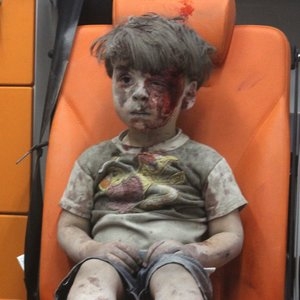
Such numbers are staggering, even by Middle East standards. However, the violence has become so routine that it only occasionally captures global attention, usually when a particularly poignant moment of human suffering is documented. The most recent example is Omran Daqneesh, a 5-year old Syrian boy who was filmed shell-shocked, bloody, and covered in dust after the airstrike bombing of his Aleppo apartment block.

The tragic image of Omran caused outrage around the world, as did the image of Aylan Kurdi, the drowned Syrian boy whose body washed up last September on a beach in Turkey. Yet Omran’s plight demonstrates that, nearly a year after the last child victim of Syrian horrors captured global sympathy, nothing has changed.

If anything, the violence in this multi-party proxy war seems to be getting worse. Since Aylan Kurdi’s drowning, Russia began blitz-bombing Syria in support of the Assad regime. The Syrian Observatory for Human Rights (SOHR) estimates that nine months of Russian airstrikes have killed 3,089 civilians – a toll that is greater, by some estimates, than the number of civilians killed by ISIS. By contrast, Syrian civilian deaths caused by U.S. airstrikes are probably in the hundreds (over roughly twice as much time, since U.S. airstrikes began in the summer of 2015).

But Syrian airstrikes are responsible for the bulk of civilian deaths in Syria. The Assad regime killed 109,347 civilians between March 2011 and July 2014 (88 percent of the total casualties at the time), according to estimates by the Syrian Network for Human Rights. That works out to about 91 civilian deaths per day. More recently, the SOHR documented 9,307 civilian deaths from 35,775 regime airstrikes over a 20-month period running from November 2014 through June 2016. Thus, roughly one innocent Syrian was killed every hour, during the 20 months that the SOHR documented civilian casualties caused by Russian and Syrian airstrikes.

Compare those figures to the number of innocent Palestinians killed by Israel from 2011 to 2014. According to Human Rights Watch (HRW), which has been accused of anti-Israel bias, 37 Palestinians were killed in 2011, 103 in 2012, 15 in 2013 and 1,500in 2014 – the year when Hamas fired rockets at Israel from highly populated Gazan areas. That’s a four-year total of 1,655. During roughly the same four-year period, the number of Syrian civilian deaths was about 76 times greater than the HRW total of Palestinian civilian casualties.

Yet the European Union singles out Israel for conflict-related consumer labels without any similar attempt to warn European consumers about goods or services whose consumption in any way helps the economies of countries responsible for the Syrian bloodshed, including Syria, Russia, and Iran. Human rights lawyer Arsen Ostrovsky has highlighted how none of those countries is targeted by those advocating a boycott of Israel out of a purported concern for human rights. Even more absurd, most of the results produced by a Google search for “academic boycott of Syria” or “academic boycott of Iran” concern academic boycotts of Israel. That asymmetry precisely captures the problem.

In addition to supporting the Assad regime in Syria and contributing to the violence there, Iran executes people for everything from drug offenses to being gay.

Indeed, the global outcry over Syrian suffering is embarrassingly weak when compared to reactions to Israel’s far less bloody conflict with the Palestinians. Imagine if Omran Daqneesh had been a Palestinian boy hurt by an Israeli airstrike on Gaza. College campus protests, the media, NGOs, and world bodies around the planet would be positively on fire. Israeli embassies would be attacked, French synagogues would be firebombed (eight were attacked in just one week during Israel’s 2014 war with Gaza), Jews around the world would be attacked, and condemnations would pour in from the EU, the United Nations, and the Obama administration. UN resolutions and emergency sessions would condemn the incident. International investigations would be demanded. Global blame would deluge Israel, regardless of whether Hamas, a terrorist organization, actually started the fighting or used human shields to maximize civilian deaths. Israel would be obsessively demonized despite any risky and unprecedented measures the Israeli military might have taken to minimize civilian casualties.

Moreover, when an occasional Syrian victim captures global attention, the protests are generally for some vague demand for “peace” in Syria, rather than blaming and demanding the punishment of Syria, Iran, and Russia, even though those regimes are clearly responsible for the slaughter. The starkly different reactions to Israel and Syria are even more shocking when it comes to the United Nations.

From its 2006 inception through August 2015, 62 United Nations Human Rights Council resolutions condemned Israel, compared to just 17 for Syria, five for Iran, and zero for Russia, according to the watchdog group UN Watch. The lopsided focus on Israel is equally appalling at the UN General Assembly, as UN Watch has highlighted. In each of the last four years, as the Syrian bloodbath claimed hundreds of thousands of lives, there were at least five times as many resolutions condemning Israel as those rebuking the rest of the world:

2012: 22 against Israel, 4 for the rest of the world

2013: 22 against Israel, 4 for the rest of the world

2014: 20 against Israel, 3 for the rest of the world

2015: 20 against Israel, 3 for the rest of the world

A corollary of the anti-Israel bias ensures that no Israeli victim will ever enjoy the kind of global sympathy expressed for Omran Daqneesh or Aylan Kurdi. When a Palestinian man enters the bedroom of a 13-year old girl and stabs her to death in her sleep,Obama says nothing even though she was a U.S. citizen and the world hardly notices. By contrast, imagine if the Israeli father of Hallel Yaffa Ariel had decided to take revenge by entering a nearby Palestinian home to stab a 13-year old Palestinian girl to death in her sleep. The global anger would be deafening.

Why do Israeli lives matter so much less? And why do student activists, the UN, the EU, the media, and the rest of the world focus so much more on alleged Palestinian civilian deaths than on Syrian civilian deaths? Doing so is woefully unjust to Syrians. It is also deeply unfair to Israel, which has endured terrorist attacks on its people throughout its existence as a state. It is the one country that, according to Col. Richard Kemp, former commander of British forces in Afghanistan, has done more to protect civilians during war than any other in the history of war.

The global obsession with condemning Israel not only defames a beleaguered democracy doing its best, it also enables the truly evil actors like the Assad regime and Hamas, by giving them a pass on some of the world’s worst crimes.

Most Who Met Hillary at State Donated to Clinton Foundation

Posted August 23, 2016 by danmillerinpanama
Categories: Clinton Foundation, Corruption, Department of State, Hillary Clinton

Tags: , ,

Most Who Met Hillary at State Donated to Clinton Foundation, The Daily Beast, August 23, 2016

hilbeast

More than half the non-government interests who met with Hillary Clinton during her tenure as secretary of State also gave money to the Clinton Foundation. According to a review by the Associated Press, at least 85 of 154 people who met or had scheduled conversations with Sec. Clinton also donated to her family’s charity or vowed to engage in its international programs. The 85 donors unearthed by the AP contributed a combined $156 million, the AP reported Tuesday, with at least 20 of those giving more than $1 million. The AP noted that the meetings did not violate legal agreements Clinton and her husband, former president Bill Clinton, signed before she took on the role as State Department chief, however, the news outlet added, “the frequency of the overlaps shows the intermingling of access and donations, and fuels perceptions that giving the foundation money was a price of admission for face time with Clinton.”

Our Catastrophic Failure of Jihad Denial

Posted August 23, 2016 by danmillerinpanama
Categories: Countering violent extremism, Department of Homeland Security, Islamic jihad, Islamic supremacy, Islamists in America, Moderate Muslims

Tags: , , , , ,

Our Catastrophic Failure of Jihad Denial, Front Page Magazine, Daniel Greenfield, August 23, 2016

cf

An outraged nation watched on September 11 as a handful of Muslim terrorists managed to kill thousands of Americans in one of the worst attacks in our history. Answers were demanded and commissions were established to investigate why we failed to prevent the attack.

Why didn’t we know that it was coming? Why didn’t we do something?

It’s still a good question as the number of attacks mount. But under Obama, we actually know less about Islamic terrorism than we used to.

While thousands of Americans died on that terrible day at the hands of Islamic terrorists, thousands of other Americans stepped forward to do their duty. Some brought sandwiches to Ground Zero. Others enlisted in the military to fight. Still others sought unique ways to use their special talents to make a contribution to combating the enemies of civilization.

Stephen Coughlin was a reserve Army officer called up to active duty. He left the private sector for the Directorate for Intelligence. For the next six years he worked in a variety of key roles to shape and orient the war and spoke about the threat of Islamic terrorism everywhere from Quantico to the Naval War College so that those on the front lines of the conflict would understand who the enemy was.

Then he was forced out because he was too good at pointing out the enemy. And the enemy had gotten inside. It would bore deeper and deeper into our national security infrastructure as the years and the wars dragged on.

But the government’s loss is our gain.

“Catastrophic Failure: Blindfolding America in the Face of Jihad” is Coughlin’s vigorous blast of fresh air through the stale clichés that clutter up counterterrorism conversations. You know the ones. Offending Islam plays into the hands of the terrorists. Mentioning that Al Qaeda is Islamic plays into the hands of the terrorists. Doing anything except playing the denial game also plays into the hands of the terrorists.

“Catastrophic Failure” conveys the information that Coughlin packaged in briefings to the men and women fighting the war. It is the outcome of his work, his briefings and his research. It is why he was fired.

As one of the leading experts in what the terrorists of Islam actually think and want, Stephen Coughlin not only shatters this brass wall of dishonesty, but shows that the real threat comes from the concealment of whom the terrorists we are fighting are and what they really want.

Coughlin’s conviction in analysis took him on this Diogenesian journey for the truth. He was not the only one traveling this road, discarding the excuses and the lies, striving to see clearly what was happening and why. And yet his position so close to the heart of the great failure machine of national security gives him a unique insight into what has gone wrong and into what must be set right.

That is what “Catastrophic Failure: Blindfolding America in the Face of Jihad” is. It is an analysis of what has gone wrong. Its cover of an eagle wearing a green blindfold all too aptly captures the tragic farce of our fight against terrorism. But it is also a compelling argument about what we must do.

Instead of seeing the threats the bird of prey tasked with our national defense has been hooded in green. He sits tamely on the arm of the Muslim Brotherhood falconer. Our government has responded to Muslim terror by seeking out Muslim moderates to save us from the extremists. But the moderates are not moderate. And working so close to the machine, Coughlin saw how the need to win over moderates, to consult them and rely on them, led to the shift in power as they created the framework in which decisions were made.

Counterterrorism was increasingly being made in Saudi Arabia, Qatar and by the Muslim Brotherhood.

The great struggle of our time is to flip that framework over and restore the power of decision for this war to Americans. Coughlin is a powerful writer and thinker, and he has poured his passion into these arguments that are meant to accomplish just that. He knows Islamic thought and law, and their real life implications, but his background has also prepared him to present focused laser blasts of information to audiences. His key goal and theme has been the importance of knowing the enemy.

“Catastrophic Failure: Blindfolding America in the Face of Jihad” is a text of knowledge. It is a book about the importance of knowing the enemy so that we may know the war that we are in.

Coughlin draws us a map of the Islamic organizational war against civilization “unconstrained” by the usual preconceptions about moderates and extremists. Instead he shows us who the enemy is by showing us how they think and how they see themselves. He connects the red dots of the Islamic Movement and the road to the Caliphate which is being pursued by far more Muslim groups than just the overt butchers of ISIS whose lack of patience leads them to act before they can sustain their Jihad.

“Catastrophic Failure” is not merely a book about Islamic terrorism. It is about the core worldview of the struggle. It is about how the bombings, shootings and stabbings that we see on the evening news are rooted in an Islamic mindset that stretches from the proverbial “lone wolf” whose actions are blamed on psychiatric problems or a failure to integrate to the Organisation of Islamic Cooperation and the rest of our so-called moderate allies and partners.

It is also about how our process, our ability to analyze and produce forecasts, and then to make decisions based on them, was corrupted by Islamic influence operations. It is about how the “eagle” was seduced with fantasies of moderate Islam by the enemies of this country. And it is about what must be done to lift the eagle’s blindfold and allow him to soar overhead again.

Stephen Coughlin has seen the profound failure of our national security up close. He saw what went wrong and equally importantly, he has seen what could have been if national security were oriented around our security instead of orbiting like a satellite around our impulses toward political correctness.

“Catastrophic Failure: Blindfolding America in the Face of Jihad” is a valuable book because it reflects the invaluable experiences of its author. It is a story of three wars. The war that was. The war that is. And the war that will be. The motives and the tactics of the enemy have remained consistent in these wars. And that allows Coughlin to predict their patterns. The enemy will not suddenly turn moderate. The question that hangs over the war that will be is whether our leaders will open their eyes to the fight.

Humor | Report: Ryan Lochte took sniper fire while boarding aircraft in Rio

Posted August 23, 2016 by danmillerinpanama
Categories: Hillary Clinton in Bosnia, Humor, Olympics, Sniper fire

Tags: , , ,

Report: Ryan Lochte took sniper fire while boarding aircraft in Rio, Duffel Blog, August 23, 2016

RIO DE JANEIRO – U.S. swimmer Ryan Lochte departed the 2016 Summer Olympics under accurate and sustained sniper fire, U.S. swimmer Ryan Lochte reported, adding with quiet admiration that the platinum-haired athlete displayed “remarkable calm and poise” during the attack.

“I knew it would practically be a combat zone, because people in Rio are actually pretty pissed at me right now,” the aquatic heartthrob explained. “But there was this 8 year-old girl, who apparently is, like, my biggest fan, and I was like, ‘I can’t, I can’t rush by her, I’ve got to at least greet her and still be super suave and cool,’ so I greeted her.”

Lochte was boarding a plane at Galeão International Airport when an unknown marksman opened fire. The rounds harmlessly ricocheted off of the 12-time Olympic medalist’s bulletproof narrative, instead striking the craft’s fuselage and all witnesses.

“Some hater tried to kill me,” Lochte stated. “I was like, ‘Whatever.’”

This marks the second time the Olympian has been on the receiving end of a gun, after he and three fellow swimmers were robbed at a gas station in Rio. Although the household name Lochte was able to escape the country unscathed, his less-than-famous teammates were detained.

“I don’t get why people, like, think I’m making this up for attention,” the world record holder of the 200-meter individual medley continued. “Every four years, people pretend to care about the sport that I’ve devoted my life to, and I inevitably come up in conversation when everyone is talking about how great Michael Phelps is.”

At press time, Lochte claimed to have “misspoke.”

“What I meant to say is that I’d be like the Michael Phelps of swimming if he wasn’t there.”