Humor | Syrian child disappointed she won’t get to be drone-striked by the first female president

Posted November 13, 2016 by danmillerinpanama
Categories: Hillary Clinton - "Feminist", Humor, Syria war

Tags: ,

Syrian child disappointed she won’t get to be drone-striked by the first female president, Duffel Blog, November 13, 2016

url

ALEPPO, Syria — In the midst of sectarian violence that has overtaken Syria for more than five years, nine-year-old Asil Kassab is shocked by the defeat of Democratic presidential candidate Hillary Clinton.

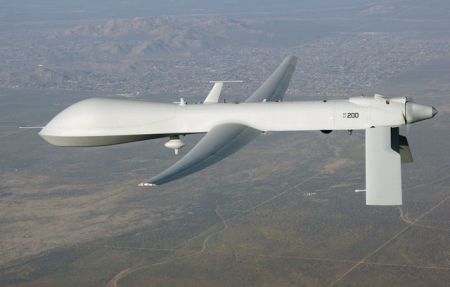
“I am so unhappy that a woman was not elected President,” Asil said, briefly ducking as a bomb from an American MQ-1 Predator drone leveled the hospital behind her. “Hillary Clinton is truly a role model for young girls like me. I was so hoping that she’d be the one to order the drone strike that would inevitably end my life.”

Despite Clinton’s support for regime change in Syria, leading to what is arguably one of the greatest humanitarian crises of the early century, Kassab surprisingly says she holds no ill will.

“I don’t put much stock in the misogynist agenda of American politics,” said Kassab, who, like many children, cannot remember a time before the war that has killed 400,000 people, including her family, and created over 4.7 million refugees. “People will always criticize her because she is a woman in a man’s world; One who has the audacity to run for President.”

“It is sexism that motivates her critics, plain and simple,” she added. “It is sexism, and racism, that caused her to lose the election!”

Huma Abedin, vice chairwoman of Hillary Clinton’s presidential campaign, took a moment from sobbing into a pile of shredded emails to applaud the statement made by young Asil.

“Hearing things like that from little girls on the other side of the globe makes all this worthwhile,” she said. “Secretary Clinton was truly committed to a protracted ground war in Syria. Despite losing the election, I’m sure she’ll find some way to continue being a role model to women everywhere by fighting for no-fly zones and military aggression against Russia.”

At press time, Asil was already busy placing “Michelle Obama 2020!” pins on the dust covered corpses lying unburied in the street.


NATO Panics As Putin Urges Trump To Force Alliance Withdrawal From Russian Border

Posted November 13, 2016 by Peter Hofman
Categories: Uncategorized

Tags: , , ,

NATO Panics As Putin Urges Trump To Force Alliance Withdrawal From Russian Border

Source: NATO Panics As Putin Urges Trump To Force Alliance Withdrawal From Russian Border | Zero Hedge

While many in the media have speculated that the Kremlin had a hand in Wikileaks’ procurement of hacked Podesta emails – something Julian Assange denied last week – and US intelligence services officially accused Russian government-supported hackers of interfering with the US election (providing zero proof for the allegation), the truth is that Vladimir Putin is delighted with the outcome from the US elections: not so much for Hillary’s loss as that the sharp, neo-con wing in the Pentagon has been muted for the next four years.

And, in the first test of Trump’s willingness to rebuild bridges with Russia, Putin’s spokesman suggested that President-elect Donald Trump should begin rebuilding the U.S.-Kremlin relationship by urging NATO to withdraw forces from the Russian border.  Dmitry Peskov told the Associated Press that such a move  “would lead to a kind of detente in Europe.” Trump repeatedly praised Putin during his campaign and suggested the U.S. abandon its commitment to the NATO alliance.

The request comes at a time of disturbing, relentless escalations in military tensions between NATO and Russia: this week we reported that NATO has placed as much as 300,000 troops on “high alert” in preparation for confrontation with Russia.

Peskov said in the interview that the NATO presence does not make Russia feel “safe.”  “Of course, we have to take measures to counter,” he said.

Additionally, setting the stage for Trump’s official position on Crimea, in a separate interview with the Associated Press on Thursday, Peskov insisted that Crimea which became part of Russia after the CIA-sponsored Ukraine presidential coup in 2014, will remain such.   “No one in Russia — never — will be ready to start any kind of discussion about Crimea,” he said, refusing to call it “annexation.”

When asked how Trump could approach the Crimea issue, quoted by The Hill, Peskov said it would take time. “We understand that it will take time for our partners in Europe, for our partners here in the United States to understand that. We are patient enough to wait until this understanding occurs here in Washington, in the States, in Europe,” he said.

* * *

But while the Crimea issue is largely moot, with the West resigned to its concession to Moscow, fears that Trump will indeed follow Russia’s advice and pressure the alliance into standing down, or worse, withdraw US support, has resulted in outright panic, and according to German Spiegel, NATO strategists are planning for a scenario in which Trump orders US troops out of Europe.

Spiegel adds that strategists from NATO Secretary-General Jens Stoltenberg’s staff have drafted a secret report which includes a worst-case scenario in which Trump orders US troops to withdraw from Europe and fulfills his threat to make Washington less involved in European security.

“For the first time, the US exit from NATO has become a threat” which would mean the end of the bloc, a German NATO officer told the magazine. During his campaign, Trump repeatedly slammed NATO, calling the alliance “obsolete.” He also suggested that under his administration, the US may refuse to come to the aid of NATO allies unless they “pay their bills” and “fulfill their obligations to us.”

Of course, this is the same Spiegel which after Trump’s victory has predicted the end of the world.

“We are experiencing a moment of the highest and yet unprecedented uncertainty in the transatlantic relationship,” said Wolfgang Ischinger, former German ambassador in Washington and head of the prominent Munich Security Conference. By criticizing the collective defense, Trump has questioned the basic pillar of NATO as a whole, Ischinger added.

Alternatively, by putting into question a core support pillar behind NATO’s endless provocations and troop buildup at Russia’s border, Trump may prevent World War III.

NATO, however, demands its way or no other way at all, and it why Ischinger demands that the president-elect reassure his “European allies” that he remains firm on the US commitment under Article 5 of the NATO charter prior to his inauguration.

This wasn’t the only criticism launched at Trump by the military alliance: earlier this week, Stoltenberg slammed Trump’s agenda, saying: “All allies have made a solemn commitment to defend each other. This is something absolutely unconditioned.” Perhaps the commitment was only contingent on having a resident in the Oval Office who put the interests of the Military Industrial Complex ahead of those of, for example, the American people?

NATO’s panic has grown so vast that out of fear Trump would not appear in Brussels even after his inauguration, NATO has re-scheduled its summit – expected to take place in early 2017 – to next summer, Spiegel said.

The NATO report likley also reflects current moods within the EU establishment as well, as Jean-Claude Juncker, President of the European Commission, has called on the member states to establish Europe’s own military. Washington “will not ensure the security of the Europeans in the long term… we have to do this ourselves,” he argued on Thursday. Because Greek troops just can’t wait to give their lives to defend German citizens and vice versa.

Meanwhile, Spiegel admits that despite NATO’s bluster, Trump has all the leverage, and if Trump is serious about reducing the number of US troops stationed in Europe, large NATO countries like Germany have little to offer, Spiegel said. Even major member states’ militaries lack units able to replace the Americans, which in turn may trigger debate on strengthening NATO’s nuclear arm, a sensitive issue in most European countries for domestic reasons.

How will Trump respond? It is unclear: while in his pre-election rhetoric, Trump pushed for an anti-interventionist agenda, and certainly made it seem that NATO would be weakned under his presidency, that remains to be seen as his transition team currently hammers out the specifics of his rather vague policies. We would not be surprised at all to find that for all the anti-establishment posturing, the “shadow government” – now in the hands of the Bush clan – which Ron Paul warned against earlier, manages to regain dominance, and far from a detente, Trump’s position emboldens NATO to pressure Putin even further. We would be delighted if our cynicism is proven wrong on this occasion.  


Donald Trump’s message to Jerusalem rally

Posted November 13, 2016 by Peter Hofman
Categories: Uncategorized

Tags: , ,

Published on Oct 26, 2016

Donald Trump Boosts Europe’s Anti-Establishment Movement

Posted November 13, 2016 by Peter Hofman
Categories: Uncategorized

Tags: , , , , ,

Donald Trump Boosts Europe’s Anti-Establishment Movement “What America can do we can do as well.”

by Soeren Kern

November 13, 2016 at 5:00 am

Source: Donald Trump Boosts Europe’s Anti-Establishment Movement


  • “America has just liberated itself from political correctness. The American people expressed their desire to remain a free and democratic people. Now it is time for Europe. We can and will do the same!” — Geert Wilders, Dutch MP, head of the Party for Freedom (PVV), and now on trial in the Netherlands for free speech.
  • “2016 is, by the looks of it, going to be the year of two great political revolutions. I thought Brexit was big but boy this looks like it is going to be even bigger.” — Nigel Farage, MEP and leader of the UK Independence Party.
  • “The political class is reviled across much of the West, the polling industry is bankrupt and the press just hasn’t woken up to what’s going on in the world.” — Nigel Farage.
  • “In a democracy, when the people feel ignored and despised, they will find a way to be heard. This vote is the consequence of a revolt of the middle class against a ruling elite that wants to impose what they should think.” — Laurent Wauquiez, leader of the French opposition party The Republicans.

Donald Trump’s electoral victory has come as a shock to Europe’s political and media establishment, which fears that the political sea change underway in the United States will energize populist parties in Europe.

Anti-establishment politicians, many of whom are polling well in a number of upcoming European elections, are hoping Trump’s rise will inspire European voters to turn out to vote for them in record numbers.

Commenting on Trump’s victory, Dutch lawmaker Geert Wilders, wrote: “America has just liberated itself from political correctness. The American people expressed their desire to remain a free and democratic people. Now it is time for Europe. We can and will do the same!”

More than a dozen elections will be held in Europe during the next twelve months, beginning with a re-run of the Austrian presidential election scheduled for December 4. Polls show that Norbert Hofer, of the anti-immigration Austrian Freedom Party, is on track to win that race.

Also on December 4, Italians will vote in a referendum on reforming the constitution. Observers say Trump’s victory will make it more difficult for Italian Prime Minister Matteo Renzi, one the few world leaders publicly to endorse Hillary Clinton, to prevail. They say Renzi’s open support for Clinton will hurt Italy’s relations with the United States. Renzi has said he will resign if he loses the referendum, which calls for curbing the role of the Senate. Most opinion polls show the “no” camp ahead. Renzi says the move will simplify decision-making, but opponents say it will reduce checks and balances.

General elections are scheduled in 2017 for the Czech Republic, France, Germany and the Netherlands, EU countries where anti-establishment candidates are challenging the established order.

Mainstream politicians and the media have sought to discredit populist leaders by branding them as neo-Nazi and xenophobic for their opposition to mass migration, multiculturalism and the rise of Islam in Europe. If Donald Trump can demonstrate that he is able to govern the United States and produce tangible results, especially by growing the economy and curbing illegal immigration, Europe’s political establishment will have a much harder time stigmatizing dissenters.
Anti-establishment politicians in Europe, such as Party for Freedom leader Geert Wilders (left) in the Netherlands and UK Independence Party leader Nigel Farage (right), have embraced Donald Trump and hope his rise will inspire European voters to turn out to vote for them in record numbers.

What follows is a selection of official European reactions to Trump’s election victory. Anti-establishment politicians have embraced Trump, while establishment politicians have mostly issued pro forma congratulatory statements that are polite but formal and distant.

Austria. The leader of the Freedom Party, Heinz-Christian Strache, congratulated Trump on Facebook. He wrote:

“Little by little, the political left and the out-of-touch and corrupt establishment is being punished by voters and driven from power. This is a good thing, because the law comes from the people. The Austrian mainstream media, which has been campaigning against Trump for weeks and prematurely declared Hillary Clinton the victor, were embarrassed by the voting public.”

Belgium. The populist Vlaams Belang (Flemish Interest) party congratulated Trump and said his unexpected election victory could be repeated in Europe. Party chairman Tom Van Grieken tweeted: “U.S. election shows again how far politicians are from the people.” In another tweet, he wrote: “The rise of Trump is not an isolated phenomenon. In Europe too, more and more voters want real change.”

Britain. Prime Minister Theresa May said:

“I would like to congratulate Donald Trump on being elected the next President of the United States, following a hard-fought campaign. Britain and the United States have an enduring and special relationship based on the values of freedom, democracy and enterprise. We are, and will remain, strong and close partners on trade, security and defense.”

The leader of the UK Independence Party, Nigel Farage, who successfully campaigned for the “Brexit” referendum for Britain to leave the European Union, said Trump’s victory did not surprise him. He tweeted:

“2016 is, by the looks of it, going to be the year of two great political revolutions. I thought Brexit was big but boy this looks like it is going to be even bigger.”

He also tweeted: “I hand over the mantle to @RealDonaldTrump! Many congratulations. You have fought a brave campaign.”

Speaking to ITV, Farage said: “The political class is reviled across much of the West, the polling industry is bankrupt and the press just hasn’t woken up to what’s going on in the world.”

Czech Republic. President Milos Zeman said Trump’s election was a victory over “media manipulation.” He said:

“I would like to cordially congratulate Donald Trump. I had, as one of few European politicians, declared public support for this candidate because I agree with his opinions on migration as well as the fight against Islamic terrorism. I appreciate Donald Trump’s public demeanor. He speaks clearly, sometimes roughly, but understandably, and avoids what is sometimes called political correctness.”

European Union. European Council President Donald Tusk wrote:

“Europe and the United States simply have no option but to cooperate as closely as possible. I listened with attention to President-elect Trump’s call for American unity. And I, in turn, would like to call for European and transatlantic unity. I do not believe that any country today can be great in isolation. But I do believe that America and Europe can, should and will work together. It is in our common interest. We have to recognise that this will take major efforts from both sides. The EU is a strong and reliable partner and will remain so. We expect the same from America and its new President.”

France. President François Hollande tweeted: “The American people have expressed themselves. They elected Donald Trump. I congratulate him. I am also thinking of Hillary Clinton.”

The French Ambassador to the US, Gérard Araud, tweeted: “This is the end of an epoch. After Brexit and this vote anything is possible. The world is crumbling in front of our eyes.” He later deleted the tweet.

Former Prime Minister Dominique de Villepin said: “What’s happening in the US could happen in France.”

Former Prime Minister Jean-Pierre Raffarin said: “The boundaries of reason disappeared with Brexit, the main lesson for France is that Le Pen can win.”

Laurent Wauquiez, leader of the opposition party The Republicans, said: “In a democracy, when the people feel ignored and despised, they will find a way to be heard. This vote is the consequence of a revolt of the middle class against a ruling elite that wants to impose what they should think.”

The leader of the National Front party, Marine Le Pen, tweeted: “Congratulations to the new president of the United States Donald Trump and the free American people!”

Le Pen’s father, party founder Jean-Marie Le Pen, tweeted: “Today the United States, tomorrow France.”

Germany. Chancellor Angela Merkel, who did not mention Trump by name, lectured the president-elect on values:

“Germany and America are connected by values of democracy, freedom and respect for the law and the dignity of man, independent of origin, skin color, religion, gender, sexual orientation or political views. I offer the next president of the United States close cooperation on the basis of these values.”

Vice Chancellor Sigmar Gabriel was less gracious. He said:

“Trump is the harbinger of a new authoritarian and chauvinist international movement. He is also a warning for us. Our country and Europe must change if we want to counter the authoritarian international movement.”

Foreign Minister Foreign Frank-Walter Steinmeier said:

“We hope that we are not facing greater instability in international politics. During his campaign, Trump was critical not just of Europe, but also of Germany. I believe we must prepare for American foreign policy becoming less predictable. We must prepare for a situation in which America will be tempted to make decisions on its own more often.

“I do not want to sugarcoat it: Nothing will be easier and much will be more difficult. Just as we Germans learned a lot in the past from our American friends, we should now encourage our American friends to stay true to past partnerships and to us.”

Defense Minister Ursula von der Leyen said Trump’s victory was “a big shock” and “not a vote for him but rather against Washington, against the establishment.” She added:

“Of course we Europeans, as a NATO ally, know that if Donald Trump becomes president, he’ll ask: What are you contributing to this alliance? But we’re also wondering, what’s your position on this alliance?”

Justice Minister Heiko Maas tweeted: “The world won’t end. But it will get crazier.”

The leader of the populist Alternative für Deutschland (AfD) party, Frauke Petry, predicted that Trump’s victory would result in a political change in Europe too. On Facebook, she wrote:

“It was high time that in the United States of America, people who feel disaffected withdrew their vote for the political establishment. While 93% of voters in Washington, DC voted for Clinton in order to retain their own power structures, the majority of voters across the country want a political new beginning, an economic recovery for the stricken middle class and an end of division in what is still the most powerful country in the world.

“This election result is encouraging for Germany and for Europe, because Trump really has the cards for political sea-change in his hand. I congratulate Donald Trump on his election victory and on this historic chance….

“Like Americans, citizens of Germany must have the courage to put a tick in the ballot box and not remain complacent. Their opinion counts, even if political correctness would appear to have elevated the decreed consensus to the level of a new doctrine.”

Beatrix von Storch, an AfD Member of the European Parliament, wrote:

“Donald Trump’s victory is a clear signal that citizens of the Western world want political change. This is a surprise only to the establishment. In the USA as well as Germany, citizens wish for secure borders, less globalism, and politics that focus with common sense on issues in their own country.”

Hungary. Prime Minister Viktor Orbán wrote on Facebook: “What great news. Democracy is still alive.”

Italy. The founder of the anti-establishment 5-Star Movement, Beppe Grillo, hailed Trump’s victory. He wrote:

“This is proof that these millions of demagogues are not the people, they are journalists, intellectuals, anchored to a world that no longer exists. There are similarities between these events in America and our movement…. We are going to govern and they will ask: ‘But how did they do it?’ They channelled the collective anger.”

The Netherlands. Dutch lawmaker Geert Wilders said:

“America regained its national sovereignty, its identity, it reclaimed its own democracy, that’s why I call it a revolution.

“Now there is a leader, despite all the negativity spread about him by the political elite and the press, that has only one concern, and that is the national interest of the voters of America who are concerned about immigration, who are concerned about the job loss as a result of globalization, who are concerned about the Islamization of their society. And he tends to say the truth and convince people that if they start moving, anything is possible, and I believe the historical event of yesterday will have an enormous effect on European politics as well.

“The lesson for Europe is, what America can do we can do as well.”

In an essay published by Breitbart, Wilders wrote:

“Yesterday, the American people made it quite clear that they do not want to follow in Western Europe’s footsteps. They do not want to give their country away. They want to preserve their nation, their freedoms, their prosperity. They felt the time for liberation had come.

“The American voters no longer want to be represented by politicians who do not take their concerns seriously. They felt Donald Trump was the only one who listens to them….

“America has just liberated itself from political correctness. The American people expressed their desire to remain a free and democratic people. Now it is time for Europe. We can and will do the same!”
PA UN Envoy Threatening to Make Trump’s Life Miserable for Moving Embassy to Jerusalem

Posted November 13, 2016 by Peter Hofman
Categories: Uncategorized

Tags: , , , , , , , , , ,

By: David Israel

Published: November 13th, 2016

Source: PA UN Envoy Threatening to Make Trump’s Life Miserable for Moving Embassy to Jerusalem | David Israel | Sunday, November 13, 2016 | JewishPress.com

PA UN envoy Riyad Mansour
Photo Credit: PressTV

In a priceless demonstration of the Arabs’ 600-year long failure to appreciate new realities, Riyad Mansour, the Palestinian Authority’s UN Ambassador, on Friday warned President-elect Donald Trump that if he dared move the US embassy to Jerusalem, he and his ilk would “make life miserable” for the United States at the United Nations.

“If people attack us by moving the embassy to Jerusalem, which is a violation of Security Council resolutions, it is a violation of resolution 181 of the UN general assembly that was drafted by the US … it means they are showing belligerency towards us … If they do that nobody should blame us for unleashing all of the weapons that we have in the UN to defend ourselves and we have a lot of weapons in the UN,” Mansour said.

Mansour did demonstrate that he was still living on Planet Earth by conceding that the Security Council would not vote to condemn such a move by the US, because, well, the US is a veto wielding member of the Security Council. But that did not hold the PA rep back from warning the incoming president. “Maybe I can’t have resolutions in the Security Council but I can make their lives miserable everyday with precipitating a veto on my admission as a member state.”

Mansour, who served as the Deputy Permanent Observer of the PLO to the United Nations from 1983 to 1994, succeeded Nasser al-Qudwa as Permanent Observer for Palestine to the UN in 2005. On November 29, 2012, 65 years to the day after the Arabs forever ruined their chance for a legitimate state in the UN Partition vote, the Permanent Observer Mission of Palestine to the United Nations was upgraded to “non-Member Observer State.” Now, it appears, Ambassador Mansour made sure no further upgrades may be coming. Especially when he promised Trump he would drag him to the International Criminal Court of Justice in the Hague.

Taking Trump to court — now, that’ll scare him.

Mansour warned that “it is illegal to defy Security Council resolutions that the US is party to it that the unilateral action by Israel annexing East Jerusalem is illegal and it is null and void. If the US administration wants to defy international law they are doing something illegal.”

Trump’s plan to move the US embassy from Tel Aviv to Jerusalem sounds radically different coming from his key advisor Jason Greenblatt than from his other key advisor, Walid Phares. The former has spread enthusiastic promises regarding the move before the election, the latter has told the BBC that the move depended on there being a favorable “consensus.”

On Saturday night’s satirical show Back of the Nation, comic Rotem Abuhav said moving the embassy would be a nightmare, seeing as it would permanently clog the already jammed city traffic, making it impossible for Israelis to receive consular services. Abuhav suggested that from now on, instead of taking a trip to see America, she and her family would just take a trip to the US embassy to take the Visa Application ride.

Early Returns on Trump’s Appointments are Good

Posted November 12, 2016 by danmillerinpanama
Categories: Appointments, President Elect Trump

Tags: ,

Early Returns on Trump’s Appointments are Good, Power Line, John Hinderaker, November 12, 2016

Donald Trump has been appointing members of his transition team, appointments that presumably foreshadow the ultimate composition of his administration. So far, I have been impressed by his choices. A case in point is Myron Ebell, who will lead Trump’s EPA transition team. The headline says it all: “Trump Picks Top Climate Skeptic to Lead EPA Transition.”

Donald Trump has selected one of the best-known climate skeptics to lead his U.S. EPA transition team, according to two sources close to the campaign.

Myron Ebell, director of the Center for Energy and Environment at the conservative Competitive Enterprise Institute, is spearheading Trump’s transition plans for EPA, the sources said.

The Trump team has also lined up leaders for its Energy Department and Interior Department teams. Republican energy lobbyist Mike McKenna is heading the DOE team; former Interior Department solicitor David Bernhardt is leading the effort for that agency, according to sources close to the campaign.

Ebell is a well-known and polarizing figure in the energy and environment realm. His participation in the EPA transition signals that the Trump team is looking to drastically reshape the climate policies the agency has pursued under the Obama administration. Ebell’s role is likely to infuriate environmentalists and Democrats but buoy critics of Obama’s climate rules.

This could hardly be better. It suggests that Trump is willing to stand up to the bullies in the EPA and the environmental movement generally. Fantastic news, if that really is what it means.

Perhaps the most important question about Trump’s administration is, what will his economic policies turn out to be? On the campaign trail, Trump often didn’t sound like an orthodox conservative on the economy. Yet I was encouraged by my interview with Steve Moore of the Heritage Foundation when I guest hosted the Laura Ingraham show yesterday. The first hour of the program is below. It starts with my monologue on the election, and the interview with Moore begins at 18:40.

The whole hour is interesting, I think, but the Moore interview particularly so for what it tells us about Trump’s economic policies. If you are a conservative, you will like what you hear. Steve names Larry Kudlow as another of Trump’s key economic advisers and lists repatriation, reform of corporate tax rates, repeal of Dodd-Frank and rejection of job-killing climate deals among the incoming administration’s objectives. As you will see, Steve Moore is still giddy about the economic prospects he sees as a result of Trump’s election:

(Podcast at the link — DM)

Trump’s first ME military action may target Iran

Posted November 12, 2016 by danmillerinpanama
Categories: Iran scam, Trump and Iran

Tags: ,

Trump’s first ME military action may target Iran, DEBKAfile, November 12, 2016

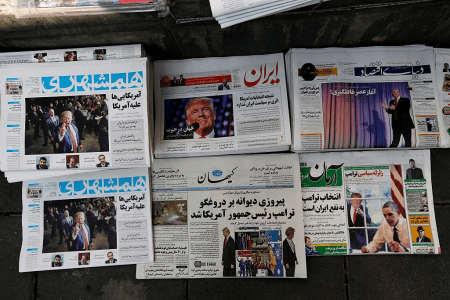
trump_election_iran_9-11-16Donald Trump’s ratings soar in Iranian media too

In more than one campaign speech, President elect Donald Trump declared that his number priority was “to dismantle the disastrous deal” with Iran, which he said was “the worst deal ever” He was referring to the 2015 accord negotiated with Iran by the 5P+1 (five Permanent Security Council members plus Germany), which the Obama administration presented as putting the lid on Iran’s nuclear weapons program.

Trump vowed to use force if necessary to prevent Tehran from acquiring the bomb.

So does Tehran have more to fear from Donald Trump than from Barack Obama in the way of US military intervention? They can’t be sure that he will not set out to show the world – and especially the Iranians – that under his presidency, they can no longer “mess with America.”

DEBKAfile’s Iranian sources report that the ayatollahs are concerned enough to seriously contemplate the following scenario.

The incoming president, after he takes office in the White House on Jan. 20, will act to raise America’s lame image in the Middle East by a surgical strike against an Iranian nuclear facility. One option projected is the blowing up of the Arak heavy water plant for plutonium production at the military complex city of Arak; another would be destroying an Iranian ballistic missile base.

Trump and the Republican-ruled Congress would certainly not tolerate Iranian breaches after America coughed up $150 billion in eased sanctions and released frozen assets.

A Trump administration would be able to marshal seven arguments to justify military action:

1. On Nov. 2, a week before the presidential election, the International Atomic Energy Agency (IAEA) in Vienna reported Iran in violation of the nuclear deal by producing 130.1 tons of heavy water at the Arak plant, one ton more than allowed. In past cases, the Iranians quickly exported the excess amount. But with a new US president on the way, they may try to use it as a one-ton test of his resolve.

2. In another challenge, Iran is threatening to renege unless more economic benefits are forthcoming.

2. The nuclear restrictions imposed under the deal end in about seven years, when Iran can start going back to its weapons program.

3.  Tehran never actually signed the 2014 nuclear deal in the first place. It has remained on paper on three pages as “The Joint Comprehensive Plan of Action Regarding the Islamic Republic of Iran’s Nuclear Program” announced in Lausanne on July 14, 2015 by US Secretary of State John Kerry and Iran’s Foreign Minister Muhammed Javad Zarif.

Three days later, Iran’s supreme leader Ayatollah Ali Khamenei commented: “Our policy will not change with regard to the arrogant US government.”

4. The document was eventually endorsed by the UN Security Council. This obliged the IAEA to follow up it its presumed commitments by inspections on the ground to confirm Iran’s compliance. However, because much of its content was kept under wraps, American and Iranian obligations have been hard to pin down.

5. The deal’s omissions are a lot clearer. Tehran is not committed to release information on its nuclear program prior to the date of the deal – including how far it had progressed towards a weapon.

6. The nuclear deal did not cover Iran’s long-range ballistic missile program, which continues to develop apace.

Ten months ago, the Obama administration tried to correct this omission by imposing fresh sanctions on Iran unless the program was curtailed. There is no information available up until now as to whether this deterrent worked.

7. US military action against Iran’s nuclear or missile programs may also serve the Trump administration to drive a wedge in the partnership between Moscow and Tehran and draw a new line in the sands of the Middle East. The Russians would certainly not step in by force in Iran’s defense, except for possibly sharing some intelligence. Moscow would be shown as failing to back its ally and therefore secure the gains Vladimir Putin managed to  amass in the Middle East  when Obama was president.

Europe’s Planned Migrant Revolution

Posted November 12, 2016 by danmillerinpanama
Categories: Europe, Islamic integration, Islamic invasion, Islamisation

Tags: , , ,

Europe’s Planned Migrant Revolution, Gatestone Institute, Yves Mamou, November 12, 2016

Between 2005 to 2014, Germany welcomed more than 6,000,000 people.

Two essential questions about integration must be put on the table: 1) What do we ask of newcomers? And 2) What do we do to those who do not accept our conditions? In Europe, these two questions of integration were never asked of anyone.

In the new migrant order, the host population is invited to make room for the newcomer and bear the burden not of what is an “integration,” but the acceptance of a coerced coexistence.

“No privileges are granted to the Europeans or to their heritage. All cultures have the same citizenship. There is no recognition of a substantial European culture that it might be useful to preserve.” — Michèle Tribalat, sociologist and demographer.

“We need people that we welcome to love France.” — French Archbishop Pontier, Le Monde, October 2016.<

When “good feelings” did not work, however, the authorities have often criminalized and prosecuted anti-immigration critics. The Dutch politician Geert Wilders is currently on trial for trying to defend his country from Moroccan immigrants whose skyrocketing crime wave has been transforming the Netherlands.


Everyone now knows — even German Chancellor Angela Merkel — that she committed a political mistake in opening the doors of her country to more than a million migrants from the the Middle East, Africa and Asia. It was, politically, a triple mistake:

  • Merkel may have thought that humanitarian motives (the war in Syria and Iraq, the refugee problem) could help Germany openly pursue a migration policy that was initially launched and conducted in the shadows.
  • Merkel mainly helped to accelerate the defense mechanisms against the transformation of German society and culture into a “multicultural” space — the “multi” being a segregated, Islamic way of life. The anti-immigration party Alternative for Germany (AfD) is now a big player on the German political scene.
  • Merkel raised anxiety all over Europe about the migrant problem. She might even have encouraged the United Kingdom to Brexit and pushed central European countries such as Hungary to the point of seceding from the European Union.

For many years, Germany was the country in Europe most open to immigration. According to Eurostat, the official data body of the European Union, between 2005 to 2014, Germany welcomed more than 6 million people. [1]

Not all six million people came from Middle East. The vast majority of them, however, were not from Europe. Clandestine immigration is not, of course, included in these figures.

Other countries also participated in a migrant race. In the same time frame, 2005-2014, three million people immigrated to France, or around 300,000 people a year. In Spain, the process was more chaotic: more than 700,000 migrants in 2005; 840,000 in 2006; almost a million in 2007 and then a slow decrease to 300,000 a year up to 2014.

The “refugee crisis,” in fact, helped to make apparent what was latent: that behind humanitarian reasons, a huge official immigration policy in Europe was proceeding apace. For economic reasons, Europe had openly decided years ago to encourage a new population to enter, supposedly to compensate for the dramatic projected shrinking of Europe’s native population.

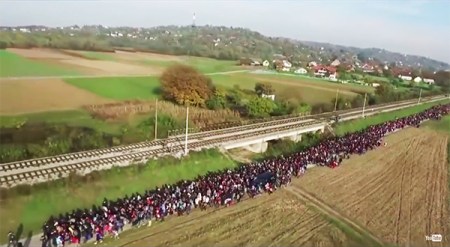
1340Thousands of migrants cross illegally into Slovenia on foot, in this screenshot from YouTube video filmed in October 2015.

According to population projections made by Eurostat in 2013, without migrants, Europe’s population would decline from 507.3 million in 2015 to 399.2 million by 2080. In roughly 65 years, a hundred million people (20%) would disappear. Country by country, the figures seemed even were more terrifying. By 2080, in Germany, 80 million people today would become 50 million. In Spain, 46.4 million people would become 30 million. In Italy, 60 million would decline to 39 million.

Some countries would be more stable: by 2080, France, with 66 million in 2015 would grow to 68.7 million, and England, with 67 million in 2015, would shrink only to approximately 65 million.

Is migration in itself a “bad” thing? Of course not. Migration from low-income countries to higher-income countries is almost a law of nature. As long as the number of births and deaths remains larger than the number of migrants, the result is considered beneficial. But when migration becomes the major contributor to population growth, the situation changes and what should be a simple evolution becomes a revolution.

It is a triple revolution:

  1. Because the number of migrants is huge. The 2015 United Nations World Population Prospects report states: “Between 2015 and 2050, total births in the group of high-income countries are projected to exceed deaths by 20 million, while the net gain in migrants is projected to be 91 million. Thus, in the medium variant, net migration is projected to account for 82 per cent of population growth in the high-income countries.”
  2. Because of the culture of the migrants. Most of them belong to a Muslim and Arabic (or Turkish) culture, which was in an old and historical conflict with the (still?) dominant Christian culture of Europe. And mainly, because this Muslim migration process happens at a historic moment of a radicalization of the world’s Muslim population.
  3. Because each European state is in position of weakness. In the process of building the European Union, national states stopped considering themselves as the indispensable integrator tool of different regional cultures inside a national frame. On the contrary, to prevent the return of large-scale chauvinistic wars such as World War I and World War II, all European nation-states engaged in the EU process and decided to program their own disappearance by transferring more and more power to a bureaucratic, unelected and untransparent executive Commission in Brussels. Not surprisingly, alongside Islamist troubles in all European countries, weak European states have now to cope with the strong resurgence of secessionist and regionalist movements, such as Corsica in France, Catalonia in Spain, and Scotland and Wales in United Kingdom.

Why did France, Germany and many other countries of the European Union opt for massive immigration, without saying it and without letting voters debate it? Perhaps because they thought a new population of taxpayers could help save their healthcare and retirement systems. To avoid the bankruptcy of social security and the social troubles of “dissatisfied retirees,” the EU took the risk of transforming more or less homogenous nation-states into multicultural societies.

Politicians and economists seem blind to multicultural conflicts. They seem not even to suspect the importance of identity questions and religious topics. These questions belong to nations and since WW II, “the nation” is considered “bad.” In addition, politicians and economists appear to think any cultural and religious problem is a secondary question. Despite the growing threat of Islamist terrorism (internal and imported from the Middle East), for example, they seem to persist in thinking that any violent domestic conflict can be dissolved in a “full-employment” society. Most of them seem to believe in U.S. President Barack Obama’s imaginary jobs-for-jihadists solution to terrorism.

To avoid cultural conflicts (Muslim migrants vs non-Muslim natives) Germany could, of course, have imported people from the countries of Europe where there were no jobs: France, Spain, Italy. But this “white” workforce is considered “expensive” by big companies (construction, care-givers and all services…) who need cheap imported workers no matter the area (Middle East, Turkey, Northern Africa) they are coming from. Internal migration inside the EU would not have solved either the main problem of a projected shrinking European population as a whole. Added to that, in a world where competition is transferred partially from nations to global regions, the might of European countries might be thought to lie in their population numbers.

Can Europe borrow a Muslim population from Turkey, Northern Africa, sub-Saharan Africa and the Middle East, and become a European world power, based on a population that is multicultural and multi-religious?

In theory, one can do that. But to succeed and avoid being crossed, day after day, by racial and religious tensions, two essential questions about integration must be put on the table: 1) What do we ask of newcomers? And 2) What do we do to those who do not accept our conditions?

In other words, integration is an asymmetrical process where the newcomer is expected to produce the effort to adapt.

Of course, if the flow of migrants is big, the host society will change, but that is evolution; the sense of cultural and historical continuity will not be demanded into a decline.

In Europe, these two questions of integration were never asked of anyone. According to Michèle Tribalat, sociologist and demographer:

“EU countries agreed at the Council of 19 November 2004, on eleven common basic principles to which to commit. When it is question of integration they disclaim any asymmetry between the host society and newcomers. No privileges are granted to the Europeans or to their heritage. All cultures have the same citizenship. There is no recognition of a substantial European culture that it might be useful to preserve. The social bond is designed as a horizontal one, between the people in the game. Its vertical dimension in reference to history and to the past seems to be superfluous. They speak about values, but these values appear to be negotiable”.

In France, in Germany, and in Sweden, it became rapidly clear that growing flow of a radicalized Muslim population began to change the rules of the integration game. The migrants did not have to “adapt” and are free to reproduce their religious and cultural habits. By contrast, the local “natives” were ordered not to resist “environmental” changes produced by immigration. When they tried to resist anyway, a political and media machine began to criminalize their “racist” behavior and supposed intolerance.

In the new migrant order, the host population is expected to make room for the newcomer and bear the burden of not what is “integration”, but the acceptance of a coerced coexistence.

France’s Archbishop Pontier declared to Le Monde in October 2016:

“We need people that we welcome to love France. If we always offer a negative view, they cannot love the country. However, if we see them as people who bring us something new, we get to grow together”.

When “good feelings” did not work, however, the authorities have often criminalized and prosecuted anti-immigration critics. The Dutch politician Geert Wilders is currently on trial for trying to defend his country from Moroccan immigrants whose skyrocketing crime wave has been transforming the Netherlands.

He may go to jail for as long as a year and could be fined a maximum of ‎€7,400 ($7,000 USD).

In France, the Paris prosecutor opened a preliminary investigation for an “apologia of terrorism” against the anti-immigration writer Eric Zemmour. In an interview with the magazine Causeur, published October 6, Zemmour said that “Muslims must choose” between France and Islam. He added that he had “respect for jihadists willing to die for what they believe.” The Paris prosecutor chose to take this sentence out of context to prosecute him.

Will this double movement — the injunction to love Islam plus criminalizing anti-Islam critics — be enough to kill off any opposition to the EU’s migration policy, and serve to Islamize the continent?

We shall find out.

______________________

[1] Statistical breakdown:

  • 707.352 migrants in 2005
  • 661.855 in 2006
  • 680.766 in 2007
  • 682.146 in 2008
  • 346.216 in 2009
  • 404.055 in 2010
  • 489.422 in 2011
  • 592.175 in 2012
  • 692.713 in 2013
  • 884.893 in 2014

Steep Learning Curve: DNC Staff Rally Behind Brazile As Democratic Leaders Reportedly Groom Chelsea For Congress

Posted November 12, 2016 by danmillerinpanama
Categories: Chelsea Clinton, Clinton campaign, Clinton Foundation, Democrat National Committee, Donna Brazile

Tags: , , , ,

Steep Learning Curve: DNC Staff Rally Behind Brazile As Democratic Leaders Reportedly Groom Chelsea For Congress, Jonathan Turley’s Blog, Jonathan Turley, November 12, 2016

donna


chelsea_clinton_dnc_july_2016_cropped

For even the armchair political commentator, the results of this election were not surprising. The voters made two things clear from the outset of the election: they wanted a change from the establishment and they did not like Hillary Clinton. The Democratic leadership responded by engineering the selection of perhaps the greatest establishment figure in politics and someone with a record level of unpopularity with voters. On election day, voters followed through on every poll: they voted against Clinton and the establishment. Only the mainstream media and democratic insiders seemed bowled over by the news — shocked that the voters would reject their sage advice and lopsided coverage. Indeed, as someone who contributed to the coverage that night, I was shocked how shocked everyone was. It showed how entirely out of touch the core Democratic leadership (and media) has become. Now, that thick cloak of denial appears firmly in place as Democrats blame FBI Director Comey for the loss despite the fact that Hillary was declining in the polls before his late disclosure to Congress and the fact that Hillary set records on dishonesty in poll after poll. Two stories this week have brought this home. One was the rallying behind Donna Brazile by DNC staff last week with the notable exception of one man who confronted both Brazile and his colleagues. The second is the report that Democratic leaders immediately turned form Hillary Clinton’s historic defeat to start grooming Chelsea Clinton for political office. The problem it seems was that the public was not given enough Clintons. Faced with a populist uprising, the Democratic leadership seems to be offering more of the same like an actor who cannot move beyond one script and one role.

We have previously discussed the unethical actions of interim DNC chief Brazile and the conspicuous failures of the media to investigate her claims of altered emails. While CNN Worldwide President Jeff Zucker called Brazile’s actions “disgusting” and others have denounced her actions, the DNC has stuck with Brazile and she recently appeared before staff to given them a pep talk.

The event however did not turn out quite as planned when one staffer had had enough. According to The Huffington Post, a staffer named Zach asked “Why should we trust you as chair to lead us through this? You backed a flawed candidate, and your friend [former DNC chairwoman Debbie Wasserman Schultz] plotted through this to support your own gain and yourself.” He continued by saying “You are part of the problem. You and your friends will die of old age and I’m going to die from climate change. You and your friends let this happen, which is going to cut 40 years off my life expectancy.”

He then left — a personification for millions of independents and Democrats who abandoned the party to elect Donald Trump.

Nevertheless, the rest of the DNC rallied behind Brazile and gave breathless accounts of her inspiring leadership. A DNC staffer told HuffPost that there was “overwhelming” support for Brazile and that her words “had some staffers in tears.” That would be welcomed news for Republican strategists. It is also worth noting that, after emails showed that Debbie Wasserman-Shultz (Brazile’s predecessor) had worked to rig the primary and dealt dishonestly with Sanders, she was overwhelmingly reelected and embraced by the DNC leadership.

The second story is even more curious. Many viewed the election as the ultimate rejection of the Clinton dynasty that has controlled the Democratic party for over a decade. The Clintons put their family and its “brand” front and center in this election . . . and voters rejected it. However, within hours of the defeat, Democratic leaders were reportedly turning to Chelsea Clinton as the new flag bearer. Clinton, 36, is reportedly being groomed by the same leadership to replace Rep. Nita Lowey, 79, in representing New York’s 17th District. Of course, Chelsea does not live there but the district covers part of Westchester County, including Bill and Hillary Clinton’s hometown of Chappaqua.

Chelsea was previously given a high-ranking media position with disastrous results— a move that was denounced by journalists as political connections overwhelming journalistic merit. Her role in the Clinton Foundation has come under fire. However, the greatest problem is that her resume is largely the result of her family and foundation ties.

The question is whether the Democrats are going to spin the result of this election and deny reality when, in two years, they will be facing the inverse of this election: more Democratic seats will be up for grabs and Trump could receive a super majority in Congress, including a veto-proof margin.

I am an independent and do not have a horse in this race. However, in speaking with my Democratic students, they express complete separation from the Democratic leadership and the establishment politics that it has come to represent. I come from a long-standing Democratic and liberal family in Chicago. When I was raised in that environment, the Democratic party was the populist party — the voice of the outsider and emerging constituencies. Now it is viewed as the party of insiders and establishment power brokers. There may be enough unhappy members (particularly Sanders people) to change the party, but these stories do not help with that image.

It seems to me that, if the Democrats want to resurrect their party, it will require entirely new leadership and a new vision to fit an increasing independent populace.

What do you think?

4 killed as blast rocks US Bagram airbase in Afghanistan

Posted November 12, 2016 by Peter Hofman
Categories: Uncategorized

4 killed as blast rocks US Bagram airbase in Afghanistan

Published time: 12 Nov, 2016 04:51 Edited time: 12 Nov, 2016 09:43

Source: 4 killed as blast rocks US Bagram airbase in Afghanistan — RT News


An explosion rocked Bagram airfield, the largest US base in Afghanistan, early Saturday morning, killing at least four people and injuring 14 others, according to a NATO-led Resolute Support Mission press release.

“An explosive device was detonated on Bagram Airfield resulting in multiple casualties. Four people have died in the attack and approximately 14 have been wounded,” Resolute Support said in a statement.
The mission added that response teams are investigating the incident.

https://twitter.com/ResoluteSupport/status/797323011502309376/photo/1?ref_src=twsrc%5Etfw

The blast was caused by a man wearing a suicide west, NBC News reported, citing a senior US official. The attacker chose the time and location because he “was looking for an opportunity to do the most damage,” the official added.

The Taliban has claimed responsibility for the attack, according to a statement of the group’s spokesman Zabihullah Mujahid on Twitter, Reuters reported.

Bagram Airfield is the largest US military base in Afghanistan and is located in the Parwan Province of Afghanistan. Bagram is currently maintained by the Combined Joint Task Force 1st Cavalry Division (CJTF-1). The base is mainly occupied by the International Security Assistance Force (ISAF), and occasionally used by the United States Armed Forces.

The airfield has a dual runway capable of handling heavy military aircraft, such as the Lockheed Martin C-5 Galaxy or Russian Antonov An-225.

The American military presence in Afghanistan has been largely scaled down since the US invasion to oust the Taliban government in October 2001. The NATO combat mission in Afghanistan officially ended in 2014, when responsibility for the nation’s security was handed over to domestic forces. Approximately 10,000 US troops remain in the country as part of NATO’s “Resolute Support” mission.