Dr. Jasser reacts to a Seattle judge’s ruling regarding the travel ban 02.07.2017, AIFD via YouTube, February 7, 2017
(Please see also, A Maniac is Running Our Foreign Policy! (It’s Not Trump). — DM)
Dr. Jasser reacts to a Seattle judge’s ruling regarding the travel ban 02.07.2017, AIFD via YouTube, February 7, 2017
(Please see also, A Maniac is Running Our Foreign Policy! (It’s Not Trump). — DM)
Smoking Out Islamists via Extreme Vetting, Middle East Forum, Daniel Pipes, January 28, 2017(?)
(Please see also, A Muslim Reformer Speaks Out About His Battle Against Islamism And PC. — DM)
On January 27, President Donald Trump signed an executive order to implement his proposed “extreme vetting” of those applying for entry visas into the United States. This article by Middle East Forum President Daniel Pipes, who has written extensively on the practicality and enforceability of screening for Islamists, is an advance release from the forthcoming Spring 2017 issue of Middle East Quarterly.
 Smoking Them Out (1906), Charles M. Russell.
Donald Trump issued an executive order on Jan. 27 establishing radically new procedures to deal with foreigners who apply to enter the United States.
Building on his earlier notion of “extreme vetting,” the order explains that
to protect Americans, the United States must ensure that those admitted to this country do not bear hostile attitudes toward it and its founding principles. The United States cannot, and should not, admit those who do not support the Constitution, or those who would place violent ideologies over American law. In addition, the United States should not admit those who engage in acts of bigotry or hatred (including “honor” killings, other forms of violence against women, or the persecution of those who practice religions different from their own) or those who would oppress Americans of any race, gender, or sexual orientation.
This passage raises several questions of translating extreme vetting in practice: How does one distinguish foreigners who “do not bear hostile attitudes toward it and its founding principles” from those who do? How do government officials figure out “those who would place violent ideologies over American law”? More specifically, given that the new procedures almost exclusively concern the fear of allowing more Islamists into the country, how does one identify them?
I shall argue these are doable tasks and the executive order provides the basis to achieve them. At the same time, they are expensive and time-consuming, demanding great skill. Keeping out Islamists can be done, but not easily.
By Islamists (as opposed to moderate Muslims), I mean those approximately 10-15 percent of Muslims who seek to apply Islamic law (the Shari’a) in its entirety. They want to implement a medieval code that calls (among much else) for restricting women, subjugating non-Muslims, violent jihad, and establishing a caliphate to rule the world.
For many non-Muslims, the rise of Islamism over the past forty years has made Islam synonymous with extremism, turmoil, aggression, and violence. But Islamists, not all Muslims, are the problem; they, not all Muslims, must urgently be excluded from the United States and other Western countries. Not just that, but anti-Islamist Muslims are the key to ending the Islamist surge, as they alone can offer a humane and modern alternative to Islamist obscurantism.
Identifying Islamists is no easy matter, however, as no simple litmus test exists. Clothing can be misleading, as some women wearing hijabs are anti-Islamists, while practicing Muslims can be Zionists; nor does one’s occupation indicate much, as some high-tech engineers are violent Islamists. Likewise, beards, teetotalism, five-times-a-day prayers, and polygyny do not tell about a Muslim’s political outlook. To make matters more confusing, Islamists often dissimulate and pretend to be moderates, while some believers change their views over time.
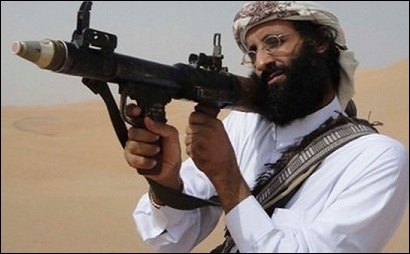 In 2001, the Pentagon invited Anwar al-Awlaki to lunch. In 2011, it killed him by a drone strike.
Finally, shades of gray further confuse the issue. As noted by Robert Satloff of The Washington Institute, a 2007 book from the Gallup press, Who Speaks for Islam? What a Billion Muslims Really Think, based on a poll of over 50,000 Muslims in 10 countries, found that 7 percent of Muslims deem the 9/11 attacks “completely justified,” 13.5 percent consider the attacks completely or “largely justified,” and 36.6 percent consider the attacks completely, largely, or “somewhat justified.” Which of these groups does one define as Islamist and which not?
Faced with these intellectual challenges, American bureaucrats are unsurprisingly incompetent, as I demonstrate in a long blog titled “The U.S. Government’s Poor Record on Islamists.” Islamists have fooled the White House, the departments of Defense, Justice, State, and Treasury, the Congress, many law enforcement agencies and a plethora of municipalities. A few examples:
Fake-moderates have fooled even me, despite all the attention I devote to this topic. In 2000, I praised a book by Tariq Ramadan; four years later, I argued for his exclusion from the United States. In 2003, I condemned a Republican operative named Kamal Nawash; two years later, I endorsed him. Did they evolve or did my understanding of them change? More than a decade later, I am still unsure.
Returning to immigration, this state of confusion points to the need for learning much more about would-be visitors and immigrants. Fortunately, Trump’s executive order, “Protecting the Nation from Foreign Terrorist Entry into the United States,” signed on Jan. 27, 2017, requires just this. It calls for “Uniform Screening Standards” with the goal of preventing individuals from entering the United States “on a fraudulent basis with the intent to cause harm, or who are at risk of causing harm subsequent to their admission.” The order requires that the uniform screening standard and procedure include such elements as (bolding is mine):
Elements 1, 3, 5, and 6 permit and demand the procedure outlined in the following analysis. It contains two main components, in-depth research and intensive interviews.
When a person applies for a security clearance, the background checks should involve finding out about his family, friends, associations, employment, memberships, and activities. Agents must probe these for questionable statements, relationships, and actions, as well as anomalies and gaps. When they find something dubious, they must look further into it, always with an eye for trouble. Is access to government secrets more important than access to the country? The immigration process should start with an inquiry into the prospective immigrant and, just as with security clearances, the border services should look for problems.
 Most everyone with strong views at some point vents them on social media.
Also, as with security clearance, this process should have a political dimension: Does the person in question have an outlook consistent with that of the Constitution? Not long ago, only public figures such as intellectuals, activists, and religious figures put their views on the record; but now, thanks to the Internet and its open invitation to everyone to comment in writing or on video in a permanent, public manner, and especially to social media (Facebook, Twitter, etc.), most everyone with strong views at some point vents them. Such data provides valuably unfiltered views on many critical topics, such as Islam, non-Muslims, women, and violence as a tactic. (Exploiting this resource may seem self-evident but U.S. immigration authorities do not do so, thereby imposing a self-restraint roughly equivalent to the Belgian police choosing not to conduct raids between 9 p.m. and 5 a.m.)
In the case of virulent, overt, outspoken jihadis, this research usually suffices to provide evidence to exclude them. Even some non-violent Islamists proudly announce their immoderation. But many Islamists adopt a milder and subtler tone, their goal being to appear moderate so they can enter the country and then impose Shari’a through lawful means. As suggested by some of the examples above, such as Abou El Fadl or CAIR, research often proves inadequate in these instances because cautious Islamists hide their goals and glibly dissimulate. Which brings us to entrance interviews.
Assuming that lawful Islamists routinely hide their true views, an interview is needed before letting them enter the country. Of course, it is voluntary, for no one is forced to apply for immigration, but it also must be very thorough. It should be:
Recorded: With the explicit permission of the person being questioned (“You understand and accept that this interview is being recorded, right?”), the exchange should be visibly videotaped so the proceedings are unambiguously on the record. This makes available the interviewee’s words, tone, speech patterns, facial expressions, and body language for further study. Form as well as substance matters: does the interviewee smile, fidget, blink, make eye contact, repeat, sweat, tremble, tire, need frequent toilet breaks, or otherwise express himself in non-verbal ways?
Polygraph: Even if a lie detector machine does not, in fact, provide useful information, attaching the interviewee to it might induce greater truth-telling.
Under oath: Knowing that falsehoods will be punished, possibly with jail time, is a strong inducement to come clean.
Public: If the candidate knows that his answers to abstract questions (as opposed to personal ones about his life) will be made public, this reduces the chances of deception. For example, asked about belief for the full application of Islamic laws, an Islamist will be less likely to answer falsely in the negative if he knows that his reply will be available for others to watch.
 Look for inconsistency by asking the same thing in different ways. An example: “May a woman show her face in public?” and “Is a male guardian responsible for making sure his women-folk don’t leave the house with faces uncovered?
Multiple: No single question can evince a reply that establishes an Islamist disposition; effective interviewing requires a battery of queries on many topics, from homosexuality to the caliphate. The answers need to be assessed in their totality.
Specific: Vague inquiries along the lines of “Is Islam a religion of peace?”, “Do you condemn terrorism?” “How do you respond to the murder of innocents,” depend too much on one’s definition of words such as peace, terrorism, and innocents to help determine a person’s outlook, and so should be avoided. Instead, questions must be focused and exact: “May Muslims convert out of Islam, whether to join another faith or to become atheists?” “Does a Muslim have the right to renounce Islam?”
Variety in phrasing: For the questions to ferret out the truth means looking for divergence and inconsistency by asking the same question with different words and variant emphases. A sampling: “May a woman show her face in public?” “What punishment do you favor for females who reveal their faces to men not related to them by family?” “Is it the responsibility of the male guardian to make sure his women-folk do not leave the house with faces uncovered?” “Should the government insist on women covering their faces?” “Is society better ordered when women cover their faces?” Any one of the questions can be asked in different ways and expanded with follows-up about the respondent’s line of reasoning or depth of feeling.
Repeated: Questions should be asked again and again over a period of weeks, months, and even longer. This is crucial: lies being much more difficult to remember than truths, the chances of a respondent changing his answers increases with both the volume of questions asked and the time lapse between questionings. Once inconsistencies occur, the questioner can zero in and explore their nature, extent, and import.
Guidelines in place, what specific questions might extract useful information?
 Zuhdi Jasser (L) with the author as teammates at a 2012 Intelligence Squared debate in New York City.
The following questions, offered as suggestions to build on, are those of this author but also derive from a number of analysts devoting years of thinking to the topic. Naser Khader, the-then Danish parliamentarian of Syrian Muslim origins, offered an early set of questions in 2002. A year later, this author published a list covering seven subject areas.
Others followed, including the liberal Egyptian Muslim Tarek Heggy, the liberal American Muslims Tashbih Sayyed and Zuhdi Jasser, the ex-Muslim who goes by “Sam Solomon,” a RAND Corporation group, and the analyst Robert Spencer. Of special interest are the queries posed by the German state of Baden-Württemberg dated September 2005 because it is an official document (intended for citizenship, not immigration, but with similar purposes).
Islamic doctrine:
1. May Muslims reinterpret the Koran in light of changes in modern times?
2. May Muslims convert out of Islam, either to join another faith or to be without religion?
3. May banks charge reasonable interest (say 3 percent over inflation) on money?
4. Is taqiya (dissimulation in the name of Islam) legitimate?
Islamic pluralism:
5. May Muslims pick and choose which Islamic regulations to abide by (e.g., drink alcohol but avoid pork)?
6. Is takfir (declaring a Muslim to be an infidel) acceptable?
7. [Asked of Sunnis only:] Are Sufis, Ibadis, and Shi’ites Muslims?
8. Are Muslims who disagree with your practice of Islam infidels (kuffar)?
The state and Islam:
9. What do you think of disestablishing religion, that is, separating mosque and state?
10. When Islamic customs conflict with secular laws (e.g., covering the face for female drivers’ license pictures), which gets priority?
11. Should the state compel prayer?
12. Should the state ban food consumption during Ramadan and penalize transgressors?
13. Should the state punish Muslims who eat pork, drink alcohol, and gamble?
14. Should the state punish adultery?
15. How about homosexuality?
16. Do you favor a mutawwa’ (religious police) as exist in Saudi Arabia?
17. Should the state enforce the criminal punishments of the Shari’a?
18. Should the state be lenient when someone is killed for the sake of family honor?
19. Should governments forbid Muslims from leaving Islam?
Marriage and divorce:
20. Does a husband have the right to hit his wife if she is disobedient?
21. Is it a good idea for men to shut their wives and daughters at home?
22. Do parents have the right to determine whom their children marry?
23. How would you react if a daughter married a non-Muslim man?
24. Is polygyny acceptable?
25. Should a husband have to get a first wife’s approval to marry a second wife? A third? A fourth?
26. Should a wife have equal rights with her husband to initiate a divorce?
27. In the case of divorce, does a wife have rights to child custody?
Female rights:
28. Should Muslim women have equal rights with men (for example, in inheritance shares or court testimony)?
29. Does a woman have the right to dress as she pleases, including showing her hair, arms and legs, so long as her genitalia and breasts are covered?
30. May Muslim women come and go or travel as they please?
31. Do Muslim women have a right to work outside the home or must the wali approve of this??
32. May Muslim women marry non-Muslim men?
33. Should males and females be separated in schools, at work, and socially?
34. Should certain professions be reserved for men or women only? If so, which ones?
35. Do you accept women occupying high governmental offices?
36. In an emergency, would you let yourself be treated by or operated on by a doctor of the opposite gender?
Sexual activity:
37. Does a husband have the right to force his wife to have sex?
38. Is female circumcision part of the Islamic religion?
39. Is stoning a justified punishment for adultery?
40. Do members of a family have the right to kill a woman if they believe she has dishonored them?
41. How would you respond to a child of yours who declares him- or herself a homosexual?
Schools:
42. Should your child learn the history of non-Muslims?
43. Should students be taught that Shari’a is a personal code or that governmental law must be based on it?
44. May your daughter take part in the sports activities, especially swimming lessons, offered by her school?
45. Would you permit your child to take part in school trips, including overnight ones?
46. What would you do if a daughter insisted on going to university?
Criticism of Muslims:
 Denying the Islamic nature of ISIS reveals much about a Muslim.
47. Did Islam spread only through peaceful means?
48. Do you accept the legitimacy of scholarly inquiry into the origins of Islam, even if it casts doubt on the received history?
49. Do you accept that Muslims were responsible for the 9/11 attacks?
50. Is the Islamic State/ISIS/ISIL/Daesh Islamic in nature?
Fighting Islamism:
51. Do you accept enhanced security measures to fight Islamism, even if this might mean extra scrutiny of yourself (for example, at airline security)?
52. When institutions credibly accused of funding jihad are shut down, is this a symptom of anti-Muslim bias?
53. Should Muslims living in the West cooperate with law enforcement?
54. Should they join the military?
55. Is the “war on terror” a war on Islam?
Non-Muslims (in general):
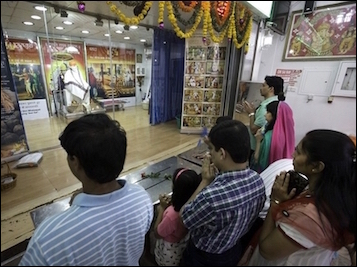 Praying at the Hindu Temple in Dubai, founded 1958.
56. Do all humans, regardless of gender, ethnicity, sexual orientation or religious beliefs, deserve equal rights?
57. Should non-Muslims enjoy completely equal civil rights with Muslims?
58. Do you accept the validity of other monotheistic religions?
59. Of polytheistic religions (such as Hinduism)?
60. Are Muslims superior to non-Muslims?
61. Should non-Muslims be subject to Islamic law?
62. Do Muslims have anything to learn from non-Muslims?
63. Can non-Muslims go to paradise?
64. Do you welcome non-Muslims to your house and go to their residences?
Non-Muslims (in Dar al-Islam):
65. May Muslims compel “Peoples of the Book” (i.e., Jews and Christians) to pay extra taxes?
66. May other monotheists build and operate institutions of their faith in Muslim-majority countries?
67. How about polytheists?
68. Should the Saudi government maintain the historic ban on non-Muslims in Mecca and Medina?
69. Should it allow churches to be built for Christian expatriates?
70. Should it stop requiring that all its subjects be Muslim?
Non-Muslims (in Dar al-Harb):
71. Should Muslims fight Jews and Christians until these “feel themselves subdued” (Koran 9:29).
72. Is the enslavement of non-Muslims acceptable?
73. Is it acceptable to arrest individuals who curse the prophet of Islam or burn the Koran?
74. If the state does not act against such deeds, may individual Muslims act?
75. Can one live a fully Muslim life in a country with a mostly non-Muslim government?
76. Should a Muslim accept a legitimate majority non-Muslim government and its laws or work to make Islam supreme?
77. Can a majority non-Muslim government unreservedly win your allegiance?
78. Should Muslims who burn churches or vandalize synagogues be punished?
79. Do you support jihad to spread Islam?
Violence:
80. Do you endorse corporal punishments (mutilation, dismemberment, crucifixion) of criminals?
81. Is beheading an acceptable form of punishment?
82. Is jihad, meaning warfare to expand Muslim rule, acceptable in today’s world?
83. What does it mean when Muslims yell “Allahu Akbar” as they attack?
84. Do you condemn violent organizations such as Boko Haram, Hamas, Hezbollah, Islamic Jihad, the Islamic State, Al-Qaeda, Shabaab, and the Taliban?
Western countries:
85. Are non-Islamic institutions immoral and decadent or can they be moral and virtuous?
86. Do you agree with studies that show non-Muslim countries such as New Zealand to be better living up to the ideals of Islam than Muslim-majority countries?
87. Is Western-style freedom an accomplishment or a form of moral corruption? Why?
88. Do you accept that Western countries are majority-Christian or do you seek to transform them into majority-Muslim countries?
89. Do you accept living in Western countries that are secular or do you seek to have Islamic law rule them?
90. What do you think of Shari’a-police patrolling Muslim-majority neighborhoods in Western countries to enforce Islamic morals?
91. Would you like to see the U.S. Constitution (or its equivalents in other countries) replaced by the Koran?
This interview:
92. In an immigration interview like this, if deceiving the questioner helps Islam, would lying be justified?
93. Why should I trust that you have answered these questions truthfully?
Beyond helping to decide whom to allow into the country, these questions can also help in other contexts as well, for example in police interrogations or interviews for sensitive employment positions. (The list of Islamists who have penetrated Western security services is a long and painful one.)
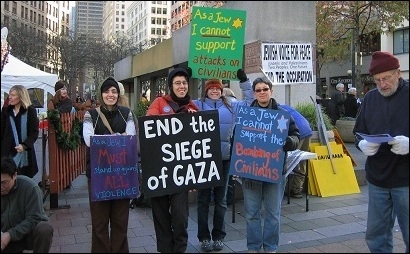 Islamists are hardly the only ones who condemn Israel. Here Jewish Voice for Peace activists protest.
Note the absence of questions about highly charged current issues. That is because Islamist views overlap with non-Islamist outlooks; plenty of non-Islamists agree with Islamists on these topics. Although Leil Leibowitz in contrast sees Israel as “moderate Islam’s real litmus test,” Islamists are hardly the only ones who demand Israel’s elimination and accept Hamas and Hezbollah as legitimate political actors – or believe the Bush administration carried out the 9/11 attacks or hate the United States. Why introduce these ambiguous issues when so many Islam-specific questions (e.g., “Is the enslavement of non-Muslim acceptable?”) have the virtue of far greater clarity?
The interviewing protocol outlined above is extensive, asking many specific questions over a substantial period using different formulations, probing for truth and inconsistencies. It is not quick, easy, or cheap, but requires case officers knowledgeable about the persons being interviewed, the societies they come from, and the Islamic religion; they are somewhat like a police questioner who knows both the accused person and the crime. This is not a casual process. There are no shortcuts.
This procedure raises two criticisms: it is less reliable than Trump’s no-Muslim policy and it is too burdensome for governments to undertake. Both are readily disposed of.
Less reliable: The no-Muslim policy sounds simple to implement but figuring out who is Muslim is a problem in itself (are Ahmadis Muslims?). Further, with such a policy in place, what will stop Muslims from pretending to renounce their religion or to convert to another religion, notably Christianity? These actions would require the same in-depth research and intensive interviews as described above. If anything, because a convert can hide behind his ignorance of his alleged new religion, distinguishing a real convert to Christianity from a fake one is even more difficult than differentiating an Islamist from a moderate Muslim.
Too burdensome: True, the procedure is expensive, slow, and requires skilled practitioners. But this also has the benefit of slowing a process that many, myself included, consider out of control, with too many immigrants entering the country too quickly. Immigrants numbered 5 percent of the population in 1965, 14 percent in 2015, and are projected to make up 18 percent in 2065. This is far too large a number to assimilate into the values of the United States, especially when so many come from outside the West; the above mechanism offers a way to slow it down.
As for those who argue that this sort of inquiry and screening for visa purposes is unlawful; prior legislation for naturalization, for example, required that an applicant be “attached to the principles of the Constitution” and it was repeatedly found to be legal.
Finally, today’s moderate Muslim could become tomorrow’s raging Islamist; or his infant daughter might two decades later become a jihadi. While any immigrant can turn hostile, such changes happen far more often among born Muslims. There is no way to guarantee this from happening but extensive research and interrogations reduce the odds.
Truly to protect the country from Islamists requires a major commitment of talent, resources, and time. But, properly handled, these questions offer a mechanism to separate enemy from friend among Muslims. They also have the benefit of slowing down immigration. Even before Trump became president, if one is to believe CAIR, the U.S. Customs and Border Protection Agency (CBP) asked questions along the lines of those advocated here (What do you think of the USA? What are your views about jihad? See the appendix for a full listing). With Trump’s endorsement, let us hope this effective “no-Islamists” policy is on its way to becoming systematic.
On January 18, 2017, just hours before Donald Trump became president of the United States, the Florida office of the Council on American-Islamic Relations (CAIR) filed ten complaints with the Customs and Border Protection Agency (CBP) for questioning Muslim citizens about their religious and political views. Among the questions allegedly asked were:
1. Are you a devout Muslim?
2. Are you Sunni or Shia?
3. What school of thought do you follow?
4. Which Muslim scholars do you follow?
5. What current Muslim scholars do you listen to?
6. Do you pray five times a day?
7. Why do you have a prayer mat in your luggage?
8. Why do you have a Qur’an in your luggage?
9. Have you visited Saudi Arabia?
10. Will you every visit Saudi or Israel?
11. What do you know about the Tableeghi-Jamat?
12. What do you think of the USA?
13. What are your views about Jihad?
14. What mosque do you attend?
15. Do any individuals in your mosque have any extreme/radical views?
16. Does your Imam express extremist views?
17. What are the views of other imams or other community members that give the Friday sermon at your mosque?
18. Do they have extremist views?
19. Have you ever delivered the Friday Prayer? What did you discuss with your community?
20. What are your views regarding [various terrorist organizations]?
21. What social media accounts do you use?
22. What is your Facebook account username?
23. What is your Twitter account username?
24. What is your Instagram account username?
25. What are the names and telephone numbers of parents, relatives, friends?
CAIR also claims a Canadian Muslim was asked by CBP the following questions and then denied entry:
1. Are you Sunni or Shia?
2. Do you think we should allow someone like you to enter our country?
3. How often do you pray?
4. Why did you shave your beard?
5. Which school of thought do you follow?
6. What do you think of America’s foreign policy towards the Muslim world?
7. What do you think of killing non-Muslims?
8. What do you think of [various terrorist groups]?
Finally, CAIR indicates that those questioned “were held between 2 to 8 hours by CBP.”
A Muslim Reformer Speaks Out About His Battle Against Islamism And PC, The Federalist, Steve Postal, January 30, 2017
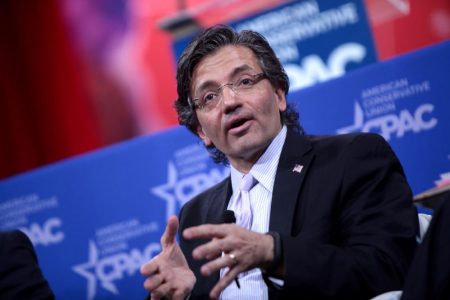
Dr. M. Zuhdi Jasser stands at the forefront of the Muslim Reform Movement (MRM), which celebrated its first anniversary on December 4, 2016. He and representatives from fourteen other Muslim reform groups formed the MRM, which held its inaugural press conference on December 5, 2015.
There, they announced their two-page declaration of principles that discusses counterterrorism, human rights, and secular governance. In a nod to Martin Luther nailing his 99 theses to the door of the All Saint’s Church in Wittenberg, Germany in 1517, several MRM members then taped their principles to the door of the Islamic Center of Washington DC.
The following is an interview with Dr. M. Zuhdi Jasser, CEO of the American Islamic Forum for Democracy (AIFD) and co-founder of the MRM. Jasser is a physician and former U.S. Navy officer whose parents fled Syria. Jasser agreed to reflect on the MRM’s one-year anniversary, the current battle between reformists and Islamists, and the Syrian Civil War.
Q (Postal): What is the MRM, and what are its main objectives?
A (Jasser): The Muslim Reform Movement is a coalition of diverse Muslim organizations and leaders. We wanted to articulate the versions of Islam that we knew and loved, and that were compatible with modernity. We determined that the clearest way to define ourselves was to create a simple “declaration” of principles and goals. The declaration is a firewall of principles that we as Westerners and “modern Muslims” who believe in freedom, liberty, and universal human rights would not compromise.
Whether it is the rejection of any Islamic state and its identity, any caliphate (a global unification of many Islamic states), or the institutionalization of sharia (Islamic jurisprudence as interpreted by Islamic jurists), our Muslim Reform Movement felt that the only way to truly counter-radicalize Muslims is through an unapologetic defense of the Universal Declaration of Human Rights (UDHR) and modern society. Our principles stand in stark contrast to the Cairo Declaration of Human Rights (of 1991) which was based in the interpretations of sharia of the Organization of Islamic Cooperation (OIC).
Q: What events spurred the creation of the MRM?
A: While each of us began separate journeys against Islamism after 9/11 (and some even before), it was the Arab Awakening that brought us all together. So-called “secular” military dictatorships across the Muslim majority world have been profoundly suffocating critical inquiry. (I say “so-called” because these dictatorships essentially govern with sharia.)
I would, for example, put Egypt, Jordan, Qatar, Saudi Arabia, and Syria in this category, though Turkey is a waning democracy cum Islamist dictatorship and Iran is an outright theocracy. Muslims cannot reform their interpretations of Islam under the boots of regimes that manifest interpretations of Islam through blasphemy, apostasy, and treason laws.
The Arab Awakening signaled to Muslims across the world that there was an opportunity for renewed critical thought by the people against the religious establishment and its tyrannical regimes. Unfortunately, since 2011, and perhaps even in the last 1,000 years, the Islamists were far better funded and organized. These opportunities gave way to large-scale violence, war, and chaos rather than heralding reform and modern institutions. Tunisia is thus far perhaps the one exception.
We reformists observed the rise of radical Islam’s attacks against the West since 9/11, and realized that we have a responsibility as Americans, patriotic Westerners, free thinkers, Muslims, and parents to counter and defeat the ideological underpinnings of Islamism.
Q: What accomplishments of the MRM have you seen in the past year? What are its goals?
A: Our greatest accomplishment to date is our declaration. While we are disappointed in the relative silence from most Muslim leaders, we recognize that their avoidance and inability to critique it has also demonstrated that it is on target. Our declaration has also withstood scrutiny from those who have been skeptical of the capacity of Muslims to have modern interpretations of Islam.
Given that we seek to counter a global theo-political establishment, our growth has certainly not been as rapid as we would like, but we are proud of how far we have come in a year.
Our successes as a coalition are highlighted by the successes of each of our respective organizations and leaders. I encourage readers of this interview to look into the works of each of these leaders, and help them make them known. Raheel Raza, Sohail Raza, and Hasan Mahmud with Muslims Facing Tomorrow in Toronto; Imam Usama Hasan with Quilliam Foundation in London; Asra Nomani, journalist and author; Farahnaz Ispahani, former member of Pakistan’s parliament, in Washington DC; Naser Khader in Denmark; myself, Courtney Lonergan, and Arif Humayun with our AIFD in Phoenix; Salma Siddiqui with the Coalition of Progressive Canadian Muslim Organizations in Canada; Tahir Gora, author, journalist, activist, in Toronto, Canada; Tawfik Hamid, Islamic thinker and reformer, Oakton, Virginia, to name a few, have all continued to grow in their programmatic reach.
We had our second annual retreat in Phoenix in October 2016 and expanded our strategic plan for the next few years. In 2017, we hope to see government, academia, media, and the interfaith establishment begin to give reformist Muslims from the MRM an equal seat at the table of any public conversations regarding Muslims and Islam.
On the government front, domestic and foreign policies should be directed by a “liberty doctrine” which engages Muslims positively on the principles embodied in our declaration and refutes those who reject any part or all of the declaration. Homeland security and foreign policy needs to focus more on “countering violent Islamism” rather than the nebulous “countering violent extremism.”
Q: In the MRM’s inaugural press conference, you said American mosques that reject the MRM’s declaration of principles are part of the problem, while those that accept the principles are part of the solution. How many mosques did the MRM approach? Did most of these mosques accept or reject these principles?
A: We spent significant resources on this outreach over a period of ten months. We reached out through snail mail, e-mail, and telephone to over 3,000 mosques and over 500 known public American Muslims. We received only 40-plus rather dismissive responses from our outreach, and sadly less than ten of them were positive. In fact, one mosque in South Carolina left us a vicious voice mail threatening our staff if we contacted them again.
We will continue to persevere with our outreach. On the one hand, we see the open hypocrisy of American Islamist groups effectively working together to sign documents, such as the recent “Open Letter to Donald Trump.” But to get their attention as reformists against Islamism, we face an uphill battle. If it’s grievances against Americans, people quickly sign on to almost anything. But getting people to sign on to an internal honest declaration of reform is like pulling teeth.
I can guess why we had shortcomings in outreach. If we had more funding, we could study this more scientifically. “Muslim” and “Islamic” institutions are often Islamist and thus unlikely to sign on to our declaration. Some estimate that 70-80 percent of Muslim organizations and mosques in the U.S. are die-hard Islamist. However, this needs to be put into an appropriate context. American Muslims, especially Sunni, are not tied to any clergy or organized “mosque” for faith practice or membership so the majority (60-70 percent) of American Muslims do not regularly participate in mosques or established Muslim institutions.
No one knows truly how that majority of Muslims feels about Islamist ideologies. National security is in desperate need of helping us study that. Our MRM is dedicated to creating new Western Muslim institutions outside the mosques and outside the “establishment” Islamist leadership to appeal to Muslims estranged from Islamist political tribalism. We have not been able to effectively reach out to the majority of Muslims because of resources and the absence of effective platforms.
Q: What are the key differences between Muslim reformers and Muslim Islamists?
A: Reformers reject any Islamic state and its legal apparatus empowered through sharia. Reformers believe that individual Muslims have a right to publicly criticize Muslim thought leaders and their legal interpretations. Islamists believe that democracy is majoritocracy and thus in countries where Muslims are a majority, the national identity should be “Islamic” or “Muslim” and sharia should govern the legal system. Islamists believe that the rights of all citizens come from Islam and the state’s legal system and public discourse should be based upon Islamic precepts and exegesis. They view the mosque and its pulpit as the center of that political movement.
Reformers, however, believe that the rights of all citizens come from God and thus all citizens, Muslim and non-Muslim, are created equal and the legal system and public discourse should be based in reason. Reformers believe rights belong to human beings, not to ideas, while Islamists believe that the legal system should protect certain ideas (like Islam) from public defamation. Islamists believe in some form of a theo-political system domestically, and ultimately globally in some form of caliphate. Reformers believe in secular governance, and reject any and all forms of the Islamic state and the global caliphate.
We at AIFD are currently working on a formal response to the “Letter to Baghdadi” signed by Western Islamists. While it admonishes the head of ISIS, Sheikh Abu Bakr Al-Baghdadi for illegitimacy in declaring jihad, establishing an Islamic state and a caliphate among other interpretations of Islamic law by al-Baghdadi, it is also a full-throated defense of an Islamic state, a caliphate, armed jihad, and other Islamist fundamentals that stand in stark contrast to Western secular liberal ideals and universal human rights.
Q: Do you believe the MRM is seeking to reform Islam itself, or Muslim interpretation of Islam? Does such reform require a change in the way Muslims interpret doctrine, or does it require Muslims to adopt humanist values apart from Islam?
A: Your question is the very reason we called this movement the Muslim Reform Movement rather than Islamic reform. If you define Islam as Wahhabi Islam or Salafi Islam, then yes we are reforming that. However if you define Islam as the Islam of the God of Abraham then we believe we are simply modernizing the interpretation to one commensurate with twenty-first century universal principles of human rights.
We understand that many may feel that Islam at its core or at its founding was problematic. But what should matter to the free world is not the origins of Islam but how Muslims are interpreting Islam in the twenty-first century.
We reformists are Muslims who are reforming the interpretation of Islam away from an Islam tied to the political construct of an Islamic state and sharia. Like the Founding Fathers of America, who sought to render unto Caesar what is Caesar’s and unto God what is God’s by preventing the establishment of religion by government, we too seek to interpret Islam in a way that separates mosque and state. Just as Muslims can embrace medical, natural, and computer science, we can embrace political science beyond the constructs of the seventh century.
Q: In the last 30 years, Saudi Arabia has spent more than an estimated $100 billion to fund the spread of Wahhabism worldwide (in contrast to the $7 billion the USSR spent spreading communism from 1921 through 1991). How does the MRM hope to compete with these vast Saudi expenditures?
A: That’s the elephant in the room. The West needs a major information program to advance ideas of liberty. The hope is that the free world will take the side of liberty, and theocracies and quasi-theocracies will fall.
Q: You and other members of the MRM have criticized the Council on American-Islamic Relations (CAIR) in the past. CAIR’s vision, mission, and core principles at first glance appear to be liberal and tolerant. What are the MRM’s concerns with CAIR?
A: The MRM believes, of course, that civil rights—chiefly, freedom of speech and religious expression—are cornerstones of our democracy, and we absolutely support efforts to protect these. CAIR can, to the untrained eye, seem to be in support of these principles as well.
However, this Hamas offshoot is hardly a true champion of civil rights. They silence dissidents, and initiate and actively support campaigns targeting LGBT Muslims, ex-Muslims, and more generally all anti-Islamists. Any cursory review of their practices reveals that they are not the progressive element they claim to be. On the contrary, they represent the very worst elements within our community.
They are, in essence, one of the centerpieces of the DC lobby of the Organization of the Islamic Cooperation (OIC). The OIC is today’s “neo-caliphate” and it seeks to keep the West on constant ideological defense apologizing for its so-called “Islamophobia.” That defensiveness then prevents us in the West from dealing with the deep ideological cancer of the Islamic state (sharia state) identity movements.
Q: You and other members of the MRM have also criticized the Muslim Brotherhood. There are currently bills in both the House (H.R. 377) and Senate (S. 68) that, if passed, would designate the Muslim Brotherhood as a terrorist organization. Do you support that legislation, and why or why not?
A: Personally, I support the designation of the Egyptian branch of the Muslim Brotherhood as a terrorist organization. This is a group that has been responsible for the targeting of Christians, Jews, and dissidents, the persecution of minority Muslims, and the abuse, torture, and murder of women, gay people, and other marginalized groups. It has also made significant efforts to export its hateful ideology internationally.
I think we have to be strategic with regards to the global “Ikhawni” or Brotherhood movement. I would compare it in the Cold War to fighting the militant version of communism as embodied in the Soviet threat, versus other versions of communism. Odds are there are links between communist parties and global Soviet sympathies but outlawing “communist parties” would have made counter-ideology and monitoring far more difficult.
Similarly with the Ikhwan, Turkey’s AKP, Tunisia’s Ennahda, and so many other Islamist parties are part of the “Ikhwani” movement. We will never defeat all of their common Islamism by declaring them terror groups. Authoritarian regimes in the Middle East have proven that such designations often serve as arson to the Islamist fire.
Q: What are your thoughts on branding any criticism of Islam as “Islamophobia?” Does such branding have any impact on your reform efforts?
A: I have spoken about this for well over a decade, and invite your readers to look at my and my organization’s discussions of this. While some anti-Muslim bigotry is real, “Islamophobia” is a word often thrown around by Islamists to silence any critical discussion of Islam, Muslims, and—most significantly—the common pathways of radicalization from Islamism.
The obsession some have with “Islamophobia” means that these conversations are censored if not entirely shut down, and reformers like me are maligned, harassed, and threatened not just from within our community, but from those outside of it as well.
Non-Muslims in particular need to learn that it is not bigotry to discuss radicalization. It is bigotry to hate people based on their religion, appearance, gender, sexual orientation, or race. It is not bigotry to want to combat a force—Islamism—that in fact promotes bigotry and violence against all marginalized peoples.
Q: As an American of Syrian descent, whose parents fled Syria for the United States in the mid 1960s, what if anything do you think the United States should do to resolve the Syrian refugee crisis?
A: America must remain a refuge for the downtrodden and oppressed who share our values. But in order to remain so, we must also remain the safest country in the world, committed to our principles and to promoting them in the world. We are and will always be “the last best hope” for freedom and that “city on a Hill” for those who seek liberty.
I have advocated at great length for a robust vetting system against any and all Islamists, whether violent or nonviolent. I have also advocated for comprehensive integration programs that help new arrivals integrate their Muslim and Arab identities with their identities as American residents and perhaps future citizens.
Q: Are you concerned that the Muslim Brotherhood will rise to power in Syria currently, or in any post-Assad Syria?
A: There is always the concern that an Islamist force will replace a dictatorship, but this question is also often used to advocate for inaction against brutal dictatorships. Further, it is not even the primary question on the table right now, as far as I’m concerned.
Several years ago, this question was used to allow Assad to remain in power. Today, over half a million people are dead, including many of the very reformers and lovers of liberty that could have saved my parents’ homeland from the twin evils of Islamist theocracy and secular fascism.
Make no mistake, Assadists and their Iranian benefactors are the Shia jihadist side of the Islamist coin opposite the Sunni Islamists of ISIS and the Muslim Brotherhood. The truth is that whatever emerges first from this genocide may be intensely problematic, and we will have to address that as well. Most revolutions often need multiple iterations before there is ever a chance for liberal democracy. But first, we must address the ongoing genocide.
Q: How do you see the Syrian civil war ending?
A: First, I don’t call this a “civil war.” It is not. It is a conflict wherein the people rose against a dictatorial regime, and that regime responded with genocidal mass rape, torture, and murder, aided by the Russians, Iranians, and global inaction. In the end, Syria could become a more formalized Iranian or Russian proxy, or it could be taken over by radical elements that are anti-Assad, anti-Ba’ath, and anti-Khomeinist. Remember, the Sunni Islamists are fueled and radicalized by their Saudi, Qatari, and Turkish Islamist benefactors.
The only solution to this Shia-Sunni Islamist stalemate is to build a third pathway of secular liberalism and civil society away from all forms of Islamist tyranny. As in the Cold War, the West needs to slowly work with those groups who share our values with a long-term vision rather than futile and ineffective short-term whack-a-mole programs.
The author would like to thank Dr. M. Zuhdi Jasser for participating in this interview.
The Islamists groups like the Council on American-Islamic Relations (a group formally considered persona-non-grata by the FBI due to their position on HAMAS) protesting his appointment are proof positive that his appointment is the right one for national security and our rule of law in the next administration.
**************************
January 11, 2017
The Honorable Chuck Grassley
Chairman
United States Senate Committee on the Judiciary
224 Dirksen Senate Office Building
Washington, DC 20510
The Honorable Dianne Feinstein
Ranking Member
United States Senate Committee on the Judiciary
152 Dirksen Senate Office Building
Washington, DC 20510
Members of the United States Senate Committee on the Judiciary
Dear Chairman Grassley, Senator Feinstein, and Members of the Committee:
I am writing to you today to ask that you enthusiastically confirm Senator Jeff Sessions as Attorney General of the United States. I am an American Muslim, former U.S. Naval officer and the son of Syrian political refugees who escaped to the United States in 1966 and instilled in me a love and devotion for the U.S. Constitution, our Bill of Rights and this great nation of ours.
In addition to serving my nation in uniform for 11 years, I have also dedicated my life to countering what many of us Muslims believe to be the root cause of Islamist terror—political Islam or the global identity movements of Islamism. The mission of our American Islamic Forum for Democracy based in Phoenix, Arizona is to protect the U.S. Constitution, freedom and liberty thought the separation of mosque and state. This has led us to what we believe to the solution to the threat of global Islamism—our diverse, bipartisan led Muslim Reform Movement with Muslim leaders in the U.S., Canada, and Europe.
As an American patriot who loves this nation, it saddens me to no end to see American Islamist sympathizers like Mr. Khizr Khan and his bevy of enabling Islamist and partisan organizations falsely malign an honorable appointee for Attorney General not only on behalf of the far left’s political machinery but in the name of American Muslims and the free practice of the faith of Islam that I love. They have no shame in exploiting the appointment of a conservative, extraordinarily well-qualified Senator in order to speak on behalf of Islamists. They are intentionally spreading false fears of the impending victimization of American Muslims in order to derail Sen. Sessions’ appointment. There is no opportunity that Islamists will not exploit or fabricate in order to victimize, segregate, and collectivize Muslims into a single group. Make no mistake. Muslims are an ideologically, diverse community and Mr. Khizr Khan, CAIR and other Islamist grievance groups do not speak for all of us.
In fact I call upon you to look at the very records of this Judiciary committee to witness, in case you missed it, the long overdue “tough love” for Muslim communities that Sen. Sessions articulately defended when I testified in June 2016 to the Judiciary Subcommittee on Oversight, Agency Action, Federal Rights and Federal Courts on “Willful Blindness: Consequences of Agency Efforts To Deemphasize Radical Islam in Combating Terrorism” chaired by Sen. Ted Cruz (R-TX). He said,
“Dr. Jasser, I remember during the Civil Rights days, national TV networks, maybe they were atheist, maybe they were Jewish or whatever, going into churches in the south, sticking a camera in the face of a (white) preacher and asking them, can an African-American, can a black person worship in your church, yes or no? This was a difficult question and it was very tough. But I thought and in retrospect that kind of challenge caused people to realize the position was untenable and could not be defended in public debate. ” (1:53:41-1:57:21 CSPAN Video)
I then responded to him that it is in fact this kind of tough love that refuses to treat Muslim communities and their leaders with a bigotry of low expectations but rather with the respect of genuine equality. Senator Sessions agreed that we Muslim reformers should be given the space to call out the homophobia, anti-Semitism and anti-freedom beliefs of Islamist leaders at mosques and any Islamic institutions.
Sen. Sessions further concluded that,
“the Islamic world and the Muslim religion is a great religion. Millions of people follow its doctrines and don’t believe in these things.” (1:53:41-1:57:21 CSPAN Video)
This is the unvarnished non-partisan truth regarding my last very public interaction with Sen. Sessions on Muslims, Islam, Islamism, national security and religious freedom. I have testified repeatedly to Congress on no less than four occasions in the past five years of the need to shift the U.S. government away from the feckless mission to simply “Counter Violent Extremism (CVE)” to the more accurate mission of “Countering Violent Islamism (CVI)”. Such a move would not mean that we Muslims would ever agree to giving up one iota of our constitutionally protected civil rights. In fact, it is quite the opposite. Public monitoring of non-violent Islamist precursors of violent Islamist terrorists is perfectly appropriate and should be part of the public-private partnerships in honest counter-radicalization programs. It is incumbent upon us in the Muslim communities to reform against the theocratic ideas which radicalize our youth. Sen. Sessions has shown a profound understanding of that need and the fact that the government should not and cannot do that. Again, this is not to suggest any illegal intrusions upon privacy, religious freedom, or the intimidation or shuttering of any mosques that are not advocating imminent acts of violence in violation of the Supreme Court decision in Brandenburg v. Ohio.
I defy anyone, Muslim or non-Muslim, protesting the appointment of Sen. Sessions to find one iota of evidence that his policies and enforcement of the U.S. Constitution and our laws will violate the religious freedoms of Muslims or put us at risk. As I said to Sen. Sessions in the June 2016 hearing, there is no better way for Muslims to melt away any bigotry that may exist than for Americans to see us lead the battle of ideas against the theocratic ideas that radicalize our youth. In fact, I believe Sen. Sessions would be a long overdue refreshingly honest partner with American Muslim communities with regards to the hard work we have yet to do against the radicalizing conveyor belt of political Islam (Islamism). That, in and of itself, uniquely qualifies him for the position.
Indeed the job of Attorney General includes a large portfolio with obviously many other interest groups and communities affected beyond the Muslim communities. I will let others speak to that. But I felt it very important that your committee understand that there are patriotic American Muslims who love our country and our faith and believe that Sen. Sessions will be unwaveringly loyal and true to lady justice. As Byron York recently reminded us, in Sen. Sessions own words when he grilled Attorneys General Reno or Gonzales, he asked them if they will have “the backbone to walk into the Oval Office, pound your fist on the desk and say, ‘Mr. President, you can’t do that.’
The Islamists groups like the Council on American-Islamic Relations (a group formally considered persona-non-grata by the FBI due to their position on HAMAS) protesting his appointment are proof positive that his appointment is the right one for national security and our rule of law in the next administration.
Sincerely yours,
Zuhdi Jasser, MD
Phoenix, ArizonaPresident, American Islamic Forum for Democracy
Co-Founder, Muslim Reform Movement
1. The Third Jihad – 9/11 and Muslim Silence, Clarion Project via YouTube, January 5, 2017
The blurb beneath the video states,
In episode 1 of The Third Jihad, Clarion Project exposes the US Islamic leaderships overwhelming silence over condemning and publicly mourning the tragedy of 9/11. It highlights CAIR and other groups unwillingness to specifically condemn the terrorists of 9/11. Get TTJ to direct your inbox every week http://www.clarionproject.org
The e-mail I received this morning states,
As a member of Clarion’s top tier group, we’re excited to send you an advance copy of episode 1 of our film series The Third Jihad.
In 2007, Clarion Project completed this landmark film highlighting radical Islamists’ engagement in a “multifaceted strategy to overcome the Western world,” waging a “cultural jihad” to “infiltrate and undermine our society from within.”
On the film’s 10th anniversary you will be astounded at how accurately we predicted the future, in a world where radical Islam was allowed to flourish, in a world where political correctness silenced Islamist detractors and in a world where ‘cultural sensibilities’ trumped free speech.
(video embed)
Week by week we will unfold the story of radical Islam, unveiling its historic, cultural, religious and militant roots and show how they manifest themselves in today’s society.
As ever, we would ask two things from you: Please send us your comments and please share this video with as many people as you can.
Thanks for your support,
The Clarion Team
It’s A Global Jihad, Stupid, Huffington Post, Raheel Raza, December 21, 2016
(I was alerted to this article this morning via an e-mail from Dr. Zuhdi Jasser. — DM)
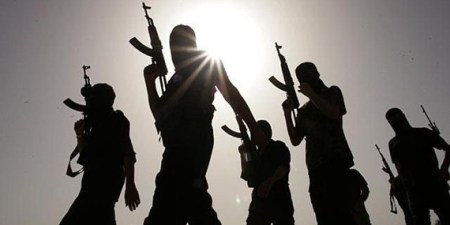
Now that Donald J. Trump is officially the President-elect of the United States, moderate Muslims like myself are hoping he changes course and refuses to surround himself with radical Muslim advisors, or members of the so-called “Islamophobia Industry” – who actually have the nerve to call real moderate Muslims – like me – an Islamophobe.
The politically correct status quo, and ominous silence on the issue of global jihad, will only give us more terror and mayhem. We need change. Whether that means pausing immigration from terror-producing countries or “extreme vetting” of new immigrants, let’s not be afraid to have the conversation.
******************************
Dr. Zuhdi Jasser, president of the American Islamic Forum for Democracy and a fellow reformist Muslim, has just suggested a new mantra in the fight against terror: “It’s the global jihad, stupid.”
I totally concur, as a moderate Muslim woman who wrote a book on radical Islam, has taken part in various documentaries, penned numerous op-eds on the issue, and toured Pakistan, parts of the Middle East and recently Europe (in fact last week I was in Berlin at the exact spot where the terrorist struck) – all in search for the root causes of radicalization.
What I found is simple: the Islamists are waging a global war – a global jihad – against the West.
We can call it a clash of civilizations; a third world war; we can listen to endless analysis given by so-called experts who cry “racism” or “Islamophobia,” we can disguise the real issue under the umbrella of political correctness, or hide behind a victim ideology – but that does nothing to change the reality.
The reality is: this is a global jihad and its target is the West.
When the radical Islamists tell us it is a jihad, while they are killing us, why are Western governments and media seemingly unable to accept reality for what it is?
The answer to this question is simple, not stupid, if we only take a moment to clear the cobwebs, to get over our Western liberal guilt and take a close hard look at where we are.
Western governments have been taking advice from Muslim advisors who are linked to the Muslim Brotherhood. And law enforcement agencies are aligning themselves with organizations that have subversive agendas.
Take a look at Mr. Obama’s invitees to the White House for Ramadan and Eid celebrations – they’re certainly not reformist Muslims. We have Keith Ellison making a run for the DNC. In Europe we see Tariq Ramadan (grandson of Hasan al Banna) posing as a celebrity and a voice for European Muslims, and organizations like CAIR in Canada and USA insist that they speak for all Muslims.
Well; they don’t speak for me. And they don’t speak for the majority of Muslims.
But they do speak to Western leaders and media. Over the past number of years; many bad decisions have been made – based on those whispers-in-the-ear from the likes of the Muslim Brotherhood and radical Islamist apologists. If you ever wonder how bad decisions get made – that’s how.
Now that Donald J. Trump is officially the President-elect of the United States, moderate Muslims like myself are hoping he changes course and refuses to surround himself with radical Muslim advisors, or members of the so-called “Islamophobia Industry” – who actually have the nerve to call real moderate Muslims – like me – an Islamophobe.
The politically correct status quo, and ominous silence on the issue of global jihad, will only give us more terror and mayhem. We need change. Whether that means pausing immigration from terror-producing countries or “extreme vetting” of new immigrants, let’s not be afraid to have the conversation.
Let’s not be afraid to use our common sense. And let’s have the courage to call it what it is:
It’s a global jihad, stupid!
Dr. Zuhdi Jasser: Fake Hate Crimes Against Muslims Are Actually Hurting Muslims, Breitbart, John Hayward, December 22, 2016

Dr. Zuhdi Jasser, founder and president of the American Islamic Forum for Democracy and author of A Battle for the Soul of Islam: An American Muslim Patriot’s Fight to Save His Faith, looked at the Berlin terrorist attack from the perspective of an Islamic reformer on Thursday’s Breitbart News Daily.
Noting that the “lone wolf” Berlin jihadi is turning out to be a “known wolf” who was under surveillance by German authorities, SiriusXM host Raheem Kassam asked Jasser why more is not being done to thwart Islamist terrorism.
“Because the current axis upon which we focus is violence,” Jasser replied. “Currently all they’re looking for is when these guys get turned on to commit an act of violence, and most of them have no ability to demonstrate that they’re going to be violent.”
“But they are Islamists, they are insurgents,” he argued. “They reject Western systems. They’re very anti-Semitic, anti-Christian. They divide the world into the land of Islam and the land of war. But that ideology is not monitored. All we’re monitoring is trying to figure out when they’re all of a sudden going to become violent, and most of them only demonstrate that a few hours or, at most, a few days, before they commit the act.”
“That’s why we need to start monitoring the public footprint of political Islam, and what is that? It’s the grievance groups that say Muslims are discriminated against and that the West is Islamophobic,” said Jasser. “It’s the anti-Semitism. It’s the misogyny, where women are treated as second-class citizens, and you see them talking about the right to wear the veil, rather than the right for women to have independence and bodily autonomy.”
“All these things that the governments of France and Germany and Britain and the U.S. would perceive as simply shades of theology need to be monitored and looked at in a public footprint perspective. Then you’d be able to say, ‘Oh, these are the guys that could become militarized or operationalized.’ Otherwise, there’s no way to predict it,” he warned. “They’re using such unconventional means now, since ISIS is telling them to use trucks and knives and things that would not be able to be monitored, that we have to be looking at the precursor ideologies – which is the hate for the West, the hate for the system that really is out there.”
Kassam spotlighted the recent media frenzy over a Muslim prankster allegedly getting kicked off an airplane, allegedly just because he spoke in Arabic, although he has been called out for staging a hate-crime hoax. Kassam contended there were real acts of discrimination against Muslims, but their number is much smaller than activists and hoaxers claim.
“Does this make it easier or harder for everyday Muslims?” he asked.
“I can’t tell you how much harder it makes it,” Jasser replied. “We, right away, on my Twitter feed and on Facebook, exposed quickly that this guy was a prankster, and obviously, he had been outed as a hoax he had committed in 2014, and was just trying to get attention as a YouTuber. People may say he’s not an Islamist, but this is the first stage, 101 or 201 of Islamism, which is to exploit a non-Muslim society, to exploit its vulnerability – which is the protection of minorities – and then mock it, separate Muslims out of that society into our own consciousness.”
“So what happens is, by mocking it and exploiting it, and then saying. ‘Oh, he was discriminated and kicked off,’ but actually lying about it, not only is it a ‘crying wolf’ phenomenon, where those who may be discriminated against are going to be ignored, but it soaks up the bandwidth of what we should be doing,” he explained.
“I’ve always said, if you want to melt away any fear of Muslims, the best way is for Americans to see us leading the battle against radicals, for Americans to see us basically recognizing that this is a Muslim problem that needs a Muslim solution,” he advised. “Then they’d say, ‘Oh, wait a minute: these are our allies; they’re not our enemies!’ But until we do that, these guys are actually radicalizing our community by telling everyone, ‘Well, make it up or whatever.’”
“Grievances are our biggest problem,” Jasser mused. “The elephant in the room, even from the discussion you and I just had on Berlin, is that our so-called allies – the Islamic Republic of Iran, Saudi Arabia, Pakistan, these huge cauldrons of tens and hundreds of millions of Islamists that believe in the Islamic State – want to separate the world into good and evil, Islam being good and the rest being evil. Unless we address that primary theocracy – which is a mentality that secular society is evil, and if you live here, then, well, Americans hate you, et cetera – those types of mentalities can’t be defeated.”
“We have to abandon that and say, ‘You know what? We’re done with the grievance mills. They are corrupt.’ We need to no longer identify as a collective as Muslims, but identify as Americans first. That’s the main core harm that’s happening with these types of wackos,” he said.




 anneinpt
 artaxes
 danmillerinpanama
 davidking1530
 Peter Hofman
 Joseph Wouk
 Peter
Peter Louisiana Steve
 WarSclerotic
Recent Comments