Archive for the ‘UN Human RIghts Council’ category

Time to delegitimize the UN

September 24, 2015

Time to delegitimize the UN, Israel Hayom, Judith Bergman, September 24, 2015

(The UN has already made numerous heroic efforts to delegitimize itself. Isn’t it finally time for free world nations to leave the UN, stop paying for it and establish a very different organization dedicated to furthering, rather than destroying, western culture? — DM)

The appointment of Saudi Arabia to head this important U.N. Human Rights Council panel displays, once more, how deeply corrupt and truly meaningless the U.N. system and the U.N. Human Rights Council in particular are in practice.

***********************

It was recently publicized that Saudi Arabia has been elected to chair the U.N. Human Rights Council panel in charge of appointing independent experts. According to the U.N. Watch independent monitoring group, Saudi Arabia was chosen to head the Consultative Group, a five-member group of ambassadors that has the power to select applicants from around the world for more than 77 positions dealing with human rights mandates. These include positions such as the U.N. special rapporteur on violence against women and experts for working groups on the issues of discrimination against women and the rights of migrants and religious minorities.

One does not quite know whether to laugh or cry at the appointment of one of the worst human rights offenders in the world to head the selection of such experts. Indeed, Michael Moller, director-general of the United Nations Office at Geneva, does look a little bit uneasy in the photo taken of him, as he shakes the hand of the Saudi ambassador to Geneva, Faisal bin Hassan Trad, at his appointment. It must have been difficult for this Danish-born diplomat, hailing from a Scandinavian country so intensely committed to the pursuit of justice and human rights, to hide a grimace. After all, he was appointing the ambassador of a country where public beheadings are not the actions of criminals or terrorist organization like Islamic State, but a regular working feature of the legal system, which is modeled according to Shariah law. Perhaps the thought of petrodollars made the handshake easier.

Saudi Arabia was first elected to the Human Rights Council in 2013, without any protests from the U.S. and the European Union.

The appointment of Saudi Arabia to head this important U.N. Human Rights Council panel displays, once more, how deeply corrupt and truly meaningless the U.N. system and the U.N. Human Rights Council in particular are in practice. What does it say about the Human Rights Council that it appoints a country that regularly beheads dozens of its own citizens, as well as several of the 9 million foreign workers who constitute over half the workforce and frequently work in slave-like conditions for their Saudi Arabian masters?

While such an appointment clearly undermines any minuscule remnant of credibility that the U.N. Human Rights Council may have left, it should give pause to those who still believe the U.N. can play any credible role in international relations. More than anything, it shows the depraved state of the self-appointed guardian of world human rights.

Unfortunately, it would appear that most human rights advocates do not care much about this appointment, as there has been precious little reaction from them worldwide. Even more disturbing, the same human rights advocates who are so quiet about this are extremely vocal about perceived human rights violations by Israel. It only proves, once more, that they do not truly care about human rights.

What is the innocent blogger Raif Badawi, who has been sentenced to 1,000 lashes in public and 10 years in a prison in Saudi Arabia, supposed to make of this appointment, other than that the international community apparently approves of such punishment for a man who blogged about freedom of speech?

We in Israel hardly have any illusions left when it comes to the U.N., yet we still expend a lot of effort in responding to various U.N. commissions of inquiry, as if anything they conclude carries any kind of meaning or weight. Perhaps it is finally time to create an alliance of nations, with Israel in its midst, to effectively lead a campaign of delegitimization of the U.N., based on that organization’s blatant depravity and utter moral corruption. This is not something that Israel would be able to carry on its own, but although the number of decent nations in the world is shrinking fast, it is still not too late to find allies who might also have an interest in exposing the true face of the U.N. The organization is an expensive and obsolete bureaucratic monster, and there must be other states who would like to see it exposed and reformed.
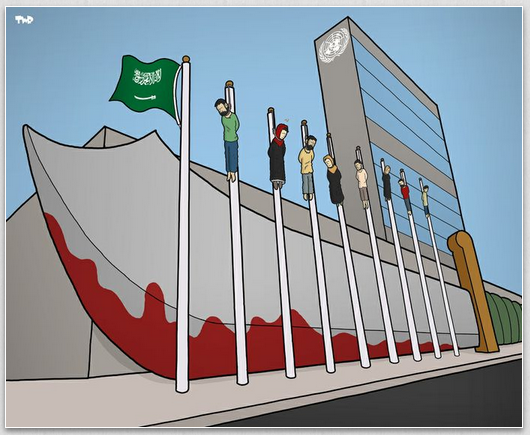
Cartoon of the day

September 24, 2015

(Please see also, Saudi Arabia: World’s Human Rights Sewer. — DM)

H/t Joopklepzeiker

screenshot_1119

Saudi Arabia: World’s Human Rights Sewer

September 21, 2015

Saudi Arabia: World’s Human Rights Sewer, Gatestone InstituteDouglas Murray, September 21, 2015

(This must be a premature April Fools Day joke. There have been several others recently, including criticisms of Donald Trump for not rebuking, correcting and silencing someone who claimed that Obama is a Muslim and of Dr. Ben Carson for saying he would not support a Muslim for President. Yeah, they must all be just sick jokes. I wish. — DM)

Saudi Arabia has been appointed as the head of a key UNHRC panel. This panel selects the top officials who shape international standards in human rights; it is intended to report on human rights violations around the world. The five-member group of ambassadors, which Saudi Arabia will now head, is known as the Consultative Group and has the power to select applicants to fill more than 77 positions worldwide that deal with human rights issues.

**********************

  • Ali Mohammed al-Nimr, sentenced to be crucified, was accused of participating in banned protests and firearms offenses — despite a complete lack of evidence on the latter charge, and he was denied access to lawyers. Al-Nimr is also alleged by human rights groups to have been tortured and then forced into signing a confession while in custody.
  • Not only are the Saudi authorities preparing to crucify someone — in 2015 — whom they tortured into making a confession; they are preparing to crucify someone who was a minor at the time of arrest.
  • Alas not a week goes by without Saudi Arabia demonstrating to the world why they retain their reputation as one of the world’s foremost human rights sewers.
  • Crucifixion is a punishment which, it would appear, is not only Sharia-compliant but also — we must assume — Geneva-compliant.

The United Nations Human Rights Council (UNHRC) in Geneva is an organization that may be easy to critique, but it is very hard to satirize. Ordinarily, if you told anyone that there was a place in Switzerland where Sudan, Iran and others of the world’s worst dictatorships and human rights abusers have their views on human rights treated with respect and deference, you would assume the script was written by Monty Python. Idi Amin would make an appearance at some point to share his views on how to improve equal conditions for women in the workplace. Pol Pot would crop up in order to castigate those countries where living standards had not been sufficiently raised in accordance with global averages.

Everything that happens in Geneva is beyond satire. But last week provides a demonstration, outrageous even by the standards of the UN. For this week, it came out – thanks to the excellent organization UN Watch — that Saudi Arabia has been appointed as the head of a key UNHRC panel. This panel selects the top officials who shape international standards in human rights; it is intended to report on human rights violations around the world. The five-member group of ambassadors, which Saudi Arabia will now head, is known as the Consultative Group and has the power to select applicants to fill more than 77 positions worldwide that deal with human rights issues. It appears that the appointment of Saudi Arabia’s envoy to the UNHRC, Faisal Trad, was made before the summer, but that diplomats in Geneva have kept silent on the matter since then.

That this appointment had to leak out months after the event raises the possibility that the UNHRC, contrary to popular perception, actually does have some sense of shame. Otherwise, why not shout from the rooftops that Saudi Arabia has won this prestigious position? Why not distribute a press release? After all, Saudi Arabia — and by extension the UNHRC — have nothing to be ashamed of, do they?

Alas not a week goes by without Saudi Arabia demonstrating to the world why they retain their reputation as one of the world’s foremost human rights sewers. Saudi Arabia may have beheaded more people in the last year than ISIS, but only rarely do any of these cases get more than a flicker of international attention. Occasionally a case breaks above the waves of public opinion. One such case is that of the jailed blogger Raif Badawi, sentenced last year to 10 years in jail and 1000 lashes for “insulting Islam.” The plight of Raif Badawi, who has already been served the first 50 lashes, and is being held in prison while awaiting the rest, has garnered international attention and condemnations of Saudi Arabia. The kingdom’s response has been strongly to denounce “the media campaign around the case.”

But the glare of international opinion clearly disturbs the Saudi authorities — a fact well worth keeping in mind. And it is not as though they have nothing to hide. This week brings a case that should get at least as much attention as that of Raif Badawi.

Ali Mohammed al-Nimr was just 17 when he was arrested by the Saudi authorities in 2012, during a crackdown on anti-government protests in the Shia province of Qatif. He was accused of participating in banned protests and firearms offenses — despite a complete lack of evidence on the latter charge. Denied access to lawyers, al-Nimr is alleged by human rights groups to have been tortured and then forced into signing a confession while in custody. Campaigners say that it seems he has been targeted by authorities because of his family association with Sheikh Nimr al-Nimr, the 53-year-old critic of the Saudi regime who is his uncle. The Sheikh has also been convicted and sentenced to death. After the confession and “trial,” his nephew was convicted at Saudi’s Specialized Criminal Court and sentenced to death. The trial itself failed to meet any international standards. Al-Nimr appealed against his sentence, but this week that appeal was dismissed. It now seems likely that he and his uncle will now be executed. Because charges include crimes involving the Saudi King and the state itself, it seems likely that the method of death will be crucifixion.

1255Imprisoned Saudi dissidents Raif Badawi (left) and Ali Mohammed al-Nimr (right).

If this were in any way to cause a flicker of concern among other participants in the UNHRC farce going on Geneva, they have at least some consolation. For in Saudi Arabia crucifixion is not what it used to be. Indeed, in Saudi Arabia crucifixion begins with the beheading of the victim and only then the mounting of the beheaded body onto a crucifix, to make it available for public viewing. This is a punishment which it would appear is not only Sharia-compliant but also — we must assume — Geneva-compliant.

Of course, Ali Mohammed al-Nimr counts as having been a juvenile at the time of his arrest, so not only are the Saudi authorities preparing to crucify someone — in 2015 — whom they tortured into making a confession – they are preparing to crucify someone who was a minor at the time of arrest. Perhaps the authorities at the UNHRC in Geneva do indeed blush when they appoint Saudi officials to head their human rights panels. But it does not seem to affect their behaviour. Just as Saudi authorities think it is “international attention” rather than flogging people to death or crucifying them after beheading that is the problem, so the UNHRC in Geneva seems to think it is public awareness of their grotesque appointments rather than the appointments themselves that are the problem.

The international attention paid to the case of Raif Badawi has not yet seen him released, but it seems to have delayed the next rounds of lashes. Which suggests the Saudi authorities have the capacity to feel some shame. This should in turn be a cause for some hope among everyone who cares about human rights. It should also provide a reminder to everyone to increase global attention on the case of Ali Mohammed al-Nimr and the many others like him who suffer under a government and judicial system that should utterly shame the world outside Geneva, even if it cannot shame the UN.


