Archive for the ‘U.S. Military’ category

Satire | Drones In Syria ‘Serving Strictly In An Advisory Role’

November 2, 2015

Drones In Syria ‘Serving Strictly In An Advisory Role,’ Duffel Blog, November 2, 2015

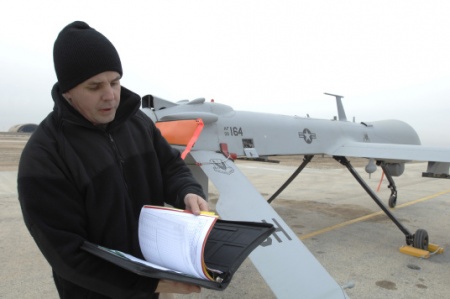
Drone-ADvisoryUS AIR FORCE PHOTO.

RAQQA, Syria — Recent increases in the tempo and nature of US operations against the Islamic State do not indicate a change in US policy, according to senior US officials, in spite of criticism that the Obama administration escalated the mission in Syria from an advisory role to a more active combat mission.

“Let me be clear: our brave drones are serving in a non-combat role,” White House Press Secretary Josh Earnest said. “Sure they might deliver sweet justice to our jihadi friends, but that’s just ‘leading by example.’”

A Predator drone operating in Syria who uses the pseudonym “Vengeance of Lindsay Graham,” spoke to Duffel Blog last week. “We’re not doing combat. Well, sort of. I led a patrol last week and we came across some ISIS jack-wagons in the clear, but the rebels I was leading weren’t ready. The training model is crawl, walk, run; they were still in a crawl phase but I was sprinting like Usain Bolt, baby!”

Despite this story, administration officials maintain that the Syrian conflict remains a strict train-and-advise mission. According to one Air Force general, who asked for anonymity because he was not authorized to talk trash on the record, “We’re advising the ISIL fighters to die, and we’re training them very quickly.”

“Besides,” Earnest said, “If we said our drones were in combat we’d probably have to get a new Authorization of Force.”


Russia warns that Syria war could become a ‘proxy war’

November 1, 2015

Russia warns that Syria war could become a ‘proxy war’ BreitbartJohn J. Xenakis, November 1, 2015

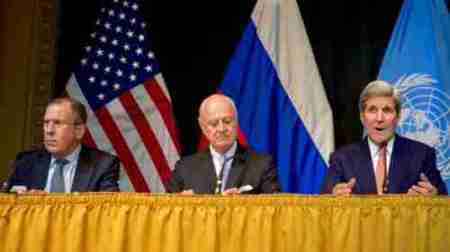
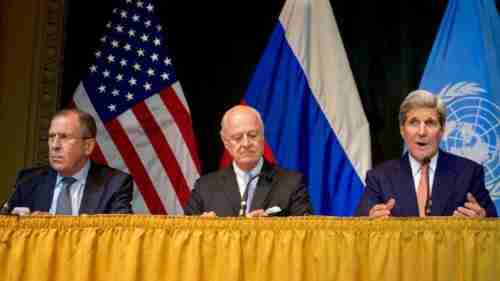
g151031bL-R: Sergei Lavrov, United Nations Special Envoy for Syria Staffan de Mistura, and John Kerry in Vienna on Friday (state.gov)

Russia has poured millions of dollars of heavy weapons into Syria, and is now sending in Russian troops to establish bases there. Recently, Russia launched 27 cruise missiles from the Caspian Sea to targets in Syria. Iran is pouring new troops into Syria. Iran has also given Lebanon’s Hezbollah terrorist group a great deal of money, and Hezbollah has sent thousands of troops into Syria to support Syria’s president Bashar al-Assad.

Al-Assad’s genocidal attacks on innocent Syrian Sunnis, killing hundreds of thousands and forcing millions from their homes, has caused Sunni jihadists from all of the world to fight against al-Assad, Russia, Hezbollah, and Iran in Syria. Along the way, these jihadists formed the so-called Islamic State (IS or ISIS or ISIL or Daesh).

And now, on Friday, Russia’s Foreign Minister Sergei Lavrov made a pronouncement that Barack Obama was going to trigger a “proxy war” in Syria by sending in 50 special operations forces, as we reported yesterday.

You can’t make this stuff up.

Thanks to Iran, Russia, al-Assad and Hezbollah, there are now tens of thousands of foreign troops fighting each other in Syria, with al-Assad in particular supported by massive amounts of foreign weapons.

But somehow, those tens of thousands of foreign fighters don’t make it a “proxy war,” but America’s 50 special forces troops do.

You can’t trust any garbage that comes out of Lavrov’s mouth, or out of al-Assad’s mouth, or out of Vladimir Putin’s mouth, but I listen to BBC, al-Jazeera, FOX, CNN, and other media sources all the time, and I see these news anchors report this crap with a straight face all the time. I don’t know whether it is more sickening to watch those fatuous news anchors, or to watch the fawning Secretary of State John Kerry suck up to Lavrov and Putin, which has happened in issues involving Ukraine, Iran’s nuclear development, and Syria.

All this verbiage is coming out of a meeting in Vienna whose purpose is to find a “political solution” to the Syria problem. With hundreds of thousands of Syrian migrants pouring into Europe, and with hundreds of ISIS militants returning to Russia to fight Putin, there is a lot of pressure to find a “political solution.” But this week’s announcement that Iran will fully enter the war in Syria on the side of the Syrian regime makes any “political solution” farther away than ever. On the contrary, Saudi Arabia and other Gulf countries will never agree to anything like the emerging situation. Actions by Russia and Iran, intervening militarily in Syria, is an emerging disaster, likely triggering a sectarian Sunni versus Shia war throughout the region. BBC and International Business Times and Reuters

Syria’s civil war and Generational Dynamics

In the 12 years that I’ve been doing this, I’ve posted about 4,000 articles with hundreds of Generational Dynamics predictions.

In 2011, when the Syrian civil war began, I said that the war should fizzle within a year or two. Of all the hundreds of Generational Dynamics predictions, this is the one where I’ve clearly been (depending on how you look at it) either wrong or poorly described.

Syria’s last generational crisis war was civil war that climaxed in 1982 with the massacre at Hama. There was a massive uprising of the 400,000 mostly Sunni citizens of Hama against Syria’s president Hafez Assad, the current president’s father. In February, 1982, Assad turned the town to rubble, 40,000 deaths and 100,000 expelled. Hama stands as a defining moment in the Middle East. It is regarded as perhaps the single deadliest act by any Arab government against its own people in the modern Middle East, a shadow that haunts the Assad regime to this day.

(As a related matter, the civil war in Lebanon also climaxed that year, with the bloody massacre at Sabra and Shatila occurring in September 1982. And it occurred as the Iran/Iraq war was ongoing, three years after Iran’s bloody Great Islamic Revolution in 1979. At that time, much of the Mideast was re-fighting World War I and the collapse of the Ottoman Empire, 60 years earlier.)

So, in 2011, I said that the civil war in Syria would fizzle, and could not turn into a crisis civil war. And that’s both wrong and true. There are too many survivors who remember the 1982 slaughter, and do not want to see it repeated. And so there’s been no massive anti-government uprising, as there was in 1982, and Bashar al-Assad’s Shia/Alawite troops have been fighting half-heartedly, with many soldiers defecting or deserting.

But the war did not fizzle.

It should have fizzled in 2011 or 2012, but Hezbollah and Iran starting pouring troops in to support al-Assad. And foreign fighters from around the world arrived to fight al-Assad and to form ISIS. That’s not something that Generational Dynamics could have predicted.

Earlier this year, it looked like al-Assad’s army was near collapse. In July, a desperate al-Assad gave a national speech in which he admitted he was losing. The war should have fizzled this year. But now, Russia and Iran are pouring tens of thousands more troops into Iran to bolster al-Assad. And that also is not something that Generational Dynamics could have predicted.

So the problem for me is: How should I have characterized the situation in 2011? The prediction that it wouldn’t turn into a crisis civil war was correct, but the war did not fizzle, because it turned into a proxy war.

Well, I don’t think there’ll be a next time, but if there is, I’ll try to characterize the situation differently, without simply using the word “fizzle.” NPR (1-Feb-2012)

Generational Dynamics and crisis civil wars

I write about a number of civil wars going on in the world today, so this is a good time to discuss civil wars from the point of view of Generational Dynamics.

Among generational crisis wars, an external war is fundamentally different than a civil war between two ethnic groups. If two ethnic groups have lived together in peace for decades, have intermarried and worked together, and then there is a civil war where one of these ethnic groups tortures, massacres and slaughters their next-door neighbors in the other ethnic group, then the outcome will be fundamentally different than if the same torture and slaughter is rendered by an external group. In either case, the country will spend the Recovery Era setting up rules and institutions designed to prevent any such war from occurring again. But in one case, the country will enter the Awakening era unified, except for generational political differences, and in the other case, the country will be increasingly torn along the same ethnic fault line.

The period following the climax of a crisis war is called the “Recovery Era.” One path that the Recovery Era can take is that the leader of one ethnic group decides that the only way to prevent a new civil war is for him to stay in power, and to respond to peaceful anti-government demonstrations by conducting massive bloody genocide, torture and slaughter of the other ethnic group, in order to maintain the peace. (Dear Reader, I assume you’ve grasped the irony of the last sentence.)

For example, in a July article about Burundi, I described how Burundi’s Hutu president Pierre Nkurunziza was using such violence to quell Tutsi protests, supposedly to avoid a repeat of the 1994 Rwandi-Burundi genocidal war between Hutus and Tutsis.

As another example, in a June article about Zimbabwe, I described how Zimbabwe’s president Robert Mugabe was even worse. His 1984 pacification campaign was known as “Operation Gukurahundi” (The rain that washes away the chaff before the spring rain). During that campaign, accomplished with the help of Mugabe’s 5th Brigade, trained by North Korea, tens of thousands of people, mostly from the Ndebele tribe, were tortured and slaughtered. Later, Mugabe single-handedly destroyed the country’s economy by driving all the white farmers off the farms, resulting in one of the biggest hyperinflation episodes in world history.

That is what Bashar al-Assad is doing in Syria. Fearing a Sunni uprising, like the one in 1982, al-Assad is conducting a massive “peace campaign” by slaughtering and displacing millions of innocent Sunnis. As I wrote above, this should have fizzled in 2011 or 2012, but it’s turned into a proxy war, and it’s a disaster for the Mideast and the world.

But none of the above three examples is a crisis civil war. A crisis war has to come from the people, not from the politicians. So, for example, there’s a massive crisis civil war going on today in Central African Republic (CAR), between the Muslim ex-Seleka militias fighting Christian anti-Balaka militias.

Unlike the previous examples, CAR is in a generational Crisis era. CAR’s last generational crisis war was the 1928-1931 Kongo-Wara Rebellion (“War of the Hoe Handle”), which was a very long time ago, putting CAR today deep into a generational Crisis era, where a new crisis war is increasingly likely. That’s why the CAR is a genuine crisis civil war, and won’t fizzle out. In fact, it won’t end until it has reached some kind of explosive conclusion — of the kind we described in Hama or Sabra and Shatila. ( “2-Oct-15 World View — Violence resurges in Central African Republic crisis war”)

Generational Dynamics and war between Palestinians and Israelis

I’ll discuss one more example — not a civil war, but very similar to a civil war, with the same kinds of issues.

In the last few years, there have been three non-crisis wars between Israelis and Palestinians in Gaza. In each case, the Israelis destroyed Hamas’s infrastructure, ending the war. The war began again each time when Hamas’s infrastructure was rebuilt.

But the point I want to make is that these three non-crisis wars were all directed by politicians. Palestinians attacked when the leadership told them to, and stopped attacking when the leadership told them to stop.

What I have been describing in numerous articles recently is that there is emerging a major, fundamental, historic change.

In the emerging situation, young people today are no longer willing to listen to these leaders. According to the CIA World Fact Book, 20% of Gaza’s population are in the 15-24 age range, and so are 21% of the West Bank — about 200,000 males in each territory, or 400,000 young males total.

On the Israeli side, there are over 600,000 young males in the same age range. There have been unconfirmed reports of young Israelis also disgusted with the leadership. It is possible that, like the young Palestinians, they are willing to take matters into their own hands.

So in this environment, what could happen next? The last three Gaza wars were non-crisis wars, but the next one could be a crisis war between Israelis and Palestinians.

How can a crisis war begin? How about if those 200,000 young male Gazans blow holes in the walls, pour across into Israel and start killing Israeli citizens en masse in their homes and villages? And how about if they are joined by those 200,000 young male Palestinians on the West Bank, who start with the Jewish settlers and continue with the Jews in Jerusalem. And how about if the young Israeli males strike back and start killing Palestinians in their homes and villages?

Israel’s tanks and bombers would not be of much use. You can’t bomb Jerusalem, and you can’t bomb Israeli villages and settlements to kill Palestinians.

That is the difference. That is what a generational crisis war is like. It is not two tanks shooting at each other. It is hand to hand combat in homes, neighborhoods and streets by people armed with sticks and knives. It is what happened in Central African Republic last year, it is what happened in Rwanda in 1994, in Bosnia in 1994, and in Palestine in 1947.

And by the way, that assumes that the bloody mess stays confined to Israel and the Palestinian territories. The Palestinians are likely to be joined by tens or hundreds of thousands from Jordan, Lebanon and Egypt.

The recent widely reported changes in the attitudes and behaviors of young Palestinians is a sign that this kind generational crisis war is coming.
Putin has no long term strategy, says administration w/no long term strategy

October 31, 2015

Putin has no long term strategy, says administration w/no long term strategy, Front Page Magazine, Daniel Greenfield, October 31, 2015

hqdefault

This is an administration that believes you win wars with word games

Obama claimed that Putin is acting in Syria out of weakness and is being all reactive. Then he reacted by shipping weapons to Sunni rebels, a move he had originally rejected, and sending American soldiers into combat as boots on the ground.

Now DNI James Clapper is claiming that Putin is being impulsive and has no long term strategy. This comes from an administration that changed its mind several times about intervening in the Syrian Civil War and keeps saying it still doesn’t have a plan for defeating ISIS.

Clapper said Putin was “very impulsive and opportunistic” as he increased Russian support for close ally President Bashar al-Assad in Syria’s roiling civil war.

“I personally question whether he has some long-term strategy or whether he is being very opportunistic on a day-to-day basis,” Clapper told CNN’s Jim Sciutto. “And I think his intervention into Syria is another manifestation of that.”

Being “opportunistic” is actually how real life battles are fought. You have a strategy, but you seize advantages based on the evolving situation on the ground.

So far Putin’s long term strategy has been to expand Russian influence in the region. It’s working really well. Russia is back to being the regional alternative to the US. It’s securing strategic territories and its allies are expanding their sphere of influence.

On top of that, Putin managed to avert US air strikes on Assad with his fake WMD deal. Then he helped Iran secure its nuclear weapons program with the Iran deal. (I’ll grant that he had a lot of help from Obama and Kerry there.) Now he’s angling to get Obama on board a peace deal that keeps Assad in power and ends US support for the rebellion. Considering this administration’s foreign policy track record, he’ll probably get his way. While the administration clown car taunts him as weak and opportunistic and reactive and impulsive.

In the Cold War, the Soviets trash talked while the US got things done. Under Obama, the US talks trash and Russia gets things done. But this is an administration that believes you win wars with word games.

How is that working out for them?

ISIS Threatens Obama With ‘New Lesson’ in Beheading Video

October 31, 2015

ISIS Threatens Obama With ‘New Lesson’ in Beheading Video, Newsmax, Sandy Fitzgerald, October 31, 2015

(Video at the link. Has Obama recently decided that the Islamic State is a greater threat than climate change?– DM)

A horrifying new 15-minute video appears to show Islamic State (ISIS) terrorists beheading four captured Kurdish Peshmerga fighters — and delivering a bold warning to President Barack Obama.

The video claims to be the ISIS response to a Delta Force-Kurdish raid in northern Iraq last week that cost American Master Sgt. Joshua Wheeler his life.

“Obama, you have learned a new lesson,” a masked terrorist warns Obama in what sounds like an American accent. “Six of the soldiers of the caliphate faced 400 of your children; they killed and injured them by Allah’s grace.”

The warning was delivered before the man executes one of the prisoners, reports CNN, and the other three prisoners are also beheaded by the video’s end. Arabic text also appears onscreen, translating as “Peshmerga soldiers that Americans came to rescue.”

The video was released online Friday, and earlier in the clip, ISIS claims to show the aftermath of the raid, in which Kurdish, U.S., and Iraqi forces rescue 70 hostages from an ISIS prison in Hawija, located in Kirkuk, a province located in northern Iraq.

CNN reports that those who were set free included 20 of the Iraqi Security Forces, local residents and several ISIS fighters accused of spying. None of the hostages were Kurds.

As of Saturday morning, there had not been an official response issued from the White House on the video or the threat. But in Kurdistan, regional government spokesman Dindar Zebari told CNN that “ISIS respects no form of human rights. Our message to them is that we will finish them.”

But Kurdistan will not kill ISIS prisoners in response, Zebari said.

“We hold 215 ISIS prisoners and we treat them according to international human rights laws,” he said. “We have also freed 85 prisoners who had been suspected of association with ISIS. We do not kill our prisoners.”

The Kurdistan regional government said that more than 20 ISIS fighters were killed in last week’s raid, and six more were captured.

The Kurdish Peshmerga, which protects an autonomous region in northern Iraq, has been fighting against ISIS and its push to take Iraq and Syria and create a caliphate.

ISIS earlier this week said the Delta Force-Kurdish raid, called for by the Kurds to rescue Peshmerga fighters, was a failure.

The man who issued the threat does not appear to be the infamous “Jihadi John,” the English-speaking jihadist who has appeared in several other ISIS beheading videos.

The terrorist, whose real name is believed to be Mohammed Emwazi, is considered to be a priority target after killing American, Western, and Japanese hostages.

Meanwhile, two Syrian activists have also been killed in recent days in the Turkish town of Urfa, and their deaths are being blamed on ISIS.

According to the groups Raqqa is Being Slaughtered Silently and Eye on Homeland, activists Ibrahim Abdul Qadir and Faris Humadi the men who were shot and beheaded. ISIS has not yet claimed responsibility for their deaths.

Qadir and Humadi worked for Eye on Homeland, a Syrian media group that reports on the civil war, and Qadar also was a founding member of the Raqqa group, which posts photos, video, and other information online from the Raqqa province in Syria.

World powers agree to more talks on Syria crisis

October 31, 2015

World powers agree to more talks on Syria crisis, Al Jazeera, October 31, 2015

(But please see, Iran-US Talks Limited to Nuclear Issue: MPs — DM)

Friday’s talks included an Iranian delegation for the first time.

***********************

Major powers meeting in Vienna for talks on Syria have found enough “common ground” to meet for a new round of talks in two weeks, even as the conflict enters a new phase with the deployment of US special forces in the country.

President Barack Obama has ordered the deployment of fewer than 50 commandos to help coalition forces coordinate with local troops, Josh Earnest, the White House spokesperson, said on Friday.

The troop announcement came as diplomats in the Austrian capital representing 17 countries and the EU agreed to launch a broad new peace attempt to gradually end Syria’s long civil war – a declaration that avoided any decision on when President Bashar al-Assad might leave.

A Syrian member of parliament said the decision is an aggression because it does not involve the government’s agreement.

Sharif Shehadeh told AP news agency on Saturday that the troops will have no effect on the ground, but Washington wants to say that it is present in Syria.

It is not clear how many rebel groups would agree to a plan that does not result in Assad’s immediate departure.

Sergey Lavrov, Russia’s foreign minister, said on Friday a US decision to deploy special forces in Syria would make cooperation between the armed forces of the two countries more important.

“I am sure that neither the United States nor Russia want [the conflict] to become a so-called proxy war,” Lavrov said after the talks in Vienna.

“But it is obvious for me that the situation makes the task of cooperation between the militaries more relevant.”

Friday’s talks included an Iranian delegation for the first time.

Representatives from Britain, Egypt, France, Germany, Italy, Lebanon, the EU and other Arab states also attended.

The participation by Russia and Iran in the attempt could mark a new and promising phase in the diplomacy since those countries have staunchly backed Assad.

‘Tough conversations’

Any ceasefire agreement that may come as a result of the peace effort would not include the Islamic State of Iraq and the Levant (ISIL) group, which controls large parts of northern Syria and has its capital there.

“There were tough conversations today,” John Kerry, US secretary of state, said on Friday. “This is the beginning of a new diplomatic process.”

Kerry acknowledged that those present have major differences regarding the Assad government.

“But we cannot allow the differences to get in the way of diplomacy to end the killing.”

Federica Mogherini, the European Union foreign policy chief, said there is “hope” for a political process to advance, saying that those involved in the talks “found common ground” for further discussion.

“It was a very long and very substantial meeting. This was not an easy one, but for sure a historical one,” she said while praising “those who took difficult decisions” in joining the talks.

Lavrov said those present in the meeting spent a “long time” pushing for an inclusive Syrian-led peace process.

Among the points agreed upon during the talks was that ISIL cannot be allowed to reign in Syria, he said.

In a rare hint of diplomatic progress, Iran indicated it would back a six-month political transition period in Syria followed by elections to decide Assad’s fate, although his opponents rejected the proposal as a trick to keep him in power.

In addition to Assad’s fate, on which delegates said no breakthrough had been expected, sticking points have long included the question of which rebel groups should be considered “terrorists” and who should be involved in the political process.

Al Jazeera’s Mohammed Jamjoom, reporting from Vienna on Friday, said that there was a “mood of optimism” following the talks.

“There is a sense of hopefulness, which has been absent in these talks for quite a long time now,” he said.

The talks came as Syrian government air strikes continued in rebel-held territories, killing at least 61 people and wounding over 100 others in the Damascus suburb of Douma on Friday.

A further 80 people were killed in government and Russian air strikes in Aleppo province.

US, Russia edge close to military collaboration in Syria and Iraq

October 27, 2015

US, Russia edge close to military collaboration in Syria and Iraq, DEBKAfile, October 27, 2015

ForcesIaqSyria480

Washington and Moscow appear close to agreeing to their armed forces teaming up for war operations in Syria and Iraq. Nothing definite has so far emerged about this potential collaboration, or even if it is to be conducted covertly and experimentally ad hoc or seriously and out in the open.

A comment suggesting that the Obama administration was ready for a new direction on Syria came from US Defense Secretary Ashton Carter Tuesday, Oct. 27. In testimony before the Senate Armed Services Committee, he said, “we won’t hold back from supporting capable partners in opportunistic attacks against ISIL…or conducting such mission directly, whether by strikes from the air or direct action on the ground.”

According to Pentagon sources, the US intends to deploy small units of Special Operations forces in Syria and “special advisers” in Iraq, which too are believed to be special operations units under another name.

However, DEBKAfile’s military sources point out that small-scale military ventures in open-ended war situations tend to extend beyond the scale originally intended. Therefore, it is more than likely that both the US and Russia will find themselves committing increasing numbers of air and ground troops if the conflicts in the two countries continue.

The way matters are going now, the plan for Iraq is for US forces to join Iraqi and Iranian units in launching an offensive to recover Ramadi, capital of the Western province of Anbar, 110 km West of Baghdad, which ISIS captured in May.

In Syria, American troops plan to work with the northeastern Kurdish PYD-YPG militia for marching on Raqqa, the Islamic State’s headquarters in that country.

At the Senate hearing, Carter pointed to last week’s rescue operation in northern Syria. US Delta commandos and Syrian Kurdish special forces stormed a prison held by the Islamic State and freed dozens of Kurdish prisoners.

This operation was outside the bounds of normal US involvement in the Syrian conflict. After it was over, the US Defense Secretary said the military expects “more raids of this kind.”

This joint US-Kurdish raid brought forth a furious response from Turkey.The Turkish military twice directed machine gun fire at the Syrian Kurdish PYD force in the Syrian town of Tal Abyad Sunday, Oct. 25.

DEBKAfile’s military sources note that Tel Abyad is the closest point to Raqqa to have been reached by America’s Kurdish allies.

Ankara is vehemently opposed to the US partnership with the Kurds of Syria and Iraq, and puts its campaign against their separatist trends ahead of its commitment to the anti-ISIS coalition.

However, the Obama administration appears to have finally come down in favor of a combined operation with the Kurdish forces, even at the expense of its ties with Ankara, another pointer to the up-and-coming US ground operations in Syria.

Neither Washington nor Moscow has commented on their possible military cooperation for the fight to vanquish ISIS. But straws in the wind point in that direction.

Russian President Vladimir Putin has repeated: “I have no plans to put ground troops in Syria,” indicating that Moscow would confine itself to air strikes.

The US Defense Minister Tuesday explicitly mentioned “…direct action on the ground” as well as, ”supporting capable partners in opportunistic attacks against ISIL.”

DEBKAfile’s military sources find common elements in the American and Russian modes of action. Whereas the Americans plan to deploy ground troops for fighting with Kurdish forces, the Russians will stick to aerial attacks in conjunction with certain Syrian rebel groups.

Moscow’s plan unfolded on Monday, Oct. 26, when a delegation of the Free Syrian Army, which is backed by the US, Israel and Saudi Arabia, turned up in Moscow seeking to coordinate its military operations with the Russians.

It is hard to tell if US-Russian military cooperation in the Syrian and Iraqi wars actually ripens into a productive effort or proves ephemeral. Israel’s concerns and its responses to the fast-moving, explosive situation on its northern borders are scheduled to be thrashed out in the talks Defense Minister Moshe Ya’alon is holding this week in Washington with Defense Secretary Carter.

Satire | Army Agrees to Accept 20,000 Syrian Migrants To Meet Retention Goals

October 26, 2015

Army Agrees to Accept 20,000 Syrian Migrants To Meet Retention Goals, Duffel Blog, October 26, 2015

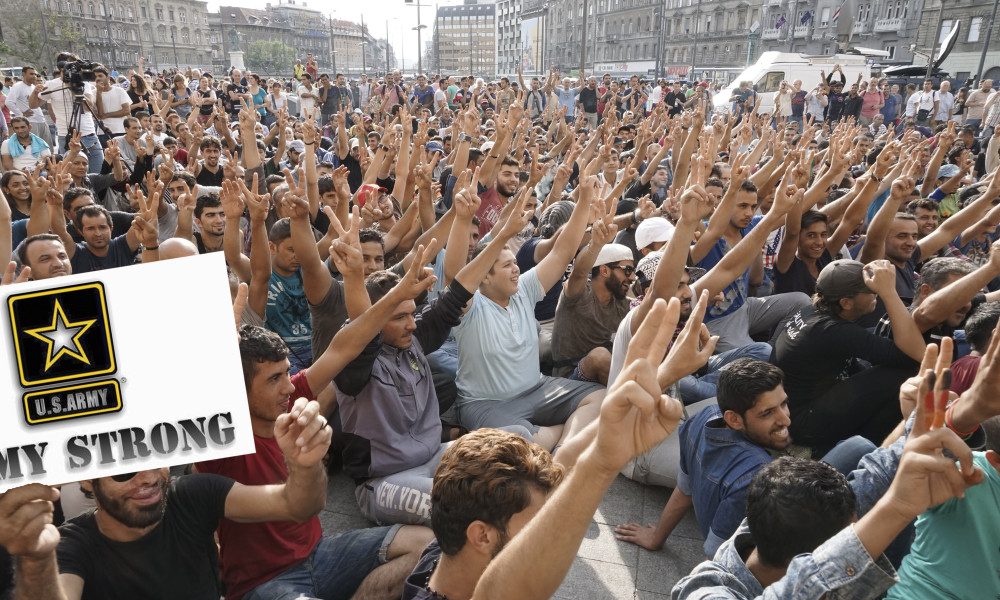
Syrian refugees strike in front of Budapest Keleti railway station. Refugee crisis. Budapest, Hungary, Central Europe, 3 September 2015.

Syrian refugees strike in front of Budapest Keleti railway station. Refugee crisis. Budapest, Hungary, Central Europe, 3 September 2015.

WASHINGTON — Early Wednesday, Pentagon officials announced that the Army will spend $2 billion this year to recruit 20,000 migrants currently fleeing Syria in an attempt to meet their retention goal for fiscal year 2015.

“We have tried everything so far but keep falling short,” said Maj. Gen. Thomas Semands, commander of Army Human Resources Command. “I’ve let in all the gays, transgendereds, and everyone in between. We’re even pretending we will let women serve in the infantry. I guess the next step is to let the deserters of other nations join, eh?”

When told that his microphone was live, Semands added, “What I really mean is, you know, diversity is our strength!”

While some countries in Europe have dedicated tents and funds set aside for incoming asylum-seekers, top Army officials will take it to the next level with barracks and “hot chow” upon their oath of enlistment, pointing out that Germany’s history of building camps is “not that great.”

“We are going to win their hearts and minds whether they like it or not,” said a drill sergeant driving a van picking up refugees in Tampa to bus them to Fort Jackson. “I’m hoping to get to train some of those Muslim cuties over there in the burqas, preferably the one with the pretty eyes.”

“Many of these new recruits have mentioned that they have college degrees. Of course, asking for documentation would be rude given the circumstances,” Semands said. “Needless to say, we are looking forward to adding our newest wave of second lieutenants.”


Islamic State grows in Afghanistan, encroaches on Kabul as U.S. remains ‘passive observer’

October 12, 2015

Islamic State grows in Afghanistan, encroaches on Kabul as U.S. remains ‘passive observer’ Washington TimesRowan Scarborough, October 11, 2015

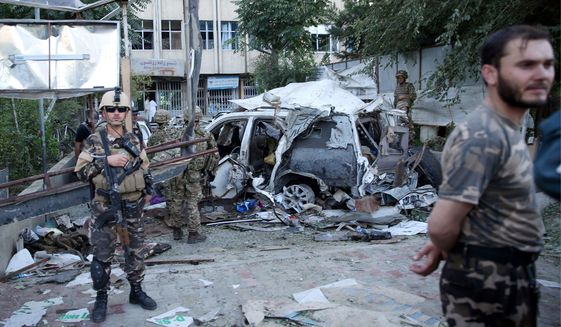
10112015_afghan8201_c0-275-5060-3224_s561x327Photo by: Massoud Hossaini  Afghan security forces and British soldiers inspect the site of a suicide attack in the heart of Kabul, Afghanistan. Loyalists of the Islamic State group are making inroads into Afghanistan, with homegrown militants claiming allegiance to the Islamic State as it controls territory in some parts of the country. (Associated Press)

Afghanistan’s 3,000-member ISIL army is about one-tenth the size of the Afghan Taliban’s forces. But NATO says the Islamic State has reached the next stage of being an emerging threat. If its growth in other regions, such as North Africa, is a gauge, its Afghan component will only expand further as young Muslims are drawn by social media to its ultraviolent ways and Sunni orthodoxy.

************************

The Islamic State is growing at an alarming rate in Afghanistan, within striking distance of the capital, and there does not seem to be a concerted U.S. effort to strike the terrorist army as there is in the Syria-Iraq war theater.

An independent think tank has concluded that the allies are “reacting disjointedly and ineffectively” to the group in Afghanistan and other places outside those two countries.

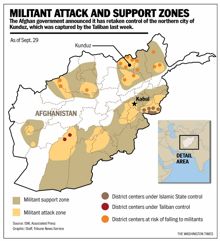
The Islamic State’s numbers now may reach as high as 3,000 in Afghanistan, mostly in Nangarhar province, less than 50 miles east of Kabul. The emergence presents the NATO-backed elected government there with a fifth deadly enemy in addition to the Taliban, al Qaeda, the Haqqani network and elements of the Pakistani intelligence service.

Globally, the Islamic State, also called ISIL and ISIS, has affiliates in nearly 20 countries.

“It’s like a metastasizing cancer spreading throughout certain parts of the Islamic world,” said James Russell, a former Pentagon official and an instructor at the Naval Postgraduate School in Monterey, California. “We have to hope that the antibodies in these societies can ward off the death, misery and destruction that will come raining down upon them if ISIS takes hold in their communities.”

ISIS_s220x241

Afghanistan’s 3,000-member ISIL army is about one-tenth the size of the Afghan Taliban’s forces. But NATO says the Islamic State has reached the next stage of being an emerging threat. If its growth in other regions, such as North Africa, is a gauge, its Afghan component will only expand further as young Muslims are drawn by social media to its ultraviolent ways and Sunni orthodoxy.

Yet unlike in Syria and Iraq, where a U.S.-led coalition conducts a series of daily airstrikes against the Islamic State, there appears to be no such strategy in Afghanistan, where Afghan government forces now have the lead in all combat operations and request NATO air power on an ad hoc basis.

“What concerns me most is the fact that the United States has become a passive observer rather than the driver of the policy,” said Larry Johnson, a former counterterrorism official at the State Department, commenting on the overall U.S. effort against the Islamic State.

U.S. military spokesmen had no immediate comment on the question of American policy toward the Afghan Islamic State. Army Gen. John Campbell, the allied commander in-country, was asked at congressional hearings last week what triggers action against Islamic State. He answered that the criterion is “force protection.”

After the Syria-Iraq war theater, Islamic State’s emergence near Kabul could be the most troublesome for the U.S., whose troop levels have dropped to less than 10,000, and only a small portion of those forces are dedicated to assist in counterterrorism. The Islamic State has shown it can execute brutal attacks and deploy vehicle bombs to take territory and hold it.

Gen. Campbell said Afghanistan’s security forces lack the leadership and troop numbers to respond to every trouble spot.

Meanwhile, the Islamic State is beginning to flex its terrorism muscle in Afghanistan.

Islamic militant competition

The Institute for the Study of War (ISW) in Washington is tracking the Islamic State’s violent ways in Afghanistan and other countries. It said the Islamic State launched attacks in mid-September against a UNICEF convoy, Afghan government forces, the Afghan Taliban and Shiite civilians. In late September the Islamic State “launched coordinated attacks on multiple Afghan security positions” in Nangarhar, the think tank said.

“The group reportedly also shut down several schools in eastern Afghanistan amid other efforts to assert social control,” the institute said. “ISIS has established robust ground campaigns in Libya, Egypt and Afghanistan.”

The ISW said in the special report “ISIS Global Strategy: A Wargame,” written by counterterrorism analyst Harleen Gambhir, that the Islamic State’s expansion stems from its ability to attract local jihadis.

“The coalition is focused on Iraq and Syria, and it is reacting disjointedly and ineffectively to ISIS’s activities in Libya, Egypt, Afghanistan, and other places,” Ms. Gambhir writes. “ISW’s war game demonstrated how this failure enables ISIS to strategically outpace the U.S. and its allies.”

U.S. intelligence agencies are still trying to digest the meaning of Islamic State setting up shop in South Asia.

Nicholas Rasmussen, director of the National Counterterrorism Center, speaks of an “increasing competition between extremist actors” in the Afghanistan-Pakistan region involving al Qaeda, the Taliban and the Islamic State.

“So that’s an additional factor that we’re still trying to understand,” Mr. Rasmussen told the Combating Terrorism Center at West Point in remarks published last month. He characterized the burgeoning competition as an “interesting feature of the South Asia landscape.”

Gen. Campbell, the U.S. commander closest to Islamic State terrorism in Afghanistan, said foreign fighters are arriving to join the Islamic State as they “try to bring in some sort of funding stream to build a place in Nangarhar.”

He said the emergence of Islamic State “has further complicated the theater landscape and potentially expanded the conflict.”

Mr. Johnson, the former counterterrorism official, said the leaders of Middle East and South Asia countries “concede that the U.S. has no appetite for being engaged, especially militarily in the region.”

The struggle between two radical Sunni groups, the Taliban and the Islamic State, may be sparked in part by the Taliban’s willingness to do business with Iran, a Shiite Islamic country.

“The Taliban have always been far more pragmatic in dealing with Iran, and the religious difference is not a critical factor,” Mr. Johnson said. “Not so with the ISIS crowd. For them, theology takes precedence, and Iran is an apostate state that must be destroyed.”

Judge Jeanine: New world order emerging thanks to Obama

October 6, 2015

Judge Jeanine: New world order emerging thanks to Obama, Fox News via You Tube, October 4, 2015


Cartoons of the day

October 6, 2015

H/t Townhall

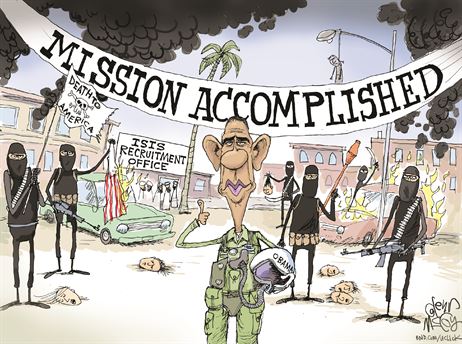
Mission accomplished

H/t Vermont Loon Watch

toys